


Roger I of Sicily

Encyclopedia
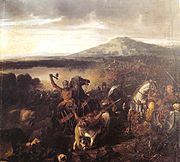
Norman conquest of southern Italy
The Norman conquest of southern Italy spanned the late eleventh and much of the twelfth centuries, involving many battles and many independent players conquering territories of their own...
.
Conquest of Calabria and Sicily
Roger was the youngest son of Tancred of HautevilleTancred of Hauteville
Tancred of Hauteville was an 11th-century Norman petty lord about whom little is known. His historical importance comes entirely from the accomplishments of his sons and later descendants...
by his second wife Fredisenda, and the great great grandson of Hiallt
Hiallt
Hiallt was a Norseman who settled in Normandy, France in the 10th century, following the success of Rollo 1st Duke of Normandy and the Treaty of Saint-Clair-sur-Epte. He settled in the Cotentin Peninsula and founded the village of Hialtus Villa...
believed to be the name of a Norseman (Viking)
Norsemen
Norsemen is used to refer to the group of people as a whole who spoke what is now called the Old Norse language belonging to the North Germanic branch of Indo-European languages, especially Norwegian, Icelandic, Faroese, Swedish and Danish in their earlier forms.The meaning of Norseman was "people...
who settled in Normandy
Normandy
Normandy is a geographical region corresponding to the former Duchy of Normandy. It is in France.The continental territory covers 30,627 km² and forms the preponderant part of Normandy and roughly 5% of the territory of France. It is divided for administrative purposes into two régions:...
, in the 10th century. Roger arrived in Southern Italy soon after 1055. Geoffrey Malaterra, who compares Robert Guiscard
Robert Guiscard
Robert d'Hauteville, known as Guiscard, Duke of Apulia and Calabria, from Latin Viscardus and Old French Viscart, often rendered the Resourceful, the Cunning, the Wily, the Fox, or the Weasel was a Norman adventurer conspicuous in the conquest of southern Italy and Sicily...
and his brother to "Joseph
Joseph (Hebrew Bible)
Joseph is an important character in the Hebrew bible, where he connects the story of Abraham, Isaac and Jacob in Canaan to the subsequent story of the liberation of the Israelites from slavery in Egypt....
and Benjamin
Benjamin
Benjamin was the last-born of Jacob's twelve sons, and the second and last son of Rachel in Jewish, Christian and Islamic tradition. He was the founder of the Israelite Tribe of Benjamin. In the Biblical account, unlike Rachel's first son, Joseph, Benjamin was born in Canaan. He died in Egypt on...
of old," says of Roger: "He was a youth of the greatest beauty, of lofty stature, of graceful shape, most eloquent in speech and cool in counsel. He was far-seeing in arranging all his actions, pleasant and merry all with men; strong and brave, and furious in battle." For a time Roger lived like a bandit in his castle of Scalea
Scalea
Scalea is a town and comune in the province of Cosenza in the Calabria region of southern Italy.The town takes its name from its terraced lay-out on the hillside, at the bottom of the Capo Scalea promontory...
, on the Gulf of Policastro. He shared the conquest of Calabria
Calabria
Calabria , in antiquity known as Bruttium, is a region in southern Italy, south of Naples, located at the "toe" of the Italian Peninsula. The capital city of Calabria is Catanzaro....
with Robert, and in a treaty of 1062 the brothers in dividing the conquest apparently made a kind of "condominium" by which either was to have half of every castle and town in Calabria.
Robert now resolved to employ Roger's genius in reducing Sicily
Sicily
Sicily is a region of Italy, and is the largest island in the Mediterranean Sea. Along with the surrounding minor islands, it constitutes an autonomous region of Italy, the Regione Autonoma Siciliana Sicily has a rich and unique culture, especially with regard to the arts, music, literature,...
, which contained, besides the Muslims, numerous Greek Christians subject to Arab princes who had become all but independent of the sultan of Tunis
Tunis
Tunis is the capital of both the Tunisian Republic and the Tunis Governorate. It is Tunisia's largest city, with a population of 728,453 as of 2004; the greater metropolitan area holds some 2,412,500 inhabitants....
. In May 1061 the brothers crossed from Reggio
Reggio Calabria
Reggio di Calabria , commonly known as Reggio Calabria or Reggio, is the biggest city and the most populated comune of Calabria, southern Italy, and is the capital of the Province of Reggio Calabria and seat of the Council of Calabrian government.Reggio is located on the "toe" of the Italian...
and captured Messina. After Palermo
Palermo
Palermo is a city in Southern Italy, the capital of both the autonomous region of Sicily and the Province of Palermo. The city is noted for its history, culture, architecture and gastronomy, playing an important role throughout much of its existence; it is over 2,700 years old...
had been taken in January 1072, Robert Guiscard, as suzerain, invested Roger as Count of Sicily, but he retained Palermo, half of Messina, and the north-east portion (the Val Demone). Not till 1085, however, was Roger able to undertake a systematic conquest.
In March 1086 Syracuse
Syracuse, Italy
Syracuse is a historic city in Sicily, the capital of the province of Syracuse. The city is notable for its rich Greek history, culture, amphitheatres, architecture, and as the birthplace of the preeminent mathematician and engineer Archimedes. This 2,700-year-old city played a key role in...
surrendered, and when in February 1091 Noto
Noto
Noto is a city and comune in the Province of Syracuse, Sicily . Its located 32 km southwest of the city of Syracuse at the foot of the Iblean Mountains and gives its name to the surrounding valley, Val di Noto...
yielded, the conquest was complete. Much of Robert's success had been due to Roger's support. Similarly, when the leadership of the Hautevilles passed to Roger, he supported his nephew Duke Roger
Roger Borsa
Roger Borsa was the Norman Duke of Apulia and effective ruler of southern Italy from 1085 until his death. He was the son of Robert Guiscard, the conqueror of southern Italy and Sicily; Roger was not as adept as his father, and most of his reign was spent in feudal anarchy.-Biography:Roger was the...
against Bohemund I of Antioch
Bohemund I of Antioch
Bohemond I , Prince of Taranto and Prince of Antioch, was one of the leaders of the First Crusade. The Crusade had no outright military leader, but instead was ruled by a committee of nobles...
, Lando IV of Capua
Lando IV of Capua
Lando IV was the last independent Lombard ruler in Italy. He was the prince of Capua after leading a local rebellion of the citizens of the city against the Norman prince Richard II, then a minor, in 1091...
, and other rebels. In return for his aid against Bohemund and the rebels, the duke surrendered his share in the castles of Calabria to his uncle in 1085, and in 1091 his inheritance in Palermo. Roger's rule in Sicily was more absolute than Robert Guiscard's in Italy. At the enfeoffments of 1072 and 1092 no great undivided fiefs were created, so the mixed Norman, French and Italian vassals all owed their benefices to the count. No feudal revolt of importance therefore troubled Roger.
Conquest of Malta
In 1091 Roger, in order to avoid an attack from North Africa, set sail with a fleet to conquer MaltaMalta
Malta , officially known as the Republic of Malta , is a Southern European country consisting of an archipelago situated in the centre of the Mediterranean, south of Sicily, east of Tunisia and north of Libya, with Gibraltar to the west and Alexandria to the east.Malta covers just over in...
. His ship reached the island before the rest. On landing, the few defenders the Normans encountered retreated and the following day Roger marched to the capital Mdina
Mdina
Mdina, Città Vecchia, or Città Notabile, is the old capital of Malta. Mdina is a medieval walled town situated on a hill in the centre of the island. Punic remains uncovered beyond the city’s walls suggest the importance of the general region to Malta’s Phoenician settlers. Mdina is commonly...
. Terms were discussed with the local qadi
Qadi
Qadi is a judge ruling in accordance with Islamic religious law appointed by the ruler of a Muslim country. Because Islam makes no distinction between religious and secular domains, qadis traditionally have jurisdiction over all legal matters involving Muslims...
. It was agreed that the islands would become tributaries
Tribute
A tribute is wealth, often in kind, that one party gives to another as a sign of respect or, as was often the case in historical contexts, of submission or allegiance. Various ancient states, which could be called suzerains, exacted tribute from areas they had conquered or threatened to conquer...
of the count himself and that the qadi should continue to administer the islands. With the treaty many Greek and other Christian prisoners were released, who chanted to Roger the Kyrie eleison (Mulej Ħniena). He left the islands with many who wished to join him and so many were on his ship that it nearly sunk, according to Geoffrey Malaterra.
Rule of Sicily
Politically supreme, the count also became master of the insular church. The Papacy, favouring a prince who had recovered Sicily from Greeks and Muslims, in 1098 granted Roger and his heirs the Apostolic LegateshipNuncio
Nuncio is an ecclesiastical diplomatic title, derived from the ancient Latin word, Nuntius, meaning "envoy." This article addresses this title as well as derived similar titles, all within the structure of the Roman Catholic Church...
of the island. Roger created new Latin bishoprics at Syracuse
Syracuse, Italy
Syracuse is a historic city in Sicily, the capital of the province of Syracuse. The city is notable for its rich Greek history, culture, amphitheatres, architecture, and as the birthplace of the preeminent mathematician and engineer Archimedes. This 2,700-year-old city played a key role in...
, Girgenti
Agrigento
Agrigento , is a city on the southern coast of Sicily, Italy, and capital of the province of Agrigento. It is renowned as the site of the ancient Greek city of Akragas , one of the leading cities of Magna Graecia during the golden...
and elsewhere, nominating the bishops personally, while he turned the archbishopric of Palermo into a Catholic
Catholic
The word catholic comes from the Greek phrase , meaning "on the whole," "according to the whole" or "in general", and is a combination of the Greek words meaning "about" and meaning "whole"...
see. He practiced general toleration towards Arabs and Greeks. In the cities, the Muslims, who had generally secured such rights in their terms of surrender, retained their mosques, their kadis, and freedom of trade; in the country, however, they became serfs. Roger drew the mass of his infantry from the Muslims; Saint Anselm
Anselm of Canterbury
Anselm of Canterbury , also called of Aosta for his birthplace, and of Bec for his home monastery, was a Benedictine monk, a philosopher, and a prelate of the church who held the office of Archbishop of Canterbury from 1093 to 1109...
, visiting him at the siege of Capua
Siege of Capua
The Siege of Capua was a military operation involving the states of medieval southern Italy, beginning in May 1098 and lasting forty days. It was an interesting siege historically for the assemblage of great persons it saw and militarily for the cooperation of Norman and Saracen forces which it...
, 1098, found "the brown tents of the Arabs innumerable". Nevertheless, the Latin element began to prevail, as Lombards and other Italians flocked to the island in the wake of the conquest, and the conquest of Sicily proved decisive in the steady decline of Muslim power in the western Mediterranean from this time.
Family
Roger's eldest son was a bastard named JordanJordan of Hauteville
Jordan of Hauteville was the eldest son and bastard of Roger I of Sicily. A fighter, he took part, from an early age, in the conquests of his father in Sicily....
, who predeceased him. His second son, Geoffrey
Geoffrey, Count of Ragusa
Geoffrey or Godfrey was the second eldest son of Roger I of Sicily. He was probably a bastard, like his elder brother Jordan, but he may have been legitimate, either the son of Judith of Évreux or Eremburga of Mortain. Either way, he stood no chance of inheriting, for he had leprosy , or some...
, may have been a bastard, but may also have been a son of his first or second wife. Whatever the case, he was a leper with no chance of inheriting.
Roger's first marriage took place in 1061, to Judith, daughter of William, Count of Évreux and Hawisa of Échauffour. She died in 1076, leaving all daughters:
- A daughter, married Hugh of Gircea (died 1075/6), the first count of PaternòPaternòPaternò is a town and comune in the Province of Catania, Sicily, southern Italy.-History:The site of Paternò was settled before 3500 BCE. Its inhabitants were probably the Sicani, although it was located in mainly Sicel territory; its initial name was Inessa. The modern name derives form the Greek...
- Matilda (1062 – before 1094) married firstly (repudiated before 1080) as his second wife, Robert, Count of Eu married secondly (1080, divorced 1088) as his second wife, Raymond IV of ToulouseRaymond IV of ToulouseRaymond IV of Toulouse , sometimes called Raymond of St Gilles, was Count of Toulouse, Duke of Narbonne, and Margrave of Provence and one of the leaders of the First Crusade. He was a son of Pons of Toulouse and Almodis de La Marche...
- Adelisa (died 1096), married in 1083 to Henry, Count of Monte Sant'AngeloHenry, Count of Monte Sant'AngeloHenry was the Count of Monte Sant'Angelo, with his seat at Foggia, from November 1081.He was the second son of Robert, Count of Lucera, and Gaitelgrima, daughter of Guaimar IV of Salerno. The identity of his father is disputable...
- Emma (died 1120), briefly engaged to Philip I of FrancePhilip I of FrancePhilip I , called the Amorous, was King of France from 1060 to his death. His reign, like that of most of the early Direct Capetians, was extraordinarily long for the time...
; married firstly William VI of AuvergneWilliam VI of AuvergneWilliam VI of Auvergne was a French count of the historically independent region of Auvergne, today in central France.He was married to Emma, daughter of Roger I of Sicily in 1086/1087, they had issue:* Robert III ....
and secondly Rudolf, Count of MontescagliosoRudolf, Count of MontescagliosoRudolf was the second Norman count of Montescaglioso from the death of his father Robert in 1080....
.
In 1077, Roger married a second time, to Eremburga of Mortain, daughter of "William, Count of Mortain" (probably William Warlenc).
Their children were:
- Mauger, Count of TroinaMauger, Count of TroinaMauger was the third eldest and probably eldest legitimate son of Roger I of Sicily. He was the son of his second wife, Eremburga of Mortain. His father made him count of Troina, but little else of him is known. He died after 1098, but when is uncertain and if he outlived his father he made no...
- Matilda, married Guigues III, Count of Albon
- Muriel (died 1119), married Josbert de LucyDe Lucyde Lucy or de Luci is the surname of an old Norman noble family originating from Lucé in Normandy, one of the great baronial Anglo-Norman families which became rooted in England after the Norman conquest. The first records are about Adrian de Luci who went into England after William the Conqueror...
- ConstanciaConstanze of SicilyConstance of Sicily was the Queen consort of Conrad II of Italy.-Family:She was a daughter of Roger I of Sicily and Eremburga of Mortain. Her maternal grandfather was "William, Count of Mortain" ....
, married Conrad of ItalyConrad of ItalyConrad II was the second son of Holy Roman Emperor Henry IV. As such, he was King of Germany from 1087 to 1098 and also King of Italy from 1093 to 1098.... - FeliciaFelicia of SicilyFelicia of Sicily was a Queen Consort of Hungary.Felicia was the eldest daughter of Count Roger I of Sicily, and his second wife, Eremburga of Mortain...
, married King Coloman of Hungary - Violante, married Robert of Burgundy, son of Robert I of BurgundyRobert I, Duke of BurgundyRobert I Capet or Robert I of Burgundy, known as Robert the Old was duke of Burgundy between 1032 to his death...
- Flandina, married Henry del VastoHenry del VastoHenry del Vasto was a son of Manfred del Vasto, margrave of Western Liguria, and brother of Adelaide, countess of Sicily and Jerusalem ....
- Judith (died 1136), married Robert I of Bassunvilla
Roger's third and last wife was Adelaide del Vasto
Adelaide del Vasto
Adelaide del Vasto was the third wife of Roger I of Sicily and mother of Roger II of Sicily, as well as Queen consort of Jerusalem due to her later marriage to Baldwin I of Jerusalem, as his third wife.-Family:She was the daughter of Manfred del Vasto Adelaide del Vasto (Adelasia, Azalaïs) (c....
, niece of Boniface
Boniface del Vasto
Boniface del Vasto was the margrave of Western Liguria from 1084 to 1125, the son and successor of Otto. He was of the Aleramici family, which also furnished the margraves of Montferrat...
, Lord of Savona. They married in 1087. Their children were:
- Simon, Count of SicilySimon, Count of SicilySimon of Hauteville , called Simon de Hauteville in French and Simone D'Altavilla in Italian, was the eldest son and successor of Roger the Great Count, count of Sicily, and Adelaide del Vasto, under whose regency he reigned....
- Matilda, married Ranulf II, Count of AlifeRanulf II, Count of AlifeRanulf II was the count of Alife and Caiazzo, and for a contested period, Duke of Apulia. He was a member of the Norman Drengot clan which ruled Aversa and Capua for most of the century between 1050 and 1150. As the third Ranulf in his family he is sometimes called Ranulf III...
- Roger II, Count, later King, of SicilyRoger II of SicilyRoger II was King of Sicily, son of Roger I of Sicily and successor to his brother Simon. He began his rule as Count of Sicily in 1105, later became Duke of Apulia and Calabria , then King of Sicily...
- Maximilla, married Hildebrand VI (of the Aldobrandeschi family)