

Lusitanic

Encyclopedia
Lusitanic from Latin Lusitanicus, adjective from Lusitania
, the name of a Roman
province in the Iberian Peninsula
and one of the two official names for Portugal
(in the Latin language) is a term used to categorize persons who share the linguistic and cultural traditions of the Portuguese
.
When the modern day country of Portugal was created in the 12th century, it inherited the term, and thus, since then, Lusitanic has also meant related to Portugal
, its people
and its culture
. When only referring to the Portuguese language, the word Lusophone
should be used.
The term is not based specifically on race or ethnicity, but rather on a shared cultural and/or linguistic heritage. It is not commonly used outside Portugal and by people of Portuguese descent, nor recognised in everyday usage within the English-speaking world.
The term can be easily compared to Hispanic
- as this term describes those who speak the Spanish language
, have Spanish ancestry
from a Spanish-speaking
nation or otherwise have cultural ties to Spanish-speaking nations.
, prior to the Roman conquest; the lands they inhabited were known as Lusitania
. The Lusitani were mentioned for the first time, by Livy
, as Carthaginian mercenaries who incorporated the army of Hannibal, when he fought the Romans.
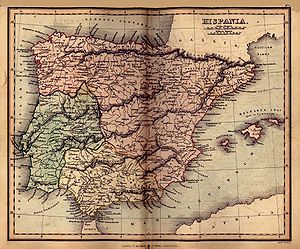
After the conquest of the peninsula (25-20 BC) Augustus
divided it into the southwestern Hispania Baetica
and the western Provincia Lusitana that included the territories of Asturia and Gallaecia
, celtic regions. In 27 BC the Emperor Augustus
made a smaller division of the province: Asturia and Gallaecia were ceded to the jurisdiction of the new Provincia Tarraconensis, the former remained as Provincia Lusitania et Vettones. The Roman province of Lusitania
comprised what is now central and south Portugal
and parts of modern day north-central Spain
.
 Other definitions include Galicia, because Portuguese and Galician share close linguistic and cultural ties, Celt
ties; having both derived from the ancient Portuguese-Galician and the term is cultural classification, rather than a Historic-Geographical definition. However, in the Roman times, the Gallaeci were not part of the Lusitania
province.
Despite all this, the language was born in the old Gallaecia
which comprise what is now Galicia and the region where Portugal was born, north Portugal
.
The term is used like the ones used in other countries that were derived from the long-standing custom among many European countries to revive the Roman names of their country or the name of tribes who lived in it in Roman times, with establishing a "Roman Connection" being considered a way of gaining respectability and legitimacy. In the case of Portugal, use of the term "Lusitan" and its derivatives is attested, for example, in the first Portuguese dictionary "Dictionarium ex Lusitanico in Latinum Sermonem" published in 1569 or the epic poem Os Lusíadas
published in 1572 . A rival Roman-era term available to the Portuguese was Iberia
- but since it referred to the entire peninsula it could be used, and was indeed used, also by the Spanish
.
Portuguese use of "Lusitania" is parallel to the use of Gallia
in France
, Britannia
in England
, Caledonia
in Scotland
, Hibernia
in Ireland
, Batavia in the Netherlands
, Helvetia
in Switzerland
and Germania
in Germany
(called "Deutschland" in its own inhabitants' languague). Belgium
got its actual present name from the Roman Belgica.
is among the most commonly spoken first languages of the world. During the period of the Portuguese Empire
, many people migrated from Portugal to the conquered lands.
. In Portugal the term "hispânico" can be used in two contexts: It has a historical meaning when referring to the people of the Roman Hispania; the contemporary meaning is for Spain-related culture.
There has often been debate as to whether Lusitanics are Hispanic
s, as historical arguments find that the region of Lusitania
was a part of Hispania
- and thus, "Lusitanics" are a subset of "Hispanic
." The same way Spanish-speaking South America
was not a part of Hispania
and the same argument can be applied: if Spanish Latin American people should be called Hispanic. Lusitania
and the Lusitanians
were known long before their conquest by the Roman Empire (Livy 218 b.c.) and incorporated in the Roman province of Hispania
thus can not be considered a subset of "Hispanic
." The contemporary meaning of "Hispanic" is much broader than the historical meaning: in the United States
the term "Hispanic
" was first adopted by the administration of Richard Nixon
and today is one of the several terms of ethnicity employed to categorize any person, of any racial background, of any country and of any religion who has at least one ancestor from the people of Spain
or Spanish-speaking Latin America
, whether or not the person has Spanish
ancestry, Lusitanics are not "Hispanic
" for most ethnic categorization purposes, although it is highly debatable, and there are some exceptions - for instance, the Equal Employment Opportunity Commission has no official position as to whether or not Lusitanic is Hispanic, while the State of Florida classifies Portuguese as Hispanic.
Using the above analogy with Hispanic, then, one definition of Lusitanic would be anyone of any racial background with at least one ancestor from Portugal or from the Lusophonic (Portuguese-speaking) area of Latin America, of Africa, and of Asia. Portuguese immigrants to the Americas
and the inhabitants of the nation
of Brazil
or Brazilians living in Hispanic America
or the United States
would be Lusitanic Americans.
Lusitania
Lusitania or Hispania Lusitania was an ancient Roman province including approximately all of modern Portugal south of the Douro river and part of modern Spain . It was named after the Lusitani or Lusitanian people...
, the name of a Roman
Ancient Rome
Ancient Rome was a thriving civilization that grew on the Italian Peninsula as early as the 8th century BC. Located along the Mediterranean Sea and centered on the city of Rome, it expanded to one of the largest empires in the ancient world....
province in the Iberian Peninsula
Iberian Peninsula
The Iberian Peninsula , sometimes called Iberia, is located in the extreme southwest of Europe and includes the modern-day sovereign states of Spain, Portugal and Andorra, as well as the British Overseas Territory of Gibraltar...
and one of the two official names for Portugal
Portugal
Portugal , officially the Portuguese Republic is a country situated in southwestern Europe on the Iberian Peninsula. Portugal is the westernmost country of Europe, and is bordered by the Atlantic Ocean to the West and South and by Spain to the North and East. The Atlantic archipelagos of the...
(in the Latin language) is a term used to categorize persons who share the linguistic and cultural traditions of the Portuguese
Portuguese language
Portuguese is a Romance language that arose in the medieval Kingdom of Galicia, nowadays Galicia and Northern Portugal. The southern part of the Kingdom of Galicia became independent as the County of Portugal in 1095...
.
When the modern day country of Portugal was created in the 12th century, it inherited the term, and thus, since then, Lusitanic has also meant related to Portugal
Portugal
Portugal , officially the Portuguese Republic is a country situated in southwestern Europe on the Iberian Peninsula. Portugal is the westernmost country of Europe, and is bordered by the Atlantic Ocean to the West and South and by Spain to the North and East. The Atlantic archipelagos of the...
, its people
Portuguese people
The Portuguese are a nation and ethnic group native to the country of Portugal, in the west of the Iberian peninsula of south-west Europe. Their language is Portuguese, and Roman Catholicism is the predominant religion....
and its culture
Culture of Portugal
The culture of Portugal is the result of a complex flow of different civilizations during the past Millennia. From prehistoric cultures, to its Pre-Roman civilizations , passing through its contacts with the Phoenician-Carthaginian world, the Roman period , the...
. When only referring to the Portuguese language, the word Lusophone
Lusophone
A Lusophone is someone who speaks the Portuguese language, either as a native, as an additional language, or as a learner. As an adjective, it means "Portuguese-speaking"...
should be used.
The term is not based specifically on race or ethnicity, but rather on a shared cultural and/or linguistic heritage. It is not commonly used outside Portugal and by people of Portuguese descent, nor recognised in everyday usage within the English-speaking world.
The term can be easily compared to Hispanic
Hispanic
Hispanic is a term that originally denoted a relationship to Hispania, which is to say the Iberian Peninsula: Andorra, Gibraltar, Portugal and Spain. During the Modern Era, Hispanic sometimes takes on a more limited meaning, particularly in the United States, where the term means a person of ...
- as this term describes those who speak the Spanish language
Spanish language
Spanish , also known as Castilian , is a Romance language in the Ibero-Romance group that evolved from several languages and dialects in central-northern Iberia around the 9th century and gradually spread with the expansion of the Kingdom of Castile into central and southern Iberia during the...
, have Spanish ancestry
Spanish people
The Spanish are citizens of the Kingdom of Spain. Within Spain, there are also a number of vigorous nationalisms and regionalisms, reflecting the country's complex history....
from a Spanish-speaking
Hispanophone
Hispanophone or Hispanosphere denotes Spanish language speakers and the Spanish-speaking world. The word derives from the Latin political name of the Iberian Peninsula, Hispania, which comprised basically the territory of the modern states of Spain and Portugal.Hispanophones are estimated at...
nation or otherwise have cultural ties to Spanish-speaking nations.
Etymology
The term derives from the name of one tribe, the Lusitani, that lived in the Western part of the Iberian PeninsulaIberian Peninsula
The Iberian Peninsula , sometimes called Iberia, is located in the extreme southwest of Europe and includes the modern-day sovereign states of Spain, Portugal and Andorra, as well as the British Overseas Territory of Gibraltar...
, prior to the Roman conquest; the lands they inhabited were known as Lusitania
Lusitania
Lusitania or Hispania Lusitania was an ancient Roman province including approximately all of modern Portugal south of the Douro river and part of modern Spain . It was named after the Lusitani or Lusitanian people...
. The Lusitani were mentioned for the first time, by Livy
Livy
Titus Livius — known as Livy in English — was a Roman historian who wrote a monumental history of Rome and the Roman people. Ab Urbe Condita Libri, "Chapters from the Foundation of the City," covering the period from the earliest legends of Rome well before the traditional foundation in 753 BC...
, as Carthaginian mercenaries who incorporated the army of Hannibal, when he fought the Romans.
After the conquest of the peninsula (25-20 BC) Augustus
Augustus
Augustus ;23 September 63 BC – 19 August AD 14) is considered the first emperor of the Roman Empire, which he ruled alone from 27 BC until his death in 14 AD.The dates of his rule are contemporary dates; Augustus lived under two calendars, the Roman Republican until 45 BC, and the Julian...
divided it into the southwestern Hispania Baetica
Hispania Baetica
Hispania Baetica was one of three Imperial Roman provinces in Hispania, . Hispania Baetica was bordered to the west by Lusitania, and to the northeast by Hispania Tarraconensis. Baetica was part of Al-Andalus under the Moors in the 8th century and approximately corresponds to modern Andalucia...
and the western Provincia Lusitana that included the territories of Asturia and Gallaecia
Gallaecia
Gallaecia or Callaecia, also known as Hispania Gallaecia, was the name of a Roman province and an early Mediaeval kingdom that comprised a territory in the north-west of Hispania...
, celtic regions. In 27 BC the Emperor Augustus
Augustus
Augustus ;23 September 63 BC – 19 August AD 14) is considered the first emperor of the Roman Empire, which he ruled alone from 27 BC until his death in 14 AD.The dates of his rule are contemporary dates; Augustus lived under two calendars, the Roman Republican until 45 BC, and the Julian...
made a smaller division of the province: Asturia and Gallaecia were ceded to the jurisdiction of the new Provincia Tarraconensis, the former remained as Provincia Lusitania et Vettones. The Roman province of Lusitania
Lusitania
Lusitania or Hispania Lusitania was an ancient Roman province including approximately all of modern Portugal south of the Douro river and part of modern Spain . It was named after the Lusitani or Lusitanian people...
comprised what is now central and south Portugal
Portugal
Portugal , officially the Portuguese Republic is a country situated in southwestern Europe on the Iberian Peninsula. Portugal is the westernmost country of Europe, and is bordered by the Atlantic Ocean to the West and South and by Spain to the North and East. The Atlantic archipelagos of the...
and parts of modern day north-central Spain
Spain
Spain , officially the Kingdom of Spain languages]] under the European Charter for Regional or Minority Languages. In each of these, Spain's official name is as follows:;;;;;;), is a country and member state of the European Union located in southwestern Europe on the Iberian Peninsula...
.
Celt
The Celts were a diverse group of tribal societies in Iron Age and Roman-era Europe who spoke Celtic languages.The earliest archaeological culture commonly accepted as Celtic, or rather Proto-Celtic, was the central European Hallstatt culture , named for the rich grave finds in Hallstatt, Austria....
ties; having both derived from the ancient Portuguese-Galician and the term is cultural classification, rather than a Historic-Geographical definition. However, in the Roman times, the Gallaeci were not part of the Lusitania
Lusitania
Lusitania or Hispania Lusitania was an ancient Roman province including approximately all of modern Portugal south of the Douro river and part of modern Spain . It was named after the Lusitani or Lusitanian people...
province.
Despite all this, the language was born in the old Gallaecia
Gallaecia
Gallaecia or Callaecia, also known as Hispania Gallaecia, was the name of a Roman province and an early Mediaeval kingdom that comprised a territory in the north-west of Hispania...
which comprise what is now Galicia and the region where Portugal was born, north Portugal
Portugal
Portugal , officially the Portuguese Republic is a country situated in southwestern Europe on the Iberian Peninsula. Portugal is the westernmost country of Europe, and is bordered by the Atlantic Ocean to the West and South and by Spain to the North and East. The Atlantic archipelagos of the...
.
The term is used like the ones used in other countries that were derived from the long-standing custom among many European countries to revive the Roman names of their country or the name of tribes who lived in it in Roman times, with establishing a "Roman Connection" being considered a way of gaining respectability and legitimacy. In the case of Portugal, use of the term "Lusitan" and its derivatives is attested, for example, in the first Portuguese dictionary "Dictionarium ex Lusitanico in Latinum Sermonem" published in 1569 or the epic poem Os Lusíadas
Os Lusíadas
Os Lusíadas , usually translated as The Lusiads, is a Portuguese epic poem by Luís Vaz de Camões ....
published in 1572 . A rival Roman-era term available to the Portuguese was Iberia
Iberian Peninsula
The Iberian Peninsula , sometimes called Iberia, is located in the extreme southwest of Europe and includes the modern-day sovereign states of Spain, Portugal and Andorra, as well as the British Overseas Territory of Gibraltar...
- but since it referred to the entire peninsula it could be used, and was indeed used, also by the Spanish
Spanish people
The Spanish are citizens of the Kingdom of Spain. Within Spain, there are also a number of vigorous nationalisms and regionalisms, reflecting the country's complex history....
.
Portuguese use of "Lusitania" is parallel to the use of Gallia
Gallia
Gallia may refer to:*Gaul , the region of Western Europe occupied by present-day France, Belgium and other neighbouring countries...
in France
France
The French Republic , The French Republic , The French Republic , (commonly known as France , is a unitary semi-presidential republic in Western Europe with several overseas territories and islands located on other continents and in the Indian, Pacific, and Atlantic oceans. Metropolitan France...
, Britannia
Britannia
Britannia is an ancient term for Great Britain, and also a female personification of the island. The name is Latin, and derives from the Greek form Prettanike or Brettaniai, which originally designated a collection of islands with individual names, including Albion or Great Britain. However, by the...
in England
England
England is a country that is part of the United Kingdom. It shares land borders with Scotland to the north and Wales to the west; the Irish Sea is to the north west, the Celtic Sea to the south west, with the North Sea to the east and the English Channel to the south separating it from continental...
, Caledonia
Caledonia
Caledonia is the Latinised form and name given by the Romans to the land in today's Scotland north of their province of Britannia, beyond the frontier of their empire...
in Scotland
Scotland
Scotland is a country that is part of the United Kingdom. Occupying the northern third of the island of Great Britain, it shares a border with England to the south and is bounded by the North Sea to the east, the Atlantic Ocean to the north and west, and the North Channel and Irish Sea to the...
, Hibernia
Hibernia
Hibernia is the Classical Latin name for the island of Ireland. The name Hibernia was taken from Greek geographical accounts. During his exploration of northwest Europe , Pytheas of Massilia called the island Ierne . In his book Geographia Hibernia is the Classical Latin name for the island of...
in Ireland
Ireland
Ireland is an island to the northwest of continental Europe. It is the third-largest island in Europe and the twentieth-largest island on Earth...
, Batavia in the Netherlands
Netherlands
The Netherlands is a constituent country of the Kingdom of the Netherlands, located mainly in North-West Europe and with several islands in the Caribbean. Mainland Netherlands borders the North Sea to the north and west, Belgium to the south, and Germany to the east, and shares maritime borders...
, Helvetia
Helvetia
Helvetia is the female national personification of Switzerland, officially Confœderatio Helvetica, the "Helvetic Confederation".The allegory is typically pictured in a flowing gown, with a spear and a shield emblazoned with the Swiss flag, and commonly with braided hair, commonly with a wreath as...
in Switzerland
Switzerland
Switzerland name of one of the Swiss cantons. ; ; ; or ), in its full name the Swiss Confederation , is a federal republic consisting of 26 cantons, with Bern as the seat of the federal authorities. The country is situated in Western Europe,Or Central Europe depending on the definition....
and Germania
Germania
Germania was the Greek and Roman geographical term for the geographical regions inhabited by mainly by peoples considered to be Germani. It was most often used to refer especially to the east of the Rhine and north of the Danube...
in Germany
Germany
Germany , officially the Federal Republic of Germany , is a federal parliamentary republic in Europe. The country consists of 16 states while the capital and largest city is Berlin. Germany covers an area of 357,021 km2 and has a largely temperate seasonal climate...
(called "Deutschland" in its own inhabitants' languague). Belgium
Belgium
Belgium , officially the Kingdom of Belgium, is a federal state in Western Europe. It is a founding member of the European Union and hosts the EU's headquarters, and those of several other major international organisations such as NATO.Belgium is also a member of, or affiliated to, many...
got its actual present name from the Roman Belgica.
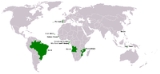
Portuguese-speaking countries and regions
Today, PortuguesePortuguese language
Portuguese is a Romance language that arose in the medieval Kingdom of Galicia, nowadays Galicia and Northern Portugal. The southern part of the Kingdom of Galicia became independent as the County of Portugal in 1095...
is among the most commonly spoken first languages of the world. During the period of the Portuguese Empire
Portuguese Empire
The Portuguese Empire , also known as the Portuguese Overseas Empire or the Portuguese Colonial Empire , was the first global empire in history...
, many people migrated from Portugal to the conquered lands.
| Portuguese speaking countries Portuguese language Portuguese is a Romance language that arose in the medieval Kingdom of Galicia, nowadays Galicia and Northern Portugal. The southern part of the Kingdom of Galicia became independent as the County of Portugal in 1095... |
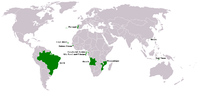 |
Note: Portuguese is identified as a co-official language in some countries. See also: List of countries where Portuguese is an official language. |
| Continent/Region | Country/Territory | Languages Spoken | Ethnic Groups | Picture | References |
|---|---|---|---|---|---|
| Europe Europe Europe is, by convention, one of the world's seven continents. Comprising the westernmost peninsula of Eurasia, Europe is generally 'divided' from Asia to its east by the watershed divides of the Ural and Caucasus Mountains, the Ural River, the Caspian and Black Seas, and the waterways connecting... |
Portugal Portugal Portugal , officially the Portuguese Republic is a country situated in southwestern Europe on the Iberian Peninsula. Portugal is the westernmost country of Europe, and is bordered by the Atlantic Ocean to the West and South and by Spain to the North and East. The Atlantic archipelagos of the... |
Portuguese (official) (Portuguese is spoken by 100% of the population, over 100% indicates bilingual population). | 96.87% Portuguese Portuguese people The Portuguese are a nation and ethnic group native to the country of Portugal, in the west of the Iberian peninsula of south-west Europe. Their language is Portuguese, and Roman Catholicism is the predominant religion.... and 3.13% legal immigrants (2007) |
||
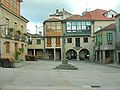
| Galicia | Portuguese (official) (Portuguese is officially called Galician Galician language Galician is a language of the Western Ibero-Romance branch, spoken in Galicia, an autonomous community located in northwestern Spain, where it is co-official with Castilian Spanish, as well as in border zones of the neighbouring territories of Asturias and Castile and León.Modern Galician and... , spoken by 48% of monolingual population and 47% of bilingual). |
88% Galician Galician people The Galicians are an ethnic group, a nationality whose historical homeland is Galicia in north-western Spain. Most Galicians are bilingual, speaking both their historic language, Galician, and Castilian Spanish.-Political and administrative divisions:... and 12% immigrants from Spain (9%) and other countries (3%) |
 |
||
| South America South America South America is a continent situated in the Western Hemisphere, mostly in the Southern Hemisphere, with a relatively small portion in the Northern Hemisphere. The continent is also considered a subcontinent of the Americas. It is bordered on the west by the Pacific Ocean and on the north and east... |
Brazil Brazil Brazil , officially the Federative Republic of Brazil , is the largest country in South America. It is the world's fifth largest country, both by geographical area and by population with over 192 million people... |
Portuguese (official and most widely spoken language) | white 53.7%, pardos (brown people, accultured native populations or mixed white, black and/or amerindian) 38.5%, black 6.2%, other (includes Asians, other Latin Americans, Pacific Islanders and Indigenous Brazilians) 0.9%, unspecified 0.7%. Defined by skin color and not ethnicity. Multiracial people can both self-identify and be accepted as white, black, Asian or Amerindian. (2000 census) | 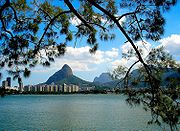 |
|
| Africa Africa Africa is the world's second largest and second most populous continent, after Asia. At about 30.2 million km² including adjacent islands, it covers 6% of the Earth's total surface area and 20.4% of the total land area... |
Angola Angola Angola, officially the Republic of Angola , is a country in south-central Africa bordered by Namibia on the south, the Democratic Republic of the Congo on the north, and Zambia on the east; its west coast is on the Atlantic Ocean with Luanda as its capital city... |
Portuguese (official), Bantu and other African languages | Ovimbundu 37%, Kimbundu 25%, Bakongo 13%, mestiço (mixed European and native African) 2%, European 1%, other 22% | ||
| Cape Verde Cape Verde The Republic of Cape Verde is an island country, spanning an archipelago of 10 islands located in the central Atlantic Ocean, 570 kilometres off the coast of Western Africa... |
Portuguese, Crioulo (a blend of Portuguese and West African words) (official), | Creole (mulatto Mulatto Mulatto denotes a person with one white parent and one black parent, or more broadly, a person of mixed black and white ancestry. Contemporary usage of the term varies greatly, and the broader sense of the term makes its application rather subjective, as not all people of mixed white and black... ) 71%, African African people African people refers to natives, inhabitants, or citizen of Africa and to people of African descent.-Etymology:Many etymological hypotheses that have been postulated for the ancient name "Africa":... 28%, European 1% |
|||
| Guinea-Bissau Guinea-Bissau The Republic of Guinea-Bissau is a country in West Africa. It is bordered by Senegal to the north, and Guinea to the south and east, with the Atlantic Ocean to its west.... |
Portuguese (official), Crioulo, African languages | African 99% (includes Balanta 30%, Fula 20%, Manjaca 14%, Mandinga 13%, Papel 7%), European and mulatto less than 1% | 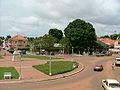 |
||
| Mozambique Mozambique Mozambique, officially the Republic of Mozambique , is a country in southeastern Africa bordered by the Indian Ocean to the east, Tanzania to the north, Malawi and Zambia to the northwest, Zimbabwe to the west and Swaziland and South Africa to the southwest... |
Emakhuwa 26.1%, Xichangana 11.3%, Portuguese 8.8% (official; spoken by 27% of population as a second language), Elomwe 7.6%, Cisena 6.8%, Echuwabo 5.8%, other Mozambican languages 32%, other foreign languages 0.3%, unspecified 1.3% (1997 census) | African 99.66% (Makhuwa, Tsonga, Lomwe, Sena, and others), Europeans 0.06%, Euro-Africans 0.2%, Indians 0.08% | |||
| São Tomé and Príncipe São Tomé and Príncipe São Tomé and Príncipe, officially the Democratic Republic of São Tomé and Príncipe, is a Portuguese-speaking island nation in the Gulf of Guinea, off the western equatorial coast of Central Africa. It consists of two islands: São Tomé and Príncipe, located about apart and about , respectively, off... |
Portuguese (official) | mestiço, angolares (descendants of Angolan slaves), forros (descendants of freed slaves), serviçais (contract laborers from Angola, Mozambique, and Cape Verde), tongas (children of serviçais born on the islands), Europeans (primarily Portuguese) | 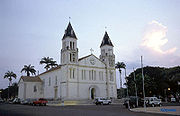 |
||
| Asia Asia Asia is the world's largest and most populous continent, located primarily in the eastern and northern hemispheres. It covers 8.7% of the Earth's total surface area and with approximately 3.879 billion people, it hosts 60% of the world's current human population... |
Macau Macau Macau , also spelled Macao , is, along with Hong Kong, one of the two special administrative regions of the People's Republic of China... |
Portuguese, Cantonese 85.7%, Hokkien 4%, Mandarin 3.2%, other Chinese dialects 2.7%, English 1.5%, Tagalog 1.3%, other 1.6% (2001 census) | Chinese 94.3%, other 5.7% (includes Macanese - mixed Portuguese and Asian ancestry) (2006 census) | 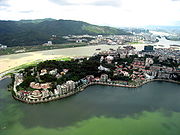 |
|
| East Timor East Timor The Democratic Republic of Timor-Leste, commonly known as East Timor , is a state in Southeast Asia. It comprises the eastern half of the island of Timor, the nearby islands of Atauro and Jaco, and Oecusse, an exclave on the northwestern side of the island, within Indonesian West Timor... |
Tetum (official), Portuguese (official), Indonesian, English | Austronesian (Malayo-Polynesian), Papuan, small Chinese, European (most of Portuguese origin) and mestiço minorities | |||
| The CIA World Factbook is in the public domain. Accordingly, it may be copied freely without permission of the Central Intelligence Agency (CIA). | |||||
Relation with Hispanic
In the historical sense Hispanic is synonym of Iberic, it refers only to the ancient people of the Iberian peninsulaIberian Peninsula
The Iberian Peninsula , sometimes called Iberia, is located in the extreme southwest of Europe and includes the modern-day sovereign states of Spain, Portugal and Andorra, as well as the British Overseas Territory of Gibraltar...
. In Portugal the term "hispânico" can be used in two contexts: It has a historical meaning when referring to the people of the Roman Hispania; the contemporary meaning is for Spain-related culture.
There has often been debate as to whether Lusitanics are Hispanic
Hispanic
Hispanic is a term that originally denoted a relationship to Hispania, which is to say the Iberian Peninsula: Andorra, Gibraltar, Portugal and Spain. During the Modern Era, Hispanic sometimes takes on a more limited meaning, particularly in the United States, where the term means a person of ...
s, as historical arguments find that the region of Lusitania
Lusitania
Lusitania or Hispania Lusitania was an ancient Roman province including approximately all of modern Portugal south of the Douro river and part of modern Spain . It was named after the Lusitani or Lusitanian people...
was a part of Hispania
Hispania
Another theory holds that the name derives from Ezpanna, the Basque word for "border" or "edge", thus meaning the farthest area or place. Isidore of Sevilla considered Hispania derived from Hispalis....
- and thus, "Lusitanics" are a subset of "Hispanic
Hispanic
Hispanic is a term that originally denoted a relationship to Hispania, which is to say the Iberian Peninsula: Andorra, Gibraltar, Portugal and Spain. During the Modern Era, Hispanic sometimes takes on a more limited meaning, particularly in the United States, where the term means a person of ...
." The same way Spanish-speaking South America
South America
South America is a continent situated in the Western Hemisphere, mostly in the Southern Hemisphere, with a relatively small portion in the Northern Hemisphere. The continent is also considered a subcontinent of the Americas. It is bordered on the west by the Pacific Ocean and on the north and east...
was not a part of Hispania
Hispania
Another theory holds that the name derives from Ezpanna, the Basque word for "border" or "edge", thus meaning the farthest area or place. Isidore of Sevilla considered Hispania derived from Hispalis....
and the same argument can be applied: if Spanish Latin American people should be called Hispanic. Lusitania
Lusitania
Lusitania or Hispania Lusitania was an ancient Roman province including approximately all of modern Portugal south of the Douro river and part of modern Spain . It was named after the Lusitani or Lusitanian people...
and the Lusitanians
Lusitanians
The Lusitanians were an Indo-European people living in the Western Iberian Peninsula long before it became the Roman province of Lusitania . They spoke the Lusitanian language which might have been Celtic. The modern Portuguese people see the Lusitanians as their ancestors...
were known long before their conquest by the Roman Empire (Livy 218 b.c.) and incorporated in the Roman province of Hispania
Hispania
Another theory holds that the name derives from Ezpanna, the Basque word for "border" or "edge", thus meaning the farthest area or place. Isidore of Sevilla considered Hispania derived from Hispalis....
thus can not be considered a subset of "Hispanic
Hispanic
Hispanic is a term that originally denoted a relationship to Hispania, which is to say the Iberian Peninsula: Andorra, Gibraltar, Portugal and Spain. During the Modern Era, Hispanic sometimes takes on a more limited meaning, particularly in the United States, where the term means a person of ...
." The contemporary meaning of "Hispanic" is much broader than the historical meaning: in the United States
United States
The United States of America is a federal constitutional republic comprising fifty states and a federal district...
the term "Hispanic
Hispanic
Hispanic is a term that originally denoted a relationship to Hispania, which is to say the Iberian Peninsula: Andorra, Gibraltar, Portugal and Spain. During the Modern Era, Hispanic sometimes takes on a more limited meaning, particularly in the United States, where the term means a person of ...
" was first adopted by the administration of Richard Nixon
Richard Nixon
Richard Milhous Nixon was the 37th President of the United States, serving from 1969 to 1974. The only president to resign the office, Nixon had previously served as a US representative and senator from California and as the 36th Vice President of the United States from 1953 to 1961 under...
and today is one of the several terms of ethnicity employed to categorize any person, of any racial background, of any country and of any religion who has at least one ancestor from the people of Spain
Spain
Spain , officially the Kingdom of Spain languages]] under the European Charter for Regional or Minority Languages. In each of these, Spain's official name is as follows:;;;;;;), is a country and member state of the European Union located in southwestern Europe on the Iberian Peninsula...
or Spanish-speaking Latin America
Latin America
Latin America is a region of the Americas where Romance languages – particularly Spanish and Portuguese, and variably French – are primarily spoken. Latin America has an area of approximately 21,069,500 km² , almost 3.9% of the Earth's surface or 14.1% of its land surface area...
, whether or not the person has Spanish
Spanish people
The Spanish are citizens of the Kingdom of Spain. Within Spain, there are also a number of vigorous nationalisms and regionalisms, reflecting the country's complex history....
ancestry, Lusitanics are not "Hispanic
Hispanic
Hispanic is a term that originally denoted a relationship to Hispania, which is to say the Iberian Peninsula: Andorra, Gibraltar, Portugal and Spain. During the Modern Era, Hispanic sometimes takes on a more limited meaning, particularly in the United States, where the term means a person of ...
" for most ethnic categorization purposes, although it is highly debatable, and there are some exceptions - for instance, the Equal Employment Opportunity Commission has no official position as to whether or not Lusitanic is Hispanic, while the State of Florida classifies Portuguese as Hispanic.
Lusitanic Americans
Luso-American was one of the ancient names called to the Portuguese settlers in Brazil.Using the above analogy with Hispanic, then, one definition of Lusitanic would be anyone of any racial background with at least one ancestor from Portugal or from the Lusophonic (Portuguese-speaking) area of Latin America, of Africa, and of Asia. Portuguese immigrants to the Americas
Americas
The Americas, or America , are lands in the Western hemisphere, also known as the New World. In English, the plural form the Americas is often used to refer to the landmasses of North America and South America with their associated islands and regions, while the singular form America is primarily...
and the inhabitants of the nation
Nation
A nation may refer to a community of people who share a common language, culture, ethnicity, descent, and/or history. In this definition, a nation has no physical borders. However, it can also refer to people who share a common territory and government irrespective of their ethnic make-up...
of Brazil
Brazil
Brazil , officially the Federative Republic of Brazil , is the largest country in South America. It is the world's fifth largest country, both by geographical area and by population with over 192 million people...
or Brazilians living in Hispanic America
Hispanic America
Hispanic America or Spanish America is the region comprising the American countries inhabited by Spanish-speaking populations.These countries have significant commonalities with each other and with Spain, whose colonies they formerly were...
or the United States
United States
The United States of America is a federal constitutional republic comprising fifty states and a federal district...
would be Lusitanic Americans.
External links
- Hispania Lusitania - Second Map of Europe - Book II, Chapter IV from GeographyGeographia (Ptolemy)The Geography is Ptolemy's main work besides the Almagest...
of Claudius Ptolemy - Comunidade dos Países de Língua Portuguesa (CPLP) (in Portuguese)
- Detailed map of the Pre-Roman Peoples of Iberia (around 200 BC)
- Filología política - La Hispanidad (in Castilian)
- Sabores da Lusofonia (in Portuguese)
- PORTUGUESE-AMERICAN HISTORICAL & RESEARCH FOUNDATION
See also
- BrazilBrazilBrazil , officially the Federative Republic of Brazil , is the largest country in South America. It is the world's fifth largest country, both by geographical area and by population with over 192 million people...
- Portuguese AmericanPortuguese AmericanPortuguese Americans are citizens of the United States whose ancestry originates in the southwest European nation of Portugal, including the offshore island groups of the Azores and Madeira....
- Latin AmericaLatin AmericaLatin America is a region of the Americas where Romance languages – particularly Spanish and Portuguese, and variably French – are primarily spoken. Latin America has an area of approximately 21,069,500 km² , almost 3.9% of the Earth's surface or 14.1% of its land surface area...
- Latin EuropeLatin EuropeLatin Europe is a loose term for the region of Europe with an especially strong Latin cultural heritage inherited from the Roman Empire.-Application:...
- Latin UnionLatin UnionThe Latin Union is an international organization of nations that use Romance languages, with the aim of protecting, projecting, and promoting the common cultural heritage and unifying identities of the Latin, and Latin-influenced, world. It was created in 1954 in Madrid, Spain, and has existed as a...
- LatinoLatinoThe demonyms Latino and Latina , are defined in English language dictionaries as:* "a person of Latin-American descent."* "A Latin American."* "A person of Hispanic, especially Latin-American, descent, often one living in the United States."...
- LusitaniaLusitaniaLusitania or Hispania Lusitania was an ancient Roman province including approximately all of modern Portugal south of the Douro river and part of modern Spain . It was named after the Lusitani or Lusitanian people...
- Lusophony GamesLusophony GamesThe Lusophony Games is a multinational multi-sport event organized by the ACOLOP, which involves athletes coming from Lusophone countries, namely those belonging to the CPLP , but also others where there are significant Portuguese communities or that have a common past with Portugal.Participating...
- Galicia
- Geographic distribution of the Portuguese language
- HispaniaHispaniaAnother theory holds that the name derives from Ezpanna, the Basque word for "border" or "edge", thus meaning the farthest area or place. Isidore of Sevilla considered Hispania derived from Hispalis....
- Hispania UlteriorHispania UlteriorDuring the Roman Republic, Hispania Ulterior was a region of Hispania roughly located in Baetica and in the Guadalquivir valley of modern Spain and extending to all of Lusitania and Gallaecia...
- HispanicHispanicHispanic is a term that originally denoted a relationship to Hispania, which is to say the Iberian Peninsula: Andorra, Gibraltar, Portugal and Spain. During the Modern Era, Hispanic sometimes takes on a more limited meaning, particularly in the United States, where the term means a person of ...
- LusophobiaLusophobiaLusophobia is a hostility toward Portugal, a nation occupying the west of the Iberian Peninsula in south-western Europe, its Portuguese people or the Portuguese language and culture. Like Lusitanic, the word derives from Lusitania, the Ancient Roman province that comprised what is nowadays Central...
- LusophiliaLusophiliaLusophilia is the love of, or friendship or sympathy toward, Portugal and/or Portuguese things. The word derives from Luso- plus -philia...
- Ibero-GermanIbero-GermanIbero-German means of or pertaining to people of Spanish or Portuguese descent living in Germany or the German speaking countries. This includes Spaniards and Portuguese people, Latin Americans and Hispanics in Germany....
- LusophoneLusophoneA Lusophone is someone who speaks the Portuguese language, either as a native, as an additional language, or as a learner. As an adjective, it means "Portuguese-speaking"...