

Hibernia

Encyclopedia
Latin
Latin is an Italic language originally spoken in Latium and Ancient Rome. It, along with most European languages, is a descendant of the ancient Proto-Indo-European language. Although it is considered a dead language, a number of scholars and members of the Christian clergy speak it fluently, and...
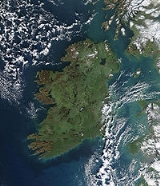
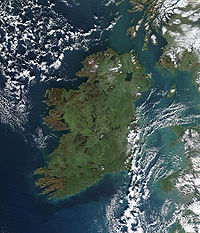
name for the island of Ireland
Ireland
Ireland is an island to the northwest of continental Europe. It is the third-largest island in Europe and the twentieth-largest island on Earth...
. The name Hibernia was taken from Greek
Greek language
Greek is an independent branch of the Indo-European family of languages. Native to the southern Balkans, it has the longest documented history of any Indo-European language, spanning 34 centuries of written records. Its writing system has been the Greek alphabet for the majority of its history;...
geographical accounts. During his exploration of northwest Europe (c. 320 BC), Pytheas of Massilia called the island Ierne (written ). In his book Geographia (c. 150 AD), Claudius Ptolemaeus
Ptolemy
Claudius Ptolemy , was a Roman citizen of Egypt who wrote in Greek. He was a mathematician, astronomer, geographer, astrologer, and poet of a single epigram in the Greek Anthology. He lived in Egypt under Roman rule, and is believed to have been born in the town of Ptolemais Hermiou in the...
("Ptolemy") called the island Iouernia (written ).
It is likely that the Romans saw a connection between these historical names and the Latin word hibernus meaning wintry
Winter
Winter is the coldest season of the year in temperate climates, between autumn and spring. At the winter solstice, the days are shortest and the nights are longest, with days lengthening as the season progresses after the solstice.-Meteorology:...
. In any case, the Roman historian Tacitus
Tacitus
Publius Cornelius Tacitus was a senator and a historian of the Roman Empire. The surviving portions of his two major works—the Annals and the Histories—examine the reigns of the Roman Emperors Tiberius, Claudius, Nero and those who reigned in the Year of the Four Emperors...
, in his book Agricola (c. 98 AD), uses the name Hibernia. It could also be that Ireland itself never stops raining, and is therefore "wintry", with the ia from Iouernia to end the hibernus instead of the us.
Iouernia was a Greek alteration of the Q-Celtic
P-Celtic and Q-Celtic
There are two main competing schemata of categorisation of Celtic languages. The older P-Celtic/Q-Celtic hypothesis links Gaulish with Brythonic as P-Celtic and links Goidelic with Celtiberian as Q-Celtic. The difference between P and Q languages is the treatment of Proto-Celtic *kw, which became...
name *Īweriū from which eventually arose the Irish
Irish language
Irish , also known as Irish Gaelic, is a Goidelic language of the Indo-European language family, originating in Ireland and historically spoken by the Irish people. Irish is now spoken as a first language by a minority of Irish people, as well as being a second language of a larger proportion of...
names Ériu
Ériu
In Irish mythology, Ériu , daughter of Ernmas of the Tuatha Dé Danann, was the eponymous matron goddess of Ireland. Her husband was Mac Gréine ....
and Éire
Éire
is the Irish name for the island of Ireland and the sovereign state of the same name.- Etymology :The modern Irish Éire evolved from the Old Irish word Ériu, which was the name of a Gaelic goddess. Ériu is generally believed to have been the matron goddess of Ireland, a goddess of sovereignty, or...
. The original meaning of the name is thought to be "abundant land".
Hibernia in the historical record
The island of Ireland was never incorporated into the Roman EmpireRoman Empire
The Roman Empire was the post-Republican period of the ancient Roman civilization, characterised by an autocratic form of government and large territorial holdings in Europe and around the Mediterranean....
. The fact that the Romans never occupied Ireland meant that Roman influence on Ireland was limited to contacts with Britain and other conquered provinces of the Empire. Roman historian Tacitus
Tacitus
Publius Cornelius Tacitus was a senator and a historian of the Roman Empire. The surviving portions of his two major works—the Annals and the Histories—examine the reigns of the Roman Emperors Tiberius, Claudius, Nero and those who reigned in the Year of the Four Emperors...
makes reference to an expedition to Ireland by the general Agricola
Gnaeus Julius Agricola
Gnaeus Julius Agricola was a Roman general responsible for much of the Roman conquest of Britain. His biography, the De vita et moribus Iulii Agricolae, was the first published work of his son-in-law, the historian Tacitus, and is the source for most of what is known about him.Born to a noted...
in 82 AD. He is reported in one passage to "have crossed the water", the water in context is unknown and perhaps is reference to some exploratory mission, however the remainder of the passage deals exclusively with Ireland. According to Seneca, Agricola was of the opinion that Ireland could be conquered with one legion and a moderate amount of auxiliaries, in all roughly 6,000 men. Reference is also made about an Irish king who had fled the island in search of refuge. Agricola provided him with safety in the hope that it may be a reason to possibly invade the island. The Ulster historian Richard Warner has theorised that the Midlands leader Túathal Techtmar, usually thought mythical, was in fact historical and went to Britain to get Roman support for his military campaigns (along with other later exiles). If there is any truth in this hypothesis, the Romans may have had a greater influence on the southeast of Ireland than normally thought by scholars. Overall, the relative lack of Roman influence on Ireland meant that it preserved its ancient culture to a much greater degree than continental countries such as Gaul.
Irish tribal expeditions harried the Roman provinces of Britannia
Roman Britain
Roman Britain was the part of the island of Great Britain controlled by the Roman Empire from AD 43 until ca. AD 410.The Romans referred to the imperial province as Britannia, which eventually comprised all of the island of Great Britain south of the fluid frontier with Caledonia...
(Britain) and Gaul
Gaul
Gaul was a region of Western Europe during the Iron Age and Roman era, encompassing present day France, Luxembourg and Belgium, most of Switzerland, the western part of Northern Italy, as well as the parts of the Netherlands and Germany on the left bank of the Rhine. The Gauls were the speakers of...
(France
France
The French Republic , The French Republic , The French Republic , (commonly known as France , is a unitary semi-presidential republic in Western Europe with several overseas territories and islands located on other continents and in the Indian, Pacific, and Atlantic oceans. Metropolitan France...
) as evidenced from surviving Roman texts.
In the early 1st century, Roman and Greek knowledge of Ireland was thin. The geographers Strabo
Strabo
Strabo, also written Strabon was a Greek historian, geographer and philosopher.-Life:Strabo was born to an affluent family from Amaseia in Pontus , a city which he said was situated the approximate equivalent of 75 km from the Black Sea...
and Pomponius Mela
Pomponius Mela
Pomponius Mela, who wrote around AD 43, was the earliest Roman geographer. He was born in Tingentera and died c. AD 45.His short work occupies less than one hundred pages of ordinary print. It is laconic in style and deficient in method, but of pure Latinity, and occasionally relieved by pleasing...
describe a cold land inhabited by extremely fierce inhabitants, where, despite the coldness,the grazing for cattle was lush.
By the 2nd century, the geographer Ptolemy
Ptolemy
Claudius Ptolemy , was a Roman citizen of Egypt who wrote in Greek. He was a mathematician, astronomer, geographer, astrologer, and poet of a single epigram in the Greek Anthology. He lived in Egypt under Roman rule, and is believed to have been born in the town of Ptolemais Hermiou in the...
gave coordinates for a surprisingly detailed map of Ireland, naming tribes, towns, rivers and headlands. This information could have come from a variety of sources but does demonstrate the increasing knowledge and interest in Ireland.
Irish written history does not mention Rome at all.
However, the lack of written history does not mean that Rome or the Roman province of Britannia
Britannia
Britannia is an ancient term for Great Britain, and also a female personification of the island. The name is Latin, and derives from the Greek form Prettanike or Brettaniai, which originally designated a collection of islands with individual names, including Albion or Great Britain. However, by the...
did not significantly interact with Ireland. Archaeologists have found an enormous fort complex at Chester
Chester
Chester is a city in Cheshire, England. Lying on the River Dee, close to the border with Wales, it is home to 77,040 inhabitants, and is the largest and most populous settlement of the wider unitary authority area of Cheshire West and Chester, which had a population of 328,100 according to the...
(Deva Victrix
Deva Victrix
Deva Victrix, or simply Deva, was a legionary fortress and town in the Roman province of Britannia. The settlement evolved into Chester, the county town of Cheshire, England...
) in northwest England that may have been planned as a centre to rule the islands, or as a military base to deter Irish invasions.
Ireland and its neighbours
From early in the archaeological recordArchaeological record
The archaeological record is the body of physical evidence about the past. It is one of the most basic concepts in archaeology, the academic discipline concerned with documenting and interpreting the archaeological record....
, the peoples of North West Europe, including Britain, Gaul, Spain and Ireland had mutually warred, traded and settled.
A degree of British settlement in the Southeast of Ireland occurred around year 1. Ptolemy
Ptolemy
Claudius Ptolemy , was a Roman citizen of Egypt who wrote in Greek. He was a mathematician, astronomer, geographer, astrologer, and poet of a single epigram in the Greek Anthology. He lived in Egypt under Roman rule, and is believed to have been born in the town of Ptolemais Hermiou in the...
, in 100s, records some Irish tribal names identical to those of tribes in Gaul and Britain, suggesting significant settlement. Recent genetic and linguistic research suggests the interesting possibility that these tribes may have been descended from the first neolithic farmers to reach Ireland (alluded to in Ireland's allegoric history The Book of Invasions
The Book of Invasions
The Book of Invasions: A Celtic Symphony is an album by the Irish Celtic rock band Horslips. It was a concept album based on an adaptation of Irish legends built into a complex story. It is named for the Lebor Gabála Érenn, a book of Irish mythology known as The Book of Invasions in English....
)
At this time Ireland, western and central Europe were all home to several Celt
Celt
The Celts were a diverse group of tribal societies in Iron Age and Roman-era Europe who spoke Celtic languages.The earliest archaeological culture commonly accepted as Celtic, or rather Proto-Celtic, was the central European Hallstatt culture , named for the rich grave finds in Hallstatt, Austria....
ic peoples with their associated Celtic religion
Celtic mythology
Celtic mythology is the mythology of Celtic polytheism, apparently the religion of the Iron Age Celts. Like other Iron Age Europeans, the early Celts maintained a polytheistic mythology and religious structure...
, and they were supervised by the Druids. A number of historians have argued that the people of Ireland and Britain shared a broadly similar Celtic heritage. The Isle of Anglesey
Anglesey
Anglesey , also known by its Welsh name Ynys Môn , is an island and, as Isle of Anglesey, a county off the north west coast of Wales...
, Welsh
Welsh language
Welsh is a member of the Brythonic branch of the Celtic languages spoken natively in Wales, by some along the Welsh border in England, and in Y Wladfa...
Ynys Môn, was the centre of the Druidic religion, just across the Irish Sea
Irish Sea
The Irish Sea separates the islands of Ireland and Great Britain. It is connected to the Celtic Sea in the south by St George's Channel, and to the Atlantic Ocean in the north by the North Channel. Anglesey is the largest island within the Irish Sea, followed by the Isle of Man...
from Ireland. Other historians, however, have disputed that such a homogeneous group existed. The application of the "Celtic" label to the inhabitants of Britain and Ireland c.1 AD may, however, be misleading as the genetic evidence suggests that most inhabitants of both islands are predominantly descended from palaeolithic hunter-gathers of Iberian and neolithic farmers of Germanic (mid-European) origin. An invasion of bands of Gaelic (Milesian) warriors from Iberia c.1500BC may have had more of a linguistic than a genetic impact.
Transport and communication was often along rivers and coasts, with the Irish Sea being a part of this network. When Julius Caesar
Julius Caesar
Gaius Julius Caesar was a Roman general and statesman and a distinguished writer of Latin prose. He played a critical role in the gradual transformation of the Roman Republic into the Roman Empire....
briefly invaded southern England
England
England is a country that is part of the United Kingdom. It shares land borders with Scotland to the north and Wales to the west; the Irish Sea is to the north west, the Celtic Sea to the south west, with the North Sea to the east and the English Channel to the south separating it from continental...
in 54 BC, he received the submission of many tribes, including that of the Orcadians in the Orkney Islands
Orkney Islands
Orkney also known as the Orkney Islands , is an archipelago in northern Scotland, situated north of the coast of Caithness...
, north of Scotland
Scotland
Scotland is a country that is part of the United Kingdom. Occupying the northern third of the island of Great Britain, it shares a border with England to the south and is bounded by the North Sea to the east, the Atlantic Ocean to the north and west, and the North Channel and Irish Sea to the...
. Communications could be long distance, but whether any Irish knew of the Romans at this time is uncertain.
Rome often projected its power beyond its boundaries. Beyond the West coast of Britannia was the Irish Sea, with many easy crossings, and many distinctive mountain landmarks to ease navigation. The spread of Roman power to Ireland's neighbours would have had significant effects on Ireland. By 51 BC the part of Gaul in what is modern France had been conquered by the Romans, with the permanent garrisoning of Britain starting after the second invasion in 43. England and Wales would remain within the Roman Empire for another 350 years.
Revolts by the newly subjugated British tribes may have increased settlement from Britain to Ireland and reduced settlement in the other direction. Events such as the destruction of the druidic shrine and sacred groves at Anglesey in 60 by the Roman general Suetonius Paulinus would have been noticed in Ireland.
Evidence of Roman influence
Four centuries of Roman presence in Roman BritainRoman Britain
Roman Britain was the part of the island of Great Britain controlled by the Roman Empire from AD 43 until ca. AD 410.The Romans referred to the imperial province as Britannia, which eventually comprised all of the island of Great Britain south of the fluid frontier with Caledonia...
were related to ancient Hibernia with a continuous trade and commerce, even if in a very small scale. Geographer Ptolemy
Ptolemy
Claudius Ptolemy , was a Roman citizen of Egypt who wrote in Greek. He was a mathematician, astronomer, geographer, astrologer, and poet of a single epigram in the Greek Anthology. He lived in Egypt under Roman rule, and is believed to have been born in the town of Ptolemais Hermiou in the...
in the 2nd century made a map of Hibernia full of data on rivers, mountains and people demonstrating a knowledge of the island that could have been originated even from the presence in Hibernia of Roman explorers/traders living in small trading places of the Ireland's south and eastern coast.
Generally in Ireland, Roman material is rare and found in different contexts from the native La Tene style material. No roads have been identified as being Roman, and no large Roman settlements have been found. However in the southeast of Ireland, where native material is rare, Roman-style cemeteries and large quantities of Roman artifacts have been found.
A group of burials on Lambay Island
Lambay Island
Lambay lies off the coast of Fingal / north County Dublin, Ireland in the Irish Sea. It is located north of Ireland's Eye at and is the easternmost point of the Republic of Ireland...
, off the coast of County Dublin
County Dublin
County Dublin is a county in Ireland. It is part of the Dublin Region and is also located in the province of Leinster. It is named after the city of Dublin which is the capital of Ireland. County Dublin was one of the first of the parts of Ireland to be shired by King John of England following the...
, contained Roman brooches and decorative metalware of a style also found in northern England from the late 1st century. However this could represent, for example, Brigantes fleeing reprisal from the crushed revolt of 74.
At Drumanagh
Drumanagh
Drumanagh is a headland 20 km north of Dublin, Ireland. It features a 19th century Martello tower and a large iron age promontory fort which has produced Roman artefacts....
, 25 km north of Dublin, a large (200,000 m²) site was identified as possibly Roman. Consisting of a peninsula defended by three rows of parallel ditches on the landward side, the site appears to have been a port or bridgehead.
The Roman historian Tacitus
Tacitus
Publius Cornelius Tacitus was a senator and a historian of the Roman Empire. The surviving portions of his two major works—the Annals and the Histories—examine the reigns of the Roman Emperors Tiberius, Claudius, Nero and those who reigned in the Year of the Four Emperors...
mentions that Agricola
Gnaeus Julius Agricola
Gnaeus Julius Agricola was a Roman general responsible for much of the Roman conquest of Britain. His biography, the De vita et moribus Iulii Agricolae, was the first published work of his son-in-law, the historian Tacitus, and is the source for most of what is known about him.Born to a noted...
, while governor of Roman Britain
Roman Britain
Roman Britain was the part of the island of Great Britain controlled by the Roman Empire from AD 43 until ca. AD 410.The Romans referred to the imperial province as Britannia, which eventually comprised all of the island of Great Britain south of the fluid frontier with Caledonia...
(AD 78 - 84), entertained an exiled Irish prince (may be Túathal), thinking to use him as a pretext for a possible conquest of Ireland. Neither Agricola nor his successors ever conquered Ireland, but in recent years archaeology
Archaeology
Archaeology, or archeology , is the study of human society, primarily through the recovery and analysis of the material culture and environmental data that they have left behind, which includes artifacts, architecture, biofacts and cultural landscapes...
has challenged the belief that the Romans never set foot on the island.
Indeed, in 82 Agricola "crossed in the first ship" and defeated peoples unknown to the Romans until then. Tacitus, in Chapter 24 of Agricola, does not tell us what body of water he crossed, although many scholars believe it was the Clyde or Forth; however, the rest of the chapter exclusively concerns Ireland
Ireland
Ireland is an island to the northwest of continental Europe. It is the third-largest island in Europe and the twentieth-largest island on Earth...
. Agricola fortified the coast facing Ireland, and Tacitus recalls that his father-in-law often claimed the island could be conquered with a single legion
Roman legion
A Roman legion normally indicates the basic ancient Roman army unit recruited specifically from Roman citizens. The organization of legions varied greatly over time but they were typically composed of perhaps 5,000 soldiers, divided into maniples and later into "cohorts"...
and auxiliaries
Auxiliaries (Roman military)
Auxiliaries formed the standing non-citizen corps of the Roman army of the Principate , alongside the citizen legions...
. This conquest never happened, but some historians believe that the crossing referred to was in fact a small-scale exploratory expedition to Ireland.
Roman and Romano-British artefacts have been found primarily in Leinster, notably a fortified site on the promontory of Drumanagh, fifteen miles north of Dublin, and burials on the nearby island of Lambay, both close to where Túathal is supposed to have landed, and other sites associated with Túathal such as Tara and Clogher. However, whether this is evidence of trade, diplomacy or military activity is a matter of controversy. It is possible that the Romans may have given support to Túathal, or someone like him, to regain his throne in the interests of having a friendly neighbour who could restrain Irish raiding. The 2nd century Roman poet Juvenal, who may have served in Britain under Agricola, wrote that "arms had been taken beyond the shores of Ireland", and the coincidence of dates is striking. Alternatively it has been suggested that Roman traders arrived for a regular "fair" or market at the site at regular dates.
Roman coins, some converted to pendants, and Romano-British brooches have been found deposited as votive offerings at Newgrange
Newgrange
Newgrange is a prehistoric monument located in County Meath, on the eastern side of Ireland, about one kilometre north of the River Boyne. It was built around 3200 BC , during the Neolithic period...
.
According to Phillip Rance some tribes of Hibernia, called Attacotti
Attacotti
Attacotti refers to a people who despoiled Roman Britain between 364 and 368, along with Scotti, Picts, Saxons, Roman military deserters, and the indigenous Britons themselves. The marauders were defeated by Count Theodosius in 368...
(Old Irish term: aithechthúatha), from southern Leinster
Leinster
Leinster is one of the Provinces of Ireland situated in the east of Ireland. It comprises the ancient Kingdoms of Mide, Osraige and Leinster. Following the Norman invasion of Ireland, the historic fifths of Leinster and Mide gradually merged, mainly due to the impact of the Pale, which straddled...
were Foederati (allies) of the late Roman Empire, and fought together with the Roman legions in the second half of the 4th century
Roman sources mention raids on Britain by two groups of people usually associated with Ireland, the Scotti
Scotti
Scotti is a surname of Italian origin. The name refers to:*Andrés Scotti , Uruguayan professional football player*Antonio Scotti , Italian operatic baritone*Ben Scotti , American professional football player...
and the Attacotti. The term Scotti comes from Queen Scotia daughter of an Egyptian Pharaoh who was Queen of the Milesians. In the Irish origin story, the Milesians come from the northern coast of Spain and are the original Celtic invaders. The island of Ireland was named Scotia in honor of their Queen. Perhaps as early as the 17th century, and certainly in the 18th century, some Irish scholars had suggested that the origin of the Attacotti might lie in Ireland. This was based on the perceived similarity between Latin Attacotti and the Old Irish term aithechthúatha, a generic designation for certain Irish population-groups, usually translated "rent-paying tribes", "vassal communities" or "tributary peoples". Combined with the knowledge of Irish raids on the coast of Britain in the late Roman period, it was suggested that one group of raiders had stayed to become the historically attested people mentioned by Ammianus.
Túathal
Túathal was, in the Irish myths, a High King of IrelandHigh King of Ireland
The High Kings of Ireland were sometimes historical and sometimes legendary figures who had, or who are claimed to have had, lordship over the whole of Ireland. Medieval and early modern Irish literature portrays an almost unbroken sequence of High Kings, ruling from Tara over a hierarchy of...
. He was the son of a High King Fiacha Finnfolaidh
Fiacha Finnfolaidh
Fiacha Finnolach, son of Feradach Finnfechtnach, was, according to medieval Irish legend and historical tradition, a High King of Ireland. He took power after killing his predecessor, Fíatach Finn...
. His father was overthrown and killed in a revolt by the King of Ulster
Ulster
Ulster is one of the four provinces of Ireland, located in the north of the island. In ancient Ireland, it was one of the fifths ruled by a "king of over-kings" . Following the Norman invasion of Ireland, the ancient kingdoms were shired into a number of counties for administrative and judicial...
. Túathal's mother, who was the daughter of the King of Alba
Alba
Alba is the Scottish Gaelic name for Scotland. It is cognate to Alba in Irish and Nalbin in Manx, the two other Goidelic Insular Celtic languages, as well as similar words in the Brythonic Insular Celtic languages of Cornish and Welsh also meaning Scotland.- Etymology :The term first appears in...
(Britain at the time, because Alba became the name for Scotland later on), fled to Britain with her son. 20 years later he returned to Ireland, defeated his father's enemies in a series of battles and subdued the entire country. He became High King at Tara, in the center of Ireland. There he convened a conference where he established laws. He annexed territory from each of the other four provinces to create the central province of Míde (Meath). Four fortresses were built, one for each of the four areas of land.
Some consider him to be the first real High King. The dating of Irish history/mythology in the 1st centuries AD is prone to error; however, the most popular belief is that Túathal was exiled in AD 56 and reigned from around 80 to 100.
Tacitus
Tacitus
Publius Cornelius Tacitus was a senator and a historian of the Roman Empire. The surviving portions of his two major works—the Annals and the Histories—examine the reigns of the Roman Emperors Tiberius, Claudius, Nero and those who reigned in the Year of the Four Emperors...
, the Roman author, tells us that around this time Agricola had with him an Irish chieftain who later returned to conquer Ireland with an army. Juvenal later wrote that Roman arms were "taken beyond the shores of Ireland." Excavations at sites linked to the tale of Túathal have produced Roman material of the late 1st or early 2nd centuries. It would be consistent for Túathal to have been that Irish chieftain.
Post-Roman usage
The High King Brian BoruBrian Boru
Brian Bóruma mac Cennétig, , , was an Irish king who ended the domination of the High Kingship of Ireland by the Uí Néill. Building on the achievements of his father, Cennétig mac Lorcain, and especially his elder brother, Mathgamain, Brian first made himself King of Munster, then subjugated...
(c. 941-1014) based his title on being emperor of the Irish people, which was in Latin: "Imperator Scottorum", as distinct from claiming to be Emperor of the island of Ireland. From 1172 the Lordship of Ireland
Lordship of Ireland
The Lordship of Ireland refers to that part of Ireland that was under the rule of the king of England, styled Lord of Ireland, between 1177 and 1541. It was created in the wake of the Norman invasion of Ireland in 1169–71 and was succeeded by the Kingdom of Ireland...
gave the King of England the additional title "Dominus Hibernie" (sic, for Hiberniae; also "Dominus Hybernie"), Lord of Ireland. The Kingdom of Ireland
Kingdom of Ireland
The Kingdom of Ireland refers to the country of Ireland in the period between the proclamation of Henry VIII as King of Ireland by the Crown of Ireland Act 1542 and the Act of Union in 1800. It replaced the Lordship of Ireland, which had been created in 1171...
created the title Rex Hiberniae, King of Ireland, for use in Latin texts. Gerard Mercator called Ireland "Hybernia" on his world map of 1541. In 1642 the motto of the Irish Confederates
Confederate Ireland
Confederate Ireland refers to the period of Irish self-government between the Rebellion of 1641 and the Cromwellian conquest of Ireland in 1649. During this time, two-thirds of Ireland was governed by the Irish Catholic Confederation, also known as the "Confederation of Kilkenny"...
, a Catholic-landlord administration that ruled much of Ireland until 1650 was: Pro Deo, Rege et Patria, Hibernia Unanimis. (In English: For God, King and Fatherland, Ireland is United).
By the 18th century Hibernia was used on Irish coins and companies such the Hibernian Insurance Company were established (now the Hibernian Group). The name took on popularity with the success of the Irish Patriot Party
Irish Patriot Party
The Irish Patriot Party was the name of a number of different political groupings in Ireland throughout the 18th century. They were primarily supportive of Whig concepts of personal liberty combined with an Irish identity that rejected full independence, but advocated strong self-government within...
. At a time when Palladian classical architecture and design were being adopted in northern Europe, Hibernia was a useful word to describe Ireland with overtones of classical style and civility, particularly by the prosperous landed gentry
Landed gentry
Landed gentry is a traditional British social class, consisting of land owners who could live entirely off rental income. Often they worked only in an administrative capacity looking after the management of their own lands....
who were generally taught Latin at school. The Royal Exchange
City Hall, Dublin
The City Hall, Dublin , originally the Royal Exchange, is a civic building in Dublin, Ireland. It was built between 1769 and 1779 to the designs of architect Thomas Cooley and is a notable example of 18th-century architecture in the city.-Overview:...
in Dublin was built in 1769-79 with the carved inscription "SPQH" for Senatus Populusque Hibernicus - The senate and people of Ireland. The Royal Hibernian Academy
Royal Hibernian Academy
The Royal Hibernian Academy is an artist-based and artist-oriented institution in Ireland, founded in Dublin in 1823.-History:The RHA was founded as the result of 30 Irish artists petitioning the government for a charter of incorporation...
dates from 1823.
Hibernia is a word that is rarely used today with regard to Ireland. It is occasionally used for names of organisations and various other things; for instance: Hibernia National Bank
Hibernia National Bank
Hibernia National Bank, founded in 1870, was a personal banking and commercial lending institution headquartered in New Orleans, Louisiana. It was the largest and oldest bank headquartered in the state, and also had locations in Texas, Mississippi, and Arkansas.-History:Founded by Irish immigrants...
, Hibernian Insurance Group, Ancient Order of Hibernians
Ancient Order of Hibernians
The Ancient Order of Hibernians is an Irish Catholic fraternal organization. Members must be Catholic and either Irish born or of Irish descent. Its largest membership is now in the United States, where it was founded in New York City in 1836...
, The Hibernian
The Hibernian
The Hibernian was a monthly Irish magazine with the subtitle “Faith, Family and Country”. Twenty-nine issues were published between May 2006 and September 2008....
magazine, Hibernia College
Hibernia College
Hibernia College is a college in Dublin, founded in 2000 by Dr. Sean Rowland. The college is Ireland’s only online college with its degrees accredited by the Irish government's Higher Education and Training Awards Council. The college specialises in post-graduate programmes.Hibernia College is...
, Hibernian Football Club
Hibernian F.C.
Hibernian Football Club are a Scottish professional football club based in Leith, in the north of Edinburgh. They are one of two Scottish Premier League clubs in the city, the other being their Edinburgh derby rivals, Hearts...
, HMS Hibernia
HMS Hibernia
Four ships and one shore establishment of the Royal Navy have borne the name HMS Hibernia after the Latin name of Ireland.* HMS Hibernia was to have been a 74-gun third rate. She was renamed in 1763 and launched in 1765. was a 110-gun first rate launched in 1804...
, the Hibernia oil field
Hibernia (oil field)
Hibernia is an oil field in the North Atlantic Ocean, approximately east-southeast of St. John's, Newfoundland, Canada.The production platform Hibernia is the world's largest oil platform and consists of a 37,000-tonne integrated topsides facility mounted on a 600,000-tonne gravity base structure...
, and modern derivatives, from Latin
Latin
Latin is an Italic language originally spoken in Latium and Ancient Rome. It, along with most European languages, is a descendant of the ancient Proto-Indo-European language. Although it is considered a dead language, a number of scholars and members of the Christian clergy speak it fluently, and...
like Respublica Hibernica (Irish Republic
Irish Republic
The Irish Republic was a revolutionary state that declared its independence from Great Britain in January 1919. It established a legislature , a government , a court system and a police force...
) and Universitas Hiberniae Nationalis (National University of Ireland
National University of Ireland
The National University of Ireland , , is a federal university system of constituent universities, previously called constituent colleges, and recognised colleges set up under the Irish Universities Act, 1908, and significantly amended by the Universities Act, 1997.The constituent universities are...
).
The compound form Hiberno- remains more common, as in Hiberno-Norse, Hiberno-English
Hiberno-English
Hiberno-English is the dialect of English written and spoken in Ireland .English was first brought to Ireland during the Norman invasion of the late 12th century. Initially it was mainly spoken in an area known as the Pale around Dublin, with Irish spoken throughout the rest of the country...
, Hiberno-Scottish, Hibernophile
Hibernophile
A Hibernophile is a person who is fond of Irish culture, Irish language and Ireland in general. Its antonym is Hibernophobe.The term is often used in particular for people all over the world who ostensibly base their business, political, or social practices on like of or admiration for Irish models...
etc.