
All Topics  
Diphtheria

 
Diphtheria

   Email Print
   Bookmark   Link


Diphtheria


Diphtheria (Greek
Greek language

Greek is an Indo-European languages native to the southern Balkan peninsula, the language of the Greek people. It forms an independent branch within Indo-European....
 d?f?e?a (diphthera)—“pair of leather scrolls") is an upper respiratory
Respiration (physiology)

In animal physiology, respiration is the transport of Oxygen from the outside air to the cells within Tissue s and the transport of carbon dioxide in the opposite direction....
 tract illness characterized by sore throat, low fever
Fever

Fever is a frequent medical sign that describes an increase in internal body temperature to levels above normal. Fever is most accurately characterized as a temporary elevation in the body's thermoregulatory set-point, usually by about 1?2 ?C ....
, and an adherent membrane (a pseudomembrane) on the tonsil
Tonsil

Palatine tonsils, occasionally called the faucial tonsils, are the tonsils that can be seen on the left and right sides at the back of the throat....
s, pharynx
Pharynx

FunctionsThe pharynx is part of the digestive system and respiratory system of many organisms.Because both food and Earth's atmosphere pass through the pharynx, a flap of connective tissue called the epiglottis closes over the trachea when food is swallowed to prevent choking or Pulmonary aspiration....
, and/or nasal cavity. A milder form of diphtheria can be restricted to the skin. It is caused by Corynebacterium diphtheriae
Corynebacterium diphtheriae

Corynebacterium diphtheriae is a pathogenic bacterium that causes diphtheria. It is also known as the Klebs-L?ffler bacillus, because it was discovered in 1884 by Germany Bacteriology Edwin Klebs and Friedrich L?ffler ....
, an aerobic
Aerobic organism

An aerobic organism or aerobe is an organism that can survive and grow in an oxygenated environment....
 Gram-positive
Gram-positive

Gram-positive Bacteria are those that are stained dark blue or violet by Gram staining. This is in contrast to Gram-negative bacteria, which cannot retain the crystal violet stain, instead taking up the counterstain and appearing red or pink....
 bacterium.

Diphtheria causes the progressive deterioration of myelin
Myelin

Myelin is an electrically-insulating dielectric material that forms a layer, the myelin sheath. Usually, myelin surrounds only the axon of a neuron....
 sheaths in the central
Central nervous system

The central nervous system is the part of the nervous system that functions to coordinate the activity of all parts of the bodies of multicellular organisms....
 and peripheral nervous system
Peripheral nervous system

The peripheral nervous system resides or extends outside the central nervous system , which consists of the brain and spinal cord. The main function of the PNS is to connect the CNS to the limbs and organs....
 leading to degenerating motor control and loss of sensation.


Discussion
Ask a question about 'Diphtheria'
Start a new discussion about 'Diphtheria'
Answer questions from other users
Full Discussion Forum


Encyclopedia


Diphtheria (Greek
Greek language

Greek is an Indo-European languages native to the southern Balkan peninsula, the language of the Greek people. It forms an independent branch within Indo-European....
 d?f?e?a (diphthera)—“pair of leather scrolls") is an upper respiratory
Respiration (physiology)

In animal physiology, respiration is the transport of Oxygen from the outside air to the cells within Tissue s and the transport of carbon dioxide in the opposite direction....
 tract illness characterized by sore throat, low fever
Fever

Fever is a frequent medical sign that describes an increase in internal body temperature to levels above normal. Fever is most accurately characterized as a temporary elevation in the body's thermoregulatory set-point, usually by about 1?2 ?C ....
, and an adherent membrane (a pseudomembrane) on the tonsil
Tonsil

Palatine tonsils, occasionally called the faucial tonsils, are the tonsils that can be seen on the left and right sides at the back of the throat....
s, pharynx
Pharynx

FunctionsThe pharynx is part of the digestive system and respiratory system of many organisms.Because both food and Earth's atmosphere pass through the pharynx, a flap of connective tissue called the epiglottis closes over the trachea when food is swallowed to prevent choking or Pulmonary aspiration....
, and/or nasal cavity. A milder form of diphtheria can be restricted to the skin. It is caused by Corynebacterium diphtheriae
Corynebacterium diphtheriae

Corynebacterium diphtheriae is a pathogenic bacterium that causes diphtheria. It is also known as the Klebs-L?ffler bacillus, because it was discovered in 1884 by Germany Bacteriology Edwin Klebs and Friedrich L?ffler ....
, an aerobic
Aerobic organism

An aerobic organism or aerobe is an organism that can survive and grow in an oxygenated environment....
 Gram-positive
Gram-positive

Gram-positive Bacteria are those that are stained dark blue or violet by Gram staining. This is in contrast to Gram-negative bacteria, which cannot retain the crystal violet stain, instead taking up the counterstain and appearing red or pink....
 bacterium.

Diphtheria causes the progressive deterioration of myelin
Myelin

Myelin is an electrically-insulating dielectric material that forms a layer, the myelin sheath. Usually, myelin surrounds only the axon of a neuron....
 sheaths in the central
Central nervous system

The central nervous system is the part of the nervous system that functions to coordinate the activity of all parts of the bodies of multicellular organisms....
 and peripheral nervous system
Peripheral nervous system

The peripheral nervous system resides or extends outside the central nervous system , which consists of the brain and spinal cord. The main function of the PNS is to connect the CNS to the limbs and organs....
 leading to degenerating motor control and loss of sensation. Diphtheria is a contagious disease spread by direct physical contact or breathing the aerosolized
Particulate

Particulates, alternatively referred to as particulate matter or fine particles, are tiny particles of solid or liquid suspended in a gas or liquid....
 secretions of infected individuals. Historically quite common, diphtheria has largely been eradicated in industrialized nations through widespread vaccination
Vaccination

Vaccination is the administration of antigenic material to produce immunity to a disease. Vaccines can prevent or ameliorate the effects of infection by a pathogen....
. In the United States
United States

The United States of America is a Federal government constitutional republic comprising U.S. state and a federal district. The country is situated mostly in central North America, where its Contiguous United States and Washington, D.C., the Capital districts and territories, lie between the Pacific Ocean and Atlantic Oceans, Borders of the U...
 for example, there were 52 reported cases of diphtheria between 1980 and 2000; between 2000 and 2007 there were only five cases as the DPT (Diphtheria–Pertussis
Pertussis

Pertussis, also known as the whooping cough, is a highly contagious disease caused by the bacterium Bordetella pertussis; it derived its name from the"whooping" sound made from the exhalation of air during a cough.; a similar, milder disease is caused by Bordetella parapertussis....
Tetanus
Tetanus

Tetanus, also called lockjaw, is a medical condition characterized by a prolonged contraction of skeletal muscle fibers. The primary symptoms are caused by tetanospasmin, a neurotoxin produced by the Gram-positive, Anaerobic organism Clostridium tetani....
) vaccine is given to all school children. Boosters of the vaccine are recommended for adults since the benefits of the vaccine decrease with age without constant re-exposure; they are particularly recommended for those traveling to areas where the disease has not been eradicated.

History

In the 1920s there were an estimated 100,000 to 200,000 cases of diphtheria per year in the United States, causing 13,000 to 15,000 deaths per year. Children represented a large majority of these cases and fatalities. One of the most famous outbreaks of diphtheria was in Nome, Alaska
Nome, Alaska

Nome is a city located on the southern Seward Peninsula coast on Norton Sound of the Bering Sea. It is in the Nome Census Area, Alaska of the U.S....
; the 1925 serum run to Nome
1925 serum run to Nome

During the 1925 serum run to Nome, also known as the "Great Race of Mercy", 20 mushings and about 150 sled dogs relayed diphtheria antitoxin 674 miles by dog sled across the Alaska Territory in a record-breaking five and a half days, saving the small city of Nome, Alaska and the surrounding communities from an incipient epidemic....
 to deliver diphtheria antitoxin is now celebrated by the "Great Race of Mercy".

One of the first effective treatments for diphtheria was discovered in the 1880s by U.S. physician Joseph O'Dwyer
Joseph O'Dwyer

Joseph O'Dwyer was a Catholic United States of America physician. He discovered a valuable system of intubation in diphtheria cases....
 (1841–1898). O'Dwyer developed tubes
Intubation

In medicine, intubation refers to the placement of a tube into an external or internal orifice of the body. Although the term can refer to endoscopy procedures, it is most often used to denote tracheal intubation....
 that were inserted into the throat, and prevented victims from suffocating due to the membrane sheath that grows over and obstructs airways. In the 1890s, the German physician Emil von Behring developed an antitoxin that did not kill the bacterium, but neutralized the toxic poisons that the bacterium releases into the body. Von Behring discovered that animal blood has antitoxins in it and so he took the blood, removed the clotting agents and injected it into human patients. Von Behring was awarded the first Nobel Prize
Nobel Prize

The Nobel Prize , established in the 1895 will of Swedish chemist Alfred Nobel; it was first awarded in Nobel Prize in Physics, Nobel Prize in Chemistry, Nobel Prize in Physiology or Medicine, Nobel Prize in Literature, and Nobel Peace Prize in 1901....
 in Medicine for his role in the discovery, and development of a serum therapy for diphtheria. (Americans William H. Park and Anna Wessels Williams
Anna Wessels Williams

Dr. Anna Wessels Williams worked as a bacteriologist at the first municipal diagnostic laboratory in the United States, helped develop the diphtheria antitoxin and was the first woman to be elected chair of the laboratory section of the American Public Health Association....
; and Pasteur Institute
Pasteur Institute

The Pasteur Institute is a France non-profit private foundation dedicated to the study of biology, micro-organisms, diseases and vaccines. It is named after Louis Pasteur, its founder and first director, who had successfully developed the first antirabies serum in 1885....
 scientists Emile Roux and Auguste Chaillou also independently developed diphtheria antitoxin in the 1890s.) The first successful vaccine for diphtheria was developed in 1913 by Behring. However, antibiotics against diphtheria were not available until the discovery and development of sulfa drugs.

The Schick test
Schick test

The Schick test, invented between 1910 and 1911, is a test used to determine whether or not a person is susceptible to diphtheria. It was named after its inventor, B?la Schick , a Hungarian-born American pediatrician....
, invented between 1910 and 1911, is a test used to determine whether or not a person is susceptible to diphtheria
Diphtheria

Diphtheria is an upper Respiration tract illness characterized by sore throat, low fever, and an adherent membrane on the tonsils, pharynx, and/or nasal cavity....
. It was named after its inventor, Béla Schick
Béla Schick

B?la Schick , was a Hungary-born United States pediatrician. He is the founder of the Schick test. Was born in Balatonbogl?r, Hungary, and brought up in Graz, Austria, where he attended medical school....
 (1877–1967), a Hungarian-born American pediatrician. A massive five-year campaign was coordinated by Dr. Schick. As a part of the campaign, 85 million pieces of literature were distributed by Metropolitan Life Insurance Company
Metropolitan Life Insurance Company

MetLife, Inc. is the holding corporation for the Metropolitan Life Insurance Company or MetLife for short. The firm was founded on March 24, 1868....
 with an appeal to parents to "Save your child from diphtheria." A vaccine was developed in the next decade, and deaths began declining in earnest in 1924.

Mechanism

Diphtheria toxin
Diphtheria toxin

Diphtheria toxin is an exotoxin secreted by Corynebacterium diphtheriae, the pathogen bacteria that causes diphtheria....
 catalyzes the ADP-ribosylation of, and inactivates, the elongation factor
Elongation factor

Elongation factors are a set of proteins that facilitate the events of translation elongation, the steps in protein synthesis from the formation of the first peptide bond to the formation of the last one....
 eEF-2. In this way, it acts to inhibit translation during eukaryotic protein synthesis. The toxin enters the host cell and is hydrolysed by a trypsin-like protease to give a fragment with enzymatic activity. The toxin then transfers an ADP-ribose from NAD+
Nicotinamide adenine dinucleotide

Nicotinamide adenine dinucleotide, abbreviated NAD+, is a coenzyme found in all living cell s. The compound is a dinucleotide, since it consists of two nucleotides joined through their phosphate groups: with one nucleotide containing an adenine base, and the other containing nicotinamide....
 to a diphthamide
Diphthamide

Diphthamide is a modified histidine amino acid found in Eukaryotic elongation factors . It is ADP ribosylation factor by diphtheria toxin, which renders the elongation factor inactive....
 residue, a modified histidine
Histidine

Histidine is one of the 20 standard amino acids present in proteins. In the nutritional sense, in humans, histidine is considered an essential amino acid, but only in children....
 (amino acid), which is found within the EF-2 protein. EF-2 is needed for translocation of tRNA from the A-site to the P-site of the ribosome during translation. The ADP-ribosylation is reversible by administering high concentrations of nicotinamide
Nicotinamide

Nicotinamide, also known as niacinamide and nicotinic acid amide, is the amide of nicotinic acid . Nicotinamide is a water-soluble vitamin and is part of the B vitamins group....
, one of the reaction products.

Signs and symptoms

The respiratory form has an incubation period
Incubation period

Incubation period is the time elapsed between exposure to a pathogenic organism, a chemical or ionizing radiation, and when symptoms and signs are first apparent....
 of 2–5 days. The onset of disease is usually gradual. Symptoms include fatigue, fever, a mild sore throat and problems swallowing
Dysphagia

Dysphagia is the medical term for the symptom of difficulty in swallowing. Although classified under "symptoms and signs" in ICD-10, the term is sometimes used as a condition in its own right....
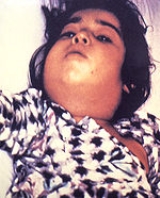
. Children infected have symptoms that include nausea, vomiting, chills, and a high fever, although some do not show symptoms until the infection has progressed further. In 10% of cases, patients experience neck swelling, informally referred to as "bull neck." These cases are associated with a higher risk of death.

In addition to symptoms at the site of infection (sore throat), the patient may experience more generalized symptoms, such as listlessness, pallor, and fast heart rate
Tachycardia

The word tachycardia comes from the Greek words tachys and kardia .Tachycardia typically refers to a heartrate that exceeds the range of the normal resting heartrate, based upon age:...
. These symptoms are caused by the toxin
Toxin

A toxin is a poisonous substance produced by living cells or organisms. For a toxic substance not produced by living organisms, "toxicant" is the more appropriate term, and "toxics" is an acceptable plural....
 released by the bacterium. Low blood pressure
Hypotension

In physiology and medicine, hypotension refers to an abnormally low blood pressure. This is best understood as a physiologic state, rather than a disease....
 may develop in these patients. Longer-term effects of the diphtheria toxin include cardiomyopathy
Cardiomyopathy

Cardiomyopathy, which literally means "heart muscle disease," is the deterioration of the function of the myocardium for any reason. People with cardiomyopathy are often at risk of arrhythmia or sudden cardiac death or both....
 and peripheral neuropathy
Peripheral neuropathy

Peripheral neuropathy is the term for damage to nerves of the peripheral nervous system, which may be caused either by diseases of the nerve or from the Adverse effect of systemic illness....
 (sensory type).

The cutaneous form of diphtheria is often a secondary infection of a preexisting skin disease. Signs of cutaneous diphtheria infection develop an average of seven days after the appearance of the primary skin disease.

Diagnosis

The current definition of diphtheria used by the Centers for Disease Control and Prevention
Centers for Disease Control and Prevention

The Centers for Disease Control and Prevention is an agency of the United States United States Department of Health and Human Services based in Atlanta, Georgia, United States adjacent to the campus of Emory University and northeast of downtown Atlanta....
 (CDC) is based on both laboratory and clinical criteria.

Laboratory criteria
  • Isolation of Corynebacterium diphtheriae
    Corynebacterium diphtheriae

    Corynebacterium diphtheriae is a pathogenic bacterium that causes diphtheria. It is also known as the Klebs-L?ffler bacillus, because it was discovered in 1884 by Germany Bacteriology Edwin Klebs and Friedrich L?ffler ....
     from a clinical specimen, or
  • Histopathologic diagnosis of diphthe what is the mortality rate of diphtheria


Clinical criteria
  • Upper respiratory tract illness with sore throat
  • high-grade fever, and
  • An adherent pseudomembrane of the tonsil(s), pharynx, and/or nose.


Case classification
  • Probable: a clinically compatible case that is not laboratory-confirmed and is not epidemiologically linked to a laboratory-confirmed case
  • Confirmed: a clinically compatible case that is either laboratory-confirmed or epidemiologically linked to a laboratory-confirmed case


Empirical treatment should generally be started in a patient in whom suspicion of diphtheria is high.

Treatment

The disease may remain manageable, but in more severe cases lymph nodes in the neck may swell, and breathing and swallowing will be more difficult. People in this stage should seek immediate medical attention, as obstruction in the throat may require intubation
Intubation

In medicine, intubation refers to the placement of a tube into an external or internal orifice of the body. Although the term can refer to endoscopy procedures, it is most often used to denote tracheal intubation....
 or a tracheotomy
Tracheotomy

Tracheotomy and tracheostomy are surgical procedures on the neck to open a direct airway through an incision in the Vertebrate trachea ....
. Abnormal cardiac rhythms can occur early in the course of the illness or weeks later, and can lead to heart failure. Diphtheria can also cause paralysis in the eye, neck, throat, or respiratory muscles. Patients with severe cases will be put in a hospital intensive care unit
Intensive Care Unit

An intensive care unit , critical care unit , intensive therapy unit or intensive treatment unit is a specialized department used in many countries' hospitals that provides intensive care medicine....
 (ICU) and be given a diphtheria anti-toxin. Since antitoxin does not neutralize toxin that is already bound to tissues, delaying its administration is associated with an increase in mortality risk. Therefore, the decision to administer diphtheria antitoxin is based on clinical diagnosis, and should not await laboratory confirmation.

Antibiotics have not been demonstrated to affect healing of local infection in diphtheria patients treated with antitoxin. Antibiotics are used in patients or carriers to eradicate C. diphtheriae and prevent its transmission to others. The CDC recommends either:
  • Erythromycin
    Erythromycin

    Erythromycin is a macrolide antibiotic that has an antimicrobial spectrum similar to or slightly wider than that of penicillin, and is often used for people who have an allergy to penicillins....
     (orally or by injection) for 14 days (40 mg/kg per day with a maximum of 2 g/d), or
  • Procaine penicillin G given intramuscularly for 14 days (300,000 U/d for patients weighing <10 kg and 600,000 U/d for those weighing >10 kg). Patients with allergies to penicillin G or erythromycin can use rifampin or clindamycin
    Clindamycin

    Clindamycin is a lincosamides antibiotic. It is usually used to treat infections with anaerobic organism bacteria but can also be used to treat some protozoal diseases, such as malaria....
    .


Epidemiology

Diphtheria is a serious disease, with fatality rates between 5% and 10%. In children under 5 years and adults over 40 years, the fatality rate may be as much as 20%. Outbreaks, though very rare, still occur worldwide, even in developed nations. After the breakup of the former Soviet Union
Soviet Union

The Union of Soviet Socialist Republics was a Constitution of the Soviet Union socialist state that existed in Eurasia from 1922 to 1991.The name is a translation of the , romanization of Russian Soyuz Sovetskikh Sotsialisticheskikh Respublik, abbreviated ????, SSSR....
 in the late 1980s, vaccination rates in its constituent countries fell so low that there was an explosion of diphtheria cases. In 1991 there were 2,000 cases of diphtheria in the USSR. By 1998, according to Red Cross estimates, there were as many as 200,000 cases in the Commonwealth of Independent States
Commonwealth of Independent States

The Commonwealth of Independent States is a regional organization whose participating countries are former Soviet Republics.The CIS is comparable to a confederation similar to the original European Community....
, with 5,000 deaths. This was so great an increase that diphtheria was cited in the Guinness Book of World Records as "most resurgent disease".

Further reading

  • Holmes RK, "Diphtheria and other corynebacterial infections". In Harrison's Principles of Internal Medicine, 16th Ed. (2005).
  • "Antitoxin dars 1735 and 1740." The William and Mary Quarterly, 3rd Ser., Vol 6, No 2. p. 338.
  • Shulman ST, , Pediatric Research. Vol. 55, No. 1 (2004).