

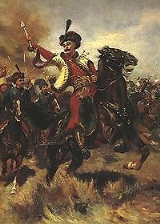
Battle of Berestechko

Encyclopedia
The Battle of Berestechko was fought between rebellious Zaporozhian Cossacks, led by Hetman
Bohdan Khmelnytsky
, aided by their Crimean Tatar
allies, and a Polish-Lithuanian Commonwealth
army under King John II Casimir. It was the largest land battle of 17th century.
Lasting from June 28 to June 30, 1651, it took place in Volhynia
. The number of Polish troops is uncertain. Duke Bogusław Radziwiłł (one of the Polish commanders) wrote that the Polish army had had 80,000 soldiers. Modern historians Zbigniew Wójcik, Józef Gierowski, and Władysław Czapliński estimate that the Polish army had 60,000-63,000 soldiers. The Cossacks had around 100,000 plus 40,000 Crimean Tatar cavalry and a few thousand Turks
and Vlachs
. Both sides had about 40,000 cavalry each. Fighting was close, with the core of excellent Cossack infantry making up for the weakness of their cavalry; much of the decisive fighting was by the infantry and dismounted dragoons of each side.
.
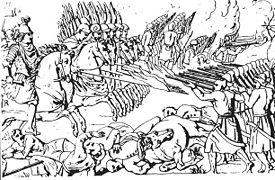
Polish commanders were hoping to break the Cossack ranks with an impetous charge of the famous Polish Winged Hussars - a tactic proven effective in many previous battles, including the decisive battles of Kircholm
, and Kłuszyn. (Such a tactic would also prove successful in the later 1683 Battle of Vienna
against the Turks).
The Cossack army knew the Polish art of war well, having great experience with both fighting along Poles and against them. Their tactic was to avoid an open field battle, while defending in a fortified camp.
Before the battle, the Cossack army totaled 80,000 men; 28,000-33,000 Tatars and uncertain numbers of Ukrainian peasants.
, supported by Jerzy Lubomirski
, six pancerni
cavalry companies of Jeremi Wiśniowiecki
and Winged Hussars under the command of Stefan Czarniecki
) repulsed the Tatars, who suffered heavy losses.
During the first day of the battle, the Poles were victorious.
The Poles lost 300 soldiers, including many officers.
During the second day of the battle, the rebels were victorious.
led a successful charge of 18 cavalry companies against the right wing of the Cossack-Tatar Army.
The Polish centre, under the command of John Casimir, moved forward. The Tatars tried to attack it, but were repulsed. During the fight, a Polish nobleman called Otwinowski noticed a banner of the Tatar Khan. Polish artillery started to fire in that direction. A Tatar standing next to the Khan fell dead. Panicked, the Khan escaped and the Tatars retreated, kidnapping Khmelnytsky. Only the Cossack wagons remained at the field of battle.
with the Poles. As the battle ended, King Kazimierz committed an error by not pursuing the fleeing and disoriented Cossacks. Later, Khmelnytsky, who was released by the Khan, and the Zaporozhians would continue the revolt.
families had the personal obligation to take part in the battle with men from their towns and villages. The officers and their supplied men for this battle were:
Duke Bogusław Radziwiłł, Autobiography
Hetman
Hetman was the title of the second-highest military commander in 15th- to 18th-century Poland and the Grand Duchy of Lithuania, which together, from 1569 to 1795, comprised the Polish-Lithuanian Commonwealth, or Rzeczpospolita....
Bohdan Khmelnytsky
Bohdan Khmelnytsky
Bohdan Zynoviy Mykhailovych Khmelnytsky was a hetman of the Zaporozhian Cossack Hetmanate of Polish–Lithuanian Commonwealth . He led an uprising against the Commonwealth and its magnates which resulted in the creation of a Cossack state...
, aided by their Crimean Tatar
Crimean Tatars
Crimean Tatars or Crimeans are a Turkic ethnic group that originally resided in Crimea. They speak the Crimean Tatar language...
allies, and a Polish-Lithuanian Commonwealth
Polish-Lithuanian Commonwealth
The Polish–Lithuanian Commonwealth was a dualistic state of Poland and Lithuania ruled by a common monarch. It was the largest and one of the most populous countries of 16th- and 17th‑century Europe with some and a multi-ethnic population of 11 million at its peak in the early 17th century...
army under King John II Casimir. It was the largest land battle of 17th century.
Lasting from June 28 to June 30, 1651, it took place in Volhynia
Volhynia
Volhynia, Volynia, or Volyn is a historic region in western Ukraine located between the rivers Prypiat and Southern Bug River, to the north of Galicia and Podolia; the region is named for the former city of Volyn or Velyn, said to have been located on the Southern Bug River, whose name may come...
. The number of Polish troops is uncertain. Duke Bogusław Radziwiłł (one of the Polish commanders) wrote that the Polish army had had 80,000 soldiers. Modern historians Zbigniew Wójcik, Józef Gierowski, and Władysław Czapliński estimate that the Polish army had 60,000-63,000 soldiers. The Cossacks had around 100,000 plus 40,000 Crimean Tatar cavalry and a few thousand Turks
Turkish people
Turkish people, also known as the "Turks" , are an ethnic group primarily living in Turkey and in the former lands of the Ottoman Empire where Turkish minorities had been established in Bulgaria, Cyprus, Bosnia and Herzegovina, Georgia, Greece, Kosovo, Macedonia, and Romania...
and Vlachs
Vlachs
Vlach is a blanket term covering several modern Latin peoples descending from the Latinised population in Central, Eastern and Southeastern Europe. English variations on the name include: Walla, Wlachs, Wallachs, Vlahs, Olahs or Ulahs...
. Both sides had about 40,000 cavalry each. Fighting was close, with the core of excellent Cossack infantry making up for the weakness of their cavalry; much of the decisive fighting was by the infantry and dismounted dragoons of each side.
The Armies
On June 19, the Polish Army totaled 14,844 Polish cavalry, 2,250 German type cavalry, 11,900 German-type infantry and dragoons, 2,950 Hungarian-type foot soldiers, 1,550 Lithuanian volunteers, 960 Tatars and 30,000 levée en massePospolite ruszenie
Pospolite ruszenie , is an anachronistic term describing the mobilisation of armed forces, especially during the period of the Polish-Lithuanian Commonwealth. The tradition of wartime mobilisation of part of the population existed from before the 13th century to the 19th century...
.
Polish commanders were hoping to break the Cossack ranks with an impetous charge of the famous Polish Winged Hussars - a tactic proven effective in many previous battles, including the decisive battles of Kircholm
Battle of Kircholm
The Battle of Kircholm was one of the major battles in the Polish-Swedish War of 1600-1611. The battle was decided in 20 minutes by the devastating charge of Polish-Lithuanian cavalry, the Winged Hussars...
, and Kłuszyn. (Such a tactic would also prove successful in the later 1683 Battle of Vienna
Battle of Vienna
The Battle of Vienna took place on 11 and 12 September 1683 after Vienna had been besieged by the Ottoman Empire for two months...
against the Turks).
The Cossack army knew the Polish art of war well, having great experience with both fighting along Poles and against them. Their tactic was to avoid an open field battle, while defending in a fortified camp.
Before the battle, the Cossack army totaled 80,000 men; 28,000-33,000 Tatars and uncertain numbers of Ukrainian peasants.
First day of battle
2000 Polish cavalry (one regiment under the command of Aleksander KoniecpolskiAleksander Koniecpolski (1620-1659)
Prince Aleksander Koniecpolski was a Polish nobleman. He became the Grand Standard-Bearer of the Crown in 1641, the Palatine of Sandomierz Voivodeship in 1656, and the Starost of Perejasław, Korsun, Płoskirow and Dolina. He was the son of the famous hetman Stanisław Koniecpolski....
, supported by Jerzy Lubomirski
Jerzy Sebastian Lubomirski
Prince Jerzy Sebastian Lubomirski was a Polish noble , magnate, outstanding politician and military commander. Lubomirski was a Prince of the Holy Roman Empire SRI. He was the initiator of the Lubomirski Rokosz....
, six pancerni
Towarzysz pancerny
Towarzysz pancerny was a medium-cavalryman in 16th-18th century Poland, named for his chainmail armor...
cavalry companies of Jeremi Wiśniowiecki
Jeremi Wisniowiecki
Jeremi Michał Korybut Wiśniowiecki was a notable member of the aristocracy of the Polish-Lithuanian Commonwealth, Prince at Wiśniowiec, Łubnie and Chorol and a father of future Polish king Michał I...
and Winged Hussars under the command of Stefan Czarniecki
Stefan Czarniecki
Stefan Czarniecki or Stefan Łodzia de Czarnca Czarniecki Polish-Lithuanian Commonwealth general and nobleman. Field Hetman of the Crown of the Polish Kingdom. He was a military commander, regarded as a Polish national hero...
) repulsed the Tatars, who suffered heavy losses.
During the first day of the battle, the Poles were victorious.
Second day of battle
The Poles, encouraged by their victory in the first day, deployed all available cavalry. Polish infantry and artillery stayed in the camp and didn't support the cavalry. But, this time, the tide turned. The Tatar cavalry won against its Polish counterpart. The Tatars came near to the Polish camp but were repulsed by heavy fire from the Polish infantry.The Poles lost 300 soldiers, including many officers.
During the second day of the battle, the rebels were victorious.
Third day of battle
At 3 p.m. Duke Jeremi WiśniowieckiJeremi Wisniowiecki
Jeremi Michał Korybut Wiśniowiecki was a notable member of the aristocracy of the Polish-Lithuanian Commonwealth, Prince at Wiśniowiec, Łubnie and Chorol and a father of future Polish king Michał I...
led a successful charge of 18 cavalry companies against the right wing of the Cossack-Tatar Army.
The Polish centre, under the command of John Casimir, moved forward. The Tatars tried to attack it, but were repulsed. During the fight, a Polish nobleman called Otwinowski noticed a banner of the Tatar Khan. Polish artillery started to fire in that direction. A Tatar standing next to the Khan fell dead. Panicked, the Khan escaped and the Tatars retreated, kidnapping Khmelnytsky. Only the Cossack wagons remained at the field of battle.
The siege of the Cossack wagons
Polish forces laid siege to the Cossack wagons. Initially, the wagons were commanded by colonel Filon Dzhalalii, but after some days he was replaced by Ivan Bohun. On July 10, the Cossacks got into a panic, believing that their commanders had escaped. The Polish forces attacked the panicked Cossacks and the battle turned into a slaughter. There were 30,000 dead in the camp, including some women and children.Results of the battle
As a result, Khmelnytsky was forced to sign the Treaty of Bila TserkvaTreaty of Bila Tserkva
The Treaty of Bila Tserkva was a peace treaty between the Polish-Lithuanian Commonwealth and the Ukrainian Cossacks in the aftermath of the Battle of Bila Tserkva...
with the Poles. As the battle ended, King Kazimierz committed an error by not pursuing the fleeing and disoriented Cossacks. Later, Khmelnytsky, who was released by the Khan, and the Zaporozhians would continue the revolt.
Polish noble families
Members of nobleSzlachta
The szlachta was a legally privileged noble class with origins in the Kingdom of Poland. It gained considerable institutional privileges during the 1333-1370 reign of Casimir the Great. In 1413, following a series of tentative personal unions between the Grand Duchy of Lithuania and the Kingdom of...
families had the personal obligation to take part in the battle with men from their towns and villages. The officers and their supplied men for this battle were:
- Czarniecki, Stefan
- Dołęga-Ossowski, Piotr
- Grzymała-Kazanowski, Adam
- Janina-Rzeczycki, Mikołaj
- Kalinowa-Kalinowski, Marcin HetmanHetmanHetman was the title of the second-highest military commander in 15th- to 18th-century Poland and the Grand Duchy of Lithuania, which together, from 1569 to 1795, comprised the Polish-Lithuanian Commonwealth, or Rzeczpospolita....
- Leliwa-Czapski, Franciszek
- Rawicz-Przyjemski, Zygmunt
Quotations
"There were in total 80,000 (of) our troops"Duke Bogusław Radziwiłł, Autobiography
External links
- http://www.kismeta.com/diGrasse/Berest.htm