

Zamosc

Encyclopedia
Zamość ' ukr. Замостя is a town in southeastern Poland with 66,633 inhabitants (2004), situated in the south-western part of Lublin Voivodeship
(since 1999), about 90 km (55.92 mi) from Lublin
, 247 km (153.48 mi) from Warsaw
and 60 km (37.28 mi) from the border with Ukraine
. About 20 kilometres from the town is the Roztocze National Park
.
The historical city centre was added to the UNESCO World Heritage List (in 1992) as a result of the decision taken during the sixteenth ordinary session of the World Heritage Committee, held in Santa Fe, New Mexico, USA, from 7 to 14 December 1992.
In the view of UNESCO, "Zamość is a unique example of a Renaissance town in Central Europe, consistently designed and built in accordance with the Italian theories of the "ideal town," on the basis of a plan which was the result of perfect cooperation between the open-minded founder, Jan Zamoyski
, and the outstanding architect, Bernardo Morando
. Zamość is an outstanding example of an innovative approach to town planning, combining the functions of an urban ensemble, a residence, and a fortress in accordance with a consistently implemented Renaissance
concept. The result of this is a stylistically homogeneous urban composition with a high level of architectural and landscape values. A real asset of this great construction was its creative enhancement with local artistic architectural achievements. Zamość is spoken of as a Renaissance town. However, on the one hand, Morando himself must have had Mannerist training, and on the other, in all the countries of Central Europe (Poland, Bohemia, Slovakia, Hungary, certain German regions and, in part, Austria proper), Italian Renaissance architecture had been well assimilated and adapted to local traditions since the 15th century. Consequently, Zamość was planned as a town in which the Mannerist taste mingled with certain Central European urban traditions, such as the arcaded galleries that surround the squares and create a sheltered passage in front of the shops."
and Hetman
(head of the army of the Polish-Lithuanian Commonwealth
) Jan Zamoyski
, on the trade route linking western and northern Europe with the Black Sea
. Modelled on Italian trading cities, and built during the Baroque
period by the architect Bernardo Morando
, a native of Padua
, Zamość remains a perfect example of a Renaissance
town of the late 16th century, which retains its original layout and fortifications (Zamość Fortress
), and a large number of buildings blending Italian and central European architectural traditions.
At the turn of the sixteenth and seventeenth centuries Zamość was one of the most impressive fortresses in the Polish-Lithuanian Commonwealth
. The city was belted with powerful bastion fortifications, curtains and moats. The defensive qualities of the fortress were determined by the natural conditions, since the city was founded at the Łabuńka river and its tributary Topornica river, surrounded by the extensive marshy valley.
As a result of the merger of the fortress and the main city and thanks to the terrain, the fortress had a shape of irregular heptagon, consisting of 7 curtains and 7 bastions placed in the bends. Jan Zamoyski
, the founder and owner of the city, paid a lot of attention to the defense functions of the city. In the founding document, he pledged to consolidate the city with ramparts and a moat. The city was founded in the areas that used to be threatened or attacked by the Tatars
. In the case of emergency, the powerful fortress could give shelter to people fleeing from threatened areas.
In the 17th century the city was thriving during the most extensive and fastest development period. It attracted not only the Poles but also many other nationalities. The city, however, faced numerous invasions, including the siege by the Cossacks led by Bohdan Khmelnytsky
in 1648, the leader of the uprising against the Polish-Lithuanian Commonwealth
(1648–1654) which resulted in the creation of a Cossack state, and during the Swedish Deluge in 1656. The Swedish army, like the Cossacks, failed to capture the city. Only during the Great Northern War
Zamość was occupied by the Swedish and Saxon troops.
Between 1772 and 1809, the city was incorporated into the Austrian Empire's Crown Province of Galicia.
In 1809 the city was incorporated to the Napoleonic Duchy of Warsaw
whereas after the fall of Napoleon, following the decisions taken during the Congress of Vienna
in 1815, Zamość became a part of the Kingdom of Poland, also called Congress Poland
, which was controlled by the Russian Empire.
In 1821 the government of the kingdom bought off the city and modernized the Zamość fortress. As a result, many buildings were restructured losing their original form and style. The modernized fortress played a big role during the November Uprising
in 1830-1831 and surrendered as the last Polish resistance point. The fortress was finally destroyed in 1866, giving rise to the robust spatial development of the city.
In 1916 the city was provided with the railway line. After Poland regained its independence in 1918, Zamość witnessed the outbreak of a communist revolt, suppressed by the Polish troops under the command of Major Leopold Lis-Kula. Two years later, during the Polish-Soviet War
, the Soviet army surrounded the city but failed to capture it.
The interwar period
was a period of fast city development when its boundaries were widened as well as many new institutions and centers, especially those relating to cultural and educational life, were created.
In 1942, Zamość County, due to its fertile black soil, was chosen for further German colonization in the General Government
as part of Generalplan Ost
. The city itself was initially to be renamed "Himmlerstadt" (Himmler City), later changed to "Pflugstadt" (Plough City). Reichsfuhrer Himmler visited Zamość in August 1942 and ordered that the buildings of the old city be demolished immediately and replaced by a "German town". The local German administrator, more sympathetic towards the town's Renaissance architecture, played for time by requesting what sort of German architecture was required. Teams of planners and architects had not reached a decision when the Germans were evicted by the Red Army
.
The German occupiers had planned the relocation of at least 60,000 ethnic Germans in the area before the end of 1943. Before that, a "test trial" expulsion
was performed in November 1941, and the whole operation ended in a pacification
operation, combined with expulsions in June/July 1943 which was code named Wehrwolf Action I and II. Around 110,000 people from 297 villages were expelled. Around 30,000 victims were children who, if racially "clean" (i.e. had physical characteristics deemed "Germanic") were planned for germanisation
in German families in the Third Reich. Most of the people expelled were sent as slave labour in Germany or to concentration camps.
Local people resisted the action with great determination; they escaped into forests, organised self-defence, helped people who were expelled, and bribed kidnapped children out of German hands. Until the middle of 1943, the Germans managed to settle 8,000 colonists, the number increased by a couple of thousand more in 1944. This settlement was met with fierce armed resistance by Polish Underground forces (see Zamość Uprising
). The Nazis found it difficult to find many families suitable for Germanization and so settlement, and that those settlers they did find often fled in fear, because those evicted would burn down houses or kill their inhabitants.
The former President of Germany Horst Köhler
was born to a family of German colonists in Skierbieszów
.
After World War II, Zamość started a period of development. In the 1970s and 1980s the population grew rapidly (from 39,100 in 1975 to 68,800 in 2003), as the city started to gain significant profits from the old trade routes linking Germany with Ukraine and the ports on the Black Sea.
During the years 1975–1998 Zamość was the capital of Zamość Voivodeship
.
Noted conservator and artist Professor Wiktor Zin
was responsible for the design and oversight of conservation work on the Arsenal and the Armenian
quarter in Zamość.
coming from Italy, Spain, Portugal and Turkey. In the 17th century, the newcomers were recruited among the Ashkenazi Jews
that soon constituted the majority within the Jewish population. The settlement rights given by Jan Zamoyski were re-confirmed in 1684 by Marcin Zamoyski
, the fourth Ordynat of Zamość estate.
At the turn of the 18th and 19th centuries, the Jewish inhabitants were under the strong influence of the Jewish Enlightenment trend called Haskalah
. The late nineteenth century saw the spread of Hasidic Judaism
. In Zamość there were a Jewish synagogue, two houses of worship and a hospital. Nowadays the best preserved remnant of the Jewish culture is the building of Zamość Synagogue
.
In 1827, 2,874 Jews lived in the city. In 1900, the Jewish population was 7,034 whereas in 1921 - 9383 (49.3% of the population).
Zamość was the hometown of many prominent Jews, including: poet Solomon Ettinger
(1799–1855), writer Isaac Leib Peretz (1852–1915), and future revolutionist Rosa Luxemburg
(1870–1919) who were all born there.
Shortly before World War II approximately 12,000 Jews lived in the city. In October 1939, the German occupants set up the Judenrat
whereas in the spring of 1942 they set up a ghetto.
From April to September 1942, around 4 thousand Jews were deported to the Bełżec extermination camp.
In October 1942, the Germans shot dead 500 people, and the remaining 4,000 were deported, via the transfer point in the Izbica concentration camp
, to the camp in Bełżec. The Jews used to be transported in unheated closed, freight train compartments, without any food and water. Many times the relatively short distance travel took 3 days, so the transported people used to arrive already dead. Today only 3 Jews live in Zamość.
Jan Zamoyski commissioned the Italian architect Bernardo Morando to design the city that would be based on the anthropomorphic concept. Its "head" was to be the Zamoyski palace, "backbone" Grodzka Street, crossing the Great Market Square from east to west, in the direction of the palace, and with the "arms" embodied by 10 streets intersecting the main streets: Solna street (north of the Great Market Square) and Bernardo Morando street (south of the Great Market Square). In these streets, the other squares were placed: Salt Square (Rynek Solny) and Water Square (Rynek Wodny), functioning as the "internal organs" of the city whereas the bastions are the "hands and legs" for self-defense.
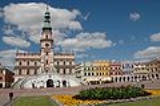
The most prominent building is the Town Hall, built at the turn of the 16th and 17th centuries in line with Bernardo Morando's design. In 1639–1651, Jan Jaroszewicz and Jan Wolff redesigned the structure. They enlarged the edifice and added three storeys with a high attic. The facades were built in accordance with the Mannerist proportions, regular divisions and excessive architectural décor. The 18th century witnessed the construction of a guardroom and a fan-shaped double stairway that were built in front of the building. In 1770 a slender dome with a lantern was added to the top of the Town Hall tower.
The Town Hall stands at the foot of the Great Market Square regarded as one of the most beautiful 16th century squares in Europe. The square is surrounded by a complex of arcaded houses that were built by the richest Zamość merchants. Its measure is exactly 100 meters in both width and length with the crossing two main axes of the old town. The 600-meter longitudinal axis goes from the east to the west: from Bastion No. 7 to the Zamoyski Palace. The 400-meter crosswise axis goes from the north to the south, linking the Great Market Square with the two smaller market squares: Solny and Wodny.
The red "Under the Angel" House at 26 Ormiańska street (Armenian street) was built in the early 1630s by a rich Armenian merchant, Garbriel Bartoszewicz. It is embelished with a carved figure of the founder's saint patron, the Archangel Gabriel holding a lily. The walls of the second floor are decorated with lions and a dragon, illustrating that the lions should protect the house against the evil embodied by the dragon. The house is the seat of the Zamość Museum.
The yellow "Under The Madonna" House at 22 Ormiańska street (Armenian street) features the Madonna with the baby Jesus; showing how the Madonna is beating down with her feet a dragon. Built by a Lwów merchant Sołtan Sachwelowicz in the 17th century, the house has been refurbished recently to expose its façade. A high attic has been reconstructed on the basis of old photographs. At present the house is the venue of the Bernardo Morando Fine Arts State Secondary School.
The "Under St. Casimir" House was erected in the 17th century and was owned alternately by Polish chemists and Armenian merchants. The façade of the house is embelished with a figure of St. Casimir, the saint patron of the new owner - Kazimierz Lubecki.
Built at the beginning of the 17th century, the green Wilczek House at 30 Ormiańska street (Armenian street) prides itself in a Baroque decor, including a relief featuring St. John the Baptist and St. Thomas the Apostle with three spears. The house was remodelled in 1665-1674 by Jan Wilczek, a town councillor.
Called also "Sapphire", the blue "Under The Married Couple" House at 24 Ormiańska street (Armenian street) was built in the second quarter of the 17th century by an Armenian merchant Torosz. The facade includes a geometrical and plant frieze whereas the attic is decorated with grotesque figures of a married couple.
The Link House at 5 Rynek Wielki street (Great Market street) was erected at the end of the 17th century with all the features of the Baroque style. A Polish architect Jan Michał Link decorated the façade of the house with fluted Ionic columns. The tops of the windows were embellished with the carved busts of two mythological warriors: Minerva wearing a basinet and Hercules dressed in lion skins. Under the windows there is a frieze featuring laurel and palm branches - symbols of glory and victory. The pilasters include wall-trophies - weapons and armours.
Called also the ‘Chemist's House', the Piechowicz House is a symbol of keeping a 350-year-old tradition. Namely the building, which was built by Szymon Piechowicz from Turobin, a chemist and a professor of medicine at the Zamość Academy, still houses a chemist's. The chemist's is furnished with a set of 19th century dark, oak cabinets.
Constructed by Bernardo Morando for an Italian merchant in the 1590s, also called the Telanowski house, the Zamoyski house belonged to Jan Zamoyski
(1599–1657). The house has got four arcades, a frieze placed under the windows and an attic. It was supposed to be a model for other houses located on the square.
The construction of the Second Morando Tenement House started around 1590. It was designed by Bernardo Morando
who placed Italian-style regular four-window façade with arcades. The windows are ornamented by a frieze with rosettes. Another frieze is situated on the side wall, showing a combination of rectangles and ovals.
The Abrek House was built for a professor of the Zamość Academy, Stanisław Rosiński. In 1636 the house was bought by another professor of the Zamość Academy, Andrzej Abrek who turned it into a splendid edifice with an arcaded portal, triangular top and three stone doors in the hallway.
Built at the end of the 16th century, the Szczebrzeszyn House belonged to the town of Szczebrzeszyn
. Its function was to keep the town's treasures and assets in Zamość fortress that was regarded as a safe place. The house has four windows, arcades and a richly ornamented finial in the form of a cartouche
in which Szczebrzeszyn coat of arms was allegedly placed.
Built in the 1600s in line with Bernardo Morando's design, the Turobin House was built for the town of Turobin which used to be part of Zamość Entail. It is embellished with many Renaissance decorations based on Italian models taken from Sebastian Serlia's books. Its façade has got a frieze featuring a system of geometrical figures.
The Cathedral (a former collegiate church until 1992) was founded by Jan Zamoyski
and dedicated to Lord's Resurrection and St. Thomas the Apostle. It was built in 1587-1598 by an Italian architect Bernardo Morando
. Being 45-meter long and 30-meter wide, the Cathedral constitutes one of the most impressive sacral buildings in Poland. Full of numerous side chapels, thin pillars and a fine vaulted presbytery, it prides itself in original interior decor and rich Renaissance
decorations, an 18th century Rococo
tabernacle and many paintings of Italian and Polish painters. In the vault of the church, there are crypts with the ashes of 16 Zamość entailers and those of their families.
Built in the Baroque style in the second half of the 18th century, the Cathedral Bell Tower is a prominent structure. It was erected according to Jerzy de Kawe's design. The passageway is decorated with plaques commemorating the martyrdom of the inhabitants of Zamość Region during World War II. In the bell tower there are three historic bells: "Jan" - the biggest and the oldest one, named after its benefactor Jan "Sobiepan" Zamoyski, "Tomasz" founded by Tomasz Józef Zamoyski
in 1721 and "Wawrzyniec" founded by Wawrzyniec Sikorski in 1715.
The Redemptorists' Church of St. Nicholas is the former Orthodox church built in 1618–1631. The project was drafted by Jan Jaroszewicz whereas the decorations were designed by Jan Wolff. The domed temple had a defensive purpose. In the 1690s a 38-m tower with a Baroque dome was added. The building has got some features typical of Moldavian Orthodox churches and Latin architecture.
Built in the 1680s in the Baroque style in line with J. M. Link's design, St. Catherine's Church was first dedicated to St. Peter from Alkantara whereas in the 1920s the church became an academic church dedicated to St. Catherine. During World War II, "The Prussian Tribute", the famous Polish painting by Jan Matejko
, was transferred secretly from Kraków
and hidden in the vault of the church to protect it from the Nazis.
Tomasz Zamoyski
, the second entailer, and his wife Katarzyna built The Franciscan Church
Dedicated to The Annunciation in the Baroque style. The biggest temple in Zamość (56-meter long and 29-meter wide) was regarded as one of the most prominent 17th century churches in Poland. It was embelished with a very rich décor by Jan Michał Link. In 1784 the Austrians closed down the Franciscan Order and as a result the church lost its sacral function for many years, housing a cinema and secondary school. In 1993 the building was transformed into a church again.
.
The Academy was an institution midway between a secondary school and an institution of higher learning. It bestowed doctorates of philosophy and law. It was known for the high quality of education that it provided, which however did not extend beyond the ideals of "nobles' liberty.
After the death of Zamoyski, it slowly lost its importance, and in 1784 it was downgraded to a lyceum. The present-day I Liceum Ogólnokształcące im. Jana Zamoyskiego is one of several secondary schools in Zamość.
Nowadays there are 9 secondary schools: 7 public (numbered from 1 to 7), one Catholic and one Social school. In addition, there are 10 primary schools: 8 public (numbered from 2 - 4 and from 6-10) as well as a Catholic and a Social primary school.
High schools
Colleges
railway line
linking former Soviet Union with Upper Silesia
n coal and sulphur mines as well as less than 60 kilometres from the border crossings to Ukraine
. Also, Zamość is located on a regular rail line, although it is not electrified. The economy of the city is based on services that is why it is dominated by numerous small and medium-sized enterprises. However, there are some large production plants, mainly food factories and companies, which is related to the dominance of agriculture in the region. These include: the Zamojskie Wheat Company (Zamojskie Zakłady Zbożowe), the Animex fodder company, the Mors frozen food producer, and a daughter company of the Dairy in Krasnystaw
.
The city is also a center of know-how support for agriculture and a market for various agricultural products.
In addition, the other companies include: a daughter company of the Black Red White furniture company (former Zamojskie Furniture Company), the Spomasz Zamość SA industrial and metal hardware producer, the SIPMOT agricultural machinery producer (a branch of the SIPMA Group from Lublin
and a branch of Stalprodukt (former Metalplast) - producer of metal hardware and equipment from Bochnia
, listed on the Warsaw Stock Exchange
.
Jazz na Kresach is a very popular annual music festival. It dates back to 1982 and has been held since then. The festival is organised in Zamość Old Town by the Zamość Jazz Club to commemorate Mieczysław Kosz.
The Zamość Festival of Mark Grechuta aims at commemorating his works. He was a composer, singer and poet. The festival has already taken place 3 times: 7–8 September 2007, 6–7 September 2008, 4–6 September 2009. The laureates of the competition and various well-known musicians sang at this festival. The festival is held in Zamość Great Market.
In addition, the admirers of open-air performances can enjoy the Zamość Summer Theatre (Zamojskie Lato Teatralne) whereas enthusiasts of folk art can relish the performances of folk groups from all over the world during the annual "EUROFOLK" International Folk Festival. Lovers of film-making can broaden their knowledge during the Summer Film Academy and the "SACROFILM" International Religious Film Days.
with
OWHC cities as well as: Bardejov
, Slovakia Loughborough
, England, United Kingdom Schwäbisch Hall
, Germany Sumy
, Ukraine Zhovkva
, Ukraine
Lublin Voivodeship
- Administrative division :Lublin Voivodeship is divided into 24 counties : 4 city counties and 20 land counties. These are further divided into 213 gminas....
(since 1999), about 90 km (55.92 mi) from Lublin
Lublin
Lublin is the ninth largest city in Poland. It is the capital of Lublin Voivodeship with a population of 350,392 . Lublin is also the largest Polish city east of the Vistula river...
, 247 km (153.48 mi) from Warsaw
Warsaw
Warsaw is the capital and largest city of Poland. It is located on the Vistula River, roughly from the Baltic Sea and from the Carpathian Mountains. Its population in 2010 was estimated at 1,716,855 residents with a greater metropolitan area of 2,631,902 residents, making Warsaw the 10th most...
and 60 km (37.28 mi) from the border with Ukraine
Ukraine
Ukraine is a country in Eastern Europe. It has an area of 603,628 km², making it the second largest contiguous country on the European continent, after Russia...
. About 20 kilometres from the town is the Roztocze National Park
Roztocze National Park
Roztocze National Park is a National Park located in eastern Poland, in Lublin Voivodeship. It protects the most valuable natural areas of the middle part of the Roztocze range. The Park was created in 1974 and initially covered area of 48.01 km². Its current size is , of which forests occupy...
.
The historical city centre was added to the UNESCO World Heritage List (in 1992) as a result of the decision taken during the sixteenth ordinary session of the World Heritage Committee, held in Santa Fe, New Mexico, USA, from 7 to 14 December 1992.
In the view of UNESCO, "Zamość is a unique example of a Renaissance town in Central Europe, consistently designed and built in accordance with the Italian theories of the "ideal town," on the basis of a plan which was the result of perfect cooperation between the open-minded founder, Jan Zamoyski
Jan Zamoyski
Jan Zamoyski , was a Polish-Lithuanian nobleman, magnate, 1st duke/ordynat of Zamość. Royal Secretary since 1566, Lesser Kanclerz ) of the Crown since 1576, Lord Grand-Chancellor of the Crown since 1578, and Grand Hetman of the Crown since 1581...
, and the outstanding architect, Bernardo Morando
Bernardo Morando
Bernardo Morando, also known as Bernardino or Morandi was a Polish-Italian architect. He is notable as the author of a new town of Zamość, modelled on Renaissance theories of the 'ideal city'....
. Zamość is an outstanding example of an innovative approach to town planning, combining the functions of an urban ensemble, a residence, and a fortress in accordance with a consistently implemented Renaissance
Renaissance
The Renaissance was a cultural movement that spanned roughly the 14th to the 17th century, beginning in Italy in the Late Middle Ages and later spreading to the rest of Europe. The term is also used more loosely to refer to the historical era, but since the changes of the Renaissance were not...
concept. The result of this is a stylistically homogeneous urban composition with a high level of architectural and landscape values. A real asset of this great construction was its creative enhancement with local artistic architectural achievements. Zamość is spoken of as a Renaissance town. However, on the one hand, Morando himself must have had Mannerist training, and on the other, in all the countries of Central Europe (Poland, Bohemia, Slovakia, Hungary, certain German regions and, in part, Austria proper), Italian Renaissance architecture had been well assimilated and adapted to local traditions since the 15th century. Consequently, Zamość was planned as a town in which the Mannerist taste mingled with certain Central European urban traditions, such as the arcaded galleries that surround the squares and create a sheltered passage in front of the shops."
History before World War II
Zamość was founded in the year 1580 by the ChancellorKanclerz
Kanclerz was one of the highest officials in the historic Poland. This office functioned from the early Polish kingdom of the 12th century until the end of the Polish-Lithuanian Commonwealth in 1795. A respective office also existed in the Grand Duchy of Lithuania since the 16th...
and Hetman
Hetman
Hetman was the title of the second-highest military commander in 15th- to 18th-century Poland and the Grand Duchy of Lithuania, which together, from 1569 to 1795, comprised the Polish-Lithuanian Commonwealth, or Rzeczpospolita....
(head of the army of the Polish-Lithuanian Commonwealth
Polish-Lithuanian Commonwealth
The Polish–Lithuanian Commonwealth was a dualistic state of Poland and Lithuania ruled by a common monarch. It was the largest and one of the most populous countries of 16th- and 17th‑century Europe with some and a multi-ethnic population of 11 million at its peak in the early 17th century...
) Jan Zamoyski
Jan Zamoyski
Jan Zamoyski , was a Polish-Lithuanian nobleman, magnate, 1st duke/ordynat of Zamość. Royal Secretary since 1566, Lesser Kanclerz ) of the Crown since 1576, Lord Grand-Chancellor of the Crown since 1578, and Grand Hetman of the Crown since 1581...
, on the trade route linking western and northern Europe with the Black Sea
Black Sea
The Black Sea is bounded by Europe, Anatolia and the Caucasus and is ultimately connected to the Atlantic Ocean via the Mediterranean and the Aegean seas and various straits. The Bosphorus strait connects it to the Sea of Marmara, and the strait of the Dardanelles connects that sea to the Aegean...
. Modelled on Italian trading cities, and built during the Baroque
Baroque
The Baroque is a period and the style that used exaggerated motion and clear, easily interpreted detail to produce drama, tension, exuberance, and grandeur in sculpture, painting, literature, dance, and music...
period by the architect Bernardo Morando
Bernardo Morando
Bernardo Morando, also known as Bernardino or Morandi was a Polish-Italian architect. He is notable as the author of a new town of Zamość, modelled on Renaissance theories of the 'ideal city'....
, a native of Padua
Padua
Padua is a city and comune in the Veneto, northern Italy. It is the capital of the province of Padua and the economic and communications hub of the area. Padua's population is 212,500 . The city is sometimes included, with Venice and Treviso, in the Padua-Treviso-Venice Metropolitan Area, having...
, Zamość remains a perfect example of a Renaissance
Renaissance
The Renaissance was a cultural movement that spanned roughly the 14th to the 17th century, beginning in Italy in the Late Middle Ages and later spreading to the rest of Europe. The term is also used more loosely to refer to the historical era, but since the changes of the Renaissance were not...
town of the late 16th century, which retains its original layout and fortifications (Zamość Fortress
Zamosc Fortress
Zamość Fortress is a set of fortifications constructed together with the city of Zamość . It was built between 1579 and 1618, and the construction was initiated by Chancellor and Hetman Jan Zamoyski...
), and a large number of buildings blending Italian and central European architectural traditions.
At the turn of the sixteenth and seventeenth centuries Zamość was one of the most impressive fortresses in the Polish-Lithuanian Commonwealth
Polish-Lithuanian Commonwealth
The Polish–Lithuanian Commonwealth was a dualistic state of Poland and Lithuania ruled by a common monarch. It was the largest and one of the most populous countries of 16th- and 17th‑century Europe with some and a multi-ethnic population of 11 million at its peak in the early 17th century...
. The city was belted with powerful bastion fortifications, curtains and moats. The defensive qualities of the fortress were determined by the natural conditions, since the city was founded at the Łabuńka river and its tributary Topornica river, surrounded by the extensive marshy valley.
As a result of the merger of the fortress and the main city and thanks to the terrain, the fortress had a shape of irregular heptagon, consisting of 7 curtains and 7 bastions placed in the bends. Jan Zamoyski
Jan Zamoyski
Jan Zamoyski , was a Polish-Lithuanian nobleman, magnate, 1st duke/ordynat of Zamość. Royal Secretary since 1566, Lesser Kanclerz ) of the Crown since 1576, Lord Grand-Chancellor of the Crown since 1578, and Grand Hetman of the Crown since 1581...
, the founder and owner of the city, paid a lot of attention to the defense functions of the city. In the founding document, he pledged to consolidate the city with ramparts and a moat. The city was founded in the areas that used to be threatened or attacked by the Tatars
Tatars
Tatars are a Turkic speaking ethnic group , numbering roughly 7 million.The majority of Tatars live in the Russian Federation, with a population of around 5.5 million, about 2 million of which in the republic of Tatarstan.Significant minority populations are found in Uzbekistan, Kazakhstan,...
. In the case of emergency, the powerful fortress could give shelter to people fleeing from threatened areas.
In the 17th century the city was thriving during the most extensive and fastest development period. It attracted not only the Poles but also many other nationalities. The city, however, faced numerous invasions, including the siege by the Cossacks led by Bohdan Khmelnytsky
Bohdan Khmelnytsky
Bohdan Zynoviy Mykhailovych Khmelnytsky was a hetman of the Zaporozhian Cossack Hetmanate of Polish–Lithuanian Commonwealth . He led an uprising against the Commonwealth and its magnates which resulted in the creation of a Cossack state...
in 1648, the leader of the uprising against the Polish-Lithuanian Commonwealth
Polish-Lithuanian Commonwealth
The Polish–Lithuanian Commonwealth was a dualistic state of Poland and Lithuania ruled by a common monarch. It was the largest and one of the most populous countries of 16th- and 17th‑century Europe with some and a multi-ethnic population of 11 million at its peak in the early 17th century...
(1648–1654) which resulted in the creation of a Cossack state, and during the Swedish Deluge in 1656. The Swedish army, like the Cossacks, failed to capture the city. Only during the Great Northern War
Great Northern War
The Great Northern War was a conflict in which a coalition led by the Tsardom of Russia successfully contested the supremacy of the Swedish Empire in northern Central Europe and Eastern Europe. The initial leaders of the anti-Swedish alliance were Peter I the Great of Russia, Frederick IV of...
Zamość was occupied by the Swedish and Saxon troops.
Between 1772 and 1809, the city was incorporated into the Austrian Empire's Crown Province of Galicia.
In 1809 the city was incorporated to the Napoleonic Duchy of Warsaw
Duchy of Warsaw
The Duchy of Warsaw was a Polish state established by Napoleon I in 1807 from the Polish lands ceded by the Kingdom of Prussia under the terms of the Treaties of Tilsit. The duchy was held in personal union by one of Napoleon's allies, King Frederick Augustus I of Saxony...
whereas after the fall of Napoleon, following the decisions taken during the Congress of Vienna
Congress of Vienna
The Congress of Vienna was a conference of ambassadors of European states chaired by Klemens Wenzel von Metternich, and held in Vienna from September, 1814 to June, 1815. The objective of the Congress was to settle the many issues arising from the French Revolutionary Wars, the Napoleonic Wars,...
in 1815, Zamość became a part of the Kingdom of Poland, also called Congress Poland
Congress Poland
The Kingdom of Poland , informally known as Congress Poland , created in 1815 by the Congress of Vienna, was a personal union of the Russian parcel of Poland with the Russian Empire...
, which was controlled by the Russian Empire.
In 1821 the government of the kingdom bought off the city and modernized the Zamość fortress. As a result, many buildings were restructured losing their original form and style. The modernized fortress played a big role during the November Uprising
November Uprising
The November Uprising , Polish–Russian War 1830–31 also known as the Cadet Revolution, was an armed rebellion in the heartland of partitioned Poland against the Russian Empire. The uprising began on 29 November 1830 in Warsaw when the young Polish officers from the local Army of the Congress...
in 1830-1831 and surrendered as the last Polish resistance point. The fortress was finally destroyed in 1866, giving rise to the robust spatial development of the city.
In 1916 the city was provided with the railway line. After Poland regained its independence in 1918, Zamość witnessed the outbreak of a communist revolt, suppressed by the Polish troops under the command of Major Leopold Lis-Kula. Two years later, during the Polish-Soviet War
Polish-Soviet War
The Polish–Soviet War was an armed conflict between Soviet Russia and Soviet Ukraine and the Second Polish Republic and the Ukrainian People's Republic—four states in post–World War I Europe...
, the Soviet army surrounded the city but failed to capture it.
The interwar period
Interwar period
Interwar period can refer to any period between two wars. The Interbellum is understood to be the period between the end of the Great War or First World War and the beginning of the Second World War in Europe....
was a period of fast city development when its boundaries were widened as well as many new institutions and centers, especially those relating to cultural and educational life, were created.
History after World War II
Following the German invasion and outbreak of World War II, in September 1939 Zamość was seized by the German army. Shortly, the Nazis created an extermination camp in the Zamość Rotunda where more than 8,000 people were killed, including displaced residents of the Zamość region and Soviet prisoners of war.In 1942, Zamość County, due to its fertile black soil, was chosen for further German colonization in the General Government
General Government
The General Government was an area of Second Republic of Poland under Nazi German rule during World War II; designated as a separate region of the Third Reich between 1939–1945...
as part of Generalplan Ost
Generalplan Ost
Generalplan Ost was a secret Nazi German plan for the colonization of Eastern Europe. Implementing it would have necessitated genocide and ethnic cleansing to be undertaken in the Eastern European territories occupied by Germany during World War II...
. The city itself was initially to be renamed "Himmlerstadt" (Himmler City), later changed to "Pflugstadt" (Plough City). Reichsfuhrer Himmler visited Zamość in August 1942 and ordered that the buildings of the old city be demolished immediately and replaced by a "German town". The local German administrator, more sympathetic towards the town's Renaissance architecture, played for time by requesting what sort of German architecture was required. Teams of planners and architects had not reached a decision when the Germans were evicted by the Red Army
Red Army
The Workers' and Peasants' Red Army started out as the Soviet Union's revolutionary communist combat groups during the Russian Civil War of 1918-1922. It grew into the national army of the Soviet Union. By the 1930s the Red Army was among the largest armies in history.The "Red Army" name refers to...
.
The German occupiers had planned the relocation of at least 60,000 ethnic Germans in the area before the end of 1943. Before that, a "test trial" expulsion
Population transfer
Population transfer is the movement of a large group of people from one region to another by state policy or international authority, most frequently on the basis of ethnicity or religion...
was performed in November 1941, and the whole operation ended in a pacification
Pacification operations in German-occupied Poland
The pacification operations in German-occupied Poland was the use of military force and punitive measures conducted during World War II by Nazi Germany with the goal of suppressing any Polish resistance....
operation, combined with expulsions in June/July 1943 which was code named Wehrwolf Action I and II. Around 110,000 people from 297 villages were expelled. Around 30,000 victims were children who, if racially "clean" (i.e. had physical characteristics deemed "Germanic") were planned for germanisation
Germanisation
Germanisation is both the spread of the German language, people and culture either by force or assimilation, and the adaptation of a foreign word to the German language in linguistics, much like the Romanisation of many languages which do not use the Latin alphabet...
in German families in the Third Reich. Most of the people expelled were sent as slave labour in Germany or to concentration camps.
Local people resisted the action with great determination; they escaped into forests, organised self-defence, helped people who were expelled, and bribed kidnapped children out of German hands. Until the middle of 1943, the Germans managed to settle 8,000 colonists, the number increased by a couple of thousand more in 1944. This settlement was met with fierce armed resistance by Polish Underground forces (see Zamość Uprising
Zamosc Uprising
The Zamość Uprising refers to the actions by Polish resistance against the forced expulsion of Poles from the Zamość region under the Nazi Generalplan Ost...
). The Nazis found it difficult to find many families suitable for Germanization and so settlement, and that those settlers they did find often fled in fear, because those evicted would burn down houses or kill their inhabitants.
The former President of Germany Horst Köhler
Horst Köhler
Horst Köhler is a German politician of the Christian Democratic Union. He was President of Germany from 2004 to 2010. As the candidate of the two Christian Democratic sister parties, the CDU and the CSU, and the liberal FDP, Köhler was elected to his first five-year term by the Federal Assembly on...
was born to a family of German colonists in Skierbieszów
Skierbieszów
Skierbieszów is a village in Zamość County, Lublin Voivodeship, in eastern Poland. It is the seat of the gmina called Gmina Skierbieszów. It lies on the river Wolica, approximately north-east of Zamość and south-east of the regional capital Lublin. The village has a population of 1,317...
.
After World War II, Zamość started a period of development. In the 1970s and 1980s the population grew rapidly (from 39,100 in 1975 to 68,800 in 2003), as the city started to gain significant profits from the old trade routes linking Germany with Ukraine and the ports on the Black Sea.
During the years 1975–1998 Zamość was the capital of Zamość Voivodeship
Zamosc Voivodeship
Zamość Voivodeship was a unit of administrative division and local government in Poland in years 1975–1998, superseded by Lublin Voivodeship.Capital city: ZamośćMajor cities and towns :* Zamość * Biłgoraj...
.
Noted conservator and artist Professor Wiktor Zin
Wiktor Zin
Wiktor Zin - Polish architect, graphic artist, professor, architectural preservationist, cultural activist, and promoter of Polish history and culture.-Biography:...
was responsible for the design and oversight of conservation work on the Arsenal and the Armenian
Armenians
Armenian people or Armenians are a nation and ethnic group native to the Armenian Highland.The largest concentration is in Armenia having a nearly-homogeneous population with 97.9% or 3,145,354 being ethnic Armenian....
quarter in Zamość.
History of Jews in Zamość
The city was a large center of Chasidic Judaism. The Qahal of Zamość was founded in 1588 when Jan Zamoyski agreed to settle the Jews in the city. The first Jewish settlers were mainly the Sephardi JewsSephardi Jews
Sephardi Jews is a general term referring to the descendants of the Jews who lived in the Iberian Peninsula before their expulsion in the Spanish Inquisition. It can also refer to those who use a Sephardic style of liturgy or would otherwise define themselves in terms of the Jewish customs and...
coming from Italy, Spain, Portugal and Turkey. In the 17th century, the newcomers were recruited among the Ashkenazi Jews
Ashkenazi Jews
Ashkenazi Jews, also known as Ashkenazic Jews or Ashkenazim , are the Jews descended from the medieval Jewish communities along the Rhine in Germany from Alsace in the south to the Rhineland in the north. Ashkenaz is the medieval Hebrew name for this region and thus for Germany...
that soon constituted the majority within the Jewish population. The settlement rights given by Jan Zamoyski were re-confirmed in 1684 by Marcin Zamoyski
Marcin Zamoyski
Marcin Zamoyski was a Polish nobleman .Marcin became the fourth Ordynat of Zamość estate in 1674. He became a Royal Rotmistrz in 1656, Podstoli of Lwów in 1677, voivode of Bracław Voivodeship in 1678, voivode of Lublin Voivodeship in 1682 and Grand Treasurer of the Crown in 1685. He was starost of...
, the fourth Ordynat of Zamość estate.
At the turn of the 18th and 19th centuries, the Jewish inhabitants were under the strong influence of the Jewish Enlightenment trend called Haskalah
Haskalah
Haskalah , the Jewish Enlightenment, was a movement among European Jews in the 18th–19th centuries that advocated adopting enlightenment values, pressing for better integration into European society, and increasing education in secular studies, Hebrew language, and Jewish history...
. The late nineteenth century saw the spread of Hasidic Judaism
Hasidic Judaism
Hasidic Judaism or Hasidism, from the Hebrew —Ḥasidut in Sephardi, Chasidus in Ashkenazi, meaning "piety" , is a branch of Orthodox Judaism that promotes spirituality and joy through the popularisation and internalisation of Jewish mysticism as the fundamental aspects of the Jewish faith...
. In Zamość there were a Jewish synagogue, two houses of worship and a hospital. Nowadays the best preserved remnant of the Jewish culture is the building of Zamość Synagogue
Zamosc Synagogue
Zamość Synagogue, , was built between 1610 and 1618 Zamość in the Polish-Lithuanian Commonwealth. The synagogue had functioned as a place of worship until World War II, when the Nazis turned the interior into a carpenters’ workshop...
.
In 1827, 2,874 Jews lived in the city. In 1900, the Jewish population was 7,034 whereas in 1921 - 9383 (49.3% of the population).
Zamość was the hometown of many prominent Jews, including: poet Solomon Ettinger
Solomon Ettinger
Solomon Ettinger was a 19th century Yiddish- and Hebrew-language playwright, poet and writer of songs and fables whose emblematic play Serkele has remained a classic of the Yiddish theatre. His given name has appeared variously as Salomon or Shlomo or Shloyme and his family name has also been...
(1799–1855), writer Isaac Leib Peretz (1852–1915), and future revolutionist Rosa Luxemburg
Rosa Luxemburg
Rosa Luxemburg was a Marxist theorist, philosopher, economist and activist of Polish Jewish descent who became a naturalized German citizen...
(1870–1919) who were all born there.
Shortly before World War II approximately 12,000 Jews lived in the city. In October 1939, the German occupants set up the Judenrat
Judenrat
Judenräte were administrative bodies during the Second World War that the Germans required Jews to form in the German occupied territory of Poland, and later in the occupied territories of the Soviet Union It is the overall term for the enforcement bodies established by the Nazi occupiers to...
whereas in the spring of 1942 they set up a ghetto.
From April to September 1942, around 4 thousand Jews were deported to the Bełżec extermination camp.
In October 1942, the Germans shot dead 500 people, and the remaining 4,000 were deported, via the transfer point in the Izbica concentration camp
Izbica concentration camp
The Izbica ghetto was a Jewish ghetto created in Izbica in occupied Poland during World War II, serving as a transfer point for deportation of Jews from Poland, Germany, Austria and Czechoslovakia to Belzec and Sobibor extermination camps. SS-Hauptsturmführer Kurt Engels was the commandant of the...
, to the camp in Bełżec. The Jews used to be transported in unheated closed, freight train compartments, without any food and water. Many times the relatively short distance travel took 3 days, so the transported people used to arrive already dead. Today only 3 Jews live in Zamość.
Architecture
The most historic buildings are located in the Old Town. The main distinguishing features of the Old Town have been well preserved since its establishment. It includes the regular Great Market Square of 100 x 100 meters with the splendid Townhall and so-called Armenian houses, as well as the fragments of the original fortress and fortifications, including those from the period of the Russian occupation in the 19th century.Jan Zamoyski commissioned the Italian architect Bernardo Morando to design the city that would be based on the anthropomorphic concept. Its "head" was to be the Zamoyski palace, "backbone" Grodzka Street, crossing the Great Market Square from east to west, in the direction of the palace, and with the "arms" embodied by 10 streets intersecting the main streets: Solna street (north of the Great Market Square) and Bernardo Morando street (south of the Great Market Square). In these streets, the other squares were placed: Salt Square (Rynek Solny) and Water Square (Rynek Wodny), functioning as the "internal organs" of the city whereas the bastions are the "hands and legs" for self-defense.
The most prominent building is the Town Hall, built at the turn of the 16th and 17th centuries in line with Bernardo Morando's design. In 1639–1651, Jan Jaroszewicz and Jan Wolff redesigned the structure. They enlarged the edifice and added three storeys with a high attic. The facades were built in accordance with the Mannerist proportions, regular divisions and excessive architectural décor. The 18th century witnessed the construction of a guardroom and a fan-shaped double stairway that were built in front of the building. In 1770 a slender dome with a lantern was added to the top of the Town Hall tower.
The Town Hall stands at the foot of the Great Market Square regarded as one of the most beautiful 16th century squares in Europe. The square is surrounded by a complex of arcaded houses that were built by the richest Zamość merchants. Its measure is exactly 100 meters in both width and length with the crossing two main axes of the old town. The 600-meter longitudinal axis goes from the east to the west: from Bastion No. 7 to the Zamoyski Palace. The 400-meter crosswise axis goes from the north to the south, linking the Great Market Square with the two smaller market squares: Solny and Wodny.
The red "Under the Angel" House at 26 Ormiańska street (Armenian street) was built in the early 1630s by a rich Armenian merchant, Garbriel Bartoszewicz. It is embelished with a carved figure of the founder's saint patron, the Archangel Gabriel holding a lily. The walls of the second floor are decorated with lions and a dragon, illustrating that the lions should protect the house against the evil embodied by the dragon. The house is the seat of the Zamość Museum.
The yellow "Under The Madonna" House at 22 Ormiańska street (Armenian street) features the Madonna with the baby Jesus; showing how the Madonna is beating down with her feet a dragon. Built by a Lwów merchant Sołtan Sachwelowicz in the 17th century, the house has been refurbished recently to expose its façade. A high attic has been reconstructed on the basis of old photographs. At present the house is the venue of the Bernardo Morando Fine Arts State Secondary School.
The "Under St. Casimir" House was erected in the 17th century and was owned alternately by Polish chemists and Armenian merchants. The façade of the house is embelished with a figure of St. Casimir, the saint patron of the new owner - Kazimierz Lubecki.
Built at the beginning of the 17th century, the green Wilczek House at 30 Ormiańska street (Armenian street) prides itself in a Baroque decor, including a relief featuring St. John the Baptist and St. Thomas the Apostle with three spears. The house was remodelled in 1665-1674 by Jan Wilczek, a town councillor.
Called also "Sapphire", the blue "Under The Married Couple" House at 24 Ormiańska street (Armenian street) was built in the second quarter of the 17th century by an Armenian merchant Torosz. The facade includes a geometrical and plant frieze whereas the attic is decorated with grotesque figures of a married couple.
The Link House at 5 Rynek Wielki street (Great Market street) was erected at the end of the 17th century with all the features of the Baroque style. A Polish architect Jan Michał Link decorated the façade of the house with fluted Ionic columns. The tops of the windows were embellished with the carved busts of two mythological warriors: Minerva wearing a basinet and Hercules dressed in lion skins. Under the windows there is a frieze featuring laurel and palm branches - symbols of glory and victory. The pilasters include wall-trophies - weapons and armours.
Called also the ‘Chemist's House', the Piechowicz House is a symbol of keeping a 350-year-old tradition. Namely the building, which was built by Szymon Piechowicz from Turobin, a chemist and a professor of medicine at the Zamość Academy, still houses a chemist's. The chemist's is furnished with a set of 19th century dark, oak cabinets.
Constructed by Bernardo Morando for an Italian merchant in the 1590s, also called the Telanowski house, the Zamoyski house belonged to Jan Zamoyski
Jan Zamoyski
Jan Zamoyski , was a Polish-Lithuanian nobleman, magnate, 1st duke/ordynat of Zamość. Royal Secretary since 1566, Lesser Kanclerz ) of the Crown since 1576, Lord Grand-Chancellor of the Crown since 1578, and Grand Hetman of the Crown since 1581...
(1599–1657). The house has got four arcades, a frieze placed under the windows and an attic. It was supposed to be a model for other houses located on the square.
The construction of the Second Morando Tenement House started around 1590. It was designed by Bernardo Morando
Bernardo Morando
Bernardo Morando, also known as Bernardino or Morandi was a Polish-Italian architect. He is notable as the author of a new town of Zamość, modelled on Renaissance theories of the 'ideal city'....
who placed Italian-style regular four-window façade with arcades. The windows are ornamented by a frieze with rosettes. Another frieze is situated on the side wall, showing a combination of rectangles and ovals.
The Abrek House was built for a professor of the Zamość Academy, Stanisław Rosiński. In 1636 the house was bought by another professor of the Zamość Academy, Andrzej Abrek who turned it into a splendid edifice with an arcaded portal, triangular top and three stone doors in the hallway.
Built at the end of the 16th century, the Szczebrzeszyn House belonged to the town of Szczebrzeszyn
Szczebrzeszyn
Szczebrzeszyn is a city in southeastern Poland in Lublin Voivodeship, in Zamość County, about 20 km west of Zamość. From 1975–1999, it was part of the Zamość Voivodeship administrative district. The town serves as the seat to Gmina Szczebrzeszyn. A 2004 census counted 5,357 inhabitants...
. Its function was to keep the town's treasures and assets in Zamość fortress that was regarded as a safe place. The house has four windows, arcades and a richly ornamented finial in the form of a cartouche
Cartouche
In Egyptian hieroglyphs, a cartouche is an ellipse with a horizontal line at one end, indicating that the text enclosed is a royal name, coming into use during the beginning of the Fourth Dynasty under Pharaoh Sneferu, replacing the earlier serekh...
in which Szczebrzeszyn coat of arms was allegedly placed.
Built in the 1600s in line with Bernardo Morando's design, the Turobin House was built for the town of Turobin which used to be part of Zamość Entail. It is embellished with many Renaissance decorations based on Italian models taken from Sebastian Serlia's books. Its façade has got a frieze featuring a system of geometrical figures.
The Cathedral (a former collegiate church until 1992) was founded by Jan Zamoyski
Jan Zamoyski
Jan Zamoyski , was a Polish-Lithuanian nobleman, magnate, 1st duke/ordynat of Zamość. Royal Secretary since 1566, Lesser Kanclerz ) of the Crown since 1576, Lord Grand-Chancellor of the Crown since 1578, and Grand Hetman of the Crown since 1581...
and dedicated to Lord's Resurrection and St. Thomas the Apostle. It was built in 1587-1598 by an Italian architect Bernardo Morando
Bernardo Morando
Bernardo Morando, also known as Bernardino or Morandi was a Polish-Italian architect. He is notable as the author of a new town of Zamość, modelled on Renaissance theories of the 'ideal city'....
. Being 45-meter long and 30-meter wide, the Cathedral constitutes one of the most impressive sacral buildings in Poland. Full of numerous side chapels, thin pillars and a fine vaulted presbytery, it prides itself in original interior decor and rich Renaissance
Renaissance
The Renaissance was a cultural movement that spanned roughly the 14th to the 17th century, beginning in Italy in the Late Middle Ages and later spreading to the rest of Europe. The term is also used more loosely to refer to the historical era, but since the changes of the Renaissance were not...
decorations, an 18th century Rococo
Rococo
Rococo , also referred to as "Late Baroque", is an 18th-century style which developed as Baroque artists gave up their symmetry and became increasingly ornate, florid, and playful...
tabernacle and many paintings of Italian and Polish painters. In the vault of the church, there are crypts with the ashes of 16 Zamość entailers and those of their families.
Built in the Baroque style in the second half of the 18th century, the Cathedral Bell Tower is a prominent structure. It was erected according to Jerzy de Kawe's design. The passageway is decorated with plaques commemorating the martyrdom of the inhabitants of Zamość Region during World War II. In the bell tower there are three historic bells: "Jan" - the biggest and the oldest one, named after its benefactor Jan "Sobiepan" Zamoyski, "Tomasz" founded by Tomasz Józef Zamoyski
Tomasz Józef Zamoyski
Tomasz Józef Zamoyski was a Polish nobleman .Tomasz became the 5th Ordynat of Zamość estate. He was also starost of Płoskirów and Gródek and became a Royal Colonel....
in 1721 and "Wawrzyniec" founded by Wawrzyniec Sikorski in 1715.
The Redemptorists' Church of St. Nicholas is the former Orthodox church built in 1618–1631. The project was drafted by Jan Jaroszewicz whereas the decorations were designed by Jan Wolff. The domed temple had a defensive purpose. In the 1690s a 38-m tower with a Baroque dome was added. The building has got some features typical of Moldavian Orthodox churches and Latin architecture.
Built in the 1680s in the Baroque style in line with J. M. Link's design, St. Catherine's Church was first dedicated to St. Peter from Alkantara whereas in the 1920s the church became an academic church dedicated to St. Catherine. During World War II, "The Prussian Tribute", the famous Polish painting by Jan Matejko
Jan Matejko
Jan Matejko was a Polish painter known for paintings of notable historical Polish political and military events. His most famous works include oil on canvas paintings like Battle of Grunwald, paintings of numerous other battles and court scenes, and a gallery of Polish kings...
, was transferred secretly from Kraków
Kraków
Kraków also Krakow, or Cracow , is the second largest and one of the oldest cities in Poland. Situated on the Vistula River in the Lesser Poland region, the city dates back to the 7th century. Kraków has traditionally been one of the leading centres of Polish academic, cultural, and artistic life...
and hidden in the vault of the church to protect it from the Nazis.
Tomasz Zamoyski
Tomasz Zamoyski
Tomasz Zamoyski was a Polish-Lithuanian nobleman and magnate.Tomasz was the 2nd Ordynat of the Zamość estates. He was voivode of Podole Voivodeship in 1618, voivode of Kijów Voivodeship in 1619, starost of Kraków in 1628, Deputy Chancellor of the Crown in 1635, as well as starost of Knyszyn,...
, the second entailer, and his wife Katarzyna built The Franciscan Church
Franciscan Church, Zamość
Church of the Annunciation to the Blessed Virgin Mary commonly known as the Franciscan Church is a Baroque Franciscan church in the Old Town in Zamość dedicated to the Annunciation...
Dedicated to The Annunciation in the Baroque style. The biggest temple in Zamość (56-meter long and 29-meter wide) was regarded as one of the most prominent 17th century churches in Poland. It was embelished with a very rich décor by Jan Michał Link. In 1784 the Austrians closed down the Franciscan Order and as a result the church lost its sacral function for many years, housing a cinema and secondary school. In 1993 the building was transformed into a church again.
Education
Zamość prides itself in the long history of educational services. The Zamojski Academy (1594–1784) was an academy founded in 1594 by Polish Crown Chancellor Jan Zamoyski. It was the fourth institution of higher education to be founded in the Polish-Lithuanian CommonwealthPolish-Lithuanian Commonwealth
The Polish–Lithuanian Commonwealth was a dualistic state of Poland and Lithuania ruled by a common monarch. It was the largest and one of the most populous countries of 16th- and 17th‑century Europe with some and a multi-ethnic population of 11 million at its peak in the early 17th century...
.
The Academy was an institution midway between a secondary school and an institution of higher learning. It bestowed doctorates of philosophy and law. It was known for the high quality of education that it provided, which however did not extend beyond the ideals of "nobles' liberty.
After the death of Zamoyski, it slowly lost its importance, and in 1784 it was downgraded to a lyceum. The present-day I Liceum Ogólnokształcące im. Jana Zamoyskiego is one of several secondary schools in Zamość.
Nowadays there are 9 secondary schools: 7 public (numbered from 1 to 7), one Catholic and one Social school. In addition, there are 10 primary schools: 8 public (numbered from 2 - 4 and from 6-10) as well as a Catholic and a Social primary school.
High schools
- I Liceum Ogólnokształcące im. Jana ZamoyskiegoJan ZamoyskiJan Zamoyski , was a Polish-Lithuanian nobleman, magnate, 1st duke/ordynat of Zamość. Royal Secretary since 1566, Lesser Kanclerz ) of the Crown since 1576, Lord Grand-Chancellor of the Crown since 1578, and Grand Hetman of the Crown since 1581...
- II Liceum Ogólnokształcąse im. M. KonopnickiejMaria KonopnickaMaria Konopnicka nee Wasiłowska , was a Polish poet, novelist, writer for children and youth, a translator, journalist and critic, as well as an activist for women's rights and Polish independence.Maria Konopnicka also composed a poem about the execution of the Irish patriot, Robert...
- III Liceum Ogólnokształcące im. K. C. Norwida
- IV Liceum Ogólnokształcące im Armi Krajowej
Colleges
- Wyższa Szkoła Humanistyczno-Ekonomiczna im. Jana ZamoyskiegoJan ZamoyskiJan Zamoyski , was a Polish-Lithuanian nobleman, magnate, 1st duke/ordynat of Zamość. Royal Secretary since 1566, Lesser Kanclerz ) of the Crown since 1576, Lord Grand-Chancellor of the Crown since 1578, and Grand Hetman of the Crown since 1581...
- Wyższa Szkoła Zarządzania i Administracji
- Państwowa Wyższa Szkoła Zawodowa w Zamościu
- Zespół Kolegiów Nauczycielskich w Zamościu
- University of Life Sciences in Lublin - faculty in Zamość
Economy
The city is located on the broad gaugeBroad gauge
Broad-gauge railways use a track gauge greater than the standard gauge of .- List :For list see: List of broad gauges, by gauge and country- History :...
railway line
Linia Hutnicza Szerokotorowa
Broad Gauge Metallurgy Line , is the longest broad gauge railway line in Poland. Except for this one line, and a few very short stretches near border crossings, Poland uses the standard gauge for its railway tracks...
linking former Soviet Union with Upper Silesia
Upper Silesia
Upper Silesia is the southeastern part of the historical and geographical region of Silesia. Since the 9th century, Upper Silesia has been part of Greater Moravia, the Duchy of Bohemia, the Piast Kingdom of Poland, again of the Lands of the Bohemian Crown and the Holy Roman Empire, as well as of...
n coal and sulphur mines as well as less than 60 kilometres from the border crossings to Ukraine
Ukraine
Ukraine is a country in Eastern Europe. It has an area of 603,628 km², making it the second largest contiguous country on the European continent, after Russia...
. Also, Zamość is located on a regular rail line, although it is not electrified. The economy of the city is based on services that is why it is dominated by numerous small and medium-sized enterprises. However, there are some large production plants, mainly food factories and companies, which is related to the dominance of agriculture in the region. These include: the Zamojskie Wheat Company (Zamojskie Zakłady Zbożowe), the Animex fodder company, the Mors frozen food producer, and a daughter company of the Dairy in Krasnystaw
Krasnystaw
Krasnystaw is a town in eastern Poland with 19,615 inhabitants . Situated in the Lublin Voivodeship , previously in Chelm Voivodeship . It is the capital of Krasnystaw County....
.
The city is also a center of know-how support for agriculture and a market for various agricultural products.
In addition, the other companies include: a daughter company of the Black Red White furniture company (former Zamojskie Furniture Company), the Spomasz Zamość SA industrial and metal hardware producer, the SIPMOT agricultural machinery producer (a branch of the SIPMA Group from Lublin
Lublin
Lublin is the ninth largest city in Poland. It is the capital of Lublin Voivodeship with a population of 350,392 . Lublin is also the largest Polish city east of the Vistula river...
and a branch of Stalprodukt (former Metalplast) - producer of metal hardware and equipment from Bochnia
Bochnia
Bochnia is a town of 30,000 inhabitants on the river Raba in southern Poland. The town lies approximately in halfway [] between Tarnów and the regional capital Kraków . Bochnia is most noted for its salt mine, the oldest functioning in Europe, built circa 1248...
, listed on the Warsaw Stock Exchange
Warsaw Stock Exchange
The Warsaw Stock Exchange , , is a stock exchange located in Warsaw, Poland. It has a capitalization of € 220 bln .The WSE is a member of the World Federation of Exchanges and the Federation of European Securities Exchanges.-History:...
.
Culture
The Old Town together with the remains of the old Zamość Fortress constitute an urban complex inscribed on the UNESCO World Heritage Site. Zamość hosts the following cultural events: concerts of music performed by the Karol Namysłowski Symphonic Orchestra in Zamość and by Polish artists representing different kinds of music, Zamość Days of Music (Zamojskie Dni Muzyki) and International Meetings of Jazz Singers (Międzynarodowe Spotkania Wokalistów Jazzowych), which is a tribute to Mieczysław Kosz, a great blind jazz player and composer who used to combine his jazz music with the Polish folk.Jazz na Kresach is a very popular annual music festival. It dates back to 1982 and has been held since then. The festival is organised in Zamość Old Town by the Zamość Jazz Club to commemorate Mieczysław Kosz.
The Zamość Festival of Mark Grechuta aims at commemorating his works. He was a composer, singer and poet. The festival has already taken place 3 times: 7–8 September 2007, 6–7 September 2008, 4–6 September 2009. The laureates of the competition and various well-known musicians sang at this festival. The festival is held in Zamość Great Market.
In addition, the admirers of open-air performances can enjoy the Zamość Summer Theatre (Zamojskie Lato Teatralne) whereas enthusiasts of folk art can relish the performances of folk groups from all over the world during the annual "EUROFOLK" International Folk Festival. Lovers of film-making can broaden their knowledge during the Summer Film Academy and the "SACROFILM" International Religious Film Days.
Famous and/or known people born in Zamość
- Tauba BitermanTauba BitermanTauba Biterman is a Holocaust survivor. She has dedicated her adult life to teaching and sharing memories of the Holocaust. Her speeches paint a realistic portrait of what a Jewish girl from Poland went through between 1939 and 1945....
(1918 - ) - is a Holocaust survivor that dedicated her adult life to teaching and sharing memories of the Holocaust. - Joseph EpsteinJoseph Epstein (French Resistance leader)Joseph Epstein , also known as Colonel Gilles and as Joseph Andrej, was a Polish-born Jewish communist activist and a French Resistance leader during World War II. He was executed by the Germans.-Communist organizer:Joseph Epstein was born in Zamość, Congress Poland. He studied law at Warsaw...
(1911–1944) - also known as Colonel Gilles, was a Polish-born Jewish communist activist and a French Resistance leader during World War II. - Solomon EttingerSolomon EttingerSolomon Ettinger was a 19th century Yiddish- and Hebrew-language playwright, poet and writer of songs and fables whose emblematic play Serkele has remained a classic of the Yiddish theatre. His given name has appeared variously as Salomon or Shlomo or Shloyme and his family name has also been...
(1802–1856) - was a 19th century Yiddish- and Hebrew-language playwright, poet and writer of songs and fables. - Marek GrechutaMarek GrechutaMarek Grechuta was a Polish singer, songwriter, composer, and lyricist.-Biography:...
(1945–2006) - was a Polish singer, songwriter, composer, and lyricist. - Anna JakubczakAnna JakubczakAnna Jakubczak is a Polish middle distance runner who specializes in the 1500 metres.-Achievements:-Personal bests:*800 metres - 2:00.78 min *1500 metres - 4:00.15 min *3000 metres - 9:17.75 min -External links:...
(1973 - ) - is a Polish middle distance runner who specializes in the 1500 metres. - Irene LieblichIrene LieblichIrene Lieblich was a Polish-born artist and Holocaust survivor noted for illustrating the books of Nobel laureate Isaac Bashevis Singer and for her paintings highlighting Jewish life and culture...
(1923–2008) - was a Polish-born artist and Holocaust survivor noted for illustrating the books of Nobel laureate Isaac Bashevis SingerIsaac Bashevis SingerIsaac Bashevis Singer – July 24, 1991) was a Polish Jewish American author noted for his short stories. He was one of the leading figures in the Yiddish literary movement, and received the Nobel Prize in Literature in 1978...
and for her paintings highlighting Jewish life and culture. - Rosa LuxemburgRosa LuxemburgRosa Luxemburg was a Marxist theorist, philosopher, economist and activist of Polish Jewish descent who became a naturalized German citizen...
(1871–1919) - was a Marxist theorist, philosopher, economist and activist of Polish Jewish descent who became a naturalized German citizen. - Adam NiklewiczAdam NiklewiczAdam Niklewicz is a Polish-American sculptor and illustrator who earned his BFA in graphic communications in 1989 from Washington University in St. Louis, and his MFA in sculpture from SUNY Purchase in 2006...
(1957 - ) - is an American sculptor and illustrator. - Zbigniew NowosadzkiZbigniew NowosadzkiZbigniew Nowosadzki is a prominent Polish painter.He was trained at the Secondary Art School in Zamość and Institute of Artistic Education at the Maria Curie-Skłodowska University in Lublin, graduating in 1983. Between 1987 and 1992 he was managing ‘Żar’ Gallery at the primary school in Warsaw...
(1957 - ) - is a prominent Polish painter. - Isaac Leib Peretz (1852–1915) - was a Yiddish language author and playwright.
- Mateusz PrusMateusz PrusMateusz Prus is a Polish professional footballer, who currently plays for Roda JC in the Dutch Eredivisie.-Club career:Prus joined Roda in the summer of 2010. He made his Eredivisie debut in February 2011.-External links:* *...
- is a professional footballer, who currently plays for Roda JC in the Dutch Eredivisie. - Leopold SkulskiLeopold SkulskiLeopold Skulski was prime minister of Poland from 1919 to 1920.He was involved in politics from at least the mid 1910s, and served as mayor of Łódź between 1917 an 1919. He became a deputy in the Polish parliament after the 1919 elections, and on 13 December 1919 he became the Prime Minister of...
(1878–1940) - was Prime Minister of Poland from 1919 to 1920. - Przemysław Tytoń (1987 - ) - is a Polish goalkeeper who plays for PSV Eindhoven in the Dutch Eredivisie.
- Gryzelda Konstancja ZamoyskaGryzelda Konstancja ZamoyskaPrincess Gryzelda Konstancja Zamoyska was a Polish szlachcianka and mother of King Michał Korybut Wiśniowiecki....
(1623–1672) - was the wife of Jeremi Michał Wiśniowiecki and the mother of Polish King Michał Korybut Wiśniowiecki. - Jan "Sobiepan" Zamoyski (1627–1665) - was the 3rd Ordynat of the Zamość Ordynacja estates.
- Aleksander ZederbaumAleksander ZederbaumAleksander Ossypovich Zederbaum was a Polish-Russian Jewish journalist. He was founder and editor of Ha-Meliẓ, and other periodicals published in Russian and Yiddish; he wrote in Hebrew.A son of poor parents, he was apprenticed to a tailor...
(1816–1893) - was a Polish-Russian Jewish journalist, founder and editor of Ha-Meliẓ, and other periodicals published in Russian and Yiddish.
Famous and/or known people connected with Zamość
- Szymon SzymonowicSzymon SzymonowicSzymon Szymonowic was a Polish Renaissance poet. He was known as "the Polish Pindar."-Life:Szymonowic studied in Poland , France and Belgium...
(1558–1629) - was a Polish humanist, poet associated with Grand Hetman and Royal Chancellor Jan Zamoyski, with whom in 1593–1605 he organized the Zamojski Academy. - Bernardo MorandoBernardo MorandoBernardo Morando, also known as Bernardino or Morandi was a Polish-Italian architect. He is notable as the author of a new town of Zamość, modelled on Renaissance theories of the 'ideal city'....
(ca. 1540-1600) - was a Polish-Italian architect, author of a new town of Zamość, mayor of Zamość. - Stanisław Staszic (1755–1826) - was a Polish priest, philosopher, statesman, geologist, scholar, poet and writer, a leader of the Polish Enlightenment. He was a tutor for the children of Andrzej Zamoyski, the 10th Ordynat of the Zamość Ordynacja properties.
- Bolesław Leśmian (1877–1937) - was a Polish poet, artist and member of the Polish Academy of Literature, one of the most influential poets of the early 20th century in Poland. He lived and worked as a lawyer (notary) in Zamość.
- Walerian Łukasiński (1786–1868) - was a Polish officer and political activist, sentenced by Russian Imperial authorities to 14 years' imprisonment, he was never released and died after 46 years. He spent 7 years in the tsarist prison in Zamość.
Literature
Fritz Stuber, "Notes on the Revalorization of Historic Towns in Poland", in Ekistics (Athens), Vol. 49, No. 295, 1982, pp. 336–341, 3 ill.Twin towns — sister cities
Zamość is twinnedTown twinning
Twin towns and sister cities are two of many terms used to describe the cooperative agreements between towns, cities, and even counties in geographically and politically distinct areas to promote cultural and commercial ties.- Terminology :...
with
OWHC cities as well as: Bardejov
Bardejov
Bardejov is a town in North-Eastern Slovakia. It is situated in the Šariš region and has about 33,000 inhabitants. The spa town, mentioned for the first time in 1241, exhibits numerous cultural monuments in its completely intact medieval town center...
, Slovakia Loughborough
Loughborough
Loughborough is a town within the Charnwood borough of Leicestershire, England. It is the seat of Charnwood Borough Council and is home to Loughborough University...
, England, United Kingdom Schwäbisch Hall
Schwäbisch Hall
Schwäbisch Hall is a town in the German state of Baden-Württemberg and capital of the district of Schwäbisch Hall. The town is located in the valley of the river Kocher in the north-eastern part of Baden-Württemberg....
, Germany Sumy
Sumy
* 1897 - 70.53% Ukrainians, 24.1% Russians, 2.6% Jewish, 2.67% others* 1926 - 80.7% Ukrainians, 11.8% Russians, 5.5% Jewish, 2% others* 1959 - 79% Ukrainians, 20% Russians, 1% others...
, Ukraine Zhovkva
Zhovkva
Zhovkva is a city in the Lviv Oblast of western Ukraine, north of Lviv. It is the administrative center of the Zhovkivskyi Raion . The current estimated population is 13,500.-History:...
, Ukraine
See also
- Zamojski Academy
- Seven Wonders of PolandSeven Wonders of PolandThe Seven Wonders of Poland is a list of cultural wonders located in Poland.The creation of the list was supported by the newspaper Rzeczpospolita. Initially over 400 national monuments were listed by internet users as candidates, however in the second round of selections a board of experts...
- Zamość SynagogueZamosc SynagogueZamość Synagogue, , was built between 1610 and 1618 Zamość in the Polish-Lithuanian Commonwealth. The synagogue had functioned as a place of worship until World War II, when the Nazis turned the interior into a carpenters’ workshop...
- Zamość FortressZamosc FortressZamość Fortress is a set of fortifications constructed together with the city of Zamość . It was built between 1579 and 1618, and the construction was initiated by Chancellor and Hetman Jan Zamoyski...