

Humanism in Germany

Encyclopedia
Renaissance Humanism
came much later to Germany
and Northern Europe in general than to Italy, and when it did, it encountered some resistance from the scholastic theology which reigned at the universities.
about 1450. Its flourishing period began at the close of the 15th century and lasted only till about 1520, when it was absorbed by the more popular and powerful religious movement, the Reformation
, as Italian Humanism was superseded by the papal counter-Reformation
. Marked features distinguished the new culture north of the Alps
from the culture of the Italians. The university and school played a much more important part than in the South according to Catholic historians. The representatives of the new scholarship were teachers; even Erasmus taught in Cambridge
and was on intimate terms with the professors at Basel
. During the progress of the movement new universities sprang up, from Basel to Rostock
. Again, in Germany, there were no princely patrons of arts and learning to be compared in intelligence and munificence to the Renaissance
popes and the Medici
. Nor was the new culture here exclusive and aristocratic. It sought the general spread of intelligence, and was active in the development of primary and grammar schools. In fact, when the currents of the Italian Renaissance
began to set toward the North, a strong, independent, intellectual current was pushing down from the flourishing schools conducted by the Brethren of the Common Life
. In the Humanistic movement, the German people was far from being a slavish imitator. It received an impulse from the South, but made its own path.
 In the North, Humanism entered into the service of religious progress. German scholars were less brilliant and elegant, but more serious in their purpose and more exact in their scholarship than their Italian predecessors and contemporaries. In the South, the ancient classics absorbed the attention of the literati. It was not so in the North. There was no consuming passion to render the classics into German as there had been in Italy. Nor did Italian literature, with its often relaxed moral attitude, find imitators in the North. Boccaccio’s Decameron was first translated into German by the physician, Henry Stainhowel, who died in 1482. North of the Alps, attention was chiefly centred on the Old
and New Testament
s. Greek
and Hebrew
were studied, not with the purpose of ministering to a cult of antiquity, but to reach the fountains of the Christian system more adequately. In this way, preparation was made for the work of the Protestant Reformation. This focus on translation was a feature of the Christian humanists who helped to launch the new, post-scholastic era, among them Erasmus and Luther. In so doing, they also placed biblical texts above any human or institutional authority, an approach that emphasised the role of the reader in understanding a text for him or herself. Closely allied to the late medieval shift of scholarship from the monastery to the university, Christian humanism
engendered a new freedom of expression, even though some of its proponents opposed that freedom of expression elsewhere, such as in their censure of the Anabaptists.
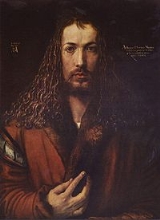
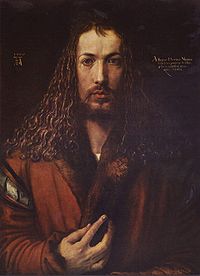
What was true of the scholarship of Germany was also true of its art. The painters, Albrecht Dürer
, who was born and died at Nuremberg
, 1471–1528, Lucas Cranach the Elder
, 1472–1553, and for the most part Hans Holbein the Younger
, 1497–1543, took little interest in mythology, apart from Cranach's nudes, and were persuaded by the Reformation, though most continued to take commissions for traditional Catholic subjects. Dürer and Holbein had close contacts with leading humanists. Cranach lived in Wittenberg
after 1504 and painted portraits of Martin Luther
, Philip Melanchthon and other leaders of the German Reformation. Holbein made frontispieces and illustrations for Protestant books and painted portraits of Erasmus and Melanchthon.
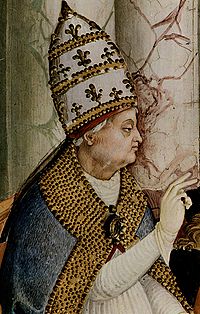 If any one individual more than another may be designated as the connecting link between the learning of Italy and Germany, it is Aeneas Sylvius. By his residence at the court of Frederick III
and at Basel, as one of the secretaries of the council, he became a well-known character north of the Alps long before he was chosen pope. The mediation, however, was not effected by any single individual. The fame of the Renaissance was carried over the pathways of trade which led from Northern Italy to Augsburg
, Nuremberg
, Konstanz
and other German cities. The visits of Frederick III and the campaigns of Charles VIII
and the ascent of the throne of Naples
by the princes of Aragon
carried Germans, Frenchmen and Spaniards to the greater centres of the peninsula. A constant stream of pilgrims travelled to Rome
and the Spanish popes drew to the city throngs of Spaniards. As the fame of Italian culture spread, scholars and artists began to travel to Venice
, Florence
and Rome, and caught the inspiration of the new era.
To the Italians Germany was a land of barbarians. They despised the German people for their ignorance, rudeness and intemperance in eating and drinking. Aeneas found that the German princes and nobles cared more for horses and dogs than for poets and scholars and loved their wine-cellars better than the muses. Campanus, a witty poet of the papal court, who was sent as legate to the Diet of Regensburg
by Pope Paul II
, and afterwards was made a bishop by Pope Pius II
, abused Germany for its dirt, cold climate, poverty, sour wine and miserable fare. He lamented his unfortunate nose, which had to smell everything, and praised his ears, which understood nothing. Such impressions were soon offset by the sound scholarship which arose in Germany and Holland. And, if Italy contributed to Germany an intellectual impulse, Germany sent out to the world the printing press, the most important agent in the history of intellectual culture since the invention of the alphabet.
in 1365, University of Heidelberg in 1386, University of Cologne
in 1388, University of Erfurt
in 1392, University of Würzburg
in 1402, University of Leipzig
in 1409 and University of Rostock
in 1419. During the last half of the 15th century, there were quickly added to this list universities at Greifswald and Freiburg 1457, Trier
1457, Basel
1459, Ingolstadt
1472, Tübingen
and Mainz
1477, and Wittenberg 1502. Ingolstadt
lost its distinct existence by incorporation in the University of Munich, 1826, and Wittenberg by removal to Halle.
Most of these universities had the four faculties, although the popes were slow to give their assent to the sanction of the theological department, as in the case of Vienna
and Rostock
, where the charter of the secular prince authorized their establishment. Strong as the religious influences of the age were, the social and moral habits of the students were by no means such as to call for praise. Parents, Luther said, in sending their sons to the universities, were sending them to destruction, and an act of the Leipzig university, dating from the close of the 15th century, stated that students came forth from their homes obedient and pious, but "how they returned, God alone knew."1061e to university archives and library.
of Kislau
, who had visited Greece
and Asia Minor
, and had been previously appointed to a chair in Heidelberg, 1456. He read on Virgil
, Jerome
, Ovid
and other Latin writers. There Agricola
studied and there Greek was taught by Nicolas Marschalck, under whose supervision the first Greek book printed in Germany issued from the press, 1501. There John of Wesel taught. It was Luther’s alma mater and, among his professors, he singled out Trutvetter for special mention as the one who directed him to the study of the Scriptures.
Heidelberg, chartered by the elector Ruprecht I
and Pope Urban VI
, showed scant sympathy with the new movement. However, the elector-palatine, Philip, 1476–1508, gathered at his court some of its representatives, among them Reuchlin. Ingolstadt for a time had Reuchlin as professor and, in 1492, Conrad Celtes
was appointed professor of poetry and eloquence
.
In 1474, a chair of poetry was established at Basel. Founded by Pius II, it had among its early teachers two Italians, Finariensis and Publicius. Sebastian Brant
taught there at the close of the century and among its notable students were Reuchlin and the Reformers, Leo Jud
and Zwingli. In 1481, Tübingen had a stipend of oratoria. Here Gabriel Biel
taught till very near the close of the century. The year after Biel’s death, Heinrich Bebel
was called to lecture on poetry. One of Bebel’s distinguished pupils was Philip Melanchthon, who studied and taught in the university, 1512–1518. Reuchlin was called from Ingolstadt to Tübingen, 1521, to teach Hebrew and Greek, but died a few months later.
Leipzig and Cologne remained inaccessible strongholds of scholasticism, till Luther appeared, when Leipzig changed front. The last German university of the Middle Ages
, Wittenberg, founded by Frederick the Wise and placed under the patronage of the Virgin Mary and St. Augustine
, acquired a worldwide influence through its professors, Luther and Melanchthon. Not till 1518, did it have instruction in Greek, when Melanchthon, soon to be the chief Greek scholar in Germany, was called to one of its chairs at the age of 21. According to Luther, his lecture-room was at once filled brimful, theologians high and low resorting to it.
As seats of the new culture, Nuremberg and Strasbourg
occupied, perhaps, even a more prominent place than any of the university towns. These two cities, with Basel
and Augsburg, had the most prosperous German printing establishments. At the close of the 15th century, Nuremberg, the fountain of inventions, had four Latin school
s and was the home of Albrecht Dürer the painter and his friend Willibald Pirkheimer, a patron of learning.
Popular education, during the century before the Reformation, was far more advanced in Germany than in other nations. Apart from the traditional monastic and civic schools, the Brothers of the Common Life had schools at Zwolle
, Deventer
, 's-Hertogenbosch and Liège in the Low Countries
. All the leading towns had schools. The town of Schlettstadt(Selestat
) in Alsace
was noted as a classical centre. Here, Thomas Platter
found Hans Sapidus teaching, and he regarded it as the best school he had found. In 1494, there were five pedagogues in Wesel
, teaching reading, writing, arithmetic and singing. One Christmas the clergy of the place entertained the pupils, giving them each cloth for a new coat and a piece of money as begun with the 4th class.
Among the noted schoolmasters was Alexander Hegius, who taught at Deventer for nearly a quarter of a century, till his death in 1498. At the age of 40 he was not ashamed to sit at the feet of Agricola. He made the classics central in education and banished the old text-books. Trebonius, who taught Luther at Eisenach
, belonged to a class of worthy men. The penitential books of the day called upon parents to be diligent in keeping their children off the streets and sending them to school.
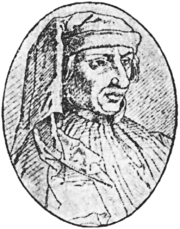 The leading Humanists of Germany included Rudolph Agricola, Reuchlin and Erasmus.
Agricola, whose original name was Roelef Huisman, was born near Groningen, 1443, and died 1485. He enjoyed the highest reputation in his day as a scholar and received unstinted praise from Erasmus and Melanchthon. He has been regarded as doing for Humanism in Germany what was done for Italy by Petrarca
, the first life of whom, in German, Agricola prepared. He was far in advance of the Italian poet in the purity of his life. After studying in Erfurt
, Louvain
and Cologne
, Agricola went to Italy, spending some time at the universities in Pavia and Ferrara. He declined a professor’s chair in favor of an appointment at the court of Philip of the Palatinate in Heidelberg. He made Cicero
and Quintilian
his models. In his last years, he turned his attention to theology and studied Hebrew. Like Pico della Mirandola, he was buried in the cowl of a monastic order. The inscription on his tomb in Heidelberg stated that he had studied what is taught about God and the true faith of the Saviour in the books of Scripture.
Another Humanist was Jacob Wimpheling, 1450–1528, of Schlettstadt, who taught in Heidelberg. He was inclined to be severe on clerical abuses but, at the close of his career, wanted to substitute for the study of Virgil and Horace
, Sedulius
and Prudentius
. The poetic Sebastian Brant
, 1457–1521, the author of the Ship of Fools
, began his career as a teacher of law in Basel. Mutianus Rufus, in his correspondence, went so far as to declare that Christianity is as old as the world and that Jupiter, Apollo, Ceres and Christ are only different names of the one hidden God.
A name which deserves a high place in the German literature of the last years of the Middle Ages is John Trithemius, 1462–1505, abbot of a Benedictine
convent at Sponheim
, which, under his guidance, gained the reputation of a learned academy. He gathered a library of 2,000 volumes and wrote a patrology, or encyclopaedia of the Fathers, and a catalogue of the renowned men of Germany. Increasing differences with the convent
led to his resignation
in 1506, when he decided to take up the offer of the Lord
Bishop
of Würzburg
, Lorenz von Bibra
(bishop from 1495 to 1519), to become abbot of the Schottenkloster in Würzburg. He remained there until the end of his life. Prelates and nobles visited him to consult and read the Latin and Greek authors he had collected. These men and others contributed their part to that movement of which Reuchlin and Erasmus were the chief lights and which led on easily to the Protestant Reformation.
Renaissance humanism
Renaissance humanism was an activity of cultural and educational reform engaged by scholars, writers, and civic leaders who are today known as Renaissance humanists. It developed during the fourteenth and the beginning of the fifteenth centuries, and was a response to the challenge of Mediæval...
came much later to Germany
Germany
Germany , officially the Federal Republic of Germany , is a federal parliamentary republic in Europe. The country consists of 16 states while the capital and largest city is Berlin. Germany covers an area of 357,021 km2 and has a largely temperate seasonal climate...
and Northern Europe in general than to Italy, and when it did, it encountered some resistance from the scholastic theology which reigned at the universities.
Origins
German Humanism may be dated from the invention of the printing pressPrinting press
A printing press is a device for applying pressure to an inked surface resting upon a print medium , thereby transferring the ink...
about 1450. Its flourishing period began at the close of the 15th century and lasted only till about 1520, when it was absorbed by the more popular and powerful religious movement, the Reformation
Protestant Reformation
The Protestant Reformation was a 16th-century split within Western Christianity initiated by Martin Luther, John Calvin and other early Protestants. The efforts of the self-described "reformers", who objected to the doctrines, rituals and ecclesiastical structure of the Roman Catholic Church, led...
, as Italian Humanism was superseded by the papal counter-Reformation
Counter-Reformation
The Counter-Reformation was the period of Catholic revival beginning with the Council of Trent and ending at the close of the Thirty Years' War, 1648 as a response to the Protestant Reformation.The Counter-Reformation was a comprehensive effort, composed of four major elements:#Ecclesiastical or...
. Marked features distinguished the new culture north of the Alps
Alps
The Alps is one of the great mountain range systems of Europe, stretching from Austria and Slovenia in the east through Italy, Switzerland, Liechtenstein and Germany to France in the west....
from the culture of the Italians. The university and school played a much more important part than in the South according to Catholic historians. The representatives of the new scholarship were teachers; even Erasmus taught in Cambridge
Cambridge
The city of Cambridge is a university town and the administrative centre of the county of Cambridgeshire, England. It lies in East Anglia about north of London. Cambridge is at the heart of the high-technology centre known as Silicon Fen – a play on Silicon Valley and the fens surrounding the...
and was on intimate terms with the professors at Basel
Basel
Basel or Basle In the national languages of Switzerland the city is also known as Bâle , Basilea and Basilea is Switzerland's third most populous city with about 166,000 inhabitants. Located where the Swiss, French and German borders meet, Basel also has suburbs in France and Germany...
. During the progress of the movement new universities sprang up, from Basel to Rostock
Rostock
Rostock -Early history:In the 11th century Polabian Slavs founded a settlement at the Warnow river called Roztoc ; the name Rostock is derived from that designation. The Danish king Valdemar I set the town aflame in 1161.Afterwards the place was settled by German traders...
. Again, in Germany, there were no princely patrons of arts and learning to be compared in intelligence and munificence to the Renaissance
Renaissance
The Renaissance was a cultural movement that spanned roughly the 14th to the 17th century, beginning in Italy in the Late Middle Ages and later spreading to the rest of Europe. The term is also used more loosely to refer to the historical era, but since the changes of the Renaissance were not...
popes and the Medici
Medici
The House of Medici or Famiglia de' Medici was a political dynasty, banking family and later royal house that first began to gather prominence under Cosimo de' Medici in the Republic of Florence during the late 14th century. The family originated in the Mugello region of the Tuscan countryside,...
. Nor was the new culture here exclusive and aristocratic. It sought the general spread of intelligence, and was active in the development of primary and grammar schools. In fact, when the currents of the Italian Renaissance
Italian Renaissance
The Italian Renaissance began the opening phase of the Renaissance, a period of great cultural change and achievement in Europe that spanned the period from the end of the 13th century to about 1600, marking the transition between Medieval and Early Modern Europe...
began to set toward the North, a strong, independent, intellectual current was pushing down from the flourishing schools conducted by the Brethren of the Common Life
Brethren of the Common Life
The Brethren of the Common Life was a Roman Catholic pietist religious community founded in the 14th century by Gerard Groote, formerly a successful and worldly educator who had had a religious experience and preached a life of simple devotion to Jesus Christ...
. In the Humanistic movement, the German people was far from being a slavish imitator. It received an impulse from the South, but made its own path.
Old Testament
The Old Testament, of which Christians hold different views, is a Christian term for the religious writings of ancient Israel held sacred and inspired by Christians which overlaps with the 24-book canon of the Masoretic Text of Judaism...
and New Testament
New Testament
The New Testament is the second major division of the Christian biblical canon, the first such division being the much longer Old Testament....
s. Greek
Greek language
Greek is an independent branch of the Indo-European family of languages. Native to the southern Balkans, it has the longest documented history of any Indo-European language, spanning 34 centuries of written records. Its writing system has been the Greek alphabet for the majority of its history;...
and Hebrew
Biblical Hebrew language
Biblical Hebrew , also called Classical Hebrew , is the archaic form of the Hebrew language, a Canaanite Semitic language spoken in the area known as Canaan between the Jordan River and the Mediterranean Sea. Biblical Hebrew is attested from about the 10th century BCE, and persisted through...
were studied, not with the purpose of ministering to a cult of antiquity, but to reach the fountains of the Christian system more adequately. In this way, preparation was made for the work of the Protestant Reformation. This focus on translation was a feature of the Christian humanists who helped to launch the new, post-scholastic era, among them Erasmus and Luther. In so doing, they also placed biblical texts above any human or institutional authority, an approach that emphasised the role of the reader in understanding a text for him or herself. Closely allied to the late medieval shift of scholarship from the monastery to the university, Christian humanism
Christian humanism
Christian humanism is the position that universal human dignity and individual freedom are essential and principal components of, or are at least compatible with, Christian doctrine and practice. It is a philosophical union of Christian and humanist principles.- Origins :Christian humanism may have...
engendered a new freedom of expression, even though some of its proponents opposed that freedom of expression elsewhere, such as in their censure of the Anabaptists.
What was true of the scholarship of Germany was also true of its art. The painters, Albrecht Dürer
Albrecht Dürer
Albrecht Dürer was a German painter, printmaker, engraver, mathematician, and theorist from Nuremberg. His prints established his reputation across Europe when he was still in his twenties, and he has been conventionally regarded as the greatest artist of the Northern Renaissance ever since...
, who was born and died at Nuremberg
Nuremberg
Nuremberg[p] is a city in the German state of Bavaria, in the administrative region of Middle Franconia. Situated on the Pegnitz river and the Rhine–Main–Danube Canal, it is located about north of Munich and is Franconia's largest city. The population is 505,664...
, 1471–1528, Lucas Cranach the Elder
Lucas Cranach the Elder
Lucas Cranach the Elder , was a German Renaissance painter and printmaker in woodcut and engraving...
, 1472–1553, and for the most part Hans Holbein the Younger
Hans Holbein the Younger
Hans Holbein the Younger was a German artist and printmaker who worked in a Northern Renaissance style. He is best known as one of the greatest portraitists of the 16th century. He also produced religious art, satire and Reformation propaganda, and made a significant contribution to the history...
, 1497–1543, took little interest in mythology, apart from Cranach's nudes, and were persuaded by the Reformation, though most continued to take commissions for traditional Catholic subjects. Dürer and Holbein had close contacts with leading humanists. Cranach lived in Wittenberg
Wittenberg
Wittenberg, officially Lutherstadt Wittenberg, is a city in Germany in the Bundesland Saxony-Anhalt, on the river Elbe. It has a population of about 50,000....
after 1504 and painted portraits of Martin Luther
Martin Luther
Martin Luther was a German priest, professor of theology and iconic figure of the Protestant Reformation. He strongly disputed the claim that freedom from God's punishment for sin could be purchased with money. He confronted indulgence salesman Johann Tetzel with his Ninety-Five Theses in 1517...
, Philip Melanchthon and other leaders of the German Reformation. Holbein made frontispieces and illustrations for Protestant books and painted portraits of Erasmus and Melanchthon.
Italian roots of the humanism in Germany
Frederick III, Holy Roman Emperor
Frederick the Peaceful KG was Duke of Austria as Frederick V from 1424, the successor of Albert II as German King as Frederick IV from 1440, and Holy Roman Emperor as Frederick III from 1452...
and at Basel, as one of the secretaries of the council, he became a well-known character north of the Alps long before he was chosen pope. The mediation, however, was not effected by any single individual. The fame of the Renaissance was carried over the pathways of trade which led from Northern Italy to Augsburg
Augsburg
Augsburg is a city in the south-west of Bavaria, Germany. It is a university town and home of the Regierungsbezirk Schwaben and the Bezirk Schwaben. Augsburg is an urban district and home to the institutions of the Landkreis Augsburg. It is, as of 2008, the third-largest city in Bavaria with a...
, Nuremberg
Nuremberg
Nuremberg[p] is a city in the German state of Bavaria, in the administrative region of Middle Franconia. Situated on the Pegnitz river and the Rhine–Main–Danube Canal, it is located about north of Munich and is Franconia's largest city. The population is 505,664...
, Konstanz
Konstanz
Konstanz is a university city with approximately 80,000 inhabitants located at the western end of Lake Constance in the south-west corner of Germany, bordering Switzerland. The city houses the University of Konstanz.-Location:...
and other German cities. The visits of Frederick III and the campaigns of Charles VIII
Charles VIII of France
Charles VIII, called the Affable, , was King of France from 1483 to his death in 1498. Charles was a member of the House of Valois...
and the ascent of the throne of Naples
Naples
Naples is a city in Southern Italy, situated on the country's west coast by the Gulf of Naples. Lying between two notable volcanic regions, Mount Vesuvius and the Phlegraean Fields, it is the capital of the region of Campania and of the province of Naples...
by the princes of Aragon
Aragon
Aragon is a modern autonomous community in Spain, coextensive with the medieval Kingdom of Aragon. Located in northeastern Spain, the Aragonese autonomous community comprises three provinces : Huesca, Zaragoza, and Teruel. Its capital is Zaragoza...
carried Germans, Frenchmen and Spaniards to the greater centres of the peninsula. A constant stream of pilgrims travelled to Rome
Rome
Rome is the capital of Italy and the country's largest and most populated city and comune, with over 2.7 million residents in . The city is located in the central-western portion of the Italian Peninsula, on the Tiber River within the Lazio region of Italy.Rome's history spans two and a half...
and the Spanish popes drew to the city throngs of Spaniards. As the fame of Italian culture spread, scholars and artists began to travel to Venice
Venice
Venice is a city in northern Italy which is renowned for the beauty of its setting, its architecture and its artworks. It is the capital of the Veneto region...
, Florence
Florence
Florence is the capital city of the Italian region of Tuscany and of the province of Florence. It is the most populous city in Tuscany, with approximately 370,000 inhabitants, expanding to over 1.5 million in the metropolitan area....
and Rome, and caught the inspiration of the new era.
To the Italians Germany was a land of barbarians. They despised the German people for their ignorance, rudeness and intemperance in eating and drinking. Aeneas found that the German princes and nobles cared more for horses and dogs than for poets and scholars and loved their wine-cellars better than the muses. Campanus, a witty poet of the papal court, who was sent as legate to the Diet of Regensburg
Diet of Regensburg
Diet of Regensburg may refer any of the sessions of the Imperial Diet, Imperial States, or the prince-electors of the Holy Roman Empire which took place in the Imperial City of Regensburg , now in Germany. These included:...
by Pope Paul II
Pope Paul II
Pope Paul II , born Pietro Barbo, was pope from 1464 until his death in 1471.- Early life :He was born in Venice, and was a nephew of Pope Eugene IV , through his mother. His adoption of the spiritual career, after having been trained as a merchant, was prompted by his uncle's election as pope...
, and afterwards was made a bishop by Pope Pius II
Pope Pius II
Pope Pius II, born Enea Silvio Piccolomini was Pope from August 19, 1458 until his death in 1464. Pius II was born at Corsignano in the Sienese territory of a noble but decayed family...
, abused Germany for its dirt, cold climate, poverty, sour wine and miserable fare. He lamented his unfortunate nose, which had to smell everything, and praised his ears, which understood nothing. Such impressions were soon offset by the sound scholarship which arose in Germany and Holland. And, if Italy contributed to Germany an intellectual impulse, Germany sent out to the world the printing press, the most important agent in the history of intellectual culture since the invention of the alphabet.
Universities
Before the first swell of the new movement was felt, the older German universities were already established: University of ViennaUniversity of Vienna
The University of Vienna is a public university located in Vienna, Austria. It was founded by Duke Rudolph IV in 1365 and is the oldest university in the German-speaking world...
in 1365, University of Heidelberg in 1386, University of Cologne
University of Cologne
The University of Cologne is one of the oldest universities in Europe and, with over 44,000 students, one of the largest universities in Germany. The university is part of the Deutsche Forschungsgemeinschaft, an association of Germany's leading research universities...
in 1388, University of Erfurt
University of Erfurt
The University of Erfurt is a public university located in Erfurt, Germany. Originally founded in 1379, the university was closed in 1816 for the next 177 years...
in 1392, University of Würzburg
University of Würzburg
The University of Würzburg is a university in Würzburg, Germany, founded in 1402. The university is a member of the distinguished Coimbra Group.-Name:...
in 1402, University of Leipzig
University of Leipzig
The University of Leipzig , located in Leipzig in the Free State of Saxony, Germany, is one of the oldest universities in the world and the second-oldest university in Germany...
in 1409 and University of Rostock
University of Rostock
The University of Rostock is the university of the city Rostock, in the German state of Mecklenburg-Vorpommern.Founded in 1419, it is the oldest and largest university in continental northern Europe and the Baltic Sea area...
in 1419. During the last half of the 15th century, there were quickly added to this list universities at Greifswald and Freiburg 1457, Trier
University of Trier
The University of Trier , in the German city of Trier, was founded in 1473. Closed in 1798 by order of the then French administration in Trier, the university was re-established in 1970 after a hiatus of some 172 years. The new university campus is located on top of the Tarforst heights, an urban...
1457, Basel
University of Basel
The University of Basel is located in Basel, Switzerland, and is considered to be one of leading universities in the country...
1459, Ingolstadt
University of Ingolstadt
The University of Ingolstadt was founded in 1472 by Louis the Rich, the Duke of Bavaria at the time, and its first Chancellor was the Bishop of Eichstätt. It consisted of five faculties: humanities, sciences, theology, law and medicine, all of which were contained in the Hoheschule...
1472, Tübingen
Eberhard Karls University of Tübingen
Eberhard Karls University, Tübingen is a public university located in the city of Tübingen, Baden-Württemberg, Germany. It is one of Germany's oldest universities, internationally noted in medicine, natural sciences and the humanities. In the area of German Studies it has been ranked first among...
and Mainz
Johannes Gutenberg University of Mainz
The Johannes Gutenberg University of Mainz is a university in Mainz, Rhineland Palatinate, Germany, named after the printer Johannes Gutenberg. With approximately 36,000 students in about 150 schools and clinics, it is among the ten largest universities in Germany...
1477, and Wittenberg 1502. Ingolstadt
Ingolstadt
Ingolstadt is a city in the Free State of Bavaria, in the Federal Republic of Germany. It is located along the banks of the Danube River, in the center of Bavaria. As at 31 March 2011, Ingolstadt had 125.407 residents...
lost its distinct existence by incorporation in the University of Munich, 1826, and Wittenberg by removal to Halle.
Most of these universities had the four faculties, although the popes were slow to give their assent to the sanction of the theological department, as in the case of Vienna
Vienna
Vienna is the capital and largest city of the Republic of Austria and one of the nine states of Austria. Vienna is Austria's primary city, with a population of about 1.723 million , and is by far the largest city in Austria, as well as its cultural, economic, and political centre...
and Rostock
Rostock
Rostock -Early history:In the 11th century Polabian Slavs founded a settlement at the Warnow river called Roztoc ; the name Rostock is derived from that designation. The Danish king Valdemar I set the town aflame in 1161.Afterwards the place was settled by German traders...
, where the charter of the secular prince authorized their establishment. Strong as the religious influences of the age were, the social and moral habits of the students were by no means such as to call for praise. Parents, Luther said, in sending their sons to the universities, were sending them to destruction, and an act of the Leipzig university, dating from the close of the 15th century, stated that students came forth from their homes obedient and pious, but "how they returned, God alone knew."1061e to university archives and library.
Education
The theological teaching was ruled by the Schoolmen, and the dialectic method prevailed in all departments. In clashing with the scholastic method and curricula, the new teaching met with many a repulse, and in no case was it thoroughly triumphant till the era of the Reformation opened. Erfurt may be regarded as having been the first to give the new culture a welcome. In 1466, it received Peter LuderPeter Luder
Peter Luder , a professor of Latin at the University of Heidelberg from 1456, was the first to introduce humanist ideas in the university.-Notes and references :...
of Kislau
Bad Schönborn
Bad Schönborn is a municipality in northern Karlsruhe district in Baden-Württemberg, Germany. It is located on the Bertha Benz Memorial Route....
, who had visited Greece
Greece
Greece , officially the Hellenic Republic , and historically Hellas or the Republic of Greece in English, is a country in southeastern Europe....
and Asia Minor
Asia Minor
Asia Minor is a geographical location at the westernmost protrusion of Asia, also called Anatolia, and corresponds to the western two thirds of the Asian part of Turkey...
, and had been previously appointed to a chair in Heidelberg, 1456. He read on Virgil
Virgil
Publius Vergilius Maro, usually called Virgil or Vergil in English , was an ancient Roman poet of the Augustan period. He is known for three major works of Latin literature, the Eclogues , the Georgics, and the epic Aeneid...
, Jerome
Jerome
Saint Jerome was a Roman Christian priest, confessor, theologian and historian, and who became a Doctor of the Church. He was the son of Eusebius, of the city of Stridon, which was on the border of Dalmatia and Pannonia...
, Ovid
Ovid
Publius Ovidius Naso , known as Ovid in the English-speaking world, was a Roman poet who is best known as the author of the three major collections of erotic poetry: Heroides, Amores, and Ars Amatoria...
and other Latin writers. There Agricola
Johannes Agricola
Johannes Agricola was a German Protestant reformer and humanist. He was a follower and friend of Martin Luther, who became his antagonist in the matter of the binding obligation of the law on Christians.-Early life:Agricola was born at Eisleben, whence he is sometimes called Magister Islebius...
studied and there Greek was taught by Nicolas Marschalck, under whose supervision the first Greek book printed in Germany issued from the press, 1501. There John of Wesel taught. It was Luther’s alma mater and, among his professors, he singled out Trutvetter for special mention as the one who directed him to the study of the Scriptures.
Heidelberg, chartered by the elector Ruprecht I
Rupert I, Elector Palatine of the Rhine
Rupert I, "the Red" , Elector Palatine was Count Palatine of the Rhine from 1353 to 1390....
and Pope Urban VI
Pope Urban VI
Pope Urban VI , born Bartolomeo Prignano, was Pope from 1378 to 1389.-Biography:Born in Itri, he was a devout monk and learned casuist, trained at Avignon. On March 21, 1364, he was consecrated Archbishop of Acerenza in the Kingdom of Naples...
, showed scant sympathy with the new movement. However, the elector-palatine, Philip, 1476–1508, gathered at his court some of its representatives, among them Reuchlin. Ingolstadt for a time had Reuchlin as professor and, in 1492, Conrad Celtes
Conrad Celtes
Conrad Celtes , also Konrad Celtis and Latin Conradus Celtis , was a German Renaissance humanist scholar and Neo-Latin poet.-Life:...
was appointed professor of poetry and eloquence
Eloquence
Eloquence is fluent, forcible, elegant or persuasive speaking. It is primarily the power of expressing strong emotions in striking and appropriate language, thereby producing conviction or persuasion...
.
In 1474, a chair of poetry was established at Basel. Founded by Pius II, it had among its early teachers two Italians, Finariensis and Publicius. Sebastian Brant
Sebastian Brant
Sebastian Brant was an Alsatian humanist and satirist. He is best known for his satire Das Narrenschiff .-Biography:...
taught there at the close of the century and among its notable students were Reuchlin and the Reformers, Leo Jud
Leo Jud
Leo Jud , known to his contemporaries as Meister Leu, Swiss reformer, was born in Guémar, Alsace....
and Zwingli. In 1481, Tübingen had a stipend of oratoria. Here Gabriel Biel
Gabriel Biel
Gabriel Biel was a German scholastic philosopher and member of the Brethren of the Common Life born in Speyer. In 1432 he was ordained to the priesthood and entered Heidelberg University. He succeeded academically and became an instructor in the faculty of the arts.- Life :His studies were pursued...
taught till very near the close of the century. The year after Biel’s death, Heinrich Bebel
Heinrich Bebel
Heinrich Bebel was a German humanist.-Biography:He was an alumnus of Krakow and Basel universities, and from 1497 professor of poetry and rhetoric at the University of Tübingen...
was called to lecture on poetry. One of Bebel’s distinguished pupils was Philip Melanchthon, who studied and taught in the university, 1512–1518. Reuchlin was called from Ingolstadt to Tübingen, 1521, to teach Hebrew and Greek, but died a few months later.
Leipzig and Cologne remained inaccessible strongholds of scholasticism, till Luther appeared, when Leipzig changed front. The last German university of the Middle Ages
Middle Ages
The Middle Ages is a periodization of European history from the 5th century to the 15th century. The Middle Ages follows the fall of the Western Roman Empire in 476 and precedes the Early Modern Era. It is the middle period of a three-period division of Western history: Classic, Medieval and Modern...
, Wittenberg, founded by Frederick the Wise and placed under the patronage of the Virgin Mary and St. Augustine
Augustine of Hippo
Augustine of Hippo , also known as Augustine, St. Augustine, St. Austin, St. Augoustinos, Blessed Augustine, or St. Augustine the Blessed, was Bishop of Hippo Regius . He was a Latin-speaking philosopher and theologian who lived in the Roman Africa Province...
, acquired a worldwide influence through its professors, Luther and Melanchthon. Not till 1518, did it have instruction in Greek, when Melanchthon, soon to be the chief Greek scholar in Germany, was called to one of its chairs at the age of 21. According to Luther, his lecture-room was at once filled brimful, theologians high and low resorting to it.
As seats of the new culture, Nuremberg and Strasbourg
Strasbourg
Strasbourg is the capital and principal city of the Alsace region in eastern France and is the official seat of the European Parliament. Located close to the border with Germany, it is the capital of the Bas-Rhin département. The city and the region of Alsace are historically German-speaking,...
occupied, perhaps, even a more prominent place than any of the university towns. These two cities, with Basel
Basel
Basel or Basle In the national languages of Switzerland the city is also known as Bâle , Basilea and Basilea is Switzerland's third most populous city with about 166,000 inhabitants. Located where the Swiss, French and German borders meet, Basel also has suburbs in France and Germany...
and Augsburg, had the most prosperous German printing establishments. At the close of the 15th century, Nuremberg, the fountain of inventions, had four Latin school
Latin School
Latin School may refer to:* Latin schools of Medieval Europe* These schools in the United States:** Boston Latin School, Boston, MA** Brooklyn Latin School, New York, NY** Brother Joseph C. Fox Latin School, Long Island, NY...
s and was the home of Albrecht Dürer the painter and his friend Willibald Pirkheimer, a patron of learning.
Popular education, during the century before the Reformation, was far more advanced in Germany than in other nations. Apart from the traditional monastic and civic schools, the Brothers of the Common Life had schools at Zwolle
Zwolle
Zwolle is a municipality and the capital city of the province of Overijssel, Netherlands, 120 kilometers northeast of Amsterdam. Zwolle has about 120,000 citizens.-History:...
, Deventer
Deventer
Deventer is a municipality and city in the Salland region of the Dutch province of Overijssel. Deventer is largely situated on the east bank of the river IJssel, but also has a small part of its territory on the west bank. In 2005 the municipality of Bathmen Deventer is a municipality and city in...
, 's-Hertogenbosch and Liège in the Low Countries
Low Countries
The Low Countries are the historical lands around the low-lying delta of the Rhine, Scheldt, and Meuse rivers, including the modern countries of Belgium, the Netherlands, Luxembourg and parts of northern France and western Germany....
. All the leading towns had schools. The town of Schlettstadt(Selestat
Sélestat
Sélestat is a commune in the Bas-Rhin department in Alsace in north-eastern France.In 2006, Sélestat had a total population of 19,459. The Communauté de communes de Sélestat et environs had a total population of 35,397.-Geography:...
) in Alsace
Alsace
Alsace is the fifth-smallest of the 27 regions of France in land area , and the smallest in metropolitan France. It is also the seventh-most densely populated region in France and third most densely populated region in metropolitan France, with ca. 220 inhabitants per km²...
was noted as a classical centre. Here, Thomas Platter
Thomas Platter
Thomas Platter was a Swiss humanist scholar and writer.His sons Felix Platter and Thomas Platter the Younger both studied medicine, a thwarted ambition of Platter's own early life...
found Hans Sapidus teaching, and he regarded it as the best school he had found. In 1494, there were five pedagogues in Wesel
Wesel
Wesel is a city in North Rhine-Westphalia, Germany. It is the capital of the Wesel district.-Division of the town:Suburbs of Wesel include Lackhausen, Obrighoven, Ginderich, Feldmark,Fusternberg, Büderich, Flüren and Blumenkamp.-History:...
, teaching reading, writing, arithmetic and singing. One Christmas the clergy of the place entertained the pupils, giving them each cloth for a new coat and a piece of money as begun with the 4th class.
Among the noted schoolmasters was Alexander Hegius, who taught at Deventer for nearly a quarter of a century, till his death in 1498. At the age of 40 he was not ashamed to sit at the feet of Agricola. He made the classics central in education and banished the old text-books. Trebonius, who taught Luther at Eisenach
Eisenach
Eisenach is a city in Thuringia, Germany. It is situated between the northern foothills of the Thuringian Forest and the Hainich National Park. Its population in 2006 was 43,626.-History:...
, belonged to a class of worthy men. The penitential books of the day called upon parents to be diligent in keeping their children off the streets and sending them to school.
Leaders of humanism
Agricola, whose original name was Roelef Huisman, was born near Groningen, 1443, and died 1485. He enjoyed the highest reputation in his day as a scholar and received unstinted praise from Erasmus and Melanchthon. He has been regarded as doing for Humanism in Germany what was done for Italy by Petrarca
Petrarch
Francesco Petrarca , known in English as Petrarch, was an Italian scholar, poet and one of the earliest humanists. Petrarch is often called the "Father of Humanism"...
, the first life of whom, in German, Agricola prepared. He was far in advance of the Italian poet in the purity of his life. After studying in Erfurt
Erfurt
Erfurt is the capital city of Thuringia and the main city nearest to the geographical centre of Germany, located 100 km SW of Leipzig, 150 km N of Nuremberg and 180 km SE of Hannover. Erfurt Airport can be reached by plane via Munich. It lies in the southern part of the Thuringian...
, Louvain
Leuven
Leuven is the capital of the province of Flemish Brabant in the Flemish Region, Belgium...
and Cologne
Cologne
Cologne is Germany's fourth-largest city , and is the largest city both in the Germany Federal State of North Rhine-Westphalia and within the Rhine-Ruhr Metropolitan Area, one of the major European metropolitan areas with more than ten million inhabitants.Cologne is located on both sides of the...
, Agricola went to Italy, spending some time at the universities in Pavia and Ferrara. He declined a professor’s chair in favor of an appointment at the court of Philip of the Palatinate in Heidelberg. He made Cicero
Cicero
Marcus Tullius Cicero , was a Roman philosopher, statesman, lawyer, political theorist, and Roman constitutionalist. He came from a wealthy municipal family of the equestrian order, and is widely considered one of Rome's greatest orators and prose stylists.He introduced the Romans to the chief...
and Quintilian
Quintilian
Marcus Fabius Quintilianus was a Roman rhetorician from Hispania, widely referred to in medieval schools of rhetoric and in Renaissance writing...
his models. In his last years, he turned his attention to theology and studied Hebrew. Like Pico della Mirandola, he was buried in the cowl of a monastic order. The inscription on his tomb in Heidelberg stated that he had studied what is taught about God and the true faith of the Saviour in the books of Scripture.
Another Humanist was Jacob Wimpheling, 1450–1528, of Schlettstadt, who taught in Heidelberg. He was inclined to be severe on clerical abuses but, at the close of his career, wanted to substitute for the study of Virgil and Horace
Horace
Quintus Horatius Flaccus , known in the English-speaking world as Horace, was the leading Roman lyric poet during the time of Augustus.-Life:...
, Sedulius
Coelius Sedulius
Coelius Sedulius, was a Christian poet of the first half of the 5th century. He is termed a presbyter by Isidore of Seville and in the Gelasian decree....
and Prudentius
Prudentius
Aurelius Prudentius Clemens was a Roman Christian poet, born in the Roman province of Tarraconensis in 348. He probably died in Spain, as well, some time after 405, possibly around 413...
. The poetic Sebastian Brant
Sebastian Brant
Sebastian Brant was an Alsatian humanist and satirist. He is best known for his satire Das Narrenschiff .-Biography:...
, 1457–1521, the author of the Ship of Fools
Ship of Fools (satire)
Ship of Fools is a satire published 1494 in Basel, Switzerland by Sebastian Brant, a conservative German theologian....
, began his career as a teacher of law in Basel. Mutianus Rufus, in his correspondence, went so far as to declare that Christianity is as old as the world and that Jupiter, Apollo, Ceres and Christ are only different names of the one hidden God.
A name which deserves a high place in the German literature of the last years of the Middle Ages is John Trithemius, 1462–1505, abbot of a Benedictine
Benedictine
Benedictine refers to the spirituality and consecrated life in accordance with the Rule of St Benedict, written by Benedict of Nursia in the sixth century for the cenobitic communities he founded in central Italy. The most notable of these is Monte Cassino, the first monastery founded by Benedict...
convent at Sponheim
Sponheim
Sponheim is a municipality in the district of Bad Kreuznach in Rhineland-Palatinate, in western Germany.-History:Sponheim was the capital of the County of Sponheim. There was a Benedictine abbey here which was founded in 1101 by Stephan II, Count of Sponheim not far from the countly residence at...
, which, under his guidance, gained the reputation of a learned academy. He gathered a library of 2,000 volumes and wrote a patrology, or encyclopaedia of the Fathers, and a catalogue of the renowned men of Germany. Increasing differences with the convent
Convent
A convent is either a community of priests, religious brothers, religious sisters, or nuns, or the building used by the community, particularly in the Roman Catholic Church and in the Anglican Communion...
led to his resignation
Resignation
A resignation is the formal act of giving up or quitting one's office or position. It can also refer to the act of admitting defeat in a game like chess, indicated by the resigning player declaring "I resign", turning his king on its side, extending his hand, or stopping the chess clock...
in 1506, when he decided to take up the offer of the Lord
Lord
Lord is a title with various meanings. It can denote a prince or a feudal superior . The title today is mostly used in connection with the peerage of the United Kingdom or its predecessor countries, although some users of the title do not themselves hold peerages, and use it 'by courtesy'...
Bishop
Bishop
A bishop is an ordained or consecrated member of the Christian clergy who is generally entrusted with a position of authority and oversight. Within the Catholic Church, Eastern Orthodox, Oriental Orthodox Churches, in the Assyrian Church of the East, in the Independent Catholic Churches, and in the...
of Würzburg
Würzburg
Würzburg is a city in the region of Franconia which lies in the northern tip of Bavaria, Germany. Located at the Main River, it is the capital of the Regierungsbezirk Lower Franconia. The regional dialect is Franconian....
, Lorenz von Bibra
Lorenz von Bibra
Lorenz von Bibra, Duke in Franconia was Prince-Bishop of the Bishopric of Würzburg from 1495 to 1519. His life paralleled Maximilian I , who served as Holy Roman Emperor from 1493 to 1519, to which Lorenz did serve as an advisor....
(bishop from 1495 to 1519), to become abbot of the Schottenkloster in Würzburg. He remained there until the end of his life. Prelates and nobles visited him to consult and read the Latin and Greek authors he had collected. These men and others contributed their part to that movement of which Reuchlin and Erasmus were the chief lights and which led on easily to the Protestant Reformation.
Source
This article is copied from- Philip SchaffPhilip SchaffPhilip Schaff , was a Swiss-born, German-educated Protestant theologian and a historian of the Christian church, who, after his education, lived and taught in the United States.-Biography:...
History of the Christian Church, Volume VI, 1882
Literature
- Marco Heiles: Topography of German humanism 1470-1550. An approach http://uni-bonn.academia.edu/MarcoHeiles/Papers/940185/Marco_Heiles_Topography_of_German_humanism_1470-1550._An_approach