

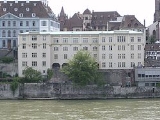
University of Basel

Encyclopedia
The University of Basel (German: Universität Basel) is located in Basel
, Switzerland, and is considered to be one of leading universities in the country. In 2011, QS World University Rankings
ranked the university 151st overall in the world, while a year before it was ranked 96–98th worldwide according to the Russian based Global University Ranking.
Erasmus, Paracelsus
, Daniel Bernoulli
, Jacob Burckhardt
, Leonhard Euler
, Friedrich Nietzsche
, Eugen Huber
, Carl Jung
, Karl Barth
, and Hans Urs von Balthasar
are among those associated with the university, which is nowadays noted for research into tropical medicine
.
The University of Basel was founded in connection with the Council of Basel
. The deed of foundation given in the form of a Papal bull
by Pope Pius II
on November 12, 1459, and the official opening ceremony was held on April 4, 1460. Originally the University of Basel was decreed to have four faculties, namely those of arts, medicine, theology and jurisprudence. The faculty of arts served until 1818 as foundation for the other three academic subjects. In the eighteenth century as Basel became more commercial, the University, one of the centers of learning in the renaissance, slipped into insignificance. Enrollment which had been over a thousand around 1600, dropped to sixty in 1785 with eighteen professors. The professors themselves were mostly sons of the elite.
Over the course of centuries as many scholars came to the city, Basel became an early center of book printing and humanism. Around the same time as the university itself, the University Library of Basel was founded. Today it has over three million books and writings and is the largest library in Switzerland. In 1830 the Canton of Basel split in two with the Federal Diet requiring that the canton's assets, including the books at the University library, be divided -- two thirds going to the new half canton of Basel Land. The city had to buy back this share and the University became so impoverished that it drastically reduced its course offerings. Students were expected to continue their education after two years or so at some German university. In 1835 the enrollment at the University was forty students, mostly from the area.
This University is also renowned for its former research into earth sciences, Slavistics and astronomy.
The Biozentrum was founded in 1971, giving room to an – at that time – quite innovative idea: the unification of various domains of the biological and natural sciences under the same roof. Its goal was to facilitate collaboration with other research areas – a successful concept, as it turned out that nowadays the different research areas cannot be considered separately. They depend on a tight collaboration and profit from each other.
The approximately 30 research groups with members from more than 30 nations investigate biological processes on a molecular basis. The spectrum of their work ranges from basic questions (what does a cell consist of, and how does it work?) to the development of whole organisms (how does a cell know whether to become a leg or an eye?); and further to the determination of a molecule’s structure and its functions (is Alzheimer’s Disease hereditary, and if so, why?). About 200 papers by the institute’s scientists are published every year, and the number and importance of these publications are situated in the top quarter internationally.
Basic studies: With the establishment of the new bachelor/master-concept ("Bologna-model"), the University of Basel joins an internationally accepted model. Studies leading to the diploma last about 4 years. The last year consists of practical diploma work in a research group.
PhD studies: Require original research that normally takes 3 – 4 years. Each year, about 25 students graduate with a doctorate. Roughly the same number carry out their PhD work at other Basel institutions, mentored by Biozentrum scientists. These institutions can be the Friedrich Miescher Institute, the Research Department of the Kantonsspital (cantonal hospital) or a research laboratory in the industry.
Postdoctoral studies: After graduation, young scientists usually spend some years in research groups in foreign countries to enlarge their knowledge and expand their horizons. In turn, many postdocs from all over the world spend time at the Biozentrum.
Basel
Basel or Basle In the national languages of Switzerland the city is also known as Bâle , Basilea and Basilea is Switzerland's third most populous city with about 166,000 inhabitants. Located where the Swiss, French and German borders meet, Basel also has suburbs in France and Germany...
, Switzerland, and is considered to be one of leading universities in the country. In 2011, QS World University Rankings
QS World University Rankings
The QS World University Rankings is a ranking of the world’s top 500 universities by Quacquarelli Symonds using a method that has published annually since 2004....
ranked the university 151st overall in the world, while a year before it was ranked 96–98th worldwide according to the Russian based Global University Ranking.
History
Founded in 1460, it is Switzerland's oldest university.Erasmus, Paracelsus
Paracelsus
Paracelsus was a German-Swiss Renaissance physician, botanist, alchemist, astrologer, and general occultist....
, Daniel Bernoulli
Daniel Bernoulli
Daniel Bernoulli was a Dutch-Swiss mathematician and was one of the many prominent mathematicians in the Bernoulli family. He is particularly remembered for his applications of mathematics to mechanics, especially fluid mechanics, and for his pioneering work in probability and statistics...
, Jacob Burckhardt
Jacob Burckhardt
Carl Jacob Christoph Burckhardt was a historian of art and culture, and an influential figure in the historiography of each field. He is known as one of the major progenitors of cultural history, albeit in a form very different from how cultural history is conceived and studied in academia today...
, Leonhard Euler
Leonhard Euler
Leonhard Euler was a pioneering Swiss mathematician and physicist. He made important discoveries in fields as diverse as infinitesimal calculus and graph theory. He also introduced much of the modern mathematical terminology and notation, particularly for mathematical analysis, such as the notion...
, Friedrich Nietzsche
Friedrich Nietzsche
Friedrich Wilhelm Nietzsche was a 19th-century German philosopher, poet, composer and classical philologist...
, Eugen Huber
Eugen Huber
Eugen Huber was a Swiss jurist and the creator of the Swiss civil code of 1907.-Biography:Huber was born in Swiss Canton of Zürich on July 31, 1849. His father was a physician...
, Carl Jung
Carl Jung
Carl Gustav Jung was a Swiss psychiatrist and the founder of Analytical Psychology. Jung is considered the first modern psychiatrist to view the human psyche as "by nature religious" and make it the focus of exploration. Jung is one of the best known researchers in the field of dream analysis and...
, Karl Barth
Karl Barth
Karl Barth was a Swiss Reformed theologian whom critics hold to be among the most important Christian thinkers of the 20th century; Pope Pius XII described him as the most important theologian since Thomas Aquinas...
, and Hans Urs von Balthasar
Hans Urs von Balthasar
Hans Urs von Balthasar was a Swiss theologian and priest who was nominated to be a cardinal of the Catholic Church...
are among those associated with the university, which is nowadays noted for research into tropical medicine
Tropical medicine
Tropical medicine is the branch of medicine that deals with health problems that occur uniquely, are more widespread, or prove more difficult to control in tropical and subtropical regions....
.
The University of Basel was founded in connection with the Council of Basel
Council of Florence
The Council of Florence was an Ecumenical Council of the Roman Catholic Church. It began in 1431 in Basel, Switzerland, and became known as the Council of Ferrara after its transfer to Ferrara was decreed by Pope Eugene IV, to convene in 1438...
. The deed of foundation given in the form of a Papal bull
Papal bull
A Papal bull is a particular type of letters patent or charter issued by a Pope of the Catholic Church. It is named after the bulla that was appended to the end in order to authenticate it....
by Pope Pius II
Pope Pius II
Pope Pius II, born Enea Silvio Piccolomini was Pope from August 19, 1458 until his death in 1464. Pius II was born at Corsignano in the Sienese territory of a noble but decayed family...
on November 12, 1459, and the official opening ceremony was held on April 4, 1460. Originally the University of Basel was decreed to have four faculties, namely those of arts, medicine, theology and jurisprudence. The faculty of arts served until 1818 as foundation for the other three academic subjects. In the eighteenth century as Basel became more commercial, the University, one of the centers of learning in the renaissance, slipped into insignificance. Enrollment which had been over a thousand around 1600, dropped to sixty in 1785 with eighteen professors. The professors themselves were mostly sons of the elite.
Over the course of centuries as many scholars came to the city, Basel became an early center of book printing and humanism. Around the same time as the university itself, the University Library of Basel was founded. Today it has over three million books and writings and is the largest library in Switzerland. In 1830 the Canton of Basel split in two with the Federal Diet requiring that the canton's assets, including the books at the University library, be divided -- two thirds going to the new half canton of Basel Land. The city had to buy back this share and the University became so impoverished that it drastically reduced its course offerings. Students were expected to continue their education after two years or so at some German university. In 1835 the enrollment at the University was forty students, mostly from the area.
This University is also renowned for its former research into earth sciences, Slavistics and astronomy.
Faculties
- Theology
- Law
- Medicine
- Faculty of Humanities (Phil I)
- Faculty of Science (Phil II)
- Business and Economy
- Psychology
- Interdisciplinary institutions
- Europainstitut
- Jewish Studies http://jewishstudies.unibas.ch/
- Mensch-Gesellschaft-Umwelt (MGU)
- Centre for African Studies Basel (ZASB) http://www.unibas-zasb.ch
- Kulturmanagement http://www.kulturmanagement.org/
- Gender Studies http://www.genderstudies.unibas.ch/
- Associated institutes
- Swiss Tropical InstituteSwiss Tropical InstituteThe Swiss Topical and Public Health Institute or Swiss TPH, was founded in 1943 as through the initiative of Professor Rudolf Geigy. He recognised the need to combine sound interdisciplinary research within the context of the social and cultural conditions of an endemic area with training and...
http://www.sti.ch - Friedrich Miescher Institute for Biomedical Research (FMI)
- Swiss Tropical Institute
Student associations
- Fachgruppen
- Dings-Shop Dings Shop
- Shop for office materials for students
- Universitätssport Universitätssport Basel
- Organizing sport events and trainings for students
- SKUBA: Studentische Körperschaft der Universität Basel Skuba Home
- Calcutta Project Basel Calcutta Project Basel
- International co-operation by students from Basel in India, KolkataKolkataKolkata , formerly known as Calcutta, is the capital of the Indian state of West Bengal. Located on the east bank of the Hooghly River, it was the commercial capital of East India...
- International co-operation by students from Basel in India, Kolkata
- GeZetera GeZetera
- Newspaper made by students for students
The Biozentrum
The Biozentrum is a Department of the University of Basel. It is a basic research institute, covering the research areas of biochemistry, biophysical chemistry, microbiology, structural biology, and cell biology of the faculty of natural sciences, as well as the areas of pharmacology and neurobiology of the medical faculty. In 2001, the new fields of bioinformatics, genomics & proteomics, and a nanosciences branch have been introduced. A second building has been constructed next to the Biozentrum which was inaugurated in fall 2000, the so-called “Pharmazentrum”. It hosts some Biozentrum research groups, including the bioinformatics unit and Applied Microbiology as well as the Zoological Institute of the Basel University. Additionally, various research units of the Department of Clinical and Biological Sciences (DKBW) and the Pharmaceutical Department are located here. Last but not least, the Center of Pharmaceutical Sciences Basel-Zurich and the Microscopy Unit of the University share its space.The Biozentrum was founded in 1971, giving room to an – at that time – quite innovative idea: the unification of various domains of the biological and natural sciences under the same roof. Its goal was to facilitate collaboration with other research areas – a successful concept, as it turned out that nowadays the different research areas cannot be considered separately. They depend on a tight collaboration and profit from each other.
The approximately 30 research groups with members from more than 30 nations investigate biological processes on a molecular basis. The spectrum of their work ranges from basic questions (what does a cell consist of, and how does it work?) to the development of whole organisms (how does a cell know whether to become a leg or an eye?); and further to the determination of a molecule’s structure and its functions (is Alzheimer’s Disease hereditary, and if so, why?). About 200 papers by the institute’s scientists are published every year, and the number and importance of these publications are situated in the top quarter internationally.
The staff
About 430 people are employed at the Biozentrum. More than half of them stay between 1 and 5 years only, for different reasons: about 120 are postdocs, independent scientists, grant holders and assistant professors (1 – 5 years), about 80 are PhD students (3 – 4 years) and 50 are diploma students (undergraduate students in their 4th year of studies). More than 80 persons occupy technical positions or work in the administration, about 70 are laboratory technicians, and about 30 tenured professors work in groups with up to 20 members. Furthermore, there is a regular turnover of guest professors and sabbatical visitors who, after a short stay (2 weeks – 1 year), return to their working places in foreign countries or other institutes. Finally, the institute welcomes about 40 new students every year. Altogether, about 44% of the staff are women, out of which only 32% are scientists, whereas two thirds are working in the administration and technical jobs.Notable alumni
- Emil AbderhaldenEmil AbderhaldenEmil Abderhalden was a Swiss biochemist and physiologist. His main findings, though disputed already in the 1920s, were not finally rejected until the late 1990s. Whether his misleading findings were based on fraud or simply the result of a lack of scientific rigor remains unclear...
(1877–1950), Swiss biochemist and physiologist - Paul ErdmanPaul ErdmanPaul Emil Erdman was one of the leading business and financial writers in the United States who became known for writing novels based on monetary trends and historical facts concerning complex matters of international finance.-Early life:Erdman was born in Stratford, Ontario, Canada, on 19 May...
(1932–2007), American business and financial writer - Carl JungCarl JungCarl Gustav Jung was a Swiss psychiatrist and the founder of Analytical Psychology. Jung is considered the first modern psychiatrist to view the human psyche as "by nature religious" and make it the focus of exploration. Jung is one of the best known researchers in the field of dream analysis and...
(1875–1961), Swiss psychiatrist, and founder of Analytical Psychology - Michael LandmannMichael LandmannMichael Landmann was a Jewish Swiss Philosopher.-Life:Michael Landmann was the son of economist Julius Landmann and philosopher Edith Landmann. Philologist Georg Peter Landmann is his brother...
(1913–84), Swiss philosopher - Yeshayahu LeibowitzYeshayahu LeibowitzYeshayahu Leibowitz was an Israeli public intellectual and polymath known for his outspoken opinions on Judaism, ethics, religion and politics.- Biography :...
(1903–94), Israeli public intellectual and polymath - Alice MillerAlice Miller (psychologist)Alice Miller née Rostovski was a psychologist and world renowned author, who is noted for her books on child abuse by their own parents, translated in several languages...
, psychologist and author - William TheilheimerWilliam TheilheimerWilliam Theilheimer , who was born in Augsburg, Germany, played a significant role in the history of what is now known as chemoinformatics.He received his Ph.D in organic chemistry from Basel University, Switzerland in 1940...
(1914–2005), German scientist - Paul van BurenPaul van BurenPaul Matthews van Buren was a Christian theologian and author. An ordained Episcopalian priest he was a Professor of religion at Temple University, Philadelphia for 22 years....
(1924–98), American Christian theologian and author - Iona YakirIona YakirIona Emmanuilovich Yakir was the Red Army commander and one of the world's major military reformers between World War I and World War II.-Early years:...
(1896–1937), Red Army commander
Teaching and education – studying at the Biozentrum
The special aspect of the Biozentrum is the fact that the studies in biology at the University of Basel are passed "live" in a research institute. The advantage is that from the beginning on, the students are personally involved in an active, authentic research environment. From their first day on, they experience the every day life of a research scientist. They gain theoretical knowledge, but at the same time learn how to set up experimental methods, and gather practical experience through active research work. The biological research studies are split up into three steps:Basic studies: With the establishment of the new bachelor/master-concept ("Bologna-model"), the University of Basel joins an internationally accepted model. Studies leading to the diploma last about 4 years. The last year consists of practical diploma work in a research group.
PhD studies: Require original research that normally takes 3 – 4 years. Each year, about 25 students graduate with a doctorate. Roughly the same number carry out their PhD work at other Basel institutions, mentored by Biozentrum scientists. These institutions can be the Friedrich Miescher Institute, the Research Department of the Kantonsspital (cantonal hospital) or a research laboratory in the industry.
Postdoctoral studies: After graduation, young scientists usually spend some years in research groups in foreign countries to enlarge their knowledge and expand their horizons. In turn, many postdocs from all over the world spend time at the Biozentrum.
See also
- List of largest universities by enrollment in Switzerland
- List of medieval universities
- Basel University LibraryBasel University LibraryThe University Library of Basle is one of the biggest libraries in Switzerland. It is located at the University of Basel, at 18 – 20 Schönbeinstrasse. It is also Kantonsbibliothek of Basel-City....
- myScience.ch – The Swiss Portal for Research and Innovation
- Bonjour, Edgar, Die Universität Basel von den Anfängen bis zur Gegenwart 1460-1960 (Basel : Helbing und Lichtenhahn, 1971)
External links
- Official Website of the University of Basel
- History Website of the University of Basel
- Swiss Tropical Institute – an Associated Institute of the University of Basel – travelTravel medicineTravel medicine or emporiatrics is the branch of medicine that deals with the prevention and management of health problems of international travelers.-Globalization and travel:...
and tropical medicineTropical medicineTropical medicine is the branch of medicine that deals with health problems that occur uniquely, are more widespread, or prove more difficult to control in tropical and subtropical regions....
, international health, medical parasitology and the biology of infection, public health and epidemiology. - Information's about the University of Basel
- Studierendenstatistik der Universität Basel
- University Rankings – University of Basel(2008)