

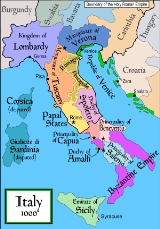
Historical states of Italy

Encyclopedia
Italy
, until the present era, was a conglomeration of city-states and other small independent entities. The following is a list of the various states that made up what we now know as Italy during the past. (rounded up to a year significant to Italian history in each case).
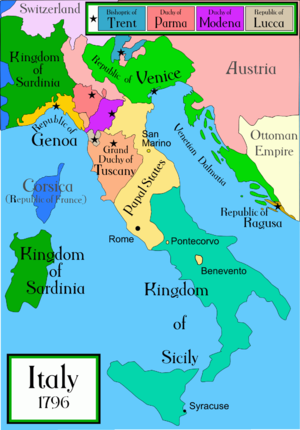
:
Italy
Italy , officially the Italian Republic languages]] under the European Charter for Regional or Minority Languages. In each of these, Italy's official name is as follows:;;;;;;;;), is a unitary parliamentary republic in South-Central Europe. To the north it borders France, Switzerland, Austria and...
, until the present era, was a conglomeration of city-states and other small independent entities. The following is a list of the various states that made up what we now know as Italy during the past. (rounded up to a year significant to Italian history in each case).
Antiquity
- Latin citiesLatins"Latins" refers to different groups of people and the meaning of the word changes for where and when it is used.The original Latins were an Italian tribe inhabiting central and south-central Italy. Through conquest by their most populous city-state, Rome, the original Latins culturally "Romanized"...
- Etruscan civilizationEtruscan civilizationEtruscan civilization is the modern English name given to a civilization of ancient Italy in the area corresponding roughly to Tuscany. The ancient Romans called its creators the Tusci or Etrusci...
- Greek city-statesAncient GreeceAncient Greece is a civilization belonging to a period of Greek history that lasted from the Archaic period of the 8th to 6th centuries BC to the end of antiquity. Immediately following this period was the beginning of the Early Middle Ages and the Byzantine era. Included in Ancient Greece is the...
- Ligurian civilizationLiguresThe Ligures were an ancient people who gave their name to Liguria, a region of north-western Italy.-Classical sources:...
- Messapian civilizationMessapiithumb|220px|Messapic ceramic, Archaeological Museum of [[Oria, Italy|Oria]], Apulia.The Messapii were an ancient tribe that inhabited, in historical times, the south-eastern peninsula or "heel" of Italy , known variously in ancient times as Calabria, Messapia and Iapygia...
- Palæovenetian civilizationAdriatic VenetiThe Veneti were an ancient people who inhabited north-eastern Italy, in an area corresponding to the modern-day region of the Veneto....
- Samnite civilizationSamnite WarsThe First, Second, and Third Samnite Wars, between the early Roman Republic and the tribes of Samnium, extended over half a century, involving almost all the states of Italy, and ended in Roman domination of the Samnites...
- Umbrian civilizationUmbriThe Umbri were an Italic people of ancient Italy. A region called Umbria still exists and is currently occupied by Italian speakers. It is somewhat smaller than the ancient Umbria....
- Roman KingdomRoman KingdomThe Roman Kingdom was the period of the ancient Roman civilization characterized by a monarchical form of government of the city of Rome and its territories....
- Roman RepublicRoman RepublicThe Roman Republic was the period of the ancient Roman civilization where the government operated as a republic. It began with the overthrow of the Roman monarchy, traditionally dated around 508 BC, and its replacement by a government headed by two consuls, elected annually by the citizens and...
- Roman EmpireRoman EmpireThe Roman Empire was the post-Republican period of the ancient Roman civilization, characterised by an autocratic form of government and large territorial holdings in Europe and around the Mediterranean....
- Western Roman EmpireWestern Roman EmpireThe Western Roman Empire was the western half of the Roman Empire after its division by Diocletian in 285; the other half of the Roman Empire was the Eastern Roman Empire, commonly referred to today as the Byzantine Empire....
Early Middle Ages
- Ostrogothic Kingdom of ItalyOstrogothic KingdomThe Kingdom established by the Ostrogoths in Italy and neighbouring areas lasted from 493 to 553. In Italy the Ostrogoths replaced Odoacer, the de facto ruler of Italy who had deposed the last emperor of the Western Roman Empire in 476. The Gothic kingdom reached its zenith under the rule of its...
- Lombard Kingdom
- Exarchate of RavennaExarchate of RavennaThe Exarchate of Ravenna or of Italy was a centre of Byzantine power in Italy, from the end of the 6th century to 751, when the last exarch was put to death by the Lombards.-Introduction:...
Duchies of the Lombard Kingdom
- Duchy of FriuliDuchy of FriuliThe Duchy of Friuli was one of the great territorial Lombard duchies, the first to be established. It was an important buffer between the Lombard kingdom of Italy and the Slavs...
- Duchy of Ceneda
- Duchy of Treviso
- Duchy of Vicenza
- Duchy of Verona
- Duchy of Trent
- Duchy of Parma
- Duchy of Reggio
- Duchy of Piacenza
- Duchy of Brescia
- Duchy of Bergamo
- Duchy of San Giulio
- Duchy of Pavia
- Duchy of Turin
- Duchy of Asti
- Duchy of Tuscia
- Duchy of SpoletoDuchy of SpoletoThe independent Duchy of Spoleto was a Lombard territory founded about 570 in central Italy by the Lombard dux Faroald.- Lombards :The Lombards, a Germanic people, had invaded Italy in 568 and conquered much of it, establishing a Kingdom divided between several dukes dependent on the King, who had...
- Duchy of BeneventoDuchy of BeneventoThe Duchy and later Principality of Benevento was the southernmost Lombard duchy in medieval Italy, centred on Benevento, a city central in the Mezzogiorno. Owing to the Ducatus Romanus of the popes, which cut it off from the rest of Lombard Italy, Benevento was from the first practically...
, then the Principality of SalernoPrincipality of SalernoThe Lombard Principality of Salerno was a South Italian state, centered on the port city of Salerno, formed in 851 out of the Principality of Benevento after a decade-long civil war.... - Duchy of Aosta
- Duchy of Milan
- Duchy of Ivrea
Districts of the Byzantine Empire
- Exarchate of RavennaExarchate of RavennaThe Exarchate of Ravenna or of Italy was a centre of Byzantine power in Italy, from the end of the 6th century to 751, when the last exarch was put to death by the Lombards.-Introduction:...
- Duchy of Istria
- Duchy of Liguria
- Duchy of NaplesDuchy of NaplesThe Duchy of Naples began as a Byzantine province that was constituted in the seventh century, in the reduced coastal lands that the Lombards had not conquered during their invasion of Italy in the sixth century...
(Including CalabriaCalabriaCalabria , in antiquity known as Bruttium, is a region in southern Italy, south of Naples, located at the "toe" of the Italian Peninsula. The capital city of Calabria is Catanzaro....
, LucaniaLucaniaLucania was an ancient district of southern Italy, extending from the Tyrrhenian Sea to the Gulf of Taranto. To the north it adjoined Campania, Samnium and Apulia, and to the south it was separated by a narrow isthmus from the district of Bruttium...
and ApuliaApuliaApulia is a region in Southern Italy bordering the Adriatic Sea in the east, the Ionian Sea to the southeast, and the Strait of Òtranto and Gulf of Taranto in the south. Its most southern portion, known as Salento peninsula, forms a high heel on the "boot" of Italy. The region comprises , and...
) - Duchy of the PentapolisDuchy of the PentapolisIn the Byzantine Empire, the Duchy of the Pentapolis was a duchy , a territory ruled by a duke appointed by and under the authority of the Praetorian Prefect of Italy and then the Exarch of Ravenna . The Pentapolis consisted of the cities of Ancona, Fano, Pesaro, Rimini and Sinigaglia...
- Duchy of PerugiaDuchy of PerugiaThe Duchy of Perugia was a duchy in the Italian part of the Byzantine Empire. Its civil and military administration was overseen by a duke appointed by and under the authority originally of the Praetorian Prefect of Italy and later of the Exarch of Ravenna . Its chief city and namesake was...
- Duchy of RomeDuchy of RomeThe Duchy of Rome was a Byzantine district in the Exarchate of Ravenna. Like other Byzantine states in Italy, it was ruled by an imperial functionary with the title dux...
- Duchy of Venetia
- Theme of Sicily
- Duchy of Calabria
Carolingian Era
- Kingdom of ItalyKingdom of Italy (medieval)The Kingdom of Italy was a political entity under control of Carolingian dynasty of Francia first, after the defeat of the Lombards in 774. It was finally incorporated as a part of the Holy Roman Empire in 962....
(under the Carolingian EmpireCarolingian EmpireCarolingian Empire is a historiographical term which has been used to refer to the realm of the Franks under the Carolingian dynasty in the Early Middle Ages. This dynasty is seen as the founders of France and Germany, and its beginning date is based on the crowning of Charlemagne, or Charles the...
) - Papal StatesPapal StatesThe Papal State, State of the Church, or Pontifical States were among the major historical states of Italy from roughly the 6th century until the Italian peninsula was unified in 1861 by the Kingdom of Piedmont-Sardinia .The Papal States comprised territories under...
- Duchy of BeneventoDuchy of BeneventoThe Duchy and later Principality of Benevento was the southernmost Lombard duchy in medieval Italy, centred on Benevento, a city central in the Mezzogiorno. Owing to the Ducatus Romanus of the popes, which cut it off from the rest of Lombard Italy, Benevento was from the first practically...
(under the LombardsLombardsThe Lombards , also referred to as Longobards, were a Germanic tribe of Scandinavian origin, who from 568 to 774 ruled a Kingdom in Italy...
) - Byzantine EmpireByzantine EmpireThe Byzantine Empire was the Eastern Roman Empire during the periods of Late Antiquity and the Middle Ages, centred on the capital of Constantinople. Known simply as the Roman Empire or Romania to its inhabitants and neighbours, the Empire was the direct continuation of the Ancient Roman State...
- VeniceVeniceVenice is a city in northern Italy which is renowned for the beauty of its setting, its architecture and its artworks. It is the capital of the Veneto region...
- GaetaGaetaGaeta is a city and comune in the province of Latina, in Lazio, central Italy. Set on a promontory stretching towards the Gulf of Gaeta, it is 120 km from Rome and 80 km from Naples....
- NaplesNaplesNaples is a city in Southern Italy, situated on the country's west coast by the Gulf of Naples. Lying between two notable volcanic regions, Mount Vesuvius and the Phlegraean Fields, it is the capital of the region of Campania and of the province of Naples...
- SalentoSalentoSalento is the south-eastern extremity of the Apulia region of Italy. It is a sub-peninsula of the main Italian Peninsula, sometimes described as the "heel" of the Italian "boot"...
- CalabriaCalabriaCalabria , in antiquity known as Bruttium, is a region in southern Italy, south of Naples, located at the "toe" of the Italian Peninsula. The capital city of Calabria is Catanzaro....
- SicilySicilySicily is a region of Italy, and is the largest island in the Mediterranean Sea. Along with the surrounding minor islands, it constitutes an autonomous region of Italy, the Regione Autonoma Siciliana Sicily has a rich and unique culture, especially with regard to the arts, music, literature,...
- SardiniaSardiniaSardinia is the second-largest island in the Mediterranean Sea . It is an autonomous region of Italy, and the nearest land masses are the French island of Corsica, the Italian Peninsula, Sicily, Tunisia and the Spanish Balearic Islands.The name Sardinia is from the pre-Roman noun *sard[],...
- Venice
- SaracenSaracenSaracen was a term used by the ancient Romans to refer to a people who lived in desert areas in and around the Roman province of Arabia, and who were distinguished from Arabs. In Europe during the Middle Ages the term was expanded to include Arabs, and then all who professed the religion of Islam...
settlements- FondiFondiFondi is a city and comune in the province of Latina, Lazio, central Italy, halfway between Rome and Naples. Before the construction of the highway between the latter cities in the late 1950s, Fondi had been an important settlement on the Roman Via Appia, which was the main connection from Rome to...
- Traetto
- PonzaPonzaPonza is the largest of the Italian Pontine Islands archipelago, located 33 km south of Cape Circeo in the Tyrrhenian Sea. It also the name of the commune of the island, a part of the province of Latina in the Lazio region....
- Capo Miseno
- SepinoSepinoSepino is a comune in the Province of Campobasso in the Italian region Molise, located about 20 km south of Campobasso....
- AgropoliAgropoliAgropoli is a town and comune located in the Cilento area of the province of Salerno, Campania, Italy. It is situated at the start of the Cilento coast, on the Tyrrhenian Sea. Its population is 21.251.-Pre-medieval period:...
and Punta Licosa - BariBariBari is the capital city of the province of Bari and of the Apulia region, on the Adriatic Sea, in Italy. It is the second most important economic centre of mainland Southern Italy after Naples, and is well known as a port and university city, as well as the city of Saint Nicholas...
- TarantoTarantoTaranto is a coastal city in Apulia, Southern Italy. It is the capital of the Province of Taranto and is an important commercial port as well as the main Italian naval base....
- BrindisiBrindisiBrindisi is a city in the Apulia region of Italy, the capital of the province of Brindisi, off the coast of the Adriatic Sea.Historically, the city has played an important role in commerce and culture, due to its position on the Italian Peninsula and its natural port on the Adriatic Sea. The city...
- AmanteaAmanteaAmantea is a town and comune in the province of Cosenza in the Calabria region of southern Italy.It is a touristical centre on the southern Tyrrhenian Sea coast...
- TropeaTropeaTropea is a municipality located within the province of Vibo Valentia, in Calabria .The town is a famous bathing place, situated on a reef, in the gulf of St...
- Fondi
States of the Holy Roman Empire
- County of Asti
- Bishopric of BrixenBishopric of BrixenThe Bishopric of Brixen is a former Roman Catholic diocese and also a former ecclesiastical state of the Holy Roman Empire in the present province of South Tyrol. The bishopric in the Eisack/Isarco valley was established in the 6th century and gradually received more secular powers...
- March of GenoaMarch of GenoaThe March of Genoa or Eastern Liguria was created in 961 by the Emperor Otto I. It was originally called either the marca Obertenga after its first holder, Oberto I, or the marca Januensis after its original capital and chief city, Genoa. Its creation was part of a general reorganisation of the...
(Marca Januensis or Eastern Liguria) - County of GoriziaCounty of GoriziaThe County of Görz was a county based around the town of Gorizia in the present-day Friuli-Venezia Giulia region of north-eastern Italy.Count Meinhard, descendant of the Bavarian Meinhardiner noble family with possessions around Lienz in Tyrol, is mentioned as early as 1107...
- Kingdom of ItalyKingdom of Italy (medieval)The Kingdom of Italy was a political entity under control of Carolingian dynasty of Francia first, after the defeat of the Lombards in 774. It was finally incorporated as a part of the Holy Roman Empire in 962....
- March of IvreaMarch of IvreaThe March of Ivrea was a large frontier county in the northwest of the medieval Italian kingdom from the late 9th to the early 11th century. Its capital was Ivrea in present-day Piedmont, and it was held by a Burgundian family of margraves called the Anscarids...
- MarcheMarcheThe population density in the region is below the national average. In 2008, it was 161.5 inhabitants per km2, compared to the national figure of 198.8. It is highest in the province of Ancona , and lowest in the province of Macerata...
includes Marches of CamerinoCamerinoCamerino is a small town of 7.135 inhabitants in the Marches , in the province of Macerata, Italy. It is located in the Apennines bordering Umbria, between the valleys of the rivers Potenza and Chienti, about 40 miles from Ancona....
, FermoFermoFermo is a town and comune of the Marche, Italy, in the Province of Fermo.Fermo is located on a hill, the Sabulo with a fine view, on a branch from Porto San Giorgio on the Adriatic coast railway....
and AnconaMarch of AnconaThe March of Ancona or marca Anconitana was a frontier march centred on the city of Ancona and, then, Macerata in the Middle Ages... - Marquisate of Montferrat (created Marca Aleramica)
- Marquisate of SaluzzoMarquisate of SaluzzoThe Marquisate of Saluzzo was an historical Italian state that included French and Piedmont territories on the Alps.-Marquisate territories:The Marquisate of Saluzzo occupied parts of the provinces of Cuneo and Turin, and at times areas now under French control. However, Saluzzo was historically...
- Marquisate of CevaMarquisate of CevaThe Marquisate of Ceva was a small independent state in north-western Italy, situated at the foot of the Apennines, in what is now a part of Piedmont.-Establishment:...
- Marquisate of IncisaMarquisate of IncisaThe Marquisate of Incisa was a lordship of the House of Aleramici in southern Piedmont, northern Italy, which existed between the 12th and 16th centuries.-History:...
- County of SavoyCounty of SavoyThe Counts of Savoy emerged, along with the free communes of Switzerland, from the collapse of the Burgundian Kingdom of Arles in the 11th century....
- County of Sorano (Aldobrandeschi)
- Duchy of SpoletoDuchy of SpoletoThe independent Duchy of Spoleto was a Lombard territory founded about 570 in central Italy by the Lombard dux Faroald.- Lombards :The Lombards, a Germanic people, had invaded Italy in 568 and conquered much of it, establishing a Kingdom divided between several dukes dependent on the King, who had...
- Bishopric of TrentBishopric of TrentThe Bishopric of Trent is a former ecclesiastical territory roughly corresponding to the present-day Northern Italian autonomous province of Trentino. It was created in 1027 and existed until 1802, when it was secularised and absorbed into the County of Tyrol held by the House of Habsburg...
- March of TurinMarch of TurinThe county or march of Turin was founded in 941 by Hugh of Italy, who appointed Arduin Glaber as its governor. Arduin had captured Turin and the Susa Valley from the Saracens...
(created Marca Arduinica; also known as the March of Susa) - March of TuscanyMarch of TuscanyThe March of Tuscany or Tuscia was a frontier march in central Italy, bordering the Papal States to the south and east, the Ligurian Sea to the west, and the rest of the Kingdom of Italy to the north. It was a Carolingian creation, a successor of the Lombard Duchy of Tuscia...
- Marquisate of Verona and AquileiaMarch of VeronaThe March of Verona and Aquileia was a vast march in northeastern Italy during the Middle Ages, centered on the cities of Verona and Aquileia. Except for Venice, it included the territories of the modern-day regions of Veneto and Friuli-Venezia Giulia as well as Istria and Trentino up to the Adige...
- March of TrevisoMarch of TrevisoThe March of Treviso was a medieval territory in Venetia, between the Garda and the Julian March. The territory corresponded roughly to the region around the city of Treviso, including Belluno, Feltre, and Ceneda and the dioceses of all four cities. It bordered the March of Verona and the Muson...
- March of FriuliMarch of FriuliThe March of Friuli was a Carolingian frontier march against the Slavs and Avars in the ninth and tenth centuries. It was a successor to the Lombard Duchy of Friuli....
Other states
- Catepanate of Italy
- Duchy of BeneventoDuchy of BeneventoThe Duchy and later Principality of Benevento was the southernmost Lombard duchy in medieval Italy, centred on Benevento, a city central in the Mezzogiorno. Owing to the Ducatus Romanus of the popes, which cut it off from the rest of Lombard Italy, Benevento was from the first practically...
- Principality of CapuaPrincipality of CapuaThe Principality of Capua was a Lombard state in Southern Italy, usually de facto independent, but under the varying suzerainty of Western and Eastern Roman Empires. It was originally a gastaldate, then a county, within the principality of Salerno....
- Principality of SalernoPrincipality of SalernoThe Lombard Principality of Salerno was a South Italian state, centered on the port city of Salerno, formed in 851 out of the Principality of Benevento after a decade-long civil war....
- Papal StatesPapal StatesThe Papal State, State of the Church, or Pontifical States were among the major historical states of Italy from roughly the 6th century until the Italian peninsula was unified in 1861 by the Kingdom of Piedmont-Sardinia .The Papal States comprised territories under...
- Emirate of SicilyEmirate of SicilyThe Emirate of Sicily was an Islamic state on the island of Sicily , which existed from 965 to 1072.-First Arab invasions of Sicily:...
- Kingdom of SicilyKingdom of SicilyThe Kingdom of Sicily was a state that existed in the south of Italy from its founding by Roger II in 1130 until 1816. It was a successor state of the County of Sicily, which had been founded in 1071 during the Norman conquest of southern Italy...
- Terra Sancti BenedictiTerra Sancti BenedictiThe Terra Sancti Benedicti was the secular territory, or seignory, of the powerful Abbey of Montecassino, the chief monastery of the Mezzogiorno and one of the first Western monasteries: founded by Benedict of Nursia himself, hence the name of its possessions.The secular holdings had their origin...
- Patriarchal State of Friuli (Patrie dal Friûl)
- Giudicato of GalluraGiudicato of GalluraThe Giudicato of Gallura was one of four Sardinian giudicati of the Middle Ages. These were de facto independent states ruled by judges bearing the title iudex . Gallura, a name which comes from gallus, meaning rooster , was subdivided into ten curatoriae governed by curatores under the judge...
- Giudicato of Torres
- Giudicato of Arborea
- Giudicato of CagliariGiudicato of CagliariThe Giudicato of Cagliari was one of the four Sardinian giudicati of the Middle Ages. It covered the entire south and central east portion of the island and was composed of thirteen subdivisions called curatoriae. To its north and west lay Arborea and north and on the east lay Gallura and Logudoro...
Main independent communes
- ArezzoArezzoArezzo is a city and comune in Central Italy, capital of the province of the same name, located in Tuscany. Arezzo is about 80 km southeast of Florence, at an elevation of 296 m above sea level. In 2011 the population was about 100,000....
- AstiAstiAsti is a city and comune of about 75,000 inhabitants located in the Piedmont region of northwestern Italy, about 55 kilometres east of Turin in the plain of the Tanaro River...
- BresciaBresciaBrescia is a city and comune in the region of Lombardy in northern Italy. It is situated at the foot of the Alps, between the Mella and the Naviglio, with a population of around 197,000. It is the second largest city in Lombardy, after the capital, Milan...
- CremonaCremonaCremona is a city and comune in northern Italy, situated in Lombardy, on the left bank of the Po River in the middle of the Pianura Padana . It is the capital of the province of Cremona and the seat of the local City and Province governments...
- FlorenceFlorenceFlorence is the capital city of the Italian region of Tuscany and of the province of Florence. It is the most populous city in Tuscany, with approximately 370,000 inhabitants, expanding to over 1.5 million in the metropolitan area....
- GenoaGenoaGenoa |Ligurian]] Zena ; Latin and, archaically, English Genua) is a city and an important seaport in northern Italy, the capital of the Province of Genoa and of the region of Liguria....
- Lodi
- MilanMilanMilan is the second-largest city in Italy and the capital city of the region of Lombardy and of the province of Milan. The city proper has a population of about 1.3 million, while its urban area, roughly coinciding with its administrative province and the bordering Province of Monza and Brianza ,...
- PerugiaPerugiaPerugia is the capital city of the region of Umbria in central Italy, near the River Tiber, and the capital of the province of Perugia. The city is located about north of Rome. It covers a high hilltop and part of the valleys around the area....
- PiacenzaPiacenzaPiacenza is a city and comune in the Emilia-Romagna region of northern Italy. It is the capital of the province of Piacenza...
- PisaPisaPisa is a city in Tuscany, Central Italy, on the right bank of the mouth of the River Arno on the Tyrrhenian Sea. It is the capital city of the Province of Pisa...
- RagusaRagusa, ItalyRagusa is a city and comune in southern Italy. It is the capital of the province of Ragusa, on the island of Sicily, with around 75,000 inhabitants. It is built on a wide limestone hill between two deep valleys, Cava San Leonardo and Cava Santa Domenica...
- SienaSienaSiena is a city in Tuscany, Italy. It is the capital of the province of Siena.The historic centre of Siena has been declared by UNESCO a World Heritage Site. It is one of the nation's most visited tourist attractions, with over 163,000 international arrivals in 2008...
- VeronaVeronaVerona ; German Bern, Dietrichsbern or Welschbern) is a city in the Veneto, northern Italy, with approx. 265,000 inhabitants and one of the seven chef-lieus of the region. It is the second largest city municipality in the region and the third of North-Eastern Italy. The metropolitan area of Verona...
- ViterboViterboSee also Viterbo, Texas and Viterbo UniversityViterbo is an ancient city and comune in the Lazio region of central Italy, the capital of the province of Viterbo. It is approximately 80 driving / 80 walking kilometers north of GRA on the Via Cassia, and it is surrounded by the Monti Cimini and...
Duchies and other entities of former Byzantine Empire appartenance
- Duchy of AmalfiDuchy of AmalfiThe Duchy of Amalfi or the Republic of Amalfi was a de facto independent state centred on the Southern Italian city of Amalfi during the 10th and 11th centuries. The city and its territory were originally part of the larger ducatus Neapolitanus, governed by a patrician, but it extracted itself...
- Duchy of Calabria
- Duchy of GaetaDuchy of GaetaThe Duchy of Gaeta was an early medieval state centred on the coastal South Italian city of Gaeta. It began in the early ninth century as the local community began to grow autonomous as Byzantine power lagged in the Mediterranean and the peninsula thanks to Lombard and Saracen incursions.Our...
- Duchy of NaplesDuchy of NaplesThe Duchy of Naples began as a Byzantine province that was constituted in the seventh century, in the reduced coastal lands that the Lombards had not conquered during their invasion of Italy in the sixth century...
- Duchy of SorrentoDuchy of SorrentoThe Duchy of Sorrento was a small peninsular principality of the Early Middle Ages centred on the Italian city of Sorrento.Originally, Sorrento was part of the Byzantine Duchy of Naples in the Dark Ages, but in the ninth century, along with Amalfi and Gaeta, it broke away from the Neapolitans to...
- Republic of VeniceRepublic of VeniceThe Republic of Venice or Venetian Republic was a state originating from the city of Venice in Northeastern Italy. It existed for over a millennium, from the late 7th century until 1797. It was formally known as the Most Serene Republic of Venice and is often referred to as La Serenissima, in...
- Republic of PisaRepublic of PisaThe Republic of Pisa was a de facto independent state centered on the Tuscan city of Pisa during the late tenth and eleventh centuries. It rose to become an economic powerhouse, a commercial center whose merchants dominated Mediterranean and Italian trade for a century before being surpassed and...
- TraniTraniTrani is a seaport of Apulia, southern Italy, on the Adriatic Sea, in the new Province of Barletta-Andria-Trani , and 40 km by railway West-Northwest of Bari.- History :...
- Exarchate of RavennaExarchate of RavennaThe Exarchate of Ravenna or of Italy was a centre of Byzantine power in Italy, from the end of the 6th century to 751, when the last exarch was put to death by the Lombards.-Introduction:...
Italy in the year 1494
Before the beginning of the Italian Wars- Papal StatesPapal StatesThe Papal State, State of the Church, or Pontifical States were among the major historical states of Italy from roughly the 6th century until the Italian peninsula was unified in 1861 by the Kingdom of Piedmont-Sardinia .The Papal States comprised territories under...
- Kingdom of NaplesKingdom of NaplesThe Kingdom of Naples, comprising the southern part of the Italian peninsula, was the remainder of the old Kingdom of Sicily after secession of the island of Sicily as a result of the Sicilian Vespers rebellion of 1282. Known to contemporaries as the Kingdom of Sicily, it is dubbed Kingdom of...
(independent Aragonese dynasty) - Kingdom of SicilyKingdom of SicilyThe Kingdom of Sicily was a state that existed in the south of Italy from its founding by Roger II in 1130 until 1816. It was a successor state of the County of Sicily, which had been founded in 1071 during the Norman conquest of southern Italy...
(to Aragon) - Kingdom of SardiniaKingdom of SardiniaThe Kingdom of Sardinia consisted of the island of Sardinia first as a part of the Crown of Aragon and subsequently the Spanish Empire , and second as a part of the composite state of the House of Savoy . Its capital was originally Cagliari, in the south of the island, and later Turin, on the...
(to Aragon) - Prince-Bishopric of Brixen
- Prince-Bishopric of TrentBishopric of TrentThe Bishopric of Trent is a former ecclesiastical territory roughly corresponding to the present-day Northern Italian autonomous province of Trentino. It was created in 1027 and existed until 1802, when it was secularised and absorbed into the County of Tyrol held by the House of Habsburg...
- Duchy of SavoyDuchy of SavoyFrom 1416 to 1847, the House of Savoy ruled the eponymous Duchy of Savoy . The Duchy was a state in the northern part of the Italian Peninsula, with some territories that are now in France. It was a continuation of the County of Savoy...
(Savoia) - Duchy of MilanDuchy of MilanThe Duchy of Milan , was created on the 1st of may 1395, when Gian Galeazzo Visconti, Lord of Milan, purchased a diploma for 100,000 Florins from King Wenceslaus. It was this diploma that installed, Gian Galeazzo as Duke of Milan and Count of Pavia...
(Visconti, then Sforza from 1450, to France 1499-1522, to Spain from 1535, to Austria from 1706) - Duchy of FerraraDuchy of FerraraThe Duchy of Ferrara is a former sovereign state of northern Italy.Obizzo II d'Este was proclaimed lifelong ruler of Ferrara in 1264. He also became seignior of nearby Modena in 1288 and of Reggio in 1289...
(Este) - Duchy of Massa and CarraraDuchy of Massa and CarraraThe Duchy of Massa and Carrara was the duchy that controlled the towns of Massa di Carrara and Carrara; the area is now part of unified Italy, but retains its local identity as the province of Massa-Carrara.-History:...
(Malaspina) - Duchy of Modena and ReggioDuchy of Modena and ReggioThe Duchy of Modena and Reggio |Italian]] state that existed from 1452 to 1859, with a break between 1796 and 1814. It was ruled by the noble House of Este, from 1814 Austria-Este.-House of Este:...
(in personal union with Ferrara) - Duchy of Urbino (MontefeltroMontefeltrothumb|Coat of Arms of the Montefeltro family.Montefeltro is the name of an historical Italian family who ruled Urbino and Rimini.The family's reign began in 1267 when Buonconte I da Montefeltro was elected podestà of Urbino...
) - Marquisate of SaluzzoMarquisate of SaluzzoThe Marquisate of Saluzzo was an historical Italian state that included French and Piedmont territories on the Alps.-Marquisate territories:The Marquisate of Saluzzo occupied parts of the provinces of Cuneo and Turin, and at times areas now under French control. However, Saluzzo was historically...
(Aleramici, to France 1548) - Marquisate of Montferrat (Paleologi, in personal union with Mantua 1533)
- Marquisate of Mantua (Gonzaga)
- Marquisate of FinaleMarquisate of FinaleThe Marquisate of Finale was an Italian state in what is now Liguria, part of the former medieval Aleramici March. It was ruled for some six centuries by the Aleramici branch known as marquesses del Vasto and later Del Carretto, when Savona became a free commune.-History:The marquisate of Finale...
(Del Carretto) - Marquisate of IncisaMarquisate of IncisaThe Marquisate of Incisa was a lordship of the House of Aleramici in southern Piedmont, northern Italy, which existed between the 12th and 16th centuries.-History:...
(Aleramici) - Marquisate of CevaMarquisate of CevaThe Marquisate of Ceva was a small independent state in north-western Italy, situated at the foot of the Apennines, in what is now a part of Piedmont.-Establishment:...
- County of NiceCounty of NiceThe County of Nice or Niçard Country is a historical region of France, located in the south-eastern part, around the city of Nice.-History:Its territory lies between the Mediterranean Sea , Var River and the southernmost crest of the...
- County of GoriziaCounty of GoriziaThe County of Görz was a county based around the town of Gorizia in the present-day Friuli-Venezia Giulia region of north-eastern Italy.Count Meinhard, descendant of the Bavarian Meinhardiner noble family with possessions around Lienz in Tyrol, is mentioned as early as 1107...
(annexed to Austria in 1500) - County of GuastallaCounty of GuastallaThe County of Guastalla was a sovereign state of northern Italy centred on Guastalla. The title of count was created in 1406 for Guido Torelli: the Torelli family held Guastalla until 1539, when it was bought by Ferrante Gonzaga. Another branch held the county of Montechiarugolo until 1612...
(Torelli, sold to a junior branch of the Gonzaga 1539) - County of Mirandola (Pico)
- County of MontechiarugoloCounty of MontechiarugoloThe County of Montechiarugolo was a small sovereign state of northern Italy which existed from 1456 to 1612. It included the other fief of Casei....
(Torelli of Montechiarugolo) - County of Novellara (Gonzaga of Novellara)
- County of Correggio (da Correggio)
- County of Pitigliano (Orsini)
- County of Santa FioraCounty of Santa FioraThe County of Santa Fiora was a small historical state of southern Tuscany, in central Italy. Together with the county of Sovana, it was one of the two subdivisions into which the possessions of the Aldobrandeschi, then lords of much of southern Tuscany, were split in 1274.At the moments of its...
(Sforza of S.Fiora) - Stato Landi (Landi)
- Stato Pallavicino (Pallavicino)
- CastiglioneCastiglione-Places:Towns in Italy, many of which were simply called Castiglione prior to the unification of Italy in the 19th century:* Castiglion Fibocchi, in the province of Arezzo* Castiglion Fiorentino, in the province of Arezzo...
(Gonzaga of Castiglione) - MirandolaMirandolaMirandola is a city and comune of Emilia-Romagna, Italy, in the Province of Modena, 31 km northeast of the provincial capital by railway.- History :Mirandola originated as a Renaissance city-fortress...
(Pico) - Carpi (Pio di Savoia)
- SassuoloSassuoloSassuolo is an important industrial centre of the Emilia-Romagna region of Italy. The town stands on the right bank of the river Secchia some 17 km south-west of Modena.-History :...
(Pio di Savoia) - BolognaBolognaBologna is the capital city of Emilia-Romagna, in the Po Valley of Northern Italy. The city lies between the Po River and the Apennine Mountains, more specifically, between the Reno River and the Savena River. Bologna is a lively and cosmopolitan Italian college city, with spectacular history,...
(Bentivoglio) - FaenzaFaenzaFaenza is an Italian city and comune, in the province of Ravenna, Emilia-Romagna, situated 50 km southeast of Bologna.Faenza is noted for its manufacture of majolica ware glazed earthenware pottery, known from the name of the town as "faience"....
(Manfredi) - RiminiRiminiRimini is a medium-sized city of 142,579 inhabitants in the Emilia-Romagna region of Italy, and capital city of the Province of Rimini. It is located on the Adriatic Sea, on the coast between the rivers Marecchia and Ausa...
(Malatesta) - ForlìForlìForlì is a comune and city in Emilia-Romagna, Italy, and is the capital of the province of Forlì-Cesena. The city is situated along the Via Emilia, to the right of the Montone river, and is an important agricultural centre...
(Riario) - PesaroPesaroPesaro is a town and comune in the Italian region of the Marche, capital of the Pesaro e Urbino province, on the Adriatic. According to the 2007 census, its population was 92,206....
(Sforza of Pesaro) - MatelicaMatelicaMatelica is a comune of the Province of Macerata in the Italian region of Marche. Located about 60 km southwest of Ancona and 35 km west of Macerata, it extends over an area of 81.0 km² and has a population of 10,316 .The municipality of Matelica comprises the hamlets of Balzani,...
(Ottoni) - CamerinoCamerinoCamerino is a small town of 7.135 inhabitants in the Marches , in the province of Macerata, Italy. It is located in the Apennines bordering Umbria, between the valleys of the rivers Potenza and Chienti, about 40 miles from Ancona....
(da Varano, duchy from 1515, confiscated and incorporated to the Papal States 1539) - Imperial Fiefdoms
- Republic of Ancona (to the Papal States in 1532)
- Republic of GenoaRepublic of GenoaThe Most Serene Republic of Genoa |Ligurian]]: Repúbrica de Zêna) was an independent state from 1005 to 1797 in Liguria on the northwestern Italian coast, as well as Corsica from 1347 to 1768, and numerous other territories throughout the Mediterranean....
- Republic of LuccaRepublic of LuccaThe Republic of Lucca was an ancient State of Tuscany which lasted from 1160 to 1805.After the death of Matilda of Tuscany, the city of Lucca began to constitute itself an independent commune, with a charter in 1160. For almost 500 years, Lucca remained an independent republic...
- Republic of FlorenceRepublic of FlorenceThe Republic of Florence , or the Florentine Republic, was a city-state that was centered on the city of Florence, located in modern Tuscany, Italy. The republic was founded in 1115, when the Florentine people rebelled against the Margraviate of Tuscany upon Margravine Matilda's death. The...
(actually under the lordship of the Medici, duchy from 1532) - Republic of SienaRepublic of SienaThe Republic of Siena , was a state originating from the city of Siena in Tuscany, Central Italy.It existed for over four hundreds years, from the late 11th century until the year 1555, when was defeated by the rival Duchy of Florence in alliance with the Spanish crown...
(incorporated to the Duchy of Florence 1555) - Republic of VeniceRepublic of VeniceThe Republic of Venice or Venetian Republic was a state originating from the city of Venice in Northeastern Italy. It existed for over a millennium, from the late 7th century until 1797. It was formally known as the Most Serene Republic of Venice and is often referred to as La Serenissima, in...
- Republic of Cospaia
- Republic of San Marino
Italy in the year 1559
After the Peace of Cateau-Cambresis:- Papal StatesPapal StatesThe Papal State, State of the Church, or Pontifical States were among the major historical states of Italy from roughly the 6th century until the Italian peninsula was unified in 1861 by the Kingdom of Piedmont-Sardinia .The Papal States comprised territories under...
- Kingdom of NaplesKingdom of NaplesThe Kingdom of Naples, comprising the southern part of the Italian peninsula, was the remainder of the old Kingdom of Sicily after secession of the island of Sicily as a result of the Sicilian Vespers rebellion of 1282. Known to contemporaries as the Kingdom of Sicily, it is dubbed Kingdom of...
(under Spain) - Kingdom of SicilyKingdom of SicilyThe Kingdom of Sicily was a state that existed in the south of Italy from its founding by Roger II in 1130 until 1816. It was a successor state of the County of Sicily, which had been founded in 1071 during the Norman conquest of southern Italy...
(under Spain) - Kingdom of SardiniaKingdom of SardiniaThe Kingdom of Sardinia consisted of the island of Sardinia first as a part of the Crown of Aragon and subsequently the Spanish Empire , and second as a part of the composite state of the House of Savoy . Its capital was originally Cagliari, in the south of the island, and later Turin, on the...
(under Spain) - Prince-Bishopric of Brixen
- Prince-Bishopric of Trent
- Duchy of SavoyDuchy of SavoyFrom 1416 to 1847, the House of Savoy ruled the eponymous Duchy of Savoy . The Duchy was a state in the northern part of the Italian Peninsula, with some territories that are now in France. It was a continuation of the County of Savoy...
(Savoia) - Duchy of MilanDuchy of MilanThe Duchy of Milan , was created on the 1st of may 1395, when Gian Galeazzo Visconti, Lord of Milan, purchased a diploma for 100,000 Florins from King Wenceslaus. It was this diploma that installed, Gian Galeazzo as Duke of Milan and Count of Pavia...
(under Spain) - Duchy of MantuaDuchy of MantuaThe Duchy of Mantua was a duchy in Lombardy, Northern Italy, subject to the Holy Roman Empire.-History:After the fall of the Western Roman Empire, Mantua was invaded by Byzantines, Longobards and Franks. In the 11th century it became a possession of Boniface of Canossa, marquis of Toscana...
(Gonzaga) - Duchy of Parma and PiacenzaDuchy of ParmaThe Duchy of Parma was created in 1545 from that part of the Duchy of Milan south of the Po River, as a fief for Pope Paul III's illegitimate son, Pier Luigi Farnese, centered on the city of Parma....
(Farnese) - Duchy of FerraraDuchy of FerraraThe Duchy of Ferrara is a former sovereign state of northern Italy.Obizzo II d'Este was proclaimed lifelong ruler of Ferrara in 1264. He also became seignior of nearby Modena in 1288 and of Reggio in 1289...
(Este; confiscated and incorporated to the Papal States 1598) - Duchy of Modena and ReggioDuchy of Modena and ReggioThe Duchy of Modena and Reggio |Italian]] state that existed from 1452 to 1859, with a break between 1796 and 1814. It was ruled by the noble House of Este, from 1814 Austria-Este.-House of Este:...
(Este; in personal union with Ferrara until 1598) - Duchy of FlorenceDuchy of FlorenceThe Duchy of Florence was an Italian monarchy that was centred on the city of Florence, in modern Tuscany, Italy. The duchy was founded in 1532 when Clement VII appointed his illegitimate son Alessandro de' Medici Duke of the Florentine Republic,...
(Grand Duchy of TuscanyGrand Duchy of TuscanyThe Grand Duchy of Tuscany was a central Italian monarchy that existed, with interruptions, from 1569 to 1859, replacing the Duchy of Florence. The grand duchy's capital was Florence...
from 1569) (Medici) - Duchy of Urbino (Della Rovere; incorporated to the Papal States 1631)
- Duchy of CastroDuchy of CastroThe Duchy of Castro was a fiefdom in central Italy formed in 1537 from a small strip of land on what is now Lazio's border with Tuscany, centred on Castro, Lazio, a fortified city on a tufa cliff overlooking the river Fiora which was its capital and ducal residence...
(in personal union with Parma; confiscated and incorporated to the Papal States 1649) - Marquisate of Montferrat (in personal union with Mantua; duchy from 1574)
- Marquisate of Masserano (Ferrero-Fieschi; principality from 1577)
- Marquisate of FinaleMarquisate of FinaleThe Marquisate of Finale was an Italian state in what is now Liguria, part of the former medieval Aleramici March. It was ruled for some six centuries by the Aleramici branch known as marquesses del Vasto and later Del Carretto, when Savona became a free commune.-History:The marquisate of Finale...
(Del Carretto; to Spain 1602) - Marquisate of Massa (Cybo-Malaspina; principality from 1568)
- County of GuastallaCounty of GuastallaThe County of Guastalla was a sovereign state of northern Italy centred on Guastalla. The title of count was created in 1406 for Guido Torelli: the Torelli family held Guastalla until 1539, when it was bought by Ferrante Gonzaga. Another branch held the county of Montechiarugolo until 1612...
(Gonzaga of Guastalla) - County of Mirandola (Pico)
- County of MontechiarugoloCounty of MontechiarugoloThe County of Montechiarugolo was a small sovereign state of northern Italy which existed from 1456 to 1612. It included the other fief of Casei....
(Torelli; to Parma 1612) - County of Correggio (da Correggio; principality from 1616, confiscated and ceded to Modena by the Emperor 1631)
- County of Novellara (Gonzaga of Novellara)
- County of Pitigliano (Orsini; acquired by Tuscany in 1604)
- County of Santa FioraCounty of Santa FioraThe County of Santa Fiora was a small historical state of southern Tuscany, in central Italy. Together with the county of Sovana, it was one of the two subdivisions into which the possessions of the Aldobrandeschi, then lords of much of southern Tuscany, were split in 1274.At the moments of its...
(Sforza; acquired by Tuscany in 1633) - State Pallavicino (Pallavicino; to Parma 1636)
- Stato Landi (Landi)
- CastiglioneCastiglione-Places:Towns in Italy, many of which were simply called Castiglione prior to the unification of Italy in the 19th century:* Castiglion Fibocchi, in the province of Arezzo* Castiglion Fiorentino, in the province of Arezzo...
(Gonzaga of Castiglione; marquisate from 1579, principality from 1659) - PiombinoPrincipality of PiombinoThe Principality of Piombino was a state of Italy, which existed from 1399 to 1805, when Napoleon absorbed it into the Principality of Lucca and Piombino...
(Appiani; principality from 1594) - SabbionetaSabbionetaSabbioneta is a town and comune in the province of Mantua, Lombardy region, northern Italy. It is situated about 30 km north of Parma, not far from the northern bank of the Po River...
(Gonzaga of Bozzolo; duchy from 1577, sold to Spain in 1629) - MirandolaMirandolaMirandola is a city and comune of Emilia-Romagna, Italy, in the Province of Modena, 31 km northeast of the provincial capital by railway.- History :Mirandola originated as a Renaissance city-fortress...
(Pico; principality from 1596, duchy from 1617) - SassuoloSassuoloSassuolo is an important industrial centre of the Emilia-Romagna region of Italy. The town stands on the right bank of the river Secchia some 17 km south-west of Modena.-History :...
(Pio di Savoia; to Modena 1599) - Imperial Fiefdoms (small, independent lordships generally under members of the Genoese nobility)
- SaluzzoSaluzzoSaluzzo is a town and former principality in the province of Cuneo, Piedmont region, Italy.The city of Saluzzo is built on a hill overlooking a vast, well-cultivated plain. Iron, lead, silver, marble, slate etc...
(under France; to Savoy from 1601) - Valtelline, Chiavenna and Bormio (under the Grisons)
- State of PresidiState of PresidiThe Stato dei Presidi was a client state of the Kingdom of Spain situated in central Italy, which included the cities of Orbetello, Porto Ercole, Porto Santo Stefano, Talamone, Ansedonia and Porto Longone, in what is now southern Tuscany...
(to Naples) - Republic of VeniceRepublic of VeniceThe Republic of Venice or Venetian Republic was a state originating from the city of Venice in Northeastern Italy. It existed for over a millennium, from the late 7th century until 1797. It was formally known as the Most Serene Republic of Venice and is often referred to as La Serenissima, in...
- Republic of GenoaRepublic of GenoaThe Most Serene Republic of Genoa |Ligurian]]: Repúbrica de Zêna) was an independent state from 1005 to 1797 in Liguria on the northwestern Italian coast, as well as Corsica from 1347 to 1768, and numerous other territories throughout the Mediterranean....
- Republic of LuccaRepublic of LuccaThe Republic of Lucca was an ancient State of Tuscany which lasted from 1160 to 1805.After the death of Matilda of Tuscany, the city of Lucca began to constitute itself an independent commune, with a charter in 1160. For almost 500 years, Lucca remained an independent republic...
- Republic of Cospaia
- Republic of San Marino
- MaltaMaltaMalta , officially known as the Republic of Malta , is a Southern European country consisting of an archipelago situated in the centre of the Mediterranean, south of Sicily, east of Tunisia and north of Libya, with Gibraltar to the west and Alexandria to the east.Malta covers just over in...
(to the Order of St.John of Jerusalem)
Italy in the year 1659
After the treaty of the Pirenees- Papal StatesPapal StatesThe Papal State, State of the Church, or Pontifical States were among the major historical states of Italy from roughly the 6th century until the Italian peninsula was unified in 1861 by the Kingdom of Piedmont-Sardinia .The Papal States comprised territories under...
- Kingdom of NaplesKingdom of NaplesThe Kingdom of Naples, comprising the southern part of the Italian peninsula, was the remainder of the old Kingdom of Sicily after secession of the island of Sicily as a result of the Sicilian Vespers rebellion of 1282. Known to contemporaries as the Kingdom of Sicily, it is dubbed Kingdom of...
(to Spain until 1707; to Austria from 1707 to 1734 then under a junior branch of the Spanish Bourbons - Kingdom of SicilyKingdom of SicilyThe Kingdom of Sicily was a state that existed in the south of Italy from its founding by Roger II in 1130 until 1816. It was a successor state of the County of Sicily, which had been founded in 1071 during the Norman conquest of southern Italy...
(to Spain until 1707; to Austria 1707-1714 and 1720–1734; to Savoy 1714-1720; in personal union with Naples thereafter) - Kingdom of SardiniaKingdom of SardiniaThe Kingdom of Sardinia consisted of the island of Sardinia first as a part of the Crown of Aragon and subsequently the Spanish Empire , and second as a part of the composite state of the House of Savoy . Its capital was originally Cagliari, in the south of the island, and later Turin, on the...
(to Spain until 1714; to Austria 1714-1720; in personal union with Savoy thereafter) - Grand Duchy of TuscanyGrand Duchy of TuscanyThe Grand Duchy of Tuscany was a central Italian monarchy that existed, with interruptions, from 1569 to 1859, replacing the Duchy of Florence. The grand duchy's capital was Florence...
(Medici until 1737; Habsburg-Lorraine thereafter) - Prince-Bishopric of Brixen
- Prince-Bishopric of Trent
- Duchy of SavoyDuchy of SavoyFrom 1416 to 1847, the House of Savoy ruled the eponymous Duchy of Savoy . The Duchy was a state in the northern part of the Italian Peninsula, with some territories that are now in France. It was a continuation of the County of Savoy...
- Duchy of MontferratDuchy of MontferratThe Duchy of Montferrat was created out of what was left of the March of Montferrat after the last Palaeologus heir had died and the margraviate been briefly controlled by Spain . After that brief interlude, it passed to the Gonzaga Dukes of Mantua...
(to Mantua until 1707, then to Savoy) - Duchy of MilanDuchy of MilanThe Duchy of Milan , was created on the 1st of may 1395, when Gian Galeazzo Visconti, Lord of Milan, purchased a diploma for 100,000 Florins from King Wenceslaus. It was this diploma that installed, Gian Galeazzo as Duke of Milan and Count of Pavia...
(to Spain until 1706, then to Austria; the union of Milan and Mantua in 1737 created the Austrian Lombardy) - Duchy of MantuaDuchy of MantuaThe Duchy of Mantua was a duchy in Lombardy, Northern Italy, subject to the Holy Roman Empire.-History:After the fall of the Western Roman Empire, Mantua was invaded by Byzantines, Longobards and Franks. In the 11th century it became a possession of Boniface of Canossa, marquis of Toscana...
(Gonzaga until the imperial confiscation in 1707, then to Austria; Austrian Lombardy from 1737) - Duchy of Parma and Piacenza (Farnese until 1731; Bourbons 1731-1734; to Austria 1734-1748 then to a junior branch of the Spanish Bourbons)
- Duchy of GuastallaDuchy of GuastallaThe Duchy of Guastalla was an Italian state which existed between 1621 to 1748. It was bordered by the Duchy of Modena and Reggio and the Po River to the north, on the opposite bank of the Duchy of Mantua.-History:...
(Gonzaga of Guastalla until their extinction in 1746; in personal union with Parma from 1748) - County (duchy since 1617) of MirandolaDuchy of MirandolaThe Duchy of Mirandola was a state which existed in Italy from 1310 until 1711, centered in Mirandola and ruled by the Pico family.-History:...
(Pico until the imperial confiscation in 1707; to Modena from 1710) - Duchy of Modena and ReggioDuchy of Modena and ReggioThe Duchy of Modena and Reggio |Italian]] state that existed from 1452 to 1859, with a break between 1796 and 1814. It was ruled by the noble House of Este, from 1814 Austria-Este.-House of Este:...
(Este) - Principality of Masserano (Ferrero-Fieschi; sold to Savoy in 1767)
- Principality of Castiglione (Gonzaga of Castiglione; confiscated by the Emperor 1691)
- Principality of Massa (Cybo-Malaspina; duchy from 1664; in personal union with Modena from 1731)
- Principality of PiombinoPrincipality of PiombinoThe Principality of Piombino was a state of Italy, which existed from 1399 to 1805, when Napoleon absorbed it into the Principality of Lucca and Piombino...
(Ludovisi until 1733, Boncompagni-Ludovisi thereafter) - County of Novellara (Gonzaga of Novellara until their extinction in 1728; to Modena from 1737)
- Stato Landi (Landi until 1679, Doria 1679-1682, then to Parma)
- Imperial Fiefdoms
- Valtelline, Chiavenna and Bormio (under the Grisons)
- State of PresidiState of PresidiThe Stato dei Presidi was a client state of the Kingdom of Spain situated in central Italy, which included the cities of Orbetello, Porto Ercole, Porto Santo Stefano, Talamone, Ansedonia and Porto Longone, in what is now southern Tuscany...
(to Naples) - Republic of VeniceRepublic of VeniceThe Republic of Venice or Venetian Republic was a state originating from the city of Venice in Northeastern Italy. It existed for over a millennium, from the late 7th century until 1797. It was formally known as the Most Serene Republic of Venice and is often referred to as La Serenissima, in...
- Republic of GenoaRepublic of GenoaThe Most Serene Republic of Genoa |Ligurian]]: Repúbrica de Zêna) was an independent state from 1005 to 1797 in Liguria on the northwestern Italian coast, as well as Corsica from 1347 to 1768, and numerous other territories throughout the Mediterranean....
- Republic of LuccaRepublic of LuccaThe Republic of Lucca was an ancient State of Tuscany which lasted from 1160 to 1805.After the death of Matilda of Tuscany, the city of Lucca began to constitute itself an independent commune, with a charter in 1160. For almost 500 years, Lucca remained an independent republic...
- Republic of Cospaia
- Republic of San Marino
- MaltaMaltaMalta , officially known as the Republic of Malta , is a Southern European country consisting of an archipelago situated in the centre of the Mediterranean, south of Sicily, east of Tunisia and north of Libya, with Gibraltar to the west and Alexandria to the east.Malta covers just over in...
(to the Order of St.John of Jerusalem)
Italy in the year 1796
Before the Napoleonic period- Papal StatesPapal StatesThe Papal State, State of the Church, or Pontifical States were among the major historical states of Italy from roughly the 6th century until the Italian peninsula was unified in 1861 by the Kingdom of Piedmont-Sardinia .The Papal States comprised territories under...
(Pope Pius VIPope Pius VIPope Pius VI , born Count Giovanni Angelo Braschi, was Pope from 1775 to 1799.-Early years:Braschi was born in Cesena...
) - Kingdom of NaplesKingdom of NaplesThe Kingdom of Naples, comprising the southern part of the Italian peninsula, was the remainder of the old Kingdom of Sicily after secession of the island of Sicily as a result of the Sicilian Vespers rebellion of 1282. Known to contemporaries as the Kingdom of Sicily, it is dubbed Kingdom of...
(Bourbons of Naples, King Ferdinand IV) (merged with Sicily in 1816 to form the Kingdom of the Two Sicilies) - Kingdom of SicilyKingdom of SicilyThe Kingdom of Sicily was a state that existed in the south of Italy from its founding by Roger II in 1130 until 1816. It was a successor state of the County of Sicily, which had been founded in 1071 during the Norman conquest of southern Italy...
(in personal union with Naples; after 1816 Kingdom of the Two Sicilies) - Kingdom of SardiniaKingdom of SardiniaThe Kingdom of Sardinia consisted of the island of Sardinia first as a part of the Crown of Aragon and subsequently the Spanish Empire , and second as a part of the composite state of the House of Savoy . Its capital was originally Cagliari, in the south of the island, and later Turin, on the...
(inclusive of the Duchy of Savoy, Savoia, King Vittorio Amedeo III) - Prince-Bishopric of Brixen (secularized and incorporated into Austria in 1802)
- Prince-Bishopric of Trent (secularized and incorporated into Austria in 1802)
- Grand Duchy of TuscanyGrand Duchy of TuscanyThe Grand Duchy of Tuscany was a central Italian monarchy that existed, with interruptions, from 1569 to 1859, replacing the Duchy of Florence. The grand duchy's capital was Florence...
(Habsburg-Lorraine, Grand Duke Ferdinand III) - Duchy of Parma, Piacenza and Guastalla (Bourbons of Parma, Duke Ferdinando I)
- Duchy of Modena and ReggioDuchy of Modena and ReggioThe Duchy of Modena and Reggio |Italian]] state that existed from 1452 to 1859, with a break between 1796 and 1814. It was ruled by the noble House of Este, from 1814 Austria-Este.-House of Este:...
(Este, Duke Ercole III) - Duchy of Massa (personal union with Modena)
- Principality of PiombinoPrincipality of PiombinoThe Principality of Piombino was a state of Italy, which existed from 1399 to 1805, when Napoleon absorbed it into the Principality of Lucca and Piombino...
(Boncompagni, Prince Antonio II) (after 1815 part of Tuscany) - Austrian Lombardy (direct Austrian control)
- Valtelline, Chiavenna and Bormio (under the Grisons; after 1816 part of Lombardo-Veneto)
- Republic of VeniceRepublic of VeniceThe Republic of Venice or Venetian Republic was a state originating from the city of Venice in Northeastern Italy. It existed for over a millennium, from the late 7th century until 1797. It was formally known as the Most Serene Republic of Venice and is often referred to as La Serenissima, in...
(abolished 1797; after 1815 part of Lombardo-Veneto) - Republic of GenoaRepublic of GenoaThe Most Serene Republic of Genoa |Ligurian]]: Repúbrica de Zêna) was an independent state from 1005 to 1797 in Liguria on the northwestern Italian coast, as well as Corsica from 1347 to 1768, and numerous other territories throughout the Mediterranean....
(after 1815 to Sardinia) - Republic of LuccaRepublic of LuccaThe Republic of Lucca was an ancient State of Tuscany which lasted from 1160 to 1805.After the death of Matilda of Tuscany, the city of Lucca began to constitute itself an independent commune, with a charter in 1160. For almost 500 years, Lucca remained an independent republic...
(after 1815 independent duchy) - Republic of Cospaia
- State of PresidiState of PresidiThe Stato dei Presidi was a client state of the Kingdom of Spain situated in central Italy, which included the cities of Orbetello, Porto Ercole, Porto Santo Stefano, Talamone, Ansedonia and Porto Longone, in what is now southern Tuscany...
(to Naples; after 1815 to Tuscany) - MaltaMaltaMalta , officially known as the Republic of Malta , is a Southern European country consisting of an archipelago situated in the centre of the Mediterranean, south of Sicily, east of Tunisia and north of Libya, with Gibraltar to the west and Alexandria to the east.Malta covers just over in...
(to the Order of St.John of Jerusalem; conquered by France 1798, by Britain 1800)
Italy in Napoleonic times (1796 - 1814)
After Napoleon’s invasion of Italy:- Republic of AlbaRepublic of Alba200px|thumb|The flagThe so-called Republic of Alba was a revolutionary municipality proclaimed on April 26, 1796, in Alba, northern Italy, when the town was taken by the French army....
(1796–1801), annexed to France - Cispadane RepublicCispadane RepublicThe Cispadane Republic was a short-lived republic located in Northern Italy, founded in 1796 with the protection of the French army, led by Napoleon Bonaparte. In the following year, it was merged into the Cisalpine Republic....
(1796–1797), formed the Cisalpine Republic - Transpadane RepublicTranspadane RepublicThe Transpadane Republic was a revolutionary, provisional and internationally unrecognized government established in Milan by General Napoleon Bonaparte....
(1796–1797), formed the Cisalpine Republic - Ligurian RepublicLigurian RepublicThe Ligurian Republic was a short-lived French client republic formed by Napoleon on 14 June 1797. It consisted of the old Republic of Genoa which covered most of the Ligurian region of Northwest Italy, and the small Imperial fiefs owned by the House of Savoy inside its territory...
(1797–1805), annexed to France - Republic of BergamoRepublic of BergamoThe Republic of Bergamo or Repubblica Bergamasca was an ephemeral revolutionary client republic of 24 members, created on March 13, 1797, by the French army to rule the local administration of Bergamo and its province...
(1797) - Republic of Brescia (1797)
- Republic of CremaRepublic of CremaThe so-called Republic of Crema was a revolutionary municipality in Lombardy, which was created when French army entered in Crema on March 28, 1797. It ruled the local affairs of the city and its neighbourhood, which previously were a Venetian enclave into the Duchy of Milan. The municipality...
(1797) - Bolognese RepublicBolognese RepublicThe Bolognese Republic was proclaimed in 1796 in the Central Italian city of Bologna.-History:It was a French client republic established when Papal authorities escaped from the city of Bologna on June 1796. It was annexed by the Cispadane Republic on 16 October 1796.It was given the first jacobin...
(1798) - Cisalpine RepublicCisalpine RepublicThe Cisalpine Republic was a French client republic in Northern Italy that lasted from 1797 to 1802.-Birth:After the Battle of Lodi in May 1796, Napoleon Bonaparte proceeded to organize two states: one to the south of the Po River, the Cispadane Republic, and one to the north, the Transpadane...
(1797–1802) transformed into the Italian Republic - Republic of AnconaRepublic of AnconaThe Republic of Ancona was a revolutionary municipality formed on 19 November 1797. It came about after a French victory at Ancona in February 1797, and the consequent occupation of the city. It existed in the region of Marche, with capital Ancona...
(1797–1798), joined Roman Republic - Roman RepublicRoman Republic (18th century)The Roman Republic was proclaimed on February 15, 1798 after Louis Alexandre Berthier, a general of Napoleon, had invaded the city of Rome on February 10....
(1798–1800) capital RomeRomeRome is the capital of Italy and the country's largest and most populated city and comune, with over 2.7 million residents in . The city is located in the central-western portion of the Italian Peninsula, on the Tiber River within the Lazio region of Italy.Rome's history spans two and a half... - Tiberina RepublicTiberina RepublicThe so-called Tiberina Republic was a revolutionary municipality proclaimed on 4 February 1798, when republicans took power in the city of Perugia. It was an occupation zone that took its name from the river Tiber. A month later, the government of all the Papal States were changed into a republic,...
(1798–1799) capital PerugiaPerugiaPerugia is the capital city of the region of Umbria in central Italy, near the River Tiber, and the capital of the province of Perugia. The city is located about north of Rome. It covers a high hilltop and part of the valleys around the area....
, joined Roman Republic - Parthenopaean RepublicParthenopaean RepublicThe Parthenopean Republic was a French-supported republic in the territory of the Kingdom of Naples, formed during the French Revolutionary Wars after King Ferdinand IV fled before advancing French troops...
(1799) capital NaplesNaplesNaples is a city in Southern Italy, situated on the country's west coast by the Gulf of Naples. Lying between two notable volcanic regions, Mount Vesuvius and the Phlegraean Fields, it is the capital of the region of Campania and of the province of Naples... - Subalpine RepublicSubalpine RepublicThe Subalpine Republic was a short-lived republic established in 1800 on the territory of Piedmont during its militar rule by Napoleonic France....
(1800–1802) - Kingdom of EtruriaKingdom of EtruriaThe Kingdom of Etruria was a kingdom comprising the larger part of Tuscany which existed between 1801 and 1807. It took its name from Etruria, the old Roman name for the land of the Etruscans.It was created by the Treaty of Aranjuez, signed on 21 March 1801...
(1801–1807) annexed to France - Italian RepublicItalian Republic (Napoleonic)The Italian Republic was a short-lived republic located in Northern Italy. It was a vassal state of the First French Republic of Napoleon.-The republic:...
(1802–1805) - Principality of Lucca and PiombinoPrincipality of Lucca and PiombinoThe Principality of Lucca and Piombino was created in 1805 by Napoleon for his beloved sister Elisa Bonaparte and her husband Felice Pasquale Baciocchi. The State was the result of the annexation of ancient Principality of Piombino by the Republic of Lucca which was turned into a monarchy...
- Kingdom of ItalyKingdom of Italy (Napoleonic)The Kingdom of Italy was a state founded in Northern Italy by Napoleon, fully influenced by revolutionary France, that ended with his defeat and fall.-Constitutional statutes:...
(1805–1814) - Kingdom of NaplesKingdom of NaplesThe Kingdom of Naples, comprising the southern part of the Italian peninsula, was the remainder of the old Kingdom of Sicily after secession of the island of Sicily as a result of the Sicilian Vespers rebellion of 1282. Known to contemporaries as the Kingdom of Sicily, it is dubbed Kingdom of...
(under French rulers 1806-1815)
Italy in the year 1816
After the Congress of ViennaCongress of Vienna
The Congress of Vienna was a conference of ambassadors of European states chaired by Klemens Wenzel von Metternich, and held in Vienna from September, 1814 to June, 1815. The objective of the Congress was to settle the many issues arising from the French Revolutionary Wars, the Napoleonic Wars,...
:
- Papal StatesPapal StatesThe Papal State, State of the Church, or Pontifical States were among the major historical states of Italy from roughly the 6th century until the Italian peninsula was unified in 1861 by the Kingdom of Piedmont-Sardinia .The Papal States comprised territories under...
(Pope Pius VIIPope Pius VIIPope Pius VII , born Barnaba Niccolò Maria Luigi Chiaramonti, was a monk, theologian and bishop, who reigned as Pope from 14 March 1800 to 20 August 1823.-Early life:...
; lost most of its territories to Sardinia 1859-1860) - Kingdom of SardiniaKingdom of SardiniaThe Kingdom of Sardinia consisted of the island of Sardinia first as a part of the Crown of Aragon and subsequently the Spanish Empire , and second as a part of the composite state of the House of Savoy . Its capital was originally Cagliari, in the south of the island, and later Turin, on the...
(Savoia, King Vittorio Emanuele I; ceded SavoySavoySavoy is a region of France. It comprises roughly the territory of the Western Alps situated between Lake Geneva in the north and Monaco and the Mediterranean coast in the south....
and NiceNiceNice is the fifth most populous city in France, after Paris, Marseille, Lyon and Toulouse, with a population of 348,721 within its administrative limits on a land area of . The urban area of Nice extends beyond the administrative city limits with a population of more than 955,000 on an area of...
to France in 1860; became Kingdom of Italy 1861) - Kingdom Lombardo-Veneto (to Austria; lost most of LombardyLombardyLombardy is one of the 20 regions of Italy. The capital is Milan. One-sixth of Italy's population lives in Lombardy and about one fifth of Italy's GDP is produced in this region, making it the most populous and richest region in the country and one of the richest in the whole of Europe...
to Sardinia in 1859) - Kingdom of the Two SiciliesKingdom of the Two SiciliesThe Kingdom of the Two Sicilies, commonly known as the Two Sicilies even before formally coming into being, was the largest and wealthiest of the Italian states before Italian unification...
(Bourbon of Sicily and Naples, later Bourbon-Two-Sicilies, King Ferdinand I; incorporated into Sardinia 1860-1861) - Grand Duchy of TuscanyGrand Duchy of TuscanyThe Grand Duchy of Tuscany was a central Italian monarchy that existed, with interruptions, from 1569 to 1859, replacing the Duchy of Florence. The grand duchy's capital was Florence...
(Habsburg-Lorraine, Grand Duke Ferdinand III; incorporated to Sardinia 1859) - Duchy of Parma, Piacenza and GuastallaDuchy of ParmaThe Duchy of Parma was created in 1545 from that part of the Duchy of Milan south of the Po River, as a fief for Pope Paul III's illegitimate son, Pier Luigi Farnese, centered on the city of Parma....
(under Marie LouiseMarie Louise, Duchess of ParmaMarie Louise of Austria was the second wife of Napoleon I, Emperor of the French and later Duchess of Parma...
, wife of Napoleon, for her lifetime. After her death in 1847, Parma and Piacenza devolve upon the House of Bourbon-Parma, Guastalla on the Duke of Modena; incorporated into Sardinia 1859) - Duchy of Modena and ReggioDuchy of Modena and ReggioThe Duchy of Modena and Reggio |Italian]] state that existed from 1452 to 1859, with a break between 1796 and 1814. It was ruled by the noble House of Este, from 1814 Austria-Este.-House of Este:...
(Austria-Este, Duke Francis IV; incorporated into Sardinia 1859) - Duchy of LuccaDuchy of LuccaThe Duchy of Lucca was an Italian state existing from 1815 to 1847. It was centered on the city of Lucca.The Duchy was formed in 1815 by the Congress of Vienna, out of the former Republic of Lucca and the Principality of Lucca and Piombino, which had been ruled by Elisa Bonaparte...
(Bourbon-Parma, Duchess Marie Louise; when they return to Parma in 1847, annexed by Tuscany) - Duchy of Massa and CarraraDuchy of Massa and CarraraThe Duchy of Massa and Carrara was the duchy that controlled the towns of Massa di Carrara and Carrara; the area is now part of unified Italy, but retains its local identity as the province of Massa-Carrara.-History:...
(annexed to the Duchy of Modena in 1829) - Republic of San Marino
Italy in the year 1861
After the unification- Papal StatesPapal StatesThe Papal State, State of the Church, or Pontifical States were among the major historical states of Italy from roughly the 6th century until the Italian peninsula was unified in 1861 by the Kingdom of Piedmont-Sardinia .The Papal States comprised territories under...
(Pope Pius IXPope Pius IXBlessed Pope Pius IX , born Giovanni Maria Mastai-Ferretti, was the longest-reigning elected Pope in the history of the Catholic Church, serving from 16 June 1846 until his death, a period of nearly 32 years. During his pontificate, he convened the First Vatican Council in 1869, which decreed papal...
; last territories with Rome incorporated into Italy 1870) - Kingdom of Italy (Savoia, King Vittorio Emanuele II)
- Kingdom Lombardo-Veneto (to Austria; incorporated into Italy 1866)
- Republic of San Marino
See also
- List of former sovereign states
- List of historic states of Russia
- List of historic states of Germany
- San MarinoSan MarinoSan Marino, officially the Republic of San Marino , is a state situated on the Italian Peninsula on the eastern side of the Apennine Mountains. It is an enclave surrounded by Italy. Its size is just over with an estimated population of over 30,000. Its capital is the City of San Marino...
- Vatican CityVatican CityVatican City , or Vatican City State, in Italian officially Stato della Città del Vaticano , which translates literally as State of the City of the Vatican, is a landlocked sovereign city-state whose territory consists of a walled enclave within the city of Rome, Italy. It has an area of...