

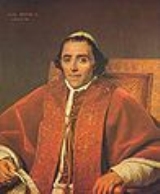
Pope Pius VII

Encyclopedia
Pope Pius VII born Barnaba Niccolò Maria Luigi Chiaramonti, was a monk
, theologian and bishop
, who reigned as Pope
from 14 March 1800 to 20 August 1823.
, the son of Count
Scipione Chiaramonti; his mother, Giovanna, was the daughter of the Marquess
Ghini and was related to the Braschi
family. He joined the Benedictine
Order in 1756 at the Abbey of St Maria del Monte
of Cesena, where he received the monastic name Gregory. He then became a teacher at Benedictine colleges in Parma
and Rome. He was ordained to the priesthood
on 21 September 1765.
His career became a series of promotions following the election of his relative, Giovanni Angelo Braschi, as Pope Pius VI
(1775–99). In 1776 Pius VI appointed the 34-year old Dom
Gregory, who had been teaching at the Monastery
of Sant'Anselmo
in Rome, as honorary abbot
in commendam
of his monastery. Though this was an ancient practice, this drew complaints from the monks of the community, as monastic communities generally felt it was not in keeping with the Rule of St. Benedict. In December 1782 the pope appointed Dom Gregory as the Bishop of Tivoli, near Rome. Pius VI soon named him, in February 1785, simultaneously both as a Cardinal-Priest
, with his titular church being the Basilica
of St. Callistus
, and as the Bishop of Imola, an office he held until 1816.
When the French Revolutionary Army
invaded Italy in 1797, Cardinal Chiaramonti cautioned temperance and submission to the Cisalpine Republic
they established. In his Christmas
homily
that year, he asserted that there was no opposition between a democratic form of government and being a good Catholic: "Christian virtue makes men good democrats.... Equality is not an idea of philosophers but of Christ...and do not believe that the Catholic religion is against democracy," said the bishop.
in August 1799, the conclave
to elect his successor met on 30 November 1799 in the Benedictine Monastery of San Giorgio
in Venice
. There were three main candidates, two of whom proved to be unacceptable to the Habsburgs, whose candidate, Alessandro Mattei
, could not secure sufficient votes. After several months of stalemate, on 14 March 1800, Chiaramonti was elected as a compromise candidate, certainly not the choice of die-hard opponents of the French Revolution
, and took the name of Pius VII. He was crowned on 21 March, in a rather unusual ceremony
, wearing a papier-mâché
papal tiara, since the French had seized the original along with Pius VI. He then left for Rome, sailing on a barely-seaworthy Austrian
ship, the "Bellona", which did not even have cooking facilities. The voyage took 12 days to carry him to Pesaro
, from where he proceeded to Rome.
Ercole Consalvi, who had performed so ably as secretary to the recent conclave, to the College of Cardinals
and to the office of Cardinal Secretary of State
. Consalvi immediately left for France, where he was able to negotiate the Concordat of 1801
with the Emperor
Napoleon
. While not effecting a return to the old Christian order, the treaty did provide certain civil guarantees to the Church, acknowledging "the Catholic, Apostolic, and Roman religion" as that of the "majority of French citizens."
As pope, he followed a policy of cooperation with the French-established Republic. He even participated in France's Continental Blockade of Great Britain
, over the objections of his Secretary of State, Consalvi, who was forced to resign. Despite this, France occupied and annexed
the Papal States
in 1809 and took Pius as their prisoner, exiling him to Savona
. This exile ended only with Pius' signing the Concordat of Fontainbleu in 1813. One result of this new treaty was the release of the exiled Cardinals, including Consalvi, who, upon re-joining the Papal retinue, persuaded Pius to revoke the concessions he had made in it. This Pius began to do in March 1814, which led the French authorities to re-arrest many of the opposing prelates. Their confinement, however, lasted only a matter of weeks, as Napoleon abdicated
on 11 April of that year.
in 1815, Pius VII's reign was completely taken up in dealing with France. He and the Emperor were continually in conflict, often involving the French military leader's wishes for concessions to his demands. Pius wanted his own release from exile as well as the return of the Papal States, and, later on, the release of the 13 "Black Cardinals", i.e., the Cardinals, including Consalvi, who had snubbed the marriage of Napoleon to Princess
Marie Louise
, believing that his previous marriage was still valid, and had been exiled and impoverished in consequence of their stand, along with several exiled or imprisoned prelate
s, priests, monks, nuns other various supporters.
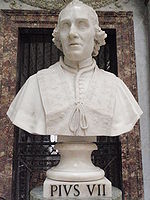 On the United States' suppression in the First Barbary War
of the Muslim Barbary Pirates along the southern Mediterranean coast, who kidnapped Christians for ransom and slavery, Pope Pius VII declared that the United States “had done more for the cause of Christianity than the most powerful nations of Christendom have done for ages.”
Bishop Germanos Adam
's works, which supported Conciliarism
, placing the authority of Ecumenical Council
s over that of the papacy.
Monk
A monk is a person who practices religious asceticism, living either alone or with any number of monks, while always maintaining some degree of physical separation from those not sharing the same purpose...
, theologian and bishop
Bishop
A bishop is an ordained or consecrated member of the Christian clergy who is generally entrusted with a position of authority and oversight. Within the Catholic Church, Eastern Orthodox, Oriental Orthodox Churches, in the Assyrian Church of the East, in the Independent Catholic Churches, and in the...
, who reigned as Pope
Pope
The Pope is the Bishop of Rome, a position that makes him the leader of the worldwide Catholic Church . In the Catholic Church, the Pope is regarded as the successor of Saint Peter, the Apostle...
from 14 March 1800 to 20 August 1823.
Early life
Chiaramonti was born at CesenaCesena
Cesena is a city and comune in the Emilia-Romagna region of northern Italy, south of Ravenna and west of Rimini, on the Savio River, co-chief of the Province of Forlì-Cesena. It is at the foot of the Apennines, and about 15 km from the Adriatic Sea.-History:Cesena was originally an Umbrian...
, the son of Count
Count
A count or countess is an aristocratic nobleman in European countries. The word count came into English from the French comte, itself from Latin comes—in its accusative comitem—meaning "companion", and later "companion of the emperor, delegate of the emperor". The adjective form of the word is...
Scipione Chiaramonti; his mother, Giovanna, was the daughter of the Marquess
Marquess
A marquess or marquis is a nobleman of hereditary rank in various European peerages and in those of some of their former colonies. The term is also used to translate equivalent oriental styles, as in imperial China, Japan, and Vietnam...
Ghini and was related to the Braschi
Braschi
Braschi may refer to:*Braschi family, an Italian noble family*Giannina Braschi, American poet*Nicoletta Braschi, Italian actress*Gianluigi Braschi, Italian film producer*Rómulo Antonio Braschi, Argentine Independent Catholic bishop,...
family. He joined the Benedictine
Benedictine
Benedictine refers to the spirituality and consecrated life in accordance with the Rule of St Benedict, written by Benedict of Nursia in the sixth century for the cenobitic communities he founded in central Italy. The most notable of these is Monte Cassino, the first monastery founded by Benedict...
Order in 1756 at the Abbey of St Maria del Monte
Abbey of St Maria del Monte
The Abbey of Santa Maria del Monte is a Catholic abbey in Cesena, Italy. This imposing building stands on the Colle Spaziano ....
of Cesena, where he received the monastic name Gregory. He then became a teacher at Benedictine colleges in Parma
Parma
Parma is a city in the Italian region of Emilia-Romagna famous for its ham, its cheese, its architecture and the fine countryside around it. This is the home of the University of Parma, one of the oldest universities in the world....
and Rome. He was ordained to the priesthood
Priesthood (Catholic Church)
The ministerial orders of the Catholic Church include the orders of bishops, deacons and presbyters, which in Latin is sacerdos. The ordained priesthood and common priesthood are different in function and essence....
on 21 September 1765.
His career became a series of promotions following the election of his relative, Giovanni Angelo Braschi, as Pope Pius VI
Pope Pius VI
Pope Pius VI , born Count Giovanni Angelo Braschi, was Pope from 1775 to 1799.-Early years:Braschi was born in Cesena...
(1775–99). In 1776 Pius VI appointed the 34-year old Dom
Dom (title)
Dom is a title of respect prefixed to the given name. It derives from Latin Dominus.It is used in English for certain Benedictine and Carthusian monks, and for members of certain communities of Canons Regular. Examples include Benedictine monks of the English Benedictine Congregation...
Gregory, who had been teaching at the Monastery
Monastery
Monastery denotes the building, or complex of buildings, that houses a room reserved for prayer as well as the domestic quarters and workplace of monastics, whether monks or nuns, and whether living in community or alone .Monasteries may vary greatly in size – a small dwelling accommodating only...
of Sant'Anselmo
Sant'Anselmo
Sant'Anselmo, named after the Italian saint and theologian, Anselm of Canterbury, is the home of the Abbot Primate of the Benedictines, seat of the Benedictine Confederation, and also hosts an Athenaeum, including the Pontifical Liturgical Institute, and the Philosophy and Theology faculties...
in Rome, as honorary abbot
Abbot
The word abbot, meaning father, is a title given to the head of a monastery in various traditions, including Christianity. The office may also be given as an honorary title to a clergyman who is not actually the head of a monastery...
in commendam
In Commendam
In canon law, commendam was a form of transferring an ecclesiastical benefice in trust to the custody of a patron...
of his monastery. Though this was an ancient practice, this drew complaints from the monks of the community, as monastic communities generally felt it was not in keeping with the Rule of St. Benedict. In December 1782 the pope appointed Dom Gregory as the Bishop of Tivoli, near Rome. Pius VI soon named him, in February 1785, simultaneously both as a Cardinal-Priest
Cardinal (Catholicism)
A cardinal is a senior ecclesiastical official, usually an ordained bishop, and ecclesiastical prince of the Catholic Church. They are collectively known as the College of Cardinals, which as a body elects a new pope. The duties of the cardinals include attending the meetings of the College and...
, with his titular church being the Basilica
Basilica
The Latin word basilica , was originally used to describe a Roman public building, usually located in the forum of a Roman town. Public basilicas began to appear in Hellenistic cities in the 2nd century BC.The term was also applied to buildings used for religious purposes...
of St. Callistus
San Callisto
San Callisto is a Roman Catholic titular church in Rome, Italy, built over the site of Saint Pope Callistus I and the location of his martyrdom. The original building dates form the time of Pope Gregory III who order the building of a church on the site. The church has been rebuilt twice since,...
, and as the Bishop of Imola, an office he held until 1816.
When the French Revolutionary Army
French Revolutionary Army
The French Revolutionary Army is the term used to refer to the military of France during the period between the fall of the ancien regime under Louis XVI in 1792 and the formation of the First French Empire under Napoleon Bonaparte in 1804. These armies were characterised by their revolutionary...
invaded Italy in 1797, Cardinal Chiaramonti cautioned temperance and submission to the Cisalpine Republic
Cisalpine Republic
The Cisalpine Republic was a French client republic in Northern Italy that lasted from 1797 to 1802.-Birth:After the Battle of Lodi in May 1796, Napoleon Bonaparte proceeded to organize two states: one to the south of the Po River, the Cispadane Republic, and one to the north, the Transpadane...
they established. In his Christmas
Christmas
Christmas or Christmas Day is an annual holiday generally celebrated on December 25 by billions of people around the world. It is a Christian feast that commemorates the birth of Jesus Christ, liturgically closing the Advent season and initiating the season of Christmastide, which lasts twelve days...
homily
Homily
A homily is a commentary that follows a reading of scripture. In Catholic, Anglican, Lutheran, and Eastern Orthodox Churches, a homily is usually given during Mass at the end of the Liturgy of the Word...
that year, he asserted that there was no opposition between a democratic form of government and being a good Catholic: "Christian virtue makes men good democrats.... Equality is not an idea of philosophers but of Christ...and do not believe that the Catholic religion is against democracy," said the bishop.
Election
Following the death of Pius VI, by then virtually France's prisoner, at ValenceValence, Drôme
Valence is a commune in southeastern France, the capital of the Drôme department, situated on the left bank of the Rhône, south of Lyon on the railway to Marseilles.Its inhabitants are called Valentinois...
in August 1799, the conclave
Papal conclave
A papal conclave is a meeting of the College of Cardinals convened to elect a Bishop of Rome, who then becomes the Pope during a period of vacancy in the papal office. The Pope is considered by Roman Catholics to be the apostolic successor of Saint Peter and earthly head of the Roman Catholic Church...
to elect his successor met on 30 November 1799 in the Benedictine Monastery of San Giorgio
San Giorgio Monastery
The San Giorgio Monastery was a Benedictine monastery in Venice, Italy, located on the island of San Giorgio Maggiore. It stands next to the Church of San Giorgio Maggiore, which formerly served the monastic community, and currently serves as the headquarters of the Cini Foundation.-Foundation:The...
in Venice
Venice
Venice is a city in northern Italy which is renowned for the beauty of its setting, its architecture and its artworks. It is the capital of the Veneto region...
. There were three main candidates, two of whom proved to be unacceptable to the Habsburgs, whose candidate, Alessandro Mattei
Alessandro Mattei
Alessandro Mattei was an Italian Cardinal, and a significant figure in papal diplomacy of the Napoleonic period. He was from the Roman aristocratic House of Mattei.He became Archbishop of Ferrara in 1777, and was created cardinal in 1779....
, could not secure sufficient votes. After several months of stalemate, on 14 March 1800, Chiaramonti was elected as a compromise candidate, certainly not the choice of die-hard opponents of the French Revolution
French Revolution
The French Revolution , sometimes distinguished as the 'Great French Revolution' , was a period of radical social and political upheaval in France and Europe. The absolute monarchy that had ruled France for centuries collapsed in three years...
, and took the name of Pius VII. He was crowned on 21 March, in a rather unusual ceremony
Papal Coronation
A papal coronation was the ceremony of the placing of the Papal Tiara on a newly elected pope. The first recorded papal coronation was that of Pope Celestine II in 1143. Soon after his coronation in 1963, Pope Paul VI abandoned the practice of wearing the tiara. His successors have chosen not to...
, wearing a papier-mâché
Papier-mâché
Papier-mâché , alternatively, paper-mache, is a composite material consisting of paper pieces or pulp, sometimes reinforced with textiles, bound with an adhesive, such as glue, starch, or wallpaper paste....
papal tiara, since the French had seized the original along with Pius VI. He then left for Rome, sailing on a barely-seaworthy Austrian
Austria
Austria , officially the Republic of Austria , is a landlocked country of roughly 8.4 million people in Central Europe. It is bordered by the Czech Republic and Germany to the north, Slovakia and Hungary to the east, Slovenia and Italy to the south, and Switzerland and Liechtenstein to the...
ship, the "Bellona", which did not even have cooking facilities. The voyage took 12 days to carry him to Pesaro
Pesaro
Pesaro is a town and comune in the Italian region of the Marche, capital of the Pesaro e Urbino province, on the Adriatic. According to the 2007 census, its population was 92,206....
, from where he proceeded to Rome.
Negotiations and exile
One of Pius VII's first acts was to appoint the minor clericMinor orders
The minor orders are the lowest ranks in the Christian clergy. The most recognized minor orders are porter, lector, exorcist, and acolyte. In the Latin rite Catholic Church, the minor orders were in most cases replaced by "instituted" ministries of lector and acolyte, though communities that use...
Ercole Consalvi, who had performed so ably as secretary to the recent conclave, to the College of Cardinals
College of Cardinals
The College of Cardinals is the body of all cardinals of the Catholic Church.A function of the college is to advise the pope about church matters when he summons them to an ordinary consistory. It also convenes on the death or abdication of a pope as a papal conclave to elect a successor...
and to the office of Cardinal Secretary of State
Cardinal Secretary of State
The Cardinal Secretary of State—officially Secretary of State of His Holiness The Pope—presides over the Holy See, usually known as the "Vatican", Secretariat of State, which is the oldest and most important dicastery of the Roman Curia...
. Consalvi immediately left for France, where he was able to negotiate the Concordat of 1801
Concordat of 1801
The Concordat of 1801 was an agreement between Napoleon and Pope Pius VII, signed on 15 July 1801. It solidified the Roman Catholic Church as the majority church of France and brought back most of its civil status....
with the Emperor
Emperor
An emperor is a monarch, usually the sovereign ruler of an empire or another type of imperial realm. Empress, the female equivalent, may indicate an emperor's wife or a woman who rules in her own right...
Napoleon
Napoleon I
Napoleon Bonaparte was a French military and political leader during the latter stages of the French Revolution.As Napoleon I, he was Emperor of the French from 1804 to 1815...
. While not effecting a return to the old Christian order, the treaty did provide certain civil guarantees to the Church, acknowledging "the Catholic, Apostolic, and Roman religion" as that of the "majority of French citizens."
As pope, he followed a policy of cooperation with the French-established Republic. He even participated in France's Continental Blockade of Great Britain
Great Britain
Great Britain or Britain is an island situated to the northwest of Continental Europe. It is the ninth largest island in the world, and the largest European island, as well as the largest of the British Isles...
, over the objections of his Secretary of State, Consalvi, who was forced to resign. Despite this, France occupied and annexed
Annexation
Annexation is the de jure incorporation of some territory into another geo-political entity . Usually, it is implied that the territory and population being annexed is the smaller, more peripheral, and weaker of the two merging entities, barring physical size...
the Papal States
Papal States
The Papal State, State of the Church, or Pontifical States were among the major historical states of Italy from roughly the 6th century until the Italian peninsula was unified in 1861 by the Kingdom of Piedmont-Sardinia .The Papal States comprised territories under...
in 1809 and took Pius as their prisoner, exiling him to Savona
Savona
Savona is a seaport and comune in the northern Italian region of Liguria, capital of the Province of Savona, in the Riviera di Ponente on the Mediterranean Sea....
. This exile ended only with Pius' signing the Concordat of Fontainbleu in 1813. One result of this new treaty was the release of the exiled Cardinals, including Consalvi, who, upon re-joining the Papal retinue, persuaded Pius to revoke the concessions he had made in it. This Pius began to do in March 1814, which led the French authorities to re-arrest many of the opposing prelates. Their confinement, however, lasted only a matter of weeks, as Napoleon abdicated
Abdication
Abdication occurs when a monarch, such as a king or emperor, renounces his office.-Terminology:The word abdication comes derives from the Latin abdicatio. meaning to disown or renounce...
on 11 April of that year.
Relationship with Napoleon I
From the time of his election as pope to the fall of NapoleonNapoleon I of France
Napoleon Bonaparte was a French military and political leader during the latter stages of the French Revolution.As Napoleon I, he was Emperor of the French from 1804 to 1815...
in 1815, Pius VII's reign was completely taken up in dealing with France. He and the Emperor were continually in conflict, often involving the French military leader's wishes for concessions to his demands. Pius wanted his own release from exile as well as the return of the Papal States, and, later on, the release of the 13 "Black Cardinals", i.e., the Cardinals, including Consalvi, who had snubbed the marriage of Napoleon to Princess
Princess
Princess is the feminine form of prince . Most often, the term has been used for the consort of a prince, or his daughters....
Marie Louise
Marie Louise, Duchess of Parma
Marie Louise of Austria was the second wife of Napoleon I, Emperor of the French and later Duchess of Parma...
, believing that his previous marriage was still valid, and had been exiled and impoverished in consequence of their stand, along with several exiled or imprisoned prelate
Prelate
A prelate is a high-ranking member of the clergy who is an ordinary or who ranks in precedence with ordinaries. The word derives from the Latin prælatus, the past participle of præferre, which means "carry before", "be set above or over" or "prefer"; hence, a prelate is one set over others.-Related...
s, priests, monks, nuns other various supporters.
Relationship with the United States of America
First Barbary War
The First Barbary War , also known as the Barbary Coast War or the Tripolitan War, was the first of two wars fought between the United States and the North African Berber Muslim states known collectively as the Barbary States...
of the Muslim Barbary Pirates along the southern Mediterranean coast, who kidnapped Christians for ransom and slavery, Pope Pius VII declared that the United States “had done more for the cause of Christianity than the most powerful nations of Christendom have done for ages.”
Condemnation of heresy
On 3 June 1816, Pius condemned the MelkiteMelkite
The term Melkite, also written Melchite, refers to various Byzantine Rite Christian churches and their members originating in the Middle East. The word comes from the Syriac word malkāyā , and the Arabic word Malakī...
Bishop Germanos Adam
Germanos Adam
Germanos Adam was the Melkite Catholic bishop of Aleppo during the late 18th century and a Christian theologian.-Life:Germanos Adam was born in 1725 in Aleppo, Syria, and studied in the College of the Propaganda in Rome. In 1774 he was consecrated Melkite Catholic bishop of Acre...
's works, which supported Conciliarism
Conciliarism
Conciliarism, or the conciliar movement, was a reform movement in the 14th, 15th and 16th century Roman Catholic Church which held that final authority in spiritual matters resided with the Roman Church as a corporation of Christians, embodied by a general church council, not with the pope...
, placing the authority of Ecumenical Council
Ecumenical council
An ecumenical council is a conference of ecclesiastical dignitaries and theological experts convened to discuss and settle matters of Church doctrine and practice....
s over that of the papacy.
Monuments
- Pope Pius VII's monument (1831) in St. Peter's BasilicaSt. Peter's BasilicaThe Papal Basilica of Saint Peter , officially known in Italian as ' and commonly known as Saint Peter's Basilica, is a Late Renaissance church located within the Vatican City. Saint Peter's Basilica has the largest interior of any Christian church in the world...
, Rome, is by the DanishDenmarkDenmark is a Scandinavian country in Northern Europe. The countries of Denmark and Greenland, as well as the Faroe Islands, constitute the Kingdom of Denmark . It is the southernmost of the Nordic countries, southwest of Sweden and south of Norway, and bordered to the south by Germany. Denmark...
sculptor Bertel ThorvaldsenBertel ThorvaldsenBertel Thorvaldsen was a Danish-Icelandic sculptor of international fame, who spent most of his life in Italy . Thorvaldsen was born in Copenhagen into a Danish/Icelandic family of humble means, and was accepted to the Royal Academy of Arts when he was eleven years old...
, a Protestant.
See also
- Apostolic Prefecture of the United StatesApostolic Prefecture of the United StatesThe Apostolic Prefecture of the United States was the earliest Roman Catholic ecclesiastical jurisdiction to be officially recognized after the United States declared independence in 1783.-Previous British jurisdiction and American independence:...
- John CarrollJohn Carroll (bishop)John Carroll, was the first Roman Catholic bishop and archbishop in the United States — serving as the ordinary of the Archdiocese of Baltimore. He is also known as the founder of Georgetown University, the oldest Catholic university in the United States, and St...
, first US bishop
External links
- Catholic-Hierarchy entry
- Spencer Napoleonica Collection at Newberry LibraryNewberry LibraryThe Newberry Library is a privately endowed, independent research library for the humanities and social sciences in Chicago, Illinois. Although it is private, non-circulating library, the Newberry Library is free and open to the public...