

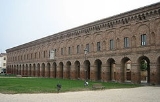
Sabbioneta

Encyclopedia
Sabbioneta is a town and comune
in the province of Mantua
, Lombardy
region, northern Italy. It is situated about 30 km north of Parma
, not far from the northern bank of the Po River
. It was inscribed in the World Heritage List in 2008.
in the late 16th century along the ancient Roman Via Vitelliana, on a sandy bank of the Po (whence the name, meaning "Sandy" in Italian; he was its first duke, using it as a personal fortress and residence.
.
It was also during this period that it became a minor musical centre; composers such as Benedetto Pallavicino
were employed here by Vespasiano Gonzaga, prior to his moving to the main Gonzaga city of Mantua
.
urban planning theories.
Sabbioneta is also known for its historic Jewish Ghetto
and Synagogue, and in particular for its Hebrew
printing-press. In 1551 Tobias Foa set up the press; he had, however, published certain "anti-Christian books" and his career was "forcibly ended". His work and possibly his type were taken up by a Christian
printer, Vicenzo Conte.
Vespasiano Gonzaga's town, designed according to the Renaissance principles of the Ideal City, included:
The church and the summer palace contain frescoes by artists of the Campi
family of Cremona
.
Paperback: 332 pages; Publisher: SugarCo (1990); ISBN-10: 8871980409
Comune
In Italy, the comune is the basic administrative division, and may be properly approximated in casual speech by the English word township or municipality.-Importance and function:...
in the province of Mantua
Province of Mantua
The Province of Mantua is a province in the Lombardy region of northern Italy. Its capital is the city of Mantua.-Communes:It includes 70 comuni , ranging in area from Viadana, with 102.19 km², to Mariana Mantovana, with 8.81 km²....
, Lombardy
Lombardy
Lombardy is one of the 20 regions of Italy. The capital is Milan. One-sixth of Italy's population lives in Lombardy and about one fifth of Italy's GDP is produced in this region, making it the most populous and richest region in the country and one of the richest in the whole of Europe...
region, northern Italy. It is situated about 30 km north of Parma
Parma
Parma is a city in the Italian region of Emilia-Romagna famous for its ham, its cheese, its architecture and the fine countryside around it. This is the home of the University of Parma, one of the oldest universities in the world....
, not far from the northern bank of the Po River
Po River
The Po |Ligurian]]: Bodincus or Bodencus) is a river that flows either or – considering the length of the Maira, a right bank tributary – eastward across northern Italy, from a spring seeping from a stony hillside at Pian del Re, a flat place at the head of the Val Po under the northwest face...
. It was inscribed in the World Heritage List in 2008.
History
Sabbioneta was founded by Vespasiano I GonzagaVespasiano I Gonzaga
thumb|250px|Vespasiano I Gonzaga.Vespasiano I Gonzaga was an Italian nobleman, diplomat, writer, military engineer and condottiero...
in the late 16th century along the ancient Roman Via Vitelliana, on a sandy bank of the Po (whence the name, meaning "Sandy" in Italian; he was its first duke, using it as a personal fortress and residence.
.
It was also during this period that it became a minor musical centre; composers such as Benedetto Pallavicino
Benedetto Pallavicino
Benedetto Pallavicino was an Italian composer and organist of the late Renaissance. A prolific composer of madrigals, he was resident at the Gonzaga court of Mantua in the 1590s, where he was a close associate of Giaches de Wert, and a competitor of his considerably more famous contemporary...
were employed here by Vespasiano Gonzaga, prior to his moving to the main Gonzaga city of Mantua
Mantua
Mantua is a city and comune in Lombardy, Italy and capital of the province of the same name. Mantua's historic power and influence under the Gonzaga family, made it one of the main artistic, cultural and notably musical hubs of Northern Italy and the country as a whole...
.
Main sights
In 2008, Sabbioneta was inscribed in the UNESCO World Heritage List as a recognition of its perfect example of practical application of RenaissanceRenaissance
The Renaissance was a cultural movement that spanned roughly the 14th to the 17th century, beginning in Italy in the Late Middle Ages and later spreading to the rest of Europe. The term is also used more loosely to refer to the historical era, but since the changes of the Renaissance were not...
urban planning theories.
Sabbioneta is also known for its historic Jewish Ghetto
Ghetto
A ghetto is a section of a city predominantly occupied by a group who live there, especially because of social, economic, or legal issues.The term was originally used in Venice to describe the area where Jews were compelled to live. The term now refers to an overcrowded urban area often associated...
and Synagogue, and in particular for its Hebrew
Hebrew language
Hebrew is a Semitic language of the Afroasiatic language family. Culturally, is it considered by Jews and other religious groups as the language of the Jewish people, though other Jewish languages had originated among diaspora Jews, and the Hebrew language is also used by non-Jewish groups, such...
printing-press. In 1551 Tobias Foa set up the press; he had, however, published certain "anti-Christian books" and his career was "forcibly ended". His work and possibly his type were taken up by a Christian
Christian
A Christian is a person who adheres to Christianity, an Abrahamic, monotheistic religion based on the life and teachings of Jesus of Nazareth as recorded in the Canonical gospels and the letters of the New Testament...
printer, Vicenzo Conte.
Vespasiano Gonzaga's town, designed according to the Renaissance principles of the Ideal City, included:
- The Ducal Palace (now the Town Hall)
- The Teatro all'anticaTeatro all'anticaThe Teatro all'antica is a theatre in Sabbioneta, northern Italy; it was the first free-standing, purpose-built theater in the modern world...
("Theatre in the style of the Ancients"), designed by Vincenzo ScamozziVincenzo Scamozzithumb|250px|Portrait of Vincenzo Scamozzi by [[Paolo Veronese]]Vincenzo Scamozzi was a Venetian architect and a writer on architecture, active mainly in Vicenza and Republic of Venice area in the second half of the 16th century... - The Galleria degli Antichi ("Gallery of the Ancient").
- Palazzo del Giardino ("Garden Palace")
- Churches of the Assunta, Incoronata and Carmine
The church and the summer palace contain frescoes by artists of the Campi
Campi
-People:Campi was a family of painters, distinguished in the annals of Italian art at Cremona in the 16th century. Some Members are:*Antonio Campi -People:Campi was a family of painters, distinguished in the annals of Italian art at Cremona in the 16th century. Some Members are:*Antonio Campi...
family of Cremona
Cremona
Cremona is a city and comune in northern Italy, situated in Lombardy, on the left bank of the Po River in the middle of the Pianura Padana . It is the capital of the province of Cremona and the seat of the local City and Province governments...
.
External links and references
- http://www.terraurunca.com/comuni/fondi/510-vespasiano-i-gonzaga.html
- Vespasiano Gonzaga Colonna duca di Sabbioneta e cavaliere del Toson d'oro. Sabbioneta. (2001).
- Luca Sarzi Amadè, Il duca di Sabbioneta: Guerre e amori di un europeo del XVI secolo ...
Paperback: 332 pages; Publisher: SugarCo (1990); ISBN-10: 8871980409
- Vespasiano Gonzaga e il ducato di Sabbioneta, [actes de la conferència, Sabbioneta-Mantova, 12-13 ottobre 1991], a cura de U. Bazzotti, Mantova (1993).
- L. Ventura, Il collezionismo di un principe: la raccolta di marmi di Vespasiano Gonzaga Colonna, (Modena), (1997).
- Vespasiano Gonzaga Colonna 1531-1591: l'uomo e le opere, actes del congrés d'estudis, Teatro olimpico di Sabbioneta, 5 de juny, 1999; a cura de E. Asinari, [Casalmaggiore] (1999).