

Groschen

Encyclopedia
Groschen was the (sometimes colloquial) name for a coin
used in various German
-speaking states as well as some non-German-speaking countries of Central Europe
(Bohemia
, Poland
), the Danubian principalities
. The name, like that of the English groat, derives from the Italian
denaro grosso, or large penny
, via the Czech
form groš.
The Qirsh
(also "Gersh", "Grush","Γρόσι" and "Kuruş
"), Arabic
, Ethiopian, Hebrew, Greek
and Turkish
names for currency denominations in and around the territories formerly part of the Ottoman Empire
, are derived from the same Italian origin.
 Names like Groschen, grossus/grossi, grosso
, grossone, Grosz
, gros, Groš, groat, Grote, Groten, Garas etc. were used in the Middle Ages for all thick silver
coin
s, as opposed to thin silver coins such as denier
s or pennies. Historically it was equal to between several and a dozen denarii
.
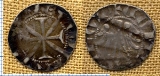
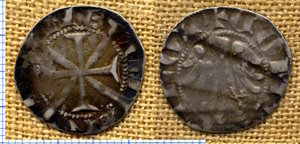
The type was introduced in 1271 by Duke Meinhard II
of Tyrol
in Meran. The 1286 example depicted here weighs 1,45 g
, it is marked with ME IN AR DVS and a Double Cross
(Obverse
), and with DUX TIROL and the Eagle of Tyrol (Reverse
)
It was minted since the Middle Ages
in the following areas:
Later the tradition of Groschen was dropped in most states while others continued to mint only coins smaller than the original coin. In Poland for example, since 1526 these included coins of 1/2 grosz, 1 grosz, 1,5 grosz, 2 grosz, 3 grosz, 4 grosz and 6 grosz. Their weight gradually dropped to 1,8 grams of silver and since 1752 they were replaced by copper coins of the same name.
In recent times, the name was used by two currencies in circulation:
Likewise, in Germany
Groschen remained a slang term for the 10 Pfennig
coin, thus a 1/10 part both of the (West German) Deutsche Mark and the East German Mark
. The word has lost popularity with the introduction of the Euro
, although it can still be heard on occasion, especially from older people.
In Western Ukraine
, grosh is still a slang
term for the kopiyka, a 1/100 part of a Hryvnia. The Ukrainian word for money, hroshi, ultimately derives from this term also.
In Bulgaria
, the grosh (Cyrillic: грош) was used as a currency until the lev
was introduced in the 19th century.
In Bulgarian
, Macedonian
and Croatian
and Serbian
, the term has been retained as a general word for a coin or currency in a number of money-related proverbs and sayings, and can also be regularly encountered in folk tales or stories set vaguely in the past.
In Palestine during the British Mandate, a grush was a coin with a hole in it, valued at 1/100 part of a pound. It was named after an Ottoman coin. When the pound was replaced by the lira after Israel
i statehood in 1948, the name was transferred to a coin (no longer with a hole) worth 1/100 of a lira. The name persisted for a while after the lira was replaced by the shekel in 1960, but it gradually lost its standing as a the name of a certain coin. Now it is a slang for a very small value.
, the name Groschen (both singular and plural) replaced "Schilling" as the common name for a 12 Pfennig
coin. In the 18th Century it was used predominantly in the northern states as a coin worth 1/24 of a Reichsthaler
(equal to 1/32 of a Conventionsthaler
). In the 19th century, beginning in 1821 in Prussia
, a new currency
system was introduced in which the Groschen (often called the Silbergroschen (Prussia, since 1821) or Neugroschen (Saxony, since 1840) to distinguish it from older Groschen) was worth 1/30 of a Thaler
(Taler). Following German unification and decimalization, the Groschen was replaced by the 10 Pfennig coin and Groschen remained a nickname for the 10 Pfennig coin until the introduction of the Euro
. For the same reason, the name "Sechser" (sixer) remained in use regionally for the half-Groschen coin, 5 Pfennigs.
There is a Beethoven rondo for piano, op. 129 (1795) entitled "Die Wut ueber den verlorenen Groschen" (literally "rage over a lost groschen", but known as "Rage over a Lost Penny
").
 Austria
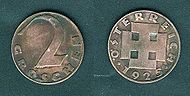
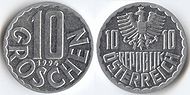
introduced the Groschen in 1924 as the subdivision of the Schilling
. It was restored, along with the Schilling, in 1945 and continued in use until the introduction of the euro
in 2002.
Coin
A coin is a piece of hard material that is standardized in weight, is produced in large quantities in order to facilitate trade, and primarily can be used as a legal tender token for commerce in the designated country, region, or territory....
used in various German
German language
German is a West Germanic language, related to and classified alongside English and Dutch. With an estimated 90 – 98 million native speakers, German is one of the world's major languages and is the most widely-spoken first language in the European Union....
-speaking states as well as some non-German-speaking countries of Central Europe
Central Europe
Central Europe or alternatively Middle Europe is a region of the European continent lying between the variously defined areas of Eastern and Western Europe...
(Bohemia
Bohemia
Bohemia is a historical region in central Europe, occupying the western two-thirds of the traditional Czech Lands. It is located in the contemporary Czech Republic with its capital in Prague...
, Poland
Poland
Poland , officially the Republic of Poland , is a country in Central Europe bordered by Germany to the west; the Czech Republic and Slovakia to the south; Ukraine, Belarus and Lithuania to the east; and the Baltic Sea and Kaliningrad Oblast, a Russian exclave, to the north...
), the Danubian principalities
Danubian Principalities
Danubian Principalities was a conventional name given to the Principalities of Moldavia and Wallachia, which emerged in the early 14th century. The term was coined in the Habsburg Monarchy after the Treaty of Küçük Kaynarca in order to designate an area on the lower Danube with a common...
. The name, like that of the English groat, derives from the Italian
Italian language
Italian is a Romance language spoken mainly in Europe: Italy, Switzerland, San Marino, Vatican City, by minorities in Malta, Monaco, Croatia, Slovenia, France, Libya, Eritrea, and Somalia, and by immigrant communities in the Americas and Australia...
denaro grosso, or large penny
Penny
A penny is a coin or a type of currency used in several English-speaking countries. It is often the smallest denomination within a currency system.-Etymology:...
, via the Czech
Czech language
Czech is a West Slavic language with about 12 million native speakers; it is the majority language in the Czech Republic and spoken by Czechs worldwide. The language was known as Bohemian in English until the late 19th century...
form groš.
The Qirsh
Qirsh
Qirsh, Gersh, Grush, Kuruş and Grosi are all names for currency denominations in and around the territories formerly part of the Ottoman Empire. The variation in the name stems from the different languages it is used in and the different transcriptions into the Latin alphabet...
(also "Gersh", "Grush","Γρόσι" and "Kuruş
Kurus
Kuruş is a Turkish currency subunit. Since 2005, one new Turkish lira is equal to 100 kuruş. The kuruş was also the standard unit of currency in the Ottoman Empire until 1844, and from that date until the late 1970s was a subdivision of the former lira. It was subdivided into 40 para , each of...
"), Arabic
Arabic language
Arabic is a name applied to the descendants of the Classical Arabic language of the 6th century AD, used most prominently in the Quran, the Islamic Holy Book...
, Ethiopian, Hebrew, Greek
Greek language
Greek is an independent branch of the Indo-European family of languages. Native to the southern Balkans, it has the longest documented history of any Indo-European language, spanning 34 centuries of written records. Its writing system has been the Greek alphabet for the majority of its history;...
and Turkish
Turkish language
Turkish is a language spoken as a native language by over 83 million people worldwide, making it the most commonly spoken of the Turkic languages. Its speakers are located predominantly in Turkey and Northern Cyprus with smaller groups in Iraq, Greece, Bulgaria, the Republic of Macedonia, Kosovo,...
names for currency denominations in and around the territories formerly part of the Ottoman Empire
Ottoman Empire
The Ottoman EmpireIt was usually referred to as the "Ottoman Empire", the "Turkish Empire", the "Ottoman Caliphate" or more commonly "Turkey" by its contemporaries...
, are derived from the same Italian origin.
History
Grosso of Venice
The grosso of Venice is a silver coin first introduced in Venice in 1193 under doge Enrico Dandolo. It originally weighed 2.18 grams and was composed of 98.5% pure silver, valued at 26 dinarii...
, grossone, Grosz
Grosz
Grosz may refer to:* Grosz, a coin used in Poland as a hundredth part of 1 złoty. Złoty is Polish currency* Kraków grosz, 14th century coins of Kraków* Groschen, a coin used in various statesGrosz or Grósz is the surname of:...
, gros, Groš, groat, Grote, Groten, Garas etc. were used in the Middle Ages for all thick silver
Silver
Silver is a metallic chemical element with the chemical symbol Ag and atomic number 47. A soft, white, lustrous transition metal, it has the highest electrical conductivity of any element and the highest thermal conductivity of any metal...
coin
Coin
A coin is a piece of hard material that is standardized in weight, is produced in large quantities in order to facilitate trade, and primarily can be used as a legal tender token for commerce in the designated country, region, or territory....
s, as opposed to thin silver coins such as denier
Denier
Denier may refer to:* Denier , a unit of linear mass density of fibers* Denier, Pas-de-Calais, France* French denier, a coin* The Deniers, a 2008 book by Canadian environmentalist Lawrence Solomon* C. Denier Warren, American TV and film actor...
s or pennies. Historically it was equal to between several and a dozen denarii
Denarius
In the Roman currency system, the denarius was a small silver coin first minted in 211 BC. It was the most common coin produced for circulation but was slowly debased until its replacement by the antoninianus...
.
The type was introduced in 1271 by Duke Meinhard II
Meinhard, Duke of Carinthia
Meinhard II from the House of Meinhardin was ruling Count of Gorizia from 1258 until 1271 and Count of Tyrol from 1258 until his death...
of Tyrol
County of Tyrol
The County of Tyrol, Princely County from 1504, was a State of the Holy Roman Empire, from 1814 a province of the Austrian Empire and from 1867 a Cisleithanian crown land of Austria-Hungary...
in Meran. The 1286 example depicted here weighs 1,45 g
Gram
The gram is a metric system unit of mass....
, it is marked with ME IN AR DVS and a Double Cross
Double cross
Double Cross may refer to:In film and television:* Double Cross , a film by Albert H. Kelley* Double Cross , a Bollywood action film* Double Cross , a Bollywood film...
(Obverse
Obverse and reverse
Obverse and its opposite, reverse, refer to the two flat faces of coins and some other two-sided objects, including paper money, flags , seals, medals, drawings, old master prints and other works of art, and printed fabrics. In this usage, obverse means the front face of the object and reverse...
), and with DUX TIROL and the Eagle of Tyrol (Reverse
Obverse and reverse
Obverse and its opposite, reverse, refer to the two flat faces of coins and some other two-sided objects, including paper money, flags , seals, medals, drawings, old master prints and other works of art, and printed fabrics. In this usage, obverse means the front face of the object and reverse...
)
It was minted since the Middle Ages
Middle Ages
The Middle Ages is a periodization of European history from the 5th century to the 15th century. The Middle Ages follows the fall of the Western Roman Empire in 476 and precedes the Early Modern Era. It is the middle period of a three-period division of Western history: Classic, Medieval and Modern...
in the following areas:
- TirolCounty of TyrolThe County of Tyrol, Princely County from 1504, was a State of the Holy Roman Empire, from 1814 a province of the Austrian Empire and from 1867 a Cisleithanian crown land of Austria-Hungary...
(since 1271) - EnglandEdward I of EnglandEdward I , also known as Edward Longshanks and the Hammer of the Scots, was King of England from 1272 to 1307. The first son of Henry III, Edward was involved early in the political intrigues of his father's reign, which included an outright rebellion by the English barons...
(since 1279, the groat, http://www.tclayton.demon.co.uk/fourd.html) - BohemiaBohemiaBohemia is a historical region in central Europe, occupying the western two-thirds of the traditional Czech Lands. It is located in the contemporary Czech Republic with its capital in Prague...
(since 1300, the Prager Groschen, later adopted by most of the Central EuropeCentral EuropeCentral Europe or alternatively Middle Europe is a region of the European continent lying between the variously defined areas of Eastern and Western Europe...
an countries) - PolandPolandPoland , officially the Republic of Poland , is a country in Central Europe bordered by Germany to the west; the Czech Republic and Slovakia to the south; Ukraine, Belarus and Lithuania to the east; and the Baltic Sea and Kaliningrad Oblast, a Russian exclave, to the north...
(since 1367, the Krakau Groschen, 3,2 grams of silver, an equivalent of 12 denariusDenariusIn the Roman currency system, the denarius was a small silver coin first minted in 211 BC. It was the most common coin produced for circulation but was slowly debased until its replacement by the antoninianus...
) - MoldaviaMoldaviaMoldavia is a geographic and historical region and former principality in Eastern Europe, corresponding to the territory between the Eastern Carpathians and the Dniester river...
(since the reign of Petru IPetru I of MoldaviaPetru I Muşat was Voivode of Moldavia from 1375 to 1391, the son of Costea Muşat, the first ruler from the dynastic House of Bogdan. During his reign, he maintained good relationships with his neighbours, especially Poland....
, 1375-1391)
Later the tradition of Groschen was dropped in most states while others continued to mint only coins smaller than the original coin. In Poland for example, since 1526 these included coins of 1/2 grosz, 1 grosz, 1,5 grosz, 2 grosz, 3 grosz, 4 grosz and 6 grosz. Their weight gradually dropped to 1,8 grams of silver and since 1752 they were replaced by copper coins of the same name.
In recent times, the name was used by two currencies in circulation:
- In PolandPolandPoland , officially the Republic of Poland , is a country in Central Europe bordered by Germany to the west; the Czech Republic and Slovakia to the south; Ukraine, Belarus and Lithuania to the east; and the Baltic Sea and Kaliningrad Oblast, a Russian exclave, to the north...
a grosz (plural: grosze or groszy, depending on the number) is a 1/100 part of a Złoty - In AustriaAustriaAustria , officially the Republic of Austria , is a landlocked country of roughly 8.4 million people in Central Europe. It is bordered by the Czech Republic and Germany to the north, Slovakia and Hungary to the east, Slovenia and Italy to the south, and Switzerland and Liechtenstein to the...
a Groschen (plural: Groschen) was a 1/100 part of a SchillingAustrian schillingThe schilling was the currency of Austria from 1924 to 1938 and from 1945 to 1999, and the circulating currency until 2002. The euro was introduced at a fixed parity of €1 = 13.7603 schilling to replace it...
(1924-1938 and 1945-2001)
Likewise, in Germany
Germany
Germany , officially the Federal Republic of Germany , is a federal parliamentary republic in Europe. The country consists of 16 states while the capital and largest city is Berlin. Germany covers an area of 357,021 km2 and has a largely temperate seasonal climate...
Groschen remained a slang term for the 10 Pfennig
Pfennig
The Pfennig , plural Pfennige, is an old German coin or note, which existed from the 9th century until the introduction of the euro in 2002....
coin, thus a 1/10 part both of the (West German) Deutsche Mark and the East German Mark
East German mark
The East German mark commonly called the eastern mark , in East Germany only Mark, was the currency of the German Democratic Republic . Its ISO 4217 currency code was DDM...
. The word has lost popularity with the introduction of the Euro
Euro
The euro is the official currency of the eurozone: 17 of the 27 member states of the European Union. It is also the currency used by the Institutions of the European Union. The eurozone consists of Austria, Belgium, Cyprus, Estonia, Finland, France, Germany, Greece, Ireland, Italy, Luxembourg,...
, although it can still be heard on occasion, especially from older people.
In Western Ukraine
Ukraine
Ukraine is a country in Eastern Europe. It has an area of 603,628 km², making it the second largest contiguous country on the European continent, after Russia...
, grosh is still a slang
Slang
Slang is the use of informal words and expressions that are not considered standard in the speaker's language or dialect but are considered more acceptable when used socially. Slang is often to be found in areas of the lexicon that refer to things considered taboo...
term for the kopiyka, a 1/100 part of a Hryvnia. The Ukrainian word for money, hroshi, ultimately derives from this term also.
In Bulgaria
Bulgaria
Bulgaria , officially the Republic of Bulgaria , is a parliamentary democracy within a unitary constitutional republic in Southeast Europe. The country borders Romania to the north, Serbia and Macedonia to the west, Greece and Turkey to the south, as well as the Black Sea to the east...
, the grosh (Cyrillic: грош) was used as a currency until the lev
Bulgarian lev
The lev is the currency of Bulgaria. It is divided in 100 stotinki . In archaic Bulgarian the word "lev" meant "lion".It is speculated that Bulgaria, as a member of the European Union will adopt the Euro in 2015 .- First lev, 1881–1952 :...
was introduced in the 19th century.
In Bulgarian
Bulgarian language
Bulgarian is an Indo-European language, a member of the Slavic linguistic group.Bulgarian, along with the closely related Macedonian language, demonstrates several linguistic characteristics that set it apart from all other Slavic languages such as the elimination of case declension, the...
, Macedonian
Macedonian language
Macedonian is a South Slavic language spoken as a first language by approximately 2–3 million people principally in the region of Macedonia but also in the Macedonian diaspora...
and Croatian
Croatian language
Croatian is the collective name for the standard language and dialects spoken by Croats, principally in Croatia, Bosnia and Herzegovina, the Serbian province of Vojvodina and other neighbouring countries...
and Serbian
Serbian language
Serbian is a form of Serbo-Croatian, a South Slavic language, spoken by Serbs in Serbia, Bosnia and Herzegovina, Montenegro, Croatia and neighbouring countries....
, the term has been retained as a general word for a coin or currency in a number of money-related proverbs and sayings, and can also be regularly encountered in folk tales or stories set vaguely in the past.
In Palestine during the British Mandate, a grush was a coin with a hole in it, valued at 1/100 part of a pound. It was named after an Ottoman coin. When the pound was replaced by the lira after Israel
Israel
The State of Israel is a parliamentary republic located in the Middle East, along the eastern shore of the Mediterranean Sea...
i statehood in 1948, the name was transferred to a coin (no longer with a hole) worth 1/100 of a lira. The name persisted for a while after the lira was replaced by the shekel in 1960, but it gradually lost its standing as a the name of a certain coin. Now it is a slang for a very small value.
Germany
In GermanyGermany
Germany , officially the Federal Republic of Germany , is a federal parliamentary republic in Europe. The country consists of 16 states while the capital and largest city is Berlin. Germany covers an area of 357,021 km2 and has a largely temperate seasonal climate...
, the name Groschen (both singular and plural) replaced "Schilling" as the common name for a 12 Pfennig
Pfennig
The Pfennig , plural Pfennige, is an old German coin or note, which existed from the 9th century until the introduction of the euro in 2002....
coin. In the 18th Century it was used predominantly in the northern states as a coin worth 1/24 of a Reichsthaler
Reichsthaler
The Reichsthaler was a standard Thaler of the Holy Roman Empire, established in 1566 by the Leipzig convention. It was also the name of a unit of account in northern Germany and of a silver coin issued by Prussia.-Reichsthaler coin:...
(equal to 1/32 of a Conventionsthaler
Conventionsthaler
The Conventionstaler was a standard silver coin of the Holy Roman Empire. It was introduced in 1754 and contained one tenth of a Cologne mark of silver ....
). In the 19th century, beginning in 1821 in Prussia
Prussia
Prussia was a German kingdom and historic state originating out of the Duchy of Prussia and the Margraviate of Brandenburg. For centuries, the House of Hohenzollern ruled Prussia, successfully expanding its size by way of an unusually well-organized and effective army. Prussia shaped the history...
, a new currency
Currency
In economics, currency refers to a generally accepted medium of exchange. These are usually the coins and banknotes of a particular government, which comprise the physical aspects of a nation's money supply...
system was introduced in which the Groschen (often called the Silbergroschen (Prussia, since 1821) or Neugroschen (Saxony, since 1840) to distinguish it from older Groschen) was worth 1/30 of a Thaler
Thaler
The Thaler was a silver coin used throughout Europe for almost four hundred years. Its name lives on in various currencies as the dollar or tolar. Etymologically, "Thaler" is an abbreviation of "Joachimsthaler", a coin type from the city of Joachimsthal in Bohemia, where some of the first such...
(Taler). Following German unification and decimalization, the Groschen was replaced by the 10 Pfennig coin and Groschen remained a nickname for the 10 Pfennig coin until the introduction of the Euro
Euro
The euro is the official currency of the eurozone: 17 of the 27 member states of the European Union. It is also the currency used by the Institutions of the European Union. The eurozone consists of Austria, Belgium, Cyprus, Estonia, Finland, France, Germany, Greece, Ireland, Italy, Luxembourg,...
. For the same reason, the name "Sechser" (sixer) remained in use regionally for the half-Groschen coin, 5 Pfennigs.
There is a Beethoven rondo for piano, op. 129 (1795) entitled "Die Wut ueber den verlorenen Groschen" (literally "rage over a lost groschen", but known as "Rage over a Lost Penny
Rage Over a Lost Penny
The Rondo alla ingharese quasi un capriccio in G major, Op. 129, is a piano rondo by Ludwig van Beethoven. It is better known by the title Rage Over a Lost Penny, Vented in a Caprice . This title appears on the autograph manuscript, but not in Beethoven's hand, and has been attributed to his friend...
").
Austria
Austria
Austria , officially the Republic of Austria , is a landlocked country of roughly 8.4 million people in Central Europe. It is bordered by the Czech Republic and Germany to the north, Slovakia and Hungary to the east, Slovenia and Italy to the south, and Switzerland and Liechtenstein to the...
introduced the Groschen in 1924 as the subdivision of the Schilling
Austrian schilling
The schilling was the currency of Austria from 1924 to 1938 and from 1945 to 1999, and the circulating currency until 2002. The euro was introduced at a fixed parity of €1 = 13.7603 schilling to replace it...
. It was restored, along with the Schilling, in 1945 and continued in use until the introduction of the euro
Euro
The euro is the official currency of the eurozone: 17 of the 27 member states of the European Union. It is also the currency used by the Institutions of the European Union. The eurozone consists of Austria, Belgium, Cyprus, Estonia, Finland, France, Germany, Greece, Ireland, Italy, Luxembourg,...
in 2002.
See also
- Prager Groschen, Krakau Groschen
- GuldengroschenGuldengroschenThe Guldengroschen was a large silver coin originally minted in Tirol in 1486.The Guldengroschen's name comes from the fact that it has an equivalent denomination value in silver relative to that of the goldgulden...
- SilbergroschenSilbergroschenThe Silbergroschen was a coin used in Prussia and several other German Confederation states in northern Germany during the 19th century, worth one thirtieth of a Thaler....
- NeugroschenNeugroschenThe neugroschen is a coin that was introduced in 1841 in Saxony. It was equivalent to the Prussian silbergroschen but was divided into 10 pfennig, not 12 as in Prussia....
- Die Dreigroschenoper, The Threepenny OperaThe Threepenny OperaThe Threepenny Opera is a musical by German dramatist Bertolt Brecht and composer Kurt Weill, in collaboration with translator Elisabeth Hauptmann and set designer Caspar Neher. It was adapted from an 18th-century English ballad opera, John Gay's The Beggar's Opera, and offers a Marxist critique...
- QirshQirshQirsh, Gersh, Grush, Kuruş and Grosi are all names for currency denominations in and around the territories formerly part of the Ottoman Empire. The variation in the name stems from the different languages it is used in and the different transcriptions into the Latin alphabet...
- KuruşKurusKuruş is a Turkish currency subunit. Since 2005, one new Turkish lira is equal to 100 kuruş. The kuruş was also the standard unit of currency in the Ottoman Empire until 1844, and from that date until the late 1970s was a subdivision of the former lira. It was subdivided into 40 para , each of...
- Groat