


Sextant

Encyclopedia

- This article is about the Sextant as used for navigationNavigationNavigation is the process of monitoring and controlling the movement of a craft or vehicle from one place to another. It is also the term of art used for the specialized knowledge used by navigators to perform navigation tasks...
. For the astronomer's sextant, see Sextant (astronomical)Sextant (astronomical)Sextants for astronomical observations were used primarily for measuring the positions of stars. They are little used today, having been replaced over time by transit telescopes, astrometry techniques, and satellites such as Hipparcos....
. - For the history and development of the sextant see Reflecting instruments
A sextant is an instrument
Measuring instrument
In the physical sciences, quality assurance, and engineering, measurement is the activity of obtaining and comparing physical quantities of real-world objects and events. Established standard objects and events are used as units, and the process of measurement gives a number relating the item...
used to measure the angle between any two visible objects. Its primary use is to determine the angle between a celestial object
Astronomical object
Astronomical objects or celestial objects are naturally occurring physical entities, associations or structures that current science has demonstrated to exist in the observable universe. The term astronomical object is sometimes used interchangeably with astronomical body...
and the horizon
Horizon
The horizon is the apparent line that separates earth from sky, the line that divides all visible directions into two categories: those that intersect the Earth's surface, and those that do not. At many locations, the true horizon is obscured by trees, buildings, mountains, etc., and the resulting...
which is known as the altitude. Making this measurement is known as sighting the object, shooting the object, or taking a sight and it is an essential part of celestial navigation
Celestial navigation
Celestial navigation, also known as astronavigation, is a position fixing technique that has evolved over several thousand years to help sailors cross oceans without having to rely on estimated calculations, or dead reckoning, to know their position...
. The angle, and the time when it was measured, can be used to calculate a position line
Position line
A position line is a line that can be identified both on a nautical chart or aeronautical chart and by observation out on the surface of the earth...
on a nautical or aeronautical chart
Nautical chart
A nautical chart is a graphic representation of a maritime area and adjacent coastal regions. Depending on the scale of the chart, it may show depths of water and heights of land , natural features of the seabed, details of the coastline, navigational hazards, locations of natural and man-made aids...
. A common use of the sextant is to sight the sun
Sun
The Sun is the star at the center of the Solar System. It is almost perfectly spherical and consists of hot plasma interwoven with magnetic fields...
at solar noon and to measure the elevation (altitude)
Horizontal coordinate system
The horizontal coordinate system is a celestial coordinate system that uses the observer's local horizon as the fundamental plane. This coordinate system divides the sky into the upper hemisphere where objects are visible, and the lower hemisphere where objects cannot be seen since the earth is in...
angle at night to measure the elevation angle from the horizon plane to Polaris
Polaris
Polaris |Alpha]] Ursae Minoris, commonly North Star or Pole Star, also Lodestar) is the brightest star in the constellation Ursa Minor. It is very close to the north celestial pole, making it the current northern pole star....
to find one's latitude
Latitude
In geography, the latitude of a location on the Earth is the angular distance of that location south or north of the Equator. The latitude is an angle, and is usually measured in degrees . The equator has a latitude of 0°, the North pole has a latitude of 90° north , and the South pole has a...
. Since the sextant can be used to measure the angle between any two objects, it can be held horizontally to measure the angle between any two landmarks which will allow for calculation of a position on a chart. A sextant can also be used to measure the Lunar distance
Lunar distance (navigation)
In celestial navigation, lunar distance is the angle between the Moon and another celestial body. A navigator can use a lunar distance and a nautical almanac to calculate Greenwich time...
between the moon and another celestial object (e.g., star, planet) in order to determine Greenwich time which is important because it can then be used to determine the longitude
Longitude
Longitude is a geographic coordinate that specifies the east-west position of a point on the Earth's surface. It is an angular measurement, usually expressed in degrees, minutes and seconds, and denoted by the Greek letter lambda ....
.
The scale of a sextant has a length of 1/6 turn
Turn (geometry)
A turn is an angle equal to a 360° or 2 radians or \tau radians. A turn is also referred to as a revolution or complete rotation or full circle or cycle or rev or rot....
(60°); hence the sextant's name (sextāns, -antis is the Latin
Latin
Latin is an Italic language originally spoken in Latium and Ancient Rome. It, along with most European languages, is a descendant of the ancient Proto-Indo-European language. Although it is considered a dead language, a number of scholars and members of the Christian clergy speak it fluently, and...
word for "one sixth", "εξάντας" in Greek
Greek language
Greek is an independent branch of the Indo-European family of languages. Native to the southern Balkans, it has the longest documented history of any Indo-European language, spanning 34 centuries of written records. Its writing system has been the Greek alphabet for the majority of its history;...
). An octant
Octant (instrument)
The octant, also called reflecting quadrant, is a measuring instrument used primarily in navigation. It is a type of reflecting instrument.-Etymology:...
is a similar device with a shorter scale ( turn
Turn (geometry)
A turn is an angle equal to a 360° or 2 radians or \tau radians. A turn is also referred to as a revolution or complete rotation or full circle or cycle or rev or rot....
, or 45°), whereas a quintant (1/5 turn
Turn (geometry)
A turn is an angle equal to a 360° or 2 radians or \tau radians. A turn is also referred to as a revolution or complete rotation or full circle or cycle or rev or rot....
, or 72°) and a quadrant
Quadrant (instrument)
A quadrant is an instrument that is used to measure angles up to 90°. It was originally proposed by Ptolemy as a better kind of astrolabe. Several different variations of the instrument were later produced by medieval Muslim astronomers.-Types of quadrants:...
( turn
Turn (geometry)
A turn is an angle equal to a 360° or 2 radians or \tau radians. A turn is also referred to as a revolution or complete rotation or full circle or cycle or rev or rot....
, or 90°) have longer scales.
Sir Isaac Newton
Isaac Newton
Sir Isaac Newton PRS was an English physicist, mathematician, astronomer, natural philosopher, alchemist, and theologian, who has been "considered by many to be the greatest and most influential scientist who ever lived."...
(1643–1727) invented the principle of the doubly reflecting navigation instrument
Reflecting instrument
Reflecting instruments are those that use mirrors to enhance their ability to make measurements. In particular, the use of mirrors permits one to observe two objects simultaneously while measuring the angular distance between the objects...
(a reflecting quadrant - see Octant (instrument)
Octant (instrument)
The octant, also called reflecting quadrant, is a measuring instrument used primarily in navigation. It is a type of reflecting instrument.-Etymology:...
), but never published it. Two men independently developed the octant
Octant (instrument)
The octant, also called reflecting quadrant, is a measuring instrument used primarily in navigation. It is a type of reflecting instrument.-Etymology:...
around 1730: John Hadley
John Hadley
John Hadley was an English mathematician, inventor of the octant, a precursor to the sextant, around 1730.He was born in Bloomsbury, London, to Katherine FitzJames and George Hadley....
(1682–1744), an English mathematician, and Thomas Godfrey
Thomas Godfrey (inventor)
Thomas Godfrey was an optician and inventor in the American colonies, who around 1730 invented the octant. At approximately the same time an Englishman, John Hadley, also invented the octant independently....
(1704–1749), a glazier in Philadelphia. The octant and later the sextant, replaced the Davis quadrant as the main instrument for navigation.
Navigational sextants
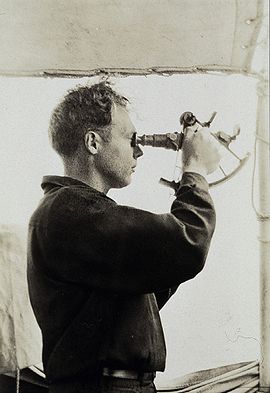
Advantages
Like the Davis quadrant (also called backstaff), the sextant allows celestial objects to be measured relative to the horizon, rather than relative to the instrument. This allows excellent precision. However, unlike the backstaff, the sextant allows direct observations of stars. This permits the use of the sextant at night when a backstaff is difficult to use. For solar observations, filters allow direct observation of the sun.Since the measurement is relative to the horizon, the measuring pointer is a beam of light that reaches to the horizon. The measurement is thus limited by the angular accuracy of the instrument and not the sine error of the length of an alidade, as it is in a mariner's astrolabe
Mariner's astrolabe
The mariner's astrolabe, also called sea astrolabe, was an inclinometer used to determine the latitude of a ship at sea by measuring the sun's noon altitude or the meridian altitude of a star of known declination. Not an astrolabe proper, the mariner's astrolabe was rather a graduated circle with...
or similar older instrument.
A sextant does not require a completely steady aim, because it measures a relative angle. For example, when a sextant is used on a moving ship, the image of both horizon and celestial object will move around in the field of view. However, the relative position of the two images will remain steady, and as long as the user can determine when the celestial object touches the horizon the accuracy of the measurement will remain high compared to the magnitude of the movement.
The sextant is not dependent upon electricity (unlike many forms of modern navigation) or anything human-controlled (like GPS satellites). For these reasons, it is considered an eminently practical back-up navigation tool for ships.
Anatomy of a sextant
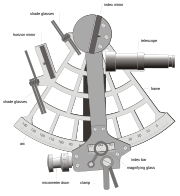
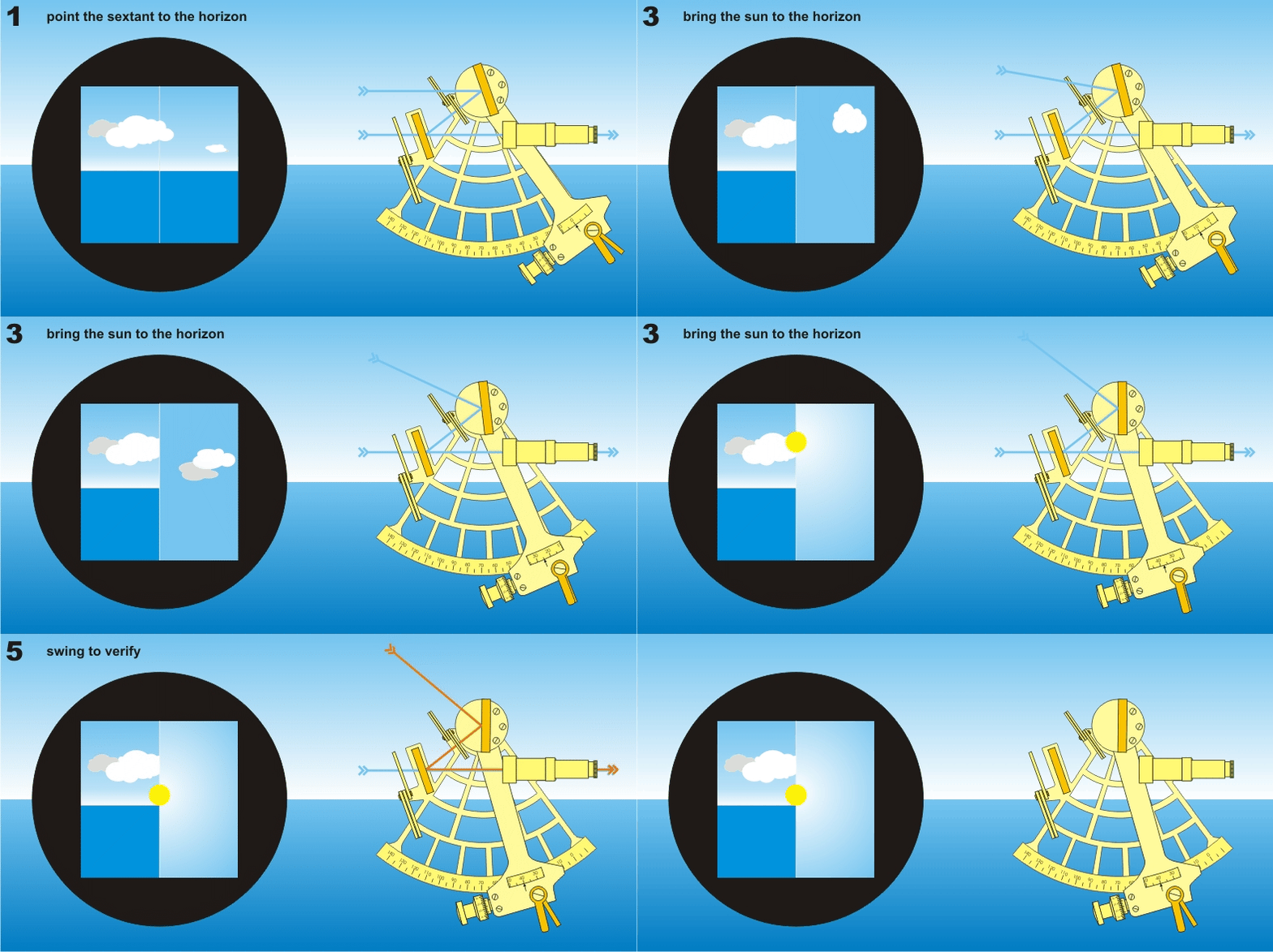
There are two types of sextants. Both types can give good results, and the choice between them is personal.
Traditional sextants have a half-horizon mirror. It divides the field of view in two. On one side, there is a view of the horizon; on the other side, a view of the celestial object. The advantage of this type is that both the horizon and celestial object are bright and as clear as possible. This is superior at night and in haze, when the horizon can be difficult to see. However, one has to sweep the celestial object to ensure that the lowest limb of the celestial object touches the horizon.
Whole-horizon sextants use a half-silvered horizon mirror to provide a full view of the horizon. This makes it easy to see when the bottom limb of a celestial object touches the horizon. Since most sights are of the sun or moon, and haze is rare without overcast, the low-light advantages of the half-horizon mirror are rarely important in practice.
In both types, larger mirrors give a larger field of view, and thus make it easier to find a celestial object. Modern sextants often have 5 cm or larger mirrors, while 19th century sextants rarely had a mirror larger than 2.5 cm (one inch). In large part, this is because precision flat mirrors have grown less expensive to manufacture and to silver
Silvering
Silvering is the chemical process of coating glass with a reflective substance. When glass mirrors first gained widespread usage in Europe during the 16th century, most were made of an amalgam of tin and mercury, but by the 19th century mirrors were commonly made through a process by which silver...
.
An artificial horizon is useful when the horizon is invisible. This occurs in fog, on moonless nights, in a calm, when sighting through a window or on land surrounded by trees or buildings. Professional sextants can mount an artificial horizon in place of the horizon-mirror assembly. An artificial horizon is usually a mirror that views a fluid-filled tube with a bubble.
Most sextants also have filters for use when viewing the sun and reducing the effects of haze.
Most sextants mount a 1 or 3 power monocular
Monocular
A monocular is a modified refracting telescope used to magnify the images of distant objects by passing light through a series of lenses and sometimes prisms; the use of prisms results in a lightweight telescope. Volume and weight are less than half those of binoculars of similar optical...
for viewing. Many users prefer a simple sighting tube, which has a wider, brighter field of view and is easier to use at night. Some navigators mount a light-amplifying monocular to help see the horizon on moonless nights. Others prefer to use a lit artificial horizon.
Professional sextants use a click-stop degree measure and a worm adjustment that reads to a minute
Minute of arc
A minute of arc, arcminute, or minute of angle , is a unit of angular measurement equal to one sixtieth of one degree. In turn, a second of arc or arcsecond is one sixtieth of one minute of arc....
, 1/60 of a degree
Degree (angle)
A degree , usually denoted by ° , is a measurement of plane angle, representing 1⁄360 of a full rotation; one degree is equivalent to π/180 radians...
. Most sextants also include a vernier
Vernier scale
A vernier scale is an additional scale which allows a distance or angle measurement to be read more precisely than directly reading a uniformly-divided straight or circular measurement scale...
on the worm dial that reads to 0.2 minute. Since 1 minute of error is about a nautical mile
Nautical mile
The nautical mile is a unit of length that is about one minute of arc of latitude along any meridian, but is approximately one minute of arc of longitude only at the equator...
, the best possible accuracy of celestial navigation is about 0.1 nautical miles (185.2 m). At sea, results within several nautical miles, well within visual range, are acceptable. A highly-skilled and experienced navigator can determine position to an accuracy of about 0.25 nautical miles (463 m).
A change in temperature can warp the arc, creating inaccuracies. Many navigators purchase weatherproof cases so that their sextant can be placed outside the cabin to come to equilibrium with outside temperatures. The standard frame designs (see illustration) are supposed to equalise differential angular error from temperature changes. The handle is separated from the arc and frame so that body heat does not warp the frame. Sextants for tropical use are often painted white to reflect sunlight and remain relatively cool. High-precision sextants have an invar
Invar
Invar, also known generically as FeNi36 , is a nickel steel alloy notable for its uniquely low coefficient of thermal expansion . The name, Invar, comes from the word invariable, referring to its lack of expansion or contraction with temperature changes.It was invented in 1896 by Swiss scientist...
(a special low-expansion steel) frame and arc. Some scientific sextants have been constructed of quartz or ceramics with even lower expansions. Many commercial sextants use low expansion brass or aluminium. Brass is lower-expansion than aluminium, but aluminium sextants are lighter and less tiring to use. Some say they are more accurate because one's hand trembles less.
Aircraft
Aircraft
An aircraft is a vehicle that is able to fly by gaining support from the air, or, in general, the atmosphere of a planet. An aircraft counters the force of gravity by using either static lift or by using the dynamic lift of an airfoil, or in a few cases the downward thrust from jet engines.Although...
sextants are now out of production, but had special features. Most had artificial horizons to permit taking a sight through a flush overhead window. Some also had mechanical averagers to make hundreds of measurements per sight for compensation of random accelerations in the artificial horizon's fluid. Older aircraft sextants had two visual paths, one standard and the other designed for use in open-cockpit aircraft that let one view from directly over the sextant in one's lap. More modern aircraft sextants were periscopic with only a small projection above the fuselage
Fuselage
The fuselage is an aircraft's main body section that holds crew and passengers or cargo. In single-engine aircraft it will usually contain an engine, although in some amphibious aircraft the single engine is mounted on a pylon attached to the fuselage which in turn is used as a floating hull...
. With these, the navigator pre-computed his sight and then noted the difference in observed versus predicted height of the body to determine his position.
After a sight is taken, it is reduced to a position by following any of several mathematical procedures. The simplest sight reduction is to draw the equal-elevation circle of the sighted celestial object on a globe. The intersection of that circle with a dead-reckoning track, or another sighting gives a more precise location.
Taking a sight
To sight (or measure) the angle between the sunSun
The Sun is the star at the center of the Solar System. It is almost perfectly spherical and consists of hot plasma interwoven with magnetic fields...
, a star
Star
A star is a massive, luminous sphere of plasma held together by gravity. At the end of its lifetime, a star can also contain a proportion of degenerate matter. The nearest star to Earth is the Sun, which is the source of most of the energy on Earth...
, or a planet
Planet
A planet is a celestial body orbiting a star or stellar remnant that is massive enough to be rounded by its own gravity, is not massive enough to cause thermonuclear fusion, and has cleared its neighbouring region of planetesimals.The term planet is ancient, with ties to history, science,...
, and the horizon
Horizon
The horizon is the apparent line that separates earth from sky, the line that divides all visible directions into two categories: those that intersect the Earth's surface, and those that do not. At many locations, the true horizon is obscured by trees, buildings, mountains, etc., and the resulting...
the 'star telescope
Telescope
A telescope is an instrument that aids in the observation of remote objects by collecting electromagnetic radiation . The first known practical telescopes were invented in the Netherlands at the beginning of the 1600s , using glass lenses...
' should be fitted to the sextant. The horizon should also be visible. On a vessel
Watercraft
A watercraft is a vessel or craft designed to move across or through water. The name is derived from the term "craft" which was used to describe all types of water going vessels...
at sea, this is usually no problem; on mist
Mist
Mist is a phenomenon of small droplets suspended in air. It can occur as part of natural weather or volcanic activity, and is common in cold air above warmer water, in exhaled air in the cold, and in a steam room of a sauna. It can also be created artificially with aerosol canisters if the...
y days, sighting from a low height above the water may give a more definite, better horizon. The sextant is removed from its box and held by the handle in the right hand, without ever touching the arc with the fingers.
For a sun sight, the shades
Filter (optics)
Optical filters are devices which selectively transmit light of different wavelengths, usually implemented as plane glass or plastic devices in the optical path which are either dyed in the mass or have interference coatings....
of the sextant overcome glare
Glare (vision)
Glare is difficulty seeing in the presence of bright light such as direct or reflected sunlight or artificial light such as car headlamps at night. Because of this, some cars include mirrors with automatic anti-glare functions....
. One method of starting is to use both index mirror and horizon mirror shades, of sufficient darkness that the sun appears through either as a solid disk and does not hurt the eyes. By setting the index bar to zero, the sun can be viewed through the telescope. Releasing the index bar (either by releasing a clamping screw, or on modern instruments, using the quick-release button), the image of the sun can be brought down to about the level of the horizon. It is necessary to flip back the horizon mirror shade to be able to see the horizon, and then the fine adjustment screw on the end of the index bar is turned until the bottom curve (the lower limb
Limb darkening
Limb darkening refers to the diminishing of intensity in the image of a star as one moves from the center of the image to the edge or "limb" of the image...
) of the sun just touches the horizon. 'Swinging
Rotation around a fixed axis
Rotation around a fixed axis is a special case of rotational motion. The fixed axis hypothesis exclude the possibility of a moving axis, and cannot describe such phenomena as wobbling or precession. According to Euler's rotation theorem, simultaneous rotation around more than one axis at the same...
' the sextant about the axis of the telescope ensures that the reading is being taken with the instrument held vertically. The angle of the sight is then read from the scale on the arc, making use of the micrometer or vernier scale provided. The exact time of the sight must also be noted simultaneously, and the height of the eye above sea-level recorded.
An alternative method is to estimate the current altitude
Horizontal coordinate system
The horizontal coordinate system is a celestial coordinate system that uses the observer's local horizon as the fundamental plane. This coordinate system divides the sky into the upper hemisphere where objects are visible, and the lower hemisphere where objects cannot be seen since the earth is in...
(angle) of the sun from navigation tables, then set the index bar to that angle on the arc, apply suitable shades only to the index mirror, and point the instrument directly at the horizon, sweeping it from side to side until a flash of the sun's rays are seen in the telescope. Fine adjustments are then made as above. This method is less likely to be successful for sighting stars and planets.
Star and planet sights are normally taken during twilight at dawn
Dawn
Dawn is the time that marks the beginning of the twilight before sunrise. It is recognized by the presence of weak sunlight, while the sun itself is still below the horizon...
or dusk
Dusk
Dusk is the beginning of darkness in the evening, and occurs after twilight, when the sky generally remains bright and blue. Civil dusk is when the earth has rotated enough that the center of the sun is at 6° below the local horizon...
, while both the heavenly bodies and the sea horizon are both visible. There is no need to use shades or to distinguish the lower limb as the body appears as a mere point
Point source
A point source is a localised, relatively small source of something.Point source may also refer to:*Point source , a localised source of pollution**Point source water pollution, water pollution with a localized source...
in the telescope. The moon
Moon
The Moon is Earth's only known natural satellite,There are a number of near-Earth asteroids including 3753 Cruithne that are co-orbital with Earth: their orbits bring them close to Earth for periods of time but then alter in the long term . These are quasi-satellites and not true moons. For more...
can be sighted, but it appears to move very fast, appears to have different sizes
Lunar distance
Lunar distance may refer to:* Lunar distance , the distance between the Earth and the Moon.* Lunar distance , a measurement used in the calculation of longitude....
at different times, and sometimes only the lower or upper limb can be distinguished due to its phase
Lunar phase
A lunar phase or phase of the moon is the appearance of the illuminated portion of the Moon as seen by an observer, usually on Earth. The lunar phases change cyclically as the Moon orbits the Earth, according to the changing relative positions of the Earth, Moon, and Sun...
.
Sextants can be used very accurately to measure other visible angles, for example between one heavenly body and another and between landmark
Landmark
This is a list of landmarks around the world.Landmarks may be split into two categories - natural phenomena and man-made features, like buildings, bridges, statues, public squares and so forth...
s ashore. Used horizontally, a sextant can measure the apparent angle between two landmarks such as a lighthouse
Lighthouse
A lighthouse is a tower, building, or other type of structure designed to emit light from a system of lamps and lenses or, in older times, from a fire, and used as an aid to navigation for maritime pilots at sea or on inland waterways....
and a church spire, which can then be used to find the distance off or out to sea. Used vertically, a measurement of the angle between the lantern of a lighthouse and the sea level
Sea level
Mean sea level is a measure of the average height of the ocean's surface ; used as a standard in reckoning land elevation...
at its base can also be used for distance off.
Adjustment
Due to the sensitivity of the instrument it is easy to knock the mirrors out of adjustment. For this reason a sextant should be checked frequently for errors and adjusted accordingly.There are four errors that can be adjusted by the navigator and they should be removed in the following order.
Perpendicularity error:This is when the index mirror is not perpendicular to the frame of the sextant. To test for this, place the index arm at about 60° on the arc and hold the sextant horizontally with the arc away from you at arms length and look into the index mirror. The arc of the sextant should appear to continue unbroken into the mirror. If there is an error then the two views will appear to be broken. Adjust the mirror until the reflection and direct view of the arc appear to be continuous.
Side error:This occurs when the horizon glass/mirror is not perpendicular to the plane of the instrument. To test for this, first zero the index arm then observe a star through the sextant. Then rotate the tangent screw back and forth so that the reflected image passes alternately above and below the direct view. If in changing from one position to another the reflected image passes directly over the unreflected image, no side error exists. If it passes to one side, side error exists. The user can hold the sextant on its side and observe the horizon to check the sextant during the day. If there are two horizons there is side error; adjust the horizon glass/mirror until the stars merge into one image or the horizons are merged into one. Side error is generally inconsequential for observations and can be ignored or reduced to a level that is merely convenient
Collimation error:This is when the telescope
Telescope
A telescope is an instrument that aids in the observation of remote objects by collecting electromagnetic radiation . The first known practical telescopes were invented in the Netherlands at the beginning of the 1600s , using glass lenses...
or monocular
Monocular
A monocular is a modified refracting telescope used to magnify the images of distant objects by passing light through a series of lenses and sometimes prisms; the use of prisms results in a lightweight telescope. Volume and weight are less than half those of binoculars of similar optical...
is not parallel
Parallel (geometry)
Parallelism is a term in geometry and in everyday life that refers to a property in Euclidean space of two or more lines or planes, or a combination of these. The assumed existence and properties of parallel lines are the basis of Euclid's parallel postulate. Two lines in a plane that do not...
to the plane
Plane (mathematics)
In mathematics, a plane is a flat, two-dimensional surface. A plane is the two dimensional analogue of a point , a line and a space...
of the sextant. To check for this you need to observe two stars 90° or more apart. Bring the two stars into coincidence either to the left or the right of the field of view. Move the sextant slightly so that the stars move to the other side of the field of view. If they separate there is collimation error.
Index error:This occurs when the index and horizon mirrors are not parallel to each other when the index arm is set to zero. To test for index error, zero the index arm and observe the horizon. If the reflected and direct image of the horizon are in line there is no index error. If one is above the other adjust the index mirror until the two horizons merge. This can be done at night with a star or with the moon.
External links
- Her Majesty's Nautical Almanac Office
- The History of HM Nautical Almanac Office Chapter from the online edition of Nathaniel BowditchNathaniel BowditchNathaniel Bowditch was an early American mathematician remembered for his work on ocean navigation. He is often credited as the founder of modern maritime navigation; his book The New American Practical Navigator, first published in 1802, is still carried on board every commissioned U.S...
's American Practical Navigator - CD-Sextant - Build your own sextant Simple do-it-yourself project.
- Lunars web site. online calculation
- Complete celnav theory book, including Lunars