

Gerald Bull

Encyclopedia
Gerald Vincent Bull was a Canadian engineer who developed long-range artillery
. He moved from project to project in his quest to launch economically a satellite
using a huge artillery piece, to which end he designed the Project Babylon
"supergun
" for the Iraq
i government. Bull was assassinated outside his apartment in Brussels
, Belgium
.
, to George and Gertrude Isabelle LaBrosse Bull. George Bull was from a family from the Trenton
area and had moved to North Bay in 1903 to start a law firm. As a Catholic, LaBrosse would normally be forbidden from marrying Bull, as he was Anglican. Bull converted to Catholicism on 20 February 1909, and the two married three days later. Over the next few years the couple had 11 children: Bernice Gwendolyn Florence, Henry, Philis, Charles Esmond, Clyde, Vivian, Ronald, Frank, Gerald, and Gordon.
George Bull was offered the position of King's Counsel in 1928. The family was well off, but the Wall Street Crash of 1929
and ensuing Great Depression
dramatically changed their circumstances. Within a year the loans Bull had taken to buy stocks on margin were called in, and the family was forced to move to Toronto to look for work.
The next year Gertrude Bull suffered complications while giving birth to Gordon. She died in 1931. George Bull suffered a nervous breakdown and fell into heavy drinking; he left his children in the care of his sister Laura, who fell victim to cancer and died in the summer of 1934. The next year, banks foreclosed on the family home. The same year, George, at the age of 58, met and married Rose Bleeker. He gave up the children to various relatives: Gerald ending up living with his older sister Bernice.
In the summer of 1938, Gerald was sent to spend the holidays with another set of relatives, Philip and Edith LaBrosse; who were relatively well off. Gerald was sent to an all-boys school run by the Jesuit order, Regiopolis College
in Kingston
. Despite his being too young to attend, the school allowed him to start in 1938 and he returned to spend the summers with the LaBrosses. During this time he took up the hobby of building balsa wood airplanes of his own design, and was a member of the school's modeling club. He graduated in 1944.
, with hopes of eventually entering officers' training school. Philip LaBrosse visited the University of Toronto
with the intention of having Bull placed there. He wrote to Bull, who was in Kingston, having found room in the medical school. Bull declined the offer and instead asked LaBrosse if a position in the new aeronautical engineering course was available. The department being brand new, it had limited qualifying criteria for entrance and agreed to interview Bull even though he was only sixteen years old - and he was accepted into the undergraduate program. Records and recollections of both classmates and his professors show little evidence of Bull's brilliance; one professor noted that "He certainly didn't stand out". After graduating in 1948 with marks that were described as "strictly average", Bull took a drafting job at A.V. Roe Canada.
Later that year, the University opened a new Institute of Aerodynamics (now the Institute for Aerospace Studies) under the direction of Dr Gordon Patterson. The Institute operated on a small budget and could afford to employ only twelve students, accepting three a year for a four year period funded by the Defence Research Board (DRB). Bull applied and was accepted at Patterson's personal recommendation, as Patterson felt that any lack in academics was made up for by Bull's tremendous energy. Bull was soon partnered up with fellow student Doug Henshaw, and the two were given the task of building a supersonic wind tunnel, which was at that time a relatively rare device.
When the Royal Canadian Air Force
donated land adjacent to RCAF Station Downsview
to the Institute, the operations were quickly moved. During construction, Bull used the wind tunnel as the basis for his 15 September 1949 Master's thesis, on the design and construction of advanced wind tunnels. The tunnel was to be featured prominently during the opening of the new Institute grounds, leading to an all-night rush to get it fully operational in time for the presentation. The work was completed at 3:30 am, but the team was too exhausted to test it. The next day Air Marshal Curtis pushed the start button and nothing happened, but Dr Patterson quickly reached around, pushed harder, and the wind tunnel worked perfectly.
Bull had largely finished his PhD thesis on the same topic in 1950, when a request from the DRB asking that the Institute provide an aerodynamicist to help on their Velvet Glove Missile project
arrived. It was to be an unpaid position on which the volunteer would remain on a normal PhD stipend from the University. Patterson selected Bull for the position, which led to a period of successful work at the Canadian Armament and Research Development Establishment, or CARDE.
. Formed up on a Military training area and artillery range outside Valcartier, northwest of Quebec City
, CARDE was one of a number of research divisions of the DRB that were well funded in the immediate post-war era. CARDE was researching supersonic
flight and a variety of rocket and missile projects when Bull was asked to join. Bull asked to build a wind tunnel for this research, but his suggestions were dismissed as too expensive.
Falling behind in their calculations, the artillerymen at CARDE suggested that they could solve their problems by firing models out of existing guns in order to gather real-world data. This provided Bull an introduction to artillery. A former Ordnance QF 25 pounder
was bored out to produce a six-inch smoothbore. Borrowing an idea developed in England in 1916, cards were placed on holders along the range and scaled models of the missile fired through them. In some ways this technique was superior to wind tunnels, as it allowed for the direct measurement of real-world influences on the trajectory, as a test of theoretical calculations. On the downside, reducing the collected data to a mathematical trajectory for checking against the theoretical calculations is difficult. The range eventually developed into a 1000 feet (304.8 m) walled and covered trench with cards hung every ten feet down its length.
Bull was at CARDE briefly before returning to the University to defend his thesis in March 1951, at 23 years old becoming the youngest PhD graduate in the Institute's history—a record that remains to this day. He returned to CARDE, now on the DRB's payroll, and continued working on the instrumented guns. On one of these trips, in 1953, he and a friend stopped in Charny
after a fishing trip to drop off some of their catch at a local doctor's house. Bull met Noemi "Mimi" Gilbert, the doctor's daughter, and the two soon started dating. Given Bull's work schedule they were rarely able to see each other, but they became engaged in February 1954, and married on 15 July. Dr. Gilbert gave the couple a small house as a wedding gift. Mimi gave birth to their first son, Phillippe, on 3 July 1955, and a second, Michael, in November 1956.
In 1954 Bull decided that a wind tunnel was too important to ignore, even if he could not arrange for funding through the DRB. Instead, he gained the ear of professors at Laval University in Quebec City, and Bull and a number of graduate students started work on a tunnel similar to the one he had earlier built at the UofT. It opened in the summer of 1955 and was capable of speeds up to Mach 4, but cost only $6,000, the result of using scrap for most of its parts.
Bull's work was brought to the public's attention in a 20 May 1955 Toronto Telegram
headline article, Unveil Canadian Gun that Fires 4,550 M.P.H. Missiles. Around this time Bull further improved the data-collection capabilities of the system by developing a telemetry system that could fit in the models. DRB staff thought the idea was unworkable and worked against having it funded, but Bull shuffled his own department's funding and went ahead and developed it anyway. All the parts of Bull's future efforts, smoothbore high-velocity guns, sabots for increasing performance, and hardened electronics, were now complete.
Work on the Velvet Glove ended in 1956, and the DRB turned its attention to anti-ballistic missile
s (ABMs). Bull's gun system was not fast enough to be useful in this role, so it was adapted to use a "sabot
" to improve its performance. Bull then moved on to hyper-sonics research and the study of infrared
and radar cross section
s for detection. But as the UK's own research efforts wound down in the Post-War political environment, CARDE's joint UK-Canadian funding was dramatically curtailed, eventually being handed over to the Canadians entirely. Further cuts made by the Canadian government followed. Bull was vocal about this turn of events, calling the Liberal government of the day "second-rate lawyers and jumped-up real-estate salesmen".
During this period CARDE was visited by a US team, including Lieutenant General Arthur Trudeau
, who was extremely impressed with Bull's work. Trudeau was director of US Army Research and Development, and he quickly set up a similar effort at the Aberdeen Proving Ground
under the direction of Dr. Charles Murphy. They built an analog of Bull's gun using a 5 inches (127 mm) gun and started test firing it over the Atlantic in 1961. The team used a fire-control radar from a Nike Hercules missile battery to track the shells, which released a cloud of chaff at altitudes up to 130,000.
Around the same time, Bull and Murphy started discussing the idea of firing scale aircraft models from their guns. Both started working on the idea, but Bull beat Murphy when he successfully fired a model of the Gloster Javelin
from his gun and managed to take shadowgraph photos of it clearly showing supersonic shock cones. Bull then used the same method to work on the Avro Arrow, discovering an instability that led to the use of a stability augmentation system. However, work on the Arrow was soon cancelled in infamous fashion, which angered Bull.
With attention turning to space after the launch of Sputnik in 1957, Bull leaked a story that Canada would soon match this feat by placing a high-velocity gun in the nose of a US Army Redstone missile. The story was a complete fabrication, but caused a major stir when it hit the papers on 22 April 1958. After the story broke Prime Minister John Diefenbaker
was besieged in the House of Commons press scrum, later dismissing it stating that "There is no foundation whatsoever to the story, not a scintilla of truth to it". A major flap broke out as a result, leading to the dressing down of several of Bull's superiors. When the press was invited to visit CARDE, the Canadian Broadcasting Company broadcast a piece covering much of the work at CARDE on May 11, including lengthy sections on Bull's gun and their work on infrared
detection and anti-ballistic missile
systems.
On 1 April 1961 Bull got into an argument with his direct superior over paperwork. Bull wrote out his resignation. A report prepared after his departure stated "...his tempestuous nature and strong dislike for administration and red tape constantly led him into trouble with senior management."
, which was in the process of building up a large engineering department under the direction of Donald Mordell. Mordell had long maintained links with CARDE and became one of Bull's ardent supporters, in spite of what other professors saw as "second-rate attempts at manipulation" and that "[Mordell] always supported Bull's work… I think sometimes he got pretty tired of supporting Bull." Bull, for his part, appeared to enjoy the new position, and later described it as "a marriage made in heaven". Bull remained in contact with his counterparts in the US and the University of Toronto, and set about equipping the University with the instrumentation it would need to be a leader in the field of aerodynamics.
Several years earlier, while still working at CARDE, Gerald and Mimi had purchased a 2000 acres (8.1 km²) plot of land on the Québec–Vermont border. Bull donated the land to be used by McGill and turned into a new ballistics lab, a private analog of the CARDE site. Renamed to become "Highwater Station" due to the local village of Highwater, the site was quickly developed under the direction of former British Army
colonel Robert Stacy, who bulldozed large sections, built various test facilities and ran power to the site. There they began working with 5" and 7" artillery pieces.
In the fall of 1961 Bull visited Murphy and Trudeau at Aberdeen and was able to interest them in the idea using guns to loft missile components for re-entry research, a task that was otherwise very expensive and time-consuming aboard rockets. They arranged funding for the work under Project HARP (for High Altitude Research Program, not to be confused with HAARP). The US Navy supplied a surplus 16-inch battleship gun, and a contract from the Office of Naval Research
paid for the gun to be re-bored into a 16.4-inch smooth bore. The entire contract, excluding shipping, was only $2,000.
The performance of the gun was so great that the Highwater site was too small to support it. McGill had long been running a meteorological station on Barbados
and had close connections with the new Democratic Labour Party
(DLP), and suggested that it would make an ideal location for the gun to be set up. Bull met with Prime Minister Errol Barrow
who became an enthusiastic supporter of HARP, and arranged for a firing site in Foul Bay, on the south-west corner of the island near the Seawell Airport
. The guns arrived in early 1962 but could not be put ashore at the site and had to be offloaded 7 miles (11.3 km) down the coast, and then transported overland via a purpose-built railway that employed hundreds of locals. As the project continued, this figure grew to over 300 permanently employed with the project, and it became a major reason for Barrow's continued support. Bull encouraged the locals to use the project as a stepping-stone to a science or engineering degree of their own, and his efforts were widely lauded in the press.
In January 1962 the first test shot was carried out, firing an empty sabot. The test was completely successful, so a further two similar firings were abandoned and the second firing was made with a dart-like finned projectile named Martlet (after the mythical bird
without feet on the McGill University crest). These tests demonstrated several problems, including poor shot-to-shot performance of the decades-old gunpowder, and the fact that the projectile left the barrel so quickly that the powder didn't have time to burn completely. New charges using modern powder were soon supplied, and by November 1962 the 150-kilogram Martlets were being fired at over 10000 ft/s (3,048 m/s) (6,818 mph) and reaching altitudes of 215000 ft (65,532 m).
The Martlets evolved through this period, growing in size and sophistication. As Bull later put it:
The Martlet's electronics triggered the release of the chemical markers at a set altitude. This left a sort of "smoke trail" through the atmosphere that could be used to measure winds aloft by visual means. The chemical was typically triethylaluminum, which burns on contact with air. Loading the shells was a dangerous job that required special handling. The Martlet were also used to release chaff instead of chemicals, allowing tracking via radar. Some shots used additional electronics to measure the magnetic field. Similar firings in support of the upper atmosphere research were made using 5" and 7" guns at Highwater, Alaska, and Wallops Island Virginia. By the time the program ran down, about 1,000 firings had taken place, and the data collected during HARP represents half of all the upper-atmospheric data to this day.
The Martlet-2 was only a stepping-stone on the way to Bull's real interest, a gun-launched rocket that could reach outer space. The gun had been thoroughly tested and was well past intercontinental ranges, but needed modifying. In the spring of 1963 HARP started experimenting with the Martlet-3, a 7-inch-diameter (177.8 mm) "full bore" projectile designed to test the basic problems of launching a solid-fuel artillery shell from guns. Solid shell fuel has the consistency of soft rubber and is cut into a pattern that is open in the middle, so on firing the "grain" would tend to collapse into the cavity. This problem was solved by filling the cavity with zinc bromide, a liquid that had a density close to the fuel which prevented the collapse and was then drained out after firing to allow the shell to light. Test firings began at the US Ballistic Research Laboratory
in Aberdeen using a bored-out 175 mm gun from the M107
. This program proved the basic concept and shots of the Martlet-3 reached altitudes of 155 miles (249.4 km).
The ultimate goal of the program was the Martlet-4, a three-stage 16.4" rocket that would be fired from a lengthened gun at Barbados
and would reach orbit. In 1964 Donald Mordell was able to convince the Canadian government of the value of the HARP project as a low-cost method for Canada to enter the space-launch business, and arranged a joint Canadian-US funding program of $3 million a year for three years, with the Canadians supplying $2.5 million of that. Another 16.4" gun, mounted horizontally, was being tested at the Highwater range, and was extended by cutting the breech off the end of one gun and welding it to the end of another to produce a new gun over 110 feet long. The extension allowed the powder to be contained for a longer period of time, slowing down the acceleration and loads on the airframe, while also offering higher overall performance. Once the system had been tested at Highwater, a second barrel was shipped to Foul Bay, attached and strengthened with external bracing to allow it to be raised up from the horizontal. This gun was extensively tested in 1965 and 66.
The orbital project faced a constant race with its own budget. Originally guaranteed three years of funding, the money was handled by the DRB, who was less than impressed with its former "star" going on to greater things while their own funding was being dramatically cut. Although the money was allocated for 1964, the DRB managed to delay delivery for ten months, forcing McGill to cover salaries in the interim. These problems did not go unnoticed in the US Army, and in order to ensure that firings would not be interrupted by problems on the Canadian side, a third double-length gun was built at the Yuma Proving Grounds to continue the high-altitude measurements. On November 18, 1966 this gun launched a Martlet-2 to 180 km, a world record that still stands today.
By 1967 it was becoming clear that the Martlet-4 would not be ready by the time the funding ran out in 1968. An effort started to build a simplified version, the GLO-1A (Gun-launched Orbiter, Version 1A), based on the Martlet-2G. Continued budget pressures, changing public attitudes towards military affairs, negative reviews from the press and other researchers in Canada and a change of government all conspired to ensure that Canadian funding was not renewed in 1967. Bull had been working on a last-ditch effort to launch a Canadian flag into orbit in time for the Canadian Centennial
, but nothing ever came of this plan.
(SRC), Bull became an international artillery consultant. Incorporated in both Quebec and Vermont
, a number of contracts from both the Canadian and US military research arms helped the company get started.
At SRC Bull continued the development of his high-velocity artillery, adapting the HARP smoothbore into a new "reverse rifled" design where the lands of a conventional rifling were replaced by grooves cut into the barrel to make a slightly larger gun also capable of firing existing ammunition. Normally artillery shells are sealed into the rifling by a driving band
of soft metal like copper
, which demands that the shell be shaped so that it balances at its widest point, where the band is located. This is not ideal for ballistics, especially supersonically where a higher fineness ratio
is desirable. Bull solved this problem by using an additional set of nub "fins" near the front of the shell to keep it centered in the barrel, allowing the driving band to be greatly reduced in size, and located wherever was convenient. Re-shaping the shell for better supersonic performance provided dramatically improved range and accuracy, up to double in both cases, when compared to a similar gun using older-style ammunition. He called the new shell design "Extended Range, Full Bore" (ERFB).
Starting in 1975, Bull designed a new gun based on the common US 155/39 M109 howitzer
, extending it slightly to 45 calibres through modifications that could be applied to existing weapons, calling the resulting weapon the GC-45 howitzer
. Bull also purchased the base bleed
technology being developed in Sweden, which allowed for further improvements in range. With ERFB round the GC-45 could routinely place rounds into 10 m circles at ranges up to 30 km, extending this to 38 km with some loss in accuracy. The gun offered ranges far in excess of even the longest-ranged heavy artillery in a gun only slightly larger than common medium-weight guns.
SRC's first major sales success was the sale of 50,000 ERFB shells to Israel in 1973 for use in American-supplied artillery pieces. The Israelis successfully used a number of 175 mm M107 guns in the counter-battery role against its Soviet counterpart, the 130 mm towed field gun M1954 (M-46)
, but the introduction of long range rockets fired from Lebanon
outranged them. The ERFB shells extended the range of this already formidable weapon to as much as 50 km, allowing the guns to counter-battery even the longest range rockets. Bull was rewarded for success of this program by a Congressional bill, sponsored by Senator Barry Goldwater
, making him retroactively eligible for a decade of American citizenship and high-level American nuclear security clearance. He was only one of three people ever granted citizenship by an Act of Congress.
Another early success for SRC was the sale of 30,000 artillery shells, gun barrels, and plans for the GC-45 howitzer
to Armscor
of Pretoria
, South Africa
. The South African army was using older weapons, notably the British WWII Ordnance QF 25 pounder
, that were completely outperformed by Soviet-supplied artillery during the Operation Savannah
in 1975-1976, which completely shut down their offensive and resulted in a rout. In order to ensure this would not happen again, they went shopping for longer-ranged weapons and were put in touch with SRC by CIA personnel, their partners in Operation Savannah. Armscor designed a new mounting to allow increased powder loads and added an auxiliary power unit
to improve its capabilities in the field by helping automate various tasks and move the gun short distances. The resulting G5 howitzer
was vital to the South African campaign against Cuban military forces in Angola
, allowing them to stop any attempt to conduct military actions of any size in the border area.
With the change to the Jimmy Carter
regime 1977, the US's policies on arms sales changed dramatically. Combatting communism was no longer the primary consideration, and international criticism of the human rights
record of the South African apartheid system became a major concern. Enforcing rules that had always been "on the books", Bull was arrested for illegal arms dealing in violation of the UN arms embargo
. Expecting a slap on the wrist, Bull was surprised to find himself spending six months in the US Federal Correctional Complex, Allenwood, Pennsylvania in 1980. On his return to Quebec
he was sued and fined $55,000 for arms dealing.
, where a subsidiary of SRC called European Poudreries Réunies de Belgique was based. Bull continued working with the ERFB ammunition design, developing a range of munitions that could be fired from existing weapons. A number of companies designed upgrades to work with older weapons, like the M114 155 mm howitzer
, combining a new barrel from the M109 with Bull's ERFB ammunition to produce an improved weapon for relatively low cost.
Bull also continued working with the GC-45 design, and soon secured work with The People's Republic of China
, and then Iraq
. He designed two artillery pieces for the Iraqis: the 155 mm Al-Majnoonan, an updated version of the G5, and a similar set of adaptations applied to the 203 mm US M110 howitzer
to produce the 210 mm Al-Fao
with a maximum range of 56 km (34.8 mi) without base bleed. Although it appears the Al-Fao was not put into production, the Al-Majnoonan started replacing Soviet designs as quickly as they could be delivered. When deliveries could not be made quickly enough, additional barrels were delivered from South Africa.
The guns were built and sold through Austria
.
Bull then convinced the Iraqis that they would never be a real power
without the capability for space launches. He offered to build a cannon capable of such launches, basically an even larger version of the original HARP design. Saddam Hussein
was interested, and work started on "Project Babylon
".
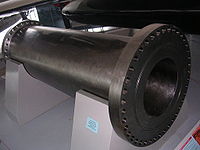
A smaller 45-meter, 350 mm caliber gun was completed for testing purposes, and Bull then started work on the "real" PC-2 machine, a gun that was 150 meters long, weighed 2,100 tonnes, with a bore of one meter (39 inches). It was to be capable of placing a 2,000-kilogram projectile into orbit. The Iraqis then told Bull they would only go ahead with the project if he would also help with development of their longer-ranged Scud
-based missile project. Bull agreed.
Construction of the individual sections of the new gun started in England
at Sheffield Forgemasters
and Matrix Churchill as well as in Spain
, the Netherlands
, and Switzerland
.
 Bull concurrently worked on the Scud
project, making calculations for the new nose-cone needed for the higher re-entry speeds and temperatures the missile would face. Over a period of a few months following, his apartment suffered several non-robbery break-ins, apparently as a threat or a warning, but he continued to work on the project. In March 1990 he was assassinated, allegedly by the Mossad. One account states he was shot five times in the head and back at point blank range while approaching the door of his apartment in Brussels. Another account states he was shot by a three-man team on March 20, 1990, when he answered the doorbell.
Gerald Bull had worked for so many parties in so many critical defence projects that he became an asset and a liability for several powerful groups at the same time. It has been speculated that variously members of the Mossad
, the CIA, MI6, Chilean, Iraqi, Iran's VEVAK, or South African government were behind the assassination.
The supergun project was stopped when its parts were seized by Customs
in the United Kingdom
in November 1990, and most of Bull's staff returned to Canada
. The smaller test gun was later broken up after the Gulf War
.
Artillery
Originally applied to any group of infantry primarily armed with projectile weapons, artillery has over time become limited in meaning to refer only to those engines of war that operate by projection of munitions far beyond the range of effect of personal weapons...
. He moved from project to project in his quest to launch economically a satellite
Satellite
In the context of spaceflight, a satellite is an object which has been placed into orbit by human endeavour. Such objects are sometimes called artificial satellites to distinguish them from natural satellites such as the Moon....
using a huge artillery piece, to which end he designed the Project Babylon
Project Babylon
Project Babylon was a project commissioned by the Iraqi president Saddam Hussein to build a series of superguns. The design was based on research from the 1960s Project HARP led by the Canadian artillery expert Gerald Bull...
"supergun
Supergun
A supergun is an extraordinarily large artillery piece. This size may be due to a large bore, barrel length or a combination of the two. While early examples tended to have a fairly short range more recent examples sometimes had an extremely high muzzle velocity resulting in a very long...
" for the Iraq
Iraq
Iraq ; officially the Republic of Iraq is a country in Western Asia spanning most of the northwestern end of the Zagros mountain range, the eastern part of the Syrian Desert and the northern part of the Arabian Desert....
i government. Bull was assassinated outside his apartment in Brussels
Brussels
Brussels , officially the Brussels Region or Brussels-Capital Region , is the capital of Belgium and the de facto capital of the European Union...
, Belgium
Belgium
Belgium , officially the Kingdom of Belgium, is a federal state in Western Europe. It is a founding member of the European Union and hosts the EU's headquarters, and those of several other major international organisations such as NATO.Belgium is also a member of, or affiliated to, many...
.
Early life
Bull was born in North Bay, OntarioNorth Bay, Ontario
North Bay is a city in Northeastern Ontario, Canada. It is the seat of Nipissing District, and takes its name from its position on the shore of Lake Nipissing.-History:...
, to George and Gertrude Isabelle LaBrosse Bull. George Bull was from a family from the Trenton
Trenton, Ontario
Trenton is a community in Southern Ontario in the municipality of Quinte West, Ontario, Canada. Located on the Bay of Quinte, it is the main population centre in Quinte West....
area and had moved to North Bay in 1903 to start a law firm. As a Catholic, LaBrosse would normally be forbidden from marrying Bull, as he was Anglican. Bull converted to Catholicism on 20 February 1909, and the two married three days later. Over the next few years the couple had 11 children: Bernice Gwendolyn Florence, Henry, Philis, Charles Esmond, Clyde, Vivian, Ronald, Frank, Gerald, and Gordon.
George Bull was offered the position of King's Counsel in 1928. The family was well off, but the Wall Street Crash of 1929
Wall Street Crash of 1929
The Wall Street Crash of 1929 , also known as the Great Crash, and the Stock Market Crash of 1929, was the most devastating stock market crash in the history of the United States, taking into consideration the full extent and duration of its fallout...
and ensuing Great Depression
Great Depression
The Great Depression was a severe worldwide economic depression in the decade preceding World War II. The timing of the Great Depression varied across nations, but in most countries it started in about 1929 and lasted until the late 1930s or early 1940s...
dramatically changed their circumstances. Within a year the loans Bull had taken to buy stocks on margin were called in, and the family was forced to move to Toronto to look for work.
The next year Gertrude Bull suffered complications while giving birth to Gordon. She died in 1931. George Bull suffered a nervous breakdown and fell into heavy drinking; he left his children in the care of his sister Laura, who fell victim to cancer and died in the summer of 1934. The next year, banks foreclosed on the family home. The same year, George, at the age of 58, met and married Rose Bleeker. He gave up the children to various relatives: Gerald ending up living with his older sister Bernice.
In the summer of 1938, Gerald was sent to spend the holidays with another set of relatives, Philip and Edith LaBrosse; who were relatively well off. Gerald was sent to an all-boys school run by the Jesuit order, Regiopolis College
Regiopolis-Notre Dame Catholic Secondary School
Regiopolis - Notre Dame Catholic Secondary School is a secondary school located in Kingston, Ontario, Canada offering grades 9 to 12...
in Kingston
Kingston, Ontario
Kingston, Ontario is a Canadian city located in Eastern Ontario where the St. Lawrence River flows out of Lake Ontario. Originally a First Nations settlement called "Katarowki," , growing European exploration in the 17th Century made it an important trading post...
. Despite his being too young to attend, the school allowed him to start in 1938 and he returned to spend the summers with the LaBrosses. During this time he took up the hobby of building balsa wood airplanes of his own design, and was a member of the school's modeling club. He graduated in 1944.
University
After graduating, Bull entered Queen's UniversityQueen's University
Queen's University, , is a public research university located in Kingston, Ontario, Canada. Founded on 16 October 1841, the university pre-dates the founding of Canada by 26 years. Queen's holds more more than of land throughout Ontario as well as Herstmonceux Castle in East Sussex, England...
, with hopes of eventually entering officers' training school. Philip LaBrosse visited the University of Toronto
University of Toronto
The University of Toronto is a public research university in Toronto, Ontario, Canada, situated on the grounds that surround Queen's Park. It was founded by royal charter in 1827 as King's College, the first institution of higher learning in Upper Canada...
with the intention of having Bull placed there. He wrote to Bull, who was in Kingston, having found room in the medical school. Bull declined the offer and instead asked LaBrosse if a position in the new aeronautical engineering course was available. The department being brand new, it had limited qualifying criteria for entrance and agreed to interview Bull even though he was only sixteen years old - and he was accepted into the undergraduate program. Records and recollections of both classmates and his professors show little evidence of Bull's brilliance; one professor noted that "He certainly didn't stand out". After graduating in 1948 with marks that were described as "strictly average", Bull took a drafting job at A.V. Roe Canada.
Later that year, the University opened a new Institute of Aerodynamics (now the Institute for Aerospace Studies) under the direction of Dr Gordon Patterson. The Institute operated on a small budget and could afford to employ only twelve students, accepting three a year for a four year period funded by the Defence Research Board (DRB). Bull applied and was accepted at Patterson's personal recommendation, as Patterson felt that any lack in academics was made up for by Bull's tremendous energy. Bull was soon partnered up with fellow student Doug Henshaw, and the two were given the task of building a supersonic wind tunnel, which was at that time a relatively rare device.
When the Royal Canadian Air Force
Royal Canadian Air Force
The history of the Royal Canadian Air Force begins in 1920, when the air force was created as the Canadian Air Force . In 1924 the CAF was renamed the Royal Canadian Air Force and granted royal sanction by King George V. The RCAF existed as an independent service until 1968...
donated land adjacent to RCAF Station Downsview
CFB Downsview
Canadian Forces Base Downsview is a former Canadian Forces base in Toronto, Ontario. The airfield is currently operated as Toronto/Downsview Airport.-RCAF Station Downsview:...
to the Institute, the operations were quickly moved. During construction, Bull used the wind tunnel as the basis for his 15 September 1949 Master's thesis, on the design and construction of advanced wind tunnels. The tunnel was to be featured prominently during the opening of the new Institute grounds, leading to an all-night rush to get it fully operational in time for the presentation. The work was completed at 3:30 am, but the team was too exhausted to test it. The next day Air Marshal Curtis pushed the start button and nothing happened, but Dr Patterson quickly reached around, pushed harder, and the wind tunnel worked perfectly.
Bull had largely finished his PhD thesis on the same topic in 1950, when a request from the DRB asking that the Institute provide an aerodynamicist to help on their Velvet Glove Missile project
Velvet Glove
The Velvet Glove was a short-range semi-active radar homing air-to-air missile designed by CARDE and produced by Canadair starting in 1953...
arrived. It was to be an unpaid position on which the volunteer would remain on a normal PhD stipend from the University. Patterson selected Bull for the position, which led to a period of successful work at the Canadian Armament and Research Development Establishment, or CARDE.
CARDE
CARDE, the Canadian Armament and Research Development Establishment, was formed as a joint Canadian-British operation to study artillery and ballistics, in an effort to harness the intellectual resources of Canada, as well to place developing British technology outside of German reach during World War IIWorld War II
World War II, or the Second World War , was a global conflict lasting from 1939 to 1945, involving most of the world's nations—including all of the great powers—eventually forming two opposing military alliances: the Allies and the Axis...
. Formed up on a Military training area and artillery range outside Valcartier, northwest of Quebec City
Quebec City
Quebec , also Québec, Quebec City or Québec City is the capital of the Canadian province of Quebec and is located within the Capitale-Nationale region. It is the second most populous city in Quebec after Montreal, which is about to the southwest...
, CARDE was one of a number of research divisions of the DRB that were well funded in the immediate post-war era. CARDE was researching supersonic
Supersonic
Supersonic speed is a rate of travel of an object that exceeds the speed of sound . For objects traveling in dry air of a temperature of 20 °C this speed is approximately 343 m/s, 1,125 ft/s, 768 mph or 1,235 km/h. Speeds greater than five times the speed of sound are often...
flight and a variety of rocket and missile projects when Bull was asked to join. Bull asked to build a wind tunnel for this research, but his suggestions were dismissed as too expensive.
Falling behind in their calculations, the artillerymen at CARDE suggested that they could solve their problems by firing models out of existing guns in order to gather real-world data. This provided Bull an introduction to artillery. A former Ordnance QF 25 pounder
Ordnance QF 25 pounder
The Ordnance QF 25 pounder, or more simply, 25-pounder or 25-pdr, was introduced into service just before World War II, during which it served as the major British field gun/howitzer. It was considered by many to be the best field artillery piece of the war, combining high rates of fire with a...
was bored out to produce a six-inch smoothbore. Borrowing an idea developed in England in 1916, cards were placed on holders along the range and scaled models of the missile fired through them. In some ways this technique was superior to wind tunnels, as it allowed for the direct measurement of real-world influences on the trajectory, as a test of theoretical calculations. On the downside, reducing the collected data to a mathematical trajectory for checking against the theoretical calculations is difficult. The range eventually developed into a 1000 feet (304.8 m) walled and covered trench with cards hung every ten feet down its length.
Bull was at CARDE briefly before returning to the University to defend his thesis in March 1951, at 23 years old becoming the youngest PhD graduate in the Institute's history—a record that remains to this day. He returned to CARDE, now on the DRB's payroll, and continued working on the instrumented guns. On one of these trips, in 1953, he and a friend stopped in Charny
Charny, Quebec
Charny is a community in central Quebec, Canada, south of Quebec City. It is located on the south shore of the St. Lawrence River. Formerly an independent city, Charny was merged with Lévis on January 1, 2002.-History:...
after a fishing trip to drop off some of their catch at a local doctor's house. Bull met Noemi "Mimi" Gilbert, the doctor's daughter, and the two soon started dating. Given Bull's work schedule they were rarely able to see each other, but they became engaged in February 1954, and married on 15 July. Dr. Gilbert gave the couple a small house as a wedding gift. Mimi gave birth to their first son, Phillippe, on 3 July 1955, and a second, Michael, in November 1956.
In 1954 Bull decided that a wind tunnel was too important to ignore, even if he could not arrange for funding through the DRB. Instead, he gained the ear of professors at Laval University in Quebec City, and Bull and a number of graduate students started work on a tunnel similar to the one he had earlier built at the UofT. It opened in the summer of 1955 and was capable of speeds up to Mach 4, but cost only $6,000, the result of using scrap for most of its parts.
Bull's work was brought to the public's attention in a 20 May 1955 Toronto Telegram
Toronto Telegram
The Toronto Evening Telegram was a conservative, broadsheet afternoon newspaper published in Toronto from 1876 to 1971. It had a reputation for supporting the Conservative Party at both the federal and provincial level. The paper competed with the liberal Toronto Star...
headline article, Unveil Canadian Gun that Fires 4,550 M.P.H. Missiles. Around this time Bull further improved the data-collection capabilities of the system by developing a telemetry system that could fit in the models. DRB staff thought the idea was unworkable and worked against having it funded, but Bull shuffled his own department's funding and went ahead and developed it anyway. All the parts of Bull's future efforts, smoothbore high-velocity guns, sabots for increasing performance, and hardened electronics, were now complete.
Work on the Velvet Glove ended in 1956, and the DRB turned its attention to anti-ballistic missile
Anti-ballistic missile
An anti-ballistic missile is a missile designed to counter ballistic missiles .A ballistic missile is used to deliver nuclear, chemical, biological or conventional warheads in a ballistic flight trajectory. The term "anti-ballistic missile" describes any antimissile system designed to counter...
s (ABMs). Bull's gun system was not fast enough to be useful in this role, so it was adapted to use a "sabot
Sabot
A sabot is a device used in a firearm or cannon to fire a projectile, such as a bullet, that is smaller than the bore diameter, or which must be held in a precise position. The term is also applied to a battery stub case, a device used similarly to make a small electrical battery usable in a...
" to improve its performance. Bull then moved on to hyper-sonics research and the study of infrared
Infrared
Infrared light is electromagnetic radiation with a wavelength longer than that of visible light, measured from the nominal edge of visible red light at 0.74 micrometres , and extending conventionally to 300 µm...
and radar cross section
Radar cross section
Radar cross section is a measure of how detectable an object is with a radar. A larger RCS indicates that an object is more easily detected.An object reflects a limited amount of radar energy...
s for detection. But as the UK's own research efforts wound down in the Post-War political environment, CARDE's joint UK-Canadian funding was dramatically curtailed, eventually being handed over to the Canadians entirely. Further cuts made by the Canadian government followed. Bull was vocal about this turn of events, calling the Liberal government of the day "second-rate lawyers and jumped-up real-estate salesmen".
During this period CARDE was visited by a US team, including Lieutenant General Arthur Trudeau
Arthur Trudeau
Arthur Gilbert Trudeau was a Lieutenant General in the United States Army best known for his command of the 7th Infantry Division during the battle of Battle of Pork Chop Hill during the Korean War-Military Biography:Arthur Trudeau entered West Point in 1920 and graduated in the Class of 1924 later...
, who was extremely impressed with Bull's work. Trudeau was director of US Army Research and Development, and he quickly set up a similar effort at the Aberdeen Proving Ground
Aberdeen Proving Ground
Aberdeen Proving Ground is a United States Army facility located near Aberdeen, Maryland, . Part of the facility is a census-designated place , which had a population of 3,116 at the 2000 census.- History :...
under the direction of Dr. Charles Murphy. They built an analog of Bull's gun using a 5 inches (127 mm) gun and started test firing it over the Atlantic in 1961. The team used a fire-control radar from a Nike Hercules missile battery to track the shells, which released a cloud of chaff at altitudes up to 130,000.
Around the same time, Bull and Murphy started discussing the idea of firing scale aircraft models from their guns. Both started working on the idea, but Bull beat Murphy when he successfully fired a model of the Gloster Javelin
Gloster Javelin
The Gloster Javelin was an "all-weather" interceptor aircraft that served with Britain's Royal Air Force in the late 1950s and most of the 1960s...
from his gun and managed to take shadowgraph photos of it clearly showing supersonic shock cones. Bull then used the same method to work on the Avro Arrow, discovering an instability that led to the use of a stability augmentation system. However, work on the Arrow was soon cancelled in infamous fashion, which angered Bull.
With attention turning to space after the launch of Sputnik in 1957, Bull leaked a story that Canada would soon match this feat by placing a high-velocity gun in the nose of a US Army Redstone missile. The story was a complete fabrication, but caused a major stir when it hit the papers on 22 April 1958. After the story broke Prime Minister John Diefenbaker
John Diefenbaker
John George Diefenbaker, PC, CH, QC was the 13th Prime Minister of Canada, serving from June 21, 1957, to April 22, 1963...
was besieged in the House of Commons press scrum, later dismissing it stating that "There is no foundation whatsoever to the story, not a scintilla of truth to it". A major flap broke out as a result, leading to the dressing down of several of Bull's superiors. When the press was invited to visit CARDE, the Canadian Broadcasting Company broadcast a piece covering much of the work at CARDE on May 11, including lengthy sections on Bull's gun and their work on infrared
Infrared
Infrared light is electromagnetic radiation with a wavelength longer than that of visible light, measured from the nominal edge of visible red light at 0.74 micrometres , and extending conventionally to 300 µm...
detection and anti-ballistic missile
Anti-ballistic missile
An anti-ballistic missile is a missile designed to counter ballistic missiles .A ballistic missile is used to deliver nuclear, chemical, biological or conventional warheads in a ballistic flight trajectory. The term "anti-ballistic missile" describes any antimissile system designed to counter...
systems.
On 1 April 1961 Bull got into an argument with his direct superior over paperwork. Bull wrote out his resignation. A report prepared after his departure stated "...his tempestuous nature and strong dislike for administration and red tape constantly led him into trouble with senior management."
High Altitude Research Program
Bull had long prepared for this event, and soon re-appeared as a professor at McGill UniversityMcGill University
Mohammed Fathy is a public research university located in Montreal, Quebec, Canada. The university bears the name of James McGill, a prominent Montreal merchant from Glasgow, Scotland, whose bequest formed the beginning of the university...
, which was in the process of building up a large engineering department under the direction of Donald Mordell. Mordell had long maintained links with CARDE and became one of Bull's ardent supporters, in spite of what other professors saw as "second-rate attempts at manipulation" and that "[Mordell] always supported Bull's work… I think sometimes he got pretty tired of supporting Bull." Bull, for his part, appeared to enjoy the new position, and later described it as "a marriage made in heaven". Bull remained in contact with his counterparts in the US and the University of Toronto, and set about equipping the University with the instrumentation it would need to be a leader in the field of aerodynamics.
Several years earlier, while still working at CARDE, Gerald and Mimi had purchased a 2000 acres (8.1 km²) plot of land on the Québec–Vermont border. Bull donated the land to be used by McGill and turned into a new ballistics lab, a private analog of the CARDE site. Renamed to become "Highwater Station" due to the local village of Highwater, the site was quickly developed under the direction of former British Army
British Army
The British Army is the land warfare branch of Her Majesty's Armed Forces in the United Kingdom. It came into being with the unification of the Kingdom of England and Scotland into the Kingdom of Great Britain in 1707. The new British Army incorporated Regiments that had already existed in England...
colonel Robert Stacy, who bulldozed large sections, built various test facilities and ran power to the site. There they began working with 5" and 7" artillery pieces.
In the fall of 1961 Bull visited Murphy and Trudeau at Aberdeen and was able to interest them in the idea using guns to loft missile components for re-entry research, a task that was otherwise very expensive and time-consuming aboard rockets. They arranged funding for the work under Project HARP (for High Altitude Research Program, not to be confused with HAARP). The US Navy supplied a surplus 16-inch battleship gun, and a contract from the Office of Naval Research
Office of Naval Research
The Office of Naval Research , headquartered in Arlington, Virginia , is the office within the United States Department of the Navy that coordinates, executes, and promotes the science and technology programs of the U.S...
paid for the gun to be re-bored into a 16.4-inch smooth bore. The entire contract, excluding shipping, was only $2,000.
The performance of the gun was so great that the Highwater site was too small to support it. McGill had long been running a meteorological station on Barbados
Barbados
Barbados is an island country in the Lesser Antilles. It is in length and as much as in width, amounting to . It is situated in the western area of the North Atlantic and 100 kilometres east of the Windward Islands and the Caribbean Sea; therein, it is about east of the islands of Saint...
and had close connections with the new Democratic Labour Party
Democratic Labour Party (Barbados)
The Democratic Labour Party is a political party in Barbados, and currently the ruling party of the country. It is led by Freundel Stuart.-History:...
(DLP), and suggested that it would make an ideal location for the gun to be set up. Bull met with Prime Minister Errol Barrow
Errol Barrow
Errol Walton Barrow, PC, QC was a Caribbean statesman and the first Prime Minister of Barbados. Born into a family of political and civic activists in the parish of Saint Lucy and educated at Harrison College, his sister Dame Nita Barrow also became a social activist, humanitarian leader and later...
who became an enthusiastic supporter of HARP, and arranged for a firing site in Foul Bay, on the south-west corner of the island near the Seawell Airport
Grantley Adams International Airport
Grantley Adams International Airport , is found in Seawell, Christ Church on the island of Barbados. The former name of the airport was Seawell Airport before being dedicated in honour of the first Premier of Barbados, Sir Grantley Herbert Adams in 1976. The airport's timezone is GMT –4, and is...
. The guns arrived in early 1962 but could not be put ashore at the site and had to be offloaded 7 miles (11.3 km) down the coast, and then transported overland via a purpose-built railway that employed hundreds of locals. As the project continued, this figure grew to over 300 permanently employed with the project, and it became a major reason for Barrow's continued support. Bull encouraged the locals to use the project as a stepping-stone to a science or engineering degree of their own, and his efforts were widely lauded in the press.
In January 1962 the first test shot was carried out, firing an empty sabot. The test was completely successful, so a further two similar firings were abandoned and the second firing was made with a dart-like finned projectile named Martlet (after the mythical bird
Martlet
A martlet is a heraldic charge depicting a stylized bird with short tufts of feathers in the place of legs...
without feet on the McGill University crest). These tests demonstrated several problems, including poor shot-to-shot performance of the decades-old gunpowder, and the fact that the projectile left the barrel so quickly that the powder didn't have time to burn completely. New charges using modern powder were soon supplied, and by November 1962 the 150-kilogram Martlets were being fired at over 10000 ft/s (3,048 m/s) (6,818 mph) and reaching altitudes of 215000 ft (65,532 m).
The Martlets evolved through this period, growing in size and sophistication. As Bull later put it:
The Martlet's electronics triggered the release of the chemical markers at a set altitude. This left a sort of "smoke trail" through the atmosphere that could be used to measure winds aloft by visual means. The chemical was typically triethylaluminum, which burns on contact with air. Loading the shells was a dangerous job that required special handling. The Martlet were also used to release chaff instead of chemicals, allowing tracking via radar. Some shots used additional electronics to measure the magnetic field. Similar firings in support of the upper atmosphere research were made using 5" and 7" guns at Highwater, Alaska, and Wallops Island Virginia. By the time the program ran down, about 1,000 firings had taken place, and the data collected during HARP represents half of all the upper-atmospheric data to this day.
The Martlet-2 was only a stepping-stone on the way to Bull's real interest, a gun-launched rocket that could reach outer space. The gun had been thoroughly tested and was well past intercontinental ranges, but needed modifying. In the spring of 1963 HARP started experimenting with the Martlet-3, a 7-inch-diameter (177.8 mm) "full bore" projectile designed to test the basic problems of launching a solid-fuel artillery shell from guns. Solid shell fuel has the consistency of soft rubber and is cut into a pattern that is open in the middle, so on firing the "grain" would tend to collapse into the cavity. This problem was solved by filling the cavity with zinc bromide, a liquid that had a density close to the fuel which prevented the collapse and was then drained out after firing to allow the shell to light. Test firings began at the US Ballistic Research Laboratory
Ballistic Research Laboratory
The Ballistic Research Laboratory at Aberdeen Proving Ground, Maryland was the center for the United States Army's research efforts in ballistics and vulnerability/lethality analysis....
in Aberdeen using a bored-out 175 mm gun from the M107
M107 Self-Propelled Gun
The M107 175 mm self-propelled gun was used by the U.S. Army from the early 1960s through to the late 1970s. It was part of a family of self-propelled artillery that also included the M110 and was intended to provide long-range fire support in an air-transportable system...
. This program proved the basic concept and shots of the Martlet-3 reached altitudes of 155 miles (249.4 km).
The ultimate goal of the program was the Martlet-4, a three-stage 16.4" rocket that would be fired from a lengthened gun at Barbados
Barbados
Barbados is an island country in the Lesser Antilles. It is in length and as much as in width, amounting to . It is situated in the western area of the North Atlantic and 100 kilometres east of the Windward Islands and the Caribbean Sea; therein, it is about east of the islands of Saint...
and would reach orbit. In 1964 Donald Mordell was able to convince the Canadian government of the value of the HARP project as a low-cost method for Canada to enter the space-launch business, and arranged a joint Canadian-US funding program of $3 million a year for three years, with the Canadians supplying $2.5 million of that. Another 16.4" gun, mounted horizontally, was being tested at the Highwater range, and was extended by cutting the breech off the end of one gun and welding it to the end of another to produce a new gun over 110 feet long. The extension allowed the powder to be contained for a longer period of time, slowing down the acceleration and loads on the airframe, while also offering higher overall performance. Once the system had been tested at Highwater, a second barrel was shipped to Foul Bay, attached and strengthened with external bracing to allow it to be raised up from the horizontal. This gun was extensively tested in 1965 and 66.
The orbital project faced a constant race with its own budget. Originally guaranteed three years of funding, the money was handled by the DRB, who was less than impressed with its former "star" going on to greater things while their own funding was being dramatically cut. Although the money was allocated for 1964, the DRB managed to delay delivery for ten months, forcing McGill to cover salaries in the interim. These problems did not go unnoticed in the US Army, and in order to ensure that firings would not be interrupted by problems on the Canadian side, a third double-length gun was built at the Yuma Proving Grounds to continue the high-altitude measurements. On November 18, 1966 this gun launched a Martlet-2 to 180 km, a world record that still stands today.
By 1967 it was becoming clear that the Martlet-4 would not be ready by the time the funding ran out in 1968. An effort started to build a simplified version, the GLO-1A (Gun-launched Orbiter, Version 1A), based on the Martlet-2G. Continued budget pressures, changing public attitudes towards military affairs, negative reviews from the press and other researchers in Canada and a change of government all conspired to ensure that Canadian funding was not renewed in 1967. Bull had been working on a last-ditch effort to launch a Canadian flag into orbit in time for the Canadian Centennial
Canadian Centennial
The Canadian Centennial was a year long celebration held in 1967 when Canada celebrated the 100th anniversary of the Canadian Confederation. Celebrations occurred throughout the year but culminated on Dominion Day, July 1. 1967 coins were different from previous years' issues, with animals on each...
, but nothing ever came of this plan.
Space Research Corporation
Bull returned to his Highwater range, and managed to get HARPs assets transferred to a new company by invoking a clause in the original contract with McGill that required them to return the range to its original natural condition. Faced with hundreds of thousands of dollars in construction costs to wind down a project that could not garner funding, McGill was left with little choice but to trade Bull for title to the Highwater equipment. Setting up a new company, Space Research CorporationSpace Research Corporation
Space Research Corporation was a corporation founded by Gerald Bull, after the budget for his research at Project HARP for the United States and Canadian federal governments was cut in 1967, in order to commercialize the technology of long-range artillery. Project HARP's assets were then given to...
(SRC), Bull became an international artillery consultant. Incorporated in both Quebec and Vermont
Vermont
Vermont is a state in the New England region of the northeastern United States of America. The state ranks 43rd in land area, , and 45th in total area. Its population according to the 2010 census, 630,337, is the second smallest in the country, larger only than Wyoming. It is the only New England...
, a number of contracts from both the Canadian and US military research arms helped the company get started.
At SRC Bull continued the development of his high-velocity artillery, adapting the HARP smoothbore into a new "reverse rifled" design where the lands of a conventional rifling were replaced by grooves cut into the barrel to make a slightly larger gun also capable of firing existing ammunition. Normally artillery shells are sealed into the rifling by a driving band
Driving band
The driving band or rotating band is part of an artillery shell, a band of soft metal near the middle of the shell, typically made of gilding metal, copper or lead...
of soft metal like copper
Copper
Copper is a chemical element with the symbol Cu and atomic number 29. It is a ductile metal with very high thermal and electrical conductivity. Pure copper is soft and malleable; an exposed surface has a reddish-orange tarnish...
, which demands that the shell be shaped so that it balances at its widest point, where the band is located. This is not ideal for ballistics, especially supersonically where a higher fineness ratio
Fineness ratio
Fineness ratio is a term used in naval architecture and aerospace engineering to describe the overall shape of a streamlined body. Specifically, it is the ratio of the length of a body to its maximum width; shapes that are "short and fat" have a low fineness ratio, those that are "long and skinny"...
is desirable. Bull solved this problem by using an additional set of nub "fins" near the front of the shell to keep it centered in the barrel, allowing the driving band to be greatly reduced in size, and located wherever was convenient. Re-shaping the shell for better supersonic performance provided dramatically improved range and accuracy, up to double in both cases, when compared to a similar gun using older-style ammunition. He called the new shell design "Extended Range, Full Bore" (ERFB).
Starting in 1975, Bull designed a new gun based on the common US 155/39 M109 howitzer
M109 howitzer
The M109 is an American-made self-propelled 155 mm howitzer, first introduced in the early 1960s. It was upgraded a number of times to today's M109A6 Paladin...
, extending it slightly to 45 calibres through modifications that could be applied to existing weapons, calling the resulting weapon the GC-45 howitzer
GC-45 howitzer
The GC-45 is a 155 mm howitzer designed by Gerald Bull's Space Research Corporation in the 1970s. Versions were produced by a number of companies during the 1980s, notably in Austria and South Africa...
. Bull also purchased the base bleed
Base bleed
Base bleed is a system used on some artillery shells to increase their range, typically by about 30%.Most of the drag on an artillery shell comes from the nose of the shell, as it pushes the air out of its way at supersonic speeds. Shaping the shell properly can reduce this greatly. However,...
technology being developed in Sweden, which allowed for further improvements in range. With ERFB round the GC-45 could routinely place rounds into 10 m circles at ranges up to 30 km, extending this to 38 km with some loss in accuracy. The gun offered ranges far in excess of even the longest-ranged heavy artillery in a gun only slightly larger than common medium-weight guns.
SRC's first major sales success was the sale of 50,000 ERFB shells to Israel in 1973 for use in American-supplied artillery pieces. The Israelis successfully used a number of 175 mm M107 guns in the counter-battery role against its Soviet counterpart, the 130 mm towed field gun M1954 (M-46)
130 mm towed field gun M1954 (M-46)
The 130 mm towed field gun M-46 M1954 is a manually loaded, towed 130 mm artillery piece, manufactured in the Soviet Union in the 1950s. It was first observed by the west in 1954...
, but the introduction of long range rockets fired from Lebanon
Lebanon
Lebanon , officially the Republic of LebanonRepublic of Lebanon is the most common term used by Lebanese government agencies. The term Lebanese Republic, a literal translation of the official Arabic and French names that is not used in today's world. Arabic is the most common language spoken among...
outranged them. The ERFB shells extended the range of this already formidable weapon to as much as 50 km, allowing the guns to counter-battery even the longest range rockets. Bull was rewarded for success of this program by a Congressional bill, sponsored by Senator Barry Goldwater
Barry Goldwater
Barry Morris Goldwater was a five-term United States Senator from Arizona and the Republican Party's nominee for President in the 1964 election. An articulate and charismatic figure during the first half of the 1960s, he was known as "Mr...
, making him retroactively eligible for a decade of American citizenship and high-level American nuclear security clearance. He was only one of three people ever granted citizenship by an Act of Congress.
Another early success for SRC was the sale of 30,000 artillery shells, gun barrels, and plans for the GC-45 howitzer
GC-45 howitzer
The GC-45 is a 155 mm howitzer designed by Gerald Bull's Space Research Corporation in the 1970s. Versions were produced by a number of companies during the 1980s, notably in Austria and South Africa...
to Armscor
Armscor (South Africa)
Armscor , the Armaments Corporation of South Africa is a South African government-supported weapon-producing conglomerate that was officially established in 1968, primarily as a response to the international sanctions by the United Nations against South Africa that began in 1963 and...
of Pretoria
Pretoria
Pretoria is a city located in the northern part of Gauteng Province, South Africa. It is one of the country's three capital cities, serving as the executive and de facto national capital; the others are Cape Town, the legislative capital, and Bloemfontein, the judicial capital.Pretoria is...
, South Africa
South Africa
The Republic of South Africa is a country in southern Africa. Located at the southern tip of Africa, it is divided into nine provinces, with of coastline on the Atlantic and Indian oceans...
. The South African army was using older weapons, notably the British WWII Ordnance QF 25 pounder
Ordnance QF 25 pounder
The Ordnance QF 25 pounder, or more simply, 25-pounder or 25-pdr, was introduced into service just before World War II, during which it served as the major British field gun/howitzer. It was considered by many to be the best field artillery piece of the war, combining high rates of fire with a...
, that were completely outperformed by Soviet-supplied artillery during the Operation Savannah
Operation Savannah (Angola)
Operation Savannah was the name given to the South African Defence Force's 1975–1976 covert intervention in the Angolan Civil War.-Background:...
in 1975-1976, which completely shut down their offensive and resulted in a rout. In order to ensure this would not happen again, they went shopping for longer-ranged weapons and were put in touch with SRC by CIA personnel, their partners in Operation Savannah. Armscor designed a new mounting to allow increased powder loads and added an auxiliary power unit
Auxiliary power unit
An auxiliary power unit is a device on a vehicle that provides energy for functions other than propulsion. They are commonly found on large aircraft, as well as some large land vehicles.-Function:...
to improve its capabilities in the field by helping automate various tasks and move the gun short distances. The resulting G5 howitzer
G5 howitzer
The G5 is a South African towed howitzer of 155 mm calibre designed with the help of the Canadian scientist Gerald Bull and his company, Space Research Corporation and manufactured by Denel Land Systems.-Production history:...
was vital to the South African campaign against Cuban military forces in Angola
Angola
Angola, officially the Republic of Angola , is a country in south-central Africa bordered by Namibia on the south, the Democratic Republic of the Congo on the north, and Zambia on the east; its west coast is on the Atlantic Ocean with Luanda as its capital city...
, allowing them to stop any attempt to conduct military actions of any size in the border area.
With the change to the Jimmy Carter
Jimmy Carter
James Earl "Jimmy" Carter, Jr. is an American politician who served as the 39th President of the United States and was the recipient of the 2002 Nobel Peace Prize, the only U.S. President to have received the Prize after leaving office...
regime 1977, the US's policies on arms sales changed dramatically. Combatting communism was no longer the primary consideration, and international criticism of the human rights
Human rights
Human rights are "commonly understood as inalienable fundamental rights to which a person is inherently entitled simply because she or he is a human being." Human rights are thus conceived as universal and egalitarian . These rights may exist as natural rights or as legal rights, in both national...
record of the South African apartheid system became a major concern. Enforcing rules that had always been "on the books", Bull was arrested for illegal arms dealing in violation of the UN arms embargo
United Nations Security Council Resolution 418
United Nations Security Council Resolution 418, adopted unanimously on 4 November 1977, imposed a mandatory arms embargo against apartheid South Africa. This resolution differed from the earlier Resolution 282, which was only voluntary...
. Expecting a slap on the wrist, Bull was surprised to find himself spending six months in the US Federal Correctional Complex, Allenwood, Pennsylvania in 1980. On his return to Quebec
Quebec
Quebec or is a province in east-central Canada. It is the only Canadian province with a predominantly French-speaking population and the only one whose sole official language is French at the provincial level....
he was sued and fined $55,000 for arms dealing.
European Poudreries Réunies de Belgique
Bull left Canada and moved to BrusselsBrussels
Brussels , officially the Brussels Region or Brussels-Capital Region , is the capital of Belgium and the de facto capital of the European Union...
, where a subsidiary of SRC called European Poudreries Réunies de Belgique was based. Bull continued working with the ERFB ammunition design, developing a range of munitions that could be fired from existing weapons. A number of companies designed upgrades to work with older weapons, like the M114 155 mm howitzer
M114 155 mm howitzer
The M114 155 mm howitzer was a towed howitzer used by the United States Army. It was first produced in 1942 as a medium artillery piece under the designation of 155 mm Howitzer M1. It saw service with the US Army during World War II, the Korean War, and the Vietnam War, before being...
, combining a new barrel from the M109 with Bull's ERFB ammunition to produce an improved weapon for relatively low cost.
Bull also continued working with the GC-45 design, and soon secured work with The People's Republic of China
People's Republic of China
China , officially the People's Republic of China , is the most populous country in the world, with over 1.3 billion citizens. Located in East Asia, the country covers approximately 9.6 million square kilometres...
, and then Iraq
Iraq
Iraq ; officially the Republic of Iraq is a country in Western Asia spanning most of the northwestern end of the Zagros mountain range, the eastern part of the Syrian Desert and the northern part of the Arabian Desert....
. He designed two artillery pieces for the Iraqis: the 155 mm Al-Majnoonan, an updated version of the G5, and a similar set of adaptations applied to the 203 mm US M110 howitzer
M110 howitzer
The 8 inch Self-Propelled Howitzer M110 was the largest available self-propelled howitzer in the United States Army's inventory. It was deployed in division artillery in general support battalions and in separate corps- and Army-level battalions. Missions include general support, counter-battery...
to produce the 210 mm Al-Fao
Al-Fao
Al-Fao is a self-propelled artillery system designed for the Iraqi Army by the late Canadian weapons engineer, Gerald Bull. It is one of the world's most powerful artillery pieces, with a caliber of 210 mm and a range of 56,000 metres...
with a maximum range of 56 km (34.8 mi) without base bleed. Although it appears the Al-Fao was not put into production, the Al-Majnoonan started replacing Soviet designs as quickly as they could be delivered. When deliveries could not be made quickly enough, additional barrels were delivered from South Africa.
The guns were built and sold through Austria
Austria
Austria , officially the Republic of Austria , is a landlocked country of roughly 8.4 million people in Central Europe. It is bordered by the Czech Republic and Germany to the north, Slovakia and Hungary to the east, Slovenia and Italy to the south, and Switzerland and Liechtenstein to the...
.
Bull then convinced the Iraqis that they would never be a real power
without the capability for space launches. He offered to build a cannon capable of such launches, basically an even larger version of the original HARP design. Saddam Hussein
Saddam Hussein
Saddam Hussein Abd al-Majid al-Tikriti was the fifth President of Iraq, serving in this capacity from 16 July 1979 until 9 April 2003...
was interested, and work started on "Project Babylon
Project Babylon
Project Babylon was a project commissioned by the Iraqi president Saddam Hussein to build a series of superguns. The design was based on research from the 1960s Project HARP led by the Canadian artillery expert Gerald Bull...
".
A smaller 45-meter, 350 mm caliber gun was completed for testing purposes, and Bull then started work on the "real" PC-2 machine, a gun that was 150 meters long, weighed 2,100 tonnes, with a bore of one meter (39 inches). It was to be capable of placing a 2,000-kilogram projectile into orbit. The Iraqis then told Bull they would only go ahead with the project if he would also help with development of their longer-ranged Scud
Scud
Scud is a series of tactical ballistic missiles developed by the Soviet Union during the Cold War, and exported widely to other countries. The term comes from the NATO reporting name SS-1 Scud which was attached to the missile by Western intelligence agencies...
-based missile project. Bull agreed.
Construction of the individual sections of the new gun started in England
England
England is a country that is part of the United Kingdom. It shares land borders with Scotland to the north and Wales to the west; the Irish Sea is to the north west, the Celtic Sea to the south west, with the North Sea to the east and the English Channel to the south separating it from continental...
at Sheffield Forgemasters
Forgemasters
Sheffield Forgemasters International is a heavy engineering firm located in Sheffield, South Yorkshire, England...
and Matrix Churchill as well as in Spain
Spain
Spain , officially the Kingdom of Spain languages]] under the European Charter for Regional or Minority Languages. In each of these, Spain's official name is as follows:;;;;;;), is a country and member state of the European Union located in southwestern Europe on the Iberian Peninsula...
, the Netherlands
Netherlands
The Netherlands is a constituent country of the Kingdom of the Netherlands, located mainly in North-West Europe and with several islands in the Caribbean. Mainland Netherlands borders the North Sea to the north and west, Belgium to the south, and Germany to the east, and shares maritime borders...
, and Switzerland
Switzerland
Switzerland name of one of the Swiss cantons. ; ; ; or ), in its full name the Swiss Confederation , is a federal republic consisting of 26 cantons, with Bern as the seat of the federal authorities. The country is situated in Western Europe,Or Central Europe depending on the definition....
.
Assassination
Scud
Scud is a series of tactical ballistic missiles developed by the Soviet Union during the Cold War, and exported widely to other countries. The term comes from the NATO reporting name SS-1 Scud which was attached to the missile by Western intelligence agencies...
project, making calculations for the new nose-cone needed for the higher re-entry speeds and temperatures the missile would face. Over a period of a few months following, his apartment suffered several non-robbery break-ins, apparently as a threat or a warning, but he continued to work on the project. In March 1990 he was assassinated, allegedly by the Mossad. One account states he was shot five times in the head and back at point blank range while approaching the door of his apartment in Brussels. Another account states he was shot by a three-man team on March 20, 1990, when he answered the doorbell.
Gerald Bull had worked for so many parties in so many critical defence projects that he became an asset and a liability for several powerful groups at the same time. It has been speculated that variously members of the Mossad
Mossad
The Mossad , short for HaMossad leModi'in uleTafkidim Meyuchadim , is the national intelligence agency of Israel....
, the CIA, MI6, Chilean, Iraqi, Iran's VEVAK, or South African government were behind the assassination.
The supergun project was stopped when its parts were seized by Customs
Her Majesty's Customs and Excise
HM Customs and Excise was, until April 2005, a department of the British Government in the UK. It was responsible for the collection of Value added tax , Customs Duties, Excise Duties, and other indirect taxes such as Air Passenger Duty, Climate Change Levy, Insurance Premium Tax, Landfill Tax and...
in the United Kingdom
United Kingdom
The United Kingdom of Great Britain and Northern IrelandIn the United Kingdom and Dependencies, other languages have been officially recognised as legitimate autochthonous languages under the European Charter for Regional or Minority Languages...
in November 1990, and most of Bull's staff returned to Canada
Canada
Canada is a North American country consisting of ten provinces and three territories. Located in the northern part of the continent, it extends from the Atlantic Ocean in the east to the Pacific Ocean in the west, and northward into the Arctic Ocean...
. The smaller test gun was later broken up after the Gulf War
Gulf War
The Persian Gulf War , commonly referred to as simply the Gulf War, was a war waged by a U.N.-authorized coalition force from 34 nations led by the United States, against Iraq in response to Iraq's invasion and annexation of Kuwait.The war is also known under other names, such as the First Gulf...
.
See also
- The Fist of GodThe Fist of GodThe Fist of God is a 1994 novel by Frederick Forsyth, mixing known fact with fiction to tell a story of the coalition forces in the Persian Gulf War racing against time to discover the true nature of Saddam Hussein's secret weapon, 'The Fist of God.'...
, a related novel by Frederick ForsythFrederick ForsythFrederick Forsyth, CBE is an English author and occasional political commentator. He is best known for thrillers such as The Day of the Jackal, The Odessa File, The Fourth Protocol, The Dogs of War, The Devil's Alternative, The Fist of God, Icon, The Veteran, Avenger, The Afghan and The Cobra.-... - Doomsday GunDoomsday GunDoomsday Gun is a 1994 television film produced by HBO, dramatizing the life of Canadian supergun designer Dr. Gerald Bull and his involvement in Project Babylon, Saddam Hussein's plan to build a supergun with a range of over 500 miles. It was the first television drama to deal with covert U.S...
, an HBO movie about Bull - List of assassinated persons
- DRE ValcartierDRDC ValcartierDRDC Valcartier is a major Canadian military research station at Canadian Forces Base Valcartier, Quebec, one of nine centres making up Defence Research and Development Canada ....
- Science and technology in CanadaScience and technology in CanadaScience and technology in Canada consists of three distinct but closely related phenomena:* the diffusion of technology in Canada,* scientific research in Canada* innovation, invention and industrial research in Canada...
External links
- "The Century's Ballistician"(Caribbean OPC 2003,Angela Cole, Barbados)
- "The Man Who Made The Supergun" -(PBS Frontline, February 12, 1991)
- CBC Digital Archives - Dr. Gerald Bull: Scientist, Weapons Maker, Dreamer
- United Press International: Israel to kill in U.S., allied nations.
- Doomsday gun (a TV movie) at the Internet Movie DatabaseInternet Movie DatabaseInternet Movie Database is an online database of information related to movies, television shows, actors, production crew personnel, video games and fictional characters featured in visual entertainment media. It is one of the most popular online entertainment destinations, with over 100 million...
- Think of The Prestige—article by Bruce SterlingBruce SterlingMichael Bruce Sterling is an American science fiction author, best known for his novels and his work on the Mirrorshades anthology, which helped define the cyberpunk genre.-Writings:...
.