


Supergun

Encyclopedia

Caliber
In guns including firearms, caliber or calibre is the approximate internal diameter of the barrel in relation to the diameter of the projectile used in it....
, barrel length or a combination of the two. While early examples tended to have a fairly short range more recent examples sometimes had an extremely high muzzle velocity resulting in a very long range.
Depending on the design they may be used to destroy heavy fortifications or are used to bombard an enemy from extremely long range.
Late Middle Ages
Late Middle Ages
The Late Middle Ages was the period of European history generally comprising the 14th to the 16th century . The Late Middle Ages followed the High Middle Ages and preceded the onset of the early modern era ....
siege warfare the term superguns applies to stone-firing bombard
Bombard (weapon)
A bombard is a large-caliber, muzzle-loading medieval cannon or mortar, used chiefly in sieges for throwing heavy stone balls. The name bombarde was first noted and sketched in a French historical text around 1380. The modern term bombardment derives from this.Bombards were usually used during...
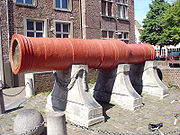
s with a ball diameter of more than 50 cm. These superguns were either manufactured by forging together longitudinal iron bars, held in place by iron rings, or cast in bronze with techniques generally similar to bell-founding. Known examples include the Pumhart von Steyr
Pumhart von Steyr
The Pumhart von Steyr is a medieval supergun from Styria, Austria, and the largest known wrought-iron bombard by caliber. The cannon was produced in the early 15th century and could fire, according to modern calculations, a 690 kg stone ball around 600 m, loaded with 15 kg of powder and set up at...
, Dulle Griet
Dulle Griet
The Dulle Griet is a medieval supergun from Ghent, Belgium. The wrought-iron bombard was constructed in the first half of the 15th century from 32 longitudinal bars enclosed by 61 rings...
and Mons Meg
Mons Meg
Mons Meg is a medieval bombard which can be classed as a supergun, now located at Edinburgh Castle, Scotland. There are conflicting theories about its origins, but it appears from the accounts of Philip the Good, Duke of Burgundy that it was made to his order around 1449 and sent as a gift 8 years...
(all iron) as well as the cast-bronze Faule Mette
Faule Mette
The Faule Mette or Faule Metze was a medieval supergun of the city of Brunswick, Germany....
, Faule Grete
Faule Grete
The Faule Grete was a medieval supergun of the Teutonic Order. The bronze bombard was cast in 1409 in the cannon foundry of the Marienburg by the gunfounder Heynrich Dumechen...
and Dardanelles Gun.
At the beginning of the development of superguns was the desire to increase the effect of the projectiles. To this end, master gunners first simply used larger powder
Gunpowder
Gunpowder, also known since in the late 19th century as black powder, was the first chemical explosive and the only one known until the mid 1800s. It is a mixture of sulfur, charcoal, and potassium nitrate - with the sulfur and charcoal acting as fuels, while the saltpeter works as an oxidizer...
loads. These, however, exerted larger pressure on the existing cannon and could make it burst, causing the death of the irreplaceable gunner with his crew (and even kings
James II of Scotland
James II reigned as King of Scots from 1437 to his death.He was the son of James I, King of Scots, and Joan Beaufort...
). In addition, it was observed that, due to their higher velocity, stone balls were shattered by the impact on the walls rather than smashing them. Thus, the mass of the cannon balls and, consequently, of the ordnance too continually increased, finally culminating in giant cannon like the Pumhart von Steyr which fired a 690 kg ball. Apart from the anticipated improvement in penetrating power, other factors such as prestige and a potential deterrent effect also played an important role.

Caliber
In guns including firearms, caliber or calibre is the approximate internal diameter of the barrel in relation to the diameter of the projectile used in it....
(in German
German language
German is a West Germanic language, related to and classified alongside English and Dutch. With an estimated 90 – 98 million native speakers, German is one of the world's major languages and is the most widely-spoken first language in the European Union....
Hauptbüchse) could be produced whose firepower was enough to shatter any medieval wall, in particular when it was concentrated in a battery
Artillery battery
In military organizations, an artillery battery is a unit of guns, mortars, rockets or missiles so grouped in order to facilitate better battlefield communication and command and control, as well as to provide dispersion for its constituent gunnery crews and their systems...
. Due to their less bulky dimensions and higher rate of fire, these artillery pieces could be more flexibly deployed and caused more destruction in any given length of time. Furthermore, the transition from stone to smaller, but much more devastating iron balls meant that super-sized bores became unnecessary. The caliber of a 50 pound
Pound (mass)
The pound or pound-mass is a unit of mass used in the Imperial, United States customary and other systems of measurement...
ball, for example, could be reduced from 28 to 18 cm when using an iron projectile instead.
Duchy of Burgundy
The Duchy of Burgundy , was heir to an ancient and prestigious reputation and a large division of the lands of the Second Kingdom of Burgundy and in its own right was one of the geographically larger ducal territories in the emergence of Early Modern Europe from Medieval Europe.Even in that...
.
At about the same time super-sized bombards were phased out in Western Europe, the technology was transmitted to the Ottoman army by Orban
Orban
Urban, also known as Orban, was a Hungarian gunfounder who cast superguns for the Ottoman siege of Constantinople in 1453.In 1452 he originally offered his services to the Byzantines, but emperor Constantine XI could not afford his high salary nor did he possess the materials necessary for...
, a Hungarian
Hungary
Hungary , officially the Republic of Hungary , is a landlocked country in Central Europe. It is situated in the Carpathian Basin and is bordered by Slovakia to the north, Ukraine and Romania to the east, Serbia and Croatia to the south, Slovenia to the southwest and Austria to the west. The...
gunfounder, on the occasion of the Siege of Constantinople
Fall of Constantinople
The Fall of Constantinople was the capture of the capital of the Byzantine Empire, which occurred after a siege by the Ottoman Empire, under the command of Ottoman Sultan Mehmed II, against the defending army commanded by Byzantine Emperor Constantine XI...
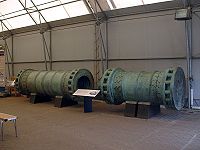
in 1453. The extant Dardanelles Gun, cast by the Ottoman gunfounder Ali several years later, is assumed to have followed closely the outline of Orban's guns. A similar super-sized bombard was employed by the Ottoman navy
Ottoman Navy
The Ottoman Navy was established in the early 14th century. During its long existence it was involved in many conflicts; refer to list of Ottoman sieges and landings and list of Admirals in the Ottoman Empire for a brief chronology.- Pre-Ottoman:...
aboard a carrack
Carrack
A carrack or nau was a three- or four-masted sailing ship developed in 15th century Western Europe for use in the Atlantic Ocean. It had a high rounded stern with large aftcastle, forecastle and bowsprit at the stem. It was first used by the Portuguese , and later by the Spanish, to explore and...
of possibly Venetian
Republic of Venice
The Republic of Venice or Venetian Republic was a state originating from the city of Venice in Northeastern Italy. It existed for over a millennium, from the late 7th century until 1797. It was formally known as the Most Serene Republic of Venice and is often referred to as La Serenissima, in...
design at the Battle of Zonchio
Battle of Zonchio
The naval Battle of Zonchio took place on four separate days: August 12, 20, 22 and 25, 1499. It was a part of the Ottoman–Venetian War of 1499–1503...
in 1499.
In India, there is a forge-welded Iron Cannon in Thanjavur, Tamil Nadu. This cannon was built during the reign of Raghunatha Nayak (1600 - 1645 AD), and it is said to be one of the largest cannons in the world. Artillery was used by Indian armies predominantly for defending against besieging armies
World Wars
World War I
World War I , which was predominantly called the World War or the Great War from its occurrence until 1939, and the First World War or World War I thereafter, was a major war centred in Europe that began on 28 July 1914 and lasted until 11 November 1918...
German
Germany
Germany , officially the Federal Republic of Germany , is a federal parliamentary republic in Europe. The country consists of 16 states while the capital and largest city is Berlin. Germany covers an area of 357,021 km2 and has a largely temperate seasonal climate...
military were especially interested in the development of these superweapon
Superweapon
A superweapon is an extremely powerful weapon by the standards of its time and its scale. Examples include the Tsar Bomba , various superguns and other various weapons employed to give a decisive advantage over opposing countries or forces. The given advantage is usually based on intimidation and...
s due to the need for the Schlieffen plan
Schlieffen Plan
The Schlieffen Plan was the German General Staff's early 20th century overall strategic plan for victory in a possible future war in which the German Empire might find itself fighting on two fronts: France to the west and Russia to the east...
to march past a line of Belgian
Belgium
Belgium , officially the Kingdom of Belgium, is a federal state in Western Europe. It is a founding member of the European Union and hosts the EU's headquarters, and those of several other major international organisations such as NATO.Belgium is also a member of, or affiliated to, many...
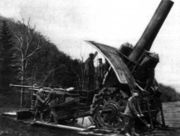
fortifications constructed specifically to stop such an invasion route. During the opening phases of the war, the Germans employed a 420 mm Krupp
Krupp
The Krupp family , a prominent 400-year-old German dynasty from Essen, have become famous for their steel production and for their manufacture of ammunition and armaments. The family business, known as Friedrich Krupp AG Hoesch-Krupp, was the largest company in Europe at the beginning of the 20th...
howitzer
Howitzer
A howitzer is a type of artillery piece characterized by a relatively short barrel and the use of comparatively small propellant charges to propel projectiles at relatively high trajectories, with a steep angle of descent...
(the Big Bertha
Big Bertha (Howitzer)
Big Bertha Bertha") is the name of a type of super-heavy howitzer developed by the famous armaments manufacturer Krupp in Germany on the eve of World War I...
) and two 305 mm Skoda Mörser M. 11
Skoda 305 mm Model 1911
The Škoda 30.5 cm Mörser M. 11 was a siege howitzer produced by Škoda Works and used by the Austro-Hungarian Army during World War I.-Development:...
mortars
Mortar (weapon)
A mortar is an indirect fire weapon that fires explosive projectiles known as bombs at low velocities, short ranges, and high-arcing ballistic trajectories. It is typically muzzle-loading and has a barrel length less than 15 times its caliber....
to reduce the famous fortresses of Liège
Battle of Liège
The Battle of Liège was the opening engagement of the German invasion of Belgium, and the first battle of World War I. The attack on the city began on 5 August 1914 and lasted until the 16th when the last Belgian fort finally surrendered...
and Namur
Namur (city)
Namur is a city and municipality in Wallonia, in southern Belgium. It is both the capital of the province of Namur and of Wallonia....
. Their low overland mobility made them arrive later than the infantry at Liège, so several infantry assaults were made with heavy loss of life and generally little success. The guns arrived a few days later and reduced the fortresses at Liège one-by-one over a short period of a few days.
Larger artillery after this opening period was generally limited to railway gun
Railway gun
A railway gun, also called a railroad gun, is a large artillery piece, often surplus naval ordnance, mounted on, transported by, and fired from a specially designed railway wagon. Many countries have built railway guns, but the best known are the large Krupp-built pieces used by Germany in World...
s, which had much greater mobility, or naval monitors
Monitor (warship)
A monitor was a class of relatively small warship which was neither fast nor strongly armoured but carried disproportionately large guns. They were used by some navies from the 1860s until the end of World War II, and saw their final use by the United States Navy during the Vietnam War.The monitors...
(two of the British Lord Clive class monitor
Lord Clive class monitor
The Lord Clive class, sometimes referred to as the General Wolfe class, of monitors were ships designed for shore bombardment and were constructed for the Royal Navy during the First World War.-Design:...
s were fitted with an 18 inch (457 mm) gun, and HMS General Wolfe
HMS General Wolfe
HMS General Wolfe, also known as Wolfe, was a Lord Clive class monitor which was built in 1915 for shore-bombardment duties in the First World War. Her class of eight ships was armed by four obsolete Majestic class pre-dreadnoughts which had their 12-inch guns and mounts removed, modified and...
fired 33 km (20.5 mi) at a railway bridge in Belgium). All of the major powers involved employed such weapons in limited numbers, typically between 280 and 305 mm (11 to 12 inches) although some larger weapons were also used. The largest of the railway guns deployed in World War I was the Paris Gun
Paris Gun
The Paris Gun was a German long-range siege gun used to bombard Paris during World War I. It was in service from March-August 1918. When it was first employed, Parisians believed they'd been bombed by a new type of high-altitude zeppelin, as neither the sound of an airplane nor a gun could be heard...
, which was used to bombard Paris
Paris
Paris is the capital and largest city in France, situated on the river Seine, in northern France, at the heart of the Île-de-France region...
from a distance of over 130 kilometres (80.8 mi).
Development continued during the inter-war era, although at a more limited pace as aircraft
Aircraft
An aircraft is a vehicle that is able to fly by gaining support from the air, or, in general, the atmosphere of a planet. An aircraft counters the force of gravity by using either static lift or by using the dynamic lift of an airfoil, or in a few cases the downward thrust from jet engines.Although...
were expected to take over in the long-range bombardment role. Nevertheless the Germans built a handful of powerful Krupp K5
Krupp K5
The Krupp 28-cm-Kanone 5 , in short K5, was a heavy railway gun used by Germany throughout World War II.-Description:The Krupp K5 series were consistent in mounting a long gun barrel in a fixed mounting with only vertical elevation of the weapon...
s and the great 800 mm (31.5 in.) Schwerer Gustav
Schwerer Gustav
Schwerer Gustav and Dora were the names of two massive World War II German 80 cm K railway siege guns. They were developed in the late 1930s by Krupp for the express purpose of destroying heavy fortifications, specifically those in the French Maginot Line...
(and Dora). The latter had been designed specifically to defeat the Maginot Line
Maginot Line
The Maginot Line , named after the French Minister of War André Maginot, was a line of concrete fortifications, tank obstacles, artillery casemates, machine gun posts, and other defences, which France constructed along its borders with Germany and Italy, in light of its experience in World War I,...
, firing a 7 ton shell to a range of 37 km (23 mi). Although their original role proved unnecessary, Gustav was used successfully to demolish several heavy fortifications, most notably those at Sevastopol
Sevastopol
Sevastopol is a city on rights of administrative division of Ukraine, located on the Black Sea coast of the Crimea peninsula. It has a population of 342,451 . Sevastopol is the second largest port in Ukraine, after the Port of Odessa....
. Dora was readied for combat at Stalingrad, but was withdrawn before it could be used. Gustav and Dora were the largest artillery pieces (by caliber) ever used in combat. Development may have ended there but for the ever-increasing Allied air power, which limited Hitler's options in terms of re-opening bombing attacks on London
London
London is the capital city of :England and the :United Kingdom, the largest metropolitan area in the United Kingdom, and the largest urban zone in the European Union by most measures. Located on the River Thames, London has been a major settlement for two millennia, its history going back to its...
. This led to the development of the V-3
V-3 cannon
The V-3 was a German World War II supergun working on the multi-charge principle whereby secondary propellant charges are fired to add velocity to a projectile....
"London Gun" or "Hochdruckpumpe", fired from the fortress of Mimoyecques in the Pas de Calais, about 95 miles (152.9 km) away. Two attempts to build underground bunkers for the huge weapons were thwarted by massive Royal Air Force
Royal Air Force
The Royal Air Force is the aerial warfare service branch of the British Armed Forces. Formed on 1 April 1918, it is the oldest independent air force in the world...
bombing raids, which made further attempts futile. Two smaller prototype versions of the gun were used during the Battle of the Bulge
Battle of the Bulge
The Battle of the Bulge was a major German offensive , launched toward the end of World War II through the densely forested Ardennes mountain region of Wallonia in Belgium, hence its French name , and France and...
.
Modern developments
Gerald Bull
Gerald Vincent Bull was a Canadian engineer who developed long-range artillery. He moved from project to project in his quest to launch economically a satellite using a huge artillery piece, to which end he designed the Project Babylon "supergun" for the Iraqi government...
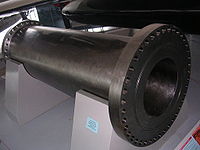
later became interested in the possibility of using superguns in place of rockets to insert payloads into orbit. He started Project HARP
Project HARP
Project HARP, short for High Altitude Research Project, was a joint project of the United States Department of Defense and Canada's Department of National Defence created with the goal of studying ballistics of re-entry vehicles at low cost; whereas most such projects used expensive rockets, HARP...
to investigate this concept. HARP was later cancelled, and Bull turned to military designs, eventually developing the GC-45 howitzer
GC-45 howitzer
The GC-45 is a 155 mm howitzer designed by Gerald Bull's Space Research Corporation in the 1970s. Versions were produced by a number of companies during the 1980s, notably in Austria and South Africa...
. Some years later, Bull interested Saddam Hussein
Saddam Hussein
Saddam Hussein Abd al-Majid al-Tikriti was the fifth President of Iraq, serving in this capacity from 16 July 1979 until 9 April 2003...
in funding Project Babylon
Project Babylon
Project Babylon was a project commissioned by the Iraqi president Saddam Hussein to build a series of superguns. The design was based on research from the 1960s Project HARP led by the Canadian artillery expert Gerald Bull...
. The objective of this project is not certain, but it is thought to have been intended to develop a gun capable of firing an object into orbit
Orbit
In physics, an orbit is the gravitationally curved path of an object around a point in space, for example the orbit of a planet around the center of a star system, such as the Solar System...
, from where it could then drop onto any place on the Earth. Gerald Bull was assassinated, allegedly by Israel
Israel
The State of Israel is a parliamentary republic located in the Middle East, along the eastern shore of the Mediterranean Sea...
i Mossad
Mossad
The Mossad , short for HaMossad leModi'in uleTafkidim Meyuchadim , is the national intelligence agency of Israel....
, terminating development, and the parts were confiscated by British customs after the Gulf War
Gulf War
The Persian Gulf War , commonly referred to as simply the Gulf War, was a war waged by a U.N.-authorized coalition force from 34 nations led by the United States, against Iraq in response to Iraq's invasion and annexation of Kuwait.The war is also known under other names, such as the First Gulf...
.
See also
- Bombard (weapon)Bombard (weapon)A bombard is a large-caliber, muzzle-loading medieval cannon or mortar, used chiefly in sieges for throwing heavy stone balls. The name bombarde was first noted and sketched in a French historical text around 1380. The modern term bombardment derives from this.Bombards were usually used during...
1411 - List of artillery
- List of the largest cannon by caliber
- Paris GunParis GunThe Paris Gun was a German long-range siege gun used to bombard Paris during World War I. It was in service from March-August 1918. When it was first employed, Parisians believed they'd been bombed by a new type of high-altitude zeppelin, as neither the sound of an airplane nor a gun could be heard...
- Super High Altitude Research ProjectSuper High Altitude Research ProjectThe Super High Altitude Research Project was a U.S. government project conducting research into the firing of high-velocity projectiles high into the atmosphere using a two stage light gas gun, with the ultimate goal of propelling satellites into Earth orbit...
- Coriolis effectCoriolis effectIn physics, the Coriolis effect is a deflection of moving objects when they are viewed in a rotating reference frame. In a reference frame with clockwise rotation, the deflection is to the left of the motion of the object; in one with counter-clockwise rotation, the deflection is to the right...
Further reading
- Gerald V. Bull, Charles H. Murphy, Paris Kanonen: The Paris Guns (Wilhelmgeschutze) and Project HARP, E. S. Mittler, Herford, 1988