

.gif)
Ganymede (moon)

Encyclopedia
Ganymede
is a satellite of Jupiter and the largest moon in the Solar System
. It is the seventh moon
and third Galilean satellite
outward from Jupiter
. Completing an orbit
in roughly seven days, Ganymede participates in a 1:2:4 orbital resonance
with the moons Europa
and Io
, respectively. It has a diameter of 5268 km (3,273.4 mi), 8% larger than that of the planet Mercury
, but has only 45% of the latter's mass
. Its diameter is 2% larger than that of Titan
, the second largest moon. It also has the highest mass of all planetary satellites, with 2.02 times the mass of the Earth's moon
.
Ganymede is composed of approximately equal amounts of silicate rock
and water ice. It is a fully differentiated
body with an iron-rich, liquid core. A saltwater ocean is believed to exist nearly 200 km below Ganymede's surface, sandwiched between layers of ice. Its surface is composed of two main types of terrain. Dark regions, saturated with impact crater
s and dated to four billion years ago, cover about a third of the satellite. Lighter regions, crosscut by extensive grooves and ridges and only slightly less ancient, cover the remainder. The cause of the light terrain's disrupted geology is not fully known, but was likely the result of tectonic
activity brought about by tidal heating
.
Ganymede is the only satellite in the Solar System known to possess a magnetosphere
, likely created through convection
within the liquid iron core. The meager magnetosphere is buried within Jupiter's much larger magnetic field
and connected to it through open field line
s. The satellite has a thin oxygen
atmosphere
that includes O, O2, and possibly O3 (ozone
). Atomic hydrogen is a minor atmospheric constituent. Whether the satellite has an ionosphere
associated with its atmosphere is unresolved.
Ganymede's discovery is credited to Galileo Galilei
, who was the first to observe it on January 7, 1610.
The satellite's name was soon suggested by astronomer Simon Marius
, for the mythological Ganymede
, cupbearer of the Greek gods
and Zeus's
lover. Beginning with Pioneer 10
, spacecraft have been able to examine Ganymede closely. The Voyager
probes refined measurements of its size, while the Galileo craft discovered its underground ocean and magnetic field. A new mission to Jupiter's icy moons, the Europa Jupiter System Mission
(EJSM), is proposed for a launch in 2020.
observed what he believed were three stars near Jupiter, including what turned out to be Ganymede, Callisto
, and one body that turned out to be the combined light from Io and Europa; the next night he noticed that they had moved. On January 13, he saw all four at once for the first time, but had seen each of the moons before this date at least once. By January 15, Galileo came to the conclusion that the stars were actually bodies orbiting Jupiter.
He claimed the right to name the moons; he considered "Cosmian Stars" and settled on "Medicean Stars".
The French astronomer Nicolas-Claude Fabri de Peiresc
suggested individual names from the Medici
family for the moons, but his proposal was not taken up. Simon Marius
, who had originally claimed to have found the Galilean satellites, tried to name the moons the "Saturn of Jupiter", the "Jupiter of Jupiter" (this was Ganymede), the "Venus of Jupiter", and the "Mercury of Jupiter", another nomenclature that never caught on. From a suggestion by Johannes Kepler
, Marius once again tried to name the moons:
This name and those of the other Galilean satellites fell into disfavor for a considerable time, and were not in common use until the mid-20th century. In much of the earlier astronomical literature, Ganymede is referred to instead by its Roman numeral designation (a system introduced by Galileo) as or as the "third satellite of Jupiter". Following the discovery of moons of Saturn, a naming system based on that of Kepler and Marius was used for Jupiter's moons. Ganymede is the only Galilean moon of Jupiter named after a male figure — like Io, Europa, and Callisto, he was a lover of Zeus.
According to Chinese astronomical records, in 365 BC, Gan De
discovered a moon of Jupiter with the naked eye, probably Ganymede.
s Jupiter at a distance of 1,070,400 km, third among the Galilean satellites, and completes a revolution every seven days and three hours. Like most known moons, Ganymede is tidally locked
, with one side of the moon always facing toward the planet. Its orbit is very slightly eccentric and inclined to the Jovian equator
, with the eccentricity
and inclination
changing quasi-periodic
ally due to solar and planetary gravitational perturbation
s on a timescale of centuries. The ranges of change are 0.0009–0.0022 and 0.05–0.32°, respectively. These orbital variations cause the axial tilt
(the angle between rotational and orbital axes) to vary between 0 and 0.33°.
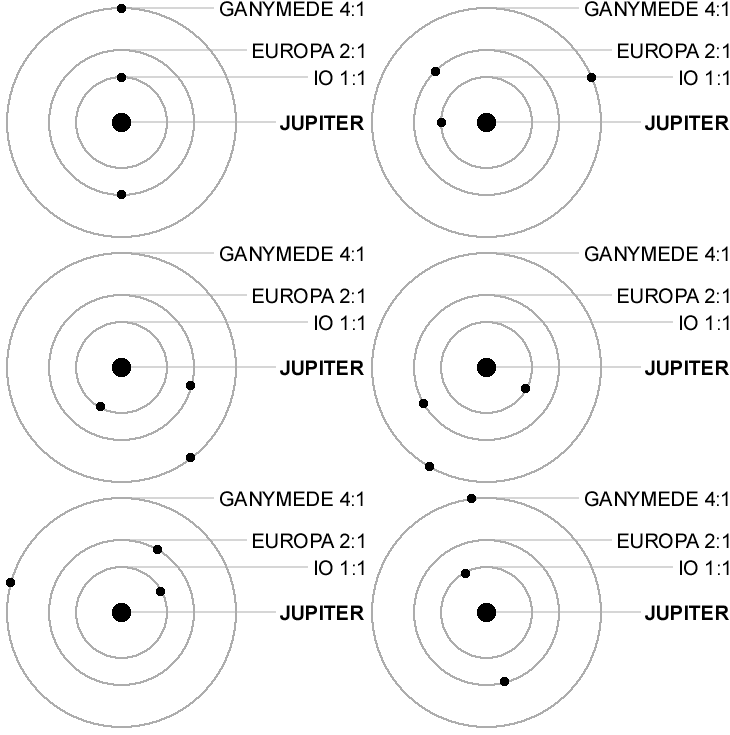 Ganymede participates in orbital resonance
s with Europa and Io: for every orbit of Ganymede, Europa orbits twice and Io orbits four times. The superior conjunction between Io and Europa always occurs when Io is at periapsis and Europa at apoapsis. The superior conjunction between Europa and Ganymede occurs when Europa is at periapsis. The longitudes of the Io–Europa and Europa–Ganymede conjunctions change with the same rate, making the triple conjunctions impossible. Such a complicated resonance is called the Laplace resonance.
The current Laplace resonance is unable to pump the orbital eccentricity of Ganymede to a higher value. The value of about 0.0013 is probably a remnant from a previous epoch, when such pumping was possible. The Ganymedian orbital eccentricity is somewhat puzzling; if it is not pumped now it should have decayed long ago due to the tidal dissipation
in the interior of Ganymede. This means that the last episode of the eccentricity excitation happened only several hundred million years ago. Because the orbital eccentricity of Ganymede is relatively low—0.0015 on average—the tidal heating
of this moon is negligible now. However, in the past Ganymede may have passed through one or more Laplace-like resonances that were able to pump the orbital eccentricity to a value as high as 0.01–0.02. This probably caused a significant tidal heating of the interior of Ganymede; the formation of the grooved terrain may be a result of one or more heating episodes.
There are two hypotheses for the origin of the Laplace resonance among Io, Europa, and Ganymede: that it is primordial and has existed from the beginning of the Solar System; or that it developed after the formation of the Solar System
. A possible sequence of events for the latter scenario is as follows: Io raised tides on Jupiter, causing its orbit to expand until it encountered the 2:1 resonance with Europa; after that the expansion continued, but some of the angular moment
was transferred to Europa as the resonance caused its orbit to expand as well; the process continued until Europa encountered the 2:1 resonance with Ganymede. Eventually the drift rates of conjunctions between all three moons were synchronized and locked in the Laplace resonance.
 The average density
of Ganymede, 1.936 g
/cm3, suggests a composition of approximately equal parts rocky material and water, which is mainly in the form of ice. The mass fraction of ices is between 46–50%, slightly lower than that in Callisto. Some additional volatile ices such as ammonia
may also be present. The exact composition of Ganymede's rock
is not known, but is probably close to the composition of L
/LL type
ordinary chondrite
s, which are characterized by less total iron
, less metallic iron and more iron oxide
than H chondrite
s. The weight ratio of iron to silicon
is 1.05–1.27 in Ganymede, whereas the solar ratio
is around 1.8.
Ganymede's surface has an albedo
of about 43%. Water ice seems to be ubiquitous on the surface, with a mass fraction of 50–90%, significantly more than in Ganymede as a whole. Near-infrared spectroscopy
has revealed the presence of strong water ice absorption band
s at wavelengths of 1.04, 1.25, 1.5, 2.0 and 3.0 μm
. The grooved terrain is brighter and has more icy composition than the dark terrain. The analysis of high-resolution, near-infrared and UV
spectra
obtained by the Galileo spacecraft and from the ground has revealed various non-water materials: carbon dioxide
, sulfur dioxide
and, possibly, cyanogen
, hydrogen sulfate and various organic compound
s. Galileo results have also shown magnesium sulfate
(MgSO4) and, possibly, sodium sulfate
(Na2SO4) on Ganymede's surface. These salts may originate from the subsurface ocean.
The Ganymedian surface is asymmetric; the leading hemisphere—that facing the direction of the orbital motion—is brighter than the trailing one. This is similar to Europa, but the reverse is true for Callisto. The trailing hemisphere of Ganymede appears to be enriched in sulfur dioxide. The distribution of carbon dioxide does not demonstrate any hemispheric asymmetry, although it is not observed near the poles. Impact crater
s on Ganymede (except one) do not show any enrichment in carbon dioxide, which also distinguishes it from Callisto. Ganymede's carbon dioxide levels were probably depleted in the past.
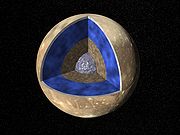 Ganymede appears to be fully differentiated, consisting of an iron sulfide
–iron
core, silicate
mantle
and an outer ice mantle. This model is supported by the low value of its dimensionless moment of inertia
, which was measured during Galileo flybys. In fact, Ganymede has the lowest moment of inertia among the solid Solar System bodies. The existence of a liquid, iron-rich core provides a natural explanation for the intrinsic magnetic field
of Ganymede detected by Galileo. The convection
in the liquid iron, which has high electrical conductivity, is the most reasonable model of magnetic field generation.
The precise thicknesses of the different layers in the interior of Ganymede depend on the assumed composition of silicates (fraction of olivine
and pyroxene
) and amount of sulfur
in the core. The most probable values are 700–900 km for the core radius and 800–1000 km for the thickness of the outer ice mantle, with the remainder being made by the silicate mantle. The density of the core is 5.5–6 g/cm3 and the silicate mantle is 3.4–3.6 g/cm3. Some models of the magnetic field generation require the existence of a solid core made of pure iron inside the liquid Fe–FeS core—similar to the structure of the Earth's core. The radius of this core may be up to 500 km. The temperature in the core of Ganymede is probably 1500–1700 K and pressure up to 10 GPa
.
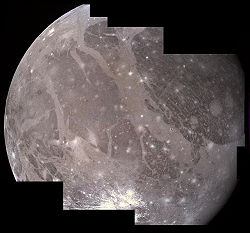 The Ganymedian surface is a mix of two types of terrain: very old, highly cratered
, dark regions and somewhat younger (but still ancient), lighter regions marked with an extensive array of grooves and ridges. The dark terrain, which comprises about one-third of the surface, contains clays and organic materials that could indicate the composition of the impactors from which Jovian satellites accreted.
The heating mechanism required for the formation of the grooved terrain on Ganymede is an unsolved problem in the planetary sciences. The modern view is that the grooved terrain is mainly tectonic in nature. Cryovulcanism is thought to have played only a minor role, if any. The forces that caused the strong stresses in the ganymedian ice lithosphere
necessary to initiate the tectonic activity may be connected to the tidal heating
events in the past, possibly caused when the satellite passed through unstable orbital resonance
s. The tidal flexing of the ice may have heated the interior and strained the lithosphere, leading to the development of cracks and horst and graben
faulting, which erased the old, dark terrain on 70% of the surface. The formation of the grooved terrain may also be connected with the early core formation and subsequent tidal heating of the moon's interior, which may have caused a slight expansion of Ganymede by 1–6% due to phase transition
s in ice and thermal expansion
. During subsequent evolution deep, hot water plume
s may have risen from the core to the surface, leading to the tectonic deformation of the lithosphere. Radiogenic heating
within the satellite is the most relevant current heat source, contributing, for instance, to ocean depth. Research models have found that if the orbital eccentricity were an order of magnitude greater than currently (as it may have been in the past), tidal heating would be a more substantial heat source than radiogenic heating.
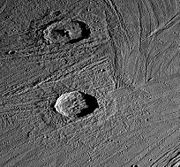 Cratering is seen on both types of terrain, but is especially extensive on the dark terrain: it appears to be saturated with impact craters and has evolved largely through impact events. The brighter, grooved terrain contains many fewer impact features, which have been only of a minor importance to its tectonic evolution. The density of cratering indicates an age of 4 billion years for the dark terrain, similar to the highlands of the Moon
, and a somewhat younger age for the grooved terrain (but how much younger is uncertain). Ganymede may have experienced a period of heavy cratering 3.5 to 4 billion years ago similar to that of the Moon. If true, the vast majority of impacts happened in that epoch, while the cratering rate has been much smaller since. Craters both overlay and are crosscut by the groove systems, indicating that some of the grooves are quite ancient. Relatively young craters with rays of ejecta are also visible. Ganymedian craters are flatter than those on the Moon and Mercury. This is probably due to the relatively weak nature of Ganymede's icy crust, which can (or could) flow and thereby soften the relief. Ancient craters whose relief has disappeared leave only a "ghost" of a crater known as a palimpsest
.
One significant feature on Ganymede is a dark plain named Galileo Regio
, which contains a series of concentric grooves, or furrows, likely created during a period of geologic activity.
Ganymede also has polar caps, likely composed of water frost. The frost extends to 40° latitude. These polar caps were first seen by the Voyager
spacecraft. Theories on the caps' formation include the migration of water to higher latitudes and bombardment of the ice by plasma. Data from Galileo suggests the latter is correct. The presence of a magnetic field on Ganymede results in more intense charged particle bombardment of its surface in the unprotected polar regions; sputtering then leads to redistribution of water molecules, with frost migrating to locally colder areas within the polar terrain.
's Bosscha Observatory
claimed that they had detected a thin atmosphere, around the satellite during an occultation
, when it and Jupiter passed in front of a star. They estimated that the surface pressure was around 0.1 Pa
. However, in 1979 Voyager 1
observed an occultation of a star (κ Centauri
) during its flyby of the planet, with differing results. The occultation measurements were conducted in the far-ultraviolet spectrum at wavelength
s shorter than 200 nm
; they were much more sensitive to the presence of gases than the 1972 measurements in the visible spectrum
. No atmosphere was revealed by the Voyager data. The upper limit on the surface particle number density
was found to be , which corresponds to a surface pressure of less than 2.5 µPa. The latter value is almost five orders of magnitude less than the 1972 estimate.
Despite the Voyager data, evidence for a tenuous oxygen
atmosphere (exosphere
) on Ganymede, very similar to the one found on Europa
, was found by the Hubble Space Telescope
(HST) in 1995. HST actually observed airglow
of atomic oxygen in the far-ultraviolet at the wavelengths 130.4 nm and 135.6 nm. Such an airglow is excited when molecular oxygen is dissociated
by electron impacts, evidence of a significant neutral atmosphere composed predominantly of O2 molecules. The surface number density probably lies in the range, corresponding to the surface pressure of . These values are in agreement with the Voyager' s upper limit set in 1981. The oxygen is not evidence of life; it is thought to be produced when water ice on Ganymede's surface is split into hydrogen
and oxygen by radiation, with the hydrogen then being more rapidly lost due to its low atomic mass. The airglow observed over Ganymede is not spatially homogeneous like that over Europa. HST observed two bright spots located in the northern and southern hemispheres, near ± 50° latitude, which is exactly the boundary between the open and closed field lines of the Ganymedian magnetosphere (see below). The bright spots are probably polar auroras
, caused by plasma precipitation along the open field lines.
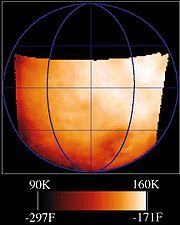 The existence of a neutral atmosphere implies that an ionosphere
should exist, because oxygen molecules are ionized by the impacts of the energetic electron
s coming from the magnetosphere and by solar EUV
radiation. However, the nature of the ganymedian ionosphere is as controversial as the nature of the atmosphere. Some Galileo measurements found an elevated electron density near the moon, suggesting an ionosphere, while others failed to detect anything. The electron density near the surface is estimated by different sources to lie in the range 400–2,500 cm−3. As of 2008, the parameters of the ionosphere of Ganymede are not well constrained.
Additional evidence of the oxygen atmosphere comes from spectral detection of gases trapped in the ice at the surface of Ganymede. The detection of ozone
(O3) bands was announced in 1996. In 1997 spectroscopic analysis revealed the dimer (or diatomic
) absorption features of molecular oxygen. Such an absorption can arise only if the oxygen is in a dense phase. The best candidate is molecular oxygen trapped in ice. The depth of the dimer absorption bands depends on latitude
and longitude
, rather than on surface albedo
—they tend to decrease with increasing latitude on Ganymede, while O3 shows an opposite trend. Laboratory work has found that O2 would not cluster or bubble but dissolve in ice at Ganymede's relatively warm surface temperature of 100 K.
A search for sodium
in the atmosphere, just after such a finding on Europa, turned up nothing in 1997. Sodium is at least 13 times less abundant around Ganymede than around Europa, possibly because of a relative deficiency at the surface or because the magnetosphere fends off energetic particles. Another minor constituent of the Ganymedian atmosphere is atomic hydrogen. Hydrogen atoms were observed as far as 3,000 km from the surface of the moon. Their density on the surface is about .
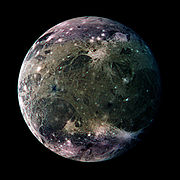 The Galileo craft made six close flybys of Ganymede from 1995–2000 (G1, G2, G7, G8, G28 and G29) and discovered that Ganymede has a permanent (intrinsic) magnetic moment
independent of the Jovian magnetic field. The value of the moment is about , which is three times larger than the magnetic moment of Mercury
. The magnetic dipole is tilted with respect to the rotational axis of Ganymede by 176°, which means that it is directed against the Jovian magnetic moment. Its north pole lies below the orbital plane
. The dipole magnetic field
created by this permanent moment has a strength of 719 ± 2 nT
at the equator of the moon, which should be compared with the Jovian magnetic field at the distance of Ganymede—about 120 nT. The equatorial field of Ganymede is directed against the Jovian field, meaning reconnection
is possible. The intrinsic field strength at the poles is two times that at the equator—1440 nT.
The permanent magnetic moment carves a part of space around Ganymede, creating a tiny magnetosphere
embedded inside that of Jupiter
; it is the only moon in the Solar System known to possess the feature. Its diameter is 4–5 RG (RG = 2,631.2 km). The Ganymedian magnetosphere has a region of closed field line
s located below 30° latitude
, where charged particle
s (electron
s and ion
s) are trapped, creating a kind of radiation belt. The main ion species in the magnetosphere is single ionized oxygen
—O+—which fits well with the tenuous oxygen atmosphere
of the moon. In the polar cap regions, at latitudes higher than 30°, magnetic field lines are open, connecting Ganymede with Jupiter's ionosphere
. In these areas, the energetic (tens and hundreds of kiloelectronvolt) electrons and ions have been detected, which may cause the aurora
s observed around the Ganymedian poles. In addition, heavy ions continuously precipitate on the polar surface of the moon, sputtering
and darkening the ice.
The interaction between the Ganymedian magnetosphere and Jovian plasma
is in many respects similar to that of the solar wind
and Earth's magnetosphere. The plasma co-rotating with Jupiter impinges on the trailing side of the ganymedian magnetosphere much like the solar wind impinges on the Earth's magnetosphere. The main difference is the speed of plasma flow—supersonic
in the case of Earth and subsonic
in the case of Ganymede. Because of the subsonic flow, there is no bow shock
off the trailing hemisphere of Ganymede.
In addition to the intrinsic magnetic moment, Ganymede has an induced dipole magnetic field. Its existence is connected with the variation of the Jovian magnetic field near the moon. The induced moment is directed radially to or from Jupiter following the direction of the varying part of the planetary magnetic field. The induced magnetic moment is an order of magnitude weaker than the intrinsic one. The field strength
of the induced field at the magnetic equator is about 60 nT—half of that of the ambient Jovian field. The induced magnetic field of Ganymede is similar to those of Callisto
and Europa
, indicating that this moon also has a subsurface water ocean with a high electrical conductivity.
Given that Ganymede is completely differentiated and has a metallic core, its intrinsic magnetic field is probably generated in a similar fashion to the Earth's: as a result of conducting material moving in the interior. The magnetic field detected around Ganymede is likely to be caused by compositional convection in the core, if the magnetic field is the product of dynamo action, or magnetoconvection.
Despite the presence of an iron core, Ganymede's magnetosphere remains enigmatic, particularly given that similar bodies lack the feature. Some research has suggested that, given its relatively small size, the core ought to have sufficiently cooled to the point where fluid motions and a magnetic field would not be sustained. One explanation is that the same orbital resonances proposed to have disrupted the surface also allowed the magnetic field to persist: with Ganymede's eccentricity pumped and tidal heating increased during such resonances, the mantle may have insulated the core, preventing it from cooling. Another explanation is a remnant magnetization of silicate rocks in the mantle, which is possible if the satellite had a more significant dynamo-generated field in the past.
in Jupiter's subnebula
, a disk of gas and dust surrounding Jupiter after its formation. The accretion of Ganymede probably took about 10,000 years, much shorter than the 100,000 years estimated for Callisto. The Jovian subnebula may have been relatively "gas-starved" when the Galilean satellites formed; this would have allowed for the lengthy accretion times required for Callisto. In contrast Ganymede formed closer to Jupiter, where the subnebula was denser, which explains its shorter formation timescale. This relatively fast formation prevented the escape of accretional heat, which may have led to ice melt and differentiation
: the separation of the rocks and ice. The rocks settled to the center, forming the core. In this respect, Ganymede is different from Callisto, which apparently failed to melt and differentiate early due to loss of the accretional heat during its slower formation. This hypothesis explains why the two Jovian moons look so dissimilar, despite their similar mass and composition. Alternative theories explain Ganymede's greater internal heating on the basis of tidal flexing or more intense pummeling by impactors during the Late Heavy Bombardment
.
After formation, the Ganymedian core largely retained the heat accumulated during accretion and differentiation, only slowly releasing it to the ice mantle like a kind of thermal battery. The mantle, in turn, transported it to the surface by convection. Soon the decay of radioactive elements within rocks further heated the core, causing increased differentiation: an inner, iron
–iron sulfide
core and a silicate
mantle formed. With this, Ganymede became a fully differentiated body. By comparison, the radioactive heating of undifferentiated Callisto caused convection in its icy interior, which effectively cooled it and prevented large-scale melting of ice and rapid differentiation. The convective motions in Callisto have caused only a partial separation of rock and ice. Today, Ganymede continues to cool slowly. The heat being released from its core and silicate mantle enables the subsurface ocean to exist, while the slow cooling of the liquid Fe–FeS core causes convection and supports magnetic field generation. The current heat flux
out of Ganymede is probably higher than that out of Callisto.
Pioneer 10
approached in 1973 and Pioneer 11
in 1974, and they returned information about the satellite. This included more specific determination on physical characteristics and resolving features to 400 km (248.5 mi) on its surface. Pioneer 10's closest approach was 446,250 km.
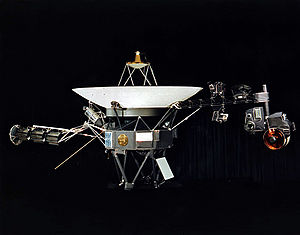 Voyager 1
and Voyager 2
were next, passing by Ganymede in 1979. They refined its size, revealing it was larger than Saturn
's moon Titan
, which was previously thought to have been bigger. The grooved terrain was also seen.
In 1995, the Galileo spacecraft entered orbit around Jupiter and between 1996 and 2000 made six close flybys to explore Ganymede. These flybys are G1, G2, G7, G8, G28 and G29. During the closest flyby—G2—Galileo passed just 264 km from the surface of Ganymede. During a G1 flyby in 1996, the Ganymedian magnetic field was discovered, while the discovery of the ocean was announced in 2001. Galileo transmitted a large number of spectral images and discovered several non-ice compounds on the surface of Ganymede. The most recent spacecraft to explore Ganymede up close was New Horizons
, which passed by in 2007 on its way to Pluto
. New Horizons made topography and composition maps of Ganymede as it sped by.
Proposed for a launch in 2020, the Europa Jupiter System Mission
(EJSM) is a joint NASA
and ESA proposal for exploration of Jupiter
's moons. In February 2009 it was announced that ESA and NASA had given this mission priority ahead of the Titan Saturn System Mission
. ESA's contribution still faces funding competition from other ESA projects. EJSM consists of the NASA-led Jupiter Europa Orbiter
, the ESA-led Jupiter Ganymede Orbiter
, and possibly a JAXA-led Jupiter Magnetospheric Orbiter
.
One canceled proposal to orbit Ganymede was the Jupiter Icy Moons Orbiter
. Nuclear fission
would have been used to power the craft, which would have been able to study Ganymede in detail. However, the mission was canceled in 2005 because of budget cuts. Another old proposal was called The Grandeur of Ganymede.
was a United States Navy
Crater class cargo ship
named after the moon.
is a satellite of Jupiter and the largest moon in the Solar System
Solar System
The Solar System consists of the Sun and the astronomical objects gravitationally bound in orbit around it, all of which formed from the collapse of a giant molecular cloud approximately 4.6 billion years ago. The vast majority of the system's mass is in the Sun...
. It is the seventh moon
Natural satellite
A natural satellite or moon is a celestial body that orbits a planet or smaller body, which is called its primary. The two terms are used synonymously for non-artificial satellites of planets, of dwarf planets, and of minor planets....
and third Galilean satellite
Galilean moons
The Galilean moons are the four moons of Jupiter discovered by Galileo Galilei in January 1610. They are the largest of the many moons of Jupiter and derive their names from the lovers of Zeus: Io, Europa, Ganymede and Callisto. Ganymede, Europa and Io participate in a 1:2:4 orbital resonance...
outward from Jupiter
Jupiter
Jupiter is the fifth planet from the Sun and the largest planet within the Solar System. It is a gas giant with mass one-thousandth that of the Sun but is two and a half times the mass of all the other planets in our Solar System combined. Jupiter is classified as a gas giant along with Saturn,...
. Completing an orbit
Orbit
In physics, an orbit is the gravitationally curved path of an object around a point in space, for example the orbit of a planet around the center of a star system, such as the Solar System...
in roughly seven days, Ganymede participates in a 1:2:4 orbital resonance
Orbital resonance
In celestial mechanics, an orbital resonance occurs when two orbiting bodies exert a regular, periodic gravitational influence on each other, usually due to their orbital periods being related by a ratio of two small integers. Orbital resonances greatly enhance the mutual gravitational influence of...
with the moons Europa
Europa (moon)
Europa Slightly smaller than Earth's Moon, Europa is primarily made of silicate rock and probably has an iron core. It has a tenuous atmosphere composed primarily of oxygen. Its surface is composed of ice and is one of the smoothest in the Solar System. This surface is striated by cracks and...
and Io
Io (moon)
Io ) is the innermost of the four Galilean moons of the planet Jupiter and, with a diameter of , the fourth-largest moon in the Solar System. It was named after the mythological character of Io, a priestess of Hera who became one of the lovers of Zeus....
, respectively. It has a diameter of 5268 km (3,273.4 mi), 8% larger than that of the planet Mercury
Mercury (planet)
Mercury is the innermost and smallest planet in the Solar System, orbiting the Sun once every 87.969 Earth days. The orbit of Mercury has the highest eccentricity of all the Solar System planets, and it has the smallest axial tilt. It completes three rotations about its axis for every two orbits...
, but has only 45% of the latter's mass
Mass
Mass can be defined as a quantitive measure of the resistance an object has to change in its velocity.In physics, mass commonly refers to any of the following three properties of matter, which have been shown experimentally to be equivalent:...
. Its diameter is 2% larger than that of Titan
Titan (moon)
Titan , or Saturn VI, is the largest moon of Saturn, the only natural satellite known to have a dense atmosphere, and the only object other than Earth for which clear evidence of stable bodies of surface liquid has been found....
, the second largest moon. It also has the highest mass of all planetary satellites, with 2.02 times the mass of the Earth's moon
Moon
The Moon is Earth's only known natural satellite,There are a number of near-Earth asteroids including 3753 Cruithne that are co-orbital with Earth: their orbits bring them close to Earth for periods of time but then alter in the long term . These are quasi-satellites and not true moons. For more...
.
Ganymede is composed of approximately equal amounts of silicate rock
Silicate
A silicate is a compound containing a silicon bearing anion. The great majority of silicates are oxides, but hexafluorosilicate and other anions are also included. This article focuses mainly on the Si-O anions. Silicates comprise the majority of the earth's crust, as well as the other...
and water ice. It is a fully differentiated
Planetary differentiation
In planetary science, planetary differentiation is the process of separating out different constituents of a planetary body as a consequence of their physical or chemical behaviour, where the body develops into compositionally distinct layers; the denser materials of a planet sink to the center,...
body with an iron-rich, liquid core. A saltwater ocean is believed to exist nearly 200 km below Ganymede's surface, sandwiched between layers of ice. Its surface is composed of two main types of terrain. Dark regions, saturated with impact crater
Impact crater
In the broadest sense, the term impact crater can be applied to any depression, natural or manmade, resulting from the high velocity impact of a projectile with a larger body...
s and dated to four billion years ago, cover about a third of the satellite. Lighter regions, crosscut by extensive grooves and ridges and only slightly less ancient, cover the remainder. The cause of the light terrain's disrupted geology is not fully known, but was likely the result of tectonic
Tectonics
Tectonics is a field of study within geology concerned generally with the structures within the lithosphere of the Earth and particularly with the forces and movements that have operated in a region to create these structures.Tectonics is concerned with the orogenies and tectonic development of...
activity brought about by tidal heating
Tidal heating
Tidal heating occurs through the tidal friction processes: orbital and rotational energy are dissipated as heat in the crust of the moons and planets involved. Io, a moon of Jupiter, is the most volcanically active body in the solar system, with no impact craters surviving on its surface...
.
Ganymede is the only satellite in the Solar System known to possess a magnetosphere
Magnetosphere
A magnetosphere is formed when a stream of charged particles, such as the solar wind, interacts with and is deflected by the intrinsic magnetic field of a planet or similar body. Earth is surrounded by a magnetosphere, as are the other planets with intrinsic magnetic fields: Mercury, Jupiter,...
, likely created through convection
Convection
Convection is the movement of molecules within fluids and rheids. It cannot take place in solids, since neither bulk current flows nor significant diffusion can take place in solids....
within the liquid iron core. The meager magnetosphere is buried within Jupiter's much larger magnetic field
Magnetic field
A magnetic field is a mathematical description of the magnetic influence of electric currents and magnetic materials. The magnetic field at any given point is specified by both a direction and a magnitude ; as such it is a vector field.Technically, a magnetic field is a pseudo vector;...
and connected to it through open field line
Field line
A field line is a locus that is defined by a vector field and a starting location within the field. Field lines are useful for visualizing vector fields, which are otherwise hard to depict...
s. The satellite has a thin oxygen
Oxygen
Oxygen is the element with atomic number 8 and represented by the symbol O. Its name derives from the Greek roots ὀξύς and -γενής , because at the time of naming, it was mistakenly thought that all acids required oxygen in their composition...
atmosphere
Atmosphere
An atmosphere is a layer of gases that may surround a material body of sufficient mass, and that is held in place by the gravity of the body. An atmosphere may be retained for a longer duration, if the gravity is high and the atmosphere's temperature is low...
that includes O, O2, and possibly O3 (ozone
Ozone
Ozone , or trioxygen, is a triatomic molecule, consisting of three oxygen atoms. It is an allotrope of oxygen that is much less stable than the diatomic allotrope...
). Atomic hydrogen is a minor atmospheric constituent. Whether the satellite has an ionosphere
Ionosphere
The ionosphere is a part of the upper atmosphere, comprising portions of the mesosphere, thermosphere and exosphere, distinguished because it is ionized by solar radiation. It plays an important part in atmospheric electricity and forms the inner edge of the magnetosphere...
associated with its atmosphere is unresolved.
Ganymede's discovery is credited to Galileo Galilei
Galileo Galilei
Galileo Galilei , was an Italian physicist, mathematician, astronomer, and philosopher who played a major role in the Scientific Revolution. His achievements include improvements to the telescope and consequent astronomical observations and support for Copernicanism...
, who was the first to observe it on January 7, 1610.
The satellite's name was soon suggested by astronomer Simon Marius
Simon Marius
Simon Marius was a German astronomer. He was born in Gunzenhausen, near Nuremberg, but he spent most of his life in the city of Ansbach....
, for the mythological Ganymede
Ganymede (mythology)
In Greek mythology, Ganymede is a divine hero whose homeland was Troy. Homer describes Ganymede as the most beautiful of mortals. In the best-known myth, he is abducted by Zeus, in the form of an eagle, to serve as cup-bearer in Olympus. Some interpretations of the myth treat it as an allegory of...
, cupbearer of the Greek gods
Greek mythology
Greek mythology is the body of myths and legends belonging to the ancient Greeks, concerning their gods and heroes, the nature of the world, and the origins and significance of their own cult and ritual practices. They were a part of religion in ancient Greece...
and Zeus's
Zeus
In the ancient Greek religion, Zeus was the "Father of Gods and men" who ruled the Olympians of Mount Olympus as a father ruled the family. He was the god of sky and thunder in Greek mythology. His Roman counterpart is Jupiter and his Etruscan counterpart is Tinia.Zeus was the child of Cronus...
lover. Beginning with Pioneer 10
Pioneer 10
Pioneer 10 is a 258-kilogram robotic space probe that completed the first interplanetary mission to Jupiter, and became the first spacecraft to achieve escape velocity from the Solar System. The project was managed by the NASA Ames Research Center and the contract for the construction of the...
, spacecraft have been able to examine Ganymede closely. The Voyager
Voyager program
The Voyager program is a U.S program that launched two unmanned space missions, scientific probes Voyager 1 and Voyager 2. They were launched in 1977 to take advantage of a favorable planetary alignment of the late 1970s...
probes refined measurements of its size, while the Galileo craft discovered its underground ocean and magnetic field. A new mission to Jupiter's icy moons, the Europa Jupiter System Mission
Europa Jupiter System Mission
The Europa Jupiter System Mission – Laplace was a proposed joint NASA/ESA unmanned space mission slated to launch around 2020 for the in-depth exploration of Jupiter's moons with a focus on Europa, Ganymede and Jupiter's magnetosphere...
(EJSM), is proposed for a launch in 2020.
Discovery and naming
On January 7, 1610, Galileo GalileiGalileo Galilei
Galileo Galilei , was an Italian physicist, mathematician, astronomer, and philosopher who played a major role in the Scientific Revolution. His achievements include improvements to the telescope and consequent astronomical observations and support for Copernicanism...
observed what he believed were three stars near Jupiter, including what turned out to be Ganymede, Callisto
Callisto (moon)
Callisto named after the Greek mythological figure of Callisto) is a moon of the planet Jupiter. It was discovered in 1610 by Galileo Galilei. It is the third-largest moon in the Solar System and the second largest in the Jovian system, after Ganymede. Callisto has about 99% the diameter of the...
, and one body that turned out to be the combined light from Io and Europa; the next night he noticed that they had moved. On January 13, he saw all four at once for the first time, but had seen each of the moons before this date at least once. By January 15, Galileo came to the conclusion that the stars were actually bodies orbiting Jupiter.
He claimed the right to name the moons; he considered "Cosmian Stars" and settled on "Medicean Stars".
The French astronomer Nicolas-Claude Fabri de Peiresc
Nicolas-Claude Fabri de Peiresc
Nicolas-Claude Fabri de Peiresc was a French astronomer, antiquary and savant who maintained a wide correspondence with scientists and was a successful organizer of scientific inquiry...
suggested individual names from the Medici
Medici
The House of Medici or Famiglia de' Medici was a political dynasty, banking family and later royal house that first began to gather prominence under Cosimo de' Medici in the Republic of Florence during the late 14th century. The family originated in the Mugello region of the Tuscan countryside,...
family for the moons, but his proposal was not taken up. Simon Marius
Simon Marius
Simon Marius was a German astronomer. He was born in Gunzenhausen, near Nuremberg, but he spent most of his life in the city of Ansbach....
, who had originally claimed to have found the Galilean satellites, tried to name the moons the "Saturn of Jupiter", the "Jupiter of Jupiter" (this was Ganymede), the "Venus of Jupiter", and the "Mercury of Jupiter", another nomenclature that never caught on. From a suggestion by Johannes Kepler
Johannes Kepler
Johannes Kepler was a German mathematician, astronomer and astrologer. A key figure in the 17th century scientific revolution, he is best known for his eponymous laws of planetary motion, codified by later astronomers, based on his works Astronomia nova, Harmonices Mundi, and Epitome of Copernican...
, Marius once again tried to name the moons:
This name and those of the other Galilean satellites fell into disfavor for a considerable time, and were not in common use until the mid-20th century. In much of the earlier astronomical literature, Ganymede is referred to instead by its Roman numeral designation (a system introduced by Galileo) as or as the "third satellite of Jupiter". Following the discovery of moons of Saturn, a naming system based on that of Kepler and Marius was used for Jupiter's moons. Ganymede is the only Galilean moon of Jupiter named after a male figure — like Io, Europa, and Callisto, he was a lover of Zeus.
According to Chinese astronomical records, in 365 BC, Gan De
Gan De
Gan De was a Chinese astronomer/astrologer born in the State of Qi also known as the Lord Gan . Along with Shi Shen, he is believed to be the first in history known by name to compile a star catalogue, preceded by the anonymous authors of the early Babylonian star catalogues and followed by the...
discovered a moon of Jupiter with the naked eye, probably Ganymede.
Orbit and rotation
Ganymede orbitOrbit
In physics, an orbit is the gravitationally curved path of an object around a point in space, for example the orbit of a planet around the center of a star system, such as the Solar System...
s Jupiter at a distance of 1,070,400 km, third among the Galilean satellites, and completes a revolution every seven days and three hours. Like most known moons, Ganymede is tidally locked
Tidal locking
Tidal locking occurs when the gravitational gradient makes one side of an astronomical body always face another; for example, the same side of the Earth's Moon always faces the Earth. A tidally locked body takes just as long to rotate around its own axis as it does to revolve around its partner...
, with one side of the moon always facing toward the planet. Its orbit is very slightly eccentric and inclined to the Jovian equator
Equator
An equator is the intersection of a sphere's surface with the plane perpendicular to the sphere's axis of rotation and containing the sphere's center of mass....
, with the eccentricity
Orbital eccentricity
The orbital eccentricity of an astronomical body is the amount by which its orbit deviates from a perfect circle, where 0 is perfectly circular, and 1.0 is a parabola, and no longer a closed orbit...
and inclination
Inclination
Inclination in general is the angle between a reference plane and another plane or axis of direction.-Orbits:The inclination is one of the six orbital parameters describing the shape and orientation of a celestial orbit...
changing quasi-periodic
Almost periodic function
In mathematics, an almost periodic function is, loosely speaking, a function of a real number that is periodic to within any desired level of accuracy, given suitably long, well-distributed "almost-periods". The concept was first studied by Harald Bohr and later generalized by Vyacheslav Stepanov,...
ally due to solar and planetary gravitational perturbation
Perturbation (astronomy)
Perturbation is a term used in astronomy in connection with descriptions of the complex motion of a massive body which is subject to appreciable gravitational effects from more than one other massive body....
s on a timescale of centuries. The ranges of change are 0.0009–0.0022 and 0.05–0.32°, respectively. These orbital variations cause the axial tilt
Axial tilt
In astronomy, axial tilt is the angle between an object's rotational axis, and a line perpendicular to its orbital plane...
(the angle between rotational and orbital axes) to vary between 0 and 0.33°.
Orbital resonance
In celestial mechanics, an orbital resonance occurs when two orbiting bodies exert a regular, periodic gravitational influence on each other, usually due to their orbital periods being related by a ratio of two small integers. Orbital resonances greatly enhance the mutual gravitational influence of...
s with Europa and Io: for every orbit of Ganymede, Europa orbits twice and Io orbits four times. The superior conjunction between Io and Europa always occurs when Io is at periapsis and Europa at apoapsis. The superior conjunction between Europa and Ganymede occurs when Europa is at periapsis. The longitudes of the Io–Europa and Europa–Ganymede conjunctions change with the same rate, making the triple conjunctions impossible. Such a complicated resonance is called the Laplace resonance.
The current Laplace resonance is unable to pump the orbital eccentricity of Ganymede to a higher value. The value of about 0.0013 is probably a remnant from a previous epoch, when such pumping was possible. The Ganymedian orbital eccentricity is somewhat puzzling; if it is not pumped now it should have decayed long ago due to the tidal dissipation
Dissipation
In physics, dissipation embodies the concept of a dynamical system where important mechanical models, such as waves or oscillations, lose energy over time, typically from friction or turbulence. The lost energy converts into heat, which raises the temperature of the system. Such systems are called...
in the interior of Ganymede. This means that the last episode of the eccentricity excitation happened only several hundred million years ago. Because the orbital eccentricity of Ganymede is relatively low—0.0015 on average—the tidal heating
Tidal heating
Tidal heating occurs through the tidal friction processes: orbital and rotational energy are dissipated as heat in the crust of the moons and planets involved. Io, a moon of Jupiter, is the most volcanically active body in the solar system, with no impact craters surviving on its surface...
of this moon is negligible now. However, in the past Ganymede may have passed through one or more Laplace-like resonances that were able to pump the orbital eccentricity to a value as high as 0.01–0.02. This probably caused a significant tidal heating of the interior of Ganymede; the formation of the grooved terrain may be a result of one or more heating episodes.
There are two hypotheses for the origin of the Laplace resonance among Io, Europa, and Ganymede: that it is primordial and has existed from the beginning of the Solar System; or that it developed after the formation of the Solar System
Formation and evolution of the Solar System
The formation and evolution of the Solar System is estimated to have begun 4.568 billion years ago with the gravitational collapse of a small part of a giant molecular cloud...
. A possible sequence of events for the latter scenario is as follows: Io raised tides on Jupiter, causing its orbit to expand until it encountered the 2:1 resonance with Europa; after that the expansion continued, but some of the angular moment
Moment (physics)
In physics, the term moment can refer to many different concepts:*Moment of force is the tendency of a force to twist or rotate an object; see the article torque for details. This is an important, basic concept in engineering and physics. A moment is valued mathematically as the product of the...
was transferred to Europa as the resonance caused its orbit to expand as well; the process continued until Europa encountered the 2:1 resonance with Ganymede. Eventually the drift rates of conjunctions between all three moons were synchronized and locked in the Laplace resonance.
Composition
Density
The mass density or density of a material is defined as its mass per unit volume. The symbol most often used for density is ρ . In some cases , density is also defined as its weight per unit volume; although, this quantity is more properly called specific weight...
of Ganymede, 1.936 g
Gram
The gram is a metric system unit of mass....
/cm3, suggests a composition of approximately equal parts rocky material and water, which is mainly in the form of ice. The mass fraction of ices is between 46–50%, slightly lower than that in Callisto. Some additional volatile ices such as ammonia
Ammonia
Ammonia is a compound of nitrogen and hydrogen with the formula . It is a colourless gas with a characteristic pungent odour. Ammonia contributes significantly to the nutritional needs of terrestrial organisms by serving as a precursor to food and fertilizers. Ammonia, either directly or...
may also be present. The exact composition of Ganymede's rock
Rock (geology)
In geology, rock or stone is a naturally occurring solid aggregate of minerals and/or mineraloids.The Earth's outer solid layer, the lithosphere, is made of rock. In general rocks are of three types, namely, igneous, sedimentary, and metamorphic...
is not known, but is probably close to the composition of L
L chondrite
The L type ordinary chondrites are the second most common type of meteorite, accounting for approximately 35% of all those catalogued, and 40% of the ordinary chondrites....
/LL type
LL chondrite
The LL chondrites are a class of stony meteorites, the least abundant group of the ordinary chondrites, accounting for about 10–11% of observed ordinary-chondrite falls and 8–9% of all meteorite falls ....
ordinary chondrite
Ordinary chondrite
The Ordinary chondrites are a class of stony chondritic meteorites. They are by far the most numerous group and comprise about 87% of all finds...
s, which are characterized by less total iron
Iron
Iron is a chemical element with the symbol Fe and atomic number 26. It is a metal in the first transition series. It is the most common element forming the planet Earth as a whole, forming much of Earth's outer and inner core. It is the fourth most common element in the Earth's crust...
, less metallic iron and more iron oxide
Iron oxide
Iron oxides are chemical compounds composed of iron and oxygen. All together, there are sixteen known iron oxides and oxyhydroxides.Iron oxides and oxide-hydroxides are widespread in nature, play an important role in many geological and biological processes, and are widely utilized by humans, e.g.,...
than H chondrite
H chondrite
The H type ordinary chondrites are the most common type of meteorite, accounting for approximately 40% of all those catalogued, 46% of the ordinary chondrites, and 44% of the chondrites....
s. The weight ratio of iron to silicon
Silicon
Silicon is a chemical element with the symbol Si and atomic number 14. A tetravalent metalloid, it is less reactive than its chemical analog carbon, the nonmetal directly above it in the periodic table, but more reactive than germanium, the metalloid directly below it in the table...
is 1.05–1.27 in Ganymede, whereas the solar ratio
Sun
The Sun is the star at the center of the Solar System. It is almost perfectly spherical and consists of hot plasma interwoven with magnetic fields...
is around 1.8.
Ganymede's surface has an albedo
Albedo
Albedo , or reflection coefficient, is the diffuse reflectivity or reflecting power of a surface. It is defined as the ratio of reflected radiation from the surface to incident radiation upon it...
of about 43%. Water ice seems to be ubiquitous on the surface, with a mass fraction of 50–90%, significantly more than in Ganymede as a whole. Near-infrared spectroscopy
Spectroscopy
Spectroscopy is the study of the interaction between matter and radiated energy. Historically, spectroscopy originated through the study of visible light dispersed according to its wavelength, e.g., by a prism. Later the concept was expanded greatly to comprise any interaction with radiative...
has revealed the presence of strong water ice absorption band
Absorption band
An absorption band is a range of wavelengths, frequencies or energies in the electromagnetic spectrum which are able to excite a particular transition in a substance...
s at wavelengths of 1.04, 1.25, 1.5, 2.0 and 3.0 μm
Micrometre
A micrometer , is by definition 1×10⁻⁶ of a meter .In plain English, it means one-millionth of a meter . Its unit symbol in the International System of Units is μm...
. The grooved terrain is brighter and has more icy composition than the dark terrain. The analysis of high-resolution, near-infrared and UV
Ultraviolet
Ultraviolet light is electromagnetic radiation with a wavelength shorter than that of visible light, but longer than X-rays, in the range 10 nm to 400 nm, and energies from 3 eV to 124 eV...
spectra
Spectrum
A spectrum is a condition that is not limited to a specific set of values but can vary infinitely within a continuum. The word saw its first scientific use within the field of optics to describe the rainbow of colors in visible light when separated using a prism; it has since been applied by...
obtained by the Galileo spacecraft and from the ground has revealed various non-water materials: carbon dioxide
Carbon dioxide
Carbon dioxide is a naturally occurring chemical compound composed of two oxygen atoms covalently bonded to a single carbon atom...
, sulfur dioxide
Sulfur dioxide
Sulfur dioxide is the chemical compound with the formula . It is released by volcanoes and in various industrial processes. Since coal and petroleum often contain sulfur compounds, their combustion generates sulfur dioxide unless the sulfur compounds are removed before burning the fuel...
and, possibly, cyanogen
Cyanogen
Cyanogen is the chemical compound with the formula 2. It is a colorless, toxic gas with a pungent odor.The molecule is a pseudohalogen. Cyanogen molecules consist of two CN groups — analogous to diatomic halogen molecules, such as Cl2, but far less oxidizing...
, hydrogen sulfate and various organic compound
Organic compound
An organic compound is any member of a large class of gaseous, liquid, or solid chemical compounds whose molecules contain carbon. For historical reasons discussed below, a few types of carbon-containing compounds such as carbides, carbonates, simple oxides of carbon, and cyanides, as well as the...
s. Galileo results have also shown magnesium sulfate
Magnesium sulfate
Magnesium sulfate is a chemical compound containing magnesium, sulfur and oxygen, with the formula MgSO4. It is often encountered as the heptahydrate epsomite , commonly called Epsom salt, from the town of Epsom in Surrey, England, where the salt was distilled from the springs that arise where the...
(MgSO4) and, possibly, sodium sulfate
Sodium sulfate
Sodium sulfate is the sodium salt of sulfuric acid. When anhydrous, it is a white crystalline solid of formula Na2SO4 known as the mineral thenardite; the decahydrate Na2SO4·10H2O has been known as Glauber's salt or, historically, sal mirabilis since the 17th century. Another solid is the...
(Na2SO4) on Ganymede's surface. These salts may originate from the subsurface ocean.
The Ganymedian surface is asymmetric; the leading hemisphere—that facing the direction of the orbital motion—is brighter than the trailing one. This is similar to Europa, but the reverse is true for Callisto. The trailing hemisphere of Ganymede appears to be enriched in sulfur dioxide. The distribution of carbon dioxide does not demonstrate any hemispheric asymmetry, although it is not observed near the poles. Impact crater
Impact crater
In the broadest sense, the term impact crater can be applied to any depression, natural or manmade, resulting from the high velocity impact of a projectile with a larger body...
s on Ganymede (except one) do not show any enrichment in carbon dioxide, which also distinguishes it from Callisto. Ganymede's carbon dioxide levels were probably depleted in the past.
Internal structure
Iron(II) sulfide
Iron sulfide or ferrous sulfide is a chemical compound with the formula . In practice, iron sulfides are often non-stoichiometric. Powdered iron sulfide is pyrophoric Iron(II) sulfide or ferrous sulfide (Br.E. sulphide) is a chemical compound with the formula . In practice, iron sulfides are...
–iron
Iron
Iron is a chemical element with the symbol Fe and atomic number 26. It is a metal in the first transition series. It is the most common element forming the planet Earth as a whole, forming much of Earth's outer and inner core. It is the fourth most common element in the Earth's crust...
core, silicate
Silicate
A silicate is a compound containing a silicon bearing anion. The great majority of silicates are oxides, but hexafluorosilicate and other anions are also included. This article focuses mainly on the Si-O anions. Silicates comprise the majority of the earth's crust, as well as the other...
mantle
Mantle (geology)
The mantle is a part of a terrestrial planet or other rocky body large enough to have differentiation by density. The interior of the Earth, similar to the other terrestrial planets, is chemically divided into layers. The mantle is a highly viscous layer between the crust and the outer core....
and an outer ice mantle. This model is supported by the low value of its dimensionless moment of inertia
Moment of inertia
In classical mechanics, moment of inertia, also called mass moment of inertia, rotational inertia, polar moment of inertia of mass, or the angular mass, is a measure of an object's resistance to changes to its rotation. It is the inertia of a rotating body with respect to its rotation...
, which was measured during Galileo flybys. In fact, Ganymede has the lowest moment of inertia among the solid Solar System bodies. The existence of a liquid, iron-rich core provides a natural explanation for the intrinsic magnetic field
Magnetosphere
A magnetosphere is formed when a stream of charged particles, such as the solar wind, interacts with and is deflected by the intrinsic magnetic field of a planet or similar body. Earth is surrounded by a magnetosphere, as are the other planets with intrinsic magnetic fields: Mercury, Jupiter,...
of Ganymede detected by Galileo. The convection
Convection
Convection is the movement of molecules within fluids and rheids. It cannot take place in solids, since neither bulk current flows nor significant diffusion can take place in solids....
in the liquid iron, which has high electrical conductivity, is the most reasonable model of magnetic field generation.
The precise thicknesses of the different layers in the interior of Ganymede depend on the assumed composition of silicates (fraction of olivine
Olivine
The mineral olivine is a magnesium iron silicate with the formula 2SiO4. It is a common mineral in the Earth's subsurface but weathers quickly on the surface....
and pyroxene
Pyroxene
The pyroxenes are a group of important rock-forming inosilicate minerals found in many igneous and metamorphic rocks. They share a common structure consisting of single chains of silica tetrahedra and they crystallize in the monoclinic and orthorhombic systems...
) and amount of sulfur
Sulfur
Sulfur or sulphur is the chemical element with atomic number 16. In the periodic table it is represented by the symbol S. It is an abundant, multivalent non-metal. Under normal conditions, sulfur atoms form cyclic octatomic molecules with chemical formula S8. Elemental sulfur is a bright yellow...
in the core. The most probable values are 700–900 km for the core radius and 800–1000 km for the thickness of the outer ice mantle, with the remainder being made by the silicate mantle. The density of the core is 5.5–6 g/cm3 and the silicate mantle is 3.4–3.6 g/cm3. Some models of the magnetic field generation require the existence of a solid core made of pure iron inside the liquid Fe–FeS core—similar to the structure of the Earth's core. The radius of this core may be up to 500 km. The temperature in the core of Ganymede is probably 1500–1700 K and pressure up to 10 GPa
Pascal (unit)
The pascal is the SI derived unit of pressure, internal pressure, stress, Young's modulus and tensile strength, named after the French mathematician, physicist, inventor, writer, and philosopher Blaise Pascal. It is a measure of force per unit area, defined as one newton per square metre...
.
Surface features
Impact crater
In the broadest sense, the term impact crater can be applied to any depression, natural or manmade, resulting from the high velocity impact of a projectile with a larger body...
, dark regions and somewhat younger (but still ancient), lighter regions marked with an extensive array of grooves and ridges. The dark terrain, which comprises about one-third of the surface, contains clays and organic materials that could indicate the composition of the impactors from which Jovian satellites accreted.
The heating mechanism required for the formation of the grooved terrain on Ganymede is an unsolved problem in the planetary sciences. The modern view is that the grooved terrain is mainly tectonic in nature. Cryovulcanism is thought to have played only a minor role, if any. The forces that caused the strong stresses in the ganymedian ice lithosphere
Lithosphere
The lithosphere is the rigid outermost shell of a rocky planet. On Earth, it comprises the crust and the portion of the upper mantle that behaves elastically on time scales of thousands of years or greater.- Earth's lithosphere :...
necessary to initiate the tectonic activity may be connected to the tidal heating
Tidal heating
Tidal heating occurs through the tidal friction processes: orbital and rotational energy are dissipated as heat in the crust of the moons and planets involved. Io, a moon of Jupiter, is the most volcanically active body in the solar system, with no impact craters surviving on its surface...
events in the past, possibly caused when the satellite passed through unstable orbital resonance
Orbital resonance
In celestial mechanics, an orbital resonance occurs when two orbiting bodies exert a regular, periodic gravitational influence on each other, usually due to their orbital periods being related by a ratio of two small integers. Orbital resonances greatly enhance the mutual gravitational influence of...
s. The tidal flexing of the ice may have heated the interior and strained the lithosphere, leading to the development of cracks and horst and graben
Horst and graben
In geology, horst and graben are terms referring to regions that lie between normal faults and are either above or lower than the area beyond the faults. A horst represents a block pushed upward by the faulting, and a graben is a block that has dropped due to the faulting.-See also:* Horst *...
faulting, which erased the old, dark terrain on 70% of the surface. The formation of the grooved terrain may also be connected with the early core formation and subsequent tidal heating of the moon's interior, which may have caused a slight expansion of Ganymede by 1–6% due to phase transition
Phase transition
A phase transition is the transformation of a thermodynamic system from one phase or state of matter to another.A phase of a thermodynamic system and the states of matter have uniform physical properties....
s in ice and thermal expansion
Thermal expansion
Thermal expansion is the tendency of matter to change in volume in response to a change in temperature.When a substance is heated, its particles begin moving more and thus usually maintain a greater average separation. Materials which contract with increasing temperature are rare; this effect is...
. During subsequent evolution deep, hot water plume
Plume (hydrodynamics)
In hydrodynamics, a plume is a column of one fluid or gas moving through another. Several effects control the motion of the fluid, including momentum, diffusion, and buoyancy...
s may have risen from the core to the surface, leading to the tectonic deformation of the lithosphere. Radiogenic heating
Radioactive decay
Radioactive decay is the process by which an atomic nucleus of an unstable atom loses energy by emitting ionizing particles . The emission is spontaneous, in that the atom decays without any physical interaction with another particle from outside the atom...
within the satellite is the most relevant current heat source, contributing, for instance, to ocean depth. Research models have found that if the orbital eccentricity were an order of magnitude greater than currently (as it may have been in the past), tidal heating would be a more substantial heat source than radiogenic heating.
Moon
The Moon is Earth's only known natural satellite,There are a number of near-Earth asteroids including 3753 Cruithne that are co-orbital with Earth: their orbits bring them close to Earth for periods of time but then alter in the long term . These are quasi-satellites and not true moons. For more...
, and a somewhat younger age for the grooved terrain (but how much younger is uncertain). Ganymede may have experienced a period of heavy cratering 3.5 to 4 billion years ago similar to that of the Moon. If true, the vast majority of impacts happened in that epoch, while the cratering rate has been much smaller since. Craters both overlay and are crosscut by the groove systems, indicating that some of the grooves are quite ancient. Relatively young craters with rays of ejecta are also visible. Ganymedian craters are flatter than those on the Moon and Mercury. This is probably due to the relatively weak nature of Ganymede's icy crust, which can (or could) flow and thereby soften the relief. Ancient craters whose relief has disappeared leave only a "ghost" of a crater known as a palimpsest
Palimpsest (planetary astronomy)
A palimpsest, in planetary astronomy, is an ancient crater on an icy moon of the outer Solar System whose relief has disappeared due to creep of the icy surface or subsequent cryovolcanic outpourings, leaving a circular albedo feature, perhaps with a "ghost" of a rim...
.
One significant feature on Ganymede is a dark plain named Galileo Regio
Galileo Regio
Galileo Regio is a large, dark surface feature on Jupiter's moon Ganymede.Contrary to the first impression, Galileo Regio is not an impact crater but a region of ancient dark material that has been broken apart by tectonism and is now surrounded by younger, brighter material that has been upwelling...
, which contains a series of concentric grooves, or furrows, likely created during a period of geologic activity.
Ganymede also has polar caps, likely composed of water frost. The frost extends to 40° latitude. These polar caps were first seen by the Voyager
Voyager program
The Voyager program is a U.S program that launched two unmanned space missions, scientific probes Voyager 1 and Voyager 2. They were launched in 1977 to take advantage of a favorable planetary alignment of the late 1970s...
spacecraft. Theories on the caps' formation include the migration of water to higher latitudes and bombardment of the ice by plasma. Data from Galileo suggests the latter is correct. The presence of a magnetic field on Ganymede results in more intense charged particle bombardment of its surface in the unprotected polar regions; sputtering then leads to redistribution of water molecules, with frost migrating to locally colder areas within the polar terrain.
Atmosphere and ionosphere
In 1972, a team of Indian, British and American astronomers working at IndonesiaIndonesia
Indonesia , officially the Republic of Indonesia , is a country in Southeast Asia and Oceania. Indonesia is an archipelago comprising approximately 13,000 islands. It has 33 provinces with over 238 million people, and is the world's fourth most populous country. Indonesia is a republic, with an...
's Bosscha Observatory
Bosscha Observatory
Bosscha Observatory is the oldest observatory in Indonesia. The observatory is located in Lembang, West Java, approximately north of Bandung. It is situated on a hilly six hectares of land and is above mean sea level plateau...
claimed that they had detected a thin atmosphere, around the satellite during an occultation
Occultation
An occultation is an event that occurs when one object is hidden by another object that passes between it and the observer. The word is used in astronomy . It can also refer to any situation wherein an object in the foreground blocks from view an object in the background...
, when it and Jupiter passed in front of a star. They estimated that the surface pressure was around 0.1 Pa
Pascal (unit)
The pascal is the SI derived unit of pressure, internal pressure, stress, Young's modulus and tensile strength, named after the French mathematician, physicist, inventor, writer, and philosopher Blaise Pascal. It is a measure of force per unit area, defined as one newton per square metre...
. However, in 1979 Voyager 1
Voyager 1
The Voyager 1 spacecraft is a 722-kilogram space probe launched by NASA in 1977, to study the outer Solar System and eventually interstellar space. Operating for as of today , the spacecraft receives routine commands and transmits data back to the Deep Space Network. At a distance of as of...
observed an occultation of a star (κ Centauri
Kappa Centauri
Kappa Centauri is a binary star in the constellation Centaurus. It is approximately 540 light years from the Earth....
) during its flyby of the planet, with differing results. The occultation measurements were conducted in the far-ultraviolet spectrum at wavelength
Wavelength
In physics, the wavelength of a sinusoidal wave is the spatial period of the wave—the distance over which the wave's shape repeats.It is usually determined by considering the distance between consecutive corresponding points of the same phase, such as crests, troughs, or zero crossings, and is a...
s shorter than 200 nm
Nanometre
A nanometre is a unit of length in the metric system, equal to one billionth of a metre. The name combines the SI prefix nano- with the parent unit name metre .The nanometre is often used to express dimensions on the atomic scale: the diameter...
; they were much more sensitive to the presence of gases than the 1972 measurements in the visible spectrum
Visible spectrum
The visible spectrum is the portion of the electromagnetic spectrum that is visible to the human eye. Electromagnetic radiation in this range of wavelengths is called visible light or simply light. A typical human eye will respond to wavelengths from about 390 to 750 nm. In terms of...
. No atmosphere was revealed by the Voyager data. The upper limit on the surface particle number density
Number density
In physics, astronomy, and chemistry, number density is an intensive quantity used to describe the degree of concentration of countable objects in the three-dimensional physical space...
was found to be , which corresponds to a surface pressure of less than 2.5 µPa. The latter value is almost five orders of magnitude less than the 1972 estimate.
Despite the Voyager data, evidence for a tenuous oxygen
Oxygen
Oxygen is the element with atomic number 8 and represented by the symbol O. Its name derives from the Greek roots ὀξύς and -γενής , because at the time of naming, it was mistakenly thought that all acids required oxygen in their composition...
atmosphere (exosphere
Exosphere
The exosphere is the uppermost layer of Earth's atmosphere. In the exosphere, an upward travelling molecule moving fast enough to attain escape velocity can escape to space with a low chance of collisions; if it is moving below escape velocity it will be prevented from escaping from the celestial...
) on Ganymede, very similar to the one found on Europa
Europa (moon)
Europa Slightly smaller than Earth's Moon, Europa is primarily made of silicate rock and probably has an iron core. It has a tenuous atmosphere composed primarily of oxygen. Its surface is composed of ice and is one of the smoothest in the Solar System. This surface is striated by cracks and...
, was found by the Hubble Space Telescope
Hubble Space Telescope
The Hubble Space Telescope is a space telescope that was carried into orbit by a Space Shuttle in 1990 and remains in operation. A 2.4 meter aperture telescope in low Earth orbit, Hubble's four main instruments observe in the near ultraviolet, visible, and near infrared...
(HST) in 1995. HST actually observed airglow
Airglow
Airglow is the very weak emission of light by a planetary atmosphere. In the case of Earth's atmosphere, this optical phenomenon causes the night sky to never be completely dark .-Development:The airglow phenomenon was first identified in 1868 by Swedish scientist...
of atomic oxygen in the far-ultraviolet at the wavelengths 130.4 nm and 135.6 nm. Such an airglow is excited when molecular oxygen is dissociated
Dissociation (chemistry)
Dissociation in chemistry and biochemistry is a general process in which ionic compounds separate or split into smaller particles, ions, or radicals, usually in a reversible manner...
by electron impacts, evidence of a significant neutral atmosphere composed predominantly of O2 molecules. The surface number density probably lies in the range, corresponding to the surface pressure of . These values are in agreement with the Voyager
Hydrogen
Hydrogen is the chemical element with atomic number 1. It is represented by the symbol H. With an average atomic weight of , hydrogen is the lightest and most abundant chemical element, constituting roughly 75% of the Universe's chemical elemental mass. Stars in the main sequence are mainly...
and oxygen by radiation, with the hydrogen then being more rapidly lost due to its low atomic mass. The airglow observed over Ganymede is not spatially homogeneous like that over Europa. HST observed two bright spots located in the northern and southern hemispheres, near ± 50° latitude, which is exactly the boundary between the open and closed field lines of the Ganymedian magnetosphere (see below). The bright spots are probably polar auroras
Aurora (astronomy)
An aurora is a natural light display in the sky particularly in the high latitude regions, caused by the collision of energetic charged particles with atoms in the high altitude atmosphere...
, caused by plasma precipitation along the open field lines.
Ionosphere
The ionosphere is a part of the upper atmosphere, comprising portions of the mesosphere, thermosphere and exosphere, distinguished because it is ionized by solar radiation. It plays an important part in atmospheric electricity and forms the inner edge of the magnetosphere...
should exist, because oxygen molecules are ionized by the impacts of the energetic electron
Electron
The electron is a subatomic particle with a negative elementary electric charge. It has no known components or substructure; in other words, it is generally thought to be an elementary particle. An electron has a mass that is approximately 1/1836 that of the proton...
s coming from the magnetosphere and by solar EUV
Extreme ultraviolet
Extreme Ultraviolet radiation is high-energy ultraviolet radiation, generally defined to be electromagnetic radiation in the part of the electromagnetic spectrum spanning wavelengths from 120 nm down to 10 nm, and therefore having photons with energies from 10 eV up to 124 eV...
radiation. However, the nature of the ganymedian ionosphere is as controversial as the nature of the atmosphere. Some Galileo measurements found an elevated electron density near the moon, suggesting an ionosphere, while others failed to detect anything. The electron density near the surface is estimated by different sources to lie in the range 400–2,500 cm−3. As of 2008, the parameters of the ionosphere of Ganymede are not well constrained.
Additional evidence of the oxygen atmosphere comes from spectral detection of gases trapped in the ice at the surface of Ganymede. The detection of ozone
Ozone
Ozone , or trioxygen, is a triatomic molecule, consisting of three oxygen atoms. It is an allotrope of oxygen that is much less stable than the diatomic allotrope...
(O3) bands was announced in 1996. In 1997 spectroscopic analysis revealed the dimer (or diatomic
Diatomic
Diatomic molecules are molecules composed only of two atoms, of either the same or different chemical elements. The prefix di- means two in Greek. Common diatomic molecules are hydrogen , nitrogen , oxygen , and carbon monoxide . Seven elements exist in the diatomic state in the liquid and solid...
) absorption features of molecular oxygen. Such an absorption can arise only if the oxygen is in a dense phase. The best candidate is molecular oxygen trapped in ice. The depth of the dimer absorption bands depends on latitude
Latitude
In geography, the latitude of a location on the Earth is the angular distance of that location south or north of the Equator. The latitude is an angle, and is usually measured in degrees . The equator has a latitude of 0°, the North pole has a latitude of 90° north , and the South pole has a...
and longitude
Longitude
Longitude is a geographic coordinate that specifies the east-west position of a point on the Earth's surface. It is an angular measurement, usually expressed in degrees, minutes and seconds, and denoted by the Greek letter lambda ....
, rather than on surface albedo
Albedo
Albedo , or reflection coefficient, is the diffuse reflectivity or reflecting power of a surface. It is defined as the ratio of reflected radiation from the surface to incident radiation upon it...
—they tend to decrease with increasing latitude on Ganymede, while O3 shows an opposite trend. Laboratory work has found that O2 would not cluster or bubble but dissolve in ice at Ganymede's relatively warm surface temperature of 100 K.
A search for sodium
Sodium
Sodium is a chemical element with the symbol Na and atomic number 11. It is a soft, silvery-white, highly reactive metal and is a member of the alkali metals; its only stable isotope is 23Na. It is an abundant element that exists in numerous minerals, most commonly as sodium chloride...
in the atmosphere, just after such a finding on Europa, turned up nothing in 1997. Sodium is at least 13 times less abundant around Ganymede than around Europa, possibly because of a relative deficiency at the surface or because the magnetosphere fends off energetic particles. Another minor constituent of the Ganymedian atmosphere is atomic hydrogen. Hydrogen atoms were observed as far as 3,000 km from the surface of the moon. Their density on the surface is about .
Magnetosphere
Magnetic moment
The magnetic moment of a magnet is a quantity that determines the force that the magnet can exert on electric currents and the torque that a magnetic field will exert on it...
independent of the Jovian magnetic field. The value of the moment is about , which is three times larger than the magnetic moment of Mercury
Mercury's magnetic field
Mercury's magnetic field is approximately a magnetic dipole that is significant, and apparently global, on planet Mercury. Data from Mariner 10 led to its discovery in 1974, and has 1.1% the strength of Earth's magnetic field, as measured by the spacecraft...
. The magnetic dipole is tilted with respect to the rotational axis of Ganymede by 176°, which means that it is directed against the Jovian magnetic moment. Its north pole lies below the orbital plane
Orbital plane (astronomy)
All of the planets, comets, and asteroids in the solar system are in orbit around the Sun. All of those orbits line up with each other making a semi-flat disk called the orbital plane. The orbital plane of an object orbiting another is the geometrical plane in which the orbit is embedded...
. The dipole magnetic field
Dipole
In physics, there are several kinds of dipoles:*An electric dipole is a separation of positive and negative charges. The simplest example of this is a pair of electric charges of equal magnitude but opposite sign, separated by some distance. A permanent electric dipole is called an electret.*A...
created by this permanent moment has a strength of 719 ± 2 nT
Tesla (unit)
The tesla is the SI derived unit of magnetic field B . One tesla is equal to one weber per square meter, and it was defined in 1960 in honour of the inventor, physicist, and electrical engineer Nikola Tesla...
at the equator of the moon, which should be compared with the Jovian magnetic field at the distance of Ganymede—about 120 nT. The equatorial field of Ganymede is directed against the Jovian field, meaning reconnection
Magnetic reconnection
Magnetic reconnection is a physical process in highly conducting plasmas in which the magnetic topology is rearranged and magnetic energy is converted to kinetic energy, thermal energy, and particle acceleration...
is possible. The intrinsic field strength at the poles is two times that at the equator—1440 nT.
The permanent magnetic moment carves a part of space around Ganymede, creating a tiny magnetosphere
Magnetosphere
A magnetosphere is formed when a stream of charged particles, such as the solar wind, interacts with and is deflected by the intrinsic magnetic field of a planet or similar body. Earth is surrounded by a magnetosphere, as are the other planets with intrinsic magnetic fields: Mercury, Jupiter,...
embedded inside that of Jupiter
Jupiter's magnetosphere
The magnetosphere of Jupiter is the cavity created in the solar wind by the planet's magnetic field. Extending up to seven million kilometers in the Sun's direction and almost to the orbit of Saturn in the opposite direction, Jupiter's magnetosphere is the largest and most powerful of any planetary...
; it is the only moon in the Solar System known to possess the feature. Its diameter is 4–5 RG (RG = 2,631.2 km). The Ganymedian magnetosphere has a region of closed field line
Field line
A field line is a locus that is defined by a vector field and a starting location within the field. Field lines are useful for visualizing vector fields, which are otherwise hard to depict...
s located below 30° latitude
Latitude
In geography, the latitude of a location on the Earth is the angular distance of that location south or north of the Equator. The latitude is an angle, and is usually measured in degrees . The equator has a latitude of 0°, the North pole has a latitude of 90° north , and the South pole has a...
, where charged particle
Charged particle
In physics, a charged particle is a particle with an electric charge. It may be either a subatomic particle or an ion. A collection of charged particles, or even a gas containing a proportion of charged particles, is called a plasma, which is called the fourth state of matter because its...
s (electron
Electron
The electron is a subatomic particle with a negative elementary electric charge. It has no known components or substructure; in other words, it is generally thought to be an elementary particle. An electron has a mass that is approximately 1/1836 that of the proton...
s and ion
Ion
An ion is an atom or molecule in which the total number of electrons is not equal to the total number of protons, giving it a net positive or negative electrical charge. The name was given by physicist Michael Faraday for the substances that allow a current to pass between electrodes in a...
s) are trapped, creating a kind of radiation belt. The main ion species in the magnetosphere is single ionized oxygen
Oxygen
Oxygen is the element with atomic number 8 and represented by the symbol O. Its name derives from the Greek roots ὀξύς and -γενής , because at the time of naming, it was mistakenly thought that all acids required oxygen in their composition...
—O+—which fits well with the tenuous oxygen atmosphere
Atmosphere
An atmosphere is a layer of gases that may surround a material body of sufficient mass, and that is held in place by the gravity of the body. An atmosphere may be retained for a longer duration, if the gravity is high and the atmosphere's temperature is low...
of the moon. In the polar cap regions, at latitudes higher than 30°, magnetic field lines are open, connecting Ganymede with Jupiter's ionosphere
Ionosphere
The ionosphere is a part of the upper atmosphere, comprising portions of the mesosphere, thermosphere and exosphere, distinguished because it is ionized by solar radiation. It plays an important part in atmospheric electricity and forms the inner edge of the magnetosphere...
. In these areas, the energetic (tens and hundreds of kiloelectronvolt) electrons and ions have been detected, which may cause the aurora
Aurora (astronomy)
An aurora is a natural light display in the sky particularly in the high latitude regions, caused by the collision of energetic charged particles with atoms in the high altitude atmosphere...
s observed around the Ganymedian poles. In addition, heavy ions continuously precipitate on the polar surface of the moon, sputtering
Sputtering
Sputtering is a process whereby atoms are ejected from a solid target material due to bombardment of the target by energetic particles. It is commonly used for thin-film deposition, etching and analytical techniques .-Physics of sputtering:...
and darkening the ice.
The interaction between the Ganymedian magnetosphere and Jovian plasma
Plasma (physics)
In physics and chemistry, plasma is a state of matter similar to gas in which a certain portion of the particles are ionized. Heating a gas may ionize its molecules or atoms , thus turning it into a plasma, which contains charged particles: positive ions and negative electrons or ions...
is in many respects similar to that of the solar wind
Solar wind
The solar wind is a stream of charged particles ejected from the upper atmosphere of the Sun. It mostly consists of electrons and protons with energies usually between 1.5 and 10 keV. The stream of particles varies in temperature and speed over time...
and Earth's magnetosphere. The plasma co-rotating with Jupiter impinges on the trailing side of the ganymedian magnetosphere much like the solar wind impinges on the Earth's magnetosphere. The main difference is the speed of plasma flow—supersonic
Supersonic
Supersonic speed is a rate of travel of an object that exceeds the speed of sound . For objects traveling in dry air of a temperature of 20 °C this speed is approximately 343 m/s, 1,125 ft/s, 768 mph or 1,235 km/h. Speeds greater than five times the speed of sound are often...
in the case of Earth and subsonic
Speed of sound
The speed of sound is the distance travelled during a unit of time by a sound wave propagating through an elastic medium. In dry air at , the speed of sound is . This is , or about one kilometer in three seconds or approximately one mile in five seconds....
in the case of Ganymede. Because of the subsonic flow, there is no bow shock
Bow shock
A bow shock is the area between a magnetosphere and an ambient medium. For stars, this is typically the boundary between their stellar wind and the interstellar medium....
off the trailing hemisphere of Ganymede.
In addition to the intrinsic magnetic moment, Ganymede has an induced dipole magnetic field. Its existence is connected with the variation of the Jovian magnetic field near the moon. The induced moment is directed radially to or from Jupiter following the direction of the varying part of the planetary magnetic field. The induced magnetic moment is an order of magnitude weaker than the intrinsic one. The field strength
Field strength
In physics, the field strength of a field is the magnitude of its vector value.In theoretical physics, field strength is another name for the curvature form...
of the induced field at the magnetic equator is about 60 nT—half of that of the ambient Jovian field. The induced magnetic field of Ganymede is similar to those of Callisto
Callisto (moon)
Callisto named after the Greek mythological figure of Callisto) is a moon of the planet Jupiter. It was discovered in 1610 by Galileo Galilei. It is the third-largest moon in the Solar System and the second largest in the Jovian system, after Ganymede. Callisto has about 99% the diameter of the...
and Europa
Europa (moon)
Europa Slightly smaller than Earth's Moon, Europa is primarily made of silicate rock and probably has an iron core. It has a tenuous atmosphere composed primarily of oxygen. Its surface is composed of ice and is one of the smoothest in the Solar System. This surface is striated by cracks and...
, indicating that this moon also has a subsurface water ocean with a high electrical conductivity.
Given that Ganymede is completely differentiated and has a metallic core, its intrinsic magnetic field is probably generated in a similar fashion to the Earth's: as a result of conducting material moving in the interior. The magnetic field detected around Ganymede is likely to be caused by compositional convection in the core, if the magnetic field is the product of dynamo action, or magnetoconvection.
Despite the presence of an iron core, Ganymede's magnetosphere remains enigmatic, particularly given that similar bodies lack the feature. Some research has suggested that, given its relatively small size, the core ought to have sufficiently cooled to the point where fluid motions and a magnetic field would not be sustained. One explanation is that the same orbital resonances proposed to have disrupted the surface also allowed the magnetic field to persist: with Ganymede's eccentricity pumped and tidal heating increased during such resonances, the mantle may have insulated the core, preventing it from cooling. Another explanation is a remnant magnetization of silicate rocks in the mantle, which is possible if the satellite had a more significant dynamo-generated field in the past.
Origin and evolution
Ganymede probably formed by an accretionAccretion (astrophysics)
In astrophysics, the term accretion is used for at least two distinct processes.The first and most common is the growth of a massive object by gravitationally attracting more matter, typically gaseous matter in an accretion disc. Accretion discs are common around smaller stars or stellar remnants...
in Jupiter's subnebula
Solar nebula
In cosmogony, the nebular hypothesis is the most widely accepted model explaining the formation and evolution of the Solar System. There is evidence that it was first proposed in 1734 by Emanuel Swedenborg. Originally applied only to our own Solar System, this method of planetary system formation...
, a disk of gas and dust surrounding Jupiter after its formation. The accretion of Ganymede probably took about 10,000 years, much shorter than the 100,000 years estimated for Callisto. The Jovian subnebula may have been relatively "gas-starved" when the Galilean satellites formed; this would have allowed for the lengthy accretion times required for Callisto. In contrast Ganymede formed closer to Jupiter, where the subnebula was denser, which explains its shorter formation timescale. This relatively fast formation prevented the escape of accretional heat, which may have led to ice melt and differentiation
Planetary differentiation
In planetary science, planetary differentiation is the process of separating out different constituents of a planetary body as a consequence of their physical or chemical behaviour, where the body develops into compositionally distinct layers; the denser materials of a planet sink to the center,...
: the separation of the rocks and ice. The rocks settled to the center, forming the core. In this respect, Ganymede is different from Callisto, which apparently failed to melt and differentiate early due to loss of the accretional heat during its slower formation. This hypothesis explains why the two Jovian moons look so dissimilar, despite their similar mass and composition. Alternative theories explain Ganymede's greater internal heating on the basis of tidal flexing or more intense pummeling by impactors during the Late Heavy Bombardment
Late Heavy Bombardment
The Late Heavy Bombardment is a period of time approximately 4.1 to 3.8 billion years ago during which a large number of impact craters are believed to have formed on the Moon, and by inference on Earth, Mercury, Venus, and Mars as well...
.
After formation, the Ganymedian core largely retained the heat accumulated during accretion and differentiation, only slowly releasing it to the ice mantle like a kind of thermal battery. The mantle, in turn, transported it to the surface by convection. Soon the decay of radioactive elements within rocks further heated the core, causing increased differentiation: an inner, iron
Iron
Iron is a chemical element with the symbol Fe and atomic number 26. It is a metal in the first transition series. It is the most common element forming the planet Earth as a whole, forming much of Earth's outer and inner core. It is the fourth most common element in the Earth's crust...
–iron sulfide
Iron(II) sulfide
Iron sulfide or ferrous sulfide is a chemical compound with the formula . In practice, iron sulfides are often non-stoichiometric. Powdered iron sulfide is pyrophoric Iron(II) sulfide or ferrous sulfide (Br.E. sulphide) is a chemical compound with the formula . In practice, iron sulfides are...
core and a silicate
Silicate
A silicate is a compound containing a silicon bearing anion. The great majority of silicates are oxides, but hexafluorosilicate and other anions are also included. This article focuses mainly on the Si-O anions. Silicates comprise the majority of the earth's crust, as well as the other...
mantle formed. With this, Ganymede became a fully differentiated body. By comparison, the radioactive heating of undifferentiated Callisto caused convection in its icy interior, which effectively cooled it and prevented large-scale melting of ice and rapid differentiation. The convective motions in Callisto have caused only a partial separation of rock and ice. Today, Ganymede continues to cool slowly. The heat being released from its core and silicate mantle enables the subsurface ocean to exist, while the slow cooling of the liquid Fe–FeS core causes convection and supports magnetic field generation. The current heat flux
Heat flux
Heat flux or thermal flux is the rate of heat energy transfer through a given surface. The SI derived unit of heat rate is joule per second, or watt. Heat flux is the heat rate per unit area. In SI units, heat flux is measured in W/m2]. Heat rate is a scalar quantity, while heat flux is a vectorial...
out of Ganymede is probably higher than that out of Callisto.
Coordinate system
A crater named Anat provides the reference point for measuring longitude on Ganymede. By definition, Anat is at 128 degrees longitude.Exploration
Several probes flying by or orbiting Jupiter have explored Ganymede more closely, including four flybys in the 1970s, and multiple passes in the 1990s to 2000s.Pioneer 10
Pioneer 10
Pioneer 10 is a 258-kilogram robotic space probe that completed the first interplanetary mission to Jupiter, and became the first spacecraft to achieve escape velocity from the Solar System. The project was managed by the NASA Ames Research Center and the contract for the construction of the...
approached in 1973 and Pioneer 11
Pioneer 11
Pioneer 11 is a 259-kilogram robotic space probe launched by NASA on April 6, 1973 to study the asteroid belt, the environment around Jupiter and Saturn, solar wind, cosmic rays, and eventually the far reaches of the solar system and heliosphere...
in 1974, and they returned information about the satellite. This included more specific determination on physical characteristics and resolving features to 400 km (248.5 mi) on its surface. Pioneer 10's closest approach was 446,250 km.
Voyager 1
The Voyager 1 spacecraft is a 722-kilogram space probe launched by NASA in 1977, to study the outer Solar System and eventually interstellar space. Operating for as of today , the spacecraft receives routine commands and transmits data back to the Deep Space Network. At a distance of as of...
and Voyager 2
Voyager 2
The Voyager 2 spacecraft is a 722-kilogram space probe launched by NASA on August 20, 1977 to study the outer Solar System and eventually interstellar space...
were next, passing by Ganymede in 1979. They refined its size, revealing it was larger than Saturn
Saturn
Saturn is the sixth planet from the Sun and the second largest planet in the Solar System, after Jupiter. Saturn is named after the Roman god Saturn, equated to the Greek Cronus , the Babylonian Ninurta and the Hindu Shani. Saturn's astronomical symbol represents the Roman god's sickle.Saturn,...
's moon Titan
Titan (moon)
Titan , or Saturn VI, is the largest moon of Saturn, the only natural satellite known to have a dense atmosphere, and the only object other than Earth for which clear evidence of stable bodies of surface liquid has been found....
, which was previously thought to have been bigger. The grooved terrain was also seen.
In 1995, the Galileo spacecraft entered orbit around Jupiter and between 1996 and 2000 made six close flybys to explore Ganymede. These flybys are G1, G2, G7, G8, G28 and G29. During the closest flyby—G2—Galileo passed just 264 km from the surface of Ganymede. During a G1 flyby in 1996, the Ganymedian magnetic field was discovered, while the discovery of the ocean was announced in 2001. Galileo transmitted a large number of spectral images and discovered several non-ice compounds on the surface of Ganymede. The most recent spacecraft to explore Ganymede up close was New Horizons
New Horizons
New Horizons is a NASA robotic spacecraft mission currently en route to the dwarf planet Pluto. It is expected to be the first spacecraft to fly by and study Pluto and its moons, Charon, Nix, Hydra and S/2011 P 1. Its estimated arrival date at the Pluto-Charon system is July 14th, 2015...
, which passed by in 2007 on its way to Pluto
Pluto
Pluto, formal designation 134340 Pluto, is the second-most-massive known dwarf planet in the Solar System and the tenth-most-massive body observed directly orbiting the Sun...
. New Horizons made topography and composition maps of Ganymede as it sped by.
Proposed for a launch in 2020, the Europa Jupiter System Mission
Europa Jupiter System Mission
The Europa Jupiter System Mission – Laplace was a proposed joint NASA/ESA unmanned space mission slated to launch around 2020 for the in-depth exploration of Jupiter's moons with a focus on Europa, Ganymede and Jupiter's magnetosphere...
(EJSM) is a joint NASA
NASA
The National Aeronautics and Space Administration is the agency of the United States government that is responsible for the nation's civilian space program and for aeronautics and aerospace research...
and ESA proposal for exploration of Jupiter
Jupiter
Jupiter is the fifth planet from the Sun and the largest planet within the Solar System. It is a gas giant with mass one-thousandth that of the Sun but is two and a half times the mass of all the other planets in our Solar System combined. Jupiter is classified as a gas giant along with Saturn,...
's moons. In February 2009 it was announced that ESA and NASA had given this mission priority ahead of the Titan Saturn System Mission
Titan Saturn System Mission
Titan Saturn System Mission was a joint NASA/ESA proposal for an exploration of Saturn and its moons Titan and Enceladus, where many complex phenomena have been revealed by the recent Cassini–Huygens mission...
. ESA's contribution still faces funding competition from other ESA projects. EJSM consists of the NASA-led Jupiter Europa Orbiter
Jupiter Europa Orbiter
As a part of the Europa Jupiter System Mission , the Jupiter Europa Orbiter is a proposed orbiter probe slated for lift-off in 2020 and planned for detailed studies of Jupiter's moons Europa and Io as well as the Jovian magnetosphere...
, the ESA-led Jupiter Ganymede Orbiter
Jupiter Ganymede Orbiter
As a part of the international Europa Jupiter System Mission , the Jupiter Ganymede Orbiter is a proposed orbiter probe by the ESA slated for lift-off in 2020. Plans for the mission include detailed studies of Jupiter's moons Ganymede and Callisto as well as the Jovian magnetosphere.-See...
, and possibly a JAXA-led Jupiter Magnetospheric Orbiter
Jupiter Magnetospheric Orbiter
As a part of the Europa Jupiter System Mission , the Jupiter Magnetospheric Orbiter is an orbiter probe proposed by the Japanese Aerospace Exploration Agency ....
.
One canceled proposal to orbit Ganymede was the Jupiter Icy Moons Orbiter
Jupiter Icy Moons Orbiter
The Jupiter Icy Moons Orbiter was a proposed spacecraft designed to explore the icy moons of Jupiter. The main target was Europa, the suspected ocean of which is one of the places where simple alien life is a possibility in our solar system...
. Nuclear fission
Nuclear fission
In nuclear physics and nuclear chemistry, nuclear fission is a nuclear reaction in which the nucleus of an atom splits into smaller parts , often producing free neutrons and photons , and releasing a tremendous amount of energy...
would have been used to power the craft, which would have been able to study Ganymede in detail. However, the mission was canceled in 2005 because of budget cuts. Another old proposal was called The Grandeur of Ganymede.
Namesakes
USS Ganymede (AK-104)USS Ganymede (AK-104)
USS Ganymede was an commissioned by the U.S. Navy for service in World War II. She was responsible for delivering troops, goods and equipment to locations in the war zone....
was a United States Navy
United States Navy
The United States Navy is the naval warfare service branch of the United States Armed Forces and one of the seven uniformed services of the United States. The U.S. Navy is the largest in the world; its battle fleet tonnage is greater than that of the next 13 largest navies combined. The U.S...
Crater class cargo ship
Crater class cargo ship
Crater-class cargo ship is a category of freighter that was constructed for use by the United States Navy during World War II under Maritime Commission EC2-S-C1 type....
named after the moon.
See also
- Jupiter's moons in fictionJupiter's moons in fictionJupiter's extensive system of natural satellites – in particular the four large Galilean moons – has been a common science fiction setting.- Satellite system :...
- List of craters on Ganymede
- List of geological features on Ganymede
- Lunar and Planetary InstituteLunar and Planetary InstituteThe Lunar and Planetary Institute is a scientific research institute dedicated to study of the solar system, its formation, evolution, and current state. The Institute is part of the Universities Space Research Association and is supported by the Science Mission Directorate of the National...
External links
- Ganymede Profile at NASA's Solar System Exploration site
- Ganymede page at The
Nine8 Planets - Ganymede page at Views of the Solar System
- Ganymede Crater Database from the Lunar and Planetary Institute
- Images of Ganymede at JPL's Planetary Photojournal
- Movie of Ganymede's rotation from the National Oceanic and Atmospheric Administration
- Ganymede map from Scientific American article
- Ganymede map with feature names from Planetary Photojournal
- Ganymede nomenclature and Ganymede map with feature names from the USGS planetary nomenclature page
- Paul Schenk's 3D images and flyover videos of Ganymede and other outer solar system satellites
- "Terraforming Ganymede with Robert A. Heinlein" (part 1), article by Gregory BenfordGregory BenfordGregory Benford is an American science fiction author and astrophysicist who is on the faculty of the Department of Physics and Astronomy at the University of California, Irvine...
, 2011 - Part 2
