Bow shock

Encyclopedia
A bow shock is the area between a magnetosphere
and an ambient medium. For stars, this is typically the boundary between their stellar wind
and the interstellar medium
.
In a planetary magnetosphere
, the bow shock is the boundary at which the speed of the solar wind
abruptly drops as a result of its approach to the magnetopause
. The best-studied example of a bow shock is that occurring where the solar wind encounters the Earth
's magnetopause, although bow shocks occur around all magnetized planets. The Earth's bow shock is about 100-1000 km thick and located about 90000 km (55,923.5 mi) from the Earth.

where cs is the speed of sound, is the ratio of specific heats, p is the pressure, and
  is the density of the plasma.
The particles making up the solar wind follow spiral paths along magnetic field lines. The velocity of each particle as it gyrates around a field line can be treated similarly to a thermal velocity in an ordinary gas, and in an ordinary gas, the mean thermal velocity is roughly the speed of sound. At the bow shock, the bulk forward velocity of the wind (which is the component of the velocity parallel to the field lines about which the particles gyrate) drops below the speed at which the particles are corkscrewing.
It is hypothesised that the Sun
also has a bow shock as it travels through the interstellar medium
, as shown in the figure. This will occur if the interstellar medium is moving supersonically towards the Sun, since the sun's solar wind is moving supersonically away from the Sun. The point where the interstellar medium becomes subsonic is the bow shock; the point where the interstellar medium and solar wind pressures balance is at the heliopause; the point where the solar wind becomes subsonic is the termination shock. According to Robert Nemiroff and Jerry Bonnell of NASA
, the solar bow shock may lie at around 230 AU from the Sun.
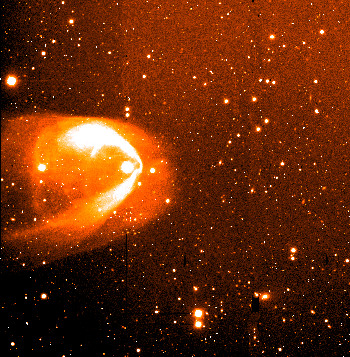
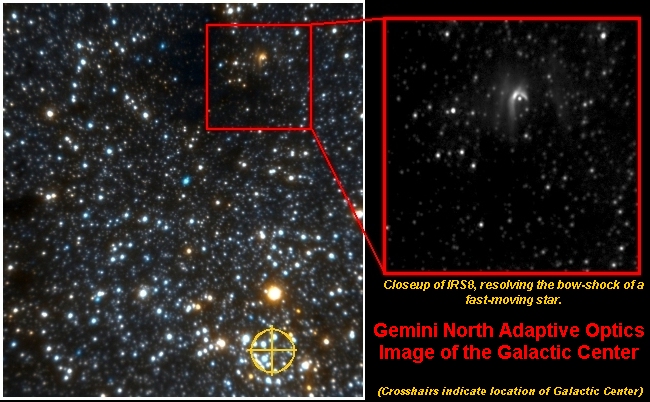
Bow shocks are also a common feature in Herbig Haro objects, in which a much stronger collimated outflow of gas and dust from the star interacts with the interstellar medium, producing bright bow shocks that are visible at optical wavelengths.
The following images show further evidence of bowshock existence from dense gases and plasma in the Orion Nebula
.
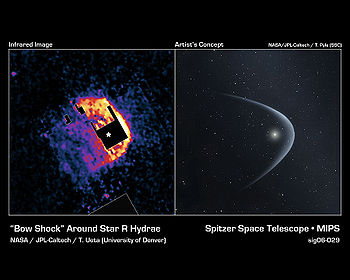
In 2006, a far infrared bow shock has been detected near the AGB star
R Hydrae
.
Magnetosphere
A magnetosphere is formed when a stream of charged particles, such as the solar wind, interacts with and is deflected by the intrinsic magnetic field of a planet or similar body. Earth is surrounded by a magnetosphere, as are the other planets with intrinsic magnetic fields: Mercury, Jupiter,...
and an ambient medium. For stars, this is typically the boundary between their stellar wind
Stellar wind
A stellar wind is a flow of neutral or charged gas ejected from the upper atmosphere of a star. It is distinguished from the bipolar outflows characteristic of young stars by being less collimated, although stellar winds are not generally spherically symmetric.Different types of stars have...
and the interstellar medium
Interstellar medium
In astronomy, the interstellar medium is the matter that exists in the space between the star systems in a galaxy. This matter includes gas in ionic, atomic, and molecular form, dust, and cosmic rays. It fills interstellar space and blends smoothly into the surrounding intergalactic space...
.
In a planetary magnetosphere
Magnetosphere
A magnetosphere is formed when a stream of charged particles, such as the solar wind, interacts with and is deflected by the intrinsic magnetic field of a planet or similar body. Earth is surrounded by a magnetosphere, as are the other planets with intrinsic magnetic fields: Mercury, Jupiter,...
, the bow shock is the boundary at which the speed of the solar wind
Solar wind
The solar wind is a stream of charged particles ejected from the upper atmosphere of the Sun. It mostly consists of electrons and protons with energies usually between 1.5 and 10 keV. The stream of particles varies in temperature and speed over time...
abruptly drops as a result of its approach to the magnetopause
Magnetopause
The magnetopause is the abrupt boundary between a magnetosphere and the surrounding plasma. For planetary science, the magnetopause is the boundary between the planet’s magnetic field and the solar wind. The location of the magnetopause is determined by the balance between the pressure of the...
. The best-studied example of a bow shock is that occurring where the solar wind encounters the Earth
Earth
Earth is the third planet from the Sun, and the densest and fifth-largest of the eight planets in the Solar System. It is also the largest of the Solar System's four terrestrial planets...
's magnetopause, although bow shocks occur around all magnetized planets. The Earth's bow shock is about 100-1000 km thick and located about 90000 km (55,923.5 mi) from the Earth.
Description
The defining criterion is that the bulk velocity of the fluid (in this case, the solar wind) drops from "supersonic" to "subsonic", where the speed of sound in plasma physics is defined aswhere cs is the speed of sound,
is the ratio of specific heats, p is the pressure, and is the density of the plasma.The particles making up the solar wind follow spiral paths along magnetic field lines. The velocity of each particle as it gyrates around a field line can be treated similarly to a thermal velocity in an ordinary gas, and in an ordinary gas, the mean thermal velocity is roughly the speed of sound. At the bow shock, the bulk forward velocity of the wind (which is the component of the velocity parallel to the field lines about which the particles gyrate) drops below the speed at which the particles are corkscrewing.
It is hypothesised that the Sun
Sun
The Sun is the star at the center of the Solar System. It is almost perfectly spherical and consists of hot plasma interwoven with magnetic fields...
also has a bow shock as it travels through the interstellar medium
Interstellar medium
In astronomy, the interstellar medium is the matter that exists in the space between the star systems in a galaxy. This matter includes gas in ionic, atomic, and molecular form, dust, and cosmic rays. It fills interstellar space and blends smoothly into the surrounding intergalactic space...
, as shown in the figure. This will occur if the interstellar medium is moving supersonically towards the Sun, since the sun's solar wind is moving supersonically away from the Sun. The point where the interstellar medium becomes subsonic is the bow shock; the point where the interstellar medium and solar wind pressures balance is at the heliopause; the point where the solar wind becomes subsonic is the termination shock. According to Robert Nemiroff and Jerry Bonnell of NASA
NASA
The National Aeronautics and Space Administration is the agency of the United States government that is responsible for the nation's civilian space program and for aeronautics and aerospace research...
, the solar bow shock may lie at around 230 AU from the Sun.
Bow shocks are also a common feature in Herbig Haro objects, in which a much stronger collimated outflow of gas and dust from the star interacts with the interstellar medium, producing bright bow shocks that are visible at optical wavelengths.
The following images show further evidence of bowshock existence from dense gases and plasma in the Orion Nebula
Orion Nebula
The Orion Nebula is a diffuse nebula situated south of Orion's Belt. It is one of the brightest nebulae, and is visible to the naked eye in the night sky. M42 is located at a distance of and is the closest region of massive star formation to Earth. The M42 nebula is estimated to be 24 light...
.
In 2006, a far infrared bow shock has been detected near the AGB star
Asymptotic Giant Branch
The asymptotic giant branch is the region of the Hertzsprung-Russell diagram populated by evolving low to medium-mass stars. This is a period of stellar evolution undertaken by all low to intermediate mass stars late in their lives....
R Hydrae
R Hydrae
R Hydrae is a Mira-type variable star in the constellation Hydra.The magnitude of R Hydrae varies over a period of 389 days, between 3.21 and 11.00. The period of R Hydrae changes slowly....
.