
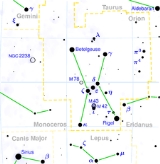
In modern
astronomyAstronomy is a natural science that deals with the study of celestial objects and phenomena that originate outside the atmosphere of Earth...
, a
constellation is an internationally defined area of the
celestial sphereIn astronomy and navigation, the celestial sphere is an imaginary sphere of arbitrarily large radius, concentric with the Earth and rotating upon the same axis. All objects in the sky can be thought of as projected upon the celestial sphere. Projected upward from Earth's equator and poles are the...
. These areas are grouped around
asterismsIn astronomy, an asterism is a pattern of stars recognized on Earth's night sky. It may form part of an official constellation, or be composed of stars from more than one. Like constellations, asterisms are in most cases composed of stars which, while they are visible in the same general direction,...
, patterns formed by prominent stars within apparent proximity to one another on Earth's
night skyThe term night sky refers to the sky as seen at night. The term is usually associated with astronomy, with reference to views of celestial bodies such as stars, the Moon, and planets that become visible on a clear night after the Sun has set. Natural light sources in a night sky include moonlight,...
.
There are
88 standard constellations recognized by the
International Astronomical UnionThe International Astronomical Union IAU is a collection of professional astronomers, at the Ph.D. level and beyond, active in professional research and education in astronomy...
(IAU) since 1922. The majority of these goes back to the 48 constellations defined by
PtolemyClaudius Ptolemy , was a Roman citizen of Egypt who wrote in Greek. He was a mathematician, astronomer, geographer, astrologer, and poet of a single epigram in the Greek Anthology. He lived in Egypt under Roman rule, and is believed to have been born in the town of Ptolemais Hermiou in the...
in his
AlmagestThe Almagest is a 2nd-century mathematical and astronomical treatise on the apparent motions of the stars and planetary paths. Written in Greek by Claudius Ptolemy, a Roman era scholar of Egypt,...
(2nd century). The remaining ones were defined in the 17th and 18th century; the most recent ones are found on the southern sky, defined in
Coelum australe stelliferum by
Nicolas Louis de LacailleAbbé Nicolas Louis de Lacaille was a French astronomer.He is noted for his catalogue of nearly 10,000 southern stars, including 42 nebulous objects. This catalogue, called Coelum Australe Stelliferum, was published posthumously in 1763. It introduced 14 new constellations which have since become...
(1763).
There are also numerous
historical constellationsFormer constellations are constellations that are no longer recognized by the International Astronomical Union for various reasons. Many of these constellations existed for long periods of time, even centuries in many cases, which means they still have a large historical value and can be found on...
not recognized by the IAU, or constellations recognized in regional traditions of astronomy or
astrologyAstrology consists of a number of belief systems which hold that there is a relationship between astronomical phenomena and events in the human world...
, such as
ChineseChinese constellations are the way the ancient Chinese grouped the stars. They are very different from the modern IAU recognized constellations. This is because the IAU was based on Greco-Roman astronomy instead of Chinese astronomy....
,
HinduNakshatra is the term for lunar mansion in Hindu astrology. A nakshatra is one of 27 sectors along the ecliptic...
or
Australian AboriginalAustralian Aboriginal astronomy is a name given to indigenous Australian culture relating to astronomical subjects — such as the Sun and Moon, the stars, planets, and the Milky Way, and their motions on the sky...
.
Terminology
The
Late LatinLate Latin is the scholarly name for the written Latin of Late Antiquity. The English dictionary definition of Late Latin dates this period from the 3rd to the 6th centuries AD extending in Spain to the 7th. This somewhat ambiguously defined period fits between Classical Latin and Medieval Latin...
term
constellātiō can be translated as "set with stars".
The term was first used in
astrologyAstrology consists of a number of belief systems which hold that there is a relationship between astronomical phenomena and events in the human world...
, of asterisms that supposedly exerted influence, attested in
AmmianusAmmianus Marcellinus was a fourth-century Roman historian. He wrote the penultimate major historical account surviving from Antiquity...
(4th century).
In
EnglishMiddle English is the stage in the history of the English language during the High and Late Middle Ages, or roughly during the four centuries between the late 11th and the late 15th century....
the term was used from the 14th century, also in astrology, of conjunctions of planets.
The modern astronomical sense of "area of the celestial sphere around a specific asterism" dates to the mid 16th century.
Colloquial usage does not distinguish the senses of "asterism" and "area surrounding an asterism".
The modern system of constellations used in astronomy focuses primarily on constellations as grid-like segments of the celestial sphere rather than as patterns, while the term for a star-pattern is
asterismIn astronomy, an asterism is a pattern of stars recognized on Earth's night sky. It may form part of an official constellation, or be composed of stars from more than one. Like constellations, asterisms are in most cases composed of stars which, while they are visible in the same general direction,...
.
For example, the asterism known as the
Big DipperThe Plough, also known as the Big Dipper or the Saptarishi , is an asterism of seven stars that has been recognized as a distinct grouping in many cultures from time immemorial...
corresponds to the seven brightest stars of the larger IAU constellation of
Ursa MajorUrsa Major , also known as the Great Bear, is a constellation visible throughout the year in most of the northern hemisphere. It can best be seen in April...
.
History
The current list of 88 constellations recognised by the
International Astronomical UnionThe International Astronomical Union IAU is a collection of professional astronomers, at the Ph.D. level and beyond, active in professional research and education in astronomy...
since 1922 is based on the 48 listed by
PtolemyClaudius Ptolemy , was a Roman citizen of Egypt who wrote in Greek. He was a mathematician, astronomer, geographer, astrologer, and poet of a single epigram in the Greek Anthology. He lived in Egypt under Roman rule, and is believed to have been born in the town of Ptolemais Hermiou in the...
in his
AlmagestThe Almagest is a 2nd-century mathematical and astronomical treatise on the apparent motions of the stars and planetary paths. Written in Greek by Claudius Ptolemy, a Roman era scholar of Egypt,...
in the 2nd century.
Ptolemy's catalogue is informed by
Eudoxus of CnidusEudoxus of Cnidus was a Greek astronomer, mathematician, scholar and student of Plato. Since all his own works are lost, our knowledge of him is obtained from secondary sources, such as Aratus's poem on astronomy...
, a Greek astronomer of the 4th century BC who introduced earlier Babylonian astronomy to the Hellenistic culture. Of the 48 constellations listed by Ptolemy, thirty can be shown to have a much longer history, reaching back into at least the Late Bronze Age. This concerns the zodiacal constellations in particular.
Ancient Near East
The oldest catalogues of stars and constellations are from Old Babylonian astronomy, beginning in the Middle Bronze Age. The numerous
SumerianSumerian is the language of ancient Sumer, which was spoken in southern Mesopotamia since at least the 4th millennium BC. During the 3rd millennium BC, there developed a very intimate cultural symbiosis between the Sumerians and the Akkadians, which included widespread bilingualism...
names in these catalogues suggest that they build on older, but otherwise unattested,
SumerSumer was a civilization and historical region in southern Mesopotamia, modern Iraq during the Chalcolithic and Early Bronze Age....
ian traditions of the Early Bronze Age.
The classical
ZodiacIn astronomy, the zodiac is a circle of twelve 30° divisions of celestial longitude which are centred upon the ecliptic: the apparent path of the Sun across the celestial sphere over the course of the year...
is a product of a revision of the Old Babylonian system in later Neo-Babylonian astronomy (6th century BC).
Knowledge of the Neo-Babylonian zodiac is also reflected in the
Hebrew BibleThe Hebrew Bible is a term used by biblical scholars outside of Judaism to refer to the Tanakh , a canonical collection of Jewish texts, and the common textual antecedent of the several canonical editions of the Christian Old Testament...
.
E. W. BullingerEthelbert William Bullinger AKC was an Anglican clergyman, Biblical scholar, and ultradispensationalist theologian.-Life and work:...
interpreted the creatures appearing in the books of
EzekielThe Book of Ezekiel is the third of the Latter Prophets in the Hebrew Bible, following the books of Isaiah and Jeremiah and preceding the Book of the Twelve....
(and thence in
RevelationThe Book of Revelation is the final book of the New Testament. The title came into usage from the first word of the book in Koine Greek: apokalupsis, meaning "unveiling" or "revelation"...
) as the middle signs of the four quarters of the Zodiac, with the Lion as
LeoLeo is the fifth astrological sign of the Zodiac, originating from the constellation of Leo. In astrology, Leo is considered to be a "masculine", positive sign. It is also considered a fire sign and is one of four fixed signs ruled by the Sun.Individuals born when the Sun is in this sign are...
, the Bull is
TaurusTaurus is the second astrological sign in the Zodiac, which spans the zodiac between the 30th and 59th degree of celestial longitude. Generally, the Sun transits this area of the zodiac between April 21 to May 21 each year...
, the Man representing Aquarius and the Eagle standing in for Scorpio.
The biblical
Book of JobThe Book of Job , commonly referred to simply as Job, is one of the books of the Hebrew Bible. It relates the story of Job, his trials at the hands of Satan, his discussions with friends on the origins and nature of his suffering, his challenge to God, and finally a response from God. The book is a...
(dating to the 6th to 4th century BC) is also aware of a number of constellations, including "bier", "fool" and "heap" (Job 9:9, 38:31-32), rendered as "Arcturus, Orion and Pleiades" by the KJV, but
`Ayish "the bier" actually corresponding to
Ursa MajorUrsa Major , also known as the Great Bear, is a constellation visible throughout the year in most of the northern hemisphere. It can best be seen in April...
. The term
MazzarothMazzaroth is a hapax legomenon of the Hebrew Bible, found in .The similar word mazalot in may be related....
, a
hapax legomenonA hapax legomenon is a word which occurs only once within a context, either in the written record of an entire language, in the works of an author, or just in a single text. The term is sometimes used incorrectly to describe a word that occurs in just one of an author's works, even though it...
in Job 38:32, may be the Hebrew word for the zodiacal constellations.
The Greeks adopted the Babylonian system in the 4th century BC. A total of twenty Ptolemaic constellations are directly continued from the Ancient Near East. Another ten have the same stars but different names.
Graeco-Roman
There is only limited information on indigenous Greek constellations. Some evidence is found in
HesiodHesiod was a Greek oral poet generally thought by scholars to have been active between 750 and 650 BC, around the same time as Homer. His is the first European poetry in which the poet regards himself as a topic, an individual with a distinctive role to play. Ancient authors credited him and...
.
Greek astronomy essentially adopted the older Babylonian system in the Hellenistic era, first introduced to Greece by
Eudoxus of CnidusEudoxus of Cnidus was a Greek astronomer, mathematician, scholar and student of Plato. Since all his own works are lost, our knowledge of him is obtained from secondary sources, such as Aratus's poem on astronomy...
in the 4th century BC.
The original work of Eudoxus is lost, but it survives as a versification by
AratusAratus was a Greek didactic poet. He is best known today for being quoted in the New Testament. His major extant work is his hexameter poem Phaenomena , the first half of which is a verse setting of a lost work of the same name by Eudoxus of Cnidus. It describes the constellations and other...
, dating to the 3rd century BC.
The most complete existing works dealing with the mythical origins of the constellations are by the Hellenistic writer termed pseudo-Eratosthenes and an early Roman writer styled pseudo-
HyginusHyginus can refer to:People:*Gaius Julius Hyginus , Roman poet, author of Fabulae, reputed author of Poeticon astronomicon*Hyginus Gromaticus, Roman surveyor*Pope Hyginus, also a saint, Bishop of Rome about 140...
.
The basis of western astronomy as taught during
Late AntiquityLate Antiquity is a periodization used by historians to describe the time of transition from Classical Antiquity to the Middle Ages, in both mainland Europe and the Mediterranean world. Precise boundaries for the period are a matter of debate, but noted historian of the period Peter Brown proposed...
and until the
Early Modern periodIn history, the early modern period of modern history follows the late Middle Ages. Although the chronological limits of the period are open to debate, the timeframe spans the period after the late portion of the Middle Ages through the beginning of the Age of Revolutions...
is the
AlmagestThe Almagest is a 2nd-century mathematical and astronomical treatise on the apparent motions of the stars and planetary paths. Written in Greek by Claudius Ptolemy, a Roman era scholar of Egypt,...
by
PtolemyClaudius Ptolemy , was a Roman citizen of Egypt who wrote in Greek. He was a mathematician, astronomer, geographer, astrologer, and poet of a single epigram in the Greek Anthology. He lived in Egypt under Roman rule, and is believed to have been born in the town of Ptolemais Hermiou in the...
, written in the 2nd century. Indian astronomy is also based on Hellenistic tradition, via transmission by the Indo-Greek kingdoms.
Classical Chinese constellations
In classical
Chinese astronomyAstronomy in China has a very long history, with historians considering that "they [the Chinese] were the most persistent and accurate observers of celestial phenomena anywhere in the world before the Arabs."...
, the northern sky is divided geometrically, into five "enclosures" and
twenty-eight mansionsThe Twenty-eight Mansions , ', ' or ' are part of the Chinese constellations system. They can be considered as the equivalent to the zodiacal constellations in the Western astronomy, though the Twenty-eight Mansions reflect the movement of the Moon in a lunar month rather than the Sun in a solar year...
along the ecliptic, grouped into
Four SymbolsThe Four Symbols are four mythological creatures in the Chinese constellations. They are:*Azure Dragon of the East *Vermilion Bird of the South *White Tiger of the West *Black Tortoise of the North...
of seven asterisms each.
The 28 lunar mansions are one of the most important and also the most ancient structures in the Chinese sky, attested from the 5th century BC.
Parallels to the earliest Babylonian (Sumerian) star catalogues suggest that the ancient Chinese system did not arise independently from that of the
Ancient Near EastThe ancient Near East was the home of early civilizations within a region roughly corresponding to the modern Middle East: Mesopotamia , ancient Egypt, ancient Iran The ancient Near East was the home of early civilizations within a region roughly corresponding to the modern Middle East: Mesopotamia...
.
Classical Chinese astronomy is recorded in the Han period and appears in the form of three schools, which are attributed to astronomers of the Zhanguo period. The constellations of the three schools were conflated into a single system by
Chen Zhuo, an astronomer of the 3rd century (Three Kingdoms period).
Chen Zhuo's work has been lost, but information on his system of constellations survives in Tang period records, notably by Qutan Xida.
The oldest extant Chinese star chart dates to the Tang period and was preserved as part of the
Dunhuang ManuscriptsThe Dunhuang manuscripts is a cache of important religious and secular documents discovered in the Mogao Caves of Dunhuang, China during the early 20th century. Dating from the 5th to early 11th centuries, the manuscripts include works ranging from history and mathematics to folk songs and dance...
. Native Chinese astronomy flourished during the
Song DynastyThe Song Dynasty was a ruling dynasty in China between 960 and 1279; it succeeded the Five Dynasties and Ten Kingdoms Period, and was followed by the Yuan Dynasty. It was the first government in world history to issue banknotes or paper money, and the first Chinese government to establish a...
, and during the
Yuan DynastyThe Yuan Dynasty , or Great Yuan Empire was a ruling dynasty founded by the Mongol leader Kublai Khan, who ruled most of present-day China, all of modern Mongolia and its surrounding areas, lasting officially from 1271 to 1368. It is considered both as a division of the Mongol Empire and as an...
became increasingly influenced by medieval Islamic astronomy.
Early Modern era
The constellations around the South Pole were observable from south of the prime meridian, by either Babylonians, Greeks, Chinese or Arabs.
The modern constellations in this region were defined during the Age of exploration, notably by Dutch navigators
Pieter Dirkszoon KeyserPieter Dirkszoon Keyser , a.k.a. Petrus Theodori, was a Dutch navigator who mapped the southern sky....
and
Frederick de HoutmanFrederick de Houtman , or Frederik de Houtman, was a Dutch explorer who sailed along the Western coast of Australia en route to Batavia.-Biography:...
at the end of sixteenth century.
They were depicted by Johann Bayer in his star atlas
UranometriaUranometria is the short title of a star atlas produced by Johann Bayer.It was published in Augsburg, Germany, in 1603 by Christophorus Mangus under the full title Uranometria : omnium asterismorum continens schemata, nova methodo delineata, aereis laminis expressa. This translates to...
of 1603. Several more were created by
Nicolas Louis de LacailleAbbé Nicolas Louis de Lacaille was a French astronomer.He is noted for his catalogue of nearly 10,000 southern stars, including 42 nebulous objects. This catalogue, called Coelum Australe Stelliferum, was published posthumously in 1763. It introduced 14 new constellations which have since become...
in his star catalogue, published in 1756.
Some modern proposals for new constellations were not successful; an example is
QuadransQuadrans Muralis was a constellation created by Jérôme Lalande in 1795. It was located between the constellations of Boötes and Draco, near the tail of Ursa Major...
, eponymous of the Quadrantid meteors, now divided between
BoötesBoötes is a constellation in the northern sky, located between 0° and +60° declination, and 13 and 16 hours of right ascension on the celestial sphere. The name comes from the Greek Βοώτης, Boōtēs, meaning herdsman or plowman...
and
DracoDraco is a constellation in the far northern sky. Its name is Latin for dragon. Draco is circumpolar for many observers in the northern hemisphere...
.
The classical constellation of
Argo NavisArgo Navis was a large constellation in the southern sky that has since been divided into three constellations. It represented the Argo, the ship used by Jason and the Argonauts in Greek mythology...
was broken up into several different constellations, for the convenience of stellar cartographers.
By the end of the
Ming DynastyThe Ming Dynasty, also Empire of the Great Ming, was the ruling dynasty of China from 1368 to 1644, following the collapse of the Mongol-led Yuan Dynasty. The Ming, "one of the greatest eras of orderly government and social stability in human history", was the last dynasty in China ruled by ethnic...
,
Xu GuangqiXu Guangqi , was a Chinese scholar-bureaucrat, agricultural scientist, astronomer, and mathematician in the Ming Dynasty. Xu was a colleague and collaborator of the Italian Jesuits Matteo Ricci and Sabatino de Ursis and they translated several classic Western texts into Chinese, including part of...
introduced 23 asterisms of the southern sky based on the knowledge of western star charts. These asterisms were since incorporated into the traditional Chinese star maps.
IAU constellations
In 1922,
Henry Norris RussellHenry Norris Russell was an American astronomer who, along with Ejnar Hertzsprung, developed the Hertzsprung–Russell diagram . In 1923, working with Frederick Saunders, he developed Russell–Saunders coupling which is also known as LS coupling.-Biography:Russell was born in 1877 in Oyster Bay, New...
aided the IAU in dividing the celestial sphere into 88 official constellations. Where possible, these modern constellations usually share the names of their Graeco-Roman predecessors, such as
OrionOrion, often referred to as The Hunter, is a prominent constellation located on the celestial equator and visible throughout the world. It is one of the most conspicuous, and most recognizable constellations in the night sky...
,
LeoLeo is one of the constellations of the zodiac. Its name is Latin for lion. Its symbol is . Leo lies between dim Cancer to the west and Virgo to the east.-Stars:...
or
ScorpiusScorpius, sometimes known as Scorpio, is one of the constellations of the zodiac. Its name is Latin for scorpion, and its symbol is . It lies between Libra to the west and Sagittarius to the east...
.
The aim of this system is area-mapping, i.e. the division of the celestial sphere into contiguous fields.
Out of the 88 modern constellations, 36 lie predominantly in the northern sky, and the other 52 predominantly in the southern.
In 1930, the boundaries between the 88 constellations were devised by Eugène Delporte along vertical and horizontal lines of
right ascensionRight ascension is the astronomical term for one of the two coordinates of a point on the celestial sphere when using the equatorial coordinate system. The other coordinate is the declination.-Explanation:...
and
declinationIn astronomy, declination is one of the two coordinates of the equatorial coordinate system, the other being either right ascension or hour angle. Declination in astronomy is comparable to geographic latitude, but projected onto the celestial sphere. Declination is measured in degrees north and...
. However, the data he used originated back to
epochIn astronomy, an epoch is a moment in time used as a reference point for some time-varying astronomical quantity, such as celestial coordinates, or elliptical orbital elements of a celestial body, where these are subject to perturbations and vary with time...
B1875.0, which was when Benjamin A. Gould first made the proposal to designate boundaries for the celestial sphere, a suggestion upon which Delporte would base his work. The consequence of this early date is that due to the precession of the
equinoxAn equinox occurs twice a year, when the tilt of the Earth's axis is inclined neither away from nor towards the Sun, the center of the Sun being in the same plane as the Earth's equator...
es, the borders on a modern star map, such as epoch J2000, are already somewhat skewed and no longer perfectly vertical or horizontal. This effect will increase over the years and centuries to come.
Asterisms
The stars of the main asterism within a constellation are usually given Greek letters in their order of brightness, the so-called
Bayer designationA Bayer designation is a stellar designation in which a specific star is identified by a Greek letter, followed by the genitive form of its parent constellation's Latin name...
introduced by
Johann BayerJohann Bayer was a German lawyer and uranographer . He was born in Rain, Bavaria, in 1572. He began his study of philosophy in Ingolstadt in 1592, and moved later to Augsburg to begin work as a lawyer. He grew interested in astronomy during his time in Augsburg...
in 1603.
A total of 1,564 stars are so identified, out of approximately 10,000 stars visible to the
naked eyeThe naked eye is a figure of speech referring to human visual perception unaided by a magnifying or light-collecting optical device, such as a telescope or microscope. Vision corrected to normal acuity using corrective lenses is considered "naked"...
.
The brightest stars, usually the stars that make up the constellation's eponymous asterism, also retain proper names, often from Arabic.
For example, the "Little Dipper" asterism of the constellation
Ursa MinorUrsa Minor , also known as the Little Bear, is a constellation in the northern sky. Like the Great Bear, the tail of the Little Bear may also be seen as the handle of a ladle, whence the name Little Dipper...
has ten stars with Bayer designation, α UMi to π UMi. Of these ten stars, seven have a proper name, viz.
PolarisPolaris |Alpha]] Ursae Minoris, commonly North Star or Pole Star, also Lodestar) is the brightest star in the constellation Ursa Minor. It is very close to the north celestial pole, making it the current northern pole star....
(α UMi), Kochab (β UMi), Pherkad (γ UMi), Yildun (δ UMi), Urodelus (ε UMi), Ahfa al Farkadain (ζ UMi) and Anwar al Farkadain (η UMi).
The stars within an asterism rarely have any substantial astrophysical relationship to each other, and their apparent proximity when viewed from Earth disguises the fact that they are far apart, some being much farther from Earth than others. However, there are some exceptions: many of the stars in the constellation of
Ursa MajorUrsa Major , also known as the Great Bear, is a constellation visible throughout the year in most of the northern hemisphere. It can best be seen in April...
(including most of the
Big DipperThe Plough, also known as the Big Dipper or the Saptarishi , is an asterism of seven stars that has been recognized as a distinct grouping in many cultures from time immemorial...
) are genuinely close to one another, travel through the
galaxyA galaxy is a massive, gravitationally bound system that consists of stars and stellar remnants, an interstellar medium of gas and dust, and an important but poorly understood component tentatively dubbed dark matter. The word galaxy is derived from the Greek galaxias , literally "milky", a...
with similar
velocitiesThe proper motion of a star is its angular change in position over time as seen from the center of mass of the solar system. It is measured in seconds of arc per year, arcsec/yr, where 3600 arcseconds equal one degree. This contrasts with radial velocity, which is the time rate of change in...
, and are likely to have formed together as part of a
clusterStar clusters or star clouds are groups of stars. Two types of star clusters can be distinguished: globular clusters are tight groups of hundreds of thousands of very old stars which are gravitationally bound, while open clusters, more loosely clustered groups of stars, generally contain less than...
that is slowly dispersing. These stars form the
Ursa Major moving groupThe Ursa Major Moving Group, also known as Collinder 285 or Ursa Major association, is a nearby stellar moving group, a set of stars with common velocities in space and thought to have a common origin. Its core is located roughly 80 light years away...
.
Dark cloud constellations
Dark patches in the
Milky WayThe Milky Way is the galaxy that contains the Solar System. This name derives from its appearance as a dim un-resolved "milky" glowing band arching across the night sky...
are more visible and striking in the
southern hemisphereThe Southern Hemisphere is the part of Earth that lies south of the equator. The word hemisphere literally means 'half ball' or "half sphere"...
than in the northern. They vividly stand out when conditions are otherwise so dark that the Milky Way's central region casts shadows on the ground. Some cultures have discerned shapes in these patches and have given names to these "dark cloud constellations." Members of the Inca civilization identified various dark areas or
dark nebulaA dark nebula is a type of interstellar cloud that is so dense that it obscures the light from the background emission or reflection nebula or that it blocks out background stars . The extinction of the light is caused by interstellar dust grains located in the coldest, densest parts of larger...
e in the
Milky WayThe Milky Way is the galaxy that contains the Solar System. This name derives from its appearance as a dim un-resolved "milky" glowing band arching across the night sky...
as animals, and associated their appearance with the seasonal rains.
Australian Aboriginal astronomyAustralian Aboriginal astronomy is a name given to indigenous Australian culture relating to astronomical subjects — such as the Sun and Moon, the stars, planets, and the Milky Way, and their motions on the sky...
also describes dark cloud constellations, the most famous being the "emu in the sky" whose head is formed by the Coalsack.
See also
- Asterism (astronomy)
In astronomy, an asterism is a pattern of stars recognized on Earth's night sky. It may form part of an official constellation, or be composed of stars from more than one. Like constellations, asterisms are in most cases composed of stars which, while they are visible in the same general direction,...
- Zodiacal constellation
- Astrological sign
Astrological signs represent twelve equal segments or divisions of the zodiac. According to astrology, celestial phenomena reflect or govern human activity on the principle of "as above, so below", so that the twelve signs are held to represent twelve basic personality types or characteristic modes...
- Former constellations
Former constellations are constellations that are no longer recognized by the International Astronomical Union for various reasons. Many of these constellations existed for long periods of time, even centuries in many cases, which means they still have a large historical value and can be found on...
- List of constellations
- List of constellations by area
- List of stars by constellation
- Planisphere
A planisphere is a star chart analog computing instrument in the form of two adjustable disks that rotate on a common pivot. It can be adjusted to display the visible stars for any time and date. It is an instrument to assist in learning how to recognize stars and constellations...
Mythology, lore, history, and archaeoastronomy
- Allen, Richard Hinckley. (1899) Star-Names And Their Meanings, G. E. Stechert, New York, New York, U.S.A., hardcover; reprint 1963 as Star Names: Their Lore and Meaning, Dover Publications, Inc., Mineola, New York, U.S.A., ISBN 978-0486210797 softcover.
- Olcott, William Tyler
William Tyler Olcott was an American lawyer and amateur astronomer.In 1909, after attending a lecture by Edward Charles Pickering, he developed an interest in observing variable stars. In 1911, he and professor Pickering...
. (1911); Star Lore of All Ages, G. P. Putnam's SonsG. P. Putnam's Sons was a major United States book publisher based in New York City, New York. Since 1996, it has been an imprint of the Penguin Group.-History:...
, New York, New York, U.S.A., hardcover; reprint 2004 as Star Lore: Myths, Legends, and Facts, Dover Publications, Inc., Mineola, New York, U.S.A., ISBN 978-0486435817 softcover.
- Kelley, David H. and Milone, Eugene F. (2004) Exploring Ancient Skies: An Encyclopedic Survey of Archaeoastronomy, Springer, ISBN 978-0-387-95310-6 hardcover.
- Ridpath, Ian
Ian William Ridpath is an English science writer and broadcaster made famous for his investigation and explanation of the Rendlesham Forest Incident of December 1980....
. (1989) Star Tales, Lutterworth Press, ISBN 0718826957 hardcover.
- Staal, Julius D. W. (1988) The New Patterns in the Sky: Myths and Legends of the Stars, McDonald & Woodward Publishing Co., ISBN 0939923106 hardcover, ISBN 0939923041 softcover.
- John H. Rogers, "Origins of the Ancient Contellations: I. The Mesopotamian Traditions", Journal of the British Astronomical Association 108 (1998) 9–28.
- John H. Rogers, "Origins of the Ancient Contellations: II. The Mediterranean Traditions", Journal of the British Astronomical Association 108 (1998) 79–89.
Atlases and celestial maps
General & Nonspecialized – Entire Celestial Heavens:
- Becvar, Antonin
Antonín Bečvář was a Czech astronomer who was active in Slovakia. He was born in Stará Boleslav. Among his chief achievements is the foundation of the Skalnaté Pleso Observatory and the discovery of the comet C/1947 F2 .Bečvář is particularly important for his star charts: he led the compilation...
. Atlas Coeli. Published as Atlas of the Heavens, Sky Publishing Corporation, Cambridge, Massachusetts, U.S.A.; with coordinate grid transparency overlay.
- Norton, Arthur Philip. (1910) Norton's Star Atlas
Norton's Star Atlas is a set of 16 celestial charts, first published in 1910 and currently in its 20th edition under the editorship of Ian Ridpath. The Star Atlas covers the entire northern and southern sky, with accompanying reference information for amateur astronomers...
, 20th Edition 2003 as Norton's Star Atlas and Reference Handbook, edited by Ridpath, IanIan William Ridpath is an English science writer and broadcaster made famous for his investigation and explanation of the Rendlesham Forest Incident of December 1980....
, Pi Press, ISBN 978-0-13-145164-3, hardcover.
- National Geographic Society
The National Geographic Society , headquartered in Washington, D.C. in the United States, is one of the largest non-profit scientific and educational institutions in the world. Its interests include geography, archaeology and natural science, the promotion of environmental and historical...
. (1957, 1970, 2001, 2007) The Heavens (1970), Cartographic Division of the National Geographic Society (NGS), Washington, D.C., U.S.A., two sided large map chart depicting the constellations of the heavens; as special supplement to the August 1970 issue of National GeographicNational Geographic, formerly the National Geographic Magazine, is the official journal of the National Geographic Society. It published its first issue in 1888, just nine months after the Society itself was founded...
. Forerunner map as A Map of The Heavens, as special supplement to the December 1957 issue. Current version 2001 (Tirion), with 2007 reprint.
- Sinnott, Roger W. and Perryman, Michael A.C. (1997) Millennium Star Atlas
The Millennium Star Atlas was constructed as a collaboration betweena team at Sky & Telescope led by Roger Sinnott, and the European Space Agency'sHipparcos project, led by Michael Perryman. It was the first sky atlas to include the...
, Epoch 2000.0, Sky Publishing Corporation, Cambridge, Massachusetts, U.S.A., and European Space Agency (ESA), ESTEC, Noordwijk, The Netherlands. Subtitle: "An All-Sky Atlas Comprising One Million Stars to Visual Magnitude Eleven from the Hipparcos and Tycho Catalogues and Ten Thousand Nonstellar Objects". 3 volumes, hardcover, in hardcover slipcase, set ISBN 0-933346-84-0. Vol. 1, 0–8 Hours (Right Ascension), ISBN 0-933346-81-6 hardcover; Vol. 2, 8–16 Hours, ISBN 0-933346-82-4 hardcover; Vol. 3, 16–24 Hours, ISBN 0-933346-83-2 hardcover. Softcover version available. Supplemental separate purchasable coordinate grid transparent overlays.
- Tirion, Wil
Wil Tirion is a Dutch uranographer . His most famous work, Sky Atlas 2000.0, is renowned by astronomers for its accuracy and beauty. The second edition of his most complete work, Uranometria 2000.0, was published in 2001 by Willmann-Bell. He is also responsible for the sky charts found in many...
; et al. (1987) Uranometria 2000.0, Willmann-Bell, Inc., Richmond, Virginia, U.S.A., 3 volumes, hardcover. Vol. 1 (1987): "The Northern Hemisphere to −6o", by Wil Tirion, Barry Rappaport, and George Lovi, ISBN 0-943396-14-X hardcover, printed boards (blue). Vol. 2 (1988): "The Southern Hemisphere to +6o", by Wil Tirion, Barry Rappaport and George Lovi, ISBN 0-943396-15-8 hardcover, printed boards (red). Vol. 3 (1993) as a separate added work: The Deep Sky Field Guide to Uranometria 2000.0, by Murray Cragin, James Lucyk, and Barry Rappaport, ISBN 0-943396-38-7 hardcover, printed boards (gray). 2nd Edition 2001 (black or dark background) as collective set of 3 volumes – Vol. 1: Uranometria 2000.0 Deep Sky Atlas, by Wil Tirion, Barry Rappaport, and Will Remaklus, ISBN 978-0-943396-71-2 hardcover, printed boards (blue edging); Vol. 2: Uranometria 2000.0 Deep Sky Atlas, by Wil Tirion, Barry Rappaport, and Will Remaklus, ISBN 978-0-943396-72-9 hardcover, printed boards (green edging); Vol. 3: Uranometria 2000.0 Deep Sky Field Guide by Murray Cragin and Emil Bonanno, ISBN 978-0-943396-73-6, hardcover, printed boards (teal green).
- Tirion, Wil
Wil Tirion is a Dutch uranographer . His most famous work, Sky Atlas 2000.0, is renowned by astronomers for its accuracy and beauty. The second edition of his most complete work, Uranometria 2000.0, was published in 2001 by Willmann-Bell. He is also responsible for the sky charts found in many...
and Sinnott, Roger W. (1998) Sky Atlas 2000.0, various editions. 2nd Deluxe Edition, Cambridge University Press, Cambridge, England (U.K.).
Northern Celestial Hemisphere & North Circumpolar Region:
- Becvar, Antonin
Antonín Bečvář was a Czech astronomer who was active in Slovakia. He was born in Stará Boleslav. Among his chief achievements is the foundation of the Skalnaté Pleso Observatory and the discovery of the comet C/1947 F2 .Bečvář is particularly important for his star charts: he led the compilation...
. (1962) Atlas Borealis 1950.0, Czechoslovak Academy of Sciences (Ceskoslovenske Akademie Ved), Praha, Czechoslovakia, 1st Edition, elephant folio hardcover, with small transparency overlay coordinate grid square and separate paper magnitude legend ruler. 2nd Edition 1972 and 1978 reprint, Czechoslovak Academy of Sciences (Ceskoslovenske Akademie Ved), Prague, Czechoslovakia, and Sky Publishing Corporation, Cambridge, Massachusetts, U.S.A., ISBN 0-933346-01-8 oversize folio softcover spiral bound, with transparency overlay coordinate grid ruler.
Equatorial, Ecliptic, & Zodiacal Celestial Sky:
- Becvar, Antonin
Antonín Bečvář was a Czech astronomer who was active in Slovakia. He was born in Stará Boleslav. Among his chief achievements is the foundation of the Skalnaté Pleso Observatory and the discovery of the comet C/1947 F2 .Bečvář is particularly important for his star charts: he led the compilation...
. (1958) Atlas Eclipticalis 1950.0, Czechoslovak Academy of Sciences (Ceskoslovenske Akademie Ved), Praha, Czechoslovakia, 1st Edition, elephant folio hardcover, with small transparency overlay coordinate grid square and separate paper magnitude legend ruler. 2nd Edition 1974, Czechoslovak Academy of Sciences (Ceskoslovenske Akademie Ved), Prague, Czechoslovakia, and Sky Publishing Corporation, Cambridge, Massachusetts, U.S.A., oversize folio softcover spiral bound, with transparency overlay coordinate grid ruler.
Southern Celestial Hemisphere & South Circumpolar Region:
- Becvar, Antonin
Antonín Bečvář was a Czech astronomer who was active in Slovakia. He was born in Stará Boleslav. Among his chief achievements is the foundation of the Skalnaté Pleso Observatory and the discovery of the comet C/1947 F2 .Bečvář is particularly important for his star charts: he led the compilation...
. Atlas Australis 1950.0, Czechoslovak Academy of Sciences (Ceskoslovenske Akademie Ved), Praha, Czechoslovakia, 1st Edition, elephant folio hardcover, with small transparency overlay coordinate grid square and separate paper magnitude legend ruler. 2nd Edition, Czechoslovak Academy of Sciences (Ceskoslovenske Akademie Ved), Prague, Czechoslovakia, and Sky Publishing Corporation, Cambridge, Massachusetts, U.S.A., oversize folio softcover spiral bound, with transparency overlay coordinate grid ruler.
Catalogs
- Becvar, Antonin. (1959) Atlas Coeli II Katalog 1950.0, Praha, 1960 Prague. Published 1964 as Atlas of the Heavens - II Catalogue 1950.0, Sky Publishing Corporation, Cambridge, Massachusetts, U.S.A.
- Hirshfeld, Alan and Sinnott, Roger W. (1982) Sky Catalogue 2000.0, Cambridge University Press and Sky Publishing Corporation, 1st Edition, 2 volumes. LCCN 81017975 both vols., and LCCN 83240310 vol. 1. "Volume 1: Stars to Magnitude 8.0", ISBN 0-521-24710-1 (Cambridge) and 0-933346-35-2 (Sky) hardcover, ISBN 0-933346-34-4 (Sky) softcover. Vol. 2 (1985) - "Volume 2: Double Stars, Variable Stars, and Nonstellar Objects", ISBN 0-521-25818-9 (Cambridge) hardcover, ISBN 0-521-27721-3 (Cambridge) softcover. 2nd Edition (1991) with additional third author Frangois Ochsenbein, 2 volumes, LCCN 91026764. Vol. 1: ISBN 0-521-41743-0 (Cambridge) hardcover (black binding); ISBN 0-521-42736-3 (Cambridge) softcover (red lettering with Hans Vehrenberg astrophoto). Vol. 2 (1999): ISBN 0-521-27721-3 (Cambridge) softcover and 0-933346-38-7 (Sky) softcover - reprint of 1985 edition (blue lettering with Hans Vehrenberg astrophoto).
- Yale University Observatory
-History:Yale's first observatory, the Atheneum, was situated in a tower, which from 1830 housed Yale's first and America's largest refractor, a Dollond donated by Sheldon Clark. With this telescope Olmsted and Elias Loomis made the first American sighting of the return of Halley's Comet in 1835....
. (1908, et al.) Catalogue of Bright StarsThe Bright Star Catalogue, also known as the Yale Catalogue of Bright Stars or Yale Bright Star Catalogue, is a star catalogue that lists all stars of stellar magnitude 6.5 or brighter, which is roughly every star visible to the naked eye from Earth. It is currently available online in its 5th...
, New Haven, Connecticut, U.S.A. Referred to commonly as "Bright Star Catalogue". Various editions with various authors historically, the longest term revising author as (Ellen) Dorrit HoffleitEllen Dorrit Hoffleit was an American senior research astronomer at Yale University.Hoffleit was born in Florence, Alabama and earned her Ph.D. in astronomy from Radcliffe College in 1938. Starting as a research assistant at the Harvard College Observatory in 1929, she was hired as an astronomer...
. 1st Edition 1908. 2nd Edition 1940 by Frank Schlesinger and Louise F. Jenkins. 3rd Edition (1964), 4th Edition, 5th Edition (1991), and 6th Edition (pending posthumous) by Hoffleit.
External links