


Common Germanic deities

Encyclopedia
The article lists gods
and goddesses (Ansewez, Wanizaz) that may be reconstructed for Proto-Germanic or Common Germanic Migration period
paganism
, or which figure in both West and North Germanic mythology. See list of Germanic deities for a complete list of Germanic gods and goddesses, including those for whom there is insufficient attestation to produce Common Germanic reconstructions.
Deity
A deity is a recognized preternatural or supernatural immortal being, who may be thought of as holy, divine, or sacred, held in high regard, and respected by believers....
and goddesses (Ansewez, Wanizaz) that may be reconstructed for Proto-Germanic or Common Germanic Migration period
Migration Period
The Migration Period, also called the Barbarian Invasions , was a period of intensified human migration in Europe that occurred from c. 400 to 800 CE. This period marked the transition from Late Antiquity to the Early Middle Ages...
paganism
Germanic paganism
Germanic paganism refers to the theology and religious practices of the Germanic peoples of north-western Europe from the Iron Age until their Christianization during the Medieval period...
, or which figure in both West and North Germanic mythology. See list of Germanic deities for a complete list of Germanic gods and goddesses, including those for whom there is insufficient attestation to produce Common Germanic reconstructions.
Deities
- WōdanazWodanazor is the reconstructed Proto-Germanic name of a god of Germanic paganism, known as in Norse mythology, in Old English, or in Old High German and in Lombardic...
, "lord of poetic/mantic inspiration", "Germanic MercuryMercury (mythology)Mercury was a messenger who wore winged sandals, and a god of trade, the son of Maia Maiestas and Jupiter in Roman mythology. His name is related to the Latin word merx , mercari , and merces...
", Norse Óðinn (often Anglicized Odin or, especially in older texts, Othin), Old English WōdenWodenWoden or Wodan is a major deity of Anglo-Saxon and Continental Germanic polytheism. Together with his Norse counterpart Odin, Woden represents a development of the Proto-Germanic god *Wōdanaz....
, Old High German Wuotan. - ÞunrazThorIn Norse mythology, Thor is a hammer-wielding god associated with thunder, lightning, storms, oak trees, strength, the protection of mankind, and also hallowing, healing, and fertility...
, "thunder", "Germanic JupiterJupiter (mythology)In ancient Roman religion and myth, Jupiter or Jove is the king of the gods, and the god of the sky and thunder. He is the equivalent of Zeus in the Greek pantheon....
", Norse Þórr (Thor), West Germanic Donar, Old English Þunor. - Teiwaz, god of war and early sky god, "Germanic Mars", Norse Týr, Old English Tiw, Old High German Ziu, continues Indo-European DyeusDyeus*Dyēus is the reconstructed chief deity of the Proto-Indo-European pantheon. He was the god of the daylight sky, and his position may have mirrored the position of the patriarch or monarch in society....
. - NerþuzNerthusIn Germanic paganism, Nerthus is a goddess associated with fertility. Nerthus is attested by Tacitus, the first century AD Roman historian, in his Germania. Various theories exist regarding the goddess and her potential later traces amongst the Germanic tribes...
, described by TacitusTacitusPublius Cornelius Tacitus was a senator and a historian of the Roman Empire. The surviving portions of his two major works—the Annals and the Histories—examine the reigns of the Roman Emperors Tiberius, Claudius, Nero and those who reigned in the Year of the Four Emperors...
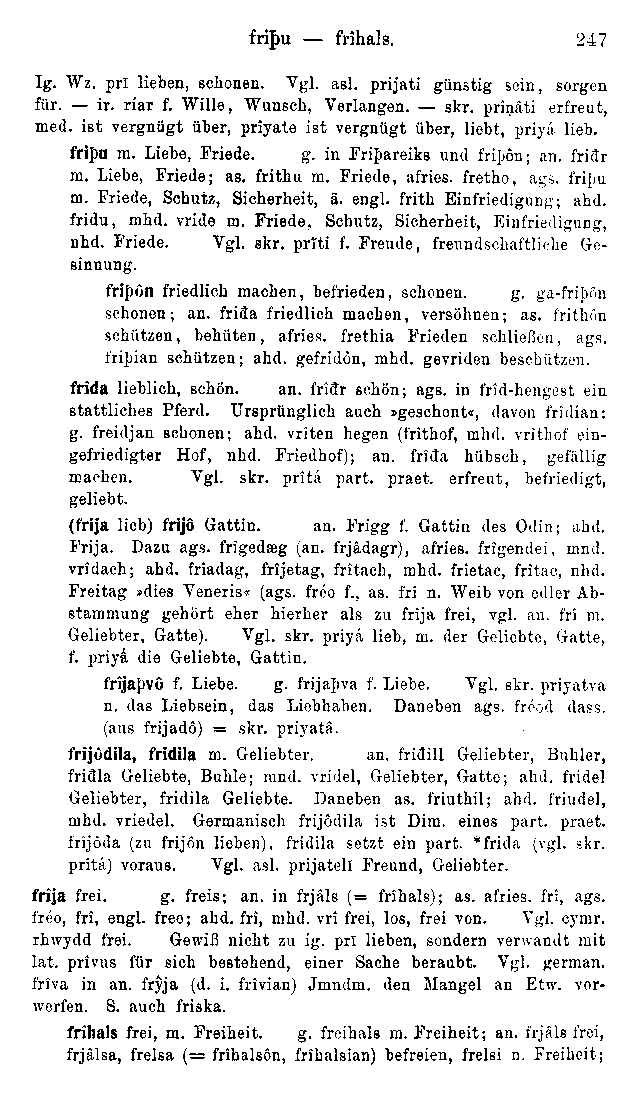
as Mother Earth, possibly continued in Norse Njǫrðr (Njord, Njorth). - FrijjōFrijjō*Frijjō is the reconstructed name or epithet of a hypothesized Common Germanic love goddess giving rise to both Frigg and Freyja....
, "wife" (specifically here the wife of Wōdanaz), Old English FrigeFrige*Frijjō is the reconstructed name or epithet of a hypothesized Common Germanic love goddess giving rise to both Frigg and Freyja....
, Norse FriggFriggFrigg is a major goddess in Norse paganism, a subset of Germanic paganism. She is said to be the wife of Odin, and is the "foremost among the goddesses" and the queen of Asgard. Frigg appears primarily in Norse mythological stories as a wife and a mother. She is also described as having the power...
, cf. Sanskrit "mistress, wife". - Frijja, daughter of Njǫrðr, Norse Freyja, Old High GermanOld High GermanThe term Old High German refers to the earliest stage of the German language and it conventionally covers the period from around 500 to 1050. Coherent written texts do not appear until the second half of the 8th century, and some treat the period before 750 as 'prehistoric' and date the start of...
Frouwa, Old English FrēoFreoFreo may refer to:* Freyja, the Norse goddess* Fremantle, Western Australia, a port town in Western Australia** Fremantle Football Club, a team in the Australian Football League commonly referred to as the "Freo Dockers"...
meaning "lady", cf. Gothic Fráujo "lady, mistress", German "Frau", Swedish "Fru." There is some etymological confusion behind both these words and Frijjō/Frigg/Frige. - FullōFullaIn Germanic mythology, Fulla or Volla is a goddess. In Norse mythology, Fulla is described as wearing a golden snood and as tending to the ashen box and the footwear owned by the goddess Frigg, and, in addition, Frigg confides in Fulla her secrets...
, goddess—or *Fullaz, god—of riches, plenty. Corresponds to Norse FullaFullaIn Germanic mythology, Fulla or Volla is a goddess. In Norse mythology, Fulla is described as wearing a golden snood and as tending to the ashen box and the footwear owned by the goddess Frigg, and, in addition, Frigg confides in Fulla her secrets...
. - SifSifIn Norse mythology, Sif is a goddess associated with earth. Sif is attested in the Poetic Edda, compiled in the 13th century from earlier traditional sources, and the Prose Edda, written in the 13th century by Snorri Sturluson, and in the poetry of skalds...
, goddess, wife of Donar/ThorThorIn Norse mythology, Thor is a hammer-wielding god associated with thunder, lightning, storms, oak trees, strength, the protection of mankind, and also hallowing, healing, and fertility...
. - Ermunaz, Saxon god (speculative, based on NenniusNenniusNennius was a Welsh monk of the 9th century.He has traditionally been attributed with the authorship of the Historia Brittonum, based on the prologue affixed to that work, This attribution is widely considered a secondary tradition....
' Armenon). The word means "strong" or "exalted" (Old High German ermen, Old Norse jǫrmaun or jörmun, Old English Eormen). - WulþuzUllrIn early Germanic paganism, *Wulþuz appears to have been a major god, or an epithet of an important god, in prehistoric times....
, "glorious one", possibly originally an epitheton, mentioned on the Thorsberg chapeThorsberg chapeThe Thorsberg chape , is an archeological find from the Thorsberg moor, Germany, that appears to have been deposited as a votive offering...
, continued in Norse UllrUllrIn early Germanic paganism, *Wulþuz appears to have been a major god, or an epithet of an important god, in prehistoric times....
. - WurdizWyrdWyrd is a concept in Anglo-Saxon culture roughly corresponding to fate or personal destiny. The word is ancestral to Modern English weird, which retains its original meaning only dialectally....
, "fate", Norse UrðrUrðrUrðr is one of the Norns in Norse mythology. Along with Verðandi and Skuld , Urðr makes up a trio of Norns that are described as deciding the fates of people...
(Urd, Urth), Old English WyrdWyrdWyrd is a concept in Anglo-Saxon culture roughly corresponding to fate or personal destiny. The word is ancestral to Modern English weird, which retains its original meaning only dialectally....
. - SōwilōSowiloSól or Sunna is the Sun personified in Germanic mythology. One of the two Old High German Merseburg Incantations, written in the 9th or 10th century CE, attests that Sunna is the sister of Sinthgunt...
, the Sun, Norse Sól, Old English Sunne, Old High German Sunna.
Semi-gods or mythical heroes
- AuzawandilazAurvandilThe names Aurvandil or Earendel are cognate Germanic personal names, continuing a Proto-Germanic reconstructed compound *Auziwandilaz "luminous wanderer", in origin probably the name of a star or planet, potentially the morning star ....
, Old English: Ēarendel; Old NorseOld NorseOld Norse is a North Germanic language that was spoken by inhabitants of Scandinavia and inhabitants of their overseas settlements during the Viking Age, until about 1300....
: Aurvandil; LombardicLombardic languageLombardic or Langobardic is the extinct language of the Lombards , the Germanic speaking people who settled in Italy in the 6th century. The language declined rapidly already in the 7th century as the invaders quickly adopted the Latin vernacular spoken by the local Roman population. E.g...
: Auriwandalo; Old High GermanOld High GermanThe term Old High German refers to the earliest stage of the German language and it conventionally covers the period from around 500 to 1050. Coherent written texts do not appear until the second half of the 8th century, and some treat the period before 750 as 'prehistoric' and date the start of...
: Orentil, Erentil; Medieval LatinMedieval LatinMedieval Latin was the form of Latin used in the Middle Ages, primarily as a medium of scholarly exchange and as the liturgical language of the medieval Roman Catholic Church, but also as a language of science, literature, law, and administration. Despite the clerical origin of many of its authors,...
: Horuuendillus, the morning star(?). - Gautaz, Old English: Geat; Old Norse: Gautr, mythical ancestor of royal houses.
- WēlanduzWeylandIn Germanic and Norse mythology, Wayland the Smith is a legendary master blacksmith. In Old Norse sources, Völundr appears in Völundarkviða, a poem in the Poetic Edda, and in Þiðrekssaga, and his legend is also depicted on the Ardre image stone VIII...
, ; ; ; from }, lit. "battle-brave", a mythical or ElvenElfAn elf is a being of Germanic mythology. The elves were originally thought of as a race of divine beings endowed with magical powers, which they use both for the benefit and the injury of mankind...
smith. - AgilazAgilazEgil is a legendary hero of the Völundarkviða and the Thidreks saga. The name is from Proto-Germanic *Agilaz, and the same legend is reflected in Old English Ægil of the Franks Casket and Alamannic Aigil of the Pforzen buckle....
, Old EnglishOld English languageOld English or Anglo-Saxon is an early form of the English language that was spoken and written by the Anglo-Saxons and their descendants in parts of what are now England and southeastern Scotland between at least the mid-5th century and the mid-12th century...
Ægil, AlamanniAlamanniThe Alamanni, Allemanni, or Alemanni were originally an alliance of Germanic tribes located around the upper Rhine river . One of the earliest references to them is the cognomen Alamannicus assumed by Roman Emperor Caracalla, who ruled the Roman Empire from 211 to 217 and claimed thereby to be...
c: Aigil, Old NorseOld NorseOld Norse is a North Germanic language that was spoken by inhabitants of Scandinavia and inhabitants of their overseas settlements during the Viking Age, until about 1300....
: Egil, a mythical archer.
Mythical races
- þurisaz (giants)
- dwergaz (dwarfs)
- albaz (elves)
- nikwuz (water spirits)
Cosmology
- MedjanagardazMidgardMidgard is one of the Nine Worlds and is an old Germanic name for our world and is the home of Humans, with the literal meaning "middle enclosure".-Etymology:...
inhabited world - erþo anþi uppahemenaz Germanic formula for "heaven and earth", notably naming earth first. Mentioned in the Norse EddaEddaThe term Edda applies to the Old Norse Poetic Edda and Prose Edda, both of which were written down in Iceland during the 13th century in Icelandic, although they contain material from earlier traditional sources, reaching into the Viking Age...
, Skarpåker StoneSkarpåker StoneThe Skarpåker Stone, designated by Rundata as Sö 154, is a Viking Age memorial runestone that was originally located in Skarpåker, Nyköping, Sörmland, Sweden, and which dates to the early 11th century.-Description:...
and Old High German Wessobrunner GebetWessobrunn PrayerThe Wessobrunn Prayer, sometimes called the Wessobrunn Creation Poem , believed to date from c790, is among the earliest known poetic works in Old High German.-Origins:...
etc. - HaljōHel (realm)In Norse mythology, Hel, the location, shares a name with Hel, a female figure associated with the location. In late Icelandic sources, varying descriptions of Hel are given and various figures are described as being buried with items that will facilitate their journey to Hel after their death...
Underworld - MuþspellMuþspellMuþspell is a reconstructed Proto-Germanic form of the root behind the Norse accounts of Muspelheim and the German Muspilli. Both refer to cataclysmic descriptions of the end of the world....
(see MuspilliMuspilliMuspilli is one of but two surviving pieces of Old High German epic poetry , dating to around 870. One large fragment of the text has survived in the margins and empty pages of a codex marked as the possession of Louis the German and now in the Bayerische Staatsbibliothek . The beginning and end of...
and MuspelheimMuspelheimIn Norse mythology, Muspelheim , also called Múspell, is a realm of fire. This realm is one of the Nine Worlds and it is home to the fire jötunn or the Sons of Muspell, and Surtr, their ruler. It is fire; and the land to the North, Niflheim, is ice...
) Disastrous world-ending (c.f. RagnarokRagnarökIn Norse mythology, Ragnarök is a series of future events, including a great battle foretold to ultimately result in the death of a number of major figures , the occurrence of various natural disasters, and the subsequent submersion of the world in water...
)