

French Crown Jewels

Encyclopedia
The French Crown Jewels were the crown
Crown (headgear)
A crown is the traditional symbolic form of headgear worn by a monarch or by a deity, for whom the crown traditionally represents power, legitimacy, immortality, righteousness, victory, triumph, resurrection, honour and glory of life after death. In art, the crown may be shown being offered to...
s, orb
Globus cruciger
The globus cruciger is an orb topped with a cross , a Christian symbol of authority used throughout the Middle Ages and even today on coins, iconography and royal regalia...
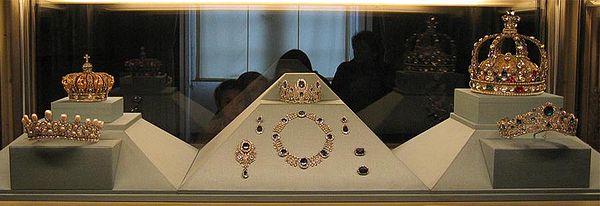
, sceptres, diadems and jewels that were the symbol of royalty and which were worn by many Kings and Queens of France. The set was finally broken up, with most of it sold off in 1885 by the Third French Republic. The surviving French Crown Jewels, principally a set of historic crowns now set with decorated glass, are on display in the Galerie d'Apollon of the Louvre
Louvre
The Musée du Louvre – in English, the Louvre Museum or simply the Louvre – is one of the world's largest museums, the most visited art museum in the world and a historic monument. A central landmark of Paris, it is located on the Right Bank of the Seine in the 1st arrondissement...
, France
France
The French Republic , The French Republic , The French Republic , (commonly known as France , is a unitary semi-presidential republic in Western Europe with several overseas territories and islands located on other continents and in the Indian, Pacific, and Atlantic oceans. Metropolitan France...
's premier museum
Museum
A museum is an institution that cares for a collection of artifacts and other objects of scientific, artistic, cultural, or historical importance and makes them available for public viewing through exhibits that may be permanent or temporary. Most large museums are located in major cities...
and former royal palace
Palace
A palace is a grand residence, especially a royal residence or the home of a head of state or some other high-ranking dignitary, such as a bishop or archbishop. The word itself is derived from the Latin name Palātium, for Palatine Hill, one of the seven hills in Rome. In many parts of Europe, the...
, together with the Regent Diamond
Regent Diamond
The Regent Diamond is a diamond which is on display in the Louvre. In 1698, a slave found the 410 carat uncut diamond in a Golkonda mine, more specifically Paritala-Kollur Mine in the state of Andhra Pradesh, India and concealed it inside of a large wound in his leg. An English sea captain stole...
, the Sancy
Sancy
The Sancy, a pale yellow diamond of , was once reputed to have belonged to the Great Moguls of antiquity, but is more likely of Indian origin owing to its cut which is unusual by Western standards....
Diamond and the 105 carats (21 g) Côte-de-Bretagne red spinel
Spinel
Spinel is the magnesium aluminium member of the larger spinel group of minerals. It has the formula MgAl2O4. Balas ruby is an old name for a rose-tinted variety.-Spinel group:...
, carved into the form of a dragon
Dragon
A dragon is a legendary creature, typically with serpentine or reptilian traits, that feature in the myths of many cultures. There are two distinct cultural traditions of dragons: the European dragon, derived from European folk traditions and ultimately related to Greek and Middle Eastern...
. In addition, some gemstones and jewels (including the Emerald of Saint Louis
Louis IX of France
Louis IX , commonly Saint Louis, was King of France from 1226 until his death. He was also styled Louis II, Count of Artois from 1226 to 1237. Born at Poissy, near Paris, he was an eighth-generation descendant of Hugh Capet, and thus a member of the House of Capet, and the son of Louis VIII and...
, the 'Ruspoli' sapphire and the diamond pins of Queen Marie Antoinette
Marie Antoinette
Marie Antoinette ; 2 November 1755 – 16 October 1793) was an Archduchess of Austria and the Queen of France and of Navarre. She was the fifteenth and penultimate child of Holy Roman Empress Maria Theresa and Holy Roman Emperor Francis I....
) are on display in the Treasury vault of the Mineralogy gallery in the Muséum national d'histoire naturelle
Muséum national d'histoire naturelle
The Muséum national d'Histoire naturelle is the National Museum of Natural History in Paris, France.- History :The museum was formally founded on 10 June 1793, during the French Revolution...
.
Use of the French crown jewels
The Crown jewels comprise the instruments of the coronationCoronation
A coronation is a ceremony marking the formal investiture of a monarch and/or their consort with regal power, usually involving the placement of a crown upon their head and the presentation of other items of regalia...
called Regalia
Regalia
Regalia is Latin plurale tantum for the privileges and the insignia characteristic of a Sovereign.The word stems from the Latin substantivation of the adjective regalis, 'regal', itself from Rex, 'king'...
and the jewels of the ruling family.
Since Pepin the Short in 752, the accession of the King of France
Kingdom of France
The Kingdom of France was one of the most powerful states to exist in Europe during the second millennium.It originated from the Western portion of the Frankish empire, and consolidated significant power and influence over the next thousand years. Louis XIV, also known as the Sun King, developed a...
was legitimized by a coronation
Coronation
A coronation is a ceremony marking the formal investiture of a monarch and/or their consort with regal power, usually involving the placement of a crown upon their head and the presentation of other items of regalia...
ceremony later performed with the Crown of Charlemagne
Crown of Charlemagne
The Crown of Charlemagne was the ancient coronation crown of Kings of the Franks, and later Kings of France after 1237. It was probably originally made as a simple circlet of four curved rectanglar jewelled plates for Charles the Bald, but later, four large jewelled fleur-de-lis were added to...
at Notre-Dame de Reims called sacre, since the emphasis was on the unction
Anointing
To anoint is to pour or smear with perfumed oil, milk, water, melted butter or other substances, a process employed ritually by many religions. People and things are anointed to symbolize the introduction of a sacramental or divine influence, a holy emanation, spirit, power or God...
with the chrism
Chrism
Chrism , also called "Myrrh" , Holy anointing oil, or "Consecrated Oil", is a consecrated oil used in the Roman Catholic, Eastern Orthodox, Eastern Rite Catholic, Oriental Orthodox, in the Assyrian Church of the East, and in Old-Catholic churches, as well as Anglican churches in the administration...
of the Holy Ampulla
Holy Ampulla
The Holy Ampulla or Holy Ampoule was a glass vial which, from its first recorded use, by Pope Innocent II for the anointing of Louis VII in 1131 to the coronation of Louis XVI in 1774, held the chrism or anointing oil for the coronation of the kings of France.The role played by the Sainte Ampoule...
. All monarchs were crowned until the French revolution
French Revolution
The French Revolution , sometimes distinguished as the 'Great French Revolution' , was a period of radical social and political upheaval in France and Europe. The absolute monarchy that had ruled France for centuries collapsed in three years...
, in the Notre-Dame de Reims cathedral (apart for two of them, who were crowned elsewhere). After the revolution, only Emperor Napoleon I
Napoleon I of France
Napoleon Bonaparte was a French military and political leader during the latter stages of the French Revolution.As Napoleon I, he was Emperor of the French from 1804 to 1815...
, Empress Josephine
Joséphine de Beauharnais
Joséphine de Beauharnais was the first wife of Napoléon Bonaparte, and thus the first Empress of the French. Her first husband Alexandre de Beauharnais had been guillotined during the Reign of Terror, and she had been imprisoned in the Carmes prison until her release five days after Alexandre's...
and King Charles X
Charles X of France
Charles X was known for most of his life as the Comte d'Artois before he reigned as King of France and of Navarre from 16 September 1824 until 2 August 1830. A younger brother to Kings Louis XVI and Louis XVIII, he supported the latter in exile and eventually succeeded him...
were crowned. Though not always used, a set of expensive crown jewels did exist and was augmented by various monarchs.
The Crown jewels or Diamants de la Couronne de France consisting of gemstones and jewellery became unalienable by decision of Francis I
Francis I of France
Francis I was King of France from 1515 until his death. During his reign, huge cultural changes took place in France and he has been called France's original Renaissance monarch...
on June 15, 1530. the Côte-de-Bretagne red spinel was then among the 8 main jewels. They suffered important loss by the Catholic League
Catholic League (French)
The Catholic League of France, sometimes referred to by contemporary Roman Catholics as the Holy League, a major player in the French Wars of Religion, was formed by Duke Henry of Guise in 1576...
in 1590 but were reconstitued by Henry IV
Henry IV of France
Henry IV , Henri-Quatre, was King of France from 1589 to 1610 and King of Navarre from 1572 to 1610. He was the first monarch of the Bourbon branch of the Capetian dynasty in France....
and greatly enhanced by Louis XIV
Louis XIV of France
Louis XIV , known as Louis the Great or the Sun King , was a Bourbon monarch who ruled as King of France and Navarre. His reign, from 1643 to his death in 1715, began at the age of four and lasted seventy-two years, three months, and eighteen days...
notably with the gift of the 18 Mazarin diamonds and the buy of the 'Royal French Blue'
Hope Diamond
The Hope Diamond, also known as "Le bleu de France" or "Le Bijou du Roi", is a large, , deep-blue diamond, now housed in the Smithsonian Natural History Museum in Washington, D.C. It is blue to the naked eye because of trace amounts of boron within its crystal structure, but exhibits red...
and 'Ruspoli' sapphire later followed in 1717 with the Regent Diamond
Regent Diamond
The Regent Diamond is a diamond which is on display in the Louvre. In 1698, a slave found the 410 carat uncut diamond in a Golkonda mine, more specifically Paritala-Kollur Mine in the state of Andhra Pradesh, India and concealed it inside of a large wound in his leg. An English sea captain stole...
. Under Louis XV
Louis XV of France
Louis XV was a Bourbon monarch who ruled as King of France and of Navarre from 1 September 1715 until his death. He succeeded his great-grandfather at the age of five, his first cousin Philippe II, Duke of Orléans, served as Regent of the kingdom until Louis's majority in 1723...
, they were kept in the Garde Meuble de la Couronne (Royal Treasury) in one of the pavilions of the Place de la Concorde
Place de la Concorde
The Place de la Concorde in area, it is the largest square in the French capital. It is located in the city's eighth arrondissement, at the eastern end of the Champs-Élysées.- History :...
where they suffered a theft in 1792 and a sale in 1795 after their partial recovery. In 1814, Napoleon I
Napoleon I of France
Napoleon Bonaparte was a French military and political leader during the latter stages of the French Revolution.As Napoleon I, he was Emperor of the French from 1804 to 1815...
had restored the Crown jewels to 65 072 stones and pearls, not including the personal jewels of both empress Josephine and Marie-Louise. Enhanced again during the Restoration
Bourbon Restoration
The Bourbon Restoration is the name given to the period following the successive events of the French Revolution , the end of the First Republic , and then the forcible end of the First French Empire under Napoleon – when a coalition of European powers restored by arms the monarchy to the...
and more again during the Second Empire
Second French Empire
The Second French Empire or French Empire was the Imperial Bonapartist regime of Napoleon III from 1852 to 1870, between the Second Republic and the Third Republic, in France.-Rule of Napoleon III:...
, they counted 77 662 stones and pearls comprising 51 403 brilliant cut diamonds, 21 119 rose cut diamonds, 2 962 pearls, 507 rubies, 136 sapphires, 250 emeralds, 528 turquoises, 22 opales, 235 amethysts and 500 other stones, when they were sold in 1885 by the Third Republic
French Third Republic
The French Third Republic was the republican government of France from 1870, when the Second French Empire collapsed due to the French defeat in the Franco-Prussian War, to 1940, when France was overrun by Nazi Germany during World War II, resulting in the German and Italian occupations of France...
. Nevetheless, as in 1793, an important set of stones and pearls was sent to the Muséum national d'histoire naturelle
Muséum national d'histoire naturelle
The Muséum national d'Histoire naturelle is the National Museum of Natural History in Paris, France.- History :The museum was formally founded on 10 June 1793, during the French Revolution...
and some of the most important jewels were bought back since 1953, what makes the collection still number more than 11 000 stones and pearls.
The Regalia
Regalia
Regalia is Latin plurale tantum for the privileges and the insignia characteristic of a Sovereign.The word stems from the Latin substantivation of the adjective regalis, 'regal', itself from Rex, 'king'...
, much lightly hit in 1590, were originally kept in the Basilica of Saint Denis from where they were removed in 1793 during the French Revolution
French Revolution
The French Revolution , sometimes distinguished as the 'Great French Revolution' , was a period of radical social and political upheaval in France and Europe. The absolute monarchy that had ruled France for centuries collapsed in three years...
. Some few pieces, considered to present an artistic value, were preserved and sent to the Louvre
Louvre
The Musée du Louvre – in English, the Louvre Museum or simply the Louvre – is one of the world's largest museums, the most visited art museum in the world and a historic monument. A central landmark of Paris, it is located on the Right Bank of the Seine in the 1st arrondissement...
and other parisians museums. The others, like the Crown of Charlemagne
Crown of Charlemagne
The Crown of Charlemagne was the ancient coronation crown of Kings of the Franks, and later Kings of France after 1237. It was probably originally made as a simple circlet of four curved rectanglar jewelled plates for Charles the Bald, but later, four large jewelled fleur-de-lis were added to...
and the one of the Queens, were melted down or dismanteled, with the rest of the basilica treasure including the cross of Saint Eligius
Saint Eligius
Saint Eligius is the patron saint of goldsmiths, other metalworkers, and coin collectors. He is also the patron saint of the Royal Electrical and Mechanical Engineers , a corps of the British Army, but he is best known for being the patron saint of horses and those who work with them...
, the screen of Charlemagne
Charlemagne
Charlemagne was King of the Franks from 768 and Emperor of the Romans from 800 to his death in 814. He expanded the Frankish kingdom into an empire that incorporated much of Western and Central Europe. During his reign, he conquered Italy and was crowned by Pope Leo III on 25 December 800...
or the gilded altar of Charles the Bald
Charles the Bald
Charles the Bald , Holy Roman Emperor and King of West Francia , was the youngest son of the Emperor Louis the Pious by his second wife Judith.-Struggle against his brothers:He was born on 13 June 823 in Frankfurt, when his elder...
. The litugical instruments kept in Reims
Reims
Reims , a city in the Champagne-Ardenne region of France, lies east-northeast of Paris. Founded by the Gauls, it became a major city during the period of the Roman Empire....
suffered the same policy. The Regalia were restored and recreated for the coronation of Napoleon I
Napoleon I of France
Napoleon Bonaparte was a French military and political leader during the latter stages of the French Revolution.As Napoleon I, he was Emperor of the French from 1804 to 1815...
, which at their turn suffered again partial destruction in 1819, and finally completed for the coronation of Charles X
Charles X of France
Charles X was known for most of his life as the Comte d'Artois before he reigned as King of France and of Navarre from 16 September 1824 until 2 August 1830. A younger brother to Kings Louis XVI and Louis XVIII, he supported the latter in exile and eventually succeeded him...
in 1825.
Crown of Louis XV
Of the about 20 documented royal crowns of the Ancien RégimeAncien Régime in France
The Ancien Régime refers primarily to the aristocratic, social and political system established in France from the 15th century to the 18th century under the late Valois and Bourbon dynasties...
, the only surviving one from the destructions of 1590 and 1793 is the crown of Louis XV. The king had the Regent Diamond set in the lower part of the fleur-de-lis
Fleur-de-lis
The fleur-de-lis or fleur-de-lys is a stylized lily or iris that is used as a decorative design or symbol. It may be "at one and the same time, political, dynastic, artistic, emblematic, and symbolic", especially in heraldry...
in the front of his crown, while eight of the famous Mazarin diamonds that the cardinal had bequeath to the French Crown are set in the other seven fleur-de-lis and in the circlet of the crown. Diamonds and colored gemstones are set between two rows of pearls on the circlet and are also set into the four arches that rise behind the fleur-de-lis and the eight ornamental points between the fleur-de-lis. At the junction of these four arches is a small pedestal surrounded by two rows of small diamonds on either side of a row of small pearls. Eight larger diamonds set between this pedestal and the arches give the effect of a sunburst when the crown is viewed from above. On the pedestal rises a double fleur-de-lis formed of nine large diamonds, including the Sancy Diamond which forms the central upper petal of this double fleur-de-lis. The gold brocade cap which lines the crown is also ornamented with large diamonds.
Since the Middle Ages, and previous to the making of this crown, the crowns of French kings were adorned with gemstones like the Crown of Charlemagne
Crown of Charlemagne
The Crown of Charlemagne was the ancient coronation crown of Kings of the Franks, and later Kings of France after 1237. It was probably originally made as a simple circlet of four curved rectanglar jewelled plates for Charles the Bald, but later, four large jewelled fleur-de-lis were added to...
or the crown of Saint Louis
Louis IX of France
Louis IX , commonly Saint Louis, was King of France from 1226 until his death. He was also styled Louis II, Count of Artois from 1226 to 1237. Born at Poissy, near Paris, he was an eighth-generation descendant of Hugh Capet, and thus a member of the House of Capet, and the son of Louis VIII and...
sometimes called Sainte Couronne. But some of the most valuable precious stones could be removed of them, since it was traditional for a French king to bequeath his crown to the treasury of the Abbey, now Basilica of St Denis on their deaths. This crown was also bequeath to Saint Denis on the death of Louis XV, but not before the diamonds had been replaced with crystals and it is on display presently in the Louvre similarly set with crystals.
Crown of Napoleon I
The Crown of NapoleonCrown of Napoleon
The Crown of Napoleon was a coronation crown manufactured for Emperor Napoleon I of the French and used in his coronation on December 2, 1804. Napoleon called his new crown the Crown of Charlemagne, the name of the ancient royal coronation crown of France that had been destroyed in the French...
was made by the jeweller Martin-Guillaume Biennais with antique cameos for the coronation of the Emperor in 1804. His gilded crown of laurels was destroyed in 1819 by Louis XVIII
Louis XVIII of France
Louis XVIII , known as "the Unavoidable", was King of France and of Navarre from 1814 to 1824, omitting the Hundred Days in 1815...
with the one of Empress Josephine, the orb
Globus cruciger
The globus cruciger is an orb topped with a cross , a Christian symbol of authority used throughout the Middle Ages and even today on coins, iconography and royal regalia...
and the eagle sceptre. His coronation throne is at the Louvre
Louvre
The Musée du Louvre – in English, the Louvre Museum or simply the Louvre – is one of the world's largest museums, the most visited art museum in the world and a historic monument. A central landmark of Paris, it is located on the Right Bank of the Seine in the 1st arrondissement...
and the coronation ring of Empress Josephine at the Château de Malmaison
Château de Malmaison
The Château de Malmaison is a country house in the city of Rueil-Malmaison about 12 km from Paris.It was formerly the residence of Joséphine de Beauharnais, and with the Tuileries, was from 1800 to 1802 the headquarters of the French government.-History:Joséphine de Beauharnais bought the...
.
Crown of Empress Eugenie
The Crown of Empress EugenieCrown of Empress Eugenie
The Crown of Empress Eugénie was the consort crown of Eugénie de Montijo, the empress consort of Emperor Napoleon III of France. Though neither she nor her husband underwent a coronation a consort crown was specially created for her....
was created in 1855 by Gabriel Lemonnier for the World's fair, like the one of the Emperor which was destroyed in 1887. But Napoleon III finally chose not to be crowned. Her diadem and large corsage diamond knot by the same jeweller are as well presented in the Louvre
Louvre
The Musée du Louvre – in English, the Louvre Museum or simply the Louvre – is one of the world's largest museums, the most visited art museum in the world and a historic monument. A central landmark of Paris, it is located on the Right Bank of the Seine in the 1st arrondissement...
with a large diamond brooch by Alfred Bapst bearing two big Mazarin stones.
Coronation sword
Scabbard
A scabbard is a sheath for holding a sword, knife, or other large blade. Scabbards have been made of many materials over the millennia, including leather, wood, and metals such as brass or steel.-Types of scabbards:...
, apart from the crown jewels. In the first part of the celebration, the king received the insignia of knighthood, consisting of spurs and the sword. Throughout the rest of the ceremony, the sword was entrusted to the "Connétable", who held it with the blade pointing upwards. The treasury of Saint-Denis possessed several medieval swords including the one of Saint Louis
Louis IX of France
Louis IX , commonly Saint Louis, was King of France from 1226 until his death. He was also styled Louis II, Count of Artois from 1226 to 1237. Born at Poissy, near Paris, he was an eighth-generation descendant of Hugh Capet, and thus a member of the House of Capet, and the son of Louis VIII and...
. According to legend the coronation sword is "Joyeuse
Joyeuse
Joyeuse , was the name of Charlemagne's personal sword. The name translates as "joyful".-Joyeuse in legend:Some legends claim that it was forged to contain the Lance of Longinus within its pommel; others state it was smithed from the same materials as Roland's Durendal and Ogier's Curtana.The 11th...
", http://www.louvre.fr/llv/oeuvres/detail_image.jsp;jsessionid=KWCxmhB23hhsBcfxW2PFJ1VxLCc2R8FDyzPjhmQpVr8PscX37P2w!1736489905?CONTENT%3C%3Ecnt_id=10134198673477491&CURRENT_LLV_ILLUSTRATION%3C%3Ecnt_id=10134198673477491&CURRENT_LLV_NOTICE%3C%3Ecnt_id=10134198673226044&FOLDER%3C%3Efolder_id=9852723696500857&bmLocale=en&&newWidth
680&&newHeight
1011 Charlemagne's sword. Its unusual build and ornamentation make it difficult to date, but the parts probably date to the 10th to 13th century. Some believe it might be much older, even manufactured before CharlemagneCharlemagne
Charlemagne was King of the Franks from 768 and Emperor of the Romans from 800 to his death in 814. He expanded the Frankish kingdom into an empire that incorporated much of Western and Central Europe. During his reign, he conquered Italy and was crowned by Pope Leo III on 25 December 800...
's reign.
The coronation swords of Napoleon I
Napoleon I
Napoleon Bonaparte was a French military and political leader during the latter stages of the French Revolution.As Napoleon I, he was Emperor of the French from 1804 to 1815...
and Charles X
Charles X of France
Charles X was known for most of his life as the Comte d'Artois before he reigned as King of France and of Navarre from 16 September 1824 until 2 August 1830. A younger brother to Kings Louis XVI and Louis XVIII, he supported the latter in exile and eventually succeeded him...
also were preserved in the Louvre museum, although the first was transferred to the Palace of Fontainebleau with most of the preserved litugical instruments and robes of the imperial ceremony and the latter stolen in 1976.
Coronation spurs
Some elements of the 12-16th centuries spurs were partially replaced for the coronation of Napoleon I.Sceptre of Charles V
One of the few surviving pieces of the medieval French crown jewels is the Sceptre Charles VCharles V of France
Charles V , called the Wise, was King of France from 1364 to his death in 1380 and a member of the House of Valois...
had made for the future coronation of his son, Charles VI
Charles VI of France
Charles VI , called the Beloved and the Mad , was the King of France from 1380 to 1422, as a member of the House of Valois. His bouts with madness, which seem to have begun in 1392, led to quarrels among the French royal family, which were exploited by the neighbouring powers of England and Burgundy...
, currently on display in the Louvre
Louvre
The Musée du Louvre – in English, the Louvre Museum or simply the Louvre – is one of the world's largest museums, the most visited art museum in the world and a historic monument. A central landmark of Paris, it is located on the Right Bank of the Seine in the 1st arrondissement...
. It is over five feet long and at the top is a lily supporting a small statuette of Charlemagne. This evocation of Charlemagne may also explain why this sceptre was included in the imperial regalia of Napoleon I.
The sceptre of Dagobert I
Dagobert I
Dagobert I was the king of Austrasia , king of all the Franks , and king of Neustria and Burgundy . He was the last Merovingian dynast to wield any real royal power...
was stolen in 1795 during the Revolution.
Main de Justice
A uniquely French type of sceptre is the Main de Justice (Hand of Justice), which has as its finialFinial
The finial is an architectural device, typically carved in stone and employed decoratively to emphasize the apex of a gable or any of various distinctive ornaments at the top, end, or corner of a building or structure. Smaller finials can be used as a decorative ornament on the ends of curtain rods...
an ivory Hand of God
Hand of God (art)
The Hand of God, or Manus Dei in Latin, also known as Dextera domini/dei, the "right hand of the Lord/God", is a motif in Jewish and Christian art, especially of the Late Antique and Early Medieval periods, when depiction of Jehovah or God the Father as a full human figure was considered...
in a blessing gesture. Only the ivory finial itself appears to be medieval and probably comes from one of the three former Hands of Justice in the treasure of Saint Denis, perhaps the one of Saint Louis
Louis IX of France
Louis IX , commonly Saint Louis, was King of France from 1226 until his death. He was also styled Louis II, Count of Artois from 1226 to 1237. Born at Poissy, near Paris, he was an eighth-generation descendant of Hugh Capet, and thus a member of the House of Capet, and the son of Louis VIII and...
. The present golden rod which it terminates was probably made for either the coronation of Napoleon I http://upload.wikimedia.org/wikipedia/commons/2/28/Ingres%2C_Napoleon_on_his_Imperial_throne.jpg or that of Charles X

Charles X of France
Charles X was known for most of his life as the Comte d'Artois before he reigned as King of France and of Navarre from 16 September 1824 until 2 August 1830. A younger brother to Kings Louis XVI and Louis XVIII, he supported the latter in exile and eventually succeeded him...
.http://upload.wikimedia.org/wikipedia/commons/f/f4/Charles_X_In_1829.jpg The addition of cameos and other medieval gemstones like the XIIth century ring of Saint Denis

Denis
Saint Denis is a Christian martyr and saint. In the third century, he was Bishop of Paris. He was martyred in connection with the Decian persecution of Christians, shortly after A.D. 250...
which surround the junction of the finial and the replaced rod represent a deliberate nineteenth century anachronism.
Another sceptre, the Baton of Guillaume de Roquemont, and the ring of Saint Louis
Louis IX of France
Louis IX , commonly Saint Louis, was King of France from 1226 until his death. He was also styled Louis II, Count of Artois from 1226 to 1237. Born at Poissy, near Paris, he was an eighth-generation descendant of Hugh Capet, and thus a member of the House of Capet, and the son of Louis VIII and...
are at the Louvre
Louvre
The Musée du Louvre – in English, the Louvre Museum or simply the Louvre – is one of the world's largest museums, the most visited art museum in the world and a historic monument. A central landmark of Paris, it is located on the Right Bank of the Seine in the 1st arrondissement...
.
Brooch of Saint Louis
The collection keeps as well the 14th century brooch or fermail of Saint LouisLouis IX of France
Louis IX , commonly Saint Louis, was King of France from 1226 until his death. He was also styled Louis II, Count of Artois from 1226 to 1237. Born at Poissy, near Paris, he was an eighth-generation descendant of Hugh Capet, and thus a member of the House of Capet, and the son of Louis VIII and...
, a large diamond shaped fibula bearing a fleur-de-lis in precious stones, which was used to hold the coronation's robe.
Serpentine paten
The serpentine patenPaten
A paten, or diskos, is a small plate, usually made of silver or gold, used to hold Eucharistic bread which is to be consecrated. It is generally used during the service itself, while the reserved hosts are stored in the Tabernacle in a ciborium....
said of Abbot Suger
Abbot Suger
Suger was one of the last Frankish abbot-statesmen, an historian, and the influential first patron of Gothic architecture....
of 1st century B.C. or A.D. associated with the Cup of the Ptolemies
Cup of the Ptolemies
The Cup of the Ptolemies is an onyx or chalcedony cameo two-handled cup , now conserved in the Cabinet des Médailles at the Bibliothèque National, Paris. Until September 1791 it formed part of the treasury of the Basilica of Saint-Denis. It was stolen in 1804, and recovered without its...
was used at the coronation of queens and keeps its gem-studded gold Carolingian mountings of Charles the Bald
Charles the Bald
Charles the Bald , Holy Roman Emperor and King of West Francia , was the youngest son of the Emperor Louis the Pious by his second wife Judith.-Struggle against his brothers:He was born on 13 June 823 in Frankfurt, when his elder...
.
Famous diamonds
Among the most famous diamonds preserved in the collection and now kept in the Apollo Gallery of the LouvreLouvre
The Musée du Louvre – in English, the Louvre Museum or simply the Louvre – is one of the world's largest museums, the most visited art museum in the world and a historic monument. A central landmark of Paris, it is located on the Right Bank of the Seine in the 1st arrondissement...
are the Sancy
Sancy
The Sancy, a pale yellow diamond of , was once reputed to have belonged to the Great Moguls of antiquity, but is more likely of Indian origin owing to its cut which is unusual by Western standards....
Diamond, which once had been part of the pre-Commonwealth Crown Jewels of England, the Hortensia pink diamond cutted in 1678 for Louis XIV
Louis XIV of France
Louis XIV , known as Louis the Great or the Sun King , was a Bourbon monarch who ruled as King of France and Navarre. His reign, from 1643 to his death in 1715, began at the age of four and lasted seventy-two years, three months, and eighteen days...
and above all the Regent Diamond
Regent Diamond
The Regent Diamond is a diamond which is on display in the Louvre. In 1698, a slave found the 410 carat uncut diamond in a Golkonda mine, more specifically Paritala-Kollur Mine in the state of Andhra Pradesh, India and concealed it inside of a large wound in his leg. An English sea captain stole...
. The treatment of the Regent Diamond epitomised the attitude of the French Royal Family to the Crown Jewels. While the Regent Diamond was the centrepiece of the King Louis XV
Louis XV of France
Louis XV was a Bourbon monarch who ruled as King of France and of Navarre from 1 September 1715 until his death. He succeeded his great-grandfather at the age of five, his first cousin Philippe II, Duke of Orléans, served as Regent of the kingdom until Louis's majority in 1723...
crown, and worn by him at his coronation in February 1723, Marie Antoinette
Marie Antoinette
Marie Antoinette ; 2 November 1755 – 16 October 1793) was an Archduchess of Austria and the Queen of France and of Navarre. She was the fifteenth and penultimate child of Holy Roman Empress Maria Theresa and Holy Roman Emperor Francis I....
, wife of Louis XVI
Louis XVI of France
Louis XVI was a Bourbon monarch who ruled as King of France and Navarre until 1791, and then as King of the French from 1791 to 1792, before being executed in 1793....
, wore it in a black velvet hat. The Royal French Blue was transformed into the Hope Diamond
Hope Diamond
The Hope Diamond, also known as "Le bleu de France" or "Le Bijou du Roi", is a large, , deep-blue diamond, now housed in the Smithsonian Natural History Museum in Washington, D.C. It is blue to the naked eye because of trace amounts of boron within its crystal structure, but exhibits red...
now in the Smithsonian Institution
Smithsonian Institution
The Smithsonian Institution is an educational and research institute and associated museum complex, administered and funded by the government of the United States and by funds from its endowment, contributions, and profits from its retail operations, concessions, licensing activities, and magazines...
in Washington, D.C.
Washington, D.C.
Washington, D.C., formally the District of Columbia and commonly referred to as Washington, "the District", or simply D.C., is the capital of the United States. On July 16, 1790, the United States Congress approved the creation of a permanent national capital as permitted by the U.S. Constitution....
.
With two remaining jewels of the Renaissance
Renaissance
The Renaissance was a cultural movement that spanned roughly the 14th to the 17th century, beginning in Italy in the Late Middle Ages and later spreading to the rest of Europe. The term is also used more loosely to refer to the historical era, but since the changes of the Renaissance were not...
, the Côte-de-Bretagne red spinel and the Dragon perle, a pin shaped into the form of a delphin, The crown jewels collection contains as well among others, the emerald set and pearl earings of Empress Josephine, the micromosaic and emerald and diamond sets of Empress Marie Louise, the pair of bracelets of rubies and the emerald diadem of the Duchess of Angoulème, the sapphire set of Queen Marie Amélie, a diamond cross of the Order of the Holy Spirit
Order of the Holy Spirit
The Order of the Holy Spirit, also known as the Order of the Knights of the Holy Spirit, was an Order of Chivalry under the French Monarchy. It should not be confused with the Congregation of the Holy Ghost or with the Order of the Holy Ghost...
or a diamond portrait box of Louis XIV
Louis XIV of France
Louis XIV , known as Louis the Great or the Sun King , was a Bourbon monarch who ruled as King of France and Navarre. His reign, from 1643 to his death in 1715, began at the age of four and lasted seventy-two years, three months, and eighteen days...
.
Gemstones in the Natural history museum and Ecole des Mines
Some gemstones and jewels are on display in the Treasury vault of the Mineralogy gallery in the Muséum national d'histoire naturelleMuséum national d'histoire naturelle
The Muséum national d'Histoire naturelle is the National Museum of Natural History in Paris, France.- History :The museum was formally founded on 10 June 1793, during the French Revolution...
. They include the 51.6 carats (10.3 g) Emerald of Saint Louis
Louis IX of France
Louis IX , commonly Saint Louis, was King of France from 1226 until his death. He was also styled Louis II, Count of Artois from 1226 to 1237. Born at Poissy, near Paris, he was an eighth-generation descendant of Hugh Capet, and thus a member of the House of Capet, and the son of Louis VIII and...
, the 135.8 carats (27.2 g) 'Ruspoli' sapphire, the Topaze (28.10 carats) and great Emerald (17 carats) of Louis XIV
Louis XIV of France
Louis XIV , known as Louis the Great or the Sun King , was a Bourbon monarch who ruled as King of France and Navarre. His reign, from 1643 to his death in 1715, began at the age of four and lasted seventy-two years, three months, and eighteen days...
, the diamond pins of Queen Marie Antoinette
Marie Antoinette
Marie Antoinette ; 2 November 1755 – 16 October 1793) was an Archduchess of Austria and the Queen of France and of Navarre. She was the fifteenth and penultimate child of Holy Roman Empress Maria Theresa and Holy Roman Emperor Francis I....
, the Diamond-portrait (9.10 carats) and the Amethyst of Empress Marie Louise, the great Opale of Louis XVIII
Louis XVIII of France
Louis XVIII , known as "the Unavoidable", was King of France and of Navarre from 1814 to 1824, omitting the Hundred Days in 1815...
, the bicolore Sapphire (19.67 carats), the Jonquille diamond (9.75 carats) and more than 800 pearls and stones. Furthermore a set of 1 044 stones and pearls is kept at the Ecole des Mines in Paris.
Regalia in the National Library of France
The Throne of Dagobert IDagobert I
Dagobert I was the king of Austrasia , king of all the Franks , and king of Neustria and Burgundy . He was the last Merovingian dynast to wield any real royal power...
coming from Saint Denis can now be seen on the Richelieu
Rue de Richelieu
Rue de Richelieu is a long street of Paris, starting in the south of the Ier arrondissement, ending in the IIe arrondissement. For the first half of the nineteenth century, before Baron Hausmann redefined Paris with grand boulevards, it was one of the most fashionable streets of Paris:The Rue de...
site of the National Library of France.
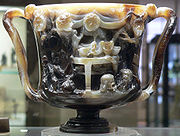
The Cup of the Ptolemies
Cup of the Ptolemies
The Cup of the Ptolemies is an onyx or chalcedony cameo two-handled cup , now conserved in the Cabinet des Médailles at the Bibliothèque National, Paris. Until September 1791 it formed part of the treasury of the Basilica of Saint-Denis. It was stolen in 1804, and recovered without its...
was used by the queens to take ablution after holy communion. This masterpieces among hardstone carving
Hardstone carving
Hardstone carving is a general term in art history and archaeology for the carving for artistic purposes of semi-precious stones, also known as gemstones, such as jade, rock crystal , agate, onyx, jasper, serpentine or carnelian, and for an object made in this way. Normally the objects are small,...
s or engraved gems of Antiquity
Classical antiquity
Classical antiquity is a broad term for a long period of cultural history centered on the Mediterranean Sea, comprising the interlocking civilizations of ancient Greece and ancient Rome, collectively known as the Greco-Roman world...
, was carved with Dionysiac
Dionysus
Dionysus was the god of the grape harvest, winemaking and wine, of ritual madness and ecstasy in Greek mythology. His name in Linear B tablets shows he was worshipped from c. 1500—1100 BC by Mycenean Greeks: other traces of Dionysian-type cult have been found in ancient Minoan Crete...
vignettes and emblems, probably in Alexandria
Alexandria
Alexandria is the second-largest city of Egypt, with a population of 4.1 million, extending about along the coast of the Mediterranean Sea in the north central part of the country; it is also the largest city lying directly on the Mediterranean coast. It is Egypt's largest seaport, serving...
during the first century BC or the first century after. It was stolen in 1804, and recovered without its Carolingian gem-studded gold mountings. Its serpentine paten
Paten
A paten, or diskos, is a small plate, usually made of silver or gold, used to hold Eucharistic bread which is to be consecrated. It is generally used during the service itself, while the reserved hosts are stored in the Tabernacle in a ciborium....
is at the Louvre
Louvre
The Musée du Louvre – in English, the Louvre Museum or simply the Louvre – is one of the world's largest museums, the most visited art museum in the world and a historic monument. A central landmark of Paris, it is located on the Right Bank of the Seine in the 1st arrondissement...
.
Charles X Regalia in Saint Denis
Some of the sovereign's robes of the coronation of Charles XCharles X of France
Charles X was known for most of his life as the Comte d'Artois before he reigned as King of France and of Navarre from 16 September 1824 until 2 August 1830. A younger brother to Kings Louis XVI and Louis XVIII, he supported the latter in exile and eventually succeeded him...
and regalia specially made for this event including the Crown of Charles X and the Crown of Queen Marie Thérèse of Savoy are displayed in one of the chapels of the nave of the Basilica of Saint Denis. The Crown of the Dauphin Louis Antoine Duke of Angoulême which subsists as well counts too among the six only surviving French crowns.
Liturgical instruments and robes in Reims
The Holy AmpullaHoly Ampulla
The Holy Ampulla or Holy Ampoule was a glass vial which, from its first recorded use, by Pope Innocent II for the anointing of Louis VII in 1131 to the coronation of Louis XVI in 1774, held the chrism or anointing oil for the coronation of the kings of France.The role played by the Sainte Ampoule...
reconstituted with some recovered fragments of the original balm
Balm
Balm can refer to:*Liniment, a topical medical preparation*Melissa , a plant genus, particularly the species commonly known as Lemon balm*Balm of Gilead, a medicinal resin from the North American species Populus candicans...
for the coronation of Charles X
Charles X of France
Charles X was known for most of his life as the Comte d'Artois before he reigned as King of France and of Navarre from 16 September 1824 until 2 August 1830. A younger brother to Kings Louis XVI and Louis XVIII, he supported the latter in exile and eventually succeeded him...
in 1825, which was originally kept in the Abbey of Saint-Remi
Abbey of Saint-Remi
The Abbey of Saint-Remi is an abbey in Reims, France, founded in the sixth century. Since 1099 it has conserved the relics of Saint Remi , the Bishop of Reims who converted Clovis, King of the Franks, to Christianity at Christmas in AD 496, after he defeated the Alamanni in the Battle of...
, is now presented in the Palace of Tau
Palace of Tau
The Palace of Tau in Reims, France, was the palace of the Archbishop of Reims. It is associated with the Kings of France, whose coronation was held in the nearby cathedral of Notre-Dame de Reims....
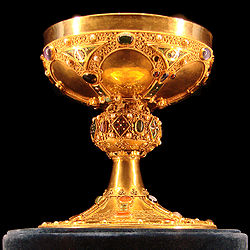
next to the cathedral Notre-Dame de Reims with the coronation Chalice
Chalice
A chalice is a goblet or footed cup intended to hold a drink. This can also refer to;* Holy Chalice, the vessel which Jesus used at the Last Supper to serve the wine* Chalice , a type of smoking pipe...
as well as several preserved sovereign's robes and gowns of kings of the Ancien Regime and the liturgical instruments made for the coronation of Charles X
Charles X of France
Charles X was known for most of his life as the Comte d'Artois before he reigned as King of France and of Navarre from 16 September 1824 until 2 August 1830. A younger brother to Kings Louis XVI and Louis XVIII, he supported the latter in exile and eventually succeeded him...
. They are displayed with the few remaining pieces of the medieval treasure of the cathedral and the Talisman
Talisman
Talisman have several meanings:*TalismanBooks and novels* The Talisman , a historical novel by Sir Walter Scott* The Talisman , a novel by Stephen King and Peter Straub...
of Charlemagne
Charlemagne
Charlemagne was King of the Franks from 768 and Emperor of the Romans from 800 to his death in 814. He expanded the Frankish kingdom into an empire that incorporated much of Western and Central Europe. During his reign, he conquered Italy and was crowned by Pope Leo III on 25 December 800...
, a large sapphire said to have been given by the Caliph
Caliph
The Caliph is the head of state in a Caliphate, and the title for the ruler of the Islamic Ummah, an Islamic community ruled by the Shari'ah. It is a transcribed version of the Arabic word which means "successor" or "representative"...
Harun al-Rashid
Harun al-Rashid
Hārūn al-Rashīd was the fifth Arab Abbasid Caliph in Iraq. He was born in Rey, Iran, close to modern Tehran. His birth date remains a point of discussion, though, as various sources give the dates from 763 to 766)....
which was found in the Emperor's grave in 1804 and later offered by Empress Eugenie. Since 1906, the content of the Holy Ampulla
Holy Ampulla
The Holy Ampulla or Holy Ampoule was a glass vial which, from its first recorded use, by Pope Innocent II for the anointing of Louis VII in 1131 to the coronation of Louis XVI in 1774, held the chrism or anointing oil for the coronation of the kings of France.The role played by the Sainte Ampoule...
is kept in Reims archbishopric.
Theft of the crown jewels during the revolution

Sancy
The Sancy, a pale yellow diamond of , was once reputed to have belonged to the Great Moguls of antiquity, but is more likely of Indian origin owing to its cut which is unusual by Western standards....
Diamond nor the French Blue Diamond were found in the years after, however. The Royal French Blue is believed to have been recut, and it is now known as the Hope Diamond
Hope Diamond
The Hope Diamond, also known as "Le bleu de France" or "Le Bijou du Roi", is a large, , deep-blue diamond, now housed in the Smithsonian Natural History Museum in Washington, D.C. It is blue to the naked eye because of trace amounts of boron within its crystal structure, but exhibits red...
.
The Hope is famously alleged to have been surrounded by bad luck. Marie Antoinette who supposedly wore it was beheaded (in fact, it was actually worn by her husband, Louis XVI, although he too was beheaded). Other owners and their families experienced suicides, marriage break-ups, bankruptcy, deaths in car crashes, falls off cliffs, revolutions, mental breakdowns, and deaths through drug overdoses. It was even tangentially associated with the case of the murdered Lindbergh baby
Lindbergh kidnapping
The kidnapping of Charles Augustus Lindbergh, Jr., was the abduction of the son of aviator Charles Lindbergh and Anne Morrow Lindbergh. The toddler, 18 months old at the time, was abducted from his family home in East Amwell, New Jersey, near the town of Hopewell, New Jersey, on the evening of...
, when its then owner, silver heiress Evalyn Walsh McLean
Evalyn Walsh McLean
Evalyn Walsh McLean was an American mining heiress and socialite who was famous for being the last private owner of the Hope Diamond as well as another famous diamond, the Star of the East...
, pawn
Pawn
Pawn may refer to:* Pawn , the weakest and most numerous piece in the game* Pawn, another name for a pledge in certain jurisdictions ** Pawnshop/pawnbroker* Pawn , an embeddable programming language...
ed it to raise money that she ended up paying to a con-man unconnected with the actual kidnapping. Most modern historians view the tales of a curse on the Hope to be spurious; the first mention of such tales is documented to 1908. Pierre Cartier, the Parisian jeweler, is widely credited with publicizing the stories of a curse on the diamond in hopes of increasing its saleability. Since 1958, it has been in the Smithsonian Institution
Smithsonian Institution
The Smithsonian Institution is an educational and research institute and associated museum complex, administered and funded by the government of the United States and by funds from its endowment, contributions, and profits from its retail operations, concessions, licensing activities, and magazines...
in Washington, D.C.
Washington, D.C.
Washington, D.C., formally the District of Columbia and commonly referred to as Washington, "the District", or simply D.C., is the capital of the United States. On July 16, 1790, the United States Congress approved the creation of a permanent national capital as permitted by the U.S. Constitution....
, where it is the single most-viewed object in the Smithsonian's collection.
The Crown Jewels were augmented by jewels added by Napoleon I
Napoleon I of France
Napoleon Bonaparte was a French military and political leader during the latter stages of the French Revolution.As Napoleon I, he was Emperor of the French from 1804 to 1815...
and Napoleon III
Napoleon III of France
Louis-Napoléon Bonaparte was the President of the French Second Republic and as Napoleon III, the ruler of the Second French Empire. He was the nephew and heir of Napoleon I, christened as Charles Louis Napoléon Bonaparte...
along with their empresses.
Last coronation
Charles X of France
Charles X was known for most of his life as the Comte d'Artois before he reigned as King of France and of Navarre from 16 September 1824 until 2 August 1830. A younger brother to Kings Louis XVI and Louis XVIII, he supported the latter in exile and eventually succeeded him...
was crowned at Reims
Reims
Reims , a city in the Champagne-Ardenne region of France, lies east-northeast of Paris. Founded by the Gauls, it became a major city during the period of the Roman Empire....
. The scale of the coronation was seen by critics to indicate a return to the absolutism of the ancien regime that had been ended by the Revolution of 1789.Some historians suggest that the very grandeur of the ceremony marked the beginning of the end for the Bourbon monarchy, with Charles's image as an old style monarch falling out of favour with the French public, who had much preferred the low-key monarchy of his brother, Louis XVIII
Louis XVIII of France
Louis XVIII , known as "the Unavoidable", was King of France and of Navarre from 1814 to 1824, omitting the Hundred Days in 1815...
. Louis Phillipe of France, the last King of France, was not crowned, and neither was Napoleon III, the last Emperor. Napoleon III's consort, Eugénie de Montijo
Eugénie de Montijo
Doña María Eugenia Ignacia Augustina de Palafox-Portocarrero de Guzmán y Kirkpatrick, 16th Countess of Teba and 15th Marquise of Ardales; 5 May 1826 – 11 July 1920), known as Eugénie de Montijo , was the last Empress consort of the French from 1853 to 1871 as the wife of Napoleon III, Emperor of...
, did have a crown
Crown of Empress Eugenie
The Crown of Empress Eugénie was the consort crown of Eugénie de Montijo, the empress consort of Emperor Napoleon III of France. Though neither she nor her husband underwent a coronation a consort crown was specially created for her....
made for her, though it was never used in an official coronation.
Break-up and sale of the French crown jewels
Throughout the late eighteenth and nineteenth centuries the jewels survived the First French Republic, the DirectorateFrench Directory
The Directory was a body of five Directors that held executive power in France following the Convention and preceding the Consulate...
, the First Empire
First French Empire
The First French Empire , also known as the Greater French Empire or Napoleonic Empire, was the empire of Napoleon I of France...
, the Restoration, the July Monarchy
July Monarchy
The July Monarchy , officially the Kingdom of France , was a period of liberal constitutional monarchy in France under King Louis-Philippe starting with the July Revolution of 1830 and ending with the Revolution of 1848...
, the Second French Republic and the Second Empire
Second French Empire
The Second French Empire or French Empire was the Imperial Bonapartist regime of Napoleon III from 1852 to 1870, between the Second Republic and the Third Republic, in France.-Rule of Napoleon III:...
. However, the decision of Henri, Comte de Chambord
Henri, comte de Chambord
Henri, comte de Chambord was disputedly King of France from 2 to 9 August 1830 as Henry V, although he was never officially proclaimed as such...
not to accept the French Crown in the early 1870s ended not just the prospect of a royal restoration. It also led to the break-up and partial sale of the Crown Jewels.
The Brazilian Beauty Symbol Aimee de Heeren, mistress of President Getulio Vargas
Getúlio Vargas
Getúlio Dornelles Vargas served as President of Brazil, first as dictator, from 1930 to 1945, and in a democratically elected term from 1951 until his suicide in 1954. Vargas led Brazil for 18 years, the most for any President, and second in Brazilian history to Emperor Pedro II...
is known for being the largest private owner of the French Crown jewels, along with the Brazilian crown jewels and other important jewelry.
In 1875 the Third French Republic came into being with the passage of a series of Organic Laws (collectively forming a constitution). The interim presidency was replaced by a full "President of the Republic".
While few expected a royal restoration, certainly after the failure of the Seize Mai attempted royalist coup by President Patrice MacMahon, duc de Magenta
Patrice MacMahon, duc de Magenta
Marie Edme Patrice Maurice de Mac-Mahon, 1st Duke of Magenta was a French general and politician with the distinction Marshal of France. He served as Chief of State of France from 1873 to 1875 and as the first president of the Third Republic, from 1875 to 1879.-Early life:Born in Sully , in the...
, the continuing agitation of extreme right wing royalists, and the fear of a royalist coup d'état, led radical deputies to propose the sale of the Crown Jewels, in the hope that their dispersal would undermine the royalist cause: "Without a crown, no need for a king" in the words of one member of the National Assembly. This controversial decision was implemented. All the jewels from the Crown Jewels were removed and sold in 1887, as were many of the crowns, diadems, rings and other items. Only a few of the crowns were kept for historic reasons, but with their original diamonds and gems replaced by colored glass. Some historic or unusual gems went to French museums, including the corsage brooch containing some of the 'Mazarin diamonds'http://cartelfr.louvre.fr/cartelfr/visite?srv=car_not_frame&idNotice=11327, which is now in the Louvre, and the 'Ruspoli' sapphire, which is now in the French Natural History Museum (curators took advantage of its unusual rhombohedral faceted shape and asked for it to be exempted from the sale, falsely claiming that it was a natural, uncut crystal).
Most recent royal ceremony in France: The funeral of Louis XVII in 2004
One of the mysteries of the French Revolution was the question of what had happened to the Dauphin, the heir apparentHeir apparent
An heir apparent or heiress apparent is a person who is first in line of succession and cannot be displaced from inheriting, except by a change in the rules of succession....
of King Louis XVI, after the execution of the King and Queen. Though it was generally believed that he had died in prison, popular legend had spoken of the young prince being spirited away from his prison and living in exile.
In 2004, however it was finally confirmed that the legend was fictitious. In reality Louis XVI's son, Louis Charles, called the young prince by some, and King Louis XVII of France
Louis XVII of France
Louis XVII , from birth to 1789 known as Louis-Charles, Duke of Normandy; then from 1789 to 1791 as Louis-Charles, Dauphin of France; and from 1791 to 1793 as Louis-Charles, Prince Royal of France, was the son of King Louis XVI of France and Queen Marie Antoinette...
by royalist supporters following his father's death, had died of tuberculosis
Tuberculosis
Tuberculosis, MTB, or TB is a common, and in many cases lethal, infectious disease caused by various strains of mycobacteria, usually Mycobacterium tuberculosis. Tuberculosis usually attacks the lungs but can also affect other parts of the body...
in prison. The fact of his death was established using DNA
DNA
Deoxyribonucleic acid is a nucleic acid that contains the genetic instructions used in the development and functioning of all known living organisms . The DNA segments that carry this genetic information are called genes, but other DNA sequences have structural purposes, or are involved in...
evidence. The heart
Heart
The heart is a myogenic muscular organ found in all animals with a circulatory system , that is responsible for pumping blood throughout the blood vessels by repeated, rhythmic contractions...
of the young man claimed by the royalists to be the young Louis XVII had been secretly removed by a doctor just after his death. By comparing the DNA from the heart with DNA taken from strands of hair of Marie Antoinette
Marie Antoinette
Marie Antoinette ; 2 November 1755 – 16 October 1793) was an Archduchess of Austria and the Queen of France and of Navarre. She was the fifteenth and penultimate child of Holy Roman Empress Maria Theresa and Holy Roman Emperor Francis I....
that had been kept as a memento by royalists, it was possible to establish that the boy who died in prison was indeed the son of Louis XVI and Marie Antoinette; the above mentioned heir to the crown of Louis XVI.
The formal funeral for Louis XVII finally took place, albeit with his heart, not his body, in 2004. For the first time in over a century a royal ceremony took place in France, complete with the fleur-de-lis
Fleur-de-lis
The fleur-de-lis or fleur-de-lys is a stylized lily or iris that is used as a decorative design or symbol. It may be "at one and the same time, political, dynastic, artistic, emblematic, and symbolic", especially in heraldry...
standard and a royal crown.