
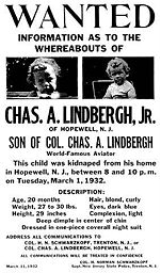
The
kidnapping of Charles Augustus Lindbergh, Jr. was the abduction of the son of
aviatorAn aviator is a person who flies aircraft for pleasure or as a profession. The first recorded use of the term was in 1887 as a variation of the French 'aviation', from the latin 'avis', coined 1863 by G. de la Landelle in "Aviation ou Navigation Aérienne"...
Charles LindberghCharles Augustus Lindbergh was an American aviator, author, inventor and explorer.On May 20–21, 1927, Lindbergh, then a 25-year old U.S...
and
Anne Morrow LindberghAnne Morrow Lindbergh, born Anne Spencer Morrow was a pioneering American aviator, author, and the spouse of fellow aviator Charles Lindbergh.-Early life:...
. The toddler was
abductedChild abduction is the abduction or kidnapping of a child by an older person.Several distinct forms of child abduction exist:* A parent removes or retains a child from the other parent's care ....
from his family home in East Amwell, New Jersey near the town of
Hopewell, New JerseyHopewell is a Borough in Mercer County, New Jersey, United States. As of the United States 2000 Census, the borough population was 2,035.Hopewell was incorporated as a borough by an Act of the New Jersey Legislature on April 14, 1891, from portions of Hopewell Township, based on the results of a...
on the evening of March 1, 1932. Over two months later, on May 12, 1932, the body of Charles Lindbergh, Jr. was discovered a short distance from the Lindberghs' home.
A medical examination determined that the toddler had a "massive fracture of the skull" which was determined to be the cause of death.
After an investigation that lasted more than two years,
Bruno Richard HauptmannBruno Richard Hauptmann was a German carpenter sentenced to death and executed for the abduction and murder of Charles Augustus Lindbergh Jr., the 20-month-old son of famous pilots Charles Lindbergh and Anne Morrow Lindbergh...
was arrested and charged with the crime. In a trial that was held from January 2, 1935 to February 13, 1935, Hauptmann was found guilty of murder in the first degree and sentenced to the death penalty. He was executed by
electric chairExecution by electrocution is an execution method originating in the United States in which the person being put to death is strapped to a specially built wooden chair and electrocuted through electrodes placed on the body...
at the
New Jersey State PrisonThe New Jersey State Prison , formerly known as Trenton State Prison, is a state prison in the United States operated by the New Jersey Department of Corrections. Located in Trenton, New Jersey, it accommodated over 1,900 prisoners as of January, 2005.NJSP operates two security units and provides...
on April 3, 1936 at 8:44 in the evening. Hauptmann proclaimed his innocence to the end.
Newspaper writer H.L. Mencken called the kidnapping and subsequent trial "the biggest story since the Resurrection." The crime spurred
CongressThe United States Congress is the bicameral legislature of the federal government of the United States of America, consisting of two houses, the Senate and the House of Representatives. Both senators and representatives are chosen through direct election....
to pass the
Federal Kidnapping ActFollowing the historic Lindbergh kidnapping , the United States Congress adopted a federal kidnapping statute—popularly known as the Federal Kidnapping Act — which was intended to let federal authorities step in and pursue kidnappers once they had...
, commonly called the "Lindbergh Law", that made transporting a
kidnappingIn criminal law, kidnapping is the taking away or asportation of a person against the person's will, usually to hold the person in false imprisonment, a confinement without legal authority...
victim across state lines a
federal crimeIn the United States, a federal crime or federal offense is a crime that is either made illegal by U.S. federal legislation or a crime that occurs on U.S...
.
The crime
At 9:00 pm on March 1, 1932, the nurse-maid, Betty Gow, put 20-month-old Charles Lindbergh Jr. in his crib. She then proceeded to pin the blanket covering him with two large safety pins so as to prevent it from moving while he slept. At around 9:30 p.m., Col. Lindbergh heard a noise that made him think some slats had fallen off an orange crate in the kitchen. At 10:00 p.m., Gow discovered that the baby was missing from his crib. She in turn went to ask Mrs. Lindbergh, who was just coming out of the bath, if she had the baby with her. After not finding Charles Lindbergh Jr. with his mother, the nurse-maid then proceeded down stairs to speak with Lindbergh, who was in the library/study just beneath the baby's nursery room in the southeast corner of the house. Charles Lindbergh then proceeded up to the nursery to see for himself that his son was not in fact in his crib. While surveying the room, he discovered a white envelope had been left on the radiator that formed the window sill. Lindbergh proceeded to locate his
Springfield rifleThe term Springfield Rifle may refer to any one of several types of small arms produced by the Springfield Armory in Springfield, Massachusetts, for the United States armed forces....
and search the rest of the house looking for intruders. Within 30 minutes the local police were en route to the house, as well as the media and Lindbergh's attorney. There was a single distinguished footprint and indentations discovered a short time later just below the window in the mud due to the rainy and blustery conditions that day and into the evening. After the authorities arrived on the scene and began to search the immediate area surrounding the house, a short distance away in a cluster of bushes were found three sections of a smartly designed but rather crude-looking ladder.
The investigation
First on the scene was Chief Harry Wolfe of the Hopewell police. Wolfe was soon joined by
New Jersey State PoliceThe New Jersey State Police is the state police force for the state of New Jersey. It is a general-powers police agency with state wide jurisdiction, designated by Troop Sectors...
officers. The police searched the home and scoured the surrounding area for miles.
After midnight, a
fingerprintA fingerprint is an impression of the friction ridges on all parts of the finger. A friction ridge is a raised portion of the epidermis on the palmar or digits or plantar skin, consisting of one or more connected ridge units of friction ridge skin...
expert arrived at the home to examine the note left on the window sill and the ladder. The ladder had 400 partial fingerprints and some footprints left behind. However, most were of no value to the investigation due to the surge of media and police that were present within the first 30 minutes to hour after the first call for help. An odd twist to this investigation is that during the fingerprint discovery process, not a single fingerprint was found in the room—none from Mr. and Mrs. Lindbergh, none from the baby, none from Betty Gow. Getting any solid evidence outside the house proved to be virtually impossible. The ransom note that was found by Lindbergh was opened and read by the police after they arrived. The brief, handwritten letter was riddled with spelling mistakes and grammatical irregularities:
Without the typos and gramatical errors, the message reads:
There were two interconnected circles (colored red and blue) below the message, with a hole punched through the red circle and two other holes punched outside the circles.
Word of the kidnapping spread quickly, and, along with police, the well-connected and well-intentioned arrived at the Lindbergh estate. Three were military colonels offering their aid, though only one had law enforcement expertise: Herbert Norman Schwarzkopf, superintendent of the New Jersey State Police and the father of General H. Norman Schwarzkopf, the commander of all coalition forces for Operation Desert Shield/Storm. The other colonels were Henry Skillman Breckinridge, a
Wall StreetWall Street is a street in Lower Manhattan, New York City, New York, United States. It runs east from Broadway to South Street on the East River, through the historical center of the Financial District. It is the first permanent home of the New York Stock Exchange; over time Wall Street became the...
lawyer;
William Joseph DonovanMajor General William Joseph Donovan, USA, GCSS, KBE was an American soldier, lawyer and intelligence officer, best remembered as wartime head of the Office of Strategic Services . He is also widely known as the "father" of today's Central Intelligence Agency .-Early life:Donovan was born in...
(a.k.a. "Wild Bill" Donovan, a hero of the
First World WarWorld War I , also known as the First World War, the Great War, and the War to End All Wars, was a global military conflict which involved most of the world's great powers, assembled in two opposing alliances: the Triple Entente and the Triple Alliance...
who would later head the
OSSThe Office of Strategic Services was a United States intelligence agency formed during World War II. It was the wartime intelligence agency, and it was the predecessor of the Central Intelligence Agency .-Origins and activities:...
). Lindbergh and these men believed that the kidnapping was perpetrated by
organized crimeOrganized crime or criminal organizations can be defined as a transnational grouping of highly centralized enterprises run by criminals for the purpose of engaging in illegal activity, most commonly for the purpose of generating a monetary profit...
figures. The letter, they thought, seemed written by someone who spoke German as his native language. It should be noted that Charles Lindbergh, at this time, used his influence to control the direction of the investigation.
They contacted Mickey Rosner, a
BroadwayBroadway Theatre, commonly called simply Broadway, is the theatre associated with the 40 large professional theaters with 500 seats or more located in the Theatre District, New York in Manhattan, New York City...
hanger-on rumored to know mobsters. Rosner, in turn, brought in two
speakeasyA speakeasy was an establishment which illegally sold alcoholic beverages during the period of United States history known as Prohibition...
owners: Salvatore "Salvy" Spitale and Irving Bitz. Lindbergh quickly endorsed the duo and appointed them his intermediaries to deal with the mob. Unknown to Lindbergh, however, Bitz and Spitale were actually in cahoots with the New York
Daily NewsThe Daily News of New York City is the fifth most-widely circulated daily newspaper in the United States with a daily circulation of 632,595, as of June 13, 2009. The first U.S. daily printed in tabloid form, it was founded in 1919, and as of 2007 is owned and run by Mortimer Zuckerman...
, a paper which hoped to use the duo to scoop other newspapers in the race for leads in the kidnapping story.
Several
organized crimeOrganized crime or criminal organizations can be defined as a transnational grouping of highly centralized enterprises run by criminals for the purpose of engaging in illegal activity, most commonly for the purpose of generating a monetary profit...
figures — notably
Al CaponeAlphonse Gabriel "Al" Capone was an American gangster who led a crime syndicate dedicated to smuggling and bootlegging of liquor and other illegal activities during the Prohibition Era of the 1920s and 1930s....
— spoke from prison, offering to help return the baby to his family in exchange for money or for legal favors. Ideally Capone was offering assistance in return for being released from prison under the guise that his assistance could be more effective. This was quickly denied by the authorities.
The morning after the kidnapping, U.S. President
Herbert HooverHerbert Clark Hoover was the 31st President of the United States . Hoover was a professional mining engineer and author. As the United States Secretary of Commerce in the 1920s under Presidents Warren Harding and Calvin Coolidge, he promoted government intervention under the rubric "economic...
was notified of the crime. Though the case did not seem to have any grounds for federal involvement (kidnapping then being classified as a local crime), Hoover declared that he would "move Heaven and Earth" to recover the missing child. The Bureau of Investigation (not yet called the
FBIThe Federal Bureau of Investigation is an agency of the United States Department of Justice that serves as both a federal criminal investigative body and an internal intelligence agency. The FBI has investigative jurisdiction over violations of more than 200 categories of federal crime...
) was authorized to investigate the case, while the
United States Coast GuardThe United States Coast Guard is a branch of the United States Armed Forces and one of seven uniformed services. It is unique among the military branches in that it has a maritime law enforcement mission and a federal regulatory agency mission as part of its mission set...
, the
U.S. Customs ServiceUntil March 2003, the United States Customs Service was an agency of the U.S. federal government that collected import tariffs and performed other selected border security duties....
, the
U.S. Immigration ServiceThe United States Immigration and Naturalization Service was a part of the United States Department of Justice and handled legal and illegal immigration and naturalization. It ceased to exist on March 1, 2003....
and the Washington D.C. police were told their services might be required. New Jersey officials announced a $25,000 reward for the safe return of "Little Lindy." The Lindbergh family offered an additional $50,000 reward of their own. The total reward of $75,000 was made even more significant by the fact that the offer was made during the early days of the
Great DepressionThe Great Depression was a severe worldwide economic depression in the decade preceding World War II. The timing of the Great Depression varied across nations, but in most countries it started in about 1929 and lasted until the late 1930s or early 1940s...
.
A few days after the kidnapping, a new ransom letter arrived at the Lindbergh home via the mail.
PostmarkA postmark is a postal marking made on a letter, package, postcard or the like indicating the date and time that the item was delivered into the care of the postal service...
ed in
BrooklynBrooklyn is one of the five boroughs of New York City, located southwest of Queens on the western tip of Long Island. An independent city until its consolidation with New York in 1898, Brooklyn is New York City's most populous borough, with 2.5 million residents, and second largest in area...
, the letter was genuine, carrying the perforated red and blue marks. Police wanted to examine the letter, but instead Lindbergh gave it to Rosner, who said he would pass it on to his supposed mob associates. In actuality, the note went back to the
Daily News, where someone photographed it. Before long, copies of the ransom note were being sold on street corners throughout New York for $5 each. Any ransom letters received after this one were therefore automatically suspect.
A second ransom note then arrived by mail, also postmarked from Brooklyn. Ed Mulrooney, Commissioner of the
New York City Police DepartmentThe New York City Police Department , established in 1845, is currently the largest police force in the United States, with primary responsibilities in law enforcement and investigation within the five boroughs of New York City...
, suggested that, given two Brooklyn postmarks, the kidnappers were probably working out of that area. Mulrooney told Lindbergh that his officers could surveil postal letterboxes in Brooklyn, and that a device could be placed inside each letterbox to isolate the letters in sequence as they were dropped in, to help track down anyone who might be tied to the case. If Lindbergh, Jr. was being held in Brooklyn by the kidnappers, Mulrooney insisted that such a plan might help locate the child as well. Mulrooney was willing to go to great lengths, including organizing a police raid to rescue the baby. Lindbergh strongly disapproved of the plan. He feared for his son's life and warned Mulrooney that if such a plan was carried out, Lindbergh would use his considerable influence in efforts to ruin Mulrooney's career. Reluctantly, Mulrooney acquiesced.
The day after Lindbergh rejected Mulrooney's plan, a third letter was mailed. It too came from Brooklyn. This letter warned that since the police were now involved in the case, the ransom had been doubled to $100,000.
John Condon aka "Jafsie"
During this time, John F. Condon, a 72-year-old retired school teacher in the Bronx, wrote a letter to the
Home News. proclaiming his willingness to help the Lindbergh case in any way he could and added $1000 of his own money to the reward. Condon received a letter in care of the
Home News purportedly written by the kidnappers. It was marked with the punctured red-and-blue circles and authorized Condon as their intermediary with Lindbergh. Lindbergh accepted the letter as genuine and at the time neither man seemed to know that copies of the first mailed ransom letter were being sold by the hundreds. So by now a great many people must have known the "signature" required to forge a letter from the kidnappers.
Following the latest letter's instructions, Condon placed a classified ad in the
New York American: "Money is Ready. Jafsie". (Jafsie was a pseudonym based on a phonetic pronunciation of Condon's initials, "J.F.C.") Condon then waited for further instructions from the
culpritA culprit, under English law properly the prisoner at the bar, is one accused of a crime. The term is used, generally, of one guilty of an offence. In origin the word is a combination of two Anglo-French legal words, culpable: guilty, and prit or prest: Old French: ready...
s.
A meeting between "Jafsie" and a representative of the group that claimed to be the kidnappers was eventually scheduled for late one evening at
Woodlawn CemeteryLocated in The Bronx, Woodlawn Cemetery is one of the largest cemeteries in New York City. It opened as a rural cemetery in 1863, out in "the country", in what was then southern Westchester County, which was annexed to New York City in 1874...
. According to Condon, the man sounded foreign but stayed in the shadows during the conversation, and he was thus unable to get a close look at his face. The man said his name was John, and he related his story: he was a "
ScandinaviaScandinavia is a geographical region in northern Europe that includes, and is named after, the Scanian Province. It consists of the kingdoms of Norway, Sweden, and Denmark...
n" sailor, part of a gang of three men and two women. The Lindbergh child was unharmed and being held on a boat, but the kidnappers were still not ready to return him or receive the ransom. When Condon expressed doubt that "John" actually had the baby, he promised some proof: the kidnapper would soon return the baby's sleeping suit. The stranger asked Condon " ... would I burn [be executed], if the package [baby] were dead?" When questioned further, he assured Condon that the baby was alive. Lindbergh had insisted that Mulrooney not be informed, and so "John" was not followed by police after the meeting. The New York Police were by now aware of the "Jafsie" newspaper advertisements, and wanted to know who the mysterious Jafsie was, but Lindbergh refused to say anything.
On March 16, 1932 John Condon received a package by mail that contained a toddler's sleeping suit, which was sent as proof of their claim, and a seventh ransom note. Condon showed the sleeping suit to Lindbergh who identified it as belonging to his son. After the delivery of the sleeping suit, Condon took out a new ad in the
Home News declaring, "Money is ready. No cops. No secret service. I come alone, like last time." One month and one day after the child was kidnapped, on April 1, 1932, Condon received a letter from the purported kidnappers. They were ready to accept payment.
Payment of the ransom
The ransom was packaged in a wooden box which was custom-made in the hope that it could later be identified. The ransom money itself was made up with a number of
gold certificateA gold certificate in general is a certificate of ownership that gold owners hold instead of storing the actual gold. It has both a historic meaning as a US paper currency and a current meaning as a way to invest in gold....
s that were to be withdrawn from circulation in the near future. It was hoped that anyone passing large amounts of gold notes would draw attention to themselves and help aid in identifying the abductors. It should also be noted that while the bills themselves were not
markedMarking bills is a technique used by police to trace and identify money used in illegal activities. The serial numbers of the bills are recorded, and sometimes markings are made on the bank notes themselves ....
the serial number of each bill was recorded.
The next evening, Condon was given a note by cab driver Raymond Perrone, who said he had been paid by a man to deliver the note. This note was the first in a series of convoluted instructions that lead Condon and Lindbergh all over
ManhattanManhattan is one of the five boroughs of New York City, located primarily on Manhattan Island at the mouth of the Hudson River.New York County, which has the same boundaries as the Borough of Manhattan , is the most densely populated county in the United States, with a 2008 population of 1,634,795...
. Eventually, they were sent to
St. Raymond's CemeterySaint Raymond's Cemetery is a Roman Catholic cemetery at 2600 Lafayette Avenue in The Bronx, New York City. There are both an Old Saint Raymond's and a New Saint Raymond's Cemetery...
. Condon met a man he thought might have been "John" and told him that they had been able to raise only $50,000. The man accepted the money and gave Condon a note. Lindbergh, who saw the man only from a distance, had insisted the police not be informed of the meeting and the suspect got away without being followed.
The note given to Condon stated that the child was being held on a boat called the
Nelly at
Martha's VineyardMartha's Vineyard is an island off the south of Cape Cod in New England. The islands both forming a part of the Outer Lands region....
. The child was supposed to be in the care of two women who were, as the note also stated, innocent. Lindbergh went there and searched the piers, however, there was no boat called the
Nelly. A desperate Lindbergh took to flying an airplane low over the piers in an attempt to startle the kidnappers into showing themselves. After two days, Lindbergh admitted he had been fooled.
Discovery of the body
On May 12, 1932 delivery truck driver William Allen pulled his truck to the side of a road about from the Lindbergh home. He went to a grove of trees to relieve himself and there he discovered the corpse of a toddler. Allen notified police, who took the body to a morgue in nearby
Trenton, New JerseyTrenton is the capital of the U.S. state of New Jersey and the county seat of Mercer County. As of 2007, the United States Census Bureau estimated that the City of Trenton had a population of 82,804....
. The body was badly decomposed and it was discovered that the skull was badly fractured. The left leg and both hands were missing and there were signs that the body had been chewed on by various animals as well as indications that someone had made an attempt to hastily bury the body. Lindbergh and Gow quickly identified the baby as the missing infant based on the overlapping toes of the right foot and the shirt that Gow had made for the baby. They surmised that the child had been killed by a blow to the head. Mr. Lindbergh was insistent on having the body cremated afterwards.
Once the U.S. Congress learned that the child was dead, legislation was rushed making kidnapping a federal crime. The Bureau of Investigations could now aid the case more directly.
In June 1932 officials began to suspect an "inside job" in that someone the Lindberghs trusted may have betrayed the family. Suspicions fell upon Violet Sharp, a British household servant of the Lindbergh home. She had given contradictory testimony regarding her whereabouts on the night of the kidnapping. It was reported that she acted nervous and suspicious when questioned. She committed
suicideSuicide is the intentional killing of one's self. Many dictionaries also note the metaphorical sense of "willful destruction of one's self-interest"...
on June 20, 1932 by ingesting a silver polish that contained
potassium cyanidePotassium cyanide is an inorganic compound with the formula KCN. This colorless crystalline compound, similar in appearance to sugar, is highly soluble in water. The vast majority of KCN is used in gold mining followed by use in organic synthesis, and electroplating. Smaller applications include...
just prior to what would have been her fourth time being questioned. After her alibi was confirmed, it was later determined that the possible threat of losing her job and the intense questioning had driven her to commit suicide. At the time the police investigators were criticized for what some felt were the "heavy handed" police tactics used.
Following the death of Violet Sharp, John Condon was also questioned by police. Condon's home was searched as well but nothing was found that tied Condon to the crime. Charles Lindbergh stood by Condon during this time as well.
John Condon's unofficial investigation
After the discovery of the body, John Condon remained unofficially involved in the case. To the public he had become a suspect and in some circles vilified. For the next two years he visited police departments and pledged to find "Cemetery John". During this time Condon would frequently take a rowboat out into
Long Island SoundLong Island Sound is an estuary of the Atlantic Ocean and various rivers in the United States that lies between the coast of Connecticut to the north and Long Island, New York to the south. The mouth of the Connecticut River at Old Saybrook, Connecticut, empties into the sound...
to have "secret meetings with informants".
Condon's actions regarding the case were becoming increasingly flamboyant. On one occasion, while riding a city bus, he saw a suspect and, announcing his secret identity, ordered the bus to a stop. The startled driver complied, and Condon darted from the bus, though Condon's target eluded him. Another time he dressed as a woman for his clandestine activities, with a collar pulled up to hide his handlebar mustache. Tiring of Condon's interference, the police threatened to charge him as an accomplice to the crime. John Condon's actions were also criticized as exploitative when he agreed to appear in a
vaudevilleVaudeville was a theatrical genre of variety entertainment in the United States and Canada from the early 1880s until the early 1930s. Each performance was made up of a series of separate, unrelated acts grouped together on a common bill...
act regarding the kidnapping. Liberty magazine published a
serializedA periodical publication, or just periodical, is a published work that appears in a new edition on a regular schedule. The most familiar examples are the newspaper, often published daily, or weekly; or the magazine, typically published weekly, monthly or as a quarterly...
account of John Condon's involvement in the Lindbergh kidnapping under the title "Jafsie Tells All".
Tracking the ransom money
Investigation of the case was soon in the doldrums. There were no developments and little evidence of any sort, so police turned their attention to tracking the ransom payments. A pamphlet was prepared with the serial numbers on the ransom bills and 250,000 copies were distributed to businesses mainly in New York City. A few of the ransom bills turned up in scattered locations, some as far away as
ChicagoChicago is the largest city in the U.S. state of Illinois, and with more than 2.8 million people, the 3rd largest city in the United States...
and
MinneapolisMinneapolis is the largest city in the U.S. state of Minnesota and is the county seat of Hennepin County. The city lies on both banks of the Mississippi River, just north of the river's confluence with the Minnesota River, and adjoins Saint Paul, the state's capital. Known as the Twin Cities,...
, but the people spending them were never found.
As per
Executive Order 6102Executive Order 6102 is an Executive Order signed on April 5, 1933 by U.S. President Franklin D. Roosevelt "forbidding the Hoarding of Gold Coin, Gold Bullion, and Gold Certificates" by U.S. citizens.-Effect of the Order:The Order required U.S...
Gold Certificates were to be turned in by May 1, 1933. A few days before the deadline a man in Manhattan brought in $2,990 of the ransom money to be exchanged. The bank was busy and no-one could remember anything specific about the person. He had filled out a required form which gave his name as J. J. Faulkner. The address supplied was 537 West 159th Street in New York City.
When authorities visited the address, they learned no one named Faulkner had lived there — or anywhere nearby — for many years. U.S. Treasury officials kept looking, and eventually learned that a woman named Jane Faulkner had lived at the address in question in 1913. She had moved after she married a German man named Geissler. The couple was tracked down, and both denied any involvement in the crime.
Mr. Geissler had two children from his first marriage. Though neither could be conclusively tied to the kidnapping, there were some curious facts which led authorities to suspect involvement: Geissler's son worked as a florist and lived about one block from Condon, while Geissler's daughter had married a German gardener. Condon again figured in the investigation: after hearing the three men from the Geissler family speak, Condon declared that Geissler's son-in-law, the gardener, had a voice very similar to "John", the man he had met in the cemeteries. The police followed up on this lead, but the gardener killed himself.
Capture of a suspect
For thirty months New York Police Detective James J. Finn and FBI Agent Thomas Sisk had been working on the Lindbergh case. They had been able to track down many bills from the ransom money that were being spent in places throughout New York City. A map Detective Finn had created recorded each find and eventually showed that many of the bills were being passed mainly along the route of the Lexington Avenue subway. This subway line connected the East Bronx with the east side of Manhattan including the German-Austrian neighborhood of Yorkville.
On September 18, 1934 a gold certificate from the ransom money was referred to Detective Finn and Agent Sisk. Although President Roosevelt had issued an executive order on April 5, 1933, calling for all gold certificates to be turned in by May 1, 1933, under the penalty of fine or imprisonment, some members of the public held on to them past the deadline.
As of July 31, 1934 $161 million in gold certificates were still in general circulation. The ten dollar gold certificate was discovered by a teller of the
Corn Exchange BankThe Corn Exchange Bank was founded in 1852 in New York, but had branches in other states, including Pennsylvania, Wisconsin, and Nebraska. It was a retail bank that acquired many community banks. In 1929 it was renamed the Corn Exchange Bank and Trust Company. In 1954 it merged with Chemical Bank...
of the Bronx. It had a New York license plate penciled in the margin which helped the investigators trace the bill to a gas station in upper Manhattan. The station manager, Walter Lyle, had written down the license plate number as per company policy feeling that his customer was acting "suspicious" and was "possibly a counterfeiter".
It was found the license plate number belonged to a blue
DodgeDodge is a United States-based brand of automobiles, minivans, sport utility vehicles, and pickup trucks, manufactured and marketed by Chrysler Group LLC in more than 60 different countries and territories worldwide....
sedan owned by Bruno Richard Hauptmann of 1279 East 222nd Street in the Bronx. Hauptmann was found to be a
GermanGermany , officially the Federal Republic of Germany , is a country in Central Europe. It is bordered to the north by the North Sea, Denmark, and the Baltic Sea; to the east by Poland and the Czech Republic; to the south by Austria and Switzerland; and to the west by France, Luxembourg, Belgium,...
immigrant with a
criminal recordA criminal record is a record of a person's criminal history, generally used by potential employers, lenders etc. to assess his or her trustworthiness. The information included in a criminal record varies between countries and even between jurisdictions within a country...
in his homeland. When Hauptmann was arrested, he had on his person a twenty dollar gold certificate. A search by police of Hauptmann's home found $1,830 of the ransom money hidden behind a board. Another $11,930 was found in an empty can near a window in the garage. During the police investigation the garage that Hauptmann built was torn down during the search for the money.
Hauptmann was arrested by Finn and interrogated as well as beaten at least once throughout the day and night that followed. The money, Hauptmann stated, along with other items, had been left with him by friend and former business partner
Isidor FischIsidor Srul Fisch was a German Jewish friend and business associate of Bruno Hauptmann, from whom Hauptmann claimed to have received a box containing gold certificates which had earlier been used to pay a ransom in the kidnapping of Charles Augustus Lindbergh jr.Fisch was born into a Jewish family...
. Fisch had died, on March 29, 1934, shortly after returning to Germany. Only following Fisch's death, Hauptmann stated, did he learn that the shoe box left with him contained a considerable sum of money. He took the money because he claimed that it was owed to him from a business deal that he and Isidor Fisch had made. Hauptmann consistently denied any connection to the crime or knowledge that the money in his house was from the ransom.
In the search of his apartment by police a considerable amount of additional evidence that he was involved in the crime surfaced. One item was a notebook that contained a sketch for the construction of a collapsible ladder similar to that which was found at the Lindbergh home in March 1932. John Condon's phone number, along with his address, were discovered written down on a closet wall in the house. A key linking piece of evidence, a piece of wood, was discovered in the attic of the home. After being examined by an expert it was determined to be an exact match to the wood used in the construction of the ladder found at the scene of the crime. This particular wood was also traced back to the saw mill where the lumber was processed in South Carolina.
Hauptmann was indicted in the Bronx on September 24, 1934 for extorting the $50,000 ransom from Charles Lindbergh. Two weeks later, on October 8, 1934, Hauptmann was indicted in New Jersey for the murder of Charles Augustus Lindbergh, Jr. Two days later he was surrendered to New Jersey authorities by New York Governor
Herbert H. LehmanHerbert Henry Lehman was a Democratic Party politician from New York. He was Governor of New York from 1933 to 1942, and represented New York in the United States Senate from 1950 to 1957.-Lehman Brothers:...
to face charges directly related to the kidnapping and murder of the child. Hauptmann was moved to the Hunterdon County Jail in Flemington, New Jersey on October 19, 1934.
The trial
Hauptmann was charged with kidnapping and
murderMurder, as defined in common law countries, is the unlawful killing of another human being with intent , and generally this state of mind distinguishes murder from other forms of unlawful homicide...
. Conviction on even one charge could earn him the death penalty. He pleaded not guilty.
Held at the
Hunterdon County CourthouseThe Hunterdon County Courthouse is an historic site located in Flemington, the county seat of Hunterdon County, New Jersey, United States, that is best known as the site of the 1935 "Trial of the Century" of Bruno Hauptmann and his conviction and sentence of death for his role in the Lindbergh...
in
Flemington, New JerseyFlemington is a Borough in Hunterdon County, New Jersey, United States. As of the United States 2000 Census, the borough population was 4,201. It is the county seat of Hunterdon County....
, the trial soon became a sensation: reporters swarmed the town, and every hotel room was booked.
In exchange for rights to publish Hauptmann's story in their paper, Edward J. Reilly was hired by the
Daily Mirror to serve as Hauptmann's attorney. Two other lawyers, Lloyd Fisher and Frederick Pope, were co-counselors.
David T. WilentzDavid Theodore Wilentz was the Attorney General of New Jersey from 1934 to 1944. In 1935 he successfully prosecuted Bruno Hauptmann in the Lindbergh kidnapping trial...
, Attorney General of New Jersey, led the prosecution.
In addition to Hauptmann's possession of the ransom money, the State introduced evidence showing a striking similarity between Hauptmann's handwriting and the handwriting on the ransom notes.
Based on the forensic work of
Arthur KoehlerArthur Koehler was a chief wood technologist at the Forest Products Laboratory in Madison, Wisconsin, and was important in the development of wood forensics in the 1930s through his role in the investigation of the Lindbergh kidnapping...
at the
Forest Products LaboratoryForest Products Laboratory is a research facility of the United States Forest Service and the USDA. For many years, FPL has provided scientific research on wood, wood products and their commercial uses to both government and private industry...
, the State also introduced photographic evidence demonstrating that the wood from the ladder left at the crime scene matched a plank from the floor of Hauptmann's attic: the type of wood, the direction of tree growth, the milling pattern at the factory, the inside and outside surface of the wood, and the grain on both sides were identical, and two oddly placed nail holes lined up with a joist splice in Hauptmann's attic.
Additionally, the prosecutors noted that Condon's address and telephone number had been found written in
pencilA pencil is a writing or drawing device consisting of a slippery, thin stick of pigment and clay, usually encased in a thin wood cylinder, although paper and plastic sheaths are also used...
on a closet door in Hauptmann's home. Hauptmann himself admitted in a police interview that he had written Condon's address on the closet door: "I must have read it in the paper about the story. I was a little bit interested and keep a little bit record of it, and maybe I was just on the closet, and was reading the paper and put it down the address." When asked about Condon's telephone number, he could respond only, "I can't give you any explanation about the telephone number."
The defense did not challenge the identification of the body, a common practice in murder cases at the time designed to avoid exposing the jury to an intense analysis of the body and its condition.
Condon and Lindbergh both testified that Hauptmann was "John." Another witness, Amandus Hockmuth, testified that he saw Hauptmann near the scene of the crime.
Hauptmann was ultimately convicted of the crimes and sentenced to death. His appeals were rejected, though New Jersey Governor
Harold G. HoffmanHarold Giles Hoffman was an American politician, a Republican who served as the 41st Governor of New Jersey, from 1935 to 1938. He also served two terms representing in the United States House of Representatives, from 1927 to 1931...
granted a temporary reprieve of Hauptmann's execution and made the politically unpopular move of having the New Jersey Board of Pardons review the case. Apparently, they found no reason to overturn the verdict.
Hauptmann turned down a $90,000 offer from a Hearst newspaper for a confession and refused a last-minute offer to commute his execution to a life sentence in exchange for a confession.
He was electrocuted on April 3, 1936 just over four years after the kidnapping.
Controversy
As with all notorious crimes, the Lindbergh kidnapping has attracted at least its fair share of hoaxes and alternative theories.
Hoaxes during the investigation
While the baby was still missing, at least two separate men,
Gaston MeansGaston Bullock Means was an American private detective, Salesman, bootlegger, Forger, swindler, murder suspect, blackmailer, and con artist....
and John Hughes Curtis, came forward with false claims that they were associates of the kidnappers. Gaston Means, who was a former FBI agent and conman, was convicted of larceny after extorting $100,000 from Washington D.C. socialite Evalyn Walsh McLean. McLean had provided Means the money in an attempt to pay a ransom for the return of Charles Jr. Means was sentenced to fifteen years in prison and died in custody in 1938. John Curtis, a respected boat builder in Norfolk, Virginia, also made claims that he was in contact with the kidnappers. Curtis even claimed that at one point he had held the baby in his arms. After the child's body was found, Curtis confessed that his stories were false and were brought about by "financial pressures". He was fined and given a one year suspended sentence.
The Lindberghs were the victims of several other pranks and claims about their baby. Even today, a man asserts that he is the Lindbergh baby.
Re-examination of the evidence
Erastus Mead Hudson was a fingerprint expert who knew the then-rare silver nitrate process of collecting fingerprints off wood and other surfaces on which the previous powder method could not detect fingerprints. He found that Hauptmann's fingerprints were not on the wood, even in places that the man who made the ladder would have to have touched. Upon reporting this to a police officer and stating that they must look further, the officer said "Good God, don't tell us that, Doctor!". The ladder was then washed of all fingerprints, and Schwarzkopt refused to make it public that Hauptmann's prints were not on the ladder.
Several books have been written proclaiming Hauptmann's innocence. These books variously criticize the police for allowing the crime scenes to become contaminated, Lindbergh and his associates for interfering with the investigation, Hauptmann's trial lawyers for ineffectively representing him, the reliability of the witnesses and the physical evidence presented at the trial.
Ludovic KennedySir Ludovic Henry Coverley Kennedy was a British journalist, broadcaster, humanist and author best known for re-examining cases such as the Lindbergh kidnapping, the murder convictions of Timothy Evans and Derek Bentley, and for his role in the abolition of the death penalty in the United...
in particular questioned much of the evidence, such as the origin of the ladder, and the testimony of many of the witnesses. The most recent book on the case - "A Talent to Deceive" by British investigative writer William Norris - not only declares Hauptmann's innocence but accuses Lindbergh of a cover-up of the killer's true identity. The book points the finger of blame at Dwight Morrow Jr., Lindbergh's brother-in-law.
In 2005, the truTV television program
Forensic FilesForensic Files is a documentary style show which reveals how forensics and science are used to solve violent crimes, mysterious accidents, and even outbreaks of illness. The show is broadcast on truTV, narrated by Peter Thomas, and produced by Medstar Television, in association with truTV Original...
conducted a re-examination of the physical evidence in the kidnapping using more modern scientific techniques. The program concluded that Hauptmann had indeed been guilty, but it noted that there remained many questions, such as how he could have known that the Lindberghs would be remaining in Hopewell during the week.
The Lindbergh kidnapping represented in the arts
Just one day after the Lindbergh baby was discovered murdered, the prolific country recording artist Bob Miller (under the pseudonym Bob Ferguson) recorded two songs for Columbia on 13 May 1932 commemorating the event. The songs were released on Columbia 15759-D with the titles "Charles A. Lindbergh, Jr." and "There's a New Star Up in Heaven (Baby Lindy Is Up There)."
Agatha ChristieDame Agatha Christie DBE , was an English crime writer of novels, short stories and plays. She also wrote romances under the name Mary Westmacott, but is best remembered for her 80 detective novels and her successful West End theatre plays...
was inspired by circumstances of the case when she described the kidnapping of baby girl Daisy Armstrong in her 1934
Hercule PoirotHercule Poirot is a fictional Belgian detective created by Agatha Christie. Along with Miss Marple, Poirot is one of Christie's most famous and long-lived characters, appearing in 33 novels and 51 short stories that were published between 1920 and 1975 and set in the same era.Poirot has been...
novel
Murder on the Orient ExpressMurder on the Orient Express is a work of detective fiction by Agatha Christie and first published in the UK by the Collins Crime Club on January 1, 1934 and in the US by Dodd, Mead and Company later in the same year under the title of Murder in the Calais Coach. The UK edition retailed at seven...
.
In
Philip RothPhilip Milton Roth is an American novelist. He gained fame with the 1959 story collection Goodbye, Columbus, and has since become one of the most honored authors of his generation: Roth's books have twice been awarded the National Book Award, twice the National Book Critics Circle award, and...
's 2004 novel
The Plot Against AmericaThe Plot Against America is a novel by Philip Roth published in 2004. It is an alternate history in which Franklin Delano Roosevelt is defeated in the presidential election of 1940 by Charles Lindbergh.-Plot introduction:...
, the narrator describes theories about the kidnapping—most notably, the possibility that prominent Nazis were responsible and used the kidnapping to extort the Lindberghs into expressing some admiration for and defense of the policies of
Nazi GermanyNazi Germany and the Third Reich are the common English names for Germany between 1933 and 1945, while it was led by Adolf Hitler and the National Socialist German Worker's Party . The name Third Reich refers to the state as the successor to the Holy Roman Empire of the Middle Ages and the German...
. According to this theory (which the narrator neither accepts nor rejects), the baby is brought to Germany where he is adopted into a Nazi family and becomes a member of the
Hitler YouthThe Hitler Youth was a paramilitary organization of the Nazi Party. It existed from 1922 to 1945. The HJ was the second oldest paramilitary Nazi group, founded one year after its adult counterpart, the Sturmabteilung .-Origins:The first NSDAP-related organization of German youth was the Jugendbund...
, unaware of his true background.
The Lindbergh kidnapping was the subject of a 1996 Golden Globe and Emmy nominated HBO TV movie titled
Crime of the CenturyCrime of the Century is a 1996 HBO television film directed by Mark Rydell. It presents a dramatization of the Lindbergh kidnapping. The film stars Stephen Rea as Bruno Hauptmann and Isabella Rossellini as his wife Anna. The film earned five Golden Globe nominations in the "Mini-Series or Motion...
. Bruno Hauptmann was played by
Stephen ReaStephen Rea is an Irish actor, who was nominated for an Academy Award for his lead performance as Fergus in the 1992 film The Crying Game.-Early life:...
and his wife Anna by
Isabella RosselliniIsabella Fiorella Elettra Giovanna Rossellini is an Italian actress, filmmaker, author, philanthropist, and model. Rossellini is noted for her 14-year tenure as a Lancôme model, and for her roles in films such as Blue Velvet and Death Becomes Her.-Background:Rossellini is the daughter of Swedish...
. In the 1976 TV movie
The Lindbergh Kidnapping Case,
Anthony HopkinsSir Philip Anthony Hopkins, CBE is a Welsh film, stage and television actor. Considered to be one of film's greatest living actors, he is known for his portrayal of cannibalistic serial killer Hannibal Lecter in the 1991's The Silence of the Lambs, its sequel, Hannibal, and its prequel, Red Dragon...
played the role of Bruno Hauptmann.
The 1993 bestselling novel
Vanished, by Danielle Steele, makes several references to the Lindbergh kidnapping and subsequent trial. The novel is about the kidnapping of a child a few years after the Lindbergh case.
See also
- Anne Morrow Lindbergh
Anne Morrow Lindbergh, born Anne Spencer Morrow was a pioneering American aviator, author, and the spouse of fellow aviator Charles Lindbergh.-Early life:...
- Bruno Hauptmann
Bruno Richard Hauptmann was a German carpenter sentenced to death and executed for the abduction and murder of Charles Augustus Lindbergh Jr., the 20-month-old son of famous pilots Charles Lindbergh and Anne Morrow Lindbergh...
- Charles Lindbergh
Charles Augustus Lindbergh was an American aviator, author, inventor and explorer.On May 20–21, 1927, Lindbergh, then a 25-year old U.S...
- Child abduction
Child abduction is the abduction or kidnapping of a child by an older person.Several distinct forms of child abduction exist:* A parent removes or retains a child from the other parent's care ....
- Dwight Morrow
Dwight Whitney Morrow was an American businessman, politician, and diplomat.-Life:Born in Huntington, West Virginia, he moved with his parents to Allegheny, Pennsylvania in 1875. After graduating from Amherst College in 1895, he studied law at Columbia Law School and began practicing at the law...
- F.B.I.
- Federal crime
In the United States, a federal crime or federal offense is a crime that is either made illegal by U.S. federal legislation or a crime that occurs on U.S...
- Forensic pathology
Forensic pathology is a branch of pathology concerned with determining the cause of death by examination of a cadaver. The autopsy is performed by the pathologist at the request of a coroner or medical examiner usually during the investigation of criminal law cases and civil law cases in some...
- Forensic Science
- Kidnapping
In criminal law, kidnapping is the taking away or asportation of a person against the person's will, usually to hold the person in false imprisonment, a confinement without legal authority...
- Questioned document examination
Questioned document examination is the forensic science discipline pertaining to documents that are in dispute in a court of law. The primary purpose of questioned/forensic document examination is to answer questions about a disputed document using a variety of scientific processes and methods...
- Norman Tweed Whitaker
Norman Tweed Whitaker was an International Master of chess. Although he did not receive his title from FIDE until 1965 , he was awarded it based on his earlier play. He was involved in a confidence trick involving the Lindbergh kidnapping and went to prison several times...
- List of kidnappings
Additional Resources
- Ahlgren, Gregory and Stephen Monier, Crime of the Century:The Lindbergh Kidnapping Hoax, Branden Books, 1993, ISBN 0-8283-1971-5
- Fisher, Jim, The Lindbergh Case, Rutgers University Press, Reprint 1994, ISBN 0813521475
- Kennedy, Sir Ludovic
Sir Ludovic Henry Coverley Kennedy was a British journalist, broadcaster, humanist and author best known for re-examining cases such as the Lindbergh kidnapping, the murder convictions of Timothy Evans and Derek Bentley, and for his role in the abolition of the death penalty in the United...
, The Airman And The Carpenter, 1985, ISBN 0-670-80606-4
- Kurland, Michael, A Gallery of Rogues: Portraits in True Crime, Prentice Hall General Reference, 1994, ISBN 0-671-85011-3
- Newton, Michael, The Encyclopedia of Unsolved Crimes, Checkmark Books, 2004, ISBN 0-8160-4981-5
- Norris, William, "A Talent to Deceive", SynergEbooks,2007, ISBN 978-0-7443-1594-3
External links