

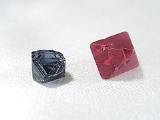
Spinel

Encyclopedia
Spinel is the magnesium aluminium member of the larger spinel group of minerals. It has the formula MgAl2O4. Balas ruby is an old name for a rose-tinted variety.
s of general formulation A2+B23+O42- which crystal
lise in the cubic
(isometric) crystal system, with the oxide anions arranged in a cubic close-packed
lattice and the cations A and B occupying some or all of the octahedral
and tetrahedral
sites in the lattice. A and B can be divalent, trivalent, or quadrivalent cations, including magnesium
, zinc
, iron
, manganese
, aluminium
, chromium
, titanium
, and silicon
. Although the anion is normally oxide, the analogous thiospinel structure includes the rest of the chalcogen
ides. A and B can also be the same metal under different charges, such as the case in Fe3O4 (as Fe2+Fe23+O42-).
Members of the spinel group include:
There are many more compounds with a spinel structure, e.g. the thiospinels and selenospinels, that can either be synthesized in the lab or in some cases occur as minerals.
is 8, its specific gravity
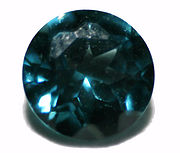
is 3.5-4.1 and it is transparent to opaque with a vitreous to dull luster. It may be colorless, but is usually various shades of red
, blue
, green
, yellow
, brown
or black
. There is a unique natural white spinel, now lost, that surfaced briefly in what is now Sri Lanka. Some spinels are among the most famous gemstones: Among them is the Black Prince's Ruby
and the 'Timur ruby' in the British Crown Jewels
, and the 'cote de Bretagne' formerly from the French Crown jewels. The Samarian Spinel
is the largest known spinel in the world, weighing 500 carats (100 g).
The transparent red spinels were called spinel-rubies or balas rubies. In the past, before the arrival of modern science, spinels and rubies were equally known as rubies. After the 18th century the word ruby was only used for the red gem variety of the mineral corundum
and the word spinel became used. "Balas" is derived from Balascia, the ancient name for Badakhshan
, a region in central Asia
situated in the upper valley of the Kokcha River
, one of the principal tributaries of the Oxus River. The Badakshan Province was for centuries the main source for red and pink spinels.
 True spinel has long been found in the gemstone
-bearing gravel of Sri Lanka
and in limestone
s of the Badakshan Province in modern day Afghanistan
and of Mogok in Burma. Recently gem quality spinels were also found in the marbles of Luc Yen (Vietnam
), Mahenge and Matombo (Tanzania
), Tsavo (Kenya
) and in the gravels of Tunduru (Tanzania
) and Ilakaka (Madagascar
). Spinel is found as a metamorphic mineral
, and also as a primary mineral in rare mafic igneous rock
s; in these igneous rock
s, the magma
s are relatively deficient in alkali
s relative to aluminium
, and aluminium oxide may form as the mineral corundum
or may combine with magnesia to form spinel. This is why spinel and ruby
are often found together.
Spinel, (Mg,Fe)(Al,Cr)2O4, is common in peridotite
in the uppermost Earth's mantle, between approximately 20 km to approximately 120 km, possibly to lower depths depending on the chromium content. At significantly shallower depths, above the Moho
, calcic plagioclase
is the more stable aluminous mineral in peridotite, while garnet
is the stable phase deeper in the mantle below the spinel stability region.
Spinel, (Mg,Fe)Al2O4, is a common mineral in the Ca-Al-rich inclusions (CAIs) in some chondritic meteorite
s.
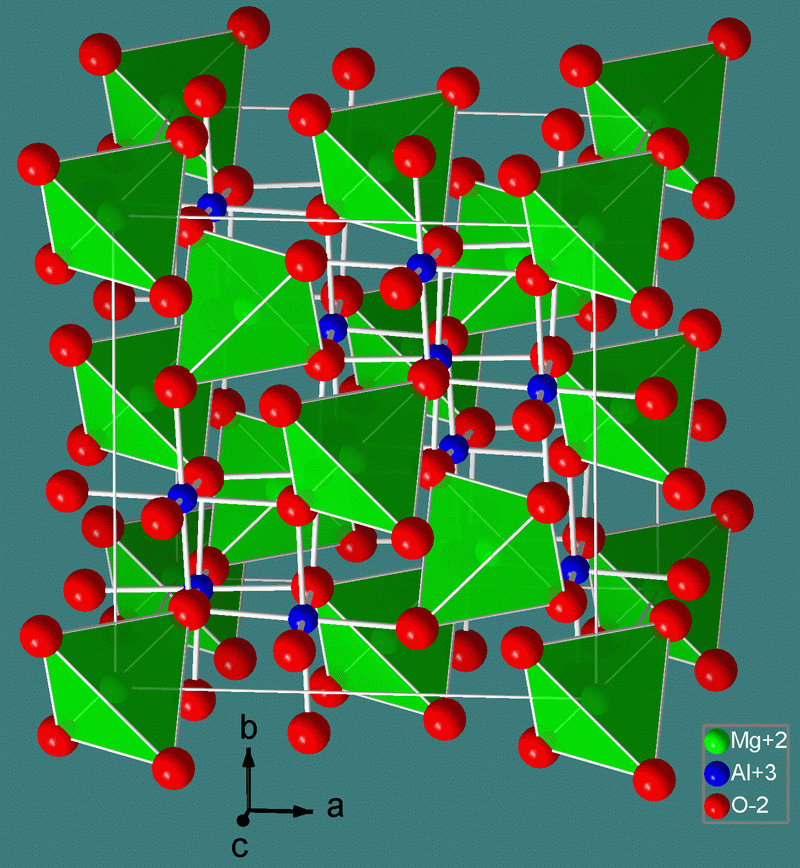 Normal spinel structures are usually cubic closed-packed oxides with one octahedral and two tetrahedral sites per oxide. The tetrahedral points are smaller than the octahedral points. B3+ ions occupy the octahedral holes because of a charge factor, but can only occupy half of the octahedral holes. A2+ ions occupy 1/8 of the tetrahedral holes. This maximises the lattice energy if the ions are similar in size. A common example of a normal spinel is MgAl2O4.
Inverse spinel structures however are slightly different in that one must take into account the crystal field stabilization energies (CFSE) of the transition metals present. Some ions may have a distinct preference on the octahedral site which is dependent on the d-electron count. If the A2+ ions have a strong preference for the octahedral site, they will force their way into it and displace half of the B3+ ions from the octahedral sites to the tetrahedral sites. If the B3+ ions have a low or zero octahedral site stabilization energy (OSSE), then they have no preference and will adopt the tetrahedral site. A common example of an inverse spinel is Fe3O4, if the Fe2+ (A2+) ions are d6 high-spin and the Fe3+ (B3+) ions are d5 high-spin.
For many years, crystal field theory
was invoked to explain the distribution of the cations within the spinels. As the octahedral and tetrahedral sites in the lattice generate different amounts of CFSE, it was argued that the arrangement of the two types of cation that generated the most CFSE would be the most stable. However, this idea was challenged by Burdett and co-workers, who showed that a better treatment used the relative sizes of the s and p atomic orbital
s of the two types of atom to determine their site preference. This is because the dominant stabilizing interaction in the solids is not the crystal field stabilization energy generated by the interaction of the ligands with the d-electrons, but the σ-type
interactions between the metal cations and the oxide anions. This rationale can explain anomalies in the spinel structures that crystal-field theory cannot, such as the marked preference of Al3+ cations for octahedral sites or of Zn2+ for tetrahedral sites - using crystal field theory would predict that both have no site preference. Only in cases where this size-based approach indicates no preference for one structure over another do crystal field effects make any difference — in effect they are just a small perturbation
that can sometimes make a difference, but which often do not.
Spinel group
The spinels are any of a class of mineralMineral
A mineral is a naturally occurring solid chemical substance formed through biogeochemical processes, having characteristic chemical composition, highly ordered atomic structure, and specific physical properties. By comparison, a rock is an aggregate of minerals and/or mineraloids and does not...
s of general formulation A2+B23+O42- which crystal
Crystal
A crystal or crystalline solid is a solid material whose constituent atoms, molecules, or ions are arranged in an orderly repeating pattern extending in all three spatial dimensions. The scientific study of crystals and crystal formation is known as crystallography...
lise in the cubic
Cubic crystal system
In crystallography, the cubic crystal system is a crystal system where the unit cell is in the shape of a cube. This is one of the most common and simplest shapes found in crystals and minerals....
(isometric) crystal system, with the oxide anions arranged in a cubic close-packed
Close-packing
In geometry, close-packing of equal spheres is a dense arrangement of congruent spheres in an infinite, regular arrangement . Carl Friedrich Gauss proved that the highest average density – that is, the greatest fraction of space occupied by spheres – that can be achieved by a regular lattice...
lattice and the cations A and B occupying some or all of the octahedral
Octahedral molecular geometry
In chemistry, octahedral molecular geometry describes the shape of compounds where in six atoms or groups of atoms or ligands are symmetrically arranged around a central atom, defining the vertices of an octahedron...
and tetrahedral
Tetrahedral molecular geometry
In a tetrahedral molecular geometry a central atom is located at the center with four substituents that are located at the corners of a tetrahedron. The bond angles are cos−1 ≈ 109.5° when all four substituents are the same, as in CH4. This molecular geometry is common throughout the first...
sites in the lattice. A and B can be divalent, trivalent, or quadrivalent cations, including magnesium
Magnesium
Magnesium is a chemical element with the symbol Mg, atomic number 12, and common oxidation number +2. It is an alkaline earth metal and the eighth most abundant element in the Earth's crust and ninth in the known universe as a whole...
, zinc
Zinc
Zinc , or spelter , is a metallic chemical element; it has the symbol Zn and atomic number 30. It is the first element in group 12 of the periodic table. Zinc is, in some respects, chemically similar to magnesium, because its ion is of similar size and its only common oxidation state is +2...
, iron
Iron
Iron is a chemical element with the symbol Fe and atomic number 26. It is a metal in the first transition series. It is the most common element forming the planet Earth as a whole, forming much of Earth's outer and inner core. It is the fourth most common element in the Earth's crust...
, manganese
Manganese
Manganese is a chemical element, designated by the symbol Mn. It has the atomic number 25. It is found as a free element in nature , and in many minerals...
, aluminium
Aluminium
Aluminium or aluminum is a silvery white member of the boron group of chemical elements. It has the symbol Al, and its atomic number is 13. It is not soluble in water under normal circumstances....
, chromium
Chromium
Chromium is a chemical element which has the symbol Cr and atomic number 24. It is the first element in Group 6. It is a steely-gray, lustrous, hard metal that takes a high polish and has a high melting point. It is also odorless, tasteless, and malleable...
, titanium
Titanium
Titanium is a chemical element with the symbol Ti and atomic number 22. It has a low density and is a strong, lustrous, corrosion-resistant transition metal with a silver color....
, and silicon
Silicon
Silicon is a chemical element with the symbol Si and atomic number 14. A tetravalent metalloid, it is less reactive than its chemical analog carbon, the nonmetal directly above it in the periodic table, but more reactive than germanium, the metalloid directly below it in the table...
. Although the anion is normally oxide, the analogous thiospinel structure includes the rest of the chalcogen
Chalcogen
The chalcogens are the chemical elements in group 16 of the periodic table. This group is also known as the oxygen family...
ides. A and B can also be the same metal under different charges, such as the case in Fe3O4 (as Fe2+Fe23+O42-).
Members of the spinel group include:
- Aluminium spinels:
- Spinel: MgAl2O4, after which this class of minerals is named
- GahniteGahniteGahnite, ZnAl2O4, is a rare mineral belonging to the spinel group. It forms octahedral crystals which may be green, blue, yellow, brown or grey. It occurs in Falun, Sweden where it is found in pegmatites and skarns, contact metamorphic rocks...
: ZnAl2O4 - HercyniteHercyniteHercynite is a spinel mineral with the formula FeAl2O4.It occurs in high-grade metamorphosed iron rich argillaceous sediments as well as in mafic and ultramafic igneous rocks. Due to its hardness it also is found in placers....
: FeAl2O4
- Iron spinels:
- CuprospinelCuprospinelCuprospinel, occurs naturally in Baie Verte, Newfoundland, Canada. The mineral was found in an exposed ore dump, on the property of Consolidated Rambler Mines Limited near Baie Verte, Newfoundland...
: CuFe2O4 - FrankliniteFrankliniteFranklinite is a mineral with formula ZnFe2O4. It is associated with the Franklin Mine and Sterling Hill Mines in New Jersey.-See also:* Spinel* Classification of minerals* List of minerals-References:*...
: (Fe,Mn,Zn)(Fe,Mn)2O4 - JacobsiteJacobsiteJacobsite is a manganese iron oxide mineral. It is in the spinel group and forms a solid solution series with magnetite. The chemical formula is MnFe2O4 or with oxidation states and substitutions:2O4....
: MnFe2O4 - MagnetiteMagnetiteMagnetite is a ferrimagnetic mineral with chemical formula Fe3O4, one of several iron oxides and a member of the spinel group. The chemical IUPAC name is iron oxide and the common chemical name is ferrous-ferric oxide. The formula for magnetite may also be written as FeO·Fe2O3, which is one part...
: Fe3O4 - TrevoriteTrevoriteTrevorite is a very rare nickeliferous mineral belonging to the spinel group. It has the chemical formula NiFe3+2O4. It is a black mineral with the typical spinel properties of crystallising in the cubic system, black streaked, infusible and insoluble in most acids.There is at least partial solid...
: NiFe2O4 - UlvöspinelUlvöspinelUlvöspinel or ulvite is an iron titanium oxide mineral with formula: Fe2TiO4 or TiFe2+2O4. It forms brown to black metallic isometric crystals with a Mohs hardness of 5.5 to 6...
: TiFe2O4 - Zinc ferriteZinc ferriteZinc ferrites are a series of synthetic inorganic compounds of zinc and iron with the general formula of ZnxFe3-xO4. Zinc ferrite compounds can be prepared by aging solutions of Zn2, Fe3, and triethanolamine in the presence and in the absence of hydrazine, or reacting iron oxides and zinc oxide...
: (Zn, Fe) Fe2O4
- Cuprospinel
- Chromium spinels:
- ChromiteChromiteChromite is an iron chromium oxide: FeCr2O4. It is an oxide mineral belonging to the spinel group. Magnesium can substitute for iron in variable amounts as it forms a solid solution with magnesiochromite ; substitution of aluminium occurs leading to hercynite .-Occurrence:Chromite is found in...
: FeCr2O4 - Magnesiochromite: MgCr2O4
- Chromite
- Others with the spinel structure:
- RingwooditeRingwooditeRingwoodite is a high-pressure polymorph of olivine, and it is stable at high temperatures and pressures like those in the Earth's mantle near 600 km depth. This mineral was first identified in the Tenham Meteorites in 1969, and it is inferred to be present in large quantity in the earth’s...
: (Mg,Fe)2SiO4, an abundant olivineOlivineThe mineral olivine is a magnesium iron silicate with the formula 2SiO4. It is a common mineral in the Earth's subsurface but weathers quickly on the surface....
polymorphPolymorphism (materials science)Polymorphism in materials science is the ability of a solid material to exist in more than one form or crystal structure. Polymorphism can potentially be found in any crystalline material including polymers, minerals, and metals, and is related to allotropy, which refers to chemical elements...
within the Earth's mantle from about 520 to 660 km depth, and a rare mineral in meteorites
- Ringwoodite
There are many more compounds with a spinel structure, e.g. the thiospinels and selenospinels, that can either be synthesized in the lab or in some cases occur as minerals.
Properties of true spinel
Spinel crystallizes in the isometric system; common crystal forms are octahedra, usually twinned. It has an imperfect octahedral cleavage and a conchoidal fracture. Its hardnessMohs scale of mineral hardness
The Mohs scale of mineral hardness characterizes the scratch resistance of various minerals through the ability of a harder material to scratch a softer material. It was created in 1812 by the German geologist and mineralogist Friedrich Mohs and is one of several definitions of hardness in...
is 8, its specific gravity
Specific gravity
Specific gravity is the ratio of the density of a substance to the density of a reference substance. Apparent specific gravity is the ratio of the weight of a volume of the substance to the weight of an equal volume of the reference substance. The reference substance is nearly always water for...
is 3.5-4.1 and it is transparent to opaque with a vitreous to dull luster. It may be colorless, but is usually various shades of red
Red
Red is any of a number of similar colors evoked by light consisting predominantly of the longest wavelengths of light discernible by the human eye, in the wavelength range of roughly 630–740 nm. Longer wavelengths than this are called infrared , and cannot be seen by the naked eye...
, blue
Blue
Blue is a colour, the perception of which is evoked by light having a spectrum dominated by energy with a wavelength of roughly 440–490 nm. It is considered one of the additive primary colours. On the HSV Colour Wheel, the complement of blue is yellow; that is, a colour corresponding to an equal...
, green
Green
Green is a color, the perception of which is evoked by light having a spectrum dominated by energy with a wavelength of roughly 520–570 nanometres. In the subtractive color system, it is not a primary color, but is created out of a mixture of yellow and blue, or yellow and cyan; it is considered...
, yellow
Yellow
Yellow is the color evoked by light that stimulates both the L and M cone cells of the retina about equally, with no significant stimulation of the S cone cells. Light with a wavelength of 570–590 nm is yellow, as is light with a suitable mixture of red and green...
, brown
Brown
Brown is a color term, denoting a range of composite colors produced by a mixture of orange, red, rose, or yellow with black or gray. The term is from Old English brún, in origin for any dusky or dark shade of color....
or black
Black
Black is the color of objects that do not emit or reflect light in any part of the visible spectrum; they absorb all such frequencies of light...
. There is a unique natural white spinel, now lost, that surfaced briefly in what is now Sri Lanka. Some spinels are among the most famous gemstones: Among them is the Black Prince's Ruby
Black Prince's Ruby
The Black Prince's Ruby is a bead-shaped spinel weighing roughly , approximately the size of a chicken egg. It is currently set in the cross pattée above the Cullinan II in the front of the Imperial State Crown...
and the 'Timur ruby' in the British Crown Jewels
Crown Jewels of the United Kingdom
The collective term Crown Jewels denotes the regalia and vestments worn by the sovereign of the United Kingdom during the coronation ceremony and at other state functions...
, and the 'cote de Bretagne' formerly from the French Crown jewels. The Samarian Spinel
Samarian spinel
The Samarian Spinel is a spinel gemstone that is the largest of its kind in the world. It is part of the Iranian Crown Jewels.-Origins:It, together with a smaller spinel, were captured by the Persian King Nader Shah during his 18th century conquest of India...
is the largest known spinel in the world, weighing 500 carats (100 g).
The transparent red spinels were called spinel-rubies or balas rubies. In the past, before the arrival of modern science, spinels and rubies were equally known as rubies. After the 18th century the word ruby was only used for the red gem variety of the mineral corundum
Corundum
Corundum is a crystalline form of aluminium oxide with traces of iron, titanium and chromium. It is a rock-forming mineral. It is one of the naturally clear transparent materials, but can have different colors when impurities are present. Transparent specimens are used as gems, called ruby if red...
and the word spinel became used. "Balas" is derived from Balascia, the ancient name for Badakhshan
Badakhshan
Badakhshan is an historic region comprising parts of what is now northeastern Afghanistan and southeastern Tajikistan. The name is retained in Badakhshan Province which is one of the thirty-four provinces of Afghanistan, in the far northeast of Afghanistan, and contains the Wakhan Corridor...
, a region in central Asia
Asia
Asia is the world's largest and most populous continent, located primarily in the eastern and northern hemispheres. It covers 8.7% of the Earth's total surface area and with approximately 3.879 billion people, it hosts 60% of the world's current human population...
situated in the upper valley of the Kokcha River
Kokcha River
The Kokcha River is a river of northeastern Afghanistan. A tributary of the Amu Darya river, it flows through Badakhshan Province in the Hindu Kush range of Afghan Turkestan. The city of Feyzabad lies along the Kokcha. Near the village of Artin Jelow there is a bridge over the river.The Kokcha...
, one of the principal tributaries of the Oxus River. The Badakshan Province was for centuries the main source for red and pink spinels.
Occurrence
Gemstone
A gemstone or gem is a piece of mineral, which, in cut and polished form, is used to make jewelry or other adornments...
-bearing gravel of Sri Lanka
Sri Lanka
Sri Lanka, officially the Democratic Socialist Republic of Sri Lanka is a country off the southern coast of the Indian subcontinent. Known until 1972 as Ceylon , Sri Lanka is an island surrounded by the Indian Ocean, the Gulf of Mannar and the Palk Strait, and lies in the vicinity of India and the...
and in limestone
Limestone
Limestone is a sedimentary rock composed largely of the minerals calcite and aragonite, which are different crystal forms of calcium carbonate . Many limestones are composed from skeletal fragments of marine organisms such as coral or foraminifera....
s of the Badakshan Province in modern day Afghanistan
Afghanistan
Afghanistan , officially the Islamic Republic of Afghanistan, is a landlocked country located in the centre of Asia, forming South Asia, Central Asia and the Middle East. With a population of about 29 million, it has an area of , making it the 42nd most populous and 41st largest nation in the world...
and of Mogok in Burma. Recently gem quality spinels were also found in the marbles of Luc Yen (Vietnam
Vietnam
Vietnam – sometimes spelled Viet Nam , officially the Socialist Republic of Vietnam – is the easternmost country on the Indochina Peninsula in Southeast Asia. It is bordered by China to the north, Laos to the northwest, Cambodia to the southwest, and the South China Sea –...
), Mahenge and Matombo (Tanzania
Tanzania
The United Republic of Tanzania is a country in East Africa bordered by Kenya and Uganda to the north, Rwanda, Burundi, and the Democratic Republic of the Congo to the west, and Zambia, Malawi, and Mozambique to the south. The country's eastern borders lie on the Indian Ocean.Tanzania is a state...
), Tsavo (Kenya
Kenya
Kenya , officially known as the Republic of Kenya, is a country in East Africa that lies on the equator, with the Indian Ocean to its south-east...
) and in the gravels of Tunduru (Tanzania
Tanzania
The United Republic of Tanzania is a country in East Africa bordered by Kenya and Uganda to the north, Rwanda, Burundi, and the Democratic Republic of the Congo to the west, and Zambia, Malawi, and Mozambique to the south. The country's eastern borders lie on the Indian Ocean.Tanzania is a state...
) and Ilakaka (Madagascar
Madagascar
The Republic of Madagascar is an island country located in the Indian Ocean off the southeastern coast of Africa...
). Spinel is found as a metamorphic mineral
Metamorphic rock
Metamorphic rock is the transformation of an existing rock type, the protolith, in a process called metamorphism, which means "change in form". The protolith is subjected to heat and pressure causing profound physical and/or chemical change...
, and also as a primary mineral in rare mafic igneous rock
Igneous rock
Igneous rock is one of the three main rock types, the others being sedimentary and metamorphic rock. Igneous rock is formed through the cooling and solidification of magma or lava...
s; in these igneous rock
Igneous rock
Igneous rock is one of the three main rock types, the others being sedimentary and metamorphic rock. Igneous rock is formed through the cooling and solidification of magma or lava...
s, the magma
Magma
Magma is a mixture of molten rock, volatiles and solids that is found beneath the surface of the Earth, and is expected to exist on other terrestrial planets. Besides molten rock, magma may also contain suspended crystals and dissolved gas and sometimes also gas bubbles. Magma often collects in...
s are relatively deficient in alkali
Alkali
In chemistry, an alkali is a basic, ionic salt of an alkali metal or alkaline earth metal element. Some authors also define an alkali as a base that dissolves in water. A solution of a soluble base has a pH greater than 7. The adjective alkaline is commonly used in English as a synonym for base,...
s relative to aluminium
Aluminium
Aluminium or aluminum is a silvery white member of the boron group of chemical elements. It has the symbol Al, and its atomic number is 13. It is not soluble in water under normal circumstances....
, and aluminium oxide may form as the mineral corundum
Corundum
Corundum is a crystalline form of aluminium oxide with traces of iron, titanium and chromium. It is a rock-forming mineral. It is one of the naturally clear transparent materials, but can have different colors when impurities are present. Transparent specimens are used as gems, called ruby if red...
or may combine with magnesia to form spinel. This is why spinel and ruby
Ruby
A ruby is a pink to blood-red colored gemstone, a variety of the mineral corundum . The red color is caused mainly by the presence of the element chromium. Its name comes from ruber, Latin for red. Other varieties of gem-quality corundum are called sapphires...
are often found together.
Spinel, (Mg,Fe)(Al,Cr)2O4, is common in peridotite
Peridotite
A peridotite is a dense, coarse-grained igneous rock, consisting mostly of the minerals olivine and pyroxene. Peridotite is ultramafic, as the rock contains less than 45% silica. It is high in magnesium, reflecting the high proportions of magnesium-rich olivine, with appreciable iron...
in the uppermost Earth's mantle, between approximately 20 km to approximately 120 km, possibly to lower depths depending on the chromium content. At significantly shallower depths, above the Moho
Mohorovičić discontinuity
The Mohorovičić discontinuity , usually referred to as the Moho, is the boundary between the Earth's crust and the mantle. Named after the pioneering Croatian seismologist Andrija Mohorovičić, the Moho separates both the oceanic crust and continental crust from underlying mantle...
, calcic plagioclase
Plagioclase
Plagioclase is an important series of tectosilicate minerals within the feldspar family. Rather than referring to a particular mineral with a specific chemical composition, plagioclase is a solid solution series, more properly known as the plagioclase feldspar series...
is the more stable aluminous mineral in peridotite, while garnet
Garnet
The garnet group includes a group of minerals that have been used since the Bronze Age as gemstones and abrasives. The name "garnet" may come from either the Middle English word gernet meaning 'dark red', or the Latin granatus , possibly a reference to the Punica granatum , a plant with red seeds...
is the stable phase deeper in the mantle below the spinel stability region.
Spinel, (Mg,Fe)Al2O4, is a common mineral in the Ca-Al-rich inclusions (CAIs) in some chondritic meteorite
Chondrite
Chondrites are stony meteorites that have not been modified due to melting or differentiation of the parent body. They formed when various types of dust and small grains that were present in the early solar system accreted to form primitive asteroids...
s.
The spinel structure
Inverse spinel structures however are slightly different in that one must take into account the crystal field stabilization energies (CFSE) of the transition metals present. Some ions may have a distinct preference on the octahedral site which is dependent on the d-electron count. If the A2+ ions have a strong preference for the octahedral site, they will force their way into it and displace half of the B3+ ions from the octahedral sites to the tetrahedral sites. If the B3+ ions have a low or zero octahedral site stabilization energy (OSSE), then they have no preference and will adopt the tetrahedral site. A common example of an inverse spinel is Fe3O4, if the Fe2+ (A2+) ions are d6 high-spin and the Fe3+ (B3+) ions are d5 high-spin.
For many years, crystal field theory
Crystal field theory
Crystal field theory is a model that describes the electronic structure of transition metal compounds, all of which can be considered coordination complexes. CFT successfully accounts for some magnetic properties, colours, hydration enthalpies, and spinel structures of transition metal complexes,...
was invoked to explain the distribution of the cations within the spinels. As the octahedral and tetrahedral sites in the lattice generate different amounts of CFSE, it was argued that the arrangement of the two types of cation that generated the most CFSE would be the most stable. However, this idea was challenged by Burdett and co-workers, who showed that a better treatment used the relative sizes of the s and p atomic orbital
Atomic orbital
An atomic orbital is a mathematical function that describes the wave-like behavior of either one electron or a pair of electrons in an atom. This function can be used to calculate the probability of finding any electron of an atom in any specific region around the atom's nucleus...
s of the two types of atom to determine their site preference. This is because the dominant stabilizing interaction in the solids is not the crystal field stabilization energy generated by the interaction of the ligands with the d-electrons, but the σ-type
Sigma bond
In chemistry, sigma bonds are the strongest type of covalent chemical bond. They are formed by head-on overlapping between atomic orbitals. Sigma bonding is most clearly defined for diatomic molecules using the language and tools of symmetry groups. In this formal approach, a σ-bond is...
interactions between the metal cations and the oxide anions. This rationale can explain anomalies in the spinel structures that crystal-field theory cannot, such as the marked preference of Al3+ cations for octahedral sites or of Zn2+ for tetrahedral sites - using crystal field theory would predict that both have no site preference. Only in cases where this size-based approach indicates no preference for one structure over another do crystal field effects make any difference — in effect they are just a small perturbation
Perturbation theory (quantum mechanics)
In quantum mechanics, perturbation theory is a set of approximation schemes directly related to mathematical perturbation for describing a complicated quantum system in terms of a simpler one. The idea is to start with a simple system for which a mathematical solution is known, and add an...
that can sometimes make a difference, but which often do not.
Synthetic spinel
Synthetic spinel was accidentally produced in the middle of the 18th century, and has been more recently described in scientific publications in 2000 and 2004.See also
- CeyloniteCeyloniteCeylonite and Pleonaste are dingy blue or grey to black varieties of spinel. Ceylonite, apparently named for the island of Ceylon , is a ferroan spinel with Mg:Fe from 3:1 and 1:1, and little or no ferric iron...
- The Samarian Spinel: the largest known spinel in the world, part of the Iranian Crown JewelsIranian Crown JewelsThe Imperial crown jewels of Iran include several elaborate crowns and decorative thrones, thirty tiaras, and numerous aigrettes, a dozen bejewelled swords and shields, a vast number of unset precious gems, numerous plates and other dining services cast in precious metals and encrusted with gems,...
- Black Prince's RubyBlack Prince's RubyThe Black Prince's Ruby is a bead-shaped spinel weighing roughly , approximately the size of a chicken egg. It is currently set in the cross pattée above the Cullinan II in the front of the Imperial State Crown...