


Fishing industry in Scotland

Encyclopedia
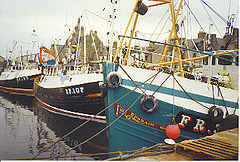
United Kingdom
The United Kingdom of Great Britain and Northern IrelandIn the United Kingdom and Dependencies, other languages have been officially recognised as legitimate autochthonous languages under the European Charter for Regional or Minority Languages...
fishing industry
Fishing industry
The fishing industry includes any industry or activity concerned with taking, culturing, processing, preserving, storing, transporting, marketing or selling fish or fish products....
. A recent inquiry by the Royal Society of Edinburgh
Royal Society of Edinburgh
The Royal Society of Edinburgh is Scotland's national academy of science and letters. It is a registered charity, operating on a wholly independent and non-party-political basis and providing public benefit throughout Scotland...
found fishing to be of much greater social, economic and cultural importance to Scotland
Scotland
Scotland is a country that is part of the United Kingdom. Occupying the northern third of the island of Great Britain, it shares a border with England to the south and is bounded by the North Sea to the east, the Atlantic Ocean to the north and west, and the North Channel and Irish Sea to the...
than to the rest of the UK. Scotland has just under 8.6% of the UK population but lands at its ports over 60% of the total catch in the UK.
Many of these are port
Port
A port is a location on a coast or shore containing one or more harbors where ships can dock and transfer people or cargo to or from land....
s in relatively remote communities such as Fraserburgh
Fraserburgh
Fraserburgh is a town in Aberdeenshire, Scotland with a population recorded in the 2001 Census at 12,454 and estimated at 12,630 in 2006. It lies at the extreme northeast corner of Aberdeenshire, around north of Aberdeen, and north of Peterhead...
, Kinlochbervie
Kinlochbervie
Kinlochbervie is a harbour village in the north west of Sutherland, in the Highland region of Scotland. In 2001 the population was 480.The majority of local industry is based upon the fishing industry...
or Lerwick
Lerwick
Lerwick is the capital and main port of the Shetland Islands, Scotland, located more than 100 miles off the north coast of mainland Scotland on the east coast of the Shetland Mainland...
, which are scattered along an extensive coast
Coast
A coastline or seashore is the area where land meets the sea or ocean. A precise line that can be called a coastline cannot be determined due to the dynamic nature of tides. The term "coastal zone" can be used instead, which is a spatial zone where interaction of the sea and land processes occurs...
line and which, for centuries, have looked to fishing as the main source of employment
Employment
Employment is a contract between two parties, one being the employer and the other being the employee. An employee may be defined as:- Employee :...
. Restrictions imposed under the Common Fisheries Policy
Common Fisheries Policy
The Common Fisheries Policy is the fisheries policy of the European Union . It sets quotas for which member states are allowed to catch what amounts of each type of fish, as well as encouraging the fishing industry by various market interventions...
(CFP) affect all Europe
Europe
Europe is, by convention, one of the world's seven continents. Comprising the westernmost peninsula of Eurasia, Europe is generally 'divided' from Asia to its east by the watershed divides of the Ural and Caucasus Mountains, the Ural River, the Caspian and Black Seas, and the waterways connecting...
an fishing fleets, but they have proved particularly severe in recent years for the demersal or whitefish sector (boats mainly fishing for cod
Cod
Cod is the common name for genus Gadus, belonging to the family Gadidae, and is also used in the common name for various other fishes. Cod is a popular food with a mild flavor, low fat content and a dense, flaky white flesh. Cod livers are processed to make cod liver oil, an important source of...
, haddock
Haddock
The haddock , also known as the offshore hake, is a marine fish distributed on both sides of the North Atlantic. Haddock is a popular food fish and is widely fished commercially....
and whiting
Merlangius merlangus
Merlangius merlangus, commonly known as whiting is an important food fish in the eastern North Atlantic, northern Mediterranean, western Baltic, and Black Sea...
) of the Scottish fishing industry.
Fishing areas
The main fishing areas are the North SeaFishing in the North Sea
Fishing in the North Sea is concentrated in the southern part of the coastal waters. The main method of fishing is trawling.Annual catches grew each year until the 1980s, when a high point of more than 3 million metric tons was reached...
and the seas west of Scotland
Seas west of Scotland
It is a central tenet of the EU maritime policy that all seas have a particular nature, defined by their geography, their ecology, their economies and their people. Most seas are nested and do not, except for specific purposes such as hydrography or fisheries management, have sharp, recognised...
.
Historical development
FishFish
Fish are a paraphyletic group of organisms that consist of all gill-bearing aquatic vertebrate animals that lack limbs with digits. Included in this definition are the living hagfish, lampreys, and cartilaginous and bony fish, as well as various extinct related groups...
have been recognised as a major food
Food
Food is any substance consumed to provide nutritional support for the body. It is usually of plant or animal origin, and contains essential nutrients, such as carbohydrates, fats, proteins, vitamins, or minerals...
source from the earliest times. Fishing was important to the earliest settlers in Scotland, around 7000 BC. At this stage, fishing was a subsistence activity, undertaken only to feed the fisher and their immediate community. By the medieval period, salmon
Salmon
Salmon is the common name for several species of fish in the family Salmonidae. Several other fish in the same family are called trout; the difference is often said to be that salmon migrate and trout are resident, but this distinction does not strictly hold true...
and herring
Herring
Herring is an oily fish of the genus Clupea, found in the shallow, temperate waters of the North Pacific and the North Atlantic oceans, including the Baltic Sea. Three species of Clupea are recognized. The main taxa, the Atlantic herring and the Pacific herring may each be divided into subspecies...
were important resources and were exported to continental Europe
Continental Europe
Continental Europe, also referred to as mainland Europe or simply the Continent, is the continent of Europe, explicitly excluding European islands....
, and the towns of the Hanseatic League
Hanseatic League
The Hanseatic League was an economic alliance of trading cities and their merchant guilds that dominated trade along the coast of Northern Europe...
in particular. As the industry developed, "fishertouns" and villages sprang up to supply the growing towns and fishing became more specialised. The many religious houses in Scotland acted as a spur to fisheries, granting exclusive fishing rights and demanding part of their tithe
Tithe
A tithe is a one-tenth part of something, paid as a contribution to a religious organization or compulsory tax to government. Today, tithes are normally voluntary and paid in cash, cheques, or stocks, whereas historically tithes were required and paid in kind, such as agricultural products...
s in fish.
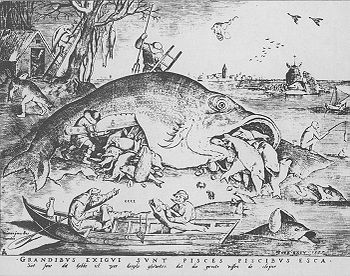
At the peak of the Herring Boom in 1907, 2,500,000 barrels of fish (227 tonnes) were cured and exported, the main markets being Germany, Eastern Europe and Russia. The traditional method used for catching herring was the drift net. A long net in the form of a curtain was suspended from corks floating on the surface. The fish were trapped by the gills as they swam against the net. In the sheltered waters around Loch Fyne
Loch Fyne
Loch Fyne is a sea loch on the west coast of Argyll and Bute, Scotland. It extends inland from the Sound of Bute, making it the longest of the sea lochs...
in Argyll
Argyll
Argyll , archaically Argyle , is a region of western Scotland corresponding with most of the part of ancient Dál Riata that was located on the island of Great Britain, and in a historical context can be used to mean the entire western coast between the Mull of Kintyre and Cape Wrath...
, ring-netting for herring developed. The method involved surrounding a shoal of herring with a net and then pulling the ring tight to trap them.
Before the 1880s, long-lining was the usual method used to catch white fish such as cod, halibut, saithe, ling and flat fish which live at the bottom of the sea. It was very labour-intensive but resulted in a high quality catch. Small line fishing was a family affair with women and children responsible for preparing the equipment. This was a line, up to a mile in length, to which were attached snoods or shorter pieces of line which were baited with fish or shellfish. Great line fishing was similar to small line fishing but was undertaken in deeper waters, further out to sea. The lines could be up to 15 miles (24.1 km) in length and would be fitted with 5,000 hooks. The fishermen usually baited the lines on the boat. Because of the work involved in preparing and hauling the lines, new methods of catching white fish were sought. Trawling was introduced into Scotland from England in the late 19th Century and, from the 1920s, seine-netting was introduced from Denmark.
The First World War interrupted the growth of the industry with many fishermen enlisting the Royal Naval Reserve
Royal Naval Reserve
The Royal Naval Reserve is the volunteer reserve force of the Royal Navy in the United Kingdom. The present Royal Naval Reserve was formed in 1958 by merging the original Royal Naval Reserve and the Royal Naval Volunteer Reserve , a reserve of civilian volunteers founded in 1903...
. They returned to a declining industry which was further interrupted by the Second World War in 1939. After 1945 much of the effort became concentrated on whitefish with an additional sector exploiting shellfish. Technical developments have concentrated fishing in the hands of fewer fishermen operating more efficient vessels and, although the annual value of catches continued to rise, the number of people working in the industry fell.
The fishing industry in Scotland continued to decline up to the Second World War, in terms of the numbers employed in the industry, with commercial fishing virtually grinding to a halt during the war years. The post-war years saw the development of a fleet heavily based on otter trawling
Bottom trawling
Bottom trawling is trawling along the sea floor. It is also often referred to as "dragging".The scientific community divides bottom trawling into benthic trawling and demersal trawling...
, less involved in distant-water fishing than the English fishing sector.
History of national waters
The concept of “freedom of the seas” has endured since the seventeenth century, when the Dutch merchant and politician, Hugo GrotiusHugo Grotius
Hugo Grotius , also known as Huig de Groot, Hugo Grocio or Hugo de Groot, was a jurist in the Dutch Republic. With Francisco de Vitoria and Alberico Gentili he laid the foundations for international law, based on natural law...
, defended Holland's trading in the Indian Ocean
Indian Ocean
The Indian Ocean is the third largest of the world's oceanic divisions, covering approximately 20% of the water on the Earth's surface. It is bounded on the north by the Indian Subcontinent and Arabian Peninsula ; on the west by eastern Africa; on the east by Indochina, the Sunda Islands, and...
, with the argument of “mare librum”, based on the idea that fish stocks were so abundant that there could be no possible benefit obtained by claiming national jurisdiction
Jurisdiction
Jurisdiction is the practical authority granted to a formally constituted legal body or to a political leader to deal with and make pronouncements on legal matters and, by implication, to administer justice within a defined area of responsibility...
over large areas of sea. His arguments prevailed, and freedom of the seas became synonymous with the freedom to fish. Countries such as Scotland had claimed exclusive rights to fishing in inshore waters as early as the fifteenth century, but there was no formal consensus as to how far off shore these areas extended. This ad hoc situation was codified by legislation in the 1930 Hague Convention on International Law. However, only Chile
Chile
Chile ,officially the Republic of Chile , is a country in South America occupying a long, narrow coastal strip between the Andes mountains to the east and the Pacific Ocean to the west. It borders Peru to the north, Bolivia to the northeast, Argentina to the east, and the Drake Passage in the far...
and Peru
Peru
Peru , officially the Republic of Peru , is a country in western South America. It is bordered on the north by Ecuador and Colombia, on the east by Brazil, on the southeast by Bolivia, on the south by Chile, and on the west by the Pacific Ocean....
claimed more than a few miles of territorial waters. This system endured until the 1970s, when it became apparent to nations with large fishery resources that “their” stocks were being overexploited by non-local fishers. The 1973 UN Conference on Law of the Sea allowed 200 nautical miles (370.4 km) national limits, which were immediately claimed by a number of countries.
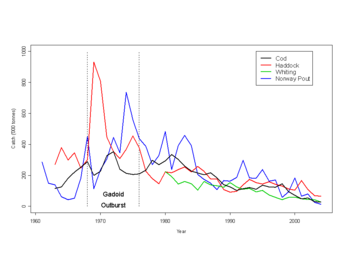
Gadoid outburst and Common Fisheries Policy
Fisheries are mentioned briefly in the Treaty of RomeTreaty of Rome
The Treaty of Rome, officially the Treaty establishing the European Economic Community, was an international agreement that led to the founding of the European Economic Community on 1 January 1958. It was signed on 25 March 1957 by Belgium, France, Italy, Luxembourg, the Netherlands and West Germany...
.
"The Common Market shall extend to agriculture and trade in agricultural products. ‘Agricultural products’ means the products of the soil, of stockfarming and of fisheries and products of first stage processing directly related to these products."
Fisheries policy was seen, therefore, as an extension of the arrangements for agriculture
Agriculture
Agriculture is the cultivation of animals, plants, fungi and other life forms for food, fiber, and other products used to sustain life. Agriculture was the key implement in the rise of sedentary human civilization, whereby farming of domesticated species created food surpluses that nurtured the...
, and the European Commission
European Commission
The European Commission is the executive body of the European Union. The body is responsible for proposing legislation, implementing decisions, upholding the Union's treaties and the general day-to-day running of the Union....
interpreted this as requiring a common policy dealing with fisheries. In 1968 the first proposals were put to the Council of Ministers for a Common Fisheries Policy
Common Fisheries Policy
The Common Fisheries Policy is the fisheries policy of the European Union . It sets quotas for which member states are allowed to catch what amounts of each type of fish, as well as encouraging the fishing industry by various market interventions...
(CFP). Implementation of the CFP was delayed by the difficulty in member states reaching agreement on the provisions of the legislation required. An agreement on the two regulations which make up the CFP was eventually reached on the night of June 30, 1970 - the day that negotiations were due to start for the accession of the UK, Ireland
Ireland
Ireland is an island to the northwest of continental Europe. It is the third-largest island in Europe and the twentieth-largest island on Earth...
, Denmark
Denmark
Denmark is a Scandinavian country in Northern Europe. The countries of Denmark and Greenland, as well as the Faroe Islands, constitute the Kingdom of Denmark . It is the southernmost of the Nordic countries, southwest of Sweden and south of Norway, and bordered to the south by Germany. Denmark...
and Norway
Norway
Norway , officially the Kingdom of Norway, is a Nordic unitary constitutional monarchy whose territory comprises the western portion of the Scandinavian Peninsula, Jan Mayen, and the Arctic archipelago of Svalbard and Bouvet Island. Norway has a total area of and a population of about 4.9 million...
. The six existing members were keen that a CFP should be in place before negotiations began and should therefore become part of the acquis communautaire, which new members would have to accept as settled policy.
The late 1960s and early 1970s were characterised by a sudden and unexplained increase in the abundance of a number of gadoid species (cod, haddock, whiting, etc.), the gadoid outburst. In this period the gadoid species in Scottish waters all produced a series of exceptionally strong year classes which have not been seen repeated in the intervening period. This great abundance, coupled with the price support system that subsidised fishermen when prices fell, contained in the CFP, lead to heavy investment in new boats, equipment and processing capacity in the Scottish whitefish fleet.
Britain's negotiating position was complicated by the conflicting interest of the inshore and distant water fishermen. The Scottish fleet had a strong interest in seeing the exclusive 12 mile (22.2 km) limit retained; but the UK Government was also pressed by the distant water fleet, mainly, but not solely based on the east coast of England, which wanted to continue fishing off Iceland, Norway and the Faroe Islands
Faroe Islands
The Faroe Islands are an island group situated between the Norwegian Sea and the North Atlantic Ocean, approximately halfway between Scotland and Iceland. The Faroe Islands are a self-governing territory within the Kingdom of Denmark, along with Denmark proper and Greenland...
. The distant water fishermen were, of course, strongly opposed to any extension of territorial waters
Territorial waters
Territorial waters, or a territorial sea, as defined by the 1982 United Nations Convention on the Law of the Sea, is a belt of coastal waters extending at most from the baseline of a coastal state...
of any country, including the UK. The drama of the cod war
Cod War
The Cod Wars, also called the Icelandic Cod Wars , were a series of confrontations in the 1950s and 1970s between the United Kingdom and Iceland regarding fishing rights in the North Atlantic....
with Iceland was still to come, with Britain’s attempt to protect the interests of its distant water fleet. Compromise was reached when it was agreed that the applicant countries would retain their 6 mile (11 km) exclusive limits, and their 12 miles (19.3 km) limits subject to existing historical rights, for substantial parts of their coastline, preventing continental European vessels fishing in much of the Scottish west coast, including all of the Minch and Irish Sea
Irish Sea
The Irish Sea separates the islands of Ireland and Great Britain. It is connected to the Celtic Sea in the south by St George's Channel, and to the Atlantic Ocean in the north by the North Channel. Anglesey is the largest island within the Irish Sea, followed by the Isle of Man...
. These limits have been renewed in legislation on two occasions, and although these rights are not a permanent feature of the policy, it is unlikely now that they will ever be extinguished, especially in the light of the need to conserve fish stocks.
In January 1977, at the behest of the EEC, the UK and other member states extended their Exclusive Economic Zone
Exclusive Economic Zone
Under the law of the sea, an exclusive economic zone is a seazone over which a state has special rights over the exploration and use of marine resources, including production of energy from water and wind. It stretches from the seaward edge of the state's territorial sea out to 200 nautical...
s (EEZs) to 200 miles (370.4 km) or to the median line with other countries. This followed the extension of exclusive fisheries limits by Iceland, Norway, the United States and Canada to 200 miles (321.9 km). By this time Norway had decided by referendum not to join the EEC, as had the Faroe Islands, which, as a Danish dependency, had the option to join but did not do so. The 12-200 mile zone around Scotland, has never, therefore, been fished solely by the Scottish fishing industry, but is a direct consequence of the adoption of the CFP into British law.
The outcome of the negotiations was considered by fishermen’s representative bodies at the time to be a success. The extension of the 12 miles (19.3 km) limit to the whole coastline (including St Kilda and North Rona
North Rona
Rona is a remote Scottish island in the North Atlantic. Rona is often referred to as North Rona in order to distinguish it from South Rona . It has an area of and a maximum height of...
and enclosing the Minch, although excluding Rockall
Rockall
Rockall is an extremely small, uninhabited, remote rocky islet in the North Atlantic Ocean. It gives its name to one of the sea areas named in the shipping forecast provided by the British Meteorological Office....
) gave Scotland one of the largest areas of inshore fishing in Europe, and the same limits as before entry to the EEC.
Current status
The current status of the fishing industry in Scotland is best considered on a sector-by-sector basis, as each faces different problems and opportunities.Demersal fleet
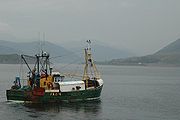
The Scottish demersal fleet has been facing economically difficult times for several years due to the decline of cod and haddock in the North Sea, which were the mainstay of catches. The fleet has declined from around 800 vessels in 1992 to just over 400 in 2004.This sector catches a diverse range of species and, although cod and haddock are important components, together
accounting for 40% of the total landings, in absolute value they represent only a modest turnover of £55m. Commercial performance of the sector has been dominated by the difficulties over cod, particularly in recent years with the implementation of the European "Cod Recovery Plan", but have also been affected by a scarcity of haddock and other demersal species. In recent years much of the demersal industry has been supported by the abundant 1999 year-class of haddock.
Nephrops fleet
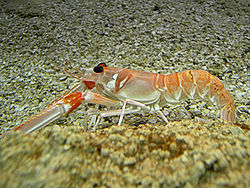
Creel
Creel can refer to:*Creel, Chihuahua, Mexico*Creel , a type of basket used in fly fishing*Creel-Terrazas Family, a notable family in the Mexican state of Chihuahua-Surname:* Gavin Creel , American actor and singer...
s or lobster pots, particularly on the west coast.
Nephrops lives on patches of soft mud, in which it excavates burrow systems. The distribution of the species is therefore limited by the extent of these mud patches, which are found in the Firth of Forth
Firth of Forth
The Firth of Forth is the estuary or firth of Scotland's River Forth, where it flows into the North Sea, between Fife to the north, and West Lothian, the City of Edinburgh and East Lothian to the south...
, Moray Firth
Moray Firth
The Moray Firth is a roughly triangular inlet of the North Sea, north and east of Inverness, which is in the Highland council area of north of Scotland...
, the North and South Minches, the Clyde
River Clyde
The River Clyde is a major river in Scotland. It is the ninth longest river in the United Kingdom, and the third longest in Scotland. Flowing through the major city of Glasgow, it was an important river for shipbuilding and trade in the British Empire....
estuary, and the Fladen ground, in the centre of the North Sea. Juveniles and females spend most of their time inside these burrows, with males venturing out more frequently. This difference in behaviour, coupled with the inherent problem in measuring the age of crustaceans, means that standard stock assessment techniques cannot be used. Nephrops stocks are assessed by surveying their habitat with TV cameras to count the number of burrows. This is then used to calculate an average population density, and from their to calculate a biomass for a particular area. The total allowable catch is set as a proportion of this biomass. Nephrops stocks in the North Minch have decreased considerably in recent years (ICES). The creel fishery in Loch Torridon
Loch Torridon
Loch Torridon is a sea loch on the west coast of Scotland in the Northwest Highlands. The loch was created by glacial processes and is in total around 15 miles long. It has two sections: Upper Loch Torridon to landward, east of Rubha na h-Airde Ghlaise, at which point it joins Loch Sheildaig;...
was first certified as sustainable in 2003 by the Marine Stewardship Council
Marine Stewardship Council
The Marine Stewardship Council is an independent non-profit organization with an ecolabel and fishery certification programme. Fisheries that are assessed and meet the standard can use the MSC blue ecolabel. The MSC mission is to 'reward sustainable fishing practices’...
but the certificate was suspended on 11th January 2011.
Pelagic sector
The commercial performance of this sector suffered a near terminal setback during the 1970s, when theherring fisheries in the North Sea and west of Scotland collapsed and had to be closed. As stocks recovered and as it became possible to separate the catching of herring and mackerel, the sector recovered. It became apparent that the domestic market for herring had disappeared, and mackerel became the dominant source of earnings. These trends encouraged a number of enterprising fishermen to set about investing in the modernisation of the fleet through the commissioning of new, state-of-the-art vessels. The pelagic fleet is now highly centralised, based in Shetland and north east Scotland, with a fleet of 27 vessels generating gross earnings of £98M. The general view is that substantial profit and excellent returns on investment are being achieved by this sector.
Recent raids by the Scottish Fisheries Protection Agency
Scottish Fisheries Protection Agency
The Scottish Fisheries Protection Agency was an Executive Agency of the Scottish Government. The SFPA is responsible for both deterring illegal fishing in Scottish waters, as well as monitoring the compliance of the fisheries industry in Scotland with the relevant Scottish and European Union laws...
(SFPA) on a number of fish processors revealed large-scale misreporting of landings by pelagic vessels. This led to the Scottish component of pelagic quotas being reduced for several years to "repay" this over-exploitation.
Fish processing industry
The Scottish fish processing industry accounts for 49% of the turnover of UK fish processing industry. Geographical distribution of the turnover of the Scottish industry is 65% around Aberdeen; 24% in central and southern Scotland; and 11% in the Highlands and Islands. The industry forms an integral part of the fishing-based economy. It accounts for more jobs than the catching industry and aquaculture combined, with the added significance that it provides employment for women in otherwise male-dominated labour markets. Two distinct sub-sectors make up the processing industry: the primary processors involved in the filleting and freezing of fresh fish for onward distribution to fresh fish retail and catering outlets, and the secondary processors producing chilled, frozen and canned products for the retail and catering trades.The current situation of the processing sector reflects the fortunes of the catching industry. Those involved in processing pelagic fish
Pelagic fish
Pelagic fish live near the surface or in the water column of coastal, ocean and lake waters, but not on the bottom of the sea or the lake. They can be contrasted with demersal fish, which do live on or near the bottom, and reef fish which are associated with coral reefs.The marine pelagic...
es and shellfish (together with farmed fish) are expanding their operations, while those engaged in whitefish processing are in difficulty. One of the major problems facing the processing sector is the scarcity of labour in isolated rural communities. Difficulties in attracting local labour reflect the low pay, the seasonal or casual nature of employment and the poor work environment compared with office or supermarket jobs. The high turnover of labour and high levels of absenteeism experienced in some plants adds significantly to labour costs. As a result, firms are now turning increasingly to agency labour and the employment of unskilled (and occasionally illegal) immigrant workers.
Associated organisations
The fishing industry in Scotland is supported by a number of governmental and non-governmental organisations.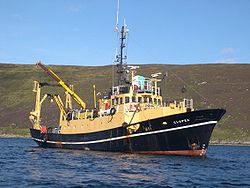
Fisheries research in Scotland
Fisheries research in Scotland dates back to the foundation of the Scottish Marine Station, near ObanOban
Oban Oban Oban ( is a resort town within the Argyll and Bute council area of Scotland. It has a total resident population of 8,120. Despite its small size, it is the largest town between Helensburgh and Fort William and during the tourist season the town can be crowded by up to 25,000 people. Oban...
and the Gatty Marine Laboratory at St Andrews
St Andrews
St Andrews is a university town and former royal burgh on the east coast of Fife in Scotland. The town is named after Saint Andrew the Apostle.St Andrews has a population of 16,680, making this the fifth largest settlement in Fife....
in 1884. Government involvement in fisheries research began in 1899 with the foundation of the Aberdeen Marine Laboratory, now operating as Fisheries Research Services
Fisheries Research Services
Fisheries Research Services was an Executive Agency of the Scottish Government. FRS was responsible for scientific and technical research into the marine and freshwater fisheries and aquaculture, and the protection of the aquatic environment in Scotland. For these purposes, the agency had two...
(FRS). FRS is an agency of the Scottish Executive Environment and Rural Affairs Department
Scottish Executive Environment and Rural Affairs Department
The Scottish Executive Environment and Rural Affairs Department was a civil service department of the Scottish Executive. SEERAD was responsible for the following areas in Scotland: agriculture, rural development, food, the environment and fisheries...
(SEERAD), and provides fish stock assessments, research and policy advice to the Scottish Executive
Scottish Executive
The Scottish Government is the executive arm of the devolved government of Scotland. It was established in 1999 as the Scottish Executive, from the extant Scottish Office, and the term Scottish Executive remains its legal name under the Scotland Act 1998...
, and the Scottish rural affairs minister, Ross Finnie
Ross Finnie
Ross Finnie is a Scottish Liberal Democrat politician and former Member of the Scottish Parliament. He is a former Minister for the Environment and Rural Development in the Scottish Executive, and Member of the Scottish Parliament for the West of Scotland region...
. FRS operates two research vessel
Research vessel
A research vessel is a ship designed and equipped to carry out research at sea. Research vessels carry out a number of roles. Some of these roles can be combined into a single vessel, others require a dedicated vessel...
s, the ocean-going FRV Scotia and the smaller inshore vessel FRV Clupea
FRV Clupea
FRV Clupea is a small, inshore fisheries research vessel of Fisheries Research Services, which operates mainly on the Scottish west coast, on behalf of the Scottish Executive, and is based at the port of Fraserburgh.-History:...
.
Non-governmental fisheries research is carried out at a number of Scottish universities and institutes, including deep-sea research at the University of Aberdeen
University of Aberdeen
The University of Aberdeen, an ancient university founded in 1495, in Aberdeen, Scotland, is a British university. It is the third oldest university in Scotland, and the fifth oldest in the United Kingdom and wider English-speaking world...
's Oceanlab at Newburgh
Newburgh, Aberdeenshire
Newburgh is a coastal village in Aberdeenshire, Scotland. The village dates to 1261 AD, when Lord Sinclair wanted to establish a chapel in the area. Originally built as a school, somewhat later the chapel of Holy Rood was established.-Geography:...
, marine mammal
Marine mammal
Marine mammals, which include seals, whales, dolphins, and walruses, form a diverse group of 128 species that rely on the ocean for their existence. They do not represent a distinct biological grouping, but rather are unified by their reliance on the marine environment for feeding. The level of...
research at the University of St Andrews
University of St Andrews
The University of St Andrews, informally referred to as "St Andrews", is the oldest university in Scotland and the third oldest in the English-speaking world after Oxford and Cambridge. The university is situated in the town of St Andrews, Fife, on the east coast of Scotland. It was founded between...
, research on the Clyde
River Clyde
The River Clyde is a major river in Scotland. It is the ninth longest river in the United Kingdom, and the third longest in Scotland. Flowing through the major city of Glasgow, it was an important river for shipbuilding and trade in the British Empire....
estuary ecosystem at the Millport Biological Station on the Isle of Cumbrae, and fisheries research at the Scottish Association of Marine Science (SAMS) near Oban, and the North Atlantic Fisheries College at Scalloway
Scalloway
Scalloway is the largest settlement on the North Atlantic coast of Mainland, Shetland with a population of approximately 812, at the 2001 census...
in Shetland, both part of the University of the Highlands and Islands project.
Industry organisations
There are numerous organisations representing different sectors of the industry, however the most senior is the Scottish Fishermen's Federation (SFF), which was formed in 1973 from eight constituent local fishermen's organisations. The SFF lobbies for the interests of Scottish fishermen at national and international levels in EdinburghEdinburgh
Edinburgh is the capital city of Scotland, the second largest city in Scotland, and the eighth most populous in the United Kingdom. The City of Edinburgh Council governs one of Scotland's 32 local government council areas. The council area includes urban Edinburgh and a rural area...
, London
London
London is the capital city of :England and the :United Kingdom, the largest metropolitan area in the United Kingdom, and the largest urban zone in the European Union by most measures. Located on the River Thames, London has been a major settlement for two millennia, its history going back to its...
and Brussels
Brussels
Brussels , officially the Brussels Region or Brussels-Capital Region , is the capital of Belgium and the de facto capital of the European Union...
. The Federation also plays a role in fisheries science
Fisheries science
Fisheries science is the academic discipline of managing and understanding fisheries. It is a multidisciplinary science, which draws on the disciplines of oceanography, marine biology, marine conservation, ecology, population dynamics, economics and management to attempt to provide an integrated...
by coordinating industry cooperation with scientific partners. The different industrial sectors each have representative organisations, such as the Scottish Whitefish Producers Organisation or the Scottish Seafood Processors Federation.
The promotion of fish and fish products along with economic analysis of fisheries is carried out by Sea Fish Industry Authority
Sea Fish Industry Authority
The Sea Fish Industry Authority is a United Kingdom non-departmental public body, established in 1981, and charged with working with the UK seafood industry to promote good quality, sustainable seafood. Seafish revised its mission in 2008...
(Seafish) - a non-departmental public body funded by a levy on fish sales - and their Scottish partner organisation, Seafood Scotland.
Regulation and enforcement
Whilst the international aspect of European fisheries negotiation, such as the setting of quotas, remain a reserved powerReserved matters
In the United Kingdom reserved matters and excepted matters are the areas of government policy where Parliament had kept the power to make laws in Scotland, Northern Ireland and Wales....
, the implementation of fisheries regulations are devolved to the Scottish Parliament
Scottish Parliament
The Scottish Parliament is the devolved national, unicameral legislature of Scotland, located in the Holyrood area of the capital, Edinburgh. The Parliament, informally referred to as "Holyrood", is a democratically elected body comprising 129 members known as Members of the Scottish Parliament...
, and are administered and enforced by Marine Scotland
Marine Scotland
Marine Scotland is part of the core Scottish Government and was set up to manage Scotland's waters. It was established on April 1, 2009 and is the lead marine management organisation in Scotland and the champion of Scotland's Seas....
.
See also
- AquacultureAquacultureAquaculture, also known as aquafarming, is the farming of aquatic organisms such as fish, crustaceans, molluscs and aquatic plants. Aquaculture involves cultivating freshwater and saltwater populations under controlled conditions, and can be contrasted with commercial fishing, which is the...
- Economy of ScotlandEconomy of ScotlandThe economy of Scotland is closely linked with the rest of the United Kingdom and the wider European Economic Area. Scotland has the second largest GVA per capita of countries in the United Kingdom after England, though it is still lower than the average of the United Kingdom as a whole...
- North Sea oilNorth Sea oilNorth Sea oil is a mixture of hydrocarbons, comprising liquid oil and natural gas, produced from oil reservoirs beneath the North Sea.In the oil industry, the term "North Sea" often includes areas such as the Norwegian Sea and the area known as "West of Shetland", "the Atlantic Frontier" or "the...
- Scottish Fisheries MuseumScottish Fisheries MuseumThe Scottish Fisheries Museum is an award-winning museum in Anstruther, Fife, that records the history of the Scottish fishing industry and its people from earliest times to the present day....
- Sea Fish Industry AuthoritySea Fish Industry AuthorityThe Sea Fish Industry Authority is a United Kingdom non-departmental public body, established in 1981, and charged with working with the UK seafood industry to promote good quality, sustainable seafood. Seafish revised its mission in 2008...
External links
- Fisheries Research Services
- Scottish Environment and Rural Affairs Department
- Scottish Fishermen's Federation
- Seafish - the UK Seafish Industry Authority
- Seafood Scotland
- Fishing Scotland . org Where to fish in Scotland, gear shops, and other information.
- Trawler Pictures - A Forum and Gallery Dedicated to Commercial Trawlers With mostly Scottish and U.K Based Members