

Oban

Encyclopedia
Oban
Oban ( is a resort
town within the Argyll and Bute
council area of Scotland
. It has a total resident population of 8,120. Despite its small size, it is the largest town between Helensburgh
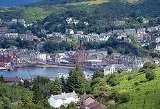
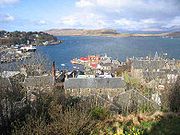
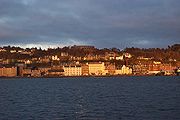
and Fort William and during the tourist season the town can be crowded by up to 25,000 people. Oban occupies a beautiful setting in the Firth of Lorn. Oban Bay is a near perfect horseshoe bay, protected by the island of Kerrera
, and beyond Kerrera is Mull
. To the north is the long low island of Lismore
, and the mountains of Morvern and Ardgour.
In Oban–also known as "The Gateway to the Isles"–some 9.4% of the population speak Gaelic.
Attractions in Oban include the Waterfront Centre, the Cathedral of St Columba, the Oban Distillery
, Dunollie Castle
, Dunstaffnage Castle
and McCaig's Tower
, which dominates the town's skyline. Oban is a convenient base from which to explore the sights of Kilmartin Glen
.
The Oban Tourist Information Centre, operated under VisitScotland
, is located in the centre of the town in Argyll Square. It is housed in an old Church of Scotland
building.
that was founded there in 1794. By the late 19th century, Oban was a busy port which shipped wool, whisky, slate and kelp to Liverpool
and Glasgow
. The arrival of the railways brought new prosperity to Oban, revitalising local industry and giving birth to local tourism. It was at this time that McCaig's Tower
, a folly
and prominent local landmark, was constructed, as well as the ill-fated Oban Hydro
.
 During World War II, Oban was a busy port used by Merchant and Royal Navy
ships. The Royal Navy
had a signal station near Ganavan which is now a private house. Also near Ganavan was an anti-submarine indicator loop station which detected any surface or submarine vessels between Oban, Mull
and Lismore
. There was a controlled minefield in the Sound of Kerrera
which was controlled from a building near the caravan site at Gallanach. There is one surviving air raid shelter in the centre of Oban.
There was also a Royal Air Force
flying boat
base at Ganavan and on Kerrera
. The airfield at North Connel
was originally built by the Royal Air Force during World War II
. A Sector Operations Room was built near the airfield and after the war this was extended to become the Royal Observer Corps
Group HQ.
Oban was also important during the Cold War
because the first Transatlantic Telephone Cable
(TAT-1
) came ashore at Gallanach Bay and this carried the "Hot Line" between the US and USSR presidents. There was protected accommodation for the cable equipment at Gallanach Bay.
(a Gaelic
festival) as the Mod was first held in Oban in 1892, with ten competitors on a Saturday afternoon. In 2003, Oban hosted the 100th Mod, and many signs were replaced with bilingual versions. As well as the 100th Mod, Oban also hosted the centenary Mod in 1992 (the year it became Royal). (The 100th Mod was later than the centenary because it was not held in the war years.) The 2009 Mod was again held in Oban.
The town has a two-screen cinema
which is not currently operating as it closed in early 2010. Oban has also been used as a backdrop to several films including Ring of Bright Water
and Morvern Callar
. See http://www.scotlandthemovie.com/movies/obaninfo.html.
The Oban War and Peace Museum advances the education of present and future generations by collecting, maintaining, conserving and exhibiting items of historical and cultural interest relating to the Oban area in peacetime and during the war years. A museum also operates within Oban Distillery
, just behind the main seafront. The distillation of whisky
in Oban predates the town: whisky has been produced on the site since 1794.
In the 2010 Pipe Band season, the local Oban High School Pipe Band were successful in winning the World Pipe Band Championships in Glasgow, the Cowal Games competition, and the Champion of Champions for the year in the novice-juvenile grade. The band is led by piping legend Angus MacColl, who has taught all of the pipers.
team is Oban Saints
with a small stadium situated in Mossfield. However, shinty
is a more popular game locally, with two major teams, Oban Camanachd
and Oban Celtic
, in the town. The Oban Times runs a "Spot the Shinty Ball" competition each week. Oban Cricket Club was formed in 2003 and plays in nearby Taynuilt. Oban Lorne Rugby Football Club is one of the more successful teams in the Highlands.
The Highlanders
were a World Wrestling Entertainment
wrestling tag-team originally from (and billed as from) Oban. Scuba Diving is also readily available around Oban. There are many dive operators running services in and around the area. The wreck diving
is spectacular, with the Sound of Mull offering some truly world-class dive sites. Although weather and visibility can be variable, the local geography means that a dive somewhere can always be achieved.
A weekend chess congress is held in Oban each year in the Royal Hotel. It usually takes place on the last weekend of November or the first weekend of December and brings 150-200 players to Oban along with their families.
The West Highland Tennis Championships are held annually in July at Atlantis Leisure and attract some of Scotland's best players to the town. Past champions include Colin Fleming
and Judy Murray.
Oban also has a thriving Martial Arts training facility, the Dojo offering Kyokushin Karate, Kick Boxing, MMA, Shukokai Karate, and Boxing classes.
) share an exchange programme which enlightens many students on the different and similar cultures within the two countries. The two schools have hosts families of 20 students (ten from each) which share experiences for two weeks in the summer (Oban) and two weeks in the autumn (Laurinburg).
The exchange was expanded in 2007 to include a participating law enforcement officer from each community. The law enforcement officer exchange is during the same time as the schools' exchange.
. http://obanchurch.com/index.html There are three church buildings in the united parish, namely at Glencruitten Road and the white church (opened in 1957) at Corran Esplanade in the town, as well as Kilmore Church. The minister (since 2007) is the Rev Dugald Cameron, who formerly served at St. John's Renfield Church, Glasgow
.
The mother church of the Roman Catholic Diocese of Argyll and the Isles
is St Columba's Cathedral at the north end of the Esplanade. During the 19th century, the Rector of the Pro-Cathedral
was Father Allan MacDonald (poet)
, a poet and Gaelic
scholar. The present Cathedral was designed by Sir Giles Gilbert Scott
and constructed between 1932 and 1959.
The Scottish Episcopal Church
is represented in Oban by the Cathedral Church of St John the Divine
, situated in George Street. http://www.st-johns-cathedral-oban.org.uk/ It is one of two cathedrals of the united Diocese of Argyll and The Isles (Episcopal), the other being the Cathedral of the Isles
in Millport
.
There are several other churches in the town, including the Free Church of Scotland
in Rockfield Road, the Baptist Church in Albany Street, Salvation Army
in Stevenson Street, Elim Pentecostal Church
in Soroba Road, Lorn Christian Fellowship(Independent) who meet at Oban High school and the Associated Presbyterian Church
in Campbell Street. http://www.apchurches.org/info_oban.html The Congregational Church in Tweedale Street was built in 1880. http://www.lochgilphead.org/CongregationalChurchOban/index.html
A Kingdom Hall of Jehovah's Witnesses is located nearby at 57 Lorn Road.http://commons.wikimedia.org/wiki/File:Kingdom_Hall_of_Jehovah's_Witnesses_-_Dunbeg_-_geograph.org.uk_-_123368.jpg
and Scotland, Oban experiences a maritime climate with cool summers and mild winters. The nearest official Met Office weather station for which online records are available is Dunstaffnage, about 2.7 miles north-north east of Oban town centre. The lowest temperature to be recorded in recent years is -7.9 C during December 2010.
 Oban lies at the western end of the A85 road
. It also has a railway station
where a number of First ScotRail
services operate to and from Glasgow Queen Street
daily. The town is also an important ferry port
, being Caledonian MacBrayne
's busiest terminal. Oban is known as the Gateway to the Isles, with ferries sailing to the islands of Lismore
, Colonsay
, Islay
, Coll
, Tiree
, to Craignure
on Mull
, to Castlebay
on Barra
and to Lochboisdale
on South Uist
. In 2005 a new ferry terminal was opened. In 2007 a second link span opened, allowing two vessels to load/unload at the same time.
Scottish Citylink
operate services from Glasgow's Buchanan bus station
several times a day, during the summer a service from Dundee via Perth (Service 973) and another to Edinburgh via Stirling (service 978) is also operated.
West Coast Motors
operate many local services and also coach links as far south as Lochgilphead
and as far north as Fort William.
Oban is also reachable by plane via Oban Airport
at the village of North Connel
. The airport is currently being upgraded (costing some £4.2 million), so commercial planes can operate life-line island services, using Oban as a hub.
In 2007 a further airlink was created between Oban and west-central Scotland with a seaplane service making it possible to fly from Glasgow
city centre's Seaplane Terminal
off the Clyde
into the bay in Oban.
, North Carolina
, USA
Gorey
, County Wexford
, Ireland
Oban ( is a resort
Resort
A resort is a place used for relaxation or recreation, attracting visitors for holidays or vacations. Resorts are places, towns or sometimes commercial establishment operated by a single company....
town within the Argyll and Bute
Argyll and Bute
Argyll and Bute is both one of 32 unitary council areas; and a Lieutenancy area in Scotland. The administrative centre for the council area is located in Lochgilphead.Argyll and Bute covers the second largest administrative area of any Scottish council...
council area of Scotland
Scotland
Scotland is a country that is part of the United Kingdom. Occupying the northern third of the island of Great Britain, it shares a border with England to the south and is bounded by the North Sea to the east, the Atlantic Ocean to the north and west, and the North Channel and Irish Sea to the...
. It has a total resident population of 8,120. Despite its small size, it is the largest town between Helensburgh
Helensburgh
Helensburgh is a town in Argyll and Bute, Scotland. It lies on the north shore of the Firth of Clyde and the eastern shore of the entrance to the Gareloch....
and Fort William and during the tourist season the town can be crowded by up to 25,000 people. Oban occupies a beautiful setting in the Firth of Lorn. Oban Bay is a near perfect horseshoe bay, protected by the island of Kerrera
Kerrera
Kerrera is an island in the Scottish Inner Hebrides, close to the town of Oban. In 2005 it had a population of about 35 people, and it is linked to the mainland by passenger ferry on the Gallanach Road....
, and beyond Kerrera is Mull
Isle of Mull
The Isle of Mull or simply Mull is the second largest island of the Inner Hebrides, off the west coast of Scotland in the council area of Argyll and Bute....
. To the north is the long low island of Lismore
Lismore, Scotland
Lismore is a partially Gaelic speaking island in the Inner Hebrides of Scotland. This fertile, low-lying island was once a major centre of Celtic Christianity, with a monastery founded by Saint Moluag and the seat of the Bishop of Argyll.-Geography:...
, and the mountains of Morvern and Ardgour.
In Oban–also known as "The Gateway to the Isles"–some 9.4% of the population speak Gaelic.
Attractions in Oban include the Waterfront Centre, the Cathedral of St Columba, the Oban Distillery
Oban Distillery
Oban Distillery is a whisky distillery in the Scottish west coast port of Oban. It is one of the few distilleries to have been built, in 1794, before the actual town which sprung up later in the surrounding craggy harbor...
, Dunollie Castle
Dunollie Castle
Dunollie Castle is a small ruin located on a hill north of the town of Oban, on the west coast Scotland. It commands a view of the town, harbour and, outlying isles. The ruin is accessible by a short, steep path. There is no entrance fee, there is a small layby at the foot of the hill...
, Dunstaffnage Castle
Dunstaffnage Castle
Dunstaffnage Castle is a partially ruined castle in Argyll and Bute, western Scotland. It lies N.N.E. of Oban, situated on a platform of conglomerate rock on a promontory at the south-west of the entrance to Loch Etive, and is surrounded on three sides by the sea.The castle dates back to the 13th...
and McCaig's Tower
McCaig's Tower
McCaig's Tower is a prominent folly on the hillside overlooking Oban in Argyll, Scotland. It is built of Bonawe granite taken from the quarries across Airds Bay, on Loch Etive, from Muckairn, with a circumference of about 200 metres with two-tiers of 94 lancet arches .The structure was...
, which dominates the town's skyline. Oban is a convenient base from which to explore the sights of Kilmartin Glen
Kilmartin Glen
Kilmartin Glen is an area in Argyll not far from Kintyre, which has one of the most important concentrations of Neolithic and Bronze Age remains in Scotland. The glen is located between Oban and Lochgilphead, surrounding the village of Kilmartin....
.
The Oban Tourist Information Centre, operated under VisitScotland
VisitScotland
VisitScotland is Scotland's national tourism agency. It is a public body, with offices in Edinburgh, Inverness, London as well as other parts of Scotland...
, is located in the centre of the town in Argyll Square. It is housed in an old Church of Scotland
Church of Scotland
The Church of Scotland, known informally by its Scots language name, the Kirk, is a Presbyterian church, decisively shaped by the Scottish Reformation....
building.
Before 1940
In the 18th century, the land where Oban now stands supported very few households, sustaining only minor shipbuilding and quarrying. The modern town of Oban grew up around the distilleryOban Distillery
Oban Distillery is a whisky distillery in the Scottish west coast port of Oban. It is one of the few distilleries to have been built, in 1794, before the actual town which sprung up later in the surrounding craggy harbor...
that was founded there in 1794. By the late 19th century, Oban was a busy port which shipped wool, whisky, slate and kelp to Liverpool
Liverpool
Liverpool is a city and metropolitan borough of Merseyside, England, along the eastern side of the Mersey Estuary. It was founded as a borough in 1207 and was granted city status in 1880...
and Glasgow
Glasgow
Glasgow is the largest city in Scotland and third most populous in the United Kingdom. The city is situated on the River Clyde in the country's west central lowlands...
. The arrival of the railways brought new prosperity to Oban, revitalising local industry and giving birth to local tourism. It was at this time that McCaig's Tower
McCaig's Tower
McCaig's Tower is a prominent folly on the hillside overlooking Oban in Argyll, Scotland. It is built of Bonawe granite taken from the quarries across Airds Bay, on Loch Etive, from Muckairn, with a circumference of about 200 metres with two-tiers of 94 lancet arches .The structure was...
, a folly
Folly
In architecture, a folly is a building constructed primarily for decoration, but either suggesting by its appearance some other purpose, or merely so extravagant that it transcends the normal range of garden ornaments or other class of building to which it belongs...
and prominent local landmark, was constructed, as well as the ill-fated Oban Hydro
Oban Hydro
The Oban Hills Hydropathic Sanatorium was a proposed Hydropathic Hotel in Oban, Scotland. Construction of the hotel began in 1881 on a hill east of the downtown overlooking the town and the harbour. Had it been completed the hotel would have been a major landmark on the Oban skyline...
.
1940 to present
Royal Navy
The Royal Navy is the naval warfare service branch of the British Armed Forces. Founded in the 16th century, it is the oldest service branch and is known as the Senior Service...
ships. The Royal Navy
Royal Navy
The Royal Navy is the naval warfare service branch of the British Armed Forces. Founded in the 16th century, it is the oldest service branch and is known as the Senior Service...
had a signal station near Ganavan which is now a private house. Also near Ganavan was an anti-submarine indicator loop station which detected any surface or submarine vessels between Oban, Mull
Mull
-Places:*Isle of Mull, Scottish island in the Inner Hebrides*Sound of Mull, between the island and the rest of Scotland*Mull , Anglicisation of Gaelic Maol, hill or promontory**Mull of Galloway, Scotland**Mull of Kintyre, Scotland...
and Lismore
Lismore, Scotland
Lismore is a partially Gaelic speaking island in the Inner Hebrides of Scotland. This fertile, low-lying island was once a major centre of Celtic Christianity, with a monastery founded by Saint Moluag and the seat of the Bishop of Argyll.-Geography:...
. There was a controlled minefield in the Sound of Kerrera
Kerrera
Kerrera is an island in the Scottish Inner Hebrides, close to the town of Oban. In 2005 it had a population of about 35 people, and it is linked to the mainland by passenger ferry on the Gallanach Road....
which was controlled from a building near the caravan site at Gallanach. There is one surviving air raid shelter in the centre of Oban.
There was also a Royal Air Force
Royal Air Force
The Royal Air Force is the aerial warfare service branch of the British Armed Forces. Formed on 1 April 1918, it is the oldest independent air force in the world...
flying boat
Flying boat
A flying boat is a fixed-winged seaplane with a hull, allowing it to land on water. It differs from a float plane as it uses a purpose-designed fuselage which can float, granting the aircraft buoyancy. Flying boats may be stabilized by under-wing floats or by wing-like projections from the fuselage...
base at Ganavan and on Kerrera
Kerrera
Kerrera is an island in the Scottish Inner Hebrides, close to the town of Oban. In 2005 it had a population of about 35 people, and it is linked to the mainland by passenger ferry on the Gallanach Road....
. The airfield at North Connel
North Connel
North Connel is a village situated on the north side of Loch Etive in Argyll and Bute, Scotland. Just to the east of the village is the Connel Bridge and Oban Airport is just west....
was originally built by the Royal Air Force during World War II
World War II
World War II, or the Second World War , was a global conflict lasting from 1939 to 1945, involving most of the world's nations—including all of the great powers—eventually forming two opposing military alliances: the Allies and the Axis...
. A Sector Operations Room was built near the airfield and after the war this was extended to become the Royal Observer Corps
Royal Observer Corps
The Royal Observer Corps was a civil defence organisation operating in the United Kingdom between 29 October 1925 and 31 December 1995, when the Corps' civilian volunteers were stood down....
Group HQ.
Oban was also important during the Cold War
Cold War
The Cold War was the continuing state from roughly 1946 to 1991 of political conflict, military tension, proxy wars, and economic competition between the Communist World—primarily the Soviet Union and its satellite states and allies—and the powers of the Western world, primarily the United States...
because the first Transatlantic Telephone Cable
Transatlantic telephone cable
A transatlantic telecommunications cable is a submarine communications cable running under the Atlantic Ocean. All modern cables use fibre optic technology....
(TAT-1
TAT-1
TAT-1 was the first submarine transatlantic telephone cable system. It was laid between Gallanach Bay, near Oban, Scotland and Clarenville, Newfoundland between 1955 and 1956. It was inaugurated on September 25, 1956, initially carrying 36 telephone channels.-History:The first transatlantic...
) came ashore at Gallanach Bay and this carried the "Hot Line" between the US and USSR presidents. There was protected accommodation for the cable equipment at Gallanach Bay.
Culture
Oban is considered the home of The Royal National ModRoyal National Mod
The Royal National Mod is the annual national mod, a festival of Scottish Gaelic song, arts and culture.The Mod is run by An Comunn Gàidhealach , and includes competitions and awards.-History:...
(a Gaelic
Gaels
The Gaels or Goidels are speakers of one of the Goidelic Celtic languages: Irish, Scottish Gaelic, and Manx. Goidelic speech originated in Ireland and subsequently spread to western and northern Scotland and the Isle of Man....
festival) as the Mod was first held in Oban in 1892, with ten competitors on a Saturday afternoon. In 2003, Oban hosted the 100th Mod, and many signs were replaced with bilingual versions. As well as the 100th Mod, Oban also hosted the centenary Mod in 1992 (the year it became Royal). (The 100th Mod was later than the centenary because it was not held in the war years.) The 2009 Mod was again held in Oban.
The town has a two-screen cinema
Movie theater
A movie theater, cinema, movie house, picture theater, film theater is a venue, usually a building, for viewing motion pictures ....
which is not currently operating as it closed in early 2010. Oban has also been used as a backdrop to several films including Ring of Bright Water
Ring of Bright Water
Ring of Bright Water is a British feature film starring Bill Travers and Virginia McKenna in a story about a Londoner and an otter living on the Scottish coast. The film was based upon a 1960 autobiographical book of the same name by Gavin Maxwell, featuring the stars of Born Free, another movie...
and Morvern Callar
Morvern Callar
Morvern Callar was the debut novel by Scottish author Alan Warner, first published in 1995. Narrated in the first person, it tells the story of Morvern, who wakes up near Christmas to find her boyfriend dead in the kitchen:...
. See http://www.scotlandthemovie.com/movies/obaninfo.html.
The Oban War and Peace Museum advances the education of present and future generations by collecting, maintaining, conserving and exhibiting items of historical and cultural interest relating to the Oban area in peacetime and during the war years. A museum also operates within Oban Distillery
Oban Distillery
Oban Distillery is a whisky distillery in the Scottish west coast port of Oban. It is one of the few distilleries to have been built, in 1794, before the actual town which sprung up later in the surrounding craggy harbor...
, just behind the main seafront. The distillation of whisky
Scotch whisky
Scotch whisky is whisky made in Scotland.Scotch whisky is divided into five distinct categories: Single Malt Scotch Whisky, Single Grain Scotch Whisky, Blended Malt Scotch Whisky , Blended Grain Scotch Whisky, and Blended Scotch Whisky.All Scotch whisky must be aged in oak barrels for at least three...
in Oban predates the town: whisky has been produced on the site since 1794.
In the 2010 Pipe Band season, the local Oban High School Pipe Band were successful in winning the World Pipe Band Championships in Glasgow, the Cowal Games competition, and the Champion of Champions for the year in the novice-juvenile grade. The band is led by piping legend Angus MacColl, who has taught all of the pipers.
Sport
The local amateur footballFootball (soccer)
Association football, more commonly known as football or soccer, is a sport played between two teams of eleven players with a spherical ball...
team is Oban Saints
Oban Saints F.C.
Oban Saints Amateur Football Club are a football club from the town of Oban, in the Lorne district of Argyll in Scotland. Formed in 1960 they currently play in the Scottish Amateur Football League...
with a small stadium situated in Mossfield. However, shinty
Shinty
Shinty is a team game played with sticks and a ball. Shinty is now played mainly in the Scottish Highlands, and amongst Highland migrants to the big cities of Scotland, but it was formerly more widespread, being once competitively played on a widespread basis in England and other areas in the...
is a more popular game locally, with two major teams, Oban Camanachd
Oban Camanachd
Oban Camanachd is one of the oldest Camanachd clubs playing in the Shinty leagues of Scotland. they were relegated from the Premier League. They have a reserve team called Lochside Rovers.- History:...
and Oban Celtic
Oban Celtic
Oban Celtic is a shinty team from Oban, Argyll, Scotland. The club plays South Division One.-History:The Club was founded in 1927 due to a plethora of players being available who could not get a game for either the senior or the junior side of Oban Camanachd...
, in the town. The Oban Times runs a "Spot the Shinty Ball" competition each week. Oban Cricket Club was formed in 2003 and plays in nearby Taynuilt. Oban Lorne Rugby Football Club is one of the more successful teams in the Highlands.
The Highlanders
The Highlanders (professional wrestling)
The Highlanders are a Scottish professional wrestling tag team consisting of storyline cousins Robbie and Rory McAllister who were best known for wrestling for World Wrestling Entertainment on the Raw brand.-History:Couch and Murray were both born and raised in Oban, Scotland The Highlanders are...
were a World Wrestling Entertainment
World Wrestling Entertainment
World Wrestling Entertainment, Inc. is an American publicly traded, privately controlled entertainment company dealing primarily in professional wrestling, with major revenue sources also coming from film, music, product licensing, and direct product sales...
wrestling tag-team originally from (and billed as from) Oban. Scuba Diving is also readily available around Oban. There are many dive operators running services in and around the area. The wreck diving
Wreck diving
Wreck diving is a type of recreational diving where shipwrecks are explored. Although most wreck dive sites are at shipwrecks, there is an increasing trend to scuttle retired ships to create artificial reef sites...
is spectacular, with the Sound of Mull offering some truly world-class dive sites. Although weather and visibility can be variable, the local geography means that a dive somewhere can always be achieved.
A weekend chess congress is held in Oban each year in the Royal Hotel. It usually takes place on the last weekend of November or the first weekend of December and brings 150-200 players to Oban along with their families.
The West Highland Tennis Championships are held annually in July at Atlantis Leisure and attract some of Scotland's best players to the town. Past champions include Colin Fleming
Colin Fleming
Colin Fleming is a British professional tennis player who lives in Linlithgow.He was selected for 2009 Great Britain Davis Cup team....
and Judy Murray.
Oban also has a thriving Martial Arts training facility, the Dojo offering Kyokushin Karate, Kick Boxing, MMA, Shukokai Karate, and Boxing classes.
Exchange
Oban High School and Scotland High School (located in sister city of Laurinburg, North CarolinaLaurinburg, North Carolina
Laurinburg is a mid-sized city in Scotland County, North Carolina, United States. It is the county seat of Scotland County. Located in southern North Carolina near the South Carolina state border, Laurinburg is southwest of Fayetteville and is home to St. Andrews Presbyterian College...
) share an exchange programme which enlightens many students on the different and similar cultures within the two countries. The two schools have hosts families of 20 students (ten from each) which share experiences for two weeks in the summer (Oban) and two weeks in the autumn (Laurinburg).
The exchange was expanded in 2007 to include a participating law enforcement officer from each community. The law enforcement officer exchange is during the same time as the schools' exchange.
Churches
Oban is served by Kilmore & Oban Parish Church of the Church of ScotlandChurch of Scotland
The Church of Scotland, known informally by its Scots language name, the Kirk, is a Presbyterian church, decisively shaped by the Scottish Reformation....
. http://obanchurch.com/index.html There are three church buildings in the united parish, namely at Glencruitten Road and the white church (opened in 1957) at Corran Esplanade in the town, as well as Kilmore Church. The minister (since 2007) is the Rev Dugald Cameron, who formerly served at St. John's Renfield Church, Glasgow
St. John's Renfield Church, Glasgow
St. John's Renfield Church is a parish church of the Church of Scotland, serving Kelvindale in the west end of Glasgow, Scotland. It is within the Church of Scotland's Presbytery of Glasgow.-Location:...
.
The mother church of the Roman Catholic Diocese of Argyll and the Isles
Roman Catholic Diocese of Argyll and the Isles
The Roman Catholic Diocese of Argyll and the Isles is an ecclesiastical territory or diocese of the Roman Catholic Church in Scotland, in the Province of Saint Andrews and Edinburgh....
is St Columba's Cathedral at the north end of the Esplanade. During the 19th century, the Rector of the Pro-Cathedral
Pro-cathedral
A pro-cathedral is a parish church that is temporarily serving as the cathedral or co-cathedral of a diocese.-Usage:In Ireland, the term is used to specifically refer to St Mary's Pro-Cathedral in Dublin, the seat of the Roman Catholic Archbishop of Dublin since the Reformation, when Christ Church...
was Father Allan MacDonald (poet)
Allan MacDonald (poet)
Father Allan MacDonald was a Roman Catholic priest, poet, folklore collector, and activist from the Scottish Gàidhealtachd.-Biography:...
, a poet and Gaelic
Gaels
The Gaels or Goidels are speakers of one of the Goidelic Celtic languages: Irish, Scottish Gaelic, and Manx. Goidelic speech originated in Ireland and subsequently spread to western and northern Scotland and the Isle of Man....
scholar. The present Cathedral was designed by Sir Giles Gilbert Scott
Giles Gilbert Scott
Sir Giles Gilbert Scott, OM, FRIBA was an English architect known for his work on such buildings as Liverpool Cathedral and Battersea Power Station and designing the iconic red telephone box....
and constructed between 1932 and 1959.
The Scottish Episcopal Church
Scottish Episcopal Church
The Scottish Episcopal Church is a Christian church in Scotland, consisting of seven dioceses. Since the 17th century, it has had an identity distinct from the presbyterian Church of Scotland....
is represented in Oban by the Cathedral Church of St John the Divine
St John's Cathedral, Oban
St John's Cathedral or the Cathedral Church of St John the Divine is a cathedral of the Scottish Episcopal Church, located in the town of Oban...
, situated in George Street. http://www.st-johns-cathedral-oban.org.uk/ It is one of two cathedrals of the united Diocese of Argyll and The Isles (Episcopal), the other being the Cathedral of the Isles
Cathedral of the Isles
The Cathedral of The Isles and Collegiate Church of the Holy Spirit is a cathedral of the Scottish Episcopal Church in the town of Millport on the Isle of Cumbrae. It is one of the two cathedrals of the Diocese of Argyll and the Isles, the other being St John's Cathedral in Oban...
in Millport
Millport, Isle of Cumbrae
Millport is the only town on the island of Great Cumbrae in the Firth of Clyde off the coast of North Ayrshire, Scotland. The town is four miles south from the Largs-based Caledonian MacBrayne ferry slipway....
.
There are several other churches in the town, including the Free Church of Scotland
Free Church of Scotland (post 1900)
Free Church of Scotland is that part of the original Free Church of Scotland that remained outside of the union with the United Presbyterian Church of Scotland in 1900...
in Rockfield Road, the Baptist Church in Albany Street, Salvation Army
Salvation Army
The Salvation Army is a Protestant Christian church known for its thrift stores and charity work. It is an international movement that currently works in over a hundred countries....
in Stevenson Street, Elim Pentecostal Church
Elim Pentecostal Church
The Elim Pentecostal Church is a UK-based Pentecostal Christian denomination.-History:George Jeffreys , a Welshman, founded the Elim Pentecostal Church in Monaghan, Ireland in 1915. Jeffreys was an evangelist with a Welsh Congregational church background. He was converted at age 15 during the...
in Soroba Road, Lorn Christian Fellowship(Independent) who meet at Oban High school and the Associated Presbyterian Church
Associated Presbyterian Churches
The Associated Presbyterian Churches is a Scottish Christian denomination , formed in 1989 from part of the community of the Free Presbyterian Church of Scotland....
in Campbell Street. http://www.apchurches.org/info_oban.html The Congregational Church in Tweedale Street was built in 1880. http://www.lochgilphead.org/CongregationalChurchOban/index.html
A Kingdom Hall of Jehovah's Witnesses is located nearby at 57 Lorn Road.http://commons.wikimedia.org/wiki/File:Kingdom_Hall_of_Jehovah's_Witnesses_-_Dunbeg_-_geograph.org.uk_-_123368.jpg

Climate
As with the rest of the British IslesBritish Isles
The British Isles are a group of islands off the northwest coast of continental Europe that include the islands of Great Britain and Ireland and over six thousand smaller isles. There are two sovereign states located on the islands: the United Kingdom of Great Britain and Northern Ireland and...
and Scotland, Oban experiences a maritime climate with cool summers and mild winters. The nearest official Met Office weather station for which online records are available is Dunstaffnage, about 2.7 miles north-north east of Oban town centre. The lowest temperature to be recorded in recent years is -7.9 C during December 2010.
Transport
A85 road
The A85 is a major road in Scotland. It runs east from Oban along the south bank of Loch Etive, through Lochawe and Tyndrum, Crianlarich, Lochearnhead, St Fillans and Crieff before passing through Perth, where it crosses the River Tay via Perth Bridge. Its name between the latter two locations is...
. It also has a railway station
Oban railway station
Oban railway station is a railway station serving Oban in Scotland. It is the terminus of one branch of the highly scenic West Highland Line north of . It was originally the terminus of the Callander and Oban Railway. Services are operated by First ScotRail....
where a number of First ScotRail
First ScotRail
ScotRail Railways Ltd. is the FirstGroup-owned train operating company running domestic passenger trains within Scotland, northern England and the cross-border Caledonian Sleeper service to London using the brand ScotRail which is the property of the Scottish Government...
services operate to and from Glasgow Queen Street
Glasgow Queen Street railway station
Glasgow Queen Street is a railway station in Glasgow, Scotland, the smaller of the city's two main line railway termini and the third-busiest station in Scotland. It is between George Street to the south and Cathedral Street Bridge to the north, at the northern end of Queen Street adjacent to...
daily. The town is also an important ferry port
Port
A port is a location on a coast or shore containing one or more harbors where ships can dock and transfer people or cargo to or from land....
, being Caledonian MacBrayne
Caledonian MacBrayne
Caledonian MacBrayne is the major operator of passenger and vehicle ferries, and ferry services, between the mainland of Scotland and 22 of the major islands on Scotland's west coast...
's busiest terminal. Oban is known as the Gateway to the Isles, with ferries sailing to the islands of Lismore
Lismore, Scotland
Lismore is a partially Gaelic speaking island in the Inner Hebrides of Scotland. This fertile, low-lying island was once a major centre of Celtic Christianity, with a monastery founded by Saint Moluag and the seat of the Bishop of Argyll.-Geography:...
, Colonsay
Colonsay
Colonsay is an island in the Scottish Inner Hebrides, located north of Islay and south of Mull and has an area of . It is the ancestral home of Clan Macfie and the Colonsay branch of Clan MacNeill. Aligned on a south-west to north-east axis, it measures in length and reaches at its widest...
, Islay
Islay
-Prehistory:The earliest settlers on Islay were nomadic hunter-gatherers who arrived during the Mesolithic period after the retreat of the Pleistocene ice caps. In 1993 a flint arrowhead was found in a field near Bridgend dating from 10,800 BC, the earliest evidence of a human presence found so far...
, Coll
Coll
Coll is a small island, west of Mull in the Inner Hebrides of Scotland. Coll is known for its sandy beaches, which rise to form large sand dunes, for its corncrakes, and for Breachacha Castle.-Geography and geology:...
, Tiree
Tiree
-History:Tiree is known for the 1st century BC Dùn Mòr broch, for the prehistoric carved Ringing Stone and for the birds of the Ceann a' Mhara headland....
, to Craignure
Craignure
Craignure is a village and the main ferry port on the Isle of Mull, Argyll and Bute, Scotland.The village is located around Craignure Bay, on Mull's east coast. It has a population of roughly 200 people....
on Mull
Isle of Mull
The Isle of Mull or simply Mull is the second largest island of the Inner Hebrides, off the west coast of Scotland in the council area of Argyll and Bute....
, to Castlebay
Castlebay
Castlebay is the main village and a community council area on the island of Barra in the Outer Hebrides of Scotland. It is located on the south coast of the island, and overlooks a bay in the Atlantic Ocean dominated by Kisimul Castle, as well as nearby islands such as Vatersay.- Church :The...
on Barra
Barra
The island of Barra is a predominantly Gaelic-speaking island, and apart from the adjacent island of Vatersay, to which it is connected by a causeway, is the southernmost inhabited island of the Outer Hebrides in Scotland.-Geography:The 2001 census showed that the resident population was 1,078...
and to Lochboisdale
Lochboisdale
Lochboisdale is a community and the main population centre on the island of South Uist, Outer Hebrides, Scotland.The town profited from the herring boom in the 19th century, and a steamer pier was built in 1880...
on South Uist
South Uist
South Uist is an island of the Outer Hebrides in Scotland. In the 2001 census it had a usually resident population of 1,818. There is a nature reserve and a number of sites of archaeological interest, including the only location in Great Britain where prehistoric mummies have been found. The...
. In 2005 a new ferry terminal was opened. In 2007 a second link span opened, allowing two vessels to load/unload at the same time.
Scottish Citylink
Scottish Citylink
Scottish Citylink Coaches Ltd is a long distance express coach operator in Scotland and the Republic of Ireland . The company was formed as a subsidiary of Scottish Transport Group in June 1985...
operate services from Glasgow's Buchanan bus station
Buchanan bus station
Buchanan Bus Station is the main bus terminus in Glasgow, Scotland.The bus station is the terminus for journeys between the city and other towns in United Kingdom and international journeys. It was originally built in 1977, close to the former site of Buchanan Street railway station which was...
several times a day, during the summer a service from Dundee via Perth (Service 973) and another to Edinburgh via Stirling (service 978) is also operated.
West Coast Motors
West Coast Motors
West Coast Motors is a coach and bus operator based in Campbeltown in Argyll. The founding of the company dates back to 1921. As well as the Campbeltown HQ, the company has bases in Ardrishaig, Oban, Dunoon, Rothesay and Glasgow.-History:...
operate many local services and also coach links as far south as Lochgilphead
Lochgilphead
Lochgilphead is a town and former burgh in Scotland, with a population of around 3,000 people. It is the administrative centre of Argyll and Bute. The town lies at the end of Loch Gilp and lies on the banks of the Crinan Canal....
and as far north as Fort William.
Oban is also reachable by plane via Oban Airport
Oban Airport
Oban Airport is located northeast of Oban, near the village of North Connel, Argyll and Bute, Scotland. Operated by Argyll and Bute council, it has a CAA licence as a commercial airport following recent upgrading. Currently Hebridean Air Services is the only airline based at Oban...
at the village of North Connel
North Connel
North Connel is a village situated on the north side of Loch Etive in Argyll and Bute, Scotland. Just to the east of the village is the Connel Bridge and Oban Airport is just west....
. The airport is currently being upgraded (costing some £4.2 million), so commercial planes can operate life-line island services, using Oban as a hub.
In 2007 a further airlink was created between Oban and west-central Scotland with a seaplane service making it possible to fly from Glasgow
Glasgow
Glasgow is the largest city in Scotland and third most populous in the United Kingdom. The city is situated on the River Clyde in the country's west central lowlands...
city centre's Seaplane Terminal
Glasgow Seaplane Terminal
Glasgow Seaplane Terminal is a new seaplane airport terminal in Glasgow, Scotland. It opened in August 2007.The terminal is located on Pacific Quay by the Glasgow Science Centre, on the River Clyde, in the city centre...
off the Clyde
River Clyde
The River Clyde is a major river in Scotland. It is the ninth longest river in the United Kingdom, and the third longest in Scotland. Flowing through the major city of Glasgow, it was an important river for shipbuilding and trade in the British Empire....
into the bay in Oban.
Town twinning
LaurinburgLaurinburg, North Carolina
Laurinburg is a mid-sized city in Scotland County, North Carolina, United States. It is the county seat of Scotland County. Located in southern North Carolina near the South Carolina state border, Laurinburg is southwest of Fayetteville and is home to St. Andrews Presbyterian College...
, North Carolina
North Carolina
North Carolina is a state located in the southeastern United States. The state borders South Carolina and Georgia to the south, Tennessee to the west and Virginia to the north. North Carolina contains 100 counties. Its capital is Raleigh, and its largest city is Charlotte...
, USA
Gorey
Gorey
Gorey , is a market town in north County Wexford, Ireland, situated beside the main M11 Dublin to Wexford road. The town is also connected to the railway network along the same route. Local newspapers include the Gorey Guardian and Gorey Echo....
, County Wexford
County Wexford
County Wexford is a county in Ireland. It is part of the South-East Region and is also located in the province of Leinster. It is named after the town of Wexford. In pre-Norman times it was part of the Kingdom of Uí Cheinnselaig, whose capital was at Ferns. Wexford County Council is the local...
, Ireland
Republic of Ireland
Ireland , described as the Republic of Ireland , is a sovereign state in Europe occupying approximately five-sixths of the island of the same name. Its capital is Dublin. Ireland, which had a population of 4.58 million in 2011, is a constitutional republic governed as a parliamentary democracy,...
See also
- Oban TimesOban TimesThe Oban Times is a local newspaper, based/published in Oban, Argyll and Bute and covering the West Highlands and Islands of Scotland and reporting on issues from the Mull of Kintyre to Kyle of Lochalsh on the mainland, to the Inner and Outer Hebridean Islands with Argyll, and Lochaber as its...
- Oban, New ZealandOban, New ZealandOban is the principal settlement on Stewart Island/Rakiura, the southernmost inhabited island of the New Zealand archipelago. Oban is located on Halfmoon Bay , on Paterson Inlet...
, a small village on Stewart Island, New Zealand, named for Oban
Further reading
- Hughes, Mike, The Hebrides at War Canongate Books, 1998, ISBN 0-86241-771-6.
- Batstone, Stephanie, Wren's Eye View, The Adventures of a Visual Signaller, Parapress Ltd, 1994, ISBN 1-898594-12-0. Written by a Wren based in Oban for most of WWII.