


English Gothic architecture

Encyclopedia
Architectural style
Architectural styles classify architecture in terms of the use of form, techniques, materials, time period, region and other stylistic influences. It overlaps with, and emerges from the study of the evolution and history of architecture...
that flourished in England from about 1180 until about 1520.
Introduction
As with the Gothic architectureGothic architecture
Gothic architecture is a style of architecture that flourished during the high and late medieval period. It evolved from Romanesque architecture and was succeeded by Renaissance architecture....
of other parts of Europe, English Gothic is defined by its pointed arch
Arch
An arch is a structure that spans a space and supports a load. Arches appeared as early as the 2nd millennium BC in Mesopotamian brick architecture and their systematic use started with the Ancient Romans who were the first to apply the technique to a wide range of structures.-Technical aspects:The...
es, vaulted
Vault (architecture)
A Vault is an architectural term for an arched form used to provide a space with a ceiling or roof. The parts of a vault exert lateral thrust that require a counter resistance. When vaults are built underground, the ground gives all the resistance required...
roofs, buttress
Buttress
A buttress is an architectural structure built against or projecting from a wall which serves to support or reinforce the wall...
es, large window
Window
A window is a transparent or translucent opening in a wall or door that allows the passage of light and, if not closed or sealed, air and sound. Windows are usually glazed or covered in some other transparent or translucent material like float glass. Windows are held in place by frames, which...
s, and spire
Spire
A spire is a tapering conical or pyramidal structure on the top of a building, particularly a church tower. Etymologically, the word is derived from the Old English word spir, meaning a sprout, shoot, or stalk of grass....
s. The Gothic style was introduced from France, where the various elements had first been used together within a single building at the choir of the Basilique Saint-Denis north of Paris, built by the Abbot Suger and dedicated in June 1144. The earliest large-scale applications of Gothic architecture in England are at Canterbury Cathedral
Canterbury Cathedral
Canterbury Cathedral in Canterbury, Kent, is one of the oldest and most famous Christian structures in England and forms part of a World Heritage Site....
and Westminster Abbey
Westminster Abbey
The Collegiate Church of St Peter at Westminster, popularly known as Westminster Abbey, is a large, mainly Gothic church, in the City of Westminster, London, United Kingdom, located just to the west of the Palace of Westminster. It is the traditional place of coronation and burial site for English,...
. Many features of Gothic architecture had evolved naturally from Romanesque architecture
Romanesque architecture
Romanesque architecture is an architectural style of Medieval Europe characterised by semi-circular arches. There is no consensus for the beginning date of the Romanesque architecture, with proposals ranging from the 6th to the 10th century. It developed in the 12th century into the Gothic style,...
(often known in England as Norman architecture
Norman architecture
About|Romanesque architecture, primarily English|other buildings in Normandy|Architecture of Normandy.File:Durham Cathedral. Nave by James Valentine c.1890.jpg|thumb|200px|The nave of Durham Cathedral demonstrates the characteristic round arched style, though use of shallow pointed arches above the...
). This evolution can be seen most particularly at the Norman Durham Cathedral
Durham Cathedral
The Cathedral Church of Christ, Blessed Mary the Virgin and St Cuthbert of Durham is a cathedral in the city of Durham, England, the seat of the Anglican Bishop of Durham. The Bishopric dates from 995, with the present cathedral being founded in AD 1093...
which has the earliest pointed ribbed high vault known.
Gothic architecture was to develop along lines that are sometimes in parallel with and sometimes diverse from those of continental Europe. Historians traditionally divide English Gothic into a number of different periods, which may be further subdivided to accurately define different styles. Gothic architecture continued to flourish in England for a hundred years after the precepts of Renaissance architecture
Renaissance architecture
Renaissance architecture is the architecture of the period between the early 15th and early 17th centuries in different regions of Europe, demonstrating a conscious revival and development of certain elements of ancient Greek and Roman thought and material culture. Stylistically, Renaissance...
were formalised in Florence
Florence
Florence is the capital city of the Italian region of Tuscany and of the province of Florence. It is the most populous city in Tuscany, with approximately 370,000 inhabitants, expanding to over 1.5 million in the metropolitan area....
in the early 15th century. The Gothic style gave way to the Renaissance in the later 16th and 17th centuries, but was revived in the late 18th century as an academic style and had great popularity as Gothic Revival architecture
Gothic Revival architecture
The Gothic Revival is an architectural movement that began in the 1740s in England...
throughout the 19th century.
Many of the largest and finest works of English architecture, notably the medieval cathedrals of England
Architecture of the medieval cathedrals of England
The medieval cathedrals of England, dating from between approximately 1040 and 1540, are a group of twenty-six buildings which together constitute a major aspect of the country’s artistic heritage and are among the most significant material symbols of Christianity. Though diversified in style, they...
are largely built in the Gothic style. So also are castle
Castle
A castle is a type of fortified structure built in Europe and the Middle East during the Middle Ages by European nobility. Scholars debate the scope of the word castle, but usually consider it to be the private fortified residence of a lord or noble...
s, palace
Palace
A palace is a grand residence, especially a royal residence or the home of a head of state or some other high-ranking dignitary, such as a bishop or archbishop. The word itself is derived from the Latin name Palātium, for Palatine Hill, one of the seven hills in Rome. In many parts of Europe, the...
s, great house
Great house
A great house is a large and stately residence; the term encompasses different styles of dwelling in different countries. The name refers to the makeup of the household rather than to any particular architectural style...
s, universities, and many smaller unpretentious secular buildings, including almshouse
Almshouse
Almshouses are charitable housing provided to enable people to live in a particular community...
s and trade halls. Another important group of Gothic buildings in England are the parish church
Parish church
A parish church , in Christianity, is the church which acts as the religious centre of a parish, the basic administrative unit of episcopal churches....
es, which, like the medieval cathedrals, are often of earlier, Norman foundation.
Terms used for English Gothic architecture
The Designation of styles in English Gothic architecture follow conventional labels given them by the antiquary Thomas RickmanThomas Rickman
Thomas Rickman , was an English architect who was a major figure in the Gothic Revival.He was born at Maidenhead, Berkshire, into a large Quaker family, and avoided the medical career envisaged for him by his father, a grocer and druggist; he went into business for himself and married his first...
, who coined the terms in his Attempt to Discriminate the Style of Architecture in England (1812–15). Historians sometimes refer to the styles as "periods", e.g. "Perpendicular period" in much the same way as an historical era may be referred to as the "Tudor period". The various styles are seen at their most fully developed in the cathedrals, abbey churches and collegiate buildings. It is, however, a distinctive characteristic of the cathedrals of England that all but one of them, Salisbury Cathedral
Salisbury Cathedral
Salisbury Cathedral, formally known as the Cathedral Church of the Blessed Virgin Mary, is an Anglican cathedral in Salisbury, England, considered one of the leading examples of Early English architecture....
, show great stylistic diversity and have building dates that typically range over 400 years.
- Early English (c. 1180–1275)
- Decorated (c. 1275–1380)
- Perpendicular (c. 1380–1520)
Early English Gothic
Nikolaus Pevsner
Sir Nikolaus Bernhard Leon Pevsner, CBE, FBA was a German-born British scholar of history of art and, especially, of history of architecture...
, or from 1189 to 1307, according to Thomas Rickman
Thomas Rickman
Thomas Rickman , was an English architect who was a major figure in the Gothic Revival.He was born at Maidenhead, Berkshire, into a large Quaker family, and avoided the medical career envisaged for him by his father, a grocer and druggist; he went into business for himself and married his first...
, who takes as his defining dates the reigns of certain English monarchs.
In the late 12th century the Early English Gothic style superseded the Romanesque
Romanesque architecture
Romanesque architecture is an architectural style of Medieval Europe characterised by semi-circular arches. There is no consensus for the beginning date of the Romanesque architecture, with proposals ranging from the 6th to the 10th century. It developed in the 12th century into the Gothic style,...
or Norman
Norman architecture
About|Romanesque architecture, primarily English|other buildings in Normandy|Architecture of Normandy.File:Durham Cathedral. Nave by James Valentine c.1890.jpg|thumb|200px|The nave of Durham Cathedral demonstrates the characteristic round arched style, though use of shallow pointed arches above the...
style (as it is better known in England, through its association with the Norman Conquest), and during the late 13th century it developed into the Decorated Gothic style, which lasted until the mid 14th century. With all of these early architectural styles there is a gradual overlap between the periods. As fashions changed, new elements were often used alongside older ones, especially in large buildings such as churches and :cathedrals, which were constructed (and added to) over long periods of time. It is customary, therefore, to recognise a transitional phase between the Romanesque and Early English periods from the middle of the 12th century.
Although usually known as Early English, this new Gothic style had originated in the area around Paris before spreading to England, where at first it was known as "the French style". Its earliest appearance was in the choir or "quire"
Cathedral diagram
In Western ecclesiastical architecture, a cathedral diagram is a floor plan showing the sections of walls and piers, giving an idea of the profiles of their columns and ribbing. Light double lines in perimeter walls indicate glazed windows. Dashed lines show the ribs of the vaulting overhead...
of the abbey church of St Denis, dedicated in June 1144. Even before that, some features had been included in Durham Cathedral
Durham Cathedral
The Cathedral Church of Christ, Blessed Mary the Virgin and St Cuthbert of Durham is a cathedral in the city of Durham, England, the seat of the Anglican Bishop of Durham. The Bishopric dates from 995, with the present cathedral being founded in AD 1093...
including a combination of Romanesque and proto-Gothic styles.
By 1175 the style had been firmly established in England with the completion of the Choir at Canterbury Cathedral
Canterbury Cathedral
Canterbury Cathedral in Canterbury, Kent, is one of the oldest and most famous Christian structures in England and forms part of a World Heritage Site....
by William of Sens
William of Sens
William of Sens was a 12th century French architect, supposed to have been born at Sens, France.He is referred to in September 1174 as having been the architect who undertook the task of rebuilding the choir of Canterbury cathedral, originally erected by Conrad, the prior of the monastery, and...
.
Characteristics of the style
The most significant and characteristic development of the Early English period was the pointed archArch
An arch is a structure that spans a space and supports a load. Arches appeared as early as the 2nd millennium BC in Mesopotamian brick architecture and their systematic use started with the Ancient Romans who were the first to apply the technique to a wide range of structures.-Technical aspects:The...
known as the lancet. Pointed arches were used almost universally, not only in arches of wide span such as those of the nave
Nave
In Romanesque and Gothic Christian abbey, cathedral basilica and church architecture, the nave is the central approach to the high altar, the main body of the church. "Nave" was probably suggested by the keel shape of its vaulting...
arcade
Arcade (architecture)
An arcade is a succession of arches, each counterthrusting the next, supported by columns or piers or a covered walk enclosed by a line of such arches on one or both sides. In warmer or wet climates, exterior arcades provide shelter for pedestrians....
, but also for doorways and lancet window
Lancet window
A lancet window is a tall narrow window with a pointed arch at its top. It acquired the "lancet" name from its resemblance to a lance. Instances of this architectural motif are most often found in Gothic and ecclesiastical structures, where they are often placed singly or in pairs.The motif first...
s.
Romanesque builders generally used round arches, although they had very occasionally employed slightly pointed ones, notably at Durham Cathedral where they are utilised for structural purposes in the Nave aisles. Compared with the rounded Romanesque style, the pointed arch of the Early English Gothic looks more elegant and, more importantly, is more efficient at distributing the weight of the stonework above it, making it possible to span higher and wider gaps using narrower columns. It also allows for much greater variation in proportions, whereas the strength of round arches depends on semicircular form.
Through the employment of the pointed arch, walls could become less massive and window openings could be larger and grouped more closely together, so architects could achieve a more open, airy and graceful building. The high walls and vaulted
Vault (architecture)
A Vault is an architectural term for an arched form used to provide a space with a ceiling or roof. The parts of a vault exert lateral thrust that require a counter resistance. When vaults are built underground, the ground gives all the resistance required...
stone roofs were often supported by flying buttress
Flying buttress
A flying buttress is a specific form of buttressing most strongly associated with Gothic church architecture. The purpose of any buttress is to resist the lateral forces pushing a wall outwards by redirecting them to the ground...
es: half arches which transmit the outward thrust of the superstructure to supports or buttresses, often visible on the exterior of the building. The barrel vault
Barrel vault
A barrel vault, also known as a tunnel vault or a wagon vault, is an architectural element formed by the extrusion of a single curve along a given distance. The curves are typically circular in shape, lending a semi-cylindrical appearance to the total design...
s and groin vault
Groin vault
A groin vault or groined vault is produced by the intersection at right angles of two barrel vaults. The word groin refers to the edge between the intersecting vaults; cf. ribbed vault. Sometimes the arches of groin vaults are pointed instead of round...
s characteristic of Romanesque building were replaced by rib vault
Rib vault
The intersection of two or three barrel vaults produces a rib vault or ribbed vault when they are edged with an armature of piped masonry often carved in decorative patterns; compare groin vault, an older form of vault construction...
s, which made possible a wider range of proportions between height, width and length.
The arched windows are usually narrow by comparison to their height and are without tracery. For this reason Early English Gothic is sometimes known as the "Lancet" style. Although arches of equilateral proportion are most often employed, lancet arches of very acute proportions are frequently found and are a highly characteristic of the style. A notable example of steeply pointed lancets being used structurally is the apsidal arcade of Westminster Abbey. The Lancet openings of windows and decorative arcading are often grouped in twos or threes. This characteristic is seen throughout Salisbury Cathedral
Salisbury Cathedral
Salisbury Cathedral, formally known as the Cathedral Church of the Blessed Virgin Mary, is an Anglican cathedral in Salisbury, England, considered one of the leading examples of Early English architecture....
where there are groups of two lancet windows lining the nave and groups of three lining the clerestory. At York Minster
York Minster
York Minster is a Gothic cathedral in York, England and is one of the largest of its kind in Northern Europe alongside Cologne Cathedral. The minster is the seat of the Archbishop of York, the second-highest office of the Church of England, and is the cathedral for the Diocese of York; it is run by...
there is, in the north transept, a cluster of five lancet windows known as the Five Sisters, each fifty feet high and still retaining ancient glass.
Instead of being massive, solid pillars, the columns were often composed of clusters of slender, detached shafts (often made of dark, polished Purbeck "marble"
Purbeck Marble
Purbeck Marble is a fossiliferous limestone quarried in the Isle of Purbeck, a peninsula in south-east Dorset, England.It is one of many kinds of Purbeck Limestone, deposited in the late Jurassic or early Cretaceous periods....
) surrounding a central pillar, or pier
Pier (architecture)
In architecture, a pier is an upright support for a superstructure, such as an arch or bridge. Sections of wall between openings function as piers. The simplest cross section of the pier is square, or rectangular, although other shapes are also common, such as the richly articulated piers of Donato...
, to which they are attached by circular moulded shaft-rings. Characteristic of Early Gothic in England is the great depth given to the hollows of the mouldings with alternating fillets and rolls, by the decoration of the hollows with the dog-tooth ornament
Ornament (architecture)
In architecture and decorative art, ornament is a decoration used to embellish parts of a building or object. Large figurative elements such as monumental sculpture and their equivalents in decorative art are excluded from the term; most ornament does not include human figures, and if present they...
and by the circular abaci
Abacus (architecture)
In architecture, an abacus is a flat slab forming the uppermost member or division of the capital of a column, above the bell. Its chief function is to provide a large supporting surface to receive the weight of the arch or the architrave above...
of the capitals
Capital (architecture)
In architecture the capital forms the topmost member of a column . It mediates between the column and the load thrusting down upon it, broadening the area of the column's supporting surface...
.
The arches of decorative wall arcades and galleries are sometimes cusp
Cusp
Cusp may refer to:*Beach cusps, a pointed and regular arc pattern of the shoreline at the beach*Behavioral cusp an important behavior change with far reaching consequences*Cusp catastrophe...
ed. Circles with trefoil
Trefoil
Trefoil is a graphic form composed of the outline of three overlapping rings used in architecture and Christian symbolism...
s, quatrefoil
Quatrefoil
The word quatrefoil etymologically means "four leaves", and applies to general four-lobed shapes in various contexts.-In heraldry:In heraldic terminology, a quatrefoil is a representation of a flower with four petals, or a leaf with four leaflets . It is sometimes shown "slipped", i.e. with an...
s, etc., are introduced into the tracery
Tracery
In architecture, Tracery is the stonework elements that support the glass in a Gothic window. The term probably derives from the 'tracing floors' on which the complex patterns of late Gothic windows were laid out.-Plate tracery:...
of galleries and large rose window
Rose window
A Rose window is often used as a generic term applied to a circular window, but is especially used for those found in churches of the Gothic architectural style and being divided into segments by stone mullions and tracery...
s in the transept
Transept
For the periodical go to The Transept.A transept is a transverse section, of any building, which lies across the main body of the building. In Christian churches, a transept is an area set crosswise to the nave in a cruciform building in Romanesque and Gothic Christian church architecture...
or nave, as at Lincoln Cathedral
Lincoln Cathedral
Lincoln Cathedral is a historic Anglican cathedral in Lincoln in England and seat of the Bishop of Lincoln in the Church of England. It was reputedly the tallest building in the world for 249 years . The central spire collapsed in 1549 and was not rebuilt...
(1220). The conventional foliage decorating the capitals is of great beauty and variety, and extends to spandrel
Spandrel
A spandrel, less often spandril or splaundrel, is the space between two arches or between an arch and a rectangular enclosure....
s, roof bosses, etc. In the spandrels of the arches of the nave, transept or choir arcade
Arcade (architecture)
An arcade is a succession of arches, each counterthrusting the next, supported by columns or piers or a covered walk enclosed by a line of such arches on one or both sides. In warmer or wet climates, exterior arcades provide shelter for pedestrians....
s, diaper work
Diapering
Diaper is any of a wide range of decorative patterns used in a variety of works of art, such as stained glass, heraldic shields, architecture, silverwork etc. Its chief use is in the enlivening of plain surfaces.-Etymology:...
is occasionally found, as in the transept of Westminster Abbey
Westminster Abbey
The Collegiate Church of St Peter at Westminster, popularly known as Westminster Abbey, is a large, mainly Gothic church, in the City of Westminster, London, United Kingdom, located just to the west of the Palace of Westminster. It is the traditional place of coronation and burial site for English,...
, which is one of the best examples of the period.
At its purest the style was simple and austere, emphasising the height of the building, as if aspiring heaven
Heaven
Heaven, the Heavens or Seven Heavens, is a common religious cosmological or metaphysical term for the physical or transcendent place from which heavenly beings originate, are enthroned or inhabit...
ward.
Other notable examples
Early English architecture is typical of many Cistercian abbeys (both in Britain and France), such as Whitby AbbeyWhitby Abbey
Whitby Abbey is a ruined Benedictine abbey overlooking the North Sea on the East Cliff above Whitby in North Yorkshire, England. It was disestablished during the Dissolution of the Monasteries under the auspices of Henry VIII...
and Rievaulx Abbey
Rievaulx Abbey
Rievaulx Abbey is a former Cistercian abbey headed by the Abbot of Rievaulx. It is located in Rievaulx , near Helmsley in North Yorkshire, England.It was one of the wealthiest abbeys in England and was dissolved by Henry VIII of England in 1538...
in Yorkshire. Salisbury Cathedral
Salisbury Cathedral
Salisbury Cathedral, formally known as the Cathedral Church of the Blessed Virgin Mary, is an Anglican cathedral in Salisbury, England, considered one of the leading examples of Early English architecture....
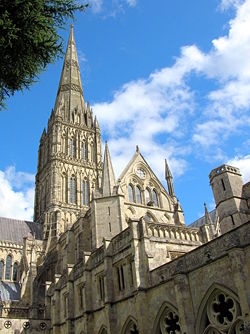
is a superb example of the style; because it was built over a relatively short period (the main body between 1220 to 1258), it is relatively unmixed with other styles (except for its facade and famous tower and spire, which date from the 14th century). Other good examples are the Galilee porch
Porch
A porch is external to the walls of the main building proper, but may be enclosed by screen, latticework, broad windows, or other light frame walls extending from the main structure.There are various styles of porches, all of which depend on the architectural tradition of its location...
at Ely Cathedral
Ely Cathedral
Ely Cathedral is the principal church of the Diocese of Ely, in Cambridgeshire, England, and is the seat of the Bishop of Ely and a suffragan bishop, the Bishop of Huntingdon...
; the nave and transept of Wells Cathedral
Wells Cathedral
Wells Cathedral is a Church of England cathedral in Wells, Somerset, England. It is the seat of the Bishop of Bath and Wells, who lives at the adjacent Bishop's Palace....
(1225—1240); the west front of Peterborough Cathedral
Peterborough Cathedral
Peterborough Cathedral, properly the Cathedral Church of St Peter, St Paul and St Andrew – also known as Saint Peter's Cathedral in the United Kingdom – is the seat of the Bishop of Peterborough, dedicated to Saint Peter, Saint Paul and Saint Andrew, whose statues look down from the...
; and Beverley Minster
Beverley Minster
Beverley Minster, in Beverley, East Riding of Yorkshire is a parish church in the Church of England. It is said to be the largest parish church in the UK....
and the south transept at York. The style has also been used in academic buildings, such as the old library of Merton College, Oxford, which constitutes a portion of the so-called "Mob Quad."
Decorated Gothic
Gothic architecture
Gothic architecture is a style of architecture that flourished during the high and late medieval period. It evolved from Romanesque architecture and was succeeded by Renaissance architecture....
. Traditionally, this period is broken into two periods: the "Geometric" style (1250–90) and the "Curvilinear" style (1290–1350).
Elements of the Decorated style
Decorated architecture is characterised by its window traceryTracery
In architecture, Tracery is the stonework elements that support the glass in a Gothic window. The term probably derives from the 'tracing floors' on which the complex patterns of late Gothic windows were laid out.-Plate tracery:...
. Elaborate windows are subdivided by closely spaced parallel mullion
Mullion
A mullion is a vertical structural element which divides adjacent window units. The primary purpose of the mullion is as a structural support to an arch or lintel above the window opening. Its secondary purpose may be as a rigid support to the glazing of the window...
s (vertical bars of stone), usually up to the level at which the arched top of the window begins. The mullions then branch out and cross, intersecting to fill the top part of the window with a mesh of elaborate patterns called tracery
Tracery
In architecture, Tracery is the stonework elements that support the glass in a Gothic window. The term probably derives from the 'tracing floors' on which the complex patterns of late Gothic windows were laid out.-Plate tracery:...
, typically including trefoil
Trefoil
Trefoil is a graphic form composed of the outline of three overlapping rings used in architecture and Christian symbolism...
s and quatrefoil
Quatrefoil
The word quatrefoil etymologically means "four leaves", and applies to general four-lobed shapes in various contexts.-In heraldry:In heraldic terminology, a quatrefoil is a representation of a flower with four petals, or a leaf with four leaflets . It is sometimes shown "slipped", i.e. with an...
s. The style was geometrical
Geometry
Geometry arose as the field of knowledge dealing with spatial relationships. Geometry was one of the two fields of pre-modern mathematics, the other being the study of numbers ....
at first and flowing in the later period, owing to the omission of the circles in the window tracery. This flowing or flamboyant tracery was introduced in the first quarter of the 14th century and lasted about fifty years. This evolution of decorated tracery is often used to subdivide the period into an earlier "Geometric" and later "Curvilinear" period.
Interiors of this period often feature tall column
Column
A column or pillar in architecture and structural engineering is a vertical structural element that transmits, through compression, the weight of the structure above to other structural elements below. For the purpose of wind or earthquake engineering, columns may be designed to resist lateral forces...
s of more slender and elegant form than in previous periods. Vaulting
Vault (architecture)
A Vault is an architectural term for an arched form used to provide a space with a ceiling or roof. The parts of a vault exert lateral thrust that require a counter resistance. When vaults are built underground, the ground gives all the resistance required...
became more elaborate, with the use of increasing number of ribs, initially for structural and then aesthetic reasons. Arch
Arch
An arch is a structure that spans a space and supports a load. Arches appeared as early as the 2nd millennium BC in Mesopotamian brick architecture and their systematic use started with the Ancient Romans who were the first to apply the technique to a wide range of structures.-Technical aspects:The...
es are generally equilateral, and the mouldings bolder than in the Early English Period, with less depth in the hollows and with the fillet (a narrow flat band) largely used. The ballflower and a four-leaved flower motif take the place of the earlier dog-tooth
Dog-tooth
thumb|Dog-tooth ornamentA dog-tooth or "dogtooth pattern", in architecture, is an ornament found in the moldings of medieval work of the commencement of the 12th century, which is thought to have been introduced by the Crusaders from the East. The earliest example is found in the hall at Rabbath...
. The foliage in the capitals
Capital (architecture)
In architecture the capital forms the topmost member of a column . It mediates between the column and the load thrusting down upon it, broadening the area of the column's supporting surface...
is less conventional than in Early English and more flowing, and the diaper
Diapering
Diaper is any of a wide range of decorative patterns used in a variety of works of art, such as stained glass, heraldic shields, architecture, silverwork etc. Its chief use is in the enlivening of plain surfaces.-Etymology:...
patterns in walls are more varied.
Notable examples
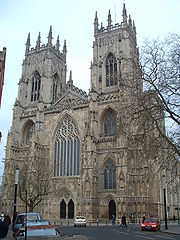
Examples of the Decorated style can be found in many British churches and cathedrals. Principal examples are those of the east ends of Lincoln CathedralLincoln Cathedral
Lincoln Cathedral is a historic Anglican cathedral in Lincoln in England and seat of the Bishop of Lincoln in the Church of England. It was reputedly the tallest building in the world for 249 years . The central spire collapsed in 1549 and was not rebuilt...
and of Carlisle Cathedral
Carlisle Cathedral
The Cathedral Church of the Holy and Undivided Trinity, otherwise called Carlisle Cathedral, is the seat of the Anglican Bishop of Carlisle. It is located in Carlisle, in Cumbria, North West England...
and the west fronts of York Minster
York Minster
York Minster is a Gothic cathedral in York, England and is one of the largest of its kind in Northern Europe alongside Cologne Cathedral. The minster is the seat of the Archbishop of York, the second-highest office of the Church of England, and is the cathedral for the Diocese of York; it is run by...
and Lichfield Cathedral
Lichfield Cathedral
Lichfield Cathedral is situated in Lichfield, Staffordshire, England. It is the only medieval English cathedral with three spires. The Diocese of Lichfield covers all of Staffordshire, much of Shropshire and part of the Black Country and West Midlands...
. Much of Exeter Cathedral
Exeter Cathedral
Exeter Cathedral, the Cathedral Church of Saint Peter at Exeter, is an Anglican cathedral, and the seat of the Bishop of Exeter, in the city of Exeter, Devon in South West England....
is built in this style, as is the crossing
Crossing (architecture)
A crossing, in ecclesiastical architecture, is the junction of the four arms of a cruciform church.In a typically oriented church , the crossing gives access to the nave on the west, the transept arms on the north and south, and the choir on the east.The crossing is sometimes surmounted by a tower...
of Ely Cathedral
Ely Cathedral
Ely Cathedral is the principal church of the Diocese of Ely, in Cambridgeshire, England, and is the seat of the Bishop of Ely and a suffragan bishop, the Bishop of Huntingdon...
, (including the famous octagonal lantern, built between 1322–1328 to replace the fallen central tower), three west bays of the choir and the Lady Chapel
Lady chapel
A Lady chapel, also called Mary chapel or Marian chapel, is a traditional English term for a chapel inside a cathedral, basilica, or large church dedicated to the Blessed Virgin Mary...
. In Scotland
Scotland
Scotland is a country that is part of the United Kingdom. Occupying the northern third of the island of Great Britain, it shares a border with England to the south and is bounded by the North Sea to the east, the Atlantic Ocean to the north and west, and the North Channel and Irish Sea to the...
, Melrose Abbey
Melrose Abbey
Melrose Abbey is a Gothic-style abbey in Melrose, Scotland. It was founded in 1136 by Cistercian monks, on the request of King David I of Scotland. It was headed by the Abbot or Commendator of Melrose. Today the abbey is maintained by Historic Scotland...
was a noteworthy example, though much of it is now in ruins.
Perpendicular Gothic
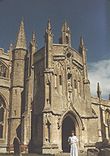
Gothic architecture
Gothic architecture is a style of architecture that flourished during the high and late medieval period. It evolved from Romanesque architecture and was succeeded by Renaissance architecture....
, and is so-called because it is characterised by an emphasis on vertical lines; it is also known as International Gothic
International Gothic
International Gothic is a phase of Gothic art which developed in Burgundy, Bohemia, France and northern Italy in the late 14th century and early 15th century...
, the Rectilinear style, or Late Gothic.
The Perpendicular style began to emerge c. 1350. Harvey (1978) puts the earliest example of a fully formed Perpendicular style at the chapter house
Chapter house
A chapter house or chapterhouse is a building or room attached to a cathedral or collegiate church in which meetings are held. They can also be found in medieval monasteries....
of Old St Paul's Cathedral
Old St Paul's Cathedral
Old St Paul's Cathedral is a name used to refer to the medieval cathedral of the City of London which until 1666 stood on the site of the present St Paul's Cathedral. Built between 1087 and 1314 and dedicated to St Paul, the cathedral was the fourth church on the site at Ludgate Hill...
, built by William Ramsey
William Ramsey (architect)
William Ramsey was an English Gothic architect, descended from the De Ramsey family of master masons whose work can be found at Ramsey Abbey, Norwich Cathedral, Ely Cathedral, and possibly also in Paris, according to John Harvey...
in 1332. It was a development of the Decorated style of the late 13th century and early 14th century, and lasted into the mid 16th century. It began under the royal architects William Ramsey
William Ramsey
William Ramsey may refer to:*William Marion Ramsey , American politician and judge in Oregon*William of Ramsey, 13th century English Benedictine monk of Croyland Abbey*William Ramsey , 14th century English architect...
and John Sponlee
John Sponlee
John Sponlee was an English Gothic architect, responsible for the Dean's Cloister at Windsor Castle .- References :...
, and fully developed in the prolific works of Henry Yevele
Henry Yevele
Henry Yevele was the most prolific and successful master mason active in late medieval England. The first document relating to him is dated 3 December 1353, when he purchased the freedom of London...
and William Wynford
William Wynford
William Wynford was one of the most successful English master masons of the 14th century, using the new Perpendicular Gothic style. He is first mentioned in 1360 when at work at Windsor Castle as warden of masons' work...
.
In the later examples of the Decorated Period the omission of the circles in the tracery
Tracery
In architecture, Tracery is the stonework elements that support the glass in a Gothic window. The term probably derives from the 'tracing floors' on which the complex patterns of late Gothic windows were laid out.-Plate tracery:...
of windows had led to the employment of curves of double curvature which developed into flamboyant tracery: the introduction of the perpendicular
Perpendicular
In geometry, two lines or planes are considered perpendicular to each other if they form congruent adjacent angles . The term may be used as a noun or adjective...
lines was a reaction in the contrary direction. The style grew out of the shadow of the Black Death which killed about half of England's population in 18 months between June 1348 and December 1349 and returned in 1361–62 to kill another fifth. This had a great effect on the arts and culture, which took a decidedly morbid and pessimistic direction. It can be argued that Perpendicular architecture reveals a populace affected by overwhelming shock and grief, focusing on death and despair, and no longer able to justify previous flamboyance or jubilation present in the Decorated style. The style was affected by the labour shortages caused by the plague as architects designed less elaborately to cope.
Features of the style
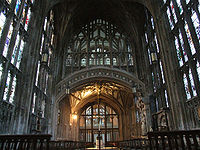
This perpendicular linearity is particularly obvious in the design of windows, which became very large, sometimes of immense size, with slimmer stone mullionMullion
A mullion is a vertical structural element which divides adjacent window units. The primary purpose of the mullion is as a structural support to an arch or lintel above the window opening. Its secondary purpose may be as a rigid support to the glazing of the window...
s than in earlier periods, allowing greater scope for stained glass
Stained glass
The term stained glass can refer to coloured glass as a material or to works produced from it. Throughout its thousand-year history, the term has been applied almost exclusively to the windows of churches and other significant buildings...
craftsmen. The mullions of the windows are carried vertically up into the arch
Arch
An arch is a structure that spans a space and supports a load. Arches appeared as early as the 2nd millennium BC in Mesopotamian brick architecture and their systematic use started with the Ancient Romans who were the first to apply the technique to a wide range of structures.-Technical aspects:The...
moulding of the windows, and the upper portion is subdivided by additional mullions (supermullions) and transoms, forming rectangular compartments, known as panel tracery. Buttress
Buttress
A buttress is an architectural structure built against or projecting from a wall which serves to support or reinforce the wall...
es and wall surfaces are likewise divided up into vertical panels. The technological development and artistic elaboration of the vault
Vault (architecture)
A Vault is an architectural term for an arched form used to provide a space with a ceiling or roof. The parts of a vault exert lateral thrust that require a counter resistance. When vaults are built underground, the ground gives all the resistance required...
reached its pinnacle, producing intricate multipartite lierne vaults and culminating in the fan vault
Fan vault
thumb|right|250px|Fan vaulting over the nave at Bath Abbey, Bath, England. Made from local Bath stone, this is a [[Victorian restoration]] of the original roof of 1608....
.
Doorways are frequently enclosed within a square head over the arch mouldings, the spandrel
Spandrel
A spandrel, less often spandril or splaundrel, is the space between two arches or between an arch and a rectangular enclosure....
s being filled with quatrefoil
Quatrefoil
The word quatrefoil etymologically means "four leaves", and applies to general four-lobed shapes in various contexts.-In heraldry:In heraldic terminology, a quatrefoil is a representation of a flower with four petals, or a leaf with four leaflets . It is sometimes shown "slipped", i.e. with an...
s or tracery. Pointed arches were still used throughout the period, but ogee
Ogee
An ogee is a curve , shaped somewhat like an S, consisting of two arcs that curve in opposite senses, so that the ends are parallel....
and four-centred Tudor arch
Tudor arch
A four-centred arch, also known as a depressed arch or Tudor arch, is a low, wide type of arch with a pointed apex. It is much wider than its height and gives the visual effect of having been flattened under pressure...
es were also introduced.
Inside the church the triforium
Triforium
A triforium is a shallow arched gallery within the thickness of inner wall, which stands above the nave of a church or cathedral. It may occur at the level of the clerestory windows, or it may be located as a separate level below the clerestory. It may itself have an outer wall of glass rather than...
disappears, or its place is filled with panelling, and greater importance is given to the clerestory
Clerestory
Clerestory is an architectural term that historically denoted an upper level of a Roman basilica or of the nave of a Romanesque or Gothic church, the walls of which rise above the rooflines of the lower aisles and are pierced with windows. In modern usage, clerestory refers to any high windows...
windows, which are often the finest features in the churches of this period. The mouldings are flatter than those of the earlier periods, and one of the chief characteristics is the introduction of large elliptical hollows.
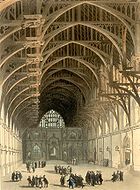
Some of the finest features of this period are the magnificent timber roofs; hammerbeam roof
Hammerbeam roof
Hammerbeam roof, in architecture, is the name given to an open timber roof, typical of English Gothic architecture, using short beams projecting from the wall.- Design :...
s, such as those of Westminster Hall (1395), Christ Church Hall, Oxford
Christ Church, Oxford
Christ Church or house of Christ, and thus sometimes known as The House), is one of the largest constituent colleges of the University of Oxford in England...
, and Crosby Hall
Crosby Hall
Crosby Hall is a historic building in Cheyne Walk, Chelsea, London, England. It is a Grade II* listed building.Part of the buildings architectural features are from the Great Hall, which is the only surviving part of the mansion of Crosby Hall, Bishopsgate which was built in 1466 by the wool...
, appeared for the first time. In areas of Southern England
Southern England
Southern England, the South and the South of England are imprecise terms used to refer to the southern counties of England bordering the English Midlands. It has a number of different interpretations of its geographic extents. The South is considered by many to be a cultural region with a distinct...
using flint
Flint
Flint is a hard, sedimentary cryptocrystalline form of the mineral quartz, categorized as a variety of chert. It occurs chiefly as nodules and masses in sedimentary rocks, such as chalks and limestones. Inside the nodule, flint is usually dark grey, black, green, white, or brown in colour, and...
architecture, elaborate flushwork
Flushwork
-Description:In architecture, flushwork is the decorative combination on the same flat plane of flint and ashlar stone. It is characteristic of the external walls of medieval buildings, most of the survivors being churches, in parts of Southern England, but especially East Anglia...
decoration in flint and ashlar
Ashlar
Ashlar is prepared stone work of any type of stone. Masonry using such stones laid in parallel courses is known as ashlar masonry, whereas masonry using irregularly shaped stones is known as rubble masonry. Ashlar blocks are rectangular cuboid blocks that are masonry sculpted to have square edges...
was used, especially in the wool church
Wool church
A wool church is an English church built primarily from the proceeds of the mediaeval wool trade. Wool churches are common in the Cotswolds and in East Anglia, where enormous profits from the wool business spurred construction of ever-grander edifices....
es of East Anglia
East Anglia
East Anglia is a traditional name for a region of eastern England, named after an ancient Anglo-Saxon kingdom, the Kingdom of the East Angles. The Angles took their name from their homeland Angeln, in northern Germany. East Anglia initially consisted of Norfolk and Suffolk, but upon the marriage of...
.
Notable examples
Some of the earliest examples of the Perpendicular Period, dating from 1360, are found at Gloucester CathedralGloucester Cathedral
Gloucester Cathedral, or the Cathedral Church of St Peter and the Holy and Indivisible Trinity, in Gloucester, England, stands in the north of the city near the river. It originated in 678 or 679 with the foundation of an abbey dedicated to Saint Peter .-Foundations:The foundations of the present...
, where the masons of the cathedral would seem to have been far in advance of those in other towns; the fan-vaulting in the cloister
Cloister
A cloister is a rectangular open space surrounded by covered walks or open galleries, with open arcades on the inner side, running along the walls of buildings and forming a quadrangle or garth...
s is particularly fine.
Among other buildings of note are:
- the Quire and tower of York MinsterYork MinsterYork Minster is a Gothic cathedral in York, England and is one of the largest of its kind in Northern Europe alongside Cologne Cathedral. The minster is the seat of the Archbishop of York, the second-highest office of the Church of England, and is the cathedral for the Diocese of York; it is run by...
(1389–1407); - the naveNaveIn Romanesque and Gothic Christian abbey, cathedral basilica and church architecture, the nave is the central approach to the high altar, the main body of the church. "Nave" was probably suggested by the keel shape of its vaulting...
, western transeptTranseptFor the periodical go to The Transept.A transept is a transverse section, of any building, which lies across the main body of the building. In Christian churches, a transept is an area set crosswise to the nave in a cruciform building in Romanesque and Gothic Christian church architecture...
s and crossing tower of Canterbury CathedralCanterbury CathedralCanterbury Cathedral in Canterbury, Kent, is one of the oldest and most famous Christian structures in England and forms part of a World Heritage Site....
(1378–1411), - the tower, towards the end of the 15th century; New College, OxfordNew College, OxfordNew College is one of the constituent colleges of the University of Oxford in the United Kingdom.- Overview :The College's official name, College of St Mary, is the same as that of the older Oriel College; hence, it has been referred to as the "New College of St Mary", and is now almost always...
(1380–86, Henry YeveleHenry YeveleHenry Yevele was the most prolific and successful master mason active in late medieval England. The first document relating to him is dated 3 December 1353, when he purchased the freedom of London...
); - the Beauchamp Chapel, WarwickCollegiate Church of St Mary, WarwickThe Collegiate Church of St Mary is a Church of England parish church in the town of Warwick, England. It lies in the centre of the town just east of the market place. It is a member of the Greater Churches Group....
(1381–91); - the remodelling of the nave and aisles of Winchester CathedralWinchester CathedralWinchester Cathedral at Winchester in Hampshire is one of the largest cathedrals in England, with the longest nave and overall length of any Gothic cathedral in Europe...
(1399–1419); - the transept and tower of Merton College, OxfordMerton College, OxfordMerton College is one of the constituent colleges of the University of Oxford in England. Its foundation can be traced back to the 1260s when Walter de Merton, chancellor to Henry III and later to Edward I, first drew up statutes for an independent academic community and established endowments to...
(1424–50); - Manchester CathedralManchester CathedralManchester Cathedral is a medieval church on Victoria Street in central Manchester and is the seat of the Bishop of Manchester. The cathedral's official name is The Cathedral and Collegiate Church of St Mary, St Denys and St George in Manchester...
(1422); - the central tower of Gloucester CathedralGloucester CathedralGloucester Cathedral, or the Cathedral Church of St Peter and the Holy and Indivisible Trinity, in Gloucester, England, stands in the north of the city near the river. It originated in 678 or 679 with the foundation of an abbey dedicated to Saint Peter .-Foundations:The foundations of the present...
(1454–57), - the central tower of Magdalen College, OxfordMagdalen College, OxfordMagdalen College is one of the constituent colleges of the University of Oxford in England. As of 2006 the college had an estimated financial endowment of £153 million. Magdalen is currently top of the Norrington Table after over half of its 2010 finalists received first-class degrees, a record...
(1475–80). - the Divinity School, OxfordDivinity School, OxfordThe Divinity School is a medieval building and room in the Perpendicular style in Oxford, England, part of the University of Oxford. Built 1427–83, it is the oldest surviving purpose-built building for university use, specifically for lectures and discussions on theology...
. - The Collegiate Church Of The Holy Trinity. Tattershall, Lincolnshire. (c1490 - 1500) http//:www.httf.org
Sherborne Abbey
Sherborne Abbey
The Abbey Church of St Mary the Virgin at Sherborne in the English county of Dorset, is usually called Sherborne Abbey. It has been a Saxon cathedral , a Benedictine abbey and is now a parish church.- Cathedral :...
(1475–c. 1580), particularly noted for its vast fan-vaulted roof, Bath Abbey
Bath Abbey
The Abbey Church of Saint Peter and Saint Paul, Bath, commonly known as Bath Abbey, is an Anglican parish church and a former Benedictine monastery in Bath, Somerset, England...
(although restored in the 1860s) and Henry VII
Henry VII of England
Henry VII was King of England and Lord of Ireland from his seizing the crown on 22 August 1485 until his death on 21 April 1509, as the first monarch of the House of Tudor....
's Lady Chapel
Henry VII Lady Chapel
The Henry VII Lady Chapel, now more often known just as the Henry VII Chapel, is a large Lady chapel at the far eastern end of Westminster Abbey, paid for by the will of Henry VII. It is separated from the rest of the abbey by brass gates and a flight of stairs.The structure of the chapel is a...
at Westminster Abbey
Westminster Abbey
The Collegiate Church of St Peter at Westminster, popularly known as Westminster Abbey, is a large, mainly Gothic church, in the City of Westminster, London, United Kingdom, located just to the west of the Palace of Westminster. It is the traditional place of coronation and burial site for English,...
(1503–1519) are notable later examples of this style.
To those examples should be added the towers at St Giles' Church, Wrexham
St Giles' Church, Wrexham
St Giles' Church is the parish church of Wrexham, Wales. Its tower is traditionally one of the Seven Wonders of Wales, which are commemorated in an anonymously written rhyme:...
, of such exceptional magnificence that it is known as one of the "Seven Wonders of Wales
Seven Wonders of Wales
The Seven Wonders of Wales is a traditional list of notable landmarks in North Wales, commemorated in an anonymously written rhyme:The seven wonders comprise:...
"; Coventry
Coventry
Coventry is a city and metropolitan borough in the county of West Midlands in England. Coventry is the 9th largest city in England and the 11th largest in the United Kingdom. It is also the second largest city in the English Midlands, after Birmingham, with a population of 300,848, although...
, Evesham, and St Mary Magdalene, Taunton
St Mary Magdalene, Taunton
The Church of St Mary Magdalene in Taunton, Somerset, England was completed in 1508, in Early Tudor Perpendicular Gothic style and has been designated as a Grade I listed building.-History and description:...
. All of a kind, Eton College Chapel, Eton
Eton College Chapel, Eton
Eton College Chapel is the chapel of Eton College, an independent school in the United Kingdom.Never completed due to the Wars of the Roses, the Chapel should have been a little over double its current length; a plaque on a building opposite the West End marks the point to which it should have...
, King's College Chapel, Cambridge
King's College Chapel, Cambridge
King's College Chapel is the chapel to King's College of the University of Cambridge, and is one of the finest examples of late Gothic English architecture, while its early Renaissance rood screen separating the nave and chancel, erected in 1532-36 in a striking contrast of style, has been called...
(1446–1515) and Syon Abbey
Syon Abbey
Syon Monastery , was a monastery of the Bridgettine Order founded in 1415 which stood until its demolition in the 16th c. on the left bank of the River Thames within the parish of Isleworth, in the county of Middlesex on or near the site of the present Georgian mansion of Syon House...
may also be put under this heading.
The Perpendicular style was less often used in the Gothic Revival than the Decorated style, but major examples include the rebuilt Palace of Westminster
Palace of Westminster
The Palace of Westminster, also known as the Houses of Parliament or Westminster Palace, is the meeting place of the two houses of the Parliament of the United Kingdom—the House of Lords and the House of Commons...
(i.e. the Houses of Parliament), Bristol University's Wills Memorial Building
Wills Memorial Building
The Wills Memorial Building is a Neo Gothic building designed by Sir George Oatley and built as a memorial to Henry Overton Wills III...
(1915–25) and St. Andrew's Cathedral, Sydney
St. Andrew's Cathedral, Sydney
St Andrew's Cathedral is the cathedral church of the Anglican Diocese of Sydney in the Anglican Church of Australia. The cathedral is the seat of the Anglican Archbishop of Sydney and Metropolitan of New South Wales, the Most Reverend Peter Jensen...
.
See also
- Gothic ArchitectureGothic architectureGothic architecture is a style of architecture that flourished during the high and late medieval period. It evolved from Romanesque architecture and was succeeded by Renaissance architecture....
- Romanesque architectureRomanesque architectureRomanesque architecture is an architectural style of Medieval Europe characterised by semi-circular arches. There is no consensus for the beginning date of the Romanesque architecture, with proposals ranging from the 6th to the 10th century. It developed in the 12th century into the Gothic style,...
- Tudor architectureTudor architectureThe Tudor architectural style is the final development of medieval architecture during the Tudor period and even beyond, for conservative college patrons...
- Architecture of the medieval cathedrals of EnglandArchitecture of the medieval cathedrals of EnglandThe medieval cathedrals of England, dating from between approximately 1040 and 1540, are a group of twenty-six buildings which together constitute a major aspect of the country’s artistic heritage and are among the most significant material symbols of Christianity. Though diversified in style, they...
- Cathedral architecture of Western EuropeCathedral architecture of Western EuropeThe architecture of cathedrals, basilicas and abbey churches is the architecture of those church buildings which are usually of large size, including most cathedrals, and follow one of several branching traditions of form, function and style that stem initially from Early Christian traditions of...
- Stained glassStained glassThe term stained glass can refer to coloured glass as a material or to works produced from it. Throughout its thousand-year history, the term has been applied almost exclusively to the windows of churches and other significant buildings...
- Poor Man's BiblePoor Man's BibleThe term Poor Man's Bible has come into use in modern times to describe works of art within churches and cathedrals which either individually or collectively have been created to illustrate the teachings of the Bible for a largely illiterate population. These artworks may take the form of carvings,...
- gothicmedGothicmedGothicmed is a European Union project carried out within the Culture 2000 programme and headed by the Ministry of Culture of the regional government of Valencia , Spain...