
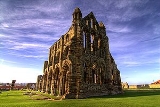
Whitby Abbey is a
ruinedRuins are the remains of human-made architecture: structures that were once complete, as time went by, have fallen into a state of partial or complete disrepair, due to lack of maintenance or deliberate acts of destruction...
BenedictineBenedictine refers to the spirituality and consecrated life in accordance with the Rule of St Benedict, written by Benedict of Nursia in the sixth century for the cenobitic communities he founded in central Italy. The most notable of these is Monte Cassino, the first monastery founded by Benedict...
abbeyAn abbey is a Catholic monastery or convent, under the authority of an Abbot or an Abbess, who serves as the spiritual father or mother of the community.The term can also refer to an establishment which has long ceased to function as an abbey,...
overlooking the
North SeaIn the southwest, beyond the Straits of Dover, the North Sea becomes the English Channel connecting to the Atlantic Ocean. In the east, it connects to the Baltic Sea via the Skagerrak and Kattegat, narrow straits that separate Denmark from Norway and Sweden respectively...
on the East Cliff above
WhitbyWhitby is a seaside town, port and civil parish in the Scarborough borough of North Yorkshire, England. Situated on the east coast of Yorkshire at the mouth of the River Esk, Whitby has a combined maritime, mineral and tourist heritage, and is home to the ruins of Whitby Abbey where Caedmon, the...
in
North YorkshireNorth Yorkshire is a non-metropolitan or shire county located in the Yorkshire and the Humber region of England, and a ceremonial county primarily in that region but partly in North East England. Created in 1974 by the Local Government Act 1972 it covers an area of , making it the largest...
,
EnglandEngland is a country that is part of the United Kingdom. It shares land borders with Scotland to the north and Wales to the west; the Irish Sea is to the north west, the Celtic Sea to the south west, with the North Sea to the east and the English Channel to the south separating it from continental...
. It was disestablished during the
Dissolution of the MonasteriesThe Dissolution of the Monasteries, sometimes referred to as the Suppression of the Monasteries, was the set of administrative and legal processes between 1536 and 1541 by which Henry VIII disbanded monasteries, priories, convents and friaries in England, Wales and Ireland; appropriated their...
under the auspices of
Henry VIIIHenry VIII was King of England from 21 April 1509 until his death. He was Lord, and later King, of Ireland, as well as continuing the nominal claim by the English monarchs to the Kingdom of France...
. It is a Grade I
Listed building in the care of
English HeritageEnglish Heritage . is an executive non-departmental public body of the British Government sponsored by the Department for Culture, Media and Sport...
and its site museum is housed in
Cholmley HouseCholmley House or Whitby Hall is a banqueting house sited next to the ruins of Whitby Abbey in North Yorkshire. It was built in 1672 for £232,000 by Sir Hugh Cholmeley, whose family had acquired the Abbey ruins and the land around them after its dissolution in 1539 - from then until 1672, the...
.
Whitby Abbey is a
ruinedRuins are the remains of human-made architecture: structures that were once complete, as time went by, have fallen into a state of partial or complete disrepair, due to lack of maintenance or deliberate acts of destruction...
BenedictineBenedictine refers to the spirituality and consecrated life in accordance with the Rule of St Benedict, written by Benedict of Nursia in the sixth century for the cenobitic communities he founded in central Italy. The most notable of these is Monte Cassino, the first monastery founded by Benedict...
abbeyAn abbey is a Catholic monastery or convent, under the authority of an Abbot or an Abbess, who serves as the spiritual father or mother of the community.The term can also refer to an establishment which has long ceased to function as an abbey,...
overlooking the
North SeaIn the southwest, beyond the Straits of Dover, the North Sea becomes the English Channel connecting to the Atlantic Ocean. In the east, it connects to the Baltic Sea via the Skagerrak and Kattegat, narrow straits that separate Denmark from Norway and Sweden respectively...
on the East Cliff above
WhitbyWhitby is a seaside town, port and civil parish in the Scarborough borough of North Yorkshire, England. Situated on the east coast of Yorkshire at the mouth of the River Esk, Whitby has a combined maritime, mineral and tourist heritage, and is home to the ruins of Whitby Abbey where Caedmon, the...
in
North YorkshireNorth Yorkshire is a non-metropolitan or shire county located in the Yorkshire and the Humber region of England, and a ceremonial county primarily in that region but partly in North East England. Created in 1974 by the Local Government Act 1972 it covers an area of , making it the largest...
,
EnglandEngland is a country that is part of the United Kingdom. It shares land borders with Scotland to the north and Wales to the west; the Irish Sea is to the north west, the Celtic Sea to the south west, with the North Sea to the east and the English Channel to the south separating it from continental...
. It was disestablished during the
Dissolution of the MonasteriesThe Dissolution of the Monasteries, sometimes referred to as the Suppression of the Monasteries, was the set of administrative and legal processes between 1536 and 1541 by which Henry VIII disbanded monasteries, priories, convents and friaries in England, Wales and Ireland; appropriated their...
under the auspices of
Henry VIIIHenry VIII was King of England from 21 April 1509 until his death. He was Lord, and later King, of Ireland, as well as continuing the nominal claim by the English monarchs to the Kingdom of France...
. It is a Grade I
Listed building in the care of
English HeritageEnglish Heritage . is an executive non-departmental public body of the British Government sponsored by the Department for Culture, Media and Sport...
and its site museum is housed in
Cholmley HouseCholmley House or Whitby Hall is a banqueting house sited next to the ruins of Whitby Abbey in North Yorkshire. It was built in 1672 for £232,000 by Sir Hugh Cholmeley, whose family had acquired the Abbey ruins and the land around them after its dissolution in 1539 - from then until 1672, the...
.
Streoneshalh
The first monastery was founded in 657 AD by the
Anglo-Saxon eraAnglo-Saxon is a term used by historians to designate the Germanic tribes who invaded and settled the south and east of Great Britain beginning in the early 5th century AD, and the period from their creation of the English nation to the Norman conquest. The Anglo-Saxon Era denotes the period of...
King of Northumbria, Oswy (Oswiu) as
Streoneshalh (the older name for Whitby). He appointed Lady Hilda, abbess of
Hartlepool AbbeyHartlepool Abbey was a Northumbrian monastery founded in 640 CE by Hieu, the first of the saintly recluses of Northumbria, and Aidan of Lindisfarne, on the Headland Estate of Hartlepool now called the Heugh or Old Hartlepool, in County Durham, England....
and niece of
EdwinEdwin , also known as Eadwine or Æduini, was the King of Deira and Bernicia – which later became known as Northumbria – from about 616 until his death. He converted to Christianity and was baptised in 627; after he fell at the Battle of Hatfield Chase, he was venerated as a saint.Edwin was the son...
the first Christian king of Northumbria, as founding abbess. The name Streoneshalh is thought to signify
Fort Bay or
Tower Bay in reference to a supposed
RomanAncient Rome was a thriving civilization that grew on the Italian Peninsula as early as the 8th century BC. Located along the Mediterranean Sea and centered on the city of Rome, it expanded to one of the largest empires in the ancient world....
settlement that previously existed on the site. This contention has never been proven though and alternate theories have been proposed, such as the name meaning
Streona's settlement. Some believe that the name referred to
Eadric StreonaEadric Streona was an ealdorman of the English Mercians. His name a loose translation of the Anglo-Saxon "the Grasper." Streona is historically regarded as the greatest traitor of the Anglo-Saxon period in English history....
, but this is highly unlikely due to chronological considerations: Streona died in 1017 so the naming of Streoneshalh would have preceded his birth by several hundred years.
The double
monasteryMonastery denotes the building, or complex of buildings, that houses a room reserved for prayer as well as the domestic quarters and workplace of monastics, whether monks or nuns, and whether living in community or alone .Monasteries may vary greatly in size – a small dwelling accommodating only...
of Celtic monks and nuns was home to the great
NorthumbriaNorthumbria was a medieval kingdom of the Angles, in what is now Northern England and South-East Scotland, becoming subsequently an earldom in a united Anglo-Saxon kingdom of England. The name reflects the approximate southern limit to the kingdom's territory, the Humber Estuary.Northumbria was...
n poet Caedmon. In 664 the
Synod of WhitbyThe Synod of Whitby was a seventh century Northumbriansynod where King Oswiu of Northumbria ruled that his kingdom would calculate Easter and observe the monastic tonsure according to the customs of Rome, rather than the customs practised by Iona and its satellite institutions...
, at which King Oswiu ruled that the Northumbrian church would adopt the Roman calculation of Easter and monastic
tonsureTonsure is the traditional practice of Christian churches of cutting or shaving the hair from the scalp of clerics, monastics, and, in the Eastern Orthodox Church, all baptized members...
took place at the abbey.
Streoneshalch was laid waste by Danes in successive raids between 867 and 870 under
IngwarIvar Ragnarsson nicknamed the Boneless , was a Viking leader and by reputation also a berserker. By the late 11th century he was known as a son of the powerful Ragnar Lodbrok, ruler of an area probably comprising parts of modern-day Denmark and Sweden.-Invader:In the autumn of AD 865, with his...
and
UbbaUbbe, Ubba or Hubba Ragnarsson was a Norse leader during the Viking Age. Ubbe Ragnarsson was one of the sons of Ragnar Lodbrok and, along with his brothers Halfdan and Ivar the Boneless, a leader of the Great Danish Army....
and remained desolate for more than 200 years. The existence of 'Prestebi', meaning the habitation of priests in
Old NorseOld Norse is a North Germanic language that was spoken by inhabitants of Scandinavia and inhabitants of their overseas settlements during the Viking Age, until about 1300....
, at the Domesday Survey may point to the revival of religious life since Danish times. The old monastery given to Reinfrid comprised about 40 ruined
monasteria vel oratoria similar to Irish monastic ruins with numerous chapels and cells.
Whitby
Reinfrid, a soldier of William the Conqueror, became a monk and travelled to Streoneshalh, which was then known as Prestebi or Hwitebi (the "white settlement" in Old Norse). He approached
William de PercyWilliam de Percy, 1st Baron Percy known as Aux Gernons , was a Norman baron who arrived in England immediately after the Norman Conquest of England, and was the founder of the powerful English House of Percy....
who gave him the ruined monastery of St. Peter with two
carucateThe carucate or ploughland was a unit of assessment for tax used in most Danelaw counties of England, and is found for example in Domesday Book. The carucate was based on the area a plough team of eight oxen could till in a single annual season...
s of land, to start the new monastery. Serlo de Percy, the founder's brother, joined Reinfrid at the new monastery which followed the
BenedictineBenedictine refers to the spirituality and consecrated life in accordance with the Rule of St Benedict, written by Benedict of Nursia in the sixth century for the cenobitic communities he founded in central Italy. The most notable of these is Monte Cassino, the first monastery founded by Benedict...
rule.
The second monastery lasted until it was destroyed by
Henry VIIIHenry VIII was King of England from 21 April 1509 until his death. He was Lord, and later King, of Ireland, as well as continuing the nominal claim by the English monarchs to the Kingdom of France...
in 1540 during the
Dissolution of the MonasteriesThe Dissolution of the Monasteries, sometimes referred to as the Suppression of the Monasteries, was the set of administrative and legal processes between 1536 and 1541 by which Henry VIII disbanded monasteries, priories, convents and friaries in England, Wales and Ireland; appropriated their...
. The abbey buildings fell into ruins, and were mined for stone, but remained a prominent landmark for sailors and helped inspire
Bram StokerAbraham "Bram" Stoker was an Irish novelist and short story writer, best known today for his 1897 Gothic novel Dracula...
's
DraculaDracula is an 1897 novel by Irish author Bram Stoker.Famous for introducing the character of the vampire Count Dracula, the novel tells the story of Dracula's attempt to relocate from Transylvania to England, and the battle between Dracula and a small group of men and women led by Professor...
. The ruins are now owned and maintained by
English HeritageEnglish Heritage . is an executive non-departmental public body of the British Government sponsored by the Department for Culture, Media and Sport...
.
In 1914, Whitby Abbey was
shelledThe raid on Scarborough, Hartlepool and Whitby, which took place on 16 December 1914, was an attack by the Imperial German Navy on the British seaport towns of Scarborough, Hartlepool, West Hartlepool, and Whitby. The attack resulted in 137 fatalities and 592 casualties, many of which were civilians...
by
GermanGermany , officially the Federal Republic of Germany , is a federal parliamentary republic in Europe. The country consists of 16 states while the capital and largest city is Berlin. Germany covers an area of 357,021 km2 and has a largely temperate seasonal climate...
battlecruiserBattlecruisers were large capital ships built in the first half of the 20th century. They were developed in the first decade of the century as the successor to the armoured cruiser, but their evolution was more closely linked to that of the dreadnought battleship...
s
Von der TannSMS Von der Tann"SMS" stands for "Seiner Majestät Schiff", or "His Majesty's Ship" in German. was the first battlecruiser built for the German Kaiserliche Marine, as well as Germany's first major turbine-powered warship. At the time of her construction, Von der Tann was the fastest dreadnought-type...
and
DerfflingerSMS Derfflinger"SMS" stands for "Seiner Majestät Schiff", or "His Majesty's Ship" in German. was a battlecruiser of the German Kaiserliche Marine built just before the outbreak of World War I. She was the lead vessel of her class of three ships; her sister ships were and...
, aiming for the signal post on the end of the headland. Scarborough and
HartlepoolHartlepool is a town and port in North East England.It was founded in the 7th century AD, around the Northumbrian monastery of Hartlepool Abbey. The village grew during the Middle Ages and developed a harbour which served as the official port of the County Palatine of Durham. A railway link from...
were also attacked. The Abbey sustained considerable damage during the attack, which lasted ten minutes.
Abbey possessions
The original gift of William de Percy not only included the monastery of St. Peter at Streoneshalch, but the town and port of Whitby with its parish church of St. Mary and six dependent chapels at
FylingFylingdales is a civil parish in the Scarborough district of North Yorkshire, England situated south of Whitby. It contains the villages of Robin Hood's Bay and Fylingthorpe and Fyling Hall School....
,
HawskerHawsker-cum-Stainsacre is a civil parish in the Scarborough district of North Yorkshire, England.According to the 2001 UK census, Hawsker-cum-Stainsacre parish had a population of 763.There is a small church dedicated to All Saints....
,
SneatonSneaton is a village and civil parish in the Scarborough district of North Yorkshire, England. There is a church which is dedicated to St Hilda.According to the 2001 UK census, Sneaton parish had a population of 190....
,
UgglebarnbyEskdaleside cum Ugglebarnby is a small village and civil parish in the Scarborough district of North Yorkshire, England.According to the 2001 UK census, Eskdaleside cum Ugglebarnby parish had a population of 2,252....
,
DunsleyNewholm-cum-Dunsley is a civil parish in the Scarborough district of North Yorkshire, England.According to the 2001 UK census, Newholm-cum-Dunsley parish had a population of 213....
, and
AislabyAislaby is a village and civil parish in the Scarborough district of North Yorkshire, England. It is situated near the town of Whitby.According to the 2001 UK census, Aislaby parish had a population of 280....
, five mills including
RuswarpRuswarp is a village within the Scarborough borough of North Yorkshire, England. It lies around from Whitby, at the junction of the B1410 and B1416 roads, on the River Esk and the Esk Valley Line, with trains stopping at Ruswarp railway station. Bus services also connect the town to the...
, the town of
HacknessHackness is a village and civil parish in the Scarboroughdistrict of the county of North Yorkshire, England.Hackness is mentioned as the site of a double monastery or nunnery by Bede, writing in the early 8th century. The church of Saint Mary has fragments of a high cross dating from the late 8th...
with two mills and the parish church of St. Mary, and the church of St. Peter at Hackness 'where our monks served God, died, and were buried,' and various other gifts enumerated in the ' Memorial' in the abbot's book.
Priors and abbots
The first prior, Reinfrid, ruled for many years and was accidentally killed and buried at St Peter at Hackness. He was succeeded as prior by Serlo de Percy.
Notable burials
- Oswiu of Northumbria
Oswiu , also known as Oswy or Oswig , was a King of Bernicia. His father, Æthelfrith of Bernicia, was killed in battle, fighting against Rædwald, King of the East Angles and Edwin of Deira at the River Idle in 616...
, a King of Bernicia
- Edwin of Deira, King of Deira
Deira was a kingdom in Northern England during the 6th century AD. Itextended from the Humber to the Tees, and from the sea to the western edge of the Vale of York...
and Bernicia, and a SaintA saint is a holy person. In various religions, saints are people who are believed to have exceptional holiness.In Christian usage, "saint" refers to any believer who is "in Christ", and in whom Christ dwells, whether in heaven or in earth...
- Eahlfrith, Oswiu's widow and an Abbess
An abbess is the female superior, or mother superior, of a community of nuns, often an abbey....
of Whitby
- Ælflæd, daughter of Oswiu and Eahlfrith, also an Abbess of Whitby
- Sir William de Percy, 1st Baron Percy
William de Percy, 1st Baron Percy known as Aux Gernons , was a Norman baron who arrived in England immediately after the Norman Conquest of England, and was the founder of the powerful English House of Percy....
(d.c. 1096), Norman baron and Crusader
- Sir Richard de Percy
Sir Richard de Percy , 5th Baron Percy, was a Magnate from the North of England, and a participant in the First Barons' War.He was the son of Agnes de Perci, suo jure Baroness Percy, the heiress of the Percy estates, and her husband Joscelin of Louvain, who was styled "brother of the queen"...
, 5th Baron Percy (1166-1243), signatory to Magna CartaMagna Carta is an English charter, originally issued in the year 1215 and reissued later in the 13th century in modified versions, which included the most direct challenges to the monarch's authority to date. The charter first passed into law in 1225...