

Durham Cathedral

Encyclopedia
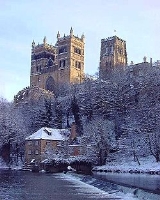
The Cathedral Church of Christ, Blessed Mary the Virgin and St Cuthbert of Durham (usually known as Durham Cathedral) is a cathedral
in the city of Durham
, England, the seat of the Anglican Bishop of Durham. The Bishopric dates from 995, with the present cathedral being founded in AD 1093. The cathedral is regarded as one of the finest examples of Norman architecture
and has been designated a UNESCO World Heritage Site
along with nearby Durham Castle
, which faces it across Palace Green
.
The present cathedral replaced the 10th century "White Church", built as part of a monastic foundation to house the shrine
of Saint Cuthbert of Lindisfarne
. The treasures of Durham Cathedral include relic
s of St Cuthbert, the head of St Oswald of Northumbria
and the remains of the Venerable Bede. In addition, its library contains one of the most complete set of early printed books in England, the pre-dissolution monastic accounts, and three copies of the Magna Carta
.
Durham Cathedral occupies a strategic position on a promontory high above the River Wear
. From 1080 until the 19th century the bishopric enjoyed the powers of a Bishop Palatine
, having military as well as religious leadership and power. Durham Castle
was built as the residence for the Bishop of Durham. The seat of the Bishop of Durham is the fourth most significant in the Church of England
hierarchy, and he stands at the right hand of the monarch at coronations. Signposts for the modern day County Durham
are subtitled "Land of the Prince Bishops."
There are daily Church of England
services at the Cathedral, with the Durham Cathedral Choir singing daily except Mondays and when the choir is on holiday. The cathedral is a major tourist attraction within the region, the central tower of 217 feet (66 m) giving views of Durham and the surrounding area.
 The see of Durham takes its origins from the Diocese of Lindisfarne
, founded by Saint Aidan
at the behest of Oswald of Northumbria
around AD 635. The see lasted until AD 664, at which point it was translated to York. The see was then reinstated at Lindisfarne in AD 678 by the Archbishop of Canterbury
. The community at Lindisfarne Priory produced many saint
s, of which Saint Cuthbert
who was Bishop of Lindisfarne from AD 685 until his death on Farne Island in 687 is central to the development of Durham Cathedral.
After repeated Viking
raids, the monks fled Lindisfarne in AD 875, carrying St Cuthbert's relics with them. The diocese of Lindisfarne remained itinerant until 882, when a community was re-established in Chester-le-Street
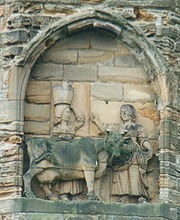
. The see had its seat here until AD 995, when further incursions once again caused the monks to move with the relics. According to local legend, the monks followed two milk maids who were searching for a dun (i.e. brown) cow and were led into a peninsula
formed by a loop in the River Wear
. At this point Cuthbert's coffin became immovable. This was taken as sign that the new shrine should be built here. A more prosaic set of reasons for the selection of the peninsula is its highly defensible position, and that a community established here would enjoy the protection of the Earl of Northumberland
, as the bishop at this time, Aldhun
, had strong family links with the earls. Nevertheless, the street leading from The Bailey
past the Cathedral's eastern towers up to Palace Green is named Dun Cow Lane.
Initially, a very simple temporary structure was built from local timber to house the relics of Cuthbert. The shrine was then transferred to a sturdier, probably wooden, building known as the White Church. This church was itself replaced three years later in 998 by a stone building also known as the White Church, which was complete apart from its tower by 1018. Durham soon became a site of pilgrimage, encouraged by the growing cult of Saint Cuthbert. King Canute
was one early pilgrim, granting many privileges and much land to the Durham community. The defendable position, flow of money from pilgrims and power embodied in the church at Durham ensured that a town formed around the cathedral, establishing the early core of the modern city.
(or William of Calais) who was appointed as the first prince-bishop by William the Conqueror in 1080. Since that time, there have been major additions and reconstructions of some parts of the building, but the greater part of the structure remains true to the Norman
design. Construction of the cathedral began in 1093 at the eastern end. The choir was completed by 1096 and work proceeded on the nave of which the walls were finished by 1128, and the high vault complete by 1135. The Chapter House, demolished in the 18th century, was built between 1133 and 1140. William died in 1099 before the building's completion, passing responsibility to his successor Ranulf Flambard
who also built Flamwell Bridge, the first crossing of the River Wear
in the town. Three bishops William of St. Carilef
, Ranulf Flambard
, and Hugh de Puiset
are all buried in the rebuilt Chapter House.
In the 1170s, Bishop Hugh de Puiset
, after a false start at the eastern end where the subsidence and cracking prevented work from continuing, added the Galilee Chapel at the west end of the cathedral. The five-aisled building occupies the position of a porch, it functioned as a Lady Chapel
and the Great West Door was blocked during the Medieval period by an altar to the Virgin Mary. The door is now blocked by the tomb of Bishop Langley
. The Galilee Chapel also holds the remains of the Venerable Bede. The main entrance to the cathedral is on the northern side, facing towards the Castle.
In 1228 Richard le Poore came from Salisbury
where a new cathedral was being built in the Gothic style. At this time, the eastern end of the cathedral was in urgent need of repair and the proposed eastern extension had failed. Richard le Poore employed the architect Richard Farnham to design an eastern terminal for the building in which many monks could say the Daily Office simultaneously. The resulting building was the Chapel of the Nine Altars. The towers also date from the early 13th century, but the central tower was damaged by lightning and replaced in two stages in the 15th century, the master masons being Thomas Barton and John Bell.
The Shrine of St. Cuthbert was located in the eastern apsidal end of the cathedral. The location of the inner wall of the apse is marked on the pavement, and St. Cuthbert's tomb is covered by a simple slab. However, an unknown monk wrote in 1593:
in 1538, and the monastery's wealth handed over to the king. The body of the saint was exhumed, and according to the Rites of Durham, was discovered to be uncorrupted
. It was reburied under a plain stone slab, but the ancient paving around it remains intact, worn by the knees of pilgrims. Two years later, on December 31, 1540, the Benedictine monastery at Durham was dissolved
, and the last prior of Durham
-- Hugh Whitehead
-- became the first dean
of the cathedral's secular chapter.
on 3 September 1650, Durham Cathedral was used by Oliver Cromwell
as a makeshift prison to hold Scottish prisoners-of-war. It is estimated that as many as 3,000 were imprisoned of whom 1,700 died in the cathedral itself, where they were kept in inhumane conditions, largely without food, water or heat. The prisoners destroyed much of the cathedral woodwork for firewood but Prior Castell's clock, which featured the Scottish thistle, was spared. It is reputed that the prisoners' bodies were buried in unmarked graves. The survivors were shipped as slave labour to North America.
In 1946 during work to install a new central heating system for the University, a mass grave of the Scottish soldiers was allegedly uncovered. Towards the end of 2007 a campaign was launched to commemorate the Dunbar Martyrs. Further to this and with the agreement of Durham University, Historic Scotland funded a geophysical survey of Palace Green. It was hoped that this might provide clarity on the final resting place of the dead, but results were inconclusive. During 2010 the Cathedral Chapter agreed to the installation of a memorial plaque within St Margaret of Scotland's chapel at the Cathedral. The "Dunbar Martyr" campaigners are raising funds to assist with the cost of creation and installation of the plaque, which will bear a Scots Thistle.
Bishop John Cosin
, who had previously been a canon of the cathedral, set about restoring the damage and refurnishing the building with new stalls, the litany desk and the towering canopy over the font. An oak screen to carry the organ was added at this time to replace a stone screen pulled down in the 16th century. On the remains of the old refectory, the Dean, John Sudbury founded a library of early printed books.
, having completed the Prebend's Bridge across the Wear, persuaded the Dean and Chapter to let him smooth off much of the outer stonework of the cathedral, thereby considerably altering its character.
The architect James Wyatt
greatly added to the destruction by demolishing half the Chapter House, altering the stonework of the east end, and inserting a large rose window
that was supposed to be faithful to one that had been there in the 13th century. Wyatt also planned to demolish the Galilee Chapel, but the Dean, John Cornwallis, returned and prevented it, just as the lead was being stripped from the roof.
The restoration
of the cathedral's tower between 1854 and 1859 was by the architect Sir George Gilbert Scott
, working with Edward Robert Robson
, who went on to serve as architect in charge of the cathedral for six years. and a statue of William Van Mildert
, the last prince-bishop (1826–1836) and driving force behind the foundation of Durham University.
 In 1986, the Cathedral, together with the nearby Castle, became a World Heritage Site
. The UNESCO
committee classified the Cathedral under criteria C (ii) (iv) (vi), reporting, "Durham Cathedral is the largest and most perfect monument of 'Norman' style architecture in England".
In 1996, the Great Western Doorway was the setting for Bill Viola
's large-scale video installation The Messenger.
Durham Cathedral has been featured in the Harry Potter
films as Hogwarts School of Witchcraft and Wizardry, where it had a spire digitally
added onto the top of the famous towers.
Interior views of the Cathedral were featured in the 1998 film Elizabeth
.
historian
Dan Cruickshank
selected the Cathedral as one of his four choices for the 2002
BBC
television
documentary series Britain's Best Buildings
.
In November 2009 the Cathedral featured in a son et lumière
festival whose highlight was the illumination of the North Front of the Cathedral with a 15 minute presentation that told the story of Lindisfarne and the foundation of Cathedral, using illustrations and text from the Lindisfarne Gospels
.
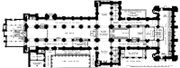
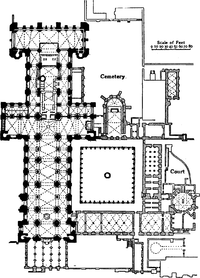 The building is notable for the ribbed vault
of the nave
roof, with pointed transverse arches supported on relatively slender composite piers alternated with massive drum columns, and flying buttress
es or lateral abutments concealed within the triforium
over the aisles. These features appear to be precursors of the Gothic architecture
of Northern France a few decades later, doubtless due to the Norman stonemasons responsible, although the building is considered Romanesque
overall. The skilled use of the pointed arch and ribbed vault made it possible to cover far more elaborate and complicated ground plans than before. Buttressing made it possible to build taller buildings and open up the intervening wall spaces to create larger windows.
Saint Cuthbert's tomb lies at the East in the Feretory and was once an elaborate monument of cream marble and gold. It remains a place of pilgrimage.
. The current dean is the Very Revd Michael Sadgrove
. Previous incumbents are given in the List of Deans of Durham.
s, choral scholar
s and child choristers. The latter are educated at the Chorister School
. Traditionally child choristers were all boys, but in November 2009 the Cathedral admitted female choristers for the first time. The girls and the boys serve alternately, not as a mixed choir, except at major festivals such as Easter
, Advent
and Christmas
when the two "top lines" come together.
 "Durham is one of the great experiences of Europe to the eyes of those who appreciate architecture, and to the minds of those who understand architecture. The group of Cathedral, Castle, and Monastery on the rock can only be compared to Avignon
and Prague
." -- Sir Nikolaus Pevsner
, The Buildings of England.
"I paused upon the bridge, and admired and wondered at the beauty and glory of this scene...it was grand, venerable, and sweet, all at once; I never saw so lovely and magnificent a scene, nor, being content with this, do I care to see a better." -- Nathaniel Hawthorne
on Durham Cathedral, The English Notebooks.
'With the cathedral at Durham we reach the incomparable masterpiece of Romanesque architecture not only in England but anywhere. The moment of entering provides for an architectural experience never to be forgotten, one of the greatest England has to offer.' -- Alec Clifton-Taylor
, 'English Towns' series on BBC television.
"I unhesitatingly gave Durham my vote for best cathedral on planet Earth." -- Bill Bryson
, Notes from a Small Island
.
-- Sir Walter Scott, Harold the Dauntless, a poem of Saxons and Vikings set in County Durham
.
Cathedral
A cathedral is a Christian church that contains the seat of a bishop...
in the city of Durham
Durham
Durham is a city in north east England. It is within the County Durham local government district, and is the county town of the larger ceremonial county...
, England, the seat of the Anglican Bishop of Durham. The Bishopric dates from 995, with the present cathedral being founded in AD 1093. The cathedral is regarded as one of the finest examples of Norman architecture
Norman architecture
About|Romanesque architecture, primarily English|other buildings in Normandy|Architecture of Normandy.File:Durham Cathedral. Nave by James Valentine c.1890.jpg|thumb|200px|The nave of Durham Cathedral demonstrates the characteristic round arched style, though use of shallow pointed arches above the...
and has been designated a UNESCO World Heritage Site
World Heritage Site
A UNESCO World Heritage Site is a place that is listed by the UNESCO as of special cultural or physical significance...
along with nearby Durham Castle
Durham Castle
Durham Castle is a Norman castle in the city of Durham, England, which has been wholly occupied since 1840 by University College, Durham. It is open to the general public to visit, but only through guided tours, since it is in use as a working building and is home to over 100 students...
, which faces it across Palace Green
Palace Green
Palace Green is a small area of grass in the centre of Durham, England, flanked by Durham Cathedral and Durham Castle. The Cathedral and Castle together form a UNESCO World Heritage Site....
.
The present cathedral replaced the 10th century "White Church", built as part of a monastic foundation to house the shrine
Shrine
A shrine is a holy or sacred place, which is dedicated to a specific deity, ancestor, hero, martyr, saint, daemon or similar figure of awe and respect, at which they are venerated or worshipped. Shrines often contain idols, relics, or other such objects associated with the figure being venerated....
of Saint Cuthbert of Lindisfarne
Cuthbert of Lindisfarne
Saint Cuthbert was an Anglo-Saxon monk, bishop and hermit associated with the monasteries of Melrose and Lindisfarne in the Kingdom of Northumbria, at that time including, in modern terms, northern England as well as south-eastern Scotland as far as the Firth of Forth...
. The treasures of Durham Cathedral include relic
Relic
In religion, a relic is a part of the body of a saint or a venerated person, or else another type of ancient religious object, carefully preserved for purposes of veneration or as a tangible memorial...
s of St Cuthbert, the head of St Oswald of Northumbria
Oswald of Northumbria
Oswald was King of Northumbria from 634 until his death, and is now venerated as a Christian saint.Oswald was the son of Æthelfrith of Bernicia and came to rule after spending a period in exile; after defeating the British ruler Cadwallon ap Cadfan, Oswald brought the two Northumbrian kingdoms of...
and the remains of the Venerable Bede. In addition, its library contains one of the most complete set of early printed books in England, the pre-dissolution monastic accounts, and three copies of the Magna Carta
Magna Carta
Magna Carta is an English charter, originally issued in the year 1215 and reissued later in the 13th century in modified versions, which included the most direct challenges to the monarch's authority to date. The charter first passed into law in 1225...
.
Durham Cathedral occupies a strategic position on a promontory high above the River Wear
River Wear
The River Wear is located in North East England, rising in the Pennines and flowing eastwards, mostly through County Durham, to the North Sea at Sunderland.-Geology and history:...
. From 1080 until the 19th century the bishopric enjoyed the powers of a Bishop Palatine
Prince-Bishop
A Prince-Bishop is a bishop who is a territorial Prince of the Church on account of one or more secular principalities, usually pre-existent titles of nobility held concurrently with their inherent clerical office...
, having military as well as religious leadership and power. Durham Castle
Durham Castle
Durham Castle is a Norman castle in the city of Durham, England, which has been wholly occupied since 1840 by University College, Durham. It is open to the general public to visit, but only through guided tours, since it is in use as a working building and is home to over 100 students...
was built as the residence for the Bishop of Durham. The seat of the Bishop of Durham is the fourth most significant in the Church of England
Church of England
The Church of England is the officially established Christian church in England and the Mother Church of the worldwide Anglican Communion. The church considers itself within the tradition of Western Christianity and dates its formal establishment principally to the mission to England by St...
hierarchy, and he stands at the right hand of the monarch at coronations. Signposts for the modern day County Durham
County Durham
County Durham is a ceremonial county and unitary district in north east England. The county town is Durham. The largest settlement in the ceremonial county is the town of Darlington...
are subtitled "Land of the Prince Bishops."
There are daily Church of England
Church of England
The Church of England is the officially established Christian church in England and the Mother Church of the worldwide Anglican Communion. The church considers itself within the tradition of Western Christianity and dates its formal establishment principally to the mission to England by St...
services at the Cathedral, with the Durham Cathedral Choir singing daily except Mondays and when the choir is on holiday. The cathedral is a major tourist attraction within the region, the central tower of 217 feet (66 m) giving views of Durham and the surrounding area.
Saxon
Lindisfarne
Lindisfarne is a tidal island off the north-east coast of England. It is also known as Holy Island and constitutes a civil parish in Northumberland...
, founded by Saint Aidan
Aidan of Lindisfarne
Known as Saint Aidan of Lindisfarne, Aidan the Apostle of Northumbria , was the founder and first bishop of the monastery on the island of Lindisfarne in England. A Christian missionary, he is credited with restoring Christianity to Northumbria. Aidan is the Anglicised form of the original Old...
at the behest of Oswald of Northumbria
Oswald of Northumbria
Oswald was King of Northumbria from 634 until his death, and is now venerated as a Christian saint.Oswald was the son of Æthelfrith of Bernicia and came to rule after spending a period in exile; after defeating the British ruler Cadwallon ap Cadfan, Oswald brought the two Northumbrian kingdoms of...
around AD 635. The see lasted until AD 664, at which point it was translated to York. The see was then reinstated at Lindisfarne in AD 678 by the Archbishop of Canterbury
Archbishop of Canterbury
The Archbishop of Canterbury is the senior bishop and principal leader of the Church of England, the symbolic head of the worldwide Anglican Communion, and the diocesan bishop of the Diocese of Canterbury. In his role as head of the Anglican Communion, the archbishop leads the third largest group...
. The community at Lindisfarne Priory produced many saint
Saint
A saint is a holy person. In various religions, saints are people who are believed to have exceptional holiness.In Christian usage, "saint" refers to any believer who is "in Christ", and in whom Christ dwells, whether in heaven or in earth...
s, of which Saint Cuthbert
Cuthbert of Lindisfarne
Saint Cuthbert was an Anglo-Saxon monk, bishop and hermit associated with the monasteries of Melrose and Lindisfarne in the Kingdom of Northumbria, at that time including, in modern terms, northern England as well as south-eastern Scotland as far as the Firth of Forth...
who was Bishop of Lindisfarne from AD 685 until his death on Farne Island in 687 is central to the development of Durham Cathedral.
After repeated Viking
Viking
The term Viking is customarily used to refer to the Norse explorers, warriors, merchants, and pirates who raided, traded, explored and settled in wide areas of Europe, Asia and the North Atlantic islands from the late 8th to the mid-11th century.These Norsemen used their famed longships to...
raids, the monks fled Lindisfarne in AD 875, carrying St Cuthbert's relics with them. The diocese of Lindisfarne remained itinerant until 882, when a community was re-established in Chester-le-Street
Chester-le-Street
Chester-le-Street is a town in County Durham, England. It has a history going back to Roman times when it was called Concangis. The town is located south of Newcastle upon Tyne and west of Sunderland on the River Wear...
. The see had its seat here until AD 995, when further incursions once again caused the monks to move with the relics. According to local legend, the monks followed two milk maids who were searching for a dun (i.e. brown) cow and were led into a peninsula
Peninsula
A peninsula is a piece of land that is bordered by water on three sides but connected to mainland. In many Germanic and Celtic languages and also in Baltic, Slavic and Hungarian, peninsulas are called "half-islands"....
formed by a loop in the River Wear
River Wear
The River Wear is located in North East England, rising in the Pennines and flowing eastwards, mostly through County Durham, to the North Sea at Sunderland.-Geology and history:...
. At this point Cuthbert's coffin became immovable. This was taken as sign that the new shrine should be built here. A more prosaic set of reasons for the selection of the peninsula is its highly defensible position, and that a community established here would enjoy the protection of the Earl of Northumberland
Earl of Northumberland
The title of Earl of Northumberland was created several times in the Peerages of England and Great Britain, succeeding the title Earl of Northumbria. Its most famous holders were the House of Percy , who were the most powerful noble family in Northern England for much of the Middle Ages...
, as the bishop at this time, Aldhun
Aldhun of Durham
Aldhun of Durham , also known as Ealdhun, was the last Bishop of Lindisfarne and the first Bishop of Durham. He was of "noble descent."...
, had strong family links with the earls. Nevertheless, the street leading from The Bailey
The Bailey
The Bailey, or The Peninsula, is an historic area in the centre of Durham, England. It is shaped like a peninsula thanks to a sharp meander in the River Wear, formed by isostatic adjustment of the land. The name 'The Bailey' derives from it being the 'outer bailey' of the Norman motte and...
past the Cathedral's eastern towers up to Palace Green is named Dun Cow Lane.
Initially, a very simple temporary structure was built from local timber to house the relics of Cuthbert. The shrine was then transferred to a sturdier, probably wooden, building known as the White Church. This church was itself replaced three years later in 998 by a stone building also known as the White Church, which was complete apart from its tower by 1018. Durham soon became a site of pilgrimage, encouraged by the growing cult of Saint Cuthbert. King Canute
Canute the Great
Cnut the Great , also known as Canute, was a king of Denmark, England, Norway and parts of Sweden. Though after the death of his heirs within a decade of his own and the Norman conquest of England in 1066, his legacy was largely lost to history, historian Norman F...
was one early pilgrim, granting many privileges and much land to the Durham community. The defendable position, flow of money from pilgrims and power embodied in the church at Durham ensured that a town formed around the cathedral, establishing the early core of the modern city.
Norman
The present cathedral was designed and built under William of St. CarilefWilliam of St. Carilef
William de St-Calais was a medieval Norman monk, abbot of the abbey of Saint-Vincent in Le Mans in Maine, who was nominated by King William I of England as Bishop of Durham in 1080. During his term as bishop, St-Calais replaced the canons of his cathedral chapter with monks, and began the...
(or William of Calais) who was appointed as the first prince-bishop by William the Conqueror in 1080. Since that time, there have been major additions and reconstructions of some parts of the building, but the greater part of the structure remains true to the Norman
Norman architecture
About|Romanesque architecture, primarily English|other buildings in Normandy|Architecture of Normandy.File:Durham Cathedral. Nave by James Valentine c.1890.jpg|thumb|200px|The nave of Durham Cathedral demonstrates the characteristic round arched style, though use of shallow pointed arches above the...
design. Construction of the cathedral began in 1093 at the eastern end. The choir was completed by 1096 and work proceeded on the nave of which the walls were finished by 1128, and the high vault complete by 1135. The Chapter House, demolished in the 18th century, was built between 1133 and 1140. William died in 1099 before the building's completion, passing responsibility to his successor Ranulf Flambard
Ranulf Flambard
Ranulf Flambard was a medieval Norman Bishop of Durham and an influential government minister of King William Rufus of England...
who also built Flamwell Bridge, the first crossing of the River Wear
River Wear
The River Wear is located in North East England, rising in the Pennines and flowing eastwards, mostly through County Durham, to the North Sea at Sunderland.-Geology and history:...
in the town. Three bishops William of St. Carilef
William of St. Carilef
William de St-Calais was a medieval Norman monk, abbot of the abbey of Saint-Vincent in Le Mans in Maine, who was nominated by King William I of England as Bishop of Durham in 1080. During his term as bishop, St-Calais replaced the canons of his cathedral chapter with monks, and began the...
, Ranulf Flambard
Ranulf Flambard
Ranulf Flambard was a medieval Norman Bishop of Durham and an influential government minister of King William Rufus of England...
, and Hugh de Puiset
Hugh de Puiset
Hugh de Puiset was a medieval Bishop of Durham and Chief Justiciar of England under King Richard I. He was the nephew of King Stephen of England and Henry of Blois, who both assisted Hugh's ecclesiastical career...
are all buried in the rebuilt Chapter House.
In the 1170s, Bishop Hugh de Puiset
Hugh de Puiset
Hugh de Puiset was a medieval Bishop of Durham and Chief Justiciar of England under King Richard I. He was the nephew of King Stephen of England and Henry of Blois, who both assisted Hugh's ecclesiastical career...
, after a false start at the eastern end where the subsidence and cracking prevented work from continuing, added the Galilee Chapel at the west end of the cathedral. The five-aisled building occupies the position of a porch, it functioned as a Lady Chapel
Lady chapel
A Lady chapel, also called Mary chapel or Marian chapel, is a traditional English term for a chapel inside a cathedral, basilica, or large church dedicated to the Blessed Virgin Mary...
and the Great West Door was blocked during the Medieval period by an altar to the Virgin Mary. The door is now blocked by the tomb of Bishop Langley
Thomas Langley
Thomas Langley was an English prelate who held high ecclesiastical and political offices in the early to mid 1400s. He was Dean of York, Bishop of Durham, twice Lord Chancellor of England to three kings, and a Pseudocardinal. In turn Keeper of the King's signet and Keeper of the Privy Seal before...
. The Galilee Chapel also holds the remains of the Venerable Bede. The main entrance to the cathedral is on the northern side, facing towards the Castle.
In 1228 Richard le Poore came from Salisbury
Salisbury Cathedral
Salisbury Cathedral, formally known as the Cathedral Church of the Blessed Virgin Mary, is an Anglican cathedral in Salisbury, England, considered one of the leading examples of Early English architecture....
where a new cathedral was being built in the Gothic style. At this time, the eastern end of the cathedral was in urgent need of repair and the proposed eastern extension had failed. Richard le Poore employed the architect Richard Farnham to design an eastern terminal for the building in which many monks could say the Daily Office simultaneously. The resulting building was the Chapel of the Nine Altars. The towers also date from the early 13th century, but the central tower was damaged by lightning and replaced in two stages in the 15th century, the master masons being Thomas Barton and John Bell.
The Shrine of St. Cuthbert was located in the eastern apsidal end of the cathedral. The location of the inner wall of the apse is marked on the pavement, and St. Cuthbert's tomb is covered by a simple slab. However, an unknown monk wrote in 1593:
Dissolution
Cuthbert's tomb was destroyed on the orders of Henry VIIIHenry VIII of England
Henry VIII was King of England from 21 April 1509 until his death. He was Lord, and later King, of Ireland, as well as continuing the nominal claim by the English monarchs to the Kingdom of France...
in 1538, and the monastery's wealth handed over to the king. The body of the saint was exhumed, and according to the Rites of Durham, was discovered to be uncorrupted
Incorruptibility
Incorruptibility is a Roman Catholic and Eastern Orthodox belief that supernatural intervention allows some human bodies to avoid the normal process of decomposition after death as a sign of their holiness...
. It was reburied under a plain stone slab, but the ancient paving around it remains intact, worn by the knees of pilgrims. Two years later, on December 31, 1540, the Benedictine monastery at Durham was dissolved
Dissolution of the Monasteries
The Dissolution of the Monasteries, sometimes referred to as the Suppression of the Monasteries, was the set of administrative and legal processes between 1536 and 1541 by which Henry VIII disbanded monasteries, priories, convents and friaries in England, Wales and Ireland; appropriated their...
, and the last prior of Durham
Prior of Durham
The Prior of Durham was the head of Durham Cathedral Priory, founded c. 1083 with the move of a previous house from Jarrow. The succession continued until dissolution of the monastery in 1540, when the priory was replaced with a deanery church.-List:...
-- Hugh Whitehead
Hugh Whitehead
Hugh Whitehead was the last prior of the Benedictine monastery at Durham in England. The monastery was dissolved by King Henry VIII in 1540. Whitehead would go on to become the cathedral's first dean.-References:...
-- became the first dean
Dean (religion)
A dean, in a church context, is a cleric holding certain positions of authority within a religious hierarchy. The title is used mainly in the Anglican Communion and the Roman Catholic Church.-Anglican Communion:...
of the cathedral's secular chapter.
17th century
After the Battle of DunbarBattle of Dunbar (1650)
The Battle of Dunbar was a battle of the Third English Civil War. The English Parliamentarian forces under Oliver Cromwell defeated a Scottish army commanded by David Leslie which was loyal to King Charles II, who had been proclaimed King of Scots on 5 February 1649.-Background:The English...
on 3 September 1650, Durham Cathedral was used by Oliver Cromwell
Oliver Cromwell
Oliver Cromwell was an English military and political leader who overthrew the English monarchy and temporarily turned England into a republican Commonwealth, and served as Lord Protector of England, Scotland, and Ireland....
as a makeshift prison to hold Scottish prisoners-of-war. It is estimated that as many as 3,000 were imprisoned of whom 1,700 died in the cathedral itself, where they were kept in inhumane conditions, largely without food, water or heat. The prisoners destroyed much of the cathedral woodwork for firewood but Prior Castell's clock, which featured the Scottish thistle, was spared. It is reputed that the prisoners' bodies were buried in unmarked graves. The survivors were shipped as slave labour to North America.
In 1946 during work to install a new central heating system for the University, a mass grave of the Scottish soldiers was allegedly uncovered. Towards the end of 2007 a campaign was launched to commemorate the Dunbar Martyrs. Further to this and with the agreement of Durham University, Historic Scotland funded a geophysical survey of Palace Green. It was hoped that this might provide clarity on the final resting place of the dead, but results were inconclusive. During 2010 the Cathedral Chapter agreed to the installation of a memorial plaque within St Margaret of Scotland's chapel at the Cathedral. The "Dunbar Martyr" campaigners are raising funds to assist with the cost of creation and installation of the plaque, which will bear a Scots Thistle.
Bishop John Cosin
John Cosin
John Cosin was an English churchman.-Life:He was born at Norwich, and was educated at Norwich grammar school and at Caius College, Cambridge, where he was scholar and afterwards fellow. On taking orders he was appointed secretary to Bishop Overall of Lichfield, and then domestic chaplain to...
, who had previously been a canon of the cathedral, set about restoring the damage and refurnishing the building with new stalls, the litany desk and the towering canopy over the font. An oak screen to carry the organ was added at this time to replace a stone screen pulled down in the 16th century. On the remains of the old refectory, the Dean, John Sudbury founded a library of early printed books.
1700–1900
During the 18th century, the deans of Durham often held another position in the south of England, and after spending the statuatory time in residence, would depart to manage their affairs. Consequently, after Cosin's refurbishment, there was little by way of restoration or rebuilding. When work commenced again on the building, it was of a most unsympathetic nature. In 1773 the architect George NicholsonGeorge Nicholson
George Nicholson, , printer, was born in Keighley, Yorkshire. Oxford Online Dictionary of National Biography - George NicholsonHe settled in Stourport-on-Severn, Worcestershire in 1808 where he remained until his death in 1825. He was a nationally known printer of the time...
, having completed the Prebend's Bridge across the Wear, persuaded the Dean and Chapter to let him smooth off much of the outer stonework of the cathedral, thereby considerably altering its character.
The architect James Wyatt
James Wyatt
James Wyatt RA , was an English architect, a rival of Robert Adam in the neoclassical style, who far outdid Adam in his work in the neo-Gothic style.-Early classical career:...
greatly added to the destruction by demolishing half the Chapter House, altering the stonework of the east end, and inserting a large rose window
Rose window
A Rose window is often used as a generic term applied to a circular window, but is especially used for those found in churches of the Gothic architectural style and being divided into segments by stone mullions and tracery...
that was supposed to be faithful to one that had been there in the 13th century. Wyatt also planned to demolish the Galilee Chapel, but the Dean, John Cornwallis, returned and prevented it, just as the lead was being stripped from the roof.
The restoration
Victorian restoration
Victorian restoration is the term commonly used to refer to the widespread and extensive refurbishment and rebuilding of Church of England churches and cathedrals that took place in England and Wales during the 19th-century reign of Queen Victoria...
of the cathedral's tower between 1854 and 1859 was by the architect Sir George Gilbert Scott
George Gilbert Scott
Sir George Gilbert Scott was an English architect of the Victorian Age, chiefly associated with the design, building and renovation of churches, cathedrals and workhouses...
, working with Edward Robert Robson
Edward Robert Robson
Edward Robert Robson FRIBA FSA FSI was an English architect famous for the progressive spirit of his London state-funded school buildings of the 1870s and early 1880s....
, who went on to serve as architect in charge of the cathedral for six years. and a statue of William Van Mildert
William Van Mildert
William Van Mildert was the last palatine Bishop of Durham , and one of the founders of the University of Durham...
, the last prince-bishop (1826–1836) and driving force behind the foundation of Durham University.
20th century
World Heritage Site
A UNESCO World Heritage Site is a place that is listed by the UNESCO as of special cultural or physical significance...
. The UNESCO
UNESCO
The United Nations Educational, Scientific and Cultural Organization is a specialized agency of the United Nations...
committee classified the Cathedral under criteria C (ii) (iv) (vi), reporting, "Durham Cathedral is the largest and most perfect monument of 'Norman' style architecture in England".
In 1996, the Great Western Doorway was the setting for Bill Viola
Bill Viola
Bill Viola is a contemporary video artist. He is considered a leading figure in the generation of artists whose artistic expression depends upon electronic, sound, and image technology in New Media...
's large-scale video installation The Messenger.
Durham Cathedral has been featured in the Harry Potter
Harry Potter (film series)
The Harry Potter film series is a British-American film series based on the Harry Potter novels by the British author J. K. Rowling...
films as Hogwarts School of Witchcraft and Wizardry, where it had a spire digitally
Computer-generated imagery
Computer-generated imagery is the application of the field of computer graphics or, more specifically, 3D computer graphics to special effects in art, video games, films, television programs, commercials, simulators and simulation generally, and printed media...
added onto the top of the famous towers.
Interior views of the Cathedral were featured in the 1998 film Elizabeth
Elizabeth (film)
Elizabeth is a 1998 biographical film written by Michael Hirst, directed by Shekhar Kapur, and starring Cate Blanchett in the title role of Queen Elizabeth I of England, alongside Geoffrey Rush, Christopher Eccleston, Joseph Fiennes, Sir John Gielgud, Fanny Ardant and Richard Attenborough...
.
21st century
ArchitecturalArchitecture
Architecture is both the process and product of planning, designing and construction. Architectural works, in the material form of buildings, are often perceived as cultural and political symbols and as works of art...
historian
History
History is the discovery, collection, organization, and presentation of information about past events. History can also mean the period of time after writing was invented. Scholars who write about history are called historians...
Dan Cruickshank
Dan Cruickshank
Dan Cruickshank is an art historian and BBC television presenter.-Early life:As a young child he lived for some years in Poland...
selected the Cathedral as one of his four choices for the 2002
2002 in television
The year 2002 in television involved some significant events.Below is a list of television-related events in 2002.For the American TV schedule, see: 2002–03 United States network television schedule.-Events:-Debuts:-1940s:...
BBC
BBC
The British Broadcasting Corporation is a British public service broadcaster. Its headquarters is at Broadcasting House in the City of Westminster, London. It is the largest broadcaster in the world, with about 23,000 staff...
television
Television
Television is a telecommunication medium for transmitting and receiving moving images that can be monochrome or colored, with accompanying sound...
documentary series Britain's Best Buildings
Britain's Best Buildings
Britain's Best Buildings is a BBC documentary series in which the TV presenter and architectural historian Dan Cruickshank discusses his selection of the finest examples of British architecture...
.
In November 2009 the Cathedral featured in a son et lumière
Son et lumière (show)
Son et lumière , or a sound and light show, is a form of nighttime entertainment that is usually presented in an outdoor venue of historic significance....
festival whose highlight was the illumination of the North Front of the Cathedral with a 15 minute presentation that told the story of Lindisfarne and the foundation of Cathedral, using illustrations and text from the Lindisfarne Gospels
Lindisfarne Gospels
The Lindisfarne Gospels is an illuminated Latin manuscript of the gospels of Matthew, Mark, Luke and John in the British Library...
.
Architecture
Rib vault
The intersection of two or three barrel vaults produces a rib vault or ribbed vault when they are edged with an armature of piped masonry often carved in decorative patterns; compare groin vault, an older form of vault construction...
of the nave
Nave
In Romanesque and Gothic Christian abbey, cathedral basilica and church architecture, the nave is the central approach to the high altar, the main body of the church. "Nave" was probably suggested by the keel shape of its vaulting...
roof, with pointed transverse arches supported on relatively slender composite piers alternated with massive drum columns, and flying buttress
Flying buttress
A flying buttress is a specific form of buttressing most strongly associated with Gothic church architecture. The purpose of any buttress is to resist the lateral forces pushing a wall outwards by redirecting them to the ground...
es or lateral abutments concealed within the triforium
Triforium
A triforium is a shallow arched gallery within the thickness of inner wall, which stands above the nave of a church or cathedral. It may occur at the level of the clerestory windows, or it may be located as a separate level below the clerestory. It may itself have an outer wall of glass rather than...
over the aisles. These features appear to be precursors of the Gothic architecture
Gothic architecture
Gothic architecture is a style of architecture that flourished during the high and late medieval period. It evolved from Romanesque architecture and was succeeded by Renaissance architecture....
of Northern France a few decades later, doubtless due to the Norman stonemasons responsible, although the building is considered Romanesque
Romanesque architecture
Romanesque architecture is an architectural style of Medieval Europe characterised by semi-circular arches. There is no consensus for the beginning date of the Romanesque architecture, with proposals ranging from the 6th to the 10th century. It developed in the 12th century into the Gothic style,...
overall. The skilled use of the pointed arch and ribbed vault made it possible to cover far more elaborate and complicated ground plans than before. Buttressing made it possible to build taller buildings and open up the intervening wall spaces to create larger windows.
Saint Cuthbert's tomb lies at the East in the Feretory and was once an elaborate monument of cream marble and gold. It remains a place of pilgrimage.
Other burials
- Stephen KembleStephen KembleGeorge Stephen Kemble was a successful theatre manager, British actor, writer, and a member of the famous Kemble family....
- actor of the famous Kemble familyKemble familyKemble is the name of a family of English actors, all distinguished actors and actresses who reigned over the British stage for decades. The most famous were Sarah Siddons and her brother John Philip Kemble , the two eldest of the twelve children of Roger Kemble , a strolling player and manager of... - William de St-Calais, in the chapter houseChapter houseA chapter house or chapterhouse is a building or room attached to a cathedral or collegiate church in which meetings are held. They can also be found in medieval monasteries....
- Ranulf FlambardRanulf FlambardRanulf Flambard was a medieval Norman Bishop of Durham and an influential government minister of King William Rufus of England...
, also in the chapter house (where his tomb was opened in 1874) - Geoffrey RufusGeoffrey RufusGeoffrey Rufus was a medieval Bishop of Durham and Lord Chancellor of England.-Life:Rufus' parentage and upbringing is unknown. The circumstances around his acquisition of the nickname "Rufus" have not been discovered either. He was a royal clerk before being named the tenth Lord Chancellor and...
, also in the chapter house (where his grave was also excavated in the 19th century) - William of St. BarbaraWilliam of St. BarbaraWilliam of St. Barbara or William of Ste Barbe was a medieval Bishop of Durham.-Life:From William's name, it is presumed that he was a native of Sainte-Barbe-en-Auge in Calvados in Normandy. He was a canon of York Minster in 1128. He was Dean of York by December of 1138.William was elected to the...
, also in the chapter house (where his grave was also excavated in the 19th century) - Nicholas FarnhamNicholas FarnhamNicholas Farnham was a medieval Bishop of Durham.Farnham was probably a native of Farnham, Surrey. He studied at Oxford University before moving on to study at Paris and Bologna. At Paris he first studied theology, but later moved to medicine. He taught at the University of Bologna as a teacher of...
- Walter of KirkhamWalter of Kirkham-Early life:Walter was probably a native of Kirkham, Yorkshire. From about January 1224 Walter held the office of Keeper of the Wardrobe jointly with Walter Brackley. Brackley was out of office by February of 1229, but Walter continued to hold the office until 15 August 1231. He held the office...
, in the chapter house - Robert StitchillRobert StitchillRobert Stitchill was a medieval Bishop of Durham in England.-Life:Stitchill probably came from the village of Stitchill in Roxburghshire. His father was a priest, and may have been the William Scot who was elected to the see of Durham in 1226. William Scot was never confirmed as bishop, for his...
(his heart only) - Robert of Holy IslandRobert of Holy IslandRobert of Holy Island was a medieval Bishop of Durham.Robert was the son of crofters and was a native of the island of Lindisfarne. He had a brother, Henry, who became Robert's executor. He became a Benedictine monk at Durham, where he served as sacrist from 1265 to 1269. He was prior of Durham's...
, in the chapter house - Antony Bek (Bishop of Durham)
- Richard KellawRichard KellawRichard Kellaw was Bishop of Durham. He was elected on 31 March 1311, and was consecrated on 30 May 1311. He died on 9 October 1316. In the 19th century, a grave identified as his was excavated in the Durham Cathedral Chapter House.-References:...
, in the chapter house - Thomas LangleyThomas LangleyThomas Langley was an English prelate who held high ecclesiastical and political offices in the early to mid 1400s. He was Dean of York, Bishop of Durham, twice Lord Chancellor of England to three kings, and a Pseudocardinal. In turn Keeper of the King's signet and Keeper of the Privy Seal before...
, his tomb blocking the Great West Door (necessitating the construction of the two later doors to north and south) - James Pilkington (bishop), at the head of Bishop Beaumont's tomb in front of the high altar
- Alfred Robert TuckerAlfred Robert TuckerAlfred Robert Tucker was the Bishop of Uganda from 1897, the inception of the diocese, until 1911.- Early days :Tucker was born in 1849 and grew up in the Lake District in England. Following in the footsteps of his family, he became an artist, exhibiting at the Royal Academy.- Church life :In...
, outside the cathedral
Dean
The cathedral is governed by the dean and chapterChapter (religion)
Chapter designates certain corporate ecclesiastical bodies in the Roman Catholic, Anglican and Nordic Lutheran churches....
. The current dean is the Very Revd Michael Sadgrove
Michael Sadgrove
The Very Reverend Michael Sadgrove is a noted theological author and the current Dean of Durham and a former Dean of Sheffield Cathedral. Educated at University College School, London, and Balliol College, Oxford, he was ordained in 1975. He was a Tutor at Sarum College from 1976 until 1982....
. Previous incumbents are given in the List of Deans of Durham.
Choir
There is a regular choir of adult lay clerkLay clerk
A lay clerk, also known as a lay vicar, song man or a vicar choral, is a professional adult singer in a Cathedral or collegiate choir in the United Kingdom. The Vicars Choral were substitutes for the Canons...
s, choral scholar
Choral scholar
A choral scholar is a student either at a university or private school who receives a scholarship in exchange for singing in the school or university's choir...
s and child choristers. The latter are educated at the Chorister School
Chorister School
The Chorister School is a co-educational independent school for the 2 to 13 age range. It consists of a nursery , a pre-preparatory and preparatory day and boarding school in Durham, England...
. Traditionally child choristers were all boys, but in November 2009 the Cathedral admitted female choristers for the first time. The girls and the boys serve alternately, not as a mixed choir, except at major festivals such as Easter
Easter
Easter is the central feast in the Christian liturgical year. According to the Canonical gospels, Jesus rose from the dead on the third day after his crucifixion. His resurrection is celebrated on Easter Day or Easter Sunday...
, Advent
Advent
Advent is a season observed in many Western Christian churches, a time of expectant waiting and preparation for the celebration of the Nativity of Jesus at Christmas. It is the beginning of the Western liturgical year and commences on Advent Sunday, called Levavi...
and Christmas
Christmas
Christmas or Christmas Day is an annual holiday generally celebrated on December 25 by billions of people around the world. It is a Christian feast that commemorates the birth of Jesus Christ, liturgically closing the Advent season and initiating the season of Christmastide, which lasts twelve days...
when the two "top lines" come together.
Organ
Details of the organ from the National Pipe Organ RegisterOrganists
- 1557 John Brimley
- 1576 William Browne
- 1588 Robert Masterman
- 1594 William Smyth
- 1599 William Browne
- 1609 Edward Smyth
- 1612 Mr Dodson
- 1614 Richard Hutchinson
- 1661 John Foster
- 1677 Alexander Shaw
- 1681 William Greggs
- 1710 James Heseltine
- 1763 Thomas EbdonThomas EbdonThomas Ebdon was a British composer and organist born in Durham. He was a chorister at Durham Cathedral and became the organist there at the age of 35 after some wrangling between the Chapter and Dean. He died in office...
- 1811 Charles E. J. Clarke
- 1813 William Henshaw
- 1862 Philip Armes
- 1907 Rev Arnold D. Culley
- 1933 John Dykes BowerJohn Dykes BowerSir John Dykes Bower CVO was an English cathedral organist, who served in Truro Cathedral, Durham Cathedral and St Paul's Cathedral-Background:John Dykes Bower was born on 13 August 1905 in Gloucester. He was one of four brothers...
- 1936 Conrad William EdenConrad William EdenConrad William Eden was an English cathedral organist, who served in Wells Cathedral and Durham CathedralHe was born in 1905 in Alton, Hampshire, and was a chorister at Wells Cathedral. He won a scholarship to Rugby School, another to the Royal College of Music and an Exhibition which took him to...
- 1974 Richard Lloyd
- 1985 James LancelotJames LancelotJames Bennett Lancelot is currently Master of the Choristers and Cathedral Organist at Durham Cathedral, a position he has held since 1985....
Assistant organists
- John Matthew Wilson YoungJohn Matthew Wilson YoungJohn Matthew Wilson Young was an English organist. He was elder brother to William James Young , also a well-known English organist. John M.W. Young was buried in the cemetery at East Gate in Lincoln...
, --?-- to 1850 (then organist of Lincoln CathedralLincoln CathedralLincoln Cathedral is a historic Anglican cathedral in Lincoln in England and seat of the Bishop of Lincoln in the Church of England. It was reputedly the tallest building in the world for 249 years . The central spire collapsed in 1549 and was not rebuilt...
) - Thomas Henry Collinson
- J.C. Whitehead, ? - 1874
- Revd John Lionel Shirley Dampier Bennett, 1895–1903
- F. E. Leatham, 1901 (temporary during absence of J. L. Bennett)
- William Ellis, 1903 - 1918 (afterwards organist of Newcastle CathedralNewcastle CathedralSt Nicholas's Cathedral is a Church of England cathedral in Newcastle upon Tyne, England. Its full title is The Cathedral Church of St Nicholas Newcastle upon Tyne...
) - Basil S. Maine, 1918–1919
- Cyril Beaumont Maude, 1919–1968
- Bruce Richard Cash, 1968–1972
- Alan ThurlowAlan ThurlowAlan Thurlow is an organist born in Essex, England.Thurlow was educated at Bancroft's School, Woodford Green. He read Music at Sheffield University before going on to Emmanuel College, Cambridge, for a period of research into pre-Reformation English Church Music.-Durham Cathedral:In 1973 he was...
, 1973 - 1980 (later Organist Chichester Cathedral) - David HillDavid Hill (choral director)David Hill , is a choral conductor and organist. His most high profile roles are as Chief Conductor of the BBC Singers from September 2007, and Musical Director of The Bach Choir from April 1998. He was previously Organist and Director of Music at St John's College, Cambridge, in succession to...
, 1980–1982 - Ian Shaw, 1982–1985
- Keith Wright, 1991–present
Quotations
Avignon
Avignon is a French commune in southeastern France in the départment of the Vaucluse bordered by the left bank of the Rhône river. Of the 94,787 inhabitants of the city on 1 January 2010, 12 000 live in the ancient town centre surrounded by its medieval ramparts.Often referred to as the...
and Prague
Prague
Prague is the capital and largest city of the Czech Republic. Situated in the north-west of the country on the Vltava river, the city is home to about 1.3 million people, while its metropolitan area is estimated to have a population of over 2.3 million...
." -- Sir Nikolaus Pevsner
Nikolaus Pevsner
Sir Nikolaus Bernhard Leon Pevsner, CBE, FBA was a German-born British scholar of history of art and, especially, of history of architecture...
, The Buildings of England.
"I paused upon the bridge, and admired and wondered at the beauty and glory of this scene...it was grand, venerable, and sweet, all at once; I never saw so lovely and magnificent a scene, nor, being content with this, do I care to see a better." -- Nathaniel Hawthorne
Nathaniel Hawthorne
Nathaniel Hawthorne was an American novelist and short story writer.Nathaniel Hawthorne was born in 1804 in the city of Salem, Massachusetts to Nathaniel Hathorne and the former Elizabeth Clarke Manning. His ancestors include John Hathorne, a judge during the Salem Witch Trials...
on Durham Cathedral, The English Notebooks.
'With the cathedral at Durham we reach the incomparable masterpiece of Romanesque architecture not only in England but anywhere. The moment of entering provides for an architectural experience never to be forgotten, one of the greatest England has to offer.' -- Alec Clifton-Taylor
Alec Clifton-Taylor
Alec Clifton-Taylor OBE was an English architectural historian, writer and TV broadcaster.-Biography and works:...
, 'English Towns' series on BBC television.
"I unhesitatingly gave Durham my vote for best cathedral on planet Earth." -- Bill Bryson
Bill Bryson
William McGuire "Bill" Bryson, OBE, is a best-selling American author of humorous books on travel, as well as books on the English language and on science. Born an American, he was a resident of Britain for most of his adult life before moving back to the US in 1995...
, Notes from a Small Island
Notes from a Small Island
Notes from a Small Island is a humorous travel book on Great Britain by American author Bill Bryson, first published in 1995.-Overview:Bryson wrote Notes from a Small Island when he decided to move back to his native United States, but wanted to take one final trip around Great Britain, which had...
.
- "Grey towers of Durham
- Yet well I love thy mixed and massive piles
- Half church of God, half castle 'gainst the Scot
- And long to roam those venerable aisles
- With records stored of deeds long since forgot."
-- Sir Walter Scott, Harold the Dauntless, a poem of Saxons and Vikings set in County Durham
County Durham
County Durham is a ceremonial county and unitary district in north east England. The county town is Durham. The largest settlement in the ceremonial county is the town of Darlington...
.
See also
- Architecture of the medieval cathedrals of EnglandArchitecture of the medieval cathedrals of EnglandThe medieval cathedrals of England, dating from between approximately 1040 and 1540, are a group of twenty-six buildings which together constitute a major aspect of the country’s artistic heritage and are among the most significant material symbols of Christianity. Though diversified in style, they...
- English Gothic architectureEnglish Gothic architectureEnglish Gothic is the name of the architectural style that flourished in England from about 1180 until about 1520.-Introduction:As with the Gothic architecture of other parts of Europe, English Gothic is defined by its pointed arches, vaulted roofs, buttresses, large windows, and spires...
- Romanesque architectureRomanesque architectureRomanesque architecture is an architectural style of Medieval Europe characterised by semi-circular arches. There is no consensus for the beginning date of the Romanesque architecture, with proposals ranging from the 6th to the 10th century. It developed in the 12th century into the Gothic style,...
- Church of EnglandChurch of EnglandThe Church of England is the officially established Christian church in England and the Mother Church of the worldwide Anglican Communion. The church considers itself within the tradition of Western Christianity and dates its formal establishment principally to the mission to England by St...
External links
- Durham Cathedral Website
- Gallery of photos
- A Tour of Durham Cathedral & Castle
- Webcam views: zoomed, wide angle
- Voted "Britain's Favourite Building" in BBC Radio 4 poll, 2001
- A history of Durham Cathedral
- A history of Durham Cathedral choristers and choir school
- Adrian Fletcher's Paradoxplace – Durham Cathedral Pages - Photos
- Place Evocation: The Galilee Chapel
- Local History Publications from County Durham Books
- Bell's Cathedrals: The Cathedral Church of Durham - from Project GutenbergProject GutenbergProject Gutenberg is a volunteer effort to digitize and archive cultural works, to "encourage the creation and distribution of eBooks". Founded in 1971 by Michael S. Hart, it is the oldest digital library. Most of the items in its collection are the full texts of public domain books...
- Durham Cathedral - Tourist Guide to Durham Cathedral