
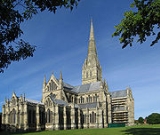
Salisbury Cathedral, formally known as the Cathedral Church of the Blessed Virgin Mary, is an
AnglicanThe Church of England is the officially established Christian church in England and the Mother Church of the worldwide Anglican Communion. The church considers itself within the tradition of Western Christianity and dates its formal establishment principally to the mission to England by St...
cathedralA cathedral is a Christian church that contains the seat of a bishop...
in Salisbury,
EnglandEngland is a country that is part of the United Kingdom. It shares land borders with Scotland to the north and Wales to the west; the Irish Sea is to the north west, the Celtic Sea to the south west, with the North Sea to the east and the English Channel to the south separating it from continental...
, considered one of the leading examples of Early English architecture.
The main body was completed in only 38 years, from 1220 to 1258.
The cathedral has the tallest church
spireA spire is a tapering conical or pyramidal structure on the top of a building, particularly a church tower. Etymologically, the word is derived from the Old English word spir, meaning a sprout, shoot, or stalk of grass....
in the
United KingdomThe United Kingdom of Great Britain and Northern IrelandIn the United Kingdom and Dependencies, other languages have been officially recognised as legitimate autochthonous languages under the European Charter for Regional or Minority Languages...
(123m/404 ft). Visitors can take the "Tower Tour" where the interior of the hollow spire, with its ancient wood scaffolding, can be viewed. The cathedral also has the largest
cloisterA cloister is a rectangular open space surrounded by covered walks or open galleries, with open arcades on the inner side, running along the walls of buildings and forming a quadrangle or garth...
and the largest cathedral close in Britain (80 acres (323,748.8 m²)). The Cathedral contains the world's oldest working
clockA clock is an instrument used to indicate, keep, and co-ordinate time. The word clock is derived ultimately from the Celtic words clagan and clocca meaning "bell". A silent instrument missing such a mechanism has traditionally been known as a timepiece...
(from AD 1386) and has the best surviving of the four original copies of
Magna CartaMagna Carta is an English charter, originally issued in the year 1215 and reissued later in the 13th century in modified versions, which included the most direct challenges to the monarch's authority to date. The charter first passed into law in 1225...
(all four original copies are in England). Although commonly known as Salisbury Cathedral, the official name is the Cathedral of Saint Mary. In 2008, the cathedral celebrated the 750th anniversary of its consecration in 1258.
It is the Mother Church of the
Diocese of SalisburyThe Diocese of Salisbury is a Church of England diocese in the south of England. The diocese covers Dorset and most of Wiltshire and is a constituent diocese of the Province of Canterbury. The diocese is led by the Bishop of Salisbury and the diocesan synod...
, and seat of the
Bishop of SalisburyThe Bishop of Salisbury is the ordinary of the Church of England's Diocese of Salisbury in the Province of Canterbury.The diocese covers much of the counties of Wiltshire and Dorset...
, the Rt. Revd.
Nick HoltamNicholas Roderick "Nick" Holtam is a bishop of the Church of England. He is currently the Bishop of Salisbury.-Education and ministry:...
.
History
As a response to deteriorating relations between the clergy and the military at
Old SarumOld Sarum Cathedral was a Norman cathedral built at Old Sarum, near modern day Salisbury, Wiltshire.After the Norman conquest of England in 1066, William the Conqueror used Old Sarum as a base of operations. William moved the bishopric from the Anglo-Saxon Sherborne Cathedral to Old Sarum,...
, the decision was taken to resite the cathedral and the bishopric was moved to its present place in Salisbury. The move occurred during the tenure of Bishop
Richard PooreRichard Poore was a medieval English clergyman best known for his role in the construction of Salisbury Cathedral.-Early life:...
, who was a wealthy man and donated the new land for construction. The new cathedral was also paid for by donations, principally by all the canons and vicars of the south-west, who were asked to contribute a fixed annual sum until its completion. Legend has it that the Bishop of Old Sarum shot an arrow in the direction he would build the cathedral; the arrow hit a deer and the deer finally died in the place where Salisbury Cathedral is now.
The foundation stone was laid on 28 April 1220. Much of the freestone for the cathedral came from
Teffont Evias quarriesTeffont Evias Quarry / Lane Cutting is a 3.6 hectare geological Site of Special Scientific Interest at Teffont Evias in Wiltshire, England, notified in 1989. It consists of two parts, Teffont Evias Quarry , and Teffont Evias Lane Cutting .-Source:...
. Due to the high water table in the new location, the cathedral was built on only four feet of foundations, and by 1258 the
naveIn Romanesque and Gothic Christian abbey, cathedral basilica and church architecture, the nave is the central approach to the high altar, the main body of the church. "Nave" was probably suggested by the keel shape of its vaulting...
,
transeptFor the periodical go to The Transept.A transept is a transverse section, of any building, which lies across the main body of the building. In Christian churches, a transept is an area set crosswise to the nave in a cruciform building in Romanesque and Gothic Christian church architecture...
s and
choirArchitecturally, the choir is the area of a church or cathedral, usually in the western part of the chancel between the nave and the sanctuary . The choir is occasionally located in the eastern part of the nave...
were complete. The west front was ready by 1265. The cloisters and chapter house were completed around 1280. Because the cathedral was built in only 38 years, Salisbury Cathedral has a single consistent architectural style, Early English Gothic.
The only major sections of the cathedral built later were the Cloisters,
Chapter houseA chapter house or chapterhouse is a building or room attached to a cathedral or collegiate church in which meetings are held. They can also be found in medieval monasteries....
, tower and
spireA spire is a tapering conical or pyramidal structure on the top of a building, particularly a church tower. Etymologically, the word is derived from the Old English word spir, meaning a sprout, shoot, or stalk of grass....
, which at 404 feet (123 m) dominated the skyline from 1320. Whilst the spire is the cathedral's most impressive feature, it has also proved to be troublesome. Together with the tower, it added 6,397 tons (6,500 tonnes) to the weight of the building. Without the addition of
buttressA buttress is an architectural structure built against or projecting from a wall which serves to support or reinforce the wall...
es, bracing arches and
ironIron is a chemical element with the symbol Fe and atomic number 26. It is a metal in the first transition series. It is the most common element forming the planet Earth as a whole, forming much of Earth's outer and inner core. It is the fourth most common element in the Earth's crust...
ties over the succeeding centuries, it would have suffered the fate of spires on later great ecclesiastical buildings (such as
Malmesbury AbbeyMalmesbury Abbey, at Malmesbury in Wiltshire, England, was founded as a Benedictine monastery around 676 by the scholar-poet Aldhelm, a nephew of King Ine of Wessex. In 941 AD, King Athelstan was buried in the Abbey. By the 11th century it contained the second largest library in Europe and was...
) and fallen down; instead, Salisbury remains the tallest church spire in the UK. To this day the large supporting
pillarsA column or pillar in architecture and structural engineering is a vertical structural element that transmits, through compression, the weight of the structure above to other structural elements below. For the purpose of wind or earthquake engineering, columns may be designed to resist lateral forces...
at the corners of the spire are seen to bend inwards under the stress. The addition of reinforcing tie beams above the
crossingA crossing, in ecclesiastical architecture, is the junction of the four arms of a cruciform church.In a typically oriented church , the crossing gives access to the nave on the west, the transept arms on the north and south, and the choir on the east.The crossing is sometimes surmounted by a tower...
, designed by
Christopher WrenSir Christopher Wren FRS is one of the most highly acclaimed English architects in history.He used to be accorded responsibility for rebuilding 51 churches in the City of London after the Great Fire in 1666, including his masterpiece, St. Paul's Cathedral, on Ludgate Hill, completed in 1710...
in 1668, arrested further deformation. The beams were hidden by a false ceiling, installed below the lantern stage of the tower.
Significant changes to the cathedral were made by the
architectAn architect is a person trained in the planning, design and oversight of the construction of buildings. To practice architecture means to offer or render services in connection with the design and construction of a building, or group of buildings and the space within the site surrounding the...
James WyattJames Wyatt RA , was an English architect, a rival of Robert Adam in the neoclassical style, who far outdid Adam in his work in the neo-Gothic style.-Early classical career:...
in 1790, including replacement of the original
rood screenThe rood screen is a common feature in late medieval church architecture. It is typically an ornate partition between the chancel and nave, of more or less open tracery constructed of wood, stone, or wrought iron...
and demolition of the
bell towerA bell tower is a tower which contains one or more bells, or which is designed to hold bells, even if it has none. In the European tradition, such a tower most commonly serves as part of a church and contains church bells. When attached to a city hall or other civic building, especially in...
which stood about 320 feet (100 m) north west of the main building. Salisbury is one of only three English cathedrals to lack a ring of bells, the others being
Norwich CathedralNorwich Cathedral is a cathedral located in Norwich, Norfolk, dedicated to the Holy and Undivided Trinity. Formerly a Catholic church, it has belonged to the Church of England since the English Reformation....
and
Ely CathedralEly Cathedral is the principal church of the Diocese of Ely, in Cambridgeshire, England, and is the seat of the Bishop of Ely and a suffragan bishop, the Bishop of Huntingdon...
. However it does strike the time every 15 minutes with bells.
Among the people buried in the cathedral, the most famous is probably
Sir Edward HeathSir Edward Richard George "Ted" Heath, KG, MBE, PC was a British Conservative politician who served as Prime Minister of the United Kingdom and as Leader of the Conservative Party ....
,
KGThe Most Noble Order of the Garter, founded in 1348, is the highest order of chivalry, or knighthood, existing in England. The order is dedicated to the image and arms of St...
,
MBEThe Most Excellent Order of the British Empire is an order of chivalry established on 4 June 1917 by George V of the United Kingdom. The Order comprises five classes in civil and military divisions...
(1916–2005), who served as
Prime Minister of the United KingdomThe Prime Minister of the United Kingdom of Great Britain and Northern Ireland is the Head of Her Majesty's Government in the United Kingdom. The Prime Minister and Cabinet are collectively accountable for their policies and actions to the Sovereign, to Parliament, to their political party and...
from 1970 to 1974 and as a
Member of ParliamentA Member of Parliament is a representative of the voters to a :parliament. In many countries with bicameral parliaments, the term applies specifically to members of the lower house, as upper houses often have a different title, such as senate, and thus also have different titles for its members,...
from 1950 to 2001.
Chapter House and Magna Carta
The
chapter houseA chapter house or chapterhouse is a building or room attached to a cathedral or collegiate church in which meetings are held. They can also be found in medieval monasteries....
is notable for its octagonal shape, slender central pillar and decorative mediæval
friezethumb|267px|Frieze of the [[Tower of the Winds]], AthensIn architecture the frieze is the wide central section part of an entablature and may be plain in the Ionic or Doric order, or decorated with bas-reliefs. Even when neither columns nor pilasters are expressed, on an astylar wall it lies upon...
. It was redecorated in 1855-9 by
William BurgesWilliam Burges was an English architect and designer. Amongst the greatest of the Victorian art-architects, Burges sought in his work an escape from 19th century industrialisation and a return to the values, architectural and social, of an imagined mediaeval England...
. The frieze circles the interior, just above the stalls, and depicts scenes and stories from the books of Genesis and Exodus, including
Adam and EveAdam and Eve were, according to the Genesis creation narratives, the first human couple to inhabit Earth, created by YHWH, the God of the ancient Hebrews...
,
NoahNoah was, according to the Hebrew Bible, the tenth and last of the antediluvian Patriarchs. The biblical story of Noah is contained in chapters 6–9 of the book of Genesis, where he saves his family and representatives of all animals from the flood by constructing an ark...
, the
Tower of BabelThe Tower of Babel , according to the Book of Genesis, was an enormous tower built in the plain of Shinar .According to the biblical account, a united humanity of the generations following the Great Flood, speaking a single language and migrating from the east, came to the land of Shinar, where...
, and
AbrahamAbraham , whose birth name was Abram, is the eponym of the Abrahamic religions, among which are Judaism, Christianity and Islam...
,
IsaacIsaac as described in the Hebrew Bible, was the only son Abraham had with his wife Sarah, and was the father of Jacob and Esau. Isaac was one of the three patriarchs of the Israelites...
and
JacobJacob "heel" or "leg-puller"), also later known as Israel , as described in the Hebrew Bible, the Talmud, the New Testament and the Qur'an was the third patriarch of the Hebrew people with whom God made a covenant, and ancestor of the tribes of Israel, which were named after his descendants.In the...
. The chapter house also displays the best-preserved of the four surviving original copies of
Magna CartaMagna Carta is an English charter, originally issued in the year 1215 and reissued later in the 13th century in modified versions, which included the most direct challenges to the monarch's authority to date. The charter first passed into law in 1225...
. This copy came to Salisbury because
Elias of DerehamElias of Dereham was a master stonemason designer, closely associated with Bishop Jocelin of Wells.Elias became a Canon of Salisbury, and oversaw the construction of Salisbury Cathedral. He was also responsible for building work at Clarendon Palace.The chapter house at Salisbury Cathedral displays...
, who was present at
RunnymedeRunnymede is a water-meadow alongside the River Thames in the English county of Berkshire, and just over west of central London. It is notable for its association with the sealing of Magna Carta, and as a consequence is the site of a collection of memorials...
in 1215, was given the task of distributing some of the original copies. Later, Elias became a
CanonA canon is a priest or minister who is a member of certain bodies of the Christian clergy subject to an ecclesiastical rule ....
of Salisbury and supervised the construction of Salisbury Cathedral.
The West Front
The west front is composed of two stair turrets at each extremity, with two niched buttresses nearer the centre line supporting the large central triple window. The stair turrets are topped with spirelets and the central section is topped by a gable which contains four lancet windows topped by two round quatrefoil windows surmounted by a mandorla containing Christ in Majesty. At ground level there is a principal door flanked by two smaller doors. The whole is highly decorated with quatrefoil motifs, columns, trefoil motifs and bands of
diaperingDiaper is any of a wide range of decorative patterns used in a variety of works of art, such as stained glass, heraldic shields, architecture, silverwork etc. Its chief use is in the enlivening of plain surfaces.-Etymology:...
. The west front was almost certainly constructed at the same time as the cathedral. This is apparent from the way in which the windows coincide with the interior spaces. The entire façade is about 33 metres high and wide.
The front accommodates over 130 shallow niches of varying sizes, 73 of these niches contains a statue. The line of niches extend round the turrets to the north, south and east faces. There are 5 levels of niches (not including the mandorla) which show, from the top, angels and archangels,
Old TestamentThe Old Testament, of which Christians hold different views, is a Christian term for the religious writings of ancient Israel held sacred and inspired by Christians which overlaps with the 24-book canon of the Masoretic Text of Judaism...
patriarchs, apostles and evangelists, martyrs, doctors and philosophers and, on the lower level, royalty, priests and worthy people connected with the cathedral. The majority of the statues were placed during the middle of the 19th century, however 7 are from the 14th century and several have been installed within the last decade.(see main article)
Clock
The
Salisbury cathedral clockThe Salisbury Cathedral clock, a large iron-framed clock without a dial located in the aisle of Salisbury Cathedral. Supposedly dating from about 1386, it is claimed to be the oldest working clock in the world....
dating from about AD 1386 is supposedly the oldest working modern clock in the world. The clock has no face because all clocks of that date rang out the hours on a bell. It was originally located in a bell tower that was demolished in 1792. Following this demolition, the clock was moved to the Cathedral Tower where it was in operation until 1884. The clock was then placed in storage and forgotten until it was discovered in 1929, in an attic of the cathedral. It was repaired and restored to working order in 1956. In 2007 remedial work and repairs were carried out to the clock.
Depictions in art, literature and film
The cathedral is the subject of famous
paintingPainting is the practice of applying paint, pigment, color or other medium to a surface . The application of the medium is commonly applied to the base with a brush but other objects can be used. In art, the term painting describes both the act and the result of the action. However, painting is...
s by
John ConstableJohn Constable was an English Romantic painter. Born in Suffolk, he is known principally for his landscape paintings of Dedham Vale, the area surrounding his home—now known as "Constable Country"—which he invested with an intensity of affection...
. The view depicted in the paintings has changed very little in almost two centuries.
The cathedral is also the subject of
William Golding'sSir William Gerald Golding was a British novelist, poet, playwright and Nobel Prize for Literature laureate, best known for his novel Lord of the Flies...
novel
The SpireThe Spire is a 1964 novel by the English author William Golding. "A dark and powerful portrait of one man's will", it deals with the construction of the 404-foot high spire of Salisbury Cathedral; the vision of the fictional Dean Jocelin...
which deals with the fictional Dean Jocelin who makes the building of the spire his life's work.
In
Edward RutherfurdEdward Rutherfurd is a pen name for Francis Edward Wintle known primarily as a writer of epic historical novels...
's historical novel Sarum, the narrative deals with the human settlement of the Salisbury area from pre-historic times just after the last
Ice AgeAn ice age or, more precisely, glacial age, is a generic geological period of long-term reduction in the temperature of the Earth's surface and atmosphere, resulting in the presence or expansion of continental ice sheets, polar ice sheets and alpine glaciers...
to the modern era. The construction of the Cathedral itself, its famous spire, bell tower and Charter House are all important plot points in the novel, which blends historic characters with invented ones.
The cathedral has been mentioned by the author
Ken FollettKen Follett is a Welsh author of thrillers and historical novels. He has sold more than 100 million copies of his works. Four of his books have reached the number 1 ranking on the New York Times best-seller list: The Key to Rebecca, Lie Down with Lions, Triple, and World Without End.-Early...
as one of two models for the fictional Kingsbridge Cathedral in his historical novel,
The Pillars of the EarthThe Pillars of the Earth is a historical novel by Ken Follett published in 1989 about the building of a cathedral in the fictional town of Kingsbridge, England. It is set in the middle of the 12th century, primarily during the Anarchy, between the time of the sinking of the White Ship and the...
. It was also used for some external shots in the 2010
miniseriesThe Pillars of the Earth is an eight part 2010 TV miniseries, adapted from Ken Follett's novel of the same name. It debuted in the U.S. on Starz and Canada on The Movie Network/Movie Central on July 23, 2010. Its UK premiere was on Channel 4 in October 2010 at 9pm...
based on Follett's book and was shown as it is today in the final scene.
The cathedral was the setting for the 2005
BBCThe British Broadcasting Corporation is a British public service broadcaster. Its headquarters is at Broadcasting House in the City of Westminster, London. It is the largest broadcaster in the world, with about 23,000 staff...
television drama
Mr. Harvey Lights a CandleMr. Harvey Lights a Candle is a television drama, written by Rhidian Brook and directed by Susanna White, which originally aired in 2005 on BBC....
, written by
Rhidian BrookRhidian Brook is a novelist, screenwriter and broadcaster.He has written two novels. His first - The Testimony of Taliesin Jones - won the 1997 Somerset Maugham Award, a Betty Trask Award and the Author's Club First Novel Award as well being runner up for Welsh Book of The Year...
and directed by Susanna White.
Kevin McCloud climbed the cathedral in his programme, Don't Look Down!, where he climbed high structures to conquer his fear of heights.
The cathedral was the subject of a
Channel 4Channel 4 is a British public-service television broadcaster which began working on 2 November 1982. Although largely commercially self-funded, it is ultimately publicly owned; originally a subsidiary of the Independent Broadcasting Authority , the station is now owned and operated by the Channel...
Time TeamTime Team is a British television series which has been aired on Channel 4 since 1994. Created by television producer Tim Taylor and presented by actor Tony Robinson, each episode features a team of specialists carrying out an archaeological dig over a period of three days, with Robinson explaining...
programme that was first broadcast on February 8, 2009.
Other burials
- Saint Osmund, Bishop of Salisbury
The Bishop of Salisbury is the ordinary of the Church of England's Diocese of Salisbury in the Province of Canterbury.The diocese covers much of the counties of Wiltshire and Dorset...
(1078 to 1099)
- Roger of Salisbury
Roger was a Norman medieval Bishop of Salisbury and the seventh Lord Chancellor and Lord Keeper of England.-Life:...
, Bishop of Salisbury (1102 to 1139)
- Josceline de Bohon
Josceline de Bohon was an English religious leader.-Life:...
, Bishop of Salisbury (1142 to 1184)
- Robert de Bingham
Robert de Bingham was the Bishop of Salisbury from 1229 to 1246.-Life:He held the prebend of Slape in the diocese of Salisbury prior to his election as bishop about 25 September 1228 and was consecrated at Wilton on 27 May 1229....
, Bishop of Salisbury (1229 to 1246)
- Giles of Bridport
-Life:He was archdeacon of Berkshire in the diocese of Salisbury as well as Dean of Wells before he was elected bishop between 13 February and 15 April 1256 and consecrated on 11 March 1257. He died in December 1262, probably on the 13th. He founded De Vaux College in 1262 and he may have been the...
, Bishop of Salisbury (1256 to 1262)
- Walter de la Wyle
Walter de la Wyle was the Bishop of Salisbury from 1263 to 1271. He was also a subcentor of Salisbury. Walter de la Wyle's is most famous for founding the St. Edmund's College and creating a new parish of St. Edmund's to serve the growing population of Salisbury...
, Bishop of Salisbury (1263 to 1271)
- Nicholas Longespee
-Life:He was the son of William Longespee earl of Salisbury and William's wife, Eva. He was a canon of Salisbury Cathedral before 1272 and held the office of treasurer of the diocese of Salisbury before 1275. He also held the position of rector of Lacock....
, Bishop of Salisbury (1291 to 1297)
- Simon of Ghent
-Life:He was a prebendary of the diocese of Salisbury and Chancellor of Oxford University, as well as Archdeacon of Oxford.He was elected bishop on 2 June 1297 and consecrated on 20 October 1297 at Canterbury He died 2 April 1315.-References:...
, Bishop of Salisbury (1297 to 1315)
- Roger Martival
Roger Martival was a medieval Bishop of Salisbury.He was elected about 11 June 1315 and consecrated on 28 September 1315. He died 14 March 1330. He has a house named for him at Bishop Wordsworth's School, Salisbury.-References:...
, Bishop of Salisbury (1315 to 1330)
- Richard Mitford
Richard Mitford was an English bishop of Chichester from 17 November 1389, and consecrated on 10 April 1390 and then bishop of Salisbury. He was translated to the see of Salisbury on 25 October 1395....
, Bishop of Salisbury (1395 to 1407)
- Richard Beauchamp (bishop), Bishop of Salisbury (1450 to 1482)
- Edmund Audley
Edmund Audley was Bishop of Rochester, Bishop of Hereford and Bishop of Salisbury.-Life:Audley graduated BA in 1463 at University College, Oxford...
, Bishop of Salisbury (1501 to 1524)
- John Jewel
John Jewel was an English bishop of Salisbury.-Life:He was the son of John Jewel of Buden, Devon, was educated under his uncle John Bellamy, rector of Hampton, and other private tutors until his matriculation at Merton College, Oxford, in July 1535.There he was taught by John Parkhurst,...
, Bishop of Salisbury (1559 to 1571)
- Edmund Gheast
Edmund Gheast was a 16th-century cleric of the Church of England.Guest was born at Northallerton, Yorkshire, the son of Thomas Geste...
, Bishop of Salisbury (1571 to 1577)
- Alexander Hyde
Alexander Hyde was an English royalist clergyman, Bishop of Salisbury from 1665 to 1667.-Life:Hyde was born at Salisbury in 1598, the fourth son of Sir Lawrence Hyde. At the age of twelve he entered Winchester College as a scholar, and matriculated 17 November 1615 at New College, Oxford. In...
, Bishop of Salisbury (1665 to 1667)
- John Thomas, Bishop of Salisbury (1761 to 1766)
Organists
- 1463 John Kegewyn
- 1563 Robert Chamberlayne
- 1568 Thomas Smythe
- 1587 John Farrant (Senior)
- 1592 John Farrant (Junior)
- 1618 Edward Tucker
- 1629 Giles Tompkins
- 1668 Michael Wise
Michael Wise was an English organist and composer. He sang as a child in the choir of the Chapel Royal and served as a countertenor in St George's Chapel, Windsor from 1666 until, in 1668, he was appointed Organist and Choirmaster at Salisbury Cathedral...
- 1689 Peter Isaacke
- 1692 Daniel Roseingrave
Daniel Roseingrave was an Irish organist and composer. He was organist at Gloucester Cathedral , Winchester Cathedral and Salisbury Cathedral , Christ Church Cathedral, Dublin together with St Patrick’s Cathedral, Dublin in 1698-1719. He composed some church music including a verse anthem Lord,...
- 1700 Anthony Walkley
- 1718 Edward Thompson
Edward Thompson is the name of:* Edward Thompson , English landowner and politician* Edward Thompson , MP and Lord of the Admiralty...
- 1746 John Stevens
John Stevens may refer to:In politics, law and public service:*John H. Stevens , built the first house west of the Mississippi in what is now Minneapolis, Minnesota*John L. Stevens , U.S. Ambassador to the Kingdom of Hawai'i...
- 1781 Robert Parry
- 1792 Joseph Corfe
- 1804 Arthur Thomas Corfe
- 1863 John Elliot Richardson
- 1881 Bertram Luard-Selby
Bertram Luard-Selby was an English composer and cathedral organist. As an organist, he served in Salisbury Cathedral and Rochester Cathedral. As a composer, he wrote prolifically for the church, the concert-hall and the theatre.-Life and works:Luard-Selby was born at The Mote, Ightham, Kent...
- 1883 Charles Frederick South
Charles Frederick South was an cathedral organist, who served at Salisbury Cathedral.-Background:Charles Frederick South was born on 6 February 1850 in London.He received the support of John Stainer who wrote:...
- 1916 Walter Galpin Alcock, MVO
- 1947 David Valentine Willcocks, MC
- 1950 Douglas Albert Guest
Douglas Albert Guest CVO was an English organist, conductor, teacher and composer.-Education:Guest was born in Mortomley, Sheffield, Yorkshire, England and studied originally at the Royal College of Music and became Organ Scholar of the King's College, Cambridge from 1935 until...
- 1957 Christopher Hugh Dearnley
Christopher Hugh Dearnley was an English cathedral organist, who served in Salisbury Cathedral and St Paul's Cathedral-Background:Christopher Hugh Dearnley was born on 11 February 1930 in Wolverhampton...
- 1968 Richard Godfrey Seal
Richard Godfrey Seal is an English organist and conductor, who served from 1968-1997 as organist and master of the choristers at Salisbury Cathedral.-Biography:...
- 1997 Simon Lole
Simon Lole is well known as a choral director, organist, composer, arranger and broadcaster. He was organist of Barking Parish Church , Croydon Parish Church , Director of Music at St...
- 2005 David Halls (Director of Music)
Assistant organists
- John Elliott Richardson 1845? - 1863 (then organist)
- Thomas Bentinck Richardson
- Albert Edward Wilshire 1881 - 1884
- George Street Chignell 1886 - 1889
- Herbert Howells
Herbert Norman Howells CH was an English composer, organist, and teacher, most famous for his large output of Anglican church music.-Life:...
1917
- Cuthbert Edward Osmond 1917 - 1927 (later organist of St Albans Abbey)
- Reginald Moore
Reginald Moore was an English cathedral organist, who served in Exeter Cathedral.-Background:Reginald Moore was born on 19 May 1910 in Bramley, Leeds. He was a pupil of Sir Edward Bairstow and held several appointments as organist in and around Leeds before becoming assistant at Salisbury...
1933 - 1947 (afterwards organist of Exeter CathedralExeter Cathedral, the Cathedral Church of Saint Peter at Exeter, is an Anglican cathedral, and the seat of the Bishop of Exeter, in the city of Exeter, Devon in South West England....
)
- John Charles Stirling Forster 1947 - 1950
- Ronald Tickner 1947 - 1954
- Christopher Hugh Dearnley
Christopher Hugh Dearnley was an English cathedral organist, who served in Salisbury Cathedral and St Paul's Cathedral-Background:Christopher Hugh Dearnley was born on 11 February 1930 in Wolverhampton...
1954 - 1957
- Richard Hey Lloyd
-Biography:Richard Lloyd was born near Stockport, Cheshire. He was a chorister of Lichfield Cathedral and was educated at Rugby School where he held a music scholarship. He studied at Jesus College, Cambridge, where he was an organ scholar . He took the Music Tripos and holds the Cambridge degree...
1957 - 1966
- Michael John Smith 1967 - 1974 (then organist of Llandaff Cathedral
Llandaff Cathedral is the seat of the Bishop of Llandaff, head of the Church in Wales Diocese of Llandaff. It is situated in the district of Llandaff in the city of Cardiff, the capital of Wales. The current building was constructed in the 12th century over the site of an earlier church...
)
- Colin Walsh 1978 - 1985 (later organist of St Albans Cathedral
St Albans Cathedral is a Church of England cathedral church at St Albans, England. At , its nave is the longest of any cathedral in England...
and Lincoln CathedralLincoln Cathedral is a historic Anglican cathedral in Lincoln in England and seat of the Bishop of Lincoln in the Church of England. It was reputedly the tallest building in the world for 249 years . The central spire collapsed in 1549 and was not rebuilt...
)
- David Halls 1985 - 2005
- Daniel Cook 2005 - (Assistant Director of Music)
Choir
Salisbury Cathedral ChoirThe Choir of Salisbury Cathedral exists to sing services in Salisbury Cathedral and has probably been in existence since consecration in 1258.The choir comprises sixteen boy choristers and sixteen girl choristers aged between 8 - 13 years and six professional Lay Vicars singing countertenor, tenor...
auditions boys and girls aged 8–9 years old annually for scholarships to
Salisbury Cathedral SchoolSalisbury Cathedral School is a school located in Salisbury, Wiltshire, England. It was founded in 1091 by Saint Osmund at Old Sarum . It was moved 150 years later to the newly built Salisbury Cathedral. In 1947 it was relocated to the former Bishop's Palace in the grounds of the cathedral. The...
, housed in the old Bishop's Palace. The boys choir and the girls choir (each 16 strong) sing alternate daily Evensong and Sunday Matins and Eucharist services throughout the school year. There are also many additional services during the Christian year particularly during Advent, Christmas, Holy Week, and Easter. The Advent From Darkness to Light services are the best known. Choristers come from across the country, some boarding. Six lay vicars (adult men) comprise the rest of the choir (singing tenor, alto and bass parts).
Cathedral constables
The Cathedral previously employed five
cathedral constableCathedral constables are employed by a small number of Church of England cathedrals in England. Previously appointed under common law, modern-day constables no longer have any of the powers and privileges of a constable....
s (known as "Close Constables"). Their duties mainly concerned the maintenance of law and order in the Cathedral Close. They were made redundant in 2010 as part of cost-cutting measures, and replaced with "traffic managers". The constables were first appointed when the Cathedral became a
libertyOriginating in the Middle Ages, a liberty was traditionally defined as an area in which regalian rights were revoked and where land was held by a mesne lord...
in 1611, and survived until the introduction of municipal police forces in 1835 with the
Municipal Corporations ActThe Municipal Corporations Act 1835 – sometimes known as the Municipal Reform Act, was an Act of the Parliament of the United Kingdom that reformed local government in the incorporated boroughs of England and Wales...
. In 1800 they were given the power, along with the city constables, to execute any justices’ or court order requiring the conveyance of prisoners to or from the county gaol (at Fisherton Anger, then outside the city of Salisbury) as if it were the city gaol (and, in so doing, they were made immune from any legal action for acting outside their respective jurisdictions). The right of the Cathedral, as a liberty, to maintain a separate police force was conclusively terminated by the
Local Government Act 1888The Local Government Act 1888 was an Act of the Parliament of the United Kingdom, which established county councils and county borough councils in England and Wales...
.
See also
- Architecture of the medieval cathedrals of England
The medieval cathedrals of England, dating from between approximately 1040 and 1540, are a group of twenty-six buildings which together constitute a major aspect of the country’s artistic heritage and are among the most significant material symbols of Christianity. Though diversified in style, they...
- Church of England
The Church of England is the officially established Christian church in England and the Mother Church of the worldwide Anglican Communion. The church considers itself within the tradition of Western Christianity and dates its formal establishment principally to the mission to England by St...
- English Gothic architecture
English Gothic is the name of the architectural style that flourished in England from about 1180 until about 1520.-Introduction:As with the Gothic architecture of other parts of Europe, English Gothic is defined by its pointed arches, vaulted roofs, buttresses, large windows, and spires...
- Francis Eginton
Francis Eginton , was an English glass painter. He painted windows for cathedrals, churches, chapels and stately homes etc. around the country, leaving 50 large works altogether; his work was also exported abroad. His masterpiece is "The conversion of St. Paul", for the east window of St Paul's...
, artist, painted the east and west windows, and ten mosaic windows.
- List of cathedrals in the United Kingdom
- List of tallest churches
- Salisbury Cathedral School
Salisbury Cathedral School is a school located in Salisbury, Wiltshire, England. It was founded in 1091 by Saint Osmund at Old Sarum . It was moved 150 years later to the newly built Salisbury Cathedral. In 1947 it was relocated to the former Bishop's Palace in the grounds of the cathedral. The...
- Killarney Cathedral
External links