

Bath Abbey

Encyclopedia
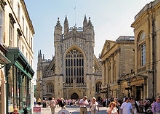
The Abbey Church of Saint Peter and Saint Paul, Bath, commonly known as Bath Abbey, is an Anglican parish church
and a former Benedictine
monastery
in Bath, Somerset
, England. Founded in the 7th century, Bath Abbey was reorganised in the 10th century and rebuilt in the 12th and 16th centuries; major restoration work
was carried out by Sir George Gilbert Scott
in the 1860s. It is one of the largest examples of Perpendicular Gothic architecture
in the West Country
.
The church is cruciform
in plan
, and is able to seat 1200. An active place of worship, with hundreds of congregation members and hundreds of thousands of visitors each year, it is used for religious services, secular civic ceremonies, concerts and lectures. The choir performs in the abbey and elsewhere. There is a heritage museum in the vaults.
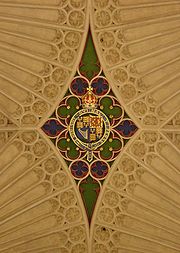
The abbey is a Grade I listed building, particularly noted for its fan vaulting ceiling. It contains war memorials for the local population and monuments to several notable people, in the form of wall and floor plaques and commemorative stained glass
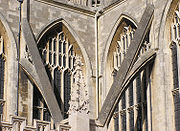
. The church has two organs and a peal of ten bells. The west front includes sculptures of angels climbing to heaven on two stone ladders.
 In 675 Osric, King of the Hwicce
, granted the Abbess Berta 100 hides
near Bath for the establishment of a convent
. This religious house became a monastery
under the patronage of the Bishop of Worcester
.
King
Offa
of Mercia
successfully wrested "that most famous monastery at Bath" from the bishop
in 781. William of Malmesbury
tells that Offa rebuilt the monastic church, which may have occupied the site of an earlier pagan
temple, to such a standard that King Eadwig was moved to describe it as being "marvellously built"; little is known about the architecture of this first building on the site. Monasticism
in England had declined by that time, but Eadwig's brother Edgar
(who was crowned "King of the English" at the abbey in 973) began its revival on his accession to the throne in 959. He encouraged monks to adopt the Rule of St Benedict
, which was introduced at Bath under Abbot Ælfheah (St. Alphege).
, John of Tours
, who became Bishop of Wells
and Abbot
of Bath. Shortly after his consecration John bought Bath Abbey's grounds from the king, as well as the city of Bath itself. Whether John paid Rufus for the city or whether he was given it as a gift by the king is unclear. The abbey had recently lost its abbot, Ælfsige, and according to Domesday Book
was the owner of large estates in and near the city; it was likely the abbey's wealth that attracted John to take over the monastery. By acquiring Bath, John also acquired the mint that was in the city. In 1090 he transferred the seat, or administration, of the bishopric to Bath Abbey, probably in an attempt to increase the revenues of his see. Bath was a rich abbey, and Wells had always been a poor diocese. By taking over the abbey, John increased his episcopal revenues. William of Malmesbury
portrays the moving of the episcopal seat as motivated by a desire for the lands of the abbey, but it was part of a pattern at the time of moving cathedral seats from small villages to larger towns. When John moved his episcopal seat, he also took over the abbey of Bath as his cathedral chapter
, turning his diocese into a bishopric served by monks instead of the canons
at Wells who had previously served the diocese. John rebuilt the monastic church at Bath, which had been damaged during one of Robert de Mowbray
's rebellions. Permission was given to move the see
of Somerset from Wells
– a comparatively small settlement – to the then walled
city
of Bath.
When this was effected in 1090, John became the first Bishop of Bath, and St Peter's was raised to cathedral
status. As the roles of bishop and abbot had been combined, the monastery became a priory
, run by its prior
. With the elevation of the abbey to cathedral status, it was felt that a larger, more up-to-date building was required. John of Tours planned a new cathedral on a grand scale, dedicated to Saint Peter
and Saint Paul, but only the ambulatory
was complete when he died in December 1122. He was buried in the cathedral. The most renowned scholar monk based in the abbey was Adelard of Bath
; after his various travels he was back in the monastery by 1106.
The half-finished cathedral was devastated by fire in 1137, but work continued under Godfrey
, the new bishop, until about 1156; the completed building was approximately 330 feet (101 m) long. There were 40 monks on the roll in 1206. Joint cathedral status was awarded by Pope Innocent IV
to Bath and Wells
in 1245. Roger of Salisbury
was appointed the first Bishop of Bath and Wells
, having been Bishop of Bath for a year previously. Later bishops preferred Wells, the canons of which had successfully petitioned various popes down the years for Wells to regain cathedral status. Bath Cathedral gradually fell into disrepair. In 1485 the priory had 22 monks. The existence of an ambulatory suggests a very large building, on a par with Durham Cathedral
.
When Oliver King
, Bishop of Bath and Wells 1495–1503, visited Bath in 1499 he was shocked to find this famous church in ruins. He also described lax discipline, idleness and a group of monks "all too eager to succumb to the temptations of the flesh". He took a year to consider what action to take, before writing to the Prior of Bath in October 1500 to explain that a large amount of the priory income would be dedicated to rebuilding the cathedral. Work probably began the following spring. Bishop King planned a smaller church, covering the area of the Norman nave only. He did not live to see the result, but the restoration of the cathedral was completed just a few years before the Dissolution of the Monasteries
in 1539. The new church is not a typical example of the Perpendicular form of Gothic architecture
; the low aisles and nave arcades
and the very tall clerestory present the opposite balance to that which was usual in perpendicular churches. As this building was to serve as a monastic church, it was built to a cruciform plan, which had become relatively rare in parish churches of the time. The interior contains fine fan vaulting by Robert
and William Vertue
, who designed similar vaulting for the Henry VII chapel, at Westminster Abbey
. The building has 52 windows, occupying about 80% of the wall space, giving the interior an impression of lightness, and reflecting the different attitudes towards churchmanship shown by the clergy of the time and those of the 12th century.
promoted the restoration of the church, to serve as the grand parish church of Bath. She ordered that a national fund should be set up to finance the work. James Montague, the Bishop of Bath and Wells from 1608–1616, paid £1,000 for a new nave roof of timber lath construction; according to the inscription on his tomb, this was prompted after seeking shelter in the roofless nave during a thunderstorm. He is buried in an alabaster
tomb in the north aisle.
was carried out by Sir George Gilbert Scott
in the 1860s, funded by the rector, Charles Kemble. The work included the installation of fan vaulting in the nave, which was not merely a fanciful aesthetic addition but a completion of the original design. Bishop King had arranged for the vaulting of the choir, to a design by William and Robert Vertue. There are clues in the stonework that King intended the vaulting to continue into the nave, but that this plan was abandoned, probably for reasons of cost. Work carried out in the 20th and 21st centuries included a full cleaning of the stonework and the reconstruction of the pipe organ
by Klais Orgelbau of Bonn
.
 The cruciform abbey is built of Bath Stone
, which gives the exterior its yellow colour. It is not a typical example of the Perpendicular form of Gothic architecture
with low aisles and nave arcades
and a tall clerestory
. The walls and roofs are supported by buttress
es and surmounted by battlement
s, pinnacle
s and pierced parapet
s, many of which were added by George Manners during his 1830's restorations.
The nave
, which has five bays, is 211 feet (64.3 m) long and 35 feet (10.7 m) wide to the pillars and rises to 75 feet (22.9 m), with the whole church being 225 feet (68.6 m) long and 80 feet (24.4 m) wide.
The west front, which was originally constructed in 1520, has a large arched window and detailed carvings. Above the window are carvings of angels and to either side long stone ladders with angels climbing up them. Below the window a battlemented parapet supports a statue and beneath this, on either side of the door, are statues of St Peter and St Paul. Restoration work in the late 20th century involved cleaning with electronically controlled intermittent water sprays and ammonium carbonate poultices. One of the figures which had lost its head and shoulders was replaced. The sculptures on the West front have been interpreted as representing "spiritual ascent through the virtue of humility and descent through the vice of pride" and Christ as the Man of Sorrow and the Antichrist. During the 1990s a major restoration and cleaning work were carried out on the exterior stonework, returning it to the yellow colour hidden under centuries of dirt.
in 1872, and was presented to the church by the Bath Literary Club.
The window of the Four Evangelists
over the northwest door is a memorial to Charles Empson, who died in 1861.
In 2010 a stained glass window was uncovered in the abbey vaults. The design around the window is by William Burges
.
of ten bells
, which are – unusually – hung so that the order of the bells from highest to lowest runs anti-clockwise around the ringing chamber. The tenor weighs 33 cwt (3,721 lb or 1,688 kg). Bath is a noted centre of change ringing
in the West Country.
and William Vertue
, was restored by Sir George Gilbert Scott
between 1864 and 1874. The fan vaulting provides structural stability by distributing the weight of the roof down ribs that transfer the force into the supporting columns via the flying buttress
es.
Scott's work in the 1870s included the installation of large gas chandeliers made by the Coventry metalworker Francis Skidmore
. They were converted to electricity in 1979. Other new features included a new pulpit and seating. A marble altarpiece from General George Wade
in the sanctuary was removed and replaced with a decorative reredos
.
In the 1920s Thomas Graham Jackson
redesigned the Norman Chapel into a War Memorial Chapel, now Gethsemane Chapel, and added a cloister
. New quire screens were installed in 2004, partly to improve the acoustics, topped with 12 carved angels playing musical instruments.
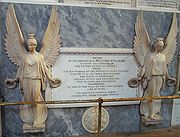 Within the abbey are 617 wall memorials and 847 floor stones. They include those dedicated to Beau Nash
, Admiral Arthur Phillip
(first Governor of the colony of New South Wales, which became part of Australia after federation in 1901), James Montague (Bishop of Bath and Wells), Lady Waller (wife of William Waller
, a Roundhead
military leader in the English Civil War
), Elizabeth Grieve (wife of James Grieve, physician to Elizabeth, Empress of Russia), Sir William Baker
, John Sibthorp
, Richard Hussey Bickerton, William Hoare
, Richard Bickerton and US Senator William Bingham
. Many of the monuments in the churchyard
were carved between 1770 and 1860 by Reeves of Bath
. War memorials include those commemorating the First Anglo-Afghan War
(1841–42), the First World War (1914–18), and the Second World War (1939–45). The most recent memorial was installed in 1958 to commemorate Isaac Pitman
, the developer of Pitman shorthand
, who died in 1897.
in 1836, then to St Mary's Church
, Yatton
, where it was subsequently rebuilt and extensively modified.
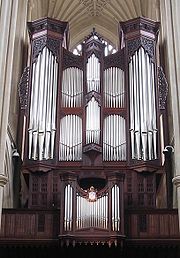 The abbey's next organ was built in 1836 by John Smith of Bristol
, to a specification of thirty stops over three manuals and pedals. This instrument was rebuilt on a new gallery in the North Transept
by William Hill & Son of London in 1868, to a specification of forty stops spread over four manuals and pedals, although the Solo department, which would have brought the total to well over forty, was not completed. It was mostly removed to the Church of St Peter & St Paul, Cromer
in 1896, the remainder being kept for incorporation in the new abbey organ.
A new organ was supplied to the abbey in 1895 by Norman and Beard
of Norwich
. It had 52 stops spread over four manuals and pedals, and stood divided on two steel beams in the North and South crossing
arches, with the console
standing on the floor next to the north-west pier
of the crossing. New cases were to be provided to designs by Brian Oliver of Bath, but were never executed. Norman & Beard re-erected it in a new case designed by Sir Thomas Jackson
in the North Transept in 1914, with the addition of two stops to the Pedal.
It was again rebuilt by them in 1930, and then by Hill, Norman and Beard in 1948, which brought the number of stops to 58. In 1972 this was increased to a total of 65 speaking stops. The Positive division, with its separate case behind the console
, was installed at the same time. Problems caused by the tonal scheme's lack of coherence – the 1895 pipework contrasting sharply with that of 1972 – and with reliability, caused by the wide variety of different types of key actions, all difficult to access, led to the decision to have the instrument rebuilt yet again.
The organ was totally reconstructed in 1997 by Klais Orgelbau of Bonn
, retaining the existing instrument as far as was possible and restoring it largely to its 1895 condition, although the Positive division was kept. The instrument as it now stands has 63 speaking stops over four manuals and pedals, and is built largely on the Werkprinzip principle of organ layout: the case is only one department deep, except for parts of the Pedal sited at the back rather than the sides of the case. New 75 percent tin front pipes were made and the case completed with back, side walls and roof. Pierced panelling executed by Derek Riley of Lyndale Woodcarving in Saxmundham
, Suffolk
, was provided to allow sound egress from the bottom of the case. The old console has been retained but thoroughly rebuilt with modern accessories and all-new manuals. Twenty-two of the organ's 83 ranks contain some pipework from the 1868 instrument. Four ranks are made up entirely of 1868 pipework, and 21 contain 1895 pipework. Only two ranks are entirely of 1895. Forty-eight ranks contain some new pipework, 34 of which are entirely new. Old wind pressures have been used wherever possible. The old wind reservoirs have also been restored rather than replaced. The instrument has tracker key action
on the manuals, with electrically assisted tracker action to the pedals. The stop action is electric throughout.
-based organ builder
Kenneth Tickell. The instrument, contained in a case of dark oak, is portable, and can be tuned to three pitches
: A=440 Hz (modern concert pitch), A=415 Hz and A=486 Hz. A lever pedal can reduce the stops sounding to only the 8' stop and, when released, returns the organ to the registration in use before it was depressed.
on BBC Radio 3
, and has made several recordings. It performed at the Three Tenors
concert for the opening of the Thermae Bath Spa
. The abbey is also used as a venue for visiting choirs and, from its inception in 1947, the City of Bath Bach Choir
.
Parish church
A parish church , in Christianity, is the church which acts as the religious centre of a parish, the basic administrative unit of episcopal churches....
and a former Benedictine
Benedictine
Benedictine refers to the spirituality and consecrated life in accordance with the Rule of St Benedict, written by Benedict of Nursia in the sixth century for the cenobitic communities he founded in central Italy. The most notable of these is Monte Cassino, the first monastery founded by Benedict...
monastery
Monastery
Monastery denotes the building, or complex of buildings, that houses a room reserved for prayer as well as the domestic quarters and workplace of monastics, whether monks or nuns, and whether living in community or alone .Monasteries may vary greatly in size – a small dwelling accommodating only...
in Bath, Somerset
Somerset
The ceremonial and non-metropolitan county of Somerset in South West England borders Bristol and Gloucestershire to the north, Wiltshire to the east, Dorset to the south-east, and Devon to the south-west. It is partly bounded to the north and west by the Bristol Channel and the estuary of the...
, England. Founded in the 7th century, Bath Abbey was reorganised in the 10th century and rebuilt in the 12th and 16th centuries; major restoration work
Victorian restoration
Victorian restoration is the term commonly used to refer to the widespread and extensive refurbishment and rebuilding of Church of England churches and cathedrals that took place in England and Wales during the 19th-century reign of Queen Victoria...
was carried out by Sir George Gilbert Scott
George Gilbert Scott
Sir George Gilbert Scott was an English architect of the Victorian Age, chiefly associated with the design, building and renovation of churches, cathedrals and workhouses...
in the 1860s. It is one of the largest examples of Perpendicular Gothic architecture
Gothic architecture
Gothic architecture is a style of architecture that flourished during the high and late medieval period. It evolved from Romanesque architecture and was succeeded by Renaissance architecture....
in the West Country
West Country
The West Country is an informal term for the area of south western England roughly corresponding to the modern South West England government region. It is often defined to encompass the historic counties of Cornwall, Devon, Dorset and Somerset and the City of Bristol, while the counties of...
.
The church is cruciform
Cruciform
Cruciform means having the shape of a cross or Christian cross.- Cruciform architectural plan :This is a common description of Christian churches. In Early Christian, Byzantine and other Eastern Orthodox forms of church architecture this is more likely to mean a tetraconch plan, a Greek cross,...
in plan
Floor plan
In architecture and building engineering, a floor plan, or floorplan, is a diagram, usually to scale, showing a view from above of the relationships between rooms, spaces and other physical features at one level of a structure....
, and is able to seat 1200. An active place of worship, with hundreds of congregation members and hundreds of thousands of visitors each year, it is used for religious services, secular civic ceremonies, concerts and lectures. The choir performs in the abbey and elsewhere. There is a heritage museum in the vaults.
The abbey is a Grade I listed building, particularly noted for its fan vaulting ceiling. It contains war memorials for the local population and monuments to several notable people, in the form of wall and floor plaques and commemorative stained glass
Stained glass
The term stained glass can refer to coloured glass as a material or to works produced from it. Throughout its thousand-year history, the term has been applied almost exclusively to the windows of churches and other significant buildings...
. The church has two organs and a peal of ten bells. The west front includes sculptures of angels climbing to heaven on two stone ladders.
Early history
Hwicce
The Hwicce were one of the peoples of Anglo-Saxon England. The exact boundaries of their kingdom are uncertain, though it is likely that they coincided with those of the old Diocese of Worcester, founded in 679–80, the early bishops of which bore the title Episcopus Hwicciorum...
, granted the Abbess Berta 100 hides
Hide (unit)
The hide was originally an amount of land sufficient to support a household, but later in Anglo-Saxon England became a unit used in assessing land for liability to "geld", or land tax. The geld would be collected at a stated rate per hide...
near Bath for the establishment of a convent
Convent
A convent is either a community of priests, religious brothers, religious sisters, or nuns, or the building used by the community, particularly in the Roman Catholic Church and in the Anglican Communion...
. This religious house became a monastery
Monastery
Monastery denotes the building, or complex of buildings, that houses a room reserved for prayer as well as the domestic quarters and workplace of monastics, whether monks or nuns, and whether living in community or alone .Monasteries may vary greatly in size – a small dwelling accommodating only...
under the patronage of the Bishop of Worcester
Bishop of Worcester
The Bishop of Worcester is the Ordinary of the Church of England Diocese of Worcester in the Province of Canterbury, England. He is the head of the Diocese of Worcester in the Province of Canterbury...
.
King
Monarch
A monarch is the person who heads a monarchy. This is a form of government in which a state or polity is ruled or controlled by an individual who typically inherits the throne by birth and occasionally rules for life or until abdication...
Offa
Offa of Mercia
Offa was the King of Mercia from 757 until his death in July 796. The son of Thingfrith and a descendant of Eowa, Offa came to the throne after a period of civil war following the assassination of Æthelbald after defeating the other claimant Beornred. In the early years of Offa's reign it is likely...
of Mercia
Mercia
Mercia was one of the kingdoms of the Anglo-Saxon Heptarchy. It was centred on the valley of the River Trent and its tributaries in the region now known as the English Midlands...
successfully wrested "that most famous monastery at Bath" from the bishop
Bishop
A bishop is an ordained or consecrated member of the Christian clergy who is generally entrusted with a position of authority and oversight. Within the Catholic Church, Eastern Orthodox, Oriental Orthodox Churches, in the Assyrian Church of the East, in the Independent Catholic Churches, and in the...
in 781. William of Malmesbury
William of Malmesbury
William of Malmesbury was the foremost English historian of the 12th century. C. Warren Hollister so ranks him among the most talented generation of writers of history since Bede, "a gifted historical scholar and an omnivorous reader, impressively well versed in the literature of classical,...
tells that Offa rebuilt the monastic church, which may have occupied the site of an earlier pagan
Paganism
Paganism is a blanket term, typically used to refer to non-Abrahamic, indigenous polytheistic religious traditions....
temple, to such a standard that King Eadwig was moved to describe it as being "marvellously built"; little is known about the architecture of this first building on the site. Monasticism
Monasticism
Monasticism is a religious way of life characterized by the practice of renouncing worldly pursuits to fully devote one's self to spiritual work...
in England had declined by that time, but Eadwig's brother Edgar
Edgar of England
Edgar the Peaceful, or Edgar I , also called the Peaceable, was a king of England . Edgar was the younger son of Edmund I of England.-Accession:...
(who was crowned "King of the English" at the abbey in 973) began its revival on his accession to the throne in 959. He encouraged monks to adopt the Rule of St Benedict
Rule of St Benedict
The Rule of Saint Benedict is a book of precepts written by St. Benedict of Nursia for monks living communally under the authority of an abbot. Since about the 7th century it has also been adopted by communities of women...
, which was introduced at Bath under Abbot Ælfheah (St. Alphege).
Norman Conquest to the Dissolution
Bath was ravaged in the power struggle between the sons of William the Conqueror following his death in 1087. The victor, William Rufus, granted the city to a royal physicianPhysician
A physician is a health care provider who practices the profession of medicine, which is concerned with promoting, maintaining or restoring human health through the study, diagnosis, and treatment of disease, injury and other physical and mental impairments...
, John of Tours
John of Tours
John of Tours was a medieval Bishop of Wells in England who moved the diocese seat to Bath. He was a native of Tours and was King William I of England's doctor before becoming a bishop...
, who became Bishop of Wells
Wells
Wells is a cathedral city and civil parish in the Mendip district of Somerset, England, on the southern edge of the Mendip Hills. Although the population recorded in the 2001 census is 10,406, it has had city status since 1205...
and Abbot
Abbot
The word abbot, meaning father, is a title given to the head of a monastery in various traditions, including Christianity. The office may also be given as an honorary title to a clergyman who is not actually the head of a monastery...
of Bath. Shortly after his consecration John bought Bath Abbey's grounds from the king, as well as the city of Bath itself. Whether John paid Rufus for the city or whether he was given it as a gift by the king is unclear. The abbey had recently lost its abbot, Ælfsige, and according to Domesday Book
Domesday Book
Domesday Book , now held at The National Archives, Kew, Richmond upon Thames in South West London, is the record of the great survey of much of England and parts of Wales completed in 1086...
was the owner of large estates in and near the city; it was likely the abbey's wealth that attracted John to take over the monastery. By acquiring Bath, John also acquired the mint that was in the city. In 1090 he transferred the seat, or administration, of the bishopric to Bath Abbey, probably in an attempt to increase the revenues of his see. Bath was a rich abbey, and Wells had always been a poor diocese. By taking over the abbey, John increased his episcopal revenues. William of Malmesbury
William of Malmesbury
William of Malmesbury was the foremost English historian of the 12th century. C. Warren Hollister so ranks him among the most talented generation of writers of history since Bede, "a gifted historical scholar and an omnivorous reader, impressively well versed in the literature of classical,...
portrays the moving of the episcopal seat as motivated by a desire for the lands of the abbey, but it was part of a pattern at the time of moving cathedral seats from small villages to larger towns. When John moved his episcopal seat, he also took over the abbey of Bath as his cathedral chapter
Cathedral chapter
In accordance with canon law, a cathedral chapter is a college of clerics formed to advise a bishop and, in the case of a vacancy of the episcopal see in some countries, to govern the diocese in his stead. These councils are made up of canons and dignitaries; in the Roman Catholic church their...
, turning his diocese into a bishopric served by monks instead of the canons
Canon (priest)
A canon is a priest or minister who is a member of certain bodies of the Christian clergy subject to an ecclesiastical rule ....
at Wells who had previously served the diocese. John rebuilt the monastic church at Bath, which had been damaged during one of Robert de Mowbray
Robert de Mowbray
Robert de Mowbray , a Norman, was Earl of Northumbria from 1086, until 1095, when he was deposed for rebelling against William Rufus, King of England. He was the son of Roger de Mowbray and nephew of Geoffrey de Montbray, bishop of Coutances...
's rebellions. Permission was given to move the see
Episcopal See
An episcopal see is, in the original sense, the official seat of a bishop. This seat, which is also referred to as the bishop's cathedra, is placed in the bishop's principal church, which is therefore called the bishop's cathedral...
of Somerset from Wells
Wells Cathedral
Wells Cathedral is a Church of England cathedral in Wells, Somerset, England. It is the seat of the Bishop of Bath and Wells, who lives at the adjacent Bishop's Palace....
– a comparatively small settlement – to the then walled
Defensive wall
A defensive wall is a fortification used to protect a city or settlement from potential aggressors. In ancient to modern times, they were used to enclose settlements...
city
City
A city is a relatively large and permanent settlement. Although there is no agreement on how a city is distinguished from a town within general English language meanings, many cities have a particular administrative, legal, or historical status based on local law.For example, in the U.S...
of Bath.
When this was effected in 1090, John became the first Bishop of Bath, and St Peter's was raised to cathedral
Cathedral
A cathedral is a Christian church that contains the seat of a bishop...
status. As the roles of bishop and abbot had been combined, the monastery became a priory
Priory
A priory is a house of men or women under religious vows that is headed by a prior or prioress. Priories may be houses of mendicant friars or religious sisters , or monasteries of monks or nuns .The Benedictines and their offshoots , the Premonstratensians, and the...
, run by its prior
Prior
Prior is an ecclesiastical title, derived from the Latin adjective for 'earlier, first', with several notable uses.-Monastic superiors:A Prior is a monastic superior, usually lower in rank than an Abbot. In the Rule of St...
. With the elevation of the abbey to cathedral status, it was felt that a larger, more up-to-date building was required. John of Tours planned a new cathedral on a grand scale, dedicated to Saint Peter
Saint Peter
Saint Peter or Simon Peter was an early Christian leader, who is featured prominently in the New Testament Gospels and the Acts of the Apostles. The son of John or of Jonah and from the village of Bethsaida in the province of Galilee, his brother Andrew was also an apostle...
and Saint Paul, but only the ambulatory
Ambulatory
The ambulatory is the covered passage around a cloister. The term is sometimes applied to the procession way around the east end of a cathedral or large church and behind the high altar....
was complete when he died in December 1122. He was buried in the cathedral. The most renowned scholar monk based in the abbey was Adelard of Bath
Adelard of Bath
Adelard of Bath was a 12th century English scholar. He is known both for his original works and for translating many important Greek and Arabic scientific works of astrology, astronomy, philosophy and mathematics into Latin from Arabic versions, which were then introduced to Western Europe...
; after his various travels he was back in the monastery by 1106.
The half-finished cathedral was devastated by fire in 1137, but work continued under Godfrey
Godfrey of Bath
-Life:Godfrey was a native of Leuven and was chaplain to Adeliza of Leuven, second wife of King Henry I of England before and after her marriage to the king. He came with her to England when she married Henry I....
, the new bishop, until about 1156; the completed building was approximately 330 feet (101 m) long. There were 40 monks on the roll in 1206. Joint cathedral status was awarded by Pope Innocent IV
Pope Innocent IV
Pope Innocent IV , born Sinibaldo Fieschi, was pope from June 25, 1243 until his death in 1254.-Early life:...
to Bath and Wells
Diocese of Bath and Wells
The Diocese of Bath and Wells is a diocese in the Church of England Province of Canterbury in England.The diocese covers the county of Somerset and a small area of Dorset. The Episcopal seat of the Bishop of Bath and Wells is located in the Cathedral Church of Saint Andrew in the tiny city of...
in 1245. Roger of Salisbury
Roger of Salisbury, bishop of Bath and Wells
Roger of Salisbury was a Bishop of Bath and Wells.-Life:Roger was a canon of Salisbury by 3 July 1223 and was a theology lecturer at Salisbury by 30 September 1225. In late 1226 or early 1227 he acquired the prebend of Netheravon in the diocese of Salisbury...
was appointed the first Bishop of Bath and Wells
Bishop of Bath and Wells
The Bishop of Bath and Wells heads the Church of England Diocese of Bath and Wells in the Province of Canterbury in England.The present diocese covers the vast majority of the county of Somerset and a small area of Dorset. The Episcopal seat is located in the Cathedral Church of Saint Andrew in...
, having been Bishop of Bath for a year previously. Later bishops preferred Wells, the canons of which had successfully petitioned various popes down the years for Wells to regain cathedral status. Bath Cathedral gradually fell into disrepair. In 1485 the priory had 22 monks. The existence of an ambulatory suggests a very large building, on a par with Durham Cathedral
Durham Cathedral
The Cathedral Church of Christ, Blessed Mary the Virgin and St Cuthbert of Durham is a cathedral in the city of Durham, England, the seat of the Anglican Bishop of Durham. The Bishopric dates from 995, with the present cathedral being founded in AD 1093...
.
When Oliver King
Oliver King
Oliver King was a Bishop of Exeter and Bishop of Bath and Wells who restored Bath Abbey after 1500.-Life:Educated at Eton and King's College, Cambridge, King became a priest and was appointed Bishop of Exeter on 1 October 1492, consecrated on 3 February 1493. He was then translated to the see of...
, Bishop of Bath and Wells 1495–1503, visited Bath in 1499 he was shocked to find this famous church in ruins. He also described lax discipline, idleness and a group of monks "all too eager to succumb to the temptations of the flesh". He took a year to consider what action to take, before writing to the Prior of Bath in October 1500 to explain that a large amount of the priory income would be dedicated to rebuilding the cathedral. Work probably began the following spring. Bishop King planned a smaller church, covering the area of the Norman nave only. He did not live to see the result, but the restoration of the cathedral was completed just a few years before the Dissolution of the Monasteries
Dissolution of the Monasteries
The Dissolution of the Monasteries, sometimes referred to as the Suppression of the Monasteries, was the set of administrative and legal processes between 1536 and 1541 by which Henry VIII disbanded monasteries, priories, convents and friaries in England, Wales and Ireland; appropriated their...
in 1539. The new church is not a typical example of the Perpendicular form of Gothic architecture
Gothic architecture
Gothic architecture is a style of architecture that flourished during the high and late medieval period. It evolved from Romanesque architecture and was succeeded by Renaissance architecture....
; the low aisles and nave arcades
Arcade (architecture)
An arcade is a succession of arches, each counterthrusting the next, supported by columns or piers or a covered walk enclosed by a line of such arches on one or both sides. In warmer or wet climates, exterior arcades provide shelter for pedestrians....
and the very tall clerestory present the opposite balance to that which was usual in perpendicular churches. As this building was to serve as a monastic church, it was built to a cruciform plan, which had become relatively rare in parish churches of the time. The interior contains fine fan vaulting by Robert
Robert Vertue
Robert Vertue was an English architect and master mason.He worked as a mason on the nave of Westminster Abbey between 1475 and 1490, and then as the master mason for Henry VII's riverside north range of Greenwich Palace, built in 1500–04 and a work at the Tower of London.Along with his brother...
and William Vertue
William Vertue
William Vertue was an English architect specialising in Fan vault ceilings.Along with his brother Robert he was involved in the construction of the Tower of London , Bath Abbey, the Vertue brothers are reported as telling Bishop Oliver King the patron of the work that the vaulting "Ther shal be...
, who designed similar vaulting for the Henry VII chapel, at Westminster Abbey
Westminster Abbey
The Collegiate Church of St Peter at Westminster, popularly known as Westminster Abbey, is a large, mainly Gothic church, in the City of Westminster, London, United Kingdom, located just to the west of the Palace of Westminster. It is the traditional place of coronation and burial site for English,...
. The building has 52 windows, occupying about 80% of the wall space, giving the interior an impression of lightness, and reflecting the different attitudes towards churchmanship shown by the clergy of the time and those of the 12th century.
Reformation and subsequent decline
Prior Holloway surrendered Bath Priory to the crown in January 1539. The church was stripped of lead, iron and glass and left to decay. In 1574, Queen Elizabeth IElizabeth I of England
Elizabeth I was queen regnant of England and Ireland from 17 November 1558 until her death. Sometimes called The Virgin Queen, Gloriana, or Good Queen Bess, Elizabeth was the fifth and last monarch of the Tudor dynasty...
promoted the restoration of the church, to serve as the grand parish church of Bath. She ordered that a national fund should be set up to finance the work. James Montague, the Bishop of Bath and Wells from 1608–1616, paid £1,000 for a new nave roof of timber lath construction; according to the inscription on his tomb, this was prompted after seeking shelter in the roofless nave during a thunderstorm. He is buried in an alabaster
Alabaster
Alabaster is a name applied to varieties of two distinct minerals, when used as a material: gypsum and calcite . The former is the alabaster of the present day; generally, the latter is the alabaster of the ancients...
tomb in the north aisle.
Modern renaissance
Major restoration workVictorian restoration
Victorian restoration is the term commonly used to refer to the widespread and extensive refurbishment and rebuilding of Church of England churches and cathedrals that took place in England and Wales during the 19th-century reign of Queen Victoria...
was carried out by Sir George Gilbert Scott
George Gilbert Scott
Sir George Gilbert Scott was an English architect of the Victorian Age, chiefly associated with the design, building and renovation of churches, cathedrals and workhouses...
in the 1860s, funded by the rector, Charles Kemble. The work included the installation of fan vaulting in the nave, which was not merely a fanciful aesthetic addition but a completion of the original design. Bishop King had arranged for the vaulting of the choir, to a design by William and Robert Vertue. There are clues in the stonework that King intended the vaulting to continue into the nave, but that this plan was abandoned, probably for reasons of cost. Work carried out in the 20th and 21st centuries included a full cleaning of the stonework and the reconstruction of the pipe organ
Pipe organ
The pipe organ is a musical instrument that produces sound by driving pressurized air through pipes selected via a keyboard. Because each organ pipe produces a single pitch, the pipes are provided in sets called ranks, each of which has a common timbre and volume throughout the keyboard compass...
by Klais Orgelbau of Bonn
Bonn
Bonn is the 19th largest city in Germany. Located in the Cologne/Bonn Region, about 25 kilometres south of Cologne on the river Rhine in the State of North Rhine-Westphalia, it was the capital of West Germany from 1949 to 1990 and the official seat of government of united Germany from 1990 to 1999....
.
Architecture
Bath Stone
Bath Stone is an Oolitic Limestone comprising granular fragments of calcium carbonate. Originally obtained from the Combe Down and Bathampton Down Mines under Combe Down, Somerset, England, its warm, honey colouring gives the World Heritage City of Bath, England its distinctive appearance...
, which gives the exterior its yellow colour. It is not a typical example of the Perpendicular form of Gothic architecture
Gothic architecture
Gothic architecture is a style of architecture that flourished during the high and late medieval period. It evolved from Romanesque architecture and was succeeded by Renaissance architecture....
with low aisles and nave arcades
Arcade (architecture)
An arcade is a succession of arches, each counterthrusting the next, supported by columns or piers or a covered walk enclosed by a line of such arches on one or both sides. In warmer or wet climates, exterior arcades provide shelter for pedestrians....
and a tall clerestory
Clerestory
Clerestory is an architectural term that historically denoted an upper level of a Roman basilica or of the nave of a Romanesque or Gothic church, the walls of which rise above the rooflines of the lower aisles and are pierced with windows. In modern usage, clerestory refers to any high windows...
. The walls and roofs are supported by buttress
Buttress
A buttress is an architectural structure built against or projecting from a wall which serves to support or reinforce the wall...
es and surmounted by battlement
Battlement
A battlement in defensive architecture, such as that of city walls or castles, comprises a parapet , in which portions have been cut out at intervals to allow the discharge of arrows or other missiles. These cut-out portions form crenels...
s, pinnacle
Pinnacle
A pinnacle is an architectural ornament originally forming the cap or crown of a buttress or small turret, but afterwards used on parapets at the corners of towers and in many other situations. The pinnacle looks like a small spire...
s and pierced parapet
Parapet
A parapet is a wall-like barrier at the edge of a roof, terrace, balcony or other structure. Where extending above a roof, it may simply be the portion of an exterior wall that continues above the line of the roof surface, or may be a continuation of a vertical feature beneath the roof such as a...
s, many of which were added by George Manners during his 1830's restorations.
The nave
Nave
In Romanesque and Gothic Christian abbey, cathedral basilica and church architecture, the nave is the central approach to the high altar, the main body of the church. "Nave" was probably suggested by the keel shape of its vaulting...
, which has five bays, is 211 feet (64.3 m) long and 35 feet (10.7 m) wide to the pillars and rises to 75 feet (22.9 m), with the whole church being 225 feet (68.6 m) long and 80 feet (24.4 m) wide.
The west front, which was originally constructed in 1520, has a large arched window and detailed carvings. Above the window are carvings of angels and to either side long stone ladders with angels climbing up them. Below the window a battlemented parapet supports a statue and beneath this, on either side of the door, are statues of St Peter and St Paul. Restoration work in the late 20th century involved cleaning with electronically controlled intermittent water sprays and ammonium carbonate poultices. One of the figures which had lost its head and shoulders was replaced. The sculptures on the West front have been interpreted as representing "spiritual ascent through the virtue of humility and descent through the vice of pride" and Christ as the Man of Sorrow and the Antichrist. During the 1990s a major restoration and cleaning work were carried out on the exterior stonework, returning it to the yellow colour hidden under centuries of dirt.
Windows
The building has 52 windows, occupying about 80 percent of the wall space. The east end has a square-framed window of seven lights. It includes a depiction of the nativity made by Clayton and BellClayton and Bell
Clayton and Bell was one of the most prolific and proficient workshops of English stained glass during the latter half of the 19th century. The partners were John Richard Clayton and Alfred Bell . The company was founded in 1855 and continued until 1993...
in 1872, and was presented to the church by the Bath Literary Club.
The window of the Four Evangelists
Four Evangelists
In Christian tradition the Four Evangelists are Matthew, Mark, Luke, and John, the authors attributed with the creation of the four Gospel accounts in the New Testament that bear the following titles:*Gospel according to Matthew*Gospel according to Mark...
over the northwest door is a memorial to Charles Empson, who died in 1861.
In 2010 a stained glass window was uncovered in the abbey vaults. The design around the window is by William Burges
William Burges (architect)
William Burges was an English architect and designer. Amongst the greatest of the Victorian art-architects, Burges sought in his work an escape from 19th century industrialisation and a return to the values, architectural and social, of an imagined mediaeval England...
.
Tower
The two-stage central tower is not square but oblong in plan. It has two bell openings on each side and four polygonal turret pinnacles. The tower is 79 feet (24.1 m) high, and is accessed by a staircase of 212 steps.Bells
In 1700 the old ring of six bells was replaced by a new ring of eight. All but the tenor still survive. In 1770 two lighter bells were added to create the first ring of ten bells in the diocese. The tenor was recast in 1870. The abbey's tower is now home to a ringRing of bells
"Ring of bells" is a term most often applied to a set of bells hung in the English style, typically for change ringing...
of ten bells
Bell (instrument)
A bell is a simple sound-making device. The bell is a percussion instrument and an idiophone. Its form is usually a hollow, cup-shaped object, which resonates upon being struck...
, which are – unusually – hung so that the order of the bells from highest to lowest runs anti-clockwise around the ringing chamber. The tenor weighs 33 cwt (3,721 lb or 1,688 kg). Bath is a noted centre of change ringing
Change ringing
Change ringing is the art of ringing a set of tuned bells in a series of mathematical patterns called "changes". It differs from many other forms of campanology in that no attempt is made to produce a conventional melody....
in the West Country.
Interior
The interior fan vaulting ceiling, originally installed by RobertRobert Vertue
Robert Vertue was an English architect and master mason.He worked as a mason on the nave of Westminster Abbey between 1475 and 1490, and then as the master mason for Henry VII's riverside north range of Greenwich Palace, built in 1500–04 and a work at the Tower of London.Along with his brother...
and William Vertue
William Vertue
William Vertue was an English architect specialising in Fan vault ceilings.Along with his brother Robert he was involved in the construction of the Tower of London , Bath Abbey, the Vertue brothers are reported as telling Bishop Oliver King the patron of the work that the vaulting "Ther shal be...
, was restored by Sir George Gilbert Scott
George Gilbert Scott
Sir George Gilbert Scott was an English architect of the Victorian Age, chiefly associated with the design, building and renovation of churches, cathedrals and workhouses...
between 1864 and 1874. The fan vaulting provides structural stability by distributing the weight of the roof down ribs that transfer the force into the supporting columns via the flying buttress
Flying buttress
A flying buttress is a specific form of buttressing most strongly associated with Gothic church architecture. The purpose of any buttress is to resist the lateral forces pushing a wall outwards by redirecting them to the ground...
es.
Scott's work in the 1870s included the installation of large gas chandeliers made by the Coventry metalworker Francis Skidmore
Francis Skidmore
Francis Alfred Skidmore was a British metalworker best known for high profile commissions including the glass and metal roof of the Oxford University Museum of Natural History , the Hereford Cathedral choir screen and the Albert Memorial in London.Skidmore was heavily influenced by Gothic...
. They were converted to electricity in 1979. Other new features included a new pulpit and seating. A marble altarpiece from General George Wade
George Wade
Field Marshal George Wade served as a British military commander and Commander-in-Chief of the Forces.-Early career:Wade, born in Kilavally, Westmeath in Ireland, was commissioned into the Earl of Bath's Regiment in 1690 and served in Flanders in 1692, during the Nine Years War, earning a...
in the sanctuary was removed and replaced with a decorative reredos
Reredos
thumb|300px|right|An altar and reredos from [[St. Josaphat's Roman Catholic Church|St. Josaphat Catholic Church]] in [[Detroit]], [[Michigan]]. This would be called a [[retable]] in many other languages and countries....
.
In the 1920s Thomas Graham Jackson
Thomas Graham Jackson
Sir Thomas Graham Jackson, 1st Baronet RA was one of the most distinguished English architects of his generation...
redesigned the Norman Chapel into a War Memorial Chapel, now Gethsemane Chapel, and added a cloister
Cloister
A cloister is a rectangular open space surrounded by covered walks or open galleries, with open arcades on the inner side, running along the walls of buildings and forming a quadrangle or garth...
. New quire screens were installed in 2004, partly to improve the acoustics, topped with 12 carved angels playing musical instruments.
Monuments
Beau Nash
Beau Nash , born Richard Nash, was a celebrated dandy and leader of fashion in 18th-century Britain. He is best remembered as the Master of Ceremonies at the spa town of Bath.- Biography :...
, Admiral Arthur Phillip
Arthur Phillip
Admiral Arthur Phillip RN was a British admiral and colonial administrator. Phillip was appointed Governor of New South Wales, the first European colony on the Australian continent, and was the founder of the settlement which is now the city of Sydney.-Early life and naval career:Arthur Phillip...
(first Governor of the colony of New South Wales, which became part of Australia after federation in 1901), James Montague (Bishop of Bath and Wells), Lady Waller (wife of William Waller
William Waller
Sir William Waller was an English soldier during the English Civil War. He received his education at Magdalen Hall, Oxford, and served in the Venetian army and in the Thirty Years' War...
, a Roundhead
Roundhead
"Roundhead" was the nickname given to the supporters of the Parliament during the English Civil War. Also known as Parliamentarians, they fought against King Charles I and his supporters, the Cavaliers , who claimed absolute power and the divine right of kings...
military leader in the English Civil War
English Civil War
The English Civil War was a series of armed conflicts and political machinations between Parliamentarians and Royalists...
), Elizabeth Grieve (wife of James Grieve, physician to Elizabeth, Empress of Russia), Sir William Baker
Sir William Baker
Sir William Baker was an English businessman and politician.-References:*...
, John Sibthorp
John Sibthorp
John Sibthorp was an English botanist.He was born in Oxford, the youngest son of Dr Humphry Sibthorp , who from 1747 to 1784 was Sherardian professor of botany at the University of Oxford....
, Richard Hussey Bickerton, William Hoare
William Hoare
William Hoare of Bath RA was an English painter and printmaker, co-founder of the Royal Academy noted for his pastels....
, Richard Bickerton and US Senator William Bingham
William Bingham
William Bingham was an American statesman from Philadelphia, Pennsylvania. He was a delegate for Pennsylvania to the Continental Congress from 1786 to 1788 and served in the United States Senate from 1795 to 1801...
. Many of the monuments in the churchyard
Bath Abbey Cemetery
The Anglican Bath Abbey Cemetery, officially dedicated as the Cemetery of St Peter and St Paul , was laid out by noted cemetery designer and landscape architect John Claudius Loudon in 1843 on a picturesque hillside site overlooking Bath, Somerset, England...
were carved between 1770 and 1860 by Reeves of Bath
Reeves of Bath
Reeves was the most prominent firm of monumental masons in Bath, Somerset. They flourished from c. 1778 to the 1860s. They often signed their work with "Reeves," or occasionally "Reeves & Son of Bath" when commissioned outside of Bath. One memorial is in the Grade I-listed City of London church St...
. War memorials include those commemorating the First Anglo-Afghan War
First Anglo-Afghan War
The First Anglo-Afghan War was fought between British India and Afghanistan from 1839 to 1842. It was one of the first major conflicts during the Great Game, the 19th century competition for power and influence in Central Asia between the United Kingdom and Russia, and also marked one of the worst...
(1841–42), the First World War (1914–18), and the Second World War (1939–45). The most recent memorial was installed in 1958 to commemorate Isaac Pitman
Isaac Pitman
Sir Isaac Pitman , knighted in 1894, developed the most widely used system of shorthand, known now as Pitman shorthand. He first proposed this in Stenographic Soundhand in 1837. Pitman was a qualified teacher and taught at a private school he founded in Wotton-under-Edge...
, the developer of Pitman shorthand
Pitman Shorthand
Pitman shorthand is a system of shorthand for the English language developed by Englishman Sir Isaac Pitman , who first presented it in 1837. Like most systems of shorthand, it is a phonetic system; the symbols do not represent letters, but rather sounds, and words are, for the most part, written...
, who died in 1897.
Main organ
The first mention of an organ in the abbey dates to 1634, but nothing is known of that instrument. The first properly recorded organ in Bath Abbey was built by Abraham Jordan in 1708. It was modified in 1718 and 1739 by Jordan's son. The specification recorded in 1800 was one of twenty stops spread over three manuals. The compasses of the manuals were extended, one and a half octaves of pedals were added and the instrument renovated in 1802 by John Holland; further repairs were effected by Flight & Robson in 1826. This instrument was removed first to the Bishop's Palace at WellsBishop's Palace, Wells
The Bishop's Palace, Wells, Somerset, England, is adjacent to Wells Cathedral and has been the home of the Bishops of the Diocese of Bath and Wells for 800 years....
in 1836, then to St Mary's Church
Church of St Mary, Yatton
The Church of St Mary in central Yatton, Somerset, England is often called the 'Cathedral of the Moors' due to its size and grandeur in relation to the village...
, Yatton
Yatton
Yatton is a village and civil parish within the unitary authority of North Somerset, which falls within the ceremonial county of Somerset, England. It is located south-west of Bristol. Its population in 2001 was 9,176...
, where it was subsequently rebuilt and extensively modified.
Bristol
Bristol is a city, unitary authority area and ceremonial county in South West England, with an estimated population of 433,100 for the unitary authority in 2009, and a surrounding Larger Urban Zone with an estimated 1,070,000 residents in 2007...
, to a specification of thirty stops over three manuals and pedals. This instrument was rebuilt on a new gallery in the North Transept
Transept
For the periodical go to The Transept.A transept is a transverse section, of any building, which lies across the main body of the building. In Christian churches, a transept is an area set crosswise to the nave in a cruciform building in Romanesque and Gothic Christian church architecture...
by William Hill & Son of London in 1868, to a specification of forty stops spread over four manuals and pedals, although the Solo department, which would have brought the total to well over forty, was not completed. It was mostly removed to the Church of St Peter & St Paul, Cromer
Cromer
Cromer is a coastal town and civil parish in north Norfolk, England. The local government authority is North Norfolk District Council, whose headquarters is in Holt Road in the town. The town is situated 23 miles north of the county town, Norwich, and is 4 miles east of Sheringham...
in 1896, the remainder being kept for incorporation in the new abbey organ.
A new organ was supplied to the abbey in 1895 by Norman and Beard
Norman and Beard
Norman and Beard were a major pipe organ manufacturer originally based in Norfolk. They were founded in Diss in 1870 by E.W. Norman, but soon moved to Norwich to a building which still exists, and formerly had its own rail link. The company merged with Hills of London in 1916, moving its production...
of Norwich
Norwich
Norwich is a city in England. It is the regional administrative centre and county town of Norfolk. During the 11th century, Norwich was the largest city in England after London, and one of the most important places in the kingdom...
. It had 52 stops spread over four manuals and pedals, and stood divided on two steel beams in the North and South crossing
Crossing (architecture)
A crossing, in ecclesiastical architecture, is the junction of the four arms of a cruciform church.In a typically oriented church , the crossing gives access to the nave on the west, the transept arms on the north and south, and the choir on the east.The crossing is sometimes surmounted by a tower...
arches, with the console
Organ console
thumb|right|250px|The console of the [[Wanamaker Organ]] in the Macy's department store in [[Philadelphia]], featuring six manuals and colour-coded stop tabs....
standing on the floor next to the north-west pier
Pier (architecture)
In architecture, a pier is an upright support for a superstructure, such as an arch or bridge. Sections of wall between openings function as piers. The simplest cross section of the pier is square, or rectangular, although other shapes are also common, such as the richly articulated piers of Donato...
of the crossing. New cases were to be provided to designs by Brian Oliver of Bath, but were never executed. Norman & Beard re-erected it in a new case designed by Sir Thomas Jackson
Thomas Graham Jackson
Sir Thomas Graham Jackson, 1st Baronet RA was one of the most distinguished English architects of his generation...
in the North Transept in 1914, with the addition of two stops to the Pedal.
It was again rebuilt by them in 1930, and then by Hill, Norman and Beard in 1948, which brought the number of stops to 58. In 1972 this was increased to a total of 65 speaking stops. The Positive division, with its separate case behind the console
Organ console
thumb|right|250px|The console of the [[Wanamaker Organ]] in the Macy's department store in [[Philadelphia]], featuring six manuals and colour-coded stop tabs....
, was installed at the same time. Problems caused by the tonal scheme's lack of coherence – the 1895 pipework contrasting sharply with that of 1972 – and with reliability, caused by the wide variety of different types of key actions, all difficult to access, led to the decision to have the instrument rebuilt yet again.
The organ was totally reconstructed in 1997 by Klais Orgelbau of Bonn
Bonn
Bonn is the 19th largest city in Germany. Located in the Cologne/Bonn Region, about 25 kilometres south of Cologne on the river Rhine in the State of North Rhine-Westphalia, it was the capital of West Germany from 1949 to 1990 and the official seat of government of united Germany from 1990 to 1999....
, retaining the existing instrument as far as was possible and restoring it largely to its 1895 condition, although the Positive division was kept. The instrument as it now stands has 63 speaking stops over four manuals and pedals, and is built largely on the Werkprinzip principle of organ layout: the case is only one department deep, except for parts of the Pedal sited at the back rather than the sides of the case. New 75 percent tin front pipes were made and the case completed with back, side walls and roof. Pierced panelling executed by Derek Riley of Lyndale Woodcarving in Saxmundham
Saxmundham
Saxmundham is a small market town in Suffolk, England. It is set in the valley of the River Fromus, a tributary of the River Alde, approximately northeast of Ipswich and west of the coast at Sizewell. The town is bypassed by the A12 and is served by Saxmundham railway station on the East Suffolk...
, Suffolk
Suffolk
Suffolk is a non-metropolitan county of historic origin in East Anglia, England. It has borders with Norfolk to the north, Cambridgeshire to the west and Essex to the south. The North Sea lies to the east...
, was provided to allow sound egress from the bottom of the case. The old console has been retained but thoroughly rebuilt with modern accessories and all-new manuals. Twenty-two of the organ's 83 ranks contain some pipework from the 1868 instrument. Four ranks are made up entirely of 1868 pipework, and 21 contain 1895 pipework. Only two ranks are entirely of 1895. Forty-eight ranks contain some new pipework, 34 of which are entirely new. Old wind pressures have been used wherever possible. The old wind reservoirs have also been restored rather than replaced. The instrument has tracker key action
Tracker action
Tracker action is a term used in reference to pipe organs and steam calliopes to indicate a mechanical linkage between keys or pedals pressed by the organist and the valve that allows air to flow into pipe of the corresponding note...
on the manuals, with electrically assisted tracker action to the pedals. The stop action is electric throughout.
Continuo organ
A four-stop continuo organ was built for the abbey in 1999 by NorthamptonNorthampton
Northampton is a large market town and local government district in the East Midlands region of England. Situated about north-west of London and around south-east of Birmingham, Northampton lies on the River Nene and is the county town of Northamptonshire. The demonym of Northampton is...
-based organ builder
Organ builder
-Australia:* William Anderson * Australian Pipe Organs Pty Ltd* Robert Cecil Clifton * William Davidson* J.E. Dodd & Sons Gunstar Organ Works* Fincham & Hobday* Geo. Fincham & Son* Alfred Fuller * Peter D.G. Jewkes Pty Ltd...
Kenneth Tickell. The instrument, contained in a case of dark oak, is portable, and can be tuned to three pitches
Pitch (music)
Pitch is an auditory perceptual property that allows the ordering of sounds on a frequency-related scale.Pitches are compared as "higher" and "lower" in the sense associated with musical melodies,...
: A=440 Hz (modern concert pitch), A=415 Hz and A=486 Hz. A lever pedal can reduce the stops sounding to only the 8' stop and, when released, returns the organ to the registration in use before it was depressed.
Choir
The abbey has sections for boys, girls and men. As well as singing at the abbey, they also tour to cathedrals in the UK and Europe. The choir has broadcast Choral EvensongEvening Prayer (Anglican)
Evening Prayer is a liturgy in use in the Anglican Communion and celebrated in the late afternoon or evening...
on BBC Radio 3
BBC Radio 3
BBC Radio 3 is a national radio station operated by the BBC within the United Kingdom. Its output centres on classical music and opera, but jazz, world music, drama, culture and the arts also feature. The station is the world’s most significant commissioner of new music, and its New Generation...
, and has made several recordings. It performed at the Three Tenors
The Three Tenors
The Three Tenors is a name given to the Spanish singers Plácido Domingo and José Carreras and the Italian singer Luciano Pavarotti who sang in concert under this banner during the 1990s and early 2000s. The trio began their collaboration with a performance at the ancient Baths of Caracalla, in...
concert for the opening of the Thermae Bath Spa
Thermae Bath Spa
Thermae Bath Spa is a combination of the historic spa and a contemporary building in the city of Bath, England, and re-opened in 2006. Bath and North East Somerset council own the buildings, and, as decreed in a Royal Charter of 1590, are the guardians of the spring waters, which are the only...
. The abbey is also used as a venue for visiting choirs and, from its inception in 1947, the City of Bath Bach Choir
City of Bath Bach Choir
The City of Bath Bach Choir , based in Bath, Somerset, England, is a choir, founded in October 1946 by Cuthbert Bates, who was also a founding father of the Bath Bach Festival in 1950. The choir gave its inaugural concert in June 1947 in Bath Abbey, a performance of J. S. Bach's great Mass in B...
.
Heritage Vaults Museum
The Bath Abbey Heritage Vaults Museum is located in the restored 18th-century cellars, and features artifacts and exhibits about the abbey's history. Displays include the different buildings on the site and their uses, the abbey's impact on the community, the construction, architecture and sculptures of the buildings, artifacts and sculptures, and the role of the abbey in present times. The museum opened in 1994, but is currently closed for redevelopment.See also
- List of former cathedrals in the United Kingdom
- List of organists and assistant organists of Bath Abbey