
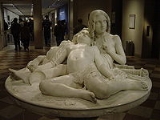
Marble sculpture is the
artArt is the product or process of deliberately arranging items in a way that influences and affects one or more of the senses, emotions, and intellect....
of creating three-dimensional forms from marble.
SculptureSculpture is three-dimensional artwork created by shaping or combining hard materials—typically stone such as marble—or metal, glass, or wood. Softer materials can also be used, such as clay, textiles, plastics, polymers and softer metals...
is among the oldest of the arts. Even before painting cave walls, early humans fashioned shapes from stone. From these beginnings, artifacts have evolved to their current complexity. The point at which they became art is for the beholder to decide.
Material origin and qualities
Marble is a metamorphic rock derived from limestone, composed mostly of calcite (a crystalline form of calcium carbonate, CaCO3). The original source of the parent limestone is the seabed deposition
calcium carbonateCalcium carbonate is a chemical compound with the formula CaCO3. It is a common substance found in rocks in all parts of the world, and is the main component of shells of marine organisms, snails, coal balls, pearls, and eggshells. Calcium carbonate is the active ingredient in agricultural lime,...
in the form of microscopic animal skeletons or similar materials. Marble is formed when the limestone is transformed by heat and pressure after being overlain by other materials. The finest marbles for sculpture have no or few stains (some natural stain can be seen in the sculpture shown at left, which the sculptor has skillfully incorporated into the sculpture).
Advantages
Among the commonly available stones only marble has a slight surface translucency that is comparable to that of human
skin-Dermis:The dermis is the layer of skin beneath the epidermis that consists of connective tissue and cushions the body from stress and strain. The dermis is tightly connected to the epidermis by a basement membrane. It also harbors many Mechanoreceptors that provide the sense of touch and heat...
. It is this translucency that gives a marble sculpture a visual depth beyond its surface and this evokes a certain realism when used for figurative works. Marble also has the advantage that when first quarried it is relatively soft and easy to work, refine, and polish. As the finished marble ages it becomes harder and more durable. Preference to the cheaper and less translucent
limestoneLimestone is a sedimentary rock composed largely of the minerals calcite and aragonite, which are different crystal forms of calcium carbonate . Many limestones are composed from skeletal fragments of marine organisms such as coral or foraminifera....
is based largely on the fineness of marble's grain, which enables the sculptor to render minute detail in a manner not always possible with limestone; it is also more weather resistant.
Disadvantages
Marble does not bear handling well as it will absorb skin oils when touched, which leads to yellow brownish staining. While more resistant than limestone it is subject to attack by weak acids, and so performs poorly in outdoor environments subject to
acid rainAcid rain is a rain or any other form of precipitation that is unusually acidic, meaning that it possesses elevated levels of hydrogen ions . It can have harmful effects on plants, aquatic animals, and infrastructure. Acid rain is caused by emissions of carbon dioxide, sulfur dioxide and nitrogen...
. For severe environments,
graniteGranite is a common and widely occurring type of intrusive, felsic, igneous rock. Granite usually has a medium- to coarse-grained texture. Occasionally some individual crystals are larger than the groundmass, in which case the texture is known as porphyritic. A granitic rock with a porphyritic...
is a more lasting material but one which is far more difficult to work and much less suitable for refined works. Compared to metals such as
bronzeBronze is a metal alloy consisting primarily of copper, usually with tin as the main additive. It is hard and brittle, and it was particularly significant in antiquity, so much so that the Bronze Age was named after the metal...
, marble lacks
ductilityIn materials science, ductility is a solid material's ability to deform under tensile stress; this is often characterized by the material's ability to be stretched into a wire. Malleability, a similar property, is a material's ability to deform under compressive stress; this is often characterized...
and strength, requiring special structural considerations when planning a sculpture. In the sculpture shown to the right, the figure can be placed upon slender lower legs and the balls of the feet only because the bending stress in the sculpture is taken through the flowing drapery of the skirt, which is founded upon an upthrust portion of the ground and with the feet forms a tripod-like foundation for the mass. For comparison see some of the examples in the article concerning
bronze sculptureBronze is the most popular metal for cast metal sculptures; a cast bronze sculpture is often called simply a "bronze".Common bronze alloys have the unusual and desirable property of expanding slightly just before they set, thus filling the finest details of a mold. Then, as the bronze cools, it...
(especially the sculpture
Jeté) for the ease with which
action and
extension may be expressed.
Developing a sculpture
The work begins with the selection of a stone for carving. The artist may carve in the direct way, by carving without a model. Or the sculptor may begin with a clearly defined model to be copied in stone. Frequently the sculptor would begin by forming a model in clay or wax, and then copying this in stone by measuring with calipers or a pointing machine. Some artists use the stone itself as inspiration; the Renaissance artist Michelangelo claimed that his job was to free the human form trapped inside the block.
When he or she is ready to carve, the carver usually begins by knocking off, or "pitching", large portions of unwanted stone. For this task he may select a point chisel, which is a long, hefty piece of steel with a point at one end and a broad striking surface at the other. A pitching tool may also be used at this early stage; which is a wedge-shaped chisel with a broad, flat edge. The pitching tool is useful for splitting the stone and removing large, unwanted chunks. The sculptor also selects a mallet, which is often a hammer with a broad, barrel-shaped head.
The carver places the point of the chisel or the edge of the pitching tool against a selected part of the stone, then swings the mallet at it with a controlled stroke. He must be careful to strike the end of the tool accurately; the smallest miscalculation can damage the stone, not to mention the sculptor’s hand. When the mallet connects to the tool, energy is transferred along the tool, shattering the stone. Most sculptors work rhythmically, turning the tool with each blow so that the stone is removed quickly and evenly. This is the “roughing out” stage of the sculpting process.
Once the general shape of the statue has been determined, the sculptor uses other tools to refine the figure. A toothed chisel or claw chisel has multiple gouging surfaces which create parallel lines in the stone. These tools are generally used to add texture to the figure. An artist might mark out specific lines by using calipers to measure an area of stone to be addressed, and marking the removal area with pencil, charcoal or chalk. The stone carver generally uses a shallower stroke at this point in the process.
Eventually the sculptor has changed the stone from a rough block into the general shape of the finished statue. Tools called
raspA rasp is a tool used for shaping wood or other material. It consists of a point or the tip, then a long steel bar or the belly, then the heel or bottom, then the tang. The tang is joined to a handle, usually made of plastic or wood. The bar has sharp teeth...
s and rifflers are then used to enhance the shape into its final form. A rasp is a flat, steel tool with a coarse surface. The sculptor uses broad, sweeping strokes to remove excess stone as small chips or dust. A riffler is a smaller variation of the rasp, which can be used to create details such as folds of clothing or locks of hair.
The final stage of the carving process is polishing. Sandpaper can be used as a first step in the polishing process, or sand cloth. Emery, a stone that is harder and rougher than the sculpture media, is also used in the finishing process. This abrading, or wearing away, brings out the color of the stone, reveals patterns in the surface and adds a sheen. Tin and iron oxides are often used to give the stone a highly reflective exterior.
Tools
The Italian terms for the basic carving tools of stone sculpture are given here, and where possible the English terms have been included.
- La Mazza - The mallet
A mallet is a kind of hammer, usually of rubber,or sometimes wood smaller than a maul or beetle and usually with a relatively large head.-Tools:Tool mallets come in different types, the most common of which are:...
. This is used to strike the chisel.
- Gli Scalpelli - The chisel
A chisel is a tool with a characteristically shaped cutting edge of blade on its end, for carving or cutting a hard material such as wood, stone, or metal. The handle and blade of some types of chisel are made of metal or wood with a sharp edge in it.In use, the chisel is forced into the material...
s. These come in various types:
- La Subbia - (the Point) a pointed chisel or punch
- L'Unghietto - (Round or Rondel Chisel) Literally, "little fingernail"
- La Gradina - (Toothed Chisel or Claw) a chisel with multiple teeth-
- Lo Scalpello - a flat chisel
- Lo Scapezzatore - (Pitcher or Pitching Tool) a hefty chisel with a broad blunt edge, for splitting.
- Il Martello Pneumatico - Pneumatic hammer
A jackhammer is a pneumatic tool that combines a hammer directly with a chisel that was invented by Charles Brady King. Hand-held jackhammers are typically powered by compressed air, but some use electric motors. Larger jackhammers, such as rig mounted hammers used on construction machinery, are...
- Il Flessibile - an angle grinder, fitted with an electrolysis
In chemistry and manufacturing, electrolysis is a method of using a direct electric current to drive an otherwise non-spontaneous chemical reaction...
-applied diamond studded blade
- Hand Drill
In addition to those hand tools listed above, the marble sculptor would use a variety of hammers - both for the striking of edge tools (chisels and hand drills) and for striking the stone directly (Bocciarda a Martello in Italian, Boucharde in French, Bush Hammer in English). Following the work of the hammer and chisel, the sculptor will sometimes refine the form further through the use of Rasps, Files and Abrasive Rubbing Stones and/or Sandpaper to smooth the surface contours of the form.
To achieve a high-lustre polish on marble a very fine abrasive,
tin oxideTin oxide may refer to:* Tin oxide , SnO* Tin dioxide , SnO2...
, is used following the use of
pumicePumice is a textural term for a volcanic rock that is a solidified frothy lava typically created when super-heated, highly pressurized rock is violently ejected from a volcano. It can be formed when lava and water are mixed. This unusual formation is due to the simultaneous actions of rapid...
or finer grits of
sandpaperSandpaper, also known as glasspaper, is a heavy paper with abrasive material attached to its surface.Sandpaper is part of the "coated abrasives" family of abrasive products. It is used to remove small amounts of material from surfaces, either to make them smoother , to remove a layer of material...
.
Tool technique
Hammer and point work is the technique used in working stone, in use at least since
RomanAncient Rome was a thriving civilization that grew on the Italian Peninsula as early as the 8th century BC. Located along the Mediterranean Sea and centered on the city of Rome, it expanded to one of the largest empires in the ancient world....
times, as it is described in the legend of
PygmalionPygmalion is a legendary figure of Cyprus. Though Pygmalion is the Greek version of the Phoenician royal name Pumayyaton, he is most familiar from Ovid's Metamorphoses, X, in which Pygmalion was a sculptor who fell in love with a statue he had carved.-In Ovid:In Ovid's narrative, Pygmalion was a...
, and even earlier, the ancient Greek sculptors used it from c. 650 BC. It consists of holding the pointed chisel against the stone and swinging the hammer at it as hard as possible. When the hammer connects with the striking end of the chisel, its energy is transferred down the length and concentrates on a single point on the surface of the block, breaking the stone. This is continued in a line following the desired contour. It may sound simple but many months are required to attain competency. A good stone worker can maintain a rhythm of relatively longer blows (about one per second), swinging the hammer in a wider arc, lifting the chisel between blows to flick out any chips that remain in the way, and repositioning it for the next blow. This way, one can drive the point deeper into the stone and remove more material at a time. Some stoneworkers also spin the subbia in their fingers between hammer blows, thus applying with each blow a different part of the point to the stone. This helps prevent the point from breaking.
See also
- List of sculptors
- Stone sculpture
Stone sculpture is the result of forming 3-dimensional visually interesting objects from stone.Carving stone into sculpture is an activity older than civilization itself, beginning perhaps with incised images on cave walls. Prehistoric sculptures were usually human forms, such as the Venus of...
- Marble
Marble is a metamorphic rock composed of recrystallized carbonate minerals, most commonly calcite or dolomite.Geologists use the term "marble" to refer to metamorphosed limestone; however stonemasons use the term more broadly to encompass unmetamorphosed limestone.Marble is commonly used for...
- Sculpture
Sculpture is three-dimensional artwork created by shaping or combining hard materials—typically stone such as marble—or metal, glass, or wood. Softer materials can also be used, such as clay, textiles, plastics, polymers and softer metals...
- Topic outline of sculpture
A few well known marble sculptures

- Elgin Marbles
The Parthenon Marbles, forming a part of the collection known as the Elgin Marbles , are a collection of classical Greek marble sculptures , inscriptions and architectural members that originally were part of the Parthenon and other buildings on the Acropolis of Athens...
, in the British MuseumThe British Museum is a museum of human history and culture in London. Its collections, which number more than seven million objects, are amongst the largest and most comprehensive in the world and originate from all continents, illustrating and documenting the story of human culture from its...
, LondonLondon is the capital city of :England and the :United Kingdom, the largest metropolitan area in the United Kingdom, and the largest urban zone in the European Union by most measures. Located on the River Thames, London has been a major settlement for two millennia, its history going back to its...
- Aphrodite of Milos
Aphrodite of Milos , better known as the Venus de Milo, is an ancient Greek statue and one of the most famous works of ancient Greek sculpture. Created at some time between 130 and 100 BC, it is believed to depict Aphrodite the Greek goddess of love and beauty. It is a marble sculpture, slightly...
, (Venus de Milo) in the LouvreThe Musée du Louvre – in English, the Louvre Museum or simply the Louvre – is one of the world's largest museums, the most visited art museum in the world and a historic monument. A central landmark of Paris, it is located on the Right Bank of the Seine in the 1st arrondissement...
, ParisParis is the capital and largest city in France, situated on the river Seine, in northern France, at the heart of the Île-de-France region...
- David by Michelangelo
Michelangelo di Lodovico Buonarroti Simoni , commonly known as Michelangelo, was an Italian Renaissance painter, sculptor, architect, poet, and engineer who exerted an unparalleled influence on the development of Western art...
, in FlorenceFlorence is the capital city of the Italian region of Tuscany and of the province of Florence. It is the most populous city in Tuscany, with approximately 370,000 inhabitants, expanding to over 1.5 million in the metropolitan area....
- Laocoön and his Sons
The statue of Laocoön and His Sons , also called the Laocoön Group, is a monumental sculpture in marble now in the Vatican Museums, Rome. The statue is attributed by the Roman author Pliny the Elder to three sculptors from the island of Rhodes: Agesander, Athenodoros and Polydorus...
by Agesander, in the Vatican MuseumsThe Vatican Museums , in Viale Vaticano in Rome, inside the Vatican City, are among the greatest museums in the world, since they display works from the immense collection built up by the Roman Catholic Church throughout the centuries, including some of the most renowned classical sculptures and...
, Vatican CityVatican City , or Vatican City State, in Italian officially Stato della Città del Vaticano , which translates literally as State of the City of the Vatican, is a landlocked sovereign city-state whose territory consists of a walled enclave within the city of Rome, Italy. It has an area of...
- Moses by Michelangelo, in Rome
Rome is the capital of Italy and the country's largest and most populated city and comune, with over 2.7 million residents in . The city is located in the central-western portion of the Italian Peninsula, on the Tiber River within the Lazio region of Italy.Rome's history spans two and a half...
- Pietà
The Pietà is a masterpiece of Renaissance sculpture by Michelangelo Buonarroti, housed in St. Peter's Basilica in Vatican City. It is the first of a number of works of the same theme by the artist. The statue was commissioned for the French cardinal Jean de Billheres, who was a representative in...
by Michelangelo, in the VaticanVatican City , or Vatican City State, in Italian officially Stato della Città del Vaticano , which translates literally as State of the City of the Vatican, is a landlocked sovereign city-state whose territory consists of a walled enclave within the city of Rome, Italy. It has an area of...
- Discobolus
The Discobolus of Myron is a famous Greek sculpture that was completed towards the end of the Severe period, circa 460-450 BC. The original Greek bronze is lost...
Lancellotti, the Lancellotti discusDiscus, "disk" in Latin, may refer to:* Discus , a progressive rock band from Indonesia* Discus , a fictional character from the Marvel Comics Universe and enemy of Luke Cage* Discus , a freshwater fish popular with aquarium keepers...
thrower in the Museo Nazionale Romano, RomeRome is the capital of Italy and the country's largest and most populated city and comune, with over 2.7 million residents in . The city is located in the central-western portion of the Italian Peninsula, on the Tiber River within the Lazio region of Italy.Rome's history spans two and a half...
External links