


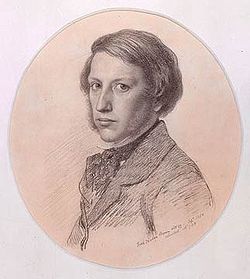
Ford Madox Brown

Encyclopedia
England
England is a country that is part of the United Kingdom. It shares land borders with Scotland to the north and Wales to the west; the Irish Sea is to the north west, the Celtic Sea to the south west, with the North Sea to the east and the English Channel to the south separating it from continental...
painter of moral and historical subjects, notable for his distinctively graphic and often Hogarthian
William Hogarth
William Hogarth was an English painter, printmaker, pictorial satirist, social critic and editorial cartoonist who has been credited with pioneering western sequential art. His work ranged from realistic portraiture to comic strip-like series of pictures called "modern moral subjects"...
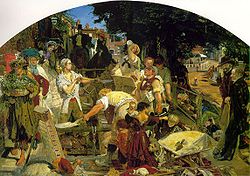
version of the Pre-Raphaelite style. Arguably, his most notable painting was Work
Work (painting)
Work is a painting by Ford Madox Brown, which is generally considered to be his most important achievement. It attempts to portray, both literally and analytically, the totality of the Victorian social system and the transition from a rural to an urban economy...
. Brown spent the latter years of his life painting The Manchester Murals
The Manchester Murals
The Manchester Murals are a series of twelve paintings by Ford Madox Brown on the history of Manchester, England in Manchester Town Hall. Following the success of Brown's painting Work he was commissioned to paint six murals for the Great Hall of the new building. Another six murals were to be...
for Manchester Town Hall
Manchester Town Hall
Manchester Town Hall is a Victorian-era, Neo-gothic municipal building in Manchester, England. The building functions as the ceremonial headquarters of Manchester City Council and houses a number of local government departments....
which depicted Mancunian history
History of Manchester
The history of Manchester encompasses its change from a minor Lancastrian township into the pre-eminent industrial metropolis of the United Kingdom and the world. Manchester began expanding "at an astonishing rate" around the turn of the 19th century as part of a process of unplanned urbanisation...
.
Life and work
Brown was born in CalaisCalais
Calais is a town in Northern France in the department of Pas-de-Calais, of which it is a sub-prefecture. Although Calais is by far the largest city in Pas-de-Calais, the department's capital is its third-largest city of Arras....
and studied art in Antwerp under Egide Charles Gustave Wappers
Egide Charles Gustave Wappers
Egide Charles Gustave, Baron Wappers is best known as the Belgian painter Gustave Wappers, while his oeuvre is also reckoned Flemish...
. In 1843 he submitted work to the Westminster Cartoon Competition, for compositions to decorate the new Palace of Westminster
Palace of Westminster
The Palace of Westminster, also known as the Houses of Parliament or Westminster Palace, is the meeting place of the two houses of the Parliament of the United Kingdom—the House of Lords and the House of Commons...
. He was not successful. His early works were, however, greatly admired by the young Dante Gabriel Rossetti
Dante Gabriel Rossetti
Dante Gabriel Rossetti was an English poet, illustrator, painter and translator. He founded the Pre-Raphaelite Brotherhood in 1848 with William Holman Hunt and John Everett Millais, and was later to be the main inspiration for a second generation of artists and writers influenced by the movement,...
, who asked him to become his tutor. Through Rossetti, Brown came into contact with the artists who went on to form the Pre-Raphaelite Brotherhood (PRB). Though closely linked to them, he was never actually a member of the brotherhood itself. Nevertheless, he remained close to Rossetti, with whom he also joined William Morris
William Morris
William Morris 24 March 18343 October 1896 was an English textile designer, artist, writer, and socialist associated with the Pre-Raphaelite Brotherhood and the English Arts and Crafts Movement...
's design company, Morris, Marshall, Faulkner & Co., in 1861. He was a close friend of the landscape artist Henry Mark Anthony
Henry Mark Anthony
Henry Mark Anthony was an English landscape artist, often favourably compared to John Constable by critics...
. Brown was also the main organiser of the Hogarth Club
Hogarth Club
The Hogarth Club was an exhibition society of artists, based at 84 Charlotte Street, Fitzrovia, which existed between 1858 and 1861. It was founded by former members of the Pre-Raphaelite Brotherhood after the original PRB had been dissolved...
, a short lived replacement for the PRB which existed between 1858 and 1861.
One of his most famous images is The Last of England
The Last of England (painting)
The Last of England is an 1855 oil-on-panel painting by Ford Madox Brown depicting two emigrants leaving England to start a new life abroad.-Background:...
which was sold in March 1859 for 325 Guineas
Guinea (British coin)
The guinea is a coin that was minted in the Kingdom of England and later in the Kingdom of Great Britain and the United Kingdom between 1663 and 1813...
(2010: £). It depicts a pair of stricken emigrants as they sail away on the ship that will take them from England forever. It was inspired by the departure of the Pre-Raphaelite sculptor Thomas Woolner
Thomas Woolner
Thomas Woolner RA was an English sculptor and poet who was one of the founder-members of the Pre-Raphaelite Brotherhood. He was the only sculptor among the original members....
, who had left for Australia
Australia
Australia , officially the Commonwealth of Australia, is a country in the Southern Hemisphere comprising the mainland of the Australian continent, the island of Tasmania, and numerous smaller islands in the Indian and Pacific Oceans. It is the world's sixth-largest country by total area...
. The painting is structured with Brown's characteristic linear energy, and emphasis on apparently grotesque and banal details, such as the cabbages hanging from the ship's side.
Brown's most important painting was Work
Work (painting)
Work is a painting by Ford Madox Brown, which is generally considered to be his most important achievement. It attempts to portray, both literally and analytically, the totality of the Victorian social system and the transition from a rural to an urban economy...
(1852–1865), commissioned by Thomas Plint
Thomas Plint
Thomas Edward Plint, was a stockbroker and important Pre-Raphaelite art collector who commissioned and owned several notable paintings. In 1839, with his friend Charles Reed, he started and edited a magazine called The Leeds Repository,...
and which he showed at a special exhibition. It attempted to depict the totality of the mid-Victorian
Victorian era
The Victorian era of British history was the period of Queen Victoria's reign from 20 June 1837 until her death on 22 January 1901. It was a long period of peace, prosperity, refined sensibilities and national self-confidence...
social experience in a single image, depicting 'navvies' digging up a road, Heath Street in Hampstead, London, and disrupting the old social hierarchies as they did so. The image erupts into proliferating details from the dynamic centre of the action, as the workers tear a hole in the road – and, symbolically, in the social fabric. Each character represents a particular social class and role in the modern urban environment. Brown wrote a catalogue to accompany the special exhibition of Work. This publication included an extensive explanation of Work that nevertheless leaves many questions unanswered.
Brown's major achievement after Work was the "Manchester Murals", a cycle of twelve paintings in the Great Hall of Manchester Town Hall
Manchester Town Hall
Manchester Town Hall is a Victorian-era, Neo-gothic municipal building in Manchester, England. The building functions as the ceremonial headquarters of Manchester City Council and houses a number of local government departments....
depicting the history of the city. Brown would be 72 by the time he finished the murals. In total, he took six year perfecting the murals which were his last major work.
Family
Brown was married twice. His first wife Elizabeth Bromley died in 1846 aged 27, after giving birth to a daughter, Lucy. He later married his model Emma Hill, who appears in many of his paintings and is the wife in The Last of EnglandThe Last of England (painting)
The Last of England is an 1855 oil-on-panel painting by Ford Madox Brown depicting two emigrants leaving England to start a new life abroad.-Background:...
. His son with Emma, Oliver Madox Brown (1855–1874) showed promise both as an artist
Artist
An artist is a person engaged in one or more of any of a broad spectrum of activities related to creating art, practicing the arts and/or demonstrating an art. The common usage in both everyday speech and academic discourse is a practitioner in the visual arts only...
and poet
Poet
A poet is a person who writes poetry. A poet's work can be literal, meaning that his work is derived from a specific event, or metaphorical, meaning that his work can take on many meanings and forms. Poets have existed since antiquity, in nearly all languages, and have produced works that vary...
, but died of blood poisoning. Their daughter, Catherine, married Francis Hueffer
Francis Hueffer
Francis Hueffer, born Franz Hüffer , was a German-English writer on music, music critic, and librettist.-Biography:...
; through Catherine, Brown was the grandfather of novelist Ford Madox Ford
Ford Madox Ford
Ford Madox Ford was an English novelist, poet, critic and editor whose journals, The English Review and The Transatlantic Review, were instrumental in the development of early 20th-century English literature...
and great-grandfather of Labour
Labour Party (UK)
The Labour Party is a centre-left democratic socialist party in the United Kingdom. It surpassed the Liberal Party in general elections during the early 1920s, forming minority governments under Ramsay MacDonald in 1924 and 1929-1931. The party was in a wartime coalition from 1940 to 1945, after...
Home Secretary
Home Secretary
The Secretary of State for the Home Department, commonly known as the Home Secretary, is the minister in charge of the Home Office of the United Kingdom, and one of the country's four Great Offices of State...
Frank Soskice
Frank Soskice
Frank Soskice, Baron Stow Hill PC was a British lawyer and Labour Party politician.-Background and education:...
.
Brown is buried in London in the St Pancras and Islington Cemetery, close to Muswell Hill. He was given a secular funeral, and the funeral oration was delivered by the American Moncure D. Conway, the secularist after whom Conway Hall was later named. (See TLS 2008 article cited below)
Heritage
The Wetherspoon pub in Oxford Road, ManchesterManchester
Manchester is a city and metropolitan borough in Greater Manchester, England. According to the Office for National Statistics, the 2010 mid-year population estimate for Manchester was 498,800. Manchester lies within one of the UK's largest metropolitan areas, the metropolitan county of Greater...
is named after Ford Madox Brown. It states on the Wetherspoons website that "This J D Wetherspoon pub is named after the much-travelled artist Ford Madox Brown, a one-time resident of Victoria Park, a suburb south of the pub." The pub opened in 2007.
Books
- Virginia Surtees (ed), The diary of Ford Madox Brown (1981, ISBN 0300027435)
- Kenneth Bendiner, Ford Madox Brown: Il Lavoro, (Turin: Lindau, 1991).
- Kenneth Bendiner, The Art of Ford Madox Brown, (University Park, PA: Penn State Press, 1998)
- Tessa Sidey (ed), Ford Madox Brown: The Unofficial Pre-Raphaelite, (2008, Birmingham Museum and Art Gallery ISBN 978-1-904832-56-0)
See also
- List of paintings by Ford Madox Brown
- The Manchester MuralsThe Manchester MuralsThe Manchester Murals are a series of twelve paintings by Ford Madox Brown on the history of Manchester, England in Manchester Town Hall. Following the success of Brown's painting Work he was commissioned to paint six murals for the Great Hall of the new building. Another six murals were to be...
- :Category:Ford Madox Brown paintings
- British artBritish artBritish art could refer to:* Art of the United Kingdom - post 1707* English art* Irish art* Scottish art* Welsh art...
- English school of painting
External links
- The iBiblio Web Museum exhibit on Brown
- Some of his paintings in the Carol Gerten Fine Art library
- Birmingham Museums & Art Gallery's Pre-Raphaelite Online Resource includes almost two hundred paintings on canvas and works on paper by Ford Madox Brown
- Waiting: An English fireside of 1854–5
- Spartacus Educational: Ford Madox Brown
- Chronology on Britain Unlimited
- Some stained glass designs by Ford Madox Brown
- Ford Madox Brown in the "History of Art"
- Phryne's list of pictures in public galleries
- "The secret love of Ford Madox Brown": essay on Ford Madox Brown and Mathilde Blind, by Angela Thirlwell, from TLS, October 8, 2008
- Photo of Ford Madox Brown's grave and a brief article about his time in Finchley
- The Pre-Raph Pack Discover more about the artists, the techniques they used and a timeline spanning 100 years.
- Ford Madox Brown: PreRaphaelite Pioneer Exhibition, Manchester Art Gallery, Saturday 24 September 2011 - Sunday 29 January 2012