

Criticism of Coca-Cola

Encyclopedia
The Coca-Cola Company
, its subsidiaries and products have been subject to sustained criticism by both consumer groups and watchdogs, particularly since the early 2000s. Allegations against the company are varied and criticism has been based around; possible health effects of Coca-Cola products, questionable labour practices (including allegations of involvement with paramilitary organisations in suppression of trade unions), the company's poor environmental
record, perception of the companies engagement in monopolistic business practices, questionable marketing
strategies and violations of intellectual property
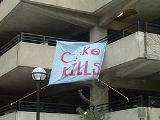
rights. Perception of the company as behaving unethically has led to the formation of pressure groups such as "Killer Coke", boycotts of Coca-Cola and related products and lawsuits.
is no more harmful than comparable soft drink
s or acid
ic fruit juices. Frequent exposure of teeth to acidic drinks increases the risk of tooth damage through dental erosion. This form of tooth decay is unrelated to dental caries
.
was rapidly introduced in many processed foods and soda drinks in the US over the period of about 1975–1985. Since 1985 in the U.S., Coke has been made with high fructose corn syrup
instead of sucrose
to reduce costs. One of the reasons this has come under criticism is because the corn
used to produce corn syrup often comes from genetically altered plants. Some nutritionists also caution against consumption of high fructose corn syrup because of possible links to obesity
and diabetes. High fructose corn syrup has been shown to be metabolized differently than sugar by the human body.
This causes problems with Coke's distribution and bottling network, because specific franchise districts are guaranteed an exclusive market area for Coke products. Mexican-made Coca-Cola may often be found for sale in stores catering to the Hispanic immigrant community. Kosher for Passover
Coke is also made with cane sugar, rather than corn syrup, due to the special dietary restrictions for observant Jews. Some Orthodox Jews do not consume corn during the holiday. Bottled with yellow caps, this variant can be found in some areas of the US around April.
's leading soft drink until 1977 when it left India after a new government ordered the company to turn over its secret formula for Coca-Cola and dilute its stake in its Indian unit as required by the Foreign Exchange Regulation Act (FERA). In 1993, the company (along with PepsiCo
) returned after the introduction of India's Liberalization
policy.
, there exists widespread concern over how Coca-Cola is produced. In particular, it is feared that the water used to produce Coke may contain unhealthy levels of pesticide
s and other harmful chemicals. It has also been alleged that due to the amount of water required to produce Coca-Cola, aquifer
s are drying up and forcing farmers to relocate.
(CSE), a non-governmental organisation in New Delhi
, said aerated waters produced by soft drinks manufacturers in India, including multinational giants PepsiCo and Coca-Cola, contained toxins including lindane
, DDT
, malathion
and chlorpyrifos
— pesticides that can contribute to cancer and a breakdown of the immune system. Tested products included Coke, Pepsi, and several other soft drinks (7Up, Mirinda
, Fanta
, Thums Up
, Limca
, Sprite
), many produced by The Coca-Cola Company.
CSE found that the Indian produced Pepsi's soft drink products had 36 times the level of pesticide residues permitted under European Union
regulations; Coca Cola's 30 times. CSE said it had tested the same products in the US and found no such residues.
Coca-Cola and PepsiCo angrily denied allegations that their products manufactured in India contained toxin levels far above the norms permitted in the developed world. David Cox, Coke's Hong Kong-based communications director for Asia, accused Sunita Narain
, CSE's director, of "brandjacking
" — using Coke's brand name to draw attention to her campaign against pesticides. Narain defended CSE's actions by describing them as a natural follow-up to a previous study it did on bottled water.
In 2004, an Indian parliamentary committee backed up CSE's findings, and a government-appointed committee was tasked with developing the world's first pesticide standards for soft drinks. Coke and PepsiCo oppose the move, arguing that lab tests aren't reliable enough to detect minute traces of pesticides in complex drinks like soda.
The Coca-Cola Company has responded that its plants filter water to remove potential contaminants and that its products are tested for pesticides and must meet minimum health standards before they are distributed.
Coca-Cola had registered a 11 percent drop in sales after the pesticide allegations were made in 2003.
, Coke and Pepsi together hold 95% market share of soft-drink sales in India.
In 2006, the Indian state of Kerala banned the sale and production of Coca-Cola, along with other soft drinks, due to concerns of high levels of pesticide residue
On Friday, September 22, 2006, the High Court in Kerala overturned the Kerala ban ruling that only the federal government can ban food products.
due to the utilisation of natural water resources by the company poses a serious threat to many communities.
In March 2004, local officials in Kerala
shut down a $16 million Coke bottling plant blamed for a drastic decline in both quantity and quality of water available to local farmers and villagers.
In April 2005, Kerala's highest court rejected water use claims, noting that wells there continued to dry up last summer, months after the local Coke plant stopped operating. Further, a scientific study requested by the court found that while the plant had "aggravated the water scarcity situation," the "most significant factor" was a lack of rainfall. Critics respond that Coke shouldn't be locating bottling plants in drought
-stricken areas. In Plachimada, Coca-Cola is allegedly responsible for creating problems for communities by creating severe water shortages and polluting the groundwater and soil, destroying farms by draining them out completely. The plant here used about 900,000 liters of water last year, about a third of it for the soft drinks, the rest to clean bottles and machinery. It is drawn from wells at the plant but also from aquifers Coca-Cola shares with neighboring farmers. The water is virtually free to all users. These farmers who have been protesting say their problems began after the Coca-Cola factory arrived in 1999.
The company has been trying to regain the plant's license, fighting a case that has gone all the way to India's Supreme Court.
Near the holy city of Varanasi
in northeastern India, a local water official blames a Coke plant — which has been the scene of many protests by NGOs and local residents — for polluting groundwater by releasing wastewater into surrounding land. A Coke official confirms there had been a drainage problem with treated wastewater several years ago but says the company built a long pipeline to correct it.
Indian environmental activist Vandana Shiva
has stated that it takes nine litres of clean water to manufacture a litre of Coke though Coca-Cola says it is only an average of 3.12 litres.
The case has been appealed and a decision is pending. Coca-Cola has set up a page to rebut these charges at this site.
have come under intense scrutiny as many communities are experiencing severe water shortages as well as contaminated groundwater and soil that some assert are a result of Coca-Cola's bottling operations. A massive movement has emerged across India to hold the Coca-Cola company accountable for its actions. The state of Kerala
imposed a ban of colas from the state only to be quashed by Coca Cola; the matter is pending in the supreme court. The Plachimada plant in Kerala
state, one of Coca-Cola's largest bottling facilities in India, has remained shut for 17 months now because the village council has refused to renew its license, blaming the company for causing water shortages and pollution.
In Sivaganga District
of Tamil Nadu
state there were several protests and rallies opposing the proposed Coca Cola bottling plant in fear of water depletion and contamination. The president of the Gangaikondan panchayat, Mr. V. Kamson died under mysterious circumstances two days after going back and forth in his resentment against the upcoming Coca-cola bottling plant in the village. When asked about the conflicting statements, he said: "I am under immense pressure from the public, police and other quarters. So I have issued this statement." Five other Indian states have announced partial bans on the drinks in schools, colleges and hospitals.
lawsuit filed by PepsiCo
Inc. accusing Coca-Cola Co. of monopolizing the market for fountain-dispensed soft drinks in the United States.
In June 2005, Coca-Cola in Europe formally agreed to end deals with shops and bars to stock its drinks exclusively after a European Union
investigation found its business methods stifled competition
.
In November 2005, Coca-Cola's Mexican unit - Coca-Cola Export Corporation - and a number of its distributors and bottlers were fined $68 million for unfair commercial practices. Coca-Cola is appealing the case.
published For God Country and Coca Cola (ISBN 0465054684), an in-depth study of the marketing
phenomenon which had made Coca-Cola synonymous with US culture.
In 2004, the British government launched a wide-ranging review into food promotion and childhood obesity
. One survey found that Coca-Cola broadcasted a high proportion of their advertisements during children's television. The company removed its branding from vending machines in Scottish schools in December 2003, replacing it with a graphic of an urban scene.
, with "forcing some bottlers to purchase hundreds of millions of dollars of unnecessary beverage concentrate to make its sales seem higher." Institutional investors, led by Carpenters Health & Welfare Fund of Philadelphia & Vicinity, accused Coca-cola of "channel stuffing
," or artificial inflation of Coca-Cola's results which gave investors a false picture of the company's health. The settlement applies to Coca-Cola common stock owners from Oct 21, 1999 to March 6, 2000.
before and during World War II
. A division of the company continued to operate in Germany during the war, but were unable to import the syrup needed for production of Coca-Cola from the United States.
Before and during World War II
, Coca-Cola adopted an apparent policy of ignoring the practice of eugenics
and anti-Semitism
by Nazi Germany
, according to a 2000 book by Mark Pendergrast
. Several of Coke's top executives in Germany
were public members of the National Socialist German Workers Party
, commonly known as the Nazi Party. When the United States entered World War II, Coke began to represent its product in the US as a patriotic drink by providing free drinks for soldiers of the United States Army
, thus allowing the company to be exempt from sugar rationing.
The United States Army permitted Coca-Cola employees to enter the front lines as "Technical Officers" when in reality they rarely if ever came close to a real battle. Instead, they operated Coke's system of providing refreshments for soldiers, who welcomed the beverage as a reminder of home. As the Allies of World War II
advanced, so did Coke, which took advantage of the situation by establishing new franchises in the newly occupied countries.
Coca-Cola set up bottling plants in several locations overseas to assure the drink's availability to soldiers, setting the stage for the company's post-war overseas expansion. The popularity of the drink exploded as US soldiers returned home from the war with a taste for the drink.
At the same time, according to Jones E and Ritzman F. in Coca Cola Goes to War, "the soft drinks giant from Atlanta, Georgia collaborated with the Nazi-regime throughout its reign from 1933–1945 and sold countless millions of bottled beverages to Hitler’s Germany."
Fanta
, a product developed in Germany due to shortages of supplies to make Coca-Cola, was merged into the Coca-Cola brand line following the end of the war.
, filed a lawsuit against Coca-Cola on April 21, 1997 in the United States District Court for the Southern District of New York
(Foley Square) Case #97-CV-02858. The suit alleges Coke knowingly purchased Bigio family property in Egypt
after the Egyptian government illegally seized it from them in the 1960s because they were Jewish. The suit was filed in US federal court under the Alien Tort Statute
, which gives non-US citizens the right to sue in US courts for alleged violations of international law
. The case may be the first of many court battles in the United States brought by Jews seeking to recover confiscated property from Arab
countries. "At a minimum, a private corporation that acts in concert with a foreign government is liable for violations of international law," asserted Grant Vinik, a Washington, DC attorney who, along with Nat Lewin
, is representing the Bigio family.
Starting in 1938, the Bigio family factories in Egypt were licensed by Coca-Cola to produce several products such as bottle caps. In addition, Coca-Cola had a bottling plant on property it had rented from the Bigios. In 1962, the government of Gamal Abdel Nasser
confiscated the land and factories, transferring it to state-owned companies. "When we left Egypt, we left with $5 each," said Bigio. After Nasser's death in 1970 privatization
began, which meant state-owned property could be sold to private bidders in 1993. In 1994 the Bigios warned Coca-Cola not to proceed with the acquisition of the property without compensating the family. Coca-Cola went ahead with that acquisition in 1994 without compensating the Bigios. "They [Coke] knew they were buying nationalized and stolen assets," Bigio charged.
Coke has argued that the case should be dismissed because the court lacked jurisdiction, and that the case was old, as the family had been expropriated of their factories and real estate assets some 25 years before.
racial discrimination lawsuit and promised to change the way it manages, promotes and treats minority employees in the US. In 2003, protesters at Coca-Cola's annual meeting claimed that black people remained underrepresented in top management at the company, were paid less than white employees and fired more often. In 2004, Luke Visconti, a co-founder of Diversity Inc., which rates companies on their diversity efforts, said: "Because of the settlement decree, Coca-Cola was forced to put in management practices that have put the company in the top 10 for diversity."
suffered a spate of mysterious murders of union-affiliated employees leading to the non-renewal of the bottling plant's license in 1981. "Coca-Cola found a new owner, and following repair work and construction on the plant, work resumed at the Guatemala bottling plant on March 1, 1985." The Company's decisions were made after pressure from several groups, including a shareholder resolution
filed in 1979. The Company argued that "it had no right to interfere in labor disputes between independent parties and asserting that such an intrusion would be improper."
On February 25, 2010, a new lawsuit was launched on behalf of 8 plaintiffs against The Coca-Cola Co. and Coke processing and bottling plants in Guatemala, with charges of murder, rape, and torture of union leaders and their families. The plaintiffs were victims of employees associated with Industria de Café SA, or Incasa, which operates an instant coffee and Coca-Cola bottling plant in Guatemala City. The plaintiffs said Incasa “is or was previously owned by Coca-Cola.”
), Coca-Cola's main bottler in Latin America, has been criticized for its relationship with unions. In Colombia
, it has been alleged that the bottling company hired paramilitary
mercenaries
to assassinate union leaders. These charges have resulted in several court cases and boycott
actions against The Coca-Cola Company.
In July 2001, the United Steelworkers of America and the International Labor Rights Fund
filed suit in US court against Coca-Cola and some bottlers in Colombia on behalf of their workers. This lawsuit was titled Sinaltrainal v. Coca-Cola
. According to the plaintiffs, the companies "hired, contracted with or otherwise directed paramilitary security forces". The companies denied the charges. In April 2003 District Judge Jose E Martinez in Miami excluded The Coca-Cola Company and its Colombian unit because its bottling agreement did not give it "explicit control" over labor issues in Colombia.
In January 2004, a New York City
-based fact-finding delegation
, a self-initiated group that included some city officials in a personal capacity, confirmed the workers' allegations. They found:
The bottler and The Coca-Cola Company deny these allegations. Specifically, The Coca-Cola Company stated in its 2004 proxy
Critics argue that, whatever their source, these assassination
s seem to have been helpful to Coca-Cola in eliminating agitator
s from their bottling plants.
The Coca-Cola Case is a feature-length documentary by the National Film Board of Canada about the situation.
Since 2003, the Campaign to Stop Killer Coke, directed by Ray Rogers
, of Corporate Campaign Inc. (CCI), has successfully urged numerous unions and universities to boycott Coke products as part of a corporate campaign
strategy to keep pressure on Coca-Cola to address these issues and make restitution to the victims and their families.
(National Union of Food Industry Workers) called for an international boycott
of Coca-Cola products because of intimidation
, kidnapping
and murder
of workers in Coca Cola bottling plants by paramilitaries. With the help of the United Steelworkers of America, SINALTRAINAL filed a lawsuit against the Coca Cola Company (Sinaltrainal v. Coca-Cola
). On March 31, 2003, the United States District Court for the Southern District of Florida
dismissed charges against The Coca-Cola Company because the alleged wrongdoing either occurred in the United States but was too removed from the injury or occurred abroad but did not have a substantial origin within the United States. Judge Jose E. Martinez
allowed the case to go forward against two Coca-Cola bottlers: Bebidas y Alimentos and Panamerican Beverages
, but not against Coke itself. On September 4, 2006, Judge Martinez dismissed the remaining claims against the two bottlers.
that called for Coca-Cola to adopt a code of conduct
on bottling practices and employee relations. Problems in Colombia were cited, but the proposal called for "clear standards for its suppliers, vendors and bottlers." The resolution received support from Coca-Cola unions in Colombia, Guatemala, Zimbabwe, the Philippines, and the United States.
However, Coca Cola's board of directors recommended rejecting the proposal, noting in the proxy: "We believe that the Company's existing policies address substantially all of the concerns raised in this proposal, and that the proposal is therefore unnecessary... For example, both our policy and the Principles specifically provide that we (i) will not condone the exploitation of children, physical punishment or involuntary servitude; and (ii) will pay wages that enable our employees to meet their basic needs."
Ultimately, shareholders rejected the resolution.
 The boycott example which started in Ireland
has continued to spread across the world, with the National Union of Students in Britain
voting to support the boycott in April 2005. UNISON
, the largest trade union
in the UK, also voted to support the boycott at its 2004 National Delegate Conference. ECOSY
, the European Young Socialists, a federation of youth wings of all the mainstream socialist and social democratic parties in the EU, voted to support the boycott in March 2005 following a motion from the Irish Labour Youth delegation. Campuses and labor and trade unions in the United States, Italy
, France
and Canada, amongst others, are also campaigning for the boycott to spread. The University of Michigan
and New York University
banned Coke products from their campuses, bringing the number to over 23. Several US universities have switched to Pepsi
in school-run facilities (not including vending machines, but including eateries and sports arenas) in support of the boycott.
but was refused a permit. Eager to avoid the [Arab League] boycott and sell to the much larger Arab market, Coca-Cola was content not to sell in Israel. In 1961 the issue came up again when an Egypt
ian civil servant mistook Amharic writing on a Coca-Cola bottle for Hebrew, and accused Coca-Cola of doing business with Israel. The manager of Egypt's Coca-Cola bottling operations quickly informed the press that Coca-Cola would never do business with Israel; forced to explain this, Coca-Cola officials explained that Israel was too small a market for a Coca-Cola operation.
The issue arose again on April 1, 1966 when Moshe Bronstein, a Tel Aviv
businessman, accused Coca-Cola of boycotting Israel to appease its Arab market. The Anti-Defamation League
took up this cause in the United States
, and questions were raised about Coca-Cola's previous explanation for not operating in Israel: If Coca-Cola could have an operation in Cyprus
, whose market was one-tenth the size of Israel's, why then was Israel too small for a Coca-Cola operation? Pressure on Coca-Cola grew, and faced with potential American boycotts, Coca-Cola promised to open a bottling plant in Tel Aviv
. In response, the Arab League boycotted Coca-Cola from August 1968 to May 1991, as part of the economic boycott of Israel.
Along with McDonald's
, Coca-Cola has become an international symbol of American culture, and especially of American consumerism
. While the company still enjoys widespread popularity, some backlash has occurred, mostly in the form of boycotts in the Middle East. One such instance in 2000 saw a claim that the Coca-Cola label, created in 1886, actually contained hidden anti-Islamic phrases ") in its mirror image in Arabic
. The Coca-Cola Company claimed sales dropped 10 to 15% in Egypt
after the rumor began spreading in 2000. The controversy became so widespread that the Grand Mufti
of Egypt — who has proudly admitted in related interviews that he himself indulges in at least one Coke daily — publicly addressed it, declaring that the logo "does not injure Islam or Muslims."
In Autumn 2002, a French Tunisia
n, Tawfiq Mathlouthi, launched a new brand of cola
drink, dubbed Mecca-Cola
, to protest American foreign policy in the Middle East. Mecca Cola was marketed as a way to combat "America's imperialism … by providing a substitute for American goods and increasing the blockade of countries boycotting American goods." By 2004, Mecca-Cola fizzled: in France, its biggest market, sales dropped about 10%.
. The song's most attacked verse referred to burying the dead president among Polish kings at the Wawel castle hill. The authors also parodied the "I love Poland"-style of nationalistic politicians. Refrain criticized the dog-eat-dog approach of political usage of mourning and country-wide grief. The song quickly spread over social networks.
Coca-Cola responded to the appeals of Polish nationalist activists and announced that its logo will be removed from "Eska Rock" Internet appearance.
, of which Coca-Cola is a client, dropped the case of defending the Defense of Marriage Act
in court on behalf of the United States House of Representatives
. It was reported that Coca-Cola had directly intervened to pressure the firm to drop the case, a move that brought heavy criticism upon the firm. Coca-Cola refused to comment.
The Coca-Cola Company
The Coca-Cola Company is an American multinational beverage corporation and manufacturer, retailer and marketer of non-alcoholic beverage concentrates and syrups. The company is best known for its flagship product Coca-Cola, invented in 1886 by pharmacist John Stith Pemberton in Columbus, Georgia...
, its subsidiaries and products have been subject to sustained criticism by both consumer groups and watchdogs, particularly since the early 2000s. Allegations against the company are varied and criticism has been based around; possible health effects of Coca-Cola products, questionable labour practices (including allegations of involvement with paramilitary organisations in suppression of trade unions), the company's poor environmental
Natural environment
The natural environment encompasses all living and non-living things occurring naturally on Earth or some region thereof. It is an environment that encompasses the interaction of all living species....
record, perception of the companies engagement in monopolistic business practices, questionable marketing
Marketing
Marketing is the process used to determine what products or services may be of interest to customers, and the strategy to use in sales, communications and business development. It generates the strategy that underlies sales techniques, business communication, and business developments...
strategies and violations of intellectual property
Intellectual property
Intellectual property is a term referring to a number of distinct types of creations of the mind for which a set of exclusive rights are recognized—and the corresponding fields of law...
rights. Perception of the company as behaving unethically has led to the formation of pressure groups such as "Killer Coke", boycotts of Coca-Cola and related products and lawsuits.
Acidity and tooth decay
Numerous court cases have been filed against the Coca-Cola Company since the 1940s alleging that the acidity of the drink is dangerous. In some of these cases, evidence has been presented showing Coca-ColaCoca-Cola
Coca-Cola is a carbonated soft drink sold in stores, restaurants, and vending machines in more than 200 countries. It is produced by The Coca-Cola Company of Atlanta, Georgia, and is often referred to simply as Coke...
is no more harmful than comparable soft drink
Soft drink
A soft drink is a non-alcoholic beverage that typically contains water , a sweetener, and a flavoring agent...
s or acid
Acid
An acid is a substance which reacts with a base. Commonly, acids can be identified as tasting sour, reacting with metals such as calcium, and bases like sodium carbonate. Aqueous acids have a pH of less than 7, where an acid of lower pH is typically stronger, and turn blue litmus paper red...
ic fruit juices. Frequent exposure of teeth to acidic drinks increases the risk of tooth damage through dental erosion. This form of tooth decay is unrelated to dental caries
Dental caries
Dental caries, also known as tooth decay or a cavity, is an irreversible infection usually bacterial in origin that causes demineralization of the hard tissues and destruction of the organic matter of the tooth, usually by production of acid by hydrolysis of the food debris accumulated on the...
.
High fructose corn syrup
High fructose corn syrupHigh fructose corn syrup
High-fructose corn syrup — also called glucose-fructose syrup in the UK, glucose/fructose in Canada, and high-fructose maize syrup in other countries — comprises any of a group of corn syrups that has undergone enzymatic processing to convert some of its glucose into fructose to produce...
was rapidly introduced in many processed foods and soda drinks in the US over the period of about 1975–1985. Since 1985 in the U.S., Coke has been made with high fructose corn syrup
High fructose corn syrup
High-fructose corn syrup — also called glucose-fructose syrup in the UK, glucose/fructose in Canada, and high-fructose maize syrup in other countries — comprises any of a group of corn syrups that has undergone enzymatic processing to convert some of its glucose into fructose to produce...
instead of sucrose
Sucrose
Sucrose is the organic compound commonly known as table sugar and sometimes called saccharose. A white, odorless, crystalline powder with a sweet taste, it is best known for its role in human nutrition. The molecule is a disaccharide composed of glucose and fructose with the molecular formula...
to reduce costs. One of the reasons this has come under criticism is because the corn
Maize
Maize known in many English-speaking countries as corn or mielie/mealie, is a grain domesticated by indigenous peoples in Mesoamerica in prehistoric times. The leafy stalk produces ears which contain seeds called kernels. Though technically a grain, maize kernels are used in cooking as a vegetable...
used to produce corn syrup often comes from genetically altered plants. Some nutritionists also caution against consumption of high fructose corn syrup because of possible links to obesity
Obesity
Obesity is a medical condition in which excess body fat has accumulated to the extent that it may have an adverse effect on health, leading to reduced life expectancy and/or increased health problems...
and diabetes. High fructose corn syrup has been shown to be metabolized differently than sugar by the human body.
This causes problems with Coke's distribution and bottling network, because specific franchise districts are guaranteed an exclusive market area for Coke products. Mexican-made Coca-Cola may often be found for sale in stores catering to the Hispanic immigrant community. Kosher for Passover
Passover
Passover is a Jewish holiday and festival. It commemorates the story of the Exodus, in which the ancient Israelites were freed from slavery in Egypt...
Coke is also made with cane sugar, rather than corn syrup, due to the special dietary restrictions for observant Jews. Some Orthodox Jews do not consume corn during the holiday. Bottled with yellow caps, this variant can be found in some areas of the US around April.
India secret formula ban
Coca-Cola was IndiaIndia
India , officially the Republic of India , is a country in South Asia. It is the seventh-largest country by geographical area, the second-most populous country with over 1.2 billion people, and the most populous democracy in the world...
's leading soft drink until 1977 when it left India after a new government ordered the company to turn over its secret formula for Coca-Cola and dilute its stake in its Indian unit as required by the Foreign Exchange Regulation Act (FERA). In 1993, the company (along with PepsiCo
PepsiCo
PepsiCo Inc. is an American multinational corporation headquartered in Purchase, New York, United States, with interests in the manufacturing, marketing and distribution of grain-based snack foods, beverages, and other products. PepsiCo was formed in 1965 with the merger of the Pepsi-Cola Company...
) returned after the introduction of India's Liberalization
Liberalization
In general, liberalization refers to a relaxation of previous government restrictions, usually in areas of social or economic policy. In some contexts this process or concept is often, but not always, referred to as deregulation...
policy.
Environmental issues
In IndiaIndia
India , officially the Republic of India , is a country in South Asia. It is the seventh-largest country by geographical area, the second-most populous country with over 1.2 billion people, and the most populous democracy in the world...
, there exists widespread concern over how Coca-Cola is produced. In particular, it is feared that the water used to produce Coke may contain unhealthy levels of pesticide
Pesticide
Pesticides are substances or mixture of substances intended for preventing, destroying, repelling or mitigating any pest.A pesticide may be a chemical unicycle, biological agent , antimicrobial, disinfectant or device used against any pest...
s and other harmful chemicals. It has also been alleged that due to the amount of water required to produce Coca-Cola, aquifer
Aquifer
An aquifer is a wet underground layer of water-bearing permeable rock or unconsolidated materials from which groundwater can be usefully extracted using a water well. The study of water flow in aquifers and the characterization of aquifers is called hydrogeology...
s are drying up and forcing farmers to relocate.
Pesticide use
In 2003, the Centre for Science and EnvironmentCentre for Science and Environment
Centre for Science and Environment is a not-for-profit public interest research and advocacy organisation based in New Delhi, India. Established in 1980, CSE has been working on various environment-development issues in India, pushing for policy changes wherever required and better implementation...
(CSE), a non-governmental organisation in New Delhi
New Delhi
New Delhi is the capital city of India. It serves as the centre of the Government of India and the Government of the National Capital Territory of Delhi. New Delhi is situated within the metropolis of Delhi. It is one of the nine districts of Delhi Union Territory. The total area of the city is...
, said aerated waters produced by soft drinks manufacturers in India, including multinational giants PepsiCo and Coca-Cola, contained toxins including lindane
Lindane
Lindane, also known as gamma-hexachlorocyclohexane, , gammaxene, Gammallin and erroneously known as benzene hexachloride , is an organochlorine chemical variant of hexachlorocyclohexane that has been used both as an agricultural insecticide and as a pharmaceutical treatment for lice and...
, DDT
DDT
DDT is one of the most well-known synthetic insecticides. It is a chemical with a long, unique, and controversial history....
, malathion
Malathion
Malathion is an organophosphate parasympathomimetic which binds irreversibly to cholinesterase. Malathion is an insecticide of relatively low human toxicity, however one recent study has shown that children with higher levels of organophosphate pesticide metabolites in their urine are more likely...
and chlorpyrifos
Chlorpyrifos
Chlorpyrifos is a crystalline organophosphate insecticide that inhibits acetylcholinesterase and is used to control insect pests. It is known by many trade names...
— pesticides that can contribute to cancer and a breakdown of the immune system. Tested products included Coke, Pepsi, and several other soft drinks (7Up, Mirinda
Mirinda
Mirinda is a brand of soft drink originally created in Spain, but with global distribution. The word Mirinda means "admirable, wonderful" in Esperanto....
, Fanta
Fanta
Fanta is a global brand of fruit-flavored carbonated soft drinks from the Coca-Cola Company. There are over 90 flavors worldwide. The drink debuted in Germany in 1941 and originally sold only in Europe.-History:...
, Thums Up
Thums Up
Thums Up is a best-selling brand of cola in India, where its bold, red thumbs up logo is common. Introduced in 1977 to offset the expulsion of The Coca-Cola Company and other foreign companies from India, Thums Up, Limca, and Campa Cola gained nationwide acceptance...
, Limca
Limca
Limca is a lemon and lime flavoured carbonated soft drink made primarily in India and certain parts of the U.S.In 1992, when the Indian government allowed Coca-Cola to return for operations, at the same time as it admitted Pepsi for the first time, Coca-Cola bought local soft-drink brands, from...
, Sprite
Sprite (soft drink)
Sprite is a transparent, lemon-lime flavored , caffeine free soft drink, produced by the Coca-Cola Company. It was introduced in the United States in 1961. This was Coke's response to the popularity of 7 Up, which had begun as "Bib-Label Lithiated Lemon-Lime Soda" in 1929...
), many produced by The Coca-Cola Company.
CSE found that the Indian produced Pepsi's soft drink products had 36 times the level of pesticide residues permitted under European Union
European Union
The European Union is an economic and political union of 27 independent member states which are located primarily in Europe. The EU traces its origins from the European Coal and Steel Community and the European Economic Community , formed by six countries in 1958...
regulations; Coca Cola's 30 times. CSE said it had tested the same products in the US and found no such residues.
Coca-Cola and PepsiCo angrily denied allegations that their products manufactured in India contained toxin levels far above the norms permitted in the developed world. David Cox, Coke's Hong Kong-based communications director for Asia, accused Sunita Narain
Sunita Narain
Sunita Narain is an Indian environmentalist and political activist as well as a major proponent of the Green concept of sustainable development. Narain has been with the India-based Centre for Science and Environment since 1982...
, CSE's director, of "brandjacking
Brandjacking
Brandjacking is an activity whereby someone acquires or otherwise assumes the online identity of another entity for the purposes of acquiring that person's or business's brand equity. The term combines the notions of 'branding' and 'hijacking', and has been used since at least 2007 when it appeared...
" — using Coke's brand name to draw attention to her campaign against pesticides. Narain defended CSE's actions by describing them as a natural follow-up to a previous study it did on bottled water.
In 2004, an Indian parliamentary committee backed up CSE's findings, and a government-appointed committee was tasked with developing the world's first pesticide standards for soft drinks. Coke and PepsiCo oppose the move, arguing that lab tests aren't reliable enough to detect minute traces of pesticides in complex drinks like soda.
The Coca-Cola Company has responded that its plants filter water to remove potential contaminants and that its products are tested for pesticides and must meet minimum health standards before they are distributed.
Coca-Cola had registered a 11 percent drop in sales after the pesticide allegations were made in 2003.
, Coke and Pepsi together hold 95% market share of soft-drink sales in India.
In 2006, the Indian state of Kerala banned the sale and production of Coca-Cola, along with other soft drinks, due to concerns of high levels of pesticide residue
On Friday, September 22, 2006, the High Court in Kerala overturned the Kerala ban ruling that only the federal government can ban food products.
Water use
Environmental degradation in the form of depletion of the local ground water tableWater table
The water table is the level at which the submarine pressure is far from atmospheric pressure. It may be conveniently visualized as the 'surface' of the subsurface materials that are saturated with groundwater in a given vicinity. However, saturated conditions may extend above the water table as...
due to the utilisation of natural water resources by the company poses a serious threat to many communities.
In March 2004, local officials in Kerala
Kerala
or Keralam is an Indian state located on the Malabar coast of south-west India. It was created on 1 November 1956 by the States Reorganisation Act by combining various Malayalam speaking regions....
shut down a $16 million Coke bottling plant blamed for a drastic decline in both quantity and quality of water available to local farmers and villagers.
In April 2005, Kerala's highest court rejected water use claims, noting that wells there continued to dry up last summer, months after the local Coke plant stopped operating. Further, a scientific study requested by the court found that while the plant had "aggravated the water scarcity situation," the "most significant factor" was a lack of rainfall. Critics respond that Coke shouldn't be locating bottling plants in drought
Drought
A drought is an extended period of months or years when a region notes a deficiency in its water supply. Generally, this occurs when a region receives consistently below average precipitation. It can have a substantial impact on the ecosystem and agriculture of the affected region...
-stricken areas. In Plachimada, Coca-Cola is allegedly responsible for creating problems for communities by creating severe water shortages and polluting the groundwater and soil, destroying farms by draining them out completely. The plant here used about 900,000 liters of water last year, about a third of it for the soft drinks, the rest to clean bottles and machinery. It is drawn from wells at the plant but also from aquifers Coca-Cola shares with neighboring farmers. The water is virtually free to all users. These farmers who have been protesting say their problems began after the Coca-Cola factory arrived in 1999.
The company has been trying to regain the plant's license, fighting a case that has gone all the way to India's Supreme Court.
Near the holy city of Varanasi
Varanasi
-Etymology:The name Varanasi has its origin possibly from the names of the two rivers Varuna and Assi, for the old city lies in the north shores of the Ganga bounded by its two tributaries, the Varuna and the Asi, with the Ganges being to its south...
in northeastern India, a local water official blames a Coke plant — which has been the scene of many protests by NGOs and local residents — for polluting groundwater by releasing wastewater into surrounding land. A Coke official confirms there had been a drainage problem with treated wastewater several years ago but says the company built a long pipeline to correct it.
Indian environmental activist Vandana Shiva
Vandana Shiva
Vandana Shiva , is a philosopher, environmental activist, and eco feminist. Shiva, currently based in Delhi, has authored more than 20 books and over 500 papers in leading scientific and technical journals. She was trained as a physicist and received her Ph.D...
has stated that it takes nine litres of clean water to manufacture a litre of Coke though Coca-Cola says it is only an average of 3.12 litres.
The case has been appealed and a decision is pending. Coca-Cola has set up a page to rebut these charges at this site.
India
Coca-Cola's operations in IndiaIndia
India , officially the Republic of India , is a country in South Asia. It is the seventh-largest country by geographical area, the second-most populous country with over 1.2 billion people, and the most populous democracy in the world...
have come under intense scrutiny as many communities are experiencing severe water shortages as well as contaminated groundwater and soil that some assert are a result of Coca-Cola's bottling operations. A massive movement has emerged across India to hold the Coca-Cola company accountable for its actions. The state of Kerala
Kerala
or Keralam is an Indian state located on the Malabar coast of south-west India. It was created on 1 November 1956 by the States Reorganisation Act by combining various Malayalam speaking regions....
imposed a ban of colas from the state only to be quashed by Coca Cola; the matter is pending in the supreme court. The Plachimada plant in Kerala
Kerala
or Keralam is an Indian state located on the Malabar coast of south-west India. It was created on 1 November 1956 by the States Reorganisation Act by combining various Malayalam speaking regions....
state, one of Coca-Cola's largest bottling facilities in India, has remained shut for 17 months now because the village council has refused to renew its license, blaming the company for causing water shortages and pollution.
In Sivaganga District
Sivaganga District
Sivaganga District is an administrative district of Tamil Nadu state in southern India. The city of Sivaganga is the district headquarters. It is bounded by Pudukkottai district on the Northeast, Tiruchirapalli district on the North, Ramanathapuram district on South East, Virudhunagar district...
of Tamil Nadu
Tamil Nadu
Tamil Nadu is one of the 28 states of India. Its capital and largest city is Chennai. Tamil Nadu lies in the southernmost part of the Indian Peninsula and is bordered by the union territory of Pondicherry, and the states of Kerala, Karnataka, and Andhra Pradesh...
state there were several protests and rallies opposing the proposed Coca Cola bottling plant in fear of water depletion and contamination. The president of the Gangaikondan panchayat, Mr. V. Kamson died under mysterious circumstances two days after going back and forth in his resentment against the upcoming Coca-cola bottling plant in the village. When asked about the conflicting statements, he said: "I am under immense pressure from the public, police and other quarters. So I have issued this statement." Five other Indian states have announced partial bans on the drinks in schools, colleges and hospitals.
Packaging
Packaging used in Coca-Cola's products has a significant environmental impact but the company strongly opposes attempts to introduce mechanisms such as container deposit legislation.Monopolistic
In 2000, a United States federal judge dismissed an antitrustAntitrust
The United States antitrust law is a body of laws that prohibits anti-competitive behavior and unfair business practices. Antitrust laws are intended to encourage competition in the marketplace. These competition laws make illegal certain practices deemed to hurt businesses or consumers or both,...
lawsuit filed by PepsiCo
PepsiCo
PepsiCo Inc. is an American multinational corporation headquartered in Purchase, New York, United States, with interests in the manufacturing, marketing and distribution of grain-based snack foods, beverages, and other products. PepsiCo was formed in 1965 with the merger of the Pepsi-Cola Company...
Inc. accusing Coca-Cola Co. of monopolizing the market for fountain-dispensed soft drinks in the United States.
In June 2005, Coca-Cola in Europe formally agreed to end deals with shops and bars to stock its drinks exclusively after a European Union
European Union
The European Union is an economic and political union of 27 independent member states which are located primarily in Europe. The EU traces its origins from the European Coal and Steel Community and the European Economic Community , formed by six countries in 1958...
investigation found its business methods stifled competition
Competition
Competition is a contest between individuals, groups, animals, etc. for territory, a niche, or a location of resources. It arises whenever two and only two strive for a goal which cannot be shared. Competition occurs naturally between living organisms which co-exist in the same environment. For...
.
In November 2005, Coca-Cola's Mexican unit - Coca-Cola Export Corporation - and a number of its distributors and bottlers were fined $68 million for unfair commercial practices. Coca-Cola is appealing the case.
Marketing
In 1993, US investigative journalist Mark PendergrastMark Pendergrast
Mark Pendergrast is an American independent scholar and author of five books.-Biography:Pendergrast was born in 1948 to Nan and Britt Pendergrast, the fourth of seven children. He was raised in Atlanta, Georgia. He earned a Bachelor of Arts degree in English Literature from Harvard College,...
published For God Country and Coca Cola (ISBN 0465054684), an in-depth study of the marketing
Marketing
Marketing is the process used to determine what products or services may be of interest to customers, and the strategy to use in sales, communications and business development. It generates the strategy that underlies sales techniques, business communication, and business developments...
phenomenon which had made Coca-Cola synonymous with US culture.
In 2004, the British government launched a wide-ranging review into food promotion and childhood obesity
Childhood obesity
Childhood obesity is a condition where excess body fat negatively affects a child's health or wellbeing. As methods to determine body fat directly are difficult, the diagnosis of obesity is often based on BMI. Due to the rising prevalence of obesity in children and its many adverse health effects...
. One survey found that Coca-Cola broadcasted a high proportion of their advertisements during children's television. The company removed its branding from vending machines in Scottish schools in December 2003, replacing it with a graphic of an urban scene.
"Channel stuffing" settlement
Coca-Cola Co, on July 7, 2008 compromised to pay $137.5 million (£69.4 million) to settle an October 2000 shareholder lawsuit. Coca-Cola was charged in a U.S. District Court for the Northern District of GeorgiaGeorgia (U.S. state)
Georgia is a state located in the southeastern United States. It was established in 1732, the last of the original Thirteen Colonies. The state is named after King George II of Great Britain. Georgia was the fourth state to ratify the United States Constitution, on January 2, 1788...
, with "forcing some bottlers to purchase hundreds of millions of dollars of unnecessary beverage concentrate to make its sales seem higher." Institutional investors, led by Carpenters Health & Welfare Fund of Philadelphia & Vicinity, accused Coca-cola of "channel stuffing
Channel stuffing
Channel stuffing is the business practice where a company, or a sales force within a company, inflates its sales figures by forcing more products through a distribution channel than the channel is capable of selling to the world at large. Also known as "trade loading", this can be the result of a...
," or artificial inflation of Coca-Cola's results which gave investors a false picture of the company's health. The settlement applies to Coca-Cola common stock owners from Oct 21, 1999 to March 6, 2000.
World War II and Nazi-Germany Interaction
In common with many large American companies, Coca-Cola had a controversial relationship with GermanyGermany
Germany , officially the Federal Republic of Germany , is a federal parliamentary republic in Europe. The country consists of 16 states while the capital and largest city is Berlin. Germany covers an area of 357,021 km2 and has a largely temperate seasonal climate...
before and during World War II
World War II
World War II, or the Second World War , was a global conflict lasting from 1939 to 1945, involving most of the world's nations—including all of the great powers—eventually forming two opposing military alliances: the Allies and the Axis...
. A division of the company continued to operate in Germany during the war, but were unable to import the syrup needed for production of Coca-Cola from the United States.
Before and during World War II
World War II
World War II, or the Second World War , was a global conflict lasting from 1939 to 1945, involving most of the world's nations—including all of the great powers—eventually forming two opposing military alliances: the Allies and the Axis...
, Coca-Cola adopted an apparent policy of ignoring the practice of eugenics
Eugenics
Eugenics is the "applied science or the bio-social movement which advocates the use of practices aimed at improving the genetic composition of a population", usually referring to human populations. The origins of the concept of eugenics began with certain interpretations of Mendelian inheritance,...
and anti-Semitism
Anti-Semitism
Antisemitism is suspicion of, hatred toward, or discrimination against Jews for reasons connected to their Jewish heritage. According to a 2005 U.S...
by Nazi Germany
Nazi Germany
Nazi Germany , also known as the Third Reich , but officially called German Reich from 1933 to 1943 and Greater German Reich from 26 June 1943 onward, is the name commonly used to refer to the state of Germany from 1933 to 1945, when it was a totalitarian dictatorship ruled by...
, according to a 2000 book by Mark Pendergrast
Mark Pendergrast
Mark Pendergrast is an American independent scholar and author of five books.-Biography:Pendergrast was born in 1948 to Nan and Britt Pendergrast, the fourth of seven children. He was raised in Atlanta, Georgia. He earned a Bachelor of Arts degree in English Literature from Harvard College,...
. Several of Coke's top executives in Germany
Germany
Germany , officially the Federal Republic of Germany , is a federal parliamentary republic in Europe. The country consists of 16 states while the capital and largest city is Berlin. Germany covers an area of 357,021 km2 and has a largely temperate seasonal climate...
were public members of the National Socialist German Workers Party
National Socialist German Workers Party
The National Socialist German Workers' Party , commonly known in English as the Nazi Party, was a political party in Germany between 1920 and 1945. Its predecessor, the German Workers' Party , existed from 1919 to 1920...
, commonly known as the Nazi Party. When the United States entered World War II, Coke began to represent its product in the US as a patriotic drink by providing free drinks for soldiers of the United States Army
United States Army
The United States Army is the main branch of the United States Armed Forces responsible for land-based military operations. It is the largest and oldest established branch of the U.S. military, and is one of seven U.S. uniformed services...
, thus allowing the company to be exempt from sugar rationing.
The United States Army permitted Coca-Cola employees to enter the front lines as "Technical Officers" when in reality they rarely if ever came close to a real battle. Instead, they operated Coke's system of providing refreshments for soldiers, who welcomed the beverage as a reminder of home. As the Allies of World War II
Allies of World War II
The Allies of World War II were the countries that opposed the Axis powers during the Second World War . Former Axis states contributing to the Allied victory are not considered Allied states...
advanced, so did Coke, which took advantage of the situation by establishing new franchises in the newly occupied countries.
Coca-Cola set up bottling plants in several locations overseas to assure the drink's availability to soldiers, setting the stage for the company's post-war overseas expansion. The popularity of the drink exploded as US soldiers returned home from the war with a taste for the drink.
At the same time, according to Jones E and Ritzman F. in Coca Cola Goes to War, "the soft drinks giant from Atlanta, Georgia collaborated with the Nazi-regime throughout its reign from 1933–1945 and sold countless millions of bottled beverages to Hitler’s Germany."
Fanta
Fanta
Fanta is a global brand of fruit-flavored carbonated soft drinks from the Coca-Cola Company. There are over 90 flavors worldwide. The drink debuted in Germany in 1941 and originally sold only in Europe.-History:...
, a product developed in Germany due to shortages of supplies to make Coca-Cola, was merged into the Coca-Cola brand line following the end of the war.
The Bigio family case
Following two years of negotiations with Coca-Cola HQ in Atlanta, the Bigio family, living in CanadaCanada
Canada is a North American country consisting of ten provinces and three territories. Located in the northern part of the continent, it extends from the Atlantic Ocean in the east to the Pacific Ocean in the west, and northward into the Arctic Ocean...
, filed a lawsuit against Coca-Cola on April 21, 1997 in the United States District Court for the Southern District of New York
United States District Court for the Southern District of New York
The United States District Court for the Southern District of New York is a federal district court. Appeals from the Southern District of New York are taken to the United States Court of Appeals for the Second Circuit The United States District Court for the Southern District of New York (in case...
(Foley Square) Case #97-CV-02858. The suit alleges Coke knowingly purchased Bigio family property in Egypt
Egypt
Egypt , officially the Arab Republic of Egypt, Arabic: , is a country mainly in North Africa, with the Sinai Peninsula forming a land bridge in Southwest Asia. Egypt is thus a transcontinental country, and a major power in Africa, the Mediterranean Basin, the Middle East and the Muslim world...
after the Egyptian government illegally seized it from them in the 1960s because they were Jewish. The suit was filed in US federal court under the Alien Tort Statute
Alien Tort Statute
The Alien Tort Statute ) is a section of the United States Code that reads: "The district courts shall have original jurisdiction of any civil action by an alien for a tort only, committed in violation of the law of nations or a treaty of the United States." This statute is notable for allowing...
, which gives non-US citizens the right to sue in US courts for alleged violations of international law
International law
Public international law concerns the structure and conduct of sovereign states; analogous entities, such as the Holy See; and intergovernmental organizations. To a lesser degree, international law also may affect multinational corporations and individuals, an impact increasingly evolving beyond...
. The case may be the first of many court battles in the United States brought by Jews seeking to recover confiscated property from Arab
Arab
Arab people, also known as Arabs , are a panethnicity primarily living in the Arab world, which is located in Western Asia and North Africa. They are identified as such on one or more of genealogical, linguistic, or cultural grounds, with tribal affiliations, and intra-tribal relationships playing...
countries. "At a minimum, a private corporation that acts in concert with a foreign government is liable for violations of international law," asserted Grant Vinik, a Washington, DC attorney who, along with Nat Lewin
Nat Lewin
Nathan Lewin is an American attorney.-Early life and education:Lewin was born in Lodz, Poland. His family fled Poland just ahead of the Nazis in 1939 and arrived in the United States in 1941. Lewin grew up in New York City....
, is representing the Bigio family.
Starting in 1938, the Bigio family factories in Egypt were licensed by Coca-Cola to produce several products such as bottle caps. In addition, Coca-Cola had a bottling plant on property it had rented from the Bigios. In 1962, the government of Gamal Abdel Nasser
Gamal Abdel Nasser
Gamal Abdel Nasser Hussein was the second President of Egypt from 1956 until his death. A colonel in the Egyptian army, Nasser led the Egyptian Revolution of 1952 along with Muhammad Naguib, the first president, which overthrew the monarchy of Egypt and Sudan, and heralded a new period of...
confiscated the land and factories, transferring it to state-owned companies. "When we left Egypt, we left with $5 each," said Bigio. After Nasser's death in 1970 privatization
Privatization
Privatization is the incidence or process of transferring ownership of a business, enterprise, agency or public service from the public sector to the private sector or to private non-profit organizations...
began, which meant state-owned property could be sold to private bidders in 1993. In 1994 the Bigios warned Coca-Cola not to proceed with the acquisition of the property without compensating the family. Coca-Cola went ahead with that acquisition in 1994 without compensating the Bigios. "They [Coke] knew they were buying nationalized and stolen assets," Bigio charged.
Coke has argued that the case should be dismissed because the court lacked jurisdiction, and that the case was old, as the family had been expropriated of their factories and real estate assets some 25 years before.
Racial discrimination
In November 2000, Coca-Cola agreed to pay $192.5 million to settle a class actionClass action
In law, a class action, a class suit, or a representative action is a form of lawsuit in which a large group of people collectively bring a claim to court and/or in which a class of defendants is being sued...
racial discrimination lawsuit and promised to change the way it manages, promotes and treats minority employees in the US. In 2003, protesters at Coca-Cola's annual meeting claimed that black people remained underrepresented in top management at the company, were paid less than white employees and fired more often. In 2004, Luke Visconti, a co-founder of Diversity Inc., which rates companies on their diversity efforts, said: "Because of the settlement decree, Coca-Cola was forced to put in management practices that have put the company in the top 10 for diversity."
Guatemala
In the 1970s, a Coca-Cola franchised bottling plant in GuatemalaGuatemala
Guatemala is a country in Central America bordered by Mexico to the north and west, the Pacific Ocean to the southwest, Belize to the northeast, the Caribbean to the east, and Honduras and El Salvador to the southeast...
suffered a spate of mysterious murders of union-affiliated employees leading to the non-renewal of the bottling plant's license in 1981. "Coca-Cola found a new owner, and following repair work and construction on the plant, work resumed at the Guatemala bottling plant on March 1, 1985." The Company's decisions were made after pressure from several groups, including a shareholder resolution
Shareholder resolution
With respect to public companies in the United States, Shareholder resolutions are proposals submitted by shareholders for a vote at the company's annual meeting. Typically, resolutions are opposed by the corporation's management, hence the insistence for a vote...
filed in 1979. The Company argued that "it had no right to interfere in labor disputes between independent parties and asserting that such an intrusion would be improper."
On February 25, 2010, a new lawsuit was launched on behalf of 8 plaintiffs against The Coca-Cola Co. and Coke processing and bottling plants in Guatemala, with charges of murder, rape, and torture of union leaders and their families. The plaintiffs were victims of employees associated with Industria de Café SA, or Incasa, which operates an instant coffee and Coca-Cola bottling plant in Guatemala City. The plaintiffs said Incasa “is or was previously owned by Coca-Cola.”
Colombia
Panamerican Beverages (PanamcoPanamco
Main article: Coca-Cola FEMSAPanamerican Beverage Panamco merged with Coca-Cola FEMSA effective May 6, 2003.Prior to the merger, Panamco was 25% owned by The Coca-Cola Company.Main article: Criticism of Coca-Cola#Colombia...
), Coca-Cola's main bottler in Latin America, has been criticized for its relationship with unions. In Colombia
Colombia
Colombia, officially the Republic of Colombia , is a unitary constitutional republic comprising thirty-two departments. The country is located in northwestern South America, bordered to the east by Venezuela and Brazil; to the south by Ecuador and Peru; to the north by the Caribbean Sea; to the...
, it has been alleged that the bottling company hired paramilitary
Paramilitary
A paramilitary is a force whose function and organization are similar to those of a professional military, but which is not considered part of a state's formal armed forces....
mercenaries
Mercenary
A mercenary, is a person who takes part in an armed conflict based on the promise of material compensation rather than having a direct interest in, or a legal obligation to, the conflict itself. A non-conscript professional member of a regular army is not considered to be a mercenary although he...
to assassinate union leaders. These charges have resulted in several court cases and boycott
Boycott
A boycott is an act of voluntarily abstaining from using, buying, or dealing with a person, organization, or country as an expression of protest, usually for political reasons...
actions against The Coca-Cola Company.
In July 2001, the United Steelworkers of America and the International Labor Rights Fund
International Labor Rights Fund
The International Labor Rights Forum is a nonprofit advocacy organization headquartered in Washington, DC that describes itself as "an advocate for and with the working poor around the world". ILRF, formerly the International Labor Rights Education & Research Fund, was founded in 1986...
filed suit in US court against Coca-Cola and some bottlers in Colombia on behalf of their workers. This lawsuit was titled Sinaltrainal v. Coca-Cola
Sinaltrainal v. Coca-Cola
Sinaltrainal v. Coca-Cola is a lawsuit filed in 2001 by the Colombian trade union Sinaltrainal in a Miami district court. Sinaltrainal alleges that Panamco, a Colombian Coca-Cola bottling company, assisted paramilitaries in murdering several union members...
. According to the plaintiffs, the companies "hired, contracted with or otherwise directed paramilitary security forces". The companies denied the charges. In April 2003 District Judge Jose E Martinez in Miami excluded The Coca-Cola Company and its Colombian unit because its bottling agreement did not give it "explicit control" over labor issues in Colombia.
In January 2004, a New York City
New York City
New York is the most populous city in the United States and the center of the New York Metropolitan Area, one of the most populous metropolitan areas in the world. New York exerts a significant impact upon global commerce, finance, media, art, fashion, research, technology, education, and...
-based fact-finding delegation
Delegation
Delegation is the assignment of authority and responsibility to another person to carry out specific activities. However the person who delegated the work remains accountable for the outcome of the delegated work. Delegation empowers a subordinate to make decisions, i.e...
, a self-initiated group that included some city officials in a personal capacity, confirmed the workers' allegations. They found:
- To date, there have been a total of 179 major human rights violations of Coca-Cola's workers, including 9 murders. Family members of union activists have been abductKidnappingIn criminal law, kidnapping is the taking away or transportation of a person against that person's will, usually to hold the person in false imprisonment, a confinement without legal authority...
ed and tortureTortureTorture is the act of inflicting severe pain as a means of punishment, revenge, forcing information or a confession, or simply as an act of cruelty. Throughout history, torture has often been used as a method of political re-education, interrogation, punishment, and coercion...
d. Union members have been fired for attending union meetings. The company has pressured workers to resign their union membership and contractual rights, and fired workers who refused to do so.
- Most troubling to the delegation were the persistent allegations that paramilitaryParamilitaryA paramilitary is a force whose function and organization are similar to those of a professional military, but which is not considered part of a state's formal armed forces....
violenceViolenceViolence is the use of physical force to apply a state to others contrary to their wishes. violence, while often a stand-alone issue, is often the culmination of other kinds of conflict, e.g...
against workers was done with the knowledge of and likely under the direction of company managersManagementManagement in all business and organizational activities is the act of getting people together to accomplish desired goals and objectives using available resources efficiently and effectively...
. The physical access that paramilitaries have had to Coca-Cola bottling plants is impossible without company knowledge and/or tacit approval....
The bottler and The Coca-Cola Company deny these allegations. Specifically, The Coca-Cola Company stated in its 2004 proxy
- Two different independent inquiries in Colombia —a judicial inquiry by a Colombian Court, and an inquiry by the Colombian Attorney General's office— examined the specific issue of whether managers at a bottling plant were complicit in the murder of a trade unionist. They found no evidence to support the allegation. Further, based on internal investigations conducted by our Company and by our bottling partners, we are confident that allegations the bottlers engaged paramilitaries to intimidate trade unionists are false.
- The allegations made against us in Colombia are not merely false; they are repugnant to all of us at The Coca-Cola Company. We agree with the proponents that our Company must clearly demonstrate that we and our bottling partners support human and labor rights and oppose all forms of violence. Our desire is for Coca-Cola to be seen as part of the solution to some of the business issues in Colombia today. We are convinced our current approach will allow for that outcome.
Critics argue that, whatever their source, these assassination
Assassination
To carry out an assassination is "to murder by a sudden and/or secret attack, often for political reasons." Alternatively, assassination may be defined as "the act of deliberately killing someone, especially a public figure, usually for hire or for political reasons."An assassination may be...
s seem to have been helpful to Coca-Cola in eliminating agitator
Agitator
An agitator is a person who actively supports some ideology or movement with speeches and especially actions. The Agitators were a political movement as well as elected representatives of soldiers, including the New Model Army of Oliver Cromwell, during the English Civil War. They were also known...
s from their bottling plants.
The Coca-Cola Case is a feature-length documentary by the National Film Board of Canada about the situation.
Since 2003, the Campaign to Stop Killer Coke, directed by Ray Rogers
Ray Rogers (labor activist)
Ray Rogers is an American labor rights activist, labor union strategist and organizer as well as a major figure of prominence in the American labor and human rights movement...
, of Corporate Campaign Inc. (CCI), has successfully urged numerous unions and universities to boycott Coke products as part of a corporate campaign
Comprehensive campaign
A comprehensive campaign is labor union organizing or a collective bargaining campaign with a heavy focus on research, the use of community coalition-building, publicity and public pressure, political and regulatory pressure, and economic and legal pressure in addition to traditional organizing...
strategy to keep pressure on Coca-Cola to address these issues and make restitution to the victims and their families.
SINALTRAINAL lawsuit
Colombian trade union SINALTRAINALSINALTRAINAL
The National Union of Food Industry Workers is a Colombian food industry trade union.The group has repeatedly tried to form unions in Colombia for workers of Panamco, a Colombian Coca-Cola bottling company, and have documentation of many members or leaders being murdered, kidnapped, and tortured...
(National Union of Food Industry Workers) called for an international boycott
Boycott
A boycott is an act of voluntarily abstaining from using, buying, or dealing with a person, organization, or country as an expression of protest, usually for political reasons...
of Coca-Cola products because of intimidation
Intimidation
Intimidation is intentional behavior "which would cause a person of ordinary sensibilities" fear of injury or harm. It's not necessary to prove that the behavior was so violent as to cause terror or that the victim was actually frightened.Criminal threatening is the crime of intentionally or...
, kidnapping
Kidnapping
In criminal law, kidnapping is the taking away or transportation of a person against that person's will, usually to hold the person in false imprisonment, a confinement without legal authority...
and murder
Murder
Murder is the unlawful killing, with malice aforethought, of another human being, and generally this state of mind distinguishes murder from other forms of unlawful homicide...
of workers in Coca Cola bottling plants by paramilitaries. With the help of the United Steelworkers of America, SINALTRAINAL filed a lawsuit against the Coca Cola Company (Sinaltrainal v. Coca-Cola
Sinaltrainal v. Coca-Cola
Sinaltrainal v. Coca-Cola is a lawsuit filed in 2001 by the Colombian trade union Sinaltrainal in a Miami district court. Sinaltrainal alleges that Panamco, a Colombian Coca-Cola bottling company, assisted paramilitaries in murdering several union members...
). On March 31, 2003, the United States District Court for the Southern District of Florida
United States District Court for the Southern District of Florida
The United States District Court for the Southern District of Florida is the federal United States district court with jurisdiction over the southern part of the state of Florida....
dismissed charges against The Coca-Cola Company because the alleged wrongdoing either occurred in the United States but was too removed from the injury or occurred abroad but did not have a substantial origin within the United States. Judge Jose E. Martinez
Jose E. Martinez
Jose E. Martinez is an American lawyer and judge. He currently serves on the United States District Court for the Southern District of Florida.-Early life and education:...
allowed the case to go forward against two Coca-Cola bottlers: Bebidas y Alimentos and Panamerican Beverages
Panamco
Main article: Coca-Cola FEMSAPanamerican Beverage Panamco merged with Coca-Cola FEMSA effective May 6, 2003.Prior to the merger, Panamco was 25% owned by The Coca-Cola Company.Main article: Criticism of Coca-Cola#Colombia...
, but not against Coke itself. On September 4, 2006, Judge Martinez dismissed the remaining claims against the two bottlers.
Shareholder resolution attempt (2002)
In 2002, Christian Brothers Investment Services, Inc. submitted, along with other co-filers, a shareholder resolutionShareholder resolution
With respect to public companies in the United States, Shareholder resolutions are proposals submitted by shareholders for a vote at the company's annual meeting. Typically, resolutions are opposed by the corporation's management, hence the insistence for a vote...
that called for Coca-Cola to adopt a code of conduct
Code of Conduct
A code of conduct is a set of rules outlining the responsibilities of or proper practices for an individual, party or organization. Related concepts include ethical codes and honor codes....
on bottling practices and employee relations. Problems in Colombia were cited, but the proposal called for "clear standards for its suppliers, vendors and bottlers." The resolution received support from Coca-Cola unions in Colombia, Guatemala, Zimbabwe, the Philippines, and the United States.
However, Coca Cola's board of directors recommended rejecting the proposal, noting in the proxy: "We believe that the Company's existing policies address substantially all of the concerns raised in this proposal, and that the proposal is therefore unnecessary... For example, both our policy and the Principles specifically provide that we (i) will not condone the exploitation of children, physical punishment or involuntary servitude; and (ii) will pay wages that enable our employees to meet their basic needs."
Ultimately, shareholders rejected the resolution.
Boycotts and controversies
Ireland
Ireland is an island to the northwest of continental Europe. It is the third-largest island in Europe and the twentieth-largest island on Earth...
has continued to spread across the world, with the National Union of Students in Britain
United Kingdom
The United Kingdom of Great Britain and Northern IrelandIn the United Kingdom and Dependencies, other languages have been officially recognised as legitimate autochthonous languages under the European Charter for Regional or Minority Languages...
voting to support the boycott in April 2005. UNISON
UNISON
UNISON is the largest trade union in the United Kingdom with over 1.3 million members.The union was formed in 1993 when three public sector trade unions, the National and Local Government Officers Association , the National Union of Public Employees and the Confederation of Health Service...
, the largest trade union
Trade union
A trade union, trades union or labor union is an organization of workers that have banded together to achieve common goals such as better working conditions. The trade union, through its leadership, bargains with the employer on behalf of union members and negotiates labour contracts with...
in the UK, also voted to support the boycott at its 2004 National Delegate Conference. ECOSY
Ecosy
ECOSY - Young European Socialists is an association of social-democratic youth organisations in the European Union. The most widely accepted pronunciation of ECOSY is as a single word with short "e" and short "o"....
, the European Young Socialists, a federation of youth wings of all the mainstream socialist and social democratic parties in the EU, voted to support the boycott in March 2005 following a motion from the Irish Labour Youth delegation. Campuses and labor and trade unions in the United States, Italy
Italy
Italy , officially the Italian Republic languages]] under the European Charter for Regional or Minority Languages. In each of these, Italy's official name is as follows:;;;;;;;;), is a unitary parliamentary republic in South-Central Europe. To the north it borders France, Switzerland, Austria and...
, France
France
The French Republic , The French Republic , The French Republic , (commonly known as France , is a unitary semi-presidential republic in Western Europe with several overseas territories and islands located on other continents and in the Indian, Pacific, and Atlantic oceans. Metropolitan France...
and Canada, amongst others, are also campaigning for the boycott to spread. The University of Michigan
University of Michigan
The University of Michigan is a public research university located in Ann Arbor, Michigan in the United States. It is the state's oldest university and the flagship campus of the University of Michigan...
and New York University
New York University
New York University is a private, nonsectarian research university based in New York City. NYU's main campus is situated in the Greenwich Village section of Manhattan...
banned Coke products from their campuses, bringing the number to over 23. Several US universities have switched to Pepsi
Pepsi
Pepsi is a carbonated soft drink that is produced and manufactured by PepsiCo...
in school-run facilities (not including vending machines, but including eateries and sports arenas) in support of the boycott.
Israel and the Middle East controversies
In 1949, Coca-Cola attempted to open a plant in IsraelIsrael
The State of Israel is a parliamentary republic located in the Middle East, along the eastern shore of the Mediterranean Sea...
but was refused a permit. Eager to avoid the [Arab League] boycott and sell to the much larger Arab market, Coca-Cola was content not to sell in Israel. In 1961 the issue came up again when an Egypt
Egypt
Egypt , officially the Arab Republic of Egypt, Arabic: , is a country mainly in North Africa, with the Sinai Peninsula forming a land bridge in Southwest Asia. Egypt is thus a transcontinental country, and a major power in Africa, the Mediterranean Basin, the Middle East and the Muslim world...
ian civil servant mistook Amharic writing on a Coca-Cola bottle for Hebrew, and accused Coca-Cola of doing business with Israel. The manager of Egypt's Coca-Cola bottling operations quickly informed the press that Coca-Cola would never do business with Israel; forced to explain this, Coca-Cola officials explained that Israel was too small a market for a Coca-Cola operation.
The issue arose again on April 1, 1966 when Moshe Bronstein, a Tel Aviv
Tel Aviv
Tel Aviv , officially Tel Aviv-Yafo , is the second most populous city in Israel, with a population of 404,400 on a land area of . The city is located on the Israeli Mediterranean coastline in west-central Israel. It is the largest and most populous city in the metropolitan area of Gush Dan, with...
businessman, accused Coca-Cola of boycotting Israel to appease its Arab market. The Anti-Defamation League
Anti-Defamation League
The Anti-Defamation League is an international non-governmental organization based in the United States. Describing itself as "the nation's premier civil rights/human relations agency", the ADL states that it "fights anti-Semitism and all forms of bigotry, defends democratic ideals and protects...
took up this cause in the United States
United States
The United States of America is a federal constitutional republic comprising fifty states and a federal district...
, and questions were raised about Coca-Cola's previous explanation for not operating in Israel: If Coca-Cola could have an operation in Cyprus
Cyprus
Cyprus , officially the Republic of Cyprus , is a Eurasian island country, member of the European Union, in the Eastern Mediterranean, east of Greece, south of Turkey, west of Syria and north of Egypt. It is the third largest island in the Mediterranean Sea.The earliest known human activity on the...
, whose market was one-tenth the size of Israel's, why then was Israel too small for a Coca-Cola operation? Pressure on Coca-Cola grew, and faced with potential American boycotts, Coca-Cola promised to open a bottling plant in Tel Aviv
Tel Aviv
Tel Aviv , officially Tel Aviv-Yafo , is the second most populous city in Israel, with a population of 404,400 on a land area of . The city is located on the Israeli Mediterranean coastline in west-central Israel. It is the largest and most populous city in the metropolitan area of Gush Dan, with...
. In response, the Arab League boycotted Coca-Cola from August 1968 to May 1991, as part of the economic boycott of Israel.
Along with McDonald's
McDonald's
McDonald's Corporation is the world's largest chain of hamburger fast food restaurants, serving around 64 million customers daily in 119 countries. Headquartered in the United States, the company began in 1940 as a barbecue restaurant operated by the eponymous Richard and Maurice McDonald; in 1948...
, Coca-Cola has become an international symbol of American culture, and especially of American consumerism
Consumerism
Consumerism is a social and economic order that is based on the systematic creation and fostering of a desire to purchase goods and services in ever greater amounts. The term is often associated with criticisms of consumption starting with Thorstein Veblen...
. While the company still enjoys widespread popularity, some backlash has occurred, mostly in the form of boycotts in the Middle East. One such instance in 2000 saw a claim that the Coca-Cola label, created in 1886, actually contained hidden anti-Islamic phrases ") in its mirror image in Arabic
Arabic language
Arabic is a name applied to the descendants of the Classical Arabic language of the 6th century AD, used most prominently in the Quran, the Islamic Holy Book...
. The Coca-Cola Company claimed sales dropped 10 to 15% in Egypt
Egypt
Egypt , officially the Arab Republic of Egypt, Arabic: , is a country mainly in North Africa, with the Sinai Peninsula forming a land bridge in Southwest Asia. Egypt is thus a transcontinental country, and a major power in Africa, the Mediterranean Basin, the Middle East and the Muslim world...
after the rumor began spreading in 2000. The controversy became so widespread that the Grand Mufti
Grand Mufti
The title of Grand Mufti refers to the highest official of religious law in a Sunni or Ibadi Muslim country. The Grand Mufti issues legal opinions and edicts, fatwā, on interpretations of Islamic law for private clients or to assist judges in deciding cases...
of Egypt — who has proudly admitted in related interviews that he himself indulges in at least one Coke daily — publicly addressed it, declaring that the logo "does not injure Islam or Muslims."
In Autumn 2002, a French Tunisia
Tunisia
Tunisia , officially the Tunisian RepublicThe long name of Tunisia in other languages used in the country is: , is the northernmost country in Africa. It is a Maghreb country and is bordered by Algeria to the west, Libya to the southeast, and the Mediterranean Sea to the north and east. Its area...
n, Tawfiq Mathlouthi, launched a new brand of cola
Cola
Cola is a carbonated beverage that was typically flavored by the kola nut as well as vanilla and other flavorings, however, some colas are now flavored artificially. It became popular worldwide after druggist John Pemberton invented Coca-Cola in 1886...
drink, dubbed Mecca-Cola
Mecca-Cola
Mecca-Cola is a cola-flavoured carbonated beverage. The flagship product of the Mecca Cola World Company, it is marketed as an alternative to U.S. brands such as Coca-Cola and Pepsi-Cola to "pro-Muslim" consumers...
, to protest American foreign policy in the Middle East. Mecca Cola was marketed as a way to combat "America's imperialism … by providing a substitute for American goods and increasing the blockade of countries boycotting American goods." By 2004, Mecca-Cola fizzled: in France, its biggest market, sales dropped about 10%.
2010 Polish election campaign
During Polish presidential election campaign 2010 two DJs of Radio "Eska Rock", Wojewodzki and Figurski, recorded a hip-hop song parodying the political usage of funerals of victims of 2010 Polish Air Force Tu-154 crash2010 Polish Air Force Tu-154 crash
The 2010 Polish Air Force Tu-154 crash occurred on 10 April 2010, when a Tupolev Tu-154M aircraft of the Polish Air Force crashed near the city of Smolensk, Russia, killing all 96 people on board...
. The song's most attacked verse referred to burying the dead president among Polish kings at the Wawel castle hill. The authors also parodied the "I love Poland"-style of nationalistic politicians. Refrain criticized the dog-eat-dog approach of political usage of mourning and country-wide grief. The song quickly spread over social networks.
Coca-Cola responded to the appeals of Polish nationalist activists and announced that its logo will be removed from "Eska Rock" Internet appearance.
Defense of Marriage Act
In April 2011, the law firm King & SpaldingKing & Spalding
King & Spalding LLP is an American law firm with 125 years of service. It was founded in Atlanta, Georgia in 1885 by Alexander C. King and Jack Spalding. The firm has expanded nationally, with offices in Austin, Charlotte, Houston, New York, San Francisco, Silicon Valley, and Washington, D.C...
, of which Coca-Cola is a client, dropped the case of defending the Defense of Marriage Act
Defense of Marriage Act
The Defense of Marriage Act is a United States federal law whereby the federal government defines marriage as a legal union between one man and one woman. Under the law, no U.S. state may be required to recognize as a marriage a same-sex relationship considered a marriage in another state...
in court on behalf of the United States House of Representatives
United States House of Representatives
The United States House of Representatives is one of the two Houses of the United States Congress, the bicameral legislature which also includes the Senate.The composition and powers of the House are established in Article One of the Constitution...
. It was reported that Coca-Cola had directly intervened to pressure the firm to drop the case, a move that brought heavy criticism upon the firm. Coca-Cola refused to comment.
External links
- Official Killer-Coke Website
- CSE - Down to Earth Magazine, Pesticides in Coke
- Page criticizing Coca-Cola's alleged crimes in India
- The first full exposé of Coca-Cola's social and environmental abuses around the world.
- Stop Killer Coke Article about controversy in Colombia in Dollars & SenseDollars & SenseDollars & Sense is a magazine dedicated to providing left-wing perspectives on economics.Published six times a year since 1974, it is edited by a collective of economists, journalists, and activists committed to the ideals of social justice and economic democracy.It was initially sponsored by the...
magazine - Sounding Circle: Anti-Coca-Cola Abusing Water Rights and Poluting Village in India Discussion of water-rights in India.
- Boycott Israel Campaign's Coca-Cola Page
- Cut Coke Campaign, University of Guelph
- Coca-Cola - Get the real facts - Coca-Cola's official website in response to allegations made by the 2007 Channel 4Channel 4Channel 4 is a British public-service television broadcaster which began working on 2 November 1982. Although largely commercially self-funded, it is ultimately publicly owned; originally a subsidiary of the Independent Broadcasting Authority , the station is now owned and operated by the Channel...
DispatchesDispatches (TV series)Dispatches is the British television current affairs documentary series on Channel 4, first transmitted in 1987. The programme covers issues about British society, politics, health, religion, international current affairs and the environment, usually featuring a mole in an organisation.-Awards:*...
program entitled Dispatches: Mark ThomasMark ThomasMark Clifford Thomas is a left-wing English comedian, presenter, political activist and reporter from south London. He first became known as a guest comic on the BBC Radio 1 comedy show The Mary Whitehouse Experience in the late 1980s. He is best known for political stunts on his show, The Mark...
on Coca-Cola - How Coke Affects Your Body
- Days and A Dream"Category: Documentary