

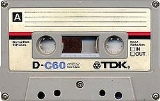
Compact Cassette

Encyclopedia
The Compact Cassette, often referred to as audio cassette, cassette tape, cassette, or simply tape, is a magnetic tape
sound recording
format. It was designed originally for dictation
, but improvements in fidelity
led the Compact Cassette to supplant the Stereo 8-track cartridge and reel-to-reel
tape recording in most non-professional applications. Its uses ranged from portable audio to home recording to data storage for early microcomputer
s. Between the early 1970s and the late 1990s, the cassette was one of the two most common formats for prerecorded music, first alongside the LP record
and later the Compact Disc
.
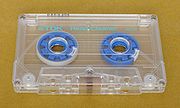
Compact Cassettes consist of two miniature spool
s, between which a magnetically coated plastic tape is passed and wound. These spools and their attendant parts are held inside a protective plastic shell. Two stereo
pairs of tracks (four total) or two monaural
analog audio tracks are available on the tape; one stereo pair or one monophonic track is played or recorded when the tape is moving in one direction and the second pair when moving in the other direction. This reversal is achieved either by manually flipping the cassette or by having the machine itself change the direction of tape movement ("auto-reverse").
 In 1935, decades before the introduction of the Compact Cassette, AEG
released the first reel-to-reel tape recorder (in German: Tonbandgerät), with the commercial name "Magnetophon
", based on the invention of the magnetic tape
(1928) by Fritz Pfleumer
, which used similar technology but with open reels (for which the tape was manufactured by BASF
). These instruments were still very expensive and relatively difficult to use and were therefore used mostly by professionals in radio station
s and recording studio
s. For private use the (reel to reel) tape recorder was not very common and only slowly took off from about the 1950s; with prices between 700 and 1500 DM (which would now be about to €
) such machines were still far too expensive for the mass market and their vacuum tube
construction made them very bulky. In the early 1960s, however, the weights and the prices dropped when vacuum tubes were replaced by transistors. Reel-to-reel tape recorders then became more common in household use, though never but a small fraction of the number of homes using long playing record disc players.
In 1958, following four years of development, RCA Victor introduced the stereo, quarter-inch, reversible, reel-to-reel RCA tape cartridge
. It was a cassette, big (5" x 7"), but offered few pre-recorded tapes; despite multiple versions, it failed.
In 1962 Philips
invented the compact audio cassette medium for audio storage
, introducing it in Europe in August 1963 (at the Berlin Radio Show
), and in the United States (under the Norelco
brand) in November 1964, with the trademark
name Compact Cassette.
Although there were other magnetic tape cartridge systems, the Compact Cassette became dominant as a result of Philips' decision in the face of pressure from Sony
to license
the format free of charge. Philips also released the Norelco
Carry-Corder 150 recorder/player in the U.S. in November 1964. By 1966 over 250,000 recorders had been sold in the US alone and Japan soon became the major source of recorders. By 1968, 85 manufacturers had sold over 2.4 million players.
In the early years, sound quality was mediocre, but it improved dramatically by the early 1970s when it caught up with the quality of 8-track tape and kept improving. The Compact Cassette went on to become a popular (and re-recordable
) alternative to the 12 inch vinyl LP
during the late 1970s.
However, the system had been designed initially for dictation and portable use, with the audio quality of early players not well suited for music. Some early models also had unreliable mechanical design. In 1971 the Advent Corporation
introduced their Model 201 tape deck that combined Dolby type B
noise reduction and chromium dioxide
(CrO2) tape, with a commercial-grade tape transport mechanism supplied by the Wollensak camera division of 3M Corporation. This resulted in the format being taken more seriously for musical use, and started the era of high fidelity
cassettes and players.
During the 1980s, the cassette's popularity grew further as a result of portable pocket recorders and high-fidelity ("hi-fi") players, such as Sony's Walkman
, which used a body not much larger than the cassette tape itself, with mechanical keys on one side, or electronic buttons or display on the face. Sony's WM-10 was even smaller than the cassette itself and expanded to hold and play a cassette.
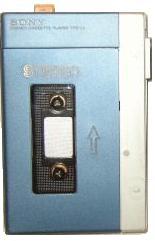 Like the transistor radio
in the 1950s and 1960s, the portable CD player
in the 1990s, and the MP3 player in the 2000s, the Walkman defined the portable music market in the 1980s, with cassette sales overtaking those of LPs
. Total vinyl record
sales remained higher well into the 1980s due to greater sales of singles, although cassette single
s achieved popularity for a period in the 1990s.
Apart from the purely technological advances cassettes brought, they also served as catalysts for social change. Their durability and ease of copying helped bring underground rock and punk music behind the Iron Curtain
, creating a foothold for Western culture among the younger generations. For similar reasons, cassettes became popular in developing nations.
One of the most famous political uses of cassette tapes was the dissemination of sermons by the Ayatollah Khomeini
throughout Iran
before the 1979 Iranian Revolution
, in which Khomeini urged the overthrow of the regime of the Shah
, Mohammad Reza Pahlavi
.
In 1970s India
, they were blamed for bringing unwanted secular influences into traditionally religious areas. Cassette technology was a booming market for pop music in India, drawing criticism from conservatives while at the same time creating a huge market for legitimate recording companies as well as pirated tapes. In some countries, particularly in the developing countries
, cassettes remain the dominant medium for purchasing and listening to music.
In 2011 the revised Oxford English Dictionary
announced it would be removing the word "cassette tape" from its Concise version, causing some media backlash.
s during the early 1990s. By 1993, annual shipments of CD players had reached 5 million, up 21% from the year before, while cassette player shipments had dropped 7% to approximately 3.4 million. The decline continued such that in 2001 cassettes accounted for only 4% of all music sold. Since then, the pre-recorded market has undergone further decline, with few retailers stocking them because they are no longer issued by the major music labels. Sales of pre-recorded music cassettes in the U.S. dropped from 442 million in 1990 to 274,000 by 2007. 2009 saw another record low with 34,000 cassettes sold, and 2,000 of those albums were at least 36 months old, bought at independent retailers in the south Atlantic region, in the suburbs. Most of the major U.S. music companies had discontinued them by late 2002 or 2003. However, , blank cassettes are still being produced and are sold at many retail stores, and facilities for cassette duplication remain available. Cassette recorders and players are becoming gradually scarcer, but are still widely available and featured in a notable percentage of Hi-Fi systems.
Cassettes remained popular for specific applications, such as car audio
, well into the 1990s. Cassettes and their players typically were more rugged and resistant to dust, heat, and shocks than the main digital competitor (the CD). Their lower fidelity was not considered a serious drawback inside the typically noisy automobile interior of the time. However, the advent of "shock proof" buffering technology
in CD players, the reduction of in-car noise levels, the general heightening of consumer expectations, and the introduction of CD auto-changers meant that, by the early 2000s, the CD player rapidly was replacing the cassette player as the default audio component in the majority of new vehicles in Europe and America.
While digital voice recorders are now common, Compact Cassette (or frequently microcassette
) recorders may be cheaper and of sufficient quality to serve as adjuncts or substitutes for note taking in business and educational settings. Audiobooks, church services, and other spoken word material are still sold frequently on cassette, as lower fidelity generally is not a drawback for such content. While most publishers sell CD audiobooks, usually they also offer a cassette version at the same price. In the audiobooks application, where recordings may span several hours, cassettes also have the advantage of holding up to 150 minutes of material, whereas the average CD holds less than 80.
While cassettes and related equipment have become increasingly marginal in commercial music sales, recording on analog tape remains a desirable option for some; however that method recently is being overtaken by portable digital recorders. Musicians in the indie rock
community have showed slight interest in releasing cassettes. Such artists as Dirty Projectors
and Deerhunter
have made recent titles available on cassette, and Thurston Moore
of Sonic Youth
has claimed "I only listen to cassettes."
Among the last in the developed countries
to leave the compact cassette format are artists and groups belonging to the "dansband
" genre, many of who still, in the early 2000s, had released their albums both to CD and to compact cassettes. Since many of their fans now are older, they often belong to a generation less interested in buying a CD player. However, also in this genre, fewer artists and groups release recordings on compact cassette. As late as 2006, Lasse Stefanz
and Torgny Melins released their latest albums to both Compact Cassette and CD.
In India, film and devotional music continues to be released in the audio cassette format due to its low cost.
Botswana-based Diamond studios recently announced plans for establishing a plant to mass-produce cassettes in a bid to combat piracy.
In South Korea, the early English education boom for toddlers encourages a continuous demand for English language audio cassettes due to the affordable cost.
In recent years, the audio cassette format has seen a revival with independent record labels ("indie" labels) preferring to issue releases in this format due to its low cost and the difficulty in sharing tape music over the internet. Underground and DIY communities release regularly, and sometimes exclusively, on cassette format, particularly in experimental music
circles and to a lesser extent in hardcore punk
, screamo, and black metal circles, out of a fondness for the format.
, though, because of the limitations of the cassette's size and speed, it initially compared poorly in quality. Unlike the 4-track stereo open-reel format, the two stereo tracks of each side lie adjacent to each other, rather than being interleaved with the tracks of the other side. This permitted monaural cassette players to play stereo recordings "summed" as mono tracks and permitted stereo players to play mono recordings through both speakers. The tape is 3.81 mm (0.150 in) wide, with each stereo track 0.6 mm wide and an unrecorded guard band
between each track. The tape moves at 4.8 cm/s (1 7/8 in/s
) from left to right.
For comparison, the typical open reel format in consumer use was ¼ inch (6.35 mm) wide, each stereo track nominally 1⁄16 inch (1.59 mm) wide, and running at either 9.5 or 19 cm/s (3.75 or 7.5 in/s).
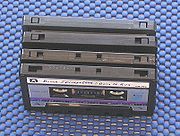 Cassette tapes are made of a polyester
type plastic film with a magnetic coating. The original magnetic material was based on gamma ferric oxide (Fe2O3). Circa 1970, 3M Company developed a cobalt volume-doping process combined with a double-coating technique to enhance overall tape output levels. This product was marketed as "High Energy" under its Scotch brand of recording tapes. Inexpensive cassettes commonly are labeled "low-noise," but typically are not optimized for high frequency response
. For this reason, some low-grade IEC Type I tapes have been marketed specifically as better suited for data storage than for sound recording.
At about the same time, chromium dioxide (CrO2) was introduced by DuPont, the inventor of the particle, and BASF
, the inventor of magnetic recording, and then coatings using magnetite
(Fe3O4) such as TDK's Audua were produced in an attempt to approach the sound quality of vinyl records. Cobalt
-absorbed iron oxide (Avilyn) was introduced by TDK in 1974 and proved very successful. Finally, pure metal particles (as opposed to oxide formulations) were introduced in 1979 by 3M under the trade name Metafine. The tape coating on most Cassettes sold today as either "Normal" or "Chrome" consists of ferric oxide and cobalt mixed in varying ratios (and using various processes); there are very few cassettes on the market that use a pure (CrO2) coating.
Simple voice recorders are designed to work with standard ferric formulations. High fidelity tape decks usually are built with switches or detectors for the different bias
and equalization
requirements for high performance tapes. The most common, iron oxide tapes (defined by an IEC
standard as "Type I"), use 120 µs equalization, while chrome and cobalt-absorbed tapes (IEC Type II) require 70 µs equalization. The recording "bias" equalizations also were different (and had a much longer time constant). BASF and Sony
tried a dual layer tape with both ferric oxide and chrome dioxide known as 'ferrichrome' (FeCr) (IEC Type III), but these were available for only a short time in the 1970s. Metal Cassettes (IEC Type IV) also use 70 µs equalization, and provide still further improvement in sound quality. The quality normally is reflected in the price; Type I cassettes generally are the cheapest, and Type IV are usually the most expensive. BASF chrome tape used in commercially pre-recorded cassettes used 120 µs (type I) equalization to allow greater high-frequency dynamic range for better sound quality, but the greater selling point for the music labels was that the Type I cassette shell could be used for both ferric and for chrome music cassettes.
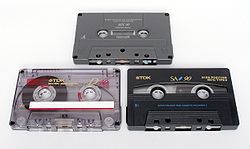
Notches on top of the cassette shell indicate the type of tape within. Type I cassettes have only write-protect
notches, Type II have an additional pair next to the write protection ones, and Type IV (metal) have a third set in the middle of the cassette shell. These allow cassette deck
s to detect the tape type automatically and select the proper bias and equalization. Virtually all recent hi-fi systems (with cassette decks) lack this feature; only a small niche of cassette decks (hi-fi separates) have the tape type selector. Playing Type II and IV tapes on a player without detection will produce exaggerated treble, but it may not be noticeable because such devices typically have amplifiers that lack extended high-frequency output. Recording on these units, however, results in very low sound reproduction, and sometimes distortion and hiss is heard. Also, these cheaper units cannot erase high bias or metal bias tapes. Attempting to do so will result in "print-through
".
, which made them unsuitable for general use. 150 minute length is still available from Maxell (UR 150), Sony (CDixI 150) and TDK (TDK AE 150).
Although the TDK-D C180 was produced for a decade (1972-82 ), it is very rare, because of several technical flaws. The tape had to be so thin that it was nearly transparent and therefore had fewer particles to magnetize, resulting in a poor sound quality and even worse durability. It required a strong motor to be driven, and had high wow and flutter. Finally, it took a relatively long time to rewind.
Other lengths are (or were) also available from some vendors, including C10 and C15 (useful for saving data from early home computer
s and in telephone answering machine
s), C30, C40, C50, C54, C64, C70, C74, C80, C84, C100, C105, and C110. As of 2010, Thomann still offers C10, C20, C30 and C40 IEC Type II tapes for use with 4- and 8-track portastudio
s.
Some companies included a complimentary blank cassette with their portable cassette recorders in the early 1980s. Panasonic's was a C14 and came with a song recorded on side one, and a blank side two. Except for C74 and C100, such non-standard lengths always have been hard to find, and tend to be more expensive than the more popular lengths. Home taping enthusiasts may have found certain lengths useful for fitting an album neatly on one or both sides of a tape. For instance, the initial maximum playback time of Compact Discs was 74 minutes, explaining the relative popularity of C74 cassettes.
mechanism to prevent re-recording and accidental erasure of important material. Each side of the cassette has a plastic tab on the top that may be broken off, leaving a small indentation in the shell. This indentation allows the entry of a sensing lever that prevents the operation of the recording function when the cassette is inserted into a cassette deck. If the cassette is held with one of the labels facing the user and the tape opening at the bottom, the write-protect tab for the corresponding side is at the top-left. Occasionally, manufacturers provided a movable panel that could be used to enable or disable write-protect on tapes.
If later required, a piece of adhesive tape
can be placed over the indentation to bypass the protection, or (on some decks), the lever can be manually depressed to record on a protected tape. Extra care is required to avoid covering the additional indents on high bias
or metal bias tape cassettes adjacent to the write-protect tabs.
The disadvantage with tape leaders was that the sound recording or playback did not start at the beginning of the tape, forcing the user to cue forward to the start of the magnetic section. For certain applications, such as dictation, special cassettes containing leaderless tapes were made, typically with stronger material and for use in machines that had more sophisticated end-of-tape prediction.
Stereo recorders eventually evolved into high fidelity and were known as cassette decks, after the reel-to-reel decks. Hi-Fi cassette decks, in contrast to cassette recorders and cassette players, often didn't have built-in amplification or speakers. Many formats of cassette players and recorders have evolved over the years. Initially all were top loading, usually with cassette on one side, and VU meter
s and recording level controls on the other side. Older models used combinations of levers and sliding buttons for control.
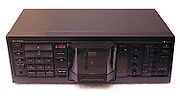 A major innovation was the front-loading arrangement. Pioneer
's angled cassette bay and the exposed bays of some Sansui models eventually were standardized as a front-loading door into which a cassette would be loaded. Later models would adopt electronic buttons, and replace conventional meters (which could be "pegged" when overloaded) with electronic LED
or vacuum fluorescent display
s, with level controls typically being controlled by either rotary controls or side-by-side sliders. BIC and Marantz briefly offered models that could be run at double speeds, but Nakamichi
was widely recognized as one of the first companies to create decks that rivaled reel-to-reel decks with frequency response from the full 20–20,000 Hz range, low noise, and very low wow and flutter
. The 3-head closed-loop dual capstan Nakamichi 1000 (1973) is one early example. Unlike typical cassette decks that use a single head for both record and playback plus a second head for erasing, the Nakamichi 1000, like the better reel-to-reel recorders, used three separate heads to optimize these functions.
Other contenders for the highest "HiFi" quality on this medium were two companies already widely known for their excellent quality reel-to-reel tape recorders: Tandberg
and Revox
(consumer brand of the Swiss professional Studer
company for studio equipment). Tandberg started with combi-head machines, such as the TCD 300, and continued with the TCD 3x0 series with separate playback and recording heads. All TCD-models possessed dual-capstan drives, belt-driven from a single capstan motor and two separate reel motors. Frequency range extended to 18 kHz. After a disastrous overinvestment in colour television production, Tandberg folded and revived without the HiFi-branch these came from.
Revox went one step further: after much hesitation about whether to accept cassettes as a medium capable for meeting their strict standards from reel-to-reel recorders at all, they produced their B710MK I (Dolby B) and MK II (Dolby B&C) machines. Both cassette units possessed double capstan drives, but with two independent, electronically controlled capstan motors and two separate reel motors. The head assembly moved by actuating a damped solenoid movement, eliminating all belt drives and other wearable parts. These machines rivaled the Nakamichi in frequency and dynamic range
. The B710MKII also achieved 20–20,000 Hz and dynamics of over 72 dB with Dolby C on chrome and slightly less dynamic range, but greater headroom with metal tapes and Dolby C. Revox adjusted the frequency range on delivery with many years of use in mind: when new, the frequency curve went upwards a few dB at 15–20 kHz, aiming for flat response after 15 years of use, and headwear to match.
A last step taken by Revox produced even more-advanced cassette drives with electronic finetuning of bias and equalization during recording. Revox also produced amplifiers, a very expensive FM tuner, and a pickup with a special parallel-arm mechanism of their own design. After releasing that product, Studer encountered financial difficulties. It had to save itself by folding its Revox-branch and all its consumer products (except their last reel-to-reel recorder, the B77).
Note that, while Nakamichi violated the tape recording standards to achieve the highest dynamics possible, producing non-compatible cassettes for playback on other machines, both Tandberg and Revox kept to the standards and produced cassettes that could be played back on other machines.
A third company, the well known Danish Bang & Olufsen
, invented a special, improved system for improving headroom at high frequencies, to reduce tape saturation despite lower bias levels. This "head room extension method, HX" was called Dolby HX Pro in full and patented. Their finest machine with HX Pro was the Beocord 9000, which indeed performed excellently. However, this machine's transport possessed only a single capstan and a single drive motor - as opposed to a multiple-motor, dual-capstan arrangement. This did not make the B&O
contender a popular choice with HiFi enthusiasts. Most of them favored Nakamichi, Tandberg or Revox instead, all of which were more mechanically complex. HX Pro was adopted by other manufacturers, including Technics
, while Aiwa
incorporated the technology into their top of the range personal stereo
s, as well as into their static machines.
As they became aimed at more casual users, fewer decks had microphone inputs. Dual decks became popular and incorporated into home entertainment systems of all sizes for tape dubbing. Although the quality would suffer each time a source was copied, there are no mechanical restrictions on copying from a record, radio, or another cassette source. Even as CD recorders are becoming more popular, some incorporate cassette decks for professional applications.
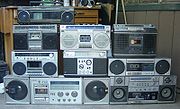 Another format that made an impact on culture in the 1980s was the radio-cassette, aka the "boom box" (a name used commonly only in the USA), which combined the portable cassette deck with a radio tuner and speakers capable of producing significant sound levels. These devices became synonymous with urban youth culture in entertainment, which led to the somewhat derisive nickname "ghetto blaster."
Applications for car stereos varied widely. Auto manufacturers in the U.S. typically would fit a cassette slot into their standard large radio faceplates. Europe and Asia would standardize on DIN and double DIN sized faceplates
. In the 1980s, a high-end installation would have a Dolby AM/FM cassette deck, and they rendered the 8-track cartridge
obsolete in car installations because of space, performance, and audio quality. As the cost of building CD players declined, many manufacturers offered a CD player, but some cars, especially those targeted at older drivers, still offer the option of a cassette player, either by itself or sometimes in combination with a CD slot. In fact, the 2009 Lexus ES 350 still comes with a cassette player as standard equipment. The newest cars often are not designed to accommodate cassette players, but the auxiliary jack advertised for MP3 players can be used also with portable cassette players.
 Although the cassettes themselves were relatively durable, the players required regular maintenance to perform properly. Head cleaning may be done with long swabs, soaked with isopropyl alcohol
, or cassette-shaped devices that could be inserted into a tape deck to remove buildup of iron-oxide from the heads
, tape-drive capstan, and pinch-roller. Some otherwise normal recording tapes included sections of leader that could clean the tape heads. One of the concerns of the time however was the use of abrasive cleaning tape. Some of the cleaning tapes actually felt rough to the touch and were considered damaging to the heads.
Similarly shaped demagnetizers used magnets to degauss the deck, which kept sound from becoming distorted. A common mechanical problem occurred when a worn-out or dirty player rotated the supply spool faster than the take-up spool or failed to release the heads from the tape upon ejection. This would cause the magnetic tape to be fed out through the bottom of the cassette and become tangled in the mechanism of the player. In these cases the player was said to have "eaten" the tape, and it often destroyed the playability of the cassette altogether, and resulted in the common sight of tangled tape on the side of the road. Cutting blocks, analogous to those used for open-reel 1/4" tape were readily available, though used mainly for retrieving valued recordings, could be used to remove the damaged portion, or repair the break in the tape. Creation of compilations usually was by re-recording rather than splicing sections of songs because of the much smaller tape area.
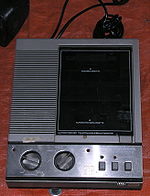 The Compact Cassette originally was intended for use in dictation
machines. In this capacity, some later-model cassette-based dictation machines could also run the tape at half speed (15⁄16 in/s) as playback quality was not critical. The Compact Cassette soon became a popular medium for distributing prerecorded music—initially through The Philips Record Company (and subsidiary labels Mercury and Philips in the U.S.). As of 2009, one still finds cassettes used for a variety of purposes, such as journalism
, oral history, meeting and interview transcripts, audio-books, and so on. However, they are starting to give way to Compact Discs and more "compact" digital storage media.
The Compact Cassette quickly found use in the commercial music industry. One artifact found on some commercially produced music cassettes was a sequence of test tones, called SDR (Super Dynamic Range, also called XDR, or eXtended Dynamic Range) soundburst tones, at the beginning and end of the tape, heard in order of low frequency to high. These were used during SDR/XDR's duplication process to gauge the quality of the tape medium. Many consumers objected to these tones since they were not part of the recorded music.
PMD-series recorders for the recording of speech interviews. The key advantages of the Marantz portable recorders were the accommodation of professional microphones with an XLR connector
, normal and double tape speed recording for extended frequency response, Dolby and dbx
noise reduction systems, manual or automatic gain control (AGC) level control, peak limiter, multiple tape formulation accommodation, microphone and line level input connections, unbalanced RCA stereo input and output connections, live or tape monitoring, VU meter
, headphone jack, playback pitch control, and operation on AC power or batteries optimized for long duration. Unlike less-expensive portable recorders that were limited to automatic gain control (AGC) recording schemes, the manual recording mode preserved low noise dynamics and avoided the automatic elevation of noise.
introduced the Portastudio
line of four- and eight-track cassette recorders for home-studio use.
In the simplest configuration, rather than playing a pair of stereo channels of each side of the cassette, the typical "portastudio" used a four-track tape head assembly to access four tracks on the cassette at once (with the tape playing in one direction). Each track could be recorded to, erased, or played back individually, allowing musicians to overdub themselves and create simple multitrack recordings easily, which could then be mixed down to a finished stereo version on an external machine. To increase audio quality in these recorders, the tape speed sometimes was doubled to 3¾ inches per second, in comparison to the standard 17⁄8 ips; additionally, dbx
, Dolby B or Dolby C noise reduction provided compansion (compression of the signal during recording with equal and opposite expansion of the signal during playback), which yields increased dynamic range
by lowering the noise level and increasing the maximum signal level before distortion occurs. Multi-track cassette recorders with built-in mixer
and signal routing features ranged from easy-to-use beginner units up to professional-level recording systems.
Although professional musicians typically used multitrack cassette machines only as "sketchpads", Bruce Springsteen
's "Nebraska
" was recorded entirely on a four-track cassette tape.
 Most compact cassettes were sold blank, and used for recording (dubbing
) the owner's records (as backup, to play in the car, or to make mixtape compilations
), their friends' records, or music from the radio. This practice was condemned by the music industry with such alarmist slogans as "Home Taping Is Killing Music
". However, many claimed that the medium was ideal for spreading new music and would increase sales, and strongly defended their right to copy at least their own records onto tape. For a limited time in the early 1980s Island Records
sold chromium dioxide “One Plus One” cassettes that had an album prerecorded on one side and the other was left blank for the purchaser to use. Cassettes were also a boon to people wishing to tape concerts (unauthorized
or authorized) for sale or trade, a practice tacitly or overtly encouraged by many bands, such as the Grateful Dead
, with a more counterculture bent. Blank Compact Cassettes also were an invaluable tool to spread the music of unsigned acts, especially within tape trading
networks.
Various legal cases arose surrounding the dubbing of cassettes. In the UK, in the case of CBS Songs v. Amstrad
(1988), the House of Lords
found in favor of Amstrad
that producing equipment that facilitated the dubbing of cassettes, in this case a high-speed twin cassette deck that allowed one cassette to be copied directly onto another, did not constitute the infringement of copyright. In a similar case, a shop owner who rented cassettes and sold blank tapes was not liable for copyright infringement even though it was clear that his customers likely were dubbing them at home. In both cases, the courts held that manufacturers and retailers could not be held accountable for the actions of consumers.
As an alternative to home dubbing, in the late 1980s, the Personics company installed booths in record stores across America that allowed customers to make personalized mixtapes from a digitally encoded back-catalogue with customised printed covers.
, Wollensak
, Sony
, and others. The duplicators would operate at double (or greater) tape speed. Systems were scalable, enabling the user to purchase initially one "master" unit (typically with 3 "copy" bays) and add "slave" units for expanded duplication abilities.
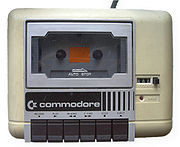
 The Hewlett Packard HP 9830
was one of the first desktop computers in the early 1970s to use automatically controlled cassette tapes for storage. It could save and find files by number, using a clear leader to detect the end of tape. These would be replaced by specialized cartridges, such as the 3M DC-series. Many of the earliest microcomputers implemented the Kansas City standard
for digital data storage. Most home computer
s of the late 1970s and early 1980s could use cassettes for data storage as a cheaper alternative to floppy disk
s, though users often had to manually stop and start a cassette recorder. Even the first version of the IBM PC
of 1981 had a cassette port and a command in its ROM
BASIC
programming language to use it. However, this was seldom used, as even then floppy drives had become commonplace in high-end machines.
The typical encoding method for computer data was simple FSK
, which resulted in data rates of typically 500 to 2000 bit/s, although some games used special, faster-loading routines, up to around 4000 bit/s. A rate of 2000 bit/s equates to a capacity of around 660 kilobyte
s per side of a 90-minute tape.
Among home computers that used primarily data cassettes for storage in the late 1970s were Commodore PET
(early models of which had a cassette drive built-in), TRS-80
and Apple II, until the introduction of floppy disk
drives and hard drives in the early 1980s made cassettes virtually obsolete for day-to-day use in the US. However, they remained in use on some portable systems such as the TRS-80 Model 100 line
until the early 1990s. Due to the high price of disks, cassettes also remained the primary data storage medium for 8-bit computers, such as the Commodore 64
, ZX Spectrum
, MSX
and Amstrad CPC 464, in many countries (for example, the UK, where 8-bit software was mostly sold on cassette until that market disappeared altogether in the early 1990s.)
In some countries, including the United Kingdom
, Poland
, Hungary
, and the Netherlands
, audio cassette data storage was so popular that some radio stations would broadcast computer programs that listeners could record onto cassette and then load into their computer. See BASICODE
.
The use of better modulation
techniques, such as QPSK or those used in modern modems, combined with the improved bandwidth and signal to noise ratio of newer cassette tapes, allowed much greater capacities (up to 60 MB
) and data transfer speeds of 10 to 17 kB/s on each cassette. They found use during the 1980s in data logger
s for scientific and industrial equipment.
The audio cassette was adapted into what is called a streamer cassette, a version dedicated solely for data storage, and used chiefly for hard disk backups and other types of data. Streamer cassettes look almost exactly the same as a standard cassette, with the exception of having a notch about 1/4 inch wide and deep situated slightly off-center at the top edge of the cassette. Streamer cassettes also have a re-usable write-protect tab on only one side of the top edge of the cassette, with the other side of the top edge having either only an open rectangular hole, or no hole at all. This is due to the whole 1/8 inch width of the tape loaded inside being used by a streamer cassette drive for the writing and reading of data, hence only one side of the cassette being used. Streamer cassettes can hold anywhere from 50 to 160 megabytes of data.
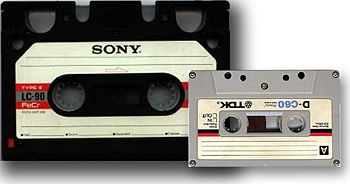 Elcaset
was a short-lived audio format created by Sony
in 1976 that was about twice the size, using larger tape and a higher recording speed. Unlike the original cassette, the Elcaset was designed from the outset for sound quality. It was never widely accepted, as the quality of standard cassette decks rapidly approached high fidelity.
Technical development of the cassette effectively ceased when digital recordable media, such as DAT
and MiniDisc
, were introduced in the late 1980s and early 1990s. Anticipating the switch from analog to digital format, major companies, such as Sony, shifted their focus to new media. In 1992, Philips introduced the Digital Compact Cassette
(DCC), a DAT-like tape in the same form factor as the compact audio cassette. It was aimed primarily at the consumer market. A DCC deck could play back both types of cassettes. Unlike DAT, which was accepted in professional usage because it could record without lossy compression effects, DCC failed in both home and mobile environments, and was discontinued in 1996.
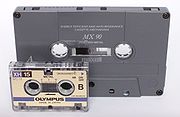 The microcassette
has in many cases supplanted the full-sized audio cassette in situations where voice-level fidelity is all that is required, such as in dictation machines and answering machines. Even these, in turn, are starting to give way to digital recorders of various descriptions. Since the rise of cheap CD-R
discs, and flash memory
-based digital audio players, the phenomenon of "home taping" has effectively switched to recording to Compact Disc or downloading from commercial or music sharing Web sites.
Because of consumer demand, the cassette has remained influential on design, more than a decade after its decline as a media mainstay. As the Compact Disc grew in popularity, cassette-shaped audio adapters
were developed to provide an economical and clear way to obtain CD functionality in vehicles equipped with cassette decks. A portable CD player would have its analog line-out connected to the adapter, which in turn fed the signal to the head of the cassette deck. These adapters continue to function with MP3 players as well, and generally are more reliable than the FM transmitters that must be used to adapt CD players to MP3s. MP3 players shaped as audio cassettes have also become available, which can be inserted into any compact cassette player and communicate with the head as if they were normal cassettes.
Magnetic tape
Magnetic tape is a medium for magnetic recording, made of a thin magnetizable coating on a long, narrow strip of plastic. It was developed in Germany, based on magnetic wire recording. Devices that record and play back audio and video using magnetic tape are tape recorders and video tape recorders...
sound recording
Sound recording and reproduction
Sound recording and reproduction is an electrical or mechanical inscription and re-creation of sound waves, such as spoken voice, singing, instrumental music, or sound effects. The two main classes of sound recording technology are analog recording and digital recording...
format. It was designed originally for dictation
Dictation
Dictation can refer to:*Dictation , when one person speaks while another person transcribes what is spoken.*A dictation machine, a device used to record speech for transcription....
, but improvements in fidelity
High fidelity
High fidelity—or hi-fi—reproduction is a term used by home stereo listeners and home audio enthusiasts to refer to high-quality reproduction of sound or images, to distinguish it from the poorer quality sound produced by inexpensive audio equipment...
led the Compact Cassette to supplant the Stereo 8-track cartridge and reel-to-reel
Reel-to-reel audio tape recording
Reel-to-reel, open reel tape recording is the form of magnetic tape audio recording in which the recording medium is held on a reel, rather than being securely contained within a cassette....
tape recording in most non-professional applications. Its uses ranged from portable audio to home recording to data storage for early microcomputer
Microcomputer
A microcomputer is a computer with a microprocessor as its central processing unit. They are physically small compared to mainframe and minicomputers...
s. Between the early 1970s and the late 1990s, the cassette was one of the two most common formats for prerecorded music, first alongside the LP record
LP record
The LP, or long-playing microgroove record, is a format for phonograph records, an analog sound storage medium. Introduced by Columbia Records in 1948, it was soon adopted as a new standard by the entire record industry...
and later the Compact Disc
Compact Disc
The Compact Disc is an optical disc used to store digital data. It was originally developed to store and playback sound recordings exclusively, but later expanded to encompass data storage , write-once audio and data storage , rewritable media , Video Compact Discs , Super Video Compact Discs ,...
.
Compact Cassettes consist of two miniature spool
Spool
Spool can mean one of the following:*Spool, a usually low-flanged or unflanged cylinder on which thread, wire, cable, paper, film, or tape is wound for distribution or use....
s, between which a magnetically coated plastic tape is passed and wound. These spools and their attendant parts are held inside a protective plastic shell. Two stereo
Stereophonic sound
The term Stereophonic, commonly called stereo, sound refers to any method of sound reproduction in which an attempt is made to create an illusion of directionality and audible perspective...
pairs of tracks (four total) or two monaural
Monaural
Monaural or monophonic sound reproduction is single-channel. Typically there is only one microphone, one loudspeaker, or channels are fed from a common signal path...
analog audio tracks are available on the tape; one stereo pair or one monophonic track is played or recorded when the tape is moving in one direction and the second pair when moving in the other direction. This reversal is achieved either by manually flipping the cassette or by having the machine itself change the direction of tape movement ("auto-reverse").
History
AEG
Allgemeine Elektricitäts-Gesellschaft was a German producer of electrical equipment founded in 1883 by Emil Rathenau....
released the first reel-to-reel tape recorder (in German: Tonbandgerät), with the commercial name "Magnetophon
Magnetophon
Magnetophon was the brand or model name of the pioneering reel-to-reel tape recorder developed by engineers of the German electronics company AEG in the 1930s, based on the magnetic tape invention by Fritz Pfleumer...
", based on the invention of the magnetic tape
Magnetic tape
Magnetic tape is a medium for magnetic recording, made of a thin magnetizable coating on a long, narrow strip of plastic. It was developed in Germany, based on magnetic wire recording. Devices that record and play back audio and video using magnetic tape are tape recorders and video tape recorders...
(1928) by Fritz Pfleumer
Fritz Pfleumer
Fritz Pfleumer was a German-Austrian engineer who invented magnetic tape for recording sound.-Biography:...
, which used similar technology but with open reels (for which the tape was manufactured by BASF
BASF
BASF SE is the largest chemical company in the world and is headquartered in Germany. BASF originally stood for Badische Anilin- und Soda-Fabrik . Today, the four letters are a registered trademark and the company is listed on the Frankfurt Stock Exchange, London Stock Exchange, and Zurich Stock...
). These instruments were still very expensive and relatively difficult to use and were therefore used mostly by professionals in radio station
Radio station
Radio broadcasting is a one-way wireless transmission over radio waves intended to reach a wide audience. Stations can be linked in radio networks to broadcast a common radio format, either in broadcast syndication or simulcast or both...
s and recording studio
Recording studio
A recording studio is a facility for sound recording and mixing. Ideally both the recording and monitoring spaces are specially designed by an acoustician to achieve optimum acoustic properties...
s. For private use the (reel to reel) tape recorder was not very common and only slowly took off from about the 1950s; with prices between 700 and 1500 DM (which would now be about to €
Euro
The euro is the official currency of the eurozone: 17 of the 27 member states of the European Union. It is also the currency used by the Institutions of the European Union. The eurozone consists of Austria, Belgium, Cyprus, Estonia, Finland, France, Germany, Greece, Ireland, Italy, Luxembourg,...
) such machines were still far too expensive for the mass market and their vacuum tube
Vacuum tube
In electronics, a vacuum tube, electron tube , or thermionic valve , reduced to simply "tube" or "valve" in everyday parlance, is a device that relies on the flow of electric current through a vacuum...
construction made them very bulky. In the early 1960s, however, the weights and the prices dropped when vacuum tubes were replaced by transistors. Reel-to-reel tape recorders then became more common in household use, though never but a small fraction of the number of homes using long playing record disc players.
In 1958, following four years of development, RCA Victor introduced the stereo, quarter-inch, reversible, reel-to-reel RCA tape cartridge
RCA tape cartridge
The RCA Victor tape cartridge was a magnetic tape format designed to offer stereo quarter-inch reel-to-reel tape in a more convenient format for the home market...
. It was a cassette, big (5" x 7"), but offered few pre-recorded tapes; despite multiple versions, it failed.
In 1962 Philips
Philips
Koninklijke Philips Electronics N.V. , more commonly known as Philips, is a multinational Dutch electronics company....
invented the compact audio cassette medium for audio storage
Sound recording and reproduction
Sound recording and reproduction is an electrical or mechanical inscription and re-creation of sound waves, such as spoken voice, singing, instrumental music, or sound effects. The two main classes of sound recording technology are analog recording and digital recording...
, introducing it in Europe in August 1963 (at the Berlin Radio Show
Internationale Funkausstellung Berlin
The IFA or Internationale Funkausstellung Berlin is one of the oldest industrial exhibitions in Germany. Between 1924 and 1939 it was an annual event, but as from 1950 it was organized on a two yearly basis until 2005. Since then it has become an annual event again, held in September...
), and in the United States (under the Norelco
Norelco
Norelco is the American brand name for electric shavers and other personal care products made by the Consumer Lifestyle division of Philips.-Norelco and Philishave:...
brand) in November 1964, with the trademark
Trademark
A trademark, trade mark, or trade-mark is a distinctive sign or indicator used by an individual, business organization, or other legal entity to identify that the products or services to consumers with which the trademark appears originate from a unique source, and to distinguish its products or...
name Compact Cassette.
Although there were other magnetic tape cartridge systems, the Compact Cassette became dominant as a result of Philips' decision in the face of pressure from Sony
Sony
, commonly referred to as Sony, is a Japanese multinational conglomerate corporation headquartered in Minato, Tokyo, Japan and the world's fifth largest media conglomerate measured by revenues....
to license
License
The verb license or grant licence means to give permission. The noun license or licence refers to that permission as well as to the document recording that permission.A license may be granted by a party to another party as an element of an agreement...
the format free of charge. Philips also released the Norelco
Norelco
Norelco is the American brand name for electric shavers and other personal care products made by the Consumer Lifestyle division of Philips.-Norelco and Philishave:...
Carry-Corder 150 recorder/player in the U.S. in November 1964. By 1966 over 250,000 recorders had been sold in the US alone and Japan soon became the major source of recorders. By 1968, 85 manufacturers had sold over 2.4 million players.
In the early years, sound quality was mediocre, but it improved dramatically by the early 1970s when it caught up with the quality of 8-track tape and kept improving. The Compact Cassette went on to become a popular (and re-recordable
Sound recording and reproduction
Sound recording and reproduction is an electrical or mechanical inscription and re-creation of sound waves, such as spoken voice, singing, instrumental music, or sound effects. The two main classes of sound recording technology are analog recording and digital recording...
) alternative to the 12 inch vinyl LP
Gramophone record
A gramophone record, commonly known as a phonograph record , vinyl record , or colloquially, a record, is an analog sound storage medium consisting of a flat disc with an inscribed, modulated spiral groove...
during the late 1970s.
Introduction of music cassettes
The mass production of compact audio cassettes began in 1964 in Hannover, Germany. Prerecorded music cassettes (also known as Musicassettes; M.C. for short) were launched in Europe in late 1965. The Mercury Record Company, a U.S. affiliate of Philips, introduced M.C. to the U.S. in July 1966. The initial offering consisted of 49 titlesHowever, the system had been designed initially for dictation and portable use, with the audio quality of early players not well suited for music. Some early models also had unreliable mechanical design. In 1971 the Advent Corporation
Henry Kloss
Henry Kloss was a prominent American audio engineer and businessman who helped advance high fidelity loudspeaker and radio receiver technology beginning in the 1950s. Kloss was an undergraduate student in physics at Massachusetts Institute of Technology , but never received a degree...
introduced their Model 201 tape deck that combined Dolby type B
Dolby noise reduction system
Dolby NR is the name given to a series of noise reduction systems developed by Dolby Laboratories for use in analog magnetic tape recording. The first was Dolby A, a professional broadband noise reduction for recording studios in 1966, but the best-known is Dolby B , a sliding band system for the...
noise reduction and chromium dioxide
Chromium(IV) oxide
Chromium dioxide or chromium oxide is a synthetic magnetic substance once widely used in magnetic tape emulsion. With the increasing popularity of CDs and DVDs, the use of chromium oxide has declined. However, it is still used in data tape applications for enterprise-class storage systems...
(CrO2) tape, with a commercial-grade tape transport mechanism supplied by the Wollensak camera division of 3M Corporation. This resulted in the format being taken more seriously for musical use, and started the era of high fidelity
High fidelity
High fidelity—or hi-fi—reproduction is a term used by home stereo listeners and home audio enthusiasts to refer to high-quality reproduction of sound or images, to distinguish it from the poorer quality sound produced by inexpensive audio equipment...
cassettes and players.
During the 1980s, the cassette's popularity grew further as a result of portable pocket recorders and high-fidelity ("hi-fi") players, such as Sony's Walkman
Walkman
Walkman is a Sony brand tradename originally used for portable audio cassette, and now used to market Sony's portable audio and video players as well as a line of Sony Ericsson mobile phones...
, which used a body not much larger than the cassette tape itself, with mechanical keys on one side, or electronic buttons or display on the face. Sony's WM-10 was even smaller than the cassette itself and expanded to hold and play a cassette.
Transistor radio
A transistor radio is a small portable radio receiver using transistor-based circuitry. Following their development in 1954 they became the most popular electronic communication device in history, with billions manufactured during the 1960s and 1970s...
in the 1950s and 1960s, the portable CD player
Portable CD player
A portable CD player is a portable audio player used to play Compact Discs. The first audio player released was the D-50 by Sony. The D-50 was able to play/pause, stop, rewind, and fast forward music all in one device...
in the 1990s, and the MP3 player in the 2000s, the Walkman defined the portable music market in the 1980s, with cassette sales overtaking those of LPs
Gramophone record
A gramophone record, commonly known as a phonograph record , vinyl record , or colloquially, a record, is an analog sound storage medium consisting of a flat disc with an inscribed, modulated spiral groove...
. Total vinyl record
Gramophone record
A gramophone record, commonly known as a phonograph record , vinyl record , or colloquially, a record, is an analog sound storage medium consisting of a flat disc with an inscribed, modulated spiral groove...
sales remained higher well into the 1980s due to greater sales of singles, although cassette single
Cassette single
A cassette single is a music single in the form of a Compact Cassette.- History :...
s achieved popularity for a period in the 1990s.
Apart from the purely technological advances cassettes brought, they also served as catalysts for social change. Their durability and ease of copying helped bring underground rock and punk music behind the Iron Curtain
Iron Curtain
The concept of the Iron Curtain symbolized the ideological fighting and physical boundary dividing Europe into two separate areas from the end of World War II in 1945 until the end of the Cold War in 1989...
, creating a foothold for Western culture among the younger generations. For similar reasons, cassettes became popular in developing nations.
One of the most famous political uses of cassette tapes was the dissemination of sermons by the Ayatollah Khomeini
Ruhollah Khomeini
Grand Ayatollah Sayyed Ruhollah Musavi Khomeini was an Iranian religious leader and politician, and leader of the 1979 Iranian Revolution which saw the overthrow of Mohammad Reza Pahlavi, the Shah of Iran...
throughout Iran
Iran
Iran , officially the Islamic Republic of Iran , is a country in Southern and Western Asia. The name "Iran" has been in use natively since the Sassanian era and came into use internationally in 1935, before which the country was known to the Western world as Persia...
before the 1979 Iranian Revolution
Iranian Revolution
The Iranian Revolution refers to events involving the overthrow of Iran's monarchy under Shah Mohammad Reza Pahlavi and its replacement with an Islamic republic under Ayatollah Ruhollah Khomeini, the leader of the...
, in which Khomeini urged the overthrow of the regime of the Shah
Shah
Shāh is the title of the ruler of certain Southwest Asian and Central Asian countries, especially Persia , and derives from the Persian word shah, meaning "king".-History:...
, Mohammad Reza Pahlavi
Mohammad Reza Pahlavi
Mohammad Rezā Shāh Pahlavi, Shah of Iran, Shah of Persia , ruled Iran from 16 September 1941 until his overthrow by the Iranian Revolution on 11 February 1979...
.
In 1970s India
India
India , officially the Republic of India , is a country in South Asia. It is the seventh-largest country by geographical area, the second-most populous country with over 1.2 billion people, and the most populous democracy in the world...
, they were blamed for bringing unwanted secular influences into traditionally religious areas. Cassette technology was a booming market for pop music in India, drawing criticism from conservatives while at the same time creating a huge market for legitimate recording companies as well as pirated tapes. In some countries, particularly in the developing countries
Developing country
A developing country, also known as a less-developed country, is a nation with a low level of material well-being. Since no single definition of the term developing country is recognized internationally, the levels of development may vary widely within so-called developing countries...
, cassettes remain the dominant medium for purchasing and listening to music.
In 2011 the revised Oxford English Dictionary
Oxford English Dictionary
The Oxford English Dictionary , published by the Oxford University Press, is the self-styled premier dictionary of the English language. Two fully bound print editions of the OED have been published under its current name, in 1928 and 1989. The first edition was published in twelve volumes , and...
announced it would be removing the word "cassette tape" from its Concise version, causing some media backlash.
Decline
In many Western countries, the market for cassettes has declined sharply since its peak in the late 1980s. This has been noticeable particularly with pre-recorded cassettes, whose sales were overtaken by those of Compact DiscCompact Disc
The Compact Disc is an optical disc used to store digital data. It was originally developed to store and playback sound recordings exclusively, but later expanded to encompass data storage , write-once audio and data storage , rewritable media , Video Compact Discs , Super Video Compact Discs ,...
s during the early 1990s. By 1993, annual shipments of CD players had reached 5 million, up 21% from the year before, while cassette player shipments had dropped 7% to approximately 3.4 million. The decline continued such that in 2001 cassettes accounted for only 4% of all music sold. Since then, the pre-recorded market has undergone further decline, with few retailers stocking them because they are no longer issued by the major music labels. Sales of pre-recorded music cassettes in the U.S. dropped from 442 million in 1990 to 274,000 by 2007. 2009 saw another record low with 34,000 cassettes sold, and 2,000 of those albums were at least 36 months old, bought at independent retailers in the south Atlantic region, in the suburbs. Most of the major U.S. music companies had discontinued them by late 2002 or 2003. However, , blank cassettes are still being produced and are sold at many retail stores, and facilities for cassette duplication remain available. Cassette recorders and players are becoming gradually scarcer, but are still widely available and featured in a notable percentage of Hi-Fi systems.
Cassettes remained popular for specific applications, such as car audio
Car audio
Car audio/video , auto radio, mobile audio, 12-volt and other terms are used to describe the sound or video system fitted in an automobile. While 12-volt audio and video systems are also used, marketed, or manufactured for marine, aviation, and buses, this article focuses on cars as the most common...
, well into the 1990s. Cassettes and their players typically were more rugged and resistant to dust, heat, and shocks than the main digital competitor (the CD). Their lower fidelity was not considered a serious drawback inside the typically noisy automobile interior of the time. However, the advent of "shock proof" buffering technology
Electronic skip protection
Electronic skip protection is a memory buffer system used mainly in some portable Compact Disc players and all MiniDisc units.-Technology:...
in CD players, the reduction of in-car noise levels, the general heightening of consumer expectations, and the introduction of CD auto-changers meant that, by the early 2000s, the CD player rapidly was replacing the cassette player as the default audio component in the majority of new vehicles in Europe and America.
While digital voice recorders are now common, Compact Cassette (or frequently microcassette
Microcassette
A Microcassette is an audio storage medium introduced by Olympus in 1969. It uses the same width of magnetic tape as the Compact Cassette but in a much smaller container. By using thinner tape and half or a quarter the tape speed, microcassettes can offer comparable recording time to the compact...
) recorders may be cheaper and of sufficient quality to serve as adjuncts or substitutes for note taking in business and educational settings. Audiobooks, church services, and other spoken word material are still sold frequently on cassette, as lower fidelity generally is not a drawback for such content. While most publishers sell CD audiobooks, usually they also offer a cassette version at the same price. In the audiobooks application, where recordings may span several hours, cassettes also have the advantage of holding up to 150 minutes of material, whereas the average CD holds less than 80.
While cassettes and related equipment have become increasingly marginal in commercial music sales, recording on analog tape remains a desirable option for some; however that method recently is being overtaken by portable digital recorders. Musicians in the indie rock
Indie rock
Indie rock is a genre of alternative rock that originated in the United Kingdom and the United States in the 1980s. Indie rock is extremely diverse, with sub-genres that include lo-fi, post-rock, math rock, indie pop, dream pop, noise rock, space rock, sadcore, riot grrrl and emo, among others...
community have showed slight interest in releasing cassettes. Such artists as Dirty Projectors
Dirty Projectors
The Dirty Projectors aka David Longstreth includes Amber Coffman , Angel Deradoorian , Brian McOmber , Nat Baldwin , and Haley Dekle during live performances...
and Deerhunter
Deerhunter
Deerhunter is an American four-piece indie rock group originating from Atlanta, Georgia. The band, consisting of Bradford Cox, Moses Archuleta, Josh Fauver, and Lockett Pundt, have described themselves as "ambient punk," though they incorporate a wide range of genres, including noise rock, art...
have made recent titles available on cassette, and Thurston Moore
Thurston Moore
Thurston Joseph Moore is an American musician best known as a singer, songwriter and guitarist of Sonic Youth. He has also participated in many solo and group collaborations outside of Sonic Youth, as well as running the Ecstatic Peace! record label...
of Sonic Youth
Sonic Youth
Sonic Youth is an American alternative rock band from New York City, formed in 1981. The current lineup consists of Thurston Moore , Kim Gordon , Lee Ranaldo , Steve Shelley , and Mark Ibold .In their early career, Sonic Youth was associated with the No Wave art and music scene in New York City...
has claimed "I only listen to cassettes."
Among the last in the developed countries
Developed country
A developed country is a country that has a high level of development according to some criteria. Which criteria, and which countries are classified as being developed, is a contentious issue...
to leave the compact cassette format are artists and groups belonging to the "dansband
Dansband
Dansband is a Swedish term for a band that plays dansbandsmusik . Dansbandsmusik is often danced to in pairs. Jitterbug and foxtrot music are often included in this category. The music is primarily inspired by swing, schlager, country, jazz, and rock...
" genre, many of who still, in the early 2000s, had released their albums both to CD and to compact cassettes. Since many of their fans now are older, they often belong to a generation less interested in buying a CD player. However, also in this genre, fewer artists and groups release recordings on compact cassette. As late as 2006, Lasse Stefanz
Lasse Stefanz
Lasse Stefanz, earlier Lasse Stefans, is a country music-inspired dansband, formed in 1967 in Kristianstad, Sweden. The band was popular during the 1980s. The band was formed by Hans Sigfridsson, Lars Sigfridsson and Olle Jönsson. Later members are Christer Ericsson, Anders Pettersson and Gunnar...
and Torgny Melins released their latest albums to both Compact Cassette and CD.
In India, film and devotional music continues to be released in the audio cassette format due to its low cost.
Botswana-based Diamond studios recently announced plans for establishing a plant to mass-produce cassettes in a bid to combat piracy.
In South Korea, the early English education boom for toddlers encourages a continuous demand for English language audio cassettes due to the affordable cost.
In recent years, the audio cassette format has seen a revival with independent record labels ("indie" labels) preferring to issue releases in this format due to its low cost and the difficulty in sharing tape music over the internet. Underground and DIY communities release regularly, and sometimes exclusively, on cassette format, particularly in experimental music
Experimental music
Experimental music refers, in the English-language literature, to a compositional tradition which arose in the mid-20th century, applied particularly in North America to music composed in such a way that its outcome is unforeseeable. Its most famous and influential exponent was John Cage...
circles and to a lesser extent in hardcore punk
Hardcore punk
Hardcore punk is an underground music genre that originated in the late 1970s, following the mainstream success of punk rock. Hardcore is generally faster, thicker, and heavier than earlier punk rock. The origin of the term "hardcore punk" is uncertain. The Vancouver-based band D.O.A...
, screamo, and black metal circles, out of a fondness for the format.
Features
The cassette was a great step forward in convenience from reel-to-reel audio tape recordingReel-to-reel audio tape recording
Reel-to-reel, open reel tape recording is the form of magnetic tape audio recording in which the recording medium is held on a reel, rather than being securely contained within a cassette....
, though, because of the limitations of the cassette's size and speed, it initially compared poorly in quality. Unlike the 4-track stereo open-reel format, the two stereo tracks of each side lie adjacent to each other, rather than being interleaved with the tracks of the other side. This permitted monaural cassette players to play stereo recordings "summed" as mono tracks and permitted stereo players to play mono recordings through both speakers. The tape is 3.81 mm (0.150 in) wide, with each stereo track 0.6 mm wide and an unrecorded guard band
Guard band
-Radio and electronic signalling:In radio, a guard band is an unused part of the radio spectrum between radio bands, for the purpose of preventing interference....
between each track. The tape moves at 4.8 cm/s (1 7/8 in/s
Inches per second
The inch per second is a unit of speed or velocity. It expresses the distance in inches traveled or displaced, divided by time in seconds...
) from left to right.
For comparison, the typical open reel format in consumer use was ¼ inch (6.35 mm) wide, each stereo track nominally 1⁄16 inch (1.59 mm) wide, and running at either 9.5 or 19 cm/s (3.75 or 7.5 in/s).
Cassette types
Polyester
Polyester is a category of polymers which contain the ester functional group in their main chain. Although there are many polyesters, the term "polyester" as a specific material most commonly refers to polyethylene terephthalate...
type plastic film with a magnetic coating. The original magnetic material was based on gamma ferric oxide (Fe2O3). Circa 1970, 3M Company developed a cobalt volume-doping process combined with a double-coating technique to enhance overall tape output levels. This product was marketed as "High Energy" under its Scotch brand of recording tapes. Inexpensive cassettes commonly are labeled "low-noise," but typically are not optimized for high frequency response
Frequency response
Frequency response is the quantitative measure of the output spectrum of a system or device in response to a stimulus, and is used to characterize the dynamics of the system. It is a measure of magnitude and phase of the output as a function of frequency, in comparison to the input...
. For this reason, some low-grade IEC Type I tapes have been marketed specifically as better suited for data storage than for sound recording.
At about the same time, chromium dioxide (CrO2) was introduced by DuPont, the inventor of the particle, and BASF
BASF
BASF SE is the largest chemical company in the world and is headquartered in Germany. BASF originally stood for Badische Anilin- und Soda-Fabrik . Today, the four letters are a registered trademark and the company is listed on the Frankfurt Stock Exchange, London Stock Exchange, and Zurich Stock...
, the inventor of magnetic recording, and then coatings using magnetite
Magnetite
Magnetite is a ferrimagnetic mineral with chemical formula Fe3O4, one of several iron oxides and a member of the spinel group. The chemical IUPAC name is iron oxide and the common chemical name is ferrous-ferric oxide. The formula for magnetite may also be written as FeO·Fe2O3, which is one part...
(Fe3O4) such as TDK's Audua were produced in an attempt to approach the sound quality of vinyl records. Cobalt
Cobalt
Cobalt is a chemical element with symbol Co and atomic number 27. It is found naturally only in chemically combined form. The free element, produced by reductive smelting, is a hard, lustrous, silver-gray metal....
-absorbed iron oxide (Avilyn) was introduced by TDK in 1974 and proved very successful. Finally, pure metal particles (as opposed to oxide formulations) were introduced in 1979 by 3M under the trade name Metafine. The tape coating on most Cassettes sold today as either "Normal" or "Chrome" consists of ferric oxide and cobalt mixed in varying ratios (and using various processes); there are very few cassettes on the market that use a pure (CrO2) coating.
Simple voice recorders are designed to work with standard ferric formulations. High fidelity tape decks usually are built with switches or detectors for the different bias
Tape bias
Tape bias is the term for two phenomena, DC bias and AC bias, that improve the fidelity of analogue magnetic tape sound recordings. DC bias is the addition of a direct current to the audio signal that is being recorded. AC bias is the addition of an inaudible high-frequency signal to the audio...
and equalization
Equalization
Equalization, is the process of adjusting the balance between frequency components within an electronic signal. The most well known use of equalization is in sound recording and reproduction but there are many other applications in electronics and telecommunications. The circuit or equipment used...
requirements for high performance tapes. The most common, iron oxide tapes (defined by an IEC
International Electrotechnical Commission
The International Electrotechnical Commission is a non-profit, non-governmental international standards organization that prepares and publishes International Standards for all electrical, electronic and related technologies – collectively known as "electrotechnology"...
standard as "Type I"), use 120 µs equalization, while chrome and cobalt-absorbed tapes (IEC Type II) require 70 µs equalization. The recording "bias" equalizations also were different (and had a much longer time constant). BASF and Sony
Sony
, commonly referred to as Sony, is a Japanese multinational conglomerate corporation headquartered in Minato, Tokyo, Japan and the world's fifth largest media conglomerate measured by revenues....
tried a dual layer tape with both ferric oxide and chrome dioxide known as 'ferrichrome' (FeCr) (IEC Type III), but these were available for only a short time in the 1970s. Metal Cassettes (IEC Type IV) also use 70 µs equalization, and provide still further improvement in sound quality. The quality normally is reflected in the price; Type I cassettes generally are the cheapest, and Type IV are usually the most expensive. BASF chrome tape used in commercially pre-recorded cassettes used 120 µs (type I) equalization to allow greater high-frequency dynamic range for better sound quality, but the greater selling point for the music labels was that the Type I cassette shell could be used for both ferric and for chrome music cassettes.
Notches on top of the cassette shell indicate the type of tape within. Type I cassettes have only write-protect
Write protection
Write protection is any physical mechanism that prevents modification or erasure of valuable data on a device. Most commercial software, audio and video is sold pre-protected.-Examples:...
notches, Type II have an additional pair next to the write protection ones, and Type IV (metal) have a third set in the middle of the cassette shell. These allow cassette deck
Cassette deck
A cassette deck is a type of tape recorder for playing or recording audio compact cassettes. A deck was formerly distinguished from a recorder as being part of a stereo component system, while a recorder had a self-contained power amplifier...
s to detect the tape type automatically and select the proper bias and equalization. Virtually all recent hi-fi systems (with cassette decks) lack this feature; only a small niche of cassette decks (hi-fi separates) have the tape type selector. Playing Type II and IV tapes on a player without detection will produce exaggerated treble, but it may not be noticeable because such devices typically have amplifiers that lack extended high-frequency output. Recording on these units, however, results in very low sound reproduction, and sometimes distortion and hiss is heard. Also, these cheaper units cannot erase high bias or metal bias tapes. Attempting to do so will result in "print-through
Print-through
Print-through is a generally undesirable effect that arises in the use of magnetic tape for storing analogue information, in particular music....
".
Tape length
Tape length usually is measured in minutes of total playing time. The most popular varieties are C46 (23 minutes per side), C60 (30 minutes per side), C90, and C120. The C46 and C60 lengths typically are 15–16 µm thick, but C90s are 10–11 µm and C120s are just 9 µm thick, rendering them more susceptible to stretching or breakage. Some vendors are more generous than others, providing 132 meters (433 feet) or 135 meters (442 feet) rather than 129 meters (423 feet) of tape for a C90 cassette. Even C180 tapes were available at one time, but these were extremely thin and fragile and suffered from such effects as print-throughPrint-through
Print-through is a generally undesirable effect that arises in the use of magnetic tape for storing analogue information, in particular music....
, which made them unsuitable for general use. 150 minute length is still available from Maxell (UR 150), Sony (CDixI 150) and TDK (TDK AE 150).
Although the TDK-D C180 was produced for a decade (1972-82 ), it is very rare, because of several technical flaws. The tape had to be so thin that it was nearly transparent and therefore had fewer particles to magnetize, resulting in a poor sound quality and even worse durability. It required a strong motor to be driven, and had high wow and flutter. Finally, it took a relatively long time to rewind.
Other lengths are (or were) also available from some vendors, including C10 and C15 (useful for saving data from early home computer
Home computer
Home computers were a class of microcomputers entering the market in 1977, and becoming increasingly common during the 1980s. They were marketed to consumers as affordable and accessible computers that, for the first time, were intended for the use of a single nontechnical user...
s and in telephone answering machine
Answering machine
The answering machine or message machine, also known as the telephone answering machine in the UK and some Commonwealth countries) and previously known as an ansaphone, ansafone, or telephone answering device is a device for answering telephones and recording callers' messages.Unlike voicemail,...
s), C30, C40, C50, C54, C64, C70, C74, C80, C84, C100, C105, and C110. As of 2010, Thomann still offers C10, C20, C30 and C40 IEC Type II tapes for use with 4- and 8-track portastudio
Portastudio
The TASCAM Portastudio was the world's first four track recorder based on a standard compact audio cassette tape.When the original Portastudio 144 made its debut in 1979 it was a revolutionary creative tool...
s.
Some companies included a complimentary blank cassette with their portable cassette recorders in the early 1980s. Panasonic's was a C14 and came with a song recorded on side one, and a blank side two. Except for C74 and C100, such non-standard lengths always have been hard to find, and tend to be more expensive than the more popular lengths. Home taping enthusiasts may have found certain lengths useful for fitting an album neatly on one or both sides of a tape. For instance, the initial maximum playback time of Compact Discs was 74 minutes, explaining the relative popularity of C74 cassettes.
Write-protection
All Compact Cassettes include a write protectionWrite protection
Write protection is any physical mechanism that prevents modification or erasure of valuable data on a device. Most commercial software, audio and video is sold pre-protected.-Examples:...
mechanism to prevent re-recording and accidental erasure of important material. Each side of the cassette has a plastic tab on the top that may be broken off, leaving a small indentation in the shell. This indentation allows the entry of a sensing lever that prevents the operation of the recording function when the cassette is inserted into a cassette deck. If the cassette is held with one of the labels facing the user and the tape opening at the bottom, the write-protect tab for the corresponding side is at the top-left. Occasionally, manufacturers provided a movable panel that could be used to enable or disable write-protect on tapes.
If later required, a piece of adhesive tape
Adhesive tape
Adhesive tape is one of many varieties of backing materials coated with an adhesive. Several types of adhesives can be used.-Types:Pressure sensitive tape...
can be placed over the indentation to bypass the protection, or (on some decks), the lever can be manually depressed to record on a protected tape. Extra care is required to avoid covering the additional indents on high bias
Tape bias
Tape bias is the term for two phenomena, DC bias and AC bias, that improve the fidelity of analogue magnetic tape sound recordings. DC bias is the addition of a direct current to the audio signal that is being recorded. AC bias is the addition of an inaudible high-frequency signal to the audio...
or metal bias tape cassettes adjacent to the write-protect tabs.
Tape leaders
In most compact cassettes the magnetic tape was attached to each spool with a leader, usually made of strong plastic (see right-hand image). This leader protected the weaker magnetic tape from the shock occurring when the tape reached the end. Leaders can be complex: a plastic slide-in wedge anchors a short fully opaque plastic tape to the take-up hub; one or more tinted semi-opaque plastic segments follow; the clear leader (a tintless semi-opaque plastic segment) follows, which wraps almost all the way around the supply reel, before splicing to the magnetic tape itself. The clear leader spreads the shock load to a long stretch of tape instead of to the microscopic splice. Various patents have been issued detailing leader construction and associated tape player mechanisms to detect leaders. Cassette tape users would also use spare leaders to repair broken tapes.The disadvantage with tape leaders was that the sound recording or playback did not start at the beginning of the tape, forcing the user to cue forward to the start of the magnetic section. For certain applications, such as dictation, special cassettes containing leaderless tapes were made, typically with stronger material and for use in machines that had more sophisticated end-of-tape prediction.
Endless loop cassette
Some Compact cassettes were made to play a continuous loop of tape without stopping. Lengths available are from around 30 seconds to a standard full length. They are used in situations where a short message or musical jingle is to be played, either continuously or whenever a device is triggered, or whenever continuous recording or playing is needed. Some include a sensing foil on the tape to allow tape players to re-cue. From as early as 1969 various patents have been issued, covering such uses as uni-directional, bi-directional, and compatibility with auto-shut-off and anti-tape-eating mechanisms.Flaws
While ubiquitous and accessible, cassette playback suffered from flaws frustrating to both professionals and home recording enthusiasts. Tape speed could vary between devices, resulting in playback pitch that was too low or too high. Speed often was calibrated at the factory, and could not be changed by users. The slow tape speed limited tape speed consistency, resulting in poor wow-and-flutter (higher values). Different tape formulation and noise reduction schemes artificially boosted or cut high frequencies and inadvertently elevated noise levels.Cassette players and recorders
The first cassette machines (e.g. the Philips EL 3300, introduced in August, 1963 ) were simple mono-record and -playback units. Early machines required attaching an external dynamic microphone. Most units after the 1970s also incorporated built-in condenser microphones, which have extended high-frequency response, but may also pick up noises from the recorder motor. A portable recorder format still common today is a long box, the width of a cassette, with a speaker at the top, a cassette bay in the middle, and "piano key" controls at the bottom edge. Another format is only slightly larger than the cassette, also adapted for stereo "Walkman" player applications. The markings of "piano key" controls soon were standardized, and are a legacy still emulated on many software control panels. These symbols are commonly a square for "stop", a right-pointing triangle for "play", double triangles for "fast-forward" and "rewind", a red dot for "record", and a vertically divided square (two rectangles side-by-side) for "pause".Stereo recorders eventually evolved into high fidelity and were known as cassette decks, after the reel-to-reel decks. Hi-Fi cassette decks, in contrast to cassette recorders and cassette players, often didn't have built-in amplification or speakers. Many formats of cassette players and recorders have evolved over the years. Initially all were top loading, usually with cassette on one side, and VU meter
VU meter
A VU meter is often included in audio equipment to display a signal level in Volume Units; the device is sometimes also called volume indicator ....
s and recording level controls on the other side. Older models used combinations of levers and sliding buttons for control.
Pioneer Corporation
is a multinational corporation that specializes in digital entertainment products, based in Kawasaki, Kanagawa, Japan. The company was founded in 1938 in Tokyo as a radio and speaker repair shop...
's angled cassette bay and the exposed bays of some Sansui models eventually were standardized as a front-loading door into which a cassette would be loaded. Later models would adopt electronic buttons, and replace conventional meters (which could be "pegged" when overloaded) with electronic LED
LEd
LEd is a TeX/LaTeX editing software working under Microsoft Windows. It is a freeware product....
or vacuum fluorescent display
Vacuum fluorescent display
A vacuum fluorescent display is a display device used commonly on consumer-electronics equipment such as video cassette recorders, car radios, and microwave ovens. Invented in Japan in 1967, the displays became common on calculators and other consumer electronics devices...
s, with level controls typically being controlled by either rotary controls or side-by-side sliders. BIC and Marantz briefly offered models that could be run at double speeds, but Nakamichi
Nakamichi
is an historic Japanese high end audio company most famous for its innovative and very high quality audio cassette decks.In 1972, Nakamichi launched its first Nakamichi-brand products, home audio gear that included the world's first three-head cassette deck...
was widely recognized as one of the first companies to create decks that rivaled reel-to-reel decks with frequency response from the full 20–20,000 Hz range, low noise, and very low wow and flutter
Wow (recording)
Wow is a relatively slow form of flutter which can affect both gramophone records and tape recorders. In the latter, the collective expression wow and flutter is commonly used.-Gramophone records:...
. The 3-head closed-loop dual capstan Nakamichi 1000 (1973) is one early example. Unlike typical cassette decks that use a single head for both record and playback plus a second head for erasing, the Nakamichi 1000, like the better reel-to-reel recorders, used three separate heads to optimize these functions.
Other contenders for the highest "HiFi" quality on this medium were two companies already widely known for their excellent quality reel-to-reel tape recorders: Tandberg
Tandberg
This article is about the video-conferencing vendor, a Cisco company. Other companies with the same name such as Tandberg Television or Tandberg Data for data storage: see here and here...
and Revox
Revox
ReVox is a brand name of Swiss audio equipment created by Studer on March 27, 1951.The ReVox brand name was spun off into Studer Revox AG in 1990. During Studer's acquisition by Harman International Industries, Revox was sold separately to a group of private investors...
(consumer brand of the Swiss professional Studer
Studer
Studer is a Swiss manufacturer of professional audio equipment, founded in Zurich in 1948 by Willi Studer. It is known primarily for the design and manufacture of analog tape recorders and mixing consoles. Studer also produce other technology solutions, such as telephony management systems and...
company for studio equipment). Tandberg started with combi-head machines, such as the TCD 300, and continued with the TCD 3x0 series with separate playback and recording heads. All TCD-models possessed dual-capstan drives, belt-driven from a single capstan motor and two separate reel motors. Frequency range extended to 18 kHz. After a disastrous overinvestment in colour television production, Tandberg folded and revived without the HiFi-branch these came from.
Revox went one step further: after much hesitation about whether to accept cassettes as a medium capable for meeting their strict standards from reel-to-reel recorders at all, they produced their B710MK I (Dolby B) and MK II (Dolby B&C) machines. Both cassette units possessed double capstan drives, but with two independent, electronically controlled capstan motors and two separate reel motors. The head assembly moved by actuating a damped solenoid movement, eliminating all belt drives and other wearable parts. These machines rivaled the Nakamichi in frequency and dynamic range
Dynamic range
Dynamic range, abbreviated DR or DNR, is the ratio between the largest and smallest possible values of a changeable quantity, such as in sound and light. It is measured as a ratio, or as a base-10 or base-2 logarithmic value.-Dynamic range and human perception:The human senses of sight and...
. The B710MKII also achieved 20–20,000 Hz and dynamics of over 72 dB with Dolby C on chrome and slightly less dynamic range, but greater headroom with metal tapes and Dolby C. Revox adjusted the frequency range on delivery with many years of use in mind: when new, the frequency curve went upwards a few dB at 15–20 kHz, aiming for flat response after 15 years of use, and headwear to match.
A last step taken by Revox produced even more-advanced cassette drives with electronic finetuning of bias and equalization during recording. Revox also produced amplifiers, a very expensive FM tuner, and a pickup with a special parallel-arm mechanism of their own design. After releasing that product, Studer encountered financial difficulties. It had to save itself by folding its Revox-branch and all its consumer products (except their last reel-to-reel recorder, the B77).
Note that, while Nakamichi violated the tape recording standards to achieve the highest dynamics possible, producing non-compatible cassettes for playback on other machines, both Tandberg and Revox kept to the standards and produced cassettes that could be played back on other machines.
A third company, the well known Danish Bang & Olufsen
Bang & Olufsen
Bang & Olufsen is a Danish company that designs and manufactures audio products, television sets and telephones. It was founded in 1925 by Peter Bang and Svend Olufsen, whose first significant product was a radio that worked with alternating current, when most radios were run from batteries...
, invented a special, improved system for improving headroom at high frequencies, to reduce tape saturation despite lower bias levels. This "head room extension method, HX" was called Dolby HX Pro in full and patented. Their finest machine with HX Pro was the Beocord 9000, which indeed performed excellently. However, this machine's transport possessed only a single capstan and a single drive motor - as opposed to a multiple-motor, dual-capstan arrangement. This did not make the B&O
Bang & Olufsen
Bang & Olufsen is a Danish company that designs and manufactures audio products, television sets and telephones. It was founded in 1925 by Peter Bang and Svend Olufsen, whose first significant product was a radio that worked with alternating current, when most radios were run from batteries...
contender a popular choice with HiFi enthusiasts. Most of them favored Nakamichi, Tandberg or Revox instead, all of which were more mechanically complex. HX Pro was adopted by other manufacturers, including Technics
Technics
Technics may refer to:* Technics turntables, no longer in production.* Technics , a brand name of the Panasonic Corporation* An anglicization of the Ancient Greek term techne, used primarily in media theory...
, while Aiwa
Aiwa
was a Japanese consumer electronics company, founded in 1951.It produced audio and video equipment from the 1970s until the early 2000s.-History:The Aiwa Corporation slid towards bankruptcy until it was purchased by competitor Sony Corporation. As of October 1, 2002, Aiwa ceased to be a separate...
incorporated the technology into their top of the range personal stereo
Personal stereo
The personal stereo is the term given to a portable audio player using an audiocassette player. This allows the listening of music through headphones while a person is mobile. The first personal stereo was the Stereobelt invented and patented by Andreas Pavel in 1977. Pavel attempted to...
s, as well as into their static machines.
As they became aimed at more casual users, fewer decks had microphone inputs. Dual decks became popular and incorporated into home entertainment systems of all sizes for tape dubbing. Although the quality would suffer each time a source was copied, there are no mechanical restrictions on copying from a record, radio, or another cassette source. Even as CD recorders are becoming more popular, some incorporate cassette decks for professional applications.
Applications for car stereos varied widely. Auto manufacturers in the U.S. typically would fit a cassette slot into their standard large radio faceplates. Europe and Asia would standardize on DIN and double DIN sized faceplates
ISO 7736
International standard ISO 7736 defines a standard size for car audio head units. The standard was originally established by the German standards body Deutsches Institut für Normung as DIN 75490, and is therefore commonly referred to as the "DIN car radio size"...
. In the 1980s, a high-end installation would have a Dolby AM/FM cassette deck, and they rendered the 8-track cartridge
8-track cartridge
Stereo 8, commonly known as the eight-track cartridge, eight-track tape, or simply eight-track, is a magnetic tape sound recording technology. It was popular in the United States from the mid-1960s through the late 1970s, but was relatively unknown in many European countries...
obsolete in car installations because of space, performance, and audio quality. As the cost of building CD players declined, many manufacturers offered a CD player, but some cars, especially those targeted at older drivers, still offer the option of a cassette player, either by itself or sometimes in combination with a CD slot. In fact, the 2009 Lexus ES 350 still comes with a cassette player as standard equipment. The newest cars often are not designed to accommodate cassette players, but the auxiliary jack advertised for MP3 players can be used also with portable cassette players.
Isopropyl alcohol
Isopropyl alcohol is a common name for a chemical compound with the molecular formula C3H8O. It is a colorless, flammable chemical compound with a strong odor...
, or cassette-shaped devices that could be inserted into a tape deck to remove buildup of iron-oxide from the heads
Recording head
A recording head is the physical interface between a recording apparatus and a moving recording medium. Recording heads are generally classified according to the physical principle that allows them to impress their data upon their medium...
, tape-drive capstan, and pinch-roller. Some otherwise normal recording tapes included sections of leader that could clean the tape heads. One of the concerns of the time however was the use of abrasive cleaning tape. Some of the cleaning tapes actually felt rough to the touch and were considered damaging to the heads.
Similarly shaped demagnetizers used magnets to degauss the deck, which kept sound from becoming distorted. A common mechanical problem occurred when a worn-out or dirty player rotated the supply spool faster than the take-up spool or failed to release the heads from the tape upon ejection. This would cause the magnetic tape to be fed out through the bottom of the cassette and become tangled in the mechanism of the player. In these cases the player was said to have "eaten" the tape, and it often destroyed the playability of the cassette altogether, and resulted in the common sight of tangled tape on the side of the road. Cutting blocks, analogous to those used for open-reel 1/4" tape were readily available, though used mainly for retrieving valued recordings, could be used to remove the damaged portion, or repair the break in the tape. Creation of compilations usually was by re-recording rather than splicing sections of songs because of the much smaller tape area.
Audio
Dictation
Dictation can refer to:*Dictation , when one person speaks while another person transcribes what is spoken.*A dictation machine, a device used to record speech for transcription....
machines. In this capacity, some later-model cassette-based dictation machines could also run the tape at half speed (15⁄16 in/s) as playback quality was not critical. The Compact Cassette soon became a popular medium for distributing prerecorded music—initially through The Philips Record Company (and subsidiary labels Mercury and Philips in the U.S.). As of 2009, one still finds cassettes used for a variety of purposes, such as journalism
Journalism
Journalism is the practice of investigation and reporting of events, issues and trends to a broad audience in a timely fashion. Though there are many variations of journalism, the ideal is to inform the intended audience. Along with covering organizations and institutions such as government and...
, oral history, meeting and interview transcripts, audio-books, and so on. However, they are starting to give way to Compact Discs and more "compact" digital storage media.
The Compact Cassette quickly found use in the commercial music industry. One artifact found on some commercially produced music cassettes was a sequence of test tones, called SDR (Super Dynamic Range, also called XDR, or eXtended Dynamic Range) soundburst tones, at the beginning and end of the tape, heard in order of low frequency to high. These were used during SDR/XDR's duplication process to gauge the quality of the tape medium. Many consumers objected to these tones since they were not part of the recorded music.
Broadcasting
News reporting, documentary, and human interest broadcast operations often used portable MarantzMarantz
Marantz is a company that develops and sells upper-mid range to high-end audio products.The first Marantz audio product was designed and built by Saul B. Marantz in his home in Kew Gardens, New York...
PMD-series recorders for the recording of speech interviews. The key advantages of the Marantz portable recorders were the accommodation of professional microphones with an XLR connector
XLR connector
The XLR connector is a style of electrical connector, primarily found on professional audio, video, and stage lighting equipment. The connectors are circular in design and have between 3 and 7 pins...
, normal and double tape speed recording for extended frequency response, Dolby and dbx
Dbx
dbx or DBX may refer to:* dbx , a Unix source-level debugger* dbx, Inc., a professional audio recording equipment company** dbx , a noise reduction system invented by dbx, Inc....
noise reduction systems, manual or automatic gain control (AGC) level control, peak limiter, multiple tape formulation accommodation, microphone and line level input connections, unbalanced RCA stereo input and output connections, live or tape monitoring, VU meter
VU meter
A VU meter is often included in audio equipment to display a signal level in Volume Units; the device is sometimes also called volume indicator ....
, headphone jack, playback pitch control, and operation on AC power or batteries optimized for long duration. Unlike less-expensive portable recorders that were limited to automatic gain control (AGC) recording schemes, the manual recording mode preserved low noise dynamics and avoided the automatic elevation of noise.
Home studio
Beginning in 1979, TascamTASCAM
TASCAM is the professional audio division of TEAC Corporation, headquartered in Montebello, California. Tascam is credited as the inventor of the Portastudio, the first cassette-based multi-track home studio recorders. Tascam also introduced the first low-cost mass produced multitrack recorders...
introduced the Portastudio
Portastudio
The TASCAM Portastudio was the world's first four track recorder based on a standard compact audio cassette tape.When the original Portastudio 144 made its debut in 1979 it was a revolutionary creative tool...
line of four- and eight-track cassette recorders for home-studio use.
In the simplest configuration, rather than playing a pair of stereo channels of each side of the cassette, the typical "portastudio" used a four-track tape head assembly to access four tracks on the cassette at once (with the tape playing in one direction). Each track could be recorded to, erased, or played back individually, allowing musicians to overdub themselves and create simple multitrack recordings easily, which could then be mixed down to a finished stereo version on an external machine. To increase audio quality in these recorders, the tape speed sometimes was doubled to 3¾ inches per second, in comparison to the standard 17⁄8 ips; additionally, dbx
Dbx (noise reduction)
dbx is a family of noise reduction systems developed by the company of the same name. The most common implementations are dbx Type I and dbx Type II for analog tape recording and, less commonly, vinyl LPs. A separate implementation, known as dbx-TV, is part of the MTS system used to provide stereo...
, Dolby B or Dolby C noise reduction provided compansion (compression of the signal during recording with equal and opposite expansion of the signal during playback), which yields increased dynamic range
Dynamic range
Dynamic range, abbreviated DR or DNR, is the ratio between the largest and smallest possible values of a changeable quantity, such as in sound and light. It is measured as a ratio, or as a base-10 or base-2 logarithmic value.-Dynamic range and human perception:The human senses of sight and...
by lowering the noise level and increasing the maximum signal level before distortion occurs. Multi-track cassette recorders with built-in mixer
Mixing console
In professional audio, a mixing console, or audio mixer, also called a sound board, mixing desk, or mixer is an electronic device for combining , routing, and changing the level, timbre and/or dynamics of audio signals. A mixer can mix analog or digital signals, depending on the type of mixer...
and signal routing features ranged from easy-to-use beginner units up to professional-level recording systems.
Although professional musicians typically used multitrack cassette machines only as "sketchpads", Bruce Springsteen
Bruce Springsteen
Bruce Frederick Joseph Springsteen , nicknamed "The Boss," is an American singer-songwriter who records and tours with the E Street Band...
's "Nebraska
Nebraska (album)
-Themes:The album begins with "Nebraska", a first-person narrative based on the true story of 19-year-old spree killer Charles Starkweather and his 14-year-old girlfriend, Caril Ann Fugate, and ends with "Reason to Believe", a complex narrative that renders its title phrase into contemptuous sarcasm...
" was recorded entirely on a four-track cassette tape.
Home dubbing
Dubbing (music)
In sound recording, dubbing is the transfer or copying of previously recorded audio material from one medium to another of the same or a different type. It may be done with a machine designed for this purpose, or by connecting two different machines: one to play back and one to record the signal...
) the owner's records (as backup, to play in the car, or to make mixtape compilations
Mixtape
A Mix Tape or Mixed Tape is a compilation of songs recorded in a specific order, traditionally onto an audio Compact Cassette.A Mix Tape, which usually reflects the musical tastes of its compiler, can range from a casually selected list of favorite songs, to a conceptual mix of songs linked by a...
), their friends' records, or music from the radio. This practice was condemned by the music industry with such alarmist slogans as "Home Taping Is Killing Music
Home Taping is Killing Music
"Home Taping Is Killing Music" was the slogan of a 1980s anti-copyright infringement campaign by the British Phonographic Industry , a British music industry trade group. With the rise in cassette recorder popularity, the BPI feared that people being able to record music from the radio onto...
". However, many claimed that the medium was ideal for spreading new music and would increase sales, and strongly defended their right to copy at least their own records onto tape. For a limited time in the early 1980s Island Records
Island Records
Island Records is a record label that was founded by Chris Blackwell in Jamaica. It was based in the United Kingdom for many years and is now owned by Universal Music Group...
sold chromium dioxide “One Plus One” cassettes that had an album prerecorded on one side and the other was left blank for the purchaser to use. Cassettes were also a boon to people wishing to tape concerts (unauthorized
Bootleg recording
A bootleg recording is an audio or video recording of a performance that was not officially released by the artist or under other legal authority. The process of making and distributing such recordings is known as bootlegging...
or authorized) for sale or trade, a practice tacitly or overtly encouraged by many bands, such as the Grateful Dead
Grateful Dead
The Grateful Dead was an American rock band formed in 1965 in the San Francisco Bay Area. The band was known for its unique and eclectic style, which fused elements of rock, folk, bluegrass, blues, reggae, country, improvisational jazz, psychedelia, and space rock, and for live performances of long...
, with a more counterculture bent. Blank Compact Cassettes also were an invaluable tool to spread the music of unsigned acts, especially within tape trading
Tape trading
Tape trading is an unofficial method of distribution of demo tapes encompassing musical genres such as punk, hardcore, and extreme metal. The practice which was most prevalent during the 1980s and 1990s, also saw people distribute recordings of live music shows...
networks.
Various legal cases arose surrounding the dubbing of cassettes. In the UK, in the case of CBS Songs v. Amstrad
Amstrad
Amstrad is a British electronics company, now wholly owned by BSkyB. As of 2006, Amstrad's main business is manufacturing Sky Digital interactive boxes....
(1988), the House of Lords
House of Lords
The House of Lords is the upper house of the Parliament of the United Kingdom. Like the House of Commons, it meets in the Palace of Westminster....
found in favor of Amstrad
Amstrad
Amstrad is a British electronics company, now wholly owned by BSkyB. As of 2006, Amstrad's main business is manufacturing Sky Digital interactive boxes....
that producing equipment that facilitated the dubbing of cassettes, in this case a high-speed twin cassette deck that allowed one cassette to be copied directly onto another, did not constitute the infringement of copyright. In a similar case, a shop owner who rented cassettes and sold blank tapes was not liable for copyright infringement even though it was clear that his customers likely were dubbing them at home. In both cases, the courts held that manufacturers and retailers could not be held accountable for the actions of consumers.
As an alternative to home dubbing, in the late 1980s, the Personics company installed booths in record stores across America that allowed customers to make personalized mixtapes from a digitally encoded back-catalogue with customised printed covers.
Institutional Duplication
Educational, faith-based, corporate, military, and broadcasting institutions benefited from messaging proliferation through accessibly priced duplicators, offered by Telex CommunicationsTelex Communications
Telex Communications, originally Telex Corporation, was a Burnsville, Minnesota-based manufacturer of hearing aids and audio equipment. Founded in 1936 as a maker of hearing aids, it entered the computer peripherals businesses in the 1960s. It became Telex Communications, a subsidiary of Telex Corp...
, Wollensak
Wollensak
Wollensak was an American manufacturer of audio-visual products. At the height of their popularity in the 1950s and 1960s, many brands of movie cameras came with a Wollensak Velostigmat lens. Wollensak reel-to-reel tape recorders were prized for their robust construction and value.-History:The...
, Sony
Sony
, commonly referred to as Sony, is a Japanese multinational conglomerate corporation headquartered in Minato, Tokyo, Japan and the world's fifth largest media conglomerate measured by revenues....
, and others. The duplicators would operate at double (or greater) tape speed. Systems were scalable, enabling the user to purchase initially one "master" unit (typically with 3 "copy" bays) and add "slave" units for expanded duplication abilities.
Data recording
HP 9830
The HP 9800 was a family of what were initially called programmable calculators and later desktop computers made by Hewlett-Packard, replacing their first HP 9100 calculator...
was one of the first desktop computers in the early 1970s to use automatically controlled cassette tapes for storage. It could save and find files by number, using a clear leader to detect the end of tape. These would be replaced by specialized cartridges, such as the 3M DC-series. Many of the earliest microcomputers implemented the Kansas City standard
Kansas City standard
The Kansas City Standard , or Byte standard, is a digital data format for audio cassette drives. Byte magazine sponsored a symposium in November 1975 in Kansas City, Missouri to develop a standard for storage of digital computer data on inexpensive consumer quality cassettes, at a time when...
for digital data storage. Most home computer
Home computer
Home computers were a class of microcomputers entering the market in 1977, and becoming increasingly common during the 1980s. They were marketed to consumers as affordable and accessible computers that, for the first time, were intended for the use of a single nontechnical user...
s of the late 1970s and early 1980s could use cassettes for data storage as a cheaper alternative to floppy disk
Floppy disk
A floppy disk is a disk storage medium composed of a disk of thin and flexible magnetic storage medium, sealed in a rectangular plastic carrier lined with fabric that removes dust particles...
s, though users often had to manually stop and start a cassette recorder. Even the first version of the IBM PC
IBM PC
The IBM Personal Computer, commonly known as the IBM PC, is the original version and progenitor of the IBM PC compatible hardware platform. It is IBM model number 5150, and was introduced on August 12, 1981...
of 1981 had a cassette port and a command in its ROM
Read-only memory
Read-only memory is a class of storage medium used in computers and other electronic devices. Data stored in ROM cannot be modified, or can be modified only slowly or with difficulty, so it is mainly used to distribute firmware .In its strictest sense, ROM refers only...
BASIC
Microsoft BASICA
IBM BASICA is a disk-based BASIC interpreter written by Microsoft for PC-DOS. BASICA used the ROM-resident code of "IBM Cassette BASIC" which was included with early models of IBM's PC. It added functions such as diskette file access, storing programs on disk, and monophonic music through the PC's...
programming language to use it. However, this was seldom used, as even then floppy drives had become commonplace in high-end machines.
The typical encoding method for computer data was simple FSK
Frequency-shift keying
Frequency-shift keying is a frequency modulation scheme in which digital information is transmitted through discrete frequency changes of a carrier wave. The simplest FSK is binary FSK . BFSK uses a pair of discrete frequencies to transmit binary information. With this scheme, the "1" is called...
, which resulted in data rates of typically 500 to 2000 bit/s, although some games used special, faster-loading routines, up to around 4000 bit/s. A rate of 2000 bit/s equates to a capacity of around 660 kilobyte
Kilobyte
The kilobyte is a multiple of the unit byte for digital information. Although the prefix kilo- means 1000, the term kilobyte and symbol KB have historically been used to refer to either 1024 bytes or 1000 bytes, dependent upon context, in the fields of computer science and information...
s per side of a 90-minute tape.
Among home computers that used primarily data cassettes for storage in the late 1970s were Commodore PET
Commodore PET
The Commodore PET was a home/personal computer produced from 1977 by Commodore International...
(early models of which had a cassette drive built-in), TRS-80
TRS-80
TRS-80 was Tandy Corporation's desktop microcomputer model line, sold through Tandy's Radio Shack stores in the late 1970s and early 1980s. The first units, ordered unseen, were delivered in November 1977, and rolled out to the stores the third week of December. The line won popularity with...
and Apple II, until the introduction of floppy disk
Floppy disk
A floppy disk is a disk storage medium composed of a disk of thin and flexible magnetic storage medium, sealed in a rectangular plastic carrier lined with fabric that removes dust particles...
drives and hard drives in the early 1980s made cassettes virtually obsolete for day-to-day use in the US. However, they remained in use on some portable systems such as the TRS-80 Model 100 line
TRS-80 Model 100 line
The TRS-80 Model 100 was an early portable computer introduced in 1983. It was one of the first notebook-style computers, featuring a keyboard and liquid crystal display, battery powered, in a package roughly the size and shape of notepad or large book....
until the early 1990s. Due to the high price of disks, cassettes also remained the primary data storage medium for 8-bit computers, such as the Commodore 64
Commodore 64
The Commodore 64 is an 8-bit home computer introduced by Commodore International in January 1982.Volume production started in the spring of 1982, with machines being released on to the market in August at a price of US$595...
, ZX Spectrum
ZX Spectrum
The ZX Spectrum is an 8-bit personal home computer released in the United Kingdom in 1982 by Sinclair Research Ltd...
, MSX
MSX
MSX was the name of a standardized home computer architecture in the 1980s conceived by Kazuhiko Nishi, then Vice-president at Microsoft Japan and Director at ASCII Corporation...
and Amstrad CPC 464, in many countries (for example, the UK, where 8-bit software was mostly sold on cassette until that market disappeared altogether in the early 1990s.)
In some countries, including the United Kingdom
United Kingdom
The United Kingdom of Great Britain and Northern IrelandIn the United Kingdom and Dependencies, other languages have been officially recognised as legitimate autochthonous languages under the European Charter for Regional or Minority Languages...
, Poland
Poland
Poland , officially the Republic of Poland , is a country in Central Europe bordered by Germany to the west; the Czech Republic and Slovakia to the south; Ukraine, Belarus and Lithuania to the east; and the Baltic Sea and Kaliningrad Oblast, a Russian exclave, to the north...
, Hungary
Hungary
Hungary , officially the Republic of Hungary , is a landlocked country in Central Europe. It is situated in the Carpathian Basin and is bordered by Slovakia to the north, Ukraine and Romania to the east, Serbia and Croatia to the south, Slovenia to the southwest and Austria to the west. The...
, and the Netherlands
Netherlands
The Netherlands is a constituent country of the Kingdom of the Netherlands, located mainly in North-West Europe and with several islands in the Caribbean. Mainland Netherlands borders the North Sea to the north and west, Belgium to the south, and Germany to the east, and shares maritime borders...
, audio cassette data storage was so popular that some radio stations would broadcast computer programs that listeners could record onto cassette and then load into their computer. See BASICODE
BASICODE
BASICODE was a computer project intended to create a unified standard for the BASIC programming language. BASIC was available on many popular home computers, but there were countless variants that were mostly incompatible with each other...
.
The use of better modulation
Modulation
In electronics and telecommunications, modulation is the process of varying one or more properties of a high-frequency periodic waveform, called the carrier signal, with a modulating signal which typically contains information to be transmitted...
techniques, such as QPSK or those used in modern modems, combined with the improved bandwidth and signal to noise ratio of newer cassette tapes, allowed much greater capacities (up to 60 MB
Megabyte
The megabyte is a multiple of the unit byte for digital information storage or transmission with two different values depending on context: bytes generally for computer memory; and one million bytes generally for computer storage. The IEEE Standards Board has decided that "Mega will mean 1 000...
) and data transfer speeds of 10 to 17 kB/s on each cassette. They found use during the 1980s in data logger
Data logger
A data logger is an electronic device that records data over time or in relation to location either with a built in instrument or sensor or via external instruments and sensors. Increasingly, but not entirely, they are based on a digital processor...
s for scientific and industrial equipment.
The audio cassette was adapted into what is called a streamer cassette, a version dedicated solely for data storage, and used chiefly for hard disk backups and other types of data. Streamer cassettes look almost exactly the same as a standard cassette, with the exception of having a notch about 1/4 inch wide and deep situated slightly off-center at the top edge of the cassette. Streamer cassettes also have a re-usable write-protect tab on only one side of the top edge of the cassette, with the other side of the top edge having either only an open rectangular hole, or no hole at all. This is due to the whole 1/8 inch width of the tape loaded inside being used by a streamer cassette drive for the writing and reading of data, hence only one side of the cassette being used. Streamer cassettes can hold anywhere from 50 to 160 megabytes of data.
Successors
Elcaset
Elcaset was a short-lived audio format created by Sony in 1976, building on an idea introduced 20 years earlier in the RCA tape cartridge.In 1976, it was widely felt that the compact cassette was never likely to be capable of the same levels of performance that was available from reel-to-reel...
was a short-lived audio format created by Sony
Sony
, commonly referred to as Sony, is a Japanese multinational conglomerate corporation headquartered in Minato, Tokyo, Japan and the world's fifth largest media conglomerate measured by revenues....
in 1976 that was about twice the size, using larger tape and a higher recording speed. Unlike the original cassette, the Elcaset was designed from the outset for sound quality. It was never widely accepted, as the quality of standard cassette decks rapidly approached high fidelity.
Technical development of the cassette effectively ceased when digital recordable media, such as DAT
Digital Audio Tape
Digital Audio Tape is a signal recording and playback medium developed by Sony and introduced in 1987. In appearance it is similar to a compact audio cassette, using 4 mm magnetic tape enclosed in a protective shell, but is roughly half the size at 73 mm × 54 mm × 10.5 mm. As...
and MiniDisc
MiniDisc
The disc is permanently housed in a cartridge with a sliding door, similar to the casing of a 3.5" floppy disk. This shutter is opened automatically by a mechanism upon insertion. The audio discs can either be recordable or premastered. Recordable MiniDiscs use a magneto-optical system to record...
, were introduced in the late 1980s and early 1990s. Anticipating the switch from analog to digital format, major companies, such as Sony, shifted their focus to new media. In 1992, Philips introduced the Digital Compact Cassette
Digital Compact Cassette
Digital Compact Cassette was a magnetic tape sound recording format introduced by Philips and Matsushita in late 1992 and pitched as a successor to the standard analog cassette. It was also a direct competitor to Sony's MiniDisc but neither format toppled the then ubiquitous analog cassette...
(DCC), a DAT-like tape in the same form factor as the compact audio cassette. It was aimed primarily at the consumer market. A DCC deck could play back both types of cassettes. Unlike DAT, which was accepted in professional usage because it could record without lossy compression effects, DCC failed in both home and mobile environments, and was discontinued in 1996.
Microcassette
A Microcassette is an audio storage medium introduced by Olympus in 1969. It uses the same width of magnetic tape as the Compact Cassette but in a much smaller container. By using thinner tape and half or a quarter the tape speed, microcassettes can offer comparable recording time to the compact...
has in many cases supplanted the full-sized audio cassette in situations where voice-level fidelity is all that is required, such as in dictation machines and answering machines. Even these, in turn, are starting to give way to digital recorders of various descriptions. Since the rise of cheap CD-R
CD-R
A CD-R is a variation of the Compact Disc invented by Philips and Sony. CD-R is a Write Once Read Many optical medium, though the whole disk does not have to be entirely written in the same session....
discs, and flash memory
Flash memory
Flash memory is a non-volatile computer storage chip that can be electrically erased and reprogrammed. It was developed from EEPROM and must be erased in fairly large blocks before these can be rewritten with new data...
-based digital audio players, the phenomenon of "home taping" has effectively switched to recording to Compact Disc or downloading from commercial or music sharing Web sites.
Because of consumer demand, the cassette has remained influential on design, more than a decade after its decline as a media mainstay. As the Compact Disc grew in popularity, cassette-shaped audio adapters
Cassette tape adaptor
The cassette adapter allows one to play music through sound systems with a tape player without the need for an auxiliary input.-Usage:A cassette tape adapter is a device that allows the use of portable audio players in older cassette decks. This is useful for cars, which often lack inputs for...
were developed to provide an economical and clear way to obtain CD functionality in vehicles equipped with cassette decks. A portable CD player would have its analog line-out connected to the adapter, which in turn fed the signal to the head of the cassette deck. These adapters continue to function with MP3 players as well, and generally are more reliable than the FM transmitters that must be used to adapt CD players to MP3s. MP3 players shaped as audio cassettes have also become available, which can be inserted into any compact cassette player and communicate with the head as if they were normal cassettes.
See also
- Cassette cultureCassette cultureCassette culture, or the cassette underground , refers to the practices surrounding amateur production and distribution of recorded music that emerged in the late 1970s via home-made audio cassettes...
- Cassette singleCassette singleA cassette single is a music single in the form of a Compact Cassette.- History :...
- Compact Disc playerCompact disc playerA Compact Disc player , or CD player, is an electronic device that plays audio Compact Discs. CD players are often a part of home stereo systems, car audio systems, and personal computers. They are also manufactured as portable devices...
- Digital cassettesDigital cassettesDigital audio cassette formats introduced to the professional audio and consumer markets:*Digital Audio Tape is the most well-known, and had some success as an audio storage format among professionals and "prosumers" before the prices of hard drive and solid-state flash memory-based digital...
- 8-track cartridge8-track cartridgeStereo 8, commonly known as the eight-track cartridge, eight-track tape, or simply eight-track, is a magnetic tape sound recording technology. It was popular in the United States from the mid-1960s through the late 1970s, but was relatively unknown in many European countries...
- ElcasetElcasetElcaset was a short-lived audio format created by Sony in 1976, building on an idea introduced 20 years earlier in the RCA tape cartridge.In 1976, it was widely felt that the compact cassette was never likely to be capable of the same levels of performance that was available from reel-to-reel...
- Electronic journalismElectronic journalismElectronic journalism or electronic news-gathering is most associated with broadcast news where television producers, reporters and editors make use of electronic video production recording devices for gathering and presenting information in telecasts and radio transmissions reaching the public...
- Home Taping Is Killing MusicHome Taping is Killing Music"Home Taping Is Killing Music" was the slogan of a 1980s anti-copyright infringement campaign by the British Phonographic Industry , a British music industry trade group. With the rise in cassette recorder popularity, the BPI feared that people being able to record music from the radio onto...
- List of audio formats
- Magnetic tape sound recordingMagnetic tape sound recordingThe use of magnetic tape for sound recording originated around 1930. Magnetizable tape revolutionized both the radio broadcast and music recording industries. It did this by giving artists and producers the power to record and re-record audio with minimal loss in quality as well as edit and...
- MicrocassetteMicrocassetteA Microcassette is an audio storage medium introduced by Olympus in 1969. It uses the same width of magnetic tape as the Compact Cassette but in a much smaller container. By using thinner tape and half or a quarter the tape speed, microcassettes can offer comparable recording time to the compact...
- Mini-Cassette
- Mix tape
- Pocket RockersPocket RockersPocket Rockers was a brand of personal stereo produced by Fisher-Price in the late 1980s, aimed at elementary school-age children. It played a proprietary variety of miniature cassette which was released only by Fisher-Price themselves. Each tape had two songs...
- PXL-2000PXL-2000The PXL-2000 is a toy black-and-white camcorder produced in 1987 that uses a compact audio cassette as its recording medium. The original designer at Fisher-Price was Andrew I...
- Receiver (radio)Receiver (radio)A radio receiver converts signals from a radio antenna to a usable form. It uses electronic filters to separate a wanted radio frequency signal from all other signals, the electronic amplifier increases the level suitable for further processing, and finally recovers the desired information through...
- VHSVHSThe Video Home System is a consumer-level analog recording videocassette standard developed by Victor Company of Japan ....
External links
- "Project C-90": Photos of many brands of cassettes
- "Vintage Cassettes": Photos of audio cassettes gathered in the chronological order
- tapedeck.org: Online collection of audio tape cassettes
- AudioTools: Cassette Tape Reference
- Technical data and photographs of vintage cassette decks
- A brief history of the recording media industry
- Tape recording and playback concepts
- Cassette Tape Sales Rising Again
- Zimbabwe to mass-produce Cassette Tapes to counter piracy