


Cassette deck

Encyclopedia
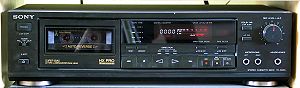
Tape recorder
An audio tape recorder, tape deck, reel-to-reel tape deck, cassette deck or tape machine is an audio storage device that records and plays back sounds, including articulated voices, usually using magnetic tape, either wound on a reel or in a cassette, for storage...
for playing or recording audio compact cassette
Compact Cassette
The Compact Cassette, often referred to as audio cassette, cassette tape, cassette, or simply tape, is a magnetic tape sound recording format. It was designed originally for dictation, but improvements in fidelity led the Compact Cassette to supplant the Stereo 8-track cartridge and reel-to-reel...
s. A deck was formerly distinguished from a recorder as being part of a stereo component system
High fidelity
High fidelity—or hi-fi—reproduction is a term used by home stereo listeners and home audio enthusiasts to refer to high-quality reproduction of sound or images, to distinguish it from the poorer quality sound produced by inexpensive audio equipment...
, while a recorder had a self-contained power amplifier (and often speakers). While the two terms are often now used interchangeably, a recorder is typically thought of as a small low-fidelity portable device, while a deck is a sophisticated high fidelity
High fidelity
High fidelity—or hi-fi—reproduction is a term used by home stereo listeners and home audio enthusiasts to refer to high-quality reproduction of sound or images, to distinguish it from the poorer quality sound produced by inexpensive audio equipment...
component.
Origins
The concept of a tape deck that used tape reels permanently housed in a removable cartridge, as opposed to individual reels and tape that needed to be threaded by hand, dates from the early 1950s. Various manufacturers attempted to commercialize this concept but a major difficulty was getting sufficient playback time with the low-performance tapes of the time, though by the early 1960s, tape formulations had improved enough to make the concept viable.The "compact cassette" (a Philips trademark) was introduced by the Philips
Philips
Koninklijke Philips Electronics N.V. , more commonly known as Philips, is a multinational Dutch electronics company....
Corporation in 1963 and marketed in 1965 as a device purely intended for portable speech-only dictation machine
Dictation machine
A dictation machine is a sound recording device most commonly used to record speech for later playback or to be typed into print. It includes digital voice recorders and tape recorders....
s. There was never any intention that it be a replacement for reel-to-reel recorders
Reel-to-reel audio tape recording
Reel-to-reel, open reel tape recording is the form of magnetic tape audio recording in which the recording medium is held on a reel, rather than being securely contained within a cassette....
. The tape width was nominally 1⁄8 inch (actually 0.15 inch, 3.81 mm) and tape speed was 1.875 inches (4.8 cm) per second, giving a decidedly non Hi-Fi frequency response and quite high noise levels.
Early recorders were typically hand-held battery-powered devices with built-in microphones and recording automatic gain control
Automatic gain control
Automatic gain control is an adaptive system found in many electronic devices. The average output signal level is fed back to adjust the gain to an appropriate level for a range of input signal levels...
, intended for dictation and journalists. However, by the mid 1970s, both tape and recorder quality had improved to the point where a cassette deck with manual level controls and VU meter
VU meter
A VU meter is often included in audio equipment to display a signal level in Volume Units; the device is sometimes also called volume indicator ....
s became a standard component of home high fidelity systems. Eventually the reel-to-reel recorder was completely displaced, in part because of the usage constraints presented by their large size, expense, and the inconvenience of threading and rewinding the tape reels, while cassettes are more portable and can be stopped and immediately removed in the middle of playback without rewinding. Cassettes became extremely popular for automotive and other portable music applications. Although prerecorded cassettes were widely available, many users would dub
Dubbing (music)
In sound recording, dubbing is the transfer or copying of previously recorded audio material from one medium to another of the same or a different type. It may be done with a machine designed for this purpose, or by connecting two different machines: one to play back and one to record the signal...
songs from their vinyl record or cassette collections to make a custom mixtape
Mixtape
A Mix Tape or Mixed Tape is a compilation of songs recorded in a specific order, traditionally onto an audio Compact Cassette.A Mix Tape, which usually reflects the musical tastes of its compiler, can range from a casually selected list of favorite songs, to a conceptual mix of songs linked by a...
.
In 1971, the Advent Corporation combined Dolby B-type tape-hiss-noise reduction system with chromium dioxide tape to create the Advent Model 201, the first high-fidelity cassette deck. Dolby B boosts treble levels well above the noise level, and reduces them on playback, while CrO2 used different bias and equalization settings to do much the same, and these technologies extended frequency response into high fidelity range beyond 15 kHz for the first time. This deck was based on a top-loading mechanism by Wollensak
Wollensak
Wollensak was an American manufacturer of audio-visual products. At the height of their popularity in the 1950s and 1960s, many brands of movie cameras came with a Wollensak Velostigmat lens. Wollensak reel-to-reel tape recorders were prized for their robust construction and value.-History:The...
, a division of 3M
3M
3M Company , formerly known as the Minnesota Mining and Manufacturing Company, is an American multinational conglomerate corporation based in Maplewood, Minnesota, United States....
, which was commonly used in audio/visual applications. It featured an unusual single VU meter which could be switched between or for both channels, and lever-operated controls, similar to those used on reel-to-reel mechanisms.

Solenoid
A solenoid is a coil wound into a tightly packed helix. In physics, the term solenoid refers to a long, thin loop of wire, often wrapped around a metallic core, which produces a magnetic field when an electric current is passed through it. Solenoids are important because they can create...
mechanical actuators, though low cost models would retain mechanical controls. Some models could search and count gaps between songs. Cassette players pioneered the modern set of control buttons: play, pause, stop, record, and "locking" fast forward and rewind (which when depressed momentarily would remain depressed until stopped.)
Widespread use
Cassette decks soon came into widespread use and were designed variously for professional applications, home audio systems, and for mobile use in cars, as well as portable recorders. From the mid 1970s to the late 1990s the cassette deck was the preferred music source for the automobileAutomobile
An automobile, autocar, motor car or car is a wheeled motor vehicle used for transporting passengers, which also carries its own engine or motor...
. Like an 8-track cartridge
8-track cartridge
Stereo 8, commonly known as the eight-track cartridge, eight-track tape, or simply eight-track, is a magnetic tape sound recording technology. It was popular in the United States from the mid-1960s through the late 1970s, but was relatively unknown in many European countries...
, it was relatively insensitive to vehicle motion, but it had reduced tape flutter, as well as the obvious advantages of smaller physical size and fast forward/rewind capability.
A major boost to the cassette's popularity came with the release of the Sony Walkman "personal" cassette player in 1979, designed specifically as a headphone-only ultra-compact "wearable" music source. Although the vast majority of such players eventually sold were not Sony products, the name "Walkman" has become synonymous with this type of device.
Performance improvements
Cassette decks reached their pinnacle of performance and complexity by the mid 1980s. Cassette decks from companies such as NakamichiNakamichi
is an historic Japanese high end audio company most famous for its innovative and very high quality audio cassette decks.In 1972, Nakamichi launched its first Nakamichi-brand products, home audio gear that included the world's first three-head cassette deck...
, Revox
Revox
ReVox is a brand name of Swiss audio equipment created by Studer on March 27, 1951.The ReVox brand name was spun off into Studer Revox AG in 1990. During Studer's acquisition by Harman International Industries, Revox was sold separately to a group of private investors...
, and Tandberg
Tandberg
This article is about the video-conferencing vendor, a Cisco company. Other companies with the same name such as Tandberg Television or Tandberg Data for data storage: see here and here...
incorporated advanced features such as multiple tape head
Tape head
A tape head is a type of transducer used in tape recorders to convert electrical signals to magnetic fluctuations and vice versa.-Principles of operation:...
s and dual capstan drive with separate reel motors. Auto-reversing decks became popular and were standard on most factory installed automobile decks.
Three-head technology uses separate heads for recording and playback. This enables hearing playback during the recording. Also, it allows different record and playback head gaps to be used, which is important for the highest fidelity, as a narrower head gap is optimal for playback than for recording, and so the head gap width of any dual-purpose single record / playback head must necessarily be a compromise. A three-head system was common on reel-to-reel decks, but it was more difficult to implement for cassettes, which do not provide separate openings for record and playback heads. A cassette has one opening designed for the erase head, a center opening for the record / play head, and a third opening for the tape drive capstan. Some models squeezed a monitor head into the capstan area, and others combined separate record and playback gaps into a single headshell.
Cassette decks sold by Harman Kardon
Harman Kardon
harman/kardon is a division of Harman International Industries and manufactures home and car audio equipment.Founded in 1953 by Dr. Sidney Harman and Bernard Kardon — two men with a deep interest in music and the arts — the company helped create the high-fidelity audio industry. Their first product...
and Japanese companies such as Aiwa
Aiwa
was a Japanese consumer electronics company, founded in 1951.It produced audio and video equipment from the 1970s until the early 2000s.-History:The Aiwa Corporation slid towards bankruptcy until it was purchased by competitor Sony Corporation. As of October 1, 2002, Aiwa ceased to be a separate...
, Akai
Akai
Akai is a consumer electronics brand, founded by Saburo Akai as , a Japanese manufacturer in 1929. It is now headquartered in Singapore as a subsidiary of Grande Holdings, a Hong Kong-based conglomerate, which also owns the formerly Japanese brands Nakamichi and Sansui. The Akai brand is now used...
, Denon
Denon
is a Japanese electronics company that was involved in the early stages of development of digital audio technology, while specializing in the manufacture of high-fidelity professional and consumer audio equipment. For many decades, Denon was a brand name of Nippon-Columbia, including the Nippon...
, JVC
JVC
, usually referred to as JVC, is a Japanese international consumer and professional electronics corporation based in Yokohama, Japan which was founded in 1927...
, Pioneer, Sony, Teac
Teac
TEAC Corporation is an electronics company based in Japan. TEAC was founded in 1953 as the Tokyo Electro Acoustic Company. TEAC has four divisions:*TASCAM - consumer to professional audio products, mostly recording...
, Technics
Technics (brand)
1960s:*SX-601 Electronic Organ — an origin of Technics SX keyboard series, the result of cooperative works of National Electronic Organ Company and Ace Tone...
and Yamaha
Yamaha (manufacturer)
is a multinational corporation and conglomerate based in Japan with a wide range of products and services, predominantly musical instruments, electronics, motorcycles and power sports equipment.-History:...
were also common, with each company offering models of very high quality. The best units could record and play the full audible spectrum from 20 Hz to 20 kHz with wow and flutter
Wow (recording)
Wow is a relatively slow form of flutter which can affect both gramophone records and tape recorders. In the latter, the collective expression wow and flutter is commonly used.-Gramophone records:...
less than 0.05% and very low noise.
A very good live cassette recording could rival the sound of an average commercial CD, though the quality of pre-recorded cassettes was usually lower than could be achieved in a high quality home recording. Cassettes remain popular for audio-visual applications. Some CD recorders incorporate a cassette well to allow both formats for recording meetings, church sermons and books on tape.
The Dolby noise reduction system
Dolby noise reduction system
Dolby NR is the name given to a series of noise reduction systems developed by Dolby Laboratories for use in analog magnetic tape recording. The first was Dolby A, a professional broadband noise reduction for recording studios in 1966, but the best-known is Dolby B , a sliding band system for the...
was key to realizing low noise performance on slow, narrow, cassette tapes. It works by boosting high frequencies on recording and then restoring them, also lowering the constant high frequency noises. Enhanced versions included C (in 1980) and S types, though the B system is the only standard supported on most high fidelity automobile decks. Some decks incorporated microprocessor programs to adjust tape bias automatically. Bang & Olufsen
Bang & Olufsen
Bang & Olufsen is a Danish company that designs and manufactures audio products, television sets and telephones. It was founded in 1925 by Peter Bang and Svend Olufsen, whose first significant product was a radio that worked with alternating current, when most radios were run from batteries...
developed the HX Pro headroom extension system in conjunction with Dolby Laboratories
Dolby Laboratories
Dolby Laboratories, Inc. , often shortened to Dolby Labs, is an American company specializing in audio noise reduction and audio encoding/compression.-History:...
in 1982. This was used in many higher-end decks. Chromium dioxide was the first tape formulation for extended high frequency response, but it required a special bias and equalization and switch (referred to as Type II). Later decks incorporated coded holes in the shell to autodetect the tape type. TDK and Maxell adapted cobalt-doped ferric formulations to mimic CrO2, which was thought to quickly wear out heads. Sony briefly tried FerriChrome which claimed to combine the best of both (Type III); some people, however, stated that the reverse was true because the Cr top layer seemed to wear off quickly, reducing this type to Fe in practice. Most decks today produce the best response with metal tapes which require yet another setting (Type IV) for recording, though they will also play back at the II setting on other machines.
In later years, an "auto reverse" feature appeared that allowed the deck to play (or, in some decks, record) on both sides of the cassette without the operator having to manually remove, flip, and re-insert the cassette. In early auto-reverse machines, this uses a dual-direction head that can play all four tracks; only two at a time are connected to the electronics. The transport in these decks also has two capstans and pinch rollers, one set used for each direction.
In cheaper auto reverse machines the "Auto Reverse" mechanism operates by disengaging the head and then flipping it around and re-engaging it, with alignment screws available for both positions. Since the auto reverse mechanism flips the head to play the other side, the alignment (azimuth) becomes worse with repeated operation. In one machine Nakamichi addressed the issue with a mechanism that physically removed the cassette from the transport, flipped it over, and re-inserted it, keeping the head stable. Akai used a similar method: the Invert-O-Matic.
Noise reduction and fidelity
A variety of noise reduction and other schemes are used to increase fidelity, with Dolby BDolby noise reduction system
Dolby NR is the name given to a series of noise reduction systems developed by Dolby Laboratories for use in analog magnetic tape recording. The first was Dolby A, a professional broadband noise reduction for recording studios in 1966, but the best-known is Dolby B , a sliding band system for the...
being almost universal for both prerecorded tapes and home recording. Dolby B was designed to address the high-frequency hiss inherent in cassette tapes, and along with improvements in tape formulation it helped the cassette win acceptances as a high-fidelity medium. At the same time, Dolby B provided acceptable performance when played back on decks that lacked Dolby circuitry, meaning there was little reason not to use it if it was available.
The main alternative to Dolby was the dbx
Dbx (noise reduction)
dbx is a family of noise reduction systems developed by the company of the same name. The most common implementations are dbx Type I and dbx Type II for analog tape recording and, less commonly, vinyl LPs. A separate implementation, known as dbx-TV, is part of the MTS system used to provide stereo...
noise reduction system, which achieved a high signal-to-noise ratio
Signal-to-noise ratio
Signal-to-noise ratio is a measure used in science and engineering that compares the level of a desired signal to the level of background noise. It is defined as the ratio of signal power to the noise power. A ratio higher than 1:1 indicates more signal than noise...
, but was essentially unlistenable when played back on decks that lacked the dbx decoding circuitry. Philips developed an alternative noise reduction system known as Dynamic Noise Limiter (DNL) which did not require the tapes to be processed during recording; this was also the basis of DNR noise reduction.
Dolby later introduced Dolby C
Dolby noise reduction system
Dolby NR is the name given to a series of noise reduction systems developed by Dolby Laboratories for use in analog magnetic tape recording. The first was Dolby A, a professional broadband noise reduction for recording studios in 1966, but the best-known is Dolby B , a sliding band system for the...
and Dolby S
Dolby noise reduction system
Dolby NR is the name given to a series of noise reduction systems developed by Dolby Laboratories for use in analog magnetic tape recording. The first was Dolby A, a professional broadband noise reduction for recording studios in 1966, but the best-known is Dolby B , a sliding band system for the...
noise reduction, which achieved higher levels of noise reduction; Dolby C became common on high-fidelity decks, but Dolby S, released when cassette sales had begun to decline, never achieved widespread use. It was only licensed for use on higher end tape decks that included dual motors, triple heads, and other refinements.
Dolby HX Pro headroom extension provided better high-frequency response by adjusting the inaudible tape bias
Tape bias
Tape bias is the term for two phenomena, DC bias and AC bias, that improve the fidelity of analogue magnetic tape sound recordings. DC bias is the addition of a direct current to the audio signal that is being recorded. AC bias is the addition of an inaudible high-frequency signal to the audio...
during the recording of strong high-frequency sounds, which had a bias effect of their own. Developed by Bang & Olufsen
Bang & Olufsen
Bang & Olufsen is a Danish company that designs and manufactures audio products, television sets and telephones. It was founded in 1925 by Peter Bang and Svend Olufsen, whose first significant product was a radio that worked with alternating current, when most radios were run from batteries...
, it did not require a decoder to play back. Since B&O held patent rights and required paying license fees, many other manufacturers refrained from using it too.
Other refinements to improve cassette performance included Tandberg's DYNEQ, Toshiba's ADRES and Telefunken's Hi-Com, and on some high-end decks, automatic recording bias, fine pitch adjustment and (sometimes) head azimuth adjustment like the Tandberg TCD 320.
By the late 1980s, thanks to such improvements in the electronics, the tape material and manufacturing techniques, as well as dramatic improvements to the precision of the cassette shell, tape head
Tape head
A tape head is a type of transducer used in tape recorders to convert electrical signals to magnetic fluctuations and vice versa.-Principles of operation:...
s and transport mechanics, sound fidelity on equipment from the top manufacturers far surpassed the levels originally expected of the medium. On suitable audio equipment, cassettes could produce a very pleasant listening experience. The best home decks could achieve 20 Hz-20 kHz frequency response
Frequency response
Frequency response is the quantitative measure of the output spectrum of a system or device in response to a stimulus, and is used to characterize the dynamics of the system. It is a measure of magnitude and phase of the output as a function of frequency, in comparison to the input...
with wow
Wow (recording)
Wow is a relatively slow form of flutter which can affect both gramophone records and tape recorders. In the latter, the collective expression wow and flutter is commonly used.-Gramophone records:...
and flutter below 0.05%, and 70 dB
Decibel
The decibel is a logarithmic unit that indicates the ratio of a physical quantity relative to a specified or implied reference level. A ratio in decibels is ten times the logarithm to base 10 of the ratio of two power quantities...
of signal-to-noise ratio
Signal-to-noise ratio
Signal-to-noise ratio is a measure used in science and engineering that compares the level of a desired signal to the level of background noise. It is defined as the ratio of signal power to the noise power. A ratio higher than 1:1 indicates more signal than noise...
using Dolby C, up to 80 dB
Decibel
The decibel is a logarithmic unit that indicates the ratio of a physical quantity relative to a specified or implied reference level. A ratio in decibels is ten times the logarithm to base 10 of the ratio of two power quantities...
of signal-to-noise ratio
Signal-to-noise ratio
Signal-to-noise ratio is a measure used in science and engineering that compares the level of a desired signal to the level of background noise. It is defined as the ratio of signal power to the noise power. A ratio higher than 1:1 indicates more signal than noise...
using Dolby S, and 90 dB with dbx. Many casual listeners could not tell the difference between cassette and compact disc.
From the early 1980s, the fidelity of prerecorded cassettes began to improve dramatically. Whereas Dolby B was already in widespread use in the 1970s, prerecorded cassettes were duplicated onto poor quality tape stock at high speed and did not compare in fidelity to LPs. However, systems such as XDR
XDR (audio)
XDR is a quality-control and duplication process for the mass-production of pre-recorded audio cassettes. It is a process designed to provide higher quality audio on pre-recorded cassettes by checking the sound quality at all stages of the tape duplication process...
, along with the adoption of higher-grade tape (such as chromium dioxide, but typically recorded in such a way as to play back at the normal 120 μs eq position), and the frequent use of Dolby HX Pro, meant that cassettes became a viable high-fidelity option, one that was more portable and required less maintenance than records. In addition, cover art, which had generally previously been restricted to a single image of the LP cover along with a minimum of text, began to be tailored to cassettes as well, with fold-out lyric sheets or librettos and fold-out sleeves becoming commonplace.
Some companies, such as Mobile Fidelity, produced audiophile
Audiophile
An audiophile is a person who enjoys listening to recorded music, usually in a home. Some audiophiles are more interested in collecting and listening to music, while others are more interested in collecting and listening to audio components, whose "sound quality" they consider as important as the...
cassettes in the 1980s, which were recorded on high-grade tape and duplicated on premium equipment in real time from a digital master. Unlike audiophile LPs, which continue to attract a following, these became moot after the Compact Disc
Compact Disc
The Compact Disc is an optical disc used to store digital data. It was originally developed to store and playback sound recordings exclusively, but later expanded to encompass data storage , write-once audio and data storage , rewritable media , Video Compact Discs , Super Video Compact Discs ,...
became widespread.
Some cassette decks have a MPX filter
MPX filter
FM stereo broadcasts contain a pilot tone at 19 kHz that indicates stereo information is available at higher frequencies...
to improve the sound quality when recording from a FM stereo broadcast.
In-car entertainment systems
A key element of the cassette's success was its use in in-car entertainment systems, where the small size of the tape was significantly more convenient than the competing 8-track cartridge8-track cartridge
Stereo 8, commonly known as the eight-track cartridge, eight-track tape, or simply eight-track, is a magnetic tape sound recording technology. It was popular in the United States from the mid-1960s through the late 1970s, but was relatively unknown in many European countries...
system. Cassette players in cars and for home use were often integrated with a radio receiver, and the term "casseiver" was occasionally used for combination units for home use. In-car cassette players were the first to adopt automatic reverse ("auto-reverse") of the tape direction at each end, allowing a cassette to be played endlessly without manual intervention. Home cassette decks soon added the feature. In Car cassette players are preferred by some particularly for their cheaper cost and serviceability.
Cassette tape adaptor
Cassette tape adaptor
The cassette adapter allows one to play music through sound systems with a tape player without the need for an auxiliary input.-Usage:A cassette tape adapter is a device that allows the use of portable audio players in older cassette decks. This is useful for cars, which often lack inputs for...
s have been developed which allow newer media players to be played through existing cassette decks, in particular those in cars which generally do not have input jacks. These units do not suffer from reception problems from FM transmitter based system to play back media players through the FM radio.
Maintenance
Cassette equipment needs regular maintenance, as cassette tape is a magnetic medium which is in physical contact with the tape headTape head
A tape head is a type of transducer used in tape recorders to convert electrical signals to magnetic fluctuations and vice versa.-Principles of operation:...
and other metallic parts of the recorder/player mechanism. Without such maintenance, the high frequency response of the cassette equipment will suffer.
One problem occurs when iron oxide (or similar) particles from the tape itself become lodged in the playback head. As a result, the tape heads will require occasional cleaning to remove such particles. The metal capstan and the rubber pinch roller can become coated with these particles, leading them to pull the tape less precisely over the head; this in turn leads to misalignment of the tape over the head azimuth, producing noticeably unclear high tones, just as if the head itself were out of alignment.
The heads and other metallic components in the tape path (such as spindles and capstans) may become magnetized with use, and require degaussing
Degaussing
Degaussing is the process of decreasing or eliminating an unwanted magnetic field. It is named after Carl Friedrich Gauss, an early researcher in the field of magnetism...
.
Isopropyl alcohol
Isopropyl alcohol
Isopropyl alcohol is a common name for a chemical compound with the molecular formula C3H8O. It is a colorless, flammable chemical compound with a strong odor...
and ethyl alcohol
Ethanol
Ethanol, also called ethyl alcohol, pure alcohol, grain alcohol, or drinking alcohol, is a volatile, flammable, colorless liquid. It is a psychoactive drug and one of the oldest recreational drugs. Best known as the type of alcohol found in alcoholic beverages, it is also used in thermometers, as a...
are both suitable head-cleaning fluids. (Rubbing alcohol
Rubbing alcohol
Rubbing alcohol, USP / B.P. is a liquid prepared and used primarily for topical application. It is prepared from a special denatured alcohol solution and contains 97.5-100% by volume of pure, concentrated ethanol or isopropyl alcohol...
may contain oil which is not suitable.) Head cleaning fluid is a relatively expensive way to buy isopropyl alcohol.
Decline in popularity
Analog cassette deck sales were expected to decline rapidly with the advent of the compact discCompact Disc
The Compact Disc is an optical disc used to store digital data. It was originally developed to store and playback sound recordings exclusively, but later expanded to encompass data storage , write-once audio and data storage , rewritable media , Video Compact Discs , Super Video Compact Discs ,...
and other digital recording technologies such as digital audio tape
Digital Audio Tape
Digital Audio Tape is a signal recording and playback medium developed by Sony and introduced in 1987. In appearance it is similar to a compact audio cassette, using 4 mm magnetic tape enclosed in a protective shell, but is roughly half the size at 73 mm × 54 mm × 10.5 mm. As...
(DAT), MiniDisc
MiniDisc
The disc is permanently housed in a cartridge with a sliding door, similar to the casing of a 3.5" floppy disk. This shutter is opened automatically by a mechanism upon insertion. The audio discs can either be recordable or premastered. Recordable MiniDiscs use a magneto-optical system to record...
, and the CD-R
CD-R
A CD-R is a variation of the Compact Disc invented by Philips and Sony. CD-R is a Write Once Read Many optical medium, though the whole disk does not have to be entirely written in the same session....
recorder drives. Philips responded with the digital compact cassette
Digital Compact Cassette
Digital Compact Cassette was a magnetic tape sound recording format introduced by Philips and Matsushita in late 1992 and pitched as a successor to the standard analog cassette. It was also a direct competitor to Sony's MiniDisc but neither format toppled the then ubiquitous analog cassette...
, a system which was backward-compatible with existing analog cassette recordings for playback, but it failed to garner a significant market share and was withdrawn. One reason proposed for the lack of acceptance of digital recording formats such as DAT was a fear by content providers that the ability to make very high quality copies would hurt sales of copyrighted recordings.
The rapid transition was not realized and CDs and cassettes successfully co-existed for nearly 20 years. A contributing factor may have been the inability of early CD players to reliably read discs with surface damage and offer anti-skipping features for applications where external vibration would be present, such as automotive and recreation environments. Early CD playback equipment also tended to be expensive compared to cassette equipment of similar quality and did not offer recording capability. Many home and portable entertainment systems supported both formats and commonly allowed the CD playback to be recorded on cassette tape. The rise of inexpensive all-solid-state portable digital music systems based on MP3
MP3
MPEG-1 or MPEG-2 Audio Layer III, more commonly referred to as MP3, is a patented digital audio encoding format using a form of lossy data compression...
, AAC and similar formats finally saw the eventual decline of the domestic cassette deck. Tascam
TASCAM
TASCAM is the professional audio division of TEAC Corporation, headquartered in Montebello, California. Tascam is credited as the inventor of the Portastudio, the first cassette-based multi-track home studio recorders. Tascam also introduced the first low-cost mass produced multitrack recorders...
, Marantz
Marantz
Marantz is a company that develops and sells upper-mid range to high-end audio products.The first Marantz audio product was designed and built by Saul B. Marantz in his home in Kew Gardens, New York...
, Yamaha, Teac
Teac
TEAC Corporation is an electronics company based in Japan. TEAC was founded in 1953 as the Tokyo Electro Acoustic Company. TEAC has four divisions:*TASCAM - consumer to professional audio products, mostly recording...
, Denon, Sony, and JVC
JVC
, usually referred to as JVC, is a Japanese international consumer and professional electronics corporation based in Yokohama, Japan which was founded in 1927...
are among the companies still manufacturing cassette decks in relatively small quantities for professional and niche market use. By the late 1990s, automobiles were offered with entertainment systems that played both cassettes and CDs. By the end of the late 2000s, very few autos were offered with cassette decks. As radios became tightly integrated into dashboards, many autos lacked even standard openings that would accept aftermarket cassette player installations.
Despite the decline in the production of cassette decks, these products are still valued by some. Many blind
Blindness
Blindness is the condition of lacking visual perception due to physiological or neurological factors.Various scales have been developed to describe the extent of vision loss and define blindness...
and elderly people find the newest digital technologies very difficult to use compared to the cassette format. Cassette tapes are not vulnerable to scratching from handling, and play from where they were last stopped. Cassette tapes can also be recorded multiple times.
Some audiophile
Audiophile
An audiophile is a person who enjoys listening to recorded music, usually in a home. Some audiophiles are more interested in collecting and listening to music, while others are more interested in collecting and listening to audio components, whose "sound quality" they consider as important as the...
s believe that the technology of the highest quality cassette decks, due to their analog nature, provides sound recordings superior to current digital technology, such as CD-R and DAT. However, cassette decks are not considered by most people today to be either the most versatile or highest fidelity sound recording devices available, as even very inexpensive CD or digital audio players can reproduce a wide frequency range with no speed variations. Many current budget-oriented cassette decks lack a tape selector to set proper bias and equalization settings to take best advantage of the extended high end of Type II [High Bias] and Type IV [Metal Bias] tapes.
External links
- Audio Asylum Tape Trail – A discussion forum of interest to those involved in cassette technology.
- Vintage Cassette Decks - A collection of Vintage cassette decks of all brands.