
Home      Discussion      Topics      Dictionary      Almanac
Signup       Login
Magnetic tape

Magnetic tape

Overview

Discussion
Ask a question about 'Magnetic tape'
Start a new discussion about 'Magnetic tape'
Answer questions from other users
Full Discussion Forum
 
Unanswered Questions
Encyclopedia

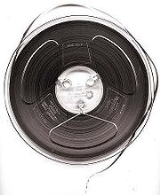
Magnetic tape is a medium for magnetic recording, made of a thin magnetizable coating on a long, narrow strip of plastic
Plastic
A plastic material is any of a wide range of synthetic or semi-synthetic organic solids used in the manufacture of industrial products. Plastics are typically polymers of high molecular mass, and may contain other substances to improve performance and/or reduce production costs...

. It was developed in Germany
Germany
Germany , officially the Federal Republic of Germany , is a federal parliamentary republic in Europe. The country consists of 16 states while the capital and largest city is Berlin. Germany covers an area of 357,021 km2 and has a largely temperate seasonal climate...

, based on magnetic wire recording
Wire recording
Wire recording is a type of analog audio storage in which a magnetic recording is made on thin steel or stainless steel wire.The wire is pulled rapidly across a recording head which magnetizes each point along the wire in accordance with the intensity and polarity of the electrical audio signal...

. Devices that record and play back audio and video using magnetic tape are tape recorder
Tape recorder
An audio tape recorder, tape deck, reel-to-reel tape deck, cassette deck or tape machine is an audio storage device that records and plays back sounds, including articulated voices, usually using magnetic tape, either wound on a reel or in a cassette, for storage...

s and video tape recorder
Video tape recorder
A video tape recorder is a tape recorder that can record video material, usually on a magnetic tape. VTRs originated as individual tape reels, serving as a replacement for motion picture film stock and making recording for television applications cheaper and quicker. An improved form included the...

s. A device that stores computer data on magnetic tape is a tape drive
Tape drive
A tape drive is a data storage device that reads and performs digital recording, writes data on a magnetic tape. Magnetic tape data storage is typically used for offline, archival data storage. Tape media generally has a favorable unit cost and long archival stability.A tape drive provides...

 (tape unit, streamer).

Magnetic tape revolutionized broadcast and recording. When all radio
Radio
Radio is the transmission of signals through free space by modulation of electromagnetic waves with frequencies below those of visible light. Electromagnetic radiation travels by means of oscillating electromagnetic fields that pass through the air and the vacuum of space...

 was live, it allowed programming to be prerecorded. At a time when gramophone record
Gramophone record
A gramophone record, commonly known as a phonograph record , vinyl record , or colloquially, a record, is an analog sound storage medium consisting of a flat disc with an inscribed, modulated spiral groove...

s were recorded in one take, it allowed recordings to be made in multiple parts, which were then mixed and edited with tolerable loss in quality. It is a key technology in early computer development, allowing unparalleled amounts of data to be mechanically created, stored for long periods, and to be rapidly accessed.

Today, other technologies can perform the functions of magnetic tape. In many cases these technologies are replacing tape. Despite this, innovation in the technology continues and tape is still widely used.

Over years, magnetic tape can suffer from deterioration called sticky-shed syndrome
Sticky-shed syndrome
Sticky-shed syndrome is a condition created by the deterioration of the binders in a magnetic tape, which hold the iron oxide magnetizable coating to its plastic carrier. This deterioration renders the tape unusable...

. Caused by absorption of moisture into the binder of the tape, it can render the tape unusable.

Audio recording


Magnetic tape was invented for recording sound by Fritz Pfleumer
Fritz Pfleumer
Fritz Pfleumer was a German-Austrian engineer who invented magnetic tape for recording sound.-Biography:...

 in 1928 in Germany, based on the invention of magnetic wire recording by Valdemar Poulsen
Valdemar Poulsen
Valdemar Poulsen was a Danish engineer who developed a magnetic wire recorder in 1899.-Biography:He was born on 23 November 1869 in Copenhagen...

 in 1898. Pfleumer's invention used an iron(III) oxide
Iron(III) oxide
Iron oxide or ferric oxide is the inorganic compound with the formula Fe2O3. It is one of the three main oxides of iron, the other two being iron oxide , which is rare, and iron oxide , which also occurs naturally as the mineral magnetite. As the mineral known as hematite, Fe2O3 is the main...

(Fe2O3) powder coating on a long strip of paper. This invention was further developed by the German electronics company AEG
AEG
Allgemeine Elektricitäts-Gesellschaft was a German producer of electrical equipment founded in 1883 by Emil Rathenau....

, which manufactured the recording machines and BASF
BASF
BASF SE is the largest chemical company in the world and is headquartered in Germany. BASF originally stood for Badische Anilin- und Soda-Fabrik . Today, the four letters are a registered trademark and the company is listed on the Frankfurt Stock Exchange, London Stock Exchange, and Zurich Stock...

, which manufactured the tape. In 1933, working for AEG, Eduard Schuller developed the ring shaped tape head. Previous head designs were needle shaped and tended to shred the tape. An important discovery made in this period was the technique of AC biasing
Tape bias
Tape bias is the term for two phenomena, DC bias and AC bias, that improve the fidelity of analogue magnetic tape sound recordings. DC bias is the addition of a direct current to the audio signal that is being recorded. AC bias is the addition of an inaudible high-frequency signal to the audio...

 which improved the fidelity of the recorded audio signal by increasing the effective linearity of the recording medium.

Due to the escalating political tensions, and the outbreak of World War II
World War II
World War II, or the Second World War , was a global conflict lasting from 1939 to 1945, involving most of the world's nations—including all of the great powers—eventually forming two opposing military alliances: the Allies and the Axis...

, these developments were largely kept secret. Although the Allies knew from their monitoring of Nazi radio broadcasts that the Germans had some new form of recording technology, the nature was not discovered until the Allies acquired captured German recording equipment as they invaded Europe in the closing of the war. It was only after the war that Americans, particularly Jack Mullin
Jack Mullin
John T. "Jack" Mullin was an American pioneer in the field of magnetic tape sound recording and made significant contributions to many other related fields. From his days at Santa Clara University to his death, he displayed a deep appreciation for classical music and an aptitude for electronics...

, John Herbert Orr
John Herbert Orr
John Herbert Orr was an Alabama entrepreneur who formed Orradio Industries, Inc., a high-technology firm that made magnetic recording tape....

, and Richard H. Ranger
Richard H. Ranger
Richard Howland Ranger was an American electrical engineer, music engineer and inventor. He was born in Indianapolis, Indiana, the son of John Hilliard and Emily Anthen Gillet Ranger, He served in the U.S. Army Signal Corps during World War I, earning the rank of Major...

 were able to bring this technology out of Germany and develop it into commercially viable formats.

A wide variety of recorders and formats have developed since, most significantly reel-to-reel and Compact Cassette
Compact Cassette
The Compact Cassette, often referred to as audio cassette, cassette tape, cassette, or simply tape, is a magnetic tape sound recording format. It was designed originally for dictation, but improvements in fidelity led the Compact Cassette to supplant the Stereo 8-track cartridge and reel-to-reel...

.

Video recording


The practice of recording and editing audio using magnetic tape rapidly established itself as an obvious improvement over previous methods. Many saw the potential of making the same improvements in recording television. Television ("video") signals are similar to audio signals. A major difference is that video signals use more bandwidth than audio signals. Existing audio tape recorders could not practically capture a video signal. Many set to work on resolving this problem. Jack Mullin (working for Bing Crosby
Bing Crosby
Harry Lillis "Bing" Crosby was an American singer and actor. Crosby's trademark bass-baritone voice made him one of the best-selling recording artists of the 20th century, with over half a billion records in circulation....

) and the BBC both created crude working systems that involved moving the tape across a fixed tape head at very fast speeds. Neither system saw much use. It was the team at Ampex
Ampex
Ampex is an American electronics company founded in 1944 by Alexander M. Poniatoff. The name AMPEX is an acronym, created by its founder, which stands for Alexander M. Poniatoff Excellence...

, led by Charles Ginsburg
Charles Ginsburg
Charles Ginsburg was an engineer and the leader of a research team at Ampex which developed one of the first practical videotape recorders....

, that made the breakthrough of using a spinning recording head and normal tape speeds to achieve a very high head-to-tape speed that could record and reproduce the high bandwidth signals of video. The Ampex system was called Quadruplex
2 inch Quadruplex videotape
2-inch quadruplex videotape was the first practical and commercially successful analog recording videotape format. It was developed and released for the broadcast television industry in 1956 by Ampex, an American company based in Redwood City, California...

 and used 2 inches (50.8 mm) tape, mounted on reels like audio tape, which wrote the signal in what is now called transverse scan.

Later improvements by other companies, particularly Sony
Sony
, commonly referred to as Sony, is a Japanese multinational conglomerate corporation headquartered in Minato, Tokyo, Japan and the world's fifth largest media conglomerate measured by revenues....

, lead to the development of helical scan
Helical scan
Helical scan is a method of recording high bandwidth signals onto magnetic tape. It is used in reel-to-reel video tape recorders, video cassette recorders, digital audio tape recorders, and some computer tape drives....

 and the enclosure of the tape reels in an easy-to-handle cartridge. Nearly all modern videotape systems use helical scan and cartridges. Videocassette recorder
Videocassette recorder
The videocassette recorder , is a type of electro-mechanical device that uses removable videocassettes that contain magnetic tape for recording analog audio and analog video from broadcast television so that the images and sound can be played back at a more convenient time...

s are very common in homes and television production facilities though many functions of the VCR are being replaced. Since the advent of digital video and computerized video processing, optical disc
Optical disc
In computing and optical disc recording technologies, an optical disc is a flat, usually circular disc which encodes binary data in the form of pits and lands on a special material on one of its flat surfaces...

 media and digital video recorder
Digital video recorder
A digital video recorder , sometimes referred to by the merchandising term personal video recorder , is a consumer electronics device or application software that records video in a digital format to a disk drive, USB flash drive, SD memory card or other local or networked mass storage device...

s can now perform the same role as videotape. These devices also offer improvements like random access
Random access
In computer science, random access is the ability to access an element at an arbitrary position in a sequence in equal time, independent of sequence size. The position is arbitrary in the sense that it is unpredictable, thus the use of the term "random" in "random access"...

 to any scene in the recording and "live" time shifting
Time shifting
Time shifting is the recording of programming to a storage medium to be viewed or listened to at a time more convenient to the consumer. Typically, this refers to TV programming but can also refer to radio shows via podcasts....

 and have replaced videotape in many situations.

Data storage


In all tape formats, a tape drive
Tape drive
A tape drive is a data storage device that reads and performs digital recording, writes data on a magnetic tape. Magnetic tape data storage is typically used for offline, archival data storage. Tape media generally has a favorable unit cost and long archival stability.A tape drive provides...

 (or "transport" or "deck") uses motors to wind the tape from one reel to another, passing tape head
Tape head
A tape head is a type of transducer used in tape recorders to convert electrical signals to magnetic fluctuations and vice versa.-Principles of operation:...

s to read, write or erase as it moves.

Magnetic tape was first used to record computer data in 1951 on the Eckert-Mauchly UNIVAC I
UNIVAC I
The UNIVAC I was the first commercial computer produced in the United States. It was designed principally by J. Presper Eckert and John Mauchly, the inventors of the ENIAC...

. The recording medium was a thin strip of one half inch (12.65 mm) wide metal, consisting of nickel-plated bronze (called Vicalloy). Recording density was 128 characters per inch (198 micrometre/character) on eight tracks.


Early IBM tape drives
IBM 7 Track
IBM's first magnetic tape data storage devices, introduced in 1952, use what is now generally known as 7 track tape. The magnetic tape is 1/2" wide and there are 6 data tracks plus 1 parity track for a total of 7 parallel tracks that span the length of the tape...

 were floor-standing drives that used vacuum columns to physically buffer long U-shaped loops of tape. The two tape reels visibly fed tape through the columns, intermittently spinning the reels in rapid, unsynchronized bursts, resulting in visually striking action. Stock shots of such vacuum-column tape drives in motion were widely used to represent "the computer" in movies and television.

Most modern magnetic tape systems use reels that are much smaller than the 10.5 inch open reels and are fixed inside a cartridge to protect the tape and facilitate handling. Many late 1970s and early 1980s home computers used Compact Cassette
Compact Cassette
The Compact Cassette, often referred to as audio cassette, cassette tape, cassette, or simply tape, is a magnetic tape sound recording format. It was designed originally for dictation, but improvements in fidelity led the Compact Cassette to supplant the Stereo 8-track cartridge and reel-to-reel...

s encoded with the Kansas City standard
Kansas City standard
The Kansas City Standard , or Byte standard, is a digital data format for audio cassette drives. Byte magazine sponsored a symposium in November 1975 in Kansas City, Missouri to develop a standard for storage of digital computer data on inexpensive consumer quality cassettes, at a time when...

. Modern cartridge formats include LTO
Linear Tape-Open
Linear Tape-Open is a magnetic tape data storage technology originally developed in the late 1990s as an open standards alternative to the proprietary magnetic tape formats that were available at the time. Hewlett-Packard, IBM and Seagate initiated the LTO Consortium, which directs development...

, DLT
Digital Linear Tape
Digital Linear Tape is a magnetic tape data storage technology developed by Digital Equipment Corporation from 1984 onwards. In 1994 the technology was purchased by Quantum Corporation, who currently manufactures drives and licenses the technology and trademark. A variant with higher capacity...

, and DAT/DDC
Digital Data Storage
Digital Data Storage is a format for storing computer data on a Digital Audio Tape .DDS uses tape with a width of 3.8mm, with the exception of the latest formats, DAT 160 and DAT 320, which are 8mm wide...

.

Tape remains a viable alternative to disk in some situations due to its lower cost per bit. This is a large advantage when dealing with large amounts of data. Though the areal density of tape is lower than for disk drives, the available surface area on a tape is far greater. The highest capacity tape media are generally on the same order as the largest available disk drives (about 5 TB
Terabyte
The terabyte is a multiple of the unit byte for digital information. The prefix tera means 1012 in the International System of Units , and therefore 1 terabyte is , or 1 trillion bytes, or 1000 gigabytes. 1 terabyte in binary prefixes is 0.9095 tebibytes, or 931.32 gibibytes...

 in 2011). Tape has historically offered enough advantage in cost over disk storage to make it a viable product, particularly for backup
Backup
In information technology, a backup or the process of backing up is making copies of data which may be used to restore the original after a data loss event. The verb form is back up in two words, whereas the noun is backup....

, where media removability is necessary.

Tape has the benefit of a comparatively long duration during which the media can be guaranteed to retain the data stored on the media. Fifteen (15) to thirty (30) years of archival data storage is cited by manufacturers of modern data tape such as Linear Tape-Open
Linear Tape-Open
Linear Tape-Open is a magnetic tape data storage technology originally developed in the late 1990s as an open standards alternative to the proprietary magnetic tape formats that were available at the time. Hewlett-Packard, IBM and Seagate initiated the LTO Consortium, which directs development...

 media.

In 2002, Imation
Imation
Imation is a US based multi-national technology corporation that designs, manufactures and sells recordable data storage media, consumer electronics products and accessories.The company is a 1996 spin off of 3M and is headquartered in Oakdale, Minnesota...

 received a US$11.9 million grant from the U.S. National Institute of Standards and Technology
National Institute of Standards and Technology
The National Institute of Standards and Technology , known between 1901 and 1988 as the National Bureau of Standards , is a measurement standards laboratory, otherwise known as a National Metrological Institute , which is a non-regulatory agency of the United States Department of Commerce...

for research into increasing the data capacity of magnetic tape.

External links