
All Topics  
Commodore PET

 
Commodore PET

   Email Print
   Bookmark   Link


Commodore PET


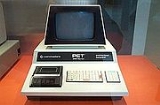
The PET (Personal Electronic Transactor) was a home
Home computer

A home computer was a class of personal computer entering the market in 1977 and becoming common during the 1980s. They were marketed to consumers as accessible personal computers, more capable than video game consoles....
-/personal computer
Personal computer

A personal computer is any general-purpose computer whose original sales price, size, and capabilities make it useful for individuals, and which is intended to be operated directly by an end user, with no intervening computer operator....
 produced by Commodore
Commodore International

Commodore, the commonly used name for Commodore International, was a United States electronics company based in West Chester, Pennsylvania which was a vital player in the home computer/personal computer field in the 1980s....
 starting in 1977. Although it was not a top seller outside the Canadian, US, and UK educational markets, it was Commodore's first full-featured computer and would form the basis for their future success.

he 1970s, Texas Instruments
Texas Instruments

Texas Instruments , better known in the electronics industry as TI, is an United States company based in Dallas, Texas, Texas, United States, renowned for developing and commercializing semiconductor and computer technology....
 was the main supplier of CPUs
Central processing unit

A central processing unit is an electronic circuit that can execute computer programs. This broad definition can easily be applied to many early computers that existed long before the term "CPU" ever came into widespread usage....
 for use in calculators.


Discussion
Ask a question about 'Commodore PET'
Start a new discussion about 'Commodore PET'
Answer questions from other users
Full Discussion Forum


Recent Posts


Encyclopedia


The PET (Personal Electronic Transactor) was a home
Home computer

A home computer was a class of personal computer entering the market in 1977 and becoming common during the 1980s. They were marketed to consumers as accessible personal computers, more capable than video game consoles....
-/personal computer
Personal computer

A personal computer is any general-purpose computer whose original sales price, size, and capabilities make it useful for individuals, and which is intended to be operated directly by an end user, with no intervening computer operator....
 produced by Commodore
Commodore International

Commodore, the commonly used name for Commodore International, was a United States electronics company based in West Chester, Pennsylvania which was a vital player in the home computer/personal computer field in the 1980s....
 starting in 1977. Although it was not a top seller outside the Canadian, US, and UK educational markets, it was Commodore's first full-featured computer and would form the basis for their future success.

History


Origins and the early models

In the 1970s, Texas Instruments
Texas Instruments

Texas Instruments , better known in the electronics industry as TI, is an United States company based in Dallas, Texas, Texas, United States, renowned for developing and commercializing semiconductor and computer technology....
 was the main supplier of CPUs
Central processing unit

A central processing unit is an electronic circuit that can execute computer programs. This broad definition can easily be applied to many early computers that existed long before the term "CPU" ever came into widespread usage....
 for use in calculators. Many companies sold calculator designs based on their chip sets, including Commodore. However, in 1975 TI increased the price to the point where the chip set alone cost more than what TI sold their entire calculators for, and the industry they had built up was frozen out of the market.

Commodore responded by looking for a chip set of their own they could purchase outright, and quickly found MOS Technology, Inc.
MOS Technology

MOS Technology, Inc., also known as CSG , was a integrated circuit design and Semiconductor device fabrication company based in Norristown, Pennsylvania, in the United States....
 who were bringing their 6502
MOS Technology 6502

The MOS Technology 6502 is an 8-bit microprocessor that was designed by Chuck Peddle and Bill Mensch for MOS Technology in 1975. When it was introduced, it was the least expensive full-featured central processing unit on the market by a considerable margin, costing less than one-sixth the price of competing designs from larger companies such...
 microprocessor design to market. Along with the company came Chuck Peddle
Chuck Peddle

Electronics engineer Chuck Peddle is mostly known as the main designer of the MOS Technology MOS Technology 6502 microprocessor; the KIM-1 single-board computer; and its successor the Commodore PET personal computer, both based on the 6502....
's KIM-1
KIM-1

The KIM-1, short for Keyboard Input Monitor, was a small MOS Technology 6502-based microcomputer kit developed and produced by MOS Technology and launched in 1975....
 design, a small computer kit based on the 6502. At Commodore, Peddle convinced Jack Tramiel
Jack Tramiel

Jack Tramiel is a businessman, best known for founding Commodore International - manufacturer of the Commodore PET, Commodore 64, Commodore 128, Commodore Amiga, and other Commodore models of home computers....
 that calculators were a dead-end. Instead they should focus on making a "real" machine out of the KIM-1, and selling that for much higher profits. Tramiel demanded that Peddle, and Tramiel's son, Leonard, create a computer in time for the June 1977 Consumer Electronics Show
Consumer Electronics Show

The International Consumer Electronics Show is a trade show held each January in Las Vegas, Nevada, Nevada, and is sponsored by the Consumer Electronics Association....
, and gave them six months to do it.

The result was the first all-in-one home computer, the
PET. The first model was the PET 2001, including either 4 KB (the 2001-4) or 8 KB (2001-8) of 8-bit RAM. It was essentially a single-board computer with discrete logic driving a small built-in monochrome monitor with 40×25 character graphics. The machine also included a built-in Datassette
Datassette

The Commodore 1530 Datasette , was Commodore International's dedicated computer tape recorder.It provided access to an inexpensive secondary storage for Commodore's 8-bit home computers, notably the Commodore PET, Commodore VIC-20, and Commodore 64....
 for data storage located on the front of the case, which left little room for the keyboard. The 2001 was announced at the '77 Winter CES in January 1977 and the first 100 units were shipped in mid October 1977. However they remained back-ordered for months, and to ease deliveries they eventually cancelled the 4 kB version early the next year.

Although the machine was fairly successful, there were frequent complaints about the tiny calculator-like keyboard, often referred to as a "chiclet keyboard
Chiclet keyboard

A chiclet keyboard is slang for a computer keyboard built with an array of small, flat rectangular or lozenge-shaped rubber or plastic keys that look like erasers or pieces of chewing gum....
" because the keys resembled the popular gum candy. This was addressed in upgraded "dash N" and "dash B" versions of the 2001, which put the cassette outside the case, and included a much larger keyboard with a full stroke non-click motion. Internally a newer and simpler motherboard was used, along with an upgrade in memory to 8, 16, or 32 KB, known as the
2001-N-8, 2001-N-16 or 2001-N-32, respectively.

Sales of the newer machines was strong, and Commodore then introduced the models to Europe. However there was already a machine called PET for sale in Europe from the huge Dutch Philips
Philips

Koninklijke Philips Electronics N.V. , usually known as Philips, is a Netherlands electronics company. It is one of the largest electronics companies in the world, founded and headquartered in the Netherlands....
 company, and the name had to be changed. The result was the
CBM 3000 series ('CBM' standing for Commodore Business Machines), which included the 3008, 3016 and 3032 models. Like the 2001-N-8, the 3008 was quickly dropped.

Commodore 4032
Commodore 4040

Education, business, and computer science

The final version of what could be thought of as the "classic" PET was the
PET 4000 series.

This was essentially the later model 2000 series, but with a larger black-and-green monitor and a newer version of Commodore's BASIC
Commodore BASIC

Commodore BASIC, also known as PET BASIC, is the dialect of the BASIC programming language used in Commodore International's 8-bit home computer line, stretching from the Commodore PET of 1977 to the Commodore 128 of 1985....
 programming language.

By this point Commodore had noticed that many customers were buying the "low memory" versions of the machines and installing their own RAM chips, so the
4008 and 4016 had the sockets punched out of the motherboard.

The
4032 was a huge success in schools, where its tough all-metal construction and all-in-one design made it better able to stand up to the rigors of classroom use. Just as important in this role was the PET's otherwise underutilized IEEE 488 port. Used wisely, the port could be used as a simple local area network
Local area network

A local area network is a computer network covering a small physical area, like a home, office, or small group of buildings, such as a school, or an airport....
 and allowed printers and disk drives (then very expensive) to be shared among all of the machines in the classroom.

Two more machines were released in the PET series. The
CBM 8000 included a new display chip which drove an 80×25 character screen, but this resulted in a number of software incompatibilities with programs designed for the 40 column screen, and it appears to have been unpopular as a result.

The machine shipped with 32 kB standard as the
8032, but allowed another 64 kB to be added externally. Later the upgrade was installed from the factory, creating the 8096.

The last in the series was the
SP9000, known as the SuperPET or MicroMainframe
MicroMainframe

The designation Micromainframe may have at least two different meanings, depending on the context and originating company:*The Commodore PET microcomputer...
. This machine was designed at the University of Waterloo
University of Waterloo

The University of Waterloo is a comprehensive public university in the city of Waterloo, Ontario, Ontario, Canada. The school was founded in 1957 by Drs....
 for teaching programming. In addition to the basic CBM 8000 hardware, the 9000 added a second CPU
Central processing unit

A central processing unit is an electronic circuit that can execute computer programs. This broad definition can easily be applied to many early computers that existed long before the term "CPU" ever came into widespread usage....
 in the form of the Motorola 6809
Motorola 6809

The Motorola 6809 is an 8-bit microprocessor central processing unit from Motorola, introduced circa 1977-78. It was a major advance over both its predecessor, the Motorola 6800, and the related, MOS Technology 6502....
, more RAM memory and included a number of programming languages including BASIC in ROM
Read-only memory

Read-only memory is a class of computer storage media used in computers and other electronic devices. Because data stored in ROM cannot be modified , it is mainly used to distribute firmware ....
 for the 6502 and APL
APL programming language

APL is an array programming language based on a notation invented in 1957 by Kenneth E. Iverson while at Harvard University. It originated as an attempt to provide consistent notation for the teaching and analysis of topics related to the application of computers....
, COBOL, FORTRAN
Fortran

Fortran is a general-purpose programming language, procedural programming language, imperative programming language programming language that is especially suited to numerical analysis and scientific computing....
, Pascal and a 6809 assembler on floppies for the 6809. It also included a terminal program which allowed the machine to be used as a "smart terminal" as well, so this single machine could replace many of the boxes currently in use at the university. Additionally this machine became a remote development environment where the user could later upload their creation to a mainframe after completing development and testing on the SuperPET.

Commodore tried to update the PET line with a new redesign called the CBM-II
CBM-II

The CBM-II was a series of personal computers sold by Commodore from 1981-1987. The line was intended to replace Commodore's successful Commodore PET series....
 series (also known as the B series). These were not as successful and were ultimately abandoned. However, due to demand, the original PET machines were revived and the CBM-II case style was retained. These were known as the
SK's (due to the separated keyboard). They also had a swivel monitor. Originally, standard 8032 boards were retrofitted into these cases. Later the SK models got a new mainboard that already included the 64 kB extension directly on the board and were sold as 8296 or, with a built-in 8250 dual disk drive, as 8296-D.

Although not officially a member of the PET series, in 1983 Commodore packaged C64 motherboards in PET 4000-series cases to create the Educator 64. This was an attempt to retake some of the education market they had largely lost by then to the Apple II.

The graphics issue

In the home computer market the line was soon outsold by machines that included bitmap
Bitmap

In computer graphics, a bitmap or pixmap is a type of computer storage organization or used to store digital images. The term bitmap comes from the computer programming terminology, meaning just a map of bits, a spatially mapped bit array....
ped color graphics and sound, mainly the Apple II (introduced later in 1977, the same year as the PET 2001), Atari 400/800
Atari 8-bit family

The Atari 8-bit family is a series of 8-bit home computers manufactured from 1979 to 1992. All are based on the MOS Technology MOS Technology 6502 central processing unit and were the first home computers designed with custom coprocessor chips, giving them the most powerful graphic, sound and I/O subsystems of any 8 bit machine of their time...
 (1979), and, in particular, Commodore's own bestselling VIC-20
Commodore VIC-20

The VIC-20 is an 8-bit home computer which was sold by Commodore International. The VIC-20 was announced in 1980, roughly three years after Commodore's first personal computer, the Commodore PET....
 (1980/81). The mainstream business computer market of the time considered colors and graphics somewhat less of an issue, a view that would change toward the end of the 1980s.

Bitmapping and colors aside, the main limitation of the PET's graphics capabilities was that the character set was "hardwired
Hardwired control

To execute instructions, a computer's processor must generate the control signals used to perform the processor's actions in the proper sequence. This sequence of actions can either be executed by another processor's software or in hardware....
" in ROM
Read-only memory

Read-only memory is a class of computer storage media used in computers and other electronic devices. Because data stored in ROM cannot be modified , it is mainly used to distribute firmware ....
. On many of the PET range's home computer rivals, the look-up address of the character graphics could be changed and pointed to RAM, where new characters could be drawn by a programmer to create custom graphics shapes. From a programming point of view, this was a relatively simple method of producing good-looking graphics images, and because of this, as well as the acceptable speed obtainable by a BASIC program moving character objects on the screen compared to bitmap graphics, many programs with a certain amount of graphics, including a fair amount of games, were made this way even on bitmap-capable machines. The PET's lack of the character set remapping feature must therefore be said to constitute a major weakness in the machine's design.

Somewhat offsetting this drawback, the PET's ROM-restricted character set—an ASCII-1963 deviation known as PETSCII
PETSCII

PETSCII , also known as CBM ASCII, is the variation of the ASCII character set used in Commodore International's 8-bit home computers, starting with the Commodore PET from 1977 and including the Commodore VIC-20, Commodore 64, Commodore CBM-II, Commodore Plus/4, Commodore 16, Commodore 116 and Commodore 128....
—was one of the most varied and flexible of the era, allowing PET games with rudimentary graphics to be created, exemplified by clones of video games such as
Space Invaders
Space Invaders

is an Arcade game video game designed by Tomohiro Nishikado, and released in 1978. It was originally manufactured and sold by Taito Corporation in Japan, and was later licensed for production in the United States by the Midway Games division of Bally Technologies....
. This flexibility was achieved by the use of two switchable character sets, allowing the choice of either mixed-case characters, or single-case with graphics. The many popular text adventure
Interactive fiction

Interactive fiction, often abbreviated IF, describes Computer software simulating environments in which players use text Command to control Player character and influence the environment....
 games of the time, some multiplatform, some created for the PET line, did not need graphics at all. For specialized applications, alternative character sets could be programmed into an EPROM
EPROM

An EPROM, or Erasable Programmable Read Only Memory, is a type of memory integrated circuit that retains its data when its power supply is switched off....
 inserted in the character set ROM socket. Alternative character set EPROMs with diacritic
Diacritic

A diacritic is a small sign added to a letter to alter pronunciation or to distinguish between similar words. The term derives from the Greek language d?a???t???? ....
s and mathematical symbols were available in the aftermarket.

Model summary


PET 2001 series / 2001-N & -B series, CBM 3000 series

CPU: 6502
MOS Technology 6502

The MOS Technology 6502 is an 8-bit microprocessor that was designed by Chuck Peddle and Bill Mensch for MOS Technology in 1975. When it was introduced, it was the least expensive full-featured central processing unit on the market by a considerable margin, costing less than one-sixth the price of competing designs from larger companies such...
, 1 MHz
RAM: 4 or 8 KB / 8, 16, or 32 KB
ROM: 18 KB, including BASIC 1.0 / 20 kB, including BASIC 2.0
Video: discrete TTL video circuit, 9" monochrome monitor, 40×25 character display
Sound: none / single piezo "beeper" (optional external speaker driven by MOS 6522 CB2 pin)
Ports: 2 MOS 6520 PIA, MOS 6522 VIA, 2 Datassette
Datassette

The Commodore 1530 Datasette , was Commodore International's dedicated computer tape recorder.It provided access to an inexpensive secondary storage for Commodore's 8-bit home computers, notably the Commodore PET, Commodore VIC-20, and Commodore 64....
 (1 used / 1 on the back), 1 IEEE-488
Notes: 69 key chiclet keyboard
Chiclet keyboard

A chiclet keyboard is slang for a computer keyboard built with an array of small, flat rectangular or lozenge-shaped rubber or plastic keys that look like erasers or pieces of chewing gum....
 and built-in Datassette / full-sized, full-travel keyboard, no built-in Datassette


PET 4000 series / CBM 8000 series

CPU: MOS 6502, 1 MHz
RAM: 8, 16, or 32 kB / 32 or 96 kB
ROM: 20K, including BASIC 4.0
Video: MOS 6545, 9" or 12" / 12" monochrome monitor, 40×25 / 80×25 character display
Sound: single piezo "beeper" (optional external speaker driven by MOS 6522 CB2 pin)
Ports: 2 MOS 6520 PIA, MOS 6522 VIA, 2 Datassette ports (1 on the back), 1 IEEE-488
Notes: basically an upgraded 2001 / basically a 4000 with 80 columns and slightly different keyboard with smaller (11 key) numeric pad


SuperPET 9000 series

CPU: MOS 6502
MOS Technology 6502

The MOS Technology 6502 is an 8-bit microprocessor that was designed by Chuck Peddle and Bill Mensch for MOS Technology in 1975. When it was introduced, it was the least expensive full-featured central processing unit on the market by a considerable margin, costing less than one-sixth the price of competing designs from larger companies such...
 and Motorola 6809
Motorola 6809

The Motorola 6809 is an 8-bit microprocessor central processing unit from Motorola, introduced circa 1977-78. It was a major advance over both its predecessor, the Motorola 6800, and the related, MOS Technology 6502....
, 1 MHz
RAM: 96 KB
ROM: 48 KB, including BASIC 4.0 and other programming languages (Waterloo MicroAPL, MicroFORTRAN, MicroBASIC, MicroPASCAL, MicroCOBOL)
Video: MOS 6545, 12" monochrome monitor, 80×25 character display
Sound: single piezo "beeper" (optional external speaker driven by MOS 6522 CB2 pin)
Ports: MOS 6520 PIA, MOS 6522 VIA, MOS 6551 ACIA, 1 RS-232, 2 Datassette ports (1 on the back), 1 IEEE-488
Notes: basically an 8000 with ROMs for programming languages, it also had three character sets, and an RS-232 for use as a terminal


Peripherals

Commodore Business Machines made a variety of disk drives available for the PET, using the IEEE 488 interface, including:
Commodore 2031
Commodore 2031

The Commodore 2031 and Commodore 4031 were single unit 5¼" floppy disk drives for Commodore International computers. They used a similar steel case form to the Commodore 9060 hard disk drives, and used the IEEE-488 interface common to Commodore PET computers....
 single disk drive
Commodore 4040
Commodore 4040

The Commodore 4040 and its sibling, the 2040 and the European marketed 3040, were dual unit 5¼" floppy disk drives for Commodore International computers....
 dual disk drive
Commodore 8050
Commodore 8050

The Commodore 8050 and Commodore 8250 were dual unit 5¼" floppy disk drives for Commodore International computers. They used a wide rectangular steel case form similar to that of the Commodore 4040, and used the IEEE-488 interface common to Commodore PET computers....
 dual disk drive
Commodore 8250 "quad density" dual disk drive
Commodore 8280 dual disk drive (8")
Commodore SFD-1001 "quad density" single disk drive
Commodore 9060 hard drive (5 Megabytes)
Commodore 9090 hard drive (7.5 Megabytes)

Easter Egg

In PET Microsoft Basic (3000 series only), typing the command “WAIT 6502,100” will fill the screen with the text "MICROSOFT!"

See also

  • PET Transfer Protocol
  • Killer poke
    Killer poke

    This article is about the hardware damage method. For the WCW incident, see The Fingerpoke of Doom.In computer jargon, a killer poke is a method of inducing computer hardware damage on a machine and/or its peripherals by the insertion of invalid values, via e.g....


External links

  • — Excerpt from the book On the Edge: The Spectacular Rise and Fall of Commodore (2005), Variant Press. (ISBN 0-9738649-0-7) documenting the creation of the Commodore PET.
  • Detailed magazine article