

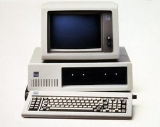
IBM PC

Encyclopedia
The IBM Personal Computer, commonly known as the IBM PC, is the original version and progenitor of the IBM PC compatible
hardware platform
. It is IBM
model number 5150, and was introduced on August 12, 1981. It was created by a team of engineers and designers under the direction of Don Estridge of the IBM Entry Systems Division in Boca Raton, Florida
.
Alongside "microcomputer
" and "home computer
", the term "personal computer
" was already in use before 1981. It was used as early as 1972 to characterize Xerox PARC
's Alto
. However, because of the success of the IBM Personal Computer, the term PC came to mean more specifically a microcomputer compatible with IBM's PC products.
BASIC language computer by 1972, with IBM's releasing its own IBM 5100
in 1975. It was a complete system programmable in BASIC
or APL, with a small built-in CRT monitor, keyboard, and tape drive for data storage. It was also very expensive — up to . It was specifically designed for professional and scientific problem-solvers, not business users or hobbyists. When the PC was introduced in 1981, it was originally designated as the IBM 5150, putting it in the "5100" series, though its architecture was not directly descended from the IBM 5100.
The original line of PCs were part of an IBM strategy to get into the small personal computer market then dominated by the Commodore PET
, Atari 8-bit family
, Apple II
, Tandy Corporation
's TRS-80
s, and various CP/M
machines.
Rather than going through the usual IBM design process, a special team was assembled with authorization to bypass normal company restrictions and get something to market rapidly. This project was given the code name Project Chess at the IBM Entry Systems Division in Boca Raton, Florida
. The team consisted of twelve people directed by Don Estridge
with Chief Designer Lewis Eggebrecht. They developed the PC in about a year. To achieve this they first decided to build the machine with "off-the-shelf" parts from a variety of different original equipment manufacturer
s (OEMs) and countries. Previously IBM had always developed its own components. Secondly for scheduling and cost reasons, rather than developing unique IBM PC monitor and printer designs, project management decided to utilize an existing "off-the-shelf" IBM monitor developed earlier in IBM Japan as well as an existing Epson printer model. Consequently, the unique IBM PC industrial design elements were relegated to the system unit and keyboard. They also decided on an open architecture
, so that other manufacturers could produce and sell peripheral components and compatible software without purchasing licenses. IBM also sold an IBM PC Technical Reference Manual that included complete circuit schematics, a listing of the ROM
BIOS
source code
, and other engineering and programming information. IBM announced the PC on August 12, 1981. Six weeks later at COMDEX
Fall, Tecmar
had 20 PC products available for sale. These products included memory expansion, IEEE-488, data acquisition, and PC Expansion chassis
. Pricing for the IBM PC started at $1,565 for a bare-bones configuration without disk drives.
At the time, Don Estridge and his team considered using the IBM 801
processor (an early RISC CPU) and its operating system that had been developed at the Thomas J. Watson Research Center
in Yorktown Heights, New York
. The 801 processor was more than an order of magnitude more powerful than the Intel 8088, and the operating system more advanced than the DOS 1.0 operating system from Microsoft
, which was finally selected. Ruling out an in-house solution made the team’s job much easier and may have avoided a delay in the schedule, but the ultimate consequences of this decision for IBM were far-reaching. IBM had recently developed the Datamaster
business microcomputer, which used an Intel processor and peripheral ICs; familiarity with these chips and the availability of the Intel 8088 processor was a deciding factor in the choice of processor for the new product. Even the 62-pin expansion bus slots were designed to be similar to the Datamaster slots. Delays due to in-house development of the Datamaster software also influenced the design team to a fast-track development process for the PC, with publicly available technical information to encourage third-party developers.
Other manufacturers soon reverse engineered
the BIOS to produce their own non-infringing functional copies. Columbia Data Products
introduced the first IBM-PC compatible computer in June 1982. In November 1982, Compaq Computer Corporation announced the Compaq Portable
, the first portable IBM PC compatible. The first models were shipped in March 1983.
Once the IBM PC became a commercial success, the product came back under the more usual tight IBM management control. IBM's tradition of "rationalizing" product lines, deliberately restricting the performance of lower-priced models in order to prevent them from "cannibalizing" profits from higher-priced models, worked against them.
, which in turn led to branding like diskettes being advertised as "IBM format". An IBM PC clone could be built with off-the-shelf parts, but the BIOS
required some reverse-engineering. Companies like Phoenix Software Associates
, American Megatrends
, Award
, and others achieved workable versions of the BIOS, allowing companies like DELL, Compaq, and HP to manufacture PCs that worked like IBM's product. The IBM PC became the industry standard.
and Sears Roebuck partnered with IBM from the beginning of development. IBM's head of sales and marketing, H.L. ('Sparky') Sparks, relied on these retail partners for important knowledge of the marketplace. Computerland and Sears became the main outlets for the new product. More than 190 Computerland stores already existed, while Sears was in the process of creating a handful of in-store computer centers for sale of the new product. This guaranteed IBM widespread distribution across the U.S.
Targeting the new PC at the home market, Sears Roebuck sales failed to live up to expectations. This unfavorable outcome revealed that the strategy of targeting the office market was the key to higher sales.
The IBM PC line >
Model name Model # Introduced CPU |Features
PC
5150
August 1981
8088
Floppy disk
or cassette
system
XT
5160
March 1983
8088
First IBM PC to come with an internal hard drive as standard.
XT/370
5160/588
October 1983
8088
5160 with XT/370 Option Kit and 3277 Emulation Adapter
3270 PC
5271
October 1983
8088
With 3270 terminal emulation, 20 Function Key Keyboard
PCjr
4860
November 1983
8088
Floppy-based home computer, Infrared Keyboard
Portable
5155
February 1984
8088
Floppy-based portable
AT
5170
August 1984
80286
Faster Processor, Faster System Bus (6 MHz, later 8 MHz, vs 4.77 MHz), Jumperless Configuration, Real Time Clock
AT/370
5170/599
October 1984
80286
5170 with AT/370 Option Kit and 3277 Emulation Adapter
3270 AT
5281
June 1985
80286
With 3270 terminal emulation
Convertible
5140
April 1986
8088
Microfloppy laptop
portable
XT 286
5162
September 1986
80286
Slow hard disk, but zero wait state
memory on the motherboard
. This 6 MHz machine was actually faster than the 8 MHz ATs (when using planar memory) because of the zero wait states
All IBM personal computers are software backwards-compatible with each other in general, but not every program will work in every machine. Some programs are time sensitive to a particular speed class. Older programs will not take advantage of newer higher-resolution and higher-color display standards, while some newer programs require newer display adapters. (Note that as the display adapter was an adapter card in all of these IBM models, newer display hardware could easily be, and often was, retrofitted to older models.) A few programs, typically very early ones, are written for and require a specific version of the IBM PC BIOS ROM. Most notably, BASICA which was dependent on the BIOS ROM had a sister program called GW-BASIC
which supported more functions and was 100% backwards compatible and could run independent from the BIOS ROM.
video card, with a suitable modulator, could use an NTSC television
set or an RGB
monitor for display; IBM's RGB monitor was their display model 5153. The other option that was offered by IBM was an MDA
and their monochrome display model 5151
. It was possible to install both an MDA and a CGA card and use both monitors concurrently, if supported by the application program. For example, AutoCAD
, Lotus 1-2-3
and others allowed use of a CGA Monitor for graphics and a separate monochrome monitor for text menus. Some model 5150 PCs with CGA monitors and a printer port also included the MDA adapter by default, because IBM provided the MDA port and printer port on the same adapter card; it was in fact an MDA/printer port combo card.
The most commonly used storage medium was the floppy disk
, though cassette tape
was originally envisioned by IBM as a low-budget alternative. Accordingly, the IBM 5150 PC was available with one or two 5-1/4" floppy drives or without any drives or storage medium; in the latter case IBM intended a user to connect his own cassette recorder via the 5150's cassette port
. The cassette tape port was mechanically identical to, and located next to, the keyboard port on the 5150's motherboard
. A hard disk
could not be installed into the 5150's system unit without retrofit
ting a more powerful power supply, but an "Expansion Unit," a.k.a. the "IBM 5161 Expansion Chassis," was available, which came with one 10 MB hard disk and also allowed the installation of a second hard disk. The system unit had five expansion slots, and the expansion unit had eight; however, one of the system unit's slots and one of the expansion unit's slots had to be occupied by the Extender Card and Receiver Card, respectively, which were needed to connect the expansion unit to the system unit and make the expansion unit's other slots available, for a total of 11 slots. A working configuration required that some of the slots be occupied by display, disk, and I/O adapters, as none of these were built in to the 5150's motherboard; the only motherboard external connectors were the keyboard and cassette ports. The simple PC speaker sound hardware was also on-board. The original PC's maximum memory using IBM parts was 256 kB
, 64 kB on the motherboard and three 64 kB expansion cards. The processor was an Intel 8088
running at 4.77 MHz (4/3 the standard NTSC color burst frequency of 3.579545 MHz). (In early units, the Intel 8088 used was a 1978 version, later were 1978/81/2 versions of the Intel chip; second-sourced AMDs were used after 1983). Some owners replaced the 8088 with an NEC V20
for a slight increase in processing speed. An Intel 8087
co-processor could also be added for hardware floating-point arithmetic. IBM sold the first IBM PCs in configurations with 16 or 64 kB of RAM
preinstalled using either nine or thirty-six 16-kbit DRAM
chips. (The ninth bit was used for parity
checking of memory.) After the IBM XT shipped, the IBM PC motherboard was configured more like the XTs motherboard with 8 narrower slots, as well as the same RAM configuration as the IBM XT. ( 64 kB in one bank, expandable to 256kB by populating the other 3 banks ).
Although the TV-compatible video board, cassette port and Federal Communications Commission
Class B certification were all aimed at making it a home computer
, the original PC proved too expensive for the home market. At introduction, a PC with 64 kB of RAM and a single 5.25-inch floppy drive and monitor sold for ($ in today's dollars), while the cheapest configuration that had no floppy drives, only 16 kB RAM, and no monitor (again, under the expectation that users would connect their existing TV sets and cassette recorders) proved too unattractive and low-spec, even for its time (cf. footnotes to the above IBM PC range table). While the 5150 did not become a top selling home computer, its floppy-based configuration became an unexpectedly large success with businesses.
(MDA) video card. The processor was a 4.77 MHz Intel 8088
and the expansion bus
8-bit XT bus architecture (later called 8-bit Industry Standard Architecture
(ISA) by IBM's competitors). The XT's expansion slots were placed closer together than with the original PC; this rendered the XT's case and mainboard incompatible with the model 5150's case and mainboard. The slots themselves and the peripheral cards however were compatible, unless a rare card designed for the PC happened to use the extra width of the 5150's slots, in which case the card might require two slots in the XT. The XT's expansion slot mechanical design, including the slot spacing and the design of the case openings and expansion card retaining screws, was identical to the design that was later used in the IBM PC AT and is still used as of 2011, though (since the phase-out of ISA slots) with different actual slot connectors and bus standards.
chip, microcoded to execute System 370 instructions, a second 68000 to handle bus arbitration and memory transfers, and a modified 8087 to emulate the S/370 floating point
instructions. The second card (370PC-M) connected to the first and contained 512 kB of memory. The third card (PC3277-EM), was a 3270 terminal emulator necessary to install the system software for the VM/PC software to run the processors. The computer booted into DOS, then ran the VM/PC Control Program.
The Portable was an XT motherboard, transplanted into a Compaq-style luggable case. The system featured 256 kilobytes of memory (expandable to 512 kB), an added CGA card connected to an internal monochrome (amber) composite monitor, and one or two half-height 5.25" 360K floppy disk drives. Unlike the Compaq Portable, which used a dual-mode monitor and special display card, IBM used a stock CGA board and a composite monitor, which had lower resolution. It could however, display color if connected to an external monitor or television.
processor, originally running at 6 MHz. It had a 16-bit
ISA bus and 20 MB hard drive. A faster model, running at 8 MHz and sporting a 30-megabyte hard disk was introduced in 1986.
The AT was designed to support multitasking; the new SysRq (System request key), little noted and often overlooked, is part of this design, as is the 80286 itself, the first Intel 16-bit processor with multitasking features (i.e. the 80286 protected mode). IBM made some attempt at marketing the AT as a multi-user machine, but it sold mainly as a faster PC for power users. For the most part, IBM PC/ATs were used as more powerful DOS (single-tasking) personal computers, in the literal sense of the PC name.
Early PC/ATs were plagued with reliability problems, in part because of some software and hardware incompatibilities, but mostly related to the internal 20 MB hard disk, and High Density Floppy Disk Drive
While some people blamed IBM's hard disk controller card and others blamed the hard disk manufacturer Computer Memories Inc.
(CMI), the IBM controller card worked fine with other drives, including CMI's 33-MB model. The problems introduced doubt about the computer and, for a while, even about the 286 architecture in general, but after IBM replaced the 20 MB CMI drives, the PC/AT proved reliable and became a lasting industry standard.
It utilized an Intel 80c88 CPU (a CMOS version of the Intel 8088) running at 4.77 MHz, 256 kB of RAM (expandable to 640 kB), dual 720 kB 3.5" floppy drives, and a monochrome CGA-compatible LCD screen at a price of $2,000. It weighed 13 pounds (5.8 kg) and featured a built-in carrying handle.
The PC Convertible had expansion capabilities through a proprietary ISA bus-based port on the rear of the machine. Extension modules, including a small printer and a video output module, could be snapped into place. The machine could also take an internal modem, but there was no room for an internal hard disk.
.
(IBM terminology calls it a planar). This mainly carries the CPU
and RAM
, and it has a bus
with slots for expansion cards. On the motherboard are also the ROM subsystem, DMA and IRQ controllers, coprocessor socket, sound (PC speaker, tone generation) circuitry, and keyboard interface. The original PC also adds to this the cassette interface.
The bus used in the original PC became very popular, and it was subsequently named ISA
. While it was popular, it was more commonly known as the PC-bus or XT-bus; the term ISA arose later when industry leaders chose to continue manufacturing machines based on the IBM PC AT architecture rather than license the PS/2
architecture and its MCA
bus from IBM. The XT-bus was then retroactively named 8-bit ISA or XT ISA, while the unqualified term ISA usually refers to the 16-bit AT-bus (as better defined in the ISA specifications.) The AT-bus is an extension of the PC-/XT-bus and is in use to this day in computers for industrial use, where its relatively low speed, 5 volt signals, and relatively simple, straightforward design (all by year 2011 standards) give it technical advantages (e.g. noise immunity for reliability).
A monitor and any floppy or hard disk drives are connected to the motherboard through cables connected to graphics adapter and disk controller cards, respectively, installed in expansion slots. Each expansion slot on the motherboard has a corresponding opening in the back of the computer case through which the card can expose connectors; a blank metal cover plate covers this case opening (to prevent dust and debris intrusion and control airflow) when no expansion card is installed. Memory expansion beyond the amount installable on the motherboard was also done with boards installed in expansion slots, and I/O devices such as parallel, serial, or network ports were likewise installed as individual expansion boards. For this reason, it was easy to fill the five expansion slots of the PC, or even the eight slots of the XT, even without installing any special hardware. Companies like Quadram and AST addressed this with their popular multi-I/O cards which combine several peripherals on one adapter card that uses only one slot; Quadram offered the QuadBoard and AST the SixPak.
Intel 8086 and 8088
-based PCs require expanded memory
(EMS) boards to work with more than 640 kB of memory. (Though the 8088 can address one megabyte
of memory, the last 384 kB of that is used or reserved for the BIOS ROM, BASIC ROM, extension ROMs installed on adapter cards, and memory address space used by devices including display adapter RAM and even the 64 kB EMS page frame itself.) The original IBM PC AT used an Intel 80286
processor which can access up to 16 MiB of memory (though standard DOS
applications cannot use more than one megabyte without using additional APIs.) Intel 80286-based computers running under OS/2
can work with the maximum memory.
The original system chips were one Intel 8259
programmable interrupt controller (PIC) (at I/O address ), one Intel 8237
direct memory access (DMA) controller (at I/O address ),and a Intel 8253
programmable interval timer (PIT) (at I/O address ). The PIT provides the clock ticks, dynamic memory refresh timing, and can be used for speaker output; one DMA channel is used to perform the memory refresh.
Math co-processor 8087 at 0xF0.
The IBM PC AT added a second, slave 8259 PIC (at I/O address ), a second 8237 DMA controller for 16-bit DMA (at I/O address ), a DMA address register (implemented with a 74LS612 IC) (at I/O address ), and a Motorola
MC146818 Real-time clock
(RTC) with Nonvolatile memory
(NVRAM) used for system configuration (replacing the DIP switches and jumpers used for this purpose in PC and PC-XT models (at I/O address ).
On expansion cards, the Intel 8255
programmable peripheral interface (PPI) (at I/O addresses is used for parallel I/O controls the printer, and
the 8250 universal asynchronous receiver/transmitter (UART) (at I/O address or ) controls the serial communication at the (pseudo-)RS-232
port.
system. Each key was rated to be reliable to over 100 million keystrokes. For the IBM PC, a separate keyboard housing was designed with a novel usability feature that allowed users to adjust the keyboard angle for personal comfort. Compared with the keyboards of other small computers at the time, the IBM PC keyboard
was far superior and played a significant role in establishing a high quality impression. For example, the industrial design of the keyboard, together with the system unit, was recognized with a major design award. Byte
magazine in the fall of 1981 went so far as to state that the keyboard was 50% of the reason to buy an IBM PC. The importance of the keyboard was definitely established when the 1983 IBM PCjr
flopped, in very large part for having a much different and mediocre Chiclet keyboard
that made a poor impression on customers. Oddly enough, the same thing almost happened to the original IBM PC when in early 1981 management seriously considered substituting a cheaper and lower quality keyboard. This mistake was narrowly avoided on the advice of one of the original development engineers.
However, the original 1981 IBM PC 84-key keyboard
was criticized by typists for its non-standard placement of the Return and left Shift keys, and because it did not have separate cursor and numeric pads that were popular on the pre-PC DEC
VT100
series video terminals. In 1982, Key Tronic
introduced the now standard 101-key PC keyboard. In 1984, IBM corrected the Return and left Shift keys on its AT keyboard, but shortened the 'backspace' key, making it harder to reach. In 1986, IBM changed to the 101 key enhanced keyboard, which added the separate cursor and numeric key pads, relocated all the function keys and the Ctrl keys, and the Esc key was also relocated to the opposite side of the keyboard.
Another criticism of the original keyboard was the relatively loud "clack" sound each key made when pressed. Since typewriter users were accustomed to keeping their eyes on the hardcopy they were typing from and had come to rely on the mechanical sound that was made as each character was typed onto the paper to ensure that they had pressed the key hard enough (and only once), the PC keyboard electronic "clack" feature was intended to provide that same reassurance. However, it proved to be very noisy and annoying, especially if many PCs were in use in the same room, and later keyboards were significantly quieter.
The IBM PC keyboard is very robust and flexible. The low-level interface for each key is the same: each key sends a signal when it is pressed and another signal when it is released. An integrated microcontroller in the keyboard scans the keyboard and encodes a "scan code" and "release code" for each key as it is pressed and released separately. Any key can be used as a shift key, and a large number of keys can be held down simultaneously and separately sensed. The controller in the keyboard handles typematic operation, issuing periodic repeat scan codes for a depressed key and then a single release code when the key is finally released.
An "IBM PC compatible" may have a keyboard that does not recognize every key combination a true IBM PC does, such as shifted cursor keys. In addition, the "compatible" vendors sometimes used proprietary keyboard interfaces, preventing the keyboard from being replaced.
Although the PC/XT and AT used the same style of keyboard connector, the low-level protocol for reading the keyboard was different between these two series. The AT keyboard uses a bidirectional interface which allows the computer to send commands to the keyboard. An AT keyboard could not be used in an XT, nor the reverse. Third-party keyboard manufacturers provided a switch on some of their keyboards to select either the AT-style or XT-style protocol for the keyboard.
alphabet as its basis, but extended it to 8 bits with nonstandard character codes. This character set was not suitable for some international applications, and soon a veritable cottage industry emerged providing variants of the original character set in various national variants. In IBM tradition, these variants were called code page
s. These codings are now obsolete, having been replaced by more systematic and standardized forms of character coding, such as ISO 8859-1, Windows-1251
and Unicode
. The original character set is known as code page 437
.
Interestingly, the IBM PC cassette interface
encodes data using a frequency modulation with a variable data rate. Either a one or a zero is represented by a single cycle of a square wave, but the square wave frequencies differ by a factor of two, with ones having the lower frequency. Therefore, the bit periods for zeros and ones also differ by a factor of two, with the unusual effect that a data stream with more zeros than ones will use less tape (and time) than an equal-length (in bits) data stream containing more ones than zeros, or equal numbers of each.
 Most or all 5150 PCs had one or two 5.25-inch floppy disk
drives. These floppy drives were either single-sided double-density drives (SS/DD, a.k.a. SSDD), or double-sided double-density drives (DS/DD, a.k.a. DSDD). The IBM PC never used single density floppy drives. The drives and disks were commonly referred to by capacity, e.g. "160KB floppy disk" or "360KB floppy drive". DSDD drives were backwards compatible; they could read and write SSDD floppies. The same type of physical diskette could be used for both drives, however to convert a 5.25-inch SSDD disk to a DSDD disk, it needed to be reformatted, at which point SSDD drives could no longer read it.
The disks were Modified Frequency Modulation
(MFM) coded in 512-byte sectors, and were soft-sectored. They contained 40 tracks per side at the 48 track per inch (TPI) density, and initially were formatted to contain eight sectors per track. This meant that SSDD disks initially had a formatted capacity of 160 kB,
The IBM Personal Computer, commonly known as the IBM PC, is the original version and progenitor of the IBM PC compatible
hardware platform
. It is IBM
model number 5150, and was introduced on August 12, 1981. It was created by a team of engineers and designers under the direction of Don Estridge of the IBM Entry Systems Division in Boca Raton, Florida
.
Alongside "microcomputer
" and "home computer
", the term "personal computer
" was already in use before 1981. It was used as early as 1972 to characterize Xerox PARC
's Alto
. However, because of the success of the IBM Personal Computer, the term PC came to mean more specifically a microcomputer compatible with IBM's PC products.
BASIC language computer by 1972, with IBM's releasing its own IBM 5100
in 1975. It was a complete system programmable in BASIC
or APL, with a small built-in CRT monitor, keyboard, and tape drive for data storage. It was also very expensive — up to . It was specifically designed for professional and scientific problem-solvers, not business users or hobbyists. When the PC was introduced in 1981, it was originally designated as the IBM 5150, putting it in the "5100" series, though its architecture was not directly descended from the IBM 5100.
The original line of PCs were part of an IBM strategy to get into the small personal computer market then dominated by the Commodore PET
, Atari 8-bit family
, Apple II
, Tandy Corporation
's TRS-80
s, and various CP/M
machines."Total share: 30 years of personal computer market share figures", Jeremy Reimer December 14, 2005 arstechnica.com
Rather than going through the usual IBM design process, a special team was assembled with authorization to bypass normal company restrictions and get something to market rapidly. This project was given the code name Project Chess at the IBM Entry Systems Division in Boca Raton, Florida
. The team consisted of twelve people directed by Don Estridge
with Chief Designer Lewis Eggebrecht.The history of computing project They developed the PC in about a year. To achieve this they first decided to build the machine with "off-the-shelf" parts from a variety of different original equipment manufacturer
s (OEMs) and countries. Previously IBM had always developed its own components. Secondly for scheduling and cost reasons, rather than developing unique IBM PC monitor and printer designs, project management decided to utilize an existing "off-the-shelf" IBM monitor developed earlier in IBM Japan as well as an existing Epson printer model. Consequently, the unique IBM PC industrial design elements were relegated to the system unit and keyboard. They also decided on an open architecture
, so that other manufacturers could produce and sell peripheral components and compatible software without purchasing licenses. IBM also sold an IBM PC Technical Reference Manual that included complete circuit schematics, a listing of the ROM
BIOS
source code
, and other engineering and programming information.. Personal website with an image of the technical manual. "The official documentation came in cool three-ring binders, complete with slip covers. Completely typeset... This book wasn't free, either—I think it cost $60. Supposedly, no Compaq BIOS programmer ever saw one of these. Yeah, right." Jargon File, TechRef: /tek'ref/ [MS-DOS] n. The original "IBM PC Technical Reference Manual", including the BIOS listing and complete schematics for the PC. The only PC documentation in the issue package that's considered serious by real hackers." IBM announced the PC on August 12, 1981. Six weeks later at COMDEX
Fall, Tecmar
had 20 PC products available for sale. These products included memory expansion, IEEE-488, data acquisition, and PC Expansion chassisCOMDEX FALL November 18, 1981 Las Vegas, NV, "Tecmar shows 20 IBM PC option cards.. LabMaster, LabTender, DADIO,DeviceTender, IEEE-488.."PC Magazine Vol1 No.1, "Taking the Measure" by David Bunnell, "Tecmar deployed 20 option cards for the IBM PC"PC Magazine Vol1 No.5, "Tecmar Triumph" by David Bunnell, Scientific Solutions releases 20 new products for the PCBYTE Vol7 No.1 "Scientific Solutions - Advertisement for data acquisition boards, stepper controllers, IEEE-488 products
.Test&Meausrement World Vol11 No 10 Decade of Progress Award: Scientific Solutions - LabMaster First in PC Data Acquisition Pricing for the IBM PC started at $1,565 for a bare-bones configuration without disk drives.IBM.com
At the time, Don Estridge and his team considered using the IBM 801
processor (an early RISC CPU) and its operating system that had been developed at the Thomas J. Watson Research Center
in Yorktown Heights, New York
. The 801 processor was more than an order of magnitude more powerful than the Intel 8088, and the operating system more advanced than the DOS 1.0 operating system from Microsoft
, which was finally selected. Ruling out an in-house solution made the team’s job much easier and may have avoided a delay in the schedule, but the ultimate consequences of this decision for IBM were far-reaching. IBM had recently developed the Datamaster
business microcomputer, which used an Intel processor and peripheral ICs; familiarity with these chips and the availability of the Intel 8088 processor was a deciding factor in the choice of processor for the new product. Even the 62-pin expansion bus slots were designed to be similar to the Datamaster slots. Delays due to in-house development of the Datamaster software also influenced the design team to a fast-track development process for the PC, with publicly available technical information to encourage third-party developers.David J. Bradley
, The Creation of the IBM PC, BYTE Magazine Volume 15 No. 9 September 1990 pages 414-420
Other manufacturers soon reverse engineered
the BIOS to produce their own non-infringing functional copies. Columbia Data Products
introduced the first IBM-PC compatible computer in June 1982. In November 1982, Compaq Computer Corporation announced the Compaq Portable
, the first portable IBM PC compatible. The first models were shipped in March 1983.
Once the IBM PC became a commercial success, the product came back under the more usual tight IBM management control. IBM's tradition of "rationalizing" product lines, deliberately restricting the performance of lower-priced models in order to prevent them from "cannibalizing" profits from higher-priced models, worked against them.
, which in turn led to branding like diskettes being advertised as "IBM format". An IBM PC clone could be built with off-the-shelf parts, but the BIOS
required some reverse-engineering. Companies like Phoenix Software Associates
, American Megatrends
, Award
, and others achieved workable versions of the BIOS, allowing companies like DELL, Compaq, and HP to manufacture PCs that worked like IBM's product. The IBM PC became the industry standard.
and Sears Roebuck partnered with IBM from the beginning of development. IBM's head of sales and marketing, H.L. ('Sparky') Sparks, relied on these retail partners for important knowledge of the marketplace. Computerland and Sears became the main outlets for the new product. More than 190 Computerland stores already existed, while Sears was in the process of creating a handful of in-store computer centers for sale of the new product. This guaranteed IBM widespread distribution across the U.S.
Targeting the new PC at the home market, Sears Roebuck sales failed to live up to expectations. This unfavorable outcome revealed that the strategy of targeting the office market was the key to higher sales.
The IBM PC line >
Model name Model # Introduced CPU |Features
PC
5150
August 1981
8088
Floppy disk
or cassette
IBM did not offer own brand cassette recorders, but the 5150 had a cassette player jack, and IBM anticipated that entry level home users would connect their own cassette recorders for data storage instead of using the more expensive floppy drives (and use their existing TV sets as monitors); to this end, IBM initially offered the 5150 in a basic configuration without any floppy drives or monitor at the price of $1,565, whereas they offered a system with a monitor and single floppy drive for an initial $3,005. Few if any users however bought IBM 5150 PCs without floppy drives. system
XT
5160
March 1983
8088
First IBM PC to come with an internal hard drive as standard.
XT/370
5160/588
October 1983
8088
5160 with XT/370 Option Kit and 3277 Emulation Adapter
3270 PC
5271
October 1983
8088
With 3270 terminal emulation, 20 Function Key Keyboard
PCjr
4860
November 1983
8088
Floppy-based home computer, Infrared Keyboard
Portable
5155
February 1984
8088
Floppy-based portable
AT
5170
August 1984
80286
Faster Processor, Faster System Bus (6 MHz, later 8 MHz, vs 4.77 MHz), Jumperless Configuration, Real Time Clock
AT/370
5170/599
October 1984
80286
5170 with AT/370 Option Kit and 3277 Emulation Adapter
3270 AT
5281
June 1985 Scott Mueller, Upgrading and Repairing PCs, 2nd Ed, Que Books 1992,ISBN 0-88022-856-3, page 94
80286
With 3270 terminal emulation
Convertible
5140
April 1986
8088
Microfloppy laptop
portable
XT 286
5162
September 1986
80286
Slow hard disk, but zero wait state
memory on the motherboard
. This 6 MHz machine was actually faster than the 8 MHz ATs (when using planar memory) because of the zero wait states
All IBM personal computers are software backwards-compatible with each other in general, but not every program will work in every machine. Some programs are time sensitive to a particular speed class. Older programs will not take advantage of newer higher-resolution and higher-color display standards, while some newer programs require newer display adapters. (Note that as the display adapter was an adapter card in all of these IBM models, newer display hardware could easily be, and often was, retrofitted to older models.) A few programs, typically very early ones, are written for and require a specific version of the IBM PC BIOS ROM. Most notably, BASICA which was dependent on the BIOS ROM had a sister program called GW-BASIC
which supported more functions and was 100% backwards compatible and could run independent from the BIOS ROM.
video card, with a suitable modulator, could use an NTSC television
set or an RGB
monitor for display; IBM's RGB monitor was their display model 5153. The other option that was offered by IBM was an MDA
and their monochrome display model 5151
. It was possible to install both an MDA and a CGA card and use both monitors concurrently,Dual-Head operation on vintage PCs if supported by the application program. For example, AutoCAD
, Lotus 1-2-3
and others allowed use of a CGA Monitor for graphics and a separate monochrome monitor for text menus. Some model 5150 PCs with CGA monitors and a printer port also included the MDA adapter by default, because IBM provided the MDA port and printer port on the same adapter card; it was in fact an MDA/printer port combo card.
The most commonly used storage medium was the floppy disk
, though cassette tape
was originally envisioned by IBM as a low-budget alternative. Accordingly, the IBM 5150 PC was available with one or two 5-1/4" floppy drives or without any drives or storage medium; in the latter case IBM intended a user to connect his own cassette recorder via the 5150's cassette port
. The cassette tape port was mechanically identical to, and located next to, the keyboard port on the 5150's motherboard
. A hard disk
could not be installed into the 5150's system unit without retrofit
ting a more powerful power supply, but an "Expansion Unit," a.k.a. the "IBM 5161 Expansion Chassis," was available, which came with one 10 MB hard disk and also allowed the installation of a second hard disk.Scott Mueller Upgrading and Repairing PCs, Second Edition, Que Books, 1992, ISBN 0-88022-856-3 page 48 The system unit had five expansion slots, and the expansion unit had eight; however, one of the system unit's slots and one of the expansion unit's slots had to be occupied by the Extender Card and Receiver Card, respectively, which were needed to connect the expansion unit to the system unit and make the expansion unit's other slots available, for a total of 11 slots. A working configuration required that some of the slots be occupied by display, disk, and I/O adapters, as none of these were built in to the 5150's motherboard; the only motherboard external connectors were the keyboard and cassette ports. The simple PC speaker sound hardware was also on-board. The original PC's maximum memory using IBM parts was 256 kB
, 64 kB on the motherboard and three 64 kB expansion cards. The processor was an Intel 8088
running at 4.77 MHz (4/3 the standard NTSC color burst frequency of 3.579545 MHz). (In early units, the Intel 8088 used was a 1978 version, later were 1978/81/2 versions of the Intel chip; second-sourced AMDs were used after 1983). Some owners replaced the 8088 with an NEC V20
for a slight increase in processing speed. An Intel 8087
co-processor could also be added for hardware floating-point arithmetic. IBM sold the first IBM PCs in configurations with 16 or 64 kB of RAM
preinstalled using either nine or thirty-six 16-kbit DRAM
chips. (The ninth bit was used for parity
checking of memory.) After the IBM XT shipped, the IBM PC motherboard was configured more like the XTs motherboard with 8 narrower slots, as well as the same RAM configuration as the IBM XT. ( 64 kB in one bank, expandable to 256kB by populating the other 3 banks ).
Although the TV-compatible video board, cassette port and Federal Communications Commission
Class B certification were all aimed at making it a home computer
,David J. Bradley The Creation of the IBM PC, BYTE,ISSN 0360-5280/09,Volume 15, Number 9, September 1990 pp. 414-420 the original PC proved too expensive for the home market. At introduction, a PC with 64 kB of RAM and a single 5.25-inch floppy drive and monitor sold for ($ in today's dollars), while the cheapest configuration that had no floppy drives, only 16 kB RAM, and no monitor (again, under the expectation that users would connect their existing TV sets and cassette recorders) proved too unattractive and low-spec, even for its time (cf. footnotes to the above IBM PC range table).Whence Came the IBM PC Test and Measurement World, retrieved March 2,Gene Smart and Andrew Reinhardt, 15 years of Bits, Bytes and Other Great Moments, BYTE Magazine, September 1990 pg. 382 While the 5150 did not become a top selling home computer, its floppy-based configuration became an unexpectedly large success with businesses.
(MDA) video card. The processor was a 4.77 MHz Intel 8088
and the expansion bus
8-bit XT bus architecture (later called 8-bit Industry Standard Architecture
(ISA) by IBM's competitors). The XT's expansion slots were placed closer togetherHoward81.co.uk than with the original PC;Howard81.co.uk this rendered the XT's case and mainboard incompatible with the model 5150's case and mainboard. The slots themselves and the peripheral cards however were compatible, unless a rare card designed for the PC happened to use the extra width of the 5150's slots, in which case the card might require two slots in the XT. The XT's expansion slot mechanical design, including the slot spacing and the design of the case openings and expansion card retaining screws, was identical to the design that was later used in the IBM PC AT and is still used as of 2011, though (since the phase-out of ISA slots) with different actual slot connectors and bus standards.
chip, microcoded to execute System 370 instructions, a second 68000 to handle bus arbitration and memory transfers, and a modified 8087 to emulate the S/370 floating point
instructions. The second card (370PC-M) connected to the first and contained 512 kB of memory. The third card (PC3277-EM), was a 3270 terminal emulator necessary to install the system software for the VM/PC software to run the processors. The computer booted into DOS, then ran the VM/PC Control Program.Corestore.orgMuller, Guide to repairing and upgrading PCs 6th edition
The Portable was an XT motherboard, transplanted into a Compaq-style luggable case. The system featured 256 kilobytes of memory (expandable to 512 kB), an added CGA card connected to an internal monochrome (amber) composite monitor, and one or two half-height 5.25" 360K floppy disk drives. Unlike the Compaq Portable, which used a dual-mode monitor and special display card, IBM used a stock CGA board and a composite monitor, which had lower resolution. It could however, display color if connected to an external monitor or television.
processor, originally running at 6 MHz. It had a 16-bit
ISA bus and 20 MB hard drive. A faster model, running at 8 MHz and sporting a 30-megabyte hard disk i.e. 33% more speed, 50% more disk space was introduced in 1986.PC Magazine, Sept. 30, 1986, pp. 179-184
The AT was designed to support multitasking; the new SysRq (System request key), little noted and often overlooked, is part of this design, as is the 80286 itself, the first Intel 16-bit processor with multitasking features (i.e. the 80286 protected mode). IBM made some attempt at marketing the AT as a multi-user machine, but it sold mainly as a faster PC for power users. For the most part, IBM PC/ATs were used as more powerful DOS (single-tasking) personal computers, in the literal sense of the PC name.
Early PC/ATs were plagued with reliability problems, in part because of some software and hardware incompatibilities, but mostly related to the internal 20 MB hard disk, and High Density Floppy Disk DriveThe opening sentence of an April 29, 1986 PC Magazine article reads "If you own an IBM PC AT and your hard disk hasn't crashed yet, don't worry -- it probably will." highbeam.com & encyclopedia.com (the latter a Chicago Sun-Times article citing the PC Magazine story). IBM recovered, although with mixed comments, as noted in the Sept. 30, 1986 PC Magazine article, "The Two Faces of IBM's 8-MHz AT," pp. 179 - 184.
While some people blamed IBM's hard disk controller card and others blamed the hard disk manufacturer Computer Memories Inc.
(CMI), the IBM controller card worked fine with other drives, including CMI's 33-MB model. The problems introduced doubt about the computer and, for a while, even about the 286 architecture in general, but after IBM replaced the 20 MB CMI drives, the PC/AT proved reliable and became a lasting industry standard.
It utilized an Intel 80c88 CPU (a CMOS version of the Intel 8088) running at 4.77 MHz, 256 kB of RAM (expandable to 640 kB), dual 720 kB 3.5" floppy drives, and a monochrome CGA-compatible LCD screen at a price of $2,000. It weighed 13 pounds (5.8 kg) and featured a built-in carrying handle.
The PC Convertible had expansion capabilities through a proprietary ISA bus-based port on the rear of the machine. Extension modules, including a small printer and a video output module, could be snapped into place. The machine could also take an internal modem, but there was no room for an internal hard disk.
.
(IBM terminology calls it a planar). This mainly carries the CPU
and RAM
, and it has a bus
with slots for expansion cards. On the motherboard are also the ROM subsystem, DMA and IRQ controllers, coprocessor socket, sound (PC speaker, tone generation) circuitry, and keyboard interface. The original PC also adds to this the cassette interface.
The bus used in the original PC became very popular, and it was subsequently named ISA
. While it was popular, it was more commonly known as the PC-bus or XT-bus; the term ISA arose later when industry leaders chose to continue manufacturing machines based on the IBM PC AT architecture rather than license the PS/2
architecture and its MCA
bus from IBM. The XT-bus was then retroactively named 8-bit ISA or XT ISA, while the unqualified term ISA usually refers to the 16-bit AT-bus (as better defined in the ISA specifications.) The AT-bus is an extension of the PC-/XT-bus and is in use to this day in computers for industrial use, where its relatively low speed, 5 volt signals, and relatively simple, straightforward design (all by year 2011 standards) give it technical advantages (e.g. noise immunity for reliability).
A monitor and any floppy or hard disk drives are connected to the motherboard through cables connected to graphics adapter and disk controller cards, respectively, installed in expansion slots. Each expansion slot on the motherboard has a corresponding opening in the back of the computer case through which the card can expose connectors; a blank metal cover plate covers this case opening (to prevent dust and debris intrusion and control airflow) when no expansion card is installed. Memory expansion beyond the amount installable on the motherboard was also done with boards installed in expansion slots, and I/O devices such as parallel, serial, or network ports were likewise installed as individual expansion boards. For this reason, it was easy to fill the five expansion slots of the PC, or even the eight slots of the XT, even without installing any special hardware. Companies like Quadram and AST addressed this with their popular multi-I/O cards which combine several peripherals on one adapter card that uses only one slot; Quadram offered the QuadBoard and AST the SixPak.
Intel 8086 and 8088
-based PCs require expanded memory
(EMS) boards to work with more than 640 kB of memory. (Though the 8088 can address one megabyte
of memory, the last 384 kB of that is used or reserved for the BIOS ROM, BASIC ROM, extension ROMs installed on adapter cards, and memory address space used by devices including display adapter RAM and even the 64 kB EMS page frame itself.) The original IBM PC AT used an Intel 80286
processor which can access up to 16 MiB of memory (though standard DOS
applications cannot use more than one megabyte without using additional APIs.) Intel 80286-based computers running under OS/2
can work with the maximum memory.
The original system chips were one Intel 8259
programmable interrupt controller (PIC) (at I/O address ), one Intel 8237
direct memory access (DMA) controller (at I/O address ),and a Intel 8253
programmable interval timer (PIT) (at I/O address ). The PIT provides the clock ticks, dynamic memory refresh timing, and can be used for speaker output;wustl.edu - ECE306 Lecture 16 one DMA channel is used to perform the memory refresh.
Math co-processor 8087 at 0xF0.
The IBM PC AT added a second, slave 8259 PIC (at I/O address ), a second 8237 DMA controller for 16-bit DMA (at I/O address ), a DMA address register (implemented with a 74LS612 IC) (at I/O address ),The DMA address register extends the 16-bit transfer memory address capacity of the 8237 to 24 bits and a Motorola
MC146818 Real-time clock
(RTC) with Nonvolatile memory
(NVRAM) used for system configuration (replacing the DIP switches and jumpers used for this purpose in PC and PC-XT models (at I/O address ).illinois.edu - Real time clock plus RAM
On expansion cards, the Intel 8255
programmable peripheral interface (PPI) (at I/O addresses is used for parallel I/O controls the printer,ctv.se - PC KITS-tutorial page (parallel port, joystick port) and
the 8250 universal asynchronous receiver/transmitter (UART) (at I/O address or ) controls the serial communication at the (pseudo-)The IBM PC serial port is not strictly RS-232, since it uses TTL signal levels, whereas RS-232 requires signals of +/- 3 to 15 volts; some signal levels that are valid for a TTL high state, and all signal levels that represent a TTL low state, fall within the forbidden range of -3 to +3 volts for standard RS-232. (However, it is not difficult to design and construct a level converter that will convert between IBM serial port and standard RS-232 signals.)RS-232
port.
system.David Bradley, BYTE September 1990 Each key was rated to be reliable to over 100 million keystrokes. For the IBM PC, a separate keyboard housing was designed with a novel usability feature that allowed users to adjust the keyboard angle for personal comfort. Compared with the keyboards of other small computers at the time, the IBM PC keyboard
was far superior and played a significant role in establishing a high quality impression. For example, the industrial design of the keyboard, together with the system unit, was recognized with a major design award. Byte
magazine in the fall of 1981 went so far as to state that the keyboard was 50% of the reason to buy an IBM PC. The importance of the keyboard was definitely established when the 1983 IBM PCjr
flopped, in very large part for having a much different and mediocre Chiclet keyboard
that made a poor impression on customers. Oddly enough, the same thing almost happened to the original IBM PC when in early 1981 management seriously considered substituting a cheaper and lower quality keyboard. This mistake was narrowly avoided on the advice of one of the original development engineers.
However, the original 1981 IBM PC 84-key keyboard
was criticized by typists for its non-standard placement of the Return and left Shift keys, and because it did not have separate cursor and numeric pads that were popular on the pre-PC DEC
VT100
series video terminals. In 1982, Key Tronic
introduced the now standard 101-key PC keyboard. In 1984, IBM corrected the Return and left Shift keys on its AT keyboard, but shortened the 'backspace' key, making it harder to reach. In 1986, IBM changed to the 101 key enhanced keyboard, which added the separate cursor and numeric key pads, relocated all the function keys and the Ctrl keys, and the Esc key was also relocated to the opposite side of the keyboard.
Another criticism of the original keyboard was the relatively loud "clack" sound each key made when pressed. Since typewriter users were accustomed to keeping their eyes on the hardcopy they were typing from and had come to rely on the mechanical sound that was made as each character was typed onto the paper to ensure that they had pressed the key hard enough (and only once), the PC keyboard electronic "clack" feature was intended to provide that same reassurance. However, it proved to be very noisy and annoying, especially if many PCs were in use in the same room, and later keyboards were significantly quieter.
The IBM PC keyboard is very robust and flexible. The low-level interface for each key is the same: each key sends a signal when it is pressed and another signal when it is released. An integrated microcontroller in the keyboard scans the keyboard and encodes a "scan code" and "release code" for each key as it is pressed and released separately. Any key can be used as a shift key, and a large number of keys can be held down simultaneously and separately sensed. The controller in the keyboard handles typematic operation, issuing periodic repeat scan codes for a depressed key and then a single release code when the key is finally released.
An "IBM PC compatible" may have a keyboard that does not recognize every key combination a true IBM PC does, such as shifted cursor keys. In addition, the "compatible" vendors sometimes used proprietary keyboard interfaces, preventing the keyboard from being replaced.
Although the PC/XT and AT used the same style of keyboard connector, the low-level protocol for reading the keyboard was different between these two series. The AT keyboard uses a bidirectional interface which allows the computer to send commands to the keyboard. An AT keyboard could not be used in an XT, nor the reverse. Third-party keyboard manufacturers provided a switch on some of their keyboards to select either the AT-style or XT-style protocol for the keyboard.
alphabet as its basis, but extended it to 8 bits with nonstandard character codes. This character set was not suitable for some international applications, and soon a veritable cottage industry emerged providing variants of the original character set in various national variants. In IBM tradition, these variants were called code page
s. These codings are now obsolete, having been replaced by more systematic and standardized forms of character coding, such as ISO 8859-1, Windows-1251
and Unicode
. The original character set is known as code page 437
.
Interestingly, the IBM PC cassette interface
encodes data using a frequency modulation with a variable data rate. Either a one or a zero is represented by a single cycle of a square wave, but the square wave frequencies differ by a factor of two, with ones having the lower frequency. Therefore, the bit periods for zeros and ones also differ by a factor of two, with the unusual effect that a data stream with more zeros than ones will use less tape (and time) than an equal-length (in bits) data stream containing more ones than zeros, or equal numbers of each.
Most or all 5150 PCs had one or two 5.25-inch floppy disk
drives. These floppy drives were either single-sided double-density drives (SS/DD, a.k.a. SSDD), or double-sided double-density drives (DS/DD, a.k.a. DSDD). The IBM PC never used single density floppy drives. The drives and disks were commonly referred to by capacity, e.g. "160KB floppy disk" or "360KB floppy drive". DSDD drives were backwards compatible; they could read and write SSDD floppies. The same type of physical diskette could be used for both drives,Even if SSDD disks were not advertised as/rated for DSDD use, they usually could be DSDD formatted all the same. DSDD-rated floppy disks could always be used as SSDD floppies. This just meant that one side was not written on. however to convert a 5.25-inch SSDD disk to a DSDD disk, it needed to be reformatted, at which point SSDD drives could no longer read it.
The disks were Modified Frequency Modulation
(MFM) coded in 512-byte sectors, and were soft-sectored. They contained 40 tracks per side at the 48 track per inch (TPI) density,Sometimes the tracks were also referred as cylinders, which is technically correct and analogous to hard drive cylinders. One floppy disk track equaled one cylinder, however with double-sided floppies, only the first side's cylinder numbers were identical to the track numbers; on the second side, the cylinders 1-40 corresponded to tracks 41-80 of the formatted floppy. and initially were formatted to contain eight sectors per track. This meant that SSDD disks initially had a formatted capacity of 160 kB,
The IBM Personal Computer, commonly known as the IBM PC, is the original version and progenitor of the IBM PC compatible
hardware platform
. It is IBM
model number 5150, and was introduced on August 12, 1981. It was created by a team of engineers and designers under the direction of Don Estridge of the IBM Entry Systems Division in Boca Raton, Florida
.
Alongside "microcomputer
" and "home computer
", the term "personal computer
" was already in use before 1981. It was used as early as 1972 to characterize Xerox PARC
's Alto
. However, because of the success of the IBM Personal Computer, the term PC came to mean more specifically a microcomputer compatible with IBM's PC products.
BASIC language computer by 1972, with IBM's releasing its own IBM 5100
in 1975. It was a complete system programmable in BASIC
or APL, with a small built-in CRT monitor, keyboard, and tape drive for data storage. It was also very expensive — up to . It was specifically designed for professional and scientific problem-solvers, not business users or hobbyists. When the PC was introduced in 1981, it was originally designated as the IBM 5150, putting it in the "5100" series, though its architecture was not directly descended from the IBM 5100.
The original line of PCs were part of an IBM strategy to get into the small personal computer market then dominated by the Commodore PET
, Atari 8-bit family
, Apple II
, Tandy Corporation
's TRS-80
s, and various CP/M
machines."Total share: 30 years of personal computer market share figures", Jeremy Reimer December 14, 2005 arstechnica.com
Rather than going through the usual IBM design process, a special team was assembled with authorization to bypass normal company restrictions and get something to market rapidly. This project was given the code name Project Chess at the IBM Entry Systems Division in Boca Raton, Florida
. The team consisted of twelve people directed by Don Estridge
with Chief Designer Lewis Eggebrecht.The history of computing project They developed the PC in about a year. To achieve this they first decided to build the machine with "off-the-shelf" parts from a variety of different original equipment manufacturer
s (OEMs) and countries. Previously IBM had always developed its own components. Secondly for scheduling and cost reasons, rather than developing unique IBM PC monitor and printer designs, project management decided to utilize an existing "off-the-shelf" IBM monitor developed earlier in IBM Japan as well as an existing Epson printer model. Consequently, the unique IBM PC industrial design elements were relegated to the system unit and keyboard. They also decided on an open architecture
, so that other manufacturers could produce and sell peripheral components and compatible software without purchasing licenses. IBM also sold an IBM PC Technical Reference Manual that included complete circuit schematics, a listing of the ROM
BIOS
source code
, and other engineering and programming information.. Personal website with an image of the technical manual. "The official documentation came in cool three-ring binders, complete with slip covers. Completely typeset... This book wasn't free, either—I think it cost $60. Supposedly, no Compaq BIOS programmer ever saw one of these. Yeah, right." Jargon File, TechRef: /tek'ref/ [MS-DOS] n. The original "IBM PC Technical Reference Manual", including the BIOS listing and complete schematics for the PC. The only PC documentation in the issue package that's considered serious by real hackers." IBM announced the PC on August 12, 1981. Six weeks later at COMDEX
Fall, Tecmar
had 20 PC products available for sale. These products included memory expansion, IEEE-488, data acquisition, and PC Expansion chassisCOMDEX FALL November 18, 1981 Las Vegas, NV, "Tecmar shows 20 IBM PC option cards.. LabMaster, LabTender, DADIO,DeviceTender, IEEE-488.."PC Magazine Vol1 No.1, "Taking the Measure" by David Bunnell, "Tecmar deployed 20 option cards for the IBM PC"PC Magazine Vol1 No.5, "Tecmar Triumph" by David Bunnell, Scientific Solutions releases 20 new products for the PCBYTE Vol7 No.1 "Scientific Solutions - Advertisement for data acquisition boards, stepper controllers, IEEE-488 products
.Test&Meausrement World Vol11 No 10 Decade of Progress Award: Scientific Solutions - LabMaster First in PC Data Acquisition Pricing for the IBM PC started at $1,565 for a bare-bones configuration without disk drives.IBM.com
At the time, Don Estridge and his team considered using the IBM 801
processor (an early RISC CPU) and its operating system that had been developed at the Thomas J. Watson Research Center
in Yorktown Heights, New York
. The 801 processor was more than an order of magnitude more powerful than the Intel 8088, and the operating system more advanced than the DOS 1.0 operating system from Microsoft
, which was finally selected. Ruling out an in-house solution made the team’s job much easier and may have avoided a delay in the schedule, but the ultimate consequences of this decision for IBM were far-reaching. IBM had recently developed the Datamaster
business microcomputer, which used an Intel processor and peripheral ICs; familiarity with these chips and the availability of the Intel 8088 processor was a deciding factor in the choice of processor for the new product. Even the 62-pin expansion bus slots were designed to be similar to the Datamaster slots. Delays due to in-house development of the Datamaster software also influenced the design team to a fast-track development process for the PC, with publicly available technical information to encourage third-party developers.David J. Bradley
, The Creation of the IBM PC, BYTE Magazine Volume 15 No. 9 September 1990 pages 414-420
Other manufacturers soon reverse engineered
the BIOS to produce their own non-infringing functional copies. Columbia Data Products
introduced the first IBM-PC compatible computer in June 1982. In November 1982, Compaq Computer Corporation announced the Compaq Portable
, the first portable IBM PC compatible. The first models were shipped in March 1983.
Once the IBM PC became a commercial success, the product came back under the more usual tight IBM management control. IBM's tradition of "rationalizing" product lines, deliberately restricting the performance of lower-priced models in order to prevent them from "cannibalizing" profits from higher-priced models, worked against them.
, which in turn led to branding like diskettes being advertised as "IBM format". An IBM PC clone could be built with off-the-shelf parts, but the BIOS
required some reverse-engineering. Companies like Phoenix Software Associates
, American Megatrends
, Award
, and others achieved workable versions of the BIOS, allowing companies like DELL, Compaq, and HP to manufacture PCs that worked like IBM's product. The IBM PC became the industry standard.
and Sears Roebuck partnered with IBM from the beginning of development. IBM's head of sales and marketing, H.L. ('Sparky') Sparks, relied on these retail partners for important knowledge of the marketplace. Computerland and Sears became the main outlets for the new product. More than 190 Computerland stores already existed, while Sears was in the process of creating a handful of in-store computer centers for sale of the new product. This guaranteed IBM widespread distribution across the U.S.
Targeting the new PC at the home market, Sears Roebuck sales failed to live up to expectations. This unfavorable outcome revealed that the strategy of targeting the office market was the key to higher sales.
The IBM PC line >
Model name Model # Introduced CPU |Features
PC
5150
August 1981
8088
Floppy disk
or cassette
IBM did not offer own brand cassette recorders, but the 5150 had a cassette player jack, and IBM anticipated that entry level home users would connect their own cassette recorders for data storage instead of using the more expensive floppy drives (and use their existing TV sets as monitors); to this end, IBM initially offered the 5150 in a basic configuration without any floppy drives or monitor at the price of $1,565, whereas they offered a system with a monitor and single floppy drive for an initial $3,005. Few if any users however bought IBM 5150 PCs without floppy drives. system
XT
5160
March 1983
8088
First IBM PC to come with an internal hard drive as standard.
XT/370
5160/588
October 1983
8088
5160 with XT/370 Option Kit and 3277 Emulation Adapter
3270 PC
5271
October 1983
8088
With 3270 terminal emulation, 20 Function Key Keyboard
PCjr
4860
November 1983
8088
Floppy-based home computer, Infrared Keyboard
Portable
5155
February 1984
8088
Floppy-based portable
AT
5170
August 1984
80286
Faster Processor, Faster System Bus (6 MHz, later 8 MHz, vs 4.77 MHz), Jumperless Configuration, Real Time Clock
AT/370
5170/599
October 1984
80286
5170 with AT/370 Option Kit and 3277 Emulation Adapter
3270 AT
5281
June 1985 Scott Mueller, Upgrading and Repairing PCs, 2nd Ed, Que Books 1992,ISBN 0-88022-856-3, page 94
80286
With 3270 terminal emulation
Convertible
5140
April 1986
8088
Microfloppy laptop
portable
XT 286
5162
September 1986
80286
Slow hard disk, but zero wait state
memory on the motherboard
. This 6 MHz machine was actually faster than the 8 MHz ATs (when using planar memory) because of the zero wait states
All IBM personal computers are software backwards-compatible with each other in general, but not every program will work in every machine. Some programs are time sensitive to a particular speed class. Older programs will not take advantage of newer higher-resolution and higher-color display standards, while some newer programs require newer display adapters. (Note that as the display adapter was an adapter card in all of these IBM models, newer display hardware could easily be, and often was, retrofitted to older models.) A few programs, typically very early ones, are written for and require a specific version of the IBM PC BIOS ROM. Most notably, BASICA which was dependent on the BIOS ROM had a sister program called GW-BASIC
which supported more functions and was 100% backwards compatible and could run independent from the BIOS ROM.
video card, with a suitable modulator, could use an NTSC television
set or an RGB
monitor for display; IBM's RGB monitor was their display model 5153. The other option that was offered by IBM was an MDA
and their monochrome display model 5151
. It was possible to install both an MDA and a CGA card and use both monitors concurrently,Dual-Head operation on vintage PCs if supported by the application program. For example, AutoCAD
, Lotus 1-2-3
and others allowed use of a CGA Monitor for graphics and a separate monochrome monitor for text menus. Some model 5150 PCs with CGA monitors and a printer port also included the MDA adapter by default, because IBM provided the MDA port and printer port on the same adapter card; it was in fact an MDA/printer port combo card.
The most commonly used storage medium was the floppy disk
, though cassette tape
was originally envisioned by IBM as a low-budget alternative. Accordingly, the IBM 5150 PC was available with one or two 5-1/4" floppy drives or without any drives or storage medium; in the latter case IBM intended a user to connect his own cassette recorder via the 5150's cassette port
. The cassette tape port was mechanically identical to, and located next to, the keyboard port on the 5150's motherboard
. A hard disk
could not be installed into the 5150's system unit without retrofit
ting a more powerful power supply, but an "Expansion Unit," a.k.a. the "IBM 5161 Expansion Chassis," was available, which came with one 10 MB hard disk and also allowed the installation of a second hard disk.Scott Mueller Upgrading and Repairing PCs, Second Edition, Que Books, 1992, ISBN 0-88022-856-3 page 48 The system unit had five expansion slots, and the expansion unit had eight; however, one of the system unit's slots and one of the expansion unit's slots had to be occupied by the Extender Card and Receiver Card, respectively, which were needed to connect the expansion unit to the system unit and make the expansion unit's other slots available, for a total of 11 slots. A working configuration required that some of the slots be occupied by display, disk, and I/O adapters, as none of these were built in to the 5150's motherboard; the only motherboard external connectors were the keyboard and cassette ports. The simple PC speaker sound hardware was also on-board. The original PC's maximum memory using IBM parts was 256 kB
, 64 kB on the motherboard and three 64 kB expansion cards. The processor was an Intel 8088
running at 4.77 MHz (4/3 the standard NTSC color burst frequency of 3.579545 MHz). (In early units, the Intel 8088 used was a 1978 version, later were 1978/81/2 versions of the Intel chip; second-sourced AMDs were used after 1983). Some owners replaced the 8088 with an NEC V20
for a slight increase in processing speed. An Intel 8087
co-processor could also be added for hardware floating-point arithmetic. IBM sold the first IBM PCs in configurations with 16 or 64 kB of RAM
preinstalled using either nine or thirty-six 16-kbit DRAM
chips. (The ninth bit was used for parity
checking of memory.) After the IBM XT shipped, the IBM PC motherboard was configured more like the XTs motherboard with 8 narrower slots, as well as the same RAM configuration as the IBM XT. ( 64 kB in one bank, expandable to 256kB by populating the other 3 banks ).
Although the TV-compatible video board, cassette port and Federal Communications Commission
Class B certification were all aimed at making it a home computer
,David J. Bradley The Creation of the IBM PC, BYTE,ISSN 0360-5280/09,Volume 15, Number 9, September 1990 pp. 414-420 the original PC proved too expensive for the home market. At introduction, a PC with 64 kB of RAM and a single 5.25-inch floppy drive and monitor sold for ($ in today's dollars), while the cheapest configuration that had no floppy drives, only 16 kB RAM, and no monitor (again, under the expectation that users would connect their existing TV sets and cassette recorders) proved too unattractive and low-spec, even for its time (cf. footnotes to the above IBM PC range table).Whence Came the IBM PC Test and Measurement World, retrieved March 2,Gene Smart and Andrew Reinhardt, 15 years of Bits, Bytes and Other Great Moments, BYTE Magazine, September 1990 pg. 382 While the 5150 did not become a top selling home computer, its floppy-based configuration became an unexpectedly large success with businesses.
(MDA) video card. The processor was a 4.77 MHz Intel 8088
and the expansion bus
8-bit XT bus architecture (later called 8-bit Industry Standard Architecture
(ISA) by IBM's competitors). The XT's expansion slots were placed closer togetherHoward81.co.uk than with the original PC;Howard81.co.uk this rendered the XT's case and mainboard incompatible with the model 5150's case and mainboard. The slots themselves and the peripheral cards however were compatible, unless a rare card designed for the PC happened to use the extra width of the 5150's slots, in which case the card might require two slots in the XT. The XT's expansion slot mechanical design, including the slot spacing and the design of the case openings and expansion card retaining screws, was identical to the design that was later used in the IBM PC AT and is still used as of 2011, though (since the phase-out of ISA slots) with different actual slot connectors and bus standards.
chip, microcoded to execute System 370 instructions, a second 68000 to handle bus arbitration and memory transfers, and a modified 8087 to emulate the S/370 floating point
instructions. The second card (370PC-M) connected to the first and contained 512 kB of memory. The third card (PC3277-EM), was a 3270 terminal emulator necessary to install the system software for the VM/PC software to run the processors. The computer booted into DOS, then ran the VM/PC Control Program.Corestore.orgMuller, Guide to repairing and upgrading PCs 6th edition
The Portable was an XT motherboard, transplanted into a Compaq-style luggable case. The system featured 256 kilobytes of memory (expandable to 512 kB), an added CGA card connected to an internal monochrome (amber) composite monitor, and one or two half-height 5.25" 360K floppy disk drives. Unlike the Compaq Portable, which used a dual-mode monitor and special display card, IBM used a stock CGA board and a composite monitor, which had lower resolution. It could however, display color if connected to an external monitor or television.
processor, originally running at 6 MHz. It had a 16-bit
ISA bus and 20 MB hard drive. A faster model, running at 8 MHz and sporting a 30-megabyte hard disk i.e. 33% more speed, 50% more disk space was introduced in 1986.PC Magazine, Sept. 30, 1986, pp. 179-184
The AT was designed to support multitasking; the new SysRq (System request key), little noted and often overlooked, is part of this design, as is the 80286 itself, the first Intel 16-bit processor with multitasking features (i.e. the 80286 protected mode). IBM made some attempt at marketing the AT as a multi-user machine, but it sold mainly as a faster PC for power users. For the most part, IBM PC/ATs were used as more powerful DOS (single-tasking) personal computers, in the literal sense of the PC name.
Early PC/ATs were plagued with reliability problems, in part because of some software and hardware incompatibilities, but mostly related to the internal 20 MB hard disk, and High Density Floppy Disk DriveThe opening sentence of an April 29, 1986 PC Magazine article reads "If you own an IBM PC AT and your hard disk hasn't crashed yet, don't worry -- it probably will." highbeam.com & encyclopedia.com (the latter a Chicago Sun-Times article citing the PC Magazine story). IBM recovered, although with mixed comments, as noted in the Sept. 30, 1986 PC Magazine article, "The Two Faces of IBM's 8-MHz AT," pp. 179 - 184.
While some people blamed IBM's hard disk controller card and others blamed the hard disk manufacturer Computer Memories Inc.
(CMI), the IBM controller card worked fine with other drives, including CMI's 33-MB model. The problems introduced doubt about the computer and, for a while, even about the 286 architecture in general, but after IBM replaced the 20 MB CMI drives, the PC/AT proved reliable and became a lasting industry standard.
It utilized an Intel 80c88 CPU (a CMOS version of the Intel 8088) running at 4.77 MHz, 256 kB of RAM (expandable to 640 kB), dual 720 kB 3.5" floppy drives, and a monochrome CGA-compatible LCD screen at a price of $2,000. It weighed 13 pounds (5.8 kg) and featured a built-in carrying handle.
The PC Convertible had expansion capabilities through a proprietary ISA bus-based port on the rear of the machine. Extension modules, including a small printer and a video output module, could be snapped into place. The machine could also take an internal modem, but there was no room for an internal hard disk.
.
(IBM terminology calls it a planar). This mainly carries the CPU
and RAM
, and it has a bus
with slots for expansion cards. On the motherboard are also the ROM subsystem, DMA and IRQ controllers, coprocessor socket, sound (PC speaker, tone generation) circuitry, and keyboard interface. The original PC also adds to this the cassette interface.
The bus used in the original PC became very popular, and it was subsequently named ISA
. While it was popular, it was more commonly known as the PC-bus or XT-bus; the term ISA arose later when industry leaders chose to continue manufacturing machines based on the IBM PC AT architecture rather than license the PS/2
architecture and its MCA
bus from IBM. The XT-bus was then retroactively named 8-bit ISA or XT ISA, while the unqualified term ISA usually refers to the 16-bit AT-bus (as better defined in the ISA specifications.) The AT-bus is an extension of the PC-/XT-bus and is in use to this day in computers for industrial use, where its relatively low speed, 5 volt signals, and relatively simple, straightforward design (all by year 2011 standards) give it technical advantages (e.g. noise immunity for reliability).
A monitor and any floppy or hard disk drives are connected to the motherboard through cables connected to graphics adapter and disk controller cards, respectively, installed in expansion slots. Each expansion slot on the motherboard has a corresponding opening in the back of the computer case through which the card can expose connectors; a blank metal cover plate covers this case opening (to prevent dust and debris intrusion and control airflow) when no expansion card is installed. Memory expansion beyond the amount installable on the motherboard was also done with boards installed in expansion slots, and I/O devices such as parallel, serial, or network ports were likewise installed as individual expansion boards. For this reason, it was easy to fill the five expansion slots of the PC, or even the eight slots of the XT, even without installing any special hardware. Companies like Quadram and AST addressed this with their popular multi-I/O cards which combine several peripherals on one adapter card that uses only one slot; Quadram offered the QuadBoard and AST the SixPak.
Intel 8086 and 8088
-based PCs require expanded memory
(EMS) boards to work with more than 640 kB of memory. (Though the 8088 can address one megabyte
of memory, the last 384 kB of that is used or reserved for the BIOS ROM, BASIC ROM, extension ROMs installed on adapter cards, and memory address space used by devices including display adapter RAM and even the 64 kB EMS page frame itself.) The original IBM PC AT used an Intel 80286
processor which can access up to 16 MiB of memory (though standard DOS
applications cannot use more than one megabyte without using additional APIs.) Intel 80286-based computers running under OS/2
can work with the maximum memory.
The original system chips were one Intel 8259
programmable interrupt controller (PIC) (at I/O address ), one Intel 8237
direct memory access (DMA) controller (at I/O address ),and a Intel 8253
programmable interval timer (PIT) (at I/O address ). The PIT provides the clock ticks, dynamic memory refresh timing, and can be used for speaker output;wustl.edu - ECE306 Lecture 16 one DMA channel is used to perform the memory refresh.
Math co-processor 8087 at 0xF0.
The IBM PC AT added a second, slave 8259 PIC (at I/O address ), a second 8237 DMA controller for 16-bit DMA (at I/O address ), a DMA address register (implemented with a 74LS612 IC) (at I/O address ),The DMA address register extends the 16-bit transfer memory address capacity of the 8237 to 24 bits and a Motorola
MC146818 Real-time clock
(RTC) with Nonvolatile memory
(NVRAM) used for system configuration (replacing the DIP switches and jumpers used for this purpose in PC and PC-XT models (at I/O address ).illinois.edu - Real time clock plus RAM
On expansion cards, the Intel 8255
programmable peripheral interface (PPI) (at I/O addresses is used for parallel I/O controls the printer,ctv.se - PC KITS-tutorial page (parallel port, joystick port) and
the 8250 universal asynchronous receiver/transmitter (UART) (at I/O address or ) controls the serial communication at the (pseudo-)The IBM PC serial port is not strictly RS-232, since it uses TTL signal levels, whereas RS-232 requires signals of +/- 3 to 15 volts; some signal levels that are valid for a TTL high state, and all signal levels that represent a TTL low state, fall within the forbidden range of -3 to +3 volts for standard RS-232. (However, it is not difficult to design and construct a level converter that will convert between IBM serial port and standard RS-232 signals.)RS-232
port.
system.David Bradley, BYTE September 1990 Each key was rated to be reliable to over 100 million keystrokes. For the IBM PC, a separate keyboard housing was designed with a novel usability feature that allowed users to adjust the keyboard angle for personal comfort. Compared with the keyboards of other small computers at the time, the IBM PC keyboard
was far superior and played a significant role in establishing a high quality impression. For example, the industrial design of the keyboard, together with the system unit, was recognized with a major design award. Byte
magazine in the fall of 1981 went so far as to state that the keyboard was 50% of the reason to buy an IBM PC. The importance of the keyboard was definitely established when the 1983 IBM PCjr
flopped, in very large part for having a much different and mediocre Chiclet keyboard
that made a poor impression on customers. Oddly enough, the same thing almost happened to the original IBM PC when in early 1981 management seriously considered substituting a cheaper and lower quality keyboard. This mistake was narrowly avoided on the advice of one of the original development engineers.
However, the original 1981 IBM PC 84-key keyboard
was criticized by typists for its non-standard placement of the Return and left Shift keys, and because it did not have separate cursor and numeric pads that were popular on the pre-PC DEC
VT100
series video terminals. In 1982, Key Tronic
introduced the now standard 101-key PC keyboard. In 1984, IBM corrected the Return and left Shift keys on its AT keyboard, but shortened the 'backspace' key, making it harder to reach. In 1986, IBM changed to the 101 key enhanced keyboard, which added the separate cursor and numeric key pads, relocated all the function keys and the Ctrl keys, and the Esc key was also relocated to the opposite side of the keyboard.
Another criticism of the original keyboard was the relatively loud "clack" sound each key made when pressed. Since typewriter users were accustomed to keeping their eyes on the hardcopy they were typing from and had come to rely on the mechanical sound that was made as each character was typed onto the paper to ensure that they had pressed the key hard enough (and only once), the PC keyboard electronic "clack" feature was intended to provide that same reassurance. However, it proved to be very noisy and annoying, especially if many PCs were in use in the same room, and later keyboards were significantly quieter.
The IBM PC keyboard is very robust and flexible. The low-level interface for each key is the same: each key sends a signal when it is pressed and another signal when it is released. An integrated microcontroller in the keyboard scans the keyboard and encodes a "scan code" and "release code" for each key as it is pressed and released separately. Any key can be used as a shift key, and a large number of keys can be held down simultaneously and separately sensed. The controller in the keyboard handles typematic operation, issuing periodic repeat scan codes for a depressed key and then a single release code when the key is finally released.
An "IBM PC compatible" may have a keyboard that does not recognize every key combination a true IBM PC does, such as shifted cursor keys. In addition, the "compatible" vendors sometimes used proprietary keyboard interfaces, preventing the keyboard from being replaced.
Although the PC/XT and AT used the same style of keyboard connector, the low-level protocol for reading the keyboard was different between these two series. The AT keyboard uses a bidirectional interface which allows the computer to send commands to the keyboard. An AT keyboard could not be used in an XT, nor the reverse. Third-party keyboard manufacturers provided a switch on some of their keyboards to select either the AT-style or XT-style protocol for the keyboard.
alphabet as its basis, but extended it to 8 bits with nonstandard character codes. This character set was not suitable for some international applications, and soon a veritable cottage industry emerged providing variants of the original character set in various national variants. In IBM tradition, these variants were called code page
s. These codings are now obsolete, having been replaced by more systematic and standardized forms of character coding, such as ISO 8859-1, Windows-1251
and Unicode
. The original character set is known as code page 437
.
Interestingly, the IBM PC cassette interface
encodes data using a frequency modulation with a variable data rate. Either a one or a zero is represented by a single cycle of a square wave, but the square wave frequencies differ by a factor of two, with ones having the lower frequency. Therefore, the bit periods for zeros and ones also differ by a factor of two, with the unusual effect that a data stream with more zeros than ones will use less tape (and time) than an equal-length (in bits) data stream containing more ones than zeros, or equal numbers of each.
Most or all 5150 PCs had one or two 5.25-inch floppy disk
drives. These floppy drives were either single-sided double-density drives (SS/DD, a.k.a. SSDD), or double-sided double-density drives (DS/DD, a.k.a. DSDD). The IBM PC never used single density floppy drives. The drives and disks were commonly referred to by capacity, e.g. "160KB floppy disk" or "360KB floppy drive". DSDD drives were backwards compatible; they could read and write SSDD floppies. The same type of physical diskette could be used for both drives,Even if SSDD disks were not advertised as/rated for DSDD use, they usually could be DSDD formatted all the same. DSDD-rated floppy disks could always be used as SSDD floppies. This just meant that one side was not written on. however to convert a 5.25-inch SSDD disk to a DSDD disk, it needed to be reformatted, at which point SSDD drives could no longer read it.
The disks were Modified Frequency Modulation
(MFM) coded in 512-byte sectors, and were soft-sectored. They contained 40 tracks per side at the 48 track per inch (TPI) density,Sometimes the tracks were also referred as cylinders, which is technically correct and analogous to hard drive cylinders. One floppy disk track equaled one cylinder, however with double-sided floppies, only the first side's cylinder numbers were identical to the track numbers; on the second side, the cylinders 1-40 corresponded to tracks 41-80 of the formatted floppy. and initially were formatted to contain eight sectors per track. This meant that SSDD disks initially had a formatted capacity of 160 kB,163,840 bytes, i.e. 512 bytes × 8 sectors × 40 tracks on the one side used while DSDD disks had a capacity of 320 kB.327,680 bytes, i.e. 512 bytes × 8 sectors × 40 tracks × 2 sides However, the DOS /drives,184,320 bytes, i.e. 512 bytes × 9 sectors × 40 tracks on the one side used and 360 kB with DSDD disks/drives.368,640 bytes, i.e. 512 bytes × 9 sectors × 40 tracks × 2 sides The unformatted capacity of the floppy disks was advertised as "250KB" for SSDD and "500KB" for DSDD ("KB" ambiguously referring to either 1000 or 1024 bytes; essentially the same for rounded-off values), however these "raw" 250/500 kB were not the same thing as the usable formatted capacity; under DOS, the maximum capacity for SSDD and DSDD disks was 180 kB and 360 kB, respectively. Regardless of type, the file system
of all floppy disks (under DOS) was FAT12.
While the SSDD drives initially were the only floppy drives available for the model 5150 PC, IBM later switched to DSDD drives, and the majority of 5150 PCs sold eventually shipped with one or two DSDD drives. The 5150's successor, the model 5160 IBM XT, never shipped with SSDD drives; it generally had one double-sided 360 kB drive (next to its internal hard disk
). While it was technically possible to retrofit
more advanced floppy drives such as the high-density drive (released in 1984) into the original IBM PC, this was not an option offered by IBM for the 5150 model, and the move to high-density 5.25-inch floppies in particular was notoriously fraught with disk compatibility problems.
IBM's original floppy disk controller card also included an external 37-pin D-shell connector. This allowed users to connect additional external floppy drives by third party vendors. IBM themselves did not offer external floppy drives.However, IBM later offered the 5161 Expansion Unit, which could allow the installation of additional floppies, though this was not a typical configuration as the Expansion Unit shipped with one or two hard drives occupying the available drive bays.
this is freaking boring.
A hard drive was a rare and expensive feature in early IBM PCs. A floppy drive (drive A) was standard, and the second floppy drive, if present, was designated as B. Hard disk boot drives became known as the "C drive," because in IBM PCs that had them, it was the third drive.
The first IBM PC that shipped with an internal, fixed, non-removable hard disk was IBM's model 5160, the XT. As other IBM-compatible PCs started to appear, hard disks with larger storage capacities also became available. Space permitting, these could be installed into either the IBM PC's Expansion Unit, into PSU-upgraded PCs or into XTs. Adding a third-party hard disk sometimes required plugging in a new controller board, because some of these hard drives were not compatible with the existing disk controller
. Some third party hard disks for IBM PCs were sold as kits including a controller card and replacement power supply. Finally, some hard disks were integrated with their controller into a single expansion card, commonly called a "Hard Card
".
After floppy disks became obsolete in the early 2000s, the letters A and B became unused. But for 25 years, virtually all DOS-based PC software assumed the program installation drive was C, so the primary HDD continues to be "the C drive" even today.
Other operating system families (e.g. Unix) are not bound to these designations.
, buyers could choose either CP/M-86
or UCSD p-System as operating systems, as well as some flavors of SysV Unix. Due to their higher prices, they never became very popular and PC-DOS (a.k.a. IBM-DOS) or MS-DOS came to be the dominant operating system.
is an 8250 or a derivative (such as the 16450 or 16550
), mapped to eight consecutive IO addresses and one interrupt request line.
Only COM1: and COM2: addresses were defined by the original PC. Attempts to share IRQ 3 and IRQ4 to use additional ports require special measures in hardware and software, since shared IRQs were not defined in the original PC design. The serial ports could be used for a modem, a printer, or a mouse
or other pointing device plugged into a serial port.
8 kB for power-on self-test
(POST) and basic input/output system (BIOS
) functions plus 32 kB BASIC in ROM (Cassette BASIC
). The IBM PC-ROM was stored on the motherboard in five 8 kB ROM DIP
chip packages installed in sockets. (A sixth empty socket was provided for a customer's own custom ROM, and some vendors resold special-purpose PC units with specialized custom ROMs.) The ROM BASIC interpreter was the default user interface if no DOS
boot disk
was present. Microsoft's Disk Basic, BASIC.COM and Microsoft's Advanced BASICA.COM was distributed on System software floppy disks and needed the Cassette ROMs to run properly. A Compiler was available to speed up interpreted BASIC. Later when the PCjr was developed, another version of BASIC called Cartridge Basic, which came on an expansion cartridge was available, but only for that machine.
upper-air observing sites, used to process data as it is returned from the ascending radiosonde
, attached to a weather balloon
, although they have been slowly phased out. Factors that have contributed to the 5150 PC's longevity are its flexible modular design, its open technical standard (making information needed to adapt, modify, and repair it readily available), use of few special nonstandard parts, and rugged high-standard IBM manufacturing, which provided for exceptional long-term reliability and durability. Many newer PCs, by contrast, use proprietary
parts and PCs themselves become obsolete quickly. According to Moore's Law
the power of a microprocessor doubles every 18 months and it becomes easier to simply dispose of the PC than to upgrade or repair it.
The slot specifications are still used in current PCs as well as the limitation of having 4 active partitions on a hard disk. Many systems still come with PS/2 style Keyboard and mouse connectors, and power supply connectors are based on later standards.
IBM PC compatible
IBM PC compatible computers are those generally similar to the original IBM PC, XT, and AT. Such computers used to be referred to as PC clones, or IBM clones since they almost exactly duplicated all the significant features of the PC architecture, facilitated by various manufacturers' ability to...
hardware platform
Platform (computing)
A computing platform includes some sort of hardware architecture and a software framework , where the combination allows software, particularly application software, to run...
. It is IBM
IBM
International Business Machines Corporation or IBM is an American multinational technology and consulting corporation headquartered in Armonk, New York, United States. IBM manufactures and sells computer hardware and software, and it offers infrastructure, hosting and consulting services in areas...
model number 5150, and was introduced on August 12, 1981. It was created by a team of engineers and designers under the direction of Don Estridge of the IBM Entry Systems Division in Boca Raton, Florida
Boca Raton, Florida
Boca Raton is a city in Palm Beach County, Florida, USA, incorporated in May 1925. In the 2000 census, the city had a total population of 74,764; the 2006 population recorded by the U.S. Census Bureau was 86,396. However, the majority of the people under the postal address of Boca Raton, about...
.
Alongside "microcomputer
Microcomputer
A microcomputer is a computer with a microprocessor as its central processing unit. They are physically small compared to mainframe and minicomputers...
" and "home computer
Home computer
Home computers were a class of microcomputers entering the market in 1977, and becoming increasingly common during the 1980s. They were marketed to consumers as affordable and accessible computers that, for the first time, were intended for the use of a single nontechnical user...
", the term "personal computer
Personal computer
A personal computer is any general-purpose computer whose size, capabilities, and original sales price make it useful for individuals, and which is intended to be operated directly by an end-user with no intervening computer operator...
" was already in use before 1981. It was used as early as 1972 to characterize Xerox PARC
Xerox PARC
PARC , formerly Xerox PARC, is a research and co-development company in Palo Alto, California, with a distinguished reputation for its contributions to information technology and hardware systems....
's Alto
Xerox Alto
The Xerox Alto was one of the first computers designed for individual use , making it arguably what is now called a personal computer. It was developed at Xerox PARC in 1973...
. However, because of the success of the IBM Personal Computer, the term PC came to mean more specifically a microcomputer compatible with IBM's PC products.
Origins
Desktop sized programmable calculators by Hewlett Packard had evolved into the HP 9830HP 9830
The HP 9800 was a family of what were initially called programmable calculators and later desktop computers made by Hewlett-Packard, replacing their first HP 9100 calculator...
BASIC language computer by 1972, with IBM's releasing its own IBM 5100
IBM 5100
The IBM 5100 Portable Computer was a portable computer introduced in September 1975, six years before the IBM PC. It was the evolution of a prototype called the SCAMP that was developed at the IBM Palo Alto Scientific Center in 1973. In January 1978 IBM announced the IBM 5110, its larger cousin,...
in 1975. It was a complete system programmable in BASIC
BASIC
BASIC is a family of general-purpose, high-level programming languages whose design philosophy emphasizes ease of use - the name is an acronym from Beginner's All-purpose Symbolic Instruction Code....
or APL, with a small built-in CRT monitor, keyboard, and tape drive for data storage. It was also very expensive — up to . It was specifically designed for professional and scientific problem-solvers, not business users or hobbyists. When the PC was introduced in 1981, it was originally designated as the IBM 5150, putting it in the "5100" series, though its architecture was not directly descended from the IBM 5100.
The original line of PCs were part of an IBM strategy to get into the small personal computer market then dominated by the Commodore PET
Commodore PET
The Commodore PET was a home/personal computer produced from 1977 by Commodore International...
, Atari 8-bit family
Atari 8-bit family
The Atari 8-bit family is a series of 8-bit home computers manufactured from 1979 to 1992. All are based on the MOS Technology 6502 CPU and were the first home computers designed with custom coprocessor chips...
, Apple II
Apple II
The Apple II is an 8-bit home computer, one of the first highly successful mass-produced microcomputer products, designed primarily by Steve Wozniak, manufactured by Apple Computer and introduced in 1977...
, Tandy Corporation
Tandy Corporation
Tandy Corporation was a family-owned leather goods company based in Fort Worth, Texas. Tandy was founded in 1919 as a leather supply store, and acquired RadioShack in 1963. The Tandy name was dropped in May 2000, when RadioShack Corporation was made the official name.-History:Tandy began in 1919...
's TRS-80
TRS-80
TRS-80 was Tandy Corporation's desktop microcomputer model line, sold through Tandy's Radio Shack stores in the late 1970s and early 1980s. The first units, ordered unseen, were delivered in November 1977, and rolled out to the stores the third week of December. The line won popularity with...
s, and various CP/M
CP/M
CP/M was a mass-market operating system created for Intel 8080/85 based microcomputers by Gary Kildall of Digital Research, Inc...
machines.
Rather than going through the usual IBM design process, a special team was assembled with authorization to bypass normal company restrictions and get something to market rapidly. This project was given the code name Project Chess at the IBM Entry Systems Division in Boca Raton, Florida
Boca Raton, Florida
Boca Raton is a city in Palm Beach County, Florida, USA, incorporated in May 1925. In the 2000 census, the city had a total population of 74,764; the 2006 population recorded by the U.S. Census Bureau was 86,396. However, the majority of the people under the postal address of Boca Raton, about...
. The team consisted of twelve people directed by Don Estridge
Philip Don Estridge
Philip Donald Estridge , known as Don Estridge,led development of the original IBM Personal Computer , and thus is known as "father of the IBM PC"...
with Chief Designer Lewis Eggebrecht. They developed the PC in about a year. To achieve this they first decided to build the machine with "off-the-shelf" parts from a variety of different original equipment manufacturer
Original Equipment Manufacturer
An original equipment manufacturer, or OEM, manufactures products or components that are purchased by a company and retailed under that purchasing company's brand name. OEM refers to the company that originally manufactured the product. When referring to automotive parts, OEM designates a...
s (OEMs) and countries. Previously IBM had always developed its own components. Secondly for scheduling and cost reasons, rather than developing unique IBM PC monitor and printer designs, project management decided to utilize an existing "off-the-shelf" IBM monitor developed earlier in IBM Japan as well as an existing Epson printer model. Consequently, the unique IBM PC industrial design elements were relegated to the system unit and keyboard. They also decided on an open architecture
Computer architecture
In computer science and engineering, computer architecture is the practical art of selecting and interconnecting hardware components to create computers that meet functional, performance and cost goals and the formal modelling of those systems....
, so that other manufacturers could produce and sell peripheral components and compatible software without purchasing licenses. IBM also sold an IBM PC Technical Reference Manual that included complete circuit schematics, a listing of the ROM
Read-only memory
Read-only memory is a class of storage medium used in computers and other electronic devices. Data stored in ROM cannot be modified, or can be modified only slowly or with difficulty, so it is mainly used to distribute firmware .In its strictest sense, ROM refers only...
BIOS
BIOS
In IBM PC compatible computers, the basic input/output system , also known as the System BIOS or ROM BIOS , is a de facto standard defining a firmware interface....
source code
Source code
In computer science, source code is text written using the format and syntax of the programming language that it is being written in. Such a language is specially designed to facilitate the work of computer programmers, who specify the actions to be performed by a computer mostly by writing source...
, and other engineering and programming information. IBM announced the PC on August 12, 1981. Six weeks later at COMDEX
COMDEX
COMDEX was a computer expo held in Las Vegas, Nevada, each November from 1979 to 2003. It was one of the largest computer trade shows in the world, usually second only to the German CeBIT, and by many accounts one of the largest trade shows in any industry sector...
Fall, Tecmar
Tecmar
Tecmar was an American manufacturer of PC enhancement products based in Solon, OH. The company was founded in 1974 and their first products were data acquisition boards for the first generation of microcomputers. Popular products included the Scientific Solutions LabMaster series of boards for...
had 20 PC products available for sale. These products included memory expansion, IEEE-488, data acquisition, and PC Expansion chassis
. Pricing for the IBM PC started at $1,565 for a bare-bones configuration without disk drives.
At the time, Don Estridge and his team considered using the IBM 801
IBM 801
The 801 was an experimental minicomputer designed by IBM. The resulting architecture was used in various roles in IBM until the 1980s. The 801 was started as a pure research project led by John Cocke in October 1975 at the Thomas J. Watson Research Center. The name 801 comes from the building the...
processor (an early RISC CPU) and its operating system that had been developed at the Thomas J. Watson Research Center
Thomas J. Watson Research Center
The Thomas J. Watson Research Center is the headquarters for the IBM Research Division.The center is on three sites, with the main laboratory in Yorktown Heights, New York, 38 miles north of New York City, a building in Hawthorne, New York, and offices in Cambridge, Massachusetts.- Overview :The...
in Yorktown Heights, New York
Yorktown Heights, New York
Yorktown Heights is a census-designated place in the town of Yorktown in Westchester County, New York, United States. The population was 1,781 at the 2010 census.-Geography:Yorktown Heights is located at ....
. The 801 processor was more than an order of magnitude more powerful than the Intel 8088, and the operating system more advanced than the DOS 1.0 operating system from Microsoft
Microsoft
Microsoft Corporation is an American public multinational corporation headquartered in Redmond, Washington, USA that develops, manufactures, licenses, and supports a wide range of products and services predominantly related to computing through its various product divisions...
, which was finally selected. Ruling out an in-house solution made the team’s job much easier and may have avoided a delay in the schedule, but the ultimate consequences of this decision for IBM were far-reaching. IBM had recently developed the Datamaster
IBM System/23
The System/23 Datamaster was announced by IBM in July 1981, only one month before the IBM PC. The Datamaster was an all-in-one computer with text-mode CRT display, keyboard, processor, memory, and two 8-inch floppy disk drives all contained in one cabinet. The processor was an 8-bit Intel 8085,...
business microcomputer, which used an Intel processor and peripheral ICs; familiarity with these chips and the availability of the Intel 8088 processor was a deciding factor in the choice of processor for the new product. Even the 62-pin expansion bus slots were designed to be similar to the Datamaster slots. Delays due to in-house development of the Datamaster software also influenced the design team to a fast-track development process for the PC, with publicly available technical information to encourage third-party developers.
Other manufacturers soon reverse engineered
Reverse engineering
Reverse engineering is the process of discovering the technological principles of a device, object, or system through analysis of its structure, function, and operation...
the BIOS to produce their own non-infringing functional copies. Columbia Data Products
Columbia Data Products
Columbia Data Products introduced the MPC 1600 "Multi Personal Computer" in June 1982. It was an exact functional copy of the IBM PC model 5150 except for the BIOS which was clean roomed...
introduced the first IBM-PC compatible computer in June 1982. In November 1982, Compaq Computer Corporation announced the Compaq Portable
Compaq Portable
The Compaq Portable was the first product in the Compaq portable series to be commercially available under the Compaq Computer Corporation brand . It was the first IBM PC compatible portable computer...
, the first portable IBM PC compatible. The first models were shipped in March 1983.
Once the IBM PC became a commercial success, the product came back under the more usual tight IBM management control. IBM's tradition of "rationalizing" product lines, deliberately restricting the performance of lower-priced models in order to prevent them from "cannibalizing" profits from higher-priced models, worked against them.
IBM PC as standard
The success of the IBM computer led other companies to develop IBM CompatiblesIBM PC compatible
IBM PC compatible computers are those generally similar to the original IBM PC, XT, and AT. Such computers used to be referred to as PC clones, or IBM clones since they almost exactly duplicated all the significant features of the PC architecture, facilitated by various manufacturers' ability to...
, which in turn led to branding like diskettes being advertised as "IBM format". An IBM PC clone could be built with off-the-shelf parts, but the BIOS
BIOS
In IBM PC compatible computers, the basic input/output system , also known as the System BIOS or ROM BIOS , is a de facto standard defining a firmware interface....
required some reverse-engineering. Companies like Phoenix Software Associates
Phoenix Technologies
Phoenix Technologies Ltd designs, develops and supports core system software for personal computers and other computing devices. Phoenix's products — commonly referred to as BIOS or firmware — support and enable the compatibility, connectivity, security and management of the various components and...
, American Megatrends
American Megatrends
American Megatrends Incorporated is an American hardware and software company that specializes in PC hardware and firmware. The company was founded in 1985 by Pat Sarma and S. Shankar, who was chairman and president...
, Award
Award Software
Award Software International Inc. was a BIOS manufacturer headquartered in Mountain View, California, United States.In June 1997 Award announced that it acquired a BIOS upgrade provider called Unicore, making it a subsidiary of Award....
, and others achieved workable versions of the BIOS, allowing companies like DELL, Compaq, and HP to manufacture PCs that worked like IBM's product. The IBM PC became the industry standard.
Third-party distribution
ComputerLandComputerLand
ComputerLand was a widespread chain of retail computer stores during the early years of the personal computer "revolution", and was one of the outlets chosen to introduce the IBM PC in 1981. The first ComputerLand opened in 1976, and the chain eventually included about 800 stores by 1985...
and Sears Roebuck partnered with IBM from the beginning of development. IBM's head of sales and marketing, H.L. ('Sparky') Sparks, relied on these retail partners for important knowledge of the marketplace. Computerland and Sears became the main outlets for the new product. More than 190 Computerland stores already existed, while Sears was in the process of creating a handful of in-store computer centers for sale of the new product. This guaranteed IBM widespread distribution across the U.S.
Targeting the new PC at the home market, Sears Roebuck sales failed to live up to expectations. This unfavorable outcome revealed that the strategy of targeting the office market was the key to higher sales.
Models
Intel 8088
The Intel 8088 microprocessor was a variant of the Intel 8086 and was introduced on July 1, 1979. It had an 8-bit external data bus instead of the 16-bit bus of the 8086. The 16-bit registers and the one megabyte address range were unchanged, however...
Floppy disk
A floppy disk is a disk storage medium composed of a disk of thin and flexible magnetic storage medium, sealed in a rectangular plastic carrier lined with fabric that removes dust particles...
or cassette
Compact Cassette
The Compact Cassette, often referred to as audio cassette, cassette tape, cassette, or simply tape, is a magnetic tape sound recording format. It was designed originally for dictation, but improvements in fidelity led the Compact Cassette to supplant the Stereo 8-track cartridge and reel-to-reel...
system
IBM Personal Computer XT
The IBM Personal Computer XT, often shortened to the IBM XT, PC XT, or simply XT, was IBM's successor to the original IBM PC. It was released as IBM Machine Type number 5160 on March 8, 1983, and came standard with a hard drive...
PC-based IBM-compatible mainframes
Since the rise of the personal computer in the 1980s, IBM and other vendors have created PC-based IBM-compatible mainframes which are compatible with the larger IBM mainframe computers. For a period of time PC-based mainframe-compatible systems had a lower price and did not require as much...
IBM 3270 PC
The IBM 3270 PC , released in October 1983, was an IBM PC XT containing additional hardware which could emulate the behaviour of an IBM 3270 terminal...
IBM PCjr
The IBM PCjr was IBM's first attempt to enter the home computer market. The PCjr, IBM model number 4860, retained the IBM PC's 8088 CPU and BIOS interface for compatibility, but various design and implementation decisions led the PCjr to be a commercial failure.- Features :Announced November 1,...
IBM Personal Computer/AT
The IBM Personal Computer AT, more commonly known as the IBM AT and also sometimes called the PC AT or PC/AT, was IBM's second-generation PC, designed around the 6 MHz Intel 80286 microprocessor and released in 1984 as machine type 5170...
Intel 80286
The Intel 80286 , introduced on 1 February 1982, was a 16-bit x86 microprocessor with 134,000 transistors. Like its contemporary simpler cousin, the 80186, it could correctly execute most software written for the earlier Intel 8086 and 8088...
PC-based IBM-compatible mainframes
Since the rise of the personal computer in the 1980s, IBM and other vendors have created PC-based IBM-compatible mainframes which are compatible with the larger IBM mainframe computers. For a period of time PC-based mainframe-compatible systems had a lower price and did not require as much...
Laptop
A laptop, also called a notebook, is a personal computer for mobile use. A laptop integrates most of the typical components of a desktop computer, including a display, a keyboard, a pointing device and speakers into a single unit...
portable
Wait state
A wait state is a delay experienced by a computer processor when accessing external memory or another device that is slow to respond.As of late 2011, computer microprocessors run at very high speeds, while memory technology does not seem to be able to catch up: typical PC processors like the Intel...
memory on the motherboard
Motherboard
In personal computers, a motherboard is the central printed circuit board in many modern computers and holds many of the crucial components of the system, providing connectors for other peripherals. The motherboard is sometimes alternatively known as the mainboard, system board, or, on Apple...
. This 6 MHz machine was actually faster than the 8 MHz ATs (when using planar memory) because of the zero wait states
All IBM personal computers are software backwards-compatible with each other in general, but not every program will work in every machine. Some programs are time sensitive to a particular speed class. Older programs will not take advantage of newer higher-resolution and higher-color display standards, while some newer programs require newer display adapters. (Note that as the display adapter was an adapter card in all of these IBM models, newer display hardware could easily be, and often was, retrofitted to older models.) A few programs, typically very early ones, are written for and require a specific version of the IBM PC BIOS ROM. Most notably, BASICA which was dependent on the BIOS ROM had a sister program called GW-BASIC
GW-BASIC
GW-BASIC was a dialect of the programming language BASIC developed by Microsoft from BASICA, originally for Compaq. It is compatible with Microsoft/IBM BASICA, but was disk based and did not need the ROM BASIC. It was bundled with MS-DOS operating systems on IBM PC compatibles by Microsoft...
which supported more functions and was 100% backwards compatible and could run independent from the BIOS ROM.
PC
The CGAColor Graphics Adapter
The Color Graphics Adapter , originally also called the Color/Graphics Adapter or IBM Color/Graphics Monitor Adapter, introduced in 1981, was IBM's first color graphics card, and the first color computer display standard for the IBM PC....
video card, with a suitable modulator, could use an NTSC television
Television
Television is a telecommunication medium for transmitting and receiving moving images that can be monochrome or colored, with accompanying sound...
set or an RGB
Color Graphics Adapter
The Color Graphics Adapter , originally also called the Color/Graphics Adapter or IBM Color/Graphics Monitor Adapter, introduced in 1981, was IBM's first color graphics card, and the first color computer display standard for the IBM PC....
monitor for display; IBM's RGB monitor was their display model 5153. The other option that was offered by IBM was an MDA
Monochrome Display Adapter
The Monochrome Display Adapter introduced in 1981 was IBM's standard video display card and computer display standard for the PC. The MDA did not have any pixel-addressable graphics modes...
and their monochrome display model 5151
IBM 5151
The IBM 5151 was 12" transistor–transistor logic monochrome monitor, shipped with the original IBM Personal Computer.It only produced green colors because it used P39 phosphor. IBM designed its MDA monochrome display system to deliver extremely well-formed characters for the time...
. It was possible to install both an MDA and a CGA card and use both monitors concurrently, if supported by the application program. For example, AutoCAD
AutoCAD
AutoCAD is a software application for computer-aided design and drafting in both 2D and 3D. It is developed and sold by Autodesk, Inc. First released in December 1982, AutoCAD was one of the first CAD programs to run on personal computers, notably the IBM PC...
, Lotus 1-2-3
Lotus 1-2-3
Lotus 1-2-3 is a spreadsheet program from Lotus Software . It was the IBM PC's first "killer application"; its huge popularity in the mid-1980s contributed significantly to the success of the IBM PC in the corporate environment.-Beginnings:...
and others allowed use of a CGA Monitor for graphics and a separate monochrome monitor for text menus. Some model 5150 PCs with CGA monitors and a printer port also included the MDA adapter by default, because IBM provided the MDA port and printer port on the same adapter card; it was in fact an MDA/printer port combo card.
The most commonly used storage medium was the floppy disk
Floppy disk
A floppy disk is a disk storage medium composed of a disk of thin and flexible magnetic storage medium, sealed in a rectangular plastic carrier lined with fabric that removes dust particles...
, though cassette tape
Compact Cassette
The Compact Cassette, often referred to as audio cassette, cassette tape, cassette, or simply tape, is a magnetic tape sound recording format. It was designed originally for dictation, but improvements in fidelity led the Compact Cassette to supplant the Stereo 8-track cartridge and reel-to-reel...
was originally envisioned by IBM as a low-budget alternative. Accordingly, the IBM 5150 PC was available with one or two 5-1/4" floppy drives or without any drives or storage medium; in the latter case IBM intended a user to connect his own cassette recorder via the 5150's cassette port
DIN connector
A DIN connector is a connector that was originally standardized by the , the German national standards organization. There are DIN standards for a large number of different connectors, therefore the term "DIN connector" alone does not unambiguously identify any particular type of connector unless...
. The cassette tape port was mechanically identical to, and located next to, the keyboard port on the 5150's motherboard
Motherboard
In personal computers, a motherboard is the central printed circuit board in many modern computers and holds many of the crucial components of the system, providing connectors for other peripherals. The motherboard is sometimes alternatively known as the mainboard, system board, or, on Apple...
. A hard disk
Hard disk
A hard disk drive is a non-volatile, random access digital magnetic data storage device. It features rotating rigid platters on a motor-driven spindle within a protective enclosure. Data is magnetically read from and written to the platter by read/write heads that float on a film of air above the...
could not be installed into the 5150's system unit without retrofit
Retrofit
Retrofitting refers to the addition of new technology or features to older systems.* power plant retrofit, improving power plant efficiency / increasing output / reducing emissions...
ting a more powerful power supply, but an "Expansion Unit," a.k.a. the "IBM 5161 Expansion Chassis," was available, which came with one 10 MB hard disk and also allowed the installation of a second hard disk. The system unit had five expansion slots, and the expansion unit had eight; however, one of the system unit's slots and one of the expansion unit's slots had to be occupied by the Extender Card and Receiver Card, respectively, which were needed to connect the expansion unit to the system unit and make the expansion unit's other slots available, for a total of 11 slots. A working configuration required that some of the slots be occupied by display, disk, and I/O adapters, as none of these were built in to the 5150's motherboard; the only motherboard external connectors were the keyboard and cassette ports. The simple PC speaker sound hardware was also on-board. The original PC's maximum memory using IBM parts was 256 kB
KB
- Computing :* Kilobit , a unit of information used, for example, to quantify computer memory or storage capacity* Kilobyte , a unit of information used, for example, to quantify computer memory or storage capacity...
, 64 kB on the motherboard and three 64 kB expansion cards. The processor was an Intel 8088
Intel 8088
The Intel 8088 microprocessor was a variant of the Intel 8086 and was introduced on July 1, 1979. It had an 8-bit external data bus instead of the 16-bit bus of the 8086. The 16-bit registers and the one megabyte address range were unchanged, however...
running at 4.77 MHz (4/3 the standard NTSC color burst frequency of 3.579545 MHz). (In early units, the Intel 8088 used was a 1978 version, later were 1978/81/2 versions of the Intel chip; second-sourced AMDs were used after 1983). Some owners replaced the 8088 with an NEC V20
NEC V20
The NEC V20 was a processor made by NEC that was a reverse-engineered, pin-compatible version of the Intel 8088 with an instruction set compatible with the Intel 80186...
for a slight increase in processing speed. An Intel 8087
Intel 8087
The Intel 8087, announced in 1980, was the first floating-point coprocessor for the 8086 line of microprocessors. It had 45,000 transistors and was manufactured as a 3 μm depletion load HMOS circuit. The 8087 was built to be paired with the Intel 8088 or 8086 microprocessors...
co-processor could also be added for hardware floating-point arithmetic. IBM sold the first IBM PCs in configurations with 16 or 64 kB of RAM
Random-access memory
Random access memory is a form of computer data storage. Today, it takes the form of integrated circuits that allow stored data to be accessed in any order with a worst case performance of constant time. Strictly speaking, modern types of DRAM are therefore not random access, as data is read in...
preinstalled using either nine or thirty-six 16-kbit DRAM
Dram
Dram or DRAM may refer to:As a unit of measure:* Dram , an imperial unit of mass and volume* Armenian dram, a monetary unit* Dirham, a unit of currency in several Arab nationsOther uses:...
chips. (The ninth bit was used for parity
Parity bit
A parity bit is a bit that is added to ensure that the number of bits with the value one in a set of bits is even or odd. Parity bits are used as the simplest form of error detecting code....
checking of memory.) After the IBM XT shipped, the IBM PC motherboard was configured more like the XTs motherboard with 8 narrower slots, as well as the same RAM configuration as the IBM XT. ( 64 kB in one bank, expandable to 256kB by populating the other 3 banks ).
Although the TV-compatible video board, cassette port and Federal Communications Commission
Federal Communications Commission
The Federal Communications Commission is an independent agency of the United States government, created, Congressional statute , and with the majority of its commissioners appointed by the current President. The FCC works towards six goals in the areas of broadband, competition, the spectrum, the...
Class B certification were all aimed at making it a home computer
Home computer
Home computers were a class of microcomputers entering the market in 1977, and becoming increasingly common during the 1980s. They were marketed to consumers as affordable and accessible computers that, for the first time, were intended for the use of a single nontechnical user...
, the original PC proved too expensive for the home market. At introduction, a PC with 64 kB of RAM and a single 5.25-inch floppy drive and monitor sold for ($ in today's dollars), while the cheapest configuration that had no floppy drives, only 16 kB RAM, and no monitor (again, under the expectation that users would connect their existing TV sets and cassette recorders) proved too unattractive and low-spec, even for its time (cf. footnotes to the above IBM PC range table). While the 5150 did not become a top selling home computer, its floppy-based configuration became an unexpectedly large success with businesses.
XT
The "IBM Personal Computer XT", IBM's model 5160, was an enhanced machine that was designed for diskette and hard drive storage, introduced two years after the introduction of the "IBM Personal Computer". It had eight expansion slots and a 10 MB hard disk (later versions 20 MB). Unlike the model 5150 PC, the model 5160 XT no longer had a cassette jack, but still contained the Cassette Basic interpreter in ROMs. The XT could take 256 kB of memory on the main board (using 64 kbit DRAM); later models were expandable to 640 kB. (The BIOS ROM and adapter ROM and RAM space, including video RAM space [since the video hardware was always an adapter] filled the remaining 384 kB of the one megabyte address space of the 8088 CPU.) It was usually sold with a Monochrome Display AdapterMonochrome Display Adapter
The Monochrome Display Adapter introduced in 1981 was IBM's standard video display card and computer display standard for the PC. The MDA did not have any pixel-addressable graphics modes...
(MDA) video card. The processor was a 4.77 MHz Intel 8088
Intel 8088
The Intel 8088 microprocessor was a variant of the Intel 8086 and was introduced on July 1, 1979. It had an 8-bit external data bus instead of the 16-bit bus of the 8086. The 16-bit registers and the one megabyte address range were unchanged, however...
and the expansion bus
Computer bus
In computer architecture, a bus is a subsystem that transfers data between components inside a computer, or between computers.Early computer buses were literally parallel electrical wires with multiple connections, but the term is now used for any physical arrangement that provides the same...
8-bit XT bus architecture (later called 8-bit Industry Standard Architecture
Industry Standard Architecture
Industry Standard Architecture is a computer bus standard for IBM PC compatible computers introduced with the IBM Personal Computer to support its Intel 8088 microprocessor's 8-bit external data bus and extended to 16 bits for the IBM Personal Computer/AT's Intel 80286 processor...
(ISA) by IBM's competitors). The XT's expansion slots were placed closer together than with the original PC; this rendered the XT's case and mainboard incompatible with the model 5150's case and mainboard. The slots themselves and the peripheral cards however were compatible, unless a rare card designed for the PC happened to use the extra width of the 5150's slots, in which case the card might require two slots in the XT. The XT's expansion slot mechanical design, including the slot spacing and the design of the case openings and expansion card retaining screws, was identical to the design that was later used in the IBM PC AT and is still used as of 2011, though (since the phase-out of ISA slots) with different actual slot connectors and bus standards.
XT/370
The IBM Personal Computer XT/370, was an XT with three custom 8-bit cards: the processor card (370PC-P), contained a modified Motorola 68000Motorola 68000
The Motorola 68000 is a 16/32-bit CISC microprocessor core designed and marketed by Freescale Semiconductor...
chip, microcoded to execute System 370 instructions, a second 68000 to handle bus arbitration and memory transfers, and a modified 8087 to emulate the S/370 floating point
Floating point
In computing, floating point describes a method of representing real numbers in a way that can support a wide range of values. Numbers are, in general, represented approximately to a fixed number of significant digits and scaled using an exponent. The base for the scaling is normally 2, 10 or 16...
instructions. The second card (370PC-M) connected to the first and contained 512 kB of memory. The third card (PC3277-EM), was a 3270 terminal emulator necessary to install the system software for the VM/PC software to run the processors. The computer booted into DOS, then ran the VM/PC Control Program.
PCjr
The IBM PCjr was IBM's first attempt to enter the market for relatively inexpensive educational and home-use personal computers. The PCjr, IBM model number 4860, retained the IBM PC's 8088 CPU and BIOS interface for compatibility, but its cost and differences in the PCjr's architecture, as well as other design and implementation decisions, eventually led the PCjr to be a commercial failure.Portable
The IBM Portable Personal Computer 5155 model 68 was an early portable computer developed by IBM after the success of Compaq's suitcase-size portable machine (the Compaq Portable). It was released in February, 1984, and was eventually replaced by the IBM Convertible.The Portable was an XT motherboard, transplanted into a Compaq-style luggable case. The system featured 256 kilobytes of memory (expandable to 512 kB), an added CGA card connected to an internal monochrome (amber) composite monitor, and one or two half-height 5.25" 360K floppy disk drives. Unlike the Compaq Portable, which used a dual-mode monitor and special display card, IBM used a stock CGA board and a composite monitor, which had lower resolution. It could however, display color if connected to an external monitor or television.
AT
The "IBM Personal Computer/AT" (model 5170), announced August 15th 1984 , used an Intel 80286Intel 80286
The Intel 80286 , introduced on 1 February 1982, was a 16-bit x86 microprocessor with 134,000 transistors. Like its contemporary simpler cousin, the 80186, it could correctly execute most software written for the earlier Intel 8086 and 8088...
processor, originally running at 6 MHz. It had a 16-bit
Bit
A bit is the basic unit of information in computing and telecommunications; it is the amount of information stored by a digital device or other physical system that exists in one of two possible distinct states...
ISA bus and 20 MB hard drive. A faster model, running at 8 MHz and sporting a 30-megabyte hard disk was introduced in 1986.
The AT was designed to support multitasking; the new SysRq (System request key), little noted and often overlooked, is part of this design, as is the 80286 itself, the first Intel 16-bit processor with multitasking features (i.e. the 80286 protected mode). IBM made some attempt at marketing the AT as a multi-user machine, but it sold mainly as a faster PC for power users. For the most part, IBM PC/ATs were used as more powerful DOS (single-tasking) personal computers, in the literal sense of the PC name.
Early PC/ATs were plagued with reliability problems, in part because of some software and hardware incompatibilities, but mostly related to the internal 20 MB hard disk, and High Density Floppy Disk Drive
While some people blamed IBM's hard disk controller card and others blamed the hard disk manufacturer Computer Memories Inc.
Computer Memories Inc.
Computer Memories Inc. was a Chatsworth, California manufacturer of hard disks during the early 1980s. CMI made basic stepper motor-based drives, with low cost in mind....
(CMI), the IBM controller card worked fine with other drives, including CMI's 33-MB model. The problems introduced doubt about the computer and, for a while, even about the 286 architecture in general, but after IBM replaced the 20 MB CMI drives, the PC/AT proved reliable and became a lasting industry standard.
- IBM AT's Drive parameter table listed the CMI-33 as having 615 cylinders instead of the 640 the drive was designed with, as to make the size an even 30Mb. Those who re-used the drives mostly found that the 616th cylinder was bad due to it being used as a landing area.
AT/370
The "IBM Personal Computer AT/370 was an AT with two custom 16-bit cards, running almost the exact same setup as the XT/370.Convertible
The IBM PC Convertible, released April 3, 1986, was IBM's first laptop computer and was also the first IBM computer to utilize the 3.5" floppy disk which went on to become the standard. Like modern laptops, it featured power management and the ability to run from batteries. It was the follow-up to the IBM Portable and was model number 5140. The concept and the design of the body was made by the German industrial designer Richard Sapper.It utilized an Intel 80c88 CPU (a CMOS version of the Intel 8088) running at 4.77 MHz, 256 kB of RAM (expandable to 640 kB), dual 720 kB 3.5" floppy drives, and a monochrome CGA-compatible LCD screen at a price of $2,000. It weighed 13 pounds (5.8 kg) and featured a built-in carrying handle.
The PC Convertible had expansion capabilities through a proprietary ISA bus-based port on the rear of the machine. Extension modules, including a small printer and a video output module, could be snapped into place. The machine could also take an internal modem, but there was no room for an internal hard disk.
Next Generation IBM PS/2
The IBM PS/2 line was introduced in 1987. The Model 30 at the bottom end of the lineup was very similar to earlier models, it used an 8086 processor and an ISA bus. The Model 30 was not "IBM compatible" in that it did not have standard 5.25" drive bays, it came with a 3.5" floppy drive and optionally a 3.5" sized hard disk. Most models in the PS/2 line further departed from "IBM compatible" by replacing the ISA bus completely with Micro Channel ArchitectureMicro Channel architecture
Micro Channel Architecture was a proprietary 16- or 32-bit parallel computer bus introduced by IBM in 1987 which was used on PS/2 and other computers through the mid 1990s.- Background :...
.
Electronics
The main circuit board in an IBM PC is called the motherboardMotherboard
In personal computers, a motherboard is the central printed circuit board in many modern computers and holds many of the crucial components of the system, providing connectors for other peripherals. The motherboard is sometimes alternatively known as the mainboard, system board, or, on Apple...
(IBM terminology calls it a planar). This mainly carries the CPU
Central processing unit
The central processing unit is the portion of a computer system that carries out the instructions of a computer program, to perform the basic arithmetical, logical, and input/output operations of the system. The CPU plays a role somewhat analogous to the brain in the computer. The term has been in...
and RAM
Computer memory
In computing, memory refers to the physical devices used to store programs or data on a temporary or permanent basis for use in a computer or other digital electronic device. The term primary memory is used for the information in physical systems which are fast In computing, memory refers to the...
, and it has a bus
Computer bus
In computer architecture, a bus is a subsystem that transfers data between components inside a computer, or between computers.Early computer buses were literally parallel electrical wires with multiple connections, but the term is now used for any physical arrangement that provides the same...
with slots for expansion cards. On the motherboard are also the ROM subsystem, DMA and IRQ controllers, coprocessor socket, sound (PC speaker, tone generation) circuitry, and keyboard interface. The original PC also adds to this the cassette interface.
The bus used in the original PC became very popular, and it was subsequently named ISA
Industry Standard Architecture
Industry Standard Architecture is a computer bus standard for IBM PC compatible computers introduced with the IBM Personal Computer to support its Intel 8088 microprocessor's 8-bit external data bus and extended to 16 bits for the IBM Personal Computer/AT's Intel 80286 processor...
. While it was popular, it was more commonly known as the PC-bus or XT-bus; the term ISA arose later when industry leaders chose to continue manufacturing machines based on the IBM PC AT architecture rather than license the PS/2
IBM Personal System/2
The Personal System/2 or PS/2 was IBM's third generation of personal computers. The PS/2 line, released to the public in 1987, was created by IBM in an attempt to recapture control of the PC market by introducing an advanced proprietary architecture...
architecture and its MCA
Micro Channel architecture
Micro Channel Architecture was a proprietary 16- or 32-bit parallel computer bus introduced by IBM in 1987 which was used on PS/2 and other computers through the mid 1990s.- Background :...
bus from IBM. The XT-bus was then retroactively named 8-bit ISA or XT ISA, while the unqualified term ISA usually refers to the 16-bit AT-bus (as better defined in the ISA specifications.) The AT-bus is an extension of the PC-/XT-bus and is in use to this day in computers for industrial use, where its relatively low speed, 5 volt signals, and relatively simple, straightforward design (all by year 2011 standards) give it technical advantages (e.g. noise immunity for reliability).
A monitor and any floppy or hard disk drives are connected to the motherboard through cables connected to graphics adapter and disk controller cards, respectively, installed in expansion slots. Each expansion slot on the motherboard has a corresponding opening in the back of the computer case through which the card can expose connectors; a blank metal cover plate covers this case opening (to prevent dust and debris intrusion and control airflow) when no expansion card is installed. Memory expansion beyond the amount installable on the motherboard was also done with boards installed in expansion slots, and I/O devices such as parallel, serial, or network ports were likewise installed as individual expansion boards. For this reason, it was easy to fill the five expansion slots of the PC, or even the eight slots of the XT, even without installing any special hardware. Companies like Quadram and AST addressed this with their popular multi-I/O cards which combine several peripherals on one adapter card that uses only one slot; Quadram offered the QuadBoard and AST the SixPak.
Intel 8086 and 8088
Intel 8088
The Intel 8088 microprocessor was a variant of the Intel 8086 and was introduced on July 1, 1979. It had an 8-bit external data bus instead of the 16-bit bus of the 8086. The 16-bit registers and the one megabyte address range were unchanged, however...
-based PCs require expanded memory
Expanded memory
In DOS memory management, expanded memory is a system of bank switching introduced April 24, 1985 that provided additional memory to DOS programs beyond the limit of conventional memory. Expanded memory uses parts of the address space normally dedicated to communication with peripherals for program...
(EMS) boards to work with more than 640 kB of memory. (Though the 8088 can address one megabyte
Megabyte
The megabyte is a multiple of the unit byte for digital information storage or transmission with two different values depending on context: bytes generally for computer memory; and one million bytes generally for computer storage. The IEEE Standards Board has decided that "Mega will mean 1 000...
of memory, the last 384 kB of that is used or reserved for the BIOS ROM, BASIC ROM, extension ROMs installed on adapter cards, and memory address space used by devices including display adapter RAM and even the 64 kB EMS page frame itself.) The original IBM PC AT used an Intel 80286
Intel 80286
The Intel 80286 , introduced on 1 February 1982, was a 16-bit x86 microprocessor with 134,000 transistors. Like its contemporary simpler cousin, the 80186, it could correctly execute most software written for the earlier Intel 8086 and 8088...
processor which can access up to 16 MiB of memory (though standard DOS
DOS
DOS, short for "Disk Operating System", is an acronym for several closely related operating systems that dominated the IBM PC compatible market between 1981 and 1995, or until about 2000 if one includes the partially DOS-based Microsoft Windows versions 95, 98, and Millennium Edition.Related...
applications cannot use more than one megabyte without using additional APIs.) Intel 80286-based computers running under OS/2
OS/2
OS/2 is a computer operating system, initially created by Microsoft and IBM, then later developed by IBM exclusively. The name stands for "Operating System/2," because it was introduced as part of the same generation change release as IBM's "Personal System/2 " line of second-generation personal...
can work with the maximum memory.
The original system chips were one Intel 8259
Intel 8259
The Intel 8259 is a Programmable Interrupt Controller designed for the Intel 8085 and Intel 8086 microprocessors. The initial part was 8259, a later A suffix version was upward compatible and usable with the 8086 or 8088 processor...
programmable interrupt controller (PIC) (at I/O address ), one Intel 8237
Intel 8237
Intel 8237 is a direct memory access controller , a part of the MCS 85 microprocessor family. It was used as the DMA controller in the original IBM PC and IBM XT...
direct memory access (DMA) controller (at I/O address ),and a Intel 8253
Intel 8253
The Intel 8253 and 8254 are Programmable Interval Timers , which perform timing and counting functions. They were primarily designed for the Intel 8080/8085-processors, but later used in x86-systems...
programmable interval timer (PIT) (at I/O address ). The PIT provides the clock ticks, dynamic memory refresh timing, and can be used for speaker output; one DMA channel is used to perform the memory refresh.
Math co-processor 8087 at 0xF0.
The IBM PC AT added a second, slave 8259 PIC (at I/O address ), a second 8237 DMA controller for 16-bit DMA (at I/O address ), a DMA address register (implemented with a 74LS612 IC) (at I/O address ), and a Motorola
Motorola
Motorola, Inc. was an American multinational telecommunications company based in Schaumburg, Illinois, which was eventually divided into two independent public companies, Motorola Mobility and Motorola Solutions on January 4, 2011, after losing $4.3 billion from 2007 to 2009...
MC146818 Real-time clock
Real-time clock
A real-time clock is a computer clock that keeps track of the current time. Although the term often refers to the devices in personal computers, servers and embedded systems, RTCs are present in almost any electronic device which needs to keep accurate time.-Terminology:The term is used to avoid...
(RTC) with Nonvolatile memory
Nonvolatile BIOS memory
Nonvolatile BIOS memory refers to a small memory on PC motherboards that is used to store BIOS settings. It was traditionally called CMOS RAM because it used a low-power Complementary metal-oxide-semiconductor SRAM powered by a small battery when system power was off...
(NVRAM) used for system configuration (replacing the DIP switches and jumpers used for this purpose in PC and PC-XT models (at I/O address ).
On expansion cards, the Intel 8255
Intel 8255
The Intel 8255 Programmable Peripheral Interface chip is a peripheral chip originally developed for the Intel 8085 microprocessor, and as such is a member of a large array of such chips, known as the MCS-85 Family. This chip was later also used with the Intel 8086 and its descendants.It was later...
programmable peripheral interface (PPI) (at I/O addresses is used for parallel I/O controls the printer, and
the 8250 universal asynchronous receiver/transmitter (UART) (at I/O address or ) controls the serial communication at the (pseudo-)RS-232
RS-232
In telecommunications, RS-232 is the traditional name for a series of standards for serial binary single-ended data and control signals connecting between a DTE and a DCE . It is commonly used in computer serial ports...
port.
Keyboard
The original 1981 IBM PC's keyboard at the time was an extremely reliable and high quality electronic keyboard originally developed in North Carolina for the DatamasterIBM System/23
The System/23 Datamaster was announced by IBM in July 1981, only one month before the IBM PC. The Datamaster was an all-in-one computer with text-mode CRT display, keyboard, processor, memory, and two 8-inch floppy disk drives all contained in one cabinet. The processor was an 8-bit Intel 8085,...
system. Each key was rated to be reliable to over 100 million keystrokes. For the IBM PC, a separate keyboard housing was designed with a novel usability feature that allowed users to adjust the keyboard angle for personal comfort. Compared with the keyboards of other small computers at the time, the IBM PC keyboard
IBM PC keyboard
The keyboards for IBM PC compatible computers are standardized. However, during the 3-plus decades of PC architecture being constantly updated, multiple types of keyboard layout variations have been developed....
was far superior and played a significant role in establishing a high quality impression. For example, the industrial design of the keyboard, together with the system unit, was recognized with a major design award. Byte
Byte (magazine)
BYTE magazine was a microcomputer magazine, influential in the late 1970s and throughout the 1980s because of its wide-ranging editorial coverage...
magazine in the fall of 1981 went so far as to state that the keyboard was 50% of the reason to buy an IBM PC. The importance of the keyboard was definitely established when the 1983 IBM PCjr
IBM PCjr
The IBM PCjr was IBM's first attempt to enter the home computer market. The PCjr, IBM model number 4860, retained the IBM PC's 8088 CPU and BIOS interface for compatibility, but various design and implementation decisions led the PCjr to be a commercial failure.- Features :Announced November 1,...
flopped, in very large part for having a much different and mediocre Chiclet keyboard
Chiclet keyboard
A chiclet keyboard or island-style keyboard is a computer keyboard built with an array of small, flat rectangular or lozenge-shaped rubber or plastic keys that look like erasers or "Chiclets", a brand of chewing gum manufactured in the shape of small squares with rounded corners...
that made a poor impression on customers. Oddly enough, the same thing almost happened to the original IBM PC when in early 1981 management seriously considered substituting a cheaper and lower quality keyboard. This mistake was narrowly avoided on the advice of one of the original development engineers.
However, the original 1981 IBM PC 84-key keyboard
Computer keyboard
In computing, a keyboard is a typewriter-style keyboard, which uses an arrangement of buttons or keys, to act as mechanical levers or electronic switches...
was criticized by typists for its non-standard placement of the Return and left Shift keys, and because it did not have separate cursor and numeric pads that were popular on the pre-PC DEC
Digital Equipment Corporation
Digital Equipment Corporation was a major American company in the computer industry and a leading vendor of computer systems, software and peripherals from the 1960s to the 1990s...
VT100
VT100
The VT100 is a video terminal that was made by Digital Equipment Corporation . Its detailed attributes became the de facto standard for terminal emulators.-History:...
series video terminals. In 1982, Key Tronic
Key Tronic
Key Tronic is a computer equipment manufacturer founded in 1969. Its core product group includes keyboards, mice and other input devices. They are considered to be one of the pioneers in ergonomic keyboard design...
introduced the now standard 101-key PC keyboard. In 1984, IBM corrected the Return and left Shift keys on its AT keyboard, but shortened the 'backspace' key, making it harder to reach. In 1986, IBM changed to the 101 key enhanced keyboard, which added the separate cursor and numeric key pads, relocated all the function keys and the Ctrl keys, and the Esc key was also relocated to the opposite side of the keyboard.
Another criticism of the original keyboard was the relatively loud "clack" sound each key made when pressed. Since typewriter users were accustomed to keeping their eyes on the hardcopy they were typing from and had come to rely on the mechanical sound that was made as each character was typed onto the paper to ensure that they had pressed the key hard enough (and only once), the PC keyboard electronic "clack" feature was intended to provide that same reassurance. However, it proved to be very noisy and annoying, especially if many PCs were in use in the same room, and later keyboards were significantly quieter.
The IBM PC keyboard is very robust and flexible. The low-level interface for each key is the same: each key sends a signal when it is pressed and another signal when it is released. An integrated microcontroller in the keyboard scans the keyboard and encodes a "scan code" and "release code" for each key as it is pressed and released separately. Any key can be used as a shift key, and a large number of keys can be held down simultaneously and separately sensed. The controller in the keyboard handles typematic operation, issuing periodic repeat scan codes for a depressed key and then a single release code when the key is finally released.
An "IBM PC compatible" may have a keyboard that does not recognize every key combination a true IBM PC does, such as shifted cursor keys. In addition, the "compatible" vendors sometimes used proprietary keyboard interfaces, preventing the keyboard from being replaced.
Although the PC/XT and AT used the same style of keyboard connector, the low-level protocol for reading the keyboard was different between these two series. The AT keyboard uses a bidirectional interface which allows the computer to send commands to the keyboard. An AT keyboard could not be used in an XT, nor the reverse. Third-party keyboard manufacturers provided a switch on some of their keyboards to select either the AT-style or XT-style protocol for the keyboard.
Character set
The original IBM PC used the 7-bit ASCIIASCII
The American Standard Code for Information Interchange is a character-encoding scheme based on the ordering of the English alphabet. ASCII codes represent text in computers, communications equipment, and other devices that use text...
alphabet as its basis, but extended it to 8 bits with nonstandard character codes. This character set was not suitable for some international applications, and soon a veritable cottage industry emerged providing variants of the original character set in various national variants. In IBM tradition, these variants were called code page
Code page
Code page is another term for character encoding. It consists of a table of values that describes the character set for a particular language. The term code page originated from IBM's EBCDIC-based mainframe systems, but many vendors use this term including Microsoft, SAP, and Oracle Corporation...
s. These codings are now obsolete, having been replaced by more systematic and standardized forms of character coding, such as ISO 8859-1, Windows-1251
Windows-1251
Windows-1251 is a popular 8-bit character encoding, designed to cover languages that use the Cyrillic alphabet such as Russian, Bulgarian, Serbian Cyrillic and other languages...
and Unicode
Unicode
Unicode is a computing industry standard for the consistent encoding, representation and handling of text expressed in most of the world's writing systems...
. The original character set is known as code page 437
Code page 437
IBM PC or MS-DOS code page 437 is the character set of the original IBM PC. It is also known as CP 437, OEM 437, PC-8, MS-DOS Latin US or sometimes misleadingly referred to as the OEM font, High ASCII or Extended ASCII....
.
Cassette tape
As mentioned above, IBM equipped the model 5150 with a cassette port for connecting a cassette drive, and originally intended compact cassettes to become the 5150's most common storage medium. However, adoption of the floppy- and monitor-less configuration was low; few (if any) IBM PCs left the factory without a floppy disk drive installed. Also, DOS was not available on cassette tape, only on floppy disks (hence "Disk Operating System"). 5150s with just external cassette recorders for storage could only use the built-in ROM BASIC as their operating system. As DOS saw increasing adoption, the incompatibility of DOS programs with PCs that used only cassettes for storage made this configuration even less attractive. The ROM BIOS supported cassette operations.Interestingly, the IBM PC cassette interface
IBM Cassette tape
On early IBM personal computers, a cassette tape interface was provided to allow use of a cassette audio recorder to load and save data and programs. This option was only included on the original 5150 and 4860 ....
encodes data using a frequency modulation with a variable data rate. Either a one or a zero is represented by a single cycle of a square wave, but the square wave frequencies differ by a factor of two, with ones having the lower frequency. Therefore, the bit periods for zeros and ones also differ by a factor of two, with the unusual effect that a data stream with more zeros than ones will use less tape (and time) than an equal-length (in bits) data stream containing more ones than zeros, or equal numbers of each.
Floppy diskettes
Floppy disk
A floppy disk is a disk storage medium composed of a disk of thin and flexible magnetic storage medium, sealed in a rectangular plastic carrier lined with fabric that removes dust particles...
drives. These floppy drives were either single-sided double-density drives (SS/DD, a.k.a. SSDD), or double-sided double-density drives (DS/DD, a.k.a. DSDD). The IBM PC never used single density floppy drives. The drives and disks were commonly referred to by capacity, e.g. "160KB floppy disk" or "360KB floppy drive". DSDD drives were backwards compatible; they could read and write SSDD floppies. The same type of physical diskette could be used for both drives, however to convert a 5.25-inch SSDD disk to a DSDD disk, it needed to be reformatted, at which point SSDD drives could no longer read it.
The disks were Modified Frequency Modulation
Modified Frequency Modulation
Modified Frequency Modulation, commonly MFM, is a line coding scheme used to encode the actual data-bits on most floppy disk formats, hardware examples include Amiga, most CP/M machines as well as IBM PC compatibles. Early hard disk drives also used this coding.MFM is a modification to the original...
(MFM) coded in 512-byte sectors, and were soft-sectored. They contained 40 tracks per side at the 48 track per inch (TPI) density, and initially were formatted to contain eight sectors per track. This meant that SSDD disks initially had a formatted capacity of 160 kB,
The IBM Personal Computer, commonly known as the IBM PC, is the original version and progenitor of the IBM PC compatible
IBM PC compatible
IBM PC compatible computers are those generally similar to the original IBM PC, XT, and AT. Such computers used to be referred to as PC clones, or IBM clones since they almost exactly duplicated all the significant features of the PC architecture, facilitated by various manufacturers' ability to...
hardware platform
Platform (computing)
A computing platform includes some sort of hardware architecture and a software framework , where the combination allows software, particularly application software, to run...
. It is IBM
IBM
International Business Machines Corporation or IBM is an American multinational technology and consulting corporation headquartered in Armonk, New York, United States. IBM manufactures and sells computer hardware and software, and it offers infrastructure, hosting and consulting services in areas...
model number 5150, and was introduced on August 12, 1981. It was created by a team of engineers and designers under the direction of Don Estridge of the IBM Entry Systems Division in Boca Raton, Florida
Boca Raton, Florida
Boca Raton is a city in Palm Beach County, Florida, USA, incorporated in May 1925. In the 2000 census, the city had a total population of 74,764; the 2006 population recorded by the U.S. Census Bureau was 86,396. However, the majority of the people under the postal address of Boca Raton, about...
.
Alongside "microcomputer
Microcomputer
A microcomputer is a computer with a microprocessor as its central processing unit. They are physically small compared to mainframe and minicomputers...
" and "home computer
Home computer
Home computers were a class of microcomputers entering the market in 1977, and becoming increasingly common during the 1980s. They were marketed to consumers as affordable and accessible computers that, for the first time, were intended for the use of a single nontechnical user...
", the term "personal computer
Personal computer
A personal computer is any general-purpose computer whose size, capabilities, and original sales price make it useful for individuals, and which is intended to be operated directly by an end-user with no intervening computer operator...
" was already in use before 1981. It was used as early as 1972 to characterize Xerox PARC
Xerox PARC
PARC , formerly Xerox PARC, is a research and co-development company in Palo Alto, California, with a distinguished reputation for its contributions to information technology and hardware systems....
's Alto
Xerox Alto
The Xerox Alto was one of the first computers designed for individual use , making it arguably what is now called a personal computer. It was developed at Xerox PARC in 1973...
. However, because of the success of the IBM Personal Computer, the term PC came to mean more specifically a microcomputer compatible with IBM's PC products.
Origins
Desktop sized programmable calculators by Hewlett Packard had evolved into the HP 9830HP 9830
The HP 9800 was a family of what were initially called programmable calculators and later desktop computers made by Hewlett-Packard, replacing their first HP 9100 calculator...
BASIC language computer by 1972, with IBM's releasing its own IBM 5100
IBM 5100
The IBM 5100 Portable Computer was a portable computer introduced in September 1975, six years before the IBM PC. It was the evolution of a prototype called the SCAMP that was developed at the IBM Palo Alto Scientific Center in 1973. In January 1978 IBM announced the IBM 5110, its larger cousin,...
in 1975. It was a complete system programmable in BASIC
BASIC
BASIC is a family of general-purpose, high-level programming languages whose design philosophy emphasizes ease of use - the name is an acronym from Beginner's All-purpose Symbolic Instruction Code....
or APL, with a small built-in CRT monitor, keyboard, and tape drive for data storage. It was also very expensive — up to . It was specifically designed for professional and scientific problem-solvers, not business users or hobbyists. When the PC was introduced in 1981, it was originally designated as the IBM 5150, putting it in the "5100" series, though its architecture was not directly descended from the IBM 5100.
The original line of PCs were part of an IBM strategy to get into the small personal computer market then dominated by the Commodore PET
Commodore PET
The Commodore PET was a home/personal computer produced from 1977 by Commodore International...
, Atari 8-bit family
Atari 8-bit family
The Atari 8-bit family is a series of 8-bit home computers manufactured from 1979 to 1992. All are based on the MOS Technology 6502 CPU and were the first home computers designed with custom coprocessor chips...
, Apple II
Apple II
The Apple II is an 8-bit home computer, one of the first highly successful mass-produced microcomputer products, designed primarily by Steve Wozniak, manufactured by Apple Computer and introduced in 1977...
, Tandy Corporation
Tandy Corporation
Tandy Corporation was a family-owned leather goods company based in Fort Worth, Texas. Tandy was founded in 1919 as a leather supply store, and acquired RadioShack in 1963. The Tandy name was dropped in May 2000, when RadioShack Corporation was made the official name.-History:Tandy began in 1919...
's TRS-80
TRS-80
TRS-80 was Tandy Corporation's desktop microcomputer model line, sold through Tandy's Radio Shack stores in the late 1970s and early 1980s. The first units, ordered unseen, were delivered in November 1977, and rolled out to the stores the third week of December. The line won popularity with...
s, and various CP/M
CP/M
CP/M was a mass-market operating system created for Intel 8080/85 based microcomputers by Gary Kildall of Digital Research, Inc...
machines."Total share: 30 years of personal computer market share figures", Jeremy Reimer December 14, 2005 arstechnica.com
Rather than going through the usual IBM design process, a special team was assembled with authorization to bypass normal company restrictions and get something to market rapidly. This project was given the code name Project Chess at the IBM Entry Systems Division in Boca Raton, Florida
Boca Raton, Florida
Boca Raton is a city in Palm Beach County, Florida, USA, incorporated in May 1925. In the 2000 census, the city had a total population of 74,764; the 2006 population recorded by the U.S. Census Bureau was 86,396. However, the majority of the people under the postal address of Boca Raton, about...
. The team consisted of twelve people directed by Don Estridge
Philip Don Estridge
Philip Donald Estridge , known as Don Estridge,led development of the original IBM Personal Computer , and thus is known as "father of the IBM PC"...
with Chief Designer Lewis Eggebrecht.The history of computing project They developed the PC in about a year. To achieve this they first decided to build the machine with "off-the-shelf" parts from a variety of different original equipment manufacturer
Original Equipment Manufacturer
An original equipment manufacturer, or OEM, manufactures products or components that are purchased by a company and retailed under that purchasing company's brand name. OEM refers to the company that originally manufactured the product. When referring to automotive parts, OEM designates a...
s (OEMs) and countries. Previously IBM had always developed its own components. Secondly for scheduling and cost reasons, rather than developing unique IBM PC monitor and printer designs, project management decided to utilize an existing "off-the-shelf" IBM monitor developed earlier in IBM Japan as well as an existing Epson printer model. Consequently, the unique IBM PC industrial design elements were relegated to the system unit and keyboard. They also decided on an open architecture
Computer architecture
In computer science and engineering, computer architecture is the practical art of selecting and interconnecting hardware components to create computers that meet functional, performance and cost goals and the formal modelling of those systems....
, so that other manufacturers could produce and sell peripheral components and compatible software without purchasing licenses. IBM also sold an IBM PC Technical Reference Manual that included complete circuit schematics, a listing of the ROM
Read-only memory
Read-only memory is a class of storage medium used in computers and other electronic devices. Data stored in ROM cannot be modified, or can be modified only slowly or with difficulty, so it is mainly used to distribute firmware .In its strictest sense, ROM refers only...
BIOS
BIOS
In IBM PC compatible computers, the basic input/output system , also known as the System BIOS or ROM BIOS , is a de facto standard defining a firmware interface....
source code
Source code
In computer science, source code is text written using the format and syntax of the programming language that it is being written in. Such a language is specially designed to facilitate the work of computer programmers, who specify the actions to be performed by a computer mostly by writing source...
, and other engineering and programming information.. Personal website with an image of the technical manual. "The official documentation came in cool three-ring binders, complete with slip covers. Completely typeset... This book wasn't free, either—I think it cost $60. Supposedly, no Compaq BIOS programmer ever saw one of these. Yeah, right." Jargon File, TechRef: /tek'ref/ [MS-DOS] n. The original "IBM PC Technical Reference Manual", including the BIOS listing and complete schematics for the PC. The only PC documentation in the issue package that's considered serious by real hackers." IBM announced the PC on August 12, 1981. Six weeks later at COMDEX
COMDEX
COMDEX was a computer expo held in Las Vegas, Nevada, each November from 1979 to 2003. It was one of the largest computer trade shows in the world, usually second only to the German CeBIT, and by many accounts one of the largest trade shows in any industry sector...
Fall, Tecmar
Tecmar
Tecmar was an American manufacturer of PC enhancement products based in Solon, OH. The company was founded in 1974 and their first products were data acquisition boards for the first generation of microcomputers. Popular products included the Scientific Solutions LabMaster series of boards for...
had 20 PC products available for sale. These products included memory expansion, IEEE-488, data acquisition, and PC Expansion chassisCOMDEX FALL November 18, 1981 Las Vegas, NV, "Tecmar shows 20 IBM PC option cards.. LabMaster, LabTender, DADIO,DeviceTender, IEEE-488.."PC Magazine Vol1 No.1, "Taking the Measure" by David Bunnell, "Tecmar deployed 20 option cards for the IBM PC"PC Magazine Vol1 No.5, "Tecmar Triumph" by David Bunnell, Scientific Solutions releases 20 new products for the PCBYTE Vol7 No.1 "Scientific Solutions - Advertisement for data acquisition boards, stepper controllers, IEEE-488 products
.Test&Meausrement World Vol11 No 10 Decade of Progress Award: Scientific Solutions - LabMaster First in PC Data Acquisition Pricing for the IBM PC started at $1,565 for a bare-bones configuration without disk drives.IBM.com
At the time, Don Estridge and his team considered using the IBM 801
IBM 801
The 801 was an experimental minicomputer designed by IBM. The resulting architecture was used in various roles in IBM until the 1980s. The 801 was started as a pure research project led by John Cocke in October 1975 at the Thomas J. Watson Research Center. The name 801 comes from the building the...
processor (an early RISC CPU) and its operating system that had been developed at the Thomas J. Watson Research Center
Thomas J. Watson Research Center
The Thomas J. Watson Research Center is the headquarters for the IBM Research Division.The center is on three sites, with the main laboratory in Yorktown Heights, New York, 38 miles north of New York City, a building in Hawthorne, New York, and offices in Cambridge, Massachusetts.- Overview :The...
in Yorktown Heights, New York
Yorktown Heights, New York
Yorktown Heights is a census-designated place in the town of Yorktown in Westchester County, New York, United States. The population was 1,781 at the 2010 census.-Geography:Yorktown Heights is located at ....
. The 801 processor was more than an order of magnitude more powerful than the Intel 8088, and the operating system more advanced than the DOS 1.0 operating system from Microsoft
Microsoft
Microsoft Corporation is an American public multinational corporation headquartered in Redmond, Washington, USA that develops, manufactures, licenses, and supports a wide range of products and services predominantly related to computing through its various product divisions...
, which was finally selected. Ruling out an in-house solution made the team’s job much easier and may have avoided a delay in the schedule, but the ultimate consequences of this decision for IBM were far-reaching. IBM had recently developed the Datamaster
IBM System/23
The System/23 Datamaster was announced by IBM in July 1981, only one month before the IBM PC. The Datamaster was an all-in-one computer with text-mode CRT display, keyboard, processor, memory, and two 8-inch floppy disk drives all contained in one cabinet. The processor was an 8-bit Intel 8085,...
business microcomputer, which used an Intel processor and peripheral ICs; familiarity with these chips and the availability of the Intel 8088 processor was a deciding factor in the choice of processor for the new product. Even the 62-pin expansion bus slots were designed to be similar to the Datamaster slots. Delays due to in-house development of the Datamaster software also influenced the design team to a fast-track development process for the PC, with publicly available technical information to encourage third-party developers.David J. Bradley
David Bradley (engineer)
David Bradley was one of the twelve engineers who worked on the original IBM PC, developing the computer ROM BIOScode. He is credited by some for inventing the "Control-Alt-Delete" key combination that was used to reboot the computer.-Control-Alt-Delete:...
, The Creation of the IBM PC, BYTE Magazine Volume 15 No. 9 September 1990 pages 414-420
Other manufacturers soon reverse engineered
Reverse engineering
Reverse engineering is the process of discovering the technological principles of a device, object, or system through analysis of its structure, function, and operation...
the BIOS to produce their own non-infringing functional copies. Columbia Data Products
Columbia Data Products
Columbia Data Products introduced the MPC 1600 "Multi Personal Computer" in June 1982. It was an exact functional copy of the IBM PC model 5150 except for the BIOS which was clean roomed...
introduced the first IBM-PC compatible computer in June 1982. In November 1982, Compaq Computer Corporation announced the Compaq Portable
Compaq Portable
The Compaq Portable was the first product in the Compaq portable series to be commercially available under the Compaq Computer Corporation brand . It was the first IBM PC compatible portable computer...
, the first portable IBM PC compatible. The first models were shipped in March 1983.
Once the IBM PC became a commercial success, the product came back under the more usual tight IBM management control. IBM's tradition of "rationalizing" product lines, deliberately restricting the performance of lower-priced models in order to prevent them from "cannibalizing" profits from higher-priced models, worked against them.
IBM PC as standard
The success of the IBM computer led other companies to develop IBM CompatiblesIBM PC compatible
IBM PC compatible computers are those generally similar to the original IBM PC, XT, and AT. Such computers used to be referred to as PC clones, or IBM clones since they almost exactly duplicated all the significant features of the PC architecture, facilitated by various manufacturers' ability to...
, which in turn led to branding like diskettes being advertised as "IBM format". An IBM PC clone could be built with off-the-shelf parts, but the BIOS
BIOS
In IBM PC compatible computers, the basic input/output system , also known as the System BIOS or ROM BIOS , is a de facto standard defining a firmware interface....
required some reverse-engineering. Companies like Phoenix Software Associates
Phoenix Technologies
Phoenix Technologies Ltd designs, develops and supports core system software for personal computers and other computing devices. Phoenix's products — commonly referred to as BIOS or firmware — support and enable the compatibility, connectivity, security and management of the various components and...
, American Megatrends
American Megatrends
American Megatrends Incorporated is an American hardware and software company that specializes in PC hardware and firmware. The company was founded in 1985 by Pat Sarma and S. Shankar, who was chairman and president...
, Award
Award Software
Award Software International Inc. was a BIOS manufacturer headquartered in Mountain View, California, United States.In June 1997 Award announced that it acquired a BIOS upgrade provider called Unicore, making it a subsidiary of Award....
, and others achieved workable versions of the BIOS, allowing companies like DELL, Compaq, and HP to manufacture PCs that worked like IBM's product. The IBM PC became the industry standard.
Third-party distribution
ComputerLandComputerLand
ComputerLand was a widespread chain of retail computer stores during the early years of the personal computer "revolution", and was one of the outlets chosen to introduce the IBM PC in 1981. The first ComputerLand opened in 1976, and the chain eventually included about 800 stores by 1985...
and Sears Roebuck partnered with IBM from the beginning of development. IBM's head of sales and marketing, H.L. ('Sparky') Sparks, relied on these retail partners for important knowledge of the marketplace. Computerland and Sears became the main outlets for the new product. More than 190 Computerland stores already existed, while Sears was in the process of creating a handful of in-store computer centers for sale of the new product. This guaranteed IBM widespread distribution across the U.S.
Targeting the new PC at the home market, Sears Roebuck sales failed to live up to expectations. This unfavorable outcome revealed that the strategy of targeting the office market was the key to higher sales.
Models
Intel 8088
The Intel 8088 microprocessor was a variant of the Intel 8086 and was introduced on July 1, 1979. It had an 8-bit external data bus instead of the 16-bit bus of the 8086. The 16-bit registers and the one megabyte address range were unchanged, however...
Floppy disk
A floppy disk is a disk storage medium composed of a disk of thin and flexible magnetic storage medium, sealed in a rectangular plastic carrier lined with fabric that removes dust particles...
or cassette
Compact Cassette
The Compact Cassette, often referred to as audio cassette, cassette tape, cassette, or simply tape, is a magnetic tape sound recording format. It was designed originally for dictation, but improvements in fidelity led the Compact Cassette to supplant the Stereo 8-track cartridge and reel-to-reel...
IBM did not offer own brand cassette recorders, but the 5150 had a cassette player jack, and IBM anticipated that entry level home users would connect their own cassette recorders for data storage instead of using the more expensive floppy drives (and use their existing TV sets as monitors); to this end, IBM initially offered the 5150 in a basic configuration without any floppy drives or monitor at the price of $1,565, whereas they offered a system with a monitor and single floppy drive for an initial $3,005. Few if any users however bought IBM 5150 PCs without floppy drives. system
IBM Personal Computer XT
The IBM Personal Computer XT, often shortened to the IBM XT, PC XT, or simply XT, was IBM's successor to the original IBM PC. It was released as IBM Machine Type number 5160 on March 8, 1983, and came standard with a hard drive...
PC-based IBM-compatible mainframes
Since the rise of the personal computer in the 1980s, IBM and other vendors have created PC-based IBM-compatible mainframes which are compatible with the larger IBM mainframe computers. For a period of time PC-based mainframe-compatible systems had a lower price and did not require as much...
IBM 3270 PC
The IBM 3270 PC , released in October 1983, was an IBM PC XT containing additional hardware which could emulate the behaviour of an IBM 3270 terminal...
IBM PCjr
The IBM PCjr was IBM's first attempt to enter the home computer market. The PCjr, IBM model number 4860, retained the IBM PC's 8088 CPU and BIOS interface for compatibility, but various design and implementation decisions led the PCjr to be a commercial failure.- Features :Announced November 1,...
IBM Personal Computer/AT
The IBM Personal Computer AT, more commonly known as the IBM AT and also sometimes called the PC AT or PC/AT, was IBM's second-generation PC, designed around the 6 MHz Intel 80286 microprocessor and released in 1984 as machine type 5170...
Intel 80286
The Intel 80286 , introduced on 1 February 1982, was a 16-bit x86 microprocessor with 134,000 transistors. Like its contemporary simpler cousin, the 80186, it could correctly execute most software written for the earlier Intel 8086 and 8088...
PC-based IBM-compatible mainframes
Since the rise of the personal computer in the 1980s, IBM and other vendors have created PC-based IBM-compatible mainframes which are compatible with the larger IBM mainframe computers. For a period of time PC-based mainframe-compatible systems had a lower price and did not require as much...
Laptop
A laptop, also called a notebook, is a personal computer for mobile use. A laptop integrates most of the typical components of a desktop computer, including a display, a keyboard, a pointing device and speakers into a single unit...
portable
Wait state
A wait state is a delay experienced by a computer processor when accessing external memory or another device that is slow to respond.As of late 2011, computer microprocessors run at very high speeds, while memory technology does not seem to be able to catch up: typical PC processors like the Intel...
memory on the motherboard
Motherboard
In personal computers, a motherboard is the central printed circuit board in many modern computers and holds many of the crucial components of the system, providing connectors for other peripherals. The motherboard is sometimes alternatively known as the mainboard, system board, or, on Apple...
. This 6 MHz machine was actually faster than the 8 MHz ATs (when using planar memory) because of the zero wait states
All IBM personal computers are software backwards-compatible with each other in general, but not every program will work in every machine. Some programs are time sensitive to a particular speed class. Older programs will not take advantage of newer higher-resolution and higher-color display standards, while some newer programs require newer display adapters. (Note that as the display adapter was an adapter card in all of these IBM models, newer display hardware could easily be, and often was, retrofitted to older models.) A few programs, typically very early ones, are written for and require a specific version of the IBM PC BIOS ROM. Most notably, BASICA which was dependent on the BIOS ROM had a sister program called GW-BASIC
GW-BASIC
GW-BASIC was a dialect of the programming language BASIC developed by Microsoft from BASICA, originally for Compaq. It is compatible with Microsoft/IBM BASICA, but was disk based and did not need the ROM BASIC. It was bundled with MS-DOS operating systems on IBM PC compatibles by Microsoft...
which supported more functions and was 100% backwards compatible and could run independent from the BIOS ROM.
PC
The CGAColor Graphics Adapter
The Color Graphics Adapter , originally also called the Color/Graphics Adapter or IBM Color/Graphics Monitor Adapter, introduced in 1981, was IBM's first color graphics card, and the first color computer display standard for the IBM PC....
video card, with a suitable modulator, could use an NTSC television
Television
Television is a telecommunication medium for transmitting and receiving moving images that can be monochrome or colored, with accompanying sound...
set or an RGB
Color Graphics Adapter
The Color Graphics Adapter , originally also called the Color/Graphics Adapter or IBM Color/Graphics Monitor Adapter, introduced in 1981, was IBM's first color graphics card, and the first color computer display standard for the IBM PC....
monitor for display; IBM's RGB monitor was their display model 5153. The other option that was offered by IBM was an MDA
Monochrome Display Adapter
The Monochrome Display Adapter introduced in 1981 was IBM's standard video display card and computer display standard for the PC. The MDA did not have any pixel-addressable graphics modes...
and their monochrome display model 5151
IBM 5151
The IBM 5151 was 12" transistor–transistor logic monochrome monitor, shipped with the original IBM Personal Computer.It only produced green colors because it used P39 phosphor. IBM designed its MDA monochrome display system to deliver extremely well-formed characters for the time...
. It was possible to install both an MDA and a CGA card and use both monitors concurrently,Dual-Head operation on vintage PCs if supported by the application program. For example, AutoCAD
AutoCAD
AutoCAD is a software application for computer-aided design and drafting in both 2D and 3D. It is developed and sold by Autodesk, Inc. First released in December 1982, AutoCAD was one of the first CAD programs to run on personal computers, notably the IBM PC...
, Lotus 1-2-3
Lotus 1-2-3
Lotus 1-2-3 is a spreadsheet program from Lotus Software . It was the IBM PC's first "killer application"; its huge popularity in the mid-1980s contributed significantly to the success of the IBM PC in the corporate environment.-Beginnings:...
and others allowed use of a CGA Monitor for graphics and a separate monochrome monitor for text menus. Some model 5150 PCs with CGA monitors and a printer port also included the MDA adapter by default, because IBM provided the MDA port and printer port on the same adapter card; it was in fact an MDA/printer port combo card.
The most commonly used storage medium was the floppy disk
Floppy disk
A floppy disk is a disk storage medium composed of a disk of thin and flexible magnetic storage medium, sealed in a rectangular plastic carrier lined with fabric that removes dust particles...
, though cassette tape
Compact Cassette
The Compact Cassette, often referred to as audio cassette, cassette tape, cassette, or simply tape, is a magnetic tape sound recording format. It was designed originally for dictation, but improvements in fidelity led the Compact Cassette to supplant the Stereo 8-track cartridge and reel-to-reel...
was originally envisioned by IBM as a low-budget alternative. Accordingly, the IBM 5150 PC was available with one or two 5-1/4" floppy drives or without any drives or storage medium; in the latter case IBM intended a user to connect his own cassette recorder via the 5150's cassette port
DIN connector
A DIN connector is a connector that was originally standardized by the , the German national standards organization. There are DIN standards for a large number of different connectors, therefore the term "DIN connector" alone does not unambiguously identify any particular type of connector unless...
. The cassette tape port was mechanically identical to, and located next to, the keyboard port on the 5150's motherboard
Motherboard
In personal computers, a motherboard is the central printed circuit board in many modern computers and holds many of the crucial components of the system, providing connectors for other peripherals. The motherboard is sometimes alternatively known as the mainboard, system board, or, on Apple...
. A hard disk
Hard disk
A hard disk drive is a non-volatile, random access digital magnetic data storage device. It features rotating rigid platters on a motor-driven spindle within a protective enclosure. Data is magnetically read from and written to the platter by read/write heads that float on a film of air above the...
could not be installed into the 5150's system unit without retrofit
Retrofit
Retrofitting refers to the addition of new technology or features to older systems.* power plant retrofit, improving power plant efficiency / increasing output / reducing emissions...
ting a more powerful power supply, but an "Expansion Unit," a.k.a. the "IBM 5161 Expansion Chassis," was available, which came with one 10 MB hard disk and also allowed the installation of a second hard disk.Scott Mueller Upgrading and Repairing PCs, Second Edition, Que Books, 1992, ISBN 0-88022-856-3 page 48 The system unit had five expansion slots, and the expansion unit had eight; however, one of the system unit's slots and one of the expansion unit's slots had to be occupied by the Extender Card and Receiver Card, respectively, which were needed to connect the expansion unit to the system unit and make the expansion unit's other slots available, for a total of 11 slots. A working configuration required that some of the slots be occupied by display, disk, and I/O adapters, as none of these were built in to the 5150's motherboard; the only motherboard external connectors were the keyboard and cassette ports. The simple PC speaker sound hardware was also on-board. The original PC's maximum memory using IBM parts was 256 kB
KB
- Computing :* Kilobit , a unit of information used, for example, to quantify computer memory or storage capacity* Kilobyte , a unit of information used, for example, to quantify computer memory or storage capacity...
, 64 kB on the motherboard and three 64 kB expansion cards. The processor was an Intel 8088
Intel 8088
The Intel 8088 microprocessor was a variant of the Intel 8086 and was introduced on July 1, 1979. It had an 8-bit external data bus instead of the 16-bit bus of the 8086. The 16-bit registers and the one megabyte address range were unchanged, however...
running at 4.77 MHz (4/3 the standard NTSC color burst frequency of 3.579545 MHz). (In early units, the Intel 8088 used was a 1978 version, later were 1978/81/2 versions of the Intel chip; second-sourced AMDs were used after 1983). Some owners replaced the 8088 with an NEC V20
NEC V20
The NEC V20 was a processor made by NEC that was a reverse-engineered, pin-compatible version of the Intel 8088 with an instruction set compatible with the Intel 80186...
for a slight increase in processing speed. An Intel 8087
Intel 8087
The Intel 8087, announced in 1980, was the first floating-point coprocessor for the 8086 line of microprocessors. It had 45,000 transistors and was manufactured as a 3 μm depletion load HMOS circuit. The 8087 was built to be paired with the Intel 8088 or 8086 microprocessors...
co-processor could also be added for hardware floating-point arithmetic. IBM sold the first IBM PCs in configurations with 16 or 64 kB of RAM
Random-access memory
Random access memory is a form of computer data storage. Today, it takes the form of integrated circuits that allow stored data to be accessed in any order with a worst case performance of constant time. Strictly speaking, modern types of DRAM are therefore not random access, as data is read in...
preinstalled using either nine or thirty-six 16-kbit DRAM
Dram
Dram or DRAM may refer to:As a unit of measure:* Dram , an imperial unit of mass and volume* Armenian dram, a monetary unit* Dirham, a unit of currency in several Arab nationsOther uses:...
chips. (The ninth bit was used for parity
Parity bit
A parity bit is a bit that is added to ensure that the number of bits with the value one in a set of bits is even or odd. Parity bits are used as the simplest form of error detecting code....
checking of memory.) After the IBM XT shipped, the IBM PC motherboard was configured more like the XTs motherboard with 8 narrower slots, as well as the same RAM configuration as the IBM XT. ( 64 kB in one bank, expandable to 256kB by populating the other 3 banks ).
Although the TV-compatible video board, cassette port and Federal Communications Commission
Federal Communications Commission
The Federal Communications Commission is an independent agency of the United States government, created, Congressional statute , and with the majority of its commissioners appointed by the current President. The FCC works towards six goals in the areas of broadband, competition, the spectrum, the...
Class B certification were all aimed at making it a home computer
Home computer
Home computers were a class of microcomputers entering the market in 1977, and becoming increasingly common during the 1980s. They were marketed to consumers as affordable and accessible computers that, for the first time, were intended for the use of a single nontechnical user...
,David J. Bradley The Creation of the IBM PC, BYTE,ISSN 0360-5280/09,Volume 15, Number 9, September 1990 pp. 414-420 the original PC proved too expensive for the home market. At introduction, a PC with 64 kB of RAM and a single 5.25-inch floppy drive and monitor sold for ($ in today's dollars), while the cheapest configuration that had no floppy drives, only 16 kB RAM, and no monitor (again, under the expectation that users would connect their existing TV sets and cassette recorders) proved too unattractive and low-spec, even for its time (cf. footnotes to the above IBM PC range table).Whence Came the IBM PC Test and Measurement World, retrieved March 2,Gene Smart and Andrew Reinhardt, 15 years of Bits, Bytes and Other Great Moments, BYTE Magazine, September 1990 pg. 382 While the 5150 did not become a top selling home computer, its floppy-based configuration became an unexpectedly large success with businesses.
XT
The "IBM Personal Computer XT", IBM's model 5160, was an enhanced machine that was designed for diskette and hard drive storage, introduced two years after the introduction of the "IBM Personal Computer". It had eight expansion slots and a 10 MB hard disk (later versions 20 MB). Unlike the model 5150 PC, the model 5160 XT no longer had a cassette jack, but still contained the Cassette Basic interpreter in ROMs. The XT could take 256 kB of memory on the main board (using 64 kbit DRAM); later models were expandable to 640 kB. (The BIOS ROM and adapter ROM and RAM space, including video RAM space [since the video hardware was always an adapter] filled the remaining 384 kB of the one megabyte address space of the 8088 CPU.) It was usually sold with a Monochrome Display AdapterMonochrome Display Adapter
The Monochrome Display Adapter introduced in 1981 was IBM's standard video display card and computer display standard for the PC. The MDA did not have any pixel-addressable graphics modes...
(MDA) video card. The processor was a 4.77 MHz Intel 8088
Intel 8088
The Intel 8088 microprocessor was a variant of the Intel 8086 and was introduced on July 1, 1979. It had an 8-bit external data bus instead of the 16-bit bus of the 8086. The 16-bit registers and the one megabyte address range were unchanged, however...
and the expansion bus
Computer bus
In computer architecture, a bus is a subsystem that transfers data between components inside a computer, or between computers.Early computer buses were literally parallel electrical wires with multiple connections, but the term is now used for any physical arrangement that provides the same...
8-bit XT bus architecture (later called 8-bit Industry Standard Architecture
Industry Standard Architecture
Industry Standard Architecture is a computer bus standard for IBM PC compatible computers introduced with the IBM Personal Computer to support its Intel 8088 microprocessor's 8-bit external data bus and extended to 16 bits for the IBM Personal Computer/AT's Intel 80286 processor...
(ISA) by IBM's competitors). The XT's expansion slots were placed closer togetherHoward81.co.uk than with the original PC;Howard81.co.uk this rendered the XT's case and mainboard incompatible with the model 5150's case and mainboard. The slots themselves and the peripheral cards however were compatible, unless a rare card designed for the PC happened to use the extra width of the 5150's slots, in which case the card might require two slots in the XT. The XT's expansion slot mechanical design, including the slot spacing and the design of the case openings and expansion card retaining screws, was identical to the design that was later used in the IBM PC AT and is still used as of 2011, though (since the phase-out of ISA slots) with different actual slot connectors and bus standards.

.JPG)
XT/370
The IBM Personal Computer XT/370, was an XT with three custom 8-bit cards: the processor card (370PC-P), contained a modified Motorola 68000Motorola 68000
The Motorola 68000 is a 16/32-bit CISC microprocessor core designed and marketed by Freescale Semiconductor...
chip, microcoded to execute System 370 instructions, a second 68000 to handle bus arbitration and memory transfers, and a modified 8087 to emulate the S/370 floating point
Floating point
In computing, floating point describes a method of representing real numbers in a way that can support a wide range of values. Numbers are, in general, represented approximately to a fixed number of significant digits and scaled using an exponent. The base for the scaling is normally 2, 10 or 16...
instructions. The second card (370PC-M) connected to the first and contained 512 kB of memory. The third card (PC3277-EM), was a 3270 terminal emulator necessary to install the system software for the VM/PC software to run the processors. The computer booted into DOS, then ran the VM/PC Control Program.Corestore.orgMuller, Guide to repairing and upgrading PCs 6th edition
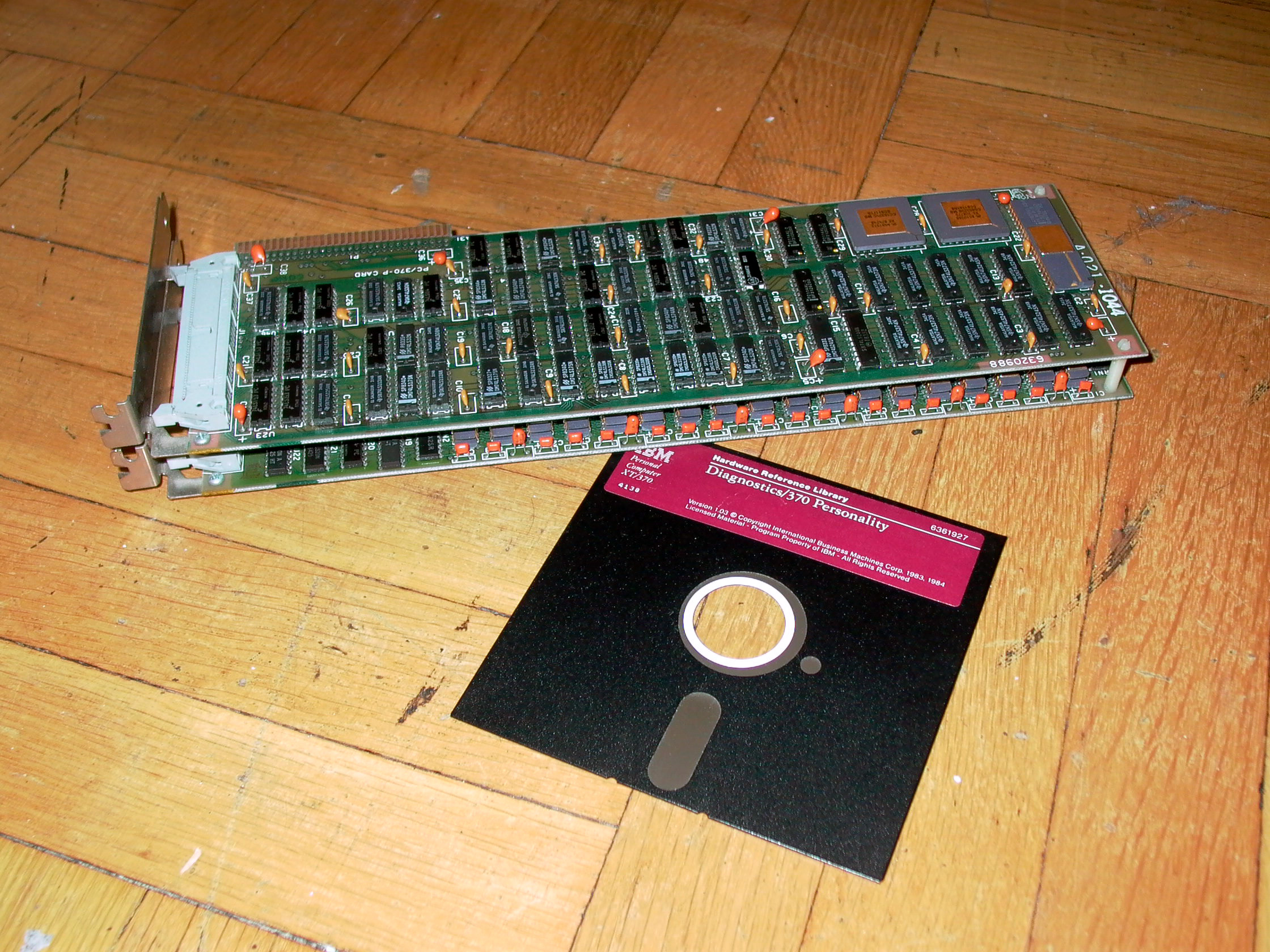
PCjr
The IBM PCjr was IBM's first attempt to enter the market for relatively inexpensive educational and home-use personal computers. The PCjr, IBM model number 4860, retained the IBM PC's 8088 CPU and BIOS interface for compatibility, but its cost and differences in the PCjr's architecture, as well as other design and implementation decisions, eventually led the PCjr to be a commercial failure.Portable
The IBM Portable Personal Computer 5155 model 68 was an early portable computer developed by IBM after the success of Compaq's suitcase-size portable machine (the Compaq Portable). It was released in February, 1984, and was eventually replaced by the IBM Convertible.The Portable was an XT motherboard, transplanted into a Compaq-style luggable case. The system featured 256 kilobytes of memory (expandable to 512 kB), an added CGA card connected to an internal monochrome (amber) composite monitor, and one or two half-height 5.25" 360K floppy disk drives. Unlike the Compaq Portable, which used a dual-mode monitor and special display card, IBM used a stock CGA board and a composite monitor, which had lower resolution. It could however, display color if connected to an external monitor or television.
AT
The "IBM Personal Computer/AT" (model 5170), announced August 15th 1984 , used an Intel 80286Intel 80286
The Intel 80286 , introduced on 1 February 1982, was a 16-bit x86 microprocessor with 134,000 transistors. Like its contemporary simpler cousin, the 80186, it could correctly execute most software written for the earlier Intel 8086 and 8088...
processor, originally running at 6 MHz. It had a 16-bit
Bit
A bit is the basic unit of information in computing and telecommunications; it is the amount of information stored by a digital device or other physical system that exists in one of two possible distinct states...
ISA bus and 20 MB hard drive. A faster model, running at 8 MHz and sporting a 30-megabyte hard disk i.e. 33% more speed, 50% more disk space was introduced in 1986.PC Magazine, Sept. 30, 1986, pp. 179-184
The AT was designed to support multitasking; the new SysRq (System request key), little noted and often overlooked, is part of this design, as is the 80286 itself, the first Intel 16-bit processor with multitasking features (i.e. the 80286 protected mode). IBM made some attempt at marketing the AT as a multi-user machine, but it sold mainly as a faster PC for power users. For the most part, IBM PC/ATs were used as more powerful DOS (single-tasking) personal computers, in the literal sense of the PC name.
Early PC/ATs were plagued with reliability problems, in part because of some software and hardware incompatibilities, but mostly related to the internal 20 MB hard disk, and High Density Floppy Disk DriveThe opening sentence of an April 29, 1986 PC Magazine article reads "If you own an IBM PC AT and your hard disk hasn't crashed yet, don't worry -- it probably will." highbeam.com & encyclopedia.com (the latter a Chicago Sun-Times article citing the PC Magazine story). IBM recovered, although with mixed comments, as noted in the Sept. 30, 1986 PC Magazine article, "The Two Faces of IBM's 8-MHz AT," pp. 179 - 184.
While some people blamed IBM's hard disk controller card and others blamed the hard disk manufacturer Computer Memories Inc.
Computer Memories Inc.
Computer Memories Inc. was a Chatsworth, California manufacturer of hard disks during the early 1980s. CMI made basic stepper motor-based drives, with low cost in mind....
(CMI), the IBM controller card worked fine with other drives, including CMI's 33-MB model. The problems introduced doubt about the computer and, for a while, even about the 286 architecture in general, but after IBM replaced the 20 MB CMI drives, the PC/AT proved reliable and became a lasting industry standard.
- IBM AT's Drive parameter table listed the CMI-33 as having 615 cylinders instead of the 640 the drive was designed with, as to make the size an even 30Mb. Those who re-used the drives mostly found that the 616th cylinder was bad due to it being used as a landing area.
AT/370
The "IBM Personal Computer AT/370 was an AT with two custom 16-bit cards, running almost the exact same setup as the XT/370.Convertible
The IBM PC Convertible, released April 3, 1986, was IBM's first laptop computer and was also the first IBM computer to utilize the 3.5" floppy disk which went on to become the standard. Like modern laptops, it featured power management and the ability to run from batteries. It was the follow-up to the IBM Portable and was model number 5140. The concept and the design of the body was made by the German industrial designer Richard Sapper.It utilized an Intel 80c88 CPU (a CMOS version of the Intel 8088) running at 4.77 MHz, 256 kB of RAM (expandable to 640 kB), dual 720 kB 3.5" floppy drives, and a monochrome CGA-compatible LCD screen at a price of $2,000. It weighed 13 pounds (5.8 kg) and featured a built-in carrying handle.
The PC Convertible had expansion capabilities through a proprietary ISA bus-based port on the rear of the machine. Extension modules, including a small printer and a video output module, could be snapped into place. The machine could also take an internal modem, but there was no room for an internal hard disk.
Next Generation IBM PS/2
The IBM PS/2 line was introduced in 1987. The Model 30 at the bottom end of the lineup was very similar to earlier models, it used an 8086 processor and an ISA bus. The Model 30 was not "IBM compatible" in that it did not have standard 5.25" drive bays, it came with a 3.5" floppy drive and optionally a 3.5" sized hard disk. Most models in the PS/2 line further departed from "IBM compatible" by replacing the ISA bus completely with Micro Channel ArchitectureMicro Channel architecture
Micro Channel Architecture was a proprietary 16- or 32-bit parallel computer bus introduced by IBM in 1987 which was used on PS/2 and other computers through the mid 1990s.- Background :...
.
Electronics
The main circuit board in an IBM PC is called the motherboardMotherboard
In personal computers, a motherboard is the central printed circuit board in many modern computers and holds many of the crucial components of the system, providing connectors for other peripherals. The motherboard is sometimes alternatively known as the mainboard, system board, or, on Apple...
(IBM terminology calls it a planar). This mainly carries the CPU
Central processing unit
The central processing unit is the portion of a computer system that carries out the instructions of a computer program, to perform the basic arithmetical, logical, and input/output operations of the system. The CPU plays a role somewhat analogous to the brain in the computer. The term has been in...
and RAM
Computer memory
In computing, memory refers to the physical devices used to store programs or data on a temporary or permanent basis for use in a computer or other digital electronic device. The term primary memory is used for the information in physical systems which are fast In computing, memory refers to the...
, and it has a bus
Computer bus
In computer architecture, a bus is a subsystem that transfers data between components inside a computer, or between computers.Early computer buses were literally parallel electrical wires with multiple connections, but the term is now used for any physical arrangement that provides the same...
with slots for expansion cards. On the motherboard are also the ROM subsystem, DMA and IRQ controllers, coprocessor socket, sound (PC speaker, tone generation) circuitry, and keyboard interface. The original PC also adds to this the cassette interface.
The bus used in the original PC became very popular, and it was subsequently named ISA
Industry Standard Architecture
Industry Standard Architecture is a computer bus standard for IBM PC compatible computers introduced with the IBM Personal Computer to support its Intel 8088 microprocessor's 8-bit external data bus and extended to 16 bits for the IBM Personal Computer/AT's Intel 80286 processor...
. While it was popular, it was more commonly known as the PC-bus or XT-bus; the term ISA arose later when industry leaders chose to continue manufacturing machines based on the IBM PC AT architecture rather than license the PS/2
IBM Personal System/2
The Personal System/2 or PS/2 was IBM's third generation of personal computers. The PS/2 line, released to the public in 1987, was created by IBM in an attempt to recapture control of the PC market by introducing an advanced proprietary architecture...
architecture and its MCA
Micro Channel architecture
Micro Channel Architecture was a proprietary 16- or 32-bit parallel computer bus introduced by IBM in 1987 which was used on PS/2 and other computers through the mid 1990s.- Background :...
bus from IBM. The XT-bus was then retroactively named 8-bit ISA or XT ISA, while the unqualified term ISA usually refers to the 16-bit AT-bus (as better defined in the ISA specifications.) The AT-bus is an extension of the PC-/XT-bus and is in use to this day in computers for industrial use, where its relatively low speed, 5 volt signals, and relatively simple, straightforward design (all by year 2011 standards) give it technical advantages (e.g. noise immunity for reliability).
A monitor and any floppy or hard disk drives are connected to the motherboard through cables connected to graphics adapter and disk controller cards, respectively, installed in expansion slots. Each expansion slot on the motherboard has a corresponding opening in the back of the computer case through which the card can expose connectors; a blank metal cover plate covers this case opening (to prevent dust and debris intrusion and control airflow) when no expansion card is installed. Memory expansion beyond the amount installable on the motherboard was also done with boards installed in expansion slots, and I/O devices such as parallel, serial, or network ports were likewise installed as individual expansion boards. For this reason, it was easy to fill the five expansion slots of the PC, or even the eight slots of the XT, even without installing any special hardware. Companies like Quadram and AST addressed this with their popular multi-I/O cards which combine several peripherals on one adapter card that uses only one slot; Quadram offered the QuadBoard and AST the SixPak.
Intel 8086 and 8088
Intel 8088
The Intel 8088 microprocessor was a variant of the Intel 8086 and was introduced on July 1, 1979. It had an 8-bit external data bus instead of the 16-bit bus of the 8086. The 16-bit registers and the one megabyte address range were unchanged, however...
-based PCs require expanded memory
Expanded memory
In DOS memory management, expanded memory is a system of bank switching introduced April 24, 1985 that provided additional memory to DOS programs beyond the limit of conventional memory. Expanded memory uses parts of the address space normally dedicated to communication with peripherals for program...
(EMS) boards to work with more than 640 kB of memory. (Though the 8088 can address one megabyte
Megabyte
The megabyte is a multiple of the unit byte for digital information storage or transmission with two different values depending on context: bytes generally for computer memory; and one million bytes generally for computer storage. The IEEE Standards Board has decided that "Mega will mean 1 000...
of memory, the last 384 kB of that is used or reserved for the BIOS ROM, BASIC ROM, extension ROMs installed on adapter cards, and memory address space used by devices including display adapter RAM and even the 64 kB EMS page frame itself.) The original IBM PC AT used an Intel 80286
Intel 80286
The Intel 80286 , introduced on 1 February 1982, was a 16-bit x86 microprocessor with 134,000 transistors. Like its contemporary simpler cousin, the 80186, it could correctly execute most software written for the earlier Intel 8086 and 8088...
processor which can access up to 16 MiB of memory (though standard DOS
DOS
DOS, short for "Disk Operating System", is an acronym for several closely related operating systems that dominated the IBM PC compatible market between 1981 and 1995, or until about 2000 if one includes the partially DOS-based Microsoft Windows versions 95, 98, and Millennium Edition.Related...
applications cannot use more than one megabyte without using additional APIs.) Intel 80286-based computers running under OS/2
OS/2
OS/2 is a computer operating system, initially created by Microsoft and IBM, then later developed by IBM exclusively. The name stands for "Operating System/2," because it was introduced as part of the same generation change release as IBM's "Personal System/2 " line of second-generation personal...
can work with the maximum memory.
The original system chips were one Intel 8259
Intel 8259
The Intel 8259 is a Programmable Interrupt Controller designed for the Intel 8085 and Intel 8086 microprocessors. The initial part was 8259, a later A suffix version was upward compatible and usable with the 8086 or 8088 processor...
programmable interrupt controller (PIC) (at I/O address ), one Intel 8237
Intel 8237
Intel 8237 is a direct memory access controller , a part of the MCS 85 microprocessor family. It was used as the DMA controller in the original IBM PC and IBM XT...
direct memory access (DMA) controller (at I/O address ),and a Intel 8253
Intel 8253
The Intel 8253 and 8254 are Programmable Interval Timers , which perform timing and counting functions. They were primarily designed for the Intel 8080/8085-processors, but later used in x86-systems...
programmable interval timer (PIT) (at I/O address ). The PIT provides the clock ticks, dynamic memory refresh timing, and can be used for speaker output;wustl.edu - ECE306 Lecture 16 one DMA channel is used to perform the memory refresh.
Math co-processor 8087 at 0xF0.
The IBM PC AT added a second, slave 8259 PIC (at I/O address ), a second 8237 DMA controller for 16-bit DMA (at I/O address ), a DMA address register (implemented with a 74LS612 IC) (at I/O address ),The DMA address register extends the 16-bit transfer memory address capacity of the 8237 to 24 bits and a Motorola
Motorola
Motorola, Inc. was an American multinational telecommunications company based in Schaumburg, Illinois, which was eventually divided into two independent public companies, Motorola Mobility and Motorola Solutions on January 4, 2011, after losing $4.3 billion from 2007 to 2009...
MC146818 Real-time clock
Real-time clock
A real-time clock is a computer clock that keeps track of the current time. Although the term often refers to the devices in personal computers, servers and embedded systems, RTCs are present in almost any electronic device which needs to keep accurate time.-Terminology:The term is used to avoid...
(RTC) with Nonvolatile memory
Nonvolatile BIOS memory
Nonvolatile BIOS memory refers to a small memory on PC motherboards that is used to store BIOS settings. It was traditionally called CMOS RAM because it used a low-power Complementary metal-oxide-semiconductor SRAM powered by a small battery when system power was off...
(NVRAM) used for system configuration (replacing the DIP switches and jumpers used for this purpose in PC and PC-XT models (at I/O address ).illinois.edu - Real time clock plus RAM
On expansion cards, the Intel 8255
Intel 8255
The Intel 8255 Programmable Peripheral Interface chip is a peripheral chip originally developed for the Intel 8085 microprocessor, and as such is a member of a large array of such chips, known as the MCS-85 Family. This chip was later also used with the Intel 8086 and its descendants.It was later...
programmable peripheral interface (PPI) (at I/O addresses is used for parallel I/O controls the printer,ctv.se - PC KITS-tutorial page (parallel port, joystick port) and
the 8250 universal asynchronous receiver/transmitter (UART) (at I/O address or ) controls the serial communication at the (pseudo-)The IBM PC serial port is not strictly RS-232, since it uses TTL signal levels, whereas RS-232 requires signals of +/- 3 to 15 volts; some signal levels that are valid for a TTL high state, and all signal levels that represent a TTL low state, fall within the forbidden range of -3 to +3 volts for standard RS-232. (However, it is not difficult to design and construct a level converter that will convert between IBM serial port and standard RS-232 signals.)RS-232
RS-232
In telecommunications, RS-232 is the traditional name for a series of standards for serial binary single-ended data and control signals connecting between a DTE and a DCE . It is commonly used in computer serial ports...
port.
Keyboard
The original 1981 IBM PC's keyboard at the time was an extremely reliable and high quality electronic keyboard originally developed in North Carolina for the DatamasterIBM System/23
The System/23 Datamaster was announced by IBM in July 1981, only one month before the IBM PC. The Datamaster was an all-in-one computer with text-mode CRT display, keyboard, processor, memory, and two 8-inch floppy disk drives all contained in one cabinet. The processor was an 8-bit Intel 8085,...
system.David Bradley, BYTE September 1990 Each key was rated to be reliable to over 100 million keystrokes. For the IBM PC, a separate keyboard housing was designed with a novel usability feature that allowed users to adjust the keyboard angle for personal comfort. Compared with the keyboards of other small computers at the time, the IBM PC keyboard
IBM PC keyboard
The keyboards for IBM PC compatible computers are standardized. However, during the 3-plus decades of PC architecture being constantly updated, multiple types of keyboard layout variations have been developed....
was far superior and played a significant role in establishing a high quality impression. For example, the industrial design of the keyboard, together with the system unit, was recognized with a major design award. Byte
Byte (magazine)
BYTE magazine was a microcomputer magazine, influential in the late 1970s and throughout the 1980s because of its wide-ranging editorial coverage...
magazine in the fall of 1981 went so far as to state that the keyboard was 50% of the reason to buy an IBM PC. The importance of the keyboard was definitely established when the 1983 IBM PCjr
IBM PCjr
The IBM PCjr was IBM's first attempt to enter the home computer market. The PCjr, IBM model number 4860, retained the IBM PC's 8088 CPU and BIOS interface for compatibility, but various design and implementation decisions led the PCjr to be a commercial failure.- Features :Announced November 1,...
flopped, in very large part for having a much different and mediocre Chiclet keyboard
Chiclet keyboard
A chiclet keyboard or island-style keyboard is a computer keyboard built with an array of small, flat rectangular or lozenge-shaped rubber or plastic keys that look like erasers or "Chiclets", a brand of chewing gum manufactured in the shape of small squares with rounded corners...
that made a poor impression on customers. Oddly enough, the same thing almost happened to the original IBM PC when in early 1981 management seriously considered substituting a cheaper and lower quality keyboard. This mistake was narrowly avoided on the advice of one of the original development engineers.
However, the original 1981 IBM PC 84-key keyboard
Computer keyboard
In computing, a keyboard is a typewriter-style keyboard, which uses an arrangement of buttons or keys, to act as mechanical levers or electronic switches...
was criticized by typists for its non-standard placement of the Return and left Shift keys, and because it did not have separate cursor and numeric pads that were popular on the pre-PC DEC
Digital Equipment Corporation
Digital Equipment Corporation was a major American company in the computer industry and a leading vendor of computer systems, software and peripherals from the 1960s to the 1990s...
VT100
VT100
The VT100 is a video terminal that was made by Digital Equipment Corporation . Its detailed attributes became the de facto standard for terminal emulators.-History:...
series video terminals. In 1982, Key Tronic
Key Tronic
Key Tronic is a computer equipment manufacturer founded in 1969. Its core product group includes keyboards, mice and other input devices. They are considered to be one of the pioneers in ergonomic keyboard design...
introduced the now standard 101-key PC keyboard. In 1984, IBM corrected the Return and left Shift keys on its AT keyboard, but shortened the 'backspace' key, making it harder to reach. In 1986, IBM changed to the 101 key enhanced keyboard, which added the separate cursor and numeric key pads, relocated all the function keys and the Ctrl keys, and the Esc key was also relocated to the opposite side of the keyboard.
Another criticism of the original keyboard was the relatively loud "clack" sound each key made when pressed. Since typewriter users were accustomed to keeping their eyes on the hardcopy they were typing from and had come to rely on the mechanical sound that was made as each character was typed onto the paper to ensure that they had pressed the key hard enough (and only once), the PC keyboard electronic "clack" feature was intended to provide that same reassurance. However, it proved to be very noisy and annoying, especially if many PCs were in use in the same room, and later keyboards were significantly quieter.
The IBM PC keyboard is very robust and flexible. The low-level interface for each key is the same: each key sends a signal when it is pressed and another signal when it is released. An integrated microcontroller in the keyboard scans the keyboard and encodes a "scan code" and "release code" for each key as it is pressed and released separately. Any key can be used as a shift key, and a large number of keys can be held down simultaneously and separately sensed. The controller in the keyboard handles typematic operation, issuing periodic repeat scan codes for a depressed key and then a single release code when the key is finally released.
An "IBM PC compatible" may have a keyboard that does not recognize every key combination a true IBM PC does, such as shifted cursor keys. In addition, the "compatible" vendors sometimes used proprietary keyboard interfaces, preventing the keyboard from being replaced.
Although the PC/XT and AT used the same style of keyboard connector, the low-level protocol for reading the keyboard was different between these two series. The AT keyboard uses a bidirectional interface which allows the computer to send commands to the keyboard. An AT keyboard could not be used in an XT, nor the reverse. Third-party keyboard manufacturers provided a switch on some of their keyboards to select either the AT-style or XT-style protocol for the keyboard.
Character set
The original IBM PC used the 7-bit ASCIIASCII
The American Standard Code for Information Interchange is a character-encoding scheme based on the ordering of the English alphabet. ASCII codes represent text in computers, communications equipment, and other devices that use text...
alphabet as its basis, but extended it to 8 bits with nonstandard character codes. This character set was not suitable for some international applications, and soon a veritable cottage industry emerged providing variants of the original character set in various national variants. In IBM tradition, these variants were called code page
Code page
Code page is another term for character encoding. It consists of a table of values that describes the character set for a particular language. The term code page originated from IBM's EBCDIC-based mainframe systems, but many vendors use this term including Microsoft, SAP, and Oracle Corporation...
s. These codings are now obsolete, having been replaced by more systematic and standardized forms of character coding, such as ISO 8859-1, Windows-1251
Windows-1251
Windows-1251 is a popular 8-bit character encoding, designed to cover languages that use the Cyrillic alphabet such as Russian, Bulgarian, Serbian Cyrillic and other languages...
and Unicode
Unicode
Unicode is a computing industry standard for the consistent encoding, representation and handling of text expressed in most of the world's writing systems...
. The original character set is known as code page 437
Code page 437
IBM PC or MS-DOS code page 437 is the character set of the original IBM PC. It is also known as CP 437, OEM 437, PC-8, MS-DOS Latin US or sometimes misleadingly referred to as the OEM font, High ASCII or Extended ASCII....
.
Cassette tape
As mentioned above, IBM equipped the model 5150 with a cassette port for connecting a cassette drive, and originally intended compact cassettes to become the 5150's most common storage medium. However, adoption of the floppy- and monitor-less configuration was low; few (if any) IBM PCs left the factory without a floppy disk drive installed. Also, DOS was not available on cassette tape, only on floppy disks (hence "Disk Operating System"). 5150s with just external cassette recorders for storage could only use the built-in ROM BASIC as their operating system. As DOS saw increasing adoption, the incompatibility of DOS programs with PCs that used only cassettes for storage made this configuration even less attractive. The ROM BIOS supported cassette operations.Interestingly, the IBM PC cassette interface
IBM Cassette tape
On early IBM personal computers, a cassette tape interface was provided to allow use of a cassette audio recorder to load and save data and programs. This option was only included on the original 5150 and 4860 ....
encodes data using a frequency modulation with a variable data rate. Either a one or a zero is represented by a single cycle of a square wave, but the square wave frequencies differ by a factor of two, with ones having the lower frequency. Therefore, the bit periods for zeros and ones also differ by a factor of two, with the unusual effect that a data stream with more zeros than ones will use less tape (and time) than an equal-length (in bits) data stream containing more ones than zeros, or equal numbers of each.
Floppy diskettes
Floppy disk
A floppy disk is a disk storage medium composed of a disk of thin and flexible magnetic storage medium, sealed in a rectangular plastic carrier lined with fabric that removes dust particles...
drives. These floppy drives were either single-sided double-density drives (SS/DD, a.k.a. SSDD), or double-sided double-density drives (DS/DD, a.k.a. DSDD). The IBM PC never used single density floppy drives. The drives and disks were commonly referred to by capacity, e.g. "160KB floppy disk" or "360KB floppy drive". DSDD drives were backwards compatible; they could read and write SSDD floppies. The same type of physical diskette could be used for both drives,Even if SSDD disks were not advertised as/rated for DSDD use, they usually could be DSDD formatted all the same. DSDD-rated floppy disks could always be used as SSDD floppies. This just meant that one side was not written on. however to convert a 5.25-inch SSDD disk to a DSDD disk, it needed to be reformatted, at which point SSDD drives could no longer read it.
The disks were Modified Frequency Modulation
Modified Frequency Modulation
Modified Frequency Modulation, commonly MFM, is a line coding scheme used to encode the actual data-bits on most floppy disk formats, hardware examples include Amiga, most CP/M machines as well as IBM PC compatibles. Early hard disk drives also used this coding.MFM is a modification to the original...
(MFM) coded in 512-byte sectors, and were soft-sectored. They contained 40 tracks per side at the 48 track per inch (TPI) density,Sometimes the tracks were also referred as cylinders, which is technically correct and analogous to hard drive cylinders. One floppy disk track equaled one cylinder, however with double-sided floppies, only the first side's cylinder numbers were identical to the track numbers; on the second side, the cylinders 1-40 corresponded to tracks 41-80 of the formatted floppy. and initially were formatted to contain eight sectors per track. This meant that SSDD disks initially had a formatted capacity of 160 kB,
The IBM Personal Computer, commonly known as the IBM PC, is the original version and progenitor of the IBM PC compatible
IBM PC compatible
IBM PC compatible computers are those generally similar to the original IBM PC, XT, and AT. Such computers used to be referred to as PC clones, or IBM clones since they almost exactly duplicated all the significant features of the PC architecture, facilitated by various manufacturers' ability to...
hardware platform
Platform (computing)
A computing platform includes some sort of hardware architecture and a software framework , where the combination allows software, particularly application software, to run...
. It is IBM
IBM
International Business Machines Corporation or IBM is an American multinational technology and consulting corporation headquartered in Armonk, New York, United States. IBM manufactures and sells computer hardware and software, and it offers infrastructure, hosting and consulting services in areas...
model number 5150, and was introduced on August 12, 1981. It was created by a team of engineers and designers under the direction of Don Estridge of the IBM Entry Systems Division in Boca Raton, Florida
Boca Raton, Florida
Boca Raton is a city in Palm Beach County, Florida, USA, incorporated in May 1925. In the 2000 census, the city had a total population of 74,764; the 2006 population recorded by the U.S. Census Bureau was 86,396. However, the majority of the people under the postal address of Boca Raton, about...
.
Alongside "microcomputer
Microcomputer
A microcomputer is a computer with a microprocessor as its central processing unit. They are physically small compared to mainframe and minicomputers...
" and "home computer
Home computer
Home computers were a class of microcomputers entering the market in 1977, and becoming increasingly common during the 1980s. They were marketed to consumers as affordable and accessible computers that, for the first time, were intended for the use of a single nontechnical user...
", the term "personal computer
Personal computer
A personal computer is any general-purpose computer whose size, capabilities, and original sales price make it useful for individuals, and which is intended to be operated directly by an end-user with no intervening computer operator...
" was already in use before 1981. It was used as early as 1972 to characterize Xerox PARC
Xerox PARC
PARC , formerly Xerox PARC, is a research and co-development company in Palo Alto, California, with a distinguished reputation for its contributions to information technology and hardware systems....
's Alto
Xerox Alto
The Xerox Alto was one of the first computers designed for individual use , making it arguably what is now called a personal computer. It was developed at Xerox PARC in 1973...
. However, because of the success of the IBM Personal Computer, the term PC came to mean more specifically a microcomputer compatible with IBM's PC products.
Origins
Desktop sized programmable calculators by Hewlett Packard had evolved into the HP 9830HP 9830
The HP 9800 was a family of what were initially called programmable calculators and later desktop computers made by Hewlett-Packard, replacing their first HP 9100 calculator...
BASIC language computer by 1972, with IBM's releasing its own IBM 5100
IBM 5100
The IBM 5100 Portable Computer was a portable computer introduced in September 1975, six years before the IBM PC. It was the evolution of a prototype called the SCAMP that was developed at the IBM Palo Alto Scientific Center in 1973. In January 1978 IBM announced the IBM 5110, its larger cousin,...
in 1975. It was a complete system programmable in BASIC
BASIC
BASIC is a family of general-purpose, high-level programming languages whose design philosophy emphasizes ease of use - the name is an acronym from Beginner's All-purpose Symbolic Instruction Code....
or APL, with a small built-in CRT monitor, keyboard, and tape drive for data storage. It was also very expensive — up to . It was specifically designed for professional and scientific problem-solvers, not business users or hobbyists. When the PC was introduced in 1981, it was originally designated as the IBM 5150, putting it in the "5100" series, though its architecture was not directly descended from the IBM 5100.
The original line of PCs were part of an IBM strategy to get into the small personal computer market then dominated by the Commodore PET
Commodore PET
The Commodore PET was a home/personal computer produced from 1977 by Commodore International...
, Atari 8-bit family
Atari 8-bit family
The Atari 8-bit family is a series of 8-bit home computers manufactured from 1979 to 1992. All are based on the MOS Technology 6502 CPU and were the first home computers designed with custom coprocessor chips...
, Apple II
Apple II
The Apple II is an 8-bit home computer, one of the first highly successful mass-produced microcomputer products, designed primarily by Steve Wozniak, manufactured by Apple Computer and introduced in 1977...
, Tandy Corporation
Tandy Corporation
Tandy Corporation was a family-owned leather goods company based in Fort Worth, Texas. Tandy was founded in 1919 as a leather supply store, and acquired RadioShack in 1963. The Tandy name was dropped in May 2000, when RadioShack Corporation was made the official name.-History:Tandy began in 1919...
's TRS-80
TRS-80
TRS-80 was Tandy Corporation's desktop microcomputer model line, sold through Tandy's Radio Shack stores in the late 1970s and early 1980s. The first units, ordered unseen, were delivered in November 1977, and rolled out to the stores the third week of December. The line won popularity with...
s, and various CP/M
CP/M
CP/M was a mass-market operating system created for Intel 8080/85 based microcomputers by Gary Kildall of Digital Research, Inc...
machines."Total share: 30 years of personal computer market share figures", Jeremy Reimer December 14, 2005 arstechnica.com
Rather than going through the usual IBM design process, a special team was assembled with authorization to bypass normal company restrictions and get something to market rapidly. This project was given the code name Project Chess at the IBM Entry Systems Division in Boca Raton, Florida
Boca Raton, Florida
Boca Raton is a city in Palm Beach County, Florida, USA, incorporated in May 1925. In the 2000 census, the city had a total population of 74,764; the 2006 population recorded by the U.S. Census Bureau was 86,396. However, the majority of the people under the postal address of Boca Raton, about...
. The team consisted of twelve people directed by Don Estridge
Philip Don Estridge
Philip Donald Estridge , known as Don Estridge,led development of the original IBM Personal Computer , and thus is known as "father of the IBM PC"...
with Chief Designer Lewis Eggebrecht.The history of computing project They developed the PC in about a year. To achieve this they first decided to build the machine with "off-the-shelf" parts from a variety of different original equipment manufacturer
Original Equipment Manufacturer
An original equipment manufacturer, or OEM, manufactures products or components that are purchased by a company and retailed under that purchasing company's brand name. OEM refers to the company that originally manufactured the product. When referring to automotive parts, OEM designates a...
s (OEMs) and countries. Previously IBM had always developed its own components. Secondly for scheduling and cost reasons, rather than developing unique IBM PC monitor and printer designs, project management decided to utilize an existing "off-the-shelf" IBM monitor developed earlier in IBM Japan as well as an existing Epson printer model. Consequently, the unique IBM PC industrial design elements were relegated to the system unit and keyboard. They also decided on an open architecture
Computer architecture
In computer science and engineering, computer architecture is the practical art of selecting and interconnecting hardware components to create computers that meet functional, performance and cost goals and the formal modelling of those systems....
, so that other manufacturers could produce and sell peripheral components and compatible software without purchasing licenses. IBM also sold an IBM PC Technical Reference Manual that included complete circuit schematics, a listing of the ROM
Read-only memory
Read-only memory is a class of storage medium used in computers and other electronic devices. Data stored in ROM cannot be modified, or can be modified only slowly or with difficulty, so it is mainly used to distribute firmware .In its strictest sense, ROM refers only...
BIOS
BIOS
In IBM PC compatible computers, the basic input/output system , also known as the System BIOS or ROM BIOS , is a de facto standard defining a firmware interface....
source code
Source code
In computer science, source code is text written using the format and syntax of the programming language that it is being written in. Such a language is specially designed to facilitate the work of computer programmers, who specify the actions to be performed by a computer mostly by writing source...
, and other engineering and programming information.. Personal website with an image of the technical manual. "The official documentation came in cool three-ring binders, complete with slip covers. Completely typeset... This book wasn't free, either—I think it cost $60. Supposedly, no Compaq BIOS programmer ever saw one of these. Yeah, right." Jargon File, TechRef: /tek'ref/ [MS-DOS] n. The original "IBM PC Technical Reference Manual", including the BIOS listing and complete schematics for the PC. The only PC documentation in the issue package that's considered serious by real hackers." IBM announced the PC on August 12, 1981. Six weeks later at COMDEX
COMDEX
COMDEX was a computer expo held in Las Vegas, Nevada, each November from 1979 to 2003. It was one of the largest computer trade shows in the world, usually second only to the German CeBIT, and by many accounts one of the largest trade shows in any industry sector...
Fall, Tecmar
Tecmar
Tecmar was an American manufacturer of PC enhancement products based in Solon, OH. The company was founded in 1974 and their first products were data acquisition boards for the first generation of microcomputers. Popular products included the Scientific Solutions LabMaster series of boards for...
had 20 PC products available for sale. These products included memory expansion, IEEE-488, data acquisition, and PC Expansion chassisCOMDEX FALL November 18, 1981 Las Vegas, NV, "Tecmar shows 20 IBM PC option cards.. LabMaster, LabTender, DADIO,DeviceTender, IEEE-488.."PC Magazine Vol1 No.1, "Taking the Measure" by David Bunnell, "Tecmar deployed 20 option cards for the IBM PC"PC Magazine Vol1 No.5, "Tecmar Triumph" by David Bunnell, Scientific Solutions releases 20 new products for the PCBYTE Vol7 No.1 "Scientific Solutions - Advertisement for data acquisition boards, stepper controllers, IEEE-488 products
.Test&Meausrement World Vol11 No 10 Decade of Progress Award: Scientific Solutions - LabMaster First in PC Data Acquisition Pricing for the IBM PC started at $1,565 for a bare-bones configuration without disk drives.IBM.com
At the time, Don Estridge and his team considered using the IBM 801
IBM 801
The 801 was an experimental minicomputer designed by IBM. The resulting architecture was used in various roles in IBM until the 1980s. The 801 was started as a pure research project led by John Cocke in October 1975 at the Thomas J. Watson Research Center. The name 801 comes from the building the...
processor (an early RISC CPU) and its operating system that had been developed at the Thomas J. Watson Research Center
Thomas J. Watson Research Center
The Thomas J. Watson Research Center is the headquarters for the IBM Research Division.The center is on three sites, with the main laboratory in Yorktown Heights, New York, 38 miles north of New York City, a building in Hawthorne, New York, and offices in Cambridge, Massachusetts.- Overview :The...
in Yorktown Heights, New York
Yorktown Heights, New York
Yorktown Heights is a census-designated place in the town of Yorktown in Westchester County, New York, United States. The population was 1,781 at the 2010 census.-Geography:Yorktown Heights is located at ....
. The 801 processor was more than an order of magnitude more powerful than the Intel 8088, and the operating system more advanced than the DOS 1.0 operating system from Microsoft
Microsoft
Microsoft Corporation is an American public multinational corporation headquartered in Redmond, Washington, USA that develops, manufactures, licenses, and supports a wide range of products and services predominantly related to computing through its various product divisions...
, which was finally selected. Ruling out an in-house solution made the team’s job much easier and may have avoided a delay in the schedule, but the ultimate consequences of this decision for IBM were far-reaching. IBM had recently developed the Datamaster
IBM System/23
The System/23 Datamaster was announced by IBM in July 1981, only one month before the IBM PC. The Datamaster was an all-in-one computer with text-mode CRT display, keyboard, processor, memory, and two 8-inch floppy disk drives all contained in one cabinet. The processor was an 8-bit Intel 8085,...
business microcomputer, which used an Intel processor and peripheral ICs; familiarity with these chips and the availability of the Intel 8088 processor was a deciding factor in the choice of processor for the new product. Even the 62-pin expansion bus slots were designed to be similar to the Datamaster slots. Delays due to in-house development of the Datamaster software also influenced the design team to a fast-track development process for the PC, with publicly available technical information to encourage third-party developers.David J. Bradley
David Bradley (engineer)
David Bradley was one of the twelve engineers who worked on the original IBM PC, developing the computer ROM BIOScode. He is credited by some for inventing the "Control-Alt-Delete" key combination that was used to reboot the computer.-Control-Alt-Delete:...
, The Creation of the IBM PC, BYTE Magazine Volume 15 No. 9 September 1990 pages 414-420
Other manufacturers soon reverse engineered
Reverse engineering
Reverse engineering is the process of discovering the technological principles of a device, object, or system through analysis of its structure, function, and operation...
the BIOS to produce their own non-infringing functional copies. Columbia Data Products
Columbia Data Products
Columbia Data Products introduced the MPC 1600 "Multi Personal Computer" in June 1982. It was an exact functional copy of the IBM PC model 5150 except for the BIOS which was clean roomed...
introduced the first IBM-PC compatible computer in June 1982. In November 1982, Compaq Computer Corporation announced the Compaq Portable
Compaq Portable
The Compaq Portable was the first product in the Compaq portable series to be commercially available under the Compaq Computer Corporation brand . It was the first IBM PC compatible portable computer...
, the first portable IBM PC compatible. The first models were shipped in March 1983.
Once the IBM PC became a commercial success, the product came back under the more usual tight IBM management control. IBM's tradition of "rationalizing" product lines, deliberately restricting the performance of lower-priced models in order to prevent them from "cannibalizing" profits from higher-priced models, worked against them.
IBM PC as standard
The success of the IBM computer led other companies to develop IBM CompatiblesIBM PC compatible
IBM PC compatible computers are those generally similar to the original IBM PC, XT, and AT. Such computers used to be referred to as PC clones, or IBM clones since they almost exactly duplicated all the significant features of the PC architecture, facilitated by various manufacturers' ability to...
, which in turn led to branding like diskettes being advertised as "IBM format". An IBM PC clone could be built with off-the-shelf parts, but the BIOS
BIOS
In IBM PC compatible computers, the basic input/output system , also known as the System BIOS or ROM BIOS , is a de facto standard defining a firmware interface....
required some reverse-engineering. Companies like Phoenix Software Associates
Phoenix Technologies
Phoenix Technologies Ltd designs, develops and supports core system software for personal computers and other computing devices. Phoenix's products — commonly referred to as BIOS or firmware — support and enable the compatibility, connectivity, security and management of the various components and...
, American Megatrends
American Megatrends
American Megatrends Incorporated is an American hardware and software company that specializes in PC hardware and firmware. The company was founded in 1985 by Pat Sarma and S. Shankar, who was chairman and president...
, Award
Award Software
Award Software International Inc. was a BIOS manufacturer headquartered in Mountain View, California, United States.In June 1997 Award announced that it acquired a BIOS upgrade provider called Unicore, making it a subsidiary of Award....
, and others achieved workable versions of the BIOS, allowing companies like DELL, Compaq, and HP to manufacture PCs that worked like IBM's product. The IBM PC became the industry standard.
Third-party distribution
ComputerLandComputerLand
ComputerLand was a widespread chain of retail computer stores during the early years of the personal computer "revolution", and was one of the outlets chosen to introduce the IBM PC in 1981. The first ComputerLand opened in 1976, and the chain eventually included about 800 stores by 1985...
and Sears Roebuck partnered with IBM from the beginning of development. IBM's head of sales and marketing, H.L. ('Sparky') Sparks, relied on these retail partners for important knowledge of the marketplace. Computerland and Sears became the main outlets for the new product. More than 190 Computerland stores already existed, while Sears was in the process of creating a handful of in-store computer centers for sale of the new product. This guaranteed IBM widespread distribution across the U.S.
Targeting the new PC at the home market, Sears Roebuck sales failed to live up to expectations. This unfavorable outcome revealed that the strategy of targeting the office market was the key to higher sales.
Models
Intel 8088
The Intel 8088 microprocessor was a variant of the Intel 8086 and was introduced on July 1, 1979. It had an 8-bit external data bus instead of the 16-bit bus of the 8086. The 16-bit registers and the one megabyte address range were unchanged, however...
Floppy disk
A floppy disk is a disk storage medium composed of a disk of thin and flexible magnetic storage medium, sealed in a rectangular plastic carrier lined with fabric that removes dust particles...
or cassette
Compact Cassette
The Compact Cassette, often referred to as audio cassette, cassette tape, cassette, or simply tape, is a magnetic tape sound recording format. It was designed originally for dictation, but improvements in fidelity led the Compact Cassette to supplant the Stereo 8-track cartridge and reel-to-reel...
IBM did not offer own brand cassette recorders, but the 5150 had a cassette player jack, and IBM anticipated that entry level home users would connect their own cassette recorders for data storage instead of using the more expensive floppy drives (and use their existing TV sets as monitors); to this end, IBM initially offered the 5150 in a basic configuration without any floppy drives or monitor at the price of $1,565, whereas they offered a system with a monitor and single floppy drive for an initial $3,005. Few if any users however bought IBM 5150 PCs without floppy drives. system
IBM Personal Computer XT
The IBM Personal Computer XT, often shortened to the IBM XT, PC XT, or simply XT, was IBM's successor to the original IBM PC. It was released as IBM Machine Type number 5160 on March 8, 1983, and came standard with a hard drive...
PC-based IBM-compatible mainframes
Since the rise of the personal computer in the 1980s, IBM and other vendors have created PC-based IBM-compatible mainframes which are compatible with the larger IBM mainframe computers. For a period of time PC-based mainframe-compatible systems had a lower price and did not require as much...
IBM 3270 PC
The IBM 3270 PC , released in October 1983, was an IBM PC XT containing additional hardware which could emulate the behaviour of an IBM 3270 terminal...
IBM PCjr
The IBM PCjr was IBM's first attempt to enter the home computer market. The PCjr, IBM model number 4860, retained the IBM PC's 8088 CPU and BIOS interface for compatibility, but various design and implementation decisions led the PCjr to be a commercial failure.- Features :Announced November 1,...
IBM Personal Computer/AT
The IBM Personal Computer AT, more commonly known as the IBM AT and also sometimes called the PC AT or PC/AT, was IBM's second-generation PC, designed around the 6 MHz Intel 80286 microprocessor and released in 1984 as machine type 5170...
Intel 80286
The Intel 80286 , introduced on 1 February 1982, was a 16-bit x86 microprocessor with 134,000 transistors. Like its contemporary simpler cousin, the 80186, it could correctly execute most software written for the earlier Intel 8086 and 8088...
PC-based IBM-compatible mainframes
Since the rise of the personal computer in the 1980s, IBM and other vendors have created PC-based IBM-compatible mainframes which are compatible with the larger IBM mainframe computers. For a period of time PC-based mainframe-compatible systems had a lower price and did not require as much...
Laptop
A laptop, also called a notebook, is a personal computer for mobile use. A laptop integrates most of the typical components of a desktop computer, including a display, a keyboard, a pointing device and speakers into a single unit...
portable
Wait state
A wait state is a delay experienced by a computer processor when accessing external memory or another device that is slow to respond.As of late 2011, computer microprocessors run at very high speeds, while memory technology does not seem to be able to catch up: typical PC processors like the Intel...
memory on the motherboard
Motherboard
In personal computers, a motherboard is the central printed circuit board in many modern computers and holds many of the crucial components of the system, providing connectors for other peripherals. The motherboard is sometimes alternatively known as the mainboard, system board, or, on Apple...
. This 6 MHz machine was actually faster than the 8 MHz ATs (when using planar memory) because of the zero wait states
All IBM personal computers are software backwards-compatible with each other in general, but not every program will work in every machine. Some programs are time sensitive to a particular speed class. Older programs will not take advantage of newer higher-resolution and higher-color display standards, while some newer programs require newer display adapters. (Note that as the display adapter was an adapter card in all of these IBM models, newer display hardware could easily be, and often was, retrofitted to older models.) A few programs, typically very early ones, are written for and require a specific version of the IBM PC BIOS ROM. Most notably, BASICA which was dependent on the BIOS ROM had a sister program called GW-BASIC
GW-BASIC
GW-BASIC was a dialect of the programming language BASIC developed by Microsoft from BASICA, originally for Compaq. It is compatible with Microsoft/IBM BASICA, but was disk based and did not need the ROM BASIC. It was bundled with MS-DOS operating systems on IBM PC compatibles by Microsoft...
which supported more functions and was 100% backwards compatible and could run independent from the BIOS ROM.
PC
The CGAColor Graphics Adapter
The Color Graphics Adapter , originally also called the Color/Graphics Adapter or IBM Color/Graphics Monitor Adapter, introduced in 1981, was IBM's first color graphics card, and the first color computer display standard for the IBM PC....
video card, with a suitable modulator, could use an NTSC television
Television
Television is a telecommunication medium for transmitting and receiving moving images that can be monochrome or colored, with accompanying sound...
set or an RGB
Color Graphics Adapter
The Color Graphics Adapter , originally also called the Color/Graphics Adapter or IBM Color/Graphics Monitor Adapter, introduced in 1981, was IBM's first color graphics card, and the first color computer display standard for the IBM PC....
monitor for display; IBM's RGB monitor was their display model 5153. The other option that was offered by IBM was an MDA
Monochrome Display Adapter
The Monochrome Display Adapter introduced in 1981 was IBM's standard video display card and computer display standard for the PC. The MDA did not have any pixel-addressable graphics modes...
and their monochrome display model 5151
IBM 5151
The IBM 5151 was 12" transistor–transistor logic monochrome monitor, shipped with the original IBM Personal Computer.It only produced green colors because it used P39 phosphor. IBM designed its MDA monochrome display system to deliver extremely well-formed characters for the time...
. It was possible to install both an MDA and a CGA card and use both monitors concurrently,Dual-Head operation on vintage PCs if supported by the application program. For example, AutoCAD
AutoCAD
AutoCAD is a software application for computer-aided design and drafting in both 2D and 3D. It is developed and sold by Autodesk, Inc. First released in December 1982, AutoCAD was one of the first CAD programs to run on personal computers, notably the IBM PC...
, Lotus 1-2-3
Lotus 1-2-3
Lotus 1-2-3 is a spreadsheet program from Lotus Software . It was the IBM PC's first "killer application"; its huge popularity in the mid-1980s contributed significantly to the success of the IBM PC in the corporate environment.-Beginnings:...
and others allowed use of a CGA Monitor for graphics and a separate monochrome monitor for text menus. Some model 5150 PCs with CGA monitors and a printer port also included the MDA adapter by default, because IBM provided the MDA port and printer port on the same adapter card; it was in fact an MDA/printer port combo card.
The most commonly used storage medium was the floppy disk
Floppy disk
A floppy disk is a disk storage medium composed of a disk of thin and flexible magnetic storage medium, sealed in a rectangular plastic carrier lined with fabric that removes dust particles...
, though cassette tape
Compact Cassette
The Compact Cassette, often referred to as audio cassette, cassette tape, cassette, or simply tape, is a magnetic tape sound recording format. It was designed originally for dictation, but improvements in fidelity led the Compact Cassette to supplant the Stereo 8-track cartridge and reel-to-reel...
was originally envisioned by IBM as a low-budget alternative. Accordingly, the IBM 5150 PC was available with one or two 5-1/4" floppy drives or without any drives or storage medium; in the latter case IBM intended a user to connect his own cassette recorder via the 5150's cassette port
DIN connector
A DIN connector is a connector that was originally standardized by the , the German national standards organization. There are DIN standards for a large number of different connectors, therefore the term "DIN connector" alone does not unambiguously identify any particular type of connector unless...
. The cassette tape port was mechanically identical to, and located next to, the keyboard port on the 5150's motherboard
Motherboard
In personal computers, a motherboard is the central printed circuit board in many modern computers and holds many of the crucial components of the system, providing connectors for other peripherals. The motherboard is sometimes alternatively known as the mainboard, system board, or, on Apple...
. A hard disk
Hard disk
A hard disk drive is a non-volatile, random access digital magnetic data storage device. It features rotating rigid platters on a motor-driven spindle within a protective enclosure. Data is magnetically read from and written to the platter by read/write heads that float on a film of air above the...
could not be installed into the 5150's system unit without retrofit
Retrofit
Retrofitting refers to the addition of new technology or features to older systems.* power plant retrofit, improving power plant efficiency / increasing output / reducing emissions...
ting a more powerful power supply, but an "Expansion Unit," a.k.a. the "IBM 5161 Expansion Chassis," was available, which came with one 10 MB hard disk and also allowed the installation of a second hard disk.Scott Mueller Upgrading and Repairing PCs, Second Edition, Que Books, 1992, ISBN 0-88022-856-3 page 48 The system unit had five expansion slots, and the expansion unit had eight; however, one of the system unit's slots and one of the expansion unit's slots had to be occupied by the Extender Card and Receiver Card, respectively, which were needed to connect the expansion unit to the system unit and make the expansion unit's other slots available, for a total of 11 slots. A working configuration required that some of the slots be occupied by display, disk, and I/O adapters, as none of these were built in to the 5150's motherboard; the only motherboard external connectors were the keyboard and cassette ports. The simple PC speaker sound hardware was also on-board. The original PC's maximum memory using IBM parts was 256 kB
KB
- Computing :* Kilobit , a unit of information used, for example, to quantify computer memory or storage capacity* Kilobyte , a unit of information used, for example, to quantify computer memory or storage capacity...
, 64 kB on the motherboard and three 64 kB expansion cards. The processor was an Intel 8088
Intel 8088
The Intel 8088 microprocessor was a variant of the Intel 8086 and was introduced on July 1, 1979. It had an 8-bit external data bus instead of the 16-bit bus of the 8086. The 16-bit registers and the one megabyte address range were unchanged, however...
running at 4.77 MHz (4/3 the standard NTSC color burst frequency of 3.579545 MHz). (In early units, the Intel 8088 used was a 1978 version, later were 1978/81/2 versions of the Intel chip; second-sourced AMDs were used after 1983). Some owners replaced the 8088 with an NEC V20
NEC V20
The NEC V20 was a processor made by NEC that was a reverse-engineered, pin-compatible version of the Intel 8088 with an instruction set compatible with the Intel 80186...
for a slight increase in processing speed. An Intel 8087
Intel 8087
The Intel 8087, announced in 1980, was the first floating-point coprocessor for the 8086 line of microprocessors. It had 45,000 transistors and was manufactured as a 3 μm depletion load HMOS circuit. The 8087 was built to be paired with the Intel 8088 or 8086 microprocessors...
co-processor could also be added for hardware floating-point arithmetic. IBM sold the first IBM PCs in configurations with 16 or 64 kB of RAM
Random-access memory
Random access memory is a form of computer data storage. Today, it takes the form of integrated circuits that allow stored data to be accessed in any order with a worst case performance of constant time. Strictly speaking, modern types of DRAM are therefore not random access, as data is read in...
preinstalled using either nine or thirty-six 16-kbit DRAM
Dram
Dram or DRAM may refer to:As a unit of measure:* Dram , an imperial unit of mass and volume* Armenian dram, a monetary unit* Dirham, a unit of currency in several Arab nationsOther uses:...
chips. (The ninth bit was used for parity
Parity bit
A parity bit is a bit that is added to ensure that the number of bits with the value one in a set of bits is even or odd. Parity bits are used as the simplest form of error detecting code....
checking of memory.) After the IBM XT shipped, the IBM PC motherboard was configured more like the XTs motherboard with 8 narrower slots, as well as the same RAM configuration as the IBM XT. ( 64 kB in one bank, expandable to 256kB by populating the other 3 banks ).
Although the TV-compatible video board, cassette port and Federal Communications Commission
Federal Communications Commission
The Federal Communications Commission is an independent agency of the United States government, created, Congressional statute , and with the majority of its commissioners appointed by the current President. The FCC works towards six goals in the areas of broadband, competition, the spectrum, the...
Class B certification were all aimed at making it a home computer
Home computer
Home computers were a class of microcomputers entering the market in 1977, and becoming increasingly common during the 1980s. They were marketed to consumers as affordable and accessible computers that, for the first time, were intended for the use of a single nontechnical user...
,David J. Bradley The Creation of the IBM PC, BYTE,ISSN 0360-5280/09,Volume 15, Number 9, September 1990 pp. 414-420 the original PC proved too expensive for the home market. At introduction, a PC with 64 kB of RAM and a single 5.25-inch floppy drive and monitor sold for ($ in today's dollars), while the cheapest configuration that had no floppy drives, only 16 kB RAM, and no monitor (again, under the expectation that users would connect their existing TV sets and cassette recorders) proved too unattractive and low-spec, even for its time (cf. footnotes to the above IBM PC range table).Whence Came the IBM PC Test and Measurement World, retrieved March 2,Gene Smart and Andrew Reinhardt, 15 years of Bits, Bytes and Other Great Moments, BYTE Magazine, September 1990 pg. 382 While the 5150 did not become a top selling home computer, its floppy-based configuration became an unexpectedly large success with businesses.
XT
The "IBM Personal Computer XT", IBM's model 5160, was an enhanced machine that was designed for diskette and hard drive storage, introduced two years after the introduction of the "IBM Personal Computer". It had eight expansion slots and a 10 MB hard disk (later versions 20 MB). Unlike the model 5150 PC, the model 5160 XT no longer had a cassette jack, but still contained the Cassette Basic interpreter in ROMs. The XT could take 256 kB of memory on the main board (using 64 kbit DRAM); later models were expandable to 640 kB. (The BIOS ROM and adapter ROM and RAM space, including video RAM space [since the video hardware was always an adapter] filled the remaining 384 kB of the one megabyte address space of the 8088 CPU.) It was usually sold with a Monochrome Display AdapterMonochrome Display Adapter
The Monochrome Display Adapter introduced in 1981 was IBM's standard video display card and computer display standard for the PC. The MDA did not have any pixel-addressable graphics modes...
(MDA) video card. The processor was a 4.77 MHz Intel 8088
Intel 8088
The Intel 8088 microprocessor was a variant of the Intel 8086 and was introduced on July 1, 1979. It had an 8-bit external data bus instead of the 16-bit bus of the 8086. The 16-bit registers and the one megabyte address range were unchanged, however...
and the expansion bus
Computer bus
In computer architecture, a bus is a subsystem that transfers data between components inside a computer, or between computers.Early computer buses were literally parallel electrical wires with multiple connections, but the term is now used for any physical arrangement that provides the same...
8-bit XT bus architecture (later called 8-bit Industry Standard Architecture
Industry Standard Architecture
Industry Standard Architecture is a computer bus standard for IBM PC compatible computers introduced with the IBM Personal Computer to support its Intel 8088 microprocessor's 8-bit external data bus and extended to 16 bits for the IBM Personal Computer/AT's Intel 80286 processor...
(ISA) by IBM's competitors). The XT's expansion slots were placed closer togetherHoward81.co.uk than with the original PC;Howard81.co.uk this rendered the XT's case and mainboard incompatible with the model 5150's case and mainboard. The slots themselves and the peripheral cards however were compatible, unless a rare card designed for the PC happened to use the extra width of the 5150's slots, in which case the card might require two slots in the XT. The XT's expansion slot mechanical design, including the slot spacing and the design of the case openings and expansion card retaining screws, was identical to the design that was later used in the IBM PC AT and is still used as of 2011, though (since the phase-out of ISA slots) with different actual slot connectors and bus standards.
XT/370
The IBM Personal Computer XT/370, was an XT with three custom 8-bit cards: the processor card (370PC-P), contained a modified Motorola 68000Motorola 68000
The Motorola 68000 is a 16/32-bit CISC microprocessor core designed and marketed by Freescale Semiconductor...
chip, microcoded to execute System 370 instructions, a second 68000 to handle bus arbitration and memory transfers, and a modified 8087 to emulate the S/370 floating point
Floating point
In computing, floating point describes a method of representing real numbers in a way that can support a wide range of values. Numbers are, in general, represented approximately to a fixed number of significant digits and scaled using an exponent. The base for the scaling is normally 2, 10 or 16...
instructions. The second card (370PC-M) connected to the first and contained 512 kB of memory. The third card (PC3277-EM), was a 3270 terminal emulator necessary to install the system software for the VM/PC software to run the processors. The computer booted into DOS, then ran the VM/PC Control Program.Corestore.orgMuller, Guide to repairing and upgrading PCs 6th edition
PCjr
The IBM PCjr was IBM's first attempt to enter the market for relatively inexpensive educational and home-use personal computers. The PCjr, IBM model number 4860, retained the IBM PC's 8088 CPU and BIOS interface for compatibility, but its cost and differences in the PCjr's architecture, as well as other design and implementation decisions, eventually led the PCjr to be a commercial failure.Portable
The IBM Portable Personal Computer 5155 model 68 was an early portable computer developed by IBM after the success of Compaq's suitcase-size portable machine (the Compaq Portable). It was released in February, 1984, and was eventually replaced by the IBM Convertible.The Portable was an XT motherboard, transplanted into a Compaq-style luggable case. The system featured 256 kilobytes of memory (expandable to 512 kB), an added CGA card connected to an internal monochrome (amber) composite monitor, and one or two half-height 5.25" 360K floppy disk drives. Unlike the Compaq Portable, which used a dual-mode monitor and special display card, IBM used a stock CGA board and a composite monitor, which had lower resolution. It could however, display color if connected to an external monitor or television.
AT
The "IBM Personal Computer/AT" (model 5170), announced August 15th 1984 , used an Intel 80286Intel 80286
The Intel 80286 , introduced on 1 February 1982, was a 16-bit x86 microprocessor with 134,000 transistors. Like its contemporary simpler cousin, the 80186, it could correctly execute most software written for the earlier Intel 8086 and 8088...
processor, originally running at 6 MHz. It had a 16-bit
Bit
A bit is the basic unit of information in computing and telecommunications; it is the amount of information stored by a digital device or other physical system that exists in one of two possible distinct states...
ISA bus and 20 MB hard drive. A faster model, running at 8 MHz and sporting a 30-megabyte hard disk i.e. 33% more speed, 50% more disk space was introduced in 1986.PC Magazine, Sept. 30, 1986, pp. 179-184
The AT was designed to support multitasking; the new SysRq (System request key), little noted and often overlooked, is part of this design, as is the 80286 itself, the first Intel 16-bit processor with multitasking features (i.e. the 80286 protected mode). IBM made some attempt at marketing the AT as a multi-user machine, but it sold mainly as a faster PC for power users. For the most part, IBM PC/ATs were used as more powerful DOS (single-tasking) personal computers, in the literal sense of the PC name.
Early PC/ATs were plagued with reliability problems, in part because of some software and hardware incompatibilities, but mostly related to the internal 20 MB hard disk, and High Density Floppy Disk DriveThe opening sentence of an April 29, 1986 PC Magazine article reads "If you own an IBM PC AT and your hard disk hasn't crashed yet, don't worry -- it probably will." highbeam.com & encyclopedia.com (the latter a Chicago Sun-Times article citing the PC Magazine story). IBM recovered, although with mixed comments, as noted in the Sept. 30, 1986 PC Magazine article, "The Two Faces of IBM's 8-MHz AT," pp. 179 - 184.
While some people blamed IBM's hard disk controller card and others blamed the hard disk manufacturer Computer Memories Inc.
Computer Memories Inc.
Computer Memories Inc. was a Chatsworth, California manufacturer of hard disks during the early 1980s. CMI made basic stepper motor-based drives, with low cost in mind....
(CMI), the IBM controller card worked fine with other drives, including CMI's 33-MB model. The problems introduced doubt about the computer and, for a while, even about the 286 architecture in general, but after IBM replaced the 20 MB CMI drives, the PC/AT proved reliable and became a lasting industry standard.
- IBM AT's Drive parameter table listed the CMI-33 as having 615 cylinders instead of the 640 the drive was designed with, as to make the size an even 30Mb. Those who re-used the drives mostly found that the 616th cylinder was bad due to it being used as a landing area.
AT/370
The "IBM Personal Computer AT/370 was an AT with two custom 16-bit cards, running almost the exact same setup as the XT/370.Convertible
The IBM PC Convertible, released April 3, 1986, was IBM's first laptop computer and was also the first IBM computer to utilize the 3.5" floppy disk which went on to become the standard. Like modern laptops, it featured power management and the ability to run from batteries. It was the follow-up to the IBM Portable and was model number 5140. The concept and the design of the body was made by the German industrial designer Richard Sapper.It utilized an Intel 80c88 CPU (a CMOS version of the Intel 8088) running at 4.77 MHz, 256 kB of RAM (expandable to 640 kB), dual 720 kB 3.5" floppy drives, and a monochrome CGA-compatible LCD screen at a price of $2,000. It weighed 13 pounds (5.8 kg) and featured a built-in carrying handle.
The PC Convertible had expansion capabilities through a proprietary ISA bus-based port on the rear of the machine. Extension modules, including a small printer and a video output module, could be snapped into place. The machine could also take an internal modem, but there was no room for an internal hard disk.
Next Generation IBM PS/2
The IBM PS/2 line was introduced in 1987. The Model 30 at the bottom end of the lineup was very similar to earlier models, it used an 8086 processor and an ISA bus. The Model 30 was not "IBM compatible" in that it did not have standard 5.25" drive bays, it came with a 3.5" floppy drive and optionally a 3.5" sized hard disk. Most models in the PS/2 line further departed from "IBM compatible" by replacing the ISA bus completely with Micro Channel ArchitectureMicro Channel architecture
Micro Channel Architecture was a proprietary 16- or 32-bit parallel computer bus introduced by IBM in 1987 which was used on PS/2 and other computers through the mid 1990s.- Background :...
.
Electronics
The main circuit board in an IBM PC is called the motherboardMotherboard
In personal computers, a motherboard is the central printed circuit board in many modern computers and holds many of the crucial components of the system, providing connectors for other peripherals. The motherboard is sometimes alternatively known as the mainboard, system board, or, on Apple...
(IBM terminology calls it a planar). This mainly carries the CPU
Central processing unit
The central processing unit is the portion of a computer system that carries out the instructions of a computer program, to perform the basic arithmetical, logical, and input/output operations of the system. The CPU plays a role somewhat analogous to the brain in the computer. The term has been in...
and RAM
Computer memory
In computing, memory refers to the physical devices used to store programs or data on a temporary or permanent basis for use in a computer or other digital electronic device. The term primary memory is used for the information in physical systems which are fast In computing, memory refers to the...
, and it has a bus
Computer bus
In computer architecture, a bus is a subsystem that transfers data between components inside a computer, or between computers.Early computer buses were literally parallel electrical wires with multiple connections, but the term is now used for any physical arrangement that provides the same...
with slots for expansion cards. On the motherboard are also the ROM subsystem, DMA and IRQ controllers, coprocessor socket, sound (PC speaker, tone generation) circuitry, and keyboard interface. The original PC also adds to this the cassette interface.
The bus used in the original PC became very popular, and it was subsequently named ISA
Industry Standard Architecture
Industry Standard Architecture is a computer bus standard for IBM PC compatible computers introduced with the IBM Personal Computer to support its Intel 8088 microprocessor's 8-bit external data bus and extended to 16 bits for the IBM Personal Computer/AT's Intel 80286 processor...
. While it was popular, it was more commonly known as the PC-bus or XT-bus; the term ISA arose later when industry leaders chose to continue manufacturing machines based on the IBM PC AT architecture rather than license the PS/2
IBM Personal System/2
The Personal System/2 or PS/2 was IBM's third generation of personal computers. The PS/2 line, released to the public in 1987, was created by IBM in an attempt to recapture control of the PC market by introducing an advanced proprietary architecture...
architecture and its MCA
Micro Channel architecture
Micro Channel Architecture was a proprietary 16- or 32-bit parallel computer bus introduced by IBM in 1987 which was used on PS/2 and other computers through the mid 1990s.- Background :...
bus from IBM. The XT-bus was then retroactively named 8-bit ISA or XT ISA, while the unqualified term ISA usually refers to the 16-bit AT-bus (as better defined in the ISA specifications.) The AT-bus is an extension of the PC-/XT-bus and is in use to this day in computers for industrial use, where its relatively low speed, 5 volt signals, and relatively simple, straightforward design (all by year 2011 standards) give it technical advantages (e.g. noise immunity for reliability).
A monitor and any floppy or hard disk drives are connected to the motherboard through cables connected to graphics adapter and disk controller cards, respectively, installed in expansion slots. Each expansion slot on the motherboard has a corresponding opening in the back of the computer case through which the card can expose connectors; a blank metal cover plate covers this case opening (to prevent dust and debris intrusion and control airflow) when no expansion card is installed. Memory expansion beyond the amount installable on the motherboard was also done with boards installed in expansion slots, and I/O devices such as parallel, serial, or network ports were likewise installed as individual expansion boards. For this reason, it was easy to fill the five expansion slots of the PC, or even the eight slots of the XT, even without installing any special hardware. Companies like Quadram and AST addressed this with their popular multi-I/O cards which combine several peripherals on one adapter card that uses only one slot; Quadram offered the QuadBoard and AST the SixPak.
Intel 8086 and 8088
Intel 8088
The Intel 8088 microprocessor was a variant of the Intel 8086 and was introduced on July 1, 1979. It had an 8-bit external data bus instead of the 16-bit bus of the 8086. The 16-bit registers and the one megabyte address range were unchanged, however...
-based PCs require expanded memory
Expanded memory
In DOS memory management, expanded memory is a system of bank switching introduced April 24, 1985 that provided additional memory to DOS programs beyond the limit of conventional memory. Expanded memory uses parts of the address space normally dedicated to communication with peripherals for program...
(EMS) boards to work with more than 640 kB of memory. (Though the 8088 can address one megabyte
Megabyte
The megabyte is a multiple of the unit byte for digital information storage or transmission with two different values depending on context: bytes generally for computer memory; and one million bytes generally for computer storage. The IEEE Standards Board has decided that "Mega will mean 1 000...
of memory, the last 384 kB of that is used or reserved for the BIOS ROM, BASIC ROM, extension ROMs installed on adapter cards, and memory address space used by devices including display adapter RAM and even the 64 kB EMS page frame itself.) The original IBM PC AT used an Intel 80286
Intel 80286
The Intel 80286 , introduced on 1 February 1982, was a 16-bit x86 microprocessor with 134,000 transistors. Like its contemporary simpler cousin, the 80186, it could correctly execute most software written for the earlier Intel 8086 and 8088...
processor which can access up to 16 MiB of memory (though standard DOS
DOS
DOS, short for "Disk Operating System", is an acronym for several closely related operating systems that dominated the IBM PC compatible market between 1981 and 1995, or until about 2000 if one includes the partially DOS-based Microsoft Windows versions 95, 98, and Millennium Edition.Related...
applications cannot use more than one megabyte without using additional APIs.) Intel 80286-based computers running under OS/2
OS/2
OS/2 is a computer operating system, initially created by Microsoft and IBM, then later developed by IBM exclusively. The name stands for "Operating System/2," because it was introduced as part of the same generation change release as IBM's "Personal System/2 " line of second-generation personal...
can work with the maximum memory.
The original system chips were one Intel 8259
Intel 8259
The Intel 8259 is a Programmable Interrupt Controller designed for the Intel 8085 and Intel 8086 microprocessors. The initial part was 8259, a later A suffix version was upward compatible and usable with the 8086 or 8088 processor...
programmable interrupt controller (PIC) (at I/O address ), one Intel 8237
Intel 8237
Intel 8237 is a direct memory access controller , a part of the MCS 85 microprocessor family. It was used as the DMA controller in the original IBM PC and IBM XT...
direct memory access (DMA) controller (at I/O address ),and a Intel 8253
Intel 8253
The Intel 8253 and 8254 are Programmable Interval Timers , which perform timing and counting functions. They were primarily designed for the Intel 8080/8085-processors, but later used in x86-systems...
programmable interval timer (PIT) (at I/O address ). The PIT provides the clock ticks, dynamic memory refresh timing, and can be used for speaker output;wustl.edu - ECE306 Lecture 16 one DMA channel is used to perform the memory refresh.
Math co-processor 8087 at 0xF0.
The IBM PC AT added a second, slave 8259 PIC (at I/O address ), a second 8237 DMA controller for 16-bit DMA (at I/O address ), a DMA address register (implemented with a 74LS612 IC) (at I/O address ),The DMA address register extends the 16-bit transfer memory address capacity of the 8237 to 24 bits and a Motorola
Motorola
Motorola, Inc. was an American multinational telecommunications company based in Schaumburg, Illinois, which was eventually divided into two independent public companies, Motorola Mobility and Motorola Solutions on January 4, 2011, after losing $4.3 billion from 2007 to 2009...
MC146818 Real-time clock
Real-time clock
A real-time clock is a computer clock that keeps track of the current time. Although the term often refers to the devices in personal computers, servers and embedded systems, RTCs are present in almost any electronic device which needs to keep accurate time.-Terminology:The term is used to avoid...
(RTC) with Nonvolatile memory
Nonvolatile BIOS memory
Nonvolatile BIOS memory refers to a small memory on PC motherboards that is used to store BIOS settings. It was traditionally called CMOS RAM because it used a low-power Complementary metal-oxide-semiconductor SRAM powered by a small battery when system power was off...
(NVRAM) used for system configuration (replacing the DIP switches and jumpers used for this purpose in PC and PC-XT models (at I/O address ).illinois.edu - Real time clock plus RAM
On expansion cards, the Intel 8255
Intel 8255
The Intel 8255 Programmable Peripheral Interface chip is a peripheral chip originally developed for the Intel 8085 microprocessor, and as such is a member of a large array of such chips, known as the MCS-85 Family. This chip was later also used with the Intel 8086 and its descendants.It was later...
programmable peripheral interface (PPI) (at I/O addresses is used for parallel I/O controls the printer,ctv.se - PC KITS-tutorial page (parallel port, joystick port) and
the 8250 universal asynchronous receiver/transmitter (UART) (at I/O address or ) controls the serial communication at the (pseudo-)The IBM PC serial port is not strictly RS-232, since it uses TTL signal levels, whereas RS-232 requires signals of +/- 3 to 15 volts; some signal levels that are valid for a TTL high state, and all signal levels that represent a TTL low state, fall within the forbidden range of -3 to +3 volts for standard RS-232. (However, it is not difficult to design and construct a level converter that will convert between IBM serial port and standard RS-232 signals.)RS-232
RS-232
In telecommunications, RS-232 is the traditional name for a series of standards for serial binary single-ended data and control signals connecting between a DTE and a DCE . It is commonly used in computer serial ports...
port.
Keyboard
The original 1981 IBM PC's keyboard at the time was an extremely reliable and high quality electronic keyboard originally developed in North Carolina for the DatamasterIBM System/23
The System/23 Datamaster was announced by IBM in July 1981, only one month before the IBM PC. The Datamaster was an all-in-one computer with text-mode CRT display, keyboard, processor, memory, and two 8-inch floppy disk drives all contained in one cabinet. The processor was an 8-bit Intel 8085,...
system.David Bradley, BYTE September 1990 Each key was rated to be reliable to over 100 million keystrokes. For the IBM PC, a separate keyboard housing was designed with a novel usability feature that allowed users to adjust the keyboard angle for personal comfort. Compared with the keyboards of other small computers at the time, the IBM PC keyboard
IBM PC keyboard
The keyboards for IBM PC compatible computers are standardized. However, during the 3-plus decades of PC architecture being constantly updated, multiple types of keyboard layout variations have been developed....
was far superior and played a significant role in establishing a high quality impression. For example, the industrial design of the keyboard, together with the system unit, was recognized with a major design award. Byte
Byte (magazine)
BYTE magazine was a microcomputer magazine, influential in the late 1970s and throughout the 1980s because of its wide-ranging editorial coverage...
magazine in the fall of 1981 went so far as to state that the keyboard was 50% of the reason to buy an IBM PC. The importance of the keyboard was definitely established when the 1983 IBM PCjr
IBM PCjr
The IBM PCjr was IBM's first attempt to enter the home computer market. The PCjr, IBM model number 4860, retained the IBM PC's 8088 CPU and BIOS interface for compatibility, but various design and implementation decisions led the PCjr to be a commercial failure.- Features :Announced November 1,...
flopped, in very large part for having a much different and mediocre Chiclet keyboard
Chiclet keyboard
A chiclet keyboard or island-style keyboard is a computer keyboard built with an array of small, flat rectangular or lozenge-shaped rubber or plastic keys that look like erasers or "Chiclets", a brand of chewing gum manufactured in the shape of small squares with rounded corners...
that made a poor impression on customers. Oddly enough, the same thing almost happened to the original IBM PC when in early 1981 management seriously considered substituting a cheaper and lower quality keyboard. This mistake was narrowly avoided on the advice of one of the original development engineers.
However, the original 1981 IBM PC 84-key keyboard
Computer keyboard
In computing, a keyboard is a typewriter-style keyboard, which uses an arrangement of buttons or keys, to act as mechanical levers or electronic switches...
was criticized by typists for its non-standard placement of the Return and left Shift keys, and because it did not have separate cursor and numeric pads that were popular on the pre-PC DEC
Digital Equipment Corporation
Digital Equipment Corporation was a major American company in the computer industry and a leading vendor of computer systems, software and peripherals from the 1960s to the 1990s...
VT100
VT100
The VT100 is a video terminal that was made by Digital Equipment Corporation . Its detailed attributes became the de facto standard for terminal emulators.-History:...
series video terminals. In 1982, Key Tronic
Key Tronic
Key Tronic is a computer equipment manufacturer founded in 1969. Its core product group includes keyboards, mice and other input devices. They are considered to be one of the pioneers in ergonomic keyboard design...
introduced the now standard 101-key PC keyboard. In 1984, IBM corrected the Return and left Shift keys on its AT keyboard, but shortened the 'backspace' key, making it harder to reach. In 1986, IBM changed to the 101 key enhanced keyboard, which added the separate cursor and numeric key pads, relocated all the function keys and the Ctrl keys, and the Esc key was also relocated to the opposite side of the keyboard.
Another criticism of the original keyboard was the relatively loud "clack" sound each key made when pressed. Since typewriter users were accustomed to keeping their eyes on the hardcopy they were typing from and had come to rely on the mechanical sound that was made as each character was typed onto the paper to ensure that they had pressed the key hard enough (and only once), the PC keyboard electronic "clack" feature was intended to provide that same reassurance. However, it proved to be very noisy and annoying, especially if many PCs were in use in the same room, and later keyboards were significantly quieter.
The IBM PC keyboard is very robust and flexible. The low-level interface for each key is the same: each key sends a signal when it is pressed and another signal when it is released. An integrated microcontroller in the keyboard scans the keyboard and encodes a "scan code" and "release code" for each key as it is pressed and released separately. Any key can be used as a shift key, and a large number of keys can be held down simultaneously and separately sensed. The controller in the keyboard handles typematic operation, issuing periodic repeat scan codes for a depressed key and then a single release code when the key is finally released.
An "IBM PC compatible" may have a keyboard that does not recognize every key combination a true IBM PC does, such as shifted cursor keys. In addition, the "compatible" vendors sometimes used proprietary keyboard interfaces, preventing the keyboard from being replaced.
Although the PC/XT and AT used the same style of keyboard connector, the low-level protocol for reading the keyboard was different between these two series. The AT keyboard uses a bidirectional interface which allows the computer to send commands to the keyboard. An AT keyboard could not be used in an XT, nor the reverse. Third-party keyboard manufacturers provided a switch on some of their keyboards to select either the AT-style or XT-style protocol for the keyboard.
Character set
The original IBM PC used the 7-bit ASCIIASCII
The American Standard Code for Information Interchange is a character-encoding scheme based on the ordering of the English alphabet. ASCII codes represent text in computers, communications equipment, and other devices that use text...
alphabet as its basis, but extended it to 8 bits with nonstandard character codes. This character set was not suitable for some international applications, and soon a veritable cottage industry emerged providing variants of the original character set in various national variants. In IBM tradition, these variants were called code page
Code page
Code page is another term for character encoding. It consists of a table of values that describes the character set for a particular language. The term code page originated from IBM's EBCDIC-based mainframe systems, but many vendors use this term including Microsoft, SAP, and Oracle Corporation...
s. These codings are now obsolete, having been replaced by more systematic and standardized forms of character coding, such as ISO 8859-1, Windows-1251
Windows-1251
Windows-1251 is a popular 8-bit character encoding, designed to cover languages that use the Cyrillic alphabet such as Russian, Bulgarian, Serbian Cyrillic and other languages...
and Unicode
Unicode
Unicode is a computing industry standard for the consistent encoding, representation and handling of text expressed in most of the world's writing systems...
. The original character set is known as code page 437
Code page 437
IBM PC or MS-DOS code page 437 is the character set of the original IBM PC. It is also known as CP 437, OEM 437, PC-8, MS-DOS Latin US or sometimes misleadingly referred to as the OEM font, High ASCII or Extended ASCII....
.
Cassette tape
As mentioned above, IBM equipped the model 5150 with a cassette port for connecting a cassette drive, and originally intended compact cassettes to become the 5150's most common storage medium. However, adoption of the floppy- and monitor-less configuration was low; few (if any) IBM PCs left the factory without a floppy disk drive installed. Also, DOS was not available on cassette tape, only on floppy disks (hence "Disk Operating System"). 5150s with just external cassette recorders for storage could only use the built-in ROM BASIC as their operating system. As DOS saw increasing adoption, the incompatibility of DOS programs with PCs that used only cassettes for storage made this configuration even less attractive. The ROM BIOS supported cassette operations.Interestingly, the IBM PC cassette interface
IBM Cassette tape
On early IBM personal computers, a cassette tape interface was provided to allow use of a cassette audio recorder to load and save data and programs. This option was only included on the original 5150 and 4860 ....
encodes data using a frequency modulation with a variable data rate. Either a one or a zero is represented by a single cycle of a square wave, but the square wave frequencies differ by a factor of two, with ones having the lower frequency. Therefore, the bit periods for zeros and ones also differ by a factor of two, with the unusual effect that a data stream with more zeros than ones will use less tape (and time) than an equal-length (in bits) data stream containing more ones than zeros, or equal numbers of each.
Floppy diskettes
Floppy disk
A floppy disk is a disk storage medium composed of a disk of thin and flexible magnetic storage medium, sealed in a rectangular plastic carrier lined with fabric that removes dust particles...
drives. These floppy drives were either single-sided double-density drives (SS/DD, a.k.a. SSDD), or double-sided double-density drives (DS/DD, a.k.a. DSDD). The IBM PC never used single density floppy drives. The drives and disks were commonly referred to by capacity, e.g. "160KB floppy disk" or "360KB floppy drive". DSDD drives were backwards compatible; they could read and write SSDD floppies. The same type of physical diskette could be used for both drives,Even if SSDD disks were not advertised as/rated for DSDD use, they usually could be DSDD formatted all the same. DSDD-rated floppy disks could always be used as SSDD floppies. This just meant that one side was not written on. however to convert a 5.25-inch SSDD disk to a DSDD disk, it needed to be reformatted, at which point SSDD drives could no longer read it.
The disks were Modified Frequency Modulation
Modified Frequency Modulation
Modified Frequency Modulation, commonly MFM, is a line coding scheme used to encode the actual data-bits on most floppy disk formats, hardware examples include Amiga, most CP/M machines as well as IBM PC compatibles. Early hard disk drives also used this coding.MFM is a modification to the original...
(MFM) coded in 512-byte sectors, and were soft-sectored. They contained 40 tracks per side at the 48 track per inch (TPI) density,Sometimes the tracks were also referred as cylinders, which is technically correct and analogous to hard drive cylinders. One floppy disk track equaled one cylinder, however with double-sided floppies, only the first side's cylinder numbers were identical to the track numbers; on the second side, the cylinders 1-40 corresponded to tracks 41-80 of the formatted floppy. and initially were formatted to contain eight sectors per track. This meant that SSDD disks initially had a formatted capacity of 160 kB,163,840 bytes, i.e. 512 bytes × 8 sectors × 40 tracks on the one side used while DSDD disks had a capacity of 320 kB.327,680 bytes, i.e. 512 bytes × 8 sectors × 40 tracks × 2 sides However, the DOS /drives,184,320 bytes, i.e. 512 bytes × 9 sectors × 40 tracks on the one side used and 360 kB with DSDD disks/drives.368,640 bytes, i.e. 512 bytes × 9 sectors × 40 tracks × 2 sides The unformatted capacity of the floppy disks was advertised as "250KB" for SSDD and "500KB" for DSDD ("KB" ambiguously referring to either 1000 or 1024 bytes; essentially the same for rounded-off values), however these "raw" 250/500 kB were not the same thing as the usable formatted capacity; under DOS, the maximum capacity for SSDD and DSDD disks was 180 kB and 360 kB, respectively. Regardless of type, the file system
File system
A file system is a means to organize data expected to be retained after a program terminates by providing procedures to store, retrieve and update data, as well as manage the available space on the device which contain it. A file system organizes data in an efficient manner and is tuned to the...
of all floppy disks (under DOS) was FAT12.
While the SSDD drives initially were the only floppy drives available for the model 5150 PC, IBM later switched to DSDD drives, and the majority of 5150 PCs sold eventually shipped with one or two DSDD drives. The 5150's successor, the model 5160 IBM XT, never shipped with SSDD drives; it generally had one double-sided 360 kB drive (next to its internal hard disk
Hard disk
A hard disk drive is a non-volatile, random access digital magnetic data storage device. It features rotating rigid platters on a motor-driven spindle within a protective enclosure. Data is magnetically read from and written to the platter by read/write heads that float on a film of air above the...
). While it was technically possible to retrofit
Retrofit
Retrofitting refers to the addition of new technology or features to older systems.* power plant retrofit, improving power plant efficiency / increasing output / reducing emissions...
more advanced floppy drives such as the high-density drive (released in 1984) into the original IBM PC, this was not an option offered by IBM for the 5150 model, and the move to high-density 5.25-inch floppies in particular was notoriously fraught with disk compatibility problems.
IBM's original floppy disk controller card also included an external 37-pin D-shell connector. This allowed users to connect additional external floppy drives by third party vendors. IBM themselves did not offer external floppy drives.However, IBM later offered the 5161 Expansion Unit, which could allow the installation of additional floppies, though this was not a typical configuration as the Expansion Unit shipped with one or two hard drives occupying the available drive bays.
this is freaking boring.
Fixed disks
The 5150 could not itself power hard drives without retrofitting a stronger power supply, but IBM later offered the 5161 Expansion Unit, which not only provided more expansion slots, but also included a 10 MB (later 20 MB) hard drive powered by the 5161's own separate 130-watt power supply. The IBM 5161 Expansion Unit was released in early 1983.A hard drive was a rare and expensive feature in early IBM PCs. A floppy drive (drive A) was standard, and the second floppy drive, if present, was designated as B. Hard disk boot drives became known as the "C drive," because in IBM PCs that had them, it was the third drive.
The first IBM PC that shipped with an internal, fixed, non-removable hard disk was IBM's model 5160, the XT. As other IBM-compatible PCs started to appear, hard disks with larger storage capacities also became available. Space permitting, these could be installed into either the IBM PC's Expansion Unit, into PSU-upgraded PCs or into XTs. Adding a third-party hard disk sometimes required plugging in a new controller board, because some of these hard drives were not compatible with the existing disk controller
Disk controller
The disk controller is the circuit which enables the CPU to communicate with a hard disk, floppy disk or other kind of disk drive.Early disk controllers were identified by their storage methods and data encoding. They were typically implemented on a separate controller card...
. Some third party hard disks for IBM PCs were sold as kits including a controller card and replacement power supply. Finally, some hard disks were integrated with their controller into a single expansion card, commonly called a "Hard Card
Hardcard
Hardcard is the genericized trademark for a hard disk drive, disk controller, and host adapter on an expansion card for a personal computer.Typically a hard disk drive installs into a drive bay; cables connect the drive to a host adapter and power source...
".
After floppy disks became obsolete in the early 2000s, the letters A and B became unused. But for 25 years, virtually all DOS-based PC software assumed the program installation drive was C, so the primary HDD continues to be "the C drive" even today.
Other operating system families (e.g. Unix) are not bound to these designations.
OS support
The IBM PC's ROM BASIC and BIOS supported cassette tape storage. DOS itself did not support cassette tape storage. PC-DOS version 1.00 supported only 160 kB SSDD floppies, but version 1.1, which was released nine months after the PC's introduction, supported 160 kB SSDD and 320 kB DSDD floppies. Support for the slightly larger nine sector per track 180 kB and 360 kB formats arrived 10 months later in March 1983. In addition to PC-DOSPC-DOS
IBM PC DOS is a DOS system for the IBM Personal Computer and compatibles, manufactured and sold by IBM from the 1980s to the 2000s....
, buyers could choose either CP/M-86
CP/M-86
CP/M-86 was a version of the CP/M operating system that Digital Research made for the Intel 8086 and Intel 8088. The commands are those of CP/M-80. Executable files used the relocatable .CMD file format...
or UCSD p-System as operating systems, as well as some flavors of SysV Unix. Due to their higher prices, they never became very popular and PC-DOS (a.k.a. IBM-DOS) or MS-DOS came to be the dominant operating system.
Serial port addresses and interrupts
The serial portSerial port
In computing, a serial port is a serial communication physical interface through which information transfers in or out one bit at a time...
is an 8250 or a derivative (such as the 16450 or 16550
16550 UART
The 16550 UART is an integrated circuit designed for implementing the interface for serial communications...
), mapped to eight consecutive IO addresses and one interrupt request line.
| COM Port | IRQ | Base port address [Hex Hexadecimal In mathematics and computer science, hexadecimal is a positional numeral system with a radix, or base, of 16. It uses sixteen distinct symbols, most often the symbols 0–9 to represent values zero to nine, and A, B, C, D, E, F to represent values ten to fifteen... ] |
|---|---|---|
| COM1 | IRQ4 | 3F8 |
| COM2 | IRQ3 | 2F8 |
| COM3 | IRQ4 | 3E8 |
| COM4 | IRQ3 | 2E8 |
Only COM1: and COM2: addresses were defined by the original PC. Attempts to share IRQ 3 and IRQ4 to use additional ports require special measures in hardware and software, since shared IRQs were not defined in the original PC design. The serial ports could be used for a modem, a printer, or a mouse
Mouse (computing)
In computing, a mouse is a pointing device that functions by detecting two-dimensional motion relative to its supporting surface. Physically, a mouse consists of an object held under one of the user's hands, with one or more buttons...
or other pointing device plugged into a serial port.
Original software
All IBM PCs include a relatively small ( 8 kB ) piece of software stored in ROMRead-only memory
Read-only memory is a class of storage medium used in computers and other electronic devices. Data stored in ROM cannot be modified, or can be modified only slowly or with difficulty, so it is mainly used to distribute firmware .In its strictest sense, ROM refers only...
8 kB for power-on self-test
Power-on self-test
Power-On Self-Test refers to routines run immediately after power is applied, by nearly all electronic devices. Perhaps the most widely-known usage pertains to computing devices...
(POST) and basic input/output system (BIOS
BIOS
In IBM PC compatible computers, the basic input/output system , also known as the System BIOS or ROM BIOS , is a de facto standard defining a firmware interface....
) functions plus 32 kB BASIC in ROM (Cassette BASIC
IBM Cassette BASIC
IBM Cassette BASIC was a version of the Microsoft BASIC programming language licensed by IBM for the IBM PC. It was included in the BIOS ROM of the original IBM PC. Cassette BASIC provided the default user interface if there was no floppy disk drive installed, or if the boot code did not find a...
). The IBM PC-ROM was stored on the motherboard in five 8 kB ROM DIP
Dual in-line package
In microelectronics, a dual in-line package is an electronic device package with a rectangular housing and two parallel rows of electrical connecting pins. The package may be through-hole mounted to a printed circuit board or inserted in a socket.A DIP is usually referred to as a DIPn, where n is...
chip packages installed in sockets. (A sixth empty socket was provided for a customer's own custom ROM, and some vendors resold special-purpose PC units with specialized custom ROMs.) The ROM BASIC interpreter was the default user interface if no DOS
DOS
DOS, short for "Disk Operating System", is an acronym for several closely related operating systems that dominated the IBM PC compatible market between 1981 and 1995, or until about 2000 if one includes the partially DOS-based Microsoft Windows versions 95, 98, and Millennium Edition.Related...
boot disk
Boot disk
A boot disk is a removable digital data storage medium from which a computer can load and run an operating system or utility program. The computer must have a built-in program which will load and execute a program from a boot disk meeting certain standards.Boot disks are used for:* Operating...
was present. Microsoft's Disk Basic, BASIC.COM and Microsoft's Advanced BASICA.COM was distributed on System software floppy disks and needed the Cassette ROMs to run properly. A Compiler was available to speed up interpreted BASIC. Later when the PCjr was developed, another version of BASIC called Cartridge Basic, which came on an expansion cartridge was available, but only for that machine.
Longevity
Many IBM PCs have remained in service long after their technology became largely obsolete. In June 2006, IBM PC and XT models were still in use at the majority of U.S. National Weather ServiceNational Weather Service
The National Weather Service , once known as the Weather Bureau, is one of the six scientific agencies that make up the National Oceanic and Atmospheric Administration of the United States government...
upper-air observing sites, used to process data as it is returned from the ascending radiosonde
Radiosonde
A radiosonde is a unit for use in weather balloons that measures various atmospheric parameters and transmits them to a fixed receiver. Radiosondes may operate at a radio frequency of 403 MHz or 1680 MHz and both types may be adjusted slightly higher or lower as required...
, attached to a weather balloon
Weather balloon
A weather or sounding balloon is a balloon which carries instruments aloft to send back information on atmospheric pressure, temperature, humidity and wind speed by means of a small, expendable measuring device called a radiosonde...
, although they have been slowly phased out. Factors that have contributed to the 5150 PC's longevity are its flexible modular design, its open technical standard (making information needed to adapt, modify, and repair it readily available), use of few special nonstandard parts, and rugged high-standard IBM manufacturing, which provided for exceptional long-term reliability and durability. Many newer PCs, by contrast, use proprietary
Proprietary hardware
Proprietary hardware is computer hardware which is owned by the proprietor.Historically, most early computer hardware was designed as proprietary until the 1980s, when IBM PC changed this paradigm...
parts and PCs themselves become obsolete quickly. According to Moore's Law
Moore's Law
Moore's law describes a long-term trend in the history of computing hardware: the number of transistors that can be placed inexpensively on an integrated circuit doubles approximately every two years....
the power of a microprocessor doubles every 18 months and it becomes easier to simply dispose of the PC than to upgrade or repair it.
The slot specifications are still used in current PCs as well as the limitation of having 4 active partitions on a hard disk. Many systems still come with PS/2 style Keyboard and mouse connectors, and power supply connectors are based on later standards.
Collectability
The IBM model 5150 Personal Computer has become a collectable among vintage computer collectors, due to the system being the first true “PC” as we know them today. Today these systems can fetch anywhere from $100 to $4500, depending on cosmetic and operational condition. The IBM model 5150 has proven to be very reliable and most systems, despite their age of 25 years or more, still function as they did when new.See also
- 386SLC386SLCThe 386SLC was an Intel-licensed version of the 386SX , developed and manufactured by IBM in 1991. It included power-management capabilities and an 8KB internal cache, which enabled it to yield comparable performance to 386DX processors of the same clock speed, which were considerably more expensive...
- Aptiva
- Conventional memoryConventional memoryIn DOS memory management, conventional memory, also called base memory, is the first 640 kilobytes of the memory on IBM PC or compatible systems. It is the read-write memory usable by the operating system and application programs...
- IBM 4860
- IBM 5120IBM 5120The IBM 5120 Computing System was announced in February 1980 as the desktop follow-on to the IBM 5110 Computing System...
- IBM 5155
- IBM 5160
- IBM token ringIBM token ringthumb|Two examples of token ring networks: a) Using a single [[Media Access Unit|MAU]] b) Using several MAUs connected to each otherthumb|Token ring networkthumb|IBM hermaphroditic connector with locking clipthumb|An IBM 8228 MAU...
networks - Influence of the IBM PC on the personal computer market
- Input/Output Base AddressInput/Output Base AddressIn the x86 architecture, an input/output base address is a base address of an I/O port. In other words, this is the first address of a range of consecutive I/O port addresses that device uses....
- List of IBM products
- ThinkCentreThinkCentreThe ThinkCentre line of desktops was introduced in 2003 by IBM’s Personal Computing Division . Following Lenovo's purchase of IBM PCD, Lenovo has continued to develop the ThinkCentre line of desktop products.-2003:...
- ThinkPadThinkPadThinkPad is line of laptop computers originally sold by IBM but now produced by Lenovo. They are known for their boxy black design, which was modeled after a traditional Japanese lunchbox...
- Apple Macintosh
Further reading
- "Birth of the IBM PC", IBM Corporation History Archives website
External links
- IBM PC 5150 System Disks and Roms
- IBM PC from IT Dictionary
- IBM PC history and technical information
- What a legacy! The IBM PC's 25 year legacy
- CNN.com - IBM PC turns 25
- IBM-5150 and collection of old digital and analog computers at oldcomputermuseum.com
- IBM PC images and information
- A brochure from November, 1982 advertising the IBM PC
- http://www.google.com/imgres?imgurl=http://www.corestore.org/XT370-1.jpg&imgrefurl=http://domino.research.ibm.com/comm/research_people.nsf/pages/koved.history.html&usg=__hfms9QIM7ODhMa7oycO3YzpCSr4=&h=1680&w=2240&sz=1107&hl=en&start=24&zoom=1&tbnid=oczfii5c6zO6KM:&tbnh=127&tbnw=153&ei=NTZkTdyCKYu4sQPP6cTdCA&prev=/images%3Fq%3DIBM%2BAT/370%26um%3D1%26hl%3Den%26sa%3DN%26biw%3D1355%26bih%3D744%26tbs%3Disch:10%2C811&um=1&itbs=1&iact=hc&vpx=632&vpy=213&dur=6215&hovh=194&hovw=259&tx=62&ty=219&oei=HTZkTfDHBpPksQP51PHCCA&page=2&ndsp=28&ved=1t:429,r:17,s:24&biw=1355&bih=744A Picture of the XT/370 cards, showing the dual 68000 processors ]
- The History Of The IBM Personal Computer
