


AEG

Encyclopedia
German language
German is a West Germanic language, related to and classified alongside English and Dutch. With an estimated 90 – 98 million native speakers, German is one of the world's major languages and is the most widely-spoken first language in the European Union....
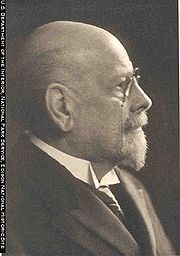
: "General electricity company") was a German producer of electrical equipment founded in 1883 by Emil Rathenau
Emil Rathenau
Emil Moritz Rathenau was a German entrepreneur and industrialist, a leading figure in the early European electrical industry.- Biography :...
.
In 1967 AEG joined with Telefunken
Telefunken
Telefunken is a German radio and television apparatus company, founded in Berlin in 1903, as a joint venture of Siemens & Halske and the Allgemeine Elektricitäts-Gesellschaft...
creating AEG-Telefunken. In 1985 AEG was bought by Daimler-Benz
Daimler-Benz
Daimler-Benz AG was a German manufacturer of automobiles, motor vehicles, and internal combustion engines; founded in 1926. An Agreement of Mutual Interest - which was valid until year 2000 - was signed on 1 May 1924 between Karl Benz's Benz & Cie., and Daimler Motoren Gesellschaft, which had...
, later being wholly integrated into DaimlerChrysler
DaimlerChrysler
Daimler AG is a German car corporation. By unit sales, it is the thirteenth-largest car manufacturer and second-largest truck manufacturer in the world. In addition to automobiles, Daimler manufactures buses and provides financial services through its Daimler Financial Services arm...
forming part of Adtranz
Adtranz
ABB Daimler-Benz Transportation , commonly known under its brand Adtranz, was a multi-national rail transport equipment manufacturer with facilities concentrated in Europe and the USA....
. By 1997 the company no longer existed.
After acquiring the household division of AEG in 1994, in 2005 Electrolux
Electrolux
The Electrolux Group is a Swedish appliance maker.As of 2010 the 2nd largest home appliance manufacturer in the world after Whirlpool, its products sell under a variety of brand names including its own and are primarily major appliances and vacuum cleaners...
bought the rights to the brand name AEG and now uses it on some of its products. As of 2009 the AEG name is also licensed to various companies.
Summary
AEG (Slogan: "Aus Erfahrung gut") was created in 1887 from the Deutsche Edison Gesellschaft (DEG), initially the company produced electrical equipment - light bulbs, motors and generators etc., it soon became involved in AC electrical tranmission systems. In 1907 Peter BehrensPeter Behrens
Peter Behrens was a German architect and designer. He was important for the modernist movement, as several of the movements leading names worked for him when they were young.-Biography:Behrens attended the Christianeum Hamburg from September 1877 until Easter 1882...
was appointed as artistic consultant to AEG. This led to the creation of the company's initial corporate identity
Corporate identity
In Corporate Communications, a corporate identity is the "persona" of a corporation which is designed to accord with and facilitate the attainment of business objectives...
, with products and advertising sharing common design features.
The company expanded in the first half of the 20th Century and is credited with a number of firsts and inventions in the electrical engineering field. During the same period it entered the automobile and airplane markets. Electrical equipment for railways was also produced during this time - starting a long history of supplying the German railways with electrical equipment.
After the black period of the Second World War the company lost those businesses located in the eastern part of Germany. In 1967, after a merger, the company was renamed AEG Telefunken. The company experienced financial difficulties during the 1970s resulting in the sale of some of its assets; in 1983 the consumer electronics division was sold and the company re-took the name AEG. In 1985 the remainder of the company was acquired by Daimler-Benz
Daimler-Benz
Daimler-Benz AG was a German manufacturer of automobiles, motor vehicles, and internal combustion engines; founded in 1926. An Agreement of Mutual Interest - which was valid until year 2000 - was signed on 1 May 1924 between Karl Benz's Benz & Cie., and Daimler Motoren Gesellschaft, which had...
; the parts that remained were primarily related to electric power distribution, and electric motor technology. Under Daimler Benz ownership the former AEG rump companies eventually become part of the newly named Adtranz
Adtranz
ABB Daimler-Benz Transportation , commonly known under its brand Adtranz, was a multi-national rail transport equipment manufacturer with facilities concentrated in Europe and the USA....
in 1995. In 1996 AEG as a manufacturing company ceased to exist.
Foundation to 1940
Emil Rathenau
Emil Moritz Rathenau was a German entrepreneur and industrialist, a leading figure in the early European electrical industry.- Biography :...
who had acquired licences to use some of Thomas Edison
Thomas Edison
Thomas Alva Edison was an American inventor and businessman. He developed many devices that greatly influenced life around the world, including the phonograph, the motion picture camera, and a long-lasting, practical electric light bulb. In addition, he created the world’s first industrial...
s lamp patents in Germany.Timeline 1882 The Deutsche Edison Gesellschaft ("German Edison Company") was founded in 1883 with the financial backing of various banks and private individuals, with Emil Rathenau as company director.Timeline 1883
In 1884 the Munich-born engineer Oskar von Miller
Oskar von Miller
Oskar von Miller was a German engineer and founder of the Deutsches Museum, a large museum of technology and science....
(who later became the founder of the Deutsches Museum
Deutsches Museum
The Deutsches Museum in Munich, Germany, is the world's largest museum of technology and science, with approximately 1.5 million visitors per year and about 28,000 exhibited objects from 50 fields of science and technology. The museum was founded on June 28, 1903, at a meeting of the Association...
) joined the executive board. The same year the company entered negotiations with the Berlin Magistrat (the municipal body) to supply a large area from a central supply, which resulted in the formation of the Städtische Elektricitäts-Werke AG zu Berlin (AGStEW) ("City electricity works company (Berlin)") on 8 May 1884 - this date is considered to be the birthday of the German electrical industry.Timeline 1884
The original factory was located near Stettin bahnhof
Berlin Nordbahnhof
Berlin Nordbahnhof is a railway station in the Mitte district of Berlin, Germany. It is served by the Berlin S-Bahn and local bus and tram lines.-History:...
. In 1887, the Company acquired land in the Berlin-Gesundbrunnen area on which the Weddingsche Maschinenfabrik (founded by Wilhelm Wedding) was previously located. In the same year, in addition to a restructuring and expansion of the production range the AEG name was adopted.Timeline 1885-1887
In 1887 Mikhail Dolivo-Dobrowolsky joined the company as chief engineer, later becoming vice-director. His work on polyphase electric power led him to become the world's leading engineer in 3 phase electric power systems at the end of the 1880s.Timeline 1888-1889
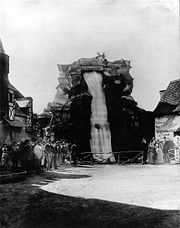
In 1891 Miller and Dobrovolski succeeded in demonstrating the transmission of electrical power over a distance of 175 km (109 mi) from a hydro electric power plant in Lauffen am Neckar to Frankfurt
Frankfurt
Frankfurt am Main , commonly known simply as Frankfurt, is the largest city in the German state of Hesse and the fifth-largest city in Germany, with a 2010 population of 688,249. The urban area had an estimated population of 2,300,000 in 2010...
, where it lit 1000 light bulbs and drove an artificial waterfall - at the International Electrotechnical Exhibition
International Electro-Technical Exhibition - 1891
The 1891 International Electro-Technical Exhibition was held between 16 May and 19 October on the disused site of the three former “Westbahnhöfe” in Frankfurt am Main. The exhibition featured the first long distance transmission of high-power, three-phase electrical current, which was generated...
in Frankfurt am Main. This success marked one of beginnings of the general use of alternating current for electrification in Germany, and showed that distance transfer of electrical power could useful economically. Additionally, in the same year the Stadtbahn Halle/Saale (City railway Halle - Saale) is opened - being the first electric tram system (of notable size) in GermanyTimeline 1890-1891
Tropp Paul began his work for the AEG 1889/90 until 1893, and Franz Schwechten
Franz Heinrich Schwechten
Franz Heinrich Schwechten was one of the most famous German architects of his time, and has contributed to the development of the historicist architecture....
designed the facades of the Acker- und Hussitenstraße 1894-95.
In 1894 the site of the former Berlin Viehmarktgasse (cattle market) was purchased. This had a siding connecting to the Berlin rail network produced, but there was no rail connection between the two plants - therefore in 1895 a link between the two plots was built as an underground railway in a specially designed tunnel of 270 meters in length. The tunnel was implemented by Siemens & Halske (S & H) (later to become Siemens
Siemens
Siemens may refer toSiemens, a German family name carried by generations of telecommunications industrialists, including:* Werner von Siemens , inventor, founder of Siemens AG...
) under the direction of C. Schwebel and Wilhelm Lauter - this is now the Spree tunnel Stralau - used by public transport.
In 1903 the competing radio companies of AEG with and of Siemens & Halske are merged forming a joint subsidiary company with the name Telefunken
Telefunken
Telefunken is a German radio and television apparatus company, founded in Berlin in 1903, as a joint venture of Siemens & Halske and the Allgemeine Elektricitäts-Gesellschaft...
.
In 1907 the architect Peter Behrens
Peter Behrens
Peter Behrens was a German architect and designer. He was important for the modernist movement, as several of the movements leading names worked for him when they were young.-Biography:Behrens attended the Christianeum Hamburg from September 1877 until Easter 1882...
became an artistic adviser.Timeline 1904-1907 Responsible for the design of all products, advertising and architecture, he has since become considered as the world's first corporate designer.
On the 20th June 1915 the founder, Emil Rathenau died aged 77.Timeline 1915-1916
- Maschinenfabrik ( DynamoDynamo- Engineering :* Dynamo, a magnetic device originally used as an electric generator* Dynamo theory, a theory relating to magnetic fields of celestial bodies* Solar dynamo, the physical process that generates the Sun's magnetic field- Software :...
s, Electric motorElectric motorAn electric motor converts electrical energy into mechanical energy.Most electric motors operate through the interaction of magnetic fields and current-carrying conductors to generate force...
s, transformerTransformerA transformer is a device that transfers electrical energy from one circuit to another through inductively coupled conductors—the transformer's coils. A varying current in the first or primary winding creates a varying magnetic flux in the transformer's core and thus a varying magnetic field...
s) - Apparatefabrik (arc lampArc lamp"Arc lamp" or "arc light" is the general term for a class of lamps that produce light by an electric arc . The lamp consists of two electrodes, first made from carbon but typically made today of tungsten, which are separated by a gas...
s, switchSwitchIn electronics, a switch is an electrical component that can break an electrical circuit, interrupting the current or diverting it from one conductor to another....
es, fuseFuse (electrical)In electronics and electrical engineering, a fuse is a type of low resistance resistor that acts as a sacrificial device to provide overcurrent protection, of either the load or source circuit...
s, resistorResistorA linear resistor is a linear, passive two-terminal electrical component that implements electrical resistance as a circuit element.The current through a resistor is in direct proportion to the voltage across the resistor's terminals. Thus, the ratio of the voltage applied across a resistor's...
s, controls, startersContactorA contactor is an electrically controlled switch used for switching a power circuit, similar to a relay except with higher current ratings. A contactor is controlled by a circuit which has a much lower power level than the switched circuit....
, electrical measuring equipment) - Kabelwerk (copper and metal works, rubber fabrication, insulator fabrication)
- Glühlampenfabriken (carbon-filament and metal thread light bulbsIncandescent light bulbThe incandescent light bulb, incandescent lamp or incandescent light globe makes light by heating a metal filament wire to a high temperature until it glows. The hot filament is protected from air by a glass bulb that is filled with inert gas or evacuated. In a halogen lamp, a chemical process...
, Nernst lampNernst lampNernst lamps were an early form of electrically powered incandescent lamps. Nernst lamps did not use a glowing tungsten filament. Instead, they used a ceramic rod that was heated to incandescence...
s) - later to become part of OsramOsramOsram, founded 1919, is part of the industry sector of Siemens AG and one of the two leading lighting manufacturers in the world. The name is derived from osmium and Wolfram , as both these elements were commonly used for lighting filaments at the time the company was founded... - Turbinenfabrik (steam turbineSteam turbineA steam turbine is a mechanical device that extracts thermal energy from pressurized steam, and converts it into rotary motion. Its modern manifestation was invented by Sir Charles Parsons in 1884....
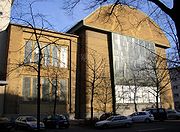
s) - famous as an example of industrial architecture
A number of other notable events involving AEG occurred in this period:
- 1900 - Invention of the hairdryer.
- 1901 - The Neue Automobil GesellschaftNeue Automobil GesellschaftNeue Automobil-Gesellschaft was a German automobile manufacturer in Berlin.In 1902, German electrical company AEG purchased the coachbuilding side of Kühlstein under engineer Joseph Vollmer, renaming it NAG...
("New Automotive Company") became part of AEG through the takeover of Allgemeine Automobil-GesellschaftTimeline 1900-1901 - 27 October 1903 - A three-phase AC AEG motor in a competition with Siemens & Halske achieves a speed of 210.2 km/h (131 mph) on the test track of the Königlich Preußische Militär-Eisenbahn (Royal Prussian military railway) between MarienfeldeMarienfeldeMarienfelde is a locality in southwest Berlin. It is a mixed industrial and residential area, and part of the borough of Tempelhof-Schöneberg.-Transportation and industry:...
and ZossenZossenZossen is a German town in the district of Teltow-Fläming in Brandenburg, south of Berlin, and next to the B96 highway. Zossen consists of several smaller municipalities, which were grouped together in 2003 to form the city.-Geography:...
. This world speed record for rail vehicles was held until 1931. - 1904 - Merger of AEG with the Union-Elektricitäts-Gesellschaft (UEG) (literal: Union-electricity Company)
- 1910 - Entry into the aircraft building market.Timeline 1910-1911
- 1929 - AEG produces its first compressor driven fridges and temperature controlled irons.Timeline 1926-1930
- 1935 - Presentation of the world's first tape device MagnetophonMagnetophonMagnetophon was the brand or model name of the pioneering reel-to-reel tape recorder developed by engineers of the German electronics company AEG in the 1930s, based on the magnetic tape invention by Fritz Pfleumer...
K1 based on work by Eduard Schüllerat the Berlin International Radio ExhibitionInternationale Funkausstellung BerlinThe IFA or Internationale Funkausstellung Berlin is one of the oldest industrial exhibitions in Germany. Between 1924 and 1939 it was an annual event, but as from 1950 it was organized on a two yearly basis until 2005. Since then it has become an annual event again, held in September...
Timeline 1931-1935 - 1941 - AEG buys Siemens & Halske shares in TelefunkenTelefunkenTelefunken is a German radio and television apparatus company, founded in Berlin in 1903, as a joint venture of Siemens & Halske and the Allgemeine Elektricitäts-Gesellschaft...
and the company becomes a subsidiary.
The Nazi era and World War II
AEG donated 60,000 Reichsmarks to the Nazi party after the Secret Meeting of 20 February 1933Secret Meeting of 20 February 1933
The Secret Meeting of 20 February 1933 was a secret meeting between Adolf Hitler and 20 to 25 industrialists at the official residence of Hermann Göring in the Reichstag Presidential Palace aimed at financing the election campaign of the Nazi Party.The German elections were to be held on 5 March...
at which the twin goals of complete power and national rearmament were explained by Hitler.
During World War II
World War II
World War II, or the Second World War , was a global conflict lasting from 1939 to 1945, involving most of the world's nations—including all of the great powers—eventually forming two opposing military alliances: the Allies and the Axis...
, an AEG factory near Riga
Riga
Riga is the capital and largest city of Latvia. With 702,891 inhabitants Riga is the largest city of the Baltic states, one of the largest cities in Northern Europe and home to more than one third of Latvia's population. The city is an important seaport and a major industrial, commercial,...
used female slave labour. AEG were also contracted for the production of electrical equipment at Auschwitz concentration camp
Auschwitz concentration camp
Concentration camp Auschwitz was a network of Nazi concentration and extermination camps built and operated by the Third Reich in Polish areas annexed by Nazi Germany during World War II...
.
AEG used slave labour from Camp No. 36 at the new sub-camp of Auschwitz III called "Arbeitslager Blechhammer". Most of these would die in 1945 during the death march
Death march
A death march is a forced march of prisoners of war or other captives or deportees. Those marching must walk over long distances for an extremely long period of time and are not supplied with food or water...
es and finally in Buchenwald.
1945 to 1970
In 1945, after the Second World War, the production in the factories in the western sectors of BerlinBerlin
Berlin is the capital city of Germany and is one of the 16 states of Germany. With a population of 3.45 million people, Berlin is Germany's largest city. It is the second most populous city proper and the seventh most populous urban area in the European Union...
and Nuremberg
Nuremberg
Nuremberg[p] is a city in the German state of Bavaria, in the administrative region of Middle Franconia. Situated on the Pegnitz river and the Rhine–Main–Danube Canal, it is located about north of Munich and is Franconia's largest city. The population is 505,664...
, Stuttgart
Stuttgart
Stuttgart is the capital of the state of Baden-Württemberg in southern Germany. The sixth-largest city in Germany, Stuttgart has a population of 600,038 while the metropolitan area has a population of 5.3 million ....
and Mulheim an der Ruhr resumed and further new works were erected, among others an Electric meter plant in Hameln.
The steam and electric locomotive plant in Hennigsdorf
Hennigsdorf
Hennigsdorf is a town in the district of Oberhavel, in Brandenburg, Germany. It is situated north-west of Berlin, just across the city border, which is formed mainly by the Havel river.-History:...
(Fabriken Hennigsdorf) became a Volkseigener Betrieb
Volkseigener Betrieb
The Volkseigener Betrieb was the legal form of industrial enterprise in East Germany...
(VEB) (people owned enterprise) as the Lokomotivbau Elektrotechnische Werke
LEW Hennigsdorf
The rail vehicle factory in Hennigsdorf, Germany was founded in 1910 by AEG. Locomotive production began in 1913, and in the 1930s absorbed the work of the August Borsig locomotive factory, being renamed the Borsig Lokomotiv Werke GmbH until 1944...
(LEW) ("electric locomotive works"). The cable plant (Draht-, Kabel- und Metallwerk Oberspree) and apparatus factory (Apparatefabrik Treptow) and other facilities also lay in East Germany and became Sowjetische Aktiengesellschaft (SAG) (Soviet joint stock companies). Over 90% of assets in Berlin lay in the Russian occupied zone and were lost.
The headquarters for the non-expropriated parts of the company was moved first to Hamburg and then finally to Frankfurt am Main, the headquarters in Berlin having been destroyed.
- 1948 - The AEG factories Kassel (FK) were founded on the site of the former MWK Motorenbau Werk KasselMotorenbau Werk KasselDuring World War II the Motorenbau Werk Kassel in Kassel was a branch factory of the Junkers Flugzeug- und Motorenwerke AG Dessau and supplier for strategic military technology among other things the first ready for serial production Turbostrahltriebwerk Jumo 004B of the world...
at Lilienthalstrasse 150 in KasselKasselKassel is a town located on the Fulda River in northern Hesse, Germany. It is the administrative seat of the Kassel Regierungsbezirk and the Kreis of the same name and has approximately 195,000 inhabitants.- History :...
/HesseHesseHesse or Hessia is both a cultural region of Germany and the name of an individual German state.* The cultural region of Hesse includes both the State of Hesse and the area known as Rhenish Hesse in the neighbouring Rhineland-Palatinate state...
/GermanyGermanyGermany , officially the Federal Republic of Germany , is a federal parliamentary republic in Europe. The country consists of 16 states while the capital and largest city is Berlin. Germany covers an area of 357,021 km2 and has a largely temperate seasonal climate...
. The first factory part was the high voltage switchgear factory (HSF), later the refrigerator factory (KSF), the ticketprinter factory (FDF), the isolating material factory (IF) as well as the worldwide accepted high voltage institute (HI)were founded. In the early sixties more than 5000 people worked for AEG in Kassel. Today, the site Lilienthalstrasse still produces high voltage switchgear. - 1950 - The new corporate headquarters is at the Friedensbrücke (Peace Bridge) in Frankfurt / Main. The number of employees in the Group rose from 20,900 in September 1948 to 55,400 persons in September 1957. In the same year the turnover exceeded one billion DM for the first time, however the high level of investment in the rebuilding of the company (1948 to 1956 over 500 million DM) placed a considerable strain on the balance sheet.
- 1958 The slogan "Aus Erfahrung Gut" is introduced - resulting in vernacular modifications such as "Auspacken, Einschalten, Geht nicht" - (unpacking, switching on, does not work) or "Alles Ein Gammel" (Everything is 'gammy')
- 1962 The Group has 127,000 employees and generates annual sales of 3.1 billion DM. In SpringeSpringeSpringe is a town in the district of Hanover, in Lower Saxony, Germany. It is situated near the Deister hills, southwest of Hanover.-City Structure:* Springe with 12,666 Inhabitants* Bennigsen with 4,095 Inhabitants...
a new factory is opened in February 1962 a new factory for the production of fluid control units with 200 employees. - 1962 Walter BruchWalter BruchWalter Bruch was a German engineer who invented the PAL color television system at Telefunken in the early 1960s. In Addition to his research activities Professor Bruch taught at Hannover Technical University. He was awarded the Werner-von-Siemens-Ring in 1975.-Biography:He was born at Neustadt an...
at Telefunken in Hannover develops PAL TV color. - 1966 The largest industrial space in Europe is created (175 m long, 45 meters wide and 26 meters high) for the construction using cranes of engines and generators with weights up to 400 tonnes. Robert Kennedy attends the opening.
- 1 January 1967 - Merger with Telefunken creates AEG-Telefunken, headquartered in Frankfurt am Main.
1970s onwards
Frankfurt Airport
Frankfurt Airport may refer to:Airports of Frankfurt, Germany:*Frankfurt Airport , the largest airport in Germany*Frankfurt Egelsbach Airport, a general aviation airport*Frankfurt-Hahn Airport , a converted U.S...
and its entrance into the nuclear powerplant building business. The companies' line of Boiling water reactor
Boiling water reactor
The boiling water reactor is a type of light water nuclear reactor used for the generation of electrical power. It is the second most common type of electricity-generating nuclear reactor after the pressurized water reactor , also a type of light water nuclear reactor...
s were not successful on the market. In particular, the nuclear power plant at Würgassen, the commissioning of which was delayed by several years due to a number of technical problems cost AEG hundreds of millions of DM. As a result the company provided a dividend for the last time in 1972.
The entertainment arm (Telefunken Fernseh und Rundfunk GmbH) headquartered in Hanover
Hanover
Hanover or Hannover, on the river Leine, is the capital of the federal state of Lower Saxony , Germany and was once by personal union the family seat of the Hanoverian Kings of Great Britain, under their title as the dukes of Brunswick-Lüneburg...
was sold outsourced. This was followed by the computer mainframe business (TR 4, TR 10, TR 440) (a partnership under the name Telefunken Computer GmbH with the company Nixdorf
Nixdorf
Nixdorf may refer to any of these companies:*Nixdorf Computer AG, a former Paderborn-based computer company *Siemens Nixdorf, the result of the merger of Nixdorf and Siemens *Wincor Nixdorf, one of the successors of Siemens-Nixdorf....
sold to Siemens
Siemens
Siemens may refer toSiemens, a German family name carried by generations of telecommunications industrialists, including:* Werner von Siemens , inventor, founder of Siemens AG...
. The process computer (TR 84, TR 86, AEG 60-10, AEG 80-20, AEG 80-60) continued as Geschäftsbereich Automatisierungstechnik (after 1980 as ATM Computer GmbH)
- 1975 The former Telefunken building at Berlin Ernst-Reuter-Platz is sold. The building was previously rented to the Technical University of BerlinTechnical University of BerlinThe Technische Universität Berlin is a research university located in Berlin, Germany. Translating the name into English is discouraged by the university, however paraphrasing as Berlin Institute of Technology is recommended by the university if necessary .The TU Berlin was founded...
In 1976 To circumvent the requirement of equal participation of employees in the Supervisory Board, Dr. Walter Cipa (Dipl.-Geol.) (AEG boss from 1976 to 1980) created four further companies as wholly owned joint stock companies in addition to the two household appliance companies. (The numbers in brackets refer to percentage of turnover in 1980)
- AEG-Telefunken Anlagentechnik AG (37 %)
- AEG-Telefunken Serienprodukte AG (16 %)
- AEG-Telefunken Kommunikationstechnik AG (6 %)
- Olympia Werke AG (business office technology, 7%)
- AEG-Hausgeräte GmbH (22 %)
- Telefunken Fernseh und Rundfunk GmbH (12%)
In 1979 AEG-Telefunken Aktiengesellschaft was renamed Allgemeine Elektricitäts-Gesellschaft (AEG), as first used in 1887
- 1980 Heinz DürrHeinz DürrHeinz Dürr is a German entrepreneur and stockholder of the Stuttgart-based Dürr AG.Dürr was born in Stuttgart and was educated at a National Political Institutes of Education He was chairman of the board at AEG from 1980 to 1990. From 1991 on, he was president of Deutsche Bundesbahn and...
becomes board Chairman (until 1990)
In August 1982 a restructuring plan, backed with federal guarantees of 600 million DM and new bank loans of 275 million DM, fell apart at the first disagreement between the banks. A banking consortium provided an administrative loan of DM 1.1 billion to the AEG Group until June 1983; 400 million of which only to be available on a guarantee by the federal government. Not only is AEG-Telefunken AG affected, but also its subsidiaries Küppersbusch AG in Gelsenkirchen
Gelsenkirchen
Gelsenkirchen is a city in North Rhine-Westphalia, Germany. It is located in the northern part of the Ruhr area. Its population in 2006 was c. 267,000....
, Hermann Zanker Maschinenfabrik GmbH & Co. KG in Tübingen
Tübingen
Tübingen is a traditional university town in central Baden-Württemberg, Germany. It is situated south of the state capital, Stuttgart, on a ridge between the Neckar and Ammer rivers.-Geography:...
and Carl Neff GmbH in Bretten
Bretten
Bretten is a town in the state of Baden-Württemberg, Germany. It is located on Bertha Benz Memorial Route.-Geography:Bretten lies in the centre of a rectangle that is formed by Heidelberg, Karlsruhe, Heilbronn and Stuttgart as corners. It has a population of approximately 28,000. The centre of...
.
The Alno-Möbelwerke GmbH & Co. KG in Pfullendorf
Pfullendorf
Pfullendorf is a small historic city in the district of Sigmaringen in Baden-Württemberg in Germany.-Geography:Its location is in the district of Sigmaringen, 25 km north of Lake Constance and south of the Danube valley and therefore on the continental divide between the watersheds of the...
was taken over by the minority shareholders, and separated from the group.
The suppliers to AEG were affected and some filed for bankruptcy - including Becher & Co. Möbelfabriken KG in Bühlertann
Bühlertann
Bühlertann is a municipality in the district of Schwäbisch Hall in Baden-Württemberg in Germany....
with lack of continuity of company policy a factor. The site at Brunnenstraße in the former Berlin district of Wedding was also sold, as were the firms AEG-Fabrik Essen and Bauknecht.
- 1983/84 the consumer electronics division (Telefunken television and broadcasting GmbH) was sold to the French group Thomson-BrandtThomson SATechnicolor SA , formerly Thomson SA and Thomson Multimedia, is a French international provider of solutions for the creation, management, post-production, delivery and access of video, for the Communication, Media and Entertainment industries. Technicolor’s headquarters are located in Issy les...
. - 1985 AEG is taken over by Daimler-Benz AG. Daimler-Benz executive Edzard ReuterEdzard ReuterEdzard Reuter was the CEO of Daimler-Benz from 1987 to 1995.Edzard Reuter was born in Berlin, his father was the popular social democratic politician and mayor of Berlin from 1948 to 1953, Ernst Reuter. His mother Hanna Reuter née Kleinert was a secretary at the party newspaper Vorwärts...
(from 1987 Daimler CEO), decides two companies should form an "integrated technology group" with beneficial synergy. - 1988 On its 60th year anniversary the AEG-Forschungsinstituts (AEG Research Institute) creates the Carl-Ramsauer Prize for scientific/technical dissertations.
- 1990 AEG Westinghouse Transportation Systems GmbH is formed in association with Westinghouse Transportation Systems Inc.Westinghouse Electric (1886)Westinghouse Electric was an American manufacturing company. It was founded in 1886 as Westinghouse Electric Company and later renamed Westinghouse Electric Corporation by George Westinghouse. The company purchased CBS in 1995 and became CBS Corporation in 1997...
- 1992 Merger (or re-uniting) of the railway business with the Lokomotivbau Elektrotechnische WerkeLEW HennigsdorfThe rail vehicle factory in Hennigsdorf, Germany was founded in 1910 by AEG. Locomotive production began in 1913, and in the 1930s absorbed the work of the August Borsig locomotive factory, being renamed the Borsig Lokomotiv Werke GmbH until 1944...
(LEW) in HennigsdorfHennigsdorfHennigsdorf is a town in the district of Oberhavel, in Brandenburg, Germany. It is situated north-west of Berlin, just across the city border, which is formed mainly by the Havel river.-History:...
, resulting in the formation of AEG Schienenfahrzeuge GmbH (AEG locomotives) - 1992 The Swedish company Atlas CopcoAtlas CopcoAtlas Copco is a Swedish industrial company that was founded in 1873. It manufactures industrial tooling and equipment.The Atlas Copco Group is a global industrial group of companies headquartered in Stockholm, Sweden. Revenues for 2009 totaled 63 billion SEK. The Group employs more than 33,000...
acquires AEG Power Tools Ltd - divested in 2004 to Techtronic IndustriesTechtronic IndustriesTechtronic Industries Company Limited , Techtronic or TTI, is one of the world's leading manufacturing and trading company in electrical and electronic products. Its products include Milwaukee, AEG power tools, and Ryobi power tools and accessories, Ryobi and Homelite outdoor products, and Hoover,...
. - 1994 sale of the Automation division to Schneider ElectricSchneider ElectricSchneider Electric is a French global company. It was founded in 1836 by two brothers, Eugène and Adolphe Schneider.In the first part of the 20th century, Schneider et Cie associated itself with Westinghouse Systems, a major international electrical group at the time. The group began manufacturing...
and of AEG Hausgeräte AG to ElectroluxElectroluxThe Electrolux Group is a Swedish appliance maker.As of 2010 the 2nd largest home appliance manufacturer in the world after Whirlpool, its products sell under a variety of brand names including its own and are primarily major appliances and vacuum cleaners...
. - 1995 AEG Schienenfahrzeuge GmbH becomes part of ABB Daimler-Benz Transportation (Adtranz)AdtranzABB Daimler-Benz Transportation , commonly known under its brand Adtranz, was a multi-national rail transport equipment manufacturer with facilities concentrated in Europe and the USA....
(subsequently becoming part of Bombardier TransportationBombardier TransportationBombardier Transportation is the rail equipment division of the Canadian firm, Bombardier Inc. Bombardier Transportation is one of the world's largest companies in the rail-equipment manufacturing and servicing industry. Its headquarters are in Berlin, Germany....
in 2001). - 1996 The Annual General Meeting of Daimler-Benz AG chaired by Juergen Schrempp decides upon the dissolution of the lossmaking group.
- 1996 GEC ALSTHOM acquires AEG Power T&D business
- September 1996 The company is deleted from the commercial register.
Locomotives and railway technology
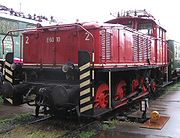
Additionally many steam locomotives were made in AEG factories. In 1931 the company acquired Borsig and transferred the locomotive production to the AEG-Borsig works (Borsig Lokomotiv-Werke GmbH) from the Borsig plant in Tegel. In 1948 the plant became VEB
Volkseigener Betrieb
The Volkseigener Betrieb was the legal form of industrial enterprise in East Germany...
Lokomotivbau Elektrotechnische Werke. In addition to numerous electric locomotives produced for the DR steam locomotive production continued until 1954.
When the Federal Republic of Germany began implementing AC propulsion systems AEG found itself in competition with Brown, Boveri & Cie
Brown, Boveri & Cie
Brown, Boveri & Cie was a Swiss group of electrical engineering companies.It was founded in Baden, Switzerland, in 1891 by Charles Eugene Lancelot Brown and Walter Boveri who worked at the Maschinenfabrik Oerlikon. In 1970 BBC took over the Maschinenfabrik Oerlikon...
. The prototype DB Class E320 was built with Krupp
Krupp
The Krupp family , a prominent 400-year-old German dynasty from Essen, have become famous for their steel production and for their manufacture of ammunition and armaments. The family business, known as Friedrich Krupp AG Hoesch-Krupp, was the largest company in Europe at the beginning of the 20th...
as dual voltage (15 kV and 25 kV AC) test machine, the technology ultimately leading to locomotives such as DB Class 120
DB Class 120
The DB Baureihe 120 is a class of electric locomotives operated by DB Fernverkehr in Germany.-Background and design:The locomotives' prototypes, delivered in 1979 , were one of the first electric locomotives with three-phase motors. They were based on experiences made in the 1970s with...
and ICE 1.
Only after German reunification
German reunification
German reunification was the process in 1990 in which the German Democratic Republic joined the Federal Republic of Germany , and when Berlin reunited into a single city, as provided by its then Grundgesetz constitution Article 23. The start of this process is commonly referred by Germans as die...
and the adoption of the LEW plant in Hennigsdorf did AEG's name return to whole locomotive manufacturing, but only for a short time. "AEG locomotives GmbH " became part of ABB Daimler-Benz Transportation
Adtranz
ABB Daimler-Benz Transportation , commonly known under its brand Adtranz, was a multi-national rail transport equipment manufacturer with facilities concentrated in Europe and the USA....
(later ADtranz) and currently the technology developed in the past, in part, now enables Bombardier Transportation
Bombardier Transportation
Bombardier Transportation is the rail equipment division of the Canadian firm, Bombardier Inc. Bombardier Transportation is one of the world's largest companies in the rail-equipment manufacturing and servicing industry. Its headquarters are in Berlin, Germany....
to build the very successful TRAXX
TRAXX
Bombardier TRAXX is a modular product platform of electric and Diesel-electric mainline locomotives built by Bombardier Transportation, built in both freight and passenger variants...
series of locomotives.
Aircraft
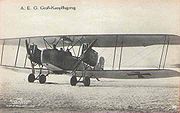
- see also List of AEG aircraft
Additionally, AEG manufactured a range of aircraft from 1910 to 1918.
The first aircraft in 1912 was of wooden construction and modelled after the biplane
Biplane
A biplane is a fixed-wing aircraft with two superimposed main wings. The Wright brothers' Wright Flyer used a biplane design, as did most aircraft in the early years of aviation. While a biplane wing structure has a structural advantage, it produces more drag than a similar monoplane wing...
of the Wright brothers
Wright brothers
The Wright brothers, Orville and Wilbur , were two Americans credited with inventing and building the world's first successful airplane and making the first controlled, powered and sustained heavier-than-air human flight, on December 17, 1903...
. It had a wingspan
Wingspan
The wingspan of an airplane or a bird, is the distance from one wingtip to the other wingtip. For example, the Boeing 777 has a wingspan of about ; and a Wandering Albatross caught in 1965 had a wingspan of , the official record for a living bird.The term wingspan, more technically extent, is...
of 17.5 m (57.4 ft); was powered by an eight-cylinder engine producing 75 hp; unladen weight was 850 kg; and could attain a speed of 65 km/h (40.4 mph). From 1912, the construction of airplanes in mixed wood and steel tube construction with fabric covering.
One of the planes designed and built was Riesenflugzeug ("giant aircraft") AEG R.I
AEG R.I
|-See also:-References:...
. This aircraft was powered by four 260 hp Mercedes D.IV
Mercedes D.IV
|-References:* Kroschel, Gunter and Helmust Stützer. Die deutschen Militarflugzeuge 1910-1918 Wilhelmshaven: Lohse-Eissing Mittler.*...
a engines linked to a combination leather cone and dog clutch
Dog clutch
A dog clutch is a type of clutch that couples two rotating shafts or other rotating components not by friction but by interference. The two parts of the clutch are designed such that one will push the other, causing both to rotate at the same speed and will never slip.Dog clutches are used where...
. The first flight tests were satisfactory, but on September 3, 1918 the R.I broke up in the air killing its seven crewmen.
During the Second World War AEG produced machines for reconnaissance purposes, including a helicopter platform driven by an AC motor, the power supply was carried by three cables from the ground, this was a tethered craft - the machine could not fly freely. The machine reached an altitude of 300 m.
Cars
AEG bought KühlsteinKühlstein
The Kühlstein Wagenbau in Berlin-Charlottenburg was a coachbuilding company that produced electric cars from 1898 to 1902. Some were vehicles of in-house design, others were Jeantaud cabs built under licence. The firm also built tractor units to replace horses for use with horse-drawn carriages....
in 1902, founding the division Neue Automobil Gesellschaft
Neue Automobil Gesellschaft
Neue Automobil-Gesellschaft was a German automobile manufacturer in Berlin.In 1902, German electrical company AEG purchased the coachbuilding side of Kühlstein under engineer Joseph Vollmer, renaming it NAG...
(New Automobile Company), to make cars
Automobile
An automobile, autocar, motor car or car is a wheeled motor vehicle used for transporting passengers, which also carries its own engine or motor...
. AEG withdrew from car production in 1908.
Models produced include:
- AAG (1900 automobile)AAG (1900 automobile)AAG was the brand name of a German automobile company which offered only one car, a 5 hp voiturette designed by one Professor Klingenberg and manufactured between 1900 and 1901. The company factory was bought by the politician Emil Rathenau, also the head of the AEG Group...
- NAG Typ A
- NAG Typ B
- NAG Typ B2
Film projectors
AEG also produced for a long period a series of film projectorFilm projector
Film projection or Film projector may refer to:*Movie projector for projection of moving images from film*Slide projector for projection of still images from film...
s:
- Stillstandsmaschine 1919 Projektor 35 mm
- Theatermaschine 1920 Projektor 35 mm
- Triumphator I–III 1924–1935 Projektor 35 mm ACR 0710
- Successor (Lehrmeister) 1925–1935 Projektor 35 mm
- Kofferkino 1927 encased Projektor 35 mm
- Lehrmeister 1929 Projektor 35 mm ACR 0709 (Leitz)
- Mechau Modell 4 1929–1934 Projektor 35 mm
- Euro K 1938–42 Projektor 35 mm
- Euro M 1936 Projektor 35 mm
- Euro G 1938 Projektor 35 mm, Interlock-Version (G-MB)
- Euro M2 1939–1944 Projektor 35 mm
The AEG brand name post dissolution
After the breakup and dissolution of the company the brand name was still seen to have a value. Electrolux acquired the brand and the name is also licensed to various companies:- AEG Electrolux - white goods; washing machines, dishwashers, ovens, fridges etc.
- ITM Technology AG produces consumer electronics and telecommunication (mobile phone, home phone etc.) equipment under the AEG name.
- AEG Elektrowerkzeuge produces hand power tools.
- AEG Haustechnik produces home heating and climate control control (humidifiers, airconditioners) products
- AEG Industrial engineering produces electrical power equipment, including generators up to 55MW, control gear and switchgear, electrical motors, transformers etc. as well as high power inverters and DC supplies for industrial use.
- AEG SVS Schweiss-Technik - manufacturer resistance welding machines and equipment
- AEG Elektrofotografie - Produces photoconductors - specifically photoconductor drums for printing applications (e.g. laser printer/photocopier)
- AEG Gesellschaft fur moderne Informationssysteme mbH (AEG-MIS) - Develops custom LCDs for information systems
- AEG ID - produces RFID tags and readers
- AEG Power Solutions (formerly Saft Power systems or AEG Power Supply Systems) - produces uninterruptable/backup/stable power supply systems for electric supply sensitive equipment (e.g. computers)
Further reading
- Erdmann Thiele (Hrsg.): Telefunken nach 100 Jahren - Das Erbe einer deutschen Weltmarke. Nicolaische Verlagsbuchhandlung Berlin, 2003.
- Aus der Geschichte der AEG: Vor 25 Jahren: Bau der ersten AEG-Flugzeuge. In: AEG-Mitteilungen. Jahrgang 1937, Heft 10 (Oktober), S. 359–362.
- Miron Mislin: Industriearchitektur in Berlin 1840–1910. Wasmuth Verlag, Tübingen 2002, ISBN 3-8030-0617-1, S. 388–403.
- Manfred Pohl: Emil Rathenau und die AEG. AEG Aktiengesellschaft, Berlin, Frankfurt am Main 1988, ISBN 3-7758-1190-7.
- Peter Obst: Die Industrie am Humboldthain (Maschinenfabrik), AEG 1896–1984. Innovations-Zentrum Berlin Management (IZBM) GmbH.
- S. Müller, K. Wittig, S. Hoffmann (2006): Empirische Befunde zum Konsumentenboykott. Der Fall AEG/Electrolux. Dresdner Beiträge zur Betriebswirtschaftslehre Nr. 116/06. (mehr dazu)
- Hans-Heinrich von Fersen: Autos in Deutschland 1920–1939.
- 50 Jahre AEG, als Manuskript gedruckt. Allgemeine Elektricitäts-Gesellschaft Abt. Presse, Berlin 1956.
- Gert Hautsch: Das Imperium AEG-Telefunken, ein multinationaler Konzern. Frankfurt/Main 1979.
- Felix Pinner: Emil Rathenau und das elektrische Zeitalter. Akademische Verlagsgesellschaft mbH, Leipzig 1918.
- Harri Czepuck: Ein Symbol zerbricht, zur Geschichte und Politik der AEG. Dietz Verlag, Berlin 1983.
- Tilmann Buddensieg: Peter Behrens und die AEG, Neue Dokumente zur Baugeschichte der Fabriken am Humboldthain. In: Schloss Charlottenburg Berlin-Preußen. Deutscher Kunstverlag, München 1971.
- Peter Strunk: Die AEG. Aufstieg und Niedergang einer Industrielegende. Nicolai, Berlin 2000.
- Jahresringe Verband für Vorruhestand und aktives Alter, Land Brandenburg e. V. (Hrsg.): Zeitzeugnisse 1945–1990. Teil I (1999) und II (2000).
External links
- AEG-Electrolux - company website aeg.de
- AEG Design case History of AEG logos goodlogo.com
- AEG Industrial Engineering
- AEG - Allgemeine Elektricitäts Gesellschaft AEG - general electric company - brief history of the company, with images of old products and share cerificates (German language)
- Aufstieg und Fall der AEG: Nur die drei Buchstaben haben überlebt Rise and Fall of AEG - only three letters remain. Article about history of AEG. heise.de
- Seidel/Dame: 1920 – Versorgungsbauten für Groß-Berlin (AEG-Bauten); eine ausführliche und bebilderte Darstellung zu AEG in Berlin Architectural history of AEG buildings. Authors : Cira López Miró, Gladys Griffault, Eric Sommerlatte, Christoph Bickenbach laufwerk-b.de