

Digital Compact Cassette

Encyclopedia
Digital Compact Cassette (DCC) was a magnetic tape sound recording
format introduced by Philips
and Matsushita in late 1992 and pitched as a successor to the standard analog
cassette
. It was also a direct competitor to Sony
's MiniDisc
(MD) but neither format toppled the then ubiquitous analog
cassette
despite their technical superiority. Another competing format, the Digital Audio Tape
(DAT) had by 1992 also failed to sell in large quantities (although it was established in recording studios)—DCC was envisaged as a cheaper alternative to DAT. DCC shared a similar form factor to analog cassettes, and DCC recorders could play back either type of cassette. This backward compatibility
allowed users to adopt digital recording without rendering their existing tape collections obsolete.
and Sony
, who had worked together successfully on the Compact Disc
, CD-ROM
and CD-i
before. Based on the success of Digital Audio Tape
in professional environments, both companies saw a market for a new consumer-oriented digital audio recording system that would be less expensive and perhaps less fragile. Sony decided to create the entirely new MiniDisc
format (based on their experience with magneto-optical recording and Compact Disc) while Philips decided on a tape format that was compatible with their earlier analog Compact Cassette
format.
This decision might appear remarkable since Philips had experimented with other recordable-disc media. At the moment although, no company (not even Sony) had been successful in creating a CD compatible read-only/read-write format (equivalent to today's CD-R
and CD-RW
). The only viable solution (at that moment) was magneto-optics, which Sony chose with the MiniDisc
which wasn't remotely compatible with CD media; so Philips' decision to go tape-based made good sense at the time. Also, around 1990 and 1991, the company was going through a difficult time, which gave even greater track to a backward compatible solution, as it was seen as a lesser risk (on hindsight, it wasn't).
DCC was developed in cooperation with Matsushita, and the first DCC recorders were introduced at the Firato consumer electronics show in Amsterdam
in 1992. At that time, not only Philips and Panasonic
(brand of Matsushita) announced DCC-recorders but also other brands such as Grundig
and Marantz
(both related to Philips at the time).
More recorders and players were introduced by Philips and other manufacturers in the following years, including some portable players and recorders and car DCC player/radio receiver combinations.
In November 1995 at the "HCC dagen" computer fair in Utrecht
, The Netherlands, Philips presented the DCC-175 portable recorder that could be connected to an IBM
-compatible PC
using the "PC-link" cable. This was the first (and only) DCC recorder that could be connected to, and controlled by, a computer, and it was only available in the Netherlands.
Philips marketed the DCC format in Europe, the United States and Japan. According to the newspaper article that announced the demise of DCC, DCC was more popular than MiniDisc in Europe (especially in the Netherlands), however in Japan, MiniDisc always outsold DCC.
DCC was discontinued in October 1996 after Philips admitted it had achieved poor sales and MiniDisc was winning.
(MR) head, which was fixed to the mechanism of the player/recorder, unlike rotary heads that are used in helical scan
systems such as DAT or VHS
to increase head-to-tape speed. The advantages of a stationary head are clear: DCC players were extremely insensitive to shock and vibration, and compared to a mechanism based on rotary head, the DCC mechanisms were cheaper to produce. In fact, existing auto-reverse audio cassette recorder mechanisms could easily be adapted for use in DCC-recorders simply by mounting a DCC head instead of an analog stereo head.
Magneto-resistive heads don't use iron so they don't build up residual magnetism. They never need to be demagnetized, and in fact if you would use a cassette demagnetizer
or similar device, you would probably damage or destroy the MR heads.
In stationary DCC-recorders (i.e. recorders meant for use in stereo systems), the head-assembly was usually a combination of a 9-track DCC-head with a 2-track analog stereo head, mounted on a mechanism that would also have the erase-head on it, and would flip the entire head assembly around by 180 degrees when the B-side was played or recorded. In portable DCC recorders the head assembly consisted of two 9-track DCC heads (and two erase heads if the device was capable of recording), which were in a fixed position, i.e. didn't flip around for the B-side. When playing analog cassettes, portable players would simply amplify the signal from two of the nine heads of the "other side": analog cassette recorders used the "bottom half" of the tape, while digital recordings used the "top half". Presumably the fixed assembly for portable recorders was more difficult to make and gave lesser sound quality (especially dynamic range) when playing analog cassettes (which was acceptable for use with headphones), but took up less space and was less sensitive to mechanical problems which were more important for the portable application.
Because of the low tape speed, the achievable bit rate was limited. Nine heads were used to read/write half the width of the tape; the other half of the width was used for the B-side. Eight of these tracks contained audio data, the ninth track was used for timing and text information and for markers to indicate the start of a song or the end of a recording.
The (theoretical) capacity of a DCC tape is 120 minutes, compared to 3 hours for DAT, however no 120-minute tapes were ever produced. Also, because of the switch to side B, there would always be an interruption in the sound at the end of side A, so the maximum theoretical continuous recording time was 60 minutes. DCC recorders could record from digital sources that used the S/PDIF
standard, at 32 kHz, 44.1 kHz or 48 kHz, or they could record from analog sources at 44.1 kHz. Because of the low tape speed, the achievable bit rate
was limited. To compensate, Philips used an audio compression codec
based upon MPEG-1 Audio Layer I
(MP1) and termed PASC (Precision Adaptive Sub-band Coding). PASC lowered the typical bitrate of a CD recording of approximately 1.4 megabits per second to the much lower bitrate of 384 kilobits per second, a compression ratio of around 4:1.
The PASC compression scheme was believed to give better quality audio than the 5:1 compression used by ATRAC
in the original MiniDisc, but not as good as the uncompressed DAT, although both Philips and Sony stated the difference was imperceptible to listeners' ears (like MP3 or AAC files today). Besides storing the data in compressed format, PASC also provided redundancy by adding CIRC
(Cross Interleaved Reed-Solomon Code) bits for error detection and correction, and by scattering the data across the tracks in what Philips called a "checkerboard pattern". According to the Philips webpage, it was possible for a DCC recorder to recover all missing data off a tape even if one of the 8 audio tracks was completely unreadable, or if all tracks were unreadable for 1.45 mm (about 0.03 seconds).
On user tapes, a track marker was recorded at the beginning of every track, so that it was possible to skip and repeat tracks automatically. The markers would be automatically recorded when a silence was detected during an analog recording, or when a track marker was received in the S/PDIF signal of a digital input source (this track marker would automatically be generated by CD players). It was possible to remove these markers (to "merge tracks"), or add extra markers (to "split tracks") without re-recording the audio. Furthermore it was possible to add markers afterwards that would signal the end of the tape or the end of the tape side, so that during playback, the player would stop the mechanism or fast-forward to the end of the A-side or would switch from A-side to B-side immediately.
On later generations of recorders, it was possible to make a third tape type, called "super user tapes", by entering title information for each track. However, contrary to prerecorded tapes, the title information was stored only once, at the start of the track, right after the track marker, so unlike prerecorded tapes it wasn't possible to see what the name of the track was at any position within the track (the user would need to rewind to the beginning of the track), and there was no way to enter album information. Entering track information was a slow process (although easier with a remote control), only upper-case characters were supported and some commonly-used symbols such as the apostrophe
were missing.
The three tape types (prerecorded, user and super-user) are compatible with all recorders and it's impossible (and unnecessary) to recognize the difference between a user tape and a super-user tape without playing it. There were some interesting minor compatibility problems with text on super-user tapes (which might indicate that Philips never had a clear internal standard for how text recording should work); for example:
copy protection system which uses two bit
s in the S/PDIF digital audio stream and on tape to differentiate between "protected" vs. "unprotected" audio, and between "original" vs. "copy":
Analog recording was not restricted: tapes recorded from analog source were marked "unprotected". The only limitation to analog recording compared to DAT recorders was that the A/D converter
was fixed to a sample frequency of 44.1 kHz. On the DCC-175 portable recorder it was possible to circumvent the SCMS protection by copying audio to the hard disk and then back to another tape, using the DCC-Studio program.
s and MiniDiscs covered the tape access holes and locked the hubs while the cassette wasn't in use. Cassettes provided several extra holes and indentations so that DCC recorders could tell a DCC cassette apart from an analog cassette, and so they could tell what the length of a DCC tape was. Also, there was a slider on the DCC to enable and disable recording. Unlike the break-away notches on analog cassettes and VHS tapes, the slider made it easier to make a tape recordable again, and unlike analog cassettes, the slider would protect the entire tape and not just one side.
The cases that DCC cassettes came in generally didn't have the characteristic "folding" mechanism of the old analog cassette (which was hated because it was fragile). Instead, DCC cassette cases tended to be simply plastic boxes that were open on one of the short sides. The front side had a hole that was almost the size of the cassette, so that any label on the cassette would be exposed even when the cassette would be in its case. This allowed the user to slide the cassette in and out of the case with one hand, and it reduced production costs, especially for prerecorded cassettes because a label was needed only for the cassette, not for the case. Format partner Matsushita did however produce blank cassettes (under their Panasonic brand) with a clam-shell style case. Because DCC cassettes had no "bulges" near the tape access holes, there was more space in the case behind the cassette to insert e.g. a booklet for a prerecorded tape, or a folded up card on which users could write the contents of the tape. In spite of the differences, the outside measurements of the standard DCC cases were exactly identical to the cases of analog cassettes, so they could be used in existing storage systems. The Matsushita design clam-shell case was slightly thinner than an analog cassette case
compatible PC. Only small quantities of both recorder and cable were made, leaving many people searching for one or both at the time of the demise of DCC. The cable contained a couple of custom chips that were made especially for this purpose, which made it impossible for people who owned a DCC-175 but no PC-link cable to make their own. Also, even though the outside of the DCC-170 was similar to the DCC-175, they were radically different on the inside so it wasn't possible to make a 175 out of a 170.
The PC-link cable package included software to use the cable on an IBM-compatible PC, running under Windows 3.1. The software consisted of:
Philips also provided a DOS backup application via their BBS
, and later on, they provided an upgrade to the DCC-Studio software to fix some bugs and provide better compatibility with Windows 95 which had come out just before the release of the DCC-175. The software also works with Windows 98 but not with any later versions of Windows.
The backup programs for DOS as well as Windows didn't support long file names. Also, because the tape ran at its usual speed, it took 90 minutes to record approximately 250 Megabytes of uncompressed data. These properties made the backup programs relatively uninteresting for users.
The DCC-Studio application however was a useful application that made it possible to copy audio from tape to hard disk and vice versa, edit track titles on the PC keyboard (so all lower-case and upper-case characters and symbols were available) and write them to tape all at once, edit audio by cutting and pasting fragments, and automatically record mix-tapes. The program was capable of writing the track information to the tape while it was recording the audio, which was a big advantage over the two-step process (record audio first, then edit each track title) which was involved in regular CD-to-DCC recording. Also, because a regular keyboard was used to enter track information, it was possible to enter lower-case characters and symbols that weren't available on stationary recorders.
The DCC-Studio program used the recorder as playback and recording device, it didn't use the PC's sound card (something that not even every PC had in those days). Working with the PASC data without the need to compress and decompress it also saved a lot of hard disk space, and most computers in that time would have a hard time encoding and decoding PASC data in real-time anyway. However, many users complained that they would have liked to have the possibility of using WAV files, and Philips sent registered users a floppy disk
in the mail, containing programs to convert a WAV file to PASC and vice versa. Unfortunately this conversion was extremely slow but it was later discovered that the PASC files were simply MPEG-1 Audio Layer I
files that used a hardly-used, hardly-documented padding feature from the MPEG standard to make all frames the same length, so it was easy to convert PASC to PCM and vice versa.
Because of the possibility to create new tapes with DCC-Studio, regardless of the source they were recorded from, the DCC-175/PC-Link cable/DCC-Studio combination effectively circumvented the SCMS copy protection scheme that all digital audio recording devices for consumers are supposed to have. It is possible that this raised some eyebrows in Philips' legal department, and that this is the reason why DCC-175 and PC-link were never sold outside the Netherlands.
for use as a data storage media for computers. MR heads are now also commonly used in hard disks, although hard disks use the GMR variant, whereas DCC used the earlier AMR.
A derivative technology developed originally for DCC is now being used for filtering beer. Silicon wafers with micrometer scale holes are ideal for separating yeast particles from beer. The beer flows through the silicon wafer leaving the yeast particles behind, which results in a very clear beer. The manufacturing process for the filters was originally developed for the read/write heads of DCC players.
Magnetic tape sound recording
The use of magnetic tape for sound recording originated around 1930. Magnetizable tape revolutionized both the radio broadcast and music recording industries. It did this by giving artists and producers the power to record and re-record audio with minimal loss in quality as well as edit and...
format introduced by Philips
Philips
Koninklijke Philips Electronics N.V. , more commonly known as Philips, is a multinational Dutch electronics company....
and Matsushita in late 1992 and pitched as a successor to the standard analog
Analog signal
An analog or analogue signal is any continuous signal for which the time varying feature of the signal is a representation of some other time varying quantity, i.e., analogous to another time varying signal. It differs from a digital signal in terms of small fluctuations in the signal which are...
cassette
Compact Cassette
The Compact Cassette, often referred to as audio cassette, cassette tape, cassette, or simply tape, is a magnetic tape sound recording format. It was designed originally for dictation, but improvements in fidelity led the Compact Cassette to supplant the Stereo 8-track cartridge and reel-to-reel...
. It was also a direct competitor to Sony
Sony
, commonly referred to as Sony, is a Japanese multinational conglomerate corporation headquartered in Minato, Tokyo, Japan and the world's fifth largest media conglomerate measured by revenues....
's MiniDisc
MiniDisc
The disc is permanently housed in a cartridge with a sliding door, similar to the casing of a 3.5" floppy disk. This shutter is opened automatically by a mechanism upon insertion. The audio discs can either be recordable or premastered. Recordable MiniDiscs use a magneto-optical system to record...
(MD) but neither format toppled the then ubiquitous analog
Analog signal
An analog or analogue signal is any continuous signal for which the time varying feature of the signal is a representation of some other time varying quantity, i.e., analogous to another time varying signal. It differs from a digital signal in terms of small fluctuations in the signal which are...
cassette
Compact Cassette
The Compact Cassette, often referred to as audio cassette, cassette tape, cassette, or simply tape, is a magnetic tape sound recording format. It was designed originally for dictation, but improvements in fidelity led the Compact Cassette to supplant the Stereo 8-track cartridge and reel-to-reel...
despite their technical superiority. Another competing format, the Digital Audio Tape
Digital Audio Tape
Digital Audio Tape is a signal recording and playback medium developed by Sony and introduced in 1987. In appearance it is similar to a compact audio cassette, using 4 mm magnetic tape enclosed in a protective shell, but is roughly half the size at 73 mm × 54 mm × 10.5 mm. As...
(DAT) had by 1992 also failed to sell in large quantities (although it was established in recording studios)—DCC was envisaged as a cheaper alternative to DAT. DCC shared a similar form factor to analog cassettes, and DCC recorders could play back either type of cassette. This backward compatibility
Backward compatibility
In the context of telecommunications and computing, a device or technology is said to be backward or downward compatible if it can work with input generated by an older device...
allowed users to adopt digital recording without rendering their existing tape collections obsolete.
History
DCC signalled the parting of ways of PhilipsPhilips
Koninklijke Philips Electronics N.V. , more commonly known as Philips, is a multinational Dutch electronics company....
and Sony
Sony
, commonly referred to as Sony, is a Japanese multinational conglomerate corporation headquartered in Minato, Tokyo, Japan and the world's fifth largest media conglomerate measured by revenues....
, who had worked together successfully on the Compact Disc
Compact Disc
The Compact Disc is an optical disc used to store digital data. It was originally developed to store and playback sound recordings exclusively, but later expanded to encompass data storage , write-once audio and data storage , rewritable media , Video Compact Discs , Super Video Compact Discs ,...
, CD-ROM
CD-ROM
A CD-ROM is a pre-pressed compact disc that contains data accessible to, but not writable by, a computer for data storage and music playback. The 1985 “Yellow Book” standard developed by Sony and Philips adapted the format to hold any form of binary data....
and CD-i
CD-i
CD-i, or Compact Disc Interactive, is the name of an interactive multimedia CD player developed and marketed by Royal Philips Electronics N.V. CD-i also refers to the multimedia Compact Disc standard used by the CD-i console, also known as Green Book, which was developed by Philips and Sony...
before. Based on the success of Digital Audio Tape
Digital Audio Tape
Digital Audio Tape is a signal recording and playback medium developed by Sony and introduced in 1987. In appearance it is similar to a compact audio cassette, using 4 mm magnetic tape enclosed in a protective shell, but is roughly half the size at 73 mm × 54 mm × 10.5 mm. As...
in professional environments, both companies saw a market for a new consumer-oriented digital audio recording system that would be less expensive and perhaps less fragile. Sony decided to create the entirely new MiniDisc
MiniDisc
The disc is permanently housed in a cartridge with a sliding door, similar to the casing of a 3.5" floppy disk. This shutter is opened automatically by a mechanism upon insertion. The audio discs can either be recordable or premastered. Recordable MiniDiscs use a magneto-optical system to record...
format (based on their experience with magneto-optical recording and Compact Disc) while Philips decided on a tape format that was compatible with their earlier analog Compact Cassette
Compact Cassette
The Compact Cassette, often referred to as audio cassette, cassette tape, cassette, or simply tape, is a magnetic tape sound recording format. It was designed originally for dictation, but improvements in fidelity led the Compact Cassette to supplant the Stereo 8-track cartridge and reel-to-reel...
format.
This decision might appear remarkable since Philips had experimented with other recordable-disc media. At the moment although, no company (not even Sony) had been successful in creating a CD compatible read-only/read-write format (equivalent to today's CD-R
CD-R
A CD-R is a variation of the Compact Disc invented by Philips and Sony. CD-R is a Write Once Read Many optical medium, though the whole disk does not have to be entirely written in the same session....
and CD-RW
CD-RW
A CD-RW is a rewritable optical disc. It was introduced in 1997, and was known as "CD-Writable" during development. It was preceded by the CD-MO, which was never commercially released....
). The only viable solution (at that moment) was magneto-optics, which Sony chose with the MiniDisc
MiniDisc
The disc is permanently housed in a cartridge with a sliding door, similar to the casing of a 3.5" floppy disk. This shutter is opened automatically by a mechanism upon insertion. The audio discs can either be recordable or premastered. Recordable MiniDiscs use a magneto-optical system to record...
which wasn't remotely compatible with CD media; so Philips' decision to go tape-based made good sense at the time. Also, around 1990 and 1991, the company was going through a difficult time, which gave even greater track to a backward compatible solution, as it was seen as a lesser risk (on hindsight, it wasn't).
DCC was developed in cooperation with Matsushita, and the first DCC recorders were introduced at the Firato consumer electronics show in Amsterdam
Amsterdam
Amsterdam is the largest city and the capital of the Netherlands. The current position of Amsterdam as capital city of the Kingdom of the Netherlands is governed by the constitution of August 24, 1815 and its successors. Amsterdam has a population of 783,364 within city limits, an urban population...
in 1992. At that time, not only Philips and Panasonic
Panasonic
Panasonic is an international brand name for Japanese electric products manufacturer Panasonic Corporation, which was formerly known as Matsushita Electric Industrial Co., Ltd...
(brand of Matsushita) announced DCC-recorders but also other brands such as Grundig
Grundig
Grundig AG is a German manufacturer of consumer electronics for home entertainment which transferred to Turkish control in 2004-2007. Established in 1945 in Nuremberg by Max Grundig, the company changed hands several times before becoming part of the Turkish Koç Holding group...
and Marantz
Marantz
Marantz is a company that develops and sells upper-mid range to high-end audio products.The first Marantz audio product was designed and built by Saul B. Marantz in his home in Kew Gardens, New York...
(both related to Philips at the time).
More recorders and players were introduced by Philips and other manufacturers in the following years, including some portable players and recorders and car DCC player/radio receiver combinations.
In November 1995 at the "HCC dagen" computer fair in Utrecht
Utrecht (city)
Utrecht city and municipality is the capital and most populous city of the Dutch province of Utrecht. It is located in the eastern corner of the Randstad conurbation, and is the fourth largest city of the Netherlands with a population of 312,634 on 1 Jan 2011.Utrecht's ancient city centre features...
, The Netherlands, Philips presented the DCC-175 portable recorder that could be connected to an IBM
IBM
International Business Machines Corporation or IBM is an American multinational technology and consulting corporation headquartered in Armonk, New York, United States. IBM manufactures and sells computer hardware and software, and it offers infrastructure, hosting and consulting services in areas...
-compatible PC
Personal computer
A personal computer is any general-purpose computer whose size, capabilities, and original sales price make it useful for individuals, and which is intended to be operated directly by an end-user with no intervening computer operator...
using the "PC-link" cable. This was the first (and only) DCC recorder that could be connected to, and controlled by, a computer, and it was only available in the Netherlands.
Philips marketed the DCC format in Europe, the United States and Japan. According to the newspaper article that announced the demise of DCC, DCC was more popular than MiniDisc in Europe (especially in the Netherlands), however in Japan, MiniDisc always outsold DCC.
DCC was discontinued in October 1996 after Philips admitted it had achieved poor sales and MiniDisc was winning.
Magneto-Resistive stationary heads
DCC used a Magneto-ResistiveMagnetoresistance
Magnetoresistance is the property of a material to change the value of its electrical resistance when an external magnetic field is applied to it. The effect was first discovered by William Thomson in 1856, but he was unable to lower the electrical resistance of anything by more than 5%. This...
(MR) head, which was fixed to the mechanism of the player/recorder, unlike rotary heads that are used in helical scan
Helical scan
Helical scan is a method of recording high bandwidth signals onto magnetic tape. It is used in reel-to-reel video tape recorders, video cassette recorders, digital audio tape recorders, and some computer tape drives....
systems such as DAT or VHS
VHS
The Video Home System is a consumer-level analog recording videocassette standard developed by Victor Company of Japan ....
to increase head-to-tape speed. The advantages of a stationary head are clear: DCC players were extremely insensitive to shock and vibration, and compared to a mechanism based on rotary head, the DCC mechanisms were cheaper to produce. In fact, existing auto-reverse audio cassette recorder mechanisms could easily be adapted for use in DCC-recorders simply by mounting a DCC head instead of an analog stereo head.
Magneto-resistive heads don't use iron so they don't build up residual magnetism. They never need to be demagnetized, and in fact if you would use a cassette demagnetizer
Cassette demagnetizer
A cassette demagnetizer is a device that removes the magnetic field that is built up from the use of audio cassettes in a cassette deck.Over time, the passage of magnetically charged cassette tape over the metallic parts of the tape deck will impart a magnetic polarity that can impair the ability...
or similar device, you would probably damage or destroy the MR heads.
In stationary DCC-recorders (i.e. recorders meant for use in stereo systems), the head-assembly was usually a combination of a 9-track DCC-head with a 2-track analog stereo head, mounted on a mechanism that would also have the erase-head on it, and would flip the entire head assembly around by 180 degrees when the B-side was played or recorded. In portable DCC recorders the head assembly consisted of two 9-track DCC heads (and two erase heads if the device was capable of recording), which were in a fixed position, i.e. didn't flip around for the B-side. When playing analog cassettes, portable players would simply amplify the signal from two of the nine heads of the "other side": analog cassette recorders used the "bottom half" of the tape, while digital recordings used the "top half". Presumably the fixed assembly for portable recorders was more difficult to make and gave lesser sound quality (especially dynamic range) when playing analog cassettes (which was acceptable for use with headphones), but took up less space and was less sensitive to mechanical problems which were more important for the portable application.
Tape specifications and PASC audio compression
The tape speed of DCC was the same as for analog cassettes: 1 7/8 inches (4.8 cm) per second, and DCC cassettes used tape that was the same width as analog cassettes: 1/8 of an inch (3.175 mm). The tape that was used in production cassettes was chromium dioxide- or cobalt-doped ferric-oxide, 3-4 µm thick in a total tape thickness of 12 µm, identical to the tape that was widely in use for video tapes.Because of the low tape speed, the achievable bit rate was limited. Nine heads were used to read/write half the width of the tape; the other half of the width was used for the B-side. Eight of these tracks contained audio data, the ninth track was used for timing and text information and for markers to indicate the start of a song or the end of a recording.
The (theoretical) capacity of a DCC tape is 120 minutes, compared to 3 hours for DAT, however no 120-minute tapes were ever produced. Also, because of the switch to side B, there would always be an interruption in the sound at the end of side A, so the maximum theoretical continuous recording time was 60 minutes. DCC recorders could record from digital sources that used the S/PDIF
S/PDIF
S/PDIF is a digital audio interconnect used in consumer audio equipment over relatively short distances. The signal is transmitted over either a coaxial cable with RCA connectors or a fiber optic cable with TOSLINK connectors. S/PDIF interconnects components in home theaters and other digital high...
standard, at 32 kHz, 44.1 kHz or 48 kHz, or they could record from analog sources at 44.1 kHz. Because of the low tape speed, the achievable bit rate
Bit rate
In telecommunications and computing, bit rate is the number of bits that are conveyed or processed per unit of time....
was limited. To compensate, Philips used an audio compression codec
Codec
A codec is a device or computer program capable of encoding or decoding a digital data stream or signal. The word codec is a portmanteau of "compressor-decompressor" or, more commonly, "coder-decoder"...
based upon MPEG-1 Audio Layer I
MPEG-1 Audio Layer I
MPEG-1 Audio Layer I, commonly abbreviated to MP1, is one of three audio formats included in the MPEG-1 standard. While supported by most media players, the codec is considered largely outdated, and replaced by MP2 or MP3....
(MP1) and termed PASC (Precision Adaptive Sub-band Coding). PASC lowered the typical bitrate of a CD recording of approximately 1.4 megabits per second to the much lower bitrate of 384 kilobits per second, a compression ratio of around 4:1.
The PASC compression scheme was believed to give better quality audio than the 5:1 compression used by ATRAC
ATRAC
Adaptive Transform Acoustic Coding is a family of proprietary audio compression algorithms developed by Sony. MiniDisc was the first commercial product to incorporate ATRAC in 1992. ATRAC allowed a relatively small disc like MiniDisc to have the same running time as CD while storing audio...
in the original MiniDisc, but not as good as the uncompressed DAT, although both Philips and Sony stated the difference was imperceptible to listeners' ears (like MP3 or AAC files today). Besides storing the data in compressed format, PASC also provided redundancy by adding CIRC
Cross-Interleaved Reed-Solomon Coding
In the compact disc system, cross-interleaved Reed-Solomon code provides error detection and error correction. CIRC adds to every three data bytes one redundant parity byte.-Overview:...
(Cross Interleaved Reed-Solomon Code) bits for error detection and correction, and by scattering the data across the tracks in what Philips called a "checkerboard pattern". According to the Philips webpage, it was possible for a DCC recorder to recover all missing data off a tape even if one of the 8 audio tracks was completely unreadable, or if all tracks were unreadable for 1.45 mm (about 0.03 seconds).
Data track
On pre-recorded tapes, the information about album artist, album title and track titles and lengths was recorded in the data track continuously for the length of the entire tape. This made it possible for players to recognize immediately what the tape position was and how to get to any of the other tracks (including which side of the tape to turn to), as soon as a tape was inserted and playback was started, regardless of whether the tape was rewound before inserting or not.On user tapes, a track marker was recorded at the beginning of every track, so that it was possible to skip and repeat tracks automatically. The markers would be automatically recorded when a silence was detected during an analog recording, or when a track marker was received in the S/PDIF signal of a digital input source (this track marker would automatically be generated by CD players). It was possible to remove these markers (to "merge tracks"), or add extra markers (to "split tracks") without re-recording the audio. Furthermore it was possible to add markers afterwards that would signal the end of the tape or the end of the tape side, so that during playback, the player would stop the mechanism or fast-forward to the end of the A-side or would switch from A-side to B-side immediately.
On later generations of recorders, it was possible to make a third tape type, called "super user tapes", by entering title information for each track. However, contrary to prerecorded tapes, the title information was stored only once, at the start of the track, right after the track marker, so unlike prerecorded tapes it wasn't possible to see what the name of the track was at any position within the track (the user would need to rewind to the beginning of the track), and there was no way to enter album information. Entering track information was a slow process (although easier with a remote control), only upper-case characters were supported and some commonly-used symbols such as the apostrophe
Apostrophe
The apostrophe is a punctuation mark, and sometimes a diacritic mark, in languages that use the Latin alphabet or certain other alphabets...
were missing.
The three tape types (prerecorded, user and super-user) are compatible with all recorders and it's impossible (and unnecessary) to recognize the difference between a user tape and a super-user tape without playing it. There were some interesting minor compatibility problems with text on super-user tapes (which might indicate that Philips never had a clear internal standard for how text recording should work); for example:
- Stationary recorders that had simple fourteen-segment displayFourteen-segment displayA fourteen-segment display is a type of display based on 14 segments that can be turned on or off to produce letters and numerals. It is an expansion of the more common seven-segment display, having an additional four diagonal and two vertical segments with the middle horizontal segment...
s, all track information was converted to upper case. They could display symbols that were impossible to enter with their own track info editors (such as the apostrophe). - The Philips DCC-822 car stereo had a full dot-matrix text displayDot matrix displayA dot matrix display is a display device used to display information on machines, clocks, railway departure indicators and many other devices requiring a simple display device of limited resolution...
which could display upper case and lower case titles from prerecorded tapes as well as super-user tapes - Portable recorders were able to display text from prerecorded tapes, but not from super-user tapes. Interestingly, this was impossible even on the DCC-175 which was capable of recording the text information (via the computer) unlike the other portables which didn't have the text recording capability at all.
Copy protection
All DCC-recorders used the SCMSSerial Copy Management System
The Serial Copy Management System or SCMS is a copy protection scheme that was created in response to the digital audio tape invention, in order to prevent DAT recorders from making second-generation or serial copies. SCMS sets a "copy" bit in all copies, which prevents anyone from making further...
copy protection system which uses two bit
Bit
A bit is the basic unit of information in computing and telecommunications; it is the amount of information stored by a digital device or other physical system that exists in one of two possible distinct states...
s in the S/PDIF digital audio stream and on tape to differentiate between "protected" vs. "unprotected" audio, and between "original" vs. "copy":
- Recording digitally from a source marked "protected" and "original" (produced by e.g. an audio CD or a prerecorded DCC) was allowed, but the recorder would change the "original" bit to the "copy" state on the tape to prevent further copying of the copy.
- Recording digitally from a source marked "unprotected" was also allowed; the "original/copy" marker was ignored.
- Recording digitally from a source marked "protected" and "copy" was not allowed: the record button would not work and any ongoing recordings would stop, and an error message would be shown on the display.
Analog recording was not restricted: tapes recorded from analog source were marked "unprotected". The only limitation to analog recording compared to DAT recorders was that the A/D converter
Analog-to-digital converter
An analog-to-digital converter is a device that converts a continuous quantity to a discrete time digital representation. An ADC may also provide an isolated measurement...
was fixed to a sample frequency of 44.1 kHz. On the DCC-175 portable recorder it was possible to circumvent the SCMS protection by copying audio to the hard disk and then back to another tape, using the DCC-Studio program.
Cassettes and cases
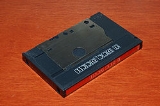
DCC Cassettes were almost identical to analog cassettes, except there were no "bulges" where the tape-access holes were located. The top side of a DCC cassette was flat and there were no access holes for the hubs on the top side (they were not required because auto-reverse was a standard feature on all DCC-cassette players and recorders), so this side could be used for a label. A spring-loaded metal slider similar to the sliders on 3.5 inch floppy diskFloppy disk
A floppy disk is a disk storage medium composed of a disk of thin and flexible magnetic storage medium, sealed in a rectangular plastic carrier lined with fabric that removes dust particles...
s and MiniDiscs covered the tape access holes and locked the hubs while the cassette wasn't in use. Cassettes provided several extra holes and indentations so that DCC recorders could tell a DCC cassette apart from an analog cassette, and so they could tell what the length of a DCC tape was. Also, there was a slider on the DCC to enable and disable recording. Unlike the break-away notches on analog cassettes and VHS tapes, the slider made it easier to make a tape recordable again, and unlike analog cassettes, the slider would protect the entire tape and not just one side.
The cases that DCC cassettes came in generally didn't have the characteristic "folding" mechanism of the old analog cassette (which was hated because it was fragile). Instead, DCC cassette cases tended to be simply plastic boxes that were open on one of the short sides. The front side had a hole that was almost the size of the cassette, so that any label on the cassette would be exposed even when the cassette would be in its case. This allowed the user to slide the cassette in and out of the case with one hand, and it reduced production costs, especially for prerecorded cassettes because a label was needed only for the cassette, not for the case. Format partner Matsushita did however produce blank cassettes (under their Panasonic brand) with a clam-shell style case. Because DCC cassettes had no "bulges" near the tape access holes, there was more space in the case behind the cassette to insert e.g. a booklet for a prerecorded tape, or a folded up card on which users could write the contents of the tape. In spite of the differences, the outside measurements of the standard DCC cases were exactly identical to the cases of analog cassettes, so they could be used in existing storage systems. The Matsushita design clam-shell case was slightly thinner than an analog cassette case
Data recording
There was only one DCC-recorder that had the capability of being connected to, and controlled by a computer: the DCC-175. It was a portable recorder that was developed in Japan (unlike most of the other Philips recorders which were developed in The Netherlands and Belgium), and looked very similar to the other portables available from Philips and Marantz at the time: the DCC-130 (player) and the DCC-170. The DCC-175 was sold only in the Netherlands, and was available separately or in a package with the "PC-link" data cable which could be used to connect the recorder to a printer port of an IBMIBM
International Business Machines Corporation or IBM is an American multinational technology and consulting corporation headquartered in Armonk, New York, United States. IBM manufactures and sells computer hardware and software, and it offers infrastructure, hosting and consulting services in areas...
compatible PC. Only small quantities of both recorder and cable were made, leaving many people searching for one or both at the time of the demise of DCC. The cable contained a couple of custom chips that were made especially for this purpose, which made it impossible for people who owned a DCC-175 but no PC-link cable to make their own. Also, even though the outside of the DCC-170 was similar to the DCC-175, they were radically different on the inside so it wasn't possible to make a 175 out of a 170.
The PC-link cable package included software to use the cable on an IBM-compatible PC, running under Windows 3.1. The software consisted of:
- DCC-Backup for Windows, a backup program
- DCC-Studio, a sound recorder and editor for Windows
- A DCC tape database program that worked together with DCC-Studio
Philips also provided a DOS backup application via their BBS
Bulletin board system
A Bulletin Board System, or BBS, is a computer system running software that allows users to connect and log in to the system using a terminal program. Once logged in, a user can perform functions such as uploading and downloading software and data, reading news and bulletins, and exchanging...
, and later on, they provided an upgrade to the DCC-Studio software to fix some bugs and provide better compatibility with Windows 95 which had come out just before the release of the DCC-175. The software also works with Windows 98 but not with any later versions of Windows.
The backup programs for DOS as well as Windows didn't support long file names. Also, because the tape ran at its usual speed, it took 90 minutes to record approximately 250 Megabytes of uncompressed data. These properties made the backup programs relatively uninteresting for users.
The DCC-Studio application however was a useful application that made it possible to copy audio from tape to hard disk and vice versa, edit track titles on the PC keyboard (so all lower-case and upper-case characters and symbols were available) and write them to tape all at once, edit audio by cutting and pasting fragments, and automatically record mix-tapes. The program was capable of writing the track information to the tape while it was recording the audio, which was a big advantage over the two-step process (record audio first, then edit each track title) which was involved in regular CD-to-DCC recording. Also, because a regular keyboard was used to enter track information, it was possible to enter lower-case characters and symbols that weren't available on stationary recorders.
The DCC-Studio program used the recorder as playback and recording device, it didn't use the PC's sound card (something that not even every PC had in those days). Working with the PASC data without the need to compress and decompress it also saved a lot of hard disk space, and most computers in that time would have a hard time encoding and decoding PASC data in real-time anyway. However, many users complained that they would have liked to have the possibility of using WAV files, and Philips sent registered users a floppy disk
Floppy disk
A floppy disk is a disk storage medium composed of a disk of thin and flexible magnetic storage medium, sealed in a rectangular plastic carrier lined with fabric that removes dust particles...
in the mail, containing programs to convert a WAV file to PASC and vice versa. Unfortunately this conversion was extremely slow but it was later discovered that the PASC files were simply MPEG-1 Audio Layer I
MPEG-1 Audio Layer I
MPEG-1 Audio Layer I, commonly abbreviated to MP1, is one of three audio formats included in the MPEG-1 standard. While supported by most media players, the codec is considered largely outdated, and replaced by MP2 or MP3....
files that used a hardly-used, hardly-documented padding feature from the MPEG standard to make all frames the same length, so it was easy to convert PASC to PCM and vice versa.
Because of the possibility to create new tapes with DCC-Studio, regardless of the source they were recorded from, the DCC-175/PC-Link cable/DCC-Studio combination effectively circumvented the SCMS copy protection scheme that all digital audio recording devices for consumers are supposed to have. It is possible that this raised some eyebrows in Philips' legal department, and that this is the reason why DCC-175 and PC-link were never sold outside the Netherlands.
Derivatives
The technology of using stationary MR heads was later developed by OnStreamOnStream
OnStream Holdings of the Netherlands was spun off from Philips in 1998 and went bankrupt for a second time in 2003.As a result of its first bankruptcy in 2001, the company was split into two parts, OnStream Data and OnStream MST. The "Data" division manufactured magnetic tape products and the...
for use as a data storage media for computers. MR heads are now also commonly used in hard disks, although hard disks use the GMR variant, whereas DCC used the earlier AMR.
A derivative technology developed originally for DCC is now being used for filtering beer. Silicon wafers with micrometer scale holes are ideal for separating yeast particles from beer. The beer flows through the silicon wafer leaving the yeast particles behind, which results in a very clear beer. The manufacturing process for the filters was originally developed for the read/write heads of DCC players.