

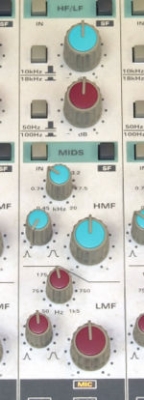
Equalization

Encyclopedia
Equalization, is the process of adjusting the balance between frequency
components within an electronic signal. The most well known use of equalization is in sound recording and reproduction
but there are many other applications in electronics and telecommunications. The circuit or equipment used to achieve equalization is called an equalizer. These devices strengthen (boost) or weaken (cut) the energy of specific frequency bands.
In telecommunications, equalizers are used to render the frequency response
—for instance of a telephone line—flat from end-to-end. When a channel has been "equalized" the frequency domain
attributes of the signal at the input are faithfully reproduced at the output. Telephones, DSL lines and television cables use equalizers to prepare data signals for transmission.
In the field of audio electronics, the term "equalization" has come to include the adjustment of frequency responses for practical or aesthetic reasons, often resulting in a net response that is not truly equalized. The term EQ specifically refers to this variant of the term. Stereos typically have adjustable equalizers which boost or cut bass or treble
frequencies. Broadcast and recording studios use sophisticated equalizers capable of much more detailed adjustments, such as eliminating unwanted sounds or making certain instruments or voices more prominent.
Equalizers are critical to the successful operation of electronic systems such as analog broadcast television
. In this application the actual waveform
of the transmitted signal must be preserved, not just its frequency content. Equalizing filters must cancel out any group delay and phase delay
between different frequency components.
 Although the range of equalization functions is governed by the theory of linear filter
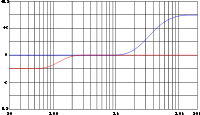
s, the adjustment of those functions and the flexibility with which they can be adjusted varies according to the topology of the circuitry and controls presented to the user. Shelving controls are usually simple first-order filter functions which alter the relative gains between frequencies much higher and much lower than the corner frequencies. A low shelf, such as the bass control on most hi-fi equipment, is adjusted to affect the gain of lower frequencies while having no effect well above its corner frequency. A high shelf, such as a treble control adjusts the gain of higher frequencies only. These are coarse adjustments more designed to increase the listener's satisfaction than providing actual equalization in the strict sense of the term.
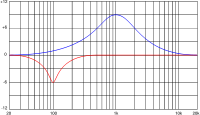
A parametric equalizer, on the other hand, has one or more sections each of which implements a second-order filter
function. This involves three adjustments: selection of the center frequency (in Hz
), adjustment of the Q
which determines the sharpness of the bandwidth, and the level or gain control which determines how much those frequencies are boosted or cut relative to frequencies much above or below the center frequency selected. In a quasi-parametric or semi-parametric equalizer there is no control for the bandwidth (it is preset by the designer) or is only selected between two presets using a switch.
A graphic equalizer also implements second-order filter functions in a more user-friendly manner, but with somewhat less flexibility. This equipment is based on a bank of filters
covering the audio spectrum in up to 30 frequency bands. Each second-order filter has a fixed center frequency and Q
, but an adjustable level. The user can raise or lower each slider in order to visually approximate a "graph" of the intended frequency response.
Variable equalization in audio reproduction was first used by John Volkman
working at RCA
in the 1920s. That system was used to equalize a motion picture theater sound playback system.
Since "equalization" in the context of audio reproduction isn't used strictly to compensate for the deficiency of equipment and transmission channels, the use of high and low pass filters may be mentioned. A high-pass filter
modifies a signal only by eliminating lower frequencies. Thus a low-cut or rumble filter is used to remove infrasonic energy from a program which may consume undue amplifier power and cause excessive excursions in (or even damage to) speakers. A low-pass filter
only modifies the audio signal by removing high frequencies. Thus a high-cut or hiss filter
may be used to remove annoying white noise at the expense of the crispness of the program material.
A first-order low or high pass filter has a standard response curve which reduces the unwanted frequencies well above or below the corner frequency with a slope of 6 dB per octave. A fancier second-order filter will reduce those frequencies with a slope of 12 dB per octave and moreover may be designed with a higher Q or finite zeros in order to effect an even steeper response around the cutoff frequency
. For instance, a second-order low-pass notch filter section only reduces (rather than eliminates) very high frequencies, but has a steep response falling to zero at a specific frequency (the so-called notch frequency). Such a filter might be ideal, for instance, in completely removing the 19 kHz FM stereo subcarrier pilot signal
while helping to cut even higher frequency subcarrier components remaining from the stereo demultiplexer.
In addition to adjusting the relative amplitude of frequency bands, an audio equalizer may alter the relative phase
s of those frequencies. While the human ear is not as sensitive to the phase of audio frequencies (involving delays of less than 1/30 second), music professionals may favor certain equalizers because of how they affect the timbre of the musical content by way of audible phase artifacts.
s. These kinds of equalizers can also be used to produce a circuit with a wider bandwidth than the standard telephone band of 300 Hz to 3.4 kHz. This was particularly useful for broadcasters who needed "music" quality, not "telephone" quality on landlines carrying program material. It is necessary to remove or cancel any loading coil
s in the line before equalization can be successful. Equalization was also applied to correct the response of the transducers, for example, a particular microphone
might be more sensitive to low frequency
sounds than to high frequency sounds, so an equalizer would be used to increase the volume of the higher frequencies (boost), and reduce the volume of the low frequency sounds (cut).
The second issue is that phase equalization is essential for an analog television signal. Without it dispersion causes the loss of integrity of the original waveshape and is seen as smearing of what were originally sharp edges in the picture.
circuits operating in the MHz range on those same wires may suffer severe attenuation distortion
, which is dealt with by automatic equalization or by abandoning the worst frequencies. Picturephone
circuits also had equalizers.
Frequency
Frequency is the number of occurrences of a repeating event per unit time. It is also referred to as temporal frequency.The period is the duration of one cycle in a repeating event, so the period is the reciprocal of the frequency...
components within an electronic signal. The most well known use of equalization is in sound recording and reproduction
Sound recording and reproduction
Sound recording and reproduction is an electrical or mechanical inscription and re-creation of sound waves, such as spoken voice, singing, instrumental music, or sound effects. The two main classes of sound recording technology are analog recording and digital recording...
but there are many other applications in electronics and telecommunications. The circuit or equipment used to achieve equalization is called an equalizer. These devices strengthen (boost) or weaken (cut) the energy of specific frequency bands.
In telecommunications, equalizers are used to render the frequency response
Frequency response
Frequency response is the quantitative measure of the output spectrum of a system or device in response to a stimulus, and is used to characterize the dynamics of the system. It is a measure of magnitude and phase of the output as a function of frequency, in comparison to the input...
—for instance of a telephone line—flat from end-to-end. When a channel has been "equalized" the frequency domain
Frequency domain
In electronics, control systems engineering, and statistics, frequency domain is a term used to describe the domain for analysis of mathematical functions or signals with respect to frequency, rather than time....
attributes of the signal at the input are faithfully reproduced at the output. Telephones, DSL lines and television cables use equalizers to prepare data signals for transmission.
In the field of audio electronics, the term "equalization" has come to include the adjustment of frequency responses for practical or aesthetic reasons, often resulting in a net response that is not truly equalized. The term EQ specifically refers to this variant of the term. Stereos typically have adjustable equalizers which boost or cut bass or treble
Treble (sound)
Treble refers to tones of high frequency or range. In music this corresponds to high notes, and for this reason the treble clef is often used for instruments with higher pitch. Examples of treble sounds are guitar tones, female voice , young boy voice, etc. They have frequencies above 9 KHz. Treble...
frequencies. Broadcast and recording studios use sophisticated equalizers capable of much more detailed adjustments, such as eliminating unwanted sounds or making certain instruments or voices more prominent.
Equalizers are critical to the successful operation of electronic systems such as analog broadcast television
Analog television
Analog television is the analog transmission that involves the broadcasting of encoded analog audio and analog video signal: one in which the message conveyed by the broadcast signal is a function of deliberate variations in the amplitude and/or frequency of the signal...
. In this application the actual waveform
Waveform
Waveform means the shape and form of a signal such as a wave moving in a physical medium or an abstract representation.In many cases the medium in which the wave is being propagated does not permit a direct visual image of the form. In these cases, the term 'waveform' refers to the shape of a graph...
of the transmitted signal must be preserved, not just its frequency content. Equalizing filters must cancel out any group delay and phase delay
Group delay and phase delay
Group delay is a measure of the time delay of the amplitude envelopes of the various sinusoidal components of a signal through a device under test, and is a function of frequency for each component...
between different frequency components.
Audio and music
Linear filter
Linear filters in the time domain process time-varying input signals to produce output signals, subject to the constraint of linearity.This results from systems composed solely of components classified as having a linear response....
s, the adjustment of those functions and the flexibility with which they can be adjusted varies according to the topology of the circuitry and controls presented to the user. Shelving controls are usually simple first-order filter functions which alter the relative gains between frequencies much higher and much lower than the corner frequencies. A low shelf, such as the bass control on most hi-fi equipment, is adjusted to affect the gain of lower frequencies while having no effect well above its corner frequency. A high shelf, such as a treble control adjusts the gain of higher frequencies only. These are coarse adjustments more designed to increase the listener's satisfaction than providing actual equalization in the strict sense of the term.
A parametric equalizer, on the other hand, has one or more sections each of which implements a second-order filter
Linear filter
Linear filters in the time domain process time-varying input signals to produce output signals, subject to the constraint of linearity.This results from systems composed solely of components classified as having a linear response....
function. This involves three adjustments: selection of the center frequency (in Hz
Hertz
The hertz is the SI unit of frequency defined as the number of cycles per second of a periodic phenomenon. One of its most common uses is the description of the sine wave, particularly those used in radio and audio applications....
), adjustment of the Q
Q factor
In physics and engineering the quality factor or Q factor is a dimensionless parameter that describes how under-damped an oscillator or resonator is, or equivalently, characterizes a resonator's bandwidth relative to its center frequency....
which determines the sharpness of the bandwidth, and the level or gain control which determines how much those frequencies are boosted or cut relative to frequencies much above or below the center frequency selected. In a quasi-parametric or semi-parametric equalizer there is no control for the bandwidth (it is preset by the designer) or is only selected between two presets using a switch.
A graphic equalizer also implements second-order filter functions in a more user-friendly manner, but with somewhat less flexibility. This equipment is based on a bank of filters
Filter bank
In signal processing, a filter bank is an array of band-pass filters that separates the input signal into multiple components, each one carrying a single frequency subband of the original signal. One application of a filter bank is a graphic equalizer, which can attenuate the components...
covering the audio spectrum in up to 30 frequency bands. Each second-order filter has a fixed center frequency and Q
Q factor
In physics and engineering the quality factor or Q factor is a dimensionless parameter that describes how under-damped an oscillator or resonator is, or equivalently, characterizes a resonator's bandwidth relative to its center frequency....
, but an adjustable level. The user can raise or lower each slider in order to visually approximate a "graph" of the intended frequency response.
Variable equalization in audio reproduction was first used by John Volkman
John Volkman
John E. Volkman was an American industrial scientist, spent his career at RCA, designing studios and auditoria, and sound reinforcement components....
working at RCA
RCA
RCA Corporation, founded as the Radio Corporation of America, was an American electronics company in existence from 1919 to 1986. The RCA trademark is currently owned by the French conglomerate Technicolor SA through RCA Trademark Management S.A., a company owned by Technicolor...
in the 1920s. That system was used to equalize a motion picture theater sound playback system.
Since "equalization" in the context of audio reproduction isn't used strictly to compensate for the deficiency of equipment and transmission channels, the use of high and low pass filters may be mentioned. A high-pass filter
High-pass filter
A high-pass filter is a device that passes high frequencies and attenuates frequencies lower than its cutoff frequency. A high-pass filter is usually modeled as a linear time-invariant system...
modifies a signal only by eliminating lower frequencies. Thus a low-cut or rumble filter is used to remove infrasonic energy from a program which may consume undue amplifier power and cause excessive excursions in (or even damage to) speakers. A low-pass filter
Low-pass filter
A low-pass filter is an electronic filter that passes low-frequency signals but attenuates signals with frequencies higher than the cutoff frequency. The actual amount of attenuation for each frequency varies from filter to filter. It is sometimes called a high-cut filter, or treble cut filter...
only modifies the audio signal by removing high frequencies. Thus a high-cut or hiss filter
Tape hiss
Tape hiss is the high frequency noise present on analogue magnetic tape recordings caused by the size of the magnetic particles used to make the tape. Effectively it is the noise floor of the recording medium. It can be reduced by the use of finer magnetic particles or by increasing the amount of...
may be used to remove annoying white noise at the expense of the crispness of the program material.
A first-order low or high pass filter has a standard response curve which reduces the unwanted frequencies well above or below the corner frequency with a slope of 6 dB per octave. A fancier second-order filter will reduce those frequencies with a slope of 12 dB per octave and moreover may be designed with a higher Q or finite zeros in order to effect an even steeper response around the cutoff frequency
Cutoff frequency
In physics and electrical engineering, a cutoff frequency, corner frequency, or break frequency is a boundary in a system's frequency response at which energy flowing through the system begins to be reduced rather than passing through.Typically in electronic systems such as filters and...
. For instance, a second-order low-pass notch filter section only reduces (rather than eliminates) very high frequencies, but has a steep response falling to zero at a specific frequency (the so-called notch frequency). Such a filter might be ideal, for instance, in completely removing the 19 kHz FM stereo subcarrier pilot signal
Pilot signal
In telecommunications, a pilot is a signal, usually a single frequency, transmitted over a communications system for supervisory, control, equalization, continuity, synchronization, or reference purposes....
while helping to cut even higher frequency subcarrier components remaining from the stereo demultiplexer.
In addition to adjusting the relative amplitude of frequency bands, an audio equalizer may alter the relative phase
Phase (waves)
Phase in waves is the fraction of a wave cycle which has elapsed relative to an arbitrary point.-Formula:The phase of an oscillation or wave refers to a sinusoidal function such as the following:...
s of those frequencies. While the human ear is not as sensitive to the phase of audio frequencies (involving delays of less than 1/30 second), music professionals may favor certain equalizers because of how they affect the timbre of the musical content by way of audible phase artifacts.
Audio lines
Early telephone systems used equalization to correct for the reduced level of high frequencies in long cables, typically using Zobel networkZobel network
Zobel networks are a type of filter section based on the image impedance design principle. They are named after Otto Zobel of Bell Labs who published a much referenced paper on image filters in 1923. The distinguishing feature of Zobel networks is that the input impedance is fixed in the design...
s. These kinds of equalizers can also be used to produce a circuit with a wider bandwidth than the standard telephone band of 300 Hz to 3.4 kHz. This was particularly useful for broadcasters who needed "music" quality, not "telephone" quality on landlines carrying program material. It is necessary to remove or cancel any loading coil
Loading coil
In electronics, a loading coil or load coil is a coil that does not provide coupling to any other circuit, but is inserted in a circuit to increase its inductance. The need was discovered by Oliver Heaviside in studying the disappointing slow speed of the Transatlantic telegraph cable...
s in the line before equalization can be successful. Equalization was also applied to correct the response of the transducers, for example, a particular microphone
Microphone
A microphone is an acoustic-to-electric transducer or sensor that converts sound into an electrical signal. In 1877, Emile Berliner invented the first microphone used as a telephone voice transmitter...
might be more sensitive to low frequency
Frequency
Frequency is the number of occurrences of a repeating event per unit time. It is also referred to as temporal frequency.The period is the duration of one cycle in a repeating event, so the period is the reciprocal of the frequency...
sounds than to high frequency sounds, so an equalizer would be used to increase the volume of the higher frequencies (boost), and reduce the volume of the low frequency sounds (cut).
Television lines
A similar approach to audio was taken with television landlines with two important additional complications. The first of these is that the television signal is a wide bandwidth covering many more octaves than an audio signal. A television equalizer consequently typically requires more filter sections than an audio equalizer. To keep this manageable, television equalizer sections were often combined into a single network using ladder topology to form a Cauer equalizer.The second issue is that phase equalization is essential for an analog television signal. Without it dispersion causes the loss of integrity of the original waveshape and is seen as smearing of what were originally sharp edges in the picture.
Digital telecommunications
Modern digital telephone systems have less trouble in the voice frequency range as only the local line to the subscriber now remains in analog format, but DSLDigital Subscriber Line
Digital subscriber line is a family of technologies that provides digital data transmission over the wires of a local telephone network. DSL originally stood for digital subscriber loop. In telecommunications marketing, the term DSL is widely understood to mean Asymmetric Digital Subscriber Line ,...
circuits operating in the MHz range on those same wires may suffer severe attenuation distortion
Attenuation Distortion
Attenuation distortion is the distortion of an analog signal that occurs during transmission when the transmission medium does not have a flat frequency response across the bandwidth of the medium or the frequency spectrum of the signal....
, which is dealt with by automatic equalization or by abandoning the worst frequencies. Picturephone
Videophone
A videophone is a telephone with a video screen, and is capable of full duplex video and audio transmissions for communication between people in real-time...
circuits also had equalizers.
See also
- Blind equalizationBlind equalizationBlind equalization is a digital signal processing technique in which the transmitted signal is inferred from the received signal, while making use only of the transmitted signal statistics. Hence, the use of the word blind in the name....
- Electronic filterElectronic filterElectronic filters are electronic circuits which perform signal processing functions, specifically to remove unwanted frequency components from the signal, to enhance wanted ones, or both...
- Adaptive equalizerAdaptive equalizerAn adaptive equalizer is an equalizer that automatically adapts to time-varying properties of the communication channel. It is frequently used with coherent modulations such as phase shift keying, mitigating the effects of multipath propagation and Doppler spreading.Many adaptation strategies exist...
- Loudness compensationLoudness compensationLoudness compensation is a setting found on some hi-fi equipment and equalisers that increases the level of the high and low frequencies. This is intended to be used at low listening levels, to compensate for the fact that as the volume of audio decreases, the ear's lower sensitivity to extreme...
- Weighting filterWeighting filterA weighting filter is used to emphasise or suppress some aspects of a phenomenon compared to others, for measurement or other purposes.- Audio applications :...
 to quality factor
  and back