
In Depth
See Also

Floppy disk

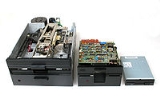
A floppy disk is a data storage device Data storage device

In computing [i], a data storage device—as the name implies—is a device for storing [i] ... 

 that is composed of a disk of thin, flexible magnetic storage medium encased in a square or rectangular Rectangle

In geometry [i], a rectangle is defined as a quadrilateral [i] where all four of its angles are right angle [i] ... 

 plastic Plastic

Plastic covers a range of synthetic or semisynthetic polymerization [i] products. ... 

 shell. Floppy disks are read and written by a floppy disk drive or FDD, the latter initialism not to be confused with "fixed disk drive", which is an old IBM IBM

company_name = International Business Machines Corporation | ... 

 term for a hard disk drive Hard disk

A hard disk drive is a digitally encoded non-volatile storage [i] device which stores data on the magnetic [i] ... 

.

Discussions

  Discussion Features

   Ask a question about 'Floppy disk'

   Start a new discussion about 'Floppy disk'

   Answer questions about 'Floppy disk'

   'Floppy disk' discussion forum


Encyclopedia


A floppy disk is a data storage device Data storage device

In computing [i], a data storage device—as the name implies—is a device for storing [i] ... 

 that is composed of a disk of thin, flexible magnetic storage medium encased in a square or rectangular Rectangle

In geometry [i], a rectangle is defined as a quadrilateral [i] where all four of its angles are right angle [i] ... 

 plastic Plastic

Plastic covers a range of synthetic or semisynthetic polymerization [i] products. ... 

 shell. Floppy disks are read and written by a floppy disk drive or FDD, the latter initialism not to be confused with "fixed disk drive", which is an old IBM IBM

company_name = International Business Machines Corporation |
... 

 term for a hard disk drive Hard disk

A hard disk drive is a digitally encoded non-volatile storage [i] device which stores data on the magnetic [i] ... 

.

Background

Floppy disks, also known as floppies or diskettes , were ubiquitous in the 1980s and 1990s, being used on home Home computer

The home computer is a consumer-friendly word for the second generation of microcomputer [i]s , entering ... 

 and personal computer Personal computer

A personal computer is usually a microcomputer [i] whose price, size, and capabilities make it suitable ... 

  platforms such as the Apple II Apple II series

The Apple II was the first popular microcomputer [i] manufactured by Apple Computer [i]. ... 

, Macintosh Macintosh

The Macintosh, or Mac, is a line of personal computer [i]s designed, developed, manufactured, and ... 

, Commodore 64 Commodore 64

The Commodore 64 personal computer, released in August 1982, became the best selling single computer mod... 

, Amiga Amiga

The Amiga is a family of home [i]/personal computer [i]s originally developed by Amiga Corporation [i] ... 

, and IBM PC IBM PC

The IBM PC , was the original version and progenitor of the IBM PC compatible [i] hardware platform [i] ... 

 to distribute software, transfer data between computers, and create small backups. Before the popularization of the hard drive for PCs, floppy disks were often used to store a computer's operating system Operating system

An operating system is a software program [i] that manages the hardware [i] and software [i] ... 

, application software Application software

Application software is a defined subclass of computer software [i] that employs the capabilities of a c ... 

, and other data. Many home computers had their primary OS kernels stored permanently in on-board ROM Read-only memory

Read-only memory is a class of storage media used in computer [i]s and other electronic devices. ... 

 chips, but stored the disk operating system on a floppy, whether it be a proprietary system, CP/M CP/M

[i] and [[Zilog Z80]... 

, or, later, DOS DOS

DOS commonly refers to the family of closely related operating system [i]s which dominated the IBM PC compatible [i] ... 

.

By the early 1990s, the increasing size of software meant that many programs were distributed on sets of floppies. Toward the end of the 1990s, software distribution gradually switched to CD-ROM CD-ROM

CD-ROM is a compact disc that contains data accessible by a computer.... 

, and higher-density backup formats were introduced . With the arrival of mass Internet Internet

The Internet is the worldwide, publicly accessible network of interconnected computer network [i]s that ... 

 access, cheap Ethernet Ethernet

Ethernet is a large and diverse family of frame [i]-based computer networking [i] ... 

 and USB keys USB flash drive

USB flash drives are NAND [i]-type flash memory [i] data storage device [i]s ... 

, the floppy was no longer necessary for data transfer either, and the floppy disk was essentially superseded. Mass backups were now made to high capacity tape drive Magnetic tape

Magnetic tape is a non-volatile [i] storage medium [i] consisting of a magnetic coa ... 

s such as DAT Digital Audio Tape

[Image:WrapGun.png|thumb|Electrical wire wrap tool.]] [i]Wire wrap is a technique for constructing small num... 

 or streamers, or written to CD Compact Disc

Cheddar is a village in the district of Sedgemoor [i] in Somerset [i], England [i], situated on the edge ... 

s or DVD DVD

DVD is an optical disc [i] storage [i] media format that can be used for data storage, ... 

s. One financially unsuccessful attempt in the late 1990s to continue the floppy was the SuperDisk , with a capacity of 120 MB , while the drive was backward compatible with standard 3½-inch floppies.

Nonetheless, manufacturers were reluctant to remove the floppy drive from their PCs, for backward compatibility, and because many companies' IT Information technology

Information Technology is a broad subject concerned with the use of technology [i] in managing and processing information [i] ... 

 departments appreciated a built-in file transfer mechanism that always worked and required no device driver Device driver

A device driver, or a software driver is a specific type of computer software [i], typically devel ... 

 to operate properly. Apple Computer Apple Computer

Apple Computer, Inc. is an American [i] computer [i] technology [i] corporation [i] with ... 

 was the first mass-market computer manufacturer to drop the floppy drive from a computer model altogether with the release of their iMac IMac

The iMac is a desktop computer designed and built by Apple Computer [i]. ... 

 model in 1998, and Dell Dell

Dell Inc., an American [i] computer-hardware [i] company based in Round Rock [i] ... 

 made the floppy drive optional in some models starting in 2003. To date, however, these moves have still not marked the end of the floppy disk as a mainstream means of data storage and exchange.

External USB Universal Serial Bus

Universal Serial Bus is a serial [i] bus [i] standard to interface [i] ... 

-based floppy disk drives are available for computers without floppy drives, and they work on any machine that supports USB.

Floppy disk sizes are almost universally referred to in imperial measurement Imperial unit

The Imperial units or the Imperial system is a collection [i] of English unit [i]s ... 

s, even in countries where metric is the standard, and even when the size is in fact defined in metric . Formatted capacities are generally set in terms of binary kilobytes . However, recent sizes of floppy are often referred to in a strange hybrid unit, i.e. a "1.44 megabyte" floppy is 1.44×1000×1024 bytes, not 1.44×1024×1024 bytes nor 1.44×1000×1000.

Historical sequence of floppy disk formats, including the last format to be generally adopted — the "1.44 MB" 3½-inch HD floppy, introduced 1987.
Floppy disk formatYear introducedFormatted
Storage capacity
Marketed
capacity¹
8-inch - IBM 23FD196981.664 kilobytes?
8-inch - 1972175.000 kilobytes1.5 megabits unformatted
8-inch - SSSD

IBM 33FD / Shugart 901
1973256.256 kilobytes3.1 megabits unformatted
8-inch - DSSD

IBM 43FD / Shugart 850
1976512.512 kilobytes6.2 megabits unformatted
5¼-inch197689.6110 kB
8-inch DSDD

IBM 53FD / Shugart 850
197712001.2 MB
5¼-inch DD1978360360 kB
3½-inch
HP single sided
1982280264 kB
3-inch1982360?
3½-inch1984720720 kB
5¼-inch QD198412001.2 MB
3-inch DD1984720?
3-inch
Mitsumi Quick Disk
1985128 to 256?
2-inch1985720?
5¼-inch Perpendicular1986100 MiB?
3½-inch HD198714401.44 MB
3½-inch ED199128802.88 MB
3½-inch LS-1201996120.375 MiB120 MB
3½-inch LS-2401997240.75 MiB240 MB
3½-inch HiFD1998/99150/200 MiB 150/200 MB
Acronyms:  DD = Double Density; QD = Quad Density; HD = High Density ED = Extended Density; LS = Laser Servo; HiFD = High capacity Floppy Disk

SS = Single Sided; DS = Double Sided
¹The formatted capacities of floppy disks frequently corresponded only vaguely to their capacities as marketed by drive and media companies, primarily due to differences between formatted and unformatted capacities and also due to the non-standard use of binary prefixes in labeling and advertising floppy media. The 1.44 MB value for the 3½-inch HD floppies is the most widely known example. See reported storage capacity.
Dates and capacities marked ? are of unclear origin and need source information; other listed capacities refer to:

Formatted Storage Capacity is total size of all sectors on the disk:
  • For 8-inch see Table of 8-inch floppy formats IBM 8" formats. Note that spare, hidden and otherwise reserved sectors are included in this number.
  • For 5¼- and 3½-inch capacities quoted are from subsystem or system vendor statements.

Marketed Capacity is the capacity, typically unformatted, by the original media OEM vendor or in the case of IBM media, the first OEM thereafter.
Other formats may get more or less capacity from the same drives and disks.

History


Origins, the 8-inch disk


In 1967 IBM IBM

company_name = International Business Machines Corporation |
... 

 gave their San Jose, California San Jose, California

Palo Alto is a city in Santa Clara County [i], in the San Francisco Bay Area [i] ... 

 storage development center a new task: develop a simple and inexpensive system for loading microcode into their System/370 System/370

The System/370 is a model range of IBM mainframe [i]s announced on June 30 [i], 1970 [i] as the successo ... 

 mainframe IBM mainframe

An IBM mainframe is a mainframe computer [i] made by IBM [i]. ... 

s. The 370s were the first IBM machines to use semiconductor memory, and whenever the power was turned off the microcode had to be reloaded . Normally this task would be left to various tape drive Tape drive

A tape drive, also known as a streamer, is a data storage device [i] that reads ... 

s which almost all 370 systems included, but tapes were large and slow. IBM wanted something faster and more purpose-built that could also be used to send out updates to customers for $5.

David Noble, working under the direction of Alan Shugart, tried a number of existing solutions to see if he could develop a new-style tape for the purpose, but eventually gave up and started over. The result was a read-only Read-only memory

Read-only memory is a class of storage media used in computer [i]s and other electronic devices. ... 

, 8-inch floppy they called the "memory disk", holding 80 kilobytes. The original versions were simply the disk itself, but dirt became a serious problem and they enclosed it in a plastic envelope lined with fabric that would pick up the dirt. The new device, developed under the code name Minnow, became a standard part of the 370 in 1969.

A Japan Japan

is an island country [i] in East Asia [i]. ... 

ese inventor, Yoshiro Nakamatsu , claims he independently came up with the floppy disk principle back in 1950, and so a sales license had to be acquired by IBM when they started manufacturing their floppy disk systems.

Alan Shugart left IBM, moved to Memorex Memorex

Established in 1961 in Silicon Valley [i], Memorex is today a consumer electronics brand of Imation [i] ... 

 where his team in 1972 shipped the Memorex 650, the first read-write floppy disk drive.

In 1973 IBM released a new version of the floppy, this time on the 3740 Data Entry System. The new system used a different recording format that stored up to 250¼ kB on the same disks, and was read-write. These drives became common, and soon were being used to move smaller amounts of data around, almost completely replacing magnetic tape Magnetic tape

Magnetic tape is a non-volatile [i] storage medium [i] consisting of a magnetic coa ... 

s.

The IBM standard soft-sectored disk format was designed to hold just as much data as one box of punch cards Punch card

The punch card is an obsolescent [i] recording medium [i] for digital information for use by automated ... 

. The disk was divided into 77 tracks of 26 sectors, each holding 128 bytes. Note that 77×26 = 2002 sectors, whereas a box of punch cards held 2000 cards.

When the first microcomputer Microcomputer

Although there is no rigid definition, a microcomputer is most often taken to mean a computer [i] with ... 

s were being developed in the 1970s, the 8-inch floppy found a place on them as one of the few "high speed, mass storage" devices that were even remotely affordable to the target market . The first microcomputer operating system, CP/M CP/M

[i] and [[Zilog Z80]... 

, originally shipped on 8-inch disks. However, the drives were still expensive, typically costing more than the computer they were attached to in early days, so most machines of the era used cassette tape Compact Cassette

Sweden Democrats , founded in 1988 [i] by Leif Zeilon [i], is a Swedish [i] far right [i] politic ... 

 instead.

This began to change with the acceptance of the first standard for the floppy disk, ECMA-59, authored by Jim O'Reilly of Burroughs Burroughs

The Burroughs Corporation began in 1886 as the American Arithmometer Company in St. Louis, Missouri [i]... 

, Helmuth Hack of BASF BASF

BASF may also historically refer to EMTEC [i], which was known as BASF for a short time after its founding.' ... 

 and others. O'Reilly set a record for maneuvering this document through ECMA's approval process, with the standard sub-committee being formed in one meeting of ECMA and approval of a draft standard in the next meeting three months later. This standard later formed the basis for the ANSI standard too. Standardization brought together a variety of competitors to make media to a single interchangeable standard, and allowed rapid quality and cost improvement.

Shugart moved on in 1973 to found Shugart Associates Shugart Associates

Shugart Associates was a computer peripheral [i] manufacturer that dominated the floppy disk drive [i] m ... 

. They started working on improvements to the existing 8-inch format, eventually creating a new 800 kB system. However, profits were hard to find, and in 1974 he was forced out of his own company.

Burroughs Corporation, meanwhile, was developing a high-performance dual-sided 8-inch drive at their Glenrothes, Scotland factory. With a capacity of 1 MB , this unit exceeded IBM's drive capacity by 4 times, and was able to provide enough space to run all the software and store data on the new Burrough's B80 data entry system, which incidentally had the first VLSI disk controller in the industry. The dual-sided 1MB floppy entered production in 1975, but was plagued by an industry problem, poor media quality. There were few tools available to test media for 'bit-shift' on the inner tracks, which made for high error rates, and the result was a substantial investment by Burroughs in a media tester design that they then gave to media makers as a quality control tool, leading to a vast improvement in yields.

The 5¼-inch minifloppy


In 1975, Burroughs' plant in Glenrothes developed a prototype 5¼-inch drive, stimulated both by the need to overcome the larger 8-inch floppy's asymmetric expansion properties with changing humidity, and to reflect the knowledge that IBM's audio recording products division was demonstrating a dictation machine using 5¼-inch disks. In one of the industry's historic gaffes, Burroughs corporate management decided it would be "too inexpensive" to make enough money, and shelved the program.

In 1976 two of Shugart Associates Shugart Associates

Shugart Associates was a computer peripheral [i] manufacturer that dominated the floppy disk drive [i] m ... 

's employees, Jim Adkisson and Don Massaro, were approached by An Wang of Wang Laboratories Wang Laboratories

egory:Programmable calculators]] [i]
... 

, who felt that the 8-inch format was simply too large for the desktop word processing machines he was developing at the time. After meeting in a bar in Boston, Adkisson asked Wang what size he thought the disks should be, and Wang pointed to a napkin and said "about that size". Adkisson took the napkin back to California, found it to be 5¼-inches wide, and developed a new drive of this size storing 98.5 kB later increased to 110 kB by adding 5 tracks. This is believed to be the first standard computer media that was not promulgated by IBM.

The 5¼-inch drive was considerably less expensive than 8-inch drives from IBM, and soon started appearing on CP/M machines. At one point Shugart was producing 4,000 drives a day. By 1978 there were more than 10 manufacturers producing 5¼-inch floppy drives, in competing physical disk formats: hard-sectored and soft-sectored . The 5¼-inch formats quickly displaced the 8-inch from most applications, and the 5¼-inch hard-sectored disk format eventually disappeared. These early drives read only one side of the disk, leading to the popular budget approach of cutting a second write-enable slot and index hole into the carrier envelope and flipping it over to use the other side for additional storage.


Tandon introduced a double-sided drive in 1978, doubling the capacity, and a new "double density" format increased it again, to 360 kB.

For most of the 1970s and 1980s the floppy drive was the primary storage device for microcomputer Microcomputer

Although there is no rigid definition, a microcomputer is most often taken to mean a computer [i] with ... 

s. Since these micros had no hard drive, the OS was usually booted from one floppy disk, which was then removed and replaced by another one containing the application. Some machines using two disk drives allowed the user to leave the OS disk in place and simply change the application disks as needed. In the early 1980s, 96 track-per-inch drives appeared, increasing the capacity from 360 to 720 kB. These did not see widespread use, as they were not supported by IBM in its PCs.


Despite the available capacity of the disks, support on the most popular operating system of the early 80's—PC-DOS PC-DOS

IBM PC-DOS was one of three major operating system [i]s that dominated the personal computer market from... 

 and MS-DOS MS-DOS

MS-DOS is an operating system [i] commercialized by Microsoft [i]. ... 

—lagged slightly behind. In fact, the original IBM PC did not include a floppy drive at all as standard equipment—you could either buy the optional 5¼-inch floppy drive or rely upon the cassette port. With version 1.0 of DOS only single sided 160 kB floppies were supported. Version 1.1 the next year saw support expand to double-sided, 320 kB disks. Finally in 1983 DOS 2.0 supported 9 sectors per track rather than 8, for a total of 360 kB of disk space. Along with this change came support for different directories on the disk , which came in handy when organizing the greater number of files possible in this increased space.

In 1984, along with the IBM PC/AT IBM Personal Computer/AT

The IBM Personal Computer/AT, more commonly known as the IBM AT and also sometimes called the P... 

, the quad density disk appeared, which used 96 tracks per inch combined with a higher density magnetic media to provide 1200 kiB of storage . Since the usual hard disk Hard disk

A hard disk drive is a digitally encoded non-volatile storage [i] device which stores data on the magnetic [i] ... 

 held 10–20 megabytes at the time, this was considered quite spacious.

By the end of the 1980s, the 5¼-inch disks had been superseded by the 3½-inch disks. Though 5¼-inch drives were still available, as were disks, they faded in popularity as the 1990s began. The main community of users was primarily those who still owned '80s legacy machines running MS-DOS MS-DOS

MS-DOS is an operating system [i] commercialized by Microsoft [i]. ... 

 that had no 3½-inch drive; the advent of Windows 95  and subsequent phaseout of standalone MS-DOS with version 6.22 forced many of them to upgrade their hardware. On most new computers the 5¼-inch drives were optional equipment. By the mid-1990s the drives had virtually disappeared as the 3½-inch disk became the preeminent floppy disk.

New formats, no standard


Throughout the early 1980s the limitations of the 5¼-inch format were starting to become clear. Originally designed to be a smaller and more practical 8-inch, the 5¼-inch system was itself too large, and as the quality of the recording media grew, the same amount of data could be placed on a smaller surface. Another problem was that the 5¼-inch disks were simply copies of the 8-inch physical format, which had never really been engineered for ease of use. The thin folded-plastic shell allowed the disk to be easily damaged through bending, and allowed dirt to get onto the disk surface through the opening.

A number of solutions were developed, with drives at 2-inch, 2½-inch, 3-inch and 3½-inch all being offered by various companies. They all shared a number of advantages over the older format, including a small form factor and a rigid case with a slideable write protect Write protection

IBM]] [i] 1/2 inch [i] magnetic tape [i] reels, introduced in the 1950s [i], had a circular groove on one side of ... 

 catch. The almost-universal use of the 5¼-inch format made it very difficult for any of these new formats to gain any significant market share.

Standard 3-inch and 3½-inch disks used the same spin speed and basic hardware interface as standard 5¼-inch drives, allowing them to be used with existing controllers and formats, although new formats were later developed that relied on the higher quality hardware in the new drive types .
The 3-inch compact floppy disk


Amdek released the AmDisk-3 Micro-Floppy-disk cartridge system in December 1982. Originally designed for use with the Apple II Apple II series

The Apple II was the first popular microcomputer [i] manufactured by Apple Computer [i]. ... 

 Disk II Disk II

The Disk II was a 5¼-inch floppy disk drive [i] designed by Steve Wozniak [i] and manufactur ... 

 interface card, it has also been connected to other computers successfully.

The drive itself was originally designed by Hitachi Hitachi, Ltd.

is a Japan [i]ese global company headquartered in Marunouchi Itchome, Chiyoda [i], Tokyo [i], ... 

, Matsushita Matsushita Electric Industrial Co.

is a Japan [i]ese electronics [i] manufacturer based in Kadoma [i], Osaka prefecture [i], Japan [i] ... 

 and Maxell Maxell

, or Maxell, is a Japanese [i] company [i] which manufactures consumer electronics [i].... 

. Only Teac Teac

TEAC Corporation is an electronics company based in Japan [i]. ... 

 outside this "network" is known to have produced drives. Similarly, only three manufacturers of media are known , but "no-name" disks with questionable quality have been seen in the wild.

Amstrad Amstrad

Amstrad is a manufacturer of electronics [i] based in Brentwood [i] in Essex [i], England [i]... 

 incorporated a 3-inch single-sided drive into their CPC Amstrad CPC

[i] during the [[1980s]... 

 and PCW Amstrad PCW

The Amstrad PCW series was British [i] company Amstrad [i]'s versatile line of home/perso ... 

 lines, and this format and the drive mechanism was later "inherited" by the ZX Spectrum +3 ZX Spectrum

The Sinclair [i] ZX Spectrum was a home computer [i] released in the United Kingdom [i] i ... 

 computer after Amstrad bought Sinclair Sinclair Research Ltd

Sinclair Research Ltd is a consumer electronics company founded by Sir Clive Sinclair [i] in Cambridge [i]... 

. Later models of the PCW featured double-sided, double density drives.

While all 3-inch media were double-sided in nature, single-sided drive owners were able to flip the disk over to use the other side. The sides were termed "A" and "B" and were completely independent, but single-sided drive units could only access the upper side at one time.

The disk format itself had no more capacity than the more popular 5¼-inch floppies. Each side held 180 kiB for a total of 360 kiB per disk, and later 720 kiB for the PCW range. Unlike 5¼-inch or 3½-inch disks, the 3-inch disks were designed to be reversible and sported two independent write-protect switches. It was also more reliable thanks to its hard casing .

3-inch drives were also used on a number of exotic and obscure CP/M systems such as the Tatung Einstein and occasionally on MSX MSX

MSX was the name of a standardized home computer [i] architecture in the 1980s [i]. ... 

 systems in some regions. Other computers to have used this format are the more unknown Gavilan Mobile Computer and Matsushita's National Mybrain 3000. The Yamaha MDR-1 Yamaha MDR-1

The Yamaha Music Disc Recorder MDR-1 was a floppy disk [i] unit which could be attached to the FX/FS org ... 

 also used 3-inch drives.

Not a bad format in its own right, but the main problems were the high prices, due to the quite elaborate and complex case mechanisms. However, the tip on the weight was when Sony Sony

is a Japanese [i] multinational corporation [i] and one of the world's largest media conglomerate [i]s.... 

 in 1984 convinced Apple Computer to use the 3½-inch drives in the Macintosh 128K model, effectively making it a de-facto standard.
Mitsumi's "Quick Disk" 3-inch floppies


Another 3-inch format was Mitsumi's Quick Disk format. The Quick Disk Quick Disk

Sorry, no overview for this topic 

 format is referred to in various size references: 2.8-inch, 3-inch×3-inch and 3-inch×4-inch. Confusing when trying to categorize the disk but perhaps not when understood that Mitsumi offered this as OEM equipment, expecting their VAR customers to customize the packaging for their own particular use. Nintendo packaged the 2.8-inch magnetic media in a 3-inch×4-inch housing, while others packaged the same media in a 3?×3? housing. This explains the different numbering labels, while here we generically call the Mitsumi Quick Disk a 3-inch format.

The Quick Disk's most successful use was in Nintendo's Famicom Disk System Famicom Disk System

The was released on February 21 [i], 1986 [i] by Nintendo [i] as a peripheral to their overwhelmingly popula ... 

. The FDS package of Mitsumi's Quick Disk used a 3-inch×4-inch plastic housing called the "Disk System Card". Most FDS disks did not have cover protection to prevent media contamination, but a later special series of five games did include a protective shutter.

Mitsumi's "3-inch" Quick Disk media was also used in a 3-inch×3-inch housing for many Smith Corona word processors. The Smith Corona disks are confusingly labeled "DataDisk 2.8 inch", presumably referring to the size of the media inside the hard plastic case.

The Quick Disk was also used in several MIDI keyboards and MIDI samplers of the mid 1980s. A non-inclusive list includes: the Roland S-10 and MT-100 samplers, the Korg SQD8 MIDI Musical Instrument Digital Interface

Musical Instrument Digital Interface, or MIDI, is an industry-standard electronic communications protocol [i] ... 

 sequencer, Akai's 1985 model MD280 drive for the S-612 MIDI Musical Instrument Digital Interface

Musical Instrument Digital Interface, or MIDI, is an industry-standard electronic communications protocol [i] ... 

 Sampler, Akai's X7000 and X3700, the Roland S-220, and the Yamaha MDF1 MIDI Musical Instrument Digital Interface

Musical Instrument Digital Interface, or MIDI, is an industry-standard electronic communications protocol [i] ... 

 disk drive .

As the cost in the 1980s to add 5.25-inch drives was still quite high, the Mitsumi Quick Disk was competing as a lower cost alternative packaged in several now obscure 8-bit computer systems. Another non-inclusive list of Quick Disk versions: QDM-01, in the Casio QD-7 drive, in a peripheral for the Sharp MZ-700 & MZ-800 system, in the DPQ-280 Quickdisk for the Daewoo/Dynadata MSX1 DPC-200, in a Dragon machine, in the Crescent Quick Disk 128, 128i and 256 peripherals for the ZX Spectrum, and in the Triton Quick Disk peripherial also for the ZX Spectrum and ZX Spectrum. reveals that the drives did come in different sizes: 128 to 256 kB in Cresent's incarnation, and in the Triton system, with a density of 4410 bpi, data transmission rate of 101.6 kb/s, a 2.8-inch double sided disk type and a capacity of up to 20 sectors per side at 2.5 kB per sector, up to 100 kB per disk. Elsewhere it has been reported that a Quick Disk holds 64 kB of data per side, requiring a manual turn-over to access the second side.

It is significant to note that the Quick Disk utilizes "a continuous linear tracking of the head and thus creates a single spiral track along the disk similar to a record groove."

The 3½-inch microfloppy diskette


Sony Sony

is a Japanese [i] multinational corporation [i] and one of the world's largest media conglomerate [i]s.... 

 introduced their own small-format 90.0 × 94.0 mm disk, similar to the others but somewhat simpler in construction than the AmDisk. The first computer to use this format was the HP-150 HP-150

The HP-150, a "compact, powerful and innovative" computer made by Hewlett-Packard [i] in 1983 and based ... 

 of 1983, and Sony also used them fairly widely on their line of MSX MSX

MSX was the name of a standardized home computer [i] architecture in the 1980s [i]. ... 

 computers. Other than this the format suffered from a similar fate as the other new formats; the 5¼-inch format simply had too much market share. Things changed dramatically in 1984 when Apple Computer selected the format for their new Macintosh Macintosh

The Macintosh, or Mac, is a line of personal computer [i]s designed, developed, manufactured, and ... 

 computers. By 1988 the 3½-inch was outselling the 5¼-inch.

The 3½-inch disks had, by way of their rigid case's slide-in-place metal cover, the significant advantage of being much better protected against unintended physical contact with the disk surface than 5¼-inch disks when the disk was handled outside the disk drive. When the disk was inserted, a part inside the drive moved the metal cover aside, giving the drive's read/write heads the necessary access to the magnetic recording surfaces. Adding the slide mechanism resulted in a slight departure from the previous square outline. The irregular, rectangular shape had the additional merit that it made it impossible to insert the disk sideways by mistake as had indeed been possible with earlier formats.

The shutter mechanism was not without its problems, however. On old or roughly treated disks the shutter could bend away from the disk. This made it vulnerable to being ripped off completely , or worse, catching inside a drive and possibly either getting stuck inside or damaging the drive. On disks with the cover bending away the best option is to rip the cover off and then immediately copy the data off it. Most modern floppies have a springy plastic cover that does not tend to bend away from the disk.

Like the 5¼-inch, the 3½-inch disk underwent an evolution of its own. When Apple introduced the Macintosh in 1984, it used single-sided 3½-inch disk drives with an advertised capacity of 400 kB. The encoding technique used by these drives was known as GCR, or Group Code Recording. Somewhat later, PC-compatible machines began using single-sided 3½-inch disks with an advertised capacity of 360 kB , and a different, incompatible recording format called MFM . GCR and MFM drives were incompatible, although the physical disks were the same. In 1986, Apple introduced double-sided, 800 kB disks, still using GCR, and around the same time, 720 kB double-sided double-density MFM disks began to appear on PC-compatibles.

A newer "high-density" format, displayed as "HD" on the disks themselves and storing 1440 kB of data, was introduced in 1987. These HD disks had an extra hole in the case on the opposite side of the write-protect notch. IBM used this format on their PS/2 IBM Personal System/2

The Personal System/2 or PS/2 was IBM [i]'s second generation of personal computer [i]s. ... 

 series introduced in 1987. Apple started using "HD" in 1988, on the Macintosh IIx, and the HD floppy drive soon became universal on virtually all Macintosh and PC hardware. Apple's HD drive was capable of reading and writing both GCR and MFM formatted disks, and thus made it relatively easy to exchange files with PC users. Apple marketed this drive as the "SuperDrive." Interestingly, Apple began using the SuperDrive brand name again around 2003 to denote their all-formats CD/DVD reader/writer.

Another advance in the oxide coatings allowed for a new "extended-density" format at 2880 kB introduced on the second generation NeXT Computer NeXT

NeXT was a computer [i] company headquartered in Redwood City [i], California [i] ... 

s in 1991, and on IBM PS/2 model 57 also in 1991, but by the time it was available it was already too small in capacity to be a useful advance over the HD format and never became widely used. The 3½-inch drives sold more than a decade later still use the same 1.44 MB HD format that was standardized in 1989, in ISO 9529-1,2.
Reported 3.5" DSHD FDD storage capacity

The unformatted capacity of 3½-inch double sided high density floppy disk is 2.0 megabytes; in its most common format it has a capacity of 1,474,560 bytes or 1.47 MB . In the binary prefix numbering system this is 1.41 MiB.

Neither of these numbers is generally used; number most frequently printed on these floppies is 1.44 MB. This value was apparently reached by doubling the capacity of the prior generation 720 "KB" [actually KiB] double sided double density floppy disk and dividing by 1,000, to arrive at 1.44 kiloKibi bytes and mis-labeling such as "MB". A person expecting the 1.44 "MB" number to be either binary prefix or decimal would always miscalculate the number of floppies needed.

Floppy Replacements


Through the early 1990s a number of attempts were made by various companies to introduce newer floppy-like formats based on the now-universal 3½-inch physical format. Most of these systems provided the ability to read and write standard DD and HD disks, while at the same time introducing a much higher-capacity format as well. There were a number of times where it was felt that the existing floppy was just about to be replaced by one of these newer devices, but a variety of problems ensured this never took place. None of these ever reached the point where it could be assumed that every current PC would have one, and they have now largely been replaced by CD CD-R

A CD-R is a variation of the Compact Disc [i] digital audio disc invented by Philips [i] and Sony [i]. ... 

 and DVD DVD

DVD is an optical disc [i] storage [i] media format that can be used for data storage, ... 

 burners and USB flash drive USB flash drive

USB flash drives are NAND [i]-type flash memory [i] data storage device [i]s ... 

s.

The main technological change was the addition of tracking information on the disk surface to allow the read/write heads to be positioned more accurately. Normal disks have no such information, so the drives use the tracks themselves with a feedback loop Feedback loop

A feedback loop is a system where outputs are fed back into the system as inputs, increasing or decreasi... 

 in order to center themselves. The newer systems generally used marks burned onto the surface of the disk to find the tracks, allowing the track width to be greatly reduced.
Flextra
As early as 1988, Brier Technology introduced the Flextra BR 3020, which boasted 21.4 MB . Later the same year it introduced the BR3225, which doubled the capacity. This model could also read standard 3½-inch disks.

Apparently it used 3½-inch standard disks which had servo information embedded on them for use with the Twin Tier Tracking technology.
Floptical
In 1991, Insite Peripherals introduced the "Floptical Floptical

Floptical drives combine magnetic and optical technologies to store large amounts of data on a media sim... 

", which used an infra-red Infrared

Infrared radiation is electromagnetic radiation [i] of a wavelength [i] longer than that of visible light [i] ... 

 LED LEd

LaTeX Editor, called later LEd, is a freeware [i] environment for rapid TeX [i]/LaTeX [i] document ... 

 to position the heads over marks in the disk surface. The original drive stored 21 MiB, while also reading and writing standard DD and HD floppies. In order to improve data transfer speeds and make the high-capacity drive usefully quick as well, the drives were attached to the system using a SCSI SCSI

SCSI stands for "Small Computer System Interface", and is a standard [i] interface ... 

 connector instead of the normal floppy controller. This made them appear to the operating system Operating system

An operating system is a software program [i] that manages the hardware [i] and software [i] ... 

 as a hard drive instead of a floppy, meaning that most PC's were unable to boot from them. This again adversely affected adoption rates.

Insite licenced their technology to a number of companies, who introduced compatible devices as well as even larger-capacity formats. Most popular of these, by far, was the LS-120, mentioned below.
Zip drive
In 1994, Iomega Iomega

The Iomega Corporation is a supplier of portable computer storage [i] devices and media. ... 

 introduced the Zip drive Zip drive

The Zip drive is a medium-capacity removable disk storage [i] system, introduced by Iomega [i] in late 1994 [i] ... 

. Not true to the 3½-inch form factor, hence not compatible with the standard 1.44 MB floppies, it became the most popular of the "super floppies". It boasted 100 MB, later 250 MB, and then 750 MB of storage and came to market at just the right time, with Zip drives gaining in popularity for several years. It never reached the same market penetration as floppy drives, as only a few new computers were sold with Zip drives. Eventually the falling prices of CD-R CD-R

A CD-R is a variation of the Compact Disc [i] digital audio disc invented by Philips [i] and Sony [i]. ... 

 and CD-RW media and flash drive USB flash drive

USB flash drives are NAND [i]-type flash memory [i] data storage device [i]s ... 

s, and notorious hardware failures reduced the popularity of the the Zip drive.

A major reason for the failure of the Zip Drives is also attributed to the higher pricing they carried. However hardware vendors such as Hewlett Packard, Dell and Compaq had promoted the same at a very high level. Zip drive media was primarily popular for the excellent compression ratio and drive speed they carried, but was always overshadowed by the price.
LS-120
Announced in 1995, the "SuperDisk" drive, often seen with the brand names Matsushita Matsushita Electric Industrial Co.

is a Japan [i]ese electronics [i] manufacturer based in Kadoma [i], Osaka prefecture [i], Japan [i] ... 

  and Imation Imation

Imation Corporation is an American [i] corporation [i] spun off from 3M [i], with a world ... 

, had an initial capacity of 120 MB using even higher density "LS-120" disks.

It was upgraded to 240 MB . Not only could the drive read and write 1440 kB disks, but the last versions of the drives could write 32 MB onto a normal 1440 kB disk . Unfortunately, popular opinion held the Super Disk disks to be quite unreliable, though no more so than the Zip drive Zip drive

The Zip drive is a medium-capacity removable disk storage [i] system, introduced by Iomega [i] in late 1994 [i] ... 

s and SyQuest Technology SyQuest Technology

SyQuest Technology, Inc., now known as SYQT, Inc., was an early entrant into the removable hard disk [i] ... 

 offerings of the same period. This again, true or otherwise, crippled adoption.
Sony HiFD
Sony introduced their own floptical-like system in 1997 as the 150 MiB Sony HiFD Sony HiFD

The Sony HiFD was an attempt by Sony [i] to replace their own aging 3.5 inch floppy disk [i], which had ... 

. Although by this time the LS-120 had already garnered some market penetration, industry observers nevertheless confidently predicted the HiFD would be the real floppy-killer and finally replace floppies in all machines.

After only a short time on the market the product was pulled as it was discovered there were a number of performance and reliability problems that made the system essentially unusable. Sony then re-engineered the device for a quick re-release, but then extended the delay well into 1998 instead and increased the capacity to 200 MiB while they were at it. By this point the market was already saturated by the Zip disk so it never gained much market share.
Caleb Technology’s UHD144
Little is known about this device except that it surfaced early in 1998 as the it drive, and provided 144 MB of storage while also being compatible with the standard 1.44 MB floppies. The drive was slower than its competitors but the media was cheaper, running about $8 at introduction and $5 soon after.

Structure


The 5¼-inch disk had a large circular hole in the center for the spindle of the drive and a small oval aperture in both sides of the plastic to allow the heads of the drive to read and write the data. The magnetic medium could be spun by rotating it from the middle hole. A small notch on the right hand side of the disk would identify whether the disk was read-only or writable, detected by a mechanical switch or photo transistor Photodiode

A photodiode is a semiconductor [i] diode [i] that functions as a photodetector [i]. ... 

 above it. Another LED/phototransistor pair located near the center of the disk could detect a small hole once per rotation, called the index hole, in the magnetic disk. It was used to detect the start of each track, and whether or not the disk rotated at the correct speed; some operating systems, such as Apple DOS Apple DOS

Apple DOS refers to operating systems [i] for the Apple II [i] series of microcomputers [i] ... 

, did not use index sync, and often the drives designed for such systems lacked the index hole sensor. Disks of this type were said to be soft sector Sector

A sector is a part of a whole.... 

disks. Very early 8-inch and 5¼-inch disks also had physical holes for each sector, and were termed hard sector disks. Inside the disk were two layers of fabric designed to reduce friction between the media and the outer casing, with the media sandwiched in the middle. The outer casing was usually a one-part sheet, folded double with flaps glued or spot-melted together. A catch was lowered into position in front of the drive to prevent the disk from emerging, as well as to raise or lower the spindle.

The 3½-inch disk is made of two pieces of rigid plastic, with the fabric-medium-fabric sandwich in the middle to remove dust and dirt. The front has only a label and a small aperture for reading and writing data, protected by a spring-loaded metal cover, which is pushed back on entry into the drive.


The reverse has a similar covered aperture, as well as a hole to allow the spindle to connect into a metal plate glued to the media. Two holes, bottom left and right, indicate the write-protect status and high-density disk correspondingly, a hole meaning protected or high density, and a covered gap meaning write-enabled or low density. A notch top right ensures that the disk is inserted correctly, and an arrow top left indicates the direction of insertion. The drive usually has a button that, when pressed, will spring the disk out at varying degrees of force. Some would barely make it out of the disk drive; others would shoot out at a fairly high speed. In a majority of drives, the ejection force is provided by the spring that holds the cover shut, and therefore the ejection speed is dependent on this spring. In PC IBM PC compatible

IBM PC compatible is a class of computer [i]s which make up the vast majority of small computers on the ... 

-type machines, a floppy disk can be inserted or ejected manually at any time , as the drive is not continuously monitored for status and so programs can make assumptions that do not match actual status . With Apple Macintosh Macintosh

The Macintosh, or Mac, is a line of personal computer [i]s designed, developed, manufactured, and ... 

 computers, disk drives are continuously monitored by the OS; a disk inserted is automatically searched for content and one is ejected only when the software agrees the disk should be ejected. This kind of disk drive does not have an eject button, but uses a motorized mechanism to eject disks; this action is triggered by the OS software . Should this not work , one can insert a straight-bent paperclip Paperclip

A paper clip is a device which holds several sheets of paper [i] together by means of pressure [i]: it ... 

 into a small hole at the drive's front, thereby forcing the disk to eject .

The 3-inch disk bears much similarity to the 3½-inch type, with some unique and somehow curious features. One example is the rectangular-shaped plastic casing, almost taller than a 3½-inch disk, but narrower, and more than twice as thick, almost the size of a standard compact audio cassette Compact Cassette

Sweden Democrats , founded in 1988 [i] by Leif Zeilon [i], is a Swedish [i] far right [i] politic ... 

. This made the disk look more like a greatly oversized present day memory card Memory card

*UFC
  • FISH Universal Transportable Memory Card Standard

... 

 or a standard PCMCIA PC card

In computing [i], PC card is the form factor [i] of a peripheral interface designed for laptop [i] comp... 

 notebook expansion card rather than a floppy disk. Despite the size, the actual 3-inch magnetic-coated disk occupied less than 50% of the space inside the casing, the rest being used by the complex protection and sealing mechanisms implemented on the disks. Such mechanisms were largely responsible for the thickness, length and high costs of the 3-inch disks. On the Amstrad machines the disks were typically flipped over to use both sides, as opposed to being truly double-sided. Double-sided mechanisms were available but rare.

Current situation


The 8-inch, 5¼-inch and 3-inch formats can be considered almost completely obsolete. 3½-inch drives and disks are still widely available. As of 2006 2006

2006 is a common year starting on Sunday [i] of the Gregorian calendar [i].
... 

 3½-inch drives are still available on many desktop PC systems, although it is usually now an optional extra or has to be bought and installed separately. HP Hewlett-Packard

The Hewlett-Packard Company , commonly known as HP, is one of the world's largest information technology [i] ... 

 has recently dropped supplying floppy drives as standard on business desktops. The majority of ATX ATX

The ATX form factor [i] was created by Intel [i] in 1995 [i]. ... 

 and Micro-ATX PC cases are still designed to accommodate at least one 3.5" drive that can be accessed from the front of the PC . As of 2006, HD floppy disks are still quite commonly available in most computer and stationery shops, although selection is usually very limited.

Floppy disks still maintain a stronghold when it comes to emergency boots, BIOS updates and as maintenance program carriers, in general, as many BIOS BIOS

BIOS, in computing [i], stands for Basic Input/Output System or Basic Integrated Operating Syst ... 

 and firmware update/restore programs are still designed to be executed from a bootable floppy disk, and the legacy support for alternate bootable media such as CD-ROMs and USB devices is still problematic in some configurations.

However, the advent of other portable storage options, such as USB storage devices USB flash drive

USB flash drives are NAND [i]-type flash memory [i] data storage device [i]s ... 

  and recordable CD-R

A CD-R is a variation of the Compact Disc [i] digital audio disc invented by Philips [i] and Sony [i]. ... 

 or rewritable CDs Compact Disc

Cheddar is a village in the district of Sedgemoor [i] in Somerset [i], England [i], situated on the edge ... 

, and the rise of multi-megapixel Megapixel

Sorry, no overview for this topic 

 digital photography Digital photography

Digital photography [i], as opposed to film [i] photography, uses electronic devices t ... 

 have encouraged the creation and use of files larger than most 3½-inch disks can hold. In addition, the increasing availability of broadband and wireless Internet Internet

The Internet is the worldwide, publicly accessible network of interconnected computer network [i]s that ... 

 connections is decreasing the utility of removable storage devices overall. The 3½-inch floppy is growing as obsolete as its larger cousin became a decade before. However, the 3½-inch floppy has been in continued use longer than the 5¼-inch floppy.

Some manufacturers have stopped offering 3½-inch drives on new computers as standard equipment. The Apple Macintosh, which popularized the format in 1984, began to move away from it in 1998 with the iMac IMac

The iMac is a desktop computer designed and built by Apple Computer [i]. ... 

 model—possibly prematurely, since the basic model iMac of the time only had a CD-ROM drive, giving users no easy access to removable media. This made USB-connected floppy drives a popular accessory for the early iMacs. In February 2003, Dell, Inc. Dell

Dell Inc., an American [i] computer-hardware [i] company based in Round Rock [i] ... 

 announced that they would no longer include floppy drives on their Dell Dimension Dell Dimension

"Dell Dimension" is the name of a home desktop computer [i] line manufactured by Dell [i], Inc. ... 

 home computers as standard equipment, although they are available as a selectable option for around $20 and can be purchased as an aftermarket OEM addon anywhere between $5 and $25.

Compatibility


In general, different physical sizes of floppy disks are incompatible by definition, and disks can be loaded only on the correct size of drive. There were some drives available with both 3½-inch and 5¼-inch slots that were popular in the transition period between the sizes.

However, there are many more subtle incompatibilities within each form factor. Consider, for example, the following Apple/IBM 'schism': Apple Macintosh computers can read, write and format IBM PC-format 3½-inch diskettes, provided suitable software is installed. However, many IBM-compatible computers use floppy disk drives that are unable to read Apple-format disks. For details on this, see the section More on floppy disk formats Floppy disk

A floppy disk is a data storage device [i] that is composed of a disk of thin, flexible magnetic storage [i] ... 

.

Within the world of IBM-compatible computers, the three densities of 3½-inch floppy disks are partially compatible. Higher density drives are built to read, write and even format lower density media without problems, provided the correct media is used for the density selected. However, if by whatever means a diskette is formatted at the wrong density, the result is a substantial risk of data loss due to magnetic mismatch between oxide and the drive head's writing attempts. Still, a fresh diskette that has been manufactured for high density use can theoretically be formatted as double density, but only if no information has ever been written on the disk using high density mode . The magnetic strength of a high density record is stronger and will "overrule" the weaker lower density, remaining on the diskette and causing problems. However, in practice there are people who use downformatted or even overformatted without apparent problems; see the Floppy trivia Floppy disk

A floppy disk is a data storage device [i] that is composed of a disk of thin, flexible magnetic storage [i] ... 

section. Doing so always constitutes a data risk, so one should weigh out the benefits versus the risks .

The situation was even more complex with 5¼-inch diskettes. The head gap of an 80 track drive is shorter than that of a 40 track drive, but will format, read and write 40 track diskettes with apparent success provided the controller supports double stepping . A blank 40 track disk formatted and written on an 80 track drive can be taken to a 40 track drive without problems, similarly a disk formatted on a 40 track drive can be used on an 80 track drive. But a disk written on a 40 track drive and updated on an 80 track drive becomes permanently unreadable on any 360 kB drive, owing to the incompatibility of the track widths . There are several other 'bad' scenarios.

Prior to the problems with head and track size, there was a period when just trying to figure out which side of a "single sided" diskette was the right side was a problem. Both Radio Shack RadioShack

RadioShack Corporation runs a chain of electronics retail stores in the United States [i], as well ... 

 and Apple used 360 kB single sided 5¼-inch disks, and both sold disks labeled "single sided" were certified for use on only one side, even though they in fact were coated in magnetic material on both sides. The irony was that the disks would work on both Radio Shack and Apple machines, yet the Radio Shack TRS-80 TRS-80

TRS-80 was Tandy Corporation [i]'s desktop microcomputer [i] model line, and sold through Tandy's RadioShack [i] ... 

 Model I computers used one side and the Apple II Apple II series

The Apple II was the first popular microcomputer [i] manufactured by Apple Computer [i]. ... 

 machines used the other, regardless of whether there was software available which could make sense of the other format.

For quite a while in the 1980s, users could purchase a special tool called a "disk notcher" which would allow them to cut a second "write unprotect" notch in these diskettes and thus use them as "flippies" : both sides could now be written on and thereby the data storage capacity was doubled. Other users made do with a steady hand and a hole punch Hole punch

A hole punch is a common office tool [i], that is used to create hole [i]s in sheets of ... 

 or scissors Scissors

Scissors are a tool [i] used for cutting thin material which requires little force [i]. ... 

. For re-protecting a disk side, one would simply place a piece of opaque tape over the notch or hole in question. These "flippy disk procedures" were followed by owners of practically every home-computer single sided disk drives. Proper disk labels became quite important for such users.
Flippies were eventually adopted by some manufacturers, with a few programs being sold in this media.

More on floppy disk formats


Using the disk space efficiently

In general, data is written to floppy disks in a series of sectors, angular blocks of the disk, and in tracks, concentric rings at a constant radius, e.g. the HD format of 3½-inch floppy disks uses 512 bytes per sector, 18 sectors per track, 80 tracks per side and two sides, for a total of 1,474,560 bytes per disk. On the IBM PC IBM PC

The IBM PC , was the original version and progenitor of the IBM PC compatible [i] hardware platform [i] ... 

 and also on the MSX MSX

MSX was the name of a standardized home computer [i] architecture in the 1980s [i]. ... 

, Atari ST Atari ST

The Atari ST is a home [i]/personal computer [i] that was commercially popular from 1985 t ... 

, Amstrad CPC Amstrad CPC

[i] during the [[1980s]... 

, and most other microcomputer platforms, disks are written using a Constant Angular Velocity —Constant Sector Capacity format. This means that the disk spins at a constant speed, and the sectors on the disk all hold the same amount of information on each track regardless of radial location.

However, this is not the most efficient way to use the disk surface, even with available drive electronics. Because the sectors have a constant angular size, the 512 bytes in each sector are packed into a smaller length near the disk's center than nearer the disk's edge. A better technique would be to increase the number of sectors/track toward the outer edge of the disk, from 18 to 30 for instance, thereby keeping constant the amount of physical disk space used for storing each 512 byte sector . Apple implemented this solution in the early Macintosh computers by spinning the disk slower when the head was at the edge while keeping the data rate the same, allowing them to store 400 kB per side, amounting to an extra 160 kB on a double-sided disk. This higher capacity came with a serious disadvantage, however: the format required a special drive mechanism and control circuitry not used by other manufacturers, meaning that Mac disks could not be read on any other computers. Apple eventually gave up on the format and used standard HD floppy drives on their later machines.

The Commodore 64/128

Commodore started its tradition of special disk formats with the 5¼-inch disk drives accompanying its PET/CBM Commodore PET

The PET was a home [i]-/personal computer [i] produced by Commodore [i] ... 

, VIC-20 Commodore VIC-20

The VIC-20 is an 8-bit [i] home computer [i].... 

 and Commodore 64 Commodore 64

The Commodore 64 personal computer, released in August 1982, became the best selling single computer mod... 

 home computers, like the 1540 and 1541 Commodore 1541

[Image:Commodore64_fdd1541_back.jpg|thumb|325px|Back panel view of the Commodore 1541 disk drive.]] [i]The '... 

 drives used with the latter two machines. The standard Commodore Group Code Recording scheme used in 1541 and compatibles employed four different data rates depending upon track position . Tracks 1 to 17 had 21 sectors, 18 to 24 had 19, 25 to 30 had 18, and 31 to 35 had 17, for a disk capacity of 170 kB .

Eventually Commodore gave in to disk format standardization, and made its last 5¼-inch drives, the 1570 Commodore 1570

[i] [[home computer|home]... 

 and 1571 Commodore 1571

The Commodore 1571 was Commodore's [i] high-end 5" floppy disk [i] drive. ... 

, compatible with Modified Frequency Modulation , to enable the Commodore 128 Commodore 128

The Commodore 128 home [i]/personal computer [i] was Commodore Business Machines [i] ... 

 to work with CP/M CP/M

[i] and [[Zilog Z80]... 

 disks from several vendors. Equipped with one of these drives, the C128 was able to access both C64 and CP/M disks, as it needed to, as well as MS-DOS disks , which was a crucial feature for some office work.

Commodore also offered its 8-bit machines a 3½-inch 800 kB disk format with its 1581 disk drive.

The Commodore Amiga

The Commodore Commodore International

Commodore is the commonly used name for Commodore International, a West Chester, Pennsylvania [i] ... 

 Amiga Amiga

The Amiga is a family of home [i]/personal computer [i]s originally developed by Amiga Corporation [i] ... 

 computers used an 880 kB format on a 3½-inch floppy. Because the entire track was written at once, inter-sector gaps could be eliminated, saving space. The Amiga floppy controller was much more flexible than the one on the PC: it did not impose arbitrary format restrictions, and foreign formats such as the IBM PC could also be handled . With the correct filesystem software, an Amiga could theoretically read any arbitrary format on the 3.5-inch floppy, including those recorded at a differential rotation rate. On the PC, however, there is no way to read an Amiga disk without special hardware or a second floppy drive, which is also a crucial reason for an emulator Emulator

A software emulator allows computer program [i]s to run on a platform other than the one for which they ...&nbs