
All Topics  
TRS-80

 
TRS 80

   Email Print
   Bookmark   Link


TRS-80


TRS-80 was Tandy Corporation
Tandy Corporation

Tandy Corporation was a family-owned leather goods company based in Fort Worth, Texas, which is best known for purchasing and giving its name to the Fort Worth, Texas-based RadioShack....
's desktop microcomputer
Microcomputer

A microcomputer is a computer with a microprocessor as its central processing unit. Another general characteristic of these computers is that they occupy physically small amounts of space when compared to mainframe computer and minicomputers....
 model line, sold through Tandy's Radio Shack
Radio shack

Radio shack is a slang term for a room or structure for housing radio equipment....
 stores in the late 1970s and early 1980s. The line won popularity with hobbyists, home users, and small-businesses. Tandy Corporation's leading position in what Byte Magazine called the "1977 Trinity" (Apple, Commodore
Commodore International

Commodore, the commonly used name for Commodore International, was a United States electronics company based in West Chester, Pennsylvania which was a vital player in the home computer/personal computer field in the 1980s....
 and Tandy) had much to do with retailing the computer through more than 3000 of its Radio Shack (Tandy in the UK) storefronts.


Discussion
Ask a question about 'TRS-80'
Start a new discussion about 'TRS-80'
Answer questions from other users
Full Discussion Forum


Encyclopedia


TRS-80 was Tandy Corporation
Tandy Corporation

Tandy Corporation was a family-owned leather goods company based in Fort Worth, Texas, which is best known for purchasing and giving its name to the Fort Worth, Texas-based RadioShack....
's desktop microcomputer
Microcomputer

A microcomputer is a computer with a microprocessor as its central processing unit. Another general characteristic of these computers is that they occupy physically small amounts of space when compared to mainframe computer and minicomputers....
 model line, sold through Tandy's Radio Shack
Radio shack

Radio shack is a slang term for a room or structure for housing radio equipment....
 stores in the late 1970s and early 1980s. The line won popularity with hobbyists, home users, and small-businesses. Tandy Corporation's leading position in what Byte Magazine called the "1977 Trinity" (Apple, Commodore
Commodore International

Commodore, the commonly used name for Commodore International, was a United States electronics company based in West Chester, Pennsylvania which was a vital player in the home computer/personal computer field in the 1980s....
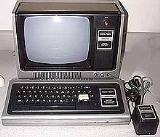
 and Tandy) had much to do with retailing the computer through more than 3000 of its Radio Shack (Tandy in the UK) storefronts. Notable features of the original TRS-80 included its full-stroke QWERTY keyboard, small size, well-written Floating Point BASIC
BASIC

In computer programming, BASIC is a family of high-level programming languages. The Dartmouth BASIC was designed in 1964 by John George Kemeny and Thomas Eugene Kurtz at Dartmouth College in New Hampshire, United States to provide computer access to non-science students....
 programming language
Programming language

A programming language is a machine-readable artificial language designed to express computations that can be performed by a machine, particularly a computer....
, an included monitor, and a starting price of $600.

One major drawback of the original system was the massive RF interference it caused in surrounding electronics. This became a problem when it was determined to violate FCC regulations, leading to the Model I's phase out in favor of the new Model III.

By 1979, the TRS-80 had the largest available selection of software in the microcomputer market.

Early Z80-based home systems


History

Announced at a press conference on August 3, 1977 by Tandy Corporation, the Radio Shack TRS-80 Microcomputer (later re-designated the Model I) was Tandy's entry into the home computer
Home computer

A home computer was a class of personal computer entering the market in 1977 and becoming common during the 1980s. They were marketed to consumers as accessible personal computers, more capable than video game consoles....
 market, meant to compete head-on against the Commodore PET
Commodore PET

The PET was a home computer-/personal computer produced by Commodore International starting in 1977. Although it was not a top seller outside the Canadian, US, and UK educational markets, it was Commodore's first full-featured computer and would form the basis for their future success....
 2001 and the Apple II. At $599 for a complete package including computer, keyboard, video monitor, and cassette storage, the computer was the most expensive single product Tandy's Radio Shack
Radio shack

Radio shack is a slang term for a room or structure for housing radio equipment....
 chain of electronics stores had ever offered. After the first demonstration of the wire wrapped version of the computer to Charles Tandy, there was a discussion as to the quantity that could be sold. The TRS-80's creators Don French and Steve Leininger both suggested that 50,000 could be sold. They were laughed at. It was decided that the initial production run would be 1,000. Several months later the Company management was still unsure of the computer's market appeal, but raised the initial production run to 3,500, because in Radio Shack President Lew Kornfield's words "When the product fails, we can use it in the stores for inventory control and other purposes." Even on introduction day the planned production run was still 3,500.

Tandy ended up selling over 10,000 TRS-80s in its first month of sales, and an additional 55,000 in the next 4 months. Before its January 1981 discontinuation, Tandy sold more than 250,000 Model Is. By the end of its lifetime, the computer had become affectionately known by its users (and snidely referred to by its detractors) as the "Trash-80".

Hardware

The Model I combined the mainboard and keyboard
Keyboard (computing)

In computing, a keyboard is an input device, partially modeled after the Typewriter#Keyboard layout, which uses an arrangement of buttons or Push-button, which act as mechanical levers or electronic switches....
 into one unit, in what was to be a common case design trend throughout the 8-bit and 16-bit microcomputer eras, although it had a separate power supply unit. It used a Zilog Z80
Zilog Z80

The Zilog Z80 is an 8-bit microprocessor designed and sold by Zilog from July 1976 onwards. It was widely used both in desktop and embedded computer designs as well as for military purposes....
 processor clocked at 1.77 MHz (later models were shipped with a Z80A). The basic model originally shipped with 4 KB of RAM, and later 16 KB.

Keyboard
The transfer of information about what keys were being pressed was unusual, in that instead of transferring data via an I/O device or chip, the hardware mapped the keyboard to pre-defined locations in memory, i.e., there was no 'real' memory at this location, but performing a read from the keyboard area of the memory map would return the state of a particular set of keys.

A version of the computer was produced which replaced the nameplate with a numeric keypad.

Many users complained about the TRS-80 keyboards, which used mechanical switches and suffered from "Keyboard Bounce
Switch

In electronics, a switch is an electrical component which can break an electrical circuit, interrupting the Electric current or diverting it from one conductor to another....
", resulting in multiple letters being typed accidentally. A Keyboard De-Bounce tape was distributed to compensate, which both ignored key contact closures if they were detected within a short time of a contact opening, and slowed down polling of the keyboard. Eventually, this was added to a later ROM revision. The keyboard hardware was also changed to be less vulnerable to bounce.

Video
The TRS-80 was accompanied by a white-on-black display, which was a modified RCA XL-100 black and white television. The actual color of the system was light bluish (the standard "P4" phosphor
Phosphor

A phosphor is a substance that exhibits the optical phenomenon of phosphorescence .Phosphors are transition metal compounds or rare earth element compounds of various types....
 used in black-and white televisions), and green and amber filters or replacement tubes (to make the display easier on the eyes) were a common aftermarket item.

Later models came with a green-on-black display.

Because of bandwidth problems in the interface card that replaced the TV's tuner, the display would lose horizontal sync if large areas of white were displayed; a simple hardware fix (involving less than half an hour's work) could be applied to correct that.

Trs 80 Graphics
The video hardware could only display text at 64 or 32 characters wide by 16 lines of resolution. This was because the video memory system used a single kilobyte of video memory. Seven of the bits of each byte were used to display ASCII characters, with the eighth bit used to differentiate between text and "semigraphics" characters.

Primitive graphics ("text semigraphics," rather than a true bitmap) could be displayed because the upper 64 characters of the 128 character set displayed as a grid of 2×3 blocks (very similar to Teletext
Teletext

Teletext is a television information retrieval service developed in the United Kingdom in the early 1970s. It offers a range of text-based information, typically including national, international and sporting news, weather and TV schedules....
). BASIC routines were provided which could write directly to this virtual 128×48 grid.

The original TRS-80 Model I could differentiate between upper and lower characters in memory, but lower case characters were not displayed on the video display. In order to display the lower case properly on the Model I, one had to solder or clip an eighth memory chip onto the back of one of the existing seven video RAM chips, and then bend up a pin to tap an address line off the system bus. This modification became a popular third-party add-on.

Later models came with the hardware allowing the lowercase character set to be displayed with descenders. The software, however, remained unchanged, and when using standard BASIC programming, no lower case characters could be displayed. A small keyboard driver written in machine language could overcome this shortcoming.

Any access to the screen memory, either by writing to it using the BASIC statement PRINT or accessing the screen memory directly, caused "flicker" on the screen. The bus arbitration logic would block video display while access was given to the CPU
Central processing unit

A central processing unit is an electronic circuit that can execute computer programs. This broad definition can easily be applied to many early computers that existed long before the term "CPU" ever came into widespread usage....
, causing a short black line. This had little effect on normal BASIC programs, but fast programs made in assembly language could be affected if the programmer didn't take it into consideration. Many software authors were able to minimize this effect. Notwithstanding this primitive display hardware, many arcade-style games
List of TRS-80 games

There were a number of games available for the monochrome TRS-80 computers....
 were available for the Tandy TRS-80.

Cassette tape drive
User data was originally stored on cassette tape. A standard monaural
Monaural

Monaural sound reproduction is single-channel. Typically there is only one microphone, one loudspeaker, or, in the case of headphones or multiple loudspeakers, they are fed from a common Signalling path, and in the case of multiple microphones, mixed into a single signal path at some stage....
 audio cassette deck (Radio Shack model CTR-41) was included with the machine. The cassette tape interface was sensitive to audio volume changes, and the machine only gave the very crudest indication as to whether the correct volume was set, via a blinking character on screen when data was actually being loaded - to find the correct volume, one would sometimes have to attempt to load a program once adjusting volume until the machine picked up the data, then reset the machine, rewind the tape and attempt the load again. Users quickly learned to save a file three or more times in hopes that one copy would prove to be readable. Automatic gain control or indicator circuits could be constructed to compensate for this (fortunately the owner's manual provided complete circuit diagrams for the whole machine, including the peripheral interfaces, with notes on operation), and there was also an alternative tape interface that one could build in order to receive transmissions from the BBC's Chip Shop programme in the UK, an experiment in transmitting free software for several different BASIC home microcomputers, in a common tape format, over the radio. A special program (loaded using the conventional tape interface) was needed to access the custom interface over the expansion port and then load the recorded software. Tandy eventually replaced the CTR-41 unit with the CTR-80 which had built-in AGC circuitry (and no volume control). This helped the situation, but tape operation was still unreliable.

TRS-80s with Level I BASIC read and wrote tapes at 250 bis per second (25 bytes per second). Level II BASIC doubled this to 500 bits per second (50 bytes per second).

Some programmers wrote machine language programs that would increase the speed to up to 1500 baud without loss in reliability.

For loading and storing data, no hardware controller existed. Instead, the processor created the sound itself by switching the output voltage from minus to plus and back, thus creating a click for every 1 and silence for every 0 in the bit stream.

The first models of the Model I also had problems reading from the cassette drives. Tandy eventually offered a small board which was installed in a service center to correct earlier models. The ROMs in later models were modified to correct this.

Expansion interface
An optional (and expensive) Expansion Interface (E/I) provided several important features - the ability to expand up to 48K of RAM, a floppy disk controller, a real-time clock, a second cassette port, a RS-232
RS-232

In telecommunications, RS-232 is a standard for serial communications binary data signals connecting between a DTE and a DCE . It is commonly used in computer serial ports....
 port (as an option) and a Centronics
Centronics

Centronics Data Computer Corporation was a pioneering American manufacturer of computer printers, now remembered primarily for the Centronics printer port that bears its name....
 parallel printer port.

Originally, one could not print from the Model I without purchasing an Expansion Interface. However, Tandy Corp. soon sold a printer-only Interface for the Model I for approx. 300 Deutschmark in Germany.

The Expansion Interface was the most troublesome part of the TRS-80 system. It went through several revisions (a pre-production version is said to have looked completely different, and to have had a card cage) before on-board buffering of the bus connector lines cured its chronic problems with random lockups and crashes. Its edge card connectors tended to oxidise due to the use of two different metals in the contacts, and required periodic cleaning with a pencil eraser. The unit required a second power supply, identical to that of the TRS-80, and was designed with an interior recess which held both power supplies.

Since the cable connecting the expansion interface carried the system bus, it was kept short (about two inches). This meant that the user had no choice but to place it directly behind the computer with the monitor on top of it. This caused problems if one owned a monitor whose case did not fit the mounting holes. Also, the loose friction fit of the edge connector on the already short interconnect cable created the precarious possibility of disconnecting the system bus from the CPU if either unit happened to be moved during operation.

Floppy disk drives
To use the Model I with a disk operating system, one had to buy the Expansion Interface, which included a single density floppy disk
Floppy disk

A floppy disk is a data storage medium that is composed of a disk of thin, flexible magnetic storage medium encased in a square or rectangle plastic shell....
 interface. This was based on a Western Digital 1771 single density floppy disk controller chip, but since it lacked a separate external data separator, it was very unreliable in practice.

Much of the unreliability was due to bugs in Radio Shack's early version(s) of TRS-DOS
TRS-DOS

TRS-DOS was the operating system for the Tandy TRS-80 line of 8-bit Zilog Z80 micro-computers that were sold through Radio Shack through the late 1970s and early 1980s....
. The 1771 could not report its status for a short interval (several instruction cycles) after it received a command. A common method of handling this was to issue a command to the 1771, perform several "NOP" instructions, then query the 1771 for command status. Early TRS-DOS neglected to use the required wait period, instead querying the chip immediately after issuing a command, and thus false status was often returned to the OS, causing various errors and crashes. If the 1771 was handled correctly by the OS, it was actually fairly reliable.

Double-density floppy disks
A Data Separator and/or a Double Density disk controller (based on the WD 1791 chip) were made available by Percom (a Texas peripheral vendor), LNW, Tandy and others. The Percom Doubler added the ability to boot and use Double Density
Double density

Double density, often shortened DD, is a capacity designation on magnetic storage, usually floppy disks. It describes the use of an encoding of information, which can encode on average twice as many bits per time unit compared to single density....
 Floppies
Floppy disk

A floppy disk is a data storage medium that is composed of a disk of thin, flexible magnetic storage medium encased in a square or rectangle plastic shell....
 (they provided their own modified TRSDOS called DoubleDOS), and included the Data Separator. The LNDoubler added the ability to read and write from 8" Diskette Drives for over 1.2mb of Storage.

Double-sided floppy disks
All TRS-80 disk formats were soft-sectored with index-sync (as opposed to the Apple II formats, which were soft-sectored without index sync, with many Apple drives lacking even an index hole detector), and except for some very early Shugart drives (recognizable by their spiral-cam head positioner), all TRS-80 floppy drives were 40-track double-density models. The combination of 40 tracks, double-density, and index-sync gave a maximum capacity of 180 kilobytes per single-sided floppy disk, considerably higher than most other systems of the era. On the other hand, the use of index-sync meant that in order to turn a floppy disk into a "flippy
Flippy disk

A flippy disk is a double-sided 5?" floppy disk, specially modified so that the two sides can be used independently in single-sided drives. Use of "flippy" disks was most common during the 8-bit home computer era of the early-to-mid 1980s....
", it was necessary not only to cut a second write-enable notch, but also to punch a second index hole window in the jacket (at great risk to the disk inside). One could also purchase factory-made "flippies", or use the back side for Apple systems (as some software publishers of the era did).

The drives sold by Radio Shack were 35-track models with a 160K capacity.

Printers
One unusual peripheral offered was a "screen printer": an electrostatic rotary printer that scanned the video memory through the same bus connector used for the E/I, and printed an image of the screen onto aluminum-coated paper in about a second. Unfortunately, it was incompatible with both the final, buffered version of the E/I, and with the "heartbeat" interrupt used for the real-time clock under Disk BASIC. This could be overcome by using special cabling, and by doing a "dummy" write to the cassette port while triggering the printer.

Two other printers were offered: one for 57 mm metal coated paper, selling for approximately 600 Deutschmark in Germany, and one built by Centronics for normal paper, costing at first 3000 Deutschmark, later sold at approximately 1500 Deutschmark in some stores. It had only 7 pins, so letters with descenders such as lowercase "g" did not reach under the baseline, but were elevated within the normal line.

BASIC

Two versions of the BASIC
BASIC

In computer programming, BASIC is a family of high-level programming languages. The Dartmouth BASIC was designed in 1964 by John George Kemeny and Thomas Eugene Kurtz at Dartmouth College in New Hampshire, United States to provide computer access to non-science students....
 programming language were produced for the Model I. Level I BASIC fit in 4 KB of ROM
Read-only memory

Read-only memory is a class of computer storage media used in computers and other electronic devices. Because data stored in ROM cannot be modified , it is mainly used to distribute firmware ....
, and Level II BASIC fit into 12 KB of ROM. Level I was single precision only and had a smaller set of commands. Level II introduced double precision floating point support and had a much wider set of commands. Level II was further enhanced when a disk system was added, allowing for the loading of Disk BASIC.

Level I Basic was based on Li-Chen Wang
Li-Chen Wang

Dr. 'Li-Chen Wang' wrote Palo Alto Tiny BASIC for Intel 8080-based microcomputers. This was the fourth version of Tiny BASIC that appeared in Dr....
's free Tiny BASIC
Tiny BASIC

Tiny BASIC is a dialect of the BASIC programming language that can fit into as little as 2 or 3 kilobyte of Random access memory. This small size made it invaluable in the early days of :Category:Early microcomputerss , when typical memory size was 4–8 KB....
, additional functions added by Radio Shack. It achieved a measure of noteworthiness due in large part to its outstanding manual, written by David Lien, which presented lessons on programming with text and humorous graphics, making the subjects very easy to understand. It had only two string
String (computer science)

In computer programming and some branches of mathematics, a string is an ordered sequence of symbols. These symbols are chosen from a predetermined set or alphabet....
 variables (A$ and B$), 26 numeric variables (A - Z) and one array, A. Code for functions like SIN, COS and TAN was not included in ROM but printed at the end of the book. The error messages were: "WHAT?" for syntax errors, "HOW?" for arithmetic errors such as division by zero
Division by zero

In mathematics, a division is called a division by zero if the divisor is 0 . Such a division can be formally expressed as a/0 where a is the dividend....
, and "SORRY" for out of memory
Out of memory

Out of memory is an undesired state of computer operation where no additional memory can be allocated for use by programs or the operating system....
 errors.

Level II BASIC was licensed from Microsoft
Microsoft

Microsoft Corporation is a multinational corporation computer technology corporation that develops, manufactures, licenses, and supports a wide range of computer software products for computing devices....
. It was a cut-down version of the 16 KB Extended BASIC
Microsoft BASIC

Microsoft BASIC was the foundation product of the Microsoft company. It first appeared in 1975 as Altair BASIC, which was the first BASIC programming language available for the Altair 8800 hobbyist microcomputer....
, since the Model I had 12 KB of ROM space. The accompanying manual was not nearly as colorful and suited for beginning programmers as the Level I BASIC manual.

The Disk Based BASIC added the ability to perform disk I/O, and in some cases (NewDos/80
NewDos/80

NewDos/80 is a third-party operating system that was made available for the Radio Shack TRS-80 line of microcomputers beginning in 1980. NewDos/80 was developed by Apparat, Inc....
, MultiDOS, DosPlus, LDOS) added powerful sorting, searching, full screen editing, and other features. Level II BASIC recognized some of these commands and issued a "?L3 ERROR", suggesting that a behind-the-scenes change of direction intervened between the recording of the Level II ROMs and the introduction of Disk BASIC, which Radio Shack didn't call Level III.

Microsoft also marketed a tape-cassette based enhanced BASIC called Level III BASIC. This added most of the functions in the full 16 KB version of BASIC.

Software applications

A wide range of software applications were available for the TRS-80. Many leading developers, and independent software companies such as Big Five, ported over popular arcade hits like Namco's Pac-Man
Pac-Man

is an arcade game developed by Namco and licensed for distribution in the United States by Midway Games, first released in Japan on May 22, 1980. Immensely popular in the United States from its original release to the present day, Pac-Man is universally considered as one of the classics of the medium, virtually synonymous with video games, and...
 and Galaxian
Galaxian

is a 1979 in video gaming Shoot 'em up#Fixed shooters arcade game by Namco and released by Midway Games in the United States....
, Atari's Centipede, Sega's Zaxxon
Zaxxon

Zaxxon is a 1982 arcade game developed by Sega and released by Sega. Some sourceshe time of its release, Zaxxon was unique as it was the first game to employ axonometric projection, something of a three-quarter viewing perspective, which lent its name to the game ....
 and Stern Electronics' Berzerk
Berzerk

Berzerk is a Shoot 'em up#Multi-directional shooter video game Arcade game, released in 1980 by Stern of Chicago....
 (with digitized speech). Some companies ported games from other home computers of the area, such as the original Zork
Zork

Zork was one of the first interactive fiction computer games and an early descendant of Colossal Cave Adventure. The first version of Zork was written in 1977?1979 on a PDP-10 computer by Tim Anderson , Marc Blank, Bruce Daniels , and Dave Lebling, and implemented in the MDL programming language....
 adventure game. There were also many games unique to the TRS-80, including shooters like Cosmic Fighter and Defence Command and strange experimental programs such as , which was not strictly speaking a game but did have significant entertainment value.

Other games unique to the TRS-80 even up till today include: the best platform game for the TRS-80 Volcano Hunter; Donut Dilemma; PANIK; and Penetrator. Part of the uniqueness came about because of the clever use of the TRS-80's lower-resolution graphics capabilities.

A full suite of office applications were also available, including the VisiCalc
VisiCalc

VisiCalc was the first spreadsheet program available for personal computers. It is often considered the application that turned the microcomputer from a hobby for computer hobby into a serious business tool....
 and As-Easy-As spreadsheets and the Lazy Writer, Electric Pencil
Electric Pencil

Electric Pencil, released in 1976, was the first word processor for home computers. It was developed by a programmer named Michael Shrayer who apparently wanted to document his own software on the same machines he was programming....
 and Scripsit
Scripsit

Scripsit is a word processing application written for the Radio Shack TRS-80 line of computers. Versions were available for most if not all computers sold under the TRS-80 name, including the Color Computer and several pocket computer designs, as well as the Tandy version of the Xenix operating system....
 word processors.

TRS-DOS—Radio Shack's operating system for its TRS-80 computers—had significant limitations, opening the market for various alternative OSes, including NewDOS, a third-party rival sold by a company called Apparat Personal Computers, which went out of business in 1987. Others included DoubleDOS, DOSPlus, LDOS
LDOS

LDOS may refer to :* Local density of states, a physical quantity* an operating system for TRS-80, a Z-80 8-bit computer, circa 1980's, developed and sold by Tandy ...
, MicroDOS, NEWDOS/80
NewDos/80

NewDos/80 is a third-party operating system that was made available for the Radio Shack TRS-80 line of microcomputers beginning in 1980. NewDos/80 was developed by Apparat, Inc....
, UltraDOS, and VTOS.

Clones

Dgt 100 Brazilian Trs 80 Clone
Many clones of the TRS-80
List of TRS-80 clones

The following is a list of clone of Tandy's TRS-80 model I and III home computers:* Aster CT-80 by Aster CT-80#The company* DGT-100 and DGT-1000 by Digitus...
 Model I came on the market: the Lobo Max-80 (Lobo also produced their own version of the Expansion Interface), the LNW-80
LNW-80

The LNW-80 is the first computer built by LNW Research. The computer is 100% compatible with the Tandy TRS-80 Model 1, but has some hardware enhancements....
 Models I/II and Team computers (LNW also produced an alternate version of the Expansion Interface), and the Dutch Aster CT-80
Aster CT-80

The Aster CT-80, an early home computer/personal computer developed by the small Netherlands company MCP , was sold in its first incarnation as a kit for hobbyists....
, a computer that could run both TRS-80 and CP/M software, and also had all the improvements of the later Model III.

EACA
EACA

EACA International Ltd was a Hong Kong-based electronics manufacturer active during the 1970s and early-1980s. They were founded by Eric Chung, a businessman born in mainland China who crossed the border into the British colony....
 in Hong Kong made a Model I clone that was marketed around the world under different names with modifications. In Australia and New Zealand it was the , in North America it was PMC-80 and PMC-81, in Hungary the HT-1080Z, in South Africa the TRZ-80, and in Western Europe it was Video Genie
Video Genie

Video Genie was a series of computers produced by Hong Kong-based manufacturer EACA during the early 1980s. They were compatible with the TRS-80 computers and could be considered a Clone although there were hardware and software differences....
. The expansion bus was different and EACA also made its own Expansion Interface to fit it. There were several versions, and it was later split into a 'home' and a 'business' version, Genie I and II, and System-80 Mark I and II, where the II would have a numeric keypad instead of the built-in cassette player. EACA's Colour Genie
Colour Genie

The EACA EG2000 Colour Genie is a computer produced by Hong Kong-based manufacturer EACA. It followed their earlier Video Genie I and II computers and was released around the same time as the business-oriented Video Genie III....
 was also based on TRS-80 Model I but with improved graphics and other changes, reducing its compatibility.

In Brazil there were several manufacturers of different Model I/III/IV clones. Digitus made the DGT-100 and DGT-1000, Prologica made the highly-successful CP300 and CP500 series, Sysdata Eletrônica Ltda. made the Sysdata Jr. Dismac made the D8000/D8001/D8002 series. Prologica also made the CP400 / CP 400II which were copies of the TRS-80 Color Computer, with the external case being almost a copy of the Timex Sinclair 2068
Timex Sinclair 2068

The Timex Sinclair 2068 , released in November 1983, was Timex Sinclair's fourth and last home computer for the US market. It was also marketed in Portugal and Poland, as the Timex Computer 2068....
.

In Germany, S.C.S. GmbH in Mörfelden- Waldorf offered the Komtek-I Model I clone. Noteworthy was its four relay switching outputs.

Model III

As a follow-on to the Model I, in July 1980 Tandy released the Model III, a more integrated and much improved system. The improvements of the Model III included built-in lower case, a better keyboard, and a faster (2.03 MHz) Z-80 processor. With the introduction of the Model III, Model I production was eventually discontinued as the Model I systems did not comply with new FCC
Federal Communications Commission

The Federal Communications Commission is an Independent agencies of the United States government, created, directed, and empowered by United States Congress statute , and with the majority of its commissioners appointed by the current President of the United States....
 regulations regarding radio interference. In fact, the Model Is radiated so much RFI that many games were designed so that an AM
Amplitude modulation

Amplitude modulation is a technique used in electronic communication, most commonly for transmitting information via a radio carrier wave....
 radio next to the computer could be used to provide sounds.

The TRS-80 Model III also came with the option of integrated disk drives.

Model 4

The successor to the Model III was the Model 4 (April 1983, with "4" written as an Arabic numeral), which included the capability to run CP/M
CP/M

CP/M is an operating system originally created for Intel 8080/Intel 8085 based microcomputers by Gary Kildall of Digital Research. Initially confined to single tasking on 8-bit processors and no more than 64 kilobytes of memory, later versions of CP/M added multi-user variations, and were migrated to 16-bit processors....
.

Running CP/M had previously only been possible via a hardware modification that remapped the BASIC ROMs away from memory address zero, such as the third-party add-on sold as the Omikron Mapper board, or by running a version of CP/M modified to run at a starting address other than zero. However, this also required modified applications, since the area of memory at zero contained the vectors for applications to access CP/M itself.

The Model 4 also had the ability to display high-resolution graphics with an optional board. A "luggable" version known as the Model 4P (1983) was a self-contained unit with a case design similar to that of a portable sewing machine.

Business systems


Tandy 10

Tandy's first design for the business market was a desk-based computer known as the Tandy 10 Business Computer System
Tandy 10 Business Computer System

The Tandy 10 Business Computer System was a short-lived product developed by Radio Shack in the late 1970s as a business-oriented complement to their TRS-80#Model I desktop computer....
, which was released in 1978 but quickly discontinued.

Model II

In October 1979, Tandy began shipping the Model II, which was targeted to the small-business market. It was not an upgrade of the Model I, but an entirely different system, built using the faster Zilog
Zilog

Zilog, Inc., often seen as ZiLOG , is a manufacturer of 8-bit, 16-bit, 24-bit, and 32-bit microprocessors, and is most famous for its Intel 8080-compatible Zilog Z80 series....
 Z80A chip running at 4 MHz, with the computer, 8" floppy disk drive, and monochrome 80x24 monitor built into a single cabinet, DMA and vectored interrupts that the Model I lacked, and a detached keyboard. It was available with 32 KB or 64 KB of RAM; two RS-232
RS-232

In telecommunications, RS-232 is a standard for serial communications binary data signals connecting between a DTE and a DCE . It is commonly used in computer serial ports....
 serial ports and a Centronics printer port were standard. Unlike the Model I, the video and keyboard were not memory-mapped, leaving the entire memory space available for programs. Hard disk drives and additional floppy drives were available as options. The Model II ran the TRSDOS-II operating system and BASIC. TRSDOS-II was not very compatible with TRSDOS for the Model I, thus the Model II never had the same breadth of available software as the Model I. This was somewhat mitigated by the availability of the CP/M
CP/M

CP/M is an operating system originally created for Intel 8080/Intel 8085 based microcomputers by Gary Kildall of Digital Research. Initially confined to single tasking on 8-bit processors and no more than 64 kilobytes of memory, later versions of CP/M added multi-user variations, and were migrated to 16-bit processors....
 operating system for the Model II from third parties such as Pickles & Trout.

Tandy offered a desk custom-designed for the Model II for US$370. It could hold an additional three 8" disk drives or up to four 8.4MB hard drives.

The Model II was later replaced by the Model 12, which was essentially a Model 16B (described below) without the Motorola processor and other features such as an expansion cage. Customers could choose to later upgrade a Model 12 to a Model 16B.

Model 16, Model 16B, and Tandy 6000


Tandy later released the TRS-80 Model 16, as the follow-on to the Model II; an upgrade kit was available for Model II systems. The Model 16 added a 6 MHz, 16-bit Motorola 68000
Motorola 68000

The Motorola 68000 is a 16/32-bit Complex instruction set computer microprocessor core designed and marketed by Freescale Semiconductor ....
 processor and memory card, keeping the original Z-80 as an I/O processor. It could run either TRSDOS-16 or Xenix
Xenix

Xenix is a version of the Unix operating system, licensed by Microsoft from AT&T in the late 1970s. The Santa Cruz Operation later acquired exclusive rights to the software, and eventually began distributing it as SCO UNIX....
, Microsoft's version of UNIX. Of the two operating systems, Xenix was far more popular. TRSDOS-16 was essentially Model II TRSDOS, with no additional features and little compatible software. 68000 functionality was added as an extension, loading 68000 code into the 68000 memory via a shared memory window with the Z80.

Xenix, on the other hand, offered the full power of UNIX System III
UNIX System III

UNIX System III was a version of the Unix operating system released by AT&T's Unix Support Group . It was first released outside of Bell Labs in 1982....
 including multi-user support. The Model 16 family with Xenix became a popular system for small business, with a relatively large library of business and office automation software for its day. Tandy offered multi-user word processing (Scripsit
Scripsit

Scripsit is a word processing application written for the Radio Shack TRS-80 line of computers. Versions were available for most if not all computers sold under the TRS-80 name, including the Color Computer and several pocket computer designs, as well as the Tandy version of the Xenix operating system....
 16), spreadsheet (Multiplan
MultiPlan

Multiplan was an early spreadsheet program developed by Microsoft. Known initially by the List of computer technology code names "EP" , it was introduced in 1982 as a competitor for VisiCalc....
), and a 3GL "database" (Profile 16, later upgraded to filePro
FilePro

filePro is a proprietary DBMS and rapid application development system originally developed by Howard Wolowitz as The Electric File Clerk in 1978....
 16+), as well as an accounting suite with optional COBOL
COBOL

COBOL is one of the oldest programming languages still in active use. Its name is an acronym for COmmon Business-Oriented Language, defining its primary domain in business, finance, and administrative systems for companies and governments....
 source for customization. RM-COBOL, Basic, and C were available for programming, with Unify and Informix
Informix

Informix is a family of relational database management system products by IBM. It is positioned as IBM's flagship data server for online transaction processing as well as integrated solutions....
 offered as relational databases. A kernel modification kit was also available.

TRS-Xenix was notable for being a master/slave implementation, with all I/O being performed by the Z80 while all processing was done within the otherwise I/O-free 68000 subsystem.

The Model 16 evolved into the Model 16B, and then the Tandy 6000 HD, gaining an internal hard drive along the way and switching to an 8 MHz 68000 and half-height, 8-inch floppy drives (double-sided, double density, 1.2 MB). Tandy offered 8.4MB, 15 MB, 35 MB, and 70 MB external hard drives, up to 768 KB of RAM, and up to six additional RS-232 serial ports supporting multi-user terminals. Additional memory and serial port expansion options were available from aftermarket companies.

Internal variants of the Model 16 architecture were built running at speeds in excess of 10 MHz, 68010 processors, up to 8Mb of RAM, SCSI
SCSI

Small Computer System Interface, or SCSI , is a set of standards for physically connecting and transferring data between computers and peripheral devices....
 disk interfaces, and up to 12 RS-232 ports.

Other systems


Color Computers

Tandy also produced the TRS-80 Color Computer (CoCo), based on the Motorola 6809
Motorola 6809

The Motorola 6809 is an 8-bit microprocessor central processing unit from Motorola, introduced circa 1977-78. It was a major advance over both its predecessor, the Motorola 6800, and the related, MOS Technology 6502....
 processor. This machine was clearly aimed at the home market, where the Model II and above were sold as business machines. It competed directly with the Commodore 64
Commodore 64

The Commodore 64 is an 8-bit home computer released by Commodore International in August, 1982, at a price of United States dollar595. Preceded by the Commodore VIC-20 and Commodore MAX Machine, the C64 features 64 kilobytes of Random-access memory with sound and graphics performance that were superior to IBM-compatible computers of tha...
, Apple II, and Atari 8-bit family
Atari 8-bit family

The Atari 8-bit family is a series of 8-bit home computers manufactured from 1979 to 1992. All are based on the MOS Technology MOS Technology 6502 central processing unit and were the first home computers designed with custom coprocessor chips, giving them the most powerful graphic, sound and I/O subsystems of any 8 bit machine of their time...
 of computers. OS-9
OS-9

OS-9 is a family of real-time computing, process , computer multitasking, multi-user, Unix-like operating systems, developed in the 1980s, originally by Microware for the Motorola 6809 microprocessor....
, a multitasking, multi-user operating system was supplied for this machine.

Model 100 line

In addition to the above, Tandy produced the TRS-80 Model 100 series of "laptop" computers. This series comprised the TRS-80 Model 100, Tandy 102, Tandy 200 and Tandy 600. The Model 100 was designed by the Japanese company Kyocera with software written by Microsoft. It is reported that the Model 100 featured the last code that Bill Gates ever wrote.

The Model 100 had an internal 300 baud modem, built-in BASIC, and a limited text editor. It was possible to use the Model 100 on essentially any phone in the world with the use of an optional acoustic coupler
Acoustic coupler

In telecommunications, the term acoustic coupler has the following meanings:# An network interface device for coupling electrical signals by acoustical means?usually into and out of a telephone instrument....
 that fit over a standard telephone handset. The combination of the acoustic coupler, the machine's outstanding battery life (it could be used for days on a set of 4 AA batteries), and its simple text editor made the Model 100/102 popular with journalists in the early 1980s. The Model 100 line also had an optional bar code reader, serial/RS-232 floppy drive and a Cassette interface.

Also available as an option to the Model 100 was an external expansion unit supporting video and a 5 1/4" disk drive. It is connected via the 40-pin expansion port in the bottom of the unit.

Tandy 200

The Tandy 200 was introduced in 1984 as a higher-end complement to the Model 100. The Tandy 200 had 24 KB RAM expandable to 72 KB, a flip-up 16 line by 40 column display, and a spreadsheet (Multiplan) included. The Tandy 200 also included DTMF tone-dialing for the internal modem. Although less popular than the Model 100, the Tandy 200 was also particularly popular with journalists in the late 1980s and early 1990s.

MC-10

The MC-10
TRS-80 MC-10

The TRS-80 MC-10 microcomputer is a lesser-known member of the TRS-80 line of home computers, produced by Tandy Corporation in the early 1980s and sold through their RadioShack chain of electronics stores....
 was a short-lived and little-known Tandy computer, similar in appearance to the Sinclair ZX81
Sinclair ZX81

The Sinclair ZX81 was a home computer released in 1981 by Sinclair Research. It was the follow-up to the Sinclair ZX80.The machine's distinctive appearance was the work of industrial designer Rick Dickinson....
.

It was a small system based on the Motorola 6803
Motorola 6800

The 6800 is an 8-bit microprocessor produced by Motorola and released shortly after the Intel 8080 in late 1974. It had 78 instructions, including the famous, undocumented Halt and Catch Fire bus test instruction....
 processor and featured 4 KB
KB

The abbreviation KB or kb can refer to:*Kilobit , a unit of information used, for example, to quantify computer memory or storage capacity...
 of RAM. A 16 KB RAM expansion pack that connected on the back of the unit was offered as an option as was a thermal paper printer. A modified version of the MC-10 was sold in France
France

France , officially the French Republic , is a country whose Metropolitan France is located in Western Europe and that also comprises various Overseas departments and territories of France....
 as the Matra Alice
Matra Alice

The Matra & Hachette Ordinateur Alice was a home computer sold in France beginning in 1983. It was a clone of the TRS-80 MC-10, produced through a collaboration between Matra and Hachette in France and Tandy Corporation in the United States....
.

Programs loaded using a cassette which worked much better than those for the Sinclair. A magazine was published which offered programs for both the CoCo and MC-10 but very few programs were available for purchase. Programs for the MC-10 were not compatible with the CoCo.

Pocket Computers

The TRS-80 brand was also used for a line of Pocket Computers which were manufactured by Sharp or Casio, depending on the model.

PC-compatible computers

In the early 1980s, Tandy began producing a line of computers that were "DOS compatible": able to run MS-DOS and certain applications, but not fully compatible with every nuance of the original IBM PC
IBM PC

The IBM Personal Computer, commonly known as the IBM PC, is the original version and progenitor of the IBM PC compatible hardware platform ....
 systems. The first of these was the Tandy 2000
Tandy 2000

The Tandy 2000 was a personal computer introduced by Radio Shack in late 1983 which used the 8 MHz Intel 80186 microprocessor. By comparison, the IBM PC XT used the older 4.7 MHz 8088 processor, and the IBM PC AT would later use the newer 6 MHz Intel 80286....
, followed later by the less expensive Tandy 1000
Tandy 1000

The Tandy 1000 was the first in a line of more or less IBM PC compatible home computer systems produced by the Tandy Corporation for sale in its Radio Shack chain of stores....
. As margins decreased in PC clones, Tandy was unable to compete and stopped marketing their own systems.

Originally, Tandy offered computers manufactured by Tandon Corporation, and then started producing their own line of systems.

The Tandy 2000 system was similar to the Texas Instruments Professional Computer in that it offered better graphics, a faster processor (80186) and higher capacity disk drives (80 track double sided 800k 5.25 drives) than the original IBM PC

However, around the time of its introduction, the industry began moving away from MS-DOS compatible computers and towards fully compatible clones; later Tandy offerings moved toward full PC hardware compatibility.

The later Tandy 1000 systems and follow-ons were also marketed by DEC
Digital Equipment Corporation

Digital Equipment Corporation was a pioneering United States company in the computer industry. It is often referred to within the computing industry as DEC ....
, as Tandy and DEC had a joint manufacturing agreement.

In popular culture

  • In the 1980s, Tandy/Radio Shack distributed a series of free comic books in which schoolchildren and their TRS-80 computers foil various evil schemes. The kids acted mostly on their own, but Superman
    Superman

    Superman is a Character , a comic book superhero widely considered to be an American cultural icon. Created by American writer Jerry Siegel and Canadian-born artist Joe Shuster in 1932 while both were living in Cleveland, Ohio, Ohio, and sold to DC Comics in 1938, the character first appeared in Action Comics Action Comics 1 and subseque...
     appeared in two issues, accompanied by Supergirl
    Supergirl

    Supergirl is a Fictional character comic book Superhero#Superheroines that is depicted as a female counterpart to the DC Comics iconic superhero Superman....
     in one and Wonder Woman
    Wonder Woman

    Wonder Woman is a Character , a DC Comics Superhero#Superheroines created by William Moulton Marston. First appearing in All Star Comics #8 , she is one of three characters to have been continuously published by DC Comics since the company's 1944 inception ....
     in the other.
  • In the Futurama
    Futurama

    Futurama is an Animated cartoon United States Situation comedy created by Matt Groening, and developed by Groening and David X. Cohen for the Fox Broadcasting Company....
     episode "The Honking
    The Honking

    "The Honking" is episode eighteen in season two of Futurama. It originally aired in North America on November 5, 2000. The title comes from The Howling , a modern werewolf film....
    " Bender's cousin is named "Tandy" and has "euroTRaSh-80" printed on his front (emphasizing the characters "TRS-80").
  • In the movie This is Spinal Tap
    This Is Spinal Tap

    is a 1984 in film mockumentary rockumentary directed by Rob Reiner and starring members of the fictional heavy-metal/hard rock band Spinal Tap....
    , on the tour bus the band can be seen playing the game Polaris, a Missile Command
    Missile Command

    Missile Command is a 1980 arcade game by Atari that was also licensed to Sega for European release.The plot of Missile Command is simple: the player's six cities are being attacked by an endless hail of ballistic missiles, some of them even splitting like multiple independently targetable reentry vehicles , and in later levels smart...
     clone, on a Color Computer.
  • "It is Pitch Dark", a song by MC Frontalot
    MC Frontalot

    Damian Hess , better known by stage name MC Frontalot, is a San Francisco, California hip hop musician and self-proclaimed "world's 579th greatest rapper." He is best known in nerdcore hip hop and computer and video game culture, for naming the nerdcore subgenre, and performing at Penny Arcade s annual Penny Arcade...
     about text adventure games, contains the line "Did I battle a snake? Was the treasure intact?/Or did the TRS-80 in my brain get hacked?"
  • In the popular TV series Chuck
    ChucK

    ChucK is a concurrent, strongly-timed audio programming language for real-time synthesis, composition, and performance, which runs on Mac OS X, Linux, and Microsoft Windows....
    , in the pilot episode, Chuck claims to have programmed his own version of the text based video game called Zork
    Zork

    Zork was one of the first interactive fiction computer games and an early descendant of Colossal Cave Adventure. The first version of Zork was written in 1977?1979 on a PDP-10 computer by Tim Anderson , Marc Blank, Bruce Daniels , and Dave Lebling, and implemented in the MDL programming language....
     with his buddy Bryce Larkin on the TRS-80. The text appeared on his screen, "The terrible troll raises his sword", to which Chuck replied, "Attack troll with nasty knife".
  • In the feature film "The Life Aquatic with Steve Zissou", the computer used to control the dolphins was a TRS-80 Model III.


Emulators

  • Windows:
  • Windows: (shareware)
  • Windows: (shareware) Several TRS-80 emulators; emulated in 80486+ assembly
  • Windows/Linux/Mac: Open source Model 100/102/200 Emulator
  • Linux/Unix: (open-source)
  • Java:
  • Mac OS X: includes TRS-80 emulator
  • Mac Classic: (no sound support) for Mac OS 7.5.5 or higher


See also

  • List of TRS-80 games
    List of TRS-80 games

    There were a number of games available for the monochrome TRS-80 computers....
  • List of TRS-80 software
  • List of TRS-80 clones
    List of TRS-80 clones

    The following is a list of clone of Tandy's TRS-80 model I and III home computers:* Aster CT-80 by Aster CT-80#The company* DGT-100 and DGT-1000 by Digitus...
  • 80 Micro
    80 Micro

    80 Micro was a home computing magazine published by CWC/I publications between 1980 and 1988. It featured articles, humor , letters and reviews about the TRS-80 microcomputer built by Tandy Corporation and sold through Radio Shack....
    , magazine devoted to the TRS-80
  • Creative Computing
    Creative Computing

    Creative Computing was one of the earliest magazines covering the microcomputer revolution. Published from 1974 until 1985, Creative Computing covered the whole spectrum of hobbyist/home/personal computing in a more accessible format than the rather technically-oriented BYTE magazine....
    , pioneering Microcomputer magazine that catered to Atari, Apple, PET and TRS-80 users during their heyday
  • SoftSide
    SoftSide

    SoftSide Magazine is a defunct computer magazine, begun in October 1978 by Roger Robitaille and published by SoftSide Publications of Milford, New Hampshire....
    , magazine with BASIC programs for the TRS-80 and other microcomputers of the same era
  • The Alternate Source Programmer's Journal
    The Alternate Source Programmer's Journal

    The Alternate Source Programmer's Journal was a magazine with deeply technical programming articles, most of which were at the Assembly Language level, for the TRS-80....
    , magazine with deeply technical programming articles, most of which were at the Assembly Language level, for the TRS-80.


External links