


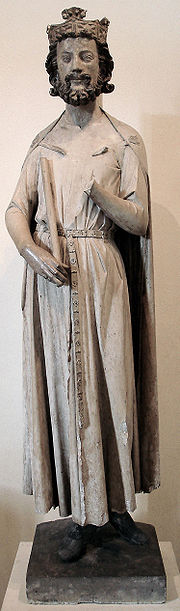
Childebert I

Encyclopedia
Franks
The Franks were a confederation of Germanic tribes first attested in the third century AD as living north and east of the Lower Rhine River. From the third to fifth centuries some Franks raided Roman territory while other Franks joined the Roman troops in Gaul. Only the Salian Franks formed a...
king of Paris, a Merovingian dynast, one of the four sons of Clovis I
Clovis I
Clovis Leuthwig was the first King of the Franks to unite all the Frankish tribes under one ruler, changing the leadership from a group of royal chieftains, to rule by kings, ensuring that the kingship was held by his heirs. He was also the first Catholic King to rule over Gaul . He was the son...
who shared the kingdom of the Franks upon their father's death in 511. He was one of the sons of Saint Clotilda, born at Reims
Reims
Reims , a city in the Champagne-Ardenne region of France, lies east-northeast of Paris. Founded by the Gauls, it became a major city during the period of the Roman Empire....
.
In the partition of the realm, he received as his share the town of Paris
Paris
Paris is the capital and largest city in France, situated on the river Seine, in northern France, at the heart of the Île-de-France region...
, the country to the north as far as the river Somme
Somme
Somme is a department of France, located in the north of the country and named after the Somme river. It is part of the Picardy region of France....
, to the west as far as the English Channel
English Channel
The English Channel , often referred to simply as the Channel, is an arm of the Atlantic Ocean that separates southern England from northern France, and joins the North Sea to the Atlantic. It is about long and varies in width from at its widest to in the Strait of Dover...
, and the Armorica
Armorica
Armorica or Aremorica is the name given in ancient times to the part of Gaul that includes the Brittany peninsula and the territory between the Seine and Loire rivers, extending inland to an indeterminate point and down the Atlantic coast...
n peninsula (modern Brittany
Brittany
Brittany is a cultural and administrative region in the north-west of France. Previously a kingdom and then a duchy, Brittany was united to the Kingdom of France in 1532 as a province. Brittany has also been referred to as Less, Lesser or Little Britain...
). His brothers ruled in different lands: Theuderic I
Theuderic I
Theuderic I was the Merovingian king of Metz, Rheims, or Austrasia—as it is variously called—from 511 to 533 or 534....
in Metz
Metz
Metz is a city in the northeast of France located at the confluence of the Moselle and the Seille rivers.Metz is the capital of the Lorraine region and prefecture of the Moselle department. Located near the tripoint along the junction of France, Germany, and Luxembourg, Metz forms a central place...
, Chlodomer
Chlodomer
Chlodomer, also spelled Clodomir or Clodomer was the second of the four sons of Clovis I, King of the Franks. On the death of his father, in 511, he divided the kingdom of the Franks with his three brothers: Theuderic I, Childebert I, and Clotaire I...
in Orléans
Orléans
-Prehistory and Roman:Cenabum was a Gallic stronghold, one of the principal towns of the Carnutes tribe where the Druids held their annual assembly. It was conquered and destroyed by Julius Caesar in 52 BC, then rebuilt under the Roman Empire...
, and Clotaire I
Clotaire I
Chlothar I , called the Old , King of the Franks, was one of the four sons of Clovis. He was born circa 497, in Soissons .-Life:...
in Soissons
Soissons
Soissons is a commune in the Aisne department in Picardy in northern France, located on the Aisne River, about northeast of Paris. It is one of the most ancient towns of France, and is probably the ancient capital of the Suessiones...
.
In 523, Childebert participated with his brothers in a war against Godomar of Burgundy
Godomar
Godomar , son of king Gundobad, was king of Burgundy. He ruled Burgundy after his elder brother's death in 524 until 534.Both he and his brother Sigismund of Burgundy were defeated in battle by Clovis' sons. Godomar fled and Sigismund was taken prisoner by Chlodomer, King of Orléans. Godomar then...
. Chlodomer died in the Battle of Vézeronce
Battle of Vézeronce
The Battle of Vézeronce took place on June 25, 524 close to Vézeronce-Curtin in Isère. It was part of the Burgundian War initiated by the four successors of the Frankish king Clovis I: Childebert I, Chlodomir, Chlothar I, and Theuderic I....
(524). In 524, after the murder of Chlodomer's children, Childebert annexed the cities of Chartres
Chartres
Chartres is a commune and capital of the Eure-et-Loir department in northern France. It is located southwest of Paris.-Geography:Chartres is built on the left bank of the Eure River, on a hill crowned by its famous cathedral, the spires of which are a landmark in the surrounding country...
and Orléans
Orléans
-Prehistory and Roman:Cenabum was a Gallic stronghold, one of the principal towns of the Carnutes tribe where the Druids held their annual assembly. It was conquered and destroyed by Julius Caesar in 52 BC, then rebuilt under the Roman Empire...
.
He took part in later various expeditions against the kingdom of Burgundy
Burgundians
The Burgundians were an East Germanic tribe which may have emigrated from mainland Scandinavia to the island of Bornholm, whose old form in Old Norse still was Burgundarholmr , and from there to mainland Europe...
. He besieged Autun
Autun
Autun is a commune in the Saône-et-Loire department in Burgundy in eastern France. It was founded during the early Roman Empire as Augustodunum. Autun marks the easternmost extent of the Umayyad campaign in Europe.-Early history:...
in 532 and, in 534, received as his share of the spoils of that kingdom the towns of Mâcon
Mâcon
Mâcon is a small city in central France. It is prefecture of the Saône-et-Loire department, in the region of Bourgogne, and the capital of the Mâconnais district. Mâcon is home to over 35,000 residents, called Mâconnais.-Geography:...
, Geneva
Geneva
Geneva In the national languages of Switzerland the city is known as Genf , Ginevra and Genevra is the second-most-populous city in Switzerland and is the most populous city of Romandie, the French-speaking part of Switzerland...
, and Lyon
Lyon
Lyon , is a city in east-central France in the Rhône-Alpes region, situated between Paris and Marseille. Lyon is located at from Paris, from Marseille, from Geneva, from Turin, and from Barcelona. The residents of the city are called Lyonnais....
s. When Witiges
Witiges
Witiges or Vitiges was King of the Ostrogoths in Italy from 536 to 540.He succeeded to the throne of Italy in the early stages of the Gothic War, as Belisarius had quickly captured Sicily the previous year and was currently in southern Italy at the head of the forces of Justinian I, the Eastern...
, the king of the Ostrogoths, ceded Provence
Provence
Provence ; Provençal: Provença in classical norm or Prouvènço in Mistralian norm) is a region of south eastern France on the Mediterranean adjacent to Italy. It is part of the administrative région of Provence-Alpes-Côte d'Azur...
to the Franks in 535, the possession of Arles
Arles
Arles is a city and commune in the south of France, in the Bouches-du-Rhône department, of which it is a subprefecture, in the former province of Provence....
and Marseilles was guaranteed to Childebert by his brothers. The annexation of that province was completed, with Clotaire's help, in the winter of 536–537.
In 531, he received pleas from his sister Chrotilda
Clotilde (died 531)
Clotilde was the daughter of King Clovis I of the Franks and Queen Clotilde.In 511 she was married to the Visigothic King Amalaric. Clotilde was a Catholic, while Amalaric and his fellow-Visigoths were Arians...
, wife of King Amalaric
Amalaric
Amalaric, or in Spanish and Portuguese, Amalarico, was king of the Visigoths from 526 until his assassination in 531. He was a son of king Alaric II and his first wife Theodegotho, daughter of Theodoric the Great....
of the Visigoths. The Arian
Arianism
Arianism is the theological teaching attributed to Arius , a Christian presbyter from Alexandria, Egypt, concerning the relationship of the entities of the Trinity and the precise nature of the Son of God as being a subordinate entity to God the Father...
king of Hispania
Hispania
Another theory holds that the name derives from Ezpanna, the Basque word for "border" or "edge", thus meaning the farthest area or place. Isidore of Sevilla considered Hispania derived from Hispalis....
, Chrotilda claimed, was grossly mistreating her, a Catholic. Childebert went down with an army and defeated the Gothic king. Amalaric retreated to Barcelona, where he was assassinated. Chrotilda died on her return journey to Paris of unknown causes.
Childebert made other expeditions against the Visigoths. In 542, he took possession of Pamplona
Pamplona
Pamplona is the historial capital city of Navarre, in Spain, and of the former kingdom of Navarre.The city is famous worldwide for the San Fermín festival, from July 6 to 14, in which the running of the bulls is one of the main attractions...
with the help of his brother Clotaire and besieged Zaragoza
Zaragoza
Zaragoza , also called Saragossa in English, is the capital city of the Zaragoza Province and of the autonomous community of Aragon, Spain...
, but was forced to retreat. From this expedition he brought back to Paris a precious relic, the tunic of Saint Vincent
Vincent of Saragossa
Saint Vincent of Saragossa, also known as Vincent Martyr, Vincent of Huesca or Vincent the Deacon, is the patron saint of Lisbon. His feast day is 22 January in the Roman Catholic Church and Anglican Communion and 11 November in the Eastern Orthodox Churches...
, in honour of which he built at the gates of Paris the famous monastery of St Vincent, known later as St-Germain-des-Prés.
He died on 13 December 558, and was buried in the abbey he had founded, where his tomb has been discovered. He left no sons, only two daughters, Chrodoberge and Chrodesinde, by his wife Ultragotha. Childebert was an acquisitive monarch. He expanded his domains in more foreign wars than any of his brothers, fighting in Burgundy (more than once), Spain (more than once), Provence, and elsewhere in Gaul. Gregory of Tours
Gregory of Tours
Saint Gregory of Tours was a Gallo-Roman historian and Bishop of Tours, which made him a leading prelate of Gaul. He was born Georgius Florentius, later adding the name Gregorius in honour of his maternal great-grandfather...
, a contemporary, speaking as a Neustria
Neustria
The territory of Neustria or Neustrasia, meaning "new [western] land", originated in 511, made up of the regions from Aquitaine to the English Channel, approximating most of the north of present-day France, with Paris and Soissons as its main cities...
n, puts these words into Childebert's mouth: Velim unquam Arvernam Lemanem quae tantae jocunditatis gratia refulgere dicitur, oculis cernere. Childbert was also one of the more religious of the sons of Clovis, cooperating with his brothers, rescuing his sister, and constructing the famous monastery of Saint Vincent to house his relics.
Ancestry
Sources
- Gregory of ToursGregory of ToursSaint Gregory of Tours was a Gallo-Roman historian and Bishop of Tours, which made him a leading prelate of Gaul. He was born Georgius Florentius, later adding the name Gregorius in honour of his maternal great-grandfather...
. The History of the Franks. 2 vol. trans. O. M. Dalton. Oxford: Clarendon Press, 1967. - Geary, Patrick J. Before France and Germany. Oxford University Press: 1988.