

.gif)
Loire (river)

Encyclopedia
The Loire is the longest river
in France
. With a length of 1012 kilometres (628.8 mi), it drains an area of 117054 km² (45,194.8 sq mi), which represents more than a fifth of France's land area. It is the 170th longest river in the world. It rises in the Cévennes
in the département of Ardèche
at 1350 m (4,429.1 ft) near Mont Gerbier de Jonc
, and flows for over 1000 km (621.4 mi) north through Nevers
to Orléans
, then west through Tours
and Nantes
until it reaches the Bay of Biscay
at St Nazaire. Its main tributaries include the Maine
, Nièvre and the Erdre rivers on its right bank, and the Allier
, Cher
, Indre
, Vienne
, and the Sèvre Nantaise
rivers from the left bank. The Loire gives its name to six départements: Loire
, Haute-Loire
, Loire-Atlantique
, Indre-et-Loire
, Maine-et-Loire
, and Saône-et-Loire
. The central part of the Loire Valley
was added to the World Heritage Sites list of UNESCO
on December 2, 2000. The banks are characterized by vineyards
and chateaux
in the Loire Valley.
Historicity of the Loire River valley begins with the earliest Middle Palaeolithic period 40-90 ka
(thousand years ago), followed by the modern humans (30 ka), succeeded by the Neolithic period (6,000 to 4,500 BC) of the Stone Age
and the Gauls
, the inhabitants in the Loire during the Iron Age
, in the period between 1500 and 500 BC. Gauls made it a major naval trading route by 600 BC establishing trade with the Greeks
on the Mediterranean coast. Gallic rule ended in the valley in 56 BC with Julius Caesar
winning over this territory. Christianity
made entry into this valley from 3rd century AD with many saints converting the pagans
. It was the time when the wineries also came to be established in the valley.
The Loire Valley has been called the "Garden of France" and is studded with over a thousand chateaux
, each with distinct architectural embellishments covering a wide range of variations, from the early medieval to the late Renaissance
periods. They were originally created as feudal strongholds, over centuries past, in the strategic divide between southern and northern France; now many are owned by private individuals.
Liger, which is itself a transcription of the native Gaulish (Celtic
) name of the river. The Gaulish name comes from the Gaulish word liga, which means "silt, sediment, deposit, alluvium", a word that gave French
lie, as in sur lie, which in turn gave English
lees
. Liga comes from the Proto-Indo-European
root *legh-, meaning "to lie, lay", which gave many words in English, such as to lie, to lay, ledge, law, etc.
the palaeo-Loire continued its northward flow and joined the Seine
, while the lower Loire found its source upstream of Orléans
in the region of Gien
, flowing westward along the present course. At a certain point during the long history of uplift in the Paris Basin
, the lower, Atlantic Loire captured the "palaeo-Loire" or Loire séquanaise ("Loire-Seine"), producing the present river. The former bed of the Loire séquanaise is occupied by the Loing
.
The Loire Valley has been inhabited since the Middle Palaeolithic period from 40—90 ka. Neanderthal
man made boats out of tree trunks and stone tools and navigated the river. Modern man inhabited the Loire valley around 30 ka. By around 5000 to 4000 BC they began clearing forests along the river edges and cultivating the lands and rearing livestock. They built megalith
s to worship the dead, especially from around 3500 BC. The Gauls arrived in the valley between 1500 and 500 BC and the Carnutes
settled in Cenabum
in what is now Orleans and built a bridge over the river. By 600 BC the Loire had already become a very important trading route between the Celts and the Greeks
and would become one of the great highways of France for over 2000 years. The Phoenicians and Greeks
had used pack horses to transport goods from Lyon
to the Loire to get from the Mediterranean basin to the Atlantic coast.
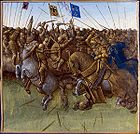 During the Roman period, they successfully subdued the Gauls in 52 BC and began developing Cenabum which they named Aurelianis and also began building the city of Caesarodunum, now Tours, from AD 1. The Romans
used the Loire as far as Roanne
, only around 150 km (93.2 mi) from the source. After AD 16, the Loire river valley became part of the Roman province of Aquitania
, with its capital at Avaricum
. From the 3rd century, Christianity spread through the river basin and many religious figures began cultivating vineyards along the river banks. In the 5th century, the Roman Empire
declined and the Franks
and the Alemanni came to the area from the east. Following this there was ongoing belligerence between the Franks and the Visigoths. In the 9th century, the Viking
s began invading the west coast of France and used long ships to navigate the Loire. In 853 they ruined Tours and its famous abbey, later ruining Angers in 854 and 872. In 877 Charles the Bald
died, marking an end to the Carolingian dynasty. After considerable conflict in the region, in 898 Foulques le Roux of Anjou
gained power.
from 1337 to 1453, the Loire River marked the border between the French and the English. One-third of the inhabitants died from the Black Death
of 1348–9. The English defeated the French in 1356 and Aquitaine
became English in 1360. In 1429, Joan of Arc
persuaded Charles VII
to banish the English from the country. Her successful relief of the siege
of Orléans
, on the Loire, was the turning point of the war. In 1477, the first printing press
in France was established in Angers, and around this time the Chateau de Langeais
was built. During the reign of Francois I from 1515 to 1547, the Italian Renaissance
had a profound impact upon the region, and became deeply ingrained in the architecture and culture of the region, particularly among the elite and their chateau
s. In the 1530s, the Reformation
ideas reached the Loire valley and in 1560 Catholics drowned several hundred Protestants in the river. During the Wars of Religion from 1562 to 1598, Orleans served as a prominent stronghold for the Huguenots but in 1568 Orleans Cathedral was blown up by the Protestants. In 1572 the St. Bartholomew's Day massacre
saw some 3000 Huguenots slaughtered in Paris, followed by the drowning of hundreds of them by the Protestants in the Loire River.
River traffic increased gradually, with a toll system being used in medieval times. Today some of these toll bridges still remain, dated to over 800 years. During the 17th century, Jean-Baptiste Colbert
instituted stone retaining walls and quays from Roanne to Nantes
which helped make the river more reliable, but navigation was frequently stopped by flood and drought. In 1707, floods were said to have drowned 50,000 people, with the water rising more than 3 m (9.8 ft) in two hours in Orléans
. A typical passenger timetable from Orléans to Nantes took eight days, with the upstream journey against the flow taking fourteen.
Steam-driven passenger boats appeared soon after the beginning of the 19th century plying the river between Nantes and Orléans; by 1843, 70,000 passengers were being carried annually in the Lower Loire and 37,000 in the Upper Loire. However with the introduction of the railway in the 1840s trade on the river steadily declined and proposals to build a fully navigable river up to Briare
came to nothing. The opening of the Canal latéral à la Loire
in 1838 enabled navigation between Digoin and Briare to continue, but the river level crossing at Briare remained a problem until the construction of the Briare aqueduct
in 1896, which at 662.69 metres was the longest such structure in the world for quite some time.
The Canal de Roanne à Digoin
was also opened in 1838 and was nearly closed in 1971 but still provides navigation further up the Loire valley to Digoin. However the 261 km (162.2 mi) Canal de Berry
, a narrow canal with locks only 2.7 m (8.9 ft) wide, which was opened in 1820s and connected the Canal latéral à la Loire at Marseilles-lès-Aubigny
to the Cher River
at Noyers
and back into the Loire near Tours, was closed in 1955. Today the river is only officially navigable as far as Bouchemaine
, where the Maine
joins it near Angers
, together with a short stretch much further upstream at Decize
, where a river level crossing from the Canal latéral à la Loire
connects to the Canal du Nivernais
.
Timeline
The monarchy of France ruled in the Loire Valley for several centuries and as a result it got the title “The Valley of Kings”. Starting with the Gauls, followed by the Romans, then the Frankish Dynasty
who were succeeded by the kings of France who ruled from late 14th century till the French Revolution
and all of rulers were responsible for the development of the valley. The chronology of the rulers is presented in the table below.
, in springs to the south side of Mont Gerbier de Jonc
at 44°50′38"N 4°13′12"E. This lies in the north-eastern part of the southern Cévennes
highlands, in the Ardèche
commune of Sainte-Eulalie
of southeastern France. It is originally a mere trickle of water
located at 1408 m (4,619.4 ft) above sea level. The presence of a groundwater
under Mont Gerbier de Jonc gives rise to multiple sources, three of them located at the foot of Mount have been highlighted as river sources. The three streams converge to form the Loire, which descends the valley south of Mount through the village of Sainte-Eulalie itself.
The Loire River changed its course, due to tectonic deformations, from the original outfall into the English Channel
to its new outfall into the Atlantic Ocean thereby creating the presently seen narrow terrain of gorges, the Loire Valley with alluvium formations and the long stretch of beaches along the Atlantic Ocean. The river can be divided into three main zones; the Upper Loire which is the area from the source to the confluence with the Allier, the middle Loire Valley which is the area from the Allier to the confluence with the Maine, about 280 km (174 mi), and the Lower Loire which is the area from Maine to the estuary. In the upper basin the river flows through a narrow, incised valley, marked by gorges and forests on the edges and a distinct low population. In the intermediate section, the alluvial plain broadens and the river meanders and forks into multi-channels. River flow is particularly high in the river area near Roanne and Vichy up to the confluence with the Allier. In the middle section of the river in the Loire Valley, numerous dikes built between the 12th and 19th century exist, providing mitigation against flooding. In this section the river is relatively straight, except for the area near Orleans
and numerous sand banks and islands exist. The lower course of the river is characterized by wetlands and fens, which are of major importance to conservationists given that they from unique habitats for migratory birds.
The Loire flows roughly northward through Roanne
and Nevers
to Orléans
and thereafter westward through Tours
to Nantes
, where it forms an estuary
. It flows into the Atlantic Ocean
at 47°16′44"N 2°10′19"W between Saint-Nazaire
and Saint-Brevin-les-Pins
, connected by a bridge over the river near its mouth. Several départements of France were named after the Loire. The Loire flows through the following départements and towns: Ardèche
, Haute-Loire
: Le Puy-en-Velay
, Loire
: Feurs
, Roanne
, Saône-et-Loire
: Digoin
, Allier
, Nièvre
: Decize
, Nevers
, La Charité-sur-Loire
, Cosne-Cours-sur-Loire
, Cher
: Sancerre
, Loiret
: Briare
, Gien
, Orléans
, Loir-et-Cher
: Blois
, Indre-et-Loire
: Amboise
, Tours
, Maine-et-Loire
: Saumur
, Loire-Atlantique
: Ancenis
, Nantes
, Saint-Nazaire
.
The Loire Valley in the Loire River basin, is a 300 km (186.4 mi) stretch in the western reach of the river starting with Orleans and terminating at Nantes
, 56 km (34.8 mi) short of the Loire estuary and the Atlantic Ocean). The tidal stretch of the river extends to a length of 60 km (37.3 mi) and a width of 3 km (1.9 mi), which has oil refineries, the port of St-Nazaire and 40000 hectares (98,842.1 acre) of wetland whose formation is dated to 7500 BC (caused by inundation by sea waters on the northern bank of the estuary), and the beaches of Le Croisic
and La Baule along the coast line.
, Nièvre and the Erdre rivers on its right bank, and the Allier
, Cher
, Indre
, Vienne
, and the Sèvre Nantaise
rivers on the left bank. The largest tributary of the river is the Allier River
, 410 km (254.8 mi) in length, which joins the Loire near the town of Nevers
at 46°57′34"N 3°4′44"E. Downstream of Nevers lies the Loire Valley
, a UNESCO World Heritage Site due to its fine assortment of castles. The second longest tributary is the 372 km (231.2 mi) Vienne River
which joins the Loire at Candes-Saint-Martin
at 47°12′45"N 0°4′31"E, followed by the 367.5 km (228.4 mi) Cher River
, which joins the Loire near Cinq-Mars-la-Pile
at 47°20′33"N 0°28′49"E and the 287 km (178.3 mi) Indre River
, which joins the Loire near Néman
at 47°14′2"N 0°11′0"E.
The middle stretches of the river has many limestone caves which were inhabited in the prehistoric era; the caves are several types of limestone formations, namely tuffeau (a porous type of chalk
, not to be confused with tufa
) and Falun
(formed 12 million years ago). The coastal zone shows hard dark stones, granite, schists and thick soil mantle.

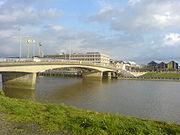 The river has a discharge rate of 863 m3/s, which is an average over the period 1967–2008.
The discharge rate varies strongly along the river, with roughly 350 m3/s at Orleans and 900 m3/s at the mouth. It also depends strongly on the season, and the flow of only 10 m3/s is not uncommon in August–September near Orleans. During floods, which usually occur in February–March but also in other periods, the flow sometimes exceeds 2000 m3/s for the Upper Loire and 8000 m3/s in Lower Loire. The most serious floods occurred in 1856, 1866 and 1911. Unlike most other rivers in western Europe, there are very few dam
s or locks creating obstacles to its natural flow. The flow is partly regulated by three dams: Grangent Dam and Villerest Dam on the Loire and Naussac Dam on the Allier River
. The Villerest dam, built in 1985 a few kilometres south of Roanne
, has played a key-role in preventing recent flooding. As a result, the Loire is a very popular river for boating excursions, flowing through a pastoral countryside, past limestone cliffs and historic castles
. Four nuclear power plants are located on the river: Belleville, Chinon, Dampierre and Saint-Laurent.
The Loire Valley, in particular, enjoys a salubrious temperate climate. The region experiences a rainfall of 690 mm along the coast and 648 mm inland.
, beech
and pine
. In the marshy lands, ash
, alder
and willows are grown with duckweed providing the needed natural fertilizing effect. The Atlantic coast is home to several aquatic herbs, the important species is Salicornia, which is used as a culinary ingredient on account of its diuretic
value. Greeks
introduced vine
s. Romans introduced melons, apples, cherries, quinces and pear
s during the Middle Ages, apart from extracting saffron
from purple crocus
species in the Orleans
. Reine claude
(Prunus domestica italica
) tree species was planted in the gardens of the Château. Asparagus
was also brought from northwestern France.
and Bassin Parisien south and in its Lower course partly through South Atlantic and Brittany.
. They are then joined by multicelluar forms including Fragilaria crotonensis, Nitzschia fruticosa and Skeletonema potamos, as well as green algae which form star-shaped or prostrate colonies. Whereas the total biomass is low in the upper reaches, the biodiversity is high, with more than 250 taxa at Orleans. At high flows and in the upper reaches the fraction of the green algae decrease and the phytoplankton is dominated by diatoms. Heterotroph
ic bacteria are represented by cocci
(49%), rods
(35%), colonies (12%) and filaments (4%) with a total density of up to 1.4 cells/L.
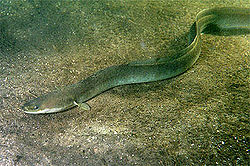 Nearly every freshwater fish species of France can be found in the Loire river basin, that is about 57 species from 20 families. Many of them are migratory, with 11 species ascending the river for spawning. The most common species are the Atlantic salmon
(Salmo salar), sea trout (Salmo trutta), shad
s (Alosa alosa and Alosa fallax), sea lamprey (Petromyzon marinus) European river lamprey (Lampetra fluviatilis) and smelt (Osmerus eperlanus). The European eel
(Anguilla anguilla) is common in the upper streams, whereas the flounder (Platichtys flesus) and flathead mullet
(Mugil spp.) tend to stay near the river mouth. The tributaries host brown trout
(Salmo trutta), European bullhead
(Cottus gobio), European brook lamprey (Lampetra planeri), zander
(Sander lucioperca), nase
(Chondrostoma nasus and C. toxostoma) and wels catfish
(Siluris glanis). The endangered species include grayling
(Thymallus thymallus), burbot
(Lota lota) and bitterling
(Rhodeus sericeus) and the on-native species are represented by the rock bass
(Ambloplites rupestris).
Although only one native fish species become extinct in the Loire river, namely the European sea sturgeon
(Acipenser sturio) in the 1940s, the fish population is declining, mostly due to the decrease in the spawning areas. The latter are mostly affected by the industrial pollution, construction of dams and drainage of oxbow
s and swamps. The loss of spawning grounds mostly affects the pike (Esox lucius), which is the major predator of the Loire, as well as eel, carp, rudd and salmon. The great Loire salmon, a subspecies of Atlantic salmon
, is regarded as the symbolic fish of the river. Its population has decreased from about 100,000 in the 19th century to below 100 in the 1990s that resulted in the adoption of a total ban of salmon fishing in the Loire basin in 1984. A salmon restoration program was initiated in the 1980s and included such as measures as removal of two obsolete hydroelectric dams and introduction of juvenile stock. As a result, the salmon population increased to about 500 in 2005.
 Most amphibians of the Loire are found in the slow flow areas near the delta, especially in the floodplain, marshes and oxbows. They are dominated by the fire salamander
(Salamandra salamandra), frogs and toads. The toads include Bufo bufo
, Alytes obstetricans
, Bombina variegata
, Bufo calamita
, Pelobates fuscus and Pelobates cultripes
. The frogs are represented by the Parsley frog (Pelodites punctatus), European tree frog
(Hyla arborea), Common Frog
(Rana temporaria), Agile Frog
(R. dalmatina), Edible Frog
(R. esculenta), Perez's Frog
(R. perezi), marsh frog (R. ridubunda) and Pool Frog
(R. lessonae). Newts of the Loire include the Marbled Newt
(Triturus marmoratus), Smooth Newt
(T. vulgaris), Alpine Newt
(T. alpestris) and Palmate Newt
(T. helveticus).
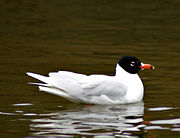 The Loire River hosts about 64% of nesting bird species of France, that is 164 species, of which 54 are water birds, 44 species are common for managed forests, 41 to natural forests, 13 to open and 12 to rocky areas. This avifauna has been rather stable, at least between 1980s and 2000s, with significant abundance variations observed only for 17 species. Of those, 5 species were growing in population, 4 declining, and other 8 were fluctuating. Some of these variations had a global nature, such as the expansion of the Mediterranean gull
in Europe.
In 1986, the French government, the Loire-Brittany Water Agency and the EPALA settled an agreement on flood prevention and water
storage programme in the basin, involving construction of four large dams, one on the Loire itself and three on the Allier and Cher. The French government proposed a construction of a dam at Serre de la Fare on the upper Loire River which would have been an environmental catastrophe, as it would have inundated some 20 km (12.4 mi) of pristine gorges. As a result the WWF and other NGOs established the Loire Vivante (Living Loire) network in 1988 to oppose the Serre de la Fare dam scheme and arranged an initial meeting with the French Minister of the Environment. The French government initially rejected the conservation concerns and in 1989 gave the dam projects the green light. This sparked public demonstrations by the WWF and conservation groups. In 1990, Loire Vivante met with the French Prime Minister and the government, this time successfully as the government later demanded that the EPALA embark upon major reforms in its approach to managing the river. Due to extensive lobbying, the proposal and the other dam proposals were eventually rejected in the 1990s and the Serre de la Fare area has since been protected as a ‘Natura 2000’ site under European Union environmental legislation.
The WWF were particularly important in changing the perception of the French authorities in support for dam building to environmental protection and sustainable management of its river basin. In 1992, they aided the ‘Loire Nature’ project, which received funds of some $US 9 million under the EU’s ‘LIFE’ programme until 1999, embarking upon restoration to the river's ecosystems and wildlife. That year, the Upper Loire Valley Farmers Association was also established through a partnership between SOS Loire Vivante and a farmers’ union to promote sustainable rural tourism. The French government adopted the Natural Loire River Plan (Plan Loire Grandeur Nature) in January 1994, initiating the decommissioning of three dams on the river. The final dam was decommissioned by Électricité de France
at a cost of 7 million francs in 1998. The basis of the decision was that the economic benefits of the dams did not outweigh their significant ecological impacts, so the intention was to restore the riverine ecosystems and replenish great Loire salmon stocks. The Loire is unique in this respect as the Atlantic Salmon can swim as far as 900 km (559.2 mi) up the river and spawn in the upper reaches of the Allier River. The French government undertook this major plan, chiefly because pollution and overfishing had reduced approximately 100,000 salmon migrating annually to their spawning grounds in the headwaters of the Loire and its tributaries to just 67 salmon in 1996 on the upper Allier.
The WWF, BirdLife International
, and local conservation bodies have also made considerable efforts to improve the conservation of the Loire estuary and its surroundings, given that they are unique habitats for migrating birds. The estuary and its shoreline are also important for fishing, shellfish farming and tourism. The major commercial port at Nantes
has caused severe damage to the ecosystem of the Loire estuary.
In 2002, the WWF aided a second Loire Nature project and expanded its cope to the entire basin, addressing some 4500 hectares (11,119.7 acre) of land under a budget of US$18 million, mainly funded by government and public bodies, such as the Établissement Publique Loire (EPL), a public institution which had formerly advocated large scale dam projects on the river.
(the Falcon). However, one of the oldest such structures in France is the Donjon de Foulques Nerra
of 944 AD vintage.
This style was replaced by the religious architectural style in the 12 and 14th century when the impregnable château fortresses were built on top of rocky hills; one of the impressive fortresses of this type is the Château de Andrex, which has 17 gruesome towers. This was followed by aesthetically built Châteaus (to also function as residential units), which substituted the quadrangular lay out of the “keep.” However, the exterior defensive structures, in the form of portcullis
and moats surrounding the thick walls of the Château forts were retained. There was further refinement in the design of the châteaus in the 15th century before the Baroque style came into prominence with decorative and elegantly designed interiors and which became fashionable from the 16th to end of 18th century.
The Baroque style artists who created some of the exquisite château structures were: The Paris
ian, Francois Mansart
(1598–1662) whose classical symmetrical design is seen in the Château de Blois
; Jacquis Boogier (1635) of Blois
whose classical design is the Château de Cheverny
; Guillaume Bautru
remodelled the Château de Serrant
(at the extreme western end of the valley). In the 17th century, there was feverish pace in the design the château for introducing exotic styles; a notable structure of this period is the Pagode de Chanteloup at Amboise
, which was built between 1773 and 1778.
The Neoclassical architectural style
, was a revival of Classical style of architecture
, which emerged in the mid 18th century; one such notable structure is the Château de Menars
built by Jacques Ange Gabriel (1698–1782) who was the royal architect in the court of Louis XV
(1715–74). This style was perpetuated during the reign of Louis XVI
(1774–92) but with more refinements; one such refined château seen close to Angers
is the Château de Montgeoffroy
. Furnishings inside the châteaus also witnessed changes to suit the living styles of its occupants. Gardens, both ornamental fountains, foot paths flower beds and tended grass) and kitchen type (to grow vegetables), also accentuated the opulence of the châteaus.
During the French Revolution
(1789), however, there was a radical change for the worst conditions in the scenarios of the chateaus, as monarchy
ended in France.
lies in the middle stretch of the river and lasts for about 280 km (174 mi) and comprising an area of roughly 800 km² (308.9 sq mi). It is also known as the Garden of France due to the abundance of vineyard
s, fruit orchards, artichoke
, asparagus
and cherry
fields which line the banks of the river. and the Cradle of the French Language. It is also noteworthy for the quality of its architectural heritage, in its historic towns such as Amboise
, Angers
, Blois
, Chinon
, Nantes
, Orléans
, Saumur
, and Tours
, but in particular for its castles, such as the Château
x d'Amboise
, Château de Chambord
, château d'Ussé
, Château de Villandry
and Chenonceau
and more particularly its many cultural monuments, which illustrate the ideals of the Renaissance
and the Age of the Enlightenment on western European thought and design.
On December 2, 2000, UNESCO
added the central part of the Loire River valley, between Maine
and Sully-sur-Loire
, to its list of World Heritage Sites. In choosing this area that includes the French départements of Loiret
, Loir-et-Cher
, Indre-et-Loire
, and Maine-et-Loire
, the committee said that the Loire Valley is:
"an exceptional cultural landscape, of great beauty, historic cities and villages, great architectural monuments – the Châteaux – and lands that have been cultivated and shaped by centuries of interaction between local populations and their physical environment, in particular the Loire itself."
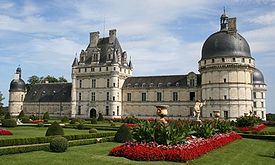 The château
x, numbering more than three hundred, represent a nation of builders starting with the necessary castle
fortification
s in the 10th century to the splendour of those built half a millennium later. When the French kings began constructing their huge châteaux here, the nobility, not wanting or even daring to be far from the seat of power, followed suit. Their presence in the lush, fertile valley began attracting the very best landscape designers. Today, these privately owned châteaux serve as homes, a few open their doors to tourist visits, while others are operated as hotels or bed and breakfasts. Many have been taken over by a local government authority or the giant structures like those at Chambord
are owned and operated by the national government and are major tourist sites, attracting hundreds of thousands of visitors each year. Some notable Châteaux on the Loire include Beaufort- Mareuil sur Cher – Lavoûte-Polignac – Bouthéon – Montrond – Bastie d'Urfé – Château féodal des Cornes d'Urfé – La Roche – Château féodal de Saint-Maurice-sur-Loire
– Saint-Pierre-la-Noaille – Chevenon – Palais ducal de Nevers – Saint-Brisson – Gien – La Bussière – Pontchevron – La Verrerie (near Aubigny-sur-Nère
) – Sully-sur-Loire
– Châteauneuf-sur-Loire – Boisgibault – Meung-sur-Loire – Menars
– Talcy
– Château de la Ferté – Chambord
– Blois
– Villesavin – Cheverny
– Beauregard – Troussay
– Château de Chaumont
– Amboise
– Clos-Lucé – Langeais
– Gizeux
– Les Réaux – Montsoreau
– Montreuil-Bellay
– Saint-Loup-sur-Thouet – Saumur
– Boumois – Brissac
– Montgeoffroy
– Plessis-Bourré
– Château des Réaux
regions situated along the Loire River from the Muscadet
region near the city of Nantes
on the Atlantic coast to the region of Sancerre
and Pouilly-Fumé
just southeast of the city of Orléans
in north central France
. In between are the regions of Anjou
, Saumur, Bourgueil
, Chinon, and Vouvray
. The Loire Valley
itself follows the river through the Loire
province to the river's origins in the Cévennes
but the majority of the wine production takes place in the regions noted above.

 The Loire Valley has a long history of winemaking
dating back to the 1st century. In the High Middle Ages
, the wines of the Loire Valley were the most esteemed wines in England
and France, even more prized than those from Bordeaux
. Archaeological evidence suggest that the Romans
planted the first vineyards in the Loire Valley during their settlement of Gaul
in the 1st century AD. By the 5th century, the flourishing viticulture
of the area was noted in a publication by the poet Sidonius Apollinaris
. In his work the History of the Franks, Bishop Gregory of Tours
wrote of the frequent plundering by the Breton
s of the area's wine stocks. By the 11th century the wines of Sancerre had a reputation across Europe for their high quality. Historically the wineries of the Loire Valley have been small, family owned operations that do a lot of estate bottling. The mid 1990s saw an increase in the number of négociant
and co-operative to where now about half of Sancerre and almost 80% of Muscadet is bottled by a négociant or co-op.
The Loire river has a significant effect on the mesoclimate of the region, adding the necessary extra few degree
s of temperature that allows grapes to grow when the areas to the north and south of the Loire Valley have shown to be unfavourable to viticulture. In addition to finding vineyards along the Loire, several of the river's tributaries
are also well planted-including the Allier
, Cher
, Indre
, Loir
, Sèvre Nantaise
and Vienne River
s. The climate can be very cool with spring time frost
being a potential hazard for the vines. During the harvest
months rain can cause the grapes to be harvested under ripe but can also aid in the development of Botrytis cinerea
for the region's dessert wines.
The Loire Valley has a high density
of vine plantings with an average of 1,600–2,000 vines per acre (4,000–5,000 per hectare
). Some Sancerre vineyards have as many as 10,000 plants per hectare. With more vines competing for the same limited resources in the soil, the density is designed to compensate for the excessive yield
s that some of the grape varieties, like Chenin blanc, are prone to have. In recent times, pruning
and canopy management have started to limit yields more effectively.
The Loire Valley is often divided into three sections. The Upper Loire includes the Sauvignon blanc dominated areas of Sancerre
and Pouilly-Fumé. The Middle Loire is dominated by more Chenin blanc and Cabernet franc wines found in the regions around Touraine
, Saumur
, Chinon
and Vouvray
. The Lower Loire that leads to the mouth of the river's entrance to the Atlantic goes through the Muscadet region which is dominated by wines of the Melon de Bourgogne grape. Spread out across the Loire Valley are 87 appellation under the AOC, VDQS and Vin de Pays systems. There are two generic designation that can be used across the whole of the Loire Valley. The Crémant de Loire which refers to any sparkling wine made according to the traditional method of Champagne. The Vin de Pays du Jardin de la France refers to any varietal
ly labelled wine, such as Chardonnay
, that is produced in the region outside of an AOC designation.
The area includes 87 appellation
s under the Appellation d'origine contrôlée
(AOC), Vin Délimité de Qualité Superieure (VDQS) and Vin de pays
systems. While the majority of production is white wine from the Chenin blanc
, Sauvignon blanc
and Melon de Bourgogne
grapes, there are red wines made (especially around the Chinon
region) from Cabernet franc
. In addition to still wines, rosé
, sparkling
and dessert wine
s are also produced. With Crémant production throughout the Loire, it is the second largest sparkling wine producer in France after Champagne. Among these different wine styles, Loire wines tend to exhibit characteristic fruitiness with fresh, crisp flavours-especially in their youth.
River
A river is a natural watercourse, usually freshwater, flowing towards an ocean, a lake, a sea, or another river. In a few cases, a river simply flows into the ground or dries up completely before reaching another body of water. Small rivers may also be called by several other names, including...
in France
France
The French Republic , The French Republic , The French Republic , (commonly known as France , is a unitary semi-presidential republic in Western Europe with several overseas territories and islands located on other continents and in the Indian, Pacific, and Atlantic oceans. Metropolitan France...
. With a length of 1012 kilometres (628.8 mi), it drains an area of 117054 km² (45,194.8 sq mi), which represents more than a fifth of France's land area. It is the 170th longest river in the world. It rises in the Cévennes
Cévennes
The Cévennes are a range of mountains in south-central France, covering parts of the départements of Gard, Lozère, Ardèche, and Haute-Loire.The word Cévennes comes from the Gaulish Cebenna, which was Latinized by Julius Caesar to Cevenna...
in the département of Ardèche
Ardèche
Ardèche is a department in south-central France named after the Ardèche River.- History :The area has been inhabited by humans at least since the Upper Paleolithic, as attested by the famous cave paintings at Chauvet Pont d'Arc. The plateau of the Ardeche River has extensive standing stones ,...
at 1350 m (4,429.1 ft) near Mont Gerbier de Jonc
Mont Gerbier de Jonc
Mont Gerbier de Jonc is a mountain located in the Massif Central in France. It rises to an altitude of 1,551 m , and at its base contains three springs that are the source of the Loire, France's longest river. It is the second most-visited site in the département of Ardèche, after the Ardèche Gorges....
, and flows for over 1000 km (621.4 mi) north through Nevers
Nevers
Nevers is a commune in – and the administrative capital of – the Nièvre department in the Bourgogne region in central France...
to Orléans
Orléans
-Prehistory and Roman:Cenabum was a Gallic stronghold, one of the principal towns of the Carnutes tribe where the Druids held their annual assembly. It was conquered and destroyed by Julius Caesar in 52 BC, then rebuilt under the Roman Empire...
, then west through Tours
Tours
Tours is a city in central France, the capital of the Indre-et-Loire department.It is located on the lower reaches of the river Loire, between Orléans and the Atlantic coast. Touraine, the region around Tours, is known for its wines, the alleged perfection of its local spoken French, and for the...
and Nantes
Nantes
Nantes is a city in western France, located on the Loire River, from the Atlantic coast. The city is the 6th largest in France, while its metropolitan area ranks 8th with over 800,000 inhabitants....
until it reaches the Bay of Biscay
Bay of Biscay
The Bay of Biscay is a gulf of the northeast Atlantic Ocean located south of the Celtic Sea. It lies along the western coast of France from Brest south to the Spanish border, and the northern coast of Spain west to Cape Ortegal, and is named in English after the province of Biscay, in the Spanish...
at St Nazaire. Its main tributaries include the Maine
Maine River
La Maine is a river , a tributary of the Loire, 12 km long, in the Maine-et-Loire département in France....
, Nièvre and the Erdre rivers on its right bank, and the Allier
Allier River
The Allier is a river in central France, and is the left tributary to the Loire River. Its source is in the Massif Central, in the Lozère département, east of Mende. It flows generally north...
, Cher
Cher River
The Cher is a river in central France, left tributary to the river Loire. Its source is in the Creuse département, north-east of Crocq. It joins the river Loire in Villandry, west of Tours....
, Indre
Indre River
The Indre is a river in central France, left tributary to the river Loire.Its source is in the département Cher, near Préveranges. It flows through the départements Cher, Indre and Indre-et-Loire...
, Vienne
Vienne River
The Vienne is one of the most important rivers in south-western France, a significant left tributary of the lower Loire. It supports numerous hydro-electric dams, and it is the main river of the Limousin region and also of the eastern part of the Poitou-Charentes region.Two French départements are...
, and the Sèvre Nantaise
Sèvre Nantaise
The Sèvre Nantaise is a river in western France, left tributary to the river Loire. Its source is in the Deux-Sèvres département, near Secondigny.It flows through the following départements and towns:*Deux-Sèvres: Moncoutant, La Forêt-sur-Sèvre...
rivers from the left bank. The Loire gives its name to six départements: Loire
Loire
Loire is an administrative department in the east-central part of France occupying the River Loire's upper reaches.-History:Loire was created in 1793 when after just 3½ years the young Rhône-et-Loire department was split into two. This was a response to counter-Revolutionary activities in Lyon...
, Haute-Loire
Haute-Loire
Haute-Loire is a department in south-central France named after the Loire River.-History:Haute-Loire is one of the original 83 departments created during the French Revolution on 4 March 1790...
, Loire-Atlantique
Loire-Atlantique
Loire-Atlantique is a department on the west coast of France named after the Loire River and the Atlantic Ocean.-History:...
, Indre-et-Loire
Indre-et-Loire
Indre-et-Loire is a department in west-central France named after the Indre and the Loire rivers.-History:Indre-et-Loire is one of the original 83 départements created during the French Revolution on 4 March 1790...
, Maine-et-Loire
Maine-et-Loire
Maine-et-Loire is a department in west-central France, in the Pays de la Loire region.- History :Maine-et-Loire is one of the original 83 departments created during the French Revolution on March 4, 1790. Originally it was called Mayenne-et-Loire, but its name was changed to Maine-et-Loire in 1791....
, and Saône-et-Loire
Saône-et-Loire
Saône-et-Loire is a French department, named after the Saône and the Loire rivers between which it lies.-History:When it was formed during the French Revolution, as of March 4, 1790 in fulfillment of the law of December 22, 1789, the new department combined parts of the provinces of southern...
. The central part of the Loire Valley
Loire Valley
The Loire Valley , spanning , is located in the middle stretch of the Loire River in central France. Its area comprises approximately . It is referred to as the Cradle of the French Language, and the Garden of France due to the abundance of vineyards, fruit orchards, and artichoke, asparagus, and...
was added to the World Heritage Sites list of UNESCO
UNESCO
The United Nations Educational, Scientific and Cultural Organization is a specialized agency of the United Nations...
on December 2, 2000. The banks are characterized by vineyards
Loire Valley (wine)
The Loire Valley wine region includes the French wine regions situated along the Loire River from the Muscadet region near the city of Nantes on the Atlantic coast to the region of Sancerre and Pouilly-Fumé just southeast of the city of Orléans in north central France. In between are the regions of...
and chateaux
Châteaux of the Loire Valley
The châteaux of the Loire Valley are part of the architectural heritage of the historic towns of Amboise, Angers, Blois, Chinon, Nantes, Orléans, Saumur, and Tours along the Loire River in France...
in the Loire Valley.
Historicity of the Loire River valley begins with the earliest Middle Palaeolithic period 40-90 ka
Ka
-Language:* Ka * Ka * Georgian language, ISO 639-1 code ka* A glyph in the Brahmic family of scripts-Media and entertainment:* Ka * Kà, a Cirque du Soleil show* Mister Mosquito, a video game, known in Japan as Ka...
(thousand years ago), followed by the modern humans (30 ka), succeeded by the Neolithic period (6,000 to 4,500 BC) of the Stone Age
Stone Age
The Stone Age is a broad prehistoric period, lasting about 2.5 million years , during which humans and their predecessor species in the genus Homo, as well as the earlier partly contemporary genera Australopithecus and Paranthropus, widely used exclusively stone as their hard material in the...
and the Gauls
Gauls
The Gauls were a Celtic people living in Gaul, the region roughly corresponding to what is now France, Belgium, Switzerland and Northern Italy, from the Iron Age through the Roman period. They mostly spoke the Continental Celtic language called Gaulish....
, the inhabitants in the Loire during the Iron Age
Iron Age
The Iron Age is the archaeological period generally occurring after the Bronze Age, marked by the prevalent use of iron. The early period of the age is characterized by the widespread use of iron or steel. The adoption of such material coincided with other changes in society, including differing...
, in the period between 1500 and 500 BC. Gauls made it a major naval trading route by 600 BC establishing trade with the Greeks
Greeks
The Greeks, also known as the Hellenes , are a nation and ethnic group native to Greece, Cyprus and neighboring regions. They also form a significant diaspora, with Greek communities established around the world....
on the Mediterranean coast. Gallic rule ended in the valley in 56 BC with Julius Caesar
Julius Caesar
Gaius Julius Caesar was a Roman general and statesman and a distinguished writer of Latin prose. He played a critical role in the gradual transformation of the Roman Republic into the Roman Empire....
winning over this territory. Christianity
Christianity
Christianity is a monotheistic religion based on the life and teachings of Jesus as presented in canonical gospels and other New Testament writings...
made entry into this valley from 3rd century AD with many saints converting the pagans
Paganism
Paganism is a blanket term, typically used to refer to non-Abrahamic, indigenous polytheistic religious traditions....
. It was the time when the wineries also came to be established in the valley.
The Loire Valley has been called the "Garden of France" and is studded with over a thousand chateaux
Château
A château is a manor house or residence of the lord of the manor or a country house of nobility or gentry, with or without fortifications, originally—and still most frequently—in French-speaking regions...
, each with distinct architectural embellishments covering a wide range of variations, from the early medieval to the late Renaissance
Renaissance
The Renaissance was a cultural movement that spanned roughly the 14th to the 17th century, beginning in Italy in the Late Middle Ages and later spreading to the rest of Europe. The term is also used more loosely to refer to the historical era, but since the changes of the Renaissance were not...
periods. They were originally created as feudal strongholds, over centuries past, in the strategic divide between southern and northern France; now many are owned by private individuals.
Etymology
The name "Loire" comes from LatinLatin
Latin is an Italic language originally spoken in Latium and Ancient Rome. It, along with most European languages, is a descendant of the ancient Proto-Indo-European language. Although it is considered a dead language, a number of scholars and members of the Christian clergy speak it fluently, and...
Liger, which is itself a transcription of the native Gaulish (Celtic
Celtic languages
The Celtic languages are descended from Proto-Celtic, or "Common Celtic"; a branch of the greater Indo-European language family...
) name of the river. The Gaulish name comes from the Gaulish word liga, which means "silt, sediment, deposit, alluvium", a word that gave French
French language
French is a Romance language spoken as a first language in France, the Romandy region in Switzerland, Wallonia and Brussels in Belgium, Monaco, the regions of Quebec and Acadia in Canada, and by various communities elsewhere. Second-language speakers of French are distributed throughout many parts...
lie, as in sur lie, which in turn gave English
English language
English is a West Germanic language that arose in the Anglo-Saxon kingdoms of England and spread into what was to become south-east Scotland under the influence of the Anglian medieval kingdom of Northumbria...
lees
Lees (fermentation)
Lees refers to deposits of dead yeast or residual yeast and other particles that precipitate, or are carried by the action of "fining", to the bottom of a vat of wine after fermentation and ageing. The yeast deposits in beer brewing are known as trub...
. Liga comes from the Proto-Indo-European
Proto-Indo-European language
The Proto-Indo-European language is the reconstructed common ancestor of the Indo-European languages, spoken by the Proto-Indo-Europeans...
root *legh-, meaning "to lie, lay", which gave many words in English, such as to lie, to lay, ledge, law, etc.
Prehistoric period
Studies of the palaeogeography of the region suggest that in the PleistocenePleistocene
The Pleistocene is the epoch from 2,588,000 to 11,700 years BP that spans the world's recent period of repeated glaciations. The name pleistocene is derived from the Greek and ....
the palaeo-Loire continued its northward flow and joined the Seine
Seine
The Seine is a -long river and an important commercial waterway within the Paris Basin in the north of France. It rises at Saint-Seine near Dijon in northeastern France in the Langres plateau, flowing through Paris and into the English Channel at Le Havre . It is navigable by ocean-going vessels...
, while the lower Loire found its source upstream of Orléans
Orléans
-Prehistory and Roman:Cenabum was a Gallic stronghold, one of the principal towns of the Carnutes tribe where the Druids held their annual assembly. It was conquered and destroyed by Julius Caesar in 52 BC, then rebuilt under the Roman Empire...
in the region of Gien
Gien
Gien is a commune in the Loiret department in north-central France.Gien is on the Loire River, from Orléans. The town was bought for the royal property by Philip II of France. The town is twinned with Malmesbury in England.-Sights:*Faience de Gien...
, flowing westward along the present course. At a certain point during the long history of uplift in the Paris Basin
Paris Basin (geology)
The Paris Basin is one of the major geological regions of France having developed since the Triassic on a basement formed by the Variscan orogeny.-Extent:...
, the lower, Atlantic Loire captured the "palaeo-Loire" or Loire séquanaise ("Loire-Seine"), producing the present river. The former bed of the Loire séquanaise is occupied by the Loing
Loing
The Loing is a 142 km long river in central France, a left tributary of the Seine. Its source is in Sainte-Colombe-sur-Loing, in the south of the Yonne département.The Loing flows into the Seine in Saint-Mammès, near Moret-sur-Loing...
.
The Loire Valley has been inhabited since the Middle Palaeolithic period from 40—90 ka. Neanderthal
Neanderthal
The Neanderthal is an extinct member of the Homo genus known from Pleistocene specimens found in Europe and parts of western and central Asia...
man made boats out of tree trunks and stone tools and navigated the river. Modern man inhabited the Loire valley around 30 ka. By around 5000 to 4000 BC they began clearing forests along the river edges and cultivating the lands and rearing livestock. They built megalith
Megalith
A megalith is a large stone that has been used to construct a structure or monument, either alone or together with other stones. Megalithic describes structures made of such large stones, utilizing an interlocking system without the use of mortar or cement.The word 'megalith' comes from the Ancient...
s to worship the dead, especially from around 3500 BC. The Gauls arrived in the valley between 1500 and 500 BC and the Carnutes
Carnutes
The Carnutes, a powerful Celtic people in the heart of independent Gaul, dwelled in a particularly extensive territory between the Sequana and the Liger rivers. Their lands later corresponded to the dioceses of Chartres, Orléans and Blois, that is, the greater part of the modern departments of...
settled in Cenabum
Cenabum
Cenabum or Genabum was the name of an oppidum of the Carnutes tribe, situated on the site of what is now Orléans. It was a prosperous commercial city on the Loire River at the time of Caesar's conquest of Gaul.- History :...
in what is now Orleans and built a bridge over the river. By 600 BC the Loire had already become a very important trading route between the Celts and the Greeks
Greeks
The Greeks, also known as the Hellenes , are a nation and ethnic group native to Greece, Cyprus and neighboring regions. They also form a significant diaspora, with Greek communities established around the world....
and would become one of the great highways of France for over 2000 years. The Phoenicians and Greeks
Ancient Greece
Ancient Greece is a civilization belonging to a period of Greek history that lasted from the Archaic period of the 8th to 6th centuries BC to the end of antiquity. Immediately following this period was the beginning of the Early Middle Ages and the Byzantine era. Included in Ancient Greece is the...
had used pack horses to transport goods from Lyon
Lyon
Lyon , is a city in east-central France in the Rhône-Alpes region, situated between Paris and Marseille. Lyon is located at from Paris, from Marseille, from Geneva, from Turin, and from Barcelona. The residents of the city are called Lyonnais....
to the Loire to get from the Mediterranean basin to the Atlantic coast.
Ancient Rome and the Vikings
Ancient Rome
Ancient Rome was a thriving civilization that grew on the Italian Peninsula as early as the 8th century BC. Located along the Mediterranean Sea and centered on the city of Rome, it expanded to one of the largest empires in the ancient world....
used the Loire as far as Roanne
Roanne
Roanne is a commune in the Loire department in central France.It is located northwest of Lyon on the Loire River.-Economy:...
, only around 150 km (93.2 mi) from the source. After AD 16, the Loire river valley became part of the Roman province of Aquitania
Aquitania
Aquitania may refer to:* the territory of the Aquitani, a people living in Roman times in what is now Aquitaine, France* Aquitaine, a region of France roughly between the Pyrenees, the Atlantic ocean and the Garonne, also a former kingdom and duchy...
, with its capital at Avaricum
Avaricum
Avaricum was an oppidum in ancient Gaul, near what is now the city of Bourges. Avaricum, situated in the lands of the Bituriges, was the largest and best-fortified town within their territory, situated on very fertile lands...
. From the 3rd century, Christianity spread through the river basin and many religious figures began cultivating vineyards along the river banks. In the 5th century, the Roman Empire
Roman Empire
The Roman Empire was the post-Republican period of the ancient Roman civilization, characterised by an autocratic form of government and large territorial holdings in Europe and around the Mediterranean....
declined and the Franks
Franks
The Franks were a confederation of Germanic tribes first attested in the third century AD as living north and east of the Lower Rhine River. From the third to fifth centuries some Franks raided Roman territory while other Franks joined the Roman troops in Gaul. Only the Salian Franks formed a...
and the Alemanni came to the area from the east. Following this there was ongoing belligerence between the Franks and the Visigoths. In the 9th century, the Viking
Viking
The term Viking is customarily used to refer to the Norse explorers, warriors, merchants, and pirates who raided, traded, explored and settled in wide areas of Europe, Asia and the North Atlantic islands from the late 8th to the mid-11th century.These Norsemen used their famed longships to...
s began invading the west coast of France and used long ships to navigate the Loire. In 853 they ruined Tours and its famous abbey, later ruining Angers in 854 and 872. In 877 Charles the Bald
Charles the Bald
Charles the Bald , Holy Roman Emperor and King of West Francia , was the youngest son of the Emperor Louis the Pious by his second wife Judith.-Struggle against his brothers:He was born on 13 June 823 in Frankfurt, when his elder...
died, marking an end to the Carolingian dynasty. After considerable conflict in the region, in 898 Foulques le Roux of Anjou
Anjou
Anjou is a former county , duchy and province centred on the city of Angers in the lower Loire Valley of western France. It corresponds largely to the present-day département of Maine-et-Loire...
gained power.
Medieval period
During the Hundred Years' WarHundred Years' War
The Hundred Years' War was a series of separate wars waged from 1337 to 1453 by the House of Valois and the House of Plantagenet, also known as the House of Anjou, for the French throne, which had become vacant upon the extinction of the senior Capetian line of French kings...
from 1337 to 1453, the Loire River marked the border between the French and the English. One-third of the inhabitants died from the Black Death
Black Death
The Black Death was one of the most devastating pandemics in human history, peaking in Europe between 1348 and 1350. Of several competing theories, the dominant explanation for the Black Death is the plague theory, which attributes the outbreak to the bacterium Yersinia pestis. Thought to have...
of 1348–9. The English defeated the French in 1356 and Aquitaine
Aquitaine
Aquitaine , archaic Guyenne/Guienne , is one of the 27 regions of France, in the south-western part of metropolitan France, along the Atlantic Ocean and the Pyrenees mountain range on the border with Spain. It comprises the 5 departments of Dordogne, :Lot et Garonne, :Pyrénées-Atlantiques, Landes...
became English in 1360. In 1429, Joan of Arc
Joan of Arc
Saint Joan of Arc, nicknamed "The Maid of Orléans" , is a national heroine of France and a Roman Catholic saint. A peasant girl born in eastern France who claimed divine guidance, she led the French army to several important victories during the Hundred Years' War, which paved the way for the...
persuaded Charles VII
Charles VII of France
Charles VII , called the Victorious or the Well-Served , was King of France from 1422 to his death, though he was initially opposed by Henry VI of England, whose Regent, the Duke of Bedford, ruled much of France including the capital, Paris...
to banish the English from the country. Her successful relief of the siege
Siege of Orléans
The Siege of Orléans marked a turning point in the Hundred Years' War between France and England. This was Joan of Arc's first major military victory and the first major French success to follow the crushing defeat at Agincourt in 1415. The outset of this siege marked the pinnacle of English power...
of Orléans
Orléans
-Prehistory and Roman:Cenabum was a Gallic stronghold, one of the principal towns of the Carnutes tribe where the Druids held their annual assembly. It was conquered and destroyed by Julius Caesar in 52 BC, then rebuilt under the Roman Empire...
, on the Loire, was the turning point of the war. In 1477, the first printing press
Printing press
A printing press is a device for applying pressure to an inked surface resting upon a print medium , thereby transferring the ink...
in France was established in Angers, and around this time the Chateau de Langeais
Château de Langeais
The Château de Langeais is a castle in Indre-et-Loire, France, built on a promontory created by the small valley of the Roumer River at the opening to the Val de Loire...
was built. During the reign of Francois I from 1515 to 1547, the Italian Renaissance
Italian Renaissance
The Italian Renaissance began the opening phase of the Renaissance, a period of great cultural change and achievement in Europe that spanned the period from the end of the 13th century to about 1600, marking the transition between Medieval and Early Modern Europe...
had a profound impact upon the region, and became deeply ingrained in the architecture and culture of the region, particularly among the elite and their chateau
Château
A château is a manor house or residence of the lord of the manor or a country house of nobility or gentry, with or without fortifications, originally—and still most frequently—in French-speaking regions...
s. In the 1530s, the Reformation
Reformation
- Movements :* Protestant Reformation, an attempt by Martin Luther to reform the Roman Catholic Church that resulted in a schism, and grew into a wider movement...
ideas reached the Loire valley and in 1560 Catholics drowned several hundred Protestants in the river. During the Wars of Religion from 1562 to 1598, Orleans served as a prominent stronghold for the Huguenots but in 1568 Orleans Cathedral was blown up by the Protestants. In 1572 the St. Bartholomew's Day massacre
St. Bartholomew's Day massacre
The St. Bartholomew's Day massacre in 1572 was a targeted group of assassinations, followed by a wave of Roman Catholic mob violence, both directed against the Huguenots , during the French Wars of Religion...
saw some 3000 Huguenots slaughtered in Paris, followed by the drowning of hundreds of them by the Protestants in the Loire River.
1600–present
For centuries attempts were made to keep a navigable channel open by the use of wooden embankments and dredging.River traffic increased gradually, with a toll system being used in medieval times. Today some of these toll bridges still remain, dated to over 800 years. During the 17th century, Jean-Baptiste Colbert
Jean-Baptiste Colbert
Jean-Baptiste Colbert was a French politician who served as the Minister of Finances of France from 1665 to 1683 under the rule of King Louis XIV. His relentless hard work and thrift made him an esteemed minister. He achieved a reputation for his work of improving the state of French manufacturing...
instituted stone retaining walls and quays from Roanne to Nantes
Nantes
Nantes is a city in western France, located on the Loire River, from the Atlantic coast. The city is the 6th largest in France, while its metropolitan area ranks 8th with over 800,000 inhabitants....
which helped make the river more reliable, but navigation was frequently stopped by flood and drought. In 1707, floods were said to have drowned 50,000 people, with the water rising more than 3 m (9.8 ft) in two hours in Orléans
Orléans
-Prehistory and Roman:Cenabum was a Gallic stronghold, one of the principal towns of the Carnutes tribe where the Druids held their annual assembly. It was conquered and destroyed by Julius Caesar in 52 BC, then rebuilt under the Roman Empire...
. A typical passenger timetable from Orléans to Nantes took eight days, with the upstream journey against the flow taking fourteen.
Steam-driven passenger boats appeared soon after the beginning of the 19th century plying the river between Nantes and Orléans; by 1843, 70,000 passengers were being carried annually in the Lower Loire and 37,000 in the Upper Loire. However with the introduction of the railway in the 1840s trade on the river steadily declined and proposals to build a fully navigable river up to Briare
Briare
Briare is a commune in the Loiret department in north-central France.Briare, the Brivodorum of the Romans, is situated at the extremity of the Briare Canal, which unites the Loire and its lateral canal with the Loing and so with the Seine. The lateral canal of the Loire crosses the Loire near...
came to nothing. The opening of the Canal latéral à la Loire
Canal latéral à la Loire
The Canal Latéral à la Loire was constructed between 1827 and 1838 to connect the Canal de Briare at Briare and the Canal du Centre at Digoin, a distance of 196 km. It replaced the use of the River Loire which had reliability problems arising from winter floods and summer droughts...
in 1838 enabled navigation between Digoin and Briare to continue, but the river level crossing at Briare remained a problem until the construction of the Briare aqueduct
Briare aqueduct
The Briare Aqueduct carries the Canal latéral à la Loire over the River Loire on its journey to the River Seine in France. It replaced a river-level crossing from the canal to meet the Briare Canal that was hazardous in times of flood...
in 1896, which at 662.69 metres was the longest such structure in the world for quite some time.
The Canal de Roanne à Digoin
Canal de Roanne à Digoin
The Canal de Roanne à Digoin connects the Canal latéral à la Loire and Canal du Centre at Digoin to Roanne.-References:...
was also opened in 1838 and was nearly closed in 1971 but still provides navigation further up the Loire valley to Digoin. However the 261 km (162.2 mi) Canal de Berry
Canal de Berry
The Canal de Berry is a disused canal in France which links the Canal latéral à la Loire at Marseilles-lès-Aubigny with the Cher at Noyers rejoining the Loire near Tours. With a branch from Montluçon it provided of canal with locks wide from 1840 until its closure in 1955...
, a narrow canal with locks only 2.7 m (8.9 ft) wide, which was opened in 1820s and connected the Canal latéral à la Loire at Marseilles-lès-Aubigny
Marseilles-lès-Aubigny
Marseilles-lès-Aubigny is a commune in the Cher department in the Centre region of France.-Geography:A forestry and farming area comprising the village and several hamlets situated by the banks of the rivers Aubois and Loire, some east of Bourges, at the junction of the D44 and the D81 roads...
to the Cher River
Cher River
The Cher is a river in central France, left tributary to the river Loire. Its source is in the Creuse département, north-east of Crocq. It joins the river Loire in Villandry, west of Tours....
at Noyers
Noyers-sur-Cher
Noyers-sur-Cher is a commune in the Loir-et-Cher department of central France.-See also:*Communes of the Loir-et-Cher department...
and back into the Loire near Tours, was closed in 1955. Today the river is only officially navigable as far as Bouchemaine
Bouchemaine
Bouchemaine is a commune in the Maine-et-Loire department in western France....
, where the Maine
Maine River
La Maine is a river , a tributary of the Loire, 12 km long, in the Maine-et-Loire département in France....
joins it near Angers
Angers
Angers is the main city in the Maine-et-Loire department in western France about south-west of Paris. Angers is located in the French region known by its pre-revolutionary, provincial name, Anjou, and its inhabitants are called Angevins....
, together with a short stretch much further upstream at Decize
Decize
Decize is a commune in the Nièvre department in central France.-Site:The town is situated on a former island in the Loire at the confluent of the Aron river. The right channel of the Loire was dammed up to reclaim land and now remains as an arm stretching upstream to the centre of town...
, where a river level crossing from the Canal latéral à la Loire
Canal latéral à la Loire
The Canal Latéral à la Loire was constructed between 1827 and 1838 to connect the Canal de Briare at Briare and the Canal du Centre at Digoin, a distance of 196 km. It replaced the use of the River Loire which had reliability problems arising from winter floods and summer droughts...
connects to the Canal du Nivernais
Canal du Nivernais
The Canal du Nivernais links the Loire basin with the Seine basin following approximately the course of the river Yonne in a south to north direction....
.
Timeline
The monarchy of France ruled in the Loire Valley for several centuries and as a result it got the title “The Valley of Kings”. Starting with the Gauls, followed by the Romans, then the Frankish Dynasty
Frankish Empire
Francia or Frankia, later also called the Frankish Empire , Frankish Kingdom , Frankish Realm or occasionally Frankland, was the territory inhabited and ruled by the Franks from the 3rd to the 10th century...
who were succeeded by the kings of France who ruled from late 14th century till the French Revolution
French Revolution
The French Revolution , sometimes distinguished as the 'Great French Revolution' , was a period of radical social and political upheaval in France and Europe. The absolute monarchy that had ruled France for centuries collapsed in three years...
and all of rulers were responsible for the development of the valley. The chronology of the rulers is presented in the table below.
| Ruler | Period of reign | Remarks |
|---|---|---|
| Gauls Gauls The Gauls were a Celtic people living in Gaul, the region roughly corresponding to what is now France, Belgium, Switzerland and Northern Italy, from the Iron Age through the Roman period. They mostly spoke the Continental Celtic language called Gaulish.... |
1500-500BC | Iron Age Iron Age The Iron Age is the archaeological period generally occurring after the Bronze Age, marked by the prevalent use of iron. The early period of the age is characterized by the widespread use of iron or steel. The adoption of such material coincided with other changes in society, including differing... . Settled in Cenabum Cenabum Cenabum or Genabum was the name of an oppidum of the Carnutes tribe, situated on the site of what is now Orléans. It was a prosperous commercial city on the Loire River at the time of Caesar's conquest of Gaul.- History :... (Orleans) and Arabou. Trading along the Loire River |
| Romans Roman Empire The Roman Empire was the post-Republican period of the ancient Roman civilization, characterised by an autocratic form of government and large territorial holdings in Europe and around the Mediterranean.... |
52 BC-5th century | Spread of Christianity Christianity Christianity is a monotheistic religion based on the life and teachings of Jesus as presented in canonical gospels and other New Testament writings... among communities living along the Loire River banks and Benedictine Order prospered. |
| Frankish Dynasty Frankish Empire Francia or Frankia, later also called the Frankish Empire , Frankish Kingdom , Frankish Realm or occasionally Frankland, was the territory inhabited and ruled by the Franks from the 3rd to the 10th century... and Feudal Lords |
5th–10th centuries | Power struggles among feudal states. Charles Martel Charles Martel Charles Martel , also known as Charles the Hammer, was a Frankish military and political leader, who served as Mayor of the Palace under the Merovingian kings and ruled de facto during an interregnum at the end of his life, using the title Duke and Prince of the Franks. In 739 he was offered the... defeated Moors Moors The description Moors has referred to several historic and modern populations of the Maghreb region who are predominately of Berber and Arab descent. They came to conquer and rule the Iberian Peninsula for nearly 800 years. At that time they were Muslim, although earlier the people had followed... at Poitiers Poitiers Poitiers is a city on the Clain river in west central France. It is a commune and the capital of the Vienne department and of the Poitou-Charentes region. The centre is picturesque and its streets are interesting for predominant remains of historical architecture, especially from the Romanesque... preventing Muslim Muslim A Muslim, also spelled Moslem, is an adherent of Islam, a monotheistic, Abrahamic religion based on the Quran, which Muslims consider the verbatim word of God as revealed to prophet Muhammad. "Muslim" is the Arabic term for "submitter" .Muslims believe that God is one and incomparable... incursions. Attila, leader of Huns Huns The Huns were a group of nomadic people who, appearing from east of the Volga River, migrated into Europe c. AD 370 and established the vast Hunnic Empire there. Since de Guignes linked them with the Xiongnu, who had been northern neighbours of China 300 years prior to the emergence of the Huns,... was stopped from entering the Orleans Orléans -Prehistory and Roman:Cenabum was a Gallic stronghold, one of the principal towns of the Carnutes tribe where the Druids held their annual assembly. It was conquered and destroyed by Julius Caesar in 52 BC, then rebuilt under the Roman Empire... city. |
| Jean II | 1350–1364 | Was defeated by England. Ceded territory to the English Crown |
| Charles VI Charles VI of France Charles VI , called the Beloved and the Mad , was the King of France from 1380 to 1422, as a member of the House of Valois. His bouts with madness, which seem to have begun in 1392, led to quarrels among the French royal family, which were exploited by the neighbouring powers of England and Burgundy... |
1380–1422 | Ruled during the peak of Hundred Years’ War. Was known as the mad king or ‘le fou’. Married his daughter to Henry V, the King of England, and who was also declared heir to the throne of France. |
| Charles VII Charles VII of France Charles VII , called the Victorious or the Well-Served , was King of France from 1422 to his death, though he was initially opposed by Henry VI of England, whose Regent, the Duke of Bedford, ruled much of France including the capital, Paris... |
1422–1461 | He was helped by the famous Joan of Arc Joan of Arc Saint Joan of Arc, nicknamed "The Maid of Orléans" , is a national heroine of France and a Roman Catholic saint. A peasant girl born in eastern France who claimed divine guidance, she led the French army to several important victories during the Hundred Years' War, which paved the way for the... to ascend the throne of France and ruled from Chinon Chinon Chinon is a commune in the Indre-et-Loire department in central France well known for Château de Chinon.In the Middle Ages, Chinon developed especially during the reign of Henry II . The castle was rebuilt and extended, becoming one of his favorite residences... . He also had an officially recognized mistress named Agnès Sorel Agnès Sorel Agnès Sorel , known by the sobriquet Dame de beauté, was a favourite mistress of King Charles VII of France, for whom she bore three daughters.... . |
| Louis XI Louis XI of France Louis XI , called the Prudent , was the King of France from 1461 to 1483. He was the son of Charles VII of France and Mary of Anjou, a member of the House of Valois.... |
1461–1483 | An authoritarian ruler, reigned from Amboise Amboise Amboise is a commune in the Indre-et-Loire department in central France. It lies on the banks of the Loire River, east of Tours. Today a small market town, it was once home of the French royal court... , and had two queens |
| Charles VIII Charles VIII of France Charles VIII, called the Affable, , was King of France from 1483 to his death in 1498. Charles was a member of the House of Valois... |
1483–1498 | He had strange marriages, including Anne, a four-year-old bride who married the heir of Charles VIII Charles VIII of France Charles VIII, called the Affable, , was King of France from 1483 to his death in 1498. Charles was a member of the House of Valois... after his death. |
| Louis XII Louis XII of France Louis proved to be a popular king. At the end of his reign the crown deficit was no greater than it had been when he succeeded Charles VIII in 1498, despite several expensive military campaigns in Italy. His fiscal reforms of 1504 and 1508 tightened and improved procedures for the collection of taxes... |
1498–1515 | Married widow Anne de Bretagne after divorcing Jeanne de Valois. Anne ruled from Blois Blois Blois is the capital of Loir-et-Cher department in central France, situated on the banks of the lower river Loire between Orléans and Tours.-History:... till her death in 1514. Louis died in 1515 |
| Francois I Francis I of France Francis I was King of France from 1515 until his death. During his reign, huge cultural changes took place in France and he has been called France's original Renaissance monarch... |
1515–47 | Second cousin of Louis XII. Activity centred at Amboise Amboise Amboise is a commune in the Indre-et-Loire department in central France. It lies on the banks of the Loire River, east of Tours. Today a small market town, it was once home of the French royal court... . Literary and architectural attainments. Influence of Renaissance architecture Renaissance architecture Renaissance architecture is the architecture of the period between the early 15th and early 17th centuries in different regions of Europe, demonstrating a conscious revival and development of certain elements of ancient Greek and Roman thought and material culture. Stylistically, Renaissance... and scientific ideas. Secular ideas prevailed over religious ethos. Leonardo da Vinci Leonardo da Vinci Leonardo di ser Piero da Vinci was an Italian Renaissance polymath: painter, sculptor, architect, musician, scientist, mathematician, engineer, inventor, anatomist, geologist, cartographer, botanist and writer whose genius, perhaps more than that of any other figure, epitomized the Renaissance... was patronized who settled in Amboise in 1516. Captured in the war in 1525 with the Italians. |
| Reformist era Reformist Movement The Reformist Movement is a French-speaking liberal political party in Belgium. The party was in coalition as part of the Leterme II Government, and was also part of the governing coalition in the Walloon Region and Brussels-Capital Region until the 2004 regional elections... , Wars of Religion |
1530–1572 | Internecine fights and killings among the Catholics, Protestants and Catholic Monarchy |
| Henri III Henry III of France Henry III was King of France from 1574 to 1589. As Henry of Valois, he was the first elected monarch of the Polish-Lithuanian Commonwealth with the dual titles of King of Poland and Grand Duke of Lithuania from 1573 to 1575.-Childhood:Henry was born at the Royal Château de Fontainebleau,... |
1574–89 | Fled from Louvre Louvre The Musée du Louvre – in English, the Louvre Museum or simply the Louvre – is one of the world's largest museums, the most visited art museum in the world and a historic monument. A central landmark of Paris, it is located on the Right Bank of the Seine in the 1st arrondissement... . Took refuge in Tours Tours Tours is a city in central France, the capital of the Indre-et-Loire department.It is located on the lower reaches of the river Loire, between Orléans and the Atlantic coast. Touraine, the region around Tours, is known for its wines, the alleged perfection of its local spoken French, and for the... and eventually killed by a monk |
| Henri IV Henry IV of France Henry IV , Henri-Quatre, was King of France from 1589 to 1610 and King of Navarre from 1572 to 1610. He was the first monarch of the Bourbon branch of the Capetian dynasty in France.... |
1553–1610 | First King of Bourbon Dynasty House of Bourbon The House of Bourbon is a European royal house, a branch of the Capetian dynasty . Bourbon kings first ruled Navarre and France in the 16th century. By the 18th century, members of the Bourbon dynasty also held thrones in Spain, Naples, Sicily, and Parma... , Adopted the Catholic faith, Decreed the Edict of Nantes Edict of Nantes The Edict of Nantes, issued on 13 April 1598, by Henry IV of France, granted the Calvinist Protestants of France substantial rights in a nation still considered essentially Catholic. In the Edict, Henry aimed primarily to promote civil unity... . Saumur Saumur Saumur is a commune in the Maine-et-Loire department in western France.The historic town is located between the Loire and Thouet rivers, and is surrounded by the vineyards of Saumur itself, Chinon, Bourgueil, Coteaux du Layon, etc... was established as a prominent academic centre. |
| Louis XIII Louis XIII of France Louis XIII was a Bourbon monarch who ruled as King of France and of Navarre from 1610 to 1643.Louis was only eight years old when he succeeded his father. His mother, Marie de Medici, acted as regent during Louis' minority... |
1610- | Importance of Loire valley declined |
| French Revolution French Revolution The French Revolution , sometimes distinguished as the 'Great French Revolution' , was a period of radical social and political upheaval in France and Europe. The absolute monarchy that had ruled France for centuries collapsed in three years... |
1789 onwards | Decline of monarchy or rule of Kings. Many Château Château A château is a manor house or residence of the lord of the manor or a country house of nobility or gentry, with or without fortifications, originally—and still most frequently—in French-speaking regions... x of Loire River valley destroyed and many converted into prisons and schools. Reign of terror between 1793 and 1794 saw killing of counter revolutionaries by sinking ships carrying them forcibly in the Loire River. |
Geography
The source of the river lies in the eastern Massif CentralMassif Central
The Massif Central is an elevated region in south-central France, consisting of mountains and plateaux....
, in springs to the south side of Mont Gerbier de Jonc
Mont Gerbier de Jonc
Mont Gerbier de Jonc is a mountain located in the Massif Central in France. It rises to an altitude of 1,551 m , and at its base contains three springs that are the source of the Loire, France's longest river. It is the second most-visited site in the département of Ardèche, after the Ardèche Gorges....
at 44°50′38"N 4°13′12"E. This lies in the north-eastern part of the southern Cévennes
Cévennes
The Cévennes are a range of mountains in south-central France, covering parts of the départements of Gard, Lozère, Ardèche, and Haute-Loire.The word Cévennes comes from the Gaulish Cebenna, which was Latinized by Julius Caesar to Cevenna...
highlands, in the Ardèche
Ardèche
Ardèche is a department in south-central France named after the Ardèche River.- History :The area has been inhabited by humans at least since the Upper Paleolithic, as attested by the famous cave paintings at Chauvet Pont d'Arc. The plateau of the Ardeche River has extensive standing stones ,...
commune of Sainte-Eulalie
Sainte-Eulalie, Ardèche
Sainte-Eulalie is a commune in the Ardèche department in southern France.-Population:-References:*...
of southeastern France. It is originally a mere trickle of water
Water
Water is a chemical substance with the chemical formula H2O. A water molecule contains one oxygen and two hydrogen atoms connected by covalent bonds. Water is a liquid at ambient conditions, but it often co-exists on Earth with its solid state, ice, and gaseous state . Water also exists in a...
located at 1408 m (4,619.4 ft) above sea level. The presence of a groundwater
Groundwater
Groundwater is water located beneath the ground surface in soil pore spaces and in the fractures of rock formations. A unit of rock or an unconsolidated deposit is called an aquifer when it can yield a usable quantity of water. The depth at which soil pore spaces or fractures and voids in rock...
under Mont Gerbier de Jonc gives rise to multiple sources, three of them located at the foot of Mount have been highlighted as river sources. The three streams converge to form the Loire, which descends the valley south of Mount through the village of Sainte-Eulalie itself.
The Loire River changed its course, due to tectonic deformations, from the original outfall into the English Channel
English Channel
The English Channel , often referred to simply as the Channel, is an arm of the Atlantic Ocean that separates southern England from northern France, and joins the North Sea to the Atlantic. It is about long and varies in width from at its widest to in the Strait of Dover...
to its new outfall into the Atlantic Ocean thereby creating the presently seen narrow terrain of gorges, the Loire Valley with alluvium formations and the long stretch of beaches along the Atlantic Ocean. The river can be divided into three main zones; the Upper Loire which is the area from the source to the confluence with the Allier, the middle Loire Valley which is the area from the Allier to the confluence with the Maine, about 280 km (174 mi), and the Lower Loire which is the area from Maine to the estuary. In the upper basin the river flows through a narrow, incised valley, marked by gorges and forests on the edges and a distinct low population. In the intermediate section, the alluvial plain broadens and the river meanders and forks into multi-channels. River flow is particularly high in the river area near Roanne and Vichy up to the confluence with the Allier. In the middle section of the river in the Loire Valley, numerous dikes built between the 12th and 19th century exist, providing mitigation against flooding. In this section the river is relatively straight, except for the area near Orleans
Orléans
-Prehistory and Roman:Cenabum was a Gallic stronghold, one of the principal towns of the Carnutes tribe where the Druids held their annual assembly. It was conquered and destroyed by Julius Caesar in 52 BC, then rebuilt under the Roman Empire...
and numerous sand banks and islands exist. The lower course of the river is characterized by wetlands and fens, which are of major importance to conservationists given that they from unique habitats for migratory birds.
The Loire flows roughly northward through Roanne
Roanne
Roanne is a commune in the Loire department in central France.It is located northwest of Lyon on the Loire River.-Economy:...
and Nevers
Nevers
Nevers is a commune in – and the administrative capital of – the Nièvre department in the Bourgogne region in central France...
to Orléans
Orléans
-Prehistory and Roman:Cenabum was a Gallic stronghold, one of the principal towns of the Carnutes tribe where the Druids held their annual assembly. It was conquered and destroyed by Julius Caesar in 52 BC, then rebuilt under the Roman Empire...
and thereafter westward through Tours
Tours
Tours is a city in central France, the capital of the Indre-et-Loire department.It is located on the lower reaches of the river Loire, between Orléans and the Atlantic coast. Touraine, the region around Tours, is known for its wines, the alleged perfection of its local spoken French, and for the...
to Nantes
Nantes
Nantes is a city in western France, located on the Loire River, from the Atlantic coast. The city is the 6th largest in France, while its metropolitan area ranks 8th with over 800,000 inhabitants....
, where it forms an estuary
Estuary
An estuary is a partly enclosed coastal body of water with one or more rivers or streams flowing into it, and with a free connection to the open sea....
. It flows into the Atlantic Ocean
Atlantic Ocean
The Atlantic Ocean is the second-largest of the world's oceanic divisions. With a total area of about , it covers approximately 20% of the Earth's surface and about 26% of its water surface area...
at 47°16′44"N 2°10′19"W between Saint-Nazaire
Saint-Nazaire
Saint-Nazaire , is a commune in the Loire-Atlantique department in western France.The town has a major harbour, on the right bank of the Loire River estuary, near the Atlantic Ocean. The town is at the south of the second-largest swamp in France, called "la Brière"...
and Saint-Brevin-les-Pins
Saint-Brevin-les-Pins
Saint-Brevin-les-Pins is a commune in the Loire-Atlantique department in western France.-References:*...
, connected by a bridge over the river near its mouth. Several départements of France were named after the Loire. The Loire flows through the following départements and towns: Ardèche
Ardèche
Ardèche is a department in south-central France named after the Ardèche River.- History :The area has been inhabited by humans at least since the Upper Paleolithic, as attested by the famous cave paintings at Chauvet Pont d'Arc. The plateau of the Ardeche River has extensive standing stones ,...
, Haute-Loire
Haute-Loire
Haute-Loire is a department in south-central France named after the Loire River.-History:Haute-Loire is one of the original 83 departments created during the French Revolution on 4 March 1790...
: Le Puy-en-Velay
Le Puy-en-Velay
Le Puy-en-Velay is a commune in the Haute-Loire department in south-central France.Its inhabitants are called Ponots.-History:Le Puy-en-Velay was a major bishopric in medieval France, founded early, though its early history is legendary...
, Loire
Loire
Loire is an administrative department in the east-central part of France occupying the River Loire's upper reaches.-History:Loire was created in 1793 when after just 3½ years the young Rhône-et-Loire department was split into two. This was a response to counter-Revolutionary activities in Lyon...
: Feurs
Feurs
Feurs is a commune in the Loire department and in the Rhône-Alpes region in central France.The inhabitants of Feurs are called Foréziens.-History:The name Feurs derives from the Roman name of the town Forum Segusiavorum...
, Roanne
Roanne
Roanne is a commune in the Loire department in central France.It is located northwest of Lyon on the Loire River.-Economy:...
, Saône-et-Loire
Saône-et-Loire
Saône-et-Loire is a French department, named after the Saône and the Loire rivers between which it lies.-History:When it was formed during the French Revolution, as of March 4, 1790 in fulfillment of the law of December 22, 1789, the new department combined parts of the provinces of southern...
: Digoin
Digoin
Digoin is a commune in the Saône-et-Loire department in the region of Bourgogne in eastern France.The junction of the Canal du Centre and the Canal latéral à la Loire is near Digoin.-Geography:...
, Allier
Allier
Allier is a department in central France named after the river Allier.- History :Allier is one of the original 83 departments created during the French Revolution on 4 March 1790. It was created from parts of the former provinces of Auvergne and Bourbonnais.In 1940, the government of Marshal...
, Nièvre
Nièvre
Nièvre is a department in the centre of France named after the Nièvre River.-History:Nièvre is one of the original 83 departments created during the French Revolution on March 4, 1790...
: Decize
Decize
Decize is a commune in the Nièvre department in central France.-Site:The town is situated on a former island in the Loire at the confluent of the Aron river. The right channel of the Loire was dammed up to reclaim land and now remains as an arm stretching upstream to the centre of town...
, Nevers
Nevers
Nevers is a commune in – and the administrative capital of – the Nièvre department in the Bourgogne region in central France...
, La Charité-sur-Loire
La Charité-sur-Loire
La Charité-sur-Loire is a commune in the Nièvre department in central France.-History:The town began as the first of the Cluniac priories on an island site in the Loire....
, Cosne-Cours-sur-Loire
Cosne-Cours-sur-Loire
Cosne-Cours-sur-Loire is a commune in the Nièvre department in central France.-Demographics:At the 1999 census, the population was 11,399. On 1 January 2005, the estimate was 11,300.-Notable residents:* Roger Marie Bricoux cellist on the...
, Cher
Cher (département)
Cher is an administrative department located in the centre of France. It is named after the Cher River.-History:Cher is one of the original 83 departments created during the French Revolution on 4 March 1790. Most of it was created, along with the adjacent department of Indre from the former...
: Sancerre
Sancerre
Sancerre is a medieval hilltop town , commune and canton in the Cher department of central France overlooking the Loire River. It is noted for its wine.-History:...
, Loiret
Loiret
Loiret is a department in north-central FranceThe department is named after the river Loiret, a tributary of the Loire. The Loiret is located wholly within the department.- History :...
: Briare
Briare
Briare is a commune in the Loiret department in north-central France.Briare, the Brivodorum of the Romans, is situated at the extremity of the Briare Canal, which unites the Loire and its lateral canal with the Loing and so with the Seine. The lateral canal of the Loire crosses the Loire near...
, Gien
Gien
Gien is a commune in the Loiret department in north-central France.Gien is on the Loire River, from Orléans. The town was bought for the royal property by Philip II of France. The town is twinned with Malmesbury in England.-Sights:*Faience de Gien...
, Orléans
Orléans
-Prehistory and Roman:Cenabum was a Gallic stronghold, one of the principal towns of the Carnutes tribe where the Druids held their annual assembly. It was conquered and destroyed by Julius Caesar in 52 BC, then rebuilt under the Roman Empire...
, Loir-et-Cher
Loir-et-Cher
Loir-et-Cher is a département in north-central France named after the rivers Loir and Cher.-History:Loir-et-Cher is one of the original 83 departments created during the French Revolution on 4 March 1790. It was created from parts of the former provinces of Orléanais and...
: Blois
Blois
Blois is the capital of Loir-et-Cher department in central France, situated on the banks of the lower river Loire between Orléans and Tours.-History:...
, Indre-et-Loire
Indre-et-Loire
Indre-et-Loire is a department in west-central France named after the Indre and the Loire rivers.-History:Indre-et-Loire is one of the original 83 départements created during the French Revolution on 4 March 1790...
: Amboise
Amboise
Amboise is a commune in the Indre-et-Loire department in central France. It lies on the banks of the Loire River, east of Tours. Today a small market town, it was once home of the French royal court...
, Tours
Tours
Tours is a city in central France, the capital of the Indre-et-Loire department.It is located on the lower reaches of the river Loire, between Orléans and the Atlantic coast. Touraine, the region around Tours, is known for its wines, the alleged perfection of its local spoken French, and for the...
, Maine-et-Loire
Maine-et-Loire
Maine-et-Loire is a department in west-central France, in the Pays de la Loire region.- History :Maine-et-Loire is one of the original 83 departments created during the French Revolution on March 4, 1790. Originally it was called Mayenne-et-Loire, but its name was changed to Maine-et-Loire in 1791....
: Saumur
Saumur
Saumur is a commune in the Maine-et-Loire department in western France.The historic town is located between the Loire and Thouet rivers, and is surrounded by the vineyards of Saumur itself, Chinon, Bourgueil, Coteaux du Layon, etc...
, Loire-Atlantique
Loire-Atlantique
Loire-Atlantique is a department on the west coast of France named after the Loire River and the Atlantic Ocean.-History:...
: Ancenis
Ancenis
Ancenis is a commune in the Loire-Atlantique department in western France. It is a sub-prefecture of the department.Now, in Région Pays de la Loire, it played a great historical role as a key location on the road to Nantes , the historical capital of Brittany...
, Nantes
Nantes
Nantes is a city in western France, located on the Loire River, from the Atlantic coast. The city is the 6th largest in France, while its metropolitan area ranks 8th with over 800,000 inhabitants....
, Saint-Nazaire
Saint-Nazaire
Saint-Nazaire , is a commune in the Loire-Atlantique department in western France.The town has a major harbour, on the right bank of the Loire River estuary, near the Atlantic Ocean. The town is at the south of the second-largest swamp in France, called "la Brière"...
.
The Loire Valley in the Loire River basin, is a 300 km (186.4 mi) stretch in the western reach of the river starting with Orleans and terminating at Nantes
Nantes
Nantes is a city in western France, located on the Loire River, from the Atlantic coast. The city is the 6th largest in France, while its metropolitan area ranks 8th with over 800,000 inhabitants....
, 56 km (34.8 mi) short of the Loire estuary and the Atlantic Ocean). The tidal stretch of the river extends to a length of 60 km (37.3 mi) and a width of 3 km (1.9 mi), which has oil refineries, the port of St-Nazaire and 40000 hectares (98,842.1 acre) of wetland whose formation is dated to 7500 BC (caused by inundation by sea waters on the northern bank of the estuary), and the beaches of Le Croisic
Le Croisic
Le Croisic is a commune in the Loire-Atlantique department in western France.-References:...
and La Baule along the coast line.
Tributaries
Its main tributaries include the MaineMaine River
La Maine is a river , a tributary of the Loire, 12 km long, in the Maine-et-Loire département in France....
, Nièvre and the Erdre rivers on its right bank, and the Allier
Allier River
The Allier is a river in central France, and is the left tributary to the Loire River. Its source is in the Massif Central, in the Lozère département, east of Mende. It flows generally north...
, Cher
Cher River
The Cher is a river in central France, left tributary to the river Loire. Its source is in the Creuse département, north-east of Crocq. It joins the river Loire in Villandry, west of Tours....
, Indre
Indre River
The Indre is a river in central France, left tributary to the river Loire.Its source is in the département Cher, near Préveranges. It flows through the départements Cher, Indre and Indre-et-Loire...
, Vienne
Vienne River
The Vienne is one of the most important rivers in south-western France, a significant left tributary of the lower Loire. It supports numerous hydro-electric dams, and it is the main river of the Limousin region and also of the eastern part of the Poitou-Charentes region.Two French départements are...
, and the Sèvre Nantaise
Sèvre Nantaise
The Sèvre Nantaise is a river in western France, left tributary to the river Loire. Its source is in the Deux-Sèvres département, near Secondigny.It flows through the following départements and towns:*Deux-Sèvres: Moncoutant, La Forêt-sur-Sèvre...
rivers on the left bank. The largest tributary of the river is the Allier River
Allier River
The Allier is a river in central France, and is the left tributary to the Loire River. Its source is in the Massif Central, in the Lozère département, east of Mende. It flows generally north...
, 410 km (254.8 mi) in length, which joins the Loire near the town of Nevers
Nevers
Nevers is a commune in – and the administrative capital of – the Nièvre department in the Bourgogne region in central France...
at 46°57′34"N 3°4′44"E. Downstream of Nevers lies the Loire Valley
Loire Valley
The Loire Valley , spanning , is located in the middle stretch of the Loire River in central France. Its area comprises approximately . It is referred to as the Cradle of the French Language, and the Garden of France due to the abundance of vineyards, fruit orchards, and artichoke, asparagus, and...
, a UNESCO World Heritage Site due to its fine assortment of castles. The second longest tributary is the 372 km (231.2 mi) Vienne River
Vienne River
The Vienne is one of the most important rivers in south-western France, a significant left tributary of the lower Loire. It supports numerous hydro-electric dams, and it is the main river of the Limousin region and also of the eastern part of the Poitou-Charentes region.Two French départements are...
which joins the Loire at Candes-Saint-Martin
Candes-Saint-Martin
Candes-Saint-Martin is a commune in the Indre-et-Loire department in central France. It overlooks the confluence of the Vienne and Loire rivers from a steep hill on the left bank of the Loire, and marks the boundary between the modern departments of Indre-et-Loire to the east, and Maine-et-Loire...
at 47°12′45"N 0°4′31"E, followed by the 367.5 km (228.4 mi) Cher River
Cher River
The Cher is a river in central France, left tributary to the river Loire. Its source is in the Creuse département, north-east of Crocq. It joins the river Loire in Villandry, west of Tours....
, which joins the Loire near Cinq-Mars-la-Pile
Cinq-Mars-la-Pile
Cinq-Mars-la-Pile is a commune in the Indre-et-Loire department in central France.- Sites and monuments :* Pile of Cinq-Mars: the town derives its name from a thirty metres high, brick Roman tower perched on the hillside. It is remarkably well preserved. This is the highest funeral stack in Gaul...
at 47°20′33"N 0°28′49"E and the 287 km (178.3 mi) Indre River
Indre River
The Indre is a river in central France, left tributary to the river Loire.Its source is in the département Cher, near Préveranges. It flows through the départements Cher, Indre and Indre-et-Loire...
, which joins the Loire near Néman
Neman
Neman may refer to:*Neman River, a major river in Eastern Europe*FC Neman Grodno, a soccer club in Belarus*FC Neman Masty, a soccer club in Belarus*Neman Stadium, a stadium in Belarus*Neman R-10, a Soviet aircraft of the 1930s...
at 47°14′2"N 0°11′0"E.
- Sèvre NantaiseSèvre NantaiseThe Sèvre Nantaise is a river in western France, left tributary to the river Loire. Its source is in the Deux-Sèvres département, near Secondigny.It flows through the following départements and towns:*Deux-Sèvres: Moncoutant, La Forêt-sur-Sèvre...
(in NantesNantesNantes is a city in western France, located on the Loire River, from the Atlantic coast. The city is the 6th largest in France, while its metropolitan area ranks 8th with over 800,000 inhabitants....
) - ErdreErdreThe Erdre is a river in western France, right tributary to the river Loire. Its source is in the Maine-et-Loire département, near La Pouëze. It flows through the départements Maine-et-Loire and Loire-Atlantique. It flows into the river Loire in the city Nantes...
(in Nantes) - ÈvreÈvreThe Èvre is a long river in western France, left tributary of the Loire River. Its source is at Vezins, northeast of the village. It flows into the Loire at Le Marillais, east of the village....
(in Le MarillaisLe MarillaisLe Marillais is a commune in the Maine-et-Loire department in western France.-Geography:The Èvre river flows into the Loire River in the commune, some east of the village....
) - LayonLayonThe Layon is a long river in the Deux-Sèvres and Maine-et-Loire départements, western France. Its source is near Saint-Maurice-la-Fougereuse. It flows generally northwest...
(in Chalonnes-sur-LoireChalonnes-sur-LoireChalonnes-sur-Loire is a commune in the Maine-et-Loire department in western France. The closest airport to Chalonnes Sur Loire is Angers Airport also worth considering are Nantes Airport , Rennes Airport , or Tours Airport ....
) - Maine (near AngersAngersAngers is the main city in the Maine-et-Loire department in western France about south-west of Paris. Angers is located in the French region known by its pre-revolutionary, provincial name, Anjou, and its inhabitants are called Angevins....
)- Mayenne (near Angers)
- OudonOudon (river)The Oudon is a long river in the Mayenne and Maine-et-Loire départements, western France. Its source is near La Gravelle. It flows generally south east...
(in Le Lion-d'AngersLe Lion-d'AngersLe Lion-d'Angers is a commune in the Maine-et-Loire department in western France.-Geography:The Oudon River forms part of the commune’s southern border before joining the Mayenne River, which forms part of the commune’s eastern border.-References:...
)- VerzéeVerzéeThe Verzée is a long river in the Loire-Atlantique and Maine-et-Loire départements, western France. Its source is at Soudan. It flows generally east-southeast...
(in SegréSegréSegré is a commune in the Maine-et-Loire department in western France.-Geography:The town of Segré is the most southern part of the commune, where the Verzée flows into the Oudon River.-External links:*...
)
- Verzée
- Ernée (in Saint-Jean-sur-MayenneSaint-Jean-sur-MayenneSaint-Jean-sur-Mayenne is a commune in the Mayenne department in north-western France.-References:*...
)
- Oudon
- Sarthe (near Angers)
- LoirLoirThe Loir is a river in western France. It is a left tributary of the Sarthe River. Its source is in the Eure-et-Loir département, north of Illiers-Combray...
(north of Angers)- Braye (in Pont-de-Braye)
- AigreAigreAigre is a commune in the Charente department in southwestern France.-Population:-References:*...
(near Cloyes-sur-le-LoirCloyes-sur-le-LoirCloyes-sur-le-Loir is a commune on the River Loir, a few kilometres south of the town of Châteaudun in the department of Eure-et-Loir in northern France.-Population:-External links:*...
) - Yerre (near Cloyes-sur-le-Loir)
- Conie (near ChâteaudunChâteaudunChâteaudun is a commune in the Eure-et-Loir department in northern France. It is a sub-prefecture of Eure-et-Loir.-Geography:Châteaudun is located about 45 km northwest of Orléans, and about 50 km south-southwest of Chartres, on the river Loir, a tributary of the...
) - Ozanne (in BonnevalBonneval, Eure-et-LoirBonneval is a commune in the Eure-et-Loir department in northern France.-Population:-References:*...
)
- VaigeVaigeThe Vaige is a long river in the Mayenne and Sarthe départements, western France. Its source is in Saint-Léger. It flows generally southeast...
(in Sablé-sur-SartheSablé-sur-SartheSablé-sur-Sarthe, commonly referred to as Sablé, is a commune in the Sarthe department in the Pays de la Loire region in west France.-Geography:...
) - VègreVègreThe Vègre is an long river in the Sarthe département, western France. Its source is near Rouessé-Vassé. It flows generally south. It is a right tributary of the Sarthe into which it flows near Avoise.-Communes along its course:...
(in AvoiseAvoiseAvoise is a commune in the Sarthe department in the region of Pays-de-la-Loire in north-western France.-Geography:The Vègre flows southward through the western part of the commune, then flows into the Sarthe River, which forms all of the commune's southern border.The village lies on the right bank...
) - HuisneHuisneThe Huisne is a river is located in France. It is a left tributary of the river Sarthe, which it meets in Le Mans. Its source is near the town Pervenchères, in the Orne department.The Huisne flows through the following départements and towns:...
(in Le MansLe MansLe Mans is a city in France, located on the Sarthe River. Traditionally the capital of the province of Maine, it is now the capital of the Sarthe department and the seat of the Roman Catholic diocese of Le Mans. Le Mans is a part of the Pays de la Loire region.Its inhabitants are called Manceaux...
)
- Loir
- Mayenne (near Angers)
- ThouetThouetThe Thouet is a tributary river of the Loire in the Poitou-Charentes and Pays de la Loire régions of France. The Thouet rises at Secondigny, close to the source of the Sèvre Nantaise, and joins the Loire just to the west of Saumur...
(near SaumurSaumurSaumur is a commune in the Maine-et-Loire department in western France.The historic town is located between the Loire and Thouet rivers, and is surrounded by the vineyards of Saumur itself, Chinon, Bourgueil, Coteaux du Layon, etc...
)- Dive (near Saint-Just-sur-DiveSaint-Just-sur-DiveSaint-Just-sur-Dive is a commune in the Maine-et-Loire department in western France.-References:*...
) - LosseLosse (river)Losse is a river of Hesse, Germany.-See also:*List of rivers of Hesse...
(near Montreuil-BellayMontreuil-BellayMontreuil-Bellay is a commune in the Maine-et-Loire department in western France.It is located c. 15 km to the south of Saumur, and is famous for the Château de Montreuil-Bellay, which is situated in the town....
) - Argenton (near Saint-Martin-de-SanzaySaint-Martin-de-SanzaySaint-Martin-de-Sanzay is a commune in the Deux-Sèvres department in western France.-References:*...
) - ThouaretThouaretThe Thouaret is a 52 km long river in France, right tributary of the Thouet. Its source is in the commune Chanteloup. Its course crosses the department of Deux-Sèvres. It flows northeast through the towns of La Chapelle-Saint-Laurent, Chiché and Saint-Varent, finally flowing into the Thouet near...
(near TaizéTaizé, Deux-SèvresTaizé is a commune in the Deux-Sèvres department in western France, one of three that share the name, confusing several hundred pilgrims a year.-References:*...
) - Cébron (near Saint-Loup-sur-Thouet)
- Palais (near ParthenayParthenayParthenay is an ancient fortified town and commune in the Poitou-Charentes region in western France, sited on a rocky spur that is surrounded on two sides by the River Thouet...
) - Viette (near Parthenay)
- Dive (near Saint-Just-sur-Dive
- Vienne (in Candes-Saint-MartinCandes-Saint-MartinCandes-Saint-Martin is a commune in the Indre-et-Loire department in central France. It overlooks the confluence of the Vienne and Loire rivers from a steep hill on the left bank of the Loire, and marks the boundary between the modern departments of Indre-et-Loire to the east, and Maine-et-Loire...
)- Creuse (north of ChâtelleraultChâtelleraultChâtellerault is a commune in the Vienne department in the Poitou-Charentes region in France.It is located to the north of Poitou, and the residents are called Châtelleraudais.-Geography:...
)- GartempeGartempeThe Gartempe is a French river, 205 kilometres long. It is a left tributary of the Creuse River, which it joins in La Roche-Posay. Its source is in the municipality of Peyrabout.Among its tributaries are the Anglin, the Brame and the Semme....
(in La Roche-PosayLa Roche-PosayLa Roche-Posay is a commune in the Vienne department in the Poitou-Charentes region in western France.-Demographics:-References:*...
)- AnglinAnglinThe Anglin is a long river in the Creuse, Indre and Vienne départements in central France. Its source is near Azerables. It flows generally northwest...
(in Angles-sur-l'AnglinAngles-sur-l'AnglinAngles-sur-l'Anglin is a commune in the Vienne department in the Poitou-Charentes region in western France. It has been selected as one of the official most beautiful villages of France and contains castle ruins dating as far back as the 11th century originally constructed for the Bishop of...
)- SalleronSalleronThe Salleron is a long river in the Haute-Vienne, Vienne and Indre départements, central France. Its source is several small streams which converge in a pond at Azat-le-Ris. It flows generally north...
(in IngrandesIngrandes, IndreIngrandes is a commune in the Indre department in central France.-Geography:The commune is located in the parc naturel régional de la Brenne....
) - BenaizeBenaizeThe Benaize is a long river in the Creuse, Haute-Vienne, Vienne and Indre départements, central France. Its source is near La Souterraine. It flows generally northwest...
(in Saint-Hilaire-sur-BenaizeSaint-Hilaire-sur-BenaizeSaint-Hilaire-sur-Benaize is a commune in the Indre department in central France.-Geography:The commune is located in the parc naturel régional de la Brenne....
) - AblouxAblouxThe Abloux is a long river in the Creuse and Indre départements, central France. Its source is at Bazelat. It flows generally northwest. It is a right tributary of the Anglin into which it flows at Prissac.-Communes along its course:...
(in PrissacPrissacPrissac is a commune in the Indre department in central France.-Geography:The commune is located in the parc naturel régional de la Brenne.The river Abloux flows westward through the southern part of the commune, then flows into the Anglin, which forms all of its south-western border.-References:*...
)
- Salleron
- BrameBrameThe Brame is a long river in the Creuse and Haute-Vienne départements, central France. Its source is at La Souterraine. It flows generally west...
(in DarnacDarnacDarnac is a commune in the Haute-Vienne department in the Limousin region in western France.-Geography:The river Brame forms all of the commune's northern border, then flows into the Gartempe, which forms all of its western border....
) - SemmeSemmeThe Semme is a 50.3 km long river in the Creuse and Haute-Vienne départements, central France. Its source is in Saint-Priest-la-Feuille...
(in DrouxDrouxDroux is a commune in the Haute-Vienne department in the Limousin region in western France.-Geography:The river Semme forms most of the commune's southwestern border, flows southwest through the middle of the commune, then flows into the Gartempe, which forms the commune's southern...
)
- Anglin
- Petite CreusePetite CreuseThe Petite Creuse is a long river in Allier and Creuse départements, in central France. Its source is at Treignat, southeast of the village. It is a left tributary of the Creuse River into which it flows at Fresselines. The river is dammed at several locations creating valley lakes that are...
(in FresselinesFresselinesFresselines is a commune in the Creuse department in the Limousin region in central France.-Geography:A tourism and farming village situated some northwest of Guéret, at the junction of the D76 and the D44 roads, where the river Petite Creuse joins the Creuse.-Population:-Sights:* The church of...
)
- Gartempe
- ClainClainThe Clain is a 144 km long river in western France, left tributary of the river Vienne. Its source is near Hiesse, in the Charente department.The Clain flows generally north through the following departments and towns:*Charente...
(in Châtellerault)- ClouèreClouèreThe Clouère is a long river in the Charente and Vienne départements, western France. Its source is at Lessac. It flows generally northwest...
(in Château-LarcherChâteau-LarcherChâteau-Larcher is a commune in the Vienne department in the Poitou-Charentes region in western France.-Geography:The Clouère flows northwesthward through the middle of the commune, forms part of its north-eastern border, then flows into the Clain, which forms its north-western border.-References:*...
)
- Clouère
- BrianceBrianceThe Briance is a long river in the Haute-Vienne département, central France. Its source is at La Croisille-sur-Briance. It flows generally northwest...
(in Condat-sur-VienneCondat-sur-VienneCondat-sur-Vienne is a commune in the Haute-Vienne department in the Limousin region in western France.-Geography:The river Briance forms most of the commune's southern border, then flows into the Vienne, which forms all of its western border....
) - TaurionTaurionThe Taurion , as it is known in Haute-Vienne, or Thaurion, as it is known in Creuse, is a 107 km long river in western France, tributary of the Vienne river....
(in Saint-Priest-TaurionSaint-Priest-TaurionSaint-Priest-Taurion is a commune in the Haute-Vienne department in the Limousin region in west-central France.-References:*...
)
- Creuse (north of Châtellerault
- Indre (east of Candes-Saint-Martin)
- IndroisIndroisThe Indrois is a long river in the Indre and Indre-et-Loire départements, central France. Its source is at Villegouin. It flows generally northwest...
(in Azay-sur-IndreAzay-sur-IndreAzay-sur-Indre is a commune in the Indre-et-Loire department in central France.-Geography:The Indrois flows westward through the eastern part of the commune, then flows into the Indre....
)
- Indrois
- Cher (in VillandryVillandryVillandry is a commune in the Indre-et-Loire department in central France. The Château de Villandry is located there....
)- SauldreSauldreThe Sauldre is a river in central France, right tributary of the river Cher. Its source is near the village Montigny, southwest of Sancerre. The Sauldre flows generally northwest through the following départements and towns:...
(in Selles-sur-CherSelles-sur-CherSelles-sur-Cher is a commune in the Loir-et-Cher department of central France.The name of the commune is known internationally for the goat's cheese, Selles-sur-Cher, that was first made in the village in the 19th century.-Demography:-References:...
)- RèreRèreThe Rère is a long river in the Cher and Loir-et-Cher département, central France. Its source is at Presly. It flows generally west. It is a left tributary of the Sauldre into which it flows at Villeherviers....
(in VilleherviersVilleherviersVilleherviers is a commune in the Loir-et-Cher department in central France.-Geography:The Rère flows northwestwad through the eastern part of the commune, then flows into the Sauldre, which flows southwestward through the middle of the commune....
)
- Rère
- Arnon (near VierzonVierzonVierzon is a commune in the Cher department in the Centre region of France.-Geography:A medium-sized town by the banks of the Cher River with some light industry and an area of forestry and farming to the north...
) - YèvreYèvreThe Yèvre is a river in central France, right tributary of the river Cher. Its source is near the village Gron, east of Bourges. The Yèvre flows generally west through the following towns, all in the département Cher: Baugy, Avord, Saint-Germain-du-Puy, Bourges, Mehun-sur-Yèvre and Vierzon.The...
(in Vierzon)- Auron (in BourgesBourgesBourges is a city in central France on the Yèvre river. It is the capital of the department of Cher and also was the capital of the former province of Berry.-History:...
) - AirainAirainThe Airain or Airin is a long river in the Cher département, central France. Its source is at Nérondes. It flows generally west, with a U shape...
(in Savigny-en-SeptaineSavigny-en-SeptaineSavigny-en-Septaine is a commune in the Cher department in the Centre region of France.-Geography:A farming area comprising a village and a couple of hamlets situated some southeast of Bourges, at the junction of the D976 with the D46 and the D66 roads...
)
- Auron (in Bourges
- TardesTardes (river)The Tardes is a long river in the Creuse département, central France. Its source is at Basville. It flows generally north. It is a left tributary of the Cher into which it flows between Évaux-les-Bains and Budelière.Its main tributary is the Voueize....
(in Évaux-les-BainsÉvaux-les-BainsÉvaux-les-Bains is a commune in the Creuse department in the Limousin region in central France.-History:A spa town founded by the Romans in the first century, who developed the thermal baths and called the place “Ivaonum”, possibly after a deity, Ivaos....
)- VoueizeVoueizeThe Voueize is a long river in the Creuse département, central France. Its source is at La Chaussade. It flows generally northeast. It is a left tributary of the Tardes into which it flows at Chambon-sur-Voueize.-Communes along its course:...
(in Chambon-sur-VoueizeChambon-sur-VoueizeChambon-sur-Voueize is a commune in the Creuse department in the Limousin region in central France.-Geography:An area of lakes, forestry and farming comprising a small town and several hamlets, situated at the confluence of the rivers Voueize and Tardes, some southwest of Montlucon near the...
)
- Voueize
- Sauldre
- BeuvronBeuvron (Loire)The Beuvron is a river in central France, left tributary of the river Loire. Its source is near the village Coullons, southwest of Gien. The Beuvron flows generally west through the following départements and towns:* Loiret: Cerdon...
(in Chaumont-sur-LoireChaumont-sur-LoireChaumont-sur-Loire is a commune in the Loir-et-Cher département in central France.-See also:* Château de Chaumont* Communes of the Loir-et-Cher department...
)- CossonCossonThe Cosson is a long river in central France, right tributary of the river Beuvron. Its source is near the village Vannes-sur-Cosson, in Sologne. The Cosson flows through the following departments and communes:...
(in Candé-sur-BeuvronCandé-sur-BeuvronCandé-sur-Beuvron is a commune in the Loir-et-Cher département in central France.-Geography:The Cosson river flows southwestward through the middle of the commune, then flows into the Beuvron, which flows westward through the southern part of the commune before to flow into the Loire, which forms...
)
- Cosson
- Loiret (in OrléansOrléans-Prehistory and Roman:Cenabum was a Gallic stronghold, one of the principal towns of the Carnutes tribe where the Druids held their annual assembly. It was conquered and destroyed by Julius Caesar in 52 BC, then rebuilt under the Roman Empire...
) - VauviseVauviseThe Vauvise is a long river in the Cher département, central France. Its source is at Nérondes. It flows generally north. It is a left tributary of the Loire into which it flows at Saint-Satur, near Sancerre.-Communes along its course:...
(in Saint-SaturSaint-SaturSaint-Satur is a commune in the Cher department in central France.It is a medieval town near the Loire River in the former province of Berry.-History:...
) - Allier (near NeversNeversNevers is a commune in – and the administrative capital of – the Nièvre department in the Bourgogne region in central France...
)- SiouleSiouleThe Sioule is a long river in central France, left tributary of the river Allier. Its source is near the village Orcival, north of Mont-Dore, in the Massif Central. The Sioule has cut a deep gorge, especially in its upper course...
(in La Ferté-HauteriveLa Ferté-HauteriveLa Ferté-Hauterive is a commune in the Allier department in central France.-Population:-References:*...
)- BoubleBoubleThe Bouble is a long river in the Allier and Puy-de-Dôme départements, south central France. Its source is at Gouttières. It flows generally northeast...
(in Saint-Pourçain-sur-SiouleSaint-Pourçain-sur-SiouleSaint-Pourçain-sur-Sioule is a commune in the Allier department in central France.-Geography:The commune is located north of Vichy and south of Moulins on the Route nationale 9....
)
- Bouble
- DoreDore (France)The Dore is a 141 km long river in central France , right tributary of the river Allier. Its source is near the town Saint-Germain-l'Herm, in the Massif Central. The Dore flows generally north through the following towns: Arlanc, Ambert, Courpière, Puy-Guillaume...
(near Puy-GuillaumePuy-GuillaumePuy-Guillaume is a commune in the Puy-de-Dôme department in Auvergne in central France.-References:*...
) - AllagnonAlagnonThe Alagnon , also spelled Allagnon, is a long river in central France, left tributary of the river Allier. Its source is near the village Laveissière, near the Plomb du Cantal, in the Massif Central...
(near JumeauxJumeauxJumeaux is a commune in the Puy-de-Dôme department in Auvergne in central France.-References:*...
) - SenouireSenouireThe Senouire is a long river in the Haute-Loire département, south-central France. Its source is at Sembadel. It flows generally west. It is a right tributary of the Allier into which it flows between Fontannes and Vieille-Brioude, near Brioude....
(near BrioudeBrioudeBrioude is a commune in the Haute-Loire department in the Auvergne region in south-central France. It lies on the banks of the River Allier, a tributary of the Loire.-History:...
) - AnceAnceAnce is a commune in the Pyrénées-Atlantiques department in Aquitaine in south-western France.-References:*...
(in Monistrol-d'AllierMonistrol-d'AllierMonistrol-d'Allier is a commune in the Haute-Loire department in south-central France.-See also:*Communes of the Haute-Loire department...
) - ChapeaurouxChapeaurouxThe Chapeauroux is a long river in the Lozère and Haute-Loire départements, south-central France. Its source is near Estables, in the Margeride. It flows generally northeast...
(in Saint-Christophe-d'AllierSaint-Christophe-d'AllierSaint-Christophe-d'Allier is a commune in the Haute-Loire department in south-central France.-Geography:The Chapeauroux forms part of the commune's south-eastern border, then flows into the Allier which forms the commune's north-eastern border.-References:...
)
- Sioule
- NièvreNièvre (Loire)The Nièvre is a river in central France, a right tributary of the Loire. It flows through the département Nièvre.Its source in Champlemy. It flows generally south, through Guérigny, Urzy, and empties into the Loire in the town centre of Nevers....
(in NeversNeversNevers is a commune in – and the administrative capital of – the Nièvre department in the Bourgogne region in central France...
) - AcolinAcolinThe Acolin is a long river in France. It is a left tributary of the Loire, which it meets near Decize. It flows through the départements Allier and Nièvre.-Course:...
(near DecizeDecizeDecize is a commune in the Nièvre department in central France.-Site:The town is situated on a former island in the Loire at the confluent of the Aron river. The right channel of the Loire was dammed up to reclaim land and now remains as an arm stretching upstream to the centre of town...
) - AronAron (Loire)The Aron is a 105 km long river in central France. It is a right tributary of the Loire, which it meets in Decize. It flows through the département Nièvre.-Course:The source of the Aron is in the commune Crux-la-Ville, about 35 km north-east of Nevers...
(in DecizeDecizeDecize is a commune in the Nièvre department in central France.-Site:The town is situated on a former island in the Loire at the confluent of the Aron river. The right channel of the Loire was dammed up to reclaim land and now remains as an arm stretching upstream to the centre of town...
)- AlèneAlèneThe Alène is a long river in the Nièvre département, central France. Its source is at Poil, about west of the village, in the parc naturel régional du Morvan. It flows generally west...
(in Cercy-la-TourCercy-la-TourCercy-la-Tour is a commune in the Nièvre department in central France.-Geography:The village is located in the middle of the commune, where the river Alène joins the Aron.-Demographics:...
)
- Alène
- BesbreBesbreThe Besbre is a river in central France, left tributary of the river Loire. Its source is on the mountain Puy de Montoncel, northeast of Thiers, in the Massif Central...
(near Dompierre-sur-BesbreDompierre-sur-BesbreDompierre-sur-Besbre is a commune in the Allier department in central France.-Population:-References:*...
) - ArrouxArrouxThe Arroux is a river in central France, right tributary of the river Loire. Its source is east of Arnay-le-Duc, in Côte-d'Or. The Arroux flows generally south through the following départements and towns:* Côte-d'Or: Arnay-le-Duc...
(in DigoinDigoinDigoin is a commune in the Saône-et-Loire department in the region of Bourgogne in eastern France.The junction of the Canal du Centre and the Canal latéral à la Loire is near Digoin.-Geography:...
)- BourbinceBourbinceThe Bourbince is an long river in the Saône-et-Loire département, in central eastern France. Its source is at Montcenis. It flows generally southwest...
(in DigoinDigoinDigoin is a commune in the Saône-et-Loire department in the region of Bourgogne in eastern France.The junction of the Canal du Centre and the Canal latéral à la Loire is near Digoin.-Geography:...
)
- Bourbince
- ArconceArconceThe Arconce is a long river in the Saône-et-Loire département, central France. Its source is in Mary, southwest of the village. It is a right tributary of the Loire into which it flows at Varenne-Saint-Germain, northwest of the village....
(in Varenne-Saint-GermainVarenne-Saint-GermainVarenne-Saint-Germain is a commune in the Saône-et-Loire department in the region of Bourgogne in eastern France.-Geography:The Arconce flows north-northwestward through the middle of the commune, then flows into the Loire, which forms parts of the commune's western border.-References:*...
) - Lignon du ForezLignon du ForezThe Lignon du Forez is a long river in the Loire department, east-central France. Its source is near Chalmazel. It flows generally east. It is a left tributary of the Loire into which it flows near Feurs.-Communes along its course:...
(in FeursFeursFeurs is a commune in the Loire department and in the Rhône-Alpes region in central France.The inhabitants of Feurs are called Foréziens.-History:The name Feurs derives from the Roman name of the town Forum Segusiavorum...
) - Furan (in Andrézieux-BouthéonAndrézieux-BouthéonAndrézieux-Bouthéon is a commune of the Loire department in central France.-See also:* Saint-Étienne - Bouthéon Airport* Furan River* ASF Andrézieux* HEF Groupe*Communes of the Loire department...
) - Lignon du VelayLignon du VelayThe Lignon du Velay is a long river in the Ardèche and Haute-Loire départements, south-central France. Its source is near Chaudeyrolles. It flows generally north...
(in Monistrol-sur-LoireMonistrol-sur-LoireMonistrol-sur-Loire is a commune in the Haute-Loire department in south-central France.It is the birthplace of former Roman Catholic archbishop Armand-François-Marie de Charbonnel-See also:*Communes of the Haute-Loire department...
)
Geology
The geological formations in the Loire River basin has been dictated by two sets of formations namely, the basement domain and the domain of sedimentary formations; the former domain primarily consists of metamorphic and siliceous fragmented rocks with ground water in fissures, and the latter formation of sedimentary rocks consists of limestone and carbonaceous rocks rich in ground water aquifers. Rock outcrops of granites or basalts are also seen exposed in the river bed in several stretches.The middle stretches of the river has many limestone caves which were inhabited in the prehistoric era; the caves are several types of limestone formations, namely tuffeau (a porous type of chalk
Chalk
Chalk is a soft, white, porous sedimentary rock, a form of limestone composed of the mineral calcite. Calcite is calcium carbonate or CaCO3. It forms under reasonably deep marine conditions from the gradual accumulation of minute calcite plates shed from micro-organisms called coccolithophores....
, not to be confused with tufa
Tufa
Tufa is a variety of limestone, formed by the precipitation of carbonate minerals from ambient temperature water bodies. Geothermally heated hot-springs sometimes produce similar carbonate deposits known as travertine...
) and Falun
Falun
Falun is a city and the seat of Falun Municipality in Dalarna County, Sweden, with 36,447 inhabitants in 2005. It is also the capital of Dalarna County...
(formed 12 million years ago). The coastal zone shows hard dark stones, granite, schists and thick soil mantle.
Discharge and flood regulation
The discharge rate varies strongly along the river, with roughly 350 m3/s at Orleans and 900 m3/s at the mouth. It also depends strongly on the season, and the flow of only 10 m3/s is not uncommon in August–September near Orleans. During floods, which usually occur in February–March but also in other periods, the flow sometimes exceeds 2000 m3/s for the Upper Loire and 8000 m3/s in Lower Loire. The most serious floods occurred in 1856, 1866 and 1911. Unlike most other rivers in western Europe, there are very few dam
Dam
A dam is a barrier that impounds water or underground streams. Dams generally serve the primary purpose of retaining water, while other structures such as floodgates or levees are used to manage or prevent water flow into specific land regions. Hydropower and pumped-storage hydroelectricity are...
s or locks creating obstacles to its natural flow. The flow is partly regulated by three dams: Grangent Dam and Villerest Dam on the Loire and Naussac Dam on the Allier River
Allier River
The Allier is a river in central France, and is the left tributary to the Loire River. Its source is in the Massif Central, in the Lozère département, east of Mende. It flows generally north...
. The Villerest dam, built in 1985 a few kilometres south of Roanne
Roanne
Roanne is a commune in the Loire department in central France.It is located northwest of Lyon on the Loire River.-Economy:...
, has played a key-role in preventing recent flooding. As a result, the Loire is a very popular river for boating excursions, flowing through a pastoral countryside, past limestone cliffs and historic castles
Château
A château is a manor house or residence of the lord of the manor or a country house of nobility or gentry, with or without fortifications, originally—and still most frequently—in French-speaking regions...
. Four nuclear power plants are located on the river: Belleville, Chinon, Dampierre and Saint-Laurent.
Climate
The French language adjective ligérien is derived from the name of the Loire river, as in le climat ligérien ("the climate of the Loire Valley"). The climate is considered the most pleasant of northern France, with warmer winters and, more generally, fewer extremes in temperatures, rarely exceeding 38 °C (100.4 °F). It is identified as temperate maritime climate, and is characterised by the lack of dry seasons and by heavy rains and snowfall in winter, especially in the upper streams. The number of sunny hours per year varies between 1400 and 2200 and increases from northwest to southeast.The Loire Valley, in particular, enjoys a salubrious temperate climate. The region experiences a rainfall of 690 mm along the coast and 648 mm inland.
Flora
The Centre region of the Loire River valley accounts for the largest forest in France, the "Foret d’Orleans", covering an area of 38,234 ha, and the 5,440 ha forested park known as the "Foret de Chambord". Other vegetation in the valley, mostly under private control, consists of tree species of oakOak
An oak is a tree or shrub in the genus Quercus , of which about 600 species exist. "Oak" may also appear in the names of species in related genera, notably Lithocarpus...
, beech
Beech
Beech is a genus of ten species of deciduous trees in the family Fagaceae, native to temperate Europe, Asia and North America.-Habit:...
and pine
Pine
Pines are trees in the genus Pinus ,in the family Pinaceae. They make up the monotypic subfamily Pinoideae. There are about 115 species of pine, although different authorities accept between 105 and 125 species.-Etymology:...
. In the marshy lands, ash
Ash tree
Fraxinus is a genus flowering plants in the olive and lilac family, Oleaceae. It contains 45-65 species of usually medium to large trees, mostly deciduous though a few subtropical species are evergreen. The tree's common English name, ash, goes back to the Old English æsc, while the generic name...
, alder
Alder
Alder is the common name of a genus of flowering plants belonging to the birch family . The genus comprises about 30 species of monoecious trees and shrubs, few reaching large size, distributed throughout the North Temperate Zone and in the Americas along the Andes southwards to...
and willows are grown with duckweed providing the needed natural fertilizing effect. The Atlantic coast is home to several aquatic herbs, the important species is Salicornia, which is used as a culinary ingredient on account of its diuretic
Diuretic
A diuretic provides a means of forced diuresis which elevates the rate of urination. There are several categories of diuretics. All diuretics increase the excretion of water from bodies, although each class does so in a distinct way.- Medical uses :...
value. Greeks
Greeks
The Greeks, also known as the Hellenes , are a nation and ethnic group native to Greece, Cyprus and neighboring regions. They also form a significant diaspora, with Greek communities established around the world....
introduced vine
Vine
A vine in the narrowest sense is the grapevine , but more generally it can refer to any plant with a growth habit of trailing or scandent, that is to say climbing, stems or runners...
s. Romans introduced melons, apples, cherries, quinces and pear
Pear
The pear is any of several tree species of genus Pyrus and also the name of the pomaceous fruit of these trees. Several species of pear are valued by humans for their edible fruit, but the fruit of other species is small, hard, and astringent....
s during the Middle Ages, apart from extracting saffron
Saffron
Saffron is a spice derived from the flower of Crocus sativus, commonly known as the saffron crocus. Crocus is a genus in the family Iridaceae. Each saffron crocus grows to and bears up to four flowers, each with three vivid crimson stigmas, which are each the distal end of a carpel...
from purple crocus
Crocus
Crocus is a genus in the iris family comprising about 80 species of perennials growing from corms. Many are cultivated for their flowers appearing in autumn, winter, or spring...
species in the Orleans
Orléans
-Prehistory and Roman:Cenabum was a Gallic stronghold, one of the principal towns of the Carnutes tribe where the Druids held their annual assembly. It was conquered and destroyed by Julius Caesar in 52 BC, then rebuilt under the Roman Empire...
. Reine claude
Greengage
The greengages, also known as the Reine Claudes, are the edible drupaceous fruits of a cultivar group of the common European plum. The first true greengage was bred in Moissac, France, from a green-fruited wild plum originally found in Asia Minor; the original greengage cultivar nowadays survives...
(Prunus domestica italica
Prunus domestica
Prunus domestica is a Prunus species with many varieties. These are often called "plums" in common English, though not all plums belong to this species. Its hybrid parentage is believed to be Prunus spinosa and Prunus cerasifera var. divaricata...
) tree species was planted in the gardens of the Château. Asparagus
Asparagus
Asparagus officinalis is a spring vegetable, a flowering perennialplant species in the genus Asparagus. It was once classified in the lily family, like its Allium cousins, onions and garlic, but the Liliaceae have been split and the onion-like plants are now in the family Amaryllidaceae and...
was also brought from northwestern France.
Wildlife
The river flows through the continental ecoregions of Massif centralMassif Central
The Massif Central is an elevated region in south-central France, consisting of mountains and plateaux....
and Bassin Parisien south and in its Lower course partly through South Atlantic and Brittany.
Plankton
With more than 100 algae species, the Loire has the highest phytoplankton diversity among French rivers. The most abundant are diatoms and green algae (about 15% by mass) which mostly occur in the lower reaches. Their total mass is low when the river flow exceeds 800 m3/s and become significant at the flows of 300 m3/s or lower which occur in summer. With decreasing flow, first species which appear are singe-cell diatoms such as Cyclostephanos invisitatus, C. meneghiniana, S. Hantzschii and Thalassiosira pseudonanaThalassiosira pseudonana
Thalassiosira pseudonana is a species of marine centric diatom. It was chosen as the first eukaryotic marine phytoplankton for whole genome sequencing. T...
. They are then joined by multicelluar forms including Fragilaria crotonensis, Nitzschia fruticosa and Skeletonema potamos, as well as green algae which form star-shaped or prostrate colonies. Whereas the total biomass is low in the upper reaches, the biodiversity is high, with more than 250 taxa at Orleans. At high flows and in the upper reaches the fraction of the green algae decrease and the phytoplankton is dominated by diatoms. Heterotroph
Heterotroph
A heterotroph is an organism that cannot fix carbon and uses organic carbon for growth. This contrasts with autotrophs, such as plants and algae, which can use energy from sunlight or inorganic compounds to produce organic compounds such as carbohydrates, fats, and proteins from inorganic carbon...
ic bacteria are represented by cocci
Coccus
Coccus can be used to describe any bacterium that has a spherical shape. It is one of the three distinct types of bacteria shapes, the other two being bacillus and spirillum cells...
(49%), rods
Bacillus (shape)
The word bacillus may be used to describe any rod-shaped bacterium, and such bacilli are found in many different taxonomic groups of bacteria. However, the name Bacillus, capitalized and italicized, refers to a specific genus of bacteria...
(35%), colonies (12%) and filaments (4%) with a total density of up to 1.4 cells/L.
Fish
Atlantic salmon
The Atlantic salmon is a species of fish in the family Salmonidae, which is found in the northern Atlantic Ocean and in rivers that flow into the north Atlantic and the north Pacific....
(Salmo salar), sea trout (Salmo trutta), shad
Shad
The shads or river herrings comprise the genus Alosa, fish related to herring in the family Clupeidae. They are distinct from others in that family by having a deeper body and spawning in rivers. The several species frequent different areas on both sides of the Atlantic Ocean, Mediterranean Sea....
s (Alosa alosa and Alosa fallax), sea lamprey (Petromyzon marinus) European river lamprey (Lampetra fluviatilis) and smelt (Osmerus eperlanus). The European eel
European eel
The European eel, Anguilla anguilla, is a species of eel, a snake-like, catadromous fish. They can reach in exceptional cases a length of 1½ m, but are normally much smaller, about 60–80 cm, and rarely more than 1 m....
(Anguilla anguilla) is common in the upper streams, whereas the flounder (Platichtys flesus) and flathead mullet
Flathead mullet
The flathead mullet, Mugil cephalus, is a mullet of the genus Mugil, found in coastal tropical and subtropical waters worldwide. Its length is typically 30 to 75 centimeters...
(Mugil spp.) tend to stay near the river mouth. The tributaries host brown trout
Brown trout
The brown trout and the sea trout are fish of the same species....
(Salmo trutta), European bullhead
European bullhead
The bullhead is a freshwater fish that is widely distributed in Europe, mainly in rivers. It is a member of the Cottidae family, a type of sculpin...
(Cottus gobio), European brook lamprey (Lampetra planeri), zander
Zander
Zander is a species of fish. The scientific name is Sander lucioperca , and it is closely allied to perch. Zander are often called pike-perch as they resemble the pike with their elongated body and head, and the perch with their spiny dorsal fin. Zander are not, as is commonly believed, a pike and...
(Sander lucioperca), nase
Chondrostoma
Chondrostoma is a genus of ray-finned fish in the family Cyprinidae. They are commonly known as nases, though this term is also used locally to denote particular species, most frequently the Common Nase Chondrostoma (from the Ancient Greek roots (khondros, “lump”) + (stoma, “mouth”) =...
(Chondrostoma nasus and C. toxostoma) and wels catfish
Wels catfish
The wels catfish , also called sheatfish, is a large catfish found in wide areas of central, southern, and eastern Europe, and near the Baltic and Caspian Seas. It is a scaleless fresh and brackish water fish recognizable by its broad, flat head and wide mouth...
(Siluris glanis). The endangered species include grayling
Grayling (species)
The grayling is a species of freshwater fish in the salmon family of order Salmoniformes. It is the type species of its genus. Native to the Palearctic ecozone, the grayling is widespread throughout northern Europe, from the United Kingdom and France to the Ural Mountains in Russia...
(Thymallus thymallus), burbot
Burbot
The burbot is the only gadiform fish inhabiting freshwaters. It is also known as mariah, the lawyer, and eelpout. It is closely related to the marine common ling and the cusk...
(Lota lota) and bitterling
Rhodeus
Rhodeus is a genus of cyprinid fish, consisting of 21 species called bitterlings. The scientific name is derived from the Greek word rhodeos, meaning "rose"....
(Rhodeus sericeus) and the on-native species are represented by the rock bass
Rock bass
The rock bass , also known as the rock perch, goggle-eye, or red eye is a species of freshwater fish in the sunfish family of order Perciformes. They are similar in appearance to smallmouth bass but are usually quite a bit smaller...
(Ambloplites rupestris).
Although only one native fish species become extinct in the Loire river, namely the European sea sturgeon
European sea sturgeon
The Atlantic or the European Sturgeon , also known as the baltic sturgeon or common sturgeon, is a species of sturgeon found on most coasts of Europe. It is currently a critically endangered species....
(Acipenser sturio) in the 1940s, the fish population is declining, mostly due to the decrease in the spawning areas. The latter are mostly affected by the industrial pollution, construction of dams and drainage of oxbow
Oxbow
An oxbow is a U-shaped wooden or metal frame that fits under and around the neck of an ox or bullock, with its upper ends passing through the bar of the yoke and held in place with a metal key, called a bow pin. The wood most often used is hardwood steamed into shape, like elm or hickory and...
s and swamps. The loss of spawning grounds mostly affects the pike (Esox lucius), which is the major predator of the Loire, as well as eel, carp, rudd and salmon. The great Loire salmon, a subspecies of Atlantic salmon
Atlantic salmon
The Atlantic salmon is a species of fish in the family Salmonidae, which is found in the northern Atlantic Ocean and in rivers that flow into the north Atlantic and the north Pacific....
, is regarded as the symbolic fish of the river. Its population has decreased from about 100,000 in the 19th century to below 100 in the 1990s that resulted in the adoption of a total ban of salmon fishing in the Loire basin in 1984. A salmon restoration program was initiated in the 1980s and included such as measures as removal of two obsolete hydroelectric dams and introduction of juvenile stock. As a result, the salmon population increased to about 500 in 2005.
Amphibians
Fire Salamander
The fire salamander is probably the best-known salamander species in Europe. It is black with yellow spots or stripes to a varying degree; some specimens can be nearly completely black while on others the yellow is dominant. Shades of red and orange may sometimes appear, either replacing or mixing...
(Salamandra salamandra), frogs and toads. The toads include Bufo bufo
Common Toad
The common toad or European toad is an amphibian widespread throughout Europe, with the exception of Iceland, Ireland and some Mediterranean islands...
, Alytes obstetricans
Common Midwife Toad
The Common Midwife Toad is a species of frog in the Discoglossidae family.It is found in Belgium, France, Germany, Luxembourg, the Netherlands, Portugal, Spain, Switzerland, and the United Kingdom .Its natural habitats are temperate forests, subtropical or tropical dry forests, temperate shrubland,...
, Bombina variegata
Yellow-bellied toad
The Yellow-Bellied Toad belongs to the order of Anura, the archaeobatrachial family of Bombinatoridae, and to the genus of fire-bellied toads.- Anatomy :...
, Bufo calamita
Natterjack Toad
The Natterjack Toad is a toad native to sandy and heathland areas of Europe. Adults are 60–70 mm in length and are distinguished from Common Toads by a yellow line down the middle of the back...
, Pelobates fuscus and Pelobates cultripes
Pelobates cultripes
Pelobates cultripes, sometimes called the Western Spadefoot, is a toad species in the family Pelobatidae. It is found in parts of France, Spain, and Portugal.-Description:...
. The frogs are represented by the Parsley frog (Pelodites punctatus), European tree frog
European tree frog
The European tree frog is the common name of Hyla arborea. The original name of this frog was Rana arborea. Some of the other common names include:*Rainette verte *Laubfrosch *Ranita de San Antonio...
(Hyla arborea), Common Frog
Common Frog
The Common Frog, Rana temporaria also known as the European Common Frog or European Common Brown Frog is found throughout much of Europe as far north as well north of the Arctic Circle in Scandinavia and as far east as the Urals, except for most of Iberia, southern Italy, and the southern Balkans...
(Rana temporaria), Agile Frog
Agile Frog
The Agile Frog is a frog in the genus Rana in the family of the true frogs.-Physical description:This species are skinny and have long limbs and a pointy snout. Adult males are rarely larger than 6.5 centimeters, while females can get up to 8 centimeters. Its ventral surface is light brown,...
(R. dalmatina), Edible Frog
Edible Frog
The Edible Frog is a name for a common European frog, also known as the common water frog or green frog . It is used for food, particularly in France for the delicacy frog legs...
(R. esculenta), Perez's Frog
Perez's Frog
Perez's Frog is a species of frog in the Ranidae family. It is found in southern France, Portugal, Spain, and two sites in the United Kingdom; in Spain it is very abundant, as evidenced by its Spanish name rana común .Its natural habitats are temperate forests, temperate shrubland,...
(R. perezi), marsh frog (R. ridubunda) and Pool Frog
Pool Frog
The Pool Frog is a European frog. It is one of only four amphibian species recognized by the UK government as protected under its Biodiversity Action Plan. The reasons for declining populations are decreased pond habitat from human encroachment and also air pollution leading to...
(R. lessonae). Newts of the Loire include the Marbled Newt
Marbled Newt
The Marbled Newt is a mainly terrestrial newt native to Europe.-Physical description:Marbled newts have dark brown or black bodies with irregular patterns of green. They have black bellies with off-white specks. Adult females have an orange stripe running down the back from the head to the tip of...
(Triturus marmoratus), Smooth Newt
Smooth Newt
The Smooth Newt, also known as the Common Newt, Lissotriton vulgaris is the most common newt species of the Lissotriton genus of amphibians. L...
(T. vulgaris), Alpine Newt
Alpine Newt
The Alpine Newt is a newt of the Salamander order Caudata in the class of Amphibians.-Description:...
(T. alpestris) and Palmate Newt
Palmate Newt
The Palmate Newt is a species of newt found in most of Western Europe, including Great Britain. It is protected by law in all countries where it occurs, and is thought to be extremely rare to endangered in the Netherlands, Belgium and Luxembourg and vulnerable in Spain and Poland but common...
(T. helveticus).
Avifauna
Mediterranean Gull
The Mediterranean Gull, Ichthyaetus melanocephalus, is a small gull which breeds almost entirely in Europe, mainly in the south east, especially around the Black Sea, and in central Turkey. There are colonies elsewhere in southern Europe, and this species has undergone a dramatic range expansion in...
in Europe.
Conservation
The Loire has been described as "constantly under threat of losing its status as the last wild river in France". The reason for this is that due to its sheer length and possibility of extensive navigation, which severely limits the scope of river conservation. The Federation, a member of the IUCN since 1970, has been very important in the campaign to save the Loire river system from development.In 1986, the French government, the Loire-Brittany Water Agency and the EPALA settled an agreement on flood prevention and water
storage programme in the basin, involving construction of four large dams, one on the Loire itself and three on the Allier and Cher. The French government proposed a construction of a dam at Serre de la Fare on the upper Loire River which would have been an environmental catastrophe, as it would have inundated some 20 km (12.4 mi) of pristine gorges. As a result the WWF and other NGOs established the Loire Vivante (Living Loire) network in 1988 to oppose the Serre de la Fare dam scheme and arranged an initial meeting with the French Minister of the Environment. The French government initially rejected the conservation concerns and in 1989 gave the dam projects the green light. This sparked public demonstrations by the WWF and conservation groups. In 1990, Loire Vivante met with the French Prime Minister and the government, this time successfully as the government later demanded that the EPALA embark upon major reforms in its approach to managing the river. Due to extensive lobbying, the proposal and the other dam proposals were eventually rejected in the 1990s and the Serre de la Fare area has since been protected as a ‘Natura 2000’ site under European Union environmental legislation.
The WWF were particularly important in changing the perception of the French authorities in support for dam building to environmental protection and sustainable management of its river basin. In 1992, they aided the ‘Loire Nature’ project, which received funds of some $US 9 million under the EU’s ‘LIFE’ programme until 1999, embarking upon restoration to the river's ecosystems and wildlife. That year, the Upper Loire Valley Farmers Association was also established through a partnership between SOS Loire Vivante and a farmers’ union to promote sustainable rural tourism. The French government adopted the Natural Loire River Plan (Plan Loire Grandeur Nature) in January 1994, initiating the decommissioning of three dams on the river. The final dam was decommissioned by Électricité de France
Électricité de France
Électricité de France S.A. is the second largest French utility company. Headquartered in Paris, France, with €65.2 billion in revenues in 2010, EDF operates a diverse portfolio of 120,000+ megawatts of generation capacity in Europe, Latin America, Asia, the Middle East and Africa.EDF is one of...
at a cost of 7 million francs in 1998. The basis of the decision was that the economic benefits of the dams did not outweigh their significant ecological impacts, so the intention was to restore the riverine ecosystems and replenish great Loire salmon stocks. The Loire is unique in this respect as the Atlantic Salmon can swim as far as 900 km (559.2 mi) up the river and spawn in the upper reaches of the Allier River. The French government undertook this major plan, chiefly because pollution and overfishing had reduced approximately 100,000 salmon migrating annually to their spawning grounds in the headwaters of the Loire and its tributaries to just 67 salmon in 1996 on the upper Allier.
The WWF, BirdLife International
BirdLife International
BirdLife International is a global Partnership of conservation organisations that strives to conserve birds, their habitats and global biodiversity, working with people towards sustainability in the use of natural resources...
, and local conservation bodies have also made considerable efforts to improve the conservation of the Loire estuary and its surroundings, given that they are unique habitats for migrating birds. The estuary and its shoreline are also important for fishing, shellfish farming and tourism. The major commercial port at Nantes
Nantes
Nantes is a city in western France, located on the Loire River, from the Atlantic coast. The city is the 6th largest in France, while its metropolitan area ranks 8th with over 800,000 inhabitants....
has caused severe damage to the ecosystem of the Loire estuary.
In 2002, the WWF aided a second Loire Nature project and expanded its cope to the entire basin, addressing some 4500 hectares (11,119.7 acre) of land under a budget of US$18 million, mainly funded by government and public bodies, such as the Établissement Publique Loire (EPL), a public institution which had formerly advocated large scale dam projects on the river.
Architecture
Architectural edifices were created in Loire valley from the 10th century onwards with the defensive fortress like structures called the ”keeps” or “donjons” built between 987 and 1040 AD by Anjou Count Foulques Nerra of AnjouAnjou
Anjou is a former county , duchy and province centred on the city of Angers in the lower Loire Valley of western France. It corresponds largely to the present-day département of Maine-et-Loire...
(the Falcon). However, one of the oldest such structures in France is the Donjon de Foulques Nerra
Château de Langeais
The Château de Langeais is a castle in Indre-et-Loire, France, built on a promontory created by the small valley of the Roumer River at the opening to the Val de Loire...
of 944 AD vintage.
This style was replaced by the religious architectural style in the 12 and 14th century when the impregnable château fortresses were built on top of rocky hills; one of the impressive fortresses of this type is the Château de Andrex, which has 17 gruesome towers. This was followed by aesthetically built Châteaus (to also function as residential units), which substituted the quadrangular lay out of the “keep.” However, the exterior defensive structures, in the form of portcullis
Portcullis
A portcullis is a latticed grille made of wood, metal, fibreglass or a combination of the three. Portcullises fortified the entrances to many medieval castles, acting as a last line of defence during time of attack or siege...
and moats surrounding the thick walls of the Château forts were retained. There was further refinement in the design of the châteaus in the 15th century before the Baroque style came into prominence with decorative and elegantly designed interiors and which became fashionable from the 16th to end of 18th century.
The Baroque style artists who created some of the exquisite château structures were: The Paris
Paris
Paris is the capital and largest city in France, situated on the river Seine, in northern France, at the heart of the Île-de-France region...
ian, Francois Mansart
François Mansart
François Mansart was a French architect credited with introducing classicism into Baroque architecture of France...
(1598–1662) whose classical symmetrical design is seen in the Château de Blois
Château de Blois
The Royal Château de Blois is located in the Loir-et-Cher département in the Loire Valley, in France, in the center of the city of Blois. The residence of several French kings, it is also the place where Joan of Arc went in 1429 to be blessed by the Archbishop of Reims before departing with her...
; Jacquis Boogier (1635) of Blois
Blois
Blois is the capital of Loir-et-Cher department in central France, situated on the banks of the lower river Loire between Orléans and Tours.-History:...
whose classical design is the Château de Cheverny
Château de Cheverny
The Château de Cheverny is located at Cheverny, in the département of Loir-et-Cher in the Loire Valley in France.-History:The lands were purchased by Henri Hurault, comte de Cheverny, a lieutenant-general and military treasurer for Louis XI, whose descendent the marquis de Vibraye is the present...
; Guillaume Bautru
Guillaume Bautru
Guillaume Bautru, comte de Serrant was a French satirical poet, court favourite and a protégé and diplomatic agent of cardinal Richelieu.-Life and work:...
remodelled the Château de Serrant
Château de Serrant
The Château de Serrant is a Renaissance château situated in the Loire Valley 15 kilometres to the west of Angers.The Renaissance château is built on the foundations of a medieval fortress. From the 14th century the castle was held by the Brie family...
(at the extreme western end of the valley). In the 17th century, there was feverish pace in the design the château for introducing exotic styles; a notable structure of this period is the Pagode de Chanteloup at Amboise
Amboise
Amboise is a commune in the Indre-et-Loire department in central France. It lies on the banks of the Loire River, east of Tours. Today a small market town, it was once home of the French royal court...
, which was built between 1773 and 1778.
The Neoclassical architectural style
Neoclassical architecture
Neoclassical architecture was an architectural style produced by the neoclassical movement that began in the mid-18th century, manifested both in its details as a reaction against the Rococo style of naturalistic ornament, and in its architectural formulas as an outgrowth of some classicizing...
, was a revival of Classical style of architecture
Classical architecture
Classical architecture is a mode of architecture employing vocabulary derived in part from the Greek and Roman architecture of classical antiquity, enriched by classicizing architectural practice in Europe since the Renaissance...
, which emerged in the mid 18th century; one such notable structure is the Château de Menars
Château de Menars
The Château de Menars is a château associated with Madame de Pompadour situated on the bank of the Loire at Menars in France.-History:...
built by Jacques Ange Gabriel (1698–1782) who was the royal architect in the court of Louis XV
Louis XV of France
Louis XV was a Bourbon monarch who ruled as King of France and of Navarre from 1 September 1715 until his death. He succeeded his great-grandfather at the age of five, his first cousin Philippe II, Duke of Orléans, served as Regent of the kingdom until Louis's majority in 1723...
(1715–74). This style was perpetuated during the reign of Louis XVI
Louis XVI of France
Louis XVI was a Bourbon monarch who ruled as King of France and Navarre until 1791, and then as King of the French from 1791 to 1792, before being executed in 1793....
(1774–92) but with more refinements; one such refined château seen close to Angers
Angers
Angers is the main city in the Maine-et-Loire department in western France about south-west of Paris. Angers is located in the French region known by its pre-revolutionary, provincial name, Anjou, and its inhabitants are called Angevins....
is the Château de Montgeoffroy
Château de Montgeoffroy
The Château de Montgeoffroy is an 18th century manor house located in the commune of Mazé , France.In 1676, Érasme de Contades acquired the property. In 1772, the Marshal Louis Georges Érasme de Contades, governor of Alsace, decided to rebuild the château as a retirement home...
. Furnishings inside the châteaus also witnessed changes to suit the living styles of its occupants. Gardens, both ornamental fountains, foot paths flower beds and tended grass) and kitchen type (to grow vegetables), also accentuated the opulence of the châteaus.
During the French Revolution
French Revolution
The French Revolution , sometimes distinguished as the 'Great French Revolution' , was a period of radical social and political upheaval in France and Europe. The absolute monarchy that had ruled France for centuries collapsed in three years...
(1789), however, there was a radical change for the worst conditions in the scenarios of the chateaus, as monarchy
Monarchy
A monarchy is a form of government in which the office of head of state is usually held until death or abdication and is often hereditary and includes a royal house. In some cases, the monarch is elected...
ended in France.
Loire Valley
The Loire ValleyLoire Valley
The Loire Valley , spanning , is located in the middle stretch of the Loire River in central France. Its area comprises approximately . It is referred to as the Cradle of the French Language, and the Garden of France due to the abundance of vineyards, fruit orchards, and artichoke, asparagus, and...
lies in the middle stretch of the river and lasts for about 280 km (174 mi) and comprising an area of roughly 800 km² (308.9 sq mi). It is also known as the Garden of France due to the abundance of vineyard
Vineyard
A vineyard is a plantation of grape-bearing vines, grown mainly for winemaking, but also raisins, table grapes and non-alcoholic grape juice...
s, fruit orchards, artichoke
Artichoke
-Plants:* Globe artichoke, a partially edible perennial thistle originating in southern Europe around the Mediterranean* Jerusalem artichoke, a species of sunflower with an edible tuber...
, asparagus
Asparagus
Asparagus officinalis is a spring vegetable, a flowering perennialplant species in the genus Asparagus. It was once classified in the lily family, like its Allium cousins, onions and garlic, but the Liliaceae have been split and the onion-like plants are now in the family Amaryllidaceae and...
and cherry
Cherry
The cherry is the fruit of many plants of the genus Prunus, and is a fleshy stone fruit. The cherry fruits of commerce are usually obtained from a limited number of species, including especially cultivars of the wild cherry, Prunus avium....
fields which line the banks of the river. and the Cradle of the French Language. It is also noteworthy for the quality of its architectural heritage, in its historic towns such as Amboise
Amboise
Amboise is a commune in the Indre-et-Loire department in central France. It lies on the banks of the Loire River, east of Tours. Today a small market town, it was once home of the French royal court...
, Angers
Angers
Angers is the main city in the Maine-et-Loire department in western France about south-west of Paris. Angers is located in the French region known by its pre-revolutionary, provincial name, Anjou, and its inhabitants are called Angevins....
, Blois
Blois
Blois is the capital of Loir-et-Cher department in central France, situated on the banks of the lower river Loire between Orléans and Tours.-History:...
, Chinon
Chinon
Chinon is a commune in the Indre-et-Loire department in central France well known for Château de Chinon.In the Middle Ages, Chinon developed especially during the reign of Henry II . The castle was rebuilt and extended, becoming one of his favorite residences...
, Nantes
Nantes
Nantes is a city in western France, located on the Loire River, from the Atlantic coast. The city is the 6th largest in France, while its metropolitan area ranks 8th with over 800,000 inhabitants....
, Orléans
Orléans
-Prehistory and Roman:Cenabum was a Gallic stronghold, one of the principal towns of the Carnutes tribe where the Druids held their annual assembly. It was conquered and destroyed by Julius Caesar in 52 BC, then rebuilt under the Roman Empire...
, Saumur
Saumur
Saumur is a commune in the Maine-et-Loire department in western France.The historic town is located between the Loire and Thouet rivers, and is surrounded by the vineyards of Saumur itself, Chinon, Bourgueil, Coteaux du Layon, etc...
, and Tours
Tours
Tours is a city in central France, the capital of the Indre-et-Loire department.It is located on the lower reaches of the river Loire, between Orléans and the Atlantic coast. Touraine, the region around Tours, is known for its wines, the alleged perfection of its local spoken French, and for the...
, but in particular for its castles, such as the Château
Château
A château is a manor house or residence of the lord of the manor or a country house of nobility or gentry, with or without fortifications, originally—and still most frequently—in French-speaking regions...
x d'Amboise
Château d'Amboise
The royal Château at Amboise is a château located in Amboise, in the Indre-et-Loire département of the Loire Valley in France.-Origins and royal residence:...
, Château de Chambord
Château de Chambord
The royal Château de Chambord at Chambord, Loir-et-Cher, France is one of the most recognizable châteaux in the world because of its very distinct French Renaissance architecture which blends traditional French medieval forms with classical Renaissance structures.The building, which was never...
, château d'Ussé
Château d'Ussé
The Château d'Ussé is located in the commune of Rigny-Ussé in the Indre-et-Loire département, in France. The stronghold at the edge of the Chinon forest overlooking the Indre Valley was first fortified in the eleventh century by the Norman seigneur of Ussé, Gueldin de Saumur, who surrounded the...
, Château de Villandry
Château de Villandry
The Château de Villandry is a castle-palace located in Villandry, in the département of Indre-et-Loire, France.The lands where an ancient fortress once stood were known as Colombier until the 17th century...
and Chenonceau
Château de Chenonceau
The Château de Chenonceau is a manor house near the small village of Chenonceaux, in the Indre-et-Loire département of the Loire Valley in France. It was built on the site of an old mill on the River Cher, sometime before its first mention in writing in the 11th century...
and more particularly its many cultural monuments, which illustrate the ideals of the Renaissance
Renaissance
The Renaissance was a cultural movement that spanned roughly the 14th to the 17th century, beginning in Italy in the Late Middle Ages and later spreading to the rest of Europe. The term is also used more loosely to refer to the historical era, but since the changes of the Renaissance were not...
and the Age of the Enlightenment on western European thought and design.
On December 2, 2000, UNESCO
UNESCO
The United Nations Educational, Scientific and Cultural Organization is a specialized agency of the United Nations...
added the central part of the Loire River valley, between Maine
Maine River
La Maine is a river , a tributary of the Loire, 12 km long, in the Maine-et-Loire département in France....
and Sully-sur-Loire
Sully-sur-Loire
Sully-sur-Loire is a commune in the Loiret department in north-central France.-Castle:The château of Sully-sur-Loire dates from the end of the 14th century and is a prime example of medieval fortress. It was built at a strategic crossing of the Loire river...
, to its list of World Heritage Sites. In choosing this area that includes the French départements of Loiret
Loiret
Loiret is a department in north-central FranceThe department is named after the river Loiret, a tributary of the Loire. The Loiret is located wholly within the department.- History :...
, Loir-et-Cher
Loir-et-Cher
Loir-et-Cher is a département in north-central France named after the rivers Loir and Cher.-History:Loir-et-Cher is one of the original 83 departments created during the French Revolution on 4 March 1790. It was created from parts of the former provinces of Orléanais and...
, Indre-et-Loire
Indre-et-Loire
Indre-et-Loire is a department in west-central France named after the Indre and the Loire rivers.-History:Indre-et-Loire is one of the original 83 départements created during the French Revolution on 4 March 1790...
, and Maine-et-Loire
Maine-et-Loire
Maine-et-Loire is a department in west-central France, in the Pays de la Loire region.- History :Maine-et-Loire is one of the original 83 departments created during the French Revolution on March 4, 1790. Originally it was called Mayenne-et-Loire, but its name was changed to Maine-et-Loire in 1791....
, the committee said that the Loire Valley is:
"an exceptional cultural landscape, of great beauty, historic cities and villages, great architectural monuments – the Châteaux – and lands that have been cultivated and shaped by centuries of interaction between local populations and their physical environment, in particular the Loire itself."
Châteaux
Château
A château is a manor house or residence of the lord of the manor or a country house of nobility or gentry, with or without fortifications, originally—and still most frequently—in French-speaking regions...
x, numbering more than three hundred, represent a nation of builders starting with the necessary castle
Castle
A castle is a type of fortified structure built in Europe and the Middle East during the Middle Ages by European nobility. Scholars debate the scope of the word castle, but usually consider it to be the private fortified residence of a lord or noble...
fortification
Fortification
Fortifications are military constructions and buildings designed for defence in warfare and military bases. Humans have constructed defensive works for many thousands of years, in a variety of increasingly complex designs...
s in the 10th century to the splendour of those built half a millennium later. When the French kings began constructing their huge châteaux here, the nobility, not wanting or even daring to be far from the seat of power, followed suit. Their presence in the lush, fertile valley began attracting the very best landscape designers. Today, these privately owned châteaux serve as homes, a few open their doors to tourist visits, while others are operated as hotels or bed and breakfasts. Many have been taken over by a local government authority or the giant structures like those at Chambord
Château de Chambord
The royal Château de Chambord at Chambord, Loir-et-Cher, France is one of the most recognizable châteaux in the world because of its very distinct French Renaissance architecture which blends traditional French medieval forms with classical Renaissance structures.The building, which was never...
are owned and operated by the national government and are major tourist sites, attracting hundreds of thousands of visitors each year. Some notable Châteaux on the Loire include Beaufort- Mareuil sur Cher – Lavoûte-Polignac – Bouthéon – Montrond – Bastie d'Urfé – Château féodal des Cornes d'Urfé – La Roche – Château féodal de Saint-Maurice-sur-Loire
Saint-Jean-Saint-Maurice-sur-Loire
Saint-Jean-Saint-Maurice-sur-Loire is a commune in the Loire department in central France.-References:*...
– Saint-Pierre-la-Noaille – Chevenon – Palais ducal de Nevers – Saint-Brisson – Gien – La Bussière – Pontchevron – La Verrerie (near Aubigny-sur-Nère
Aubigny-sur-Nère
Aubigny-sur-Nère is a commune in the Cher department in the Centre region of France.-Geography:An area of forestry and farming surrounding a small light industrial town, situated in the valley of the river Nère some north of Bourges at the junction of the D940, D924, D30 and the D923...
) – Sully-sur-Loire
Château de Sully-sur-Loire
The Château de Sully-sur-Loire is a castle, converted to a palatial seigneurial residence, situated in the commune of Sully-sur-Loire, Loiret, France.-History:...
– Châteauneuf-sur-Loire – Boisgibault – Meung-sur-Loire – Menars
Château de Menars
The Château de Menars is a château associated with Madame de Pompadour situated on the bank of the Loire at Menars in France.-History:...
– Talcy
Château de Talcy
The Château de Talcy lies on the left bank of the Loire River, in the Loire Valley, famous for its 16th-century châteaux. It was commissioned toward 1520 by Bernardo Salviati, a Florentine banker with connections to the Medici family...
– Château de la Ferté – Chambord
Château de Chambord
The royal Château de Chambord at Chambord, Loir-et-Cher, France is one of the most recognizable châteaux in the world because of its very distinct French Renaissance architecture which blends traditional French medieval forms with classical Renaissance structures.The building, which was never...
– Blois
Château de Blois
The Royal Château de Blois is located in the Loir-et-Cher département in the Loire Valley, in France, in the center of the city of Blois. The residence of several French kings, it is also the place where Joan of Arc went in 1429 to be blessed by the Archbishop of Reims before departing with her...
– Villesavin – Cheverny
Château de Cheverny
The Château de Cheverny is located at Cheverny, in the département of Loir-et-Cher in the Loire Valley in France.-History:The lands were purchased by Henri Hurault, comte de Cheverny, a lieutenant-general and military treasurer for Louis XI, whose descendent the marquis de Vibraye is the present...
– Beauregard – Troussay
Château de Troussay
The Château de Troussay is one of the smallest Châteaux of the Loire Valley, and is situated in Cheverny, in the Loir-et-Cher.- History :If the first stone of the mansion was placed around 1450, the oldest existing parts of the structure date from the Renaissance...
– Château de Chaumont
Château de Chaumont
The Château de Chaumont is a French castle at Chaumont-sur-Loire, Loir-et-Cher, France.The first château-fort on this site between Blois and Amboise was a primitive fortress built by Eudes II, Count of Blois, in the 10th century with the purpose of protecting Blois from attacks from his feudal...
– Amboise
Château d'Amboise
The royal Château at Amboise is a château located in Amboise, in the Indre-et-Loire département of the Loire Valley in France.-Origins and royal residence:...
– Clos-Lucé – Langeais
Château de Langeais
The Château de Langeais is a castle in Indre-et-Loire, France, built on a promontory created by the small valley of the Roumer River at the opening to the Val de Loire...
– Gizeux
Château de Gizeux
The Château de Gizeux is an important edifice, dating from the Middle Ages and much altered over the centuries, notably during the Renaissance and the Age of Enlightenment....
– Les Réaux – Montsoreau
Château de Montsoreau
The Château de Montsoreau, in the market town of Montsoreau, Maine-et-Loire, France, was constructed in 1455 by Jean de Chambes, a senior councillor to King Charles VII. Erected on the bank of the Loire river, it was a strategic fortress, controlling river traffic between Chinon and Saumur...
– Montreuil-Bellay
Château de Montreuil-Bellay
The Château de Montreuil-Bellay is a historical building in the town of Montreuil-Bellay, département of Maine-et-Loire, France, first built on the site of a Gallo-Roman village high on a hill on the banks of the Thouet River...
– Saint-Loup-sur-Thouet – Saumur
Château de Saumur
Located in the French town of Saumur, in the Maine-et-Loire département, the Château de Saumur was originally constructed in the 10th century by Theobald I, Count of Blois, as a fortified stronghold against Norman predations. It overlooks the confluence of the Loire and the Thouet. In 1026 it came...
– Boumois – Brissac
Château de Brissac
The Château de Brissac is a noble mansion in the commune of Brissac-Quincé, in the département of Maine-et-Loire, France. It was originally built as a fortified castle by the Counts of Anjou in the 11th century. After the victory over the English by Philip II of France, he gave the property to...
– Montgeoffroy
Château de Montgeoffroy
The Château de Montgeoffroy is an 18th century manor house located in the commune of Mazé , France.In 1676, Érasme de Contades acquired the property. In 1772, the Marshal Louis Georges Érasme de Contades, governor of Alsace, decided to rebuild the château as a retirement home...
– Plessis-Bourré
Château du Plessis-Bourré
Château du Plessis-Bourré is a château in the Loire Valley in France, situated in the commune of Écuillé in the Maine-et-Loire department.Built in less than 5 years from 1468 to 1472 by Finance Minister Jean Bourré, the principal advisor to King Louis XI, the château has not been modified...
– Château des Réaux
Wine making
The Loire Valley wine region includes the French wineFrench wine
French wine is produced in several regions throughout France, in quantities between 50 and 60 million hectolitres per year, or 7–8 billion bottles. France has the world's second-largest total vineyard area, behind Spain, and is in the position of being the world's largest wine producer...
regions situated along the Loire River from the Muscadet
Muscadet
Muscadet is a white French wine. It is made at the western end of the Loire Valley, near the city of Nantes in the Pays de la Loire region neighboring the Brittany Region. More Muscadet is produced than any other Loire wine. It is made from the Melon de Bourgogne grape, often referred to simply as...
region near the city of Nantes
Nantes
Nantes is a city in western France, located on the Loire River, from the Atlantic coast. The city is the 6th largest in France, while its metropolitan area ranks 8th with over 800,000 inhabitants....
on the Atlantic coast to the region of Sancerre
Sancerre (wine)
Sancerre is a French wine Appellation d'origine contrôlée for wine produced in the environs of Sancerre in the eastern part of the Loire valley, southeast of Orléans. Almost all of the appellation lies on the left bank of the Loire, opposite Pouilly-Fumé. It is well regarded for and primarily...
and Pouilly-Fumé
Pouilly-Fumé
Pouilly-Fumé is an Appellation d'origine contrôlée for dry white wine from the Loire Valley wine-producing region of France. Pouilly-Fumé is made from the Sauvignon Blanc grape variety. It is characterized by smoky flavors and minerality. The vineyards are located in the communes...
just southeast of the city of Orléans
Orléans
-Prehistory and Roman:Cenabum was a Gallic stronghold, one of the principal towns of the Carnutes tribe where the Druids held their annual assembly. It was conquered and destroyed by Julius Caesar in 52 BC, then rebuilt under the Roman Empire...
in north central France
France
The French Republic , The French Republic , The French Republic , (commonly known as France , is a unitary semi-presidential republic in Western Europe with several overseas territories and islands located on other continents and in the Indian, Pacific, and Atlantic oceans. Metropolitan France...
. In between are the regions of Anjou
Anjou
Anjou is a former county , duchy and province centred on the city of Angers in the lower Loire Valley of western France. It corresponds largely to the present-day département of Maine-et-Loire...
, Saumur, Bourgueil
Bourgueil
Bourgueil is a commune in the Indre-et-Loire department in central France.The inhabitants of the town of Saint-Nicolas-de-Bourgueil are "Nicolaisiens St., San Nicolaisiennes."-Bourgueil wine:...
, Chinon, and Vouvray
Vouvray (wine)
Vouvray is a French region of the Loire Valley located in the Touraine district just east of the city of Tours in the commune of Vouvray. The Appellation d'origine contrôlée is dedicated almost exclusively to Chenin blanc though the obscure and minor grape Arbois is permitted but rarely used.Wine...
. The Loire Valley
Loire Valley
The Loire Valley , spanning , is located in the middle stretch of the Loire River in central France. Its area comprises approximately . It is referred to as the Cradle of the French Language, and the Garden of France due to the abundance of vineyards, fruit orchards, and artichoke, asparagus, and...
itself follows the river through the Loire
Loire
Loire is an administrative department in the east-central part of France occupying the River Loire's upper reaches.-History:Loire was created in 1793 when after just 3½ years the young Rhône-et-Loire department was split into two. This was a response to counter-Revolutionary activities in Lyon...
province to the river's origins in the Cévennes
Cévennes
The Cévennes are a range of mountains in south-central France, covering parts of the départements of Gard, Lozère, Ardèche, and Haute-Loire.The word Cévennes comes from the Gaulish Cebenna, which was Latinized by Julius Caesar to Cevenna...
but the majority of the wine production takes place in the regions noted above.
Winemaking
Winemaking, or vinification, is the production of wine, starting with selection of the grapes or other produce and ending with bottling the finished wine. Although most wine is made from grapes, it may also be made from other fruit or non-toxic plant material...
dating back to the 1st century. In the High Middle Ages
High Middle Ages
The High Middle Ages was the period of European history around the 11th, 12th, and 13th centuries . The High Middle Ages were preceded by the Early Middle Ages and followed by the Late Middle Ages, which by convention end around 1500....
, the wines of the Loire Valley were the most esteemed wines in England
England
England is a country that is part of the United Kingdom. It shares land borders with Scotland to the north and Wales to the west; the Irish Sea is to the north west, the Celtic Sea to the south west, with the North Sea to the east and the English Channel to the south separating it from continental...
and France, even more prized than those from Bordeaux
Bordeaux
Bordeaux is a port city on the Garonne River in the Gironde department in southwestern France.The Bordeaux-Arcachon-Libourne metropolitan area, has a population of 1,010,000 and constitutes the sixth-largest urban area in France. It is the capital of the Aquitaine region, as well as the prefecture...
. Archaeological evidence suggest that the Romans
Roman Empire
The Roman Empire was the post-Republican period of the ancient Roman civilization, characterised by an autocratic form of government and large territorial holdings in Europe and around the Mediterranean....
planted the first vineyards in the Loire Valley during their settlement of Gaul
Roman Gaul
Roman Gaul consisted of an area of provincial rule in the Roman Empire, in modern day France, Belgium, Luxembourg, and western Germany. Roman control of the area lasted for less than 500 years....
in the 1st century AD. By the 5th century, the flourishing viticulture
Viticulture
Viticulture is the science, production and study of grapes which deals with the series of events that occur in the vineyard. When the grapes are used for winemaking, it is also known as viniculture...
of the area was noted in a publication by the poet Sidonius Apollinaris
Sidonius Apollinaris
Gaius Sollius Apollinaris Sidonius or Saint Sidonius Apollinaris was a poet, diplomat, and bishop. Sidonius is "the single most important surviving author from fifth-century Gaul" according to Eric Goldberg...
. In his work the History of the Franks, Bishop Gregory of Tours
Gregory of Tours
Saint Gregory of Tours was a Gallo-Roman historian and Bishop of Tours, which made him a leading prelate of Gaul. He was born Georgius Florentius, later adding the name Gregorius in honour of his maternal great-grandfather...
wrote of the frequent plundering by the Breton
Breton people
The Bretons are an ethnic group located in the region of Brittany in France. They trace much of their heritage to groups of Brythonic speakers who emigrated from southwestern Great Britain in waves from the 3rd to 6th century into the Armorican peninsula, subsequently named Brittany after them.The...
s of the area's wine stocks. By the 11th century the wines of Sancerre had a reputation across Europe for their high quality. Historically the wineries of the Loire Valley have been small, family owned operations that do a lot of estate bottling. The mid 1990s saw an increase in the number of négociant
Négociant
A négociant is the French term for a wine merchant who assembles the produce of smaller growers and winemakers and sells the result under its own name....
and co-operative to where now about half of Sancerre and almost 80% of Muscadet is bottled by a négociant or co-op.
The Loire river has a significant effect on the mesoclimate of the region, adding the necessary extra few degree
Degree (temperature)
The term degree is used in several scales of temperature. The symbol ° is usually used, followed by the initial letter of the unit, for example “°C” for degree Celsius...
s of temperature that allows grapes to grow when the areas to the north and south of the Loire Valley have shown to be unfavourable to viticulture. In addition to finding vineyards along the Loire, several of the river's tributaries
Tributary
A tributary or affluent is a stream or river that flows into a main stem river or a lake. A tributary does not flow directly into a sea or ocean...
are also well planted-including the Allier
Allier River
The Allier is a river in central France, and is the left tributary to the Loire River. Its source is in the Massif Central, in the Lozère département, east of Mende. It flows generally north...
, Cher
Cher River
The Cher is a river in central France, left tributary to the river Loire. Its source is in the Creuse département, north-east of Crocq. It joins the river Loire in Villandry, west of Tours....
, Indre
Indre River
The Indre is a river in central France, left tributary to the river Loire.Its source is in the département Cher, near Préveranges. It flows through the départements Cher, Indre and Indre-et-Loire...
, Loir
Loir
The Loir is a river in western France. It is a left tributary of the Sarthe River. Its source is in the Eure-et-Loir département, north of Illiers-Combray...
, Sèvre Nantaise
Sèvre Nantaise
The Sèvre Nantaise is a river in western France, left tributary to the river Loire. Its source is in the Deux-Sèvres département, near Secondigny.It flows through the following départements and towns:*Deux-Sèvres: Moncoutant, La Forêt-sur-Sèvre...
and Vienne River
Vienne River
The Vienne is one of the most important rivers in south-western France, a significant left tributary of the lower Loire. It supports numerous hydro-electric dams, and it is the main river of the Limousin region and also of the eastern part of the Poitou-Charentes region.Two French départements are...
s. The climate can be very cool with spring time frost
Frost
Frost is the solid deposition of water vapor from saturated air. It is formed when solid surfaces are cooled to below the dew point of the adjacent air as well as below the freezing point of water. Frost crystals' size differ depending on time and water vapour available. Frost is also usually...
being a potential hazard for the vines. During the harvest
Harvest (wine)
The harvesting of wine grapes is one of the most crucial steps in the process of winemaking. The time of harvest is determined primarily by the ripeness of the grape as measured by sugar, acid and tannin levels with winemakers basing their decision to pick based on the style of wine they wish to...
months rain can cause the grapes to be harvested under ripe but can also aid in the development of Botrytis cinerea
Botrytis cinerea
Botrytis cinerea is a necrotrophic fungus that affects many plant species, although its most notable hosts may be wine grapes. In viticulture, it is commonly known as botrytis bunch rot; in horticulture, it is usually called grey mould or gray mold.The fungus gives rise to two different kinds of...
for the region's dessert wines.
The Loire Valley has a high density
Density
The mass density or density of a material is defined as its mass per unit volume. The symbol most often used for density is ρ . In some cases , density is also defined as its weight per unit volume; although, this quantity is more properly called specific weight...
of vine plantings with an average of 1,600–2,000 vines per acre (4,000–5,000 per hectare
Hectare
The hectare is a metric unit of area defined as 10,000 square metres , and primarily used in the measurement of land. In 1795, when the metric system was introduced, the are was defined as being 100 square metres and the hectare was thus 100 ares or 1/100 km2...
). Some Sancerre vineyards have as many as 10,000 plants per hectare. With more vines competing for the same limited resources in the soil, the density is designed to compensate for the excessive yield
Crop yield
In agriculture, crop yield is not only a measure of the yield of cereal per unit area of land under cultivation, yield is also the seed generation of the plant itself...
s that some of the grape varieties, like Chenin blanc, are prone to have. In recent times, pruning
Pruning
Pruning is a horticultural practice involving the selective removal of parts of a plant, such as branches, buds, or roots. Reasons to prune plants include deadwood removal, shaping , improving or maintaining health, reducing risk from falling branches, preparing nursery specimens for...
and canopy management have started to limit yields more effectively.
The Loire Valley is often divided into three sections. The Upper Loire includes the Sauvignon blanc dominated areas of Sancerre
Sancerre
Sancerre is a medieval hilltop town , commune and canton in the Cher department of central France overlooking the Loire River. It is noted for its wine.-History:...
and Pouilly-Fumé. The Middle Loire is dominated by more Chenin blanc and Cabernet franc wines found in the regions around Touraine
Touraine
The Touraine is one of the traditional provinces of France. Its capital was Tours. During the political reorganization of French territory in 1790, the Touraine was divided between the departments of Indre-et-Loire, :Loir-et-Cher and Indre.-Geography:...
, Saumur
Saumur
Saumur is a commune in the Maine-et-Loire department in western France.The historic town is located between the Loire and Thouet rivers, and is surrounded by the vineyards of Saumur itself, Chinon, Bourgueil, Coteaux du Layon, etc...
, Chinon
Chinon
Chinon is a commune in the Indre-et-Loire department in central France well known for Château de Chinon.In the Middle Ages, Chinon developed especially during the reign of Henry II . The castle was rebuilt and extended, becoming one of his favorite residences...
and Vouvray
Vouvray
Vouvray is a commune in the Indre-et-Loire department in central France.It is best known for its production of white wine, among some of the best rated in France.-References:*...
. The Lower Loire that leads to the mouth of the river's entrance to the Atlantic goes through the Muscadet region which is dominated by wines of the Melon de Bourgogne grape. Spread out across the Loire Valley are 87 appellation under the AOC, VDQS and Vin de Pays systems. There are two generic designation that can be used across the whole of the Loire Valley. The Crémant de Loire which refers to any sparkling wine made according to the traditional method of Champagne. The Vin de Pays du Jardin de la France refers to any varietal
Varietal
"Varietal" describes wines made primarily from a single named grape variety, and which typically displays the name of that variety on the wine label. Examples of grape varieties commonly used in varietal wines are Cabernet Sauvignon, Chardonnay and Merlot...
ly labelled wine, such as Chardonnay
Chardonnay
Chardonnay is a green-skinned grape variety used to make white wine. It is originated from the Burgundy wine region of eastern France but is now grown wherever wine is produced, from England to New Zealand...
, that is produced in the region outside of an AOC designation.
The area includes 87 appellation
Appellation
An appellation is a legally defined and protected geographical indication used to identify where the grapes for a wine were grown; other types of food often have appellations as well...
s under the Appellation d'origine contrôlée
Appellation d'Origine Contrôlée
Appellation d’origine contrôlée , which translates as "controlled designation of origin", is the French certification granted to certain French geographical indications for wines, cheeses, butters, and other agricultural products, all under the auspices of the government bureau Institut National...
(AOC), Vin Délimité de Qualité Superieure (VDQS) and Vin de pays
Vin de pays
Vin de pays is a French term meaning "country wine". Vins de pays are a step in the French wine classification which is above the table wine classification, but below the VDQS and Appellation d'origine contrôlée classifications...
systems. While the majority of production is white wine from the Chenin blanc
Chenin Blanc
Chenin blanc , is a white wine grape variety from the Loire valley of France. Its high acidity means it can be used to make everything from sparkling wines to well-balanced dessert wines, although it can produce very bland, neutral wines if the vine's natural vigor is not controlled...
, Sauvignon blanc
Sauvignon blanc
Sauvignon Blanc is a green-skinned grape variety which originates from the Bordeaux region of France. The grape most likely gets its name from the French word sauvage and blanc due to its early origins as an indigenous grape in South West France., a possible descendant of savagnin...
and Melon de Bourgogne
Melon de Bourgogne
Melon de Bourgogne or Melon is a variety of white grape grown primarily in the Loire Valley region of France. It is also grown in North America. It is best known through its use in the white wine Muscadet....
grapes, there are red wines made (especially around the Chinon
Chinon
Chinon is a commune in the Indre-et-Loire department in central France well known for Château de Chinon.In the Middle Ages, Chinon developed especially during the reign of Henry II . The castle was rebuilt and extended, becoming one of his favorite residences...
region) from Cabernet franc
Cabernet Franc
Cabernet Franc is one of the major black grape varieties worldwide. It is principally grown for blending with Cabernet Sauvignon and Merlot in the Bordeaux style, but can also be vinified alone - as in the Loire's Chinon...
. In addition to still wines, rosé
Rosé
A rosé is a type of wine that has some of the color typical of a red wine, but only enough to turn it pink. The pink color can range from a pale orange to a vivid near-purple, depending on the grapes and wine making techniques.- Production techniques :There are three major ways to produce rosé...
, sparkling
Sparkling wine
Sparkling wine is a wine with significant levels of carbon dioxide in it making it fizzy. The carbon dioxide may result from natural fermentation, either in a bottle, as with the méthode champenoise, in a large tank designed to withstand the pressures involved , or as a result of carbon dioxide...
and dessert wine
Dessert wine
Dessert wines are sweet wines typically served with dessert.There is no simple definition of a dessert wine. In the UK, a dessert wine is considered to be any sweet wine drunk with a meal, as opposed to the white fortified wines drunk before the meal, and the red fortified wines drunk after it...
s are also produced. With Crémant production throughout the Loire, it is the second largest sparkling wine producer in France after Champagne. Among these different wine styles, Loire wines tend to exhibit characteristic fruitiness with fresh, crisp flavours-especially in their youth.