


Bulgarian Air Force

Encyclopedia
The Bulgarian Air Force is a branch of the Military of Bulgaria
, the other two being the Bulgarian Navy
and Bulgarian land forces
. Its mission is to guard and protect the sovereignty of Bulgaria
n airspace, to provide aerial support and to assist the Land Forces in case of war. The Bulgarian Air Force is one of the oldest air forces in Europe
and the world. In recent times it has been actively taking part in numerous NATO missions and exercises
in Europe
.
The current commanding officer of the Bulgarian Air Force is Major General
Constantin Popov.
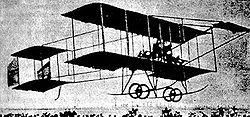 The history of the Bulgarian Air Force can be traced back to the end of the 19th century, when in 1892 at the Plovdiv International Fair two lieutenants of the Bulgarian Army flew with the ‘La France’ airship
of the Frenchman Godard
. Later, being inspired by the flight, they succeeded to convince the General Staff that the Bulgarian Army should build a balloon force. The Imperial Aviation School in St. Petersburg enrolled Lieutenant Vasil Zlatarov as a student, following numerous refusals from military schools around Europe to teach Bulgarian officers to use airships. On 20 April 1906 “Vazduhoplavatelno Otdelenie” (roughly translated as Aviation Department) was created to operate observation balloons for the army. After graduation Lt. Zlatarov was appointed its first commander. The first generation of Bulgarian aviators were trained on a balloon named ‘Sofia-1’, constructed by Zlatarov with materials bought from Russia
.
In 1910 a Russian aircraft engineer, Boris Maslennikov, was invited to Bulgaria
, where he presented his airplane, a modification of the French Farman III
. Following his demonstration assisted by Vasil Zlatarov over the hippodrome in Sofia
, the Bulgarian Government decided to acquire airplanes for The Aviation Corps. In early 1912 thirteen army officers were sent abroad for training as pilots and orders were placed for five French, British and German airplanes.
In June 1912 Lt. Simeon Petrov First air-dropped bomb, training at the school of Louis Blériot
in France
, for the first time in the history of aviation succeeded to land an airplane with a stopped engine. The event was praised in the French newspapers and La Poste
, the French mail service acknowledged, it by publishing a stamp.
The officers sent to France completed their training first and returned to Bulgaria in July 1912. The same year Bulgaria received its first airplane – Bleriot XXI with which on 13 August 1912 Simeon Petrov flew to become the first Bulgarian to pilot an airplane over Bulgaria.
proved the words of the great French military theorist Ferdinand Foch
that aviation is of no military value, to be completely wrong. Following the outbreak of the war, the Bulgarian pilots still abroad hastily procured aircraft to follow them home. Many foreign volunteer pilots, along with military journalists from all over Europe, arrived in Bulgaria. After the front lines had stabilized, an Aeroplane Platoon was established at a new airfield closer to the fighting.
On October 15, 1912 an order was issued to gather intelligence about the Turkish army
strength and dispositions in the Odrin(Adrianople) keep. Following the order, on October 16, two airmen - Radul Milkov and Prodan Tarakchiev - performed a reconnaissance flight over the city in an Albatros F-2 biplane. This was the first military mission performed by a Bulgarian aircraft. The wheels of the right chassis were broken during the landing.
Later that month the Bulgarian Aviation Corps was expanded to three Aeroplane Platoons. Foreign volunteers began flying operational sorties alongside Bulgarian pilots and carried out multiple reconnaissance
, leaflet-dropping and bombing missions. During the war at least three aircraft were shot down. Considerable help was received from the Russians in terms of aircraft, maintenance and training. Due to low aircraft serviceability and frequent training accidents, the actual number of missions flown was relatively low. Despite that the Bulgarian airmen and their foreign helpers were able to gather enough aerial reconnaissance for the Army General Staff to make use of and later go on to capture the city. Another factor, which is sometimes underestimated was the huge psychological effect the aerial bombings had. Although inflicting relatively little physical damage, the bombs dropped from the sky had a devastating effect on the defending Turkish garrison's morale and as such, played a crucial part in the fall of the city, which was until then considered impregnable.
The first bombing raid by a Bulgarian aircraft was performed on November 17, 1912 when the Italian volunteer Lieutenant Sabelli and Major Zlatarov dropped two bombs over Odrin.
During the siege of Odrin, the Bulgarian airmen made innovative use of their airplanes, setting a number of world firsts - such as the first combat use of a plane and the first use of a plane to drop leaflets. Those applications would be further developed during the First World War and form the basis of modern combat aviation.

entered World War I
as an ally of the Central Powers
on October 4, 1915. The Aeroplane Section of the Bulgarian Army was deployed to Kumanovo
Airfield in support of the rapidly advancing Bulgarian forces, but bad weather made flying virtually impossible upon arrival. To that moment the section had completed 11 combat sorties, flown from an airfield in Sofia
(a location today occupied by the central railway station of the Bulgarian capital). With the advance of the frontline the unit re-deployed to airfields near Belitsa and Xanthi
, in modern Greece
). The newly acquired German LVG aircraft were hastily pressed into action. Two more airfields were constructed near Udovo and Levunovo. The Allies
started conducting reconnaissance and bomber sorties against the forward Bulgarian ground units on the Southern Balkan Front
. Through the entire period of fighting in World War I the Bulgarian military aviation experienced a steady boost in both numbers and quality of the types of aircraft in its inventory. However, they still were inferior to those, flown by the Allies, especially the British and French. The First Aeroplane Section (the country's only aircraft unit) was attached to the Second Bulgarian Army. It flew 255 sorties, compared with 397, flown by the four squadrons of the Entente
it opposed. The Section operated the following types:
In addition, the Bulgarian Navy used the following airplanes:
A number of Bulgarian pilots flew with German air units at the Western Front
. Even more pilots flew with the German units based at Xanthi. They operated several types, including the Albatros D.III
and Halberstadt, which would later mistakenly be added to the Bulgarian inventory, and which were scrapped at Bozhourishte.
On the 30 September 1916 a single French Farman 40 entered Bulgarian aerospace with the intention to bomb the capital Sofia
. The two seater belonged to the French Escadrille 384. The pilot was Sergeant
Maurice Rauable and Branco Naumovich, a Serbian, serving in the French army, was the gunner. At Bozhurishte Airfield a pair of Bulgarian Fokker E.IIIs were scrambled. One of them was flown by the German flight instructor at the Bulgarian Aviation School, Feldwebel
Wagner, and the Bulgarian Lieutenant Marko Parvanov flew as his wingman. After a rapid climb the fighters gained altitude of 3000 m (9,842.5 ft) and entered battle stations over the village of Vladaya
to the south of the city (today a part of Sofia
), awaiting the intruder. At the same time a flight of 3 armed Albatros C.III twin-seater trainers was dispatched over the exact center of the capital as a second line of defense.
Heavy anti-aircraft ground fire met the Farman when it tried to enter the airspace of Sofia
. The bomber quickly released its load (which caused no casualties) and the pilot Sgt. Rauable tried to elude the Bulgarian fighters. Fld. Wagner fired the guns of his Fokker E.III at the target, but missed. Then Lieutenant Parvanov engaged the French aircraft and damaged it. The bomber then made an emergency landing with a dead engine and the crew was captured.
Another Allied aircraft, a British
Armstrong Whitworth
F.K.3
, was captured by Bulgarian troops. Bulgarian fighter pilots forced the pilot to land and it and the crew of two were taken into custody unharmed. Later the bomber would receive Bulgarian insignia and introduced to service for "special operations". The Armstrong Whitworth was used for night bombings of Allied positions, the darkness hiding away its Bulgarian insignia and the sound of its engine representing a friendly machine. Four such sorties were flown with considerable success before intensive AA fire damaged the captured bomber. The pilot Captain Ivan Uzunov (to become a legendary airman, a national hero and a key person in Bulgarian aviation activities) was able to land it in the almost complete darkness and set the machine on fire. Together with his navigator Lieutenant Popatanasov they made a three-day-long march behind enemy lines, until they made it to the advancing Bulgarian infantry units unharmed.
Two Nieuport XXVII fighters were also captured . Lieutenant Vladimir Balan, a Bulgarian fighter pilot who until that time flew with a German JaSta on the Western Front (and was awarded with the German Iron Cross
for his excellent service) flew one of the Nieuports. During one such a sortie he shot down the squadron leader of the British No. XVII Squadron RAF
, Captain O'Dwyer.
Bulgarian airmen also suffered losses, but mostly when their recon planes were involved in dogfight with dedicated fighters.
, operating initially four Friedrichshafen FF-33 bombers and a Rumpler 6B1 fighter. Later at the coast of the Varna Lake a second seaplane
station was built (this one under Bulgarian control), operating the same inventory. Near Sozopol
a forward fuel and ammunition replenishment base was established in support of patrol flights over the southern Bulgarian coastline. At the end of 1917 the German station was transferred to the Bulgarian Navy. At the time of the armistice the Bulgarian fleet air arm comprised two seaplane stations, a forward replenishment base, three hangars, three workshops, ammunition warehouses and 10 seaplanes. After the cease-fire the machines were used for mine reconnaissance. At the end of 1919 they are transported by train to Bozhurishte
Airfield to be scrapped along with the army aviation inventory.
The Bulgarian balloon observers also took part in the war. They were most active on the Dobrudzha
Front, where aircraft activities were scarce (a German bomber squadron, flying missions against Bucharest
and Constanţa
ine: "Gotha" bombers accounted for the most flights). Near the Bulgarian city of Yambol
an airship hangar was constructed to house German airships. The airship Schütte-Lanz SL 10 was the first to use it. According to documents of the time it was assigned to the Bulgarian Army, but was actually under German control. It was lost during a flight over the Black Sea
in July 1916. In August 1916 the LZ 101 replaced it. After performing raids on targets in Romania and Greece it returned to Germany in August 1917. In November 1917 arrived the naval airship L 59. That airship flew a series of remarkable missions, such as an attempted resupply of the garrison in the colony German East Africa
and the bombing of Naples
and Port Said
. During a mission against the British naval base in Malta
, lightning set it on fire over the Mediterranean Sea
and caused its complete destruction. All hands were lost.
The Chaika Naval Seaplane station at Varna was under Naval command.
On November 27, 1919 the Treaty of Neuilly-sur-Seine was signed. In accordance with the treaty
the Kingdom of Bulgaria
was banned from operating military aircraft
under any form for the next 20 years. For that reason all Bulgarian airplanes, balloons, aviation equipment, weaponry and ammunition were to be destroyed under Allied control. Under the terms of the treaty any aircraft, procured for civilian purposes, were to be bought from the countries on the winning side. The combined engine power for any airplane (including multiengined ones) was not to exceed 180 hp. In addition, the Bulgarian airspace was to be controlled by the allies and used according to the victorious countries' interests.
In accordance with the treaty during 1920 no less than 70 airplanes, 110 aviation engines, 3 air balloons, 76 aviation
machine guns, a number of photographic camera
s and other aviation equipment were destroyed at the military airfield of Bozhurishte. The seaplanes of the Bulgarian Navy
were delivered by train to the same airfield and scrapped soon after that.
Due to the devotion of the Air Troops personnel and the help of the population of the surrounding villages, several aircraft were hidden, thus evading Allied inspection following destruction. Seven DFW C.V, Albatros C.III and a single Fokker D.VII were among the survivors. In addition, at least ten aviation engines (Benz-IV and Mercedes-III) were also saved.
The Bulgarian government tried to get around the ban for military flight activity by establishing a Gendarmery Aeroplane Section in 1919. Since the Gendarmery was at that time a service under the Ministry of War, the creation of the unit was met by fierce opposition by the Allied commission. This almost resulted in the destruction of the whole Vrazhdebna Airfield
, but the disbandment of the unit prevented this from happening.
An Aeroflight Section under the Ministry of Railways, Postal Service and Telegraph was created in 1920. Bulgarian aviation personnel assembled two airplanes from hidden spares and parts, salvaged from the destroyed military airplanes. The two aircraft, known as "the mixed planes", recorded about 1000 flight hours altogether. The sole remaining Bulgarian Fokker D.VII was disguised as a two seater, thus being classified as a trainer and returning to active service.
On 5 July 1923 Bulgaria ratified the International Civil Aviation Treaty. From that moment on its air vehicles would carry a registration in the form B-B??? (the latter three signs being a combination of capital letters). In 1923 the first group of cadets, called "student-flyers" entered the Flying school at Vrazhdebna AF.
The following year (1924) the first new airplanes were acquired. Those were machines of the Potez
VIII, Caudron C.59
, Henriot XD.14, Bristol 29 Tourer types; Avro
522 seaplanes were also procured. During the same year the Bulgarian airplane construction specialist Atanas Grigorov (who obtained his qualification at the "Albatroswerke - Berlin") assembled his superb seaplane, called "Grigorov-1". The aircraft made several test-flights, recording excellent characteristics, but was damaged beyond repair by a storm in the hangar where it was stationed. Also in 1924 the Aeroplane Section was expanded to an Aeroflight Directorate still under the Ministry of Railways, Postal Service and Telegraph.
1925 saw the Potez XVII, Bristol Lucifer
and the Macchi 2000/18 flying boats boosting the country's aircraft inventory. The Bulgarian government invited a group of German aircraft engineers, headed by the constructor Herr Hermann Winter to help establish an aviation factory. Named The State's Aeroconstruction Atelliér (more popular as DAR-Bozhurishte) the factory was initially managed by the first Bulgarian pilot to achieve an aerial victory - Mr. Marko Parvanov. The first aircraft types, produced by the plant were the "Uzounov-1" (an indigenous variant of the wartime German DFW C.V) and the DAR-2 (indigenous variant of the German Albatross C.III of the same era). Both types well-known and loved by the personnel of the former Air Troops and with Bulgarian combat service experience. A new type - the DAR-1 - was also in a phase of development.
During the course of 1926 the Airplane School was moved to the geographical center of the country. The town of Kazanlak
was well suited, for it stayed away from the Allied Control Commission. The Czechoslovak "AERO-Praha" company has also built an aircraft factory near that city, but its models were not up to the requirements of the Bulgarian authorities. After unsuccessful switch to automotive production the plant was finally sold to the Italian Caproni
company. The factory became popular as "Balgarski Kaproni" or "Bulgarian Caproni". The first examples of the very successful DAR-1 were produced and entered service with the Aeroflight Directorate during 1926.
The 1927 structure of the Directorate was the following:
In 1928 the Ministry of War started the ambitious 10-year program for development of the military aviation (still banned by the peace treaty). According to the plan the following structure had to be achieved:
In 1931 Bulgaria signed the Warsaw Treaty, concerning international civil air activities and the country was assigned the new civil registration - LZ-??? (the latter three signs being a combination of capital letters). In 1933 the Bulgarian Council of Ministers approved the following wartime order of battle of the aviation:
Bulgaria started acquiring German, Czechoslovak and Polish airplanes.
In 1934 the Aviation Regiment was renamed His Majesty's Air Troops, comprising a headquarters, with two army orlyaks (based at Bozhurishte
and Plovdiv
airfields), a training orlyak (in Plovdiv
), a maritime yato (at NAS Chaika, Varna) and additional operational support units. Chief of the HMAT became Colonel Ivan Mikhailov with Lieutenant-Colonel Georgi Vasilev appointed as his Deputy.
 The first combat aircraft entered service in the reestablished air force in 1937 were 12 Arado Ar.65 fighters, 12 Heinkel He.51 fighters, 12 Dornier Do.11 bombers and 12 Heinkel He.45B recon planes. These machines are known as the Royal Gift, donated to the HMAT personally by King
Boris III.
During the traditional military parade of St. George's Day (National Day of Bravery and of the patron-saint of the Bulgarian Armed Forces) in 1937 military aircraft officially debuted as a part of the armed forces after a nearly two-decade hiatus. A month later Boris III himself presented the Bulgarian air regiments with their new combat flags at an official ceremony at Vrazhdebna Airfield. In 1938 14 newly built Polish PZL.24B fighters were acquired along with 12 PZL.43B light bombers.
When the Third Reich occupied Czechoslovakia
, absorbing her Czech Lands as the Protectorate of Bohemia and Moravia, her air force ceased to exist. Bulgaria used the opportunity to acquire large numbers of relatively modern aircraft at a symbolic price. 78 Avia B.534 biplane fighters, 32 Avia B.71 bombers (a license version of the Soviet SB
light bomber) and 60 Letov Š.328 recon were part of the reinforcements. In less than 3 years the Air Force inventory had grown up to 478 pieces of which 135 of Bulgarian construction.
 At the beginning of World War II
, the combat air fleet comprised 374 machines in various roles. In addition orders were placed for 10 Messerschmitt Bf 109E-4 fighters, 11 Dornier Do 17M/P bombers, 6 Messerschmitt Bf 108 light liaison and utility aircraft, 24 Arado Ar 96B-2 and 14 Bücker-Bestmann Bü 131 trainers.
The Air Force order of battle comprised the 1st, 2nd, 3rd and 4th Army Aviation Orlyaks (Army Air Groups or air regiments), each attached to the correspondingly-numbered field army. Each orlyak had a fighter, a line bomber and two reconnaissance yatos (Squadrons). There was also an Independent Aviation corps, which combined the 5th Bomber and 6th Fighter Regiments. The training units consisted of the "Junker" School Orlyak at Vrazhdebna airfield, the 2nd Training Orlyak at Telish airfield (called the Blind Flying Training School) and the 3rd Training Orlyak at Stara Zagora
airfield. In 1940, the Bulgarian aviation industry provided the HMAT with 42 DAR-9, 45 KB-5 aircraft and the serial production of the KB-6 - Bulgaria's first twin-engined aircraft was scheduled to commence. At year's end the Air Force had 595 aircraft (258 combat) and 10 287 personnel.
The Kingdom of Bulgaria
entered World War II
on the 1 March 1941 as a German ally. Under the signed treaty Bulgaria allowed the use of its territory as a staging point for the invasion of Yugoslavia and Greece and some minor logistical support.
Despite the impressive inventory, Bulgaria's fighter force at the time consisted of 91 machines, with just 10 of them being of the modern Bf 109E-4 type. Further 11 were of the outdated PZL.24B; the remaining numbers were of the Avia B.534 biplane types. The ground-based air defenses were made up of only 8 88 mm (3.5 in) and 6 20 mm (0.78740157480315 in) AA guns. To help its new ally the 12th Army of the Wehrmacht offered support with its air and air defense assets and 8 Freya-type radars dispersed throughout the country. A dispersed observation and reporting system was gradually developed.
The first air strike against Bulgarian targets was carried out by 4 Yugoslav
Dornier Do.17Kb-1 on the 6th of April 1941 on the city of Kyustendil
and its railway station killing 47 and injuring 95, mostly civilians. The air strikes intensifying following days; British Royal Air Force
units based in Greece
participated in the attack
s as well. At the end of April 2 and 5th Bulgaria
n armies
occupied Greek
and Yugoslav
territories according to an agreement with the Third Reich. As a part of the joint armed forces' effort on June 26, 1941 6 Avia B.71 and 9 Dornier Do 17M bombers were transferred to the Badem Chiflik airfield near Kavala
(in modern Greece). They were tasked with ASW patrols and air support for Italian shipping over the adjacent area of the Aegean Sea
. In addition 9 Letov Š.328s based in Badem Chiflik provided the ground troops with air reconnaissance. At the Black Sea shores the "Galata" Fighter Orlyak was established at NAS Chaika, Varna
, with the 10 Bf 109E-4s and 6 Avia B.534s. The S.328s were also used for ASW patrols over the Black Sea
, flying out of the Sarafovo
and Balchik
airfields. At the end of 1941 the inventory of His Majesty's Air Troops consisted of 609 aircraft of 40 different types.

 The Bulgarian Air Force, along with other branches of the military, adopted the doctrine of the Soviet deep battle in its Cold War development. The force expanded rapidly with deliveries of different types of combat aircraft. The first shipments of Soviet equipment arrived immediately after the end of World War II, mostly consisting of propeller-driven aircraft, such as the Ilyushin Il-2
(120 Il-2 and 10 Il-2U), the Ilyushin Il-10
and the Tupolev Tu-2
. By 1954, these types were withdrawn from service, as the Korean War
marked the beginning of the jet fighter era. In 1955 a new wave of deliveries began, which included MiG-15, MiG-17 and MiG-19 fighters and Ilyushin Il-28
bombers, as well as the first helicopters (Mil Mi-1
). These aircraft were withdrawn in the 1970s, when the last wave of modernization began.
In June 1979 the Mil
Mi-24 Hind entered service through a significant re-equipment program and a boost to rotary power to the BVVS. The Sukhoi
Su-25 Frogfoot and Su-22 Fitter entered service in 1988 in the strike
/ reconnaissance
role. 40 Su-25K/KUBs were delivered and 21 Su-22M4/UM-3s were delivered. In total, by 1989 the Bulgarian Air Force had received and operated:
Bulgaria's air force is limited to 226 aircraft. A large number of early MiG-21 variants were withdrawn from service and were cut for scrap. And the armament from the trainers for the MiG-21 and MiG-23 was removed. In 1998 four air bases were closed down: Gabrovnitsa, Balchick, Uzundzhovo
and Shtraklevo. Then in 2000 the Stara Zagora (operating Mi-24s) air force base was closed. Then in 2001 three more bases were closed down: Dobrich, Ravnets and Cheshnegirovo. In 2003 Dobroslavtsi was closed down and the MiG-23s were withdrawn from service, because it is more expensive to run than the MiG-21. In February 2004 the Su-22s, which were stationed first in Dobrich then in Bezmer, were withdrawn. http://www.scramble.nl/bg.htm

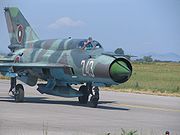

 In the past decade Bulgaria has been trying actively to restructure its army as a whole and a lot of attention has been placed on keeping the aging Russian aircraft operational. Currently the attack and defence branches of the Bulgarian air force are composed mainly of MiG-21s, MiG-29s and Su-25s. About 16 MiG-29 fighters have been modernized in order to meet NATO standards and until now everything is going according to plan (7 jets will be ready until September 2007).In January 2011 the Bulgarian MoD issued a Request for Information (RFI) regarding the acquisition of 8 multi-role fighters. The main competitors are expected to be the Eurofighter GmbH
Eurofighter Typhoon
, Dassault Rafale, Saab
JAS 39 Gripen
, Lockheed Martin
F-16 and Boeing
F/A-18 Super Hornet. On March 9, 2011 the Swedish Government submitted its response to the RFI containing 8 new Gripen C/D fighters. The Bulgarian MoD has extended the time limit for submittal of responses by two months due to the lack of responses from the other competitors.
In 2006 the Bulgarian government signed a contract with Alenia Aeronautica
for the delivery of five C-27J Spartan transport aircraft
in order to replace the older Soviet An-24 and An-26. The first Spartan arrived in 2007. Now, the contract has changed to the delivery of only 3 planes and the remaining third arrived in 31 of March 2011.
Modern European transport helicopter
s were ordered and purchased in 2005 and until now 12 Eurocopter Cougar
helicopters (8 transport and 4 CSAR
) have arrived. For the Navy 3 Eurocopter Panther were ordered, however, they were refused with the cancellation of the contract for the new multi-role corvettes . Until then the Bulgarian Air force will have to rely on 6 Mi-24s and 3 Mi-17
s, all to be modernized. As of 2010 the Bulgarian Air Force uses the Eurocopter Cougar in with Soviet era M-17s and Mi-24s.
Branches of the air force include:
Bulgaria is planning to reinforce the international forces in Afghanistan
by sending two Mil Mi-17 transport helicopters to the country. As a result, a special fund was created that will provide money for the renovation of older Soviet-made equipment, which could then be used in Afghanistan.
Reserve (closed) air bases
The plans state that 25% of the manpower of the bulgarian military should be in the Air Forces, which according to the level of 26 000 servicemen envisioned calls for about 6 500 airmen.
As stated by the Ministry of Defense the tender for new multirole fighter should commence at the end of the year 2011, the contract should be signed by midterm of 2012 and the first machines should start arriving in 2015.
Tactical UAV should be procured in support of the land forces operations.
The number of C-27J Spartan aircraft should be slated down to 3 of which all are already in the inventory.
attack helicopter. Aircraft of Western origin have only begun to enter the fleet, numbering 27 of the total in service.
Bulgaria signed a deal with Eurocopter worth 358 million euros for purchase of 12 AS 532 Eurocopter Cougar
(4 of which are modified for CSAR
) and 3 Eurocopter Panther AS 565. The country also agreed to the purchase of 5 C27J transports with Alenia of Italy
, a deal worth some 210 million euro
s. Currently, Bulgaria wants to purchase only 3 Spartan transports.
As a result of new helicopter
and transport
aircraft purchase it was decided to delay the purchase of new fighters for time being. Extra funds may be secured in 2009-2011 for the purchase of 12-24 fighters.
The BAF plans to retire most of its Soviet-era aircraft, keeping only the Mikoyan-Gurevich MiG-29 Fulcrum fleet which was modernized only recently, as well as its Mi-24 gunships and Su-25s. The MiG-21s in service where scheduled to be replaced with possible American or European aircraft, but the program has been dealt with by poor budget and the program is currently delayed. Due to poor budget conditions of Bulgaria the older Soviet aircraft may stay in service for years longer.
ML air-to-ground missile (on Su-25 ground attack jets) S-5
unguided rocket (on Su-25 and Mi-24 helicopters, manufactured locally) GSh-30-1 cannon GSh-23 cannon NR-30 cannon AA-2 Atoll
short-range AA missile AA-8 Aphid
short-range AA missile AA-10 Alamo medium-range AA missile AA-11 Archer
short-range AA missile
Military of Bulgaria
The Military of Bulgaria, officially the Bulgarian Army represents the Armed Forces of the Republic of Bulgaria. The Commander-in-Chief is the President of Bulgaria . The Ministry of Defence is in charge of political leadership while military command remains in the hands of the General Staff,...
, the other two being the Bulgarian Navy
Bulgarian Navy
The Bulgarian Navy is the navy of Republic of Bulgaria and forms part of the Bulgarian Armed Forces. It has been largely overlooked in the reforms that Bulgaria had to go through in order to comply with NATO standards, mostly because of the great expense involved and the fact that naval assaults...
and Bulgarian land forces
Bulgarian land forces
The Bulgarian Land Forces are one of the service branches of the Bulgarian Armed Forces. Their existence is to be traced back to the establishment of the First Bulgarian Empire in 681. In more recent history the Land Forces have played an active role in the Bulgarian participation in the Balkan...
. Its mission is to guard and protect the sovereignty of Bulgaria
Bulgaria
Bulgaria , officially the Republic of Bulgaria , is a parliamentary democracy within a unitary constitutional republic in Southeast Europe. The country borders Romania to the north, Serbia and Macedonia to the west, Greece and Turkey to the south, as well as the Black Sea to the east...
n airspace, to provide aerial support and to assist the Land Forces in case of war. The Bulgarian Air Force is one of the oldest air forces in Europe
Europe
Europe is, by convention, one of the world's seven continents. Comprising the westernmost peninsula of Eurasia, Europe is generally 'divided' from Asia to its east by the watershed divides of the Ural and Caucasus Mountains, the Ural River, the Caspian and Black Seas, and the waterways connecting...
and the world. In recent times it has been actively taking part in numerous NATO missions and exercises
Military exercise
A military exercise is the employment of military resources in training for military operations, either exploring the effects of warfare or testing strategies without actual combat...
in Europe
Europe
Europe is, by convention, one of the world's seven continents. Comprising the westernmost peninsula of Eurasia, Europe is generally 'divided' from Asia to its east by the watershed divides of the Ural and Caucasus Mountains, the Ural River, the Caspian and Black Seas, and the waterways connecting...
.
The current commanding officer of the Bulgarian Air Force is Major General
Major General
Major general or major-general is a military rank used in many countries. It is derived from the older rank of sergeant major general. A major general is a high-ranking officer, normally subordinate to the rank of lieutenant general and senior to the ranks of brigadier and brigadier general...
Constantin Popov.
Early years
Airship
An airship or dirigible is a type of aerostat or "lighter-than-air aircraft" that can be steered and propelled through the air using rudders and propellers or other thrust mechanisms...
of the Frenchman Godard
Godard
-People:* Agnès Godard, French cinematographer* André Godard , French Iranologist* Benjamin Godard , French composer best known for his opera Jocelyn and salon music* Christian Godard , French comic artist...
. Later, being inspired by the flight, they succeeded to convince the General Staff that the Bulgarian Army should build a balloon force. The Imperial Aviation School in St. Petersburg enrolled Lieutenant Vasil Zlatarov as a student, following numerous refusals from military schools around Europe to teach Bulgarian officers to use airships. On 20 April 1906 “Vazduhoplavatelno Otdelenie” (roughly translated as Aviation Department) was created to operate observation balloons for the army. After graduation Lt. Zlatarov was appointed its first commander. The first generation of Bulgarian aviators were trained on a balloon named ‘Sofia-1’, constructed by Zlatarov with materials bought from Russia
Russia
Russia or , officially known as both Russia and the Russian Federation , is a country in northern Eurasia. It is a federal semi-presidential republic, comprising 83 federal subjects...
.
In 1910 a Russian aircraft engineer, Boris Maslennikov, was invited to Bulgaria
Bulgaria
Bulgaria , officially the Republic of Bulgaria , is a parliamentary democracy within a unitary constitutional republic in Southeast Europe. The country borders Romania to the north, Serbia and Macedonia to the west, Greece and Turkey to the south, as well as the Black Sea to the east...
, where he presented his airplane, a modification of the French Farman III
Farman III
|-See also:-Bibliography:*Opdycke, Leonard E French Aeroplanes Before the Great War Atglen, PA: Schiffer 1999 ISBN 0 7643 0752 5-External links:**...
. Following his demonstration assisted by Vasil Zlatarov over the hippodrome in Sofia
Sofia
Sofia is the capital and largest city of Bulgaria and the 12th largest city in the European Union with a population of 1.27 million people. It is located in western Bulgaria, at the foot of Mount Vitosha and approximately at the centre of the Balkan Peninsula.Prehistoric settlements were excavated...
, the Bulgarian Government decided to acquire airplanes for The Aviation Corps. In early 1912 thirteen army officers were sent abroad for training as pilots and orders were placed for five French, British and German airplanes.
In June 1912 Lt. Simeon Petrov First air-dropped bomb, training at the school of Louis Blériot
Louis Blériot
Louis Charles Joseph Blériot was a French aviator, inventor and engineer. In 1909 he completed the first flight across a large body of water in a heavier-than-air craft, when he crossed the English Channel. For this achievement, he received a prize of £1,000...
in France
France
The French Republic , The French Republic , The French Republic , (commonly known as France , is a unitary semi-presidential republic in Western Europe with several overseas territories and islands located on other continents and in the Indian, Pacific, and Atlantic oceans. Metropolitan France...
, for the first time in the history of aviation succeeded to land an airplane with a stopped engine. The event was praised in the French newspapers and La Poste
La Poste (France)
La Poste is the mail service of France, which also operates postal services in the French Overseas Departments of Réunion, Guadeloupe, Martinique and French Guiana, and the territorial collectivities of Saint Pierre and Miquelon and Mayotte...
, the French mail service acknowledged, it by publishing a stamp.
The officers sent to France completed their training first and returned to Bulgaria in July 1912. The same year Bulgaria received its first airplane – Bleriot XXI with which on 13 August 1912 Simeon Petrov flew to become the first Bulgarian to pilot an airplane over Bulgaria.
First and Second Balkan Wars
The First Balkan WarFirst Balkan War
The First Balkan War, which lasted from October 1912 to May 1913, pitted the Balkan League against the Ottoman Empire. The combined armies of the Balkan states overcame the numerically inferior and strategically disadvantaged Ottoman armies and achieved rapid success...
proved the words of the great French military theorist Ferdinand Foch
Ferdinand Foch
Ferdinand Foch , GCB, OM, DSO was a French soldier, war hero, military theorist, and writer credited with possessing "the most original and subtle mind in the French army" in the early 20th century. He served as general in the French army during World War I and was made Marshal of France in its...
that aviation is of no military value, to be completely wrong. Following the outbreak of the war, the Bulgarian pilots still abroad hastily procured aircraft to follow them home. Many foreign volunteer pilots, along with military journalists from all over Europe, arrived in Bulgaria. After the front lines had stabilized, an Aeroplane Platoon was established at a new airfield closer to the fighting.
On October 15, 1912 an order was issued to gather intelligence about the Turkish army
Turkish Army
The Turkish Army or Turkish Land Forces is the main branch of the Turkish Armed Forces responsible for land-based military operations. The modern history of the army began with its formation after the collapse of the Ottoman Empire...
strength and dispositions in the Odrin(Adrianople) keep. Following the order, on October 16, two airmen - Radul Milkov and Prodan Tarakchiev - performed a reconnaissance flight over the city in an Albatros F-2 biplane. This was the first military mission performed by a Bulgarian aircraft. The wheels of the right chassis were broken during the landing.
Later that month the Bulgarian Aviation Corps was expanded to three Aeroplane Platoons. Foreign volunteers began flying operational sorties alongside Bulgarian pilots and carried out multiple reconnaissance
Reconnaissance
Reconnaissance is the military term for exploring beyond the area occupied by friendly forces to gain information about enemy forces or features of the environment....
, leaflet-dropping and bombing missions. During the war at least three aircraft were shot down. Considerable help was received from the Russians in terms of aircraft, maintenance and training. Due to low aircraft serviceability and frequent training accidents, the actual number of missions flown was relatively low. Despite that the Bulgarian airmen and their foreign helpers were able to gather enough aerial reconnaissance for the Army General Staff to make use of and later go on to capture the city. Another factor, which is sometimes underestimated was the huge psychological effect the aerial bombings had. Although inflicting relatively little physical damage, the bombs dropped from the sky had a devastating effect on the defending Turkish garrison's morale and as such, played a crucial part in the fall of the city, which was until then considered impregnable.
The first bombing raid by a Bulgarian aircraft was performed on November 17, 1912 when the Italian volunteer Lieutenant Sabelli and Major Zlatarov dropped two bombs over Odrin.
During the siege of Odrin, the Bulgarian airmen made innovative use of their airplanes, setting a number of world firsts - such as the first combat use of a plane and the first use of a plane to drop leaflets. Those applications would be further developed during the First World War and form the basis of modern combat aviation.
World War I (1914–1918)
Army air action
The Kingdom of BulgariaKingdom of Bulgaria
The Kingdom of Bulgaria was established as an independent state when the Principality of Bulgaria, an Ottoman vassal, officially proclaimed itself independent on October 5, 1908 . This move also formalised the annexation of the Ottoman province of Eastern Rumelia, which had been under the control...
entered World War I
World War I
World War I , which was predominantly called the World War or the Great War from its occurrence until 1939, and the First World War or World War I thereafter, was a major war centred in Europe that began on 28 July 1914 and lasted until 11 November 1918...
as an ally of the Central Powers
Central Powers
The Central Powers were one of the two warring factions in World War I , composed of the German Empire, the Austro-Hungarian Empire, the Ottoman Empire, and the Kingdom of Bulgaria...
on October 4, 1915. The Aeroplane Section of the Bulgarian Army was deployed to Kumanovo
Kumanovo
Kumanovo is a city in the Republic of Macedonia and is the seat of Kumanovo Municipality which is the largest municipality in the country. Municipal institutions include a city council, mayor and other administrative bodies.-Name:...
Airfield in support of the rapidly advancing Bulgarian forces, but bad weather made flying virtually impossible upon arrival. To that moment the section had completed 11 combat sorties, flown from an airfield in Sofia
Sofia
Sofia is the capital and largest city of Bulgaria and the 12th largest city in the European Union with a population of 1.27 million people. It is located in western Bulgaria, at the foot of Mount Vitosha and approximately at the centre of the Balkan Peninsula.Prehistoric settlements were excavated...
(a location today occupied by the central railway station of the Bulgarian capital). With the advance of the frontline the unit re-deployed to airfields near Belitsa and Xanthi
Xanthi
Xanthi ; is a city in Thrace, northeastern Greece. It is the capital of the Xanthi peripheral unit of the periphery of East Macedonia and Thrace.-History:...
, in modern Greece
Greece
Greece , officially the Hellenic Republic , and historically Hellas or the Republic of Greece in English, is a country in southeastern Europe....
). The newly acquired German LVG aircraft were hastily pressed into action. Two more airfields were constructed near Udovo and Levunovo. The Allies
Allies of World War I
The Entente Powers were the countries at war with the Central Powers during World War I. The members of the Triple Entente were the United Kingdom, France, and the Russian Empire; Italy entered the war on their side in 1915...
started conducting reconnaissance and bomber sorties against the forward Bulgarian ground units on the Southern Balkan Front
Macedonian front (World War I)
The Macedonian Front resulted from an attempt by the Allied Powers to aid Serbia, in the autumn of 1915, against the combined attack of Germany, Austria-Hungary and Bulgaria. The expedition came too late and in insufficient force to prevent the fall of Serbia, and was complicated by the internal...
. Through the entire period of fighting in World War I the Bulgarian military aviation experienced a steady boost in both numbers and quality of the types of aircraft in its inventory. However, they still were inferior to those, flown by the Allies, especially the British and French. The First Aeroplane Section (the country's only aircraft unit) was attached to the Second Bulgarian Army. It flew 255 sorties, compared with 397, flown by the four squadrons of the Entente
Allies of World War I
The Entente Powers were the countries at war with the Central Powers during World War I. The members of the Triple Entente were the United Kingdom, France, and the Russian Empire; Italy entered the war on their side in 1915...
it opposed. The Section operated the following types:
- 12 LVGLVGLuftverkehrsgesellschaft m.b.H. was a German aircraft manufacturer based in Berlin-Johannisthal, which began constructing aircraft in 1912, building Farman-type aircraft. The company constructed many reconnaissance and light bomber biplanes during World War I.The raid on London in 1916 was...
B.II - recon planes, the first group of six arriving in November 1915. Those venerable two seaters were also used as fighters by the Bulgarians, since no dedicated "scouts" were available. - 13 Otto C.I - an exotic twin-tailed bombers. The type received its first Otto in May 1916.
- 18 Albatros C.IIIAlbatros C.III-See also:-References:[1] Y. MIlanov: The aviation in Bulgaria in the wars from 1912 to 1945, Vol.I. Sveti Gueorgui Pobedonosetz, Sofia, 1995 -External links:...
- recon planes, also used as trainers. First delivery in August 1916. - 12 DFW C.VDFW C.V-External Links:*...
recon planes, first arriving in August 1917. - 6 Roland D.II fighters. During July 1917 the first of these arrived with the Section.
- 6 Roland D.III fighters planes, the first arriving at the end of 1917.
- 3 Fokker E.IIIFokker E.III|-See also:...
fighters planes, first of these delivered in the spring of 1916. - 8 Fokker D.VIIFokker D.VIIThe Fokker D.VII was a German World War I fighter aircraft designed by Reinhold Platz of the Fokker-Flugzeugwerke. Germany produced around 3,300 D.VII aircraft in the summer and autumn of 1918. In service, the D.VII quickly proved itself to be a formidable aircraft...
Bulgaria's finest fighter of WW1. Delivery took place in September 1918. The D.VIIs weren't pressed into action, 7 them were scrapped in accordance with the peace treaty. The 8th would fly as a pseudo two-seater after the war. - 2 Albatros C.IAlbatros C.I|-See also:-Further Reading:*Cowin, H.W. German and Austrian Aviation of World War I. Osprey Publishing Ltd, 2000 ISBN 1-84176-069-2*van Wyngarden, G . Early German Aces of World War I, Osprey Publishing Ltd. ISBN 1-84176-997-5...
. These were ordered by the Ottoman Empire before Bulgaria entered the war. During early 1915 the couple landed on Bulgarian territory by a navigational mistake, and the then-neutral country requisitioned them.
In addition, the Bulgarian Navy used the following airplanes:
- 8 Friedrichshafen FF-33 floatplane bombers for the Navy, first in 1916
- 2 Rumpler 6B1 floatplane fighters for the Navy, first in 1916
A number of Bulgarian pilots flew with German air units at the Western Front
Western Front (World War I)
Following the outbreak of World War I in 1914, the German Army opened the Western Front by first invading Luxembourg and Belgium, then gaining military control of important industrial regions in France. The tide of the advance was dramatically turned with the Battle of the Marne...
. Even more pilots flew with the German units based at Xanthi. They operated several types, including the Albatros D.III
Albatros D.III
The Albatros D.III was a biplane fighter aircraft used by the Imperial German Army Air Service and the Austro-Hungarian Air Service during World War I. The D.III was flown by many top German aces, including Manfred von Richthofen, Ernst Udet, Erich Löwenhardt, Kurt Wolff, and Karl Emil Schäfer...
and Halberstadt, which would later mistakenly be added to the Bulgarian inventory, and which were scrapped at Bozhourishte.
Captured Allied aircraft
On the 30 September 1916 a single French Farman 40 entered Bulgarian aerospace with the intention to bomb the capital Sofia
Sofia
Sofia is the capital and largest city of Bulgaria and the 12th largest city in the European Union with a population of 1.27 million people. It is located in western Bulgaria, at the foot of Mount Vitosha and approximately at the centre of the Balkan Peninsula.Prehistoric settlements were excavated...
. The two seater belonged to the French Escadrille 384. The pilot was Sergeant
Sergeant
Sergeant is a rank used in some form by most militaries, police forces, and other uniformed organizations around the world. Its origins are the Latin serviens, "one who serves", through the French term Sergent....
Maurice Rauable and Branco Naumovich, a Serbian, serving in the French army, was the gunner. At Bozhurishte Airfield a pair of Bulgarian Fokker E.IIIs were scrambled. One of them was flown by the German flight instructor at the Bulgarian Aviation School, Feldwebel
Feldwebel
Feldwebel is a German military rank which has existed since at least the 18th century with usage as a title dating to the Middle Ages. The word Feldwebel is usually translated as sergeant being rated OR-6 in the NATO rank comparison scale, equivalent to the British Army Sergeant and the US Army...
Wagner, and the Bulgarian Lieutenant Marko Parvanov flew as his wingman. After a rapid climb the fighters gained altitude of 3000 m (9,842.5 ft) and entered battle stations over the village of Vladaya
Vladaya
Vladaya is a village situated on the northwestern parts of Vitosha mountain in western Bulgaria. - Geography and population :The village is situated in the valley between Vitosha mountain and Lyulin Mountain on the outskirts of Sofia city....
to the south of the city (today a part of Sofia
Sofia
Sofia is the capital and largest city of Bulgaria and the 12th largest city in the European Union with a population of 1.27 million people. It is located in western Bulgaria, at the foot of Mount Vitosha and approximately at the centre of the Balkan Peninsula.Prehistoric settlements were excavated...
), awaiting the intruder. At the same time a flight of 3 armed Albatros C.III twin-seater trainers was dispatched over the exact center of the capital as a second line of defense.
Heavy anti-aircraft ground fire met the Farman when it tried to enter the airspace of Sofia
Sofia
Sofia is the capital and largest city of Bulgaria and the 12th largest city in the European Union with a population of 1.27 million people. It is located in western Bulgaria, at the foot of Mount Vitosha and approximately at the centre of the Balkan Peninsula.Prehistoric settlements were excavated...
. The bomber quickly released its load (which caused no casualties) and the pilot Sgt. Rauable tried to elude the Bulgarian fighters. Fld. Wagner fired the guns of his Fokker E.III at the target, but missed. Then Lieutenant Parvanov engaged the French aircraft and damaged it. The bomber then made an emergency landing with a dead engine and the crew was captured.
Another Allied aircraft, a British
United Kingdom
The United Kingdom of Great Britain and Northern IrelandIn the United Kingdom and Dependencies, other languages have been officially recognised as legitimate autochthonous languages under the European Charter for Regional or Minority Languages...
Armstrong Whitworth
Armstrong Whitworth
Sir W G Armstrong Whitworth & Co Ltd was a major British manufacturing company of the early years of the 20th century. Headquartered in Elswick, Newcastle upon Tyne, Armstrong Whitworth engaged in the construction of armaments, ships, locomotives, automobiles, and aircraft.-History:In 1847,...
F.K.3
Armstrong Whitworth F.K.3
-See also:...
, was captured by Bulgarian troops. Bulgarian fighter pilots forced the pilot to land and it and the crew of two were taken into custody unharmed. Later the bomber would receive Bulgarian insignia and introduced to service for "special operations". The Armstrong Whitworth was used for night bombings of Allied positions, the darkness hiding away its Bulgarian insignia and the sound of its engine representing a friendly machine. Four such sorties were flown with considerable success before intensive AA fire damaged the captured bomber. The pilot Captain Ivan Uzunov (to become a legendary airman, a national hero and a key person in Bulgarian aviation activities) was able to land it in the almost complete darkness and set the machine on fire. Together with his navigator Lieutenant Popatanasov they made a three-day-long march behind enemy lines, until they made it to the advancing Bulgarian infantry units unharmed.
Two Nieuport XXVII fighters were also captured . Lieutenant Vladimir Balan, a Bulgarian fighter pilot who until that time flew with a German JaSta on the Western Front (and was awarded with the German Iron Cross
Iron Cross
The Iron Cross is a cross symbol typically in black with a white or silver outline that originated after 1219 when the Kingdom of Jerusalem granted the Teutonic Order the right to combine the Teutonic Black Cross placed above a silver Cross of Jerusalem....
for his excellent service) flew one of the Nieuports. During one such a sortie he shot down the squadron leader of the British No. XVII Squadron RAF
No. XVII Squadron RAF
No. 17 Squadron is an active squadron of the Royal Air Force and the Operational Evaluation Unit for the Typhoon T.1 and F.2.-History:...
, Captain O'Dwyer.
Bulgarian airmen also suffered losses, but mostly when their recon planes were involved in dogfight with dedicated fighters.
Naval air action
Bulgarian naval aviators also played important role in the air war. In 1912 Petty-Officers Lyapchev and Mikhailov were sent, along with other officers and seamen, to the German naval aviation forming facilities for training. Another group of naval personnel followed in the beginning of the First World War. Training was held at List, Nordenhai and Kiel. In November 1915 a seaplane station under German control was established near VarnaVarna
Varna is the largest city and seaside resort on the Bulgarian Black Sea Coast and third-largest in Bulgaria after Sofia and Plovdiv, with a population of 334,870 inhabitants according to Census 2011...
, operating initially four Friedrichshafen FF-33 bombers and a Rumpler 6B1 fighter. Later at the coast of the Varna Lake a second seaplane
Seaplane
A seaplane is a fixed-wing aircraft capable of taking off and landing on water. Seaplanes that can also take off and land on airfields are a subclass called amphibian aircraft...
station was built (this one under Bulgarian control), operating the same inventory. Near Sozopol
Sozopol
Sozopol is an ancient seaside town located 35 km south of Burgas on the southern Bulgarian Black Sea Coast. Today it is one of the major seaside resorts in the country, known for the Apollonia art and film festival that is named after one of the town's ancient names.The busiest times of the year...
a forward fuel and ammunition replenishment base was established in support of patrol flights over the southern Bulgarian coastline. At the end of 1917 the German station was transferred to the Bulgarian Navy. At the time of the armistice the Bulgarian fleet air arm comprised two seaplane stations, a forward replenishment base, three hangars, three workshops, ammunition warehouses and 10 seaplanes. After the cease-fire the machines were used for mine reconnaissance. At the end of 1919 they are transported by train to Bozhurishte
Bozhurishte
Bozhurishte is a town in western Bulgaria. It is the administrative center of Bozhurishte Municipality in Sofia Province; close to Kostinbrod and the capital Sofia. The old airport of Sofia, now a military one, is near the town. Bozhurishte was first mentioned in 1750...
Airfield to be scrapped along with the army aviation inventory.
The Bulgarian balloon observers also took part in the war. They were most active on the Dobrudzha
Dobruja
Dobruja is a historical region shared by Bulgaria and Romania, located between the lower Danube river and the Black Sea, including the Danube Delta, Romanian coast and the northernmost part of the Bulgarian coast...
Front, where aircraft activities were scarce (a German bomber squadron, flying missions against Bucharest
Bucharest
Bucharest is the capital municipality, cultural, industrial, and financial centre of Romania. It is the largest city in Romania, located in the southeast of the country, at , and lies on the banks of the Dâmbovița River....
and Constanţa
Constanta
Constanța is the oldest extant city in Romania, founded around 600 BC. The city is located in the Dobruja region of Romania, on the Black Sea coast. It is the capital of Constanța County and the largest city in the region....
ine: "Gotha" bombers accounted for the most flights). Near the Bulgarian city of Yambol
Yambol
Yambol is a city in southeastern Bulgaria, an administrative centre of Yambol Province. It lies on both banks of the Tundzha river in the historical region of Thrace. As of February 2011, the town has a population of 72,843 inhabitants. It is occasionally spelt 'Jambol'.The administrative centres...
an airship hangar was constructed to house German airships. The airship Schütte-Lanz SL 10 was the first to use it. According to documents of the time it was assigned to the Bulgarian Army, but was actually under German control. It was lost during a flight over the Black Sea
Black Sea
The Black Sea is bounded by Europe, Anatolia and the Caucasus and is ultimately connected to the Atlantic Ocean via the Mediterranean and the Aegean seas and various straits. The Bosphorus strait connects it to the Sea of Marmara, and the strait of the Dardanelles connects that sea to the Aegean...
in July 1916. In August 1916 the LZ 101 replaced it. After performing raids on targets in Romania and Greece it returned to Germany in August 1917. In November 1917 arrived the naval airship L 59. That airship flew a series of remarkable missions, such as an attempted resupply of the garrison in the colony German East Africa
German East Africa
German East Africa was a German colony in East Africa, which included what are now :Burundi, :Rwanda and Tanganyika . Its area was , nearly three times the size of Germany today....
and the bombing of Naples
Naples
Naples is a city in Southern Italy, situated on the country's west coast by the Gulf of Naples. Lying between two notable volcanic regions, Mount Vesuvius and the Phlegraean Fields, it is the capital of the region of Campania and of the province of Naples...
and Port Said
Port Said
Port Said is a city that lies in north east Egypt extending about 30 km along the coast of the Mediterranean Sea, north of the Suez Canal, with an approximate population of 603,787...
. During a mission against the British naval base in Malta
Malta
Malta , officially known as the Republic of Malta , is a Southern European country consisting of an archipelago situated in the centre of the Mediterranean, south of Sicily, east of Tunisia and north of Libya, with Gibraltar to the west and Alexandria to the east.Malta covers just over in...
, lightning set it on fire over the Mediterranean Sea
Mediterranean Sea
The Mediterranean Sea is a sea connected to the Atlantic Ocean surrounded by the Mediterranean region and almost completely enclosed by land: on the north by Anatolia and Europe, on the south by North Africa, and on the east by the Levant...
and caused its complete destruction. All hands were lost.
Destruction and survival under the peace treaty (1919–1936)
On the 4 October 1918 the Bulgarian Tsar issued a Royal Act of Demobilization. Per the document the military aviation converted to its peace-time structure. The Aeroplane group, based in Bozhurishte comprised the following:- Two aeroplane companies
- An aeroplane school
- An aeroplane atelliér
- An aeroplane depot
The Chaika Naval Seaplane station at Varna was under Naval command.
On November 27, 1919 the Treaty of Neuilly-sur-Seine was signed. In accordance with the treaty
Treaty
A treaty is an express agreement under international law entered into by actors in international law, namely sovereign states and international organizations. A treaty may also be known as an agreement, protocol, covenant, convention or exchange of letters, among other terms...
the Kingdom of Bulgaria
Kingdom of Bulgaria
The Kingdom of Bulgaria was established as an independent state when the Principality of Bulgaria, an Ottoman vassal, officially proclaimed itself independent on October 5, 1908 . This move also formalised the annexation of the Ottoman province of Eastern Rumelia, which had been under the control...
was banned from operating military aircraft
Military aircraft
A military aircraft is any fixed-wing or rotary-wing aircraft that is operated by a legal or insurrectionary armed service of any type. Military aircraft can be either combat or non-combat:...
under any form for the next 20 years. For that reason all Bulgarian airplanes, balloons, aviation equipment, weaponry and ammunition were to be destroyed under Allied control. Under the terms of the treaty any aircraft, procured for civilian purposes, were to be bought from the countries on the winning side. The combined engine power for any airplane (including multiengined ones) was not to exceed 180 hp. In addition, the Bulgarian airspace was to be controlled by the allies and used according to the victorious countries' interests.
In accordance with the treaty during 1920 no less than 70 airplanes, 110 aviation engines, 3 air balloons, 76 aviation
Aviation
Aviation is the design, development, production, operation, and use of aircraft, especially heavier-than-air aircraft. Aviation is derived from avis, the Latin word for bird.-History:...
machine guns, a number of photographic camera
Camera
A camera is a device that records and stores images. These images may be still photographs or moving images such as videos or movies. The term camera comes from the camera obscura , an early mechanism for projecting images...
s and other aviation equipment were destroyed at the military airfield of Bozhurishte. The seaplanes of the Bulgarian Navy
Bulgarian Navy
The Bulgarian Navy is the navy of Republic of Bulgaria and forms part of the Bulgarian Armed Forces. It has been largely overlooked in the reforms that Bulgaria had to go through in order to comply with NATO standards, mostly because of the great expense involved and the fact that naval assaults...
were delivered by train to the same airfield and scrapped soon after that.
Due to the devotion of the Air Troops personnel and the help of the population of the surrounding villages, several aircraft were hidden, thus evading Allied inspection following destruction. Seven DFW C.V, Albatros C.III and a single Fokker D.VII were among the survivors. In addition, at least ten aviation engines (Benz-IV and Mercedes-III) were also saved.
The Bulgarian government tried to get around the ban for military flight activity by establishing a Gendarmery Aeroplane Section in 1919. Since the Gendarmery was at that time a service under the Ministry of War, the creation of the unit was met by fierce opposition by the Allied commission. This almost resulted in the destruction of the whole Vrazhdebna Airfield
Sofia Airport
Sofia Airport , sometimes also called Letishte Sofia-Vrazhdebna , is the main airport in Sofia, Bulgaria. Located east of central Sofia. In 2010 the number of passengers was 3.3 million...
, but the disbandment of the unit prevented this from happening.
An Aeroflight Section under the Ministry of Railways, Postal Service and Telegraph was created in 1920. Bulgarian aviation personnel assembled two airplanes from hidden spares and parts, salvaged from the destroyed military airplanes. The two aircraft, known as "the mixed planes", recorded about 1000 flight hours altogether. The sole remaining Bulgarian Fokker D.VII was disguised as a two seater, thus being classified as a trainer and returning to active service.
On 5 July 1923 Bulgaria ratified the International Civil Aviation Treaty. From that moment on its air vehicles would carry a registration in the form B-B??? (the latter three signs being a combination of capital letters). In 1923 the first group of cadets, called "student-flyers" entered the Flying school at Vrazhdebna AF.
The following year (1924) the first new airplanes were acquired. Those were machines of the Potez
Potez
Potez was a French aircraft manufacturer founded as Aéroplanes Henry Potez by Henry Potez at Aubervilliers in 1919. The firm began by refurbishing war-surplus SEA IV aircraft, but was soon building new examples of an improved version, the Potez VII...
VIII, Caudron C.59
Caudron C.59
The Caudron C.59 was a French, two-seat biplane with a single engine and a canvas-covered fuselage. The French aircraft manufacturer Caudron made this aircraft between 1922-1924...
, Henriot XD.14, Bristol 29 Tourer types; Avro
Avro
Avro was a British aircraft manufacturer, with numerous landmark designs such as the Avro 504 trainer in the First World War, the Avro Lancaster, one of the pre-eminent bombers of the Second World War, and the delta wing Avro Vulcan, a stalwart of the Cold War.-Early history:One of the world's...
522 seaplanes were also procured. During the same year the Bulgarian airplane construction specialist Atanas Grigorov (who obtained his qualification at the "Albatroswerke - Berlin") assembled his superb seaplane, called "Grigorov-1". The aircraft made several test-flights, recording excellent characteristics, but was damaged beyond repair by a storm in the hangar where it was stationed. Also in 1924 the Aeroplane Section was expanded to an Aeroflight Directorate still under the Ministry of Railways, Postal Service and Telegraph.
1925 saw the Potez XVII, Bristol Lucifer
Bristol Primary Trainer
-External links:*...
and the Macchi 2000/18 flying boats boosting the country's aircraft inventory. The Bulgarian government invited a group of German aircraft engineers, headed by the constructor Herr Hermann Winter to help establish an aviation factory. Named The State's Aeroconstruction Atelliér (more popular as DAR-Bozhurishte) the factory was initially managed by the first Bulgarian pilot to achieve an aerial victory - Mr. Marko Parvanov. The first aircraft types, produced by the plant were the "Uzounov-1" (an indigenous variant of the wartime German DFW C.V) and the DAR-2 (indigenous variant of the German Albatross C.III of the same era). Both types well-known and loved by the personnel of the former Air Troops and with Bulgarian combat service experience. A new type - the DAR-1 - was also in a phase of development.
During the course of 1926 the Airplane School was moved to the geographical center of the country. The town of Kazanlak
Kazanlak
Kazanlak, formerly Kazanlık is a Bulgarian town in Stara Zagora Province, located in the middle of the plain of the same name, at the foot of the Balkan mountain range, at the eastern end of the Rose Valley...
was well suited, for it stayed away from the Allied Control Commission. The Czechoslovak "AERO-Praha" company has also built an aircraft factory near that city, but its models were not up to the requirements of the Bulgarian authorities. After unsuccessful switch to automotive production the plant was finally sold to the Italian Caproni
Caproni
thumb|right|300px|[[Caproni Ca.316]] seaplane at its moorings.Caproni was an Italian aircraft manufacturer founded in 1908 by Giovanni Battista "Gianni" Caproni....
company. The factory became popular as "Balgarski Kaproni" or "Bulgarian Caproni". The first examples of the very successful DAR-1 were produced and entered service with the Aeroflight Directorate during 1926.
The 1927 structure of the Directorate was the following:
- A fighter yatoThe Bulgarian word "yato" means a "flock of birds" and was the Bulgarian equivalent of an air force squadron at the time, flying the DAR-1s
- A bomber yato, flying the DAR-"Uzounov-1" and DAR-2
- A recon yato, flying the Potez XVIIs
- A seaplane yato, flying the Avro 522 floatplanes and the Macchi 2000/18 flying boats
- An aeroplane school, flying the Caudron C-59, the Henriot XD.14 and the Šmolnik Š.18
In 1928 the Ministry of War started the ambitious 10-year program for development of the military aviation (still banned by the peace treaty). According to the plan the following structure had to be achieved:
- 4 army fighter orlyaksThe Bulgarian word "orlyak" used here means a "Air Group", each made of two yatos, or overall 8 yatos flying 96 fighter planes
- 4 army recon orlyaks, each made of two yatos, or overall 8 yatos flying 96 recon planes
- 18 divisionary recon yatos, basically air support aviation, each flying 12 planes or 216 planes altogether
- Strike Aviation Brigade with:
- Fighter Orlyak of 48 machines
- Bomber Orlyak of 36 machines
- Recon Orlyak of 2 machines
- Maritime Orlyak
- 2 seaplane fighter yatos, flying 24 fighters
- 2 seaplane bomber yatos, flying 18 bombers
In 1931 Bulgaria signed the Warsaw Treaty, concerning international civil air activities and the country was assigned the new civil registration - LZ-??? (the latter three signs being a combination of capital letters). In 1933 the Bulgarian Council of Ministers approved the following wartime order of battle of the aviation:
- a mixed orlyak of:
- a fighter yato
- a bomber yato
- a recon yato
- a liaison and photographic survey yato
- a maritime yato
- a training orlyak
- a Pilot School at Kazanlak airfield
- a balloon company (which was never actually created, as the balloon was considered obsolete for military purposes at the time).
Bulgaria started acquiring German, Czechoslovak and Polish airplanes.
In 1934 the Aviation Regiment was renamed His Majesty's Air Troops, comprising a headquarters, with two army orlyaks (based at Bozhurishte
Bozhurishte
Bozhurishte is a town in western Bulgaria. It is the administrative center of Bozhurishte Municipality in Sofia Province; close to Kostinbrod and the capital Sofia. The old airport of Sofia, now a military one, is near the town. Bozhurishte was first mentioned in 1750...
and Plovdiv
Plovdiv
Plovdiv is the second-largest city in Bulgaria after Sofia with a population of 338,153 inhabitants according to Census 2011. Plovdiv's history spans some 6,000 years, with traces of a Neolithic settlement dating to roughly 4000 BC; it is one of the oldest cities in Europe...
airfields), a training orlyak (in Plovdiv
Plovdiv
Plovdiv is the second-largest city in Bulgaria after Sofia with a population of 338,153 inhabitants according to Census 2011. Plovdiv's history spans some 6,000 years, with traces of a Neolithic settlement dating to roughly 4000 BC; it is one of the oldest cities in Europe...
), a maritime yato (at NAS Chaika, Varna) and additional operational support units. Chief of the HMAT became Colonel Ivan Mikhailov with Lieutenant-Colonel Georgi Vasilev appointed as his Deputy.
Years of Rebirth (1937–1939)
King
- Centers of population :* King, Ontario, CanadaIn USA:* King, Indiana* King, North Carolina* King, Lincoln County, Wisconsin* King, Waupaca County, Wisconsin* King County, Washington- Moving-image works :Television:...
Boris III.
During the traditional military parade of St. George's Day (National Day of Bravery and of the patron-saint of the Bulgarian Armed Forces) in 1937 military aircraft officially debuted as a part of the armed forces after a nearly two-decade hiatus. A month later Boris III himself presented the Bulgarian air regiments with their new combat flags at an official ceremony at Vrazhdebna Airfield. In 1938 14 newly built Polish PZL.24B fighters were acquired along with 12 PZL.43B light bombers.
When the Third Reich occupied Czechoslovakia
Czechoslovakia
Czechoslovakia or Czecho-Slovakia was a sovereign state in Central Europe which existed from October 1918, when it declared its independence from the Austro-Hungarian Empire, until 1992...
, absorbing her Czech Lands as the Protectorate of Bohemia and Moravia, her air force ceased to exist. Bulgaria used the opportunity to acquire large numbers of relatively modern aircraft at a symbolic price. 78 Avia B.534 biplane fighters, 32 Avia B.71 bombers (a license version of the Soviet SB
Tupolev SB
The Tupolev ANT-40, also known by its service name Tupolev SB , and development co-name TsAGI-40, was a high speed twin-engined three-seat monoplane bomber, first flown in 1934....
light bomber) and 60 Letov Š.328 recon were part of the reinforcements. In less than 3 years the Air Force inventory had grown up to 478 pieces of which 135 of Bulgarian construction.
World War II (1939–1945)
World War II
World War II, or the Second World War , was a global conflict lasting from 1939 to 1945, involving most of the world's nations—including all of the great powers—eventually forming two opposing military alliances: the Allies and the Axis...
, the combat air fleet comprised 374 machines in various roles. In addition orders were placed for 10 Messerschmitt Bf 109E-4 fighters, 11 Dornier Do 17M/P bombers, 6 Messerschmitt Bf 108 light liaison and utility aircraft, 24 Arado Ar 96B-2 and 14 Bücker-Bestmann Bü 131 trainers.
The Air Force order of battle comprised the 1st, 2nd, 3rd and 4th Army Aviation Orlyaks (Army Air Groups or air regiments), each attached to the correspondingly-numbered field army. Each orlyak had a fighter, a line bomber and two reconnaissance yatos (Squadrons). There was also an Independent Aviation corps, which combined the 5th Bomber and 6th Fighter Regiments. The training units consisted of the "Junker" School Orlyak at Vrazhdebna airfield, the 2nd Training Orlyak at Telish airfield (called the Blind Flying Training School) and the 3rd Training Orlyak at Stara Zagora
Stara Zagora
Stara Zagora is the sixth largest city in Bulgaria, and a nationally important economic center. Located in Southern Bulgaria, it is the administrative capital of the homonymous Stara Zagora Province...
airfield. In 1940, the Bulgarian aviation industry provided the HMAT with 42 DAR-9, 45 KB-5 aircraft and the serial production of the KB-6 - Bulgaria's first twin-engined aircraft was scheduled to commence. At year's end the Air Force had 595 aircraft (258 combat) and 10 287 personnel.
The Kingdom of Bulgaria
Kingdom of Bulgaria
The Kingdom of Bulgaria was established as an independent state when the Principality of Bulgaria, an Ottoman vassal, officially proclaimed itself independent on October 5, 1908 . This move also formalised the annexation of the Ottoman province of Eastern Rumelia, which had been under the control...
entered World War II
World War II
World War II, or the Second World War , was a global conflict lasting from 1939 to 1945, involving most of the world's nations—including all of the great powers—eventually forming two opposing military alliances: the Allies and the Axis...
on the 1 March 1941 as a German ally. Under the signed treaty Bulgaria allowed the use of its territory as a staging point for the invasion of Yugoslavia and Greece and some minor logistical support.
Despite the impressive inventory, Bulgaria's fighter force at the time consisted of 91 machines, with just 10 of them being of the modern Bf 109E-4 type. Further 11 were of the outdated PZL.24B; the remaining numbers were of the Avia B.534 biplane types. The ground-based air defenses were made up of only 8 88 mm (3.5 in) and 6 20 mm (0.78740157480315 in) AA guns. To help its new ally the 12th Army of the Wehrmacht offered support with its air and air defense assets and 8 Freya-type radars dispersed throughout the country. A dispersed observation and reporting system was gradually developed.
The first air strike against Bulgarian targets was carried out by 4 Yugoslav
Yugoslavia
Yugoslavia refers to three political entities that existed successively on the western part of the Balkans during most of the 20th century....
Dornier Do.17Kb-1 on the 6th of April 1941 on the city of Kyustendil
Kyustendil
Kyustendil is a town in the far west of Bulgaria, the capital of Kyustendil Province, with a population of 44 416 . Kyustendil is situated in the southern part of the Kyustendil Valley, 90 km southwest of Sofia...
and its railway station killing 47 and injuring 95, mostly civilians. The air strikes intensifying following days; British Royal Air Force
Royal Air Force
The Royal Air Force is the aerial warfare service branch of the British Armed Forces. Formed on 1 April 1918, it is the oldest independent air force in the world...
units based in Greece
Greece
Greece , officially the Hellenic Republic , and historically Hellas or the Republic of Greece in English, is a country in southeastern Europe....
participated in the attack
Offensive (military)
An offensive is a military operation that seeks through aggressive projection of armed force to occupy territory, gain an objective or achieve some larger strategic, operational or tactical goal...
s as well. At the end of April 2 and 5th Bulgaria
Bulgaria
Bulgaria , officially the Republic of Bulgaria , is a parliamentary democracy within a unitary constitutional republic in Southeast Europe. The country borders Romania to the north, Serbia and Macedonia to the west, Greece and Turkey to the south, as well as the Black Sea to the east...
n armies
Army
An army An army An army (from Latin arma "arms, weapons" via Old French armée, "armed" (feminine), in the broadest sense, is the land-based military of a nation or state. It may also include other branches of the military such as the air force via means of aviation corps...
occupied Greek
Greece
Greece , officially the Hellenic Republic , and historically Hellas or the Republic of Greece in English, is a country in southeastern Europe....
and Yugoslav
Yugoslavia
Yugoslavia refers to three political entities that existed successively on the western part of the Balkans during most of the 20th century....
territories according to an agreement with the Third Reich. As a part of the joint armed forces' effort on June 26, 1941 6 Avia B.71 and 9 Dornier Do 17M bombers were transferred to the Badem Chiflik airfield near Kavala
Kavala
Kavala , is the second largest city in northern Greece, the principal seaport of eastern Macedonia and the capital of Kavala peripheral unit. It is situated on the Bay of Kavala, across from the island of Thasos...
(in modern Greece). They were tasked with ASW patrols and air support for Italian shipping over the adjacent area of the Aegean Sea
Aegean Sea
The Aegean Sea[p] is an elongated embayment of the Mediterranean Sea located between the southern Balkan and Anatolian peninsulas, i.e., between the mainlands of Greece and Turkey. In the north, it is connected to the Marmara Sea and Black Sea by the Dardanelles and Bosporus...
. In addition 9 Letov Š.328s based in Badem Chiflik provided the ground troops with air reconnaissance. At the Black Sea shores the "Galata" Fighter Orlyak was established at NAS Chaika, Varna
Varna
Varna is the largest city and seaside resort on the Bulgarian Black Sea Coast and third-largest in Bulgaria after Sofia and Plovdiv, with a population of 334,870 inhabitants according to Census 2011...
, with the 10 Bf 109E-4s and 6 Avia B.534s. The S.328s were also used for ASW patrols over the Black Sea
Black Sea
The Black Sea is bounded by Europe, Anatolia and the Caucasus and is ultimately connected to the Atlantic Ocean via the Mediterranean and the Aegean seas and various straits. The Bosphorus strait connects it to the Sea of Marmara, and the strait of the Dardanelles connects that sea to the Aegean...
, flying out of the Sarafovo
Sarafovo
Sarafovo is a neighbourhood of Burgas, which is the biggest city in South Eastern Bulgaria - a regional, tourist and trade center.Sarafovo is a beautiful calm quarter of Burgas, which is the fourth largest city in Bulgaria. The city has great infrastructure, an International airport and it is a...
and Balchik
Balchik
Balchik is a Black Sea coastal town and seaside resort in the Southern Dobruja area of northeastern Bulgaria. It is located in Dobrich Oblast and is 42 km northeast of Varna...
airfields. At the end of 1941 the inventory of His Majesty's Air Troops consisted of 609 aircraft of 40 different types.
Reestablishment under the Socialist government
Ilyushin Il-2
The Ilyushin Il-2 was a ground-attack aircraft in the Second World War, produced by the Soviet Union in very large numbers...
(120 Il-2 and 10 Il-2U), the Ilyushin Il-10
Ilyushin Il-10
Ilyushin Il-10 was a Soviet ground attack aircraft developed at the end of World War II by the Ilyushin construction bureau...
and the Tupolev Tu-2
Tupolev Tu-2
|-See also:-References:NotesBibliography* Bishop, Chris. The Encyclopedia of Weapons of WWII: The Comprehensive Guide to Over 1,500 Weapons Systems, Including Tanks, Small Arms, Warplanes, Artillery, Ships, and Submarines. New York: Sterling, 2002. ISBN 1-58663-762-2.* Ethell, Jeffrey L. Aircraft...
. By 1954, these types were withdrawn from service, as the Korean War
Korean War
The Korean War was a conventional war between South Korea, supported by the United Nations, and North Korea, supported by the People's Republic of China , with military material aid from the Soviet Union...
marked the beginning of the jet fighter era. In 1955 a new wave of deliveries began, which included MiG-15, MiG-17 and MiG-19 fighters and Ilyushin Il-28
Ilyushin Il-28
The Ilyushin Il-28 is a jet bomber aircraft of the immediate postwar period that was originally manufactured for the Soviet Air Force. It was the USSR's first such aircraft to enter large-scale production. It was also licence-built in China as the Harbin H-5. Total production in the USSR was 6,316...
bombers, as well as the first helicopters (Mil Mi-1
Mil Mi-1
The Mil Mi-1 The Mil Mi-1 The Mil Mi-1 ( (USAF/DoD reporting name "Type 32", NATO reporting name "Hare") was a Soviet three- or four-seat light utility helicopter. It was the first Soviet helicopter to enter serial production. It is powered by one 575 hp Ivchenko AI-26V radial. It entered...
). These aircraft were withdrawn in the 1970s, when the last wave of modernization began.
In June 1979 the Mil
Mil Moscow Helicopter Plant
Mil Helicopters is the short name of the Soviet Russian helicopter producer Mil Moscow Helicopter Plant , named after the constructor Mikhail Mil. Mil participates in the Euromil joint venture with Eurocopter....
Mi-24 Hind entered service through a significant re-equipment program and a boost to rotary power to the BVVS. The Sukhoi
Sukhoi
Sukhoi Company is a major Russian aircraft manufacturer, headquartered in Begovoy District, Northern Administrative Okrug, Moscow, famous for its fighters...
Su-25 Frogfoot and Su-22 Fitter entered service in 1988 in the strike
Airstrike
An air strike is an attack on a specific objective by military aircraft during an offensive mission. Air strikes are commonly delivered from aircraft such as fighters, bombers, ground attack aircraft, attack helicopters, and others...
/ reconnaissance
Reconnaissance
Reconnaissance is the military term for exploring beyond the area occupied by friendly forces to gain information about enemy forces or features of the environment....
role. 40 Su-25K/KUBs were delivered and 21 Su-22M4/UM-3s were delivered. In total, by 1989 the Bulgarian Air Force had received and operated:
- 224 MiG-21;
- 90 MiG-23
- 4 MiG-25;
- 22 MiG-29;
- 23 Su-22;
- 31 Su-25;
- 54 Mil Mi-24Mil Mi-24The Mil Mi-24 is a large helicopter gunship and attack helicopter and low-capacity troop transport with room for 8 passengers. It is produced by Mil Moscow Helicopter Plant and operated since 1972 by the Soviet Air Force, its successors, and by over thirty other nations.In NATO circles the export...
The downfall (1989–2004)
After the end of the Cold warCold War
The Cold War was the continuing state from roughly 1946 to 1991 of political conflict, military tension, proxy wars, and economic competition between the Communist World—primarily the Soviet Union and its satellite states and allies—and the powers of the Western world, primarily the United States...
Bulgaria's air force is limited to 226 aircraft. A large number of early MiG-21 variants were withdrawn from service and were cut for scrap. And the armament from the trainers for the MiG-21 and MiG-23 was removed. In 1998 four air bases were closed down: Gabrovnitsa, Balchick, Uzundzhovo
Uzundzhovo
Uzundzhovo is a village in southeastern Bulgaria, part of Haskovo municipality, Haskovo Province. As of 2008, it has a population of 1,727 and the mayor is Vancho Vanchev. The village lies in the agricultural Upper Thracian Plain , east of Haskovo, south of Dimitrovgrad and west of Simeonovgrad...
and Shtraklevo. Then in 2000 the Stara Zagora (operating Mi-24s) air force base was closed. Then in 2001 three more bases were closed down: Dobrich, Ravnets and Cheshnegirovo. In 2003 Dobroslavtsi was closed down and the MiG-23s were withdrawn from service, because it is more expensive to run than the MiG-21. In February 2004 the Su-22s, which were stationed first in Dobrich then in Bezmer, were withdrawn. http://www.scramble.nl/bg.htm
Modern times
Eurofighter GmbH
Eurofighter Jagdflugzeug GmbH is a multinational company that co-ordinates the design, production and upgrade of the Eurofighter Typhoon, this includes incorporating the jet engines designed and manufactured by EuroJet Turbo GmbH.Founded in 1986, it has its head office in Hallbergmoos, Bavaria,...
Eurofighter Typhoon
Eurofighter Typhoon
The Eurofighter Typhoon is a twin-engine, canard-delta wing, multirole combat aircraft, designed and built by a consortium of three companies: EADS, Alenia Aeronautica and BAE Systems; working through a holding company, Eurofighter GmbH, which was formed in 1986...
, Dassault Rafale, Saab
Saab
Saab AB is a Swedish aerospace and defence company, founded in 1937. From 1947 to 1990 it was the parent company of automobile manufacturer Saab Automobile, and between 1968 and 1995 the company was in a merger with commercial vehicle manufacturer Scania, known as Saab-Scania.-History:"Svenska...
JAS 39 Gripen
JAS 39 Gripen
The Saab JAS 39 Gripen is a lightweight single-engine multirole fighter manufactured by the Swedish aerospace company Saab. It was designed to replace the Saab 35 Draken and 37 Viggen in the Swedish Air Force...
, Lockheed Martin
Lockheed Martin
Lockheed Martin is an American global aerospace, defense, security, and advanced technology company with worldwide interests. It was formed by the merger of Lockheed Corporation with Martin Marietta in March 1995. It is headquartered in Bethesda, Maryland, in the Washington Metropolitan Area....
F-16 and Boeing
Boeing
The Boeing Company is an American multinational aerospace and defense corporation, founded in 1916 by William E. Boeing in Seattle, Washington. Boeing has expanded over the years, merging with McDonnell Douglas in 1997. Boeing Corporate headquarters has been in Chicago, Illinois since 2001...
F/A-18 Super Hornet. On March 9, 2011 the Swedish Government submitted its response to the RFI containing 8 new Gripen C/D fighters. The Bulgarian MoD has extended the time limit for submittal of responses by two months due to the lack of responses from the other competitors.
In 2006 the Bulgarian government signed a contract with Alenia Aeronautica
Alenia Aeronautica
Alenia Aeronautica, a Finmeccanica subsidiary, is a European aerospace company from Italy. Its subsidiaries include Alenia Aermacchi and Alenia Aeronavali...
for the delivery of five C-27J Spartan transport aircraft
Military transport aircraft
Military transport aircraft are typically fixed and rotary wing cargo aircraft which are used to deliver troops, weapons and other military equipment by a variety of methods to any area of military operations around the surface of the planet, usually outside of the commercial flight routes in...
in order to replace the older Soviet An-24 and An-26. The first Spartan arrived in 2007. Now, the contract has changed to the delivery of only 3 planes and the remaining third arrived in 31 of March 2011.
Modern European transport helicopter
Helicopter
A helicopter is a type of rotorcraft in which lift and thrust are supplied by one or more engine-driven rotors. This allows the helicopter to take off and land vertically, to hover, and to fly forwards, backwards, and laterally...
s were ordered and purchased in 2005 and until now 12 Eurocopter Cougar
Eurocopter Cougar
-See also:-External links:* *...
helicopters (8 transport and 4 CSAR
Combat search and rescue
Combat search and rescue are search and rescue operations that are carried out during war that are within or near combat zones.A CSAR mission may be carried out by a task force of helicopters, ground-attack aircraft, tankers and an airborne command post...
) have arrived. For the Navy 3 Eurocopter Panther were ordered, however, they were refused with the cancellation of the contract for the new multi-role corvettes . Until then the Bulgarian Air force will have to rely on 6 Mi-24s and 3 Mi-17
MI-17
MI-17 can refer to:* Mil Mi-17, Soviet helicopter*M-17...
s, all to be modernized. As of 2010 the Bulgarian Air Force uses the Eurocopter Cougar in with Soviet era M-17s and Mi-24s.
Branches of the air force include:
- Fighter aviation
- Fighter-bomber aviation
- Ground attack aviation
- Tactical reconnaissance aviation
- Transport aviation
- Missile aid defense troops
- Radio-technical troops
- Communications troops
- Logistics and medical troops.
Bulgaria is planning to reinforce the international forces in Afghanistan
Afghanistan
Afghanistan , officially the Islamic Republic of Afghanistan, is a landlocked country located in the centre of Asia, forming South Asia, Central Asia and the Middle East. With a population of about 29 million, it has an area of , making it the 42nd most populous and 41st largest nation in the world...
by sending two Mil Mi-17 transport helicopters to the country. As a result, a special fund was created that will provide money for the renovation of older Soviet-made equipment, which could then be used in Afghanistan.
Air bases
Active Air Bases- 3rd Fighter Air Base - Graf Ignatievo Air BaseGraf Ignatievo Air BaseGraf Ignatievo Air Base , is located in the village of Graf Ignatievo, about north of the Bulgaria's second largest city of Plovdiv. It is the sole remaining fighter base of that state and houses two squadrons of jet aircrafts.-Early years:...
- 1/3 Fighter Squadron - operating 12 MiG-21bis, 2 MiG-21UM
- 2/3 Fighter Squadron - operating 14 MiG-29AS, 4 MiG-29UB
- 12th Training Air Base - Kamenets
- 1/12 Training Squadron - operating 12 L-39ZA, 6 Pilatus PC-9Pilatus PC-9The Pilatus PC-9 is a single-engine, low-wing tandem-seat turboprop training aircraft manufactured by Pilatus Aircraft of Switzerland.-Design and development:...
- 1/12 Training Squadron - operating 12 L-39ZA, 6 Pilatus PC-9
- 16th Transport Air Base - Vrazhdebna (Military site of Sofia IAP)
- 1/16 Transport Squadron - operating 3 C-27JSpartan, 1 An-24, 2 An-26Curl, 1 An-30Clank, 2 An-2T Colt, 1 Pilatus PC-12Pilatus PC-12The Pilatus PC-12 is a single-engine turboprop passenger and cargo aircraft manufactured by Pilatus Aircraft of Switzerland. The main market for the aircraft is corporate transport and regional airliner operators.-Design and development:...
M
- 1/16 Transport Squadron - operating 3 C-27JSpartan, 1 An-24, 2 An-26Curl, 1 An-30Clank, 2 An-2T Colt, 1 Pilatus PC-12
- 22nd Attack Air Base - Bezmer Air BaseBezmer Air BaseBezmer Air Base is situated in the eastern part of the Upper Thracian Lowland, in Yambol Oblast , 10 km west of the city of Yambol and 30 km southeast of the city of Sliven, between the villages of Bezmer and Bolyarsko, and near the Sofia-Burgas railway...
- 1/22 Attack Squadron - operating 10 Su-25K
- 2/22 Attack Squadron - operating 4 Su-25UBK
- 24th Helicopter Air Base - Krumovo Air Base
- 1/24 Attack Helicopter Squadron - operating 12 Mi-24D, 6 Mi-24V
- 2/24 Transport Helicopter Squadron - operating 6 Mi-17MI-17MI-17 can refer to:* Mil Mi-17, Soviet helicopter*M-17...
, 12 Eurocopter CougarEurocopter Cougar-See also:-External links:* *...
AS-532AL - Helicopter Training Flight - operating 6 Bell 206Bell 206The Bell 206 is a family of two-bladed, single- or twin-engine helicopters, manufactured by Bell Helicopter at its Mirabel, Quebec plant. Originally developed as the Bell YOH-4 for the United States Army's Light Observation Helicopter program, the 206 failed to be selected...
Reserve (closed) air bases
- 1st Fighter Airbase - Dobroslavtsi Air BaseDobroslavtsi Air BaseDobroslavtsi Air Base or 1st Fighter Air Base Dobroslavtsi is an air force facility near Sofia, the capital of Bulgaria. It is located to the west of the city and has for long time been its major air defence asset...
- 2nd Fighter Airbase - Gabrovnitsa Air BaseGabrovnitsa Air BaseGabrovnitsa Air Base or 2nd Fighter Air Base is a former military air force base located near Gabrovnitsa, Bulgaria.- See also :* Bulgarian Air Force* List of Bulgarian Air Force Bases* List of airports in Bulgaria...
- 5th Fighter Airbase - Ravnets Air BaseRavnets Air BaseRavnets Air Base , also known as 5th Fighter Air Base, is a former military air force base located near Ravnets, Bulgaria.- See also :* Bulgarian Air Force* List of Bulgarian Air Force Bases* List of airports in Bulgaria- External links :...
- 25th Fighter-bomb Airbase - Cheshnegirovo Air Base
- 26th Airbase - Dobrich Air BaseDobrich Air Base26th Reconnaissance Air Base Dobrich is a former Bulgarian military installation near the City of Dobrich in the northeastern part of the country...
Current Structure
Commander of the Air Forces- Air Forces Staff SofiaSofiaSofia is the capital and largest city of Bulgaria and the 12th largest city in the European Union with a population of 1.27 million people. It is located in western Bulgaria, at the foot of Mount Vitosha and approximately at the centre of the Balkan Peninsula.Prehistoric settlements were excavated...
- Aviation Operations Center SofiaSofiaSofia is the capital and largest city of Bulgaria and the 12th largest city in the European Union with a population of 1.27 million people. It is located in western Bulgaria, at the foot of Mount Vitosha and approximately at the centre of the Balkan Peninsula.Prehistoric settlements were excavated...
- Fighter Air Base Graf IgnatievoGraf IgnatievoGraf Ignatievo is a village in the Maritsa municipality, southern Bulgaria. As of 2006 it has 2015 inhabitants. There is the major military Graf Ignatievo Air Base of great importance used by the Bulgarian Air Force and the US.- External links :* * * *...
- Helicopter Air Base KrumovoKrumovoKrumovo is a village in the Plovdiv Province, southern Bulgaria. As of 2006 it has 3,378 inhabitants. The village is located at 2 km to the south of the Maritsa river and at 12 km to the south-east of Plovdiv. The Plovdiv International Airport is located in the vicinity of the village...
- Missile Air Defense Brigade SofiaSofiaSofia is the capital and largest city of Bulgaria and the 12th largest city in the European Union with a population of 1.27 million people. It is located in western Bulgaria, at the foot of Mount Vitosha and approximately at the centre of the Balkan Peninsula.Prehistoric settlements were excavated...
- Air Forces Training Base Dolna MitropoliyaDolna MitropoliyaDolna Mitropoliya is a town in Pleven Province of northern Bulgaria, the administrative center of Dolna Mitropoliya municipality. It is about 10 km northwest of the city of Pleven. As of December 2009, the town has a population of 3,303 inhabitants....
- Forward Deployment Air Base Bezmer
- Transport Air Base Vrazhdebna
- Radio-Technical Regiment
- Technical Inspection and Maintenance Base
- CIS and Navigational Support Base
- Meteorological Center
- Technical Air Base
- Aviation Fire Range
- Missile Air Defense Fire Range
- Storage Base
- Center for Specialised Training of Air Crews
- Air Forces Band
- Aviation Operations Center Sofia
White Paper on Defense 2010 Plans for Reform
Commander of the Air Forces- Air Forces Staff (Sofia)
- Aviation Operations Center (Sofia)
- Graf Ignatievo Fighter Air Base
- Air Forces Training Base (Dolna Mitropoliya)
- Krumovo Helicopter Air Base
- Vrazhdebna Transport Air Base
- Forward Deployment Base (Bezmer)
- Missile Air Defense Baze
- Command, Control and Surveillance Base
- Special Equipment Base
- Military Police Company
The plans state that 25% of the manpower of the bulgarian military should be in the Air Forces, which according to the level of 26 000 servicemen envisioned calls for about 6 500 airmen.
As stated by the Ministry of Defense the tender for new multirole fighter should commence at the end of the year 2011, the contract should be signed by midterm of 2012 and the first machines should start arriving in 2015.
Tactical UAV should be procured in support of the land forces operations.
The number of C-27J Spartan aircraft should be slated down to 3 of which all are already in the inventory.
Aircraft Inventory
With the exception of the Navy's small helicopter fleet, the Air Force is responsible for all military aircraft in Bulgaria. The Air Force's inventory numbers around 137 aircraft, including 55-56 combat jets, but only the MiG-29s, about a dozen Su-25s and a few MiG-21bis are flight worthy, and the L-39ZA is only used for training. The condition of some of the Su-25Ks is bad, but the Air Force is capable of overhauling and repairing them. There are around 23-30 helicopters operated by the Bulgarian Air Force at the moment, including Mil Mi-24Mil Mi-24
The Mil Mi-24 is a large helicopter gunship and attack helicopter and low-capacity troop transport with room for 8 passengers. It is produced by Mil Moscow Helicopter Plant and operated since 1972 by the Soviet Air Force, its successors, and by over thirty other nations.In NATO circles the export...
attack helicopter. Aircraft of Western origin have only begun to enter the fleet, numbering 27 of the total in service.
Bulgaria signed a deal with Eurocopter worth 358 million euros for purchase of 12 AS 532 Eurocopter Cougar
Eurocopter Cougar
-See also:-External links:* *...
(4 of which are modified for CSAR
Combat search and rescue
Combat search and rescue are search and rescue operations that are carried out during war that are within or near combat zones.A CSAR mission may be carried out by a task force of helicopters, ground-attack aircraft, tankers and an airborne command post...
) and 3 Eurocopter Panther AS 565. The country also agreed to the purchase of 5 C27J transports with Alenia of Italy
Italy
Italy , officially the Italian Republic languages]] under the European Charter for Regional or Minority Languages. In each of these, Italy's official name is as follows:;;;;;;;;), is a unitary parliamentary republic in South-Central Europe. To the north it borders France, Switzerland, Austria and...
, a deal worth some 210 million euro
Euro
The euro is the official currency of the eurozone: 17 of the 27 member states of the European Union. It is also the currency used by the Institutions of the European Union. The eurozone consists of Austria, Belgium, Cyprus, Estonia, Finland, France, Germany, Greece, Ireland, Italy, Luxembourg,...
s. Currently, Bulgaria wants to purchase only 3 Spartan transports.
As a result of new helicopter
Helicopter
A helicopter is a type of rotorcraft in which lift and thrust are supplied by one or more engine-driven rotors. This allows the helicopter to take off and land vertically, to hover, and to fly forwards, backwards, and laterally...
and transport
Transport
Transport or transportation is the movement of people, cattle, animals and goods from one location to another. Modes of transport include air, rail, road, water, cable, pipeline, and space. The field can be divided into infrastructure, vehicles, and operations...
aircraft purchase it was decided to delay the purchase of new fighters for time being. Extra funds may be secured in 2009-2011 for the purchase of 12-24 fighters.
The BAF plans to retire most of its Soviet-era aircraft, keeping only the Mikoyan-Gurevich MiG-29 Fulcrum fleet which was modernized only recently, as well as its Mi-24 gunships and Su-25s. The MiG-21s in service where scheduled to be replaced with possible American or European aircraft, but the program has been dealt with by poor budget and the program is currently delayed. Due to poor budget conditions of Bulgaria the older Soviet aircraft may stay in service for years longer.
Weapons inventory
Kh-29Kh-29
The Kh-29 is a Soviet air-to-surface missile with a range of 10–30 km. It has a large warhead of 320 kg, has a choice of laser, infrared, active radar or TV guidance, and is typically carried by tactical aircraft such as the Su-24, Su-30, MiG-29K as well as the "T/TM" models of the...
ML air-to-ground missile (on Su-25 ground attack jets) S-5
S-5 rocket
The S-5 is a rocket weapon developed by the Soviet Air Force and used by military aircraft against ground area targets...
unguided rocket (on Su-25 and Mi-24 helicopters, manufactured locally) GSh-30-1 cannon GSh-23 cannon NR-30 cannon AA-2 Atoll
Vympel K-13
The K-13 is an short-range, infrared homing air-to-air missile developed by the Soviet Union. It is similar in appearance and function to the American AIM-9 Sidewinder from which it was reverse-engineered...
short-range AA missile AA-8 Aphid
Molniya R-60
The Molniya R-60 is a lightweight air-to-air missile designed for use by Soviet fighter aircraft. It has been widely exported, and remains in service with the CIS and many other nations....
short-range AA missile AA-10 Alamo medium-range AA missile AA-11 Archer
Vympel R-73
The Vympel R-73 developed by Vympel machine-building design bureau, is the most modern Russian short-range air-to-air missile.-Development:...
short-range AA missile
- different types of free-falling bombs and machine guns
Ranks
| Звание | Генерал | Генерал-лейтенант | Генерал-майор | Бригаден генерал | Полковник | Подполковник | Майор | Капитан | Старши лейтенант | Лейтенант | Младши лейтенант |
| Title | General General A general officer is an officer of high military rank, usually in the army, and in some nations, the air force. The term is widely used by many nations of the world, and when a country uses a different term, there is an equivalent title given.... |
General-lieutenant | General-major | Brigadier General Brigadier General Brigadier general is a senior rank in the armed forces. It is the lowest ranking general officer in some countries, usually sitting between the ranks of colonel and major general. When appointed to a field command, a brigadier general is typically in command of a brigade consisting of around 4,000... |
Colonel Colonel Colonel , abbreviated Col or COL, is a military rank of a senior commissioned officer. It or a corresponding rank exists in most armies and in many air forces; the naval equivalent rank is generally "Captain". It is also used in some police forces and other paramilitary rank structures... |
Lieutenant Colonel Lieutenant colonel Lieutenant colonel is a rank of commissioned officer in the armies and most marine forces and some air forces of the world, typically ranking above a major and below a colonel. The rank of lieutenant colonel is often shortened to simply "colonel" in conversation and in unofficial correspondence... |
Major Major Major is a rank of commissioned officer, with corresponding ranks existing in almost every military in the world.When used unhyphenated, in conjunction with no other indicator of rank, the term refers to the rank just senior to that of an Army captain and just below the rank of lieutenant colonel. ... |
Captain | Senior Lieutenant First Lieutenant First lieutenant is a military rank and, in some forces, an appointment.The rank of lieutenant has different meanings in different military formations , but the majority of cases it is common for it to be sub-divided into a senior and junior rank... |
Lieutenant Lieutenant A lieutenant is a junior commissioned officer in many nations' armed forces. Typically, the rank of lieutenant in naval usage, while still a junior officer rank, is senior to the army rank... |
Junior Lieutenant Second Lieutenant Second lieutenant is a junior commissioned officer military rank in many armed forces.- United Kingdom and Commonwealth :The rank second lieutenant was introduced throughout the British Army in 1871 to replace the rank of ensign , although it had long been used in the Royal Artillery, Royal... |
| Звание | Офицерски кандидат | Старшина | Старши сержант | Сержант | Младши сержант | Ефрейтор | Редник |
| Title | Officer candidate Officer Candidate Officer Candidate is a rank in some militaries of the world that is an appointed position while a person is in training to become an officer. More often than not, an Officer Candidate was a civilian who applied to join the military directly as an officer... |
Senior Senior Senior may refer to:* Senior citizen, a common polite designation for an elderly person in both UK and US English* Senior , a 2010 album by Röyksopp* Senior , a student in the final year of high school, college or university... |
Staff Sergeant Staff Sergeant Staff sergeant is a rank of non-commissioned officer used in several countries.The origin of the name is that they were part of the staff of a British army regiment and paid at that level rather than as a member of a battalion or company.-Australia:... |
Sergeant Sergeant Sergeant is a rank used in some form by most militaries, police forces, and other uniformed organizations around the world. Its origins are the Latin serviens, "one who serves", through the French term Sergent.... |
Junior Sergeant Junior Sergeant A Junior Sergeant , is an Estonian military rank in the Ground and Air Force of Estonia, which has existed since the end of the Estonian War of Liberation in 1920... |
Corporal Corporal Corporal is a rank in use in some form by most militaries and by some police forces or other uniformed organizations. It is usually equivalent to NATO Rank Code OR-4.... |
Private Private (rank) A Private is a soldier of the lowest military rank .In modern military parlance, 'Private' is shortened to 'Pte' in the United Kingdom and other Commonwealth countries and to 'Pvt.' in the United States.Notably both Sir Fitzroy MacLean and Enoch Powell are examples of, rare, rapid career... |
Notable facilities
- 1st Fighter Air Base - Dobroslavtsi Air BaseDobroslavtsi Air BaseDobroslavtsi Air Base or 1st Fighter Air Base Dobroslavtsi is an air force facility near Sofia, the capital of Bulgaria. It is located to the west of the city and has for long time been its major air defence asset...
- 2nd Fighter Air Base - Gabrovnitsa Air BaseGabrovnitsa Air BaseGabrovnitsa Air Base or 2nd Fighter Air Base is a former military air force base located near Gabrovnitsa, Bulgaria.- See also :* Bulgarian Air Force* List of Bulgarian Air Force Bases* List of airports in Bulgaria...
- 3rd Fighter Air Base - Graf Ignatievo Air BaseGraf Ignatievo Air BaseGraf Ignatievo Air Base , is located in the village of Graf Ignatievo, about north of the Bulgaria's second largest city of Plovdiv. It is the sole remaining fighter base of that state and houses two squadrons of jet aircrafts.-Early years:...
- 4th Fighter Air Base - Uzundzhovo Air BaseUzundzhovo Air BaseUzundzhovo Air Base or 4th Fighter Air Base is a former military air force base located near Uzundzhovo, Bulgaria.- See also :* Bulgarian Air Force* List of Bulgarian Air Force Bases* List of airports in Bulgaria...
(later 21st Fighter-Bomber Air Base) - 5th Fighter Air Base - Ravnets Air BaseRavnets Air BaseRavnets Air Base , also known as 5th Fighter Air Base, is a former military air force base located near Ravnets, Bulgaria.- See also :* Bulgarian Air Force* List of Bulgarian Air Force Bases* List of airports in Bulgaria- External links :...
- 6th Fighter Air Base - Balchik Air Base
- 11th Training Air Base - Shtraklevo Air Base
- 12th Training Air Base - Kamenets (now transferred to Dolna MitropoliyaDolna MitropoliyaDolna Mitropoliya is a town in Pleven Province of northern Bulgaria, the administrative center of Dolna Mitropoliya municipality. It is about 10 km northwest of the city of Pleven. As of December 2009, the town has a population of 3,303 inhabitants....
) - 16th Transport Air Base - Vrazhdebna Air BaseVrazhdebna Air BaseVrazhdebna Air Base or 16th Transport Air Base is a military air base, located on the site of Sofia Airport. The air base functions as a hub for the 16th Transport Squadron of the BAF.- History :...
(military area of Sofia AirportSofia AirportSofia Airport , sometimes also called Letishte Sofia-Vrazhdebna , is the main airport in Sofia, Bulgaria. Located east of central Sofia. In 2010 the number of passengers was 3.3 million...
) - 21st Fighter-Bomber Air Base - Uzundzhovo Air BaseUzundzhovo Air BaseUzundzhovo Air Base or 4th Fighter Air Base is a former military air force base located near Uzundzhovo, Bulgaria.- See also :* Bulgarian Air Force* List of Bulgarian Air Force Bases* List of airports in Bulgaria...
(formerly 4th FAB) - 22nd Ground Attack Air Base - Bezmer Air BaseBezmer Air BaseBezmer Air Base is situated in the eastern part of the Upper Thracian Lowland, in Yambol Oblast , 10 km west of the city of Yambol and 30 km southeast of the city of Sliven, between the villages of Bezmer and Bolyarsko, and near the Sofia-Burgas railway...
(becoming a joint Bulgarian-American training facility) - 23rd Attack Helicopters Air Base - Stara Zagora Air Base
- 24th Helicopter Air Base - Krumovo Air Base (military area of Plovdiv AirportPlovdiv International AirportPlovdiv Airport is the airport of the second largest city in Bulgaria, Plovdiv. Often referred to as Plovdiv Krumovo Airport, a small village located 12 km south-east away from the city on the main highway Plovdiv-Asenovgrad....
) - 25th Fighter-Bomber Air Base - Cheshnegirovo Air Base/ SadovoSadovoSadovo is a small town in the Plovdiv Province, central Bulgaria. The population is 2 551. Most of the people are employed in agriculture, which due to the fertile soils and the high levels of mechanisation is efficient and highly productive. Major crops are apples, tomatoes, peppers, wheat,...
- 26th Reconnaissance Air Base - Dobrich Air BaseDobrich Air Base26th Reconnaissance Air Base Dobrich is a former Bulgarian military installation near the City of Dobrich in the northeastern part of the country...
- Bozhurishte Airfield
- The city of PlovdivPlovdivPlovdiv is the second-largest city in Bulgaria after Sofia with a population of 338,153 inhabitants according to Census 2011. Plovdiv's history spans some 6,000 years, with traces of a Neolithic settlement dating to roughly 4000 BC; it is one of the oldest cities in Europe...
used to house the headquarters of the Tactical Aviation Command and is still a place of significance as it houses a number of logistical and operational support units of the Bulgarian Air Force. - The city of Bourgas is the place around which the 3rd Missile Air Defence Brigade of the Bulgarian Air Force is deployed.
- 63rd Independent Maritime Helicopter Air Base at VarnaVarnaVarna is the largest city and seaside resort on the Bulgarian Black Sea Coast and third-largest in Bulgaria after Sofia and Plovdiv, with a population of 334,870 inhabitants according to Census 2011...
- Chaika, which houses the Independent Maritime Helicopter Squadron.
See also
- BulgariaBulgariaBulgaria , officially the Republic of Bulgaria , is a parliamentary democracy within a unitary constitutional republic in Southeast Europe. The country borders Romania to the north, Serbia and Macedonia to the west, Greece and Turkey to the south, as well as the Black Sea to the east...
- Military of BulgariaMilitary of BulgariaThe Military of Bulgaria, officially the Bulgarian Army represents the Armed Forces of the Republic of Bulgaria. The Commander-in-Chief is the President of Bulgaria . The Ministry of Defence is in charge of political leadership while military command remains in the hands of the General Staff,...
- The Bulgarian Cosmonauts
- List of joint US-Bulgarian military bases