
All Topics  
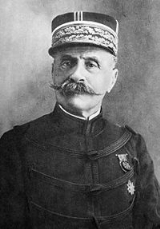
Ferdinand Foch

 
Ferdinand Foch

   Email Print
   Bookmark   Link


Ferdinand Foch


Ferdinand Foch (Breton
Breton language

The Breton language is a Celtic languages spoken by some of the inhabitants of Brittany in France....
 pronounced "Fosh"). OM
Order of Merit

The Order of Merit is a United Kingdom and Commonwealth of Nations Order bestowed by the Elizabeth II of the United Kingdom. It was established in 1902 by King Edward VII of the United Kingdom as a reward for distinguished service in the armed forces, science, art, literature, or for the promotion of culture....
 GCB
List of honorary British Knights

This is an incomplete list of people who have been created honorary Knights by the British crown, as well as those who have been raised to the two comparable Orders of Chivalry and the Royal Victorian Chain, which do not carry titles....
 (2 October 1851 – 20 March 1929) was a French
France

France , officially the French Republic , is a country whose Metropolitan France is located in Western Europe and that also comprises various Overseas departments and territories of France....
 soldier, military theorist, and writer credited with possessing "the most original and subtle mind in the French army
French Army

The French Army, officially the Arm?e de Terre , is the Army component of the Military of France and its largest. As of 2007, the army employs 134,000 regular soldiers, 15,500 reservists, and 25,750 civilians....
" in the early 20th century. He served as general in the French army during World War I
World War I

World War I, or the First World War , was a global military conflict which involved the Great powers, organized into two opposing military alliances: the Allies of World War I and the Central Powers....
 and was made Marshal of France
Marshal of France

The Marshal of France is a military distinction in contemporary France, not a military rank. It is granted to generals for exceptional achievements....
 in its final year, 1918. Shortly after the start of the Spring Offensive
Spring Offensive

The 1918 Spring Offensive or Kaiserschlacht and also known as the Ludendorff Offensive was a series of German attacks along the Western Front during World War I, which marked the deepest advances by either side since 1914....
, Germany's final attempt to win the war, Foch was chosen as supreme commander of the Allied armies
Allies of World War I

File:Map Europe alliances 1914-en.svgThe Entente Powers were the countries at war with the Central Powers during World War I. The main allies were the Russian Empire, French Third Republic, the British Empire, Kingdom of Italy , the Empire of Japan, and the United States....
, a position that he held until 11 November 1918, when he accepted the German request for an armistice.

He advocated peace terms that would make Germany unable to ever pose a threat to France again.


Discussion
Ask a question about 'Ferdinand Foch'
Start a new discussion about 'Ferdinand Foch'
Answer questions from other users
Full Discussion Forum


Encyclopedia


Ferdinand Foch (Breton
Breton language

The Breton language is a Celtic languages spoken by some of the inhabitants of Brittany in France....
 pronounced "Fosh"). OM
Order of Merit

The Order of Merit is a United Kingdom and Commonwealth of Nations Order bestowed by the Elizabeth II of the United Kingdom. It was established in 1902 by King Edward VII of the United Kingdom as a reward for distinguished service in the armed forces, science, art, literature, or for the promotion of culture....
 GCB
List of honorary British Knights

This is an incomplete list of people who have been created honorary Knights by the British crown, as well as those who have been raised to the two comparable Orders of Chivalry and the Royal Victorian Chain, which do not carry titles....
 (2 October 1851 – 20 March 1929) was a French
France

France , officially the French Republic , is a country whose Metropolitan France is located in Western Europe and that also comprises various Overseas departments and territories of France....
 soldier, military theorist, and writer credited with possessing "the most original and subtle mind in the French army
French Army

The French Army, officially the Arm?e de Terre , is the Army component of the Military of France and its largest. As of 2007, the army employs 134,000 regular soldiers, 15,500 reservists, and 25,750 civilians....
" in the early 20th century. He served as general in the French army during World War I
World War I

World War I, or the First World War , was a global military conflict which involved the Great powers, organized into two opposing military alliances: the Allies of World War I and the Central Powers....
 and was made Marshal of France
Marshal of France

The Marshal of France is a military distinction in contemporary France, not a military rank. It is granted to generals for exceptional achievements....
 in its final year, 1918. Shortly after the start of the Spring Offensive
Spring Offensive

The 1918 Spring Offensive or Kaiserschlacht and also known as the Ludendorff Offensive was a series of German attacks along the Western Front during World War I, which marked the deepest advances by either side since 1914....
, Germany's final attempt to win the war, Foch was chosen as supreme commander of the Allied armies
Allies of World War I

File:Map Europe alliances 1914-en.svgThe Entente Powers were the countries at war with the Central Powers during World War I. The main allies were the Russian Empire, French Third Republic, the British Empire, Kingdom of Italy , the Empire of Japan, and the United States....
, a position that he held until 11 November 1918, when he accepted the German request for an armistice.

He advocated peace terms that would make Germany unable to ever pose a threat to France again. His words after the Treaty of Versailles
Treaty of Versailles

The Treaty of Versailles was one of the peace treaty at the end of World War I. It ended the declaration of war between German Empire and Allies of World War I....
, "This is not a peace. It is an armistice for 20 years" would prove prophetic.

Early life

Foch was born in Tarbes
Tarbes

Tarbes is a France town and commune in France, in the d?partement in France of Hautes-Pyr?n?es, of which it is the pr?fecture. It is part of the historical region of Gascony....
, France
France

France , officially the French Republic , is a country whose Metropolitan France is located in Western Europe and that also comprises various Overseas departments and territories of France....
 as the son of a civil servant from Provence
Provence

Provence is a region of southeastern France on the Mediterranean adjacent to Italy. It is part of the administrative regions of France of Provence-Alpes-C?te d'Azur....
. He attended school in Tarbes, Rodez
Rodez

Rodez is a city and communes of France in southern France, in the Aveyron Departments of France, of which it is the capital. Its inhabitants are called Ruthenois....
, and the Jesuit
Society of Jesus

The Society of Jesus is a Roman Catholic religious order of clerks regular whose members are called Jesuits, Soldiers of Jesus Christ, and Foot soldiers of the Pope, because the founder, Saint Ignatius of Loyola, was a knight before becoming a Holy Orders....
 College in St. Etienne. His brother was later a Jesuit and this may initially have hindered Foch's rise through the ranks of the French Army
French Army

The French Army, officially the Arm?e de Terre , is the Army component of the Military of France and its largest. As of 2007, the army employs 134,000 regular soldiers, 15,500 reservists, and 25,750 civilians....
 (since the Republican government of France was anti-clerical).

Foch enlisted in the French 4th Infantry
Infantry

Infantry are soldiers who are primarily trained for the role of fighting on foot. A soldier in the infantry is known as an infantryman. Infantry units have more physically demanding training than other branches of armies, and place a greater emphasis on fitness, physical strength and aggression....
 Regiment
Regiment

A regiment is a military unit, composed of variable numbers of battalions, commanded by a Colonel. Depending on the nation, military branch, mission, and organization, a modern regiment resembles a brigade, in that both range in size from a few hundred to 5,000 soldiers ....
, in 1870, during the Franco-Prussian War
Franco-Prussian War

The Franco-Prussian War or Franco-German War, often referred to in France as the 1870 War was a conflict between Second French Empire and Kingdom of Prussia, while Prussia was backed by the North German Confederation, of which it was a member, and the South German states of Grand Duchy of Baden, History of W?rttemberg#The Kingdom...
, and decided to stay in the army after the war. In 1871, Foch entered the École Polytechnique
École Polytechnique

The ?cole Polytechnique , often referred to by the nickname X, is the foremost France grande ?cole of engineering . Founded in 1794 and initially located in the Quartier Latin in central Paris, it was moved to Palaiseau in 1976....
 and received his commission as a Lieutenant
Lieutenant

Lieutenant is a military, naval, paramilitary, fire service, emergency medical services or police commissioned officer military rank.Lieutenant may also appear as part of a title used in various other organisations with a codified command structure....
 in the 24th Artillery
Artillery

Artillery is a military Combat Arms which employs any apparatus, machine, an assortment of tools or instruments, a system or systems used as weapons for the discharge of large projectiles in combat as a major contribution of fire power within the overall military capability of an armed force....
 Regiment, in 1873, despite not having the time to complete his course due to the shortage of junior officers. He rose through the ranks, eventually reaching the rank of Captain
Captain (Land)

The army rank of Captain is an officer rank historically corresponding to command of a company of soldiers. The rank is also used by some air forces and Marine ....
 before entering the Staff College in 1885. In 1895, he was to return to the College as an instructor and it is for his work here that he was later acclaimed as "the most original military thinker of his generation". Turning to history for inspiration, Foch became known for his critical analyses of the Franco-Prussian and Napoleonic
Napoleonic Wars

The Napoleonic Wars were a series of conflicts involving Napoleon I of France First French Empire and changing sets of European allies and opposing coalitions that ran from 1803 to 1815....
 campaigns and of their relevance to the pursuit of military operations in the new century. His re-examination of France's painful defeat in 1870 was among the first of its kind.

In his career as instructor Foch created renewed interest in French military history
Military history of France

The military history of France encompasses an immense panorama of conflicts and struggles extending for more than 2,000 years across areas including modern France, greater Europe, and List of former European colonies....
, inspired confidence in a new class of French officers, and brought about "the intellectual and moral regeneration of the French Army". His thinking on military doctrine was shaped by the unshakeable belief, uncommon at the time, that "the will to conquer is the first condition of victory." Collections of his lectures, which reintroduced the concept of the offensive to French military theory, were published in the volumes "Des Principes de la Guerre" ("On the Principles of War") in 1903, and "De la Conduite de la Guerre" ("On the Conduct of War") in 1904. Sadly, while Foch advised "qualification and discernment" in military strategy and cautioned that "recklessness in attack could lead to prohibitive losses and ultimate failure," his concepts, distorted and misunderstood by contemporaries, became associated with the perverse offensive doctrines (l'offensive à outrance) of his successors. To Foch's regret, the cult of the offensive
Cult of the offensive

Cult of the offensive refers to a strategic military dilemma, where leaders believe that offensive advantages are so great that a defending force would have no hope of repelling the attack; consequently, all states choose to attack....
 came to dominate military circles, and Foch's books were even cited in the development of Plan XVII
Plan XVII

Plan XVII was the name of the battle plan adopted by the French General Staff in 1913, to be put into effect by the French Army in the event of war between France and Germany....
, the disastrous French strategy for war with Germany
Germany

Germany , officially the Federal Republic of Germany , is a country in Central Europe. It is bordered to the north by the North Sea, Denmark, and the Baltic Sea; to the east by Poland and the Czech Republic; to the south by Austria and Switzerland; and to the west by France, Luxembourg, Belgium, and the Netherlands....
 that brought France so close to ruin in 1914.

Foch continued his initially slow rise through the ranks, being promoted to Lieutenant-Colonel in 1898. Thereafter, his career accelerated and he returned to command in 1901, when he was posted to a regiment
Regiment

A regiment is a military unit, composed of variable numbers of battalions, commanded by a Colonel. Depending on the nation, military branch, mission, and organization, a modern regiment resembles a brigade, in that both range in size from a few hundred to 5,000 soldiers ....
. He was promoted to become a Colonel
Colonel

Colonel is a military rank of a commissioned officer, with corresponding ranks existing in almost every country in the world. It is also used in some police forces and other paramilitary rank structures....
 in 1903, then Brigadier
Brigadier

Brigadier is a military Military rank, the meaning of which has a considerable variation....
 General (Général de Brigade) in 1907, returning to the Staff College as Commandant from 1907–1911. In 1911 he was promoted Major General
Major General

Major General or Major-General is a military rank used in many countries. It is derived from the older rank of Sergeant Major General. A Major General is a high-ranking officer, normally subordinate to the rank of Lieutenant General and senior to the ranks of Brigadier and Brigadier General....
 (Général de Division) and then Lieutenant General (Général de corps d’Armée) in 1913, taking command of XXe Corps at Nancy
Nancy

Nancy is a city in the Meurthe-et-Moselle Departments of France in northeastern France.The city is the capital of the department. The metropolitan area of Nancy had a population of 410,509 inhabitants at the 1999 census, 103,602 of whom lived in the city of Nancy proper ....
.

Foch and World War I

Ferdinand Foch
On the outbreak of the war, Foch was in command of XX Corps, part of the Second Army of General de Castelnau
Noël Édouard, vicomte de Curières de Castelnau

No?l Marie Joseph ?douard, Vicomte de Curi?res de Castelnau was a French general in World War I, one of the leading proponents of the philosophy of attaque ? outrance that dominated French military thinking in the early part of the war....
. On 14 August the corps advanced towards the Sarrebourg
Sarrebourg

Sarrebourg is a Communes of France in the Moselle Departments of France in Lorraine in northeastern France. It lies in on the upper course of the river Saar River....
-Morhange
Morhange

Morhange is a Communes of France in the Moselle Departments of France in Lorraine in northeastern France....
 line, taking heavy casualties in the Battle of the Frontiers
Battle of the Frontiers

The Battle of the Frontiers was a series of battles fought along the eastern frontier of France and in southern Belgium shortly after the outbreak of World War I....
. The defeat of XV Corps to its right forced Foch into retreat. Foch acquitted himself well, covering the withdrawal to Nancy
Nancy

Nancy is a city in the Meurthe-et-Moselle Departments of France in northeastern France.The city is the capital of the department. The metropolitan area of Nancy had a population of 410,509 inhabitants at the 1999 census, 103,602 of whom lived in the city of Nancy proper ....
 and the Charmes Gap, before launching a counter-attack that prevented the Germans from crossing the Meurthe
Meurthe

Meurthe is a former d?partement in France of France. Its pr?fecture was Nancy. It ceased to exist following the annexation of Alsace-Lorraine by Germany in 1871....
.

He was then selected to command the newly formed Ninth Army, which he was to command during the First Battle of the Marne
First Battle of the Marne

The First Battle of the Marne was a World War I battle fought between the 5th and 12th of September 1914. It resulted in a France-United Kingdom victory against the German Empire Wehrmacht under Chief of Staff Helmuth von Moltke the Younger....
 and the Race to the Sea
Race to the Sea

The Race to the Sea was a name given to a period of World War I when, on the Western Front, the two sides were still engaged in mobile warfare....
. With his Chief of Staff Maxime Weygand
Maxime Weygand

Maxime Weygand was a France military commander in World War I and World War II. Though not as infamous as Philippe Petain, Weygand is remembered for initially fighting the Battle of France, then surrendering to and collaborating with the Germans as part of the Vichy France regime....
, Foch managed to do this while the whole French Army was in full retreat. Only a week after taking command of 9th Army, he was forced to fight a series of defensive actions to prevent a German breakthrough. It was then that he spoke the famous words: "Hard pressed on my right. My center is yielding. Impossible to maneuver. Situation excellent. I attack." His counter-attack
Counter-Attack

Counter-Attack is a 1945 in film war film starring Paul Muni and Marguerite Chapman as two Russians trapped in a collapsed building with seven enemy German soldiers....
 was an implementation of the theories he had developed during his staff college days, and succeeded in stopping the German advance. Foch received further reinforcements from the Fifth Army and, following another attack on his forces, counter-attacked again on the Marne. The Germans dug in before eventually retreating. On 12 September Foch regained Marne at Châlons
Châlons-en-Champagne

Ch?lons-en-Champagne is a city in France. It is the capital of both the Departments of France of Marne and the r?gion in France of Champagne-Ardenne, despite being only a quarter the size of the city of Reims....
 and liberated the city. The people of Châlons greeted as a hero the man widely believed to have been instrumental in stopping the great retreat
Great Retreat

The Great Retreat is the name given to the slow, fighting retreat by Allies of World War I forces to the River Marne, on the Western Front early in World War I, after their holding action against the German Empire Armies at the Battle of Mons on 23 August 1914....
 and stabilising the Allied position. Receiving thanks from the Bishop of Châlons
Bishop of Châlons

Bishop of Ch?lons may refer to:*Bishop of Ch?lons-sur-Marne*Bishop of Ch?lon-sur-Sa?ne...
, Foch piously replied, "non nobis, Domine, non nobis, sed nomini tuo da gloriam." (Not unto us, o Lord, not unto us, but to Your name give glory, Psalm 115:1)

Foch's successes gained him a further promotion, on 4 October, when he was appointed assistant Commander-in-Chief with responsibility for co-ordinating the activities of the northern French armies, and liaising with the British forces. This was a key appointment as the so-called "Race to the Sea" was then in progress. Joffre had also wanted to nominate Foch as his successor "in case of accident", to make sure the job would not be given to Galliéni, but the French government would not agree to this. When the Germans attacked on 13 October, they narrowly failed to break through the British
United Kingdom of Great Britain and Ireland

The United Kingdom of Great Britain and Ireland was the formal name and the state form of the United Kingdom from 1 January 1801 until 12 April 1927....
 and French lines. They tried again at the end of the month during the First Battle of Ypres
First Battle of Ypres

}|-||}The First Battle of Ypres, also called the Battle of Flanders, was the last major battle of the first year of World War I ; actually a series of battles, starting on 19 October and ending, according to the various histories, on 13 November , 22 November or 30 November ....
; this time suffering terrible casualties. Foch had again succeeded in co-ordinating a defence and winning against the odds. On 2 December 1914, King George V of the United Kingdom appointed him an honorary Knight Grand Cross of the Order of the Bath. In 1915, his responsibilities by now crystallised into command of the Northern Army Group, he conducted the Artois Offensive
Third Battle of Artois

The Third Battle of Artois was a battle on the Western Front of World War I, is also known as the Loos-Artois Offensive, including the major British Battle of Loos....
, and, in 1916, the French part of the Battle of the Somme. He was strongly criticised for his tactics and the heavy casualties that were suffered by the Allied armies during these battles, and in December 1916 was removed from command, by General Joffre
Joseph Joffre

Joseph Jacques C?saire Joffre was a France general who was Commander-in-Chief of the French Army between 1914 and 1916 during the First World War....
, and sent to command in Italy
Italy

Italy , officially the Italian Republic , is a country located on the Italian Peninsula in Southern Europe and on the two largest islands in the Mediterranean Sea, Sicily and Sardinia....
; Joffre was himself sacked days later.

Just a few months later, after the failure of General Nivelle
Robert Nivelle

Robert Georges Nivelle was a French artillery officer who served in the Boxer Rebellion, and the First World War. He took command of one of the main French armies engaged in the Battle of Verdun, leading it during its successful counter-strokes against the Germans, but was accused of wasting French lives during some of his attacks....
, General Pétain
Philippe Pétain

Henri Philippe Benoni Omer Joseph P?tain , generally known as Philippe P?tain or Marshal P?tain , was a France general who reached the distinction of Marshal of France, later Head of state of Vichy France , from 1940 to 1944....
 was appointed Chief of the General Staff; Foch hoped to succeed Pétain in command of Army Group Centre, but this job was instead given to General Fayolle. The following month General Pétain
Philippe Pétain

Henri Philippe Benoni Omer Joseph P?tain , generally known as Philippe P?tain or Marshal P?tain , was a France general who reached the distinction of Marshal of France, later Head of state of Vichy France , from 1940 to 1944....
 was appointed Commander-in-Chief in place of Nivelle, and Foch was recalled and promoted to Chief of the General Staff.

On 26 March 1918, Foch was appointed Supreme Commander of the Allied Armies with the title of Généralissime
Generalissimo

Generalissimo or Generalissimus is a military rank of the highest degree, superior to a Field Marshal or Grand Admiral....
 ("supreme General") with the job of co-ordinating the activities of the Allied armies, forming a common reserve and using these divisions to guard the junction of the French and British armies and to plug the potentially fatal gap that would have followed a German breakthrough in the British Fifth Army sector. Despite being surprised by the German offensive on the Chemin des Dames
Chemin des Dames

In France, the Chemin des Dames, literally, the "Ladies' Way", is part of the D18 and runs east and west in the d?partement of Aisne, between in the west, the road N2, and in the east, the D1044 at Corbeny....
, the Allied armies under Foch's command ultimately held the advance of the German
Germany

Germany , officially the Federal Republic of Germany , is a country in Central Europe. It is bordered to the north by the North Sea, Denmark, and the Baltic Sea; to the east by Poland and the Czech Republic; to the south by Austria and Switzerland; and to the west by France, Luxembourg, Belgium, and the Netherlands....
 forces during the great Spring Offensive
Spring Offensive

The 1918 Spring Offensive or Kaiserschlacht and also known as the Ludendorff Offensive was a series of German attacks along the Western Front during World War I, which marked the deepest advances by either side since 1914....
 of 1918 and at the Second Battle of Marne in July 1918. The celebrated phrase, "I will fight in front of Paris, I will fight in Paris, I will fight behind Paris," attributed both to Foch and Clemenceau
Georges Clemenceau

Georges Benjamin Clemenceau was a French statesman, physician, and journalist. He served as the List of Prime Ministers of France from 1906-1909 and 1917-1920....
, illustrated the Generalissimo's resolve to keep the Allied armies intact, even at the risk of losing the capital. On 6 August 1918, Foch was made Marshal of France
Marshal of France

The Marshal of France is a military distinction in contemporary France, not a military rank. It is granted to generals for exceptional achievements....
.

Along with the British commander Field Marshal Haig
Douglas Haig

Douglas Haig may refer to:*Douglas Haig, 1st Earl Haig, British Earl and a Field Marshall during the First World War*Club Atl?tico Douglas Haig, a football club from Argentina...
, Foch planned the Grand Offensive, opening on 26 September 1918, which led to the defeat of Germany. Foch accepted the German cessation of hostilities
Armistice with Germany (Compiègne)

The armistice treaty between the Allies and German Empire was signed in a railway carriage in Compi?gne Forest on 11 November 1918, and marked the end of the World War I on the Western Front ....
 in November, after which he refused to shake the hand of the German signatory. On the day of the armistice, he was elected to the Académie des Sciences. Ten days later, he was unanimously elected to the Académie française
Académie française

L'Acad?mie fran?aise, or the French Academy, is the pre-eminent France learned body on matters pertaining to the French language. The Acad?mie was officially established in 1635 by Cardinal Richelieu, the chief minister to Louis XIII of France....
.

Paris Peace Conference

Tarbes Eq Foch
In January 1919, at the Paris Peace Conference
Paris Peace Conference, 1919

The Paris Peace Conference was the meeting of the Allied victors in World War I to set the peace terms for Germany and other defeated nations, and to deal with the empires of the defeated powers following the Armistice of 1918....
 Foch presented a memorandum
Memorandum

A memorandum or memo is a document or other communication that aids the memory by recording events or observations on a topic, such as may be used in a business office....
 to the Allied plenipotentiaries in which he stated:

In a subsequent memorandum, Foch argued that the Allies should take full advantage of their victory by permanently weakening German power in order to prevent her from threatening France again:

However the British Prime Minister
Prime Minister of the United Kingdom

The Prime Minister of the United Kingdom of Great Britain and Northern Ireland is the political leader of the United Kingdom and the head of government Her Majesty's Government....
 David Lloyd George
David Lloyd George

David Lloyd George, 1st Earl Lloyd-George of Dwyfor Order of Merit , Privy Council of the United Kingdom was a United Kingdom statesman and the only Wales Prime Minister of the United Kingdom - he is also the only one to have spoken English language as a second language, Welsh language having been his first....
 and the American President Wilson
Woodrow Wilson

Thomas Woodrow Wilson was the List of Presidents of the United States President of the United States. A devout Presbyterianism and leading intellectual of the Progressive Era, he served as President of Princeton University of Princeton University from 1902 to 1910, and then as the Governor of New Jersey from 1911 to 1913....
 objected to the detachment of the Rhineland
Rhineland

The Rhineland is the general name for the land on both sides of the river Rhine in the west of Germany. After the collapse of the First French Empire in the early 19th century, the German-speaking regions at the middle and lower course of the Rhine were annexed to the kingdom of Prussia....
 from Germany, but agreed to Allied military occupation for fifteen years, which Foch thought insufficient to protect France.

Foch considered the Treaty of Versailles
Treaty of Versailles

The Treaty of Versailles was one of the peace treaty at the end of World War I. It ended the declaration of war between German Empire and Allies of World War I....
 to be "a capitulation, a treason
Treason

In law, treason is the crime that covers some of the more serious acts of loyalty to one's sovereignty or nation. Historically, treason also covered the murder of specific social superiors, such as the murder of a husband by his wife ....
" because he believed that only permanent occupation of the Rhineland would grant France sufficient security against a revival of German aggression. As the treaty
Treaty

A Treaty is an agreement under international law entered into by actors in international law, namely states and international organizations. A Treaty may also be known as: agreement, protocol, covenant, convention, exchange of letters, etc....
 was being signed Foch said: "This is not peace. It is an armistice for 20 years".

Post-war career

Ferdinand Foch Grabmal
Foch was made a British Field Marshal
List of British Field Marshals

This is a list of Field Marshals of the United Kingdom, with their respective years of appointment.#George Douglas-Hamilton, 1st Earl of Orkney #John Campbell, 2nd Duke of Argyll ...
 in 1919, and, for his advice during the Polish-Bolshevik War of 1920, as well as his pressure on Germany during the Great Poland Uprising, he was awarded with the title of Marshal of Poland
Marshal of Poland

Marshal of Poland is the highest rank in the Polish Army. It has been granted to only six officers. At present, this rank is equivalent to a Field Marshal or General of the Army in other NATO armies....
 in 1923.

On 1 November 1921 Foch was in Kansas City
Kansas City, Missouri

Kansas City is the largest city in the U.S. state of Missouri. It encompasses in parts of Jackson County, Missouri, Clay County, Missouri, Cass County, Missouri, and Platte County, Missouri counties....
 to take part in the groundbreaking ceremony for the Liberty Memorial
Liberty Memorial

The Liberty Memorial, located in Kansas City, Missouri, Missouri, United States, houses the The National World War I Museum, as designated by the United States Congress in 2004....
 that was being constructed there. Also present that day were Lieutenant General Baron Jacques of Belgium, Admiral David Beatty
David Beatty, 1st Earl Beatty

Admiral of the Fleet David Beatty, 1st Earl Beatty Order of the Bath, Order of Merit , Royal Victorian Order, Distinguished Service Order , was an admiral in the Royal Navy....
 of Great Britain, General Armando Diaz
Armando Diaz

Armando Diaz, 1st Duke of the Victory was an Italian people general and a Marshal of Italy.Born in Naples, Diaz began his military career as a student at the Military Academy of Turin, where he became an artillery officer ....
 of Italy and General John J. Pershing
John J. Pershing

John Joseph "Black Jack" Pershing, Order of the Bath was an officer in the United States Army. He is the only person to be promoted in his own lifetime to the highest rank ever held in the United States Army?General of the Armies....
 of the United States. One of the main speakers was Vice President Calvin Coolidge
Calvin Coolidge

John Calvin Coolidge, Jr. was the List of Presidents of the United States President of the United States . A Republican Party lawyer from Vermont, Coolidge worked his way up the ladder of Massachusetts state politics, eventually becoming governor of that state....
 of the United States. In 1935 bas-reliefs of Foch, Jacques, Diaz and Pershing by sculptor Walker Hancock
Walker Hancock

Walker Kirtland Hancock was an United States Sculpture of the 20th century noted for his monumental sculptures. He is well known, among other things, for his work on the memorial sculptures at Stone Mountain, and was awarded the National Medal of Arts in 1989....
 were added to the memorial.

Foch died on 20 March 1929, and was interred in Les Invalides
Les Invalides

Les Invalides in Paris, France, is a complex of buildings in the city's 7th arrondissement of Paris containing museums and monuments, all relating to the military history of France, as well as a hospital and a retirement home for war veterans, the building's original purpose....
, next to Napoleon and many other famous French soldiers and officers.

A statue of Foch was set up at the Compiègne
Compiègne

Compi?gne is a Communes of France in the Oise Departments of France in northern France.The city is located along the Oise River. Its inhabitants are called Compi?gnois....
 Armistice site when the area was converted into a national memorial. This statue was the one item left undisturbed by the Germans following their defeat of France in June, 1940. Following the signing of France's surrender on 21 June, the Germans ravaged the area surrounding the railway car in which both the 1918 and 1940 surrenders had taken place. The statue was left standing, to view nothing but a wasteland.

A heavy cruiser
French cruiser Foch

The Foch was a French heavy cruiser of the Suffren class cruiser class, that saw service in World War II. She was the first French warship named for the French Marshall Ferdinand Foch....
 and a full-size aircraft carrier
Foch (R 99)

Foch was the second of the French Navy. She was the second warship named in honour of Marshal Ferdinand Foch, after a French cruiser Foch commissioned in 1932, and scuttled in Toulon on 27 November 1942....
 were named in his honour, as well as an early district of Gdynia
Gdynia

Gdynia is a city in the Pomeranian Voivodeship of Poland and an important seaport at Gdansk Bay on the south coast of the Baltic Sea.Located in Kashubia in Eastern Pomerania, Gdynia is part of a conurbation with the spa town of Sopot, the city of Gdansk and suburban communities, which together form a metropolitan area called the Tricity...
, Poland. The latter was, however, renamed by the Communist government after World War II
World War II

World War II, or the Second World War , was a global military conflict which involved a Participants in World War II, including all of the great powers, organised into two opposing military alliances: the Allies of World War II and the Axis powers....
. Nevertheless, one of the major avenues of the town of Bydgoszcz
Bydgoszcz

Bydgoszcz is a city in northern Poland, on the Brda River and Vistula rivers, with a population of 360,142 , agglomeration more than 400 000, which makes it the 8th biggest city in Poland....
, located in then in the Polish corridor
Polish Corridor

The Polish Corridor was a territory located in the region of Pomerelia which provided the Second Republic of Poland with access to the Baltic Sea, thus dividing the bulk of Germany from her province of East Prussia....
, holds his name -as sign of gratitude for campaigning for Free Poland. A street in Paris
Paris

Paris is the Capital of France and the country's largest city. It is situated on the river Seine, in northern France, at the heart of the ?le-de-France Regions of France ....
 is named after him, Avenue Foch
Avenue Foch

Avenue Foch is a street in Paris, France, named after Ferdinand Foch in 1929. It was previously named Avenue du Bois de Boulogne.It is located in the XVIe arrondissement and runs from the Arc de Triomphe southwest to the Porte Dauphine at the edge of the Bois de Boulogne city park....
, one in Lyon
Lyon

||-||}Lyon, also known as Lyons in English, is a city in east-central France. Its name is pronounced in French language and Franco-Proven?al language, and or in English language....
, one in Krakow
Kraków

Krak?w , in English also spelled Krakow or Cracow , is one of the largest and oldest cities in Poland, with a population of 756,336 in 2007 ....
, one in Grenoble
Grenoble

Grenoble is a city in southeastern France situated at the foot of the Alps where the Drac River joins the Is?re River.Located in the Rh?ne-Alpes regions of France, Grenoble is the capital of the Departments of France of Is?re....
, Boulevard Marechal Foch, as are Mariscal Foch in Quito
Quito

San Francisco de Quito, most often called Quito, is the Capital city of Ecuador in northwestern South America. It is located in north-central Ecuador in the Guayllabamba river basin, on the eastern slopes of Pichincha , an active stratovolcano in the Andes mountains....
, Ecuador
Ecuador

Ecuador , officially the , literally, "Republic of the equator") is a representative democratic republic in South America, bordered by Colombia on the north, by Peru on the east and south, and by the Pacific Ocean to the west....
, Rue Foch - a luxury shopping street in downtown Beirut
Beirut

Beirut is the Capital and largest city of Lebanon with a population of over 2.1 million as of 2007. Located on a peninsula at the midpoint of Lebanon's coastline with the Mediterranean sea, it serves as the country's largest and main seaport and also forms the Beirut District area, which consists of the city and its suburbs....
, Lebanon
Lebanon

Lebanon , officially the Republic of Lebanon or Lebanese Republic , is a country in Western Asia, on the eastern shore of the Mediterranean Sea....
, Marshall Foch Street in the Lakeview
Lakeview, New Orleans

Lakeview is a New Orleans neighborhoods of the city of New Orleans, Louisiana. A subdistrict of the Lakeview District Area, its boundaries as defined by the City Planning Commission are: Robert E....
 neighborhood of New Orleans, Louisiana
Louisiana

The State of Louisiana is a U.S. state located in the U.S. Southern States of the United States of America. Its capital is Baton Rouge and largest city is New Orleans....
, the Marshall Foch Square in Leuven
Leuven

Leuven is the capital of the province of Flemish Brabant in the Flanders, Belgium. It is located about 30 kilometers east of Brussels, with as other neighbouring cities Mechelen, Aarschot, Tienen, and Wavre....
 and Foch Avenue in Milltown, New Jersey
New Jersey

New Jersey is a state in the Mid-Atlantic States and Northeastern United States regions of the United States. It is bordered on the north by New York, on the east by the Hudson River and the Atlantic Ocean, on the southwest by Delaware, and on the west by Pennsylvania....
, USA..Fochville in South Africa
South Africa

The Republic of South Africa, also known by Official names of South Africa, is a country located at the southern tip of the continent of Africa....
 was also named in his honor. A statue of Foch stands near to Victoria Station in London.

Bibliography

  • Des Principes de la Guerre (On the Principles of War) (1903)
  • De la Conduite de la Guerre (On the Conduct of War) (1904)
  • Mémoires pour servir à l’histoire de la guerre 1914-1918 (The Memoirs of Marshal Foch) (Posthumous, 1931)


See also

  • Army Manoeuvres of 1912
    Army Manoeuvres of 1912

    The Army Manoeuvres of 1912 was the last exercise of its kind conducted by the British army before the outbreak of the First World War. In the manoeuvres, James Grierson decisively beat Douglas Haig, 1st Earl Haig, calling into question Haig's abilities as a field commander....
  • Foch Line
    Foch Line

    The Foch Line was a temporary demarcation line between Poland and Lithuania proposed by the Entente in the aftermath of World War I. The line was proposed by Marshal of France Ferdinand Foch and was accepted by the Conference of Ambassadors in 1919....


External links