
All Topics  
Seaplane

 
Seaplane

   Email Print
   Bookmark   Link


Seaplane


A seaplane is a fixed-wing aircraft
Fixed-wing aircraft

A fixed-wing aircraft is an aircraft capable of heavier-than-air flight whose Lift is generated not by wing motion relative to the aircraft, but by forward motion through the air....
 capable of taking off
Takeoff

Takeoff is the phase of flight in which an aircraft goes through a transition from moving along the ground to flying in the air, usually starting on a runway....
 and landing
Water landing

A water landing is, in the broadest sense, any landing on a body of water. All waterfowl, those seabirds capable of flight, and some human-built vehicles are capable of landing in water as a matter of course....
 (alighting) on water. Seaplanes are usually divided into two categories: floatplane
Floatplane

A floatplane is a type of seaplane, with slender pontoons mounted under the fuselage; only the floats of a floatplane normally come into contact with water, with the fuselage remaining above water....
s and flying boat
Flying boat

A flying boat is a specialised form of aircraft that is designed to take off from and land on water, using its fuselage as a floating Hull . Such aircraft are sometimes stabilised on water by underwing floats or by wing-like projections from the fuselage....
s. These aircraft are occasionally called hydroplanes.

word "seaplane" is used to describe two types of air/water vehicles: the floatplane and the flying boat
Flying boat

A flying boat is a specialised form of aircraft that is designed to take off from and land on water, using its fuselage as a floating Hull . Such aircraft are sometimes stabilised on water by underwing floats or by wing-like projections from the fuselage....
.

The term "seaplane" is used by some instead of "floatplanes".


Discussion
Ask a question about 'Seaplane'
Start a new discussion about 'Seaplane'
Answer questions from other users
Full Discussion Forum


Recent Posts


Encyclopedia


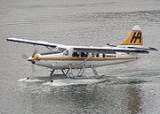
Dehavilland Single Otter Harbour Air
A seaplane is a fixed-wing aircraft
Fixed-wing aircraft

A fixed-wing aircraft is an aircraft capable of heavier-than-air flight whose Lift is generated not by wing motion relative to the aircraft, but by forward motion through the air....
 capable of taking off
Takeoff

Takeoff is the phase of flight in which an aircraft goes through a transition from moving along the ground to flying in the air, usually starting on a runway....
 and landing
Water landing

A water landing is, in the broadest sense, any landing on a body of water. All waterfowl, those seabirds capable of flight, and some human-built vehicles are capable of landing in water as a matter of course....
 (alighting) on water. Seaplanes are usually divided into two categories: floatplane
Floatplane

A floatplane is a type of seaplane, with slender pontoons mounted under the fuselage; only the floats of a floatplane normally come into contact with water, with the fuselage remaining above water....
s and flying boat
Flying boat

A flying boat is a specialised form of aircraft that is designed to take off from and land on water, using its fuselage as a floating Hull . Such aircraft are sometimes stabilised on water by underwing floats or by wing-like projections from the fuselage....
s. These aircraft are occasionally called hydroplanes.

Types

The word "seaplane" is used to describe two types of air/water vehicles: the floatplane and the flying boat
Flying boat

A flying boat is a specialised form of aircraft that is designed to take off from and land on water, using its fuselage as a floating Hull . Such aircraft are sometimes stabilised on water by underwing floats or by wing-like projections from the fuselage....
.
  • A floatplane
    Floatplane

    A floatplane is a type of seaplane, with slender pontoons mounted under the fuselage; only the floats of a floatplane normally come into contact with water, with the fuselage remaining above water....
     has slender pontoons
    Pontoon (boat)

    A pontoon is a flat-bottomed boat or the floats used to support a structure on water. It may be simply constructed from closed cylinder s such as pipes or barrels or fabricated as boxes from metal or concrete....
     mounted under the fuselage
    Fuselage

    The fuselage is an aircraft's main body section that holds crew and passengers or cargo. In single-engine aircraft it will usually contain an engine, although in some amphibious aircraft the single engine is mounted on a hardpoint attached to the fuselage which in turn is used as a floating Hull ....
    . Two floats are common, but other configurations are possible. Only the "floats" of a floatplane normally come into contact with water. The fuselage remains above water. Some small land aircraft can be modified to become float planes and in general floatplanes are small aircraft.
  • In a flying boat
    Flying boat

    A flying boat is a specialised form of aircraft that is designed to take off from and land on water, using its fuselage as a floating Hull . Such aircraft are sometimes stabilised on water by underwing floats or by wing-like projections from the fuselage....
    , the main source of buoyancy
    Buoyancy

    In physics, buoyancy is the upward force that keeps things afloat. The net upward buoyancy force is equal to the magnitude of the weight of fluid displaced by the body....
     is the fuselage, which acts like a ship's hull
    Hull (watercraft)

    A hull is the watertight body of a ship or boat. It is a central concept in floating vessels as it provides the buoyancy that keeps the vessel from sinking....
     in the water. Most flying boats have small floats mounted on their wings to keep them stable. Not all small seaplanes have been floatplanes, but all large seaplanes have been flying boats, their great weight supported on their hull
    Hull (watercraft)

    A hull is the watertight body of a ship or boat. It is a central concept in floating vessels as it provides the buoyancy that keeps the vessel from sinking....
    .


The term "seaplane" is used by some instead of "floatplanes". This is the standard British usage, which does not use the term "floatplane" widely nor have a collective name for both types. This article treats both flying boats and floatplanes as types of seaplane, in the US fashion.

An amphibious aircraft
Amphibious aircraft

An amphibious or amphibian aircraft is an aircraft that can take off and land on either land or water. Amphibious aircraft are typically flying boats and floatplanes with retractable wheels....
 can take off and land both on conventional runways and water. A true seaplane can only take off and land on water. There are amphibious flying boats and amphibious floatplanes, as well as some hybrid designs, e.g., floatplanes with retractable floats. Modern production seaplanes are typically light aircraft
Light aircraft

Light aircraft is a generic category of aircraft that comprises many official designations in many countries. Generally, however, under ICAO rules,...
, amphibious and of a floatplane design.

History

The first manned and controlled (though unpowered) seaplane flight was established by French aircraft designer, builder and pilot Gabriel Voisin
Gabriel Voisin

Gabriel Voisin was a French aviation pioneer....
 on June 1905, on river Seine (Paris); it was a towed flight, at 15 to 20 m altitude (50 to 66 ft), and 600 meters (2000 ft) long. The aircraft was a biplane configuration with an aft tail and a front elevator, supported at rest by 2 planing floats (catamaran).

The first autonomous flight by a seaplane was done by the French engineer Henri Fabre
Henri Fabre

Henri Fabre was a France aviator and the inventor of Le Canard, the first seaplane in history.Henri Fabre was born into a prominent family of shipowners in the city of Marseilles....
 in March 1910. Its name was Le Canard
Le Canard

The Fabre Hydravion or Le Canard was a France experimental seaplane designed by Henri Fabre, and the first seaplane in history to take off from water under its own power....
 ('the duck'), and took off from the water and flew 800 meters on its first flight on March 28 1910. These experiments were closely followed by the aircraft pioneers Gabriel and Charles Voisin
Gabriel Voisin

Gabriel Voisin was a French aviation pioneer....
, who purchased several of the Fabre floats and fitted them to their Canard Voisin
Canard Voisin

The Canard Voisin was a plane developed by Gabriel Voisin in 1910. Original in design, with its main wings positioned at the back, the Canard Voisin was a very popular aircraft during the first decades of the 20th century....
 airplane. In October 1910, the Canard Voisin became the first seaplane to fly over the river Seine
Seine

The Seine is a slow flowing major river and commercial waterway within Regions of France of ?le-de-France and Haute-Normandie in France and famous as a romantic backdrop in photographs of Paris, France....
, and in March 1912, the first seaplane to be used militarily from a seaplane carrier, La Foudre
La Foudre

The Foudre was a French seaplane carrier, and the first seaplane carrier in history . Her development followed the invention of the seaplane in 1910 with the French Le Canard....
 ('the lightning').

Lacanardphotograph
In the United States, early development was carried out at Hammondsport
Hammondsport, New York

Hammondsport is a village in Steuben County, New York, New York, United States. The population was 731 at the 2000 census. The village is named after its founding father....
, New York
New York

The State of New York is a U.S. state in the Mid-Atlantic States and Northeastern United States regions of the United States and is the nation's List of U.S....
 by Glenn Curtiss
Glenn Curtiss

Glenn Hammond Curtiss was an American aviation pioneer and founder of the Curtiss Aeroplane and Motor Company, now part of Curtiss-Wright Corporation....
 who had beaten Alexander Graham Bell
Alexander Graham Bell

Alexander Graham Bell was an eminent scientist, Innovation and innovator who is credited with inventing the first practical telephone.Bell's father, grandfather, and brother had all been associated with work on elocution and speech, and both his mother and wife were deaf, profoundly influencing Bell's life's work....
 and others in the Aerial Experiment Association
Aerial Experiment Association

The Aerial Experiment Association was a Canadian aeronautical research group formed on 30 September 1907, under the tutelage of Dr. Alexander Graham Bell....
. The first American seaplane flight occurred on January 26, 1911.

Englishman John Cyril Porte
John Cyril Porte

Lieutenant Commander John Cyril Porte Order of St Michael and St George RN was a flying boat pioneer associated with the World War I Seaplane Experimental Station at Felixstowe....
 joined with Curtiss to design a transatlantic flying boat, and developed a more practical hull for Curtiss' airframe and engines with the distinctive 'step' which enabled the hull and floats to cleanly break free of the water's surface at take-off. In the UK the Curtiss flying boat was developed into the Felixstowe series
Felixstowe Porte Baby

The Felixstowe Porte Baby was a United Kingdom reconnaissance flying boat of the First World War first flying in 1916....
 of flying boats, which were used in the First World War to patrol for German submarines
U-boat

U-boat is the anglicized#Loanwords version of the German language word , itself an abbreviation of Unterseeboot , and refers to military submarines operated by Germany, particularly in World War I and World War II....
. Curtiss N-9
Curtiss N-9

The Curtiss N-9 was a seaplane variant of the Curtiss Aeroplane and Motor Company Curtiss JN-4 "Jenny" military trainer used during the First World War....
 seaplanes were used during World War I as primary trainers, and over 2,500 Navy pilots learned to fly in them. A handful of N-9s were used in the Hewitt-Sperry Automatic Airplane
Hewitt-Sperry Automatic Airplane

The Hewitt-Sperry Automatic Airplane was a project undertaken during World War I to develop an aerial torpedo, a pilotless aircraft capable of carrying explosives to its target....
 project to develop an "aerial torpedo", an early RPV
Remotely Piloted Vehicle

Remotely Piloted Vehicle is a term used by United States Department of Defense during the 70's and 80's to describe a robotic aircraft flown by a pilot located in a Ground Control Station....
.

On March 27, 1919, the first transatlantic flight was completed by a U.S. Navy NC
Curtiss NC

The Curtiss NC was a flying boat built by Curtiss Aeroplane and Motor Company and used by the United States Navy from 1918 through the early 1920s....
 flying boat.

Due to the lack of runways and the perceived safety factor over water, many commercial airlines including Imperial Airways
Imperial Airways

Imperial Airways was the early British commercial long range air transport company, operating from 1924 to 1939 and serving parts of Europe but especially the Empire routes to South Africa, India and the Far East....
 (fore-runner of BOAC
Boac

Boac can refer to:* Boac, Marinduque, a municipality in the Southern Philippines* British Overseas Airways Corporation the former United Kingdom state-owned airline...
), and Pan-American World Airways used large seaplanes to provide service for long distance service across the Atlantic, Pacific and Indian Ocean
Indian Ocean

The Indian Ocean is the third largest of the world's oceanic divisions, covering about 20% of the water on the Earth's surface. It is bounded on the north by Asia ; on the west by Africa; on the east by Indochina, the Sunda Islands, and Australia; and on the south by the Southern Ocean ....
s. Aircraft specially built for these routes included some of the largest aircraft built between the wars.

Examples include:

  • Aeromarine 75
  • Consolidated Commodore
  • Martin China Clipper
  • Boeing Clipper
  • Sikorsky S-42
    Sikorsky S-42

    The Sikorsky S-42 was an 1930s United States commercial flying boat designed and built by Sikorsky Aircraft Corporation to meet a 1931 requirement from Pan American World Airways for a long-range transatlantic flying boat....
  • Sikorsky VS-44
    Sikorsky VS-44

    The Sikorsky Aircraft VS-44 was a large four-Piston engine flying boat built in the USA in the early 1940's. The VS-44 was designed primarily for the trans-Atlantic passenger market, with a capacity of 40+ passengers....
  • Dornier Wal
  • Short Kent
    Short Kent

    The Short S.17 Kent was a United Kingdom 4-engined 15-seat biplane luxury flying-boat airliner, designed and built by Short Brothers to meet a requirement from Imperial Airways for an aircraft with greater range than the Short Calcutta....
  • Short Empire
    Short Empire

    The Short Empire was a passenger and mail carrying flying boat, of the 1930s and 1940s, which flew between UK and British colonies in Africa, Asia and Australia....
  • Latécoère 631
    Latécoère 631

    The Lat?co?re 631 was a civil transatlantic flying boat built by Lat?co?re, the largest ever built up to its time. The prototype was captured by Germany during their occupation of France in World War II, and subsequently bombed by the Allies....


Smaller carriers found them useful as well for operating into areas without prepared runways. Popular with bush operators, sportsmen and explorers, a huge variety of designs were built. Examples include:

  • Sikorsky S-38
    Sikorsky S-38

    The Sikorsky Aircraft S-38 was an United States twin-engined 8-seat amphibious aircraft. It was sometimes called "The Explorer's Air Yacht" and was Sikorsky's first widely produced Amphibious aircraft flying boat which in addition to serving successfully for Pan American World Airways and the U....
  • Sikorsky S-39
    Sikorsky S-39

    File:CAP Sikorsky S-39 NC54V.jpgThe Sikorsky S-39 was a smaller, single-engine version of the Sikorsky S-38 light amphibious aircraft, built in the USA by aviation firm Sikorsky Aircraft during the 1930s....
  • Grumman Goose
    Grumman Goose

    The Grumman G-21 Goose amphibious aircraft was designed as an eight-seat "commuter" plane for businessmen in the Long Island area. The Goose was Grumman?s first monoplane to fly, its first twin-engined aircraft and its first aircraft to enter commercial airline service....
  • Grumman Mallard
    Grumman Mallard

    The Grumman G-73 "Mallard" is a large, twin engine amphibious aircraft. Many have been modified by replacing the original Pratt & Whitney Wasp radial engines with modern turboprop engines....
  • Douglas Dolphin
    Douglas Dolphin

    The Douglas Aircraft Company Dolphin was an amphibious flying boat. While only fifty-eight were built, they served a wide variety of roles: private "yacht," airliner, military transport, and search and rescue....
  • Dornier Delphin
    Dornier Delphin

    File:Bundesarchiv Bild 102-05956, Dornier-Flugboot "Delphin III".jpgThe Dornier Delphin was a 1920s Germany single-engined commercial flying boat built by Dornier Flugzeugwerke....
  • Supermarine Sea Eagle
    Supermarine Sea Eagle

    The Supermarine Sea Eagle was a United Kingdom passenger-carrying flying boat designed and built by the Supermarine for its subsidiary, the British Marine Air Navigation Co Ltd, to be used on their cross-channel route between Southampton and the Channel Islands and the Europe....
  • Vickers Viking
    Vickers Viking

    The Vickers Viking was a United Kingdom single-engined amphibious aircraft designed for military use shortly after World War I....
  • Canadian Vickers Vedette
    Canadian Vickers Vedette

    The Canadian Vickers Vedette was the first aircraft in Canada designed and built to meet a specification for Canadian conditions. It was a single-engine biplane flying boat purchased to meet a Royal Canadian Air Force demand for a smaller aircraft than the Vickers Viking with a much greater rate of climb, to be suitable for forestry survey a...
  • Beriev MBR-2
    Beriev MBR-2

    The Beriev MBR-2 was a reconnaissance flying boat which entered service with the Soviet Navy in 1935....


Typical for the above types, the Grumman Goose
Grumman Goose

The Grumman G-21 Goose amphibious aircraft was designed as an eight-seat "commuter" plane for businessmen in the Long Island area. The Goose was Grumman?s first monoplane to fly, its first twin-engined aircraft and its first aircraft to enter commercial airline service....
 came about in 1936, when a group of wealthy industrialists, including Henry Morgan, Marshall Field and E.R. Harriman, wanted an easier way to commute from their homes on Long Island, New York, to the financial district of Wall Street. They commissioned Roy Grumman to build ten airplanes that could take off from their private air strips and land on the water near the financial district. Grumman re-engineered their amphibians after the war and built a commercial version of their durable amphibians, called the Grumman Mallard
Grumman Mallard

The Grumman G-73 "Mallard" is a large, twin engine amphibious aircraft. Many have been modified by replacing the original Pratt & Whitney Wasp radial engines with modern turboprop engines....
.

During World War II
World War II

World War II, or the Second World War , was a global military conflict which involved a Participants in World War II, including all of the great powers, organised into two opposing military alliances: the Allies of World War II and the Axis powers....
, most navies
Navy

A navy is the branch of a nation's military forces principally designated for naval warfare and amphibious warfare; namely, lake- or ocean-borne combat operations and related functions....
 used seaplanes for reconnaissance
Reconnaissance

Reconnaissance is a military and medical term denoting exploration conducted to gain information. Militarily, its shorthand Australian, Canadian, and British form is recce , its American usage form is recon ....
, search and rescue
Search and rescue

Search and rescue is the search for and provision of aid to people who are in distress or imminent danger....
, and anti-submarine warfare
Anti-submarine warfare

Anti-submarine warfare is a branch of naval warfare that uses surface warships, aircraft, or other submarines to find, track and then damage or destroy enemy submarines....
. Possibly the most commonly known was the Consolidated PBY Catalina
PBY Catalina

The Consolidated PBY Catalina was an United States flying boat of the 1930s and 1940s produced by Consolidated Aircraft. It could be equipped with depth charges, bombs, torpedoes, and M2 Browning machine gun machine guns and was one of the most widely used multi-role aircraft of World War II....
 which was flown by the United States, United Kingdom, Russia, and Canada, among many others. Similar aircraft were used by Japan, Germany, Italy.

The US Navy utilized a fleet of seaplanes for reconnaissance, rescue and had many fitted with machine guns and bombs. Most battleship
Battleship

A battleship is a large, heavily armour warship with a main artillery battery consisting of the largest calibre of guns. Battleships were larger, better armed, and better armored than cruisers and destroyers....
s carried one or two (some cases as many as four) catapult-launched seaplanes to spot targets over the horizon for the big guns, or to fight off enemy reconnaissance planes. The failure of the German battleship Bismarck
German battleship Bismarck

Hide header=|Header caption=|Ship class=|Ship displacement=41,700 tonnes standard 50,900 tonnes full load|Ship length= overall waterline...
's Arado 196 seaplane to hunt down a PBY is said to have contributed to that ship's demise.

Examples include:

  • Arado 196
  • Blohm & Voss BV 222 Wiking
  • CANT Z.501
    CANT Z.501

    The CANT Z.501 Gabbiano was a single engine flying boat that served with the Italy Regia Aeronautica during World War II. It had a crew of four or five and was used mainly for reconnaissance....
  • Dornier Do 18
    Dornier Do 18

    The Dornier Do 18 was a development of the Dornier Do 15 "Wal" flying-boat. It was developed for Lufthansa and they introduced it in 1935. Its records included a non-stop 5,214 mile flight from Start Point, Devon to Caravelas in Brazil....
  • Dornier Do 24
    Dornier Do 24

    The Dornier Do 24 is a 1930s Germany 3-engined flying boat designed by the Dornier Flugzeugwerke for maritime patrol and search-and-rescue. According to Dornier records, some 12,000 people were rescued by Do 24s during its flying career....
  • Consolidated Catalina
    PBY Catalina

    The Consolidated PBY Catalina was an United States flying boat of the 1930s and 1940s produced by Consolidated Aircraft. It could be equipped with depth charges, bombs, torpedoes, and M2 Browning machine gun machine guns and was one of the most widely used multi-role aircraft of World War II....
  • Consolidated Coronado
    PB2Y Coronado

    The PB2Y Coronado was a large flying boat patrol bomber designed by Consolidated Aircraft. As of 2005, one Coronado remains at the Pensacola, Florida National Museum of Naval Aviation....
  • Martin Mariner
    PBM Mariner

    The Glenn L. Martin Company PBM Mariner was a patrol bomber flying boat of World War II and the early Cold War period. It was designed to complement the PBY Catalina in service....
  • Short Sunderland
    Short Sunderland

    The Short S.25 Sunderland was a British flying boat patrol bomber developed for the Royal Air Force by Short Brothers, first flown on 16 October 1937 by Shorts' test pilot, John Lankester Parker....
  • Supermarine Sea Otter
    Supermarine Sea Otter

    The Supermarine Sea Otter was a United Kingdom flying boat designed and built by Supermarine. It was a longer range development of the Supermarine Walrus and was the last biplane flying boat to be designed by Supermarine....
  • Supermarine Stranraer
    Supermarine Stranraer

    The Supermarine Stranraer was a 1930s United Kingdom flying boat designed and built by Supermarine which marked the end of biplane flying-boat development for the Royal Air Force....
  • Supermarine Walrus
    Supermarine Walrus

    The Supermarine Walrus was a United Kingdom single-engine Amphibious aircraft biplane reconnaissance aircraft designed by R. J. Mitchell and operated by the Fleet Air Arm....


Rampa Natal
In the post war period the availability of large paved runways and the greatly expanded performance of land-based planes meant that both commercial and military use of seaplanes was much reduced. Anti-Submarine Warfare
Anti-submarine warfare

Anti-submarine warfare is a branch of naval warfare that uses surface warships, aircraft, or other submarines to find, track and then damage or destroy enemy submarines....
 was just as easily carried out with land based aircraft, which often had better performance, and Search and Rescue
Search and rescue

Search and rescue is the search for and provision of aid to people who are in distress or imminent danger....
 could more easily be carried out with helicopters, which had the advantages of being operated from smaller ships, and in higher sea states. The compromises that came from being able to float and rise again from the water caused excessive drag and added considerably to the weight of the aircraft. In commercial service this translated into increased costs, and for a military aircraft, into reduced warloads, speeds and ranges.

Only in specialized roles were they able to remain competitive, such as waterbombing, where their ability to quickly reload was a huge asset. A number of surplus WW2 seaplanes including the PBY and Martin Mars were initially used in this role but their advancing age has required a new specially designed aircraft in the form of the Canadair CL-215
Canadair CL-215

The Canadair CL-215 was the first model in a series of firefighting flying boat amphibious aircraft built by Canadair and later Bombardier Aerospace....
 which operates alongside an entire air force of second-hand land-based bombers and transports.

The only amphibian aircraft produced for post war commercial usage was the Grumman Mallard
Grumman Mallard

The Grumman G-73 "Mallard" is a large, twin engine amphibious aircraft. Many have been modified by replacing the original Pratt & Whitney Wasp radial engines with modern turboprop engines....
 which was designed as a true airliner, with modern technology and longer ranges, greater passenger and cargo loads. The Mallard saw production from 1946-1951. Only 59 were delivered, used mostly by corporations and some regional commuter carriers.

The British and the US experimented with jet powered seaplane fighters such as the Saunders-Roe SR.A/1
Saunders-Roe SR.A/1

The Saunders-Roe SR.A/1 was a prototype flying boat fighter aircraft designed and built by Saunders-Roe. It was tested by the Royal Air Force shortly after World War II....
 but despite some successes these did not enter service. An attempt was made in the early to mid-1950s to develop a large jet-powered flying boat (the Martin P6M SeaMaster
P6M SeaMaster

The Martin P6M SeaMaster, built by the Glenn L. Martin Company, was a 1950s strategic bomber flying boat for the United States Navy that almost entered service; production aircraft had been built and Navy crews were undergoing operational conversion, with a service entry about six months off, when the program was cancelled on August 21, 1959....
) for the U.S. Navy. Although several prototypes were built and tested, the project, like those of the fighters, was eventually terminated.

The U.S. Navy, however, continued to operate seaplanes and seaplane tenders, especially in the Far East, until the mid-1970s. Both Japan and Russia continued operating military seaplanes even later, including the ShinMaywa US-1 and Beriev Be-12
Beriev Be-12

The Beriev Be-12 Chayka is a Soviet Union twin-turboprop-powered amphibious aircraft anti-submarine and maritime patrol bomber aircraft....
, primarily for Anti-Submarine Warfare
Anti-submarine warfare

Anti-submarine warfare is a branch of naval warfare that uses surface warships, aircraft, or other submarines to find, track and then damage or destroy enemy submarines....
, where they can take advantage of their range and speed over helicopters, while still able to land on water.

Seaplanes are still being used for firefighting and sightseeing, but have been replaced in nearly all military roles by helicopters.

Uses and operation

Westcoastairfloatplane
Numerous modern civilian aircraft have a floatplane variant, usually for light duty transportation to lakes and other remote areas. Most of these are offered as third-party modifications under a supplemental type certificate
Type certificate

A Type Certificate, is awarded by aviation regulating bodies to aerospace manufacturers after it has been established that the particular design of a civil aircraft, engine, or propeller has fulfilled the regulating bodies' current prevailing airworthiness requirements for the safe conduct of flights under all normally conceivable conditions...
 (STC), although there are several aircraft manufacturers that build floatplanes from scratch, and a few that continue to build flying boats. Many older flying boats remain in service for fire-fighting duty, and Chalk's Ocean Airways operated a fleet of Grumman Mallards in passenger service until service was suspended after a crash
Chalk's Ocean Airways flight 101

On December 19, 2005, Chalk's Ocean Airways Flight 101 from Fort Lauderdale, Florida, Florida, United States to Bimini, Bahamas, with an unscheduled stop at Watson Island, Florida, Miami, Florida , crashed off Miami Beach, Florida....
 on December 19, 2005, which was linked to maintenance, not to design of the aircraft. Purely water-based seaplanes have largely been supplanted by amphibious aircraft.

Seaplanes can only take off and land on water with little or no wave
Ocean surface wave

In fluid dynamics wind waves, or more precisely wind generated waves, are surface waves that occur on the free surface of oceans, seas, lakes, rivers and canals ? or even on small puddles and ponds....
 action and, like other aircraft, have trouble in extreme weather. The size of waves a given design can withstand depends on, among other factors, the aircraft's size, hull or float design, and its weight, all making for a much more unstable aircraft, limiting actual operational days. Flying boats can typically handle rougher water and are generally more stable than floatplanes while on the water.

Rescue
Rescue

Rescue refers to operations that usually involve the saving of life, or prevention of injury.Tools used might include search dogs, search and rescue horses, helicopters, and the "Jaws of Life" and other hydraulic cutting and spreading tools used to vehicle extrication individuals from wrecked vehicles....
 organizations, such as coast guard
Coast guard

A coast guard is a national organization responsible for various services at sea. However the term implies widely different responsibilities in different countries....
s, are among the largest modern operators of seaplanes due to their efficiency and their ability to both spot and rescue survivors. Land-based airplanes cannot rescue survivors, and many helicopters are limited in their capacity to carry survivors and in their fuel efficiency
Fuel efficiency

Fuel efficiency, in its basic sense, is the same as thermal efficiency, meaning the efficiency of a process that converts chemical potential energy contained in a carrier fuel into kinetic energy or Mechanical work....
 compared to fixed-wing aircraft. (Helicopters may also be fitted with floats to facilitate their usage on water, though not referred to as seaplanes.) These are even more limited in range.

Water aircraft are also often used in remote areas such as the Alaska
Alaska

Alaska is the largest U.S. state of the United States by area; it is situated in the northwest extremity of the North American continent, with Canada to the east, the Arctic Ocean to the north, and the Pacific Ocean to the west and south, with Russia further west across the Bering Strait....
n and Canadian
Canada

Canada is a country occupying most of northern North America, extending from the Atlantic Ocean in the east to the Pacific Ocean in the west and northward into the Arctic Ocean....
 wilderness, especially in areas with a large number of lake
Lake

A lake is a terrain feature , a body of liquid on the surface of a world that is localized to the bottom of basin and moves slowly if it moves at all....
s convenient for takeoff and landing. They may operate on a charter
Charter airline

A charter airline, also sometimes referred to as an air taxi, operates aircraft on a charter basis, that is flights that take place outside normal schedules, by a hiring arrangement with a particular customer....
 basis, provide scheduled service, or be operated by residents of the area for private, personal use.

Greece
Greece

Greece , officially the Hellenic Republic , is a country in southeastern Europe, situated on the southern end of the Balkans. It has borders with Albania, Bulgaria and the former Yugoslav Republic of Macedonia to the north, and Turkey to the east....
 uses seaplanes to connect its many islands to the mainland. In the Western Hemisphere, there are numerous seaplane operators in the Caribbean Sea
Caribbean Sea

The Caribbean Sea is a sea of the Atlantic Ocean situated in the mid-latitudes of the Western Hemisphere, bounded to the south and west by the Americas, with the North Atlantic Ocean proper to the northeast and the Gulf of Mexico to the northwest....
 that offer service within or between island groups.

In August 2007, Scottish based commercial operator Loch Lomond Seaplanes
Loch Lomond Seaplanes

Loch Lomond Seaplanes is an airline based in Scotland. After receiving approval from the Civil Aviation Authority and Clydeport to launch services from Glasgow Seaplane Terminal, by Glasgow's Science Centre on the River Clyde in Glasgow city centre it's maiden scheduled service from Glasgow to Oban began in August 2007, making it Europe's fi...
 launched the only European city based seaplane service. They offer a daily service from Glasgow
Glasgow

Glasgow is the largest city in Scotland and List of largest United Kingdom settlements by population in the United Kingdom. The city is situated on the River Clyde in the country's Scottish Lowlands....
, Scotland
Scotland

conventional_long_name = ScotlandAlba|common_name= Scotland|image_flag = Flag of Scotland.svg|flag_width = 130px...
's largest city, to the west coast town of Oban
Oban

Oban is a resort town within the Argyll and Bute council area of Scotland. It has a total resident population of 8,120. Despite its small size, it is the largest town between Helensburgh and Fort William, Highland and during the tourist season the town can be crowded by up to 25,000 people....
, as well as charters and excursions elsewhere.

See also

  • Amphibious aircraft
    Amphibious aircraft

    An amphibious or amphibian aircraft is an aircraft that can take off and land on either land or water. Amphibious aircraft are typically flying boats and floatplanes with retractable wheels....
  • Floatplane
    Floatplane

    A floatplane is a type of seaplane, with slender pontoons mounted under the fuselage; only the floats of a floatplane normally come into contact with water, with the fuselage remaining above water....
  • Flying boat
    Flying boat

    A flying boat is a specialised form of aircraft that is designed to take off from and land on water, using its fuselage as a floating Hull . Such aircraft are sometimes stabilised on water by underwing floats or by wing-like projections from the fuselage....
  • List of flying boats and seaplanes
    List of seaplanes and flying boats

    The following is a list of seaplanes and amphibious aircraft, with both types including Floatplanes and flying boats. These do not include WIG or 'Wing-In-Ground'-effect craft, also referred to as water-skimming wingships or, in Russian, ekranoplans....
  • Auxiliary cruiser
  • Seaplane tender
    Seaplane tender

    A seaplane tender is a ship that provides facilities for operating seaplanes. These ships were the first aircraft carriers and appeared just before the World War I....