

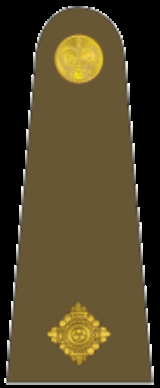
Second Lieutenant

Encyclopedia
Second lieutenant is a junior commissioned officer
Officer (armed forces)
An officer is a member of an armed force or uniformed service who holds a position of authority. Commissioned officers derive authority directly from a sovereign power and, as such, hold a commission charging them with the duties and responsibilities of a specific office or position...
military rank
Military rank
Military rank is a system of hierarchical relationships in armed forces or civil institutions organized along military lines. Usually, uniforms denote the bearer's rank by particular insignia affixed to the uniforms...
in many armed forces
Armed forces
The armed forces of a country are its government-sponsored defense, fighting forces, and organizations. They exist to further the foreign and domestic policies of their governing body, and to defend that body and the nation it represents from external aggressors. In some countries paramilitary...
.
United Kingdom and Commonwealth
The rank second lieutenant was introduced throughout the British ArmyBritish Army
The British Army is the land warfare branch of Her Majesty's Armed Forces in the United Kingdom. It came into being with the unification of the Kingdom of England and Scotland into the Kingdom of Great Britain in 1707. The new British Army incorporated Regiments that had already existed in England...
in 1871 to replace the rank of ensign
Ensign (rank)
Ensign is a junior rank of a commissioned officer in the armed forces of some countries, normally in the infantry or navy. As the junior officer in an infantry regiment was traditionally the carrier of the ensign flag, the rank itself acquired the name....
(cornet
Cornet (military rank)
Cornet was originally the third and lowest grade of commissioned officer in a British cavalry troop, after captain and lieutenant. A cornet is a new and junior officer.- Traditional duties :The cornet carried the troop standard, also known as a "cornet"....
in the cavalry), although it had long been used in the Royal Artillery
Royal Artillery
The Royal Regiment of Artillery, commonly referred to as the Royal Artillery , is the artillery arm of the British Army. Despite its name, it comprises a number of regiments.-History:...
, Royal Engineers
Royal Engineers
The Corps of Royal Engineers, usually just called the Royal Engineers , and commonly known as the Sappers, is one of the corps of the British Army....
, Fusilier
Fusilier
Fusilier was originally the name of a soldier armed with a light flintlock musket called the fusil. The word was first used around 1680, and has later developed into a regimental designation.-History:...
and Rifle regiment
Regiment
A regiment is a major tactical military unit, composed of variable numbers of batteries, squadrons or battalions, commanded by a colonel or lieutenant colonel...
s. At first the rank bore no distinct insignia. In 1902 a single bath star
British Army officer rank insignia
-Origins:The first British Army rank insignia were introduced in 1760. According to the Royal Clothing Warrant, General Officers were distinguished by the pattern and arrangement of laces on the cuff.Badges for field officers were first introduced in 1810...
(now commonly referred to as a pip) was introduced; the ranks of lieutenant
Lieutenant
A lieutenant is a junior commissioned officer in many nations' armed forces. Typically, the rank of lieutenant in naval usage, while still a junior officer rank, is senior to the army rank...
and captain
Captain (British Army and Royal Marines)
Captain is a junior officer rank of the British Army and Royal Marines. It ranks above Lieutenant and below Major and has a NATO ranking code of OF-2. The rank is equivalent to a Lieutenant in the Royal Navy and to a Flight Lieutenant in the Royal Air Force...
had their number of stars increased by one to (respectively) two and three. The rank is also used by the Royal Marines
Royal Marines
The Corps of Her Majesty's Royal Marines, commonly just referred to as the Royal Marines , are the marine corps and amphibious infantry of the United Kingdom and, along with the Royal Navy and Royal Fleet Auxiliary, form the Naval Service...
.
In the Royal Air Force
Royal Air Force
The Royal Air Force is the aerial warfare service branch of the British Armed Forces. Formed on 1 April 1918, it is the oldest independent air force in the world...
the comparable rank is pilot officer
Pilot Officer
Pilot officer is the lowest commissioned rank in the Royal Air Force and the air forces of many other Commonwealth countries. It ranks immediately below flying officer...
. The Royal Navy
Royal Navy
The Royal Navy is the naval warfare service branch of the British Armed Forces. Founded in the 16th century, it is the oldest service branch and is known as the Senior Service...
has no exactly equivalent rank, and a second lieutenant is senior to a Royal Navy midshipman
Midshipman
A midshipman is an officer cadet, or a commissioned officer of the lowest rank, in the Royal Navy, United States Navy, and many Commonwealth navies. Commonwealth countries which use the rank include Australia, New Zealand, South Africa, India, Pakistan, Singapore, Sri Lanka and Kenya...
but junior to a Sub-Lieutenant
Sub-Lieutenant
Sub-lieutenant is a military rank. It is normally a junior officer rank.In many navies, a sub-lieutenant is a naval commissioned or subordinate officer, ranking below a lieutenant. In the Royal Navy the rank of sub-lieutenant is equivalent to the rank of lieutenant in the British Army and of...
. The Royal New Zealand Navy
Royal New Zealand Navy
The Royal New Zealand Navy is the maritime arm of the New Zealand Defence Force...
– breaking with Royal Navy tradition – uses the ensign
Ensign (rank)
Ensign is a junior rank of a commissioned officer in the armed forces of some countries, normally in the infantry or navy. As the junior officer in an infantry regiment was traditionally the carrier of the ensign flag, the rank itself acquired the name....
grade for this rank equivalent. The Royal Australian Navy
Royal Australian Navy
The Royal Australian Navy is the naval branch of the Australian Defence Force. Following the Federation of Australia in 1901, the ships and resources of the separate colonial navies were integrated into a national force: the Commonwealth Naval Forces...
also breaks tradition in the sense that it has the equivalent rank of Ensign, but it is titled "acting sub lieutenant."
The Canadian Forces
Canadian Forces
The Canadian Forces , officially the Canadian Armed Forces , are the unified armed forces of Canada, as constituted by the National Defence Act, which states: "The Canadian Forces are the armed forces of Her Majesty raised by Canada and consist of one Service called the Canadian Armed Forces."...
adopted the rank with insignia of a single gold ring around the service dress uniform cuff for both army and air personnel upon unification in 1968. For a time, naval personnel used this rank but reverted to the Royal Canadian Navy rank of acting sub-lieutenant, though the CF Green uniform was retained until the mid-1980s.
United States


United States
The United States of America is a federal constitutional republic comprising fifty states and a federal district...
, Second Lieutenant is typically the entry-level rank for most commissioned officers
Officer (armed forces)
An officer is a member of an armed force or uniformed service who holds a position of authority. Commissioned officers derive authority directly from a sovereign power and, as such, hold a commission charging them with the duties and responsibilities of a specific office or position...
.
In the U.S. Army
United States Army
The United States Army is the main branch of the United States Armed Forces responsible for land-based military operations. It is the largest and oldest established branch of the U.S. military, and is one of seven U.S. uniformed services...
and the U.S. Marine Corps
United States Marine Corps
The United States Marine Corps is a branch of the United States Armed Forces responsible for providing power projection from the sea, using the mobility of the United States Navy to deliver combined-arms task forces rapidly. It is one of seven uniformed services of the United States...
, a second lieutenant typically commands a platoon
Platoon
A platoon is a military unit typically composed of two to four sections or squads and containing 16 to 50 soldiers. Platoons are organized into a company, which typically consists of three, four or five platoons. A platoon is typically the smallest military unit led by a commissioned officer—the...
-size element (16 to 44 soldiers or Marines). In the Army, the rank bore no insignia
United States Army officer rank insignia
United States Army officer rank insignia in use today.-History:The structure of U.S. ranks has its roots in British military traditions. At the start of the American Revolutionary War, uniforms, let alone insignia, were barely affordable and recognition of ranks in the field was problematic...
other than a brown sleeve braid on blouses and an officer's cap device and hat cord until December 1917, when a gold bar similar to the silver bar of a first lieutenant
First Lieutenant
First lieutenant is a military rank and, in some forces, an appointment.The rank of lieutenant has different meanings in different military formations , but the majority of cases it is common for it to be sub-divided into a senior and junior rank...
was introduced.
In the U.S. Air Force
United States Air Force
The United States Air Force is the aerial warfare service branch of the United States Armed Forces and one of the American uniformed services. Initially part of the United States Army, the USAF was formed as a separate branch of the military on September 18, 1947 under the National Security Act of...
, a second lieutenant may supervise flights
Flight (military unit)
A flight is a military unit in an air force, naval air service, or army air corps. It usually comprises three to six aircraft, with their aircrews and ground staff; or, in the case of a non-flying ground flight, no aircraft and a roughly equivalent number of support personnel. In most usages,...
of varying sizes, depending upon the career field, as a flight commander or assistant flight commander or may work in a variety of administrative positions at the squadron
Squadron (aviation)
A squadron in air force, army aviation or naval aviation is mainly a unit comprising a number of military aircraft, usually of the same type, typically with 12 to 24 aircraft, sometimes divided into three or four flights, depending on aircraft type and air force...
, group
Group (air force)
A group is a military aviation unit, a component of military organization and a military formation. Usage of the terms group and wing differ from one country to another, as well as different branches of a defence force, in some cases...
, or wing
Wing (air force unit)
Wing is a term used by different military aviation forces for a unit of command. The terms wing, group or Staffel are used for different-sized units from one country or service to another....
level.
As a result of the gold color of the bars and their usual inexperience as officers, second lieutenants are often colloquially
Military slang
Military slang is an array of colloquial terminology used commonly by military personnel, including slang which is unique to or originates with the armed forces. It often takes the form of abbreviations/acronyms or derivations of the NATO Phonetic Alphabet, or otherwise incorporates aspects of...
referred to as Butterbars or Nuggets. Other colloquialisms include Commissioned Privates
Private (rank)
A Private is a soldier of the lowest military rank .In modern military parlance, 'Private' is shortened to 'Pte' in the United Kingdom and other Commonwealth countries and to 'Pvt.' in the United States.Notably both Sir Fitzroy MacLean and Enoch Powell are examples of, rare, rapid career...
, 2nd Luey, or Brown Bars (this last is due to the subdued gold color of the bar as worn on tactical uniforms).
The corresponding United States Coast Guard
United States Coast Guard
The United States Coast Guard is a branch of the United States Armed Forces and one of the seven U.S. uniformed services. The Coast Guard is a maritime, military, multi-mission service unique among the military branches for having a maritime law enforcement mission and a federal regulatory agency...
and United States Navy
United States Navy
The United States Navy is the naval warfare service branch of the United States Armed Forces and one of the seven uniformed services of the United States. The U.S. Navy is the largest in the world; its battle fleet tonnage is greater than that of the next 13 largest navies combined. The U.S...
rank is ensign
Ensign (rank)
Ensign is a junior rank of a commissioned officer in the armed forces of some countries, normally in the infantry or navy. As the junior officer in an infantry regiment was traditionally the carrier of the ensign flag, the rank itself acquired the name....
.
People who have graduated from an ROTC program or completed at least 4 years of college and Officer Candidate School
Officer Candidate School
Officer Candidate School or Officer Cadet School are institutions which train civilians and enlisted personnel in order for them to gain a commission as officers in the armed forces of a country....
may enter as a Second Lieutenant. People with special skills such as lawyers or medical professionals may receive a direct commission to Second Lieutenant, and enlisted soldiers can receive a battlefield commission for displaying exemplary leadership and bravery in battle, but this is usually done only during wars with high officer attrition.
Norway
The equivalent rank in Norway (O-1) is "fenrik", but the function of the rank differs drastically from other armies. Although it is an officer rank, it strongly resembles an NCO-rank in practice. The ranking system in Norway is quite different, while they do not have a professional army, Fenriks are usually former experienced sergeants but to become a sergeant one has to go through officer's training and education. Though they still fill such roles as squad leaders and platoon sergeants while at the rank Fenrik, in some cases Fenriks are Executive Officers (XOs). Most Fenriks have finished the War Academy as well, and are fully trained officers. This is due to the lack of an NCO-corps in the Norwegian army.>
Other countries
: Dvahom Baridman: Nëntoger- Arabic-speaking countries except BahrainBahrain' , officially the Kingdom of Bahrain , is a small island state near the western shores of the Persian Gulf. It is ruled by the Al Khalifa royal family. The population in 2010 stood at 1,214,705, including 235,108 non-nationals. Formerly an emirate, Bahrain was declared a kingdom in 2002.Bahrain is...
, OmanOmanOman , officially called the Sultanate of Oman , is an Arab state in southwest Asia on the southeast coast of the Arabian Peninsula. It is bordered by the United Arab Emirates to the northwest, Saudi Arabia to the west, and Yemen to the southwest. The coast is formed by the Arabian Sea on the...
, SudanSudanSudan , officially the Republic of the Sudan , is a country in North Africa, sometimes considered part of the Middle East politically. It is bordered by Egypt to the north, the Red Sea to the northeast, Eritrea and Ethiopia to the east, South Sudan to the south, the Central African Republic to the...
, YemenYemenThe Republic of Yemen , commonly known as Yemen , is a country located in the Middle East, occupying the southwestern to southern end of the Arabian Peninsula. It is bordered by Saudi Arabia to the north, the Red Sea to the west, and Oman to the east....
: ملازم (Mulazim), Cuba,
Cuba,  Nicaragua and
  Peru: Teniente: լեյտենանտ (Leytenant) and
  Uzbekistan: Leytenant,
  Oman,
Oman,  Sudan and
  Yemen: ملازم ثاني (Mulazim Thani): Second Lieutenant: Sous-Lieutenant (French); Onderluitenant (Dutch); Unterleutnant (German): Deda Wom,
  Chile,
  Colombia,
  Ecuador,
  El Salvador,
  Guatemala,
  Panama and
  Paraguay: Subteniente: Podporučnik and
  Angola: Segundo Tenente: Ak-no-say-ney-trey and
  Guinea-Bissau: Tenente: 少尉 (Shào wèi) Imperial China (Qing Dynasty)Qing DynastyThe Qing Dynasty was the last dynasty of China, ruling from 1644 to 1912 with a brief, abortive restoration in 1917. It was preceded by the Ming Dynasty and followed by the Republic of China....
: 協軍校 (Xié jūn xiào): Poručnik and ex Czechoslovakia: Poručík: Løjtnant: Segundo Teniente: Nooremleitnant: Vänrikki (Finnish) or Fänrik (Swedish) (army and air force); Aliluutnantti (Finnish) or Underlöjtnant (Swedish) (navy) and all FrenchFrench languageFrench is a Romance language spoken as a first language in France, the Romandy region in Switzerland, Wallonia and Brussels in Belgium, Monaco, the regions of Quebec and Acadia in Canada, and by various communities elsewhere. Second-language speakers of French are distributed throughout many parts...
-speaking non-European countries: Sous-Lieutenant: ლეიტენანტი (Leytenanti) and Austria: Leutnant and
  Cyprus: AnthypolokhagosAnthypolokhagosAnthypolochagos is used in the Greek language to mean "Second Lieutenant". In the modern Hellenic Army the rank is the lowest commissioned officer rank and is inferior to an Ypolochagos . The insignia consists of a single silver star...
(army); Anthyposminagos (air force): Hadnagy: Segundo Teniente: Letnan Dua: ستوان دوم (Setvan Dovom) Second Lieutenant (English); Dara-Lefteanant (Irish): סגן משנה (Segen mishne): Sottotenente: Santō Rikui (or San'i) (modern); Shōi (historical) and South Korea: 소위 (Sowi): Roitrïäkäd: Leitnants: Leitenantas: Lieutenant: Leftenan Muda: Subteniente: Du Bo: Дэслэгч(Deslegch): Sahayak-Senani and
  Suriname: Tweede-Luitenant: Fenrik Ottoman EmpireOttoman EmpireThe Ottoman EmpireIt was usually referred to as the "Ottoman Empire", the "Turkish Empire", the "Ottoman Caliphate" or more commonly "Turkey" by its contemporaries...
: Mülazım Philippines: Second Lieutenant (English); Magat, Tenyente, Ikalawang Tenyente, Alperes (cognate of Alferez): Podporucznik and MozambiqueMozambiqueMozambique, officially the Republic of Mozambique , is a country in southeastern Africa bordered by the Indian Ocean to the east, Tanzania to the north, Malawi and Zambia to the northwest, Zimbabwe to the west and Swaziland and South Africa to the southwest...
: Alferes: Sublocotenent (modern); Locotenent (former), Belarus,
  Kingdom of Bulgaria,
  Kazakhstan,
  Ukraine and
  Soviet Union: Лейтенант (Leytenant): Подпоручик (Podporuchik); Kорнет (Kornet) (cavalry): ملازم,
  Republic of Macedonia and
  Kingdom of Yugoslavia: Потпоручник (Potporučnik): Poručík: Poročnik and
  Equatorial Guinea: Alférez: Fänrik: Leutnant (German); Lieutenant (French); Tenente (Italian) (Taiwan): 少尉 (Shào wèi): ร้่อยตรี: Teğmen: Teniente Segundo: Subteniente (army); Subteniente (air force); Alférez (Navy): Thiếu Uý
See also
- British Army officer rank insigniaBritish Army officer rank insignia-Origins:The first British Army rank insignia were introduced in 1760. According to the Royal Clothing Warrant, General Officers were distinguished by the pattern and arrangement of laces on the cuff.Badges for field officers were first introduced in 1810...
- Comparative military ranksComparative military ranksThis article is a list of various states' armed forces ranking designations. Comparisons are made between the different systems used by nations to categorize the hierarchy of an armed force compared to another. Several of these lists mention NATO reference codes. These are the NATO rank reference...
- Cornet (military rank)Cornet (military rank)Cornet was originally the third and lowest grade of commissioned officer in a British cavalry troop, after captain and lieutenant. A cornet is a new and junior officer.- Traditional duties :The cornet carried the troop standard, also known as a "cornet"....
- U.S. Army officer rank insignia