

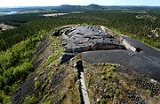
Boden Fortress

Encyclopedia
Boden Fortress is a modern fortress
consisting of several major and minor forts and fortifications surrounding the city of Boden
, Norrbotten
, in northern Sweden
. The fortress was originally intended to stop or delay attacks from the east or coastal assaults, which at the time of construction meant Russian attacks launched from Finland
. It was primarily the expansion of the railway net in Norrland
, which in turn was a consequence of the rising importance of the northern iron ore fields, that led to the increased strategic value of northern Sweden and the construction of the fortress. Although the main forts were finished in 1908, many of the supporting fortifications were not completed until the start of the First World War
. Improvements were also continuously made during, and between, both World War
s.
Boden Fortress is made up of five primary self-supporting forts excavated out of the bedrock
in five of the mountains surrounding Boden: Degerberget, Mjösjöberget, Gammelängsberget, Södra Åberget and Rödberget. Eight fortified secondary artillery
positions were constructed between the forts to give flanking support and to cover areas not in range of the main forts' artillery. In addition, 40 bunker
s for infantry, along with dugouts and other fortifications, were built to cover even more terrain. During the Second World War
anti-tank gun emplacements and additional bunkers and shelters were built, and tens of kilometres of dragon's teeth
were placed around the fortress and the city itself. Owing to the end of the Cold War and the reduction of the threat from the Soviet Union
, Boden Fortress became less important to the defence of Sweden, and began to be decommissioned. The last fort of the complex was decommissioned on 31 December 1998, and is now used as a tourist attraction. All five forts as well as some of the supporting structures have been declared historic buildings, to be preserved for the future, by the Swedish government.
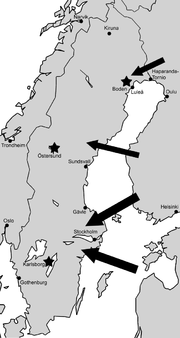 The two dominating theories of how to use fortifications in the operational perspective during the 18th and 19th century were the central fortress system and the peripheral fortress system , the latter also called the cordon system. The two systems were also known as central defence and peripheral defence. The peripheral defence theory was based on building smaller fortifications in advance positions to meet the enemy at an early stage, while the central defence theory was meant to weaken the enemy step by step in minor skirmishes and ambush
es carried out by forces supplied and supported by central fortresses not located in the front line
. In short, one theory advocated many minor fortifications built to directly engage the enemy, while the other advocated only a few major fortifications built not to directly engage the enemy, but to support the troops that engaged the enemy.The meaning of these two terms have shifted over the years. In the military terminology of the 19th century, the theories were mainly applied at the operational level, which means that both systems could be used for the defence of a country at the same time but at different theatres of war. From the late 19th century and onwards, the terms were used in a wider context, being applied mainly at the grand strategic level, thus making the two systems mutually exclusive rather than complementary for the defence of a country. This has spurred confusion as a fortification built for central defence—by the early usage of the term—in the outer portions of a country can be seen as a fortification built for peripheral defence—by the late usage of the term. See Nyström 1990, pp. 29–40 for a discussion on this and examples of the early usage, see Nelsson 1993, p. 89 for an example of the terms in late usage applied to Boden Fortress. This article uses the terms in their original, operational, meaning.
In the beginning of the 19th century the peripheral system—at least in Sweden—was deemed unmodern, due to the extremely long border and coastline of the country, which required a lot of personnel to maintain and support, leading to high costs and a neglectance of the more mobile armed forces. The peripheral system was also meant to contain the enemy to a specific area, the coast and borders, but as time went and new tactics were taken into practice, the thin line of fortifications would be easily penetrated by the enemy forces, and when the enemy had advanced through the peripheral line, there would not be enough troops in the hinterland to stop the attacker. The central fortress system was better adjusted to defence in depth
, it was not until the enemy attack had reached its culminating point
that full counter-attacks
would be launched. The central defence had also proven effective in the Seven Years' War
—used by Frederick II of Prussia
—and in Napoleon's Invasion of Russia—used by the Russians. Carl von Clausewitz
, in his military treatise On War
, even mentioned Sweden's good conditions for this kind of war of attrition
:
out of it during the Finnish War
in 1808–1809. Shortly after, in 1814, the west flank had been secured by the personal union with Norway
, and after the Napoleonic Wars
, the former main enemy of Sweden in the south, Denmark
, was no longer any threat. The only threat left was Russia, which now stood just across the border in the north, and had possession of the Åland Islands less than 150 km from the Swedish capital Stockholm
. The Swedish Navy
was considered superior to the Russian in the Gulf of Bothnia
, so a seaborne invasion against the coast of Norrland
was not likely. And even though the Russians had invaded northern Sweden via Finland in the previous war, the general opinion was that in case of a new war, their main attack would be conducted towards Stockholm and southern Sweden.
 This opinion led to the thought of finding a good rear defence area where the Riksdag
and the Swedish government
could move if the capital was in danger. This in turn naturally strengthened the central defence theory. The core land would be the place from where the main part of the field army would conduct its operations, supported by a few fortresses. The area between the two large lakes of Vänern
and Vättern
was the choice for this core land, with approximately the same border as Skaraborg County
. Sweden above the province of Dalarna
was not even considered to be included in this strategy. The realisation of the middle Sweden central defence system was finally made 5 February 1819 when King Charles XIV John
decided that one main fortress, the central fortress, and two smaller "operational fortresses" were to be built. The central fortress became Karlsborg Fortress
at Karlsborg
, while the two operational fortresses meant to be located at either end of Vättern never were built due to lack of funds.
While Norrland
was supposed not to be included in this main central defence strategy, studies on how to defend this major part of the country were still conducted. However, northern Sweden was generally considered of very limited military interest and unsuitable for larger military operations due to the bad state of most of the roads, the large uninhabited areas, the large rivers and the very limited economical gain that the lands provided. The first of these studies, laid down by the Fortification Committee of 1819 —which was largely influenced by the committee's secretary Johan Peter Lefrén—led to nothing more than the opinion that the large rivers up north—especially the Ångerman River
—would benefit the defence and that no major fortifications were to be built. In another study from 1824, colonel—and much later Swedish Minister for War—Gustaf Oscar Peyron
suggested that it would be better to fortify positions just south of Boden—along the more northern Lule River
—for example at Sävast or Avan. However no major changes were made, partially due to the limited military interest, but also because of the large amounts of money that was spent on building Karlsborg Fortress and modernizing other older fortifications in southern Sweden.
 It was not until fifteen year later, when yet another committee—the Coastal Fortification Committee of 1839 —studied the defence of Norrland, that the Swedish Armed Forces
started to focus a bit more on the northern provinces. This study however mainly presented plans for middle Norrland, and the provinces of Medelpad
, Ångermanland
and Jämtland
. Those provinces had a more significant role as it was there that the main roads of Sweden started to intersect with the road network of Norway
, which at the time was allied with Sweden. The road network north of this area consisted of the large coastal road—the only major north–south road—from Haparanda
and all the way through Norrland down to Gävle
. All the other major roads exclusively ran southeast–northwest—following the run of the large rivers—before ending in wilderness and thus did not provide any route further west into Norway and on to the Atlantic
coast. The plans to strengthen Norrland by building a central fortress either on Frösön
outside Östersund
, or closer to the coast at Borgsjö outside Ånge
, once again fell flat due to lack of money and lower priority compared to fortifications in southern Sweden.
By the 1860s, the first Swedish railway
trunk lines were completed in the southern part of the country, and by 1881 the trunk line through Norrland had reached Ånge. This, and the opening of the railway line connecting Sundsvall
–Östersund
–Trondheim
four years later strengthened the plans for a defensive line in the middlemost provinces of Norrland. At the same time, on the other side of the Bothnian Gulf, the Finnish main railway to Oulu
had almost been completed, and would soon be of great use for the Russians to transport military personnel and supplies towards the Swedish border in case of war. Combined with the planned Luleå
–Boden–Gällivare
–Kiruna
–Narvik
railway line, this would pose a great opportunity for the Russians to fulfill their latent wish to seize control of northern Scandinavia
and the Atlantic ports on the Norwegian coast. At least according to some officers—both Swedish and Norwegian—which in the second half of the 1880s noticed the increased strategic importance of northern Scandinavia and Lapland
as an effect of the construction of the railway lines in the area. This was also noticed by the Riksdag
member Johan Erik Nyström from Norrbotten's electoral district who—worried about the railway to Oulu—put forward a motion about strengthening the Upper Norrland defence in 1885. The length of the railway lines started to affect strategic planning, and in some cases military decisions influenced the planning of new railway lines.
Even though the northernmost stretch of the trunk line in Norrland had long been planned, it was not until 1887 and the victory of the Lantmanna Party
's protectionist
wing in that year's election that the financial means and the political will allowed the completion of the railway through Överluleå, which Boden was sometimes called. The "slumbering resources and the rapid expansion" in Upper Norrland were two reasons to build a railway to the sparsely populated area; another factor that had a big part in the decision to complete the northern trunk line was the government's takeover of the Luleå–Gällivare line, which had previously been in the hands of an English company. The stretch was very lucrative, as it considerably eased the transport of iron ore from the ore fields around Kiruna and Gällivare down to the coast for further transport by boat. Another English company had in the 1860s tried to construct a combination of a railway and a canal—the English Canal
—for the stretch, but went bankrupt before their plans were completed. The company contracted for the new railway line experienced similar economic difficulties and the Swedish state decided to buy the nearly completed line to finish it in 1891.
The decision to complete the railway through to Boden sparked interest in Norrbotten
among the members of the Swedish General Staff, and the chief, Axel Rappe
, conducted a survey trip to the region in 1887. His report mentioned the changed strategic options due to the railway lines on both sides of the Gulf and a need for some kind of fortification in Boden, but he also toned down the earlier thoughts on the Russian interest in the Luleå–Narvik line. Rappe's report directly affected the future stretch of the railway line in Norrbotten. His recommendations, largely based on his and the General Staff's military planning, not to build the line along the coast, or build it all the way to the Swedish-Finnish border at Haparanda were later followed. The subsequent report completed in 1890 by the Neutrality Committee of 1888 —with Axel Rappe as one of its members—proposed a budget of 1.3 million Swedish kronor
, corresponding in today's money to around US$11 million (as of 2011), for the construction of permanent fortifications in Boden.
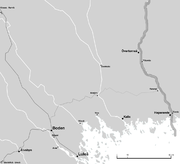
The following year, in 1892, Rappe wrote a memorandum that explained in more detail the budget, which suddenly had risen to 4.5 million kronor, and would finance the construction of two strongholds at Paglaberget and Åberget (see map) with a total of six long cannon
, ten howitzer
s and eight quick-firing cannon
, all in armoured turrets
, along with machine gun
s and bunkers, barracks
and supply depots. The plan included a reserve battalion of 1,000 men, an artillery battalion of 600 men, an engineer company of 120 men, and supply and depot personnel. Axel Rappe's large study on the permanent fortifications of Sweden (named Underdånigt betänkande angående Sveriges fasta försvar) was published in 1892 and cemented the view that a central fortress was needed in Boden to support and supply troops gathering between the Lule River and the eastern border.
Although Rappe did not completely rule out the possibility of a German
or British
attack on southern Sweden if the opportunity arose, he felt that Russia was the most realistic threat. There were only two plausible scenarios for war with Russia: either Sweden would become involved in a war between Germany and Russia which would feature southern and central Sweden as the battleground—and Rappe made no attempt to hide which country the General Staff wanted Sweden to side with in that case—or Russia would make a limited attack on Norrbotten to reach northern Norway and the Atlantic, an attack that Rappe earlier said was not very likely. Rappe probably said that to get more focus on the importance of the railway line to Boden, which was under discussion at that time, and he thus hoped that it would speed up its completion. A railway line to Boden was of utmost need to be able to bring up troops to Lule River—the main line of defence—and a future fortress there.
During the following years a fierce debate raged between the supporters of the army on one side and the navy on the other. The proposed expansion of Swedish fortifications nationwide, which in turn would see less money spent on the fleet, upset many naval proponents, amongst them Wilhelm Dyrssen—later Minister for Defence—and Fredrik von Otter
—later Admiral
and Prime Minister of Sweden
. They argued that the theory of central defence would leave large swaths of Swedish land in the hands of the enemy, and instead suggested smaller fortifications at the border, along with a strengthened navy. The debate was inconclusive and a request for 500,000 kronor to initiate construction of the fortress was not accepted by the government. Instead, they wanted a committee to further investigate all Swedish fortifications and possible new constructions of such. Thus the Fortification Committee of 1897 was formed. The committee, led by chairman Jesper Crusebjörn
, discussed and examined the defence of Norrland thoroughly, and also travelled to Boden where they climbed most of the heights and mountains that were considered for the fortifications.Even the chairman which—according to assistant secretary Melander—had "a pretty extensive corpus to carry around, did not fear toil and in own person climbed, even though slowly, the highest of all the mountains." Bergmark 1980, pp. 526–527. The selection of Boden as the most suitable place for the fortification, according to the committee's final report published 25 July 1898, had numerous reasons:
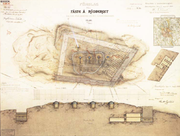 The report calculated the costs at 8.7 million kronor—the same sum that Axel Rappe had proposed in 1896—which corresponds in today's money to around $70 million (as of 2011), spent over a total construction schedule of one four-year period and two three-year periods. The cost was still considerably lower than that of many of the recently built or modernised fortifications on the continent
; Belgium
had spent the equivalent of 62 million kronor on the fortified positions of Liège
and Namur
along the Meuse
, and Romania
had spent around the same to strengthen the defence of Bucharest
. In 1899, Rappe proposed to the Swedish Riksdag
—in line with the plans of the Fortification Committee—that construction of already existing fortificatory works in Sweden would commence, while the question on Boden would be postponed to the next year. The plan gained support from the first chamber but not from the second chamber, but when put to a joint vote of both chambers, the proposition passed. Even though the result did not really mean anything concrete for the possible construction in Boden, it was considered a great success for that question as well. During the last years of the century, the Riksdag's general attitude towards the army became more positive, most likely due to the increased Russification of Finland
, increased tension in the Union between Sweden and Norway
, and rumors that the Russian sawfiler
s that worked in Sweden also worked for the Okhrana, the secret Russian police.
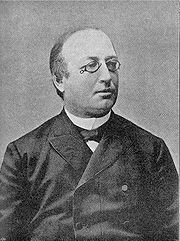 Despite this progress, Axel Rappe left as Minister for War in 1899, due to setbacks on other issues. He was replaced by Jesper Crusebjörn, who inherited the Boden fortification project. Crusebjörn followed in the footsteps of Rappe—described as "the spiritual father of Boden Fortress" thanks to his efforts—as he proposed, in accordance with the Committee's plan, that the Riksdag should allocate an initial sum of 560,000 kronorThere is some confusion regarding the sum as Nyström 1990, p. 70 instead mentions less than half, 260,000 kronor. which would be used to initiate construction of Boden Fortress. Crusebjörn also maintained the belief of his predecessor, and of the committee in which he was chairman, that Boden Fortress when completed should act as the operational base for all troops attached for the defence of Norrbotten, that it should serve as a supply fortress for troops stationed between it and the front line, and that it also should serve as a blocking fortress in case of a Russian surprise attack. The 1897 committee also had set the goal to have Boden Fortress in a finished state when the trunk line through railway found its way through to the border against Finland.
The result of the votes—held 7 May 1900, a date which can be seen as the birth of the fortress—in the first and second chambers were the same as the previous year. The result in the first chamber was overwhelmingly for the proposal at 108–16, but the proponents feared a defeat in the second chamber. During the debate both the Prime Minister of Sweden
Erik Gustaf Boström
and Jesper Crusebjörn threatened to resign from their posts if the proposal was not accepted, to exert pressure on the second chamber. Boström expressed the following that day:
Even after this, the second chamber voted against the proposal, with a vote count of 73–130. Neither Boström nor Crusebjörn resigned, since after further discussion and voting it was decided that the matter should be settled by a joint vote. The first chamber voted in favor, 125–14, while the second chamber voted against, 87–135, with a total outcome of 212–149 in favour of constructing Boden Fortress and allocating the funds needed to start construction. Funding for the purchase of the land that the fortifications were to be built on had largely been provided several years in advance by two voluntary organisations. The Organisation for the Fortified Defence of Upper Norrland and the Swedish Women's Organisation had collected 71,000 kronor out of the 131,000 kronor needed for land purchase.
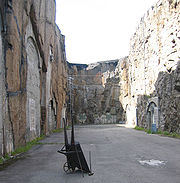
 The main inspiration for the design—in which the forts are blasted into the mountains rather than constructed on top of them—came from Vaberget Fortress
near Karlsborg Fortress
. Vaberget Fortress was built in the 1890s and its southern fort was the first fort in the world that fully used the protection provided by the bedrock itself by having all of its functions embedded in the mountain. Vaberget Fortress served as a prototype for Boden Fortress and many more future fortifications in Sweden, including the late 20th century fixed army and coastal artillery batteries that gave the Swedish Fortifications Agency
world renown. Preparatory work was started in 1900 and consisted of a diverse number of tasks, ranging from purchase of beds for the construction workers, construction of a new loading site for the railway, building roads to the various construction sites and clearing the land of those sites. The plan for the Fortifications at Boden —which was the term used until the First World War
when the present name Boden Fortress came into widespread use—was largely based on the proposal laid forward by the Fortification Committee of 1897, with only minor modifications.
 Even before any construction work had started the cost of the forts had been estimated to exceed the previous calculations by fifty percent. In December 1901, only few months after the first blasting work that had been done at Gammelängsberget in July 1901, the cost for the four forts northeast of the river was expected to be sixty-five percent more expensive than the initial calculation. The blueprints of the forts at Degerberget, Gammelängsberget and Södra Åberget were the first to be confirmed, which happened on 11 May 1901. The fort at Mjösjöberget followed suit on 3 April 1902 and the last fort to get a confirmed blueprint was the fort at Rödberget, on 19 May 1903. The last proposed fort, at Paglaberget, was deleted from the plans in 1906—along with the batteries at Fällberget and Slumpberget as well as the fortifications at Avan and Svartbyträsket—before any work on the fort had started, due to the proposal of the new Fortification Committee of 1905, which was formed following the reports of the large rise in costs. On 9 February 1906, the current Minister for War Lars Tingsten calculated the total cost to end at 19,220,000 kronor, more than twice the cost reported by the 1897 committee.
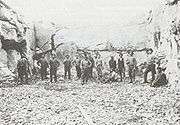
All work on the large masses of bedrock was conducted by hand, without any help of powered machines, as the first power station
in Boden was not constructed until almost ten years later in 1909. The first work that was done at the site was to create a large ditch
, 9–12 m wide and width a depth of 6 m or more, that would surround the core of the fort. Creating patrol trenches and placements for the turrets on the top of the forts was also work done early on. The teams of workers would first bore
down in the bedrock using pinch bars and sledgehammers, then use black powder to blast the rock into manageable pieces which could be transported away from the site, using wheelbarrows, horse-drawn carriages and in some cases Decauville
railways. When the ditch, or parts of it, had been completed, work started on the inner part of the fort by boring horizontally from the bottom of the ditch into the mountain itself. This work was a lot harder—the cost for each cubic metre of blasted tunnel was five times the cost of a cubic metre of blasted ditch—both due to the confined space in the tunnels and the risk of damaging the bedrock. The use of black powder instead of dynamite reduced the risk of bedrock damage, but it also increased the time needed to complete the tunnels. All in all, the amount of bedrock bored, blasted, loaded and transported away from the forts has been estimated to be around 300,000 m3 (11,000,000 cu ft).Nyström 1990, p. 329 says that the total volume of bedrock that was blasted was more than 241,000 m3, while Lidström 2005, p. 4 says that it "supposedly" was around 350,000 m3.
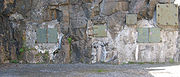 When the ditches and tunnels were finished, concrete works started, including flooring, construction of joist systems in forts with second floors, staircases, partition walls and counterscarp
galleries. Water well
s were bored to a depth of up to 200 metres (660 ft) to guarantee water supply, since the forts were supposed to be self-supporting. However, the most demanding part of the project was the construction, transport and installation of the armoured turrets and the armament itself. Two companies had been previously contracted for the construction of other fortifications in Sweden, Swedish AB Bofors-Gullspång
and French Compagnie des Forges de Châtillon, offers from both companies existed already in 1901, but it was not until after tests conducted in December 1902 that the Swedish company was contracted and given royal approval on 26 May 1903. The order was for the 8.4 cm and 12 cm pieces that was to be mounted on the first three forts. The following two forts at Rödberget and Mjösjöberget were to have 15 cm pieces, an order Bofors would get as well, but due to the time factor a few of those were actually delivered by the French company.
 The cost of a single armoured turret for a 12 cm piece was almost 100,000 kronor—around $800,000 (as of 2011) in today's money—and it could weigh as much as 100 tonnes (220,000 lb). It was delivered in parts to simplify transport, but the heaviest part still had a weight of 26 tonnes (57,000 lb). The parts were delivered by rail up to Boden and unloaded with the help of gantry crane
s. As the roads of the time could not handle the weight during summer, transport had to wait until winter when the frost
had hardened the ground. The turret parts were lifted onto sleighs drawn by 16–30 horses depending on the situation. The toughest stretch, up the mountain, was handled with the help of block and tackle
, the ditch was crossed on temporarily built sturdy wooden bridges and the mounting of the turret was finished with cranes. A major part of the mounts for the turrets were completed by the end of 1905, despite the harsh winter working conditions, with temperatures falling below −40 °C at times. The peak workforce amounted to around 900 men,Fästningsguiden n.d. gives a slightly higher number of 1,200 men. but their numbers fluctuated, with the lowest number of active workers during the winter months. The first artillery test firing was conducted on 15 January 1907 when the guns at Gammelängsberget fired their first rounds, and all five forts "were in a defensible state" by 1908.
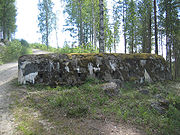 Apart from the forts, the garrison itself was heavily expanded during the initial construction years and became the largest garrison in Sweden, taking an exceptional position in Swedish military history of the 20th century; even at the start of the 21st century, Boden was the largest garrison city in the Swedish Army
. Still, no other fortifications than the forts themselves were finished by 1908, and work now started to fill the holes in between them. It was realised that prepared positions were needed for the mobile batteries, and apart from those, three larger battery positions (sometimes called fästen, strongholds) were also constructed at Leåkersberget, Norra Åberget and Svedjeberget. These works were started in 1911 and were finished during the First World War. The last of the three strongholds was positioned in the mountain itself with embrasures in the mountain side,The battery on Svedjeberget is often referred to as a fort—especially in post-decommission promotional and tourist material—but that is incorrect, see for example Kartaschew 2000, pp. 4–6. and Leåkersberget had parts of the battery position inside the mountain, but the gun emplacements outside—the other positions were concrete fortifications above the ground, some inside a bunker
and others behind a parapet
.
The main fortifications for infantry consisted of 44 concrete bunkers, 23 dugouts and 26 fortified observation posts. The concrete bunkers were long and narrow. The longest, Abramsskansen, was 155 m long and had room for 160 men and four machine guns, but most had room for less than 80 men—usually a rifle platoon
reinforced with a machine gun section
and an anti-tank section. Due to their length, their curved shapes following the mountain sides, and other characteristics, the bunkers were popularly referred to as "sausages" . The construction of these started in 1911. Many officers still considered the fortress to have inadequate and too few fortifications for the infantry, and one officer compared the fortress to "a shoe, which is too large for the foot." One million kronor was allocated in 1915 to fix that problem, and many minor fortifications were built during the First World War.
Blockhouses were also built by the railway bridge at Trångforsen and the road bridge Hedenbron (built from 1911 to 1912), located just 1.5 kilometres (0.9 mi) southeast of the Trångforsen bridge. The later was built to accommodate easier access to Rödberget Fort and the military training area on the southwestern shore of Lule River and was at the time of completion the longest single span road bridge in Sweden.
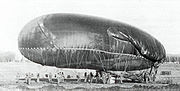 Both internal and external communication systems as well as means of reconnaissance were needed, both directed by the commandant
located in the headquarters building. The building—finished in 1910—had three floors, the upper two functioned as home and workplace for the commandant and the chief of staff, while the ground floor had extra thick walls and functioned as the command post for the fortress. A large field telephone network was built, connecting all forts with the headquarters. Liaison with higher commands was at first maintained by regular post, telegraph and telephone. The fortress' radio station
was finished by 1914, originally for the Swedish Navy
, and was located south of Degerberget on a bog
now known as the "Radio Mire" . The first Swedish radio broadcasts were sent from this building. The fortress also had homing pigeon
s for sending messages
. At the end of the Second World War, around 280 such pigeons were stationed in Boden. The pigeons were part of the balloon department whose main task was to operate the balloon
of the garrison. For this, the Balloon Hangar with inner measurements of 35×10×10 m (115×33×33 ft) was built near the radio station. More than fifty men were attached to the department, of whom two could follow the balloon up to its maximum height of 1,000 m (3,300 ft), limited by the length of the wire connecting it to the ground. The hydrogen-filled balloon itself was of German make and measured 27 m (89 ft) in length, had a diameter of around 7 m (23 ft) and a total volume of 750 m3 (26,000 cu ft).
 Most parts of the fortress were finished during the First World War
, and many minor works were started and completed during the course of the war. Even though Sweden remained neutral
during the First and Second World War
, the start and outcome of both had large impact on the fortress. Finland
's independence
during the First World War created a buffer state
between Sweden and Imperial Russia's successor state, the Soviet Union
, which radically changed the strategic value of northern Sweden, put the usefulness of Boden Fortress into question. Only the most basic needs were satisfied during the interwar period
; even apparent needs—based on the experiences from the war—such as better air defence and fortifications to halt or temporarily impede attacks by armoured forces
were neglected. Thanks to local commanders, construction of new fortifications and improvements to already existing ones were done with the help of garrisoned troops. Engineer companies built new shelters and trenches as training, and the telephone network was improved and completed by the garrisoned telegraph company. This cut the cost drastically as the only expenditure was the needed material.
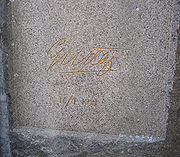 Only a few necessary projects were funded, including an underground headquarters bunker, improvement of the garrison hospital and new training areas. It was not until the increased tension in Europe following Adolf Hitler
's rise to power
, Benito Mussolini
's March on Rome
and the outbreak of the Spanish Civil War
that focus once again was put on military readiness and prepared fortifications. Improvements were made to fortifications in many parts of Sweden during the last years of the 1930s following the German annexation of Austria
and occupation of Czechoslovakia
. In Boden, this included building underground storage rooms for ammunition and food, replenishing already existing stocks, increasing protection for other important supply functions—such as the waterworks—as well as further military planning and also preparations for destruction of—for an advancing enemy—important bridges and roads.
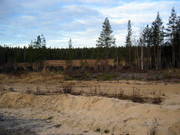 When the Second World War
broke out, only limited resources where allotted to the defence of Northern Sweden, but following the Soviet attack on Finland
a few months later and the German Operation Weserübung
against Norway
and Denmark
the next year, major work on improving and extending the defensive lives was commenced. Bunkers, bomb shelters, gun emplacements—particularly for anti-tank guns—were built by the units that had been mobilised and stationed in the vicinity of Boden. The Finnish experiences gained from meeting superior armoured forces during the Winter War were adopted in Sweden, and triple rows of large stones or blocks of reinforced concrete, dragon's teeth
, soon formed a continuous line—defended by anti-tank guns in concrete bunkers and machine-gun nests—around the fortress and city. As the war continued and advances in most fields of warfare were made, Boden Fortress was continually improved to meet new or increased threats such as air, armoured or gas attacks. The command, supply and intelligence services were improved as well.
As Sweden has remained neutral since 1816, Boden Fortress was never put to the test. Nonetheless, there are a few indications on how Boden, the garrison, the fortress and its crew would have come through a wartime attack. Already in 1904, Lars Tingsten—commander of Norrbottens regemente
, later Minister for War and first commander of Boden Fortress—expressed worries over the low number of soldiers that were planned to garrison the town. The 1892 army war plans had two infantry battalion
s stationed in the area, and allowed for three or four more to be transferred there, while Tingsten reported that the battalions should number at least 24 and perhaps even 33. The lack of personnel, and even more the lack of organisation, was shown when the fortress was tested against a coup de main
during a military excercise in April 1913. Led by its commander Bror Munck
, the cavalry regiment Kronprinsens husarregemente
managed to seize control of the railway station, the railway bridge, the ordnance depot, the electric works and the waterworks in the matter of a day. When the unit reached the headquarters building, Tingsten, now commandant of the fortress, saw his earlier worries come true. Despite this, the wartime infantry garrison was no more than four battalions in 1937. But as the Second World War came to its end, the fortress had been given a new role. From 1943 on it was no longer meant to stand on its own against a besieging enemy, and instead became only one piece in a larger network of fortifications. The wartime strength was never more than 12,000–13,000 men, while calculations talked about at least 25,000 men, up to 40,000 men, were needed to withstand a siege.
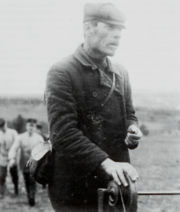 Strict secrecy surrounded the fortress for a very long time, and there were several attempts made by foreign powers to gain knowledge of various kinds of information. One early possible attempt at espionage
were the Russian sawfiler
s who travelled through Sweden, mostly in Norrland during the last years of the 19th century and the years leading up to World War I
. A large part of the Swedish population believed that the sawfilers, no more than 300 in total in Sweden, were spies hired by the Okhrana, the Russian secret police. Some sources are of the belief that the sawfilers were never sent out on specific missions but instead acted as unknowing spies, only having contact with the Okhrana who interrogated them regarding their experiences when they returned to Russia. Other sources claim that at least some of the sawfilers that the Okhrana found most useful were educated in the art of espionage, and were in fact given specific missions, as well as being paid 300 rouble
per season for their work. Another form of this kind of legal espionage is believed to have been conducted by the German Wandervogel
movement during the late interwar period.
The first known attempt of purposeful espionage against the fortress was conducted in 1913–14. A former lieutenant in the Danish
coastal artillery
, A. B. Fredrikssen, was enlisted in Copenhagen
by the Russian military attaché
in Stockholm
, colonel Assanovitch. Fredrikssen was sent to Boden with the task to explore the fortress and its surroundings. He and his wife stayed at a boarding house
in the city, and had regular correspondence with his employer who stayed in Copenhagen. It was also the correspondence that exposed the attempt, which was not very successful in terms of information gained by the Russians. They had better luck in late 1914 with two brothers named Hiukka, who both served with one of the artillery regiments in Boden, Norrlands artilleriregemente
. They were discovered due to their extravagant living, and it was found out that one of the brothers—despite his employment in the army—had Finnish-Russian citizenship. They had provided intelligence to Russia, but the full extent of the affair was never disclosed. A minor case of German espionage was exposed during the Second World War. The first permanently stationed German officer in Luleå, a Hauptmann
Schultz, was caught photographing parts of the fortifications and was deported. It is probable that his espionage was not ordered from any higher command but was an act on own initiative.In a private conversation with the author, he stated that it is likely that the officer's name was Schulte rather than Schultz, however it is not entirely clear which name is correct.
Two extensive espionage cases in Sweden during the Cold War
involved Boden Fortress, both exposed in 1951. The first case involved Fritjof Enbom, a former worker at the Swedish State Railways
in Boden, and later the local editor for the communist
newspaper Norrskensflamman
. He was exposed by his own careless talk—often under the influence of alcohol—to the owners of the house in Stockholm
where he had lodged since he moved there from Boden. The family told the Swedish Security Service
after the Christmas
holidays of 1951, and Enbom was arrested on 16 February 1952. During interrogation, he confessed that he—from February 1943 to April 1951—had met with Soviet
employers around 25 times. Enbom had provided a large variety of intelligence, most of it from public sources, but also secrets, of which the armament of one of the forts in the fortress was one of the pieces of information that concerned Boden Fortress and nearby fortifications. He was sentenced to lifetime hard labour
, but was released after ten years. The other case involved Ernst Hilding Andersson, who was arrested on 21 September 1951. He had carried out seven missions for the Soviets and had provided them primarily with information regarding the Swedish Navy
, but also information on the fortifications along the Norrland coast, and an initiated report about Boden Fortress and the airforce unit located in Boden and Luleå, Norrbottens flygbaskår. Andersson was, like Fritjof Enbom, sentenced to hard labour for life.
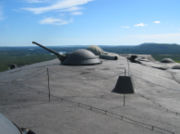 The fortress was gradually modernised in the decades following the Second World War, including newer main artillery for some of the forts and newer secondary artillery for all forts as well as other improvements. But the development of new weapons and the evolution of warfare during the Cold War
gradually decreased the importance of the fortifications. Weapons such as cruise missile
s and smart bomb
s made large static fortifications such as Boden Fortress obsolete when they demonstrated their worth during the Gulf War
in 1991. Mjösjöberget Fort had been decommissioned and removed from the wartime organisation twelve years earlier in 1979,Dig Maps 2001 says that Mjösjöberget Fort was removed from the wartime organisation one year earlier, in 1978. The date of decommission might have been 31 December 1978, which possibly could have been tranformed into "removed in 1979" and "removed in 1978" respectively. and less than ten years after the Gulf War and the collapse of the Soviet Union
, the four other forts followed suit. The last shot was fired from Rödberget on 14:11 local time on 31 December 1997, and exactly one year later, on 31 December 1998, that last fort was decommissioned after 90 years in service.
All five forts and three battery positions—Leåkersberget, Norra Åberget and Södra Slumpberget—were declared historic buildings in the summer of 1998 and are to be preserved for the future. The balloon hangar, the only of its kind in Sweden, was declared a historic building three years later in 2001. Two forts, Rödberget and Södra Åberget, are held in operation, and the former is used as a tourist attraction
with guided tours, and there is also a possibility for companies to hold smaller conferences inside the fort. Over 10,000 visitors were expected to visit Rödberget Fort in 2002, averaging 300 a day during the summer. Boden Fortress is also still one of the salute
batteries of Sweden, which fire a 21-gun salute
at special occasions such as the National holiday of Sweden
and birthdays of some members of the Swedish Royal Family
. The fortress was made a salute battery on 2 June 1931, but since the forts have been decommissioned, the salute is now fired with four cannon located at Kvarnängen in central Boden.
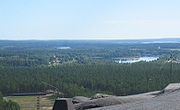 Due to the strict security surrounding the garrison, many rumors circulated during the fortress' lifetime. Some were later dismissed as myths or as disinformation, but others were confirmed. One common rumor was that the artillery of the main forts had a range of fire that made it possible to shoot at the important Luleå
harbour more than 40 km (25 mi) away, but in reality, the maximum range of the farthest shooting pieces was less than half of that. Another widespread myth was that all the forts were connected to each other with a complex system of tunnels beneath the city. One rumor, on the other hand, has been confirmed, that the forts were used as storage for a large part of the Swedish gold reserve
. Around a third of the total Swedish gold holdings of 280 tonnes (9,000,000 ozt) was kept in Degerberget Fort from 1941—transported there disguised as boxes of ammunition—until the last ingot
s were brought from the fort by six armoured cars
in 1982 as the fort no longer was to have around-the-clock surveillance.
The total construction cost of Boden Fortress—somewhere around 20 million kr at the time—would correspond to almost 1 billion kronor (as of 2011) according to the consumer price index
which the government agency Statistics Sweden uses. Despite this, the cost has been claimed to correspond to 4 billion kronor of today, and it has also been claimed that the project was more expensive than the JAS 39 Gripen project, which cost 106 billion kronor in total, each aircraft costing between 300 and 500 million kronor depending on what to include in the calculation. No matter what the actual cost was, opinions on Boden Fortress differ markedly, from being called a boastful project and the "JAS project of the turn of the century" to one of the reasons that kept Sweden out of two World Wars. The fortress also had a psychological aspect, in that its mere existence kept a firm grip of peoples' minds—essentially functioning as a morale booster—during times when Sweden was in the shadow of war.
 Degerberget Fort
was planned and constructed on Degerberget Mountain, north of Boden and west of the lake Buddbyträsket, between 1900 and 1908. It was the only fort in the northern fort group as defined in the 1914 defensive plans for Boden Fortress. The main artillery consisted of four 12 cm Kanon m/99, backed up by another four 8.4 cm Kanon m/94-04 which were replaced by 8.4 cm Kanon m/47 in the early 1950s. Surrounded by a caponier ditch on all sides, the fort area also features one observation post, two searchlight sites and two larger bunkers. Part of the Swedish gold reserve was kept here from 1941 to 1982. Degerberget Fort was decommissioned in 1992 together with Gammelängsberget Fort.
The only fort not to feature four distinct sides, Södra Åberget Fort instead features the triangular design that was originally planned for all the forts, and the southwestern side is formed by the mountain scarp rather than a caponier ditch. The fort—planned and constructed on Södra Åberget Mountain south of Boden between 1902 and 1908—was together with Rödberget Fort part of the southern fort group. Södra Åberget Fort had the standard armament in the form of 12 cm Kanon m/99, 8.4 cm Kanon m/94-04 and 57 mm Kaponjärkanon m/07. The 8.4 cm artillery was modernised between 1950 and 1952. Just like the neighbour Rödberget Fort on the other side of Lule River, Södra Åberget Fort has four bunkers, two observation posts and two searchlight sites in its surroundings.
destroyer
s.Dig Maps 2001 says that the year was 1979. It is also possible that the change of armament was made over a span of years. At the same time, another two 12 cm cannon were fitted on a newly constructed small satellite fortification to the north of the fort. Rödberget Fort was part of the southern fort group together with Södra Åberget Fort on the other side of Lule River. These two forts—unlike the other forts—do not have a caponier ditch on all sides, as the western side of Rödberget Fort is protected by the natural scarp of the mountain. The surroundings feature four large bunkers, two observation posts and two searchlight sites. Today, Rödberget Fort is the only larger fortification of Boden Fortress that is open to the public.
's Sagan om Karl-Bertil Jonssons Julafton
; the story was made into a short film in 1975 and has been shown on Swedish television every Christmas Eve
since that year. Karl-Bertil Jonsson, the young boy of the story, works extra at the post office where he steals Christmas gifts addressed to rich people and instead gives them to the poor, Robin Hood
-style. One of all the gifts he steals is a match
stick picture of the fortress. When telling the intended receiver of the gift, senior administrative officer H. K. Bergdahl, what he had done Bergdahl answers "Thank you, my lad, for saving us from Boden Fortress!"
The fortress also plays a part in Operation Garbo, a three-volume novel
written by Harry Winter
, a pseudonym
for an undisclosed number of people. The techno-thriller
novel is about a Soviet
invasion of Sweden, and while Boden Fortress is not a main part of the story, one chapter in the first volume briefly mentions Södra Åberget Fort, and two chapters in the second volume are devoted to events at and around the forts, Södra Åberget and Mjösjöberget Forts are mentioned by name while Rödberget Fort is described more in detail.
A 30 minute episode of the Swedish public broadcaster SVT
's series Hemliga svenska rum ("Secret Swedish spaces") covered Boden Fortress and its secrets, lesser known facts and myths. The programme brought up the use of Degerberget Fort as storage for the gold reserve and other pieces of information from 100 years of Swedish military history about "one of Sweden's most peculiar and perhaps mightiest constructions".
Fortification
Fortifications are military constructions and buildings designed for defence in warfare and military bases. Humans have constructed defensive works for many thousands of years, in a variety of increasingly complex designs...
consisting of several major and minor forts and fortifications surrounding the city of Boden
Boden, Sweden
Boden is a locality and the seat of Boden Municipality in Norrbotten County, Sweden with 18,680 inhabitants in 2005.- History :The town of Boden started as a railway junction where the Northern Line met with the Ore Line from the rich iron ore fields in northern Sweden.The town experienced...
, Norrbotten
Norrbotten
Norrbotten is a Swedish province in northernmost Sweden. It borders south to Västerbotten, west to Swedish Lapland, and east to Finland.- Administration :...
, in northern Sweden
Sweden
Sweden , officially the Kingdom of Sweden , is a Nordic country on the Scandinavian Peninsula in Northern Europe. Sweden borders with Norway and Finland and is connected to Denmark by a bridge-tunnel across the Öresund....
. The fortress was originally intended to stop or delay attacks from the east or coastal assaults, which at the time of construction meant Russian attacks launched from Finland
Grand Duchy of Finland
The Grand Duchy of Finland was the predecessor state of modern Finland. It existed 1809–1917 as part of the Russian Empire and was ruled by the Russian czar as Grand Prince.- History :...
. It was primarily the expansion of the railway net in Norrland
Norrland
Norrland is one of the three lands of Sweden , the northern part, consisting of nine provinces. The term Norrland is not used for any administrative purpose, but it is common in everyday language, e.g...
, which in turn was a consequence of the rising importance of the northern iron ore fields, that led to the increased strategic value of northern Sweden and the construction of the fortress. Although the main forts were finished in 1908, many of the supporting fortifications were not completed until the start of the First World War
World War I
World War I , which was predominantly called the World War or the Great War from its occurrence until 1939, and the First World War or World War I thereafter, was a major war centred in Europe that began on 28 July 1914 and lasted until 11 November 1918...
. Improvements were also continuously made during, and between, both World War
World war
A world war is a war affecting the majority of the world's most powerful and populous nations. World wars span multiple countries on multiple continents, with battles fought in multiple theaters....
s.
Boden Fortress is made up of five primary self-supporting forts excavated out of the bedrock
Bedrock
In stratigraphy, bedrock is the native consolidated rock underlying the surface of a terrestrial planet, usually the Earth. Above the bedrock is usually an area of broken and weathered unconsolidated rock in the basal subsoil...
in five of the mountains surrounding Boden: Degerberget, Mjösjöberget, Gammelängsberget, Södra Åberget and Rödberget. Eight fortified secondary artillery
Artillery
Originally applied to any group of infantry primarily armed with projectile weapons, artillery has over time become limited in meaning to refer only to those engines of war that operate by projection of munitions far beyond the range of effect of personal weapons...
positions were constructed between the forts to give flanking support and to cover areas not in range of the main forts' artillery. In addition, 40 bunker
Bunker
A military bunker is a hardened shelter, often buried partly or fully underground, designed to protect the inhabitants from falling bombs or other attacks...
s for infantry, along with dugouts and other fortifications, were built to cover even more terrain. During the Second World War
World War II
World War II, or the Second World War , was a global conflict lasting from 1939 to 1945, involving most of the world's nations—including all of the great powers—eventually forming two opposing military alliances: the Allies and the Axis...
anti-tank gun emplacements and additional bunkers and shelters were built, and tens of kilometres of dragon's teeth
Dragon's teeth (fortification)
Dragon's teeth are square-pyramidal fortifications of reinforced concrete first used during the Second World War to impede the movement of tanks and mechanised infantry...
were placed around the fortress and the city itself. Owing to the end of the Cold War and the reduction of the threat from the Soviet Union
Soviet Union
The Soviet Union , officially the Union of Soviet Socialist Republics , was a constitutionally socialist state that existed in Eurasia between 1922 and 1991....
, Boden Fortress became less important to the defence of Sweden, and began to be decommissioned. The last fort of the complex was decommissioned on 31 December 1998, and is now used as a tourist attraction. All five forts as well as some of the supporting structures have been declared historic buildings, to be preserved for the future, by the Swedish government.
Central and peripheral defence
Ambush
An ambush is a long-established military tactic, in which the aggressors take advantage of concealment and the element of surprise to attack an unsuspecting enemy from concealed positions, such as among dense underbrush or behind hilltops...
es carried out by forces supplied and supported by central fortresses not located in the front line
Front line
A front line is the farthest-most forward position of an armed force's personnel and equipment - generally in respect of maritime or land forces. Forward Line of Own Troops , or Forward Edge of Battle Area are technical terms used by all branches of the armed services...
. In short, one theory advocated many minor fortifications built to directly engage the enemy, while the other advocated only a few major fortifications built not to directly engage the enemy, but to support the troops that engaged the enemy.The meaning of these two terms have shifted over the years. In the military terminology of the 19th century, the theories were mainly applied at the operational level, which means that both systems could be used for the defence of a country at the same time but at different theatres of war. From the late 19th century and onwards, the terms were used in a wider context, being applied mainly at the grand strategic level, thus making the two systems mutually exclusive rather than complementary for the defence of a country. This has spurred confusion as a fortification built for central defence—by the early usage of the term—in the outer portions of a country can be seen as a fortification built for peripheral defence—by the late usage of the term. See Nyström 1990, pp. 29–40 for a discussion on this and examples of the early usage, see Nelsson 1993, p. 89 for an example of the terms in late usage applied to Boden Fortress. This article uses the terms in their original, operational, meaning.
In the beginning of the 19th century the peripheral system—at least in Sweden—was deemed unmodern, due to the extremely long border and coastline of the country, which required a lot of personnel to maintain and support, leading to high costs and a neglectance of the more mobile armed forces. The peripheral system was also meant to contain the enemy to a specific area, the coast and borders, but as time went and new tactics were taken into practice, the thin line of fortifications would be easily penetrated by the enemy forces, and when the enemy had advanced through the peripheral line, there would not be enough troops in the hinterland to stop the attacker. The central fortress system was better adjusted to defence in depth
Defence in depth
Defence in depth is a military strategy; it seeks to delay rather than prevent the advance of an attacker, buying time and causing additional casualties by yielding space...
, it was not until the enemy attack had reached its culminating point
Culminating point
The culminating point in military strategy is the point at which a military force no longer is able to perform its operations.On the offensive, the culminating point marks the time when the attacking force can no longer continue its advance, because of supply problems, the opposing force, or the...
that full counter-attacks
Counterattack
A counterattack is a tactic used in response against an attack. The term originates in military strategy. The general objective is to negate or thwart the advantage gained by the enemy in attack and the specific objectives are usually to regain lost ground or to destroy attacking enemy units.It is...
would be launched. The central defence had also proven effective in the Seven Years' War
Seven Years' War
The Seven Years' War was a global military war between 1756 and 1763, involving most of the great powers of the time and affecting Europe, North America, Central America, the West African coast, India, and the Philippines...
—used by Frederick II of Prussia
Frederick II of Prussia
Frederick II was a King in Prussia and a King of Prussia from the Hohenzollern dynasty. In his role as a prince-elector of the Holy Roman Empire, he was also Elector of Brandenburg. He was in personal union the sovereign prince of the Principality of Neuchâtel...
—and in Napoleon's Invasion of Russia—used by the Russians. Carl von Clausewitz
Carl von Clausewitz
Carl Philipp Gottfried von Clausewitz was a Prussian soldier and German military theorist who stressed the moral and political aspects of war...
, in his military treatise On War
On War
Vom Kriege is a book on war and military strategy by Prussian general Carl von Clausewitz , written mostly after the Napoleonic wars, between 1816 and 1830, and published posthumously by his wife in 1832. It has been translated into English several times as On War...
, even mentioned Sweden's good conditions for this kind of war of attrition
Attrition warfare
Attrition warfare is a military strategy in which a belligerent side attempts to win a war by wearing down its enemy to the point of collapse through continuous losses in personnel and matériel....
:
The fourth principle, the Assistance of the Theatre of WarTheater (warfare)In warfare, a theater, is defined as an area or place within which important military events occur or are progressing. The entirety of the air, land, and sea area that is or that may potentially become involved in war operations....
, is naturally an advantage on the side of the defensive. [...] the army on the defensive continues to keep up its connection with everything, that is, it enjoys the support of its fortresses, is not weakened in any way, and is near to its sources of supply. [...] The campaign of 1812, gives as it were in a magnifying glass a very clear illustration of the effect of the means specified under principles 3 and 4. [...] It is true that with the exception of Sweden there is no country in Europe which is situated like Russia, but the efficient principle is always the same, the only distinction being in the greater or less degree of its strength.
Fortification of Sweden
Sweden had just lost one third of its mainland territory, as Russia had conquered the eastern part and created the Grand Duchy of FinlandGrand Duchy of Finland
The Grand Duchy of Finland was the predecessor state of modern Finland. It existed 1809–1917 as part of the Russian Empire and was ruled by the Russian czar as Grand Prince.- History :...
out of it during the Finnish War
Finnish War
The Finnish War was fought between Sweden and the Russian Empire from February 1808 to September 1809. As a result of the war, the eastern third of Sweden was established as the autonomous Grand Duchy of Finland within the Russian Empire...
in 1808–1809. Shortly after, in 1814, the west flank had been secured by the personal union with Norway
Union between Sweden and Norway
The Union between Sweden and Norway , officially the United Kingdoms of Sweden and Norway, consisted of present-day Sweden and Norway between 1814 and 1905, when they were united under one monarch in a personal union....
, and after the Napoleonic Wars
Napoleonic Wars
The Napoleonic Wars were a series of wars declared against Napoleon's French Empire by opposing coalitions that ran from 1803 to 1815. As a continuation of the wars sparked by the French Revolution of 1789, they revolutionised European armies and played out on an unprecedented scale, mainly due to...
, the former main enemy of Sweden in the south, Denmark
Denmark
Denmark is a Scandinavian country in Northern Europe. The countries of Denmark and Greenland, as well as the Faroe Islands, constitute the Kingdom of Denmark . It is the southernmost of the Nordic countries, southwest of Sweden and south of Norway, and bordered to the south by Germany. Denmark...
, was no longer any threat. The only threat left was Russia, which now stood just across the border in the north, and had possession of the Åland Islands less than 150 km from the Swedish capital Stockholm
Stockholm
Stockholm is the capital and the largest city of Sweden and constitutes the most populated urban area in Scandinavia. Stockholm is the most populous city in Sweden, with a population of 851,155 in the municipality , 1.37 million in the urban area , and around 2.1 million in the metropolitan area...
. The Swedish Navy
Swedish Navy
The Royal Swedish Navy is the naval branch of the Swedish Armed Forces. It is composed of surface and submarine naval units – the Fleet – as well as marine units, the so-called Amphibious Corps .In Swedish, vessels of the Swedish Navy are given the prefix "HMS," short for Hans/Hennes...
was considered superior to the Russian in the Gulf of Bothnia
Gulf of Bothnia
The Gulf of Bothnia is the northernmost arm of the Baltic Sea. It is situated between Finland's west coast and Sweden's east coast. In the south of the gulf lie the Åland Islands, between the Sea of Åland and the Archipelago Sea.-Name:...
, so a seaborne invasion against the coast of Norrland
Norrland
Norrland is one of the three lands of Sweden , the northern part, consisting of nine provinces. The term Norrland is not used for any administrative purpose, but it is common in everyday language, e.g...
was not likely. And even though the Russians had invaded northern Sweden via Finland in the previous war, the general opinion was that in case of a new war, their main attack would be conducted towards Stockholm and southern Sweden.
Parliament of Sweden
The Riksdag is the national legislative assembly of Sweden. The riksdag is a unicameral assembly with 349 members , who are elected on a proportional basis to serve fixed terms of four years...
and the Swedish government
Government of Sweden
The Government of the Kingdom of Sweden is the supreme executive authority of Sweden. It consists of the Prime Minister and cabinet ministers appointed by the Prime Minister. The Government is responsible for their actions to the Riksdag, which is the legislative assembly...
could move if the capital was in danger. This in turn naturally strengthened the central defence theory. The core land would be the place from where the main part of the field army would conduct its operations, supported by a few fortresses. The area between the two large lakes of Vänern
Vänern
Vänern is the largest lake in Sweden, the largest lake in the EU and the third largest lake in Europe after Ladoga and Onega in Russia. It is located in the provinces of Västergötland, Dalsland, and Värmland in the southwest of the country.- History :...
and Vättern
Vättern
Vättern is the second largest lake in Sweden, after Lake Vänern and the sixth largest lake in Europe. It is a long, finger-shaped body of fresh water in south central Sweden to the southeast of Vänern pointing at the tip of Scandinavia....
was the choice for this core land, with approximately the same border as Skaraborg County
Skaraborg County
Skaraborg County, or Skaraborgs län, was a county of Sweden until December 31, 1998 when it was merged with the counties of Gothenburg and Bohus and Älvsborg to form Västra Götaland County....
. Sweden above the province of Dalarna
Dalarna
', English exonym: Dalecarlia, is a historical province or landskap in central Sweden. Another English language form established in literature is the Dales. Places involving the element Dalecarlia exist in the United States....
was not even considered to be included in this strategy. The realisation of the middle Sweden central defence system was finally made 5 February 1819 when King Charles XIV John
Charles XIV John of Sweden
Charles XIV & III John, also Carl John, Swedish and Norwegian: Karl Johan was King of Sweden and King of Norway from 1818 until his death...
decided that one main fortress, the central fortress, and two smaller "operational fortresses" were to be built. The central fortress became Karlsborg Fortress
Karlsborg Fortress
Karlsborg Fortress is situated on the Vannäs peninsula in Karlsborg by lake Vättern, the province of Västergötland, Sweden. Construction on the fortress began 1819 to realize the so-called central defense idea adopted by the Swedish military after the Finnish and Napoleonic Wars...
at Karlsborg
Karlsborg
Karlsborg is a locality and the seat of Karlsborg Municipality, Västra Götaland County, Sweden. It had 3,574 inhabitants in 2005. This garrison town lies at the shore of lake Vättern in Västergötland.-History:...
, while the two operational fortresses meant to be located at either end of Vättern never were built due to lack of funds.
While Norrland
Norrland
Norrland is one of the three lands of Sweden , the northern part, consisting of nine provinces. The term Norrland is not used for any administrative purpose, but it is common in everyday language, e.g...
was supposed not to be included in this main central defence strategy, studies on how to defend this major part of the country were still conducted. However, northern Sweden was generally considered of very limited military interest and unsuitable for larger military operations due to the bad state of most of the roads, the large uninhabited areas, the large rivers and the very limited economical gain that the lands provided. The first of these studies, laid down by the Fortification Committee of 1819 —which was largely influenced by the committee's secretary Johan Peter Lefrén—led to nothing more than the opinion that the large rivers up north—especially the Ångerman River
Ångerman River
The Ångerman River is one of Sweden's longest rivers with a total length of 460 kilometers. It also has the largest amount of water running through it....
—would benefit the defence and that no major fortifications were to be built. In another study from 1824, colonel—and much later Swedish Minister for War—Gustaf Oscar Peyron
Gustaf Oscar Peyron
Gustaf Oscar Peyron was a Swedish military officer and politician. He was born in Nyköping as the son of future Minister for War Gustaf Peyron....
suggested that it would be better to fortify positions just south of Boden—along the more northern Lule River
Lule River
Lule River is a major river in Sweden, rising in northern Sweden and flowing southeast for before reaching the Gulf of Bothnia at Luleå. It is the second longest river by watershed area or length in Norrbotten County , but is the largest by average discharge.It has a watershed of 25,240.5 km² of...
—for example at Sävast or Avan. However no major changes were made, partially due to the limited military interest, but also because of the large amounts of money that was spent on building Karlsborg Fortress and modernizing other older fortifications in southern Sweden.
Railroads speed up planning
Swedish Armed Forces
The Swedish Armed Forces is a Swedish Government Agency responsible for the operation of the armed forces of the Realm. The primary task of the agency is to train, organize and to deploy military forces, domestically and abroad, while maintaining the long-term ability to defend the Realm in the...
started to focus a bit more on the northern provinces. This study however mainly presented plans for middle Norrland, and the provinces of Medelpad
Medelpad
' is a historical province or landskap in the north of Sweden. It borders to Hälsingland, Härjedalen, Jämtland, Ångermanland and the Gulf of Bothnia....
, Ångermanland
Ångermanland
' is a historical province or landskap in the north of Sweden. It borders to Medelpad, Jämtland, Lapland, Västerbotten and the Gulf of Bothnia. The name "Ångermanland" comes from the Old Norse "anger", which means "deep fjord" and refers to the deep mouth of the river Ångermanälven...
and Jämtland
Jämtland
Jämtland or Jamtland is a historical province or landskap in the center of Sweden in northern Europe. It borders to Härjedalen and Medelpad in the south, Ångermanland in the east, Lapland in the north and Trøndelag and Norway in the west...
. Those provinces had a more significant role as it was there that the main roads of Sweden started to intersect with the road network of Norway
Norway
Norway , officially the Kingdom of Norway, is a Nordic unitary constitutional monarchy whose territory comprises the western portion of the Scandinavian Peninsula, Jan Mayen, and the Arctic archipelago of Svalbard and Bouvet Island. Norway has a total area of and a population of about 4.9 million...
, which at the time was allied with Sweden. The road network north of this area consisted of the large coastal road—the only major north–south road—from Haparanda
Haparanda
Haparanda is a locality and the seat of Haparanda Municipality in Norrbotten County, Sweden with 4,778 inhabitants in 2005. It is adjacent to Tornio, Finland...
and all the way through Norrland down to Gävle
Gävle
Gävle is a city in Sweden, the seat of Gävle Municipality and the capital of Gävleborg County. It had 71,033 inhabitants in 12/31 2010. It is the oldest city in the historical Norrland , having received its charter in 1446 from Christopher of Bavaria.-History:It is believed that the name Gävle...
. All the other major roads exclusively ran southeast–northwest—following the run of the large rivers—before ending in wilderness and thus did not provide any route further west into Norway and on to the Atlantic
Atlantic Ocean
The Atlantic Ocean is the second-largest of the world's oceanic divisions. With a total area of about , it covers approximately 20% of the Earth's surface and about 26% of its water surface area...
coast. The plans to strengthen Norrland by building a central fortress either on Frösön
Frösön
Frösön is a small island in the lake Storsjön located west of the city Östersund in Jämtland. For ages this island was the regional centre of Jämtland....
outside Östersund
Östersund
Östersund is an urban area in Jämtland in the middle of Sweden. It is the seat of Östersund Municipality and the capital of Jämtland County. Östersund is located at the shores of Sweden's fifth largest lake, Storsjön, opposite the island Frösön, and is the only city in Jämtland. Östersund is the...
, or closer to the coast at Borgsjö outside Ånge
Ånge
Ånge is a locality and the seat of Ånge Municipality in Västernorrland County, Sweden with 2,956 inhabitants in 2005.Ånge is a railway junction where the northern main line railway connected with the central main line railway .- References :...
, once again fell flat due to lack of money and lower priority compared to fortifications in southern Sweden.
By the 1860s, the first Swedish railway
Rail transport in Sweden
Rail transport in Sweden uses a network of 13,000 km of track, the 20th largest in the world. Construction of the first railway line in Sweden began in 1855. The major operator is the state-owned SJ AB....
trunk lines were completed in the southern part of the country, and by 1881 the trunk line through Norrland had reached Ånge. This, and the opening of the railway line connecting Sundsvall
Sundsvall
-External links:* - Official site from Nordisk Familjebok - Sundsvalls tourist information bureau. - The alternative guide to Sundsvall. - Blog with photos from Sundsvall....
–Östersund
Östersund
Östersund is an urban area in Jämtland in the middle of Sweden. It is the seat of Östersund Municipality and the capital of Jämtland County. Östersund is located at the shores of Sweden's fifth largest lake, Storsjön, opposite the island Frösön, and is the only city in Jämtland. Östersund is the...
–Trondheim
Trondheim
Trondheim , historically, Nidaros and Trondhjem, is a city and municipality in Sør-Trøndelag county, Norway. With a population of 173,486, it is the third most populous municipality and city in the country, although the fourth largest metropolitan area. It is the administrative centre of...
four years later strengthened the plans for a defensive line in the middlemost provinces of Norrland. At the same time, on the other side of the Bothnian Gulf, the Finnish main railway to Oulu
Oulu
Oulu is a city and municipality of inhabitants in the region of Northern Ostrobothnia, in Finland. It is the most populous city in Northern Finland and the sixth most populous city in the country. It is one of the northernmost larger cities in the world....
had almost been completed, and would soon be of great use for the Russians to transport military personnel and supplies towards the Swedish border in case of war. Combined with the planned Luleå
Luleå
- Transportation :Local buses are run by .A passenger train service is available from Luleå Centralstation on Sweden's national SJ railway service northbound to Narvik on the Norwegian coast, or southbound to Stockholm. See Rail transport in Sweden....
–Boden–Gällivare
Gällivare
Gällivare is a locality and the seat of Gällivare Municipality in Norrbotten County, Sweden with 8,480 inhabitants in 2005. The town was founded in the 17th century...
–Kiruna
Kiruna
Kiruna is the northernmost city in Sweden, situated in Lapland province, with 18,154 inhabitants in 2005. It is the seat of Kiruna Municipality Kiruna (Northern Sami: Giron, Finnish: Kiiruna) is the northernmost city in Sweden, situated in Lapland province, with 18,154 inhabitants in 2005. It is...
–Narvik
Narvik
is the third largest city and municipality in Nordland county, Norway by population. Narvik is located on the shores of the Narvik Fjord . The municipality is part of the Ofoten traditional region of North Norway, inside the arctic circle...
railway line, this would pose a great opportunity for the Russians to fulfill their latent wish to seize control of northern Scandinavia
Scandinavia
Scandinavia is a cultural, historical and ethno-linguistic region in northern Europe that includes the three kingdoms of Denmark, Norway and Sweden, characterized by their common ethno-cultural heritage and language. Modern Norway and Sweden proper are situated on the Scandinavian Peninsula,...
and the Atlantic ports on the Norwegian coast. At least according to some officers—both Swedish and Norwegian—which in the second half of the 1880s noticed the increased strategic importance of northern Scandinavia and Lapland
Lapland (region)
Lapland is a region in northern Fennoscandia, largely within the Arctic Circle. It streches across Norway, Sweden, Finland and the Kola Peninsula . On the North it is bounded by the Barents Sea, on the West by the Norwegian Sea and on the East by the White Sea...
as an effect of the construction of the railway lines in the area. This was also noticed by the Riksdag
Parliament of Sweden
The Riksdag is the national legislative assembly of Sweden. The riksdag is a unicameral assembly with 349 members , who are elected on a proportional basis to serve fixed terms of four years...
member Johan Erik Nyström from Norrbotten's electoral district who—worried about the railway to Oulu—put forward a motion about strengthening the Upper Norrland defence in 1885. The length of the railway lines started to affect strategic planning, and in some cases military decisions influenced the planning of new railway lines.
Even though the northernmost stretch of the trunk line in Norrland had long been planned, it was not until 1887 and the victory of the Lantmanna Party
Lantmanna Party
Lantmanna Party was a political party in Sweden, essentially a fraction in the parliament which existed from 1867 to 1912 ....
's protectionist
Protectionism
Protectionism is the economic policy of restraining trade between states through methods such as tariffs on imported goods, restrictive quotas, and a variety of other government regulations designed to allow "fair competition" between imports and goods and services produced domestically.This...
wing in that year's election that the financial means and the political will allowed the completion of the railway through Överluleå, which Boden was sometimes called. The "slumbering resources and the rapid expansion" in Upper Norrland were two reasons to build a railway to the sparsely populated area; another factor that had a big part in the decision to complete the northern trunk line was the government's takeover of the Luleå–Gällivare line, which had previously been in the hands of an English company. The stretch was very lucrative, as it considerably eased the transport of iron ore from the ore fields around Kiruna and Gällivare down to the coast for further transport by boat. Another English company had in the 1860s tried to construct a combination of a railway and a canal—the English Canal
English Canal
The English Canal was a planned and partially completed canal project that would connect the Swedish iron ore fields around Kiruna and Gällivare with Luleå and the Gulf of Bothnia....
—for the stretch, but went bankrupt before their plans were completed. The company contracted for the new railway line experienced similar economic difficulties and the Swedish state decided to buy the nearly completed line to finish it in 1891.
The decision to complete the railway through to Boden sparked interest in Norrbotten
Norrbotten
Norrbotten is a Swedish province in northernmost Sweden. It borders south to Västerbotten, west to Swedish Lapland, and east to Finland.- Administration :...
among the members of the Swedish General Staff, and the chief, Axel Rappe
Axel Rappe (born 1838)
Axel Rappe was a Swedish free lord and military officer. Rappe was born in Kristinelund, Kalmar County...
, conducted a survey trip to the region in 1887. His report mentioned the changed strategic options due to the railway lines on both sides of the Gulf and a need for some kind of fortification in Boden, but he also toned down the earlier thoughts on the Russian interest in the Luleå–Narvik line. Rappe's report directly affected the future stretch of the railway line in Norrbotten. His recommendations, largely based on his and the General Staff's military planning, not to build the line along the coast, or build it all the way to the Swedish-Finnish border at Haparanda were later followed. The subsequent report completed in 1890 by the Neutrality Committee of 1888 —with Axel Rappe as one of its members—proposed a budget of 1.3 million Swedish kronor
Swedish krona
The krona has been the currency of Sweden since 1873. Both the ISO code "SEK" and currency sign "kr" are in common use; the former precedes or follows the value, the latter usually follows it, but especially in the past, it sometimes preceded the value...
, corresponding in today's money to around US$11 million (as of 2011), for the construction of permanent fortifications in Boden.
Why Boden?
| Proposal of the Fortification Committee of 1897All forts, plus the battery at Slumpberget, were supposed to have the 8 cm and 12 cm artillery pieces in armoured turrets. All other artillery was supposed to be at least semi-mobile. Nyström 1990, p. 109. | |||
|---|---|---|---|
| Fortification | Artillery | Arty crew | Inf crew |
| Degerberget Fort | 4×12 cm haub Howitzer A howitzer is a type of artillery piece characterized by a relatively short barrel and the use of comparatively small propellant charges to propel projectiles at relatively high trajectories, with a steep angle of descent... 4×8 cm kan Cannon A cannon is any piece of artillery that uses gunpowder or other usually explosive-based propellents to launch a projectile. Cannon vary in caliber, range, mobility, rate of fire, angle of fire, and firepower; different forms of cannon combine and balance these attributes in varying degrees,... 8×6 cm kan |
288 men | 45 men |
| Mjösjöberget Fort | 4×12 cm kan 2×8 cm kan |
205 men | 22 men |
| Gammelängsberget Fort | 4×12 cm haub 5×8 cm kan |
234 men | 45 men |
| Södra Åberget Fort | 4×12 cm haub 4×8 cm kan |
206 men | 45 men |
| Rödberget Fort | 4×12 cm kan | 168 men | 22 men |
| Paglaberget Fort | 4×12 cm kan 4×6 cm kan |
134 men | 22 men |
| Leåkersberget Battery | 4×6 cm kan | 39 men | 0 men |
| Fällberget Battery | 2×6 cm kan | 19 men | 0 men |
| Norra Åberget Battery | 2×6 cm kan | 35 men | 0 men |
| Slumpberget Battery | 3×8 cm kan | 35 men | 0 men |
| Paglaberget Batteries | 4×6 cm kan | 40 men | 0 men |
| Avan Fortification | 6×8 cm kan | 91 men | 222 men |
| Svartbyträsket Fortification | 6×8 cm kan | 92 men | 222 men |
| Mobile batteries | 12×12 cm haub 12×8 cm kan |
264 men | 0 men |
| Total | 102 pieces | 1,868 men | 645 men |
The following year, in 1892, Rappe wrote a memorandum that explained in more detail the budget, which suddenly had risen to 4.5 million kronor, and would finance the construction of two strongholds at Paglaberget and Åberget (see map) with a total of six long cannon
Cannon
A cannon is any piece of artillery that uses gunpowder or other usually explosive-based propellents to launch a projectile. Cannon vary in caliber, range, mobility, rate of fire, angle of fire, and firepower; different forms of cannon combine and balance these attributes in varying degrees,...
, ten howitzer
Howitzer
A howitzer is a type of artillery piece characterized by a relatively short barrel and the use of comparatively small propellant charges to propel projectiles at relatively high trajectories, with a steep angle of descent...
s and eight quick-firing cannon
Quick-firing gun
A quick-firing gun is an artillery piece, typically a gun or howitzer, which has several characteristics which taken together mean the weapon can fire at a fast rate...
, all in armoured turrets
Gun turret
A gun turret is a weapon mount that protects the crew or mechanism of a projectile-firing weapon and at the same time lets the weapon be aimed and fired in many directions.The turret is also a rotating weapon platform...
, along with machine gun
Machine gun
A machine gun is a fully automatic mounted or portable firearm, usually designed to fire rounds in quick succession from an ammunition belt or large-capacity magazine, typically at a rate of several hundred rounds per minute....
s and bunkers, barracks
Barracks
Barracks are specialised buildings for permanent military accommodation; the word may apply to separate housing blocks or to complete complexes. Their main object is to separate soldiers from the civilian population and reinforce discipline, training and esprit de corps. They were sometimes called...
and supply depots. The plan included a reserve battalion of 1,000 men, an artillery battalion of 600 men, an engineer company of 120 men, and supply and depot personnel. Axel Rappe's large study on the permanent fortifications of Sweden (named Underdånigt betänkande angående Sveriges fasta försvar) was published in 1892 and cemented the view that a central fortress was needed in Boden to support and supply troops gathering between the Lule River and the eastern border.
Although Rappe did not completely rule out the possibility of a German
German Empire
The German Empire refers to Germany during the "Second Reich" period from the unification of Germany and proclamation of Wilhelm I as German Emperor on 18 January 1871, to 1918, when it became a federal republic after defeat in World War I and the abdication of the Emperor, Wilhelm II.The German...
or British
United Kingdom of Great Britain and Ireland
The United Kingdom of Great Britain and Ireland was the formal name of the United Kingdom during the period when what is now the Republic of Ireland formed a part of it....
attack on southern Sweden if the opportunity arose, he felt that Russia was the most realistic threat. There were only two plausible scenarios for war with Russia: either Sweden would become involved in a war between Germany and Russia which would feature southern and central Sweden as the battleground—and Rappe made no attempt to hide which country the General Staff wanted Sweden to side with in that case—or Russia would make a limited attack on Norrbotten to reach northern Norway and the Atlantic, an attack that Rappe earlier said was not very likely. Rappe probably said that to get more focus on the importance of the railway line to Boden, which was under discussion at that time, and he thus hoped that it would speed up its completion. A railway line to Boden was of utmost need to be able to bring up troops to Lule River—the main line of defence—and a future fortress there.
During the following years a fierce debate raged between the supporters of the army on one side and the navy on the other. The proposed expansion of Swedish fortifications nationwide, which in turn would see less money spent on the fleet, upset many naval proponents, amongst them Wilhelm Dyrssen—later Minister for Defence—and Fredrik von Otter
Fredrik von Otter
Fredrik Wilhelm von Otter was a Swedish friherre, naval officer and politician, most notably serving as Prime Minister of Sweden from 1900 to 1902....
—later Admiral
Admiral (Sweden)
Admiral is a naval rank in Sweden. According to current practice only royalties and the Supreme Commander of the Swedish Armed Forces, if he were to come from the Swedish Navy, has the rank of full, four star, Admiral in Sweden...
and Prime Minister of Sweden
Prime Minister of Sweden
The Prime Minister is the head of government in the Kingdom of Sweden. Before the creation of the office of a Prime Minister in 1876, Sweden did not have a head of government separate from its head of state, namely the King, in whom the executive authority was vested...
. They argued that the theory of central defence would leave large swaths of Swedish land in the hands of the enemy, and instead suggested smaller fortifications at the border, along with a strengthened navy. The debate was inconclusive and a request for 500,000 kronor to initiate construction of the fortress was not accepted by the government. Instead, they wanted a committee to further investigate all Swedish fortifications and possible new constructions of such. Thus the Fortification Committee of 1897 was formed. The committee, led by chairman Jesper Crusebjörn
Jesper Crusebjörn
Jesper Ingevald Crusebjörn was a Swedish politician and officer of the Swedish Army, eventually attaining the rank of lieutenant-general.- Biography :...
, discussed and examined the defence of Norrland thoroughly, and also travelled to Boden where they climbed most of the heights and mountains that were considered for the fortifications.Even the chairman which—according to assistant secretary Melander—had "a pretty extensive corpus to carry around, did not fear toil and in own person climbed, even though slowly, the highest of all the mountains." Bergmark 1980, pp. 526–527. The selection of Boden as the most suitable place for the fortification, according to the committee's final report published 25 July 1898, had numerous reasons:
- The rail trunk line through Norrland crossed Lule RiverLule RiverLule River is a major river in Sweden, rising in northern Sweden and flowing southeast for before reaching the Gulf of Bothnia at Luleå. It is the second longest river by watershed area or length in Norrbotten County , but is the largest by average discharge.It has a watershed of 25,240.5 km² of...
there. - The intersection of the trunk line and the LuleåLuleå- Transportation :Local buses are run by .A passenger train service is available from Luleå Centralstation on Sweden's national SJ railway service northbound to Narvik on the Norwegian coast, or southbound to Stockholm. See Rail transport in Sweden....
–NarvikNarvikis the third largest city and municipality in Nordland county, Norway by population. Narvik is located on the shores of the Narvik Fjord . The municipality is part of the Ofoten traditional region of North Norway, inside the arctic circle...
line was located there. - The most important road intersection in Norrbotten was located there.
- The most suitable river crossing sites over Lule River were located there.
- The distance to the coast was long enough to prevent a surprise attack by a naval landing force.
- The topographyTopographyTopography is the study of Earth's surface shape and features or those ofplanets, moons, and asteroids...
of the area was suitable for a modern fortress.
Final decision
Continental Europe
Continental Europe, also referred to as mainland Europe or simply the Continent, is the continent of Europe, explicitly excluding European islands....
; Belgium
Belgium
Belgium , officially the Kingdom of Belgium, is a federal state in Western Europe. It is a founding member of the European Union and hosts the EU's headquarters, and those of several other major international organisations such as NATO.Belgium is also a member of, or affiliated to, many...
had spent the equivalent of 62 million kronor on the fortified positions of Liège
Fortified Position of Liège
The fortified position of Liège was established following World War I by Belgium to fortify the traditional invasion corridor from Germany through Belgium to France. The Belgian experience of World War I, in which the Belgian Army held the invading force for a week at Liège, impeding the German...
and Namur
Fortified Position of Namur
The fortified position of Namur was established by Belgium following World War I to fortify the traditional invasion corridor between Germany and France through Belgium. The position incorporated the fortress ring of Namur, originally designed by Belgian General Henri Alexis Brialmont to deter an...
along the Meuse
Meuse River
The Maas or Meuse is a major European river, rising in France and flowing through Belgium and the Netherlands before draining into the North Sea...
, and Romania
Romania
Romania is a country located at the crossroads of Central and Southeastern Europe, on the Lower Danube, within and outside the Carpathian arch, bordering on the Black Sea...
had spent around the same to strengthen the defence of Bucharest
Fortifications of Bucharest
Bucharest, the capital of Romania, is surrounded by a ring of 18 fortifications built in the late 19th century.A report by the War Ministry led the celebrated Belgian military architect Henri Alexis Brialmont to draft a plan for the city's fortifications, with construction beginning in 1884...
. In 1899, Rappe proposed to the Swedish Riksdag
Parliament of Sweden
The Riksdag is the national legislative assembly of Sweden. The riksdag is a unicameral assembly with 349 members , who are elected on a proportional basis to serve fixed terms of four years...
—in line with the plans of the Fortification Committee—that construction of already existing fortificatory works in Sweden would commence, while the question on Boden would be postponed to the next year. The plan gained support from the first chamber but not from the second chamber, but when put to a joint vote of both chambers, the proposition passed. Even though the result did not really mean anything concrete for the possible construction in Boden, it was considered a great success for that question as well. During the last years of the century, the Riksdag's general attitude towards the army became more positive, most likely due to the increased Russification of Finland
Russification of Finland
The policy of Russification of Finland was a governmental policy of the Russian Empire aimed at limiting the special status of the Grand Duchy of Finland and possibly the termination of its political autonomy and cultural uniqueness...
, increased tension in the Union between Sweden and Norway
Union between Sweden and Norway
The Union between Sweden and Norway , officially the United Kingdoms of Sweden and Norway, consisted of present-day Sweden and Norway between 1814 and 1905, when they were united under one monarch in a personal union....
, and rumors that the Russian sawfiler
Sawfiler
A saw filer or saw doctor is a person who maintains and repairs saws in a saw mill. A saw filer's work area in the mill is called the filing room....
s that worked in Sweden also worked for the Okhrana, the secret Russian police.
The result of the votes—held 7 May 1900, a date which can be seen as the birth of the fortress—in the first and second chambers were the same as the previous year. The result in the first chamber was overwhelmingly for the proposal at 108–16, but the proponents feared a defeat in the second chamber. During the debate both the Prime Minister of Sweden
Prime Minister of Sweden
The Prime Minister is the head of government in the Kingdom of Sweden. Before the creation of the office of a Prime Minister in 1876, Sweden did not have a head of government separate from its head of state, namely the King, in whom the executive authority was vested...
Erik Gustaf Boström
Erik Gustaf Boström
Erik Gustaf Bernhard Boström was a Swedish landowner and politician, who was a member of the Swedish Parliament and Prime Minister of Sweden twice . He was also known as E.G. Boström or E. Gust...
and Jesper Crusebjörn threatened to resign from their posts if the proposal was not accepted, to exert pressure on the second chamber. Boström expressed the following that day:
For believe me gentlemen, I consider this question so important that in the same moment I get the definite answer that it is not embraced by the Swedish Riksdag, I will no longer stay in this place.
Even after this, the second chamber voted against the proposal, with a vote count of 73–130. Neither Boström nor Crusebjörn resigned, since after further discussion and voting it was decided that the matter should be settled by a joint vote. The first chamber voted in favor, 125–14, while the second chamber voted against, 87–135, with a total outcome of 212–149 in favour of constructing Boden Fortress and allocating the funds needed to start construction. Funding for the purchase of the land that the fortifications were to be built on had largely been provided several years in advance by two voluntary organisations. The Organisation for the Fortified Defence of Upper Norrland and the Swedish Women's Organisation had collected 71,000 kronor out of the 131,000 kronor needed for land purchase.
Initial work
Vaberget Fortress
Vaberget Fortress is a fortress located five kilometers west of Karlsborg Fortress, by lake Vättern, in Västergötland, Sweden. The southern fort at Vaberget Fortress was the first fort in the world that fully used the protection provided by the bedrock itself by having all of its functions...
near Karlsborg Fortress
Karlsborg Fortress
Karlsborg Fortress is situated on the Vannäs peninsula in Karlsborg by lake Vättern, the province of Västergötland, Sweden. Construction on the fortress began 1819 to realize the so-called central defense idea adopted by the Swedish military after the Finnish and Napoleonic Wars...
. Vaberget Fortress was built in the 1890s and its southern fort was the first fort in the world that fully used the protection provided by the bedrock itself by having all of its functions embedded in the mountain. Vaberget Fortress served as a prototype for Boden Fortress and many more future fortifications in Sweden, including the late 20th century fixed army and coastal artillery batteries that gave the Swedish Fortifications Agency
Swedish Fortifications Agency
The Swedish Fortifications Agency is a Swedish government agency under the Swedish Ministry of Finance , tasked with managing government-owned defense-related buildings and land. The agency functions as the landlord for the Swedish Armed Forces , managing various types of military installations...
world renown. Preparatory work was started in 1900 and consisted of a diverse number of tasks, ranging from purchase of beds for the construction workers, construction of a new loading site for the railway, building roads to the various construction sites and clearing the land of those sites. The plan for the Fortifications at Boden —which was the term used until the First World War
World War I
World War I , which was predominantly called the World War or the Great War from its occurrence until 1939, and the First World War or World War I thereafter, was a major war centred in Europe that began on 28 July 1914 and lasted until 11 November 1918...
when the present name Boden Fortress came into widespread use—was largely based on the proposal laid forward by the Fortification Committee of 1897, with only minor modifications.
All work on the large masses of bedrock was conducted by hand, without any help of powered machines, as the first power station
Power station
A power station is an industrial facility for the generation of electric energy....
in Boden was not constructed until almost ten years later in 1909. The first work that was done at the site was to create a large ditch
Ditch (fortification)
A ditch in military engineering is an obstacle, designed to slow down or break up an attacking force, while a trench is intended to provide cover to the defenders...
, 9–12 m wide and width a depth of 6 m or more, that would surround the core of the fort. Creating patrol trenches and placements for the turrets on the top of the forts was also work done early on. The teams of workers would first bore
Boring (earth)
Boring is drilling a hole, tunnel, or well in the earth.-Earth boring:Boring is used for a wide variety of applications in geology, agriculture, hydrology, civil engineering, and oil and natural gas industries...
down in the bedrock using pinch bars and sledgehammers, then use black powder to blast the rock into manageable pieces which could be transported away from the site, using wheelbarrows, horse-drawn carriages and in some cases Decauville
Decauville
The Decauville manufacturing company was founded by Paul Decauville , a French pioneer in industrial railways. Decauville's major innovation was the use of ready-made sections of light, narrow gauge track fastened to steel sleepers; this track was portable and could be disassembled and transported...
railways. When the ditch, or parts of it, had been completed, work started on the inner part of the fort by boring horizontally from the bottom of the ditch into the mountain itself. This work was a lot harder—the cost for each cubic metre of blasted tunnel was five times the cost of a cubic metre of blasted ditch—both due to the confined space in the tunnels and the risk of damaging the bedrock. The use of black powder instead of dynamite reduced the risk of bedrock damage, but it also increased the time needed to complete the tunnels. All in all, the amount of bedrock bored, blasted, loaded and transported away from the forts has been estimated to be around 300,000 m3 (11,000,000 cu ft).Nyström 1990, p. 329 says that the total volume of bedrock that was blasted was more than 241,000 m3, while Lidström 2005, p. 4 says that it "supposedly" was around 350,000 m3.
Finishing touches
Counterscarp
A scarp and a counterscarp are the inner and outer sides of a ditch used in fortifications. In permanent fortifications the scarp and counterscarp may be encased in stone...
galleries. Water well
Water well
A water well is an excavation or structure created in the ground by digging, driving, boring or drilling to access groundwater in underground aquifers. The well water is drawn by an electric submersible pump, a trash pump, a vertical turbine pump, a handpump or a mechanical pump...
s were bored to a depth of up to 200 metres (660 ft) to guarantee water supply, since the forts were supposed to be self-supporting. However, the most demanding part of the project was the construction, transport and installation of the armoured turrets and the armament itself. Two companies had been previously contracted for the construction of other fortifications in Sweden, Swedish AB Bofors-Gullspång
Bofors
The name Bofors has been associated with the iron industry for more than 350 years.Located in Karlskoga, Sweden, the company originates from the hammer mill "Boofors" founded 1646. The modern corporate structure was created in 1873 with the foundation of Aktiebolaget Bofors-Gullspång...
and French Compagnie des Forges de Châtillon, offers from both companies existed already in 1901, but it was not until after tests conducted in December 1902 that the Swedish company was contracted and given royal approval on 26 May 1903. The order was for the 8.4 cm and 12 cm pieces that was to be mounted on the first three forts. The following two forts at Rödberget and Mjösjöberget were to have 15 cm pieces, an order Bofors would get as well, but due to the time factor a few of those were actually delivered by the French company.
Gantry crane
Gantry cranes, bridge cranes, and overhead cranes, are all types of cranes which lift objects by a hoist which is fitted in a hoist trolley and can move horizontally on a rail or pair of rails fitted under a beam...
s. As the roads of the time could not handle the weight during summer, transport had to wait until winter when the frost
Frost
Frost is the solid deposition of water vapor from saturated air. It is formed when solid surfaces are cooled to below the dew point of the adjacent air as well as below the freezing point of water. Frost crystals' size differ depending on time and water vapour available. Frost is also usually...
had hardened the ground. The turret parts were lifted onto sleighs drawn by 16–30 horses depending on the situation. The toughest stretch, up the mountain, was handled with the help of block and tackle
Block and tackle
A block and tackle is a system of two or more pulleys with a rope or cable threaded between them, usually used to lift or pull heavy loads.The pulleys are assembled together to form blocks so that one is fixed and one moves with the load...
, the ditch was crossed on temporarily built sturdy wooden bridges and the mounting of the turret was finished with cranes. A major part of the mounts for the turrets were completed by the end of 1905, despite the harsh winter working conditions, with temperatures falling below −40 °C at times. The peak workforce amounted to around 900 men,Fästningsguiden n.d. gives a slightly higher number of 1,200 men. but their numbers fluctuated, with the lowest number of active workers during the winter months. The first artillery test firing was conducted on 15 January 1907 when the guns at Gammelängsberget fired their first rounds, and all five forts "were in a defensible state" by 1908.
Other fortificatory works
Swedish Army
The Swedish Army is one of the oldest standing armies in the world and a branch of the Swedish Armed Forces; it is in charge of land operations. General Sverker Göranson is the Supreme Commander-in-Chief of the Army.- Organization :...
. Still, no other fortifications than the forts themselves were finished by 1908, and work now started to fill the holes in between them. It was realised that prepared positions were needed for the mobile batteries, and apart from those, three larger battery positions (sometimes called fästen, strongholds) were also constructed at Leåkersberget, Norra Åberget and Svedjeberget. These works were started in 1911 and were finished during the First World War. The last of the three strongholds was positioned in the mountain itself with embrasures in the mountain side,The battery on Svedjeberget is often referred to as a fort—especially in post-decommission promotional and tourist material—but that is incorrect, see for example Kartaschew 2000, pp. 4–6. and Leåkersberget had parts of the battery position inside the mountain, but the gun emplacements outside—the other positions were concrete fortifications above the ground, some inside a bunker
Bunker
A military bunker is a hardened shelter, often buried partly or fully underground, designed to protect the inhabitants from falling bombs or other attacks...
and others behind a parapet
Parapet
A parapet is a wall-like barrier at the edge of a roof, terrace, balcony or other structure. Where extending above a roof, it may simply be the portion of an exterior wall that continues above the line of the roof surface, or may be a continuation of a vertical feature beneath the roof such as a...
.
The main fortifications for infantry consisted of 44 concrete bunkers, 23 dugouts and 26 fortified observation posts. The concrete bunkers were long and narrow. The longest, Abramsskansen, was 155 m long and had room for 160 men and four machine guns, but most had room for less than 80 men—usually a rifle platoon
Platoon
A platoon is a military unit typically composed of two to four sections or squads and containing 16 to 50 soldiers. Platoons are organized into a company, which typically consists of three, four or five platoons. A platoon is typically the smallest military unit led by a commissioned officer—the...
reinforced with a machine gun section
Section (military unit)
A section is a small military unit in some armies. In many armies, it is a squad of seven to twelve soldiers. However in France and armies based on the French model, it is the sub-division of a company .-Australian Army:...
and an anti-tank section. Due to their length, their curved shapes following the mountain sides, and other characteristics, the bunkers were popularly referred to as "sausages" . The construction of these started in 1911. Many officers still considered the fortress to have inadequate and too few fortifications for the infantry, and one officer compared the fortress to "a shoe, which is too large for the foot." One million kronor was allocated in 1915 to fix that problem, and many minor fortifications were built during the First World War.
Blockhouses were also built by the railway bridge at Trångforsen and the road bridge Hedenbron (built from 1911 to 1912), located just 1.5 kilometres (0.9 mi) southeast of the Trångforsen bridge. The later was built to accommodate easier access to Rödberget Fort and the military training area on the southwestern shore of Lule River and was at the time of completion the longest single span road bridge in Sweden.
Commandant
Commandant is a senior title often given to the officer in charge of a large training establishment or academy. This usage is common in anglophone nations...
located in the headquarters building. The building—finished in 1910—had three floors, the upper two functioned as home and workplace for the commandant and the chief of staff, while the ground floor had extra thick walls and functioned as the command post for the fortress. A large field telephone network was built, connecting all forts with the headquarters. Liaison with higher commands was at first maintained by regular post, telegraph and telephone. The fortress' radio station
Boden Fortress Radio Bunker
Boden Fortress Radio Bunker is a communications bunker, part of Boden Fortress, outside the city of Boden, Norrbotten, in northern Sweden. It was used for the first radio broadcast in Swedish history.- History :...
was finished by 1914, originally for the Swedish Navy
Swedish Navy
The Royal Swedish Navy is the naval branch of the Swedish Armed Forces. It is composed of surface and submarine naval units – the Fleet – as well as marine units, the so-called Amphibious Corps .In Swedish, vessels of the Swedish Navy are given the prefix "HMS," short for Hans/Hennes...
, and was located south of Degerberget on a bog
Bog
A bog, quagmire or mire is a wetland that accumulates acidic peat, a deposit of dead plant material—often mosses or, in Arctic climates, lichens....
now known as the "Radio Mire" . The first Swedish radio broadcasts were sent from this building. The fortress also had homing pigeon
Homing pigeon
The homing pigeon is a variety of domestic pigeon derived from the Rock Pigeon selectively bred to find its way home over extremely long distances. The wild rock pigeon has an innate homing ability, meaning that it will generally return to its own nest and its own mate...
s for sending messages
Pigeon post
Pigeon post is the use of homing pigeons to carry messages. Pigeons were effective as messengers due to their natural homing abilities. The pigeons were transported to a destination in cages, where they would be attached with messages, then naturally the pigeon would fly back to its home where the...
. At the end of the Second World War, around 280 such pigeons were stationed in Boden. The pigeons were part of the balloon department whose main task was to operate the balloon
Balloon (aircraft)
A balloon is a type of aircraft that remains aloft due to its buoyancy. A balloon travels by moving with the wind. It is distinct from an airship, which is a buoyant aircraft that can be propelled through the air in a controlled manner....
of the garrison. For this, the Balloon Hangar with inner measurements of 35×10×10 m (115×33×33 ft) was built near the radio station. More than fifty men were attached to the department, of whom two could follow the balloon up to its maximum height of 1,000 m (3,300 ft), limited by the length of the wire connecting it to the ground. The hydrogen-filled balloon itself was of German make and measured 27 m (89 ft) in length, had a diameter of around 7 m (23 ft) and a total volume of 750 m3 (26,000 cu ft).
Two World Wars
World War I
World War I , which was predominantly called the World War or the Great War from its occurrence until 1939, and the First World War or World War I thereafter, was a major war centred in Europe that began on 28 July 1914 and lasted until 11 November 1918...
, and many minor works were started and completed during the course of the war. Even though Sweden remained neutral
Swedish neutrality
Swedish neutrality refers to Sweden's policy of neutrality in armed conflicts, which has been in effect since the early 19th century. The policy originated largely as a result of Sweden's involvement in the Napoleonic Wars during which over a third of the country's territory was lost, including the...
during the First and Second World War
Sweden during World War II
Sweden during World War II maintained a policy of neutrality. When the Second World War began on September 1, 1939, the fate of Sweden was unclear...
, the start and outcome of both had large impact on the fortress. Finland
Finland
Finland , officially the Republic of Finland, is a Nordic country situated in the Fennoscandian region of Northern Europe. It is bordered by Sweden in the west, Norway in the north and Russia in the east, while Estonia lies to its south across the Gulf of Finland.Around 5.4 million people reside...
's independence
Finland's declaration of independence
The Finnish declaration of independence was adopted by the Parliament of Finland on 6 December 1917. It declared Finland an independent and sovereign nation state rather than an autonomous Russian Grand duchy.-Revolution in Russia:...
during the First World War created a buffer state
Buffer state
A buffer state is a country lying between two rival or potentially hostile greater powers, which by its sheer existence is thought to prevent conflict between them. Buffer states, when authentically independent, typically pursue a neutralist foreign policy, which distinguishes them from satellite...
between Sweden and Imperial Russia's successor state, the Soviet Union
Soviet Union
The Soviet Union , officially the Union of Soviet Socialist Republics , was a constitutionally socialist state that existed in Eurasia between 1922 and 1991....
, which radically changed the strategic value of northern Sweden, put the usefulness of Boden Fortress into question. Only the most basic needs were satisfied during the interwar period
Interwar period
Interwar period can refer to any period between two wars. The Interbellum is understood to be the period between the end of the Great War or First World War and the beginning of the Second World War in Europe....
; even apparent needs—based on the experiences from the war—such as better air defence and fortifications to halt or temporarily impede attacks by armoured forces
Armoured warfare
Armoured warfare or tank warfare is the use of armoured fighting vehicles in modern warfare. It is a major component of modern methods of war....
were neglected. Thanks to local commanders, construction of new fortifications and improvements to already existing ones were done with the help of garrisoned troops. Engineer companies built new shelters and trenches as training, and the telephone network was improved and completed by the garrisoned telegraph company. This cut the cost drastically as the only expenditure was the needed material.
Adolf Hitler
Adolf Hitler was an Austrian-born German politician and the leader of the National Socialist German Workers Party , commonly referred to as the Nazi Party). He was Chancellor of Germany from 1933 to 1945, and head of state from 1934 to 1945...
's rise to power
Hitler's rise to power
Adolf Hitler's rise to power began in Germany in September 1919 when Hitler joined the political party that was known as the Deutsche Arbeiterpartei . This political party was formed and developed during the post-World War I era...
, Benito Mussolini
Benito Mussolini
Benito Amilcare Andrea Mussolini was an Italian politician who led the National Fascist Party and is credited with being one of the key figures in the creation of Fascism....
's March on Rome
March on Rome
The March on Rome was a march by which Italian dictator Benito Mussolini's National Fascist Party came to power in the Kingdom of Italy...
and the outbreak of the Spanish Civil War
Spanish Civil War
The Spanish Civil WarAlso known as The Crusade among Nationalists, the Fourth Carlist War among Carlists, and The Rebellion or Uprising among Republicans. was a major conflict fought in Spain from 17 July 1936 to 1 April 1939...
that focus once again was put on military readiness and prepared fortifications. Improvements were made to fortifications in many parts of Sweden during the last years of the 1930s following the German annexation of Austria
Anschluss
The Anschluss , also known as the ', was the occupation and annexation of Austria into Nazi Germany in 1938....
and occupation of Czechoslovakia
German occupation of Czechoslovakia
German occupation of Czechoslovakia began with the Nazi annexation of Czechoslovakia's northern and western border regions, known collectively as the Sudetenland, under terms outlined by the Munich Agreement. Nazi leader Adolf Hitler's pretext for this effort was the alleged privations suffered by...
. In Boden, this included building underground storage rooms for ammunition and food, replenishing already existing stocks, increasing protection for other important supply functions—such as the waterworks—as well as further military planning and also preparations for destruction of—for an advancing enemy—important bridges and roads.
World War II
World War II, or the Second World War , was a global conflict lasting from 1939 to 1945, involving most of the world's nations—including all of the great powers—eventually forming two opposing military alliances: the Allies and the Axis...
broke out, only limited resources where allotted to the defence of Northern Sweden, but following the Soviet attack on Finland
Winter War
The Winter War was a military conflict between the Soviet Union and Finland. It began with a Soviet offensive on 30 November 1939 – three months after the start of World War II and the Soviet invasion of Poland – and ended on 13 March 1940 with the Moscow Peace Treaty...
a few months later and the German Operation Weserübung
Operation Weserübung
Operation Weserübung was the code name for Germany's assault on Denmark and Norway during the Second World War and the opening operation of the Norwegian Campaign...
against Norway
Norway
Norway , officially the Kingdom of Norway, is a Nordic unitary constitutional monarchy whose territory comprises the western portion of the Scandinavian Peninsula, Jan Mayen, and the Arctic archipelago of Svalbard and Bouvet Island. Norway has a total area of and a population of about 4.9 million...
and Denmark
Denmark
Denmark is a Scandinavian country in Northern Europe. The countries of Denmark and Greenland, as well as the Faroe Islands, constitute the Kingdom of Denmark . It is the southernmost of the Nordic countries, southwest of Sweden and south of Norway, and bordered to the south by Germany. Denmark...
the next year, major work on improving and extending the defensive lives was commenced. Bunkers, bomb shelters, gun emplacements—particularly for anti-tank guns—were built by the units that had been mobilised and stationed in the vicinity of Boden. The Finnish experiences gained from meeting superior armoured forces during the Winter War were adopted in Sweden, and triple rows of large stones or blocks of reinforced concrete, dragon's teeth
Dragon's teeth (fortification)
Dragon's teeth are square-pyramidal fortifications of reinforced concrete first used during the Second World War to impede the movement of tanks and mechanised infantry...
, soon formed a continuous line—defended by anti-tank guns in concrete bunkers and machine-gun nests—around the fortress and city. As the war continued and advances in most fields of warfare were made, Boden Fortress was continually improved to meet new or increased threats such as air, armoured or gas attacks. The command, supply and intelligence services were improved as well.
As Sweden has remained neutral since 1816, Boden Fortress was never put to the test. Nonetheless, there are a few indications on how Boden, the garrison, the fortress and its crew would have come through a wartime attack. Already in 1904, Lars Tingsten—commander of Norrbottens regemente
Norrbottens regemente
Norrbottens regemente , designation I 19, is a Swedish Army arctic armoured, light infantry and ranger regiment that traces its origins back to the 19th century. The regiment's soldiers were originally recruited from the province of Norrbotten, and it is currently garrisoned in Boden, Norrbotten...
, later Minister for War and first commander of Boden Fortress—expressed worries over the low number of soldiers that were planned to garrison the town. The 1892 army war plans had two infantry battalion
Battalion
A battalion is a military unit of around 300–1,200 soldiers usually consisting of between two and seven companies and typically commanded by either a Lieutenant Colonel or a Colonel...
s stationed in the area, and allowed for three or four more to be transferred there, while Tingsten reported that the battalions should number at least 24 and perhaps even 33. The lack of personnel, and even more the lack of organisation, was shown when the fortress was tested against a coup de main
Coup de main
A coup de main is a swift attack that relies on speed and surprise to accomplish its objectives in a single blow. The United States Department of Defense defines it as:The literal translation from French means a stroke or blow of the hand...
during a military excercise in April 1913. Led by its commander Bror Munck
Bror Munck (born 1857)
Bror Olivier Claës Munck, friherre Munck af Fulkila was an officer of the Swedish Army, eventually attaining the rank of lieutenant-general.- Biography :...
, the cavalry regiment Kronprinsens husarregemente
Kronprinsens husarregemente
Kronprinsens husarregemente , also K 7, was a Swedish Army cavalry regiment located in the province of Skåne that traced its origins back to the 18th century. It was disbanded in 1927.- History :...
managed to seize control of the railway station, the railway bridge, the ordnance depot, the electric works and the waterworks in the matter of a day. When the unit reached the headquarters building, Tingsten, now commandant of the fortress, saw his earlier worries come true. Despite this, the wartime infantry garrison was no more than four battalions in 1937. But as the Second World War came to its end, the fortress had been given a new role. From 1943 on it was no longer meant to stand on its own against a besieging enemy, and instead became only one piece in a larger network of fortifications. The wartime strength was never more than 12,000–13,000 men, while calculations talked about at least 25,000 men, up to 40,000 men, were needed to withstand a siege.
Espionage
Espionage
Espionage or spying involves an individual obtaining information that is considered secret or confidential without the permission of the holder of the information. Espionage is inherently clandestine, lest the legitimate holder of the information change plans or take other countermeasures once it...
were the Russian sawfiler
Sawfiler
A saw filer or saw doctor is a person who maintains and repairs saws in a saw mill. A saw filer's work area in the mill is called the filing room....
s who travelled through Sweden, mostly in Norrland during the last years of the 19th century and the years leading up to World War I
World War I
World War I , which was predominantly called the World War or the Great War from its occurrence until 1939, and the First World War or World War I thereafter, was a major war centred in Europe that began on 28 July 1914 and lasted until 11 November 1918...
. A large part of the Swedish population believed that the sawfilers, no more than 300 in total in Sweden, were spies hired by the Okhrana, the Russian secret police. Some sources are of the belief that the sawfilers were never sent out on specific missions but instead acted as unknowing spies, only having contact with the Okhrana who interrogated them regarding their experiences when they returned to Russia. Other sources claim that at least some of the sawfilers that the Okhrana found most useful were educated in the art of espionage, and were in fact given specific missions, as well as being paid 300 rouble
Russian ruble
The ruble or rouble is the currency of the Russian Federation and the two partially recognized republics of Abkhazia and South Ossetia. Formerly, the ruble was also the currency of the Russian Empire and the Soviet Union prior to their breakups. Belarus and Transnistria also use currencies with...
per season for their work. Another form of this kind of legal espionage is believed to have been conducted by the German Wandervogel
Wandervogel
Wandervogel is the name adopted by a popular movement of German youth groups from 1896 onward. The name can be translated as rambling, hiking or wandering bird and the ethos is to shake off the restrictions of society and get back to nature and freedom...
movement during the late interwar period.
The first known attempt of purposeful espionage against the fortress was conducted in 1913–14. A former lieutenant in the Danish
Denmark
Denmark is a Scandinavian country in Northern Europe. The countries of Denmark and Greenland, as well as the Faroe Islands, constitute the Kingdom of Denmark . It is the southernmost of the Nordic countries, southwest of Sweden and south of Norway, and bordered to the south by Germany. Denmark...
coastal artillery
Coastal artillery
Coastal artillery is the branch of armed forces concerned with operating anti-ship artillery or fixed gun batteries in coastal fortifications....
, A. B. Fredrikssen, was enlisted in Copenhagen
Copenhagen
Copenhagen is the capital and largest city of Denmark, with an urban population of 1,199,224 and a metropolitan population of 1,930,260 . With the completion of the transnational Øresund Bridge in 2000, Copenhagen has become the centre of the increasingly integrating Øresund Region...
by the Russian military attaché
Military attaché
A military attaché is a military expert who is attached to a diplomatic mission . This post is normally filled by a high-ranking military officer who retains the commission while serving in an embassy...
in Stockholm
Stockholm
Stockholm is the capital and the largest city of Sweden and constitutes the most populated urban area in Scandinavia. Stockholm is the most populous city in Sweden, with a population of 851,155 in the municipality , 1.37 million in the urban area , and around 2.1 million in the metropolitan area...
, colonel Assanovitch. Fredrikssen was sent to Boden with the task to explore the fortress and its surroundings. He and his wife stayed at a boarding house
Boarding house
A boarding house, is a house in which lodgers rent one or more rooms for one or more nights, and sometimes for extended periods of weeks, months and years. The common parts of the house are maintained, and some services, such as laundry and cleaning, may be supplied. They normally provide "bed...
in the city, and had regular correspondence with his employer who stayed in Copenhagen. It was also the correspondence that exposed the attempt, which was not very successful in terms of information gained by the Russians. They had better luck in late 1914 with two brothers named Hiukka, who both served with one of the artillery regiments in Boden, Norrlands artilleriregemente
Norrlands artilleriregemente
Norrlands artilleriregemente , designation A 4, was a Swedish Army artillery regiment that traced its origins back to the 19th century. The regiment's soldiers were originally recruited from the provinces of Norrland...
. They were discovered due to their extravagant living, and it was found out that one of the brothers—despite his employment in the army—had Finnish-Russian citizenship. They had provided intelligence to Russia, but the full extent of the affair was never disclosed. A minor case of German espionage was exposed during the Second World War. The first permanently stationed German officer in Luleå, a Hauptmann
Hauptmann
Hauptmann is a German word usually translated as captain when it is used as an officer's rank in the German, Austrian and Swiss armies. While "haupt" in contemporary German means "main", it also has the dated meaning of "head", i.e...
Schultz, was caught photographing parts of the fortifications and was deported. It is probable that his espionage was not ordered from any higher command but was an act on own initiative.In a private conversation with the author, he stated that it is likely that the officer's name was Schulte rather than Schultz, however it is not entirely clear which name is correct.
Two extensive espionage cases in Sweden during the Cold War
Cold War
The Cold War was the continuing state from roughly 1946 to 1991 of political conflict, military tension, proxy wars, and economic competition between the Communist World—primarily the Soviet Union and its satellite states and allies—and the powers of the Western world, primarily the United States...
involved Boden Fortress, both exposed in 1951. The first case involved Fritjof Enbom, a former worker at the Swedish State Railways
Statens Järnvägar
The Swedish State Railways or SJ, originally the Royal Railway Board , is a former government agency responsible for operating the state railways in Sweden....
in Boden, and later the local editor for the communist
Communism
Communism is a social, political and economic ideology that aims at the establishment of a classless, moneyless, revolutionary and stateless socialist society structured upon common ownership of the means of production...
newspaper Norrskensflamman
Flamman
Flamman is a Swedish socialist newspaper. It was founded in 1906 by the workers in the northern mine fields, and the paper was originally named Norrskensflamman , before a change of name in 1998...
. He was exposed by his own careless talk—often under the influence of alcohol—to the owners of the house in Stockholm
Stockholm
Stockholm is the capital and the largest city of Sweden and constitutes the most populated urban area in Scandinavia. Stockholm is the most populous city in Sweden, with a population of 851,155 in the municipality , 1.37 million in the urban area , and around 2.1 million in the metropolitan area...
where he had lodged since he moved there from Boden. The family told the Swedish Security Service
Swedish Security Service
The Swedish Security Service , former name Rikspolisstyrelsens säkerhetsavdelning , is the security service of Sweden, belonging to the Swedish National Police Board....
after the Christmas
Christmas
Christmas or Christmas Day is an annual holiday generally celebrated on December 25 by billions of people around the world. It is a Christian feast that commemorates the birth of Jesus Christ, liturgically closing the Advent season and initiating the season of Christmastide, which lasts twelve days...
holidays of 1951, and Enbom was arrested on 16 February 1952. During interrogation, he confessed that he—from February 1943 to April 1951—had met with Soviet
Soviet Union
The Soviet Union , officially the Union of Soviet Socialist Republics , was a constitutionally socialist state that existed in Eurasia between 1922 and 1991....
employers around 25 times. Enbom had provided a large variety of intelligence, most of it from public sources, but also secrets, of which the armament of one of the forts in the fortress was one of the pieces of information that concerned Boden Fortress and nearby fortifications. He was sentenced to lifetime hard labour
Penal labour
Penal labour is a form of unfree labour in which prisoners perform work, typically manual labour. The work may be light or hard, depending on the context. Forms of sentence which involve penal labour include penal servitude and imprisonment with hard labour...
, but was released after ten years. The other case involved Ernst Hilding Andersson, who was arrested on 21 September 1951. He had carried out seven missions for the Soviets and had provided them primarily with information regarding the Swedish Navy
Swedish Navy
The Royal Swedish Navy is the naval branch of the Swedish Armed Forces. It is composed of surface and submarine naval units – the Fleet – as well as marine units, the so-called Amphibious Corps .In Swedish, vessels of the Swedish Navy are given the prefix "HMS," short for Hans/Hennes...
, but also information on the fortifications along the Norrland coast, and an initiated report about Boden Fortress and the airforce unit located in Boden and Luleå, Norrbottens flygbaskår. Andersson was, like Fritjof Enbom, sentenced to hard labour for life.
Cold War and decommission
Cold War
The Cold War was the continuing state from roughly 1946 to 1991 of political conflict, military tension, proxy wars, and economic competition between the Communist World—primarily the Soviet Union and its satellite states and allies—and the powers of the Western world, primarily the United States...
gradually decreased the importance of the fortifications. Weapons such as cruise missile
Cruise missile
A cruise missile is a guided missile that carries an explosive payload and is propelled, usually by a jet engine, towards a land-based or sea-based target. Cruise missiles are designed to deliver a large warhead over long distances with high accuracy...
s and smart bomb
Precision-guided munition
A precision-guided munition is a guided munition intended to precisely hit a specific target, and to minimize damage to things other than the target....
s made large static fortifications such as Boden Fortress obsolete when they demonstrated their worth during the Gulf War
Gulf War
The Persian Gulf War , commonly referred to as simply the Gulf War, was a war waged by a U.N.-authorized coalition force from 34 nations led by the United States, against Iraq in response to Iraq's invasion and annexation of Kuwait.The war is also known under other names, such as the First Gulf...
in 1991. Mjösjöberget Fort had been decommissioned and removed from the wartime organisation twelve years earlier in 1979,Dig Maps 2001 says that Mjösjöberget Fort was removed from the wartime organisation one year earlier, in 1978. The date of decommission might have been 31 December 1978, which possibly could have been tranformed into "removed in 1979" and "removed in 1978" respectively. and less than ten years after the Gulf War and the collapse of the Soviet Union
History of the Soviet Union (1985-1991)
The history of the Soviet Union from 1982 through 1991, spans the period from Leonid Brezhnev's death and funeral until the dissolution of the Soviet Union. Due to the years of Soviet military buildup at the expense of domestic development, economic growth stagnated...
, the four other forts followed suit. The last shot was fired from Rödberget on 14:11 local time on 31 December 1997, and exactly one year later, on 31 December 1998, that last fort was decommissioned after 90 years in service.
All five forts and three battery positions—Leåkersberget, Norra Åberget and Södra Slumpberget—were declared historic buildings in the summer of 1998 and are to be preserved for the future. The balloon hangar, the only of its kind in Sweden, was declared a historic building three years later in 2001. Two forts, Rödberget and Södra Åberget, are held in operation, and the former is used as a tourist attraction
Tourist attraction
A tourist attraction is a place of interest where tourists visit, typically for its inherent or exhibited cultural value, historical significance, natural or built beauty, or amusement opportunities....
with guided tours, and there is also a possibility for companies to hold smaller conferences inside the fort. Over 10,000 visitors were expected to visit Rödberget Fort in 2002, averaging 300 a day during the summer. Boden Fortress is also still one of the salute
Salute
A salute is a gesture or other action used to display respect. Salutes are primarily associated with armed forces, but other organizations and civil people also use salutes.-Military salutes:...
batteries of Sweden, which fire a 21-gun salute
21-gun salute
Gun salutes are the firing of cannons or firearms as a military or naval honor.The custom stems from naval tradition, where a warship would fire its cannons harmlessly out to sea, until all ammunition was spent, to show that it was disarmed, signifying the lack of hostile intent...
at special occasions such as the National holiday of Sweden
National holiday of Sweden
National Day of Sweden is a national holiday so observed in Sweden on 6 June every year. The day was renamed and justified as the national day by Riksdagen, the Swedish parliament, in 1983...
and birthdays of some members of the Swedish Royal Family
Swedish Royal Family
The Swedish Royal Family since 1818 consists of a number of persons in the Swedish Royal House of Bernadotte, closely related to the King of Sweden. They are entitled to royal titles and style , and some perform official engagements and ceremonial duties of state...
. The fortress was made a salute battery on 2 June 1931, but since the forts have been decommissioned, the salute is now fired with four cannon located at Kvarnängen in central Boden.
Myths and impact
Luleå
- Transportation :Local buses are run by .A passenger train service is available from Luleå Centralstation on Sweden's national SJ railway service northbound to Narvik on the Norwegian coast, or southbound to Stockholm. See Rail transport in Sweden....
harbour more than 40 km (25 mi) away, but in reality, the maximum range of the farthest shooting pieces was less than half of that. Another widespread myth was that all the forts were connected to each other with a complex system of tunnels beneath the city. One rumor, on the other hand, has been confirmed, that the forts were used as storage for a large part of the Swedish gold reserve
Official gold reserves
A gold reserve is the gold held by a central bank or nation intended as a store of value and as a guarantee to redeem promises to pay depositors, note holders , or trading peers, or to secure a currency....
. Around a third of the total Swedish gold holdings of 280 tonnes (9,000,000 ozt) was kept in Degerberget Fort from 1941—transported there disguised as boxes of ammunition—until the last ingot
Ingot
An ingot is a material, usually metal, that is cast into a shape suitable for further processing. Non-metallic and semiconductor materials prepared in bulk form may also be referred to as ingots, particularly when cast by mold based methods.-Uses:...
s were brought from the fort by six armoured cars
Armored car (valuables)
A common meaning of armored car is as an armored van or truck, used in transporting valuables, such as large quantities of money . The armored car is a multifunctional vehicle designed to protect and ensure the well being of the transported individuals and/or contents...
in 1982 as the fort no longer was to have around-the-clock surveillance.
The total construction cost of Boden Fortress—somewhere around 20 million kr at the time—would correspond to almost 1 billion kronor (as of 2011) according to the consumer price index
Consumer price index
A consumer price index measures changes in the price level of consumer goods and services purchased by households. The CPI, in the United States is defined by the Bureau of Labor Statistics as "a measure of the average change over time in the prices paid by urban consumers for a market basket of...
which the government agency Statistics Sweden uses. Despite this, the cost has been claimed to correspond to 4 billion kronor of today, and it has also been claimed that the project was more expensive than the JAS 39 Gripen project, which cost 106 billion kronor in total, each aircraft costing between 300 and 500 million kronor depending on what to include in the calculation. No matter what the actual cost was, opinions on Boden Fortress differ markedly, from being called a boastful project and the "JAS project of the turn of the century" to one of the reasons that kept Sweden out of two World Wars. The fortress also had a psychological aspect, in that its mere existence kept a firm grip of peoples' minds—essentially functioning as a morale booster—during times when Sweden was in the shadow of war.
Degerberget
Degerberget Fort
Degerberget Fort is a modern fort, part of Boden Fortress, outside the city of Boden, Norrbotten, in northern Sweden. The fort was finished in 1908 but improvements were also continuously made during, and between, both World Wars. Besides its military role, the fort also served as storage for part...
was planned and constructed on Degerberget Mountain, north of Boden and west of the lake Buddbyträsket, between 1900 and 1908. It was the only fort in the northern fort group as defined in the 1914 defensive plans for Boden Fortress. The main artillery consisted of four 12 cm Kanon m/99, backed up by another four 8.4 cm Kanon m/94-04 which were replaced by 8.4 cm Kanon m/47 in the early 1950s. Surrounded by a caponier ditch on all sides, the fort area also features one observation post, two searchlight sites and two larger bunkers. Part of the Swedish gold reserve was kept here from 1941 to 1982. Degerberget Fort was decommissioned in 1992 together with Gammelängsberget Fort.
Mjösjöberget
Mjösjöberget Fort was planned and constructed between 1900 and 1908. A part of the eastern fort group together with Gammelängsberget Fort, it was situated on Mjösjöberget Mountain to the east of Boden. As Rödberget Fort it was fitted with the 15 cm Fästningshaubits m/06 as main artillery, together with the standard secondary 8.4 cm cannon and tertiary 57 mm caponier cannon. Since Rödberget Fort was refitted with new main artillery in the 1970s, Mjösjöberget Fort is the only to still feature 15 cm main artillery as it was decommissioned in 1979, some 20 years earlier than the other forts. Like the other two forts northeast of Boden, it is surrounded on all sides by a ditch. The fort also has a large bunker and two searchlight sites close by.Gammelängsberget
Planned and constructed between 1900 and 1908, Gammelängsberget Fort situated on Gammelängsberget Mountain east of Boden was the first of the five forts to be finished and the first to fire any guns when a test firing was conducted in 1907. It was part of the eastern fort group—together with the close by Mjösjöberget Fort—in the 1914 defensive plans. Just as on the other forts, the original secondary guns, 8.4 cm Kanon m/94-04, were replaced by 8.4 cm Kanon m/47 between 1950 and 1952. The main artillery, 12 cm Kanon m/99, and the caponier artillery, 57 mm Kaponjärkanon m/07, served with the fort until it was closed down in 1992. Gammelängsberget Fort is surrounded by a caponier ditch on all sides, and a large concrete bunker is located in proximity of the fort.Södra Åberget
| Forts and selected batteries in 1928All forts had the 8 cm, 12 cm and 15 cm artillery pieces in armoured turrets. Kartaschew 2000, pp. 4–6. | |||
|---|---|---|---|
| Fortification | Artillery | Arty crew | Inf crew |
| Degerberget Fort | 4×12 cm kan Cannon A cannon is any piece of artillery that uses gunpowder or other usually explosive-based propellents to launch a projectile. Cannon vary in caliber, range, mobility, rate of fire, angle of fire, and firepower; different forms of cannon combine and balance these attributes in varying degrees,... m/99 4×8 cm kan m/94-04 8×6 cm kan m/95 |
251 men | 161 men |
| Mjösjöberget Fort | 4×15 cm haub Howitzer A howitzer is a type of artillery piece characterized by a relatively short barrel and the use of comparatively small propellant charges to propel projectiles at relatively high trajectories, with a steep angle of descent... m/06 4×8 cm kan m/94-04 8×6 cm kan m/07 |
233 men | 161 men |
| Gammelängsberget Fort | 4×12 cm kan m/99 4×8 cm kan m/94-04 8×6 cm kan m/07 |
255 men | 161 men |
| Södra Åberget Fort | 4×12 cm kan m/99 4×8 cm kan m/94-04 4×6 cm kan m/07 |
242 men | 161 men |
| Rödberget Fort | 4×15 cm haub m/06 4×8 cm kan m/94-04 8×6 cm kan m/07 |
250 men | 161 men |
| Leåkersberget Battery | 10×8 cm kan m/94 | 66 men | 161 men |
| Norra Åberget Battery | 4×8 cm kan m/94 | 27 men | 0 men |
| Svedjeberget Battery | 4×8 cm kan m/94 | 25 men | 0 men |
The only fort not to feature four distinct sides, Södra Åberget Fort instead features the triangular design that was originally planned for all the forts, and the southwestern side is formed by the mountain scarp rather than a caponier ditch. The fort—planned and constructed on Södra Åberget Mountain south of Boden between 1902 and 1908—was together with Rödberget Fort part of the southern fort group. Södra Åberget Fort had the standard armament in the form of 12 cm Kanon m/99, 8.4 cm Kanon m/94-04 and 57 mm Kaponjärkanon m/07. The 8.4 cm artillery was modernised between 1950 and 1952. Just like the neighbour Rödberget Fort on the other side of Lule River, Södra Åberget Fort has four bunkers, two observation posts and two searchlight sites in its surroundings.
Rödberget
Perhaps the best known of the five forts, Rödberget Fort , situated on Rödberget Mountain southwest of Boden, was the last in line for construction, which started in 1903. The fort was finished in 1908 and originally featured four 15 cm Fästningshaubits m/06 which in 1976 were replaced by four 12 cm Kanon m/24 taken from scrapped Swedish NavySwedish Navy
The Royal Swedish Navy is the naval branch of the Swedish Armed Forces. It is composed of surface and submarine naval units – the Fleet – as well as marine units, the so-called Amphibious Corps .In Swedish, vessels of the Swedish Navy are given the prefix "HMS," short for Hans/Hennes...
destroyer
Destroyer
In naval terminology, a destroyer is a fast and maneuverable yet long-endurance warship intended to escort larger vessels in a fleet, convoy or battle group and defend them against smaller, powerful, short-range attackers. Destroyers, originally called torpedo-boat destroyers in 1892, evolved from...
s.Dig Maps 2001 says that the year was 1979. It is also possible that the change of armament was made over a span of years. At the same time, another two 12 cm cannon were fitted on a newly constructed small satellite fortification to the north of the fort. Rödberget Fort was part of the southern fort group together with Södra Åberget Fort on the other side of Lule River. These two forts—unlike the other forts—do not have a caponier ditch on all sides, as the western side of Rödberget Fort is protected by the natural scarp of the mountain. The surroundings feature four large bunkers, two observation posts and two searchlight sites. Today, Rödberget Fort is the only larger fortification of Boden Fortress that is open to the public.
In media
Boden Fortress is mentioned in Tage DanielssonTage Danielsson
Tage Danielsson was a Swedish author, actor, poet and film director. He was born in Linköping and died in Stockholm...
's Sagan om Karl-Bertil Jonssons Julafton
Sagan om Karl-Bertil Jonssons Julafton
Sagan om Karl-Bertil Jonssons julafton is a 1975 Swedish animated short film directed by Per Åhlin, adapted from Tage Danielsson's short story of the same name, telling the tale of a boy who steals Christmas gifts from the wealthy to give to the poor people of Stockholm while working in a post...
; the story was made into a short film in 1975 and has been shown on Swedish television every Christmas Eve
Christmas Eve
Christmas Eve refers to the evening or entire day preceding Christmas Day, a widely celebrated festival commemorating the birth of Jesus of Nazareth that takes place on December 25...
since that year. Karl-Bertil Jonsson, the young boy of the story, works extra at the post office where he steals Christmas gifts addressed to rich people and instead gives them to the poor, Robin Hood
Robin Hood
Robin Hood was a heroic outlaw in English folklore. A highly skilled archer and swordsman, he is known for "robbing from the rich and giving to the poor", assisted by a group of fellow outlaws known as his "Merry Men". Traditionally, Robin Hood and his men are depicted wearing Lincoln green clothes....
-style. One of all the gifts he steals is a match
Match
A match is a tool for starting a fire under controlled conditions. A typical modern match is made of a small wooden stick or stiff paper. One end is coated with a material that can be ignited by frictional heat generated by striking the match against a suitable surface...
stick picture of the fortress. When telling the intended receiver of the gift, senior administrative officer H. K. Bergdahl, what he had done Bergdahl answers "Thank you, my lad, for saving us from Boden Fortress!"
The fortress also plays a part in Operation Garbo, a three-volume novel
Novel
A novel is a book of long narrative in literary prose. The genre has historical roots both in the fields of the medieval and early modern romance and in the tradition of the novella. The latter supplied the present generic term in the late 18th century....
written by Harry Winter
Harry Winter
Harry Winter , born Horst Winter, was a German-Austrian singer who performed at the 1960 Eurovision Song Contest...
, a pseudonym
Pseudonym
A pseudonym is a name that a person assumes for a particular purpose and that differs from his or her original orthonym...
for an undisclosed number of people. The techno-thriller
Techno-thriller
Techno-thrillers are a hybrid genre, drawing subject matter generally from spy/action thrillers, fantasy/war novels, and science fiction...
novel is about a Soviet
Soviet Union
The Soviet Union , officially the Union of Soviet Socialist Republics , was a constitutionally socialist state that existed in Eurasia between 1922 and 1991....
invasion of Sweden, and while Boden Fortress is not a main part of the story, one chapter in the first volume briefly mentions Södra Åberget Fort, and two chapters in the second volume are devoted to events at and around the forts, Södra Åberget and Mjösjöberget Forts are mentioned by name while Rödberget Fort is described more in detail.
A 30 minute episode of the Swedish public broadcaster SVT
Sveriges Television
Sveriges Television AB , Sweden's Television, is a national television broadcaster based in Sweden, funded by a compulsory fee to be paid by all television owners...
's series Hemliga svenska rum ("Secret Swedish spaces") covered Boden Fortress and its secrets, lesser known facts and myths. The programme brought up the use of Degerberget Fort as storage for the gold reserve and other pieces of information from 100 years of Swedish military history about "one of Sweden's most peculiar and perhaps mightiest constructions".
External links
- Rödberget Fort is at coordinates 65.7911°N 21.6572°W
- Södra Åberget Fort is at coordinates 65.7848°N 21.7025°W
- Gammelängsberget Fort is at coordinates 65.8268°N 21.7712°W
- Mjösöberget Fort is at coordinates 65.8333°N 21.7626°W
- Degerberget Fort is at coordinates 65.8598°N 21.6497°W