
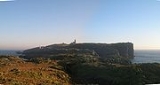
The
Isle of May is located in the north of the outer
Firth of ForthThe Firth of Forth is the estuary or firth of Scotland's River Forth, where it flows into the North Sea, between Fife to the north, and West Lothian, the City of Edinburgh and East Lothian to the south...
, approximately 8 km (5 mi) off the coast of mainland
ScotlandScotland is a country that is part of the United Kingdom. Occupying the northern third of the island of Great Britain, it shares a border with England to the south and is bounded by the North Sea to the east, the Atlantic Ocean to the north and west, and the North Channel and Irish Sea to the...
. It is 1.8 km long and less than half a kilometre wide. The island is owned and managed by
Scottish Natural HeritageScottish Natural Heritage is a Scottish public body. It is responsible for Scotland's natural heritage, especially its natural, genetic and scenic diversity. It advises the Scottish Government and acts as a government agent in the delivery of conservation designations, i.e...
as a National Nature Reserve.
Most visitors to the island are daytrippers taking the ferry from
AnstrutherAnstruther is a small town in Fife, Scotland. The two halves of Anstruther are divided by a small stream called Dreel Burn. Anstruther lies 9 miles south-southeast of St Andrews. It is the largest community on the stretch of north-shore coastline of the Firth of Forth known as the East Neuk,...
in
FifeFife is a council area and former county of Scotland. It is situated between the Firth of Tay and the Firth of Forth, with inland boundaries to Perth and Kinross and Clackmannanshire...
, although up to six visitors can stay at the observatory, usually for a week at a time. The only way to get there is by ferry, the journey taking 45 minutes from the small ports of
AnstrutherAnstruther is a small town in Fife, Scotland. The two halves of Anstruther are divided by a small stream called Dreel Burn. Anstruther lies 9 miles south-southeast of St Andrews. It is the largest community on the stretch of north-shore coastline of the Firth of Forth known as the East Neuk,...
and
CrailCrail ; ) is a former royal burgh in the East Neuk of Fife, Scotland.-History:Crail probably dates from at least as far back as the Pictish period, as the place-name includes the Pictish/Brythonic element caer, 'fort', and there is a Dark Age cross-slab preserved in the parish kirk, itself...
. The island is closed to visitors from 1 October until 1 May to prevent disturbance to the large number of seal pups. The
Scottish Seabird CentreThe Scottish Seabird Centre is a visitor attraction in North Berwick, East Lothian, Scotland. Opened by HRH The Prince of Wales in 2000 and funded by the Millennium Commission, the showpiece of the centre is the network of cameras which beam back live pictures from the bird colonies on islands such...
at
North BerwickThe Royal Burgh of North Berwick is a seaside town in East Lothian, Scotland. It is situated on the south shore of the Firth of Forth, approximately 25 miles east of Edinburgh. North Berwick became a fashionable holiday resort in the 19th century because of its two sandy bays, the East Bay and the...
has three live cameras on the island, which can be remotely controlled by visitors at the Seabird Centre, to allow close viewing of the seabird cities in spring and summer, including
puffinPuffins are any of three small species of auk in the bird genus Fratercula with a brightly coloured beak during the breeding season. These are pelagic seabirds that feed primarily by diving in the water. They breed in large colonies on coastal cliffs or offshore islands, nesting in crevices among...
s,
guillemotGuillemots is the common name for several species of seabird in the auk family . In British use, the term comprises two genera: Uria and Cepphus. In North America the Uria species are called "murres" and only the Cepphus species are called "guillemots"...
s,
razorbillThe Razorbill is colonial seabird that will only come to land in order to breed. It is the largest living member of the Auk family. This agile bird will choose only one partner for life and females will lay one egg per year. Razorbills will nest along coastal cliffs in enclosed or slightly exposed...
s,
shagThe European Shag or Common Shag is a species of cormorant. It breeds around the rocky coasts of western and southern...
s,
cormorantThe bird family Phalacrocoracidae is represented by some 40 species of cormorants and shags. Several different classifications of the family have been proposed recently, and the number of genera is disputed.- Names :...
s and
ternTerns are seabirds in the family Sternidae, previously considered a subfamily of the gull family Laridae . They form a lineage with the gulls and skimmers which in turn is related to skuas and auks...
s and the fluffy
Grey sealThe grey seal is found on both shores of the North Atlantic Ocean. It is a large seal of the family Phocidae or "true seals". It is the only species classified in the genus Halichoerus...
pups in winter, without disturbing the animals.
There are now no permanent residents, but the island was the site of a
prioryThe Isle of May Priory was a community of Benedictine monks established for 9 monks of Reading Abbey on the Isle of May in the Firth of Forth. It had been founded by 1153, under the patronage of David I of Scotland...
(St. Adrian's Priory) during the Middle Ages.
Geography and geology
The island's rock is "fine grained
basaltBasalt is a common extrusive volcanic rock. It is usually grey to black and fine-grained due to rapid cooling of lava at the surface of a planet. It may be porphyritic containing larger crystals in a fine matrix, or vesicular, or frothy scoria. Unweathered basalt is black or grey...
of a dark-grey colour with tinges of green and
greenstoneGreenschist is a general field petrologic term applied to metamorphic or altered mafic volcanic rock. The term greenstone is sometimes used to refer to greenschist but can refer to other rock types too. The green is due to abundant green chlorite, actinolite and epidote minerals that dominate the...
."
There is a peninsula in the north, known as Rona, which is almost a separate island.
History
The island's name is of disputed etymology, but is possibly of
Old NorseOld Norse is a North Germanic language that was spoken by inhabitants of Scandinavia and inhabitants of their overseas settlements during the Viking Age, until about 1300....
origin, meaning "island of seagulls". Alternatively, is a Gaelic origin from
Magh meaning a plain - most of the other islands in the Forth, such as
InchmickeryInchmickery is a small island in the Firth of Forth in Scotland. It is about a mile north of Edinburgh.Its name comes from the Scottish Gaelic, Innis nam Bhiocaire, meaning Isle of the Vicar, implying that there may have been an old ecclesiastical or Culdee settlement here, as in nearby Inchcolm...
,
InchcolmInchcolm is an island in the Firth of Forth in Scotland. Repeatedly attacked by English raiders during the Wars of Scottish Independence, it was fortified during both World Wars to defend nearby Edinburgh...
and
CraigleithCraigleith is a small island in the Firth of Forth off North Berwick in East Lothian, Scotland. Its name comes from the Scottish Gaelic Creag Lìte meaning "rock of Leith". It is 24 m at its highest point.-Geography and geology:...
have Gaelic etymologies. There are certainly names on the island from both languages, including "Tarbet" (
tairbeart, an isthmus), "St Colme's Hole" (
Colm CilleSaint Columba —also known as Colum Cille , Colm Cille , Calum Cille and Kolban or Kolbjørn —was a Gaelic Irish missionary monk who propagated Christianity among the Picts during the Early Medieval Period...
) and "Ardchattan" from Gaelic, and "Kirkhaven" which may refer a Norse original "Kirkshavn". It is also thought that the name may refer to the use of the island by the
MaeataeThe Maeatae were a confederation of tribes who lived probably beyond the Antonine Wall in Roman Britain. The historical sources are vague as to the exact region they inhabited....
as a regal burial site.
A folk etymology derives "May" from a
Lowland ScotsScots is the Germanic language variety spoken in Lowland Scotland and parts of Ulster . It is sometimes called Lowland Scots to distinguish it from Scottish Gaelic, the Celtic language variety spoken in most of the western Highlands and in the Hebrides.Since there are no universally accepted...
word meaning "maiden" and given that archaeology has shown that this was a pilgrimage and burial site from pagan into Christian times, might well refer to female priestesses. Thenaw, mother of St Kentigern is said to have floated here in an oarless coracle and some writers have suggested she may have been one of a group of Nine Maidens, or priestesses on
Traprain LawTraprain Law is a hill about 221m in elevation, located east of Haddington in East Lothian, Scotland. It is the site of an oppidum or hill fort, which covered at its maximum extent about 16 ha and must have been a veritable town...
in East Lothian.
The island was the site of one of the earliest
Christian churchThe Christian Church is the assembly or association of followers of Jesus Christ. The Greek term ἐκκλησία that in its appearances in the New Testament is usually translated as "church" basically means "assembly"...
es in Scotland, founded in the 9th century and built into an unusual mass-burial mound that probably dates from
prehistoricPrehistory is the span of time before recorded history. Prehistory can refer to the period of human existence before the availability of those written records with which recorded history begins. More broadly, it refers to all the time preceding human existence and the invention of writing...
times. Although
radiocarbon datingRadiocarbon dating is a radiometric dating method that uses the naturally occurring radioisotope carbon-14 to estimate the age of carbon-bearing materials up to about 58,000 to 62,000 years. Raw, i.e. uncalibrated, radiocarbon ages are usually reported in radiocarbon years "Before Present" ,...
of
boneBones are rigid organs that constitute part of the endoskeleton of vertebrates. They support, and protect the various organs of the body, produce red and white blood cells and store minerals. Bone tissue is a type of dense connective tissue...
s reveal them to date from the 7th century to the 10th century, remains of
Bronze AgeThe Bronze Age is a period characterized by the use of copper and its alloy bronze as the chief hard materials in the manufacture of some implements and weapons. Chronologically, it stands between the Stone Age and Iron Age...
funeral urns suggest that the mound may be older.
The current chapel on the site is dedicated to
Saint Adrian of MaySaint Adrian of May was a martyr-saint of ancient Scotland, whose cult became popular in the 14th century.-Life and martyrdom:Little is known of the life of this Scottish saint and martyr. He is held by some to have been an Irish monk and bishop, with the Gaelic name of Ethernan, who, though he...
, who was killed on the island by
DanishDenmark is a Scandinavian country in Northern Europe. The countries of Denmark and Greenland, as well as the Faroe Islands, constitute the Kingdom of Denmark . It is the southernmost of the Nordic countries, southwest of Sweden and south of Norway, and bordered to the south by Germany. Denmark...
invaders in 875.
The
Orkneyinga sagaThe Orkneyinga saga is a historical narrative of the history of the Orkney Islands, from their capture by the Norwegian king in the ninth century onwards until about 1200...
records another Viking raid, by
Sweyn AsleifssonSweyn Asleifsson was twelfth century Viking who appeared in the Orkneyinga Saga.-Early career:Sweyn was born in Caithness in the early twelfth century, to Olaf Hrolfsson and his wife Åsleik. According to the Orkneyinga Saga, he came to prominence when he murdered Earl Paul of Orkney's cup-bearer c...
, and Margad Grimsson, after they had been expelled from Orkney by Earl Rögnvald, that they went raiding on the eastern seaboard of Scotland:
- "They sailed south off Scotland until they came to Máeyar (the Isle of May). There was a monastery, the head of which was an abbot, by name, Baldwin. Swein and his men were detained there seven nights by stress of bad weather. They said they had been sent by Earl Rögnvald to the King of Scots. The monks suspected their tale, and thinking they were pirates, sent to the mainland for men. When Swein and his comrades became aware of this, they went hastily aboard their ship, after having plundered much treasure from the monastery. They went along Myrkvifjörð (the Firth of Forth), and found David
David I or Dabíd mac Maíl Choluim was a 12th-century ruler who was Prince of the Cumbrians and later King of the Scots...
, the King of Scots, in EdinburghEdinburgh is the capital city of Scotland, the second largest city in Scotland, and the eighth most populous in the United Kingdom. The City of Edinburgh Council governs one of Scotland's 32 local government council areas. The council area includes urban Edinburgh and a rural area...
. He received Swein well, and requested him to stay with him. He told the King explicitly the reason of his visit, how matters had gone between him and Earl Rögnvald before they parted, and also that they had plundered in Máeyar. Swein and Margad stayed for a while with the King of Scots, and were well treated. King David sent men to those who had been robbed by Swein, and told them to estimate their loss themselves, and then of his own money, he made good to everyone his loss" (Chapter LXXVII)
However, no abbot of the name Baldwin was recorded. There may be some conflation with St Baldred, who is connected with the nearby
Bass RockThe Bass Rock, or simply The Bass, , is an island in the outer part of the Firth of Forth in the east of Scotland. It is approximately offshore, and north-east of North Berwick. It is a steep-sided volcanic rock, at its highest point, and is home to a large colony of gannets...
, and St Baldred's Boat off
DunbarDunbar is a town in East Lothian on the southeast coast of Scotland, approximately 28 miles east of Edinburgh and 28 miles from the English Border at Berwick-upon-Tweed....
. Another possible mention of the island is under the name "Mosey". This may be a conflation with
MousaMousa is a small island in Shetland, Scotland, uninhabited since the nineteenth century. The island is known for the Broch of Mousa, an Iron Age round tower, and is designated as a Special Protection Area for storm-petrel breeding colonies.-Geography:...
(properly Mosey), since it comes close to a mention of "Moseyjarborg" (the Broch of Mousa), or a mistranscription of "Maey" in the old script. It is also suspiciously similar to the previous extract.
- "They put into Mosey, and Swein sent men to Eidinaborg (Edinburgh), to tell the King of Scots of their plunder."
The original church was expanded during the 12th century by
David I of ScotlandDavid I or Dabíd mac Maíl Choluim was a 12th-century ruler who was Prince of the Cumbrians and later King of the Scots...
, under the aegis of
Reading AbbeyReading Abbey is a large, ruined abbey in the centre of the town of Reading, in the English county of Berkshire. It was founded by Henry I in 1121 "for the salvation of my soul, and the souls of King William, my father, and of King William, my brother, and Queen Maud, my wife, and all my ancestors...
which had been founded by his
brother-in-lawA brother-in-law is the brother of one's spouse, the husband of one's sibling, or the husband of one's spouse's sibling.-See also:*Affinity *Sister-in-law*Brothers in Law , a 1955 British comedy novel...
,
Henry I of EnglandHenry I was the fourth son of William I of England. He succeeded his elder brother William II as King of England in 1100 and defeated his eldest brother, Robert Curthose, to become Duke of Normandy in 1106...
. The
monkA monk is a person who practices religious asceticism, living either alone or with any number of monks, while always maintaining some degree of physical separation from those not sharing the same purpose...
s agreed to maintain nine priests on the island to
prayPrayer is a form of religious practice that seeks to activate a volitional rapport to a deity through deliberate practice. Prayer may be either individual or communal and take place in public or in private. It may involve the use of words or song. When language is used, prayer may take the form of...
for the
soulA soul in certain spiritual, philosophical, and psychological traditions is the incorporeal essence of a person or living thing or object. Many philosophical and spiritual systems teach that humans have souls, and others teach that all living things and even inanimate objects have souls. The...
s of the Kings Of Scots.
The island, with the supposed relics of Saint Ethernan who died there in around 669, was a popular destination for
pilgrimA pilgrim is a traveler who is on a journey to a holy place. Typically, this is a physical journeying to some place of special significance to the adherent of a particular religious belief system...
s during the later
Middle AgesThe Middle Ages is a periodization of European history from the 5th century to the 15th century. The Middle Ages follows the fall of the Western Roman Empire in 476 and precedes the Early Modern Era. It is the middle period of a three-period division of Western history: Classic, Medieval and Modern...
. Evidence that it was already an important place for pilgrimage in the 12th century include the remains of a ten seater communal lavatory, much larger than necessary for an abbey with only nine or ten monks. Bishop Wishart of
St AndrewsSt Andrews is a university town and former royal burgh on the east coast of Fife in Scotland. The town is named after Saint Andrew the Apostle.St Andrews has a population of 16,680, making this the fifth largest settlement in Fife....
bought the priory in the middle of the 13th century, although there was an attempt to overturn this and the dispute rumbled on for about fifty years. The priory was finally transferred to the
CanonA canon is a priest or minister who is a member of certain bodies of the Christian clergy subject to an ecclesiastical rule ....
s of St Andrews in 1318, and was relocated at
PittenweemPittenweem is a small and secluded fishing village and civil parish tucked in the corner of Fife on the east coast of Scotland. According to the 2006 estimate, the village has a population of 1,600. At the 2001 census, the parish had a population of 1,747....
(see
Pittenweem PrioryPittenweem Priory is the name of an Augustinian priory located at the village of Pittenweem, Fife, Scotland. It was originally a Benedictine abbey founded from Reading Abbey and based on the Isle of May...
). The Prior of Pittenweem passed the island to Patrick Learmonth of
DairsieDairsie, or Osnaburgh, is a village in north-east Fife, Scotland. It is south-southwest of Leuchars Junction, and east-northeast of Cupar on the A91 Stirling to St Andrews road. The village grew out of two smaller settlements , and developed principally around the industry of weaving...
,
ProvostA provost is a senior official in a number of Christian churches.-Historical Development:The word praepositus was originally applied to any ecclesiastical ruler or dignitary...
of St Andrews in 1549.
He sold it to Balfour of Manquhany in 1551, who in turn passed it on to Forret of Fyngask seven years later, who sold it to Allan Lamont, who in turn sold it to it to John Cunningham (or Cunynghame) of Barnes (in Fife) who was responsible for the first lighthouse beacon on the island.
The so-called
"Battle" of May IslandThe Battle of May Island is the name given to the series of accidents that occurred during Operation E.C.1 in 1918.Named after the Isle of May, an island in the Firth of Forth, close by, it was a disastrous series of accidents amongst Royal Navy ships on their way from Rosyth in Scotland to fleet...
took place nearby on the night of 31 January 1918. A sequence of accidental collisions between
Royal NavyThe Royal Navy is the naval warfare service branch of the British Armed Forces. Founded in the 16th century, it is the oldest service branch and is known as the Senior Service...
warships occurred over little more than an hour which saw two submarines sunk with heavy loss of life, another four damaged along with a
light cruiserA light cruiser is a type of small- or medium-sized warship. The term is a shortening of the phrase "light armored cruiser", describing a small ship that carried armor in the same way as an armored cruiser: a protective belt and deck...
.
The Navy maintained a control centre on the island for indicator loops and six
ASDICSonar is a technique that uses sound propagation to navigate, communicate with or detect other vessels...
units laid on the
seabedThe seabed is the bottom of the ocean.- Ocean structure :Most of the oceans have a common structure, created by common physical phenomena, mainly from tectonic movement, and sediment from various sources...
to detect U-boats and enemy surface vessels trying to enter the Forth from shortly before the Second World War until 1946.
Since 1956 the isle has been dedicated as a
National Nature ReserveFor details of National nature reserves in the United Kingdom see:*National Nature Reserves in England*National Nature Reserves in Northern Ireland*National Nature Reserves in Scotland*National Nature Reserves in Wales...
and managed by the
Nature Conservancy CouncilThe Nature Conservancy Council was a United Kingdom government agency responsible for designating and managing National Nature Reserves and other nature conservation areas in Great Britain between 1973 and 1991 ....
, now
Scottish Natural HeritageScottish Natural Heritage is a Scottish public body. It is responsible for Scotland's natural heritage, especially its natural, genetic and scenic diversity. It advises the Scottish Government and acts as a government agent in the delivery of conservation designations, i.e...
, although until 1989 it was actually owned by the
Northern Lighthouse BoardThe Northern Lighthouse Board is the General Lighthouse Authority for Scotland and the Isle of Man. It is a non-departmental public body responsible for marine navigation aids around coastal areas.-History:...
.
Lighthouses
A coal-fired beacon was established in 1635 (or 1636) by James Maxwell of
InnerwickInnerwick is a coastal civil parish and small village, which lies in the east of East Lothian, from Dunbar and approximately from Edinburgh....
, and John and Alexander Cunningham, who charged shipping a tonnage-based fee. This was originally 2 Scottish
shillingThe shilling is a unit of currency used in some current and former British Commonwealth countries. The word shilling comes from scilling, an accounting term that dates back to Anglo-Saxon times where it was deemed to be the value of a cow in Kent or a sheep elsewhere. The word is thought to derive...
s per ton for Scottish
shipSince the end of the age of sail a ship has been any large buoyant marine vessel. Ships are generally distinguished from boats based on size and cargo or passenger capacity. Ships are used on lakes, seas, and rivers for a variety of activities, such as the transport of people or goods, fishing,...
s (equivalent to two pence
sterlingThe pound sterling , commonly called the pound, is the official currency of the United Kingdom, its Crown Dependencies and the British Overseas Territories of South Georgia and the South Sandwich Islands, British Antarctic Territory and Tristan da Cunha. It is subdivided into 100 pence...
) and twice this amount for non-local shipping per voyage, but was reduced to 1 shilling and sixpence, and three shillings respectively in 1639 with some shipping entirely exempt during the summer.
The beacon, the first permanently manned one in Scotland and considered at the time to be one of the best in existence, used around 400 tons of coal per year, requiring three men to look after it.
One of the three lightkeepers, his wife and five of his six children were suffocated by fumes in January 1791, the exception being a three-year-old girl who was discovered alive three days later. Ash and
clinkerClinker is a general name given to waste from industrial processes — particularly those that involve smelting metals, burning fossil fuels and using a blacksmith's forge which will usually result in a large buildup of clinker around the tuyère...
had piled up beside the 12 metres (39.4 ft) beacon tower over the previous ten years and had reached the window of keepers' room, and was set smouldering by coals falling from the beacon.
The light was sometimes hard to recognise, for example a 36-gun fifth rate captured from the French in 1780 and were wrecked near
DunbarDunbar is a town in East Lothian on the southeast coast of Scotland, approximately 28 miles east of Edinburgh and 28 miles from the English Border at Berwick-upon-Tweed....
on the night of 19 December 1810 because their navigators had mistaken a lime kiln on the mainland coast for the beacon.
The
Northern Lighthouse BoardThe Northern Lighthouse Board is the General Lighthouse Authority for Scotland and the Isle of Man. It is a non-departmental public body responsible for marine navigation aids around coastal areas.-History:...
purchased the island in 1814 from the
Duke and Duchess of PortlandWilliam Henry Cavendish Cavendish-Scott-Bentinck, 4th Duke of Portland PC, FRS, FSA , styled Marquess of Titchfield until 1809, was a British politician who served in various positions in the governments of George Canning and Lord Goderich.-Background and education:Portland was the eldest son of...
for 60,000
poundThe pound sterling , commonly called the pound, is the official currency of the United Kingdom, its Crown Dependencies and the British Overseas Territories of South Georgia and the South Sandwich Islands, British Antarctic Territory and Tristan da Cunha. It is subdivided into 100 pence...
s, by which time the beacon was the last remaining private lighthouse in Scotland. A proper
lighthouseA lighthouse is a tower, building, or other type of structure designed to emit light from a system of lamps and lenses or, in older times, from a fire, and used as an aid to navigation for maritime pilots at sea or on inland waterways....
was built on the island in 1816 by
Robert StevensonRobert Stevenson FRSE MInstCE FSAS MWS FGS FRAS FSA was a Scottish civil engineer and famed designer and builder of lighthouses.One of his finest achievements was the construction of the Bell Rock Lighthouse.-Early life:...
. and is an ornate
gothicGothic architecture is a style of architecture that flourished during the high and late medieval period. It evolved from Romanesque architecture and was succeeded by Renaissance architecture....
tower on a castellated stone building designed to resemble a
castleA castle is a type of fortified structure built in Europe and the Middle East during the Middle Ages by European nobility. Scholars debate the scope of the word castle, but usually consider it to be the private fortified residence of a lord or noble...
, 24 metres (78.7 ft) high and with accommodation for three light keepers and their families, along with additional space for visiting officials. The new lighthouse started operating on 1 September 1816, and is now a
listed building.
It was upgraded in September 1836, when a new light and refractor lens was fitted, and further extensive work took place in 1885–1886. Additional dwellings,
boilerA boiler is a closed vessel in which water or other fluid is heated. The heated or vaporized fluid exits the boiler for use in various processes or heating applications.-Materials:...
and
engineA steam engine is a heat engine that performs mechanical work using steam as its working fluid.Steam engines are external combustion engines, where the working fluid is separate from the combustion products. Non-combustion heat sources such as solar power, nuclear power or geothermal energy may be...
houses, a
workshopA workshop is a room or building which provides both the area and tools that may be required for the manufacture or repair of manufactured goods...
and a coal store were built 250 metres (273.4 yd) from the lighthouse in a small valley containing a
fresh waterFresh Water is the debut album by Australian rock and blues singer Alison McCallum, released in 1972. Rare for an Australian artist at the time, it came in a gatefold sleeve...
lochLoch is the Irish and Scottish Gaelic word for a lake or a sea inlet. It has been anglicised as lough, although this is pronounced the same way as loch. Some lochs could also be called a firth, fjord, estuary, strait or bay...
. The engine house was fitted with two steam-powered generators, at 4.5 tons each the largest ever constructed at that time, and with a total output of 8.8 kilowatts. These powered an
arc lamp"Arc lamp" or "arc light" is the general term for a class of lamps that produce light by an electric arc . The lamp consists of two electrodes, first made from carbon but typically made today of tungsten, which are separated by a gas...
in the lighthouse, with a three-wick
paraffinIn chemistry, paraffin is a term that can be used synonymously with "alkane", indicating hydrocarbons with the general formula CnH2n+2. Paraffin wax refers to a mixture of alkanes that falls within the 20 ≤ n ≤ 40 range; they are found in the solid state at room temperature and begin to enter the...
lamp kept lit but turned down in case the electric lamp failed. The new light was first used on 1 December 1886 and produced four flashes every 30 seconds.
The high cost of the coal, around 150 tons per year, along with improvements in oil lights led to the replacement with an
incandescent mantleAn incandescent gas mantle, gas mantle, or Welsbach mantle is a device for generating bright white light when heated by a flame. The name refers to its original heat source, existing gas lights, which filled the streets of Europe and North America in the late 19th century, mantle referring to the...
in 1924.
Another smaller lighthouse, the
Low Light was constructed a few hundred yards from the main light in 1843 to provide (with the main lighthouse) a pair of lights which would become aligned to help ships avoid the
North CarrThe North Carr Reef is a sandstone reef northeast of Edinburgh, on the headland between the Firth of Forth and St Andrews Bay. There have been many ships wrecked on the reef, which lies on the busy shipping lanes into the Forth ports and the River Tay.A buoy was first placed on the reef in 1809...
Rock 11 kilometres (6.8 mi) to the north of the island off
Fife NessFife Ness is a headland , forming the most eastern point in Fife. It is situated in the area of Fife known as the East Neuk, and forms the muzzle of the dog-like outline of the latter when viewed on a map....
. It was first used in April 1844, but is no longer used, having been made redundant by the establishment of the
North Carr LightshipNorth Carr is the last remaining Scottish lightship. She is in length, in beam and 250 tons.The purpose of the vessel was to warn mariners by sight, light or sound of the dangers of the North Carr rocks which are situated 1.7 miles off Fife Ness at the turning point for vessels entering...
in 1887 and the building is now used for bird watching.
In 1930 two keepers rescued four crew members of the wrecked commercial trawler
George Aunger by swimming out to it. The lighthouse became a "rock" station on 9 August 1972, meaning that the keeper's families were no longer accommodated at the lighthouse but on the mainland, and a fully automatic one on 31 March 1989 shortly before ownership of the island passed to the
Nature Conservancy CouncilThe Nature Conservancy Council was a United Kingdom government agency responsible for designating and managing National Nature Reserves and other nature conservation areas in Great Britain between 1973 and 1991 ....
. It is now monitored and controlled via a
UHFUltra-High Frequency designates the ITU Radio frequency range of electromagnetic waves between 300 MHz and 3 GHz , also known as the decimetre band or decimetre wave as the wavelengths range from one to ten decimetres...
radio link to
Fife NessFife Ness is a headland , forming the most eastern point in Fife. It is situated in the area of Fife known as the East Neuk, and forms the muzzle of the dog-like outline of the latter when viewed on a map....
Lighthouse and then by landline to the
Northern Lighthouse BoardThe Northern Lighthouse Board is the General Lighthouse Authority for Scotland and the Isle of Man. It is a non-departmental public body responsible for marine navigation aids around coastal areas.-History:...
headquarters in
EdinburghEdinburgh is the capital city of Scotland, the second largest city in Scotland, and the eighth most populous in the United Kingdom. The City of Edinburgh Council governs one of Scotland's 32 local government council areas. The council area includes urban Edinburgh and a rural area...
.
The modern light produces two white flashes every 15 seconds, and has a range of 41 kilometres (22.1 nmi) in good visibility. The fog signal, from two designated buildings at each end of the island, were powered by compressed air, generated from the island's power plant in the centre of the island, and delivered by 150 millimetres (5.9 in) cast-iron pipes laid on the ground to top up a series of air tanks located adjacent to both North and South buildings. The North horn provided a single blast of 7 seconds duration every 2.1/4 minutes and the South horn provided four 2.1/2 second blasts of the same pitch every 2.1/4 minutes. The North and South horns did not blast together, being approximately 67.1/2 seconds apart. This facility was discontinued in 1989.
Wildlife
Because it is an important breeding site for
seabirdSeabirds are birds that have adapted to life within the marine environment. While seabirds vary greatly in lifestyle, behaviour and physiology, they often exhibit striking convergent evolution, as the same environmental problems and feeding niches have resulted in similar adaptations...
s and
sealsPinnipeds or fin-footed mammals are a widely distributed and diverse group of semiaquatic marine mammals comprising the families Odobenidae , Otariidae , and Phocidae .-Overview: Pinnipeds are typically sleek-bodied and barrel-shaped...
, the island is protected as part of the Forth Islands Special Protection Area.
The visitor centre of the isle, the old Low Light lighthouse buildings, was founded as a bird observatory in 1934, the first such observatory in Scotland. During the height of the breeding season, over 200,000 seabirds of 12 species nest on the island, including
PuffinPuffins are any of three small species of auk in the bird genus Fratercula with a brightly coloured beak during the breeding season. These are pelagic seabirds that feed primarily by diving in the water. They breed in large colonies on coastal cliffs or offshore islands, nesting in crevices among...
s,
Black-legged KittiwakeThe Black-legged Kittiwake is a seabird species in the gull family Laridae.This species was first described by Linnaeus in his Systema naturae in 1758 as Larus tridactylus....
s,
RazorbillThe Razorbill is colonial seabird that will only come to land in order to breed. It is the largest living member of the Auk family. This agile bird will choose only one partner for life and females will lay one egg per year. Razorbills will nest along coastal cliffs in enclosed or slightly exposed...
s,
GuillemotGuillemots is the common name for several species of seabird in the auk family . In British use, the term comprises two genera: Uria and Cepphus. In North America the Uria species are called "murres" and only the Cepphus species are called "guillemots"...
s,
ShagThe European Shag or Common Shag is a species of cormorant. It breeds around the rocky coasts of western and southern...
s,
TernTerns are seabirds in the family Sternidae, previously considered a subfamily of the gull family Laridae . They form a lineage with the gulls and skimmers which in turn is related to skuas and auks...
s and
Eider DuckThe Common Eider, Somateria mollissima, is a large sea-duck that is distributed over the northern coasts of Europe, North America and eastern Siberia. It breeds in Arctic and some northern temperate regions, but winters somewhat farther south in temperate zones, when it can form large flocks on...
.
Further reading
- Aboard HMS May Island, Ron Morris, Save the Wemyss Ancient Caves Society 2006, ISBN 0946294402
External links